Tag: borrowing

  • Another economic crisis looms, govt is over-borrowing from local market – IEA warns

    Another economic crisis looms, govt is over-borrowing from local market – IEA warns

    The Institute of Economic Affairs (IEA) has raised concerns over the Ghanaian government’s excessive borrowing from the domestic debt market, particularly at the short end, where investor demand remains high.

    The think tank warns that this aggressive borrowing could trigger another economic crisis if not closely monitored and controlled.

    In its July-August 2024 Economic Outlook, the IEA revealed that Ghana’s domestic debt surged by GH¢32.7 billion, a 12.7% increase, from GH¢257.3 billion to GH¢290.0 billion within the year leading up to June 2024.

    In contrast, the external debt component saw only a modest rise of US$0.9 billion, or 0.3%, from US$30.1 billion to US$31.0 billion over the same period.

    While the government’s reliance on domestic borrowing is understandable—given its lack of access to the international bond market—the IEA cautioned that such borrowing must be carefully managed to avoid exacerbating the country’s debt situation.

    As of June 2024, Ghana’s total public debt reached GH¢742.0 billion, marking a year-to-date increase of GH¢133.6 billion, or 22.0%. In dollar terms, this equated to US$50.9 billion, down from US$52.2 billion at the end of December 2023, largely due to the depreciation of the cedi impacting the domestic debt component.

    Despite the surge in domestic borrowing, the debt-to-GDP ratio decreased slightly to 70.6% in June 2024, from 72.3% at the end of 2023. This was attributed to an increase in nominal GDP. However, under the International Monetary Fund’s (IMF) Economic Credit Facility (ECF) programme, Ghana’s public debt is projected to rise to 82.5% of GDP by the end of 2024, according to the IMF’s Executive Board review in June 2024.

    The IEA expressed surprise at this high projection, given that the debt restructuring efforts and fiscal consolidation under the ECF were initially expected to bring Ghana’s debt down to a sustainable level of around 56% by 2028.

    “It is not clear whether this sustainable target is still attainable,” the IEA concluded.

  • Ghana’s public debt surges by GHC46.4bn in 2 months to hit GHC658.6bn

    Ghana’s public debt surges by GHC46.4bn in 2 months to hit GHC658.6bn

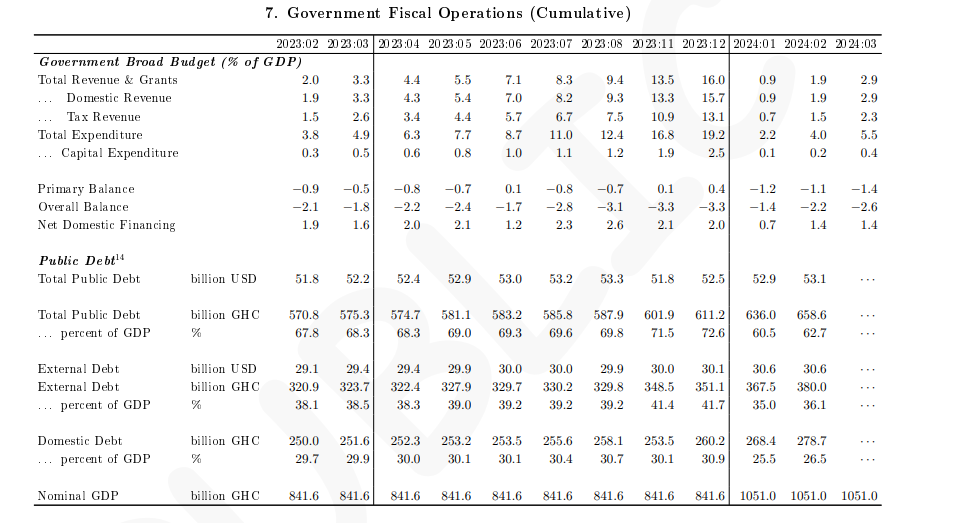
    Ghana’s public debt increased by GH¢46.4 billion in the first two months of 2024, reaching GH¢658.6 billion ($53.1 billion), according to data from the Bank of Ghana.

    This total public debt stock is equivalent to 62.7% of the country’s Gross Domestic Product (GDP).

    The Central Bank’s May 2024 Summary of Economic and Financial Data revealed that the country’s debt, which ended 2023 at GH¢611.2 billion, increased to GH¢626.0 billion in January 2024 and further to GH¢658.6 billion in February 2024.

    The rise in public debt was attributed to the cedi’s depreciation and increased government borrowing on the domestic market.

    In the first two months of 2024, domestic debt increased by GH¢18.5 billion, while external debt rose by GH¢28.9 billion, primarily due to the cedi’s depreciation.

    The Central Bank data showed that the external component of the total public debt stood at $30.6 billion (GH¢350.3 billion) in February 2024, representing 36.1% of GDP.

    Domestic debt was GH¢278.7 billion in February 2024, also about 36.1% of GDP.

    The report also indicated that the government’s fiscal operations were on target, with the deficit-to-GDP ratio standing at 2.6% in the first quarter of 2024, compared to a deficit of 1.8% of GDP during the same period the previous year.

    Additionally, the primary balance recorded a deficit of 1.4% of GDP in March 2024.

    In December 2022, Ghana halted interest payments on loans to its external creditors due to economic difficulties.

    Subsequently, the country received a Memorandum of Understanding from its bilateral creditors regarding the restructuring of a portion of the external debt.

    After successfully negotiating a deal with the bilateral creditors in January 2024, Ghana is currently in negotiations with bondholders.

  • Pay your debt on time and stop borrowing – IMF tells gov’t

    Pay your debt on time and stop borrowing – IMF tells gov’t

    The International Monetary Fund (IMF) has cautioned the Ghanaian government to strictly restrict borrowing on non-concessional terms and ensure timely debt payments.

    The Fund also suggested that the authorities should formulate and disclose a medium-term debt management strategy and an annual borrowing plan following the completion of external debt restructuring.

    In its 2023 Article IV Consultation, the IMF acknowledged the government’s commitment to the fiscal objectives of the program and its readiness to implement contingency measures if necessary.

    “Specifically, on the revenue side, some of the measures identified in our MTRS could be brought forward in case of unexpected underperformance,” the IMF added.

    On the spending side, the IMF noted that the budget allocations for Ministries, Departments, and Agencies (MDAs) would be reduced during the year if necessary.

    Despite expressing concerns, the IMF acknowledged that Ghana’s program has remained on track, with all indicative targets being met.

    “All quantitative performance criteria for the first review and almost all indicative targets and structural benchmarks were met”.

    The staff report added that Ghana is on track to reduce the fiscal primary deficit on a commitment basis by approximately 4 percentage points of Gross Domestic Product in 2023, aligning with the authorities’ commitments under the Fund-supported program.

    It further stated that spending has remained within program limits, and on the revenue side, Ghana has achieved its non-oil revenue mobilization target.

    It said sound policies and reforms should foster recovery and further reduce inflation over the medium term, adding, “downside risks include slippages in programme execution, delays in restructuring debt, and a deterioration in the external environment.”

    “The authorities have reoriented their macroeconomic policies, made progress in restructuring their debt, and initiated wide-ranging reforms,” the IMF concluded.

  • Borrowings in first half of 2023 fell by 39.1% – Central Bank

    Borrowings in first half of 2023 fell by 39.1% – Central Bank

    The Bank of Ghana has reported a contraction of total borrowing in the banking sector during the first half of the year.

    In its Monetary Policy Committee Press Release dated 24th July, 2023, the Central Bank revealed that total borrowings declined by 39.1 percent to GH¢16.0 billion compared
    with GH¢26.4 billion a year earlier.

    Total deposits on the other hand, grew significantly by 42.8 percent to GH¢187.6 billion in June 2023.

    In the period under review last year, total deposits grew to GH¢131.3 billion, representing 19.1 percent growth.

    The banking sector’s total assets as at June 2023 was GH¢242.4 billion, showing a moderation in growth of 21.2 percent from 22.8 percent in June 2022.

    According to the Bank of Ghana, data submitted by banks for the first half of 2023 reflected the lingering effects of the Domestic Debt Exchange Programme (DDEP), notwithstanding the strong rebound in profitability following significant losses incurred at year end 2022 on account of impairments of holdings in government of Ghana bonds.

    Meanwhile, the banking industry’s investments increased sharply, supported by significant growth in deposits.

    Total investments rose to GH¢89.9 billion in June 2023 from GH¢ 81.0 billion in June 2022, made up of short-term investments which grew by 149.6 percent to GH¢39.9 billion, from GH¢15.9 billion last year, while medium-to-long term investments declined to GH¢50.1 billion from GH¢65.0 billion, as a result of portfolio rebalancing following the DDEP.

    Source: The Independent Ghana

  • Government borrowing to give tax cuts to the wealthy says labour

    Chancellor Kwasi Kwarteng is accused of squandering a chance to lay out a “real response to the cost of living problem” by Labour’s Shadow Chancellor Rachel Reeves in the opening of her keynote address at the Labour Party’s Annual Conference in Liverpool.

    “What did we get instead?” she asks. “Tax cuts for the top 1%, increased bankers bonuses, and more than £50bn piled onto the national debt every single year.

    “Sterling is down, that means higher prices as the cost of imports rise,” she says.

    She adds that with the cost of government borrowing up, taxpayers’ money will go into paying off debt.

    “The cost of borrowing for working people will now go up too,” with higher mortgage repayments for families, she says.

    “And all for what? Not to invest in industries of the future, not for our NHS, not for schools, but for tax cuts for the wealthiest, a return to trickle-down economics.”