Tag: BRICS

  • What to know about BRICS and its growing clout

    What to know about BRICS and its growing clout

    The BRICS group of emerging-market powers — the acronym stands for Brazil, Russia, India, China and South Africa — has gone from a slogan dreamed up at an investment bank two decades ago to a real-world club that controls a multilateral lender.

    Comprising 10 member states, it pairs several major energy producers with some of the biggest consumers among developing countries.

    The group has been increasing its ranks, enhancing its economic clout in a US-dominated world.

    Who are the new members of BRICS?

    The bloc expanded in early 2024 to include Iran, the United Arab Emirates, Ethiopia and Egypt. Saudi Arabia was also announced as a new member, though the kingdom has yet to take a final decision on whether to join.

    Argentinian President Javier Milei, who took office in December 2023 and is steering his country’s geopolitical alignment toward the US and away from China and Brazil, declined a membership invitation.

    In November 2024, Turkey said it had been granted “partner-country status,” short of its expectation that it would gain full admission. A number of other countries have also been offered such second-tier membership, which would come without voting rights.

    The group agreed by consensus to admit Indonesia in January 2025, according to Brazil’s government. Nations still seeking to join include Malaysia and Thailand.

    What is the impetus for expansion?

    The push has been driven largely by China, now the world’s pre-eminent industrial power, which is trying to boost its global clout.

    South Africa and Russia have backed the expansion. India was initially hesitant because it was concerned that a bigger BRICS would transform the group into a mouthpiece for China, while Brazil was worried about alienating the West — although both eventually agreed to an enlargement.

    For new members, BRICS offers the potential for easier access to financing from its wealthier members, and a political venue independent of Washington’s influence.

    What does a larger BRICS mean for the world?

    The addition of major fossil-fuel producers may give the bloc more scope to challenge the dollar’s dominance in oil and gas trading by switching to other currencies, a concept referred to as dedollarization.

    That prospect has drawn the ire of US President-elect Donald Trump, who said any nation that abandons the greenback can forget about selling anything to America and find another “sucker” to trade with.

    Analysts at Bloomberg Economics say the expansion of BRICS is “more about politics and less about economics.” Beijing is trying to build an alternative world order by pulling southern hemisphere countries into its economic orbit in a challenge to US hegemony.

    The enlarged alliance may become a stronger counterweight to the Group of Seven industrialized nations — the US, Canada, France, Germany, Italy, Japan and the UK. Russian President Vladimir Putin, isolated by the US and its allies over his war in Ukraine, is also keen to see Washington’s global influence recede.

    Other groupings that are already promoting a move toward a more “multipolar” world — and away from the post-Cold War dominance of the US — include OPEC, the Shanghai Cooperation Organization, the Southern Common Market (Mercosur), and the African Union.

    What does BRICS do?

    The biggest achievements of the group have been financial. The countries agreed to pool $100 billion of foreign-currency reserves, which they can lend to each other during emergencies.

    That liquidity facility became operational in 2016. They also founded the New Development Bank, a World Bank-inspired lending institution that has approved almost $33 billion of loans since it began operations in 2015, mainly for water, transport and other infrastructure projects.

    By comparison, the World Bank committed $117.5 billion to partner countries in fiscal 2024.

    How did BRICS get started?

    “BRIC” was coined in 2001 by economist Jim O’Neill, then at Goldman Sachs Group Inc., to draw attention to strong economic growth rates in Brazil, Russia, India and China. The term was intended as an optimistic scenario for investors amid market pessimism following the terrorist attacks in the US on Sept. 11 that year. The four nations took the concept and ran with it.

    Their rapid growth at the time meant they had shared interests and challenges, and combining their voices could increase their influence.

    The first meeting of BRIC foreign ministers was organized by Russia on the sidelines of the United Nations General Assembly in 2006.

    The group held its first leaders’ summit in 2009. South Africa was invited to join in 2010, adding another continent and the letter “S.”

    Who’s in charge?

    For most of the time BRICS has existed, China’s gross domestic product has been more than twice the combined economic output of the four other members prior to the expansion.

    In theory, that should give it the most sway. In practice, India, which recently surpassed China in population, has been a counterweight.

    BRICS didn’t formally endorse China’s big push to build infrastructure abroad, called the Belt and Road Initiative. That’s partly because India objected to such projects in disputed territory held by Pakistan, its neighbor and archrival.

    The New Development Bank has no dominant shareholder: Beijing agreed to the equal holdings for each member advocated by New Delhi.

    The bank is headquartered in Shanghai, but has been led by an Indian and two Brazilians, most recently former President Dilma Rousseff.

    Did Russia’s invasion of Ukraine affect the group?

    The other BRICS countries have adopted a broadly neutral stance toward the war, viewing it as more of a regional issue than a global crisis. However, the war changed Russia’s relations with BRICS institutions.

    The New Development Bank quickly froze Russian projects, and Moscow hasn’t been able to access dollars via the BRICS shared foreign-currency system.

    Essentially, with US sanctions piling up, other BRICS countries prioritized ongoing access to the dollar-based financial system over helping Russia.

    Moscow has proposed changes to cross-border payments between BRICS countries, a system that would circumvent the global financial system and help sanction-proof its own economy.

    The alternatives include developing a network of commercial banks that can conduct such transactions in local currencies as well as establishing direct links between central banks, a report prepared by the Russian Finance Ministry, the Bank of Russia and Moscow-based consultancy Yakov & Partners shows. It also envisions the creation of centers for mutual trade in oil, gas, grain, gold and other commodities.

    Are investors still interested in BRICS?

    There’s still interest in emerging markets. But BRICS is largely irrelevant as an investment theme today due to geopolitical changes and the members’ different economic trajectories. US-led sanctions have put Russia off limits for most foreign investors, and some sectors in China — especially technology companies — have also been sanctioned or face potential investment bans.

    China also is a maturing economy, increasingly separated from other emerging markets and facing a structural slowdown. Brazil’s economy slowed markedly following the end of a global commodity boom about a decade ago.

    South Africa’s economy has been hamstrung by rolling power blackouts and logistics snarls, although it’s recently made some tentative progress in tackling those problems.

    India is still a growth story that investment banks compare with China 10 or 15 years ago, though it’s unclear if it can follow China’s manufacturing-led model.

    Source: Bloomberg.com

  • China benefits greatly from BRICS expansion – Steve Tsang

    China benefits greatly from BRICS expansion – Steve Tsang

    The gathering of BRICS country leaders in Johannesburg last week depicted China’s efforts in establishing a fresh global arrangement through their united photo session.

    At the front and center was Xi Jinping, the strong leader of China. He stood on a stage with leaders from developing countries in Africa, Asia, and Latin America.

    The summit was the biggest meeting ever for the BRICS countries. More than 60 countries came to the meeting, including the member nations Brazil, Russia, India, China, and South Africa.

    Next to the BRICS leaders, there were also leaders from Argentina, Ethiopia, Iran, Saudi Arabia, Egypt, and the United Arab Emirates, who were recently invited to join the club.

    This is a big win for Xi, who wanted to make the group bigger and more influential. Even though some members like India and Brazil had doubts, he was able to make it happen.

    The group is getting bigger and it will have more than twice as many members as before. This will make the group have a bigger influence around the world, especially in the Middle East.

    “China is the obvious winner,” said Steve Tsang, who is the director of the SOAS China Institute at the University of London. “Adding six new members is a big step in the way it wants to go. ”

    Beijing and Moscow want to expand their economic group to be a powerful force against the West and Western organizations like the G7.

    That goal has become more important in the past year because China and the United States are in a growing rivalry, and the Ukraine war has also caused China to become more distant from the Western countries because of its support for Moscow.

    The BRICS expansion and the long waiting list to join show that many countries in the Global South are interested in Xi’s offer of a different world order. These countries feel left out in the current international system, which they believe is controlled by the US and its wealthy allies.

    The BRICS leaders want emerging markets and developing countries to have more power and influence in international organizations like the United Nations, the IMF, and the World Bank.

    Xi, who criticized the dominance of the US in his speeches at the summit, expressed positive feelings about the expansion, calling it a significant moment and the beginning of a new phase for cooperation among BRICS countries.

    Happymon Jacob, a professor who studies international affairs at Jawaharlal Nehru University in New Delhi, said that the expansion shows a change in global political borders.

    He said that if China becomes a leader in non-Western forums and the Global South, they will be able to challenge the US and the world order that is controlled by the US.

    BRICS group, which consists of five countries (Brazil, Russia, India, China, and South Africa), has invited six other nations, including Iran and Saudi Arabia, to become members.

    However, if more countries join BRICS, it may become less unified and less organized. This is because the current members of BRICS already have significant differences in their political systems, economic strength, and diplomatic objectives.

    “I have doubts about how well the organization will work after it expands, and whether the expansion will actually make a significant impact,” said Yun Sun, who leads the China program at the Stimson Center in Washington.

    The bigger the group, the more different interests the organization has to deal with and make everyone happy.

    This is especially true for a group like BRICS, where decisions are only made if everyone agrees.

    The new employees are a slightly different and varied group. There are two economies that are facing a lot of difficulties. Argentina has a history of not being able to pay back its debts and has faced problems with high prices and money issues. It borrows the most money from the IMF. Egypt has financial problems of its own, and it owes a lot of money to the International Monetary Fund (IMF), which is an organization that provides financial assistance to countries.

    Ethiopia, a country in Africa with a lot of people, used to have a strong economy but is now suffering a lot because of a civil war that happened in the Tigray region. The war lasted for two years and ended in December. During the war, many people’s rights were violated.

    The bigger group will also have three of the biggest countries that sell a lot of oil: Saudi Arabia, the UAE, and Iran.

    In simpler words, both countries used to be very close friends with America, but now they are getting even closer to China. China has been increasing its presence in the area because it seems like the US isn’t as involved anymore.

    Iran and Saudi Arabia are enemies who have been fighting each other for a long time. However, this year they made an agreement with the help of China to start talking to each other again.

    This is very different from a more united group like the G7, which is made up of democracies that think similarly and have big developed economies.

    Helena Legarda, a top analyst at the Mercator Institute for China Studies in Berlin, said it is not clear how much the BRICS expansion will raise the worth and power of the group.

    If BRICS doesn’t have a common belief and a clear main objective, it is possible that adding six new members will make the group more split or divided.

    One big issue is that China and Russia are against the United States, and now Iran has joined them, making their agenda even stronger.

    India and Brazil are worried that the bloc could become too against the West and controlled by China. Some of the new members may also have doubts about this.

    Even though China has specific goals for the group, many other developing and emerging economies do not view BRICS as only about politics. She said that they are also driven by the chance to make money and get special advantages in the Chinese and other markets.

    However, China is currently facing economic difficulties within its own country. These difficulties include a worsening situation with their real estate market, increasing debt among local governments, a high number of unemployed young people, and a population that is growing older. A lot of economists think that the world’s second largest economy is going to start growing much more slowly. This could have a big effect on the economy of the whole world.

    The BRICS expansion may cause more competition and disagreements between China and India. China and India already have strained relations due to an ongoing border conflict.

    Jacob in New Delhi said that the competition between China and India for leadership of the Global South is going to intensify even more, with China having a clear advantage.

    India has good relationships with the new BRICS members. However, China has lots of money and power which allows them to have more influence in the Middle East and in the institution compared to India.

    Sun, from the Stimson Center, said that because of the rivalry and tensions between China and India, as well as between Iran and Saudi Arabia, there will not be many important issues that they can agree on and work together on.

    The expansion gives the impression that there is a larger group of countries working together against the West, but just having more countries in the group does not necessarily mean they will be more effective.

  • Putin finally speaks out about Wagner plane accident

    Putin finally speaks out about Wagner plane accident

    The leader of the Wagner group, Yevgeny Prigozhin, who died in a plane crash near Moscow, was mentioned by Vladimir Putin for the first time.

    It took the Russian president a whole day to speak up about the incident where the person who led a rebellion against him was killed.

    Officials have confirmed that all 10 individuals aboard the private jet perished when it crashed to the ground yesterday. Among the passengers were the leader and his closest associate Dmitry Utkin.

    During a TV meeting at the Kremlin, Putin said he was informed about the crash only this morning.

    The leader of the war expressed sadness for the families of the seven passengers and three crew members on the plane.

    He praised the mercenary chief and called him a skilled businessman. He has known him since the 1990s.

    Putin said that he had known Prigozhin for a long time, since the early 1990s. He was someone who had a difficult past.

    He was very skilled and successful in business. He not only worked in our country and did well, but he also worked in other countries, especially in Africa.

    Putin said that Prigozhin made a lot of mistakes in his life, but he still accomplished what was needed, possibly referring to the war in Ukraine and Wagner’s actions in Bakhmut.

    ‘The president said that he made big mistakes in his life and he achieved the expected outcomes, both for himself and for the common cause, when I asked him, in the past few months. ‘

    He worked with oil, gas, valuable metals, and stones at that place. He came back from Africa just yesterday. He saw some important people here.

    Russian state media did not talk much about the crash. Instead, they focused on what Putin said at the BRICS summit in Johannesburg through a video link, and the invasion of Ukraine by Russia.

    At the moment, the police have blocked off the area where the airplane crashed in the village called Kuzhenkino. This village is about 185 miles northwest of the capital city.

  • Modi and Xi Jinping meet to ‘intensify efforts’ to defuse border dispute

    Modi and Xi Jinping meet to ‘intensify efforts’ to defuse border dispute

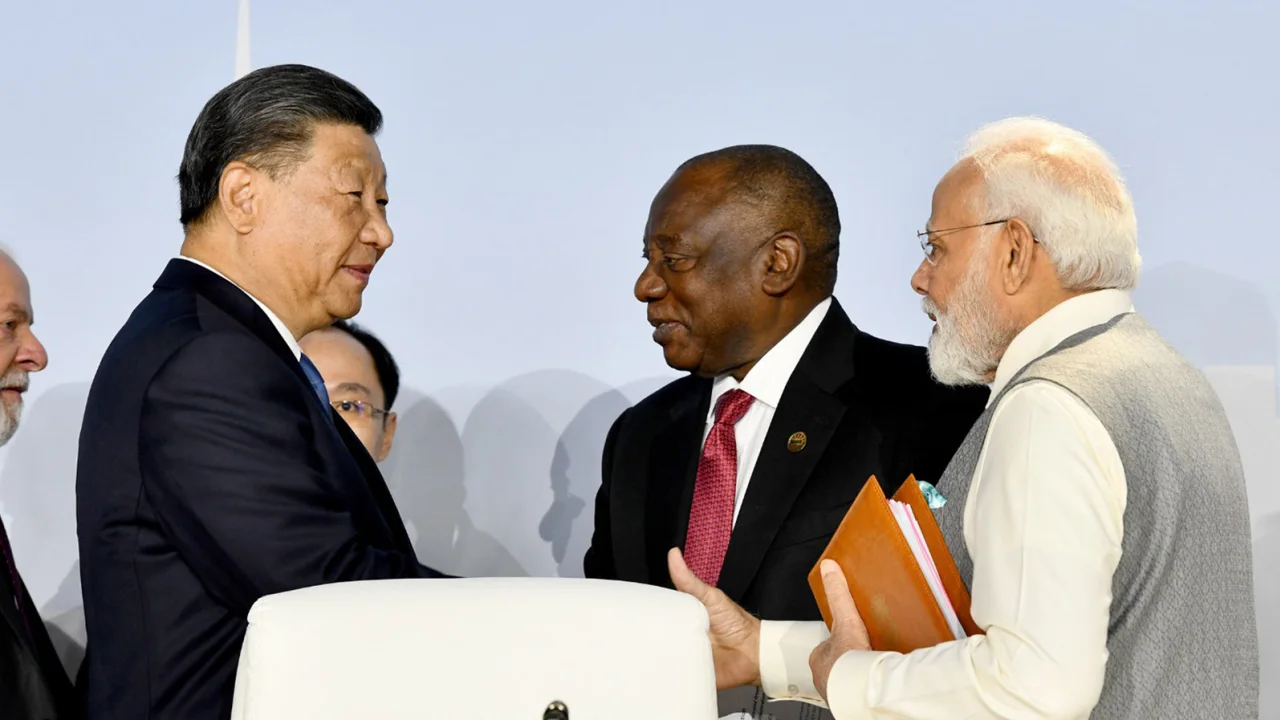
    Indian Prime Minister Narendra Modi and Chinese leader Xi Jinping convened face-to-face to address the de-escalation of tensions along their contested border. It is a crucial encounter as the two countries have not engaged in face-to-face discussions since a lethal confrontation three years back. They reached a consensus to exert significant efforts in order to pacify the situation.

    Modi and Xi have arrived in Johannesburg to attend a BRICS gathering.They talked on the side of the summit. On Thursday, India’s Foreign Secretary, Vinay Kwatra, informed reporters of this statement.The day before, the Chinese leader missed an important event. It is unusual for the leaders of India and China, both of which have the highest populations globally, to have personal meetings.

    The argument over the border has caused tension between New Delhi and Beijing for a long time. This argument led to a war in 1962, which China won. In the years following that, a poorly defined unofficial border called the Line of Actual Control (LAC) has divided the two countries with nuclear capabilities.

    Modi emphasized the importance of keeping peace and tranquility in the border areas and following the Line of Actual Control (LAC). This is crucial for improving the relationship between India and China.

    On Friday, China’s Ministry of Foreign Affairs said that the two leaders had an open and detailed discussion about the current relationship between China and India, along with other topics.

    The text means that President Xi said it is important to make China and India’s relationship better,because it is good for both countries and their people. Both sides need to consider the overall benefits of their relationship and manage the border issue carefully to protect peace and calmness in the border area together.

    The two countries, India and China, will have a meeting to try and improve their difficult relationship. This meeting is following their 19th round of talks to solve their border problem.

    India’s Ministry of External Affairs said that both sides had a good and detailed discussion on resolving the remaining issues on the border in the Western Sector.

    Modi and Xi went to a meeting called the Shanghai Cooperation Organization (SCO) in Uzbekistan in September last year. They were both there, but they didn’t talk to each other about important matters. They spokes hortly a few weeks later during the sidelines of the G20leaders’ meeting in Bali, Indonesia.

    The relationship between the two countries became worse after a fight in Aksai Chin-Ladakh in 2020. It got even worse last December when soldiers from both sides got into a fight in the Tawang sector of Arunachal Pradesh,causing minor injuries.

    In April, the defense minister of India told the defense minister of China that when their shared border is crossed, it weakens the foundation of their relationship.

    India has implemented multiple measures in response to the 2020 clash, aiming to counter the threats posed by China. Popular Chinese apps like TikTok and others have been banned, as authorities assert that these apps undermine their authority and solidarity.Moreover, they have taken steps to stop Chinese telecommunication companies like Huawei and ZTE from offering their 5G network.

    Recently, there has been an increase in restrictions on journalists in both nations, resulting in a limited number of approved reporters in each other’s regions.

    New Delhi expresses concern over Beijing’s increasing assertiveness as both countries prioritize their individual interests.Because of this, India has built a stronger relationship with the United States. They are part of a group called the Quad, along with Japan and Australia, which is seen as a way to balance China’s influence.

    China opted not to participate in a tourism conference held in the region of Jammu and Kashmir, which was orchestrated by India.They said that they do not agree with having any G20 meetings in disputed territory. Both India and Pakistan say that the Kashmir region belongs to them.
    India’s choice to hold this year’s SCO online meant that Modi and Xi couldn’t meet in person. Xi is also likely to go to the G20 leaders’ meeting in New Delhi next month.

  • Xi of China visits South Africa for the second time this year while dealing with domestic economic problems

    Xi of China visits South Africa for the second time this year while dealing with domestic economic problems

    The Chinese president, Xi Jinping, will travel to South Africa on Monday in an effort to increase Beijing’s influence among rising and developing countries while relations with the United States remain extremely tense and domestic economic problems continue to grow.

    A stark contrast to his globe-trotting days of diplomacy prior to the coronavirus outbreak is the three-day state visit, which also includes a summit with the leaders of the BRICS rising economies.

    The last time the Chinese leader travelled outside of the nation was in March to meet with his “dear friend” Vladimir Putin in Moscow. There, the two authoritarian strongmen renewed their strategic alliance against the US and outlined their plans for a post-Western world order.

    The BRICS grouping’s first in-person summit since the outbreak will give Xi another chance to pursue that ambition.

    More than 40% of the world’s population resides in the countries that make up the bloc: Brazil, Russia, India, China, and South Africa. They both want a more multipolar world and more influence over international affairs.

    “Xi Jinping is not attempting to subvert the US’s dominance of the current liberal international order. His long-term objective is to transform the global order into one that is Sino-centric, according to Steve Tsang, head of the University of London’s SOAS China Institute.

    Tsang stated that in order to achieve this goal, “it makes sense for China to engage with the Global South, (which is) much more numerous than Western democracies and mostly authoritarian in its governance structure.”

    Chen Xiaodong, China’s ambassador to South Africa, praised BRICS as “the backbone of international fairness and justice” and “an important platform for cooperation among emerging and developing nations” ahead of Xi’s arrival on Friday.

    The established structure of global governance looks to be dysfunctional, unable to function, and nonexistent. The BRICS will soon “play a leading role in the international community,” Chen told reporters.

    A few days ago, US President Joe Biden met with the leaders of Japan and South Korea in a show of power and unity against the growing dangers from China. Now, Xi is travelling to South Africa.

    The US and its two closest allies in Asia strengthened their military and economic ties during the Camp Davis meeting, and China was criticised for its “dangerous and aggressive behaviour” in the South China Sea.

    According to Paul Nantulya, a research associate at the Africa Centre for Strategic Studies, the BRICS have gained increased strategic significance to Beijing as China and the United States are embroiled in an increasingly bitter rivalry.

    Vladimir Putin won’t be present in person, so Xi will be the focus of the BRICS summit, he claimed.

    Putin, who is wanted internationally for allegedly committing war crimes in Ukraine, will participate by video from Russia.

    “Another multilateral platform through which China can exert influence around the world, especially in the Global South,” was how Nantulya characterised BRICS.

    But Xi, who is ten months into his historic third term, is also facing a number of domestic difficulties at the time of the summit.

    The long-awaited economic recovery of China following its strict Covid lockdowns is struggling. Instead, a slew of issues, including a growing real estate crisis, rising local government debt, and deflationary pressure, plague the second-largest economy in the world.

    The youth unemployment rate in the nation, which just reached back-to-back records highs, is so severe that the Chinese government has stopped disseminating data on it entirely.

    Hear how other nations may be harmed and helped by China’s economic decline.

    According to Yun Sun, director of the China programme at the Washington-based Stimson Centre think tank, Xi’s diplomatic charm offensive is severely hampered by the faltering economy, particularly in the Global South.

    “When Xi travels to underdeveloped nations, it’s customary for China to offer sizable aid, financing, and collaboration packages. But Beijing is no longer as prepared to do that given the situation of the Chinese economy, she said.

    His ability to portray the great power leader he once was is limited by the economy.

    The populace in China has grown considerably more wary of their government’s extravagant expenditures abroad.

    Xi’s premier international infrastructure initiative, the Belt and Road Initiative, has received a lot of criticism on Chinese social media, according to Nantulya.

    “Chinese citizens are wondering why China is investing so much money abroad when there are so many issues at home.”

    According to Nantulya, the Chinese government has become considerably more picky about which international projects it funds as a result of the economy’s slowdown.

    Xi’s journey to Africa is his first in five years.

    His most recent trip to the continent, which coincided with the BRICS conference in South Africa, included a flurry of stops in Senegal, Rwanda, and Mauritius, covering nearly the whole Sub-Saharan region.

    Beijing has not yet confirmed Xi’s further stops this time.

    On the margins of the BRICS meeting, the Chinese leader will co-chair the China-Africa Leaders’ Dialogue with his South African counterpart, Cyril Ramaphosa, according to China’s Foreign Ministry.

    The conference has received invitations from 69 nations overall, including all African governments.