The Vice-President in charge of research at the IMANI Centre for Policy and Education, Bright Simons, has expressed profound concern regarding what he perceives as alarming wastefulness within Ghana’s political system.
Addressing the X platform, Simons illuminated a critical aspect of governance that he believes urgently requires attention and reform.
One specific issue highlighted by Mr Simons is the recent controversy surrounding the adoption of a new electoral register.
“The WASTEFULNESS of the political system in Ghana FRIGHTENS me! Many didn’t pay attention, but when IMANI opposed the new electoral register, our main reason was that the EC intended to trash thousands of devices in good condition. No one cared,” he wrote.
Despite objections from the advocacy group IMANI, which raised concerns about the unnecessary disposal of thousands of functional devices by the Electoral Commission (EC), Mr Simons expressed dismay at the apparent lack of public outcry over the matter.
A recent report by IMANI revealed that the Electoral Commission (EC) intends to discard a system valued at $60 million, with at least $40 million of value accumulated since 2016 alone.
According to the group, the implementation of this new biometric system is estimated to cost $150 million (plus contingency).
IMANI’s report suggests that a careful analysis of best practices in procuring biometric technology for elections in Africa indicates that the EC’s proposed spending plans are inflated by about 60 per cent.
They argued that the EC’s proposed system is disproportionately expensive compared to similar systems in other African countries.
1/ The WASTEFULNESS of the political system in Ghana FRIGHTENS me! Many didn't pay attention, but when IMANI opposed the new electoral register, our main reason was that the EC intended to trash thousands of devices in good condition. No one cared. https://t.co/vGEIvtkd3x
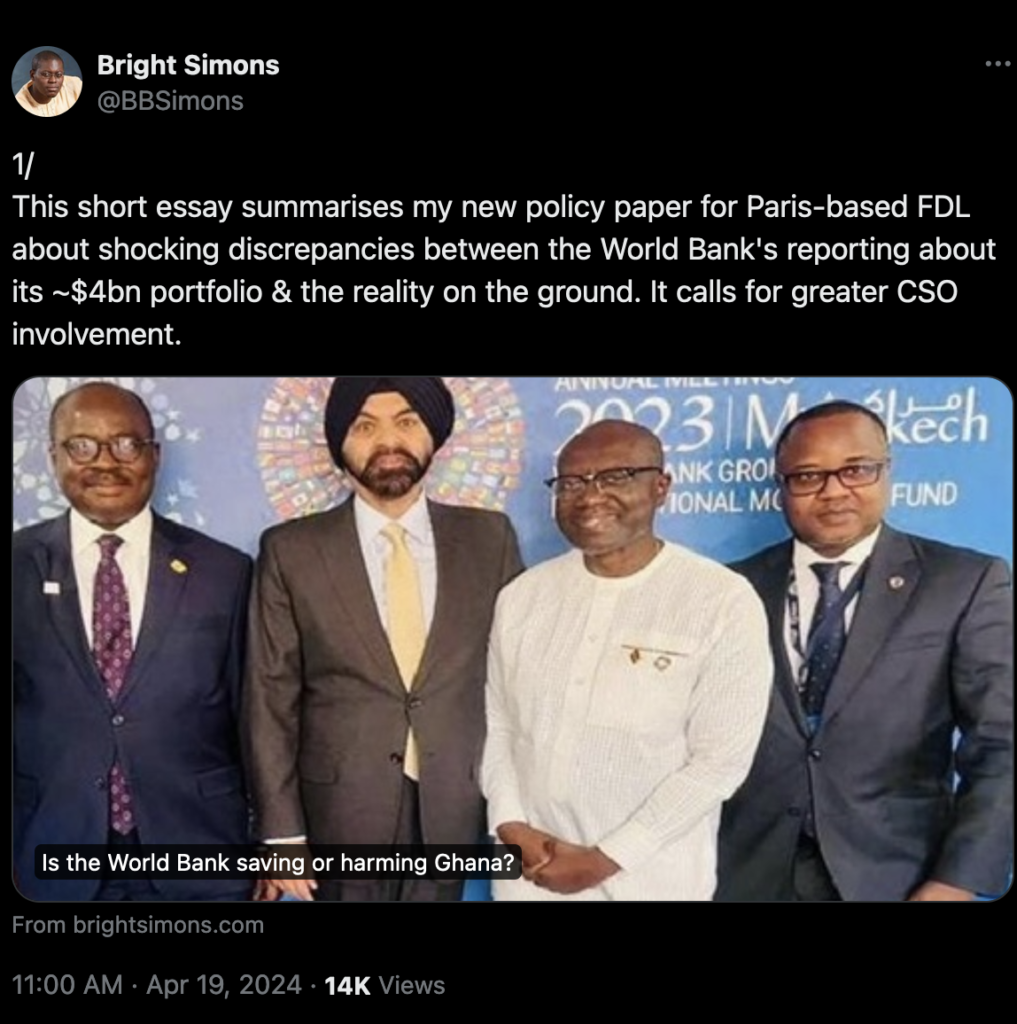
Vice President at policy think tank IMANI Africa, Bright Simons has raised alarming concerns about the World Bank’s operations in Ghana.
In a recent tweet, Mr Simons cast a spotlight on the alleged discrepancies between the World Bank’s portrayal of its projects in Ghana citing his policy paper for the Paris-based Finance for Development Lab (FDL) as a point of reference, revealing a gap between the World Bank’s reports and the lived experiences of Ghanaians.
Simons’ investigation into the World Bank’s nearly $4 billion portfolio in Ghana shows that the reported outcomes are often at odds with reality, with a deviation occurring approximately 70% of the time. This alarming statistic raises questions about the effectiveness of the World Bank’s efforts in the country.
The paper scrutinizes several projects, including the Ghana Energy Development & Access Program (GEDAP) and the e-Ghana/e-Transform initiatives.
Despite high disbursement rates and positive ratings, these programs have not delivered the promised improvements. For example, the GEDAP aimed to reduce losses for the Electricity Company of Ghana (ECG) but instead saw an increase in losses and fines for non-compliance with regulatory directives.
Similarly, the e-Ghana project, which sought to digitize various government services, has been plagued by inefficiencies and bypassing of systems.
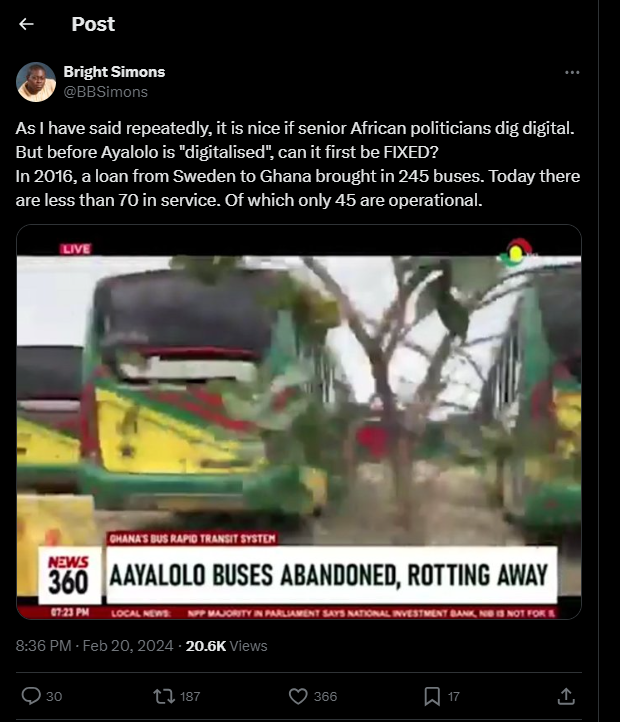
A screenshot of Bright Simons’ post on X
The Government Integrated Financial Management Information System (GIFMIS), despite being praised as a major accomplishment, was largely ignored, with over 86% of government payments circumventing the system.
The e-Procurement module, launched to cut government procurement costs, was found to be ineffective, with most tenders posted for negligible amounts and many lacking award amounts, undermining the goal of a transparent e-procurement platform.
Simons’ findings suggest that the World Bank’s focus on disbursement rates does not necessarily lead to positive social outcomes.
He points out that Ghana’s growth model has led to an increase in poverty and inequality, contrasting with countries like Kenya, which have seen improvements in these areas.
The paper concludes with a call for greater involvement of domestic activists and the establishment of “community rating agencies” to ensure that development finance leads to real social impact.
Such agencies could provide not just information but also political pressure to correct project execution issues proactively or preemptively, potentially avoiding the neocolonialist implications often associated with World Bank and IMF conditionality.
Simons’ revelations suggest a need for a fundamental reevaluation of the World Bank’s approach to development finance, particularly in how it measures and reports on the success of its projects.
As the Spring Meeting and its panoply of side events wind to a close, the recurring theme yet again is “more money” for the world’s poor. A point made with refreshing clarity by the World Bank’s President: “no amount of creative financial engineering will compensate for the fact that we just need more funding.”
There is always much talk and jargon about “reform” of the “global development finance architecture” but it really all boils down to convincing richer folks in the “Global North” to release more cash to relatively poorer folks in the “Global South”.
That convincing has had many ups and downs. Whilst the World Bank has celebrated the replenishment of its grants and soft loans pot, the IDA, in 2021 as the biggest ever in history, and is looking forward to an even bigger inflow for the next replenishment cycle (which will be known as IDA21), development activists at the global level point to the massive gap between the $5 billion more per year the Bank committed to spend recently and the trillions of dollars experts say are needed to align needs in the developing world with the climate and resilience agenda ($4 trillion, says the UN).
For those of us whose activism mostly focuses on the country level, though, we sense a major gap in the global discourse: when the likes of the World Bank get more money, that doesn’t necessarily translate to bigger and better investments in developing countries. Various factors much closer to home than in Washington appear to conspire and create a “constriction” in the flow of allocated money. Attempts to clear up the pipe and speed up “disbursements” of the money, on the other hand, can lead to a deterioration in the quality of development projects and compromise the impact on people’s lives.
To examine this idea carefully in Ghana, the prime focus of my own policy activism, I have been painstakingly probing the outcomes of the World Bank’s investments there over the last two decades for a paper that has just been published by Paris-based Finance for Development Lab (FDL).
I conclude that the results presented by the World Bank’s reports on these investments substantially deviate from the reality on the ground about 70% of the time.
This analysis excludes certain investments made through the IFC, the World Bank’s private sector arm, or the guarantees issued by the World Bank’s MIGA, even though there are other reasons to be concerned about the IFC’s growing penchant for prioritizing malls and luxurious apartment complexes over social enterprises.
The “Disbursement” Bogey
In the early 2010s, the World Bank was struggling to disburse the funds it had allocated/committed to Ghana. The disbursement rate was languishing around 10%. In the ensuing years, efforts were made to considerably boost disbursements. Today, the global Bank’s ~$4 billion Ghana portfolio has an average disbursement rate higher than 48%.
I have selected a few case studies discussed in the FDL paper mentioned above based on their stellar ratings by World Bank staff. The idea being that if these are among the best projects from a disbursement and outcomes perspective, then there is even greater concern about the rest of the portfolio.
Ghana Energy Development & Access Program/Energy Sector Reform Program
In 2007, the World Bank launched a $220 million project called GEDAP. One of its major aims was to transform the Electricity Company of Ghana (ECG). From 2010 onwards, the World Bank has expanded the scope and ticket of GEDAP to double down on the intervention. Having started with a $70 million investment, an extra $60 million soon followed. In GEDAP assessments, the World Bank touts progress in lowering ECG’s commercial losses and assures evaluators that progress on improving bill collections, especially for power consumed by government entities, is imminent.
An enhanced effort, the Energy Sector Recovery Program, launched in 2019, with even higher focus on persistent ECG arrears accumulation and value chain debt. Boasting 88% disbursement rates and a “moderately satisfactory” rating, one might easily assume that these interventions have made a significant difference to ECG’s operational situation.
According to the World Bank’s official assessment of the results of these investments, a $55 million injection to upgrade billing and revenue protection, a “Commercial Management System”, and “Advanced Metering Infrastructure”, have been critical to salvaging ECG’s finances. For example, a provision was made in the program for 156,000 smart retail-level meters and 25,000 bulk meters to support revenue management. A timeline of January 2020 for all these powerful measures to bear fruit was indicated in the official project update.
Unfortunately, the facts on the ground, amply attested to by Ghana’s Auditor General and the ongoing rolling blackouts in Ghana today, do not bear out these assessments. Official audit data shows that ECG procured smart meters costing more than $145 million without competitive tender, contrary to its own procurement policies. Consequently, Ghana’s Auditor General failed the entire exercise on Value for Money grounds. Some contractors failed to perform on contracts, and the frustratingly long waiting times for securing a meter have not improved. ECG’s losses have actually increased since GEDAP commenced, to an average of about 30% over the project horizon. Taking full account of collection failures, the loss ratio actually exceeds 50% in some quarters. Very recently, ECG’s regulators fined the company’s board members millions of Ghana Cedis out of frustration with the company’s persistent flouting of regulatory directives.
e-Ghana/e-Transform
The e-Ghana project began in 2006, was reviewed when the new government assumed office in 2010, and wrapped up in 2014, whereupon a follow-up digitalisation program, e-Transform, was put together to carry forward the broad vision of ICT-driven development in Ghana. Besides the World Bank, the EU chipped in, as also did the British and Danish governments (about 40% of the ~$60 million ticket).
When the government changed again in 2017, the usual review occurred. The digital ID component was dropped because a politically favoured vendor was not keen to play to World Bank dictates. Newer focuses like cybersecurity, digitalisation of the postal system, and the digital transformation of the national hydromet infrastructure were introduced to complement the core e-government initiatives. By 2020, disbursements had jacked up to 74%. There are projections of the disbursement rate hitting 96% in 2024. Here is how a few of the key modules are doing.
GIFMIS
One of the most important reforms carried over from e-Ghana to e-Transform was the automation of the payments and payments-monitoring aspects of public financial management, through a platform called GIFMIS.
The World Bank’s assessment documents describe GIFMIS as “one of the major accomplishments of the project”. GIFMIS was said to have “added several major functions: treasury, budget formulation and execution, financial reporting and more transparent use of funds”.
GIFMIS was also hailed as having connected all key government Ministries and regional treasuries and spending units, and thus for having “improved the efficiency of government functions, in this case planning the national budget.”
The EU and the European bilateral donors disputed the World Bank’s findings. They insisted that their reading of the joint audits showed that at best GIFMIS was at 60% readiness. They pointed to persistent public financial management (PFM) challenges – like arrears, overspending, extra-budget allocations, and slippages – that a well-functioning automated payments platform should be able to address but GIFMIS seemingly couldn’t. Unable to make progress with the World Bank, the EU and the bilateral donors withdrew from the joint effort and transitioned to observers.
Recent reports by Ghana’s Auditor General also paint a very different picture of GIFMIS. It turns out that more than 86% of government payments meant to be covered by the system have been bypassing it, defeating its very rationale for existence.
e-Procurement
The e-Procurement module of e-Transform was launched on 30th April 2019 with a unique selling point of cutting procurement costs for the government by $10 million a year over the ensuing decade. Analysts in Ghana estimate losses to the state due to poor procurement of $3 billion per year, the same as the country’s IMF bailout package. Over 600 public and state-controlled institutions were expected to make use of the new platform.
We examined 4000 of the 4875 tender results posted on the GHANEP e-procurement website. Based on our sample, we estimate that 95% of all tenders posted on the site are for amounts less than $100,000. We found hundreds of entries of less than a $100, and some below a dollar. Many records do not even feature award amounts, rendering them useless for analysis and defeating the very purpose of a transparent e-procurement platform.
For example, virtually every entry related to Bekwai Municipal Hospital and Nsawam Government Hospital was for a token amount of the cedi equivalent of a few dollars or even less than a dollar. Virtually all entries related to Asamankese Government Hospital, Oda Government Hospital, Sefwi Asafo College of Health, Asankragwa Nursing & Midwifery College, and Kade Government Hospital have no dollar amount mentioned at all. Public health institutions are overrepresented most probably because the reimbursement procedures of the national health insurance mechanism have made use of similar systems familiar to personnel. More than 60% of all entries relate to about 5 government owned health facilities.
Unsurprisingly, procurement activity related to the vast majority of World Bank funded projects do not feature on the GHANEP site. In fact, our extensive search in March 2024 revealed only one World Bank funded procurement activity featured, a Ghana Health Service office equipment purchase in December 2023, with reference number GHSHQ/2023/ODG/20. It goes without saying that all the multimillion-dollar government projects that have given Ghanaian activists serious grief over the last half a decade such as SML, the National Cathedral, and the Bank of Ghana motels do not feature.
e-Health
The Integrated e-Health system promised in the e-Transform initiative was to deliver on telemedicine, mHealth, and training at multiple levels of the health ecosystem to enable service interoperability. Instead, the strategy never really took off in any concrete form. The clear calls for interoperability among digital solutions has been totally abandoned for a monopoly system owned by a US-based Ghanaian entrepreneur and developed in closed-source fashion by a contractor in India.
The platform, known as Lightwave, was declared by ministerial fiat as the only acceptable electronic health solution across the entire health network, even though many of the modules needed for fully-fledged health management operations were still under development. Even more perplexing, existing ehealth solutions provided by other companies were forced out, again by Ministerial fiat. The result has been extreme vendor lock-in and a decimation of the e-health innovation marketplace in Ghana.
e-Justice
The e-Justice module went live in March 2019. In their assessments justifying the need to extend and expand e-Transform, World Bank staff hailed tremendous early successes: 43000 legal cases had been filed electronically within 2 years of launch. Our survey of legal practitioners however indicate that the vast majority of processes related to court functions are still operated manually.
An evaluation by independent analysts show that the website has fallen into functional disrepair, the “effective launch” date has been pushed back to 2026, and the court authorities are now looking to engage consultants to implement a change management system.
e-Immigration
Of the different e-Transform modules, the e-Immigration system presents the most bewildering account. It was envisaged to deliver automated immigration clearance at the airport (using biometrically-enabled e-gates), digital visa processing, and the phasing out of paper-based procedures across all borders (including land and sea). In short, a big deal. The e-gates submodule alone was budgeted at nearly $20 million. Central to all this was a Secure Border Management System (SBMS) meant to replace a US-donated platform on the grounds of enhanced data security.
6 years after SBMS was expected to launch, the web version of the US-donated system continues to be the primary immigration clearance solution in use at Ghana’s sole international airport. Despite claims to the contrary in the official World Bank records about the project, the fact on the ground is that no SBMS was rolled out. The $16.3 million e-gates that the official records claim were already functional and just needed to be transferred from terminal 2 to terminal 3 of the international airport, at the cost of an extra $2.9 million, have not been deployed to automate immigration clearance five years on. The multi-million-dollar electronic visa management system launched, according to World Bank records, in February 2019, failed to deploy to most of Ghana’s diplomatic missions abroad. The individual missions have had to engage service providers to build and manage separate systems at their own cost.
Despite good intentions, reality has not been too kind
It should now be apparent to the reader that official World Bank reports diverge substantially from the lived reality of domestic activists. Even though it was already apparent in 2020 that most of the touted deliverables on e-Transform were mostly on paper, the World Bank, in 2020, agreed to extend it for a further 4 years and even doubled the commitment from $97 million to $115 million.
It is also evident that World Bank staff operate based on assumptions of the intent of political actors that are not grounded in reality. For example, in one of their assessments of the status of the institutional reforms considered necessary for the success of e-Transform, the World Bank team gave the impression that the “broadcasting law” deliverable in the program would be passed by Parliament sometime in 2014. Ten years on, lacking any serious domestic political constituency, the law has still not been passed.
Clearly, World Bank staff regularly misdiagnose the political economy of the country when designing and monitoring projects.
For example, software platforms (called “TRIPS” and “e-Register”) developed under e-Ghana/e-Transform for the tax authorities and the Ghanaian companies’ registry by a company called GCNet and launched with great fanfare in 2013 and 2015 respectively. They quickly fell into disuse and never went mainstream because GCNet progressively lost political capital. Eventually, GCNet lost its legacy port automation business to a new politically favoured contractor, and was forced to concentrate on the Company Registry automation effort only to be hobbled by employee strikes, leading to a shutdown of the e-Register system. TRIPS, on the other hand, was eventually scrapped altogether and a new system built by a new vendor, called ITAS, was introduced in 2023. The tender leading to the selection of the successful vendor, a consortium constituted by TATA and local ICT firm, IPMC, was impugned by Ghana’s Central Tender Review Committee, an advisory body, leading to protracted contracting delays.
Sometimes, projects do get off the ground nicely but fail the sustainability test. One of the main hopes in rolling out e-Transform was to turn Ghana into a Business Process Outsourcing (BPO) hub and innovation powerhouse through effective incubation of startups. “Regional Innovation Centers” were to be set up in the capital of each of the ten administrative provinces in Ghana at that time. In e-Transform project assessment documents, the evaluators highlighted considerable progress by listing startups that have benefited from the initiative and are poised to make major contributions to the ecosystem. No resilience metrics were provided. Yet, 90%+ of the 25 startups listed as evidence of the success of the innovation program had ceased to operate within 3 years.
The same World Bank assessments used the growing presence of companies like QAI, Teletech, Comviva, Tech Mahindra, and ACS, to back claims that the BPO strategy had been wildly successful.
A few years later, the idea of decentralising the program to all provincial capitals was shelved and with that the concept of using them as e-government enablement platforms. The effort was consolidated into two facilities in Ghana’s two largest cities, which today mainly function as office space for well-connected startups looking for subsidised rent. The BPO momentum has almost fizzled out.
The lesson here is that disbursement rates for World Bank and other global development finance flows cannot be improved without fundamental improvements to the quality of governance. Trying to do otherwise is not merely wasteful, it can even be counterproductive.
By contributing to Ghana’s high input but low outcome resource use strategy, the World Bank may well be weakening social solidarity. Ghana’s current growth model is one that has seen the growth elasticity of poverty (the corresponding decline in poverty as a result of economic growth) decline by a staggering 25 times from -1.18 to -0.07. Consequently, both Ghana’s poverty gap and inequality measure (GINI coefficient) have worsened considerably.
Hence, whilst Ghana’s current World Bank average disbursement ratio of 48.6% (having accelerated from 16.6% in 2018) is markedly higher than Kenya’s 17.7%, the latest available measure of the share of “problem projects” in Ghana, at a five-year average of 30%, is significantly higher than the comparable Africa-wide average of 26%. Comparatively, Kenya has seen its GINI coefficient fall from 45 in 2005 to roughly 35 today. The latest measure of Ghana’s World Bank portfolio commitments at risk at 38% is likewise considerably higher than Kenya’s 22.2%, or even the Africa-wide average of 26%. To repeat: improving disbursement of development finance at all cost does not always generate positive social outcomes.
One could make the argument that waste and inefficiency are inherent in the nature of all government bureaucracy, included that of the so-called Global North. The difference is that Global North governments account primarily to domestic stakeholders for their development finance decisions. In the Global South, certainly in Ghana and most African countries, the likes of the World Bank and the IMF are critical stakeholders that are nonetheless fully captured in domestic accountability regimes. To the extent that countries like Ghana depend heavily on external public finance actors, waste and inefficiency are compounded by the gaps in domestic oversight.
Thus, alongside the push for more money to be pumped through global development finance channels, like the World Bank, we all ought to pay equal attention to the role of domestic activists in ensuring that the money will actually go towards real social impact. Such a move would require intentional resourcing of such “citizen and community verification and rating service providers”.
It is common in the commercial world for investors to pay ratings agencies to produce rigorous information on the jurisdictions they want to invest in and the governments they want to lend to. The World Bank and other development agencies ought to take a leaf from this playbook and invest in grassroots “community rating agencies” that can provide not just information, as classical ratings agencies do, but also the necessary political pressure to right wrongs in project execution proactively, or even preemptively.
And for added bonus, such a model may even escape the neocolonialist baggage often associated with World Bank – IMF “conditionality”.
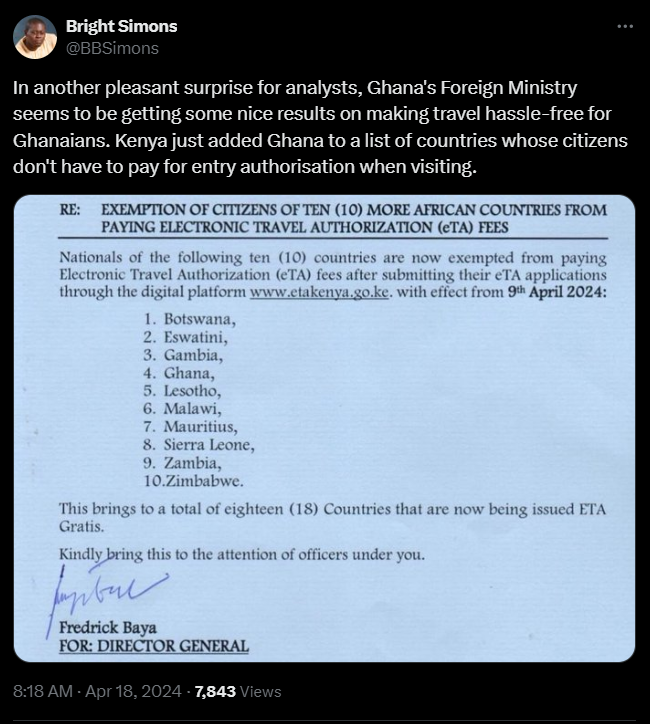
Renowned Ghanaian social innovator, entrepreneur, writer, and commentator Bright Simons champions Ghana’s inclusion in Kenya’s roster of nations whose citizens are exempt from entry authorization fees.
The move, effective April 9th, 2024, aligns Ghana with countries like Botswana, Malawi, and Zambia, streamlining travel procedures for its citizens.
Simons applauds Ghana’s Foreign Ministry for this development, highlighting its significance amid ongoing challenges faced by the nation.
He shared the news on social media, noting Ghana’s addition.
Ghana is on the list of other countries such as Saint Kitts and Nevis, Singapore, and Trinidad and Tobago.
This step marks a positive stride in facilitating hassle-free travel for Ghanaians and reflects growing international cooperation in simplifying entry procedures.
See tweet below:
In another pleasant surprise for analysts, Ghana's Foreign Ministry seems to be getting some nice results on making travel hassle-free for Ghanaians. Kenya just added Ghana to a list of countries whose citizens don't have to pay for entry authorisation when visiting. pic.twitter.com/AajAjYhACD
Honorary Vice President at IMANI Africa, Bright Simons, has urged Fidelity Bank and the Electricity Company of Ghana (ECG), to desist from what he terms as a coordinated public relations campaign to discredit him.
Fidelity Bank has dragged Bright Simons, the Vice President of IMANI Africa, to court over his allegation that the Electricity Company of Ghana (ECG), the government-controlled electricity utility, is “dishing out” approximately GHC80 million to the financial institution in sweetheart exchange rate deals.
In a rejoinder, media consultants for Bright Simons noted that if it was the intention of Fidelity to engage in a public debate with our client, the ethical and professional thing to do would have been to withdraw their pending libel lawsuit against him so that all sides can speak freely and robustly about the issues in the press.
“Promoting one-sided commentary in the press is not the professional and ethical approach in this circumstance.
“Our client has been careful and diligent in his public commentary till date to avoid prejudicing the case, but the ongoing attempt to foist a one-sided perspective compels us to respond to specific factual mischaracterizations,” a portion of the rejoinder read.
The media consultants argued that the context in which their client publicly questioned ECG about its foreign exchange (FX) dealings is key to appreciating the situation.
“ECG had been reported by auditors appointed by its regulators, the PURC, to be hiding information and refusing to cooperate with them to unravel its financial dealings. The organisation had furthermore been charged with procurement irregularities by the Auditor General.”
There're some "Ghana things" I will never understand. You say someone has tarnished your corporate reputation, so you've sued for libel. The matter will be heard in court. What is the point of blasting the writ all over & pushing 1 side in the media? 🤔https://t.co/UFABgl5nTp
Re: Fidelity lawsuit against Bright Simons – Dumsor will not be solved by PR
We serve as media consultants for Bright Simons, a honorary Vice President at IMANI Africa and a frequent collaborator of ACEP, both think tanks, in which capacity we issue this public statement.
We have observed with dismay what appears to be a coordinated public relations campaign to discredit our client by Fidelity Bank Ghana Limited (“Fidelity”) and the Electricity Corporation of Ghana (“ECG”).
If it was the intention of Fidelity to engage in a public debate with our client, the ethical and professional thing to do would have been to withdraw their pending libel lawsuit against him so that all sides can speak freely and robustly about the issues in the press. Promoting one-sided commentary in the press is not the professional and ethical approach in this circumstance.
Our client has been careful and diligent in his public commentary till date to avoid prejudicing the case, but the ongoing attempt to foist a one-sided perspective compels us to respond to specific factual mischaracterisations.
The context in which our client publicly questioned ECG about its foreign exchange (FX) dealings is key to appreciating the situation. ECG had been reported by auditors appointed by its regulators, the PURC, to be hiding information and refusing to cooperate with them to unravel its financial dealings. The organisation had furthermore been charged with procurement irregularities by the Auditor General.
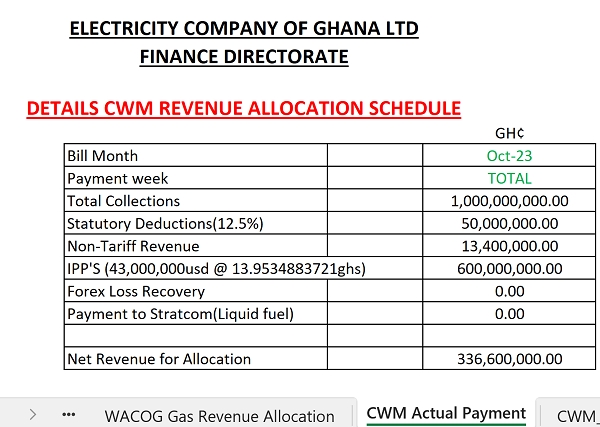
These developments, and the recurrent energy crises that keep engulfing the nation, a situation that many analysts believe can be partly attributed to challenges at ECG, prompted civil society activists and energy analysts at IMANI and ACEP to keep a steady spotlight on ECG, examine its finances, and monitor its procurement activities. It was during this work that ECG’s submissions to the Cash Waterfall Committee came to light showing that the organisation priced each dollar procured for a certain transaction at ~GHS13.95.
We have noted ECG’s misrepresentation of facts in its recent statement, a portion of which we reproduce below.
The suggestion that the “circulating cash waterfall spreadsheet” (“spreadsheet”) contains an “estimation” rather than the “actuals” implies that our client was either not diligent or attempted to misinform the public. This characterisation is totally false and misleading.
1. The Excel Workbook from which the information was found is an official document of the Cash Waterfall Mechanism Committee.
2. The spreadsheet in question was prepared from information supplied by the Finance Directorate of ECG.
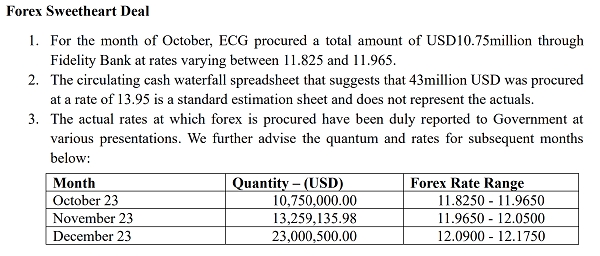
3. The spreadsheet contains multiple entries. The spreadsheet is titled CWM Actual Payment (emphasis on “actual”). For transparency, we reproduce the relevant section of the document below.
4. It is clearly indicated in the highlighted page that ECG’s unit procurement cost for 600 million GHS was ~GHS13.953/$1.
5. The billing month is indicated clearly as October 2023.
7. Fidelity is the acknowledged single account operator of ECG and has been the main FX broker for ECG at various times.
8. Nothing in the spreadsheet suggests that the figures and other entries are merely hypothetical. On the contrary, the document was in use as late as February 2024 as part of reconciliation exercises relating to past payments already made by ECG.
Our client did not pluck these numbers from the air. He did not concoct them. As an analyst he was entitled to draw fair and analytically sound conclusions from official, public, documents, which he did.
Whilst ECG and Fidelity have made various claims about what happened, their claims clearly contradict the official CWM records. Only a deep forensic audit by a reputable team of auditors can effectively resolve these contradictions.
What is before the court however is a libel lawsuit that alleges that our client knowingly made false and misleading claims to tarnish the reputation of Fidelity. Lawyers of our client intend to contest this allegation vigorously.
Our client has explained his motive for questioning whether the ECG – Fidelity transactions were arm’s length or tainted by insider dealing, as hinted in his post on X (formerly known as Twitter). Further expatiation is strictly a matter for trial.
For the sake of completeness, we are providing a link to our client’s article detailing this conflict of interest, which is highly germane to his motive for questioning the financial soundness of ECG – Fidelity transactions.
Our client disclosed that a close relative/associate of the Chief of Staff of Ghana’s President serves as the Head of Legal at Fidelity Bank. In that role, she negotiates and/or clears some legal transactions involving the two corporate entities on both ends. This “politically exposed person” undertakes activities at ECG, including corporate initiatives, that go beyond her board remit. ECG’s statements on this affair therefore lack candour and evade the issues of insider dealing.
In deference to the court, we hope that Fidelity Bank and ECG shall not provide our client with occasion to publicly defend his professional integrity in this manner again while this suit is still pending.
Given the serious public interest dimension of this case, it is our hope that all parties will cooperate in good faith to ensure a smooth and civil trial. In the meantime, we urge all editors to give this statement the same level of prominence being given to the circulating ECG and Fidelity documents.
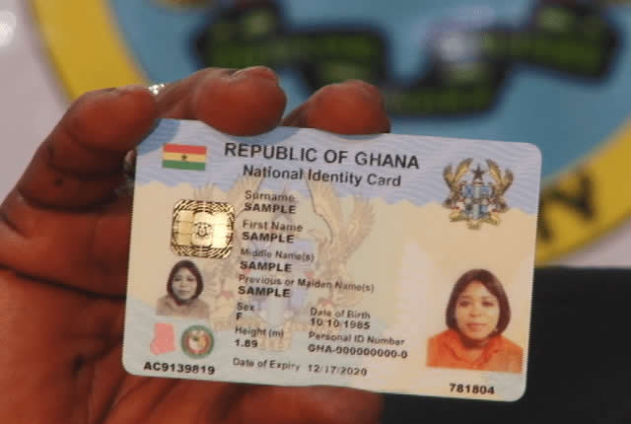
This discovery has sparked debates about the NIA’s competence and its ability to defend Ghana’s interests in the Ghana Card Public-Private Partnership (PPP) with Margins Group.
The issue was brought to light by an X user, Sharudeen Yahya, who tagged the Vice President of IMANI Africa, Bright Simons.
Mr Simons raised concerns about the NIA’s lack of originality and its reliance on copied content. He argued that the real problem lies not in the act of plagiarism itself but in the NIA’s apparent incompetence and disregard for Ghana’s interests.
1/ Finally! De-zombification? Ghana's NIA removes webpages copied verbatim from UAE agency websites because it couldn't even bother to create its own. The real issue isn't plagiarism. It is that the NIA isn't fit to defend Ghana's interest in the Ghana Card PPP with Margins. https://t.co/2VV0Bbpplc
Earlier, Mr Simons alleged that Ghana’s National Identification System, also known as the “Ghana Card” is owned by a company called Margins Group and not the government of Ghana.
He is of the view that the National Identification Authority (NIA) is no longer useful, describing it as a “zombie” as “it lacks the capacity to develop specifications and to exercise serious oversight.”
He made this claim in an article in which he provided an extensive analysis of his research.
“Ghana Card’s main technology asset base belongs to Margins Group, not the government of Ghana,” he wrote.
According to him, this makes it impossible for the government to save money by using smart procurement to obtain the printed cards, biometric devices, and system integrations.
“It must get everything from Margins alone. Ghana Card, as a system, cannot be operated without Margins, so the idea that the government “owns” the data is meaningless.”
Mr Simons noted that due to Margins Group’s ownership of the Ghana Card, each unit costs Ghana nearly 20 times what a similar smartcard costs Rwanda.
“The Ghana Card Public Private Partnership (PPP) agreement between NIA was supposed to be cost-neutral to the government. It was to pay a startup contribution of $124 million and then recoup over time as revenues come in. However, the “revenues” are a sham since they come from the same government,” he added.
He asserts that by 2033, the Ghana card system would have generated revenue of $1.44 billion. However, this money, he said will be paid to Margins Group.
“Government of Ghana is therefore going to end up paying up all the $1.44 billion revenues the system is designed to generate by 2033, and Margins will get virtually all of the money.”
1/ Most Ghanaians think that Ghana Card is the greatest thing since sliced bread. They don't know that they are being ripped off. The lack of awareness is a product of "State Enchantment". This essay is the first attempt to de-hypnotise the masses.https://t.co/cbUVQpTRvU
The National Identification System (NIS), project contract is being executed under a Public Private Partnership (PPP) agreement between NIA and Identity Management Systems (IMS), a subsidiary of the Margins Group of companies.
The cost of the project is jointly shared by the parties. NIA’s component of the contract sum is $124 million, which caters for operations in both Ghana and abroad to register and issue smart, biometric, chip-embedded ID cards to all Ghanaians aged 15 years and over, and 2-dimentional bar code cards to all Ghanaians under 15 years old. The cost of the project to IMS is $169 million. All subsequent costs will be covered by proceeds from the project over the contract term of 15 years.
Unlike other traditional contracts, IMS will not be given any money by the Government of Ghana.
It will be recalled that the Minority in Parliament issued a press statement on 10 June 2018 in which it admitted to having received documents from NIA which it subsequently approved, showing the total life cost of the project over 15 years as $1.2bn with tax exemption of $176million. It is baffling that the NIA will be accused of bloating the contract sum which it presented to all members of Parliament. th
It must be emphasised that the cost per smart card issued to Ghanaians 15years and above is $5.40, while the cost per 2D bar code card issued to Ghanaians under 15years is $1.50.
It is factually not correct that nationals of India are issued with a biometric ID card. What India issues to its nationals is merely a Personal Identification Number; India does not provide its citizens with any form of identity cards whatsoever.
The closest national ID cards that can be compared to the Ghana Card, in terms of their physical characteristics and technical functionalities, are those of Rwanda and Nigeria. The Rwandan national ID card is a multipurpose card with a 64-kilobyte chip which contains the bearer’s passport, driving licence and health insurance information. The Ghana Card has a 148-kilobyte capacity chip and greater functionalities than the Rwandan card. The Ghana Card also has 14 applets, and far transcends Rwanda’s, and it also has a passport for travel within West Africa. There are also three international ID profiles on the Ghana Card. Information from other data silos, such as the DVLA, NHIA, SSNIT and GIS may be incorporated onto the Ghana card.
The Rwandan biometric ID card will be optionally available at a cost of $18.17 while the Ghana card costs $5.40, and is issued free of charge to Ghanaian citizens in Ghana.
The NIA-IMS contract costs have undergone Value-For-Money (VFM) audits by the Public Procurement Authority (PPA) and have also been thoroughly assessed by the Public Investments Division of the Ministry of Finance. The contract has also been reviewed by the Attorney-General’s Department and the Legal Unit of the Ministry of Finance. In addition, the contract has been reviewed and given approval by the Public Private Partnership Approval Committee (PPPAC) of the Ministry of Finance, as well as the Economic Management Team of Government. It has also received Cabinet approval.
Copies of the draft Contract were distributed to all 275 members of Parliament, and appropriate waivers for import duty exemptions were also granted by Parliament prior to the contract being executed by the parties in April 2018.
Further information on the NIS project could be found on NIA’s website www.nia.gov.gh
Vice President of IMANI Africa, Bright Simons, has reacted to the recent reports surrounding the purported shrinking of the male reproductive organ in Kasoa.
Per reports, seven individuals have fallen victim.
In a post on X platform, Mr Simons likened the current situation to an outbreak dubbed “koro”, a psychotic/panic anxiety disease that “triggered mass hysteria in many parts of the world, from China & Thailand to Nigeria & Kenya for decades.”
Per the information shared by Mr Simons, the koro phenomenon is also known among diverse ethnic and religious groups in Asia and Africa, typically in cultures in which reproductive ability is a major determinant of a young person’s worth.
“Koro epidemics of panic anxiety due to widespread fears of losing one’s genitals, procreative ability, and even one’s life, are triggered by rumors of genital disappearance supposedly caused in China by female fox spirits, in Singapore and Thailand by mass poisoning, and in Africa by sorcery, usually in the context of socioeconomic or political tension.
“Today, in contemporary Western societies, ideas of genital disappearance are not culturally endorsed. But historically, it should be remembered that in the late Middle Ages in Europe, a man could lose his membrum virile through magical attacks by witches.
“The conclusion is that the psychological disappearance of the penis is a universal syndrome that was described recently in Asia and Africa and already in Medieval Europe.”
The reported shrinking of genitals is not a new phenomenon in Ghana. In January 1997, 19 people were arrested for assaulting an innocent individual and disserminating false information on the shrinking of genitalia.
The recent Kasoa "missing manhood" scare in the outer suburbs of Accra is most likely just another outbreak of "koro", the well known psychotic/panic anxiety disease that has triggered mass hysteria in many parts of the world, from China & Thailand to Nigeria & Kenya for decades pic.twitter.com/O6FBFBpSxp
Currently, a District Court at Awutu Breku has remanded into police custody a 22-year-old electrician who allegedly raised false alarm that his penis shrunk at Millenium City in Kasoa.
Michael Nelson is being held over publication of false news and causing unlawful harm.
Nelson is said to have raised alarm falsely that his penis had shrunk and accused Safiru Bohari, a nail technician, the complainant, as the one who caused it.
Due to the accused person’s false alarm, Bohari was beaten up by some people.
The court did not take the plea of Michael Nelson. He is expected to reappear before the court presided over by Naomi Kontuor on April 11, 2024.
Vice President of IMANI Africa, Bright Simons, has indicated that Ghana would forfeit the revenue generated from Ghana’s National Identification System, also known as the “Ghana Card” to one Margins Group.
He alleged that the Ghana National Identification System is owned by a company called Margins Group and not the government of Ghana.
Mr Simons noted that due to Margins Group’s ownership of the Ghana Card, each unit costs Ghana nearly 20 times what a similar smartcard costs Rwanda.
He made this claim in an article in which he provided an extensive analysis of his research.
“The Ghana Card Public Private Partnership (PPP) agreement between NIA was supposed to be cost-neutral to the government. It was to pay a startup contribution of $124 million and then recoup over time as revenues come in. However, the “revenues” are a sham since they come from the same government.”
“Government of Ghana is therefore going to end up paying up all the $1.44 billion revenues the system is designed to generate by 2033, and Margins will get virtually all of the money.”
According to him, this makes it impossible for the government to save money by using smart procurement to obtain the printed cards, biometric devices, and system integrations.
“It must get everything from Margins alone. Ghana Card, as a system, cannot be operated without Margins, so the idea that the government “owns” the data is meaningless.”
He is of the view that the National Identification Authority (NIA) is no longer useful, describing it as a “zombie” as “it lacks the capacity to develop specifications and to exercise serious oversight.”
1/ Most Ghanaians think that Ghana Card is the greatest thing since sliced bread. They don't know that they are being ripped off. The lack of awareness is a product of "State Enchantment". This essay is the first attempt to de-hypnotise the masses.https://t.co/cbUVQpTRvU
The National Identification System (NIS), project contract is being executed under a Public Private Partnership (PPP) agreement between NIA and Identity Management Systems (IMS), a subsidiary of the Margins Group of companies.
The cost of the project is jointly shared by the parties. NIA’s component of the contract sum is $124 million, which caters for operations in both Ghana and abroad to register and issue smart, biometric, chip-embedded ID cards to all Ghanaians aged 15 years and over, and 2-dimentional bar code cards to all Ghanaians under 15 years old. The cost of the project to IMS is $169 million. All subsequent costs will be covered by proceeds from the project over the contract term of 15 years.
Unlike other traditional contracts, IMS will not be given any money by the Government of Ghana.
It will be recalled that the Minority in Parliament issued a press statement on 10 June 2018 in which it admitted to having received documents from NIA which it subsequently approved, showing the total life cost of the project over 15 years as $1.2bn with tax exemption of $176million. It is baffling that the NIA will be accused of bloating the contract sum which it presented to all members of Parliament. th
It must be emphasised that the cost per smart card issued to Ghanaians 15years and above is $5.40, while the cost per 2D bar code card issued to Ghanaians under 15years is $1.50.
It is factually not correct that nationals of India are issued with a biometric ID card. What India issues to its nationals is merely a Personal Identification Number; India does not provide its citizens with any form of identity cards whatsoever.
The closest national ID cards that can be compared to the Ghana Card, in terms of their physical characteristics and technical functionalities, are those of Rwanda and Nigeria. The Rwandan national ID card is a multipurpose card with a 64-kilobyte chip which contains the bearer’s passport, driving licence and health insurance information. The Ghana Card has a 148-kilobyte capacity chip and greater functionalities than the Rwandan card. The Ghana Card also has 14 applets, and far transcends Rwanda’s, and it also has a passport for travel within West Africa. There are also three international ID profiles on the Ghana Card. Information from other data silos, such as the DVLA, NHIA, SSNIT and GIS may be incorporated onto the Ghana card.
The Rwandan biometric ID card will be optionally available at a cost of $18.17 while the Ghana card costs $5.40, and is issued free of charge to Ghanaian citizens in Ghana.
The NIA-IMS contract costs have undergone Value-For-Money (VFM) audits by the Public Procurement Authority (PPA) and have also been thoroughly assessed by the Public Investments Division of the Ministry of Finance. The contract has also been reviewed by the Attorney-General’s Department and the Legal Unit of the Ministry of Finance. In addition, the contract has been reviewed and given approval by the Public Private Partnership Approval Committee (PPPAC) of the Ministry of Finance, as well as the Economic Management Team of Government. It has also received Cabinet approval.
Copies of the draft Contract were distributed to all 275 members of Parliament, and appropriate waivers for import duty exemptions were also granted by Parliament prior to the contract being executed by the parties in April 2018.
Further information on the NIS project could be found on NIA’s website www.nia.gov.gh
Vice President of IMANI Africa, Bright Simons, has alleged that Ghana’s National Identification System, also known as the “Ghana Card” is owned by a company called Margins Group and not the government of Ghana.
He made this claim in an article in which he provided an extensive analysis of his research.
“Ghana Card’s main technology asset base belongs to Margins Group, not the government of Ghana,” he wrote.
According to him, this makes it impossible for the government to save money by using smart procurement to obtain the printed cards, biometric devices, and system integrations.
“It must get everything from Margins alone. Ghana Card, as a system, cannot be operated without Margins, so the idea that the government “owns” the data is meaningless.”
Mr Simons noted that due to Margins Group’s ownership of the Ghana Card, each unit costs Ghana nearly 20 times what a similar smartcard costs Rwanda.
“The Ghana Card Public Private Partnership (PPP) agreement between NIA was supposed to be cost-neutral to the government. It was to pay a startup contribution of $124 million and then recoup over time as revenues come in. However, the “revenues” are a sham since they come from the same government,” he added.
He asserts that by 2033, the Ghana card system would have generated revenue of $1.44 billion. However, this money, he said will be paid to Margins Group.
“Government of Ghana is therefore going to end up paying up all the $1.44 billion revenues the system is designed to generate by 2033, and Margins will get virtually all of the money.”
He is of the view that the National Identification Authority (NIA) is no longer useful, describing it as a “zombie” as “it lacks the capacity to develop specifications and to exercise serious oversight.”
1/ Most Ghanaians think that Ghana Card is the greatest thing since sliced bread. They don't know that they are being ripped off. The lack of awareness is a product of "State Enchantment". This essay is the first attempt to de-hypnotise the masses.https://t.co/cbUVQpTRvU
The National Identification System (NIS), project contract is being executed under a Public Private Partnership (PPP) agreement between NIA and Identity Management Systems (IMS), a subsidiary of the Margins Group of companies.
The cost of the project is jointly shared by the parties. NIA’s component of the contract sum is $124 million, which caters for operations in both Ghana and abroad to register and issue smart, biometric, chip-embedded ID cards to all Ghanaians aged 15 years and over, and 2-dimentional bar code cards to all Ghanaians under 15 years old. The cost of the project to IMS is $169 million. All subsequent costs will be covered by proceeds from the project over the contract term of 15 years.
Unlike other traditional contracts, IMS will not be given any money by the Government of Ghana.
It will be recalled that the Minority in Parliament issued a press statement on 10 June 2018 in which it admitted to having received documents from NIA which it subsequently approved, showing the total life cost of the project over 15 years as $1.2bn with tax exemption of $176million. It is baffling that the NIA will be accused of bloating the contract sum which it presented to all members of Parliament. th
It must be emphasised that the cost per smart card issued to Ghanaians 15years and above is $5.40, while the cost per 2D bar code card issued to Ghanaians under 15years is $1.50.
It is factually not correct that nationals of India are issued with a biometric ID card. What India issues to its nationals is merely a Personal Identification Number; India does not provide its citizens with any form of identity cards whatsoever.
The closest national ID cards that can be compared to the Ghana Card, in terms of their physical characteristics and technical functionalities, are those of Rwanda and Nigeria. The Rwandan national ID card is a multipurpose card with a 64-kilobyte chip which contains the bearer’s passport, driving licence and health insurance information. The Ghana Card has a 148-kilobyte capacity chip and greater functionalities than the Rwandan card. The Ghana Card also has 14 applets, and far transcends Rwanda’s, and it also has a passport for travel within West Africa. There are also three international ID profiles on the Ghana Card. Information from other data silos, such as the DVLA, NHIA, SSNIT and GIS may be incorporated onto the Ghana card.
The Rwandan biometric ID card will be optionally available at a cost of $18.17 while the Ghana card costs $5.40, and is issued free of charge to Ghanaian citizens in Ghana.
The NIA-IMS contract costs have undergone Value-For-Money (VFM) audits by the Public Procurement Authority (PPA) and have also been thoroughly assessed by the Public Investments Division of the Ministry of Finance. The contract has also been reviewed by the Attorney-General’s Department and the Legal Unit of the Ministry of Finance. In addition, the contract has been reviewed and given approval by the Public Private Partnership Approval Committee (PPPAC) of the Ministry of Finance, as well as the Economic Management Team of Government. It has also received Cabinet approval.
Copies of the draft Contract were distributed to all 275 members of Parliament, and appropriate waivers for import duty exemptions were also granted by Parliament prior to the contract being executed by the parties in April 2018.
Further information on the NIS project could be found on NIA’s website www.nia.gov.gh
This is a fairly long essay, so here is the quick take for those too busy to read.
Ghana Card’s main technology asset base belongs to Margins Group, not the government of Ghana.
This makes it impossible for the government to save cost by using smart procurement to obtain the printed cards, biometric devices, and system integrations. It must get everything from Margins alone.
Ghana Card, as a system, cannot be operated without Margins, so the idea that the government “owns” the data is meaningless.
The government agency in the Ghana Card PPP, NIA, has become a “zombie”; it lacks the capacity to develop specifications and to exercise serious oversight. Some senior parliamentarians are also mere praise-singers of Margins.
Due to the stranglehold Margins has over the Ghana Card, each unit costs Ghana nearly 20 times what a similar smartcard costs Rwanda.
The Ghana Card PPP was supposed to be cost neutral to the government. It was to pay a startup contribution of $124 million and then recoup over time as revenues come in. However, the “revenues” are a sham since they come from the same government.
Government of Ghana is therefore going to end up paying up all the $1.44 billion revenues the system is designed to generate by 2033, and Margins will get virtually all of the money.
Now, let us get into the meat.
Some senior MPs are making it hard to take Ghana’s Parliament seriously
A few weeks ago, members of the “subsidiary legislation” committee of Ghana’s Parliament visited one of the factories of Margins Group, the company that owns Ghana’s National Identification System, the so-called “Ghana Card”. The powerful committee makes virtually all the administrative and regulatory laws that govern many day-to-day functions of the administrative state and its government.
Even though concerns about Ghana Card are a matter of periodic inquiries before the Parliament, the Chair of the Committee, the Member for Bolgatanga East, could not contain his enthusiasm to declare the Opposition Party’s unrestrained support for anything Ghana Card. Given his premature and prejudicial excitement, one wonders how anyone can expect the Parliament, as presently constituted, to exercise any serious oversight in the matter.
The MP’s behaviour is reminiscent of another visit to another company, whose business relationship with Ghana has come under severe scrutiny, SML. Even whilst the matter was under investigation by Parliament, and concurrently by the Presidency, the Chair of a powerful parliamentary committee rushed to the premises of the company to pass very prejudicial comments about the ongoing investigations. He insisted that he had observed “world class monitoring” activity on the premises, the very issue being probed. This was curious since the President of Ghana had announced a suspension of the company’s activities whilst investigations continued.
How then was the MP, the Honourable Member for Akim Abuakwa South, able to observe “world class monitoring” in an operation halted by no mean person than the President of the Republic? How?
State Enchantment
It has become clear for some time now that the institutions set up to safeguard the public interest in Ghana have been performing below par. In some cases, the results suggest that they may even have become compromised.
Even more concerning is a trend best described by this term: “state enchantment”, a process by which projects primarily intended to enrich private actors are wrapped up in spectacular clothes of national glory, so radiant that the public is perpetually blinded as to the underlying commercial motives. The “haze of glory” surrounding these projects makes any call for scrutiny easily dismissible as bizarre negativity.
Such state enchantment programs benefit massively in an environment such as Ghana, where the official watchdogs like Parliament and the anti-graft institutions have powerful actors within who compromise these institutions’ oversight functions in relation to these same programs.
This author recently had the opportunity to talk about this at an event organized by some respected institutions. One of the case studies highlighted in the talk was, unsurprisingly, Ghana Card.
Ghana Card, for reasons to be offered shortly, is one of the most brazenly potent examples of state enchantment ever conceived.
What is Ghana Card?
Creating a general-purpose ID card for Ghanaians is a national dream of old. The military regime after the Second Republic acted on this and distributed some cards starting with areas around Ghana’s land borders. Not much progress was made thereafter.
After various fits and starts, the National Identity Authority was set up in 2003 and its enabling legislation passed in 2006 (Act 707). A strategy was taken to issue cards to both Ghanaians at home and abroad.
In the perennial confusion and amidst the jostling for rents by elites that attend every public project in Ghana, the project got stuck. Even though loans sourced from France for French contractor, Sagem Morpho, and “counterpart funding” from the Ghanaian government, led to a $60 million budget being put together by 2008, time was too short; the government of the day lost elections at the end of that year and the new government, as is customarily, decided to restructure the entire project. Margins was a subcontractor to Sagem in that initial run.
After 8 years, some progress had been made, but significant challenges remained. Activist organisations like IMANI pointed out a wide range of defects in the prevailing regime which unchecked would undermine outcomes over time. Before the sitting government could get a grip on the project, they also lost power.
Wastefulness
When the new government arrived on the scene in 2017, 15 million Ghanaians were already captured in the national database, and the entire infrastructure (except the foreigners segment) was primarily controlled by the State.
What remained was the development of value-adding authentication modules on top of the national database, the perfection of a higher-spec physical card production process, and a distribution system to ensure that printed cards could get to their owners. So weak was the initial logistics solution that even though 2.7 million cards had already been produced by 2013, only 900,000 had been distributed by then. By the end of 2016, 50% of the 3 million printed cards remained uncollected. A new biometric data collection system held data for 4.5 million Ghanaians (less than 30% target penetration).
Fixing project challenges, the Ghana Way
When the new government took the reins of power in 2017, the usual review of programs occurred. Having identified the problem as being one of inadequate resources, all that was necessary was to determine the right level of government financial commitment, prioritise efficient procurement, and cut out waste due to poor logistics planning.
Instead, the government decided to start all over again, discard the old databases on grounds of forward-incompatibility of the technology stack, and enter into a new public-private partnership (PPP) contract with the Margins group. This is the precise moment when the state enchantment effort began.
What had been a routine bureaucratic program of identifying citizens, something that many Francophone countries have been doing for decades without fanfare, suddenly became a messianic affair of Marian proportions. All of a sudden, every problem in Ghana was only solvable by “Ghana Card”.
Many have been swayed by these antics, and the more hard-nosed among the population merely dismiss the hype as the usual dross of PR-centric Ghanaian political showboating. In this essay, however, the intent is to show how the PPP model by its very design requires such high levels of state enchantment to operate. It also explains why all levers of state power has been brought to bear to force the Ghana Card on the population in order to artificially inflate its importance.
How did Margins get in? (Nice contract if you can get it)
The subsidiary of the Margins group that entered into the PPP with the NIA to roll out the Ghana Card solution is Identity Management Services (IMS). IMS got its muscle from a joint venture it initiated with American and Danish investors to print cards for the first incarnation of the Ghana Card in 2003 when the design was based on State control of the system, with contractors just producing the cards and selling equipment. IMS had the local relationships, the Danes and Americans had the technology and fund-raising capacity.
With both local and international connections in place, the Margins Group would benefit from a million-dollar grant from the Danish government to cover its part of the joint investment. In total, $3.5 million in Danish funding went to the partners in a nice blend of grant funding and commercial credit. The Danish development finance institution, IFU, doubled down on the project with additional credit of $5 million by 2015.
With financial muscle comes influence, and so Margins was able to convince the NIA to enter into a PPP in 2013 to handle just the registration of foreigners in Ghana. The template was thus set for the current wide-ranging relationship consummated with the 2018 PPP agreement.
Why PPPs can unblock resources in Ghana
The impression created that somehow the PPP for the national ID card program in Ghana unlocked fresh private sector resources and saved the government money is of course abject nonsense. regardless of the precise model, in the end, the money would have come from the government.
What is true however is that crafting the program as a PPP did make the government more willing to release money. Somehow, just having a big private beneficiary driving outcomes propels government institutions to unlock large amounts of money they would never otherwise had released if a government agency was the one driving the project. Furthermore, entrusting the asset base of the project to a private businessman appeared to have created the necessary motivation across all levels for the project to succeed. This is the only reason why Ghana Card issuance has successfully been boosted to ~17 million Ghanaians.
Who owns the Ghana Card Assets
There are a number of key systems that make the Ghana Card work:
A datacenter to store the data, including the biometrics.
Database software to organize the data effectively for retrieval, validation and updating.
A special memory chip to contain the identification information stored on the physical smartcard.
Unique cryptographic and encryption solutions, plus the accompanying cybersecurity techniques, to prevent manipulation of the data and enable authentication of the individual.
A stack of security features to prevent unauthorized issuance, alteration and duplication of cards.
Biometric capturing, de-duplication, and validation systems.
As mentioned previously, the data collected is meaningless unless organized and deployed by such assets. That is why the 15 million citizen data points collected by 2016 did not translate into much; the asset base was not adequate.
When Margins Group says that “government of Ghana” owns the Ghana Card data, it is not being candid. It owns the assets and infrastructure that makes the data usable.
The best way to emphasise the reality of things as currently pertains in Ghana is to say that WITHOUT MARGINS, GOVERNMENT OF GHANA CANNOT OPERATE THE GHANA CARD.
The licenses covering the critical technologies and the service contracts for their maintenance are all owned and controlled by the Margins Group and not the government of Ghana. The government can easily put minds at ease by publishing the inventory of technologies with a map of ownership.
Ghana’s fingers are in Margins’ mouth
To underscore the point about ownership, let us ask a simple question: could the government of Ghana ask another contractor to print Ghana Cards or to supply biometric authentication devices for any purpose related to national identification, such as a mass registration campaign, service center setup (offices where one can go to replace their Ghana Cards or seek technical assistance), or integration into the information system of another government agency without the Margins Group? The answer is an emphatic, NO. It cannot.
And the issue is not just about requiring the expertise of to provide technical support. We are talking here about the actual provision of goods and services related to national identification. No other company can produce the physical cards for the government, supply biometric devices, or handle data integration activities for any national identification purpose in Ghana EXCEPT Margins group. No matter how cheaper any other company can print ID cards (which, by the way, is a commodity business today), procure and supply biometric devices, or handle integration between another agency and the National Identity Register, the government of Ghana is bound to use Margins.
This is absolutely not the kind of PPP most have in mind when they hear about the Ghana Card project, and yet that is what the country is saddled with.
Of course, a rational strategist designing a Ghana Card system purely in the public interest would have unbundled the architecture such that the underlying registry containing the biometric data would have been entirely government controlled.
They would then have ensured that assets purchased and configured by the private contractor for authentication and validation would have been transferred to the government.
And, no doubt, they would have ensured that the peripherals such as the physical ID cards and biometric devices are uncoupled from the core infrastructure such that anytime the government or any of its agencies want to acquire some cards or biometric terminals, they would simply issue a tender and award the contract to the most cost-effective and technologically advanced vendor. This is how it is done in Malaysia. This is how it is done in Indonesia. And this is how it is done in South Africa. And, in fact, this is how it is done in every serious jurisdiction concerned about fiscal prudence and fairplay. Even Rwanda’s card production (even though it was coupled with data collection) was subject to open tender. Of course, tenders can be rigged, but without even the option to tender, a country is essentially locked in a pattern of poor procurement.
Pretend Nationalisation
Constant complaints by a few activists like this author about the way the National Identification System was set up finally convinced the authorities to act. In 2022, they began the process of migrating the Ghana Card database to the national datacenter and transferring the Public Key Infrastructure (PKI) associated with the project to the National Information Technology Agency (NITA).
However, this effort has been cosmetic because the essential design and structure of the database system makes it very difficult for the government to pursue a flexible vendor strategy: letting anyone other than Margins print cards remains a practical impossibility. As for the PKI model, it has never been fully implemented, except for the deposit of Ghana’s public keys in Montreal, with ICAO, as part of the comical e-Passport fiasco. This year, the Ministry of Communications is requesting yet more money to build this mysterious PKI thing. Ghana Card’s encryption and cryptographic domains remain the exclusive province of Margins.
In fact, Margins simply used the half-hearted nationalisation process to secure more lucrative contracts. They billed the government more than 55 million GHS to establish the Disaster Recovery System that they claimed the transfer required to be successful.
Furthermore, the authentication software is still closely-coupled with the data system (with related licenses, such as those covering the Entrust technology and its durashield module, remaining with Margins). The net effect of all these is that any vendor brought in to compete for jobs like cards production, biometric device supply, and API integrations for government agencies, will be entirely reliant on Margins. In fact, they will be redundant.
This pretense of a transfer continues unchallenged because of the extreme opacity of the entire architecture and process.
Some readers may still be unconvinced at this point about whether these serious institutional defects are having any tangible adverse effects. And the answer is, yes. Plenty.
Ghana Card has become a MASSIVE rip-off
The big justification for the PPP model used in rolling out the National identification System is that it unlocked private resources and thus overcame the old “no money” syndrome bedeviling so many public sector initiatives. But this is a big lie. It merely UNLOCKED GOVERNMENT MONEY.
As part of the April 2018 Agreement signed between Margins and the government of Ghana, which was never published for the benefit of the general public, the government of Ghana agreed to make guaranteed payments every month to Margins. These payments are due if the fantastic revenue amounts anticipated under the agreement do not materialise.
Since the agreement was based on agencies like SSNIT (the public pensions fund), Ghana Revenue Authority, the National Health Insurance Authority (NHIA), the Drivers & Vehicles Licensing Authority (DVLA) and others paying Margins hundreds of millions of Ghana Cedis over the 15-year lifecycle of the project, it was always a foregone conclusion that the burden would ultimately be transferred to the central government. NHIA, GRA, CAGD and the likes are not primarily profit-making institutions. To buttress the point, note NIA’s projected revenue from Ghana Card operations of barely 8 million GHS in 2024.
Source: Ministry of Finance, Ghana
The projected 2024 figures are based on a recognition that the premium services forced down the throats of Ghanaians in the last few years at 250 GHS per person, and the integrations forced on some state institutions, leading to revenues of nearly 78 million GHS in 2023, have ceased having attraction, with premium service centers now lying mostly empty.
Source: Ministry of Finance, Ghana
It was thus a ruse to pretend that there was something financially innovative about how the PPP was set up. Government was always going to have to pay for the system, except that in the specific type of PPP model selected, the cost burden on the government was heavily inflated just so that a private company can make fantastic returns that other private companies struggle to make in any industry.
It is mind-boggling reflecting on the whole financial design of the Ghana Card
The April 2018 agreement was based on the premise of the setup of the card costing a little less than $300 million, and operations and maintenance costing another $900 million over the 15-year period (i.e. 780 million Ghana Cedis a year). The private partner was guaranteed a minimum 17% return.
For the numbers to work out, the system must generate income of at least $93 million a year (far more than that, actually, if one considers the time value of money, which we are ignoring to keep things simple). If the system doesn’t, then the government is indebted to Margins since the “profits” and “losses” are shared in a way whereby Margins is guaranteed a profit only. Essentially, the government bears all the risks, and Margins has none of the downside. On top of all these, Margins has already been granted tax exemptions of at least ~$177 million.
It was thus highly deceitful when the impression was earlier created that the government’s liability was limited to the $124 million it had to contribute to setting up NIA’s offices, buying vehicles, and hiring people. The approval of the PPP by Cabinet and the Ministry of Finance (and later by Parliament) was based on this erroneous impression of a one-off cost and self-sustenance thereafter.
In the end, the government of Ghana had to hire roughly 1400 more people to provide the NIA with the manpower needed for national operations. Actually, the NIA wanted to hire 3265 people, but the Ministry of Finance refused. The total personnel cost of running the government side of the system was barely 5.2 million GHS in 2017. Total admin costs in 2019 were 3.3 million Ghana Cedis in 2019. Today, the goods and services budget alone is over 165 million GHS per annum and compensation has gone up by more than ten times.
Source: Ministry of Finance
The idea of a one-time cost has now been thrown out of the window and government contributions both to the NIA and Margins keep ballooning even as arrears pile up.
The government’s maximal exposure could well exceed $1 billion if the evasive revenues don’t show up. Remember, however, that the revenues are mostly supposed to come from government agencies that often struggle to balance their books, and whose liabilities always end up being transferred to the government anyway. Like the NHIA policy that was supposed to find innovative financing through “insurance” but is today 98% tax-funded, the Ghana Card project is today predominantly tax-financed.
One-half of the Ghana Card PPP, the portion focused on the Ghanaian diaspora, had already racked up losses of nearly $300 million by 2021. Losses that the government of Ghana is expected to make whole for Margins.
Source: Ministry of Finance, Ghana
How then can one attribute the successful issuance of 17 million cards as an outcome of some innovative PPP, except for the fact that the mere existence of private incentives has made the government more willing to spend money that in the past it was not willing to spend?
Squeezing every drop from Ghanaians
Margins, with the strong support of the NIA and various other elite enablers, constantly find ways to squeeze more money from Ghanaians. It’s justification is that it invested massively to set the system up and as a private investor, it is entitled to recoup. But this claim is dubious in a number of respects.
It is true that the PPP strategy envisaged an upfront investment of $169 million by Margins. But no one has ever audited the actual expenses made. Even though Margins was supposed to be totally responsible for the entire technical infrastructure setup, including all equipment etc., the situation right now is that government agencies are buying the equipment and paying for activities that per the April 2018 agreement Margins was expected to fund.
Heavily incentivized to make the most money possible, Margins constantly induces the NIA to shift strategy towards approaches that cost more money.
For example, an earlier decision was made to produce 2D barcoded cards (instead of cards with chips) for children under 15 years since their risk of impersonation and identity fraud in general is so low. A plastic card without a smart chip can cost about one-tenth of the price of one that has a chip. Imagine the surprise of analysts then when it was recently announced that NHIA will procure smartcards from Margins for children.
It stopped being surprising, however, when the cost was revealed. Just for the physical cards, NHIA will pay 81.9 Ghana Cedis per unit, that is nearly $9 at the time the procurement decision was made. Just for the cards. Adding ancillary costs like equipment and data capture, which are also being billed to the NHIA, take the cost to nearly $20, about the same price Margins and NIA charges for those who want to acquire the Ghana Card outside the government’s poorly organized mass registration campaigns. Rwanda, because it could use open tender to obtain smartcards and data capture services spends just $0.9 per card.
The unconscionable unit costs reflect in the total NHIA budget for the Ghana Card for Children project.
Source: Parliament of Ghana
NHIA’s Parliament-approved allocation model for the NHIF levies all Ghanaians pay when they buy VAT-rated products for 2023 shows that the 4th largest budget item, at 405 million GHS, was for spending on Ghana Card. Thus, every time anyone in Ghana pays NHIL on any item, a massive amount is pumped through schemes like this into Margins’ ever-ready pocket.
In the end, instead of the 6.87 billion GHS spending plan, the total budget for 2023 came down to 4.53 billion GHS, of which 4.37 billion GHS was actually spent. The allocation to Ghana Card thus reduced to 180 million GHS, but it still remained the 4th largest budget item. Consider that the entire call center operation of the NHIA, so essential to customer service, was allocated just 1 million GHS. NHIA’s entire sensitization budget was just 3 million GHS. Only 42 million GHS was spent on emergency medical care. Public education, social marketing and sensitization was lucky to get 9 million GHS.
In 2024, the NHIA intends to spend more than 300 million GHS on Ghana Cards.
Why on Earth would a health insurance service prioritise ID cards to such a great extent when everyone knows that its anti-fraud concerns are not about people impersonating other people (no point in doing that as packages are virtually identical) but about service providers inflating costs? In most countries, ID cards don’t even merit their own line item in the budgets of public health insurance bodies. Why couldn’t Parliament push back when confronted with these mind-boggling figures? Simple answer: State Enchantment.
The NHIA is of course not the only organisation being squeezed to ensure that the $1.2 billion revenue target (plus extra return) is reached at all cost by 2033 so that Margins can make its guaranteed returns. Organisations like SSNIT, GRA and others have large bills outstanding for so-called integration services. As at 2022, GRA alone owed Margins at least $12 million. And, of course, citizens must bear the inconvenience of being denied services like banking and drivers’ licenses if they can’t show a Ghana Card in order to induce them to part with nearly $20 for the privilege.
Somehow, someone has been able to hypnotise the whole country into believing that Ghana Card is actually saving government entities money. That somehow GRA needed to pay tens of millions of dollars just to integrate into a national identity system. And that impersonation is such a big problem that instead of a cheap plastic card with a 2D barcode costing about 20 cents ($0.2), NHIA instead needs a $9 smartcard.
When the previous government secured a loan promise from China of $115 million in 2013 to rollout a truly national system, many were those who criticized the government for profligacy. Yet, in the name of an innovative PPP, the government is on course to spend a billion dollars for an identical system.
The NIA is a zombie partner
It is not entirely clear how much the NIA sees its role as simply facilitating the profit margins of Margins Group versus defending the public interest.
One thing, however, is for sure, the NIA is quite clueless in serving as some kind of technical bulwark to Margins in the defence of the national interest. It is clear that it is simply out of its depth and cannot shadow the shrewd Margins operators in this fairly complex domain.
How do we know? In attempting to shed a bit of light on the notoriously opaque Ghana Card system, NIA simply went over to the websites of various government agencies in the United Arab Emirates and copied everything verbatim, a clear sign that they had no hand in designing the specifications. Because of a history of webpages disappearing in the heat of national debates, we have ensured that the screenshots below have the exact web addresses so that readers can make their own screenshots (here, for example).
We have NOTHING against Margins Group
No one is disrespectful of the entrepreneurial acumen of the people behind Margins Group. In fact, many of us with an exposure to entrepreneurship in Africa admire their tenacity and shrewdness. Most businesspeople who get the chance to milk an unserious client, who seems all too happy to be milked, will do so. The founders of Margins are in business to make money.
The people who deserves our ire are the politicians in Parliament and elsewhere who are busily working to throw wool in the eyes of the citizens, even as the hypnotic effect of state enchantment works to siphon off hundreds of millions of dollars into private pockets.
DISCLAIMER: TIGPost.co will not be liable for any inaccuracies contained in this article. The views expressed in the article are solely those of the author’s, and do not reflect those of The Independent Ghana.
Vice President of IMANI Africa, Bright Simons, has alleged that Ghana to sell a portion of its future cocoa production in exchange for securing loans.
Taking to the X platform, he highlighted that the surge in cocoa prices, rising fourfold, has prompted some individuals within Ghana’s cocoa regulator, COCOBOD, to either cancel or renegotiate the existing forward contracts.
According to Mr. Simons, these individuals seek to exploit the lucrative spot market prices, where cocoa can be sold immediately.
He expressed concerns about the potential repercussions of such actions on Ghana’s future relationships with banks.
Renegotiating contracts, he warned, could undermine trust and credibility with financial institutions, potentially affecting Ghana’s ability to obtain favorable loan terms in the future.
“Ghana sells fwd some of its cocoa to collateralise loans. The price of cocoa has quadrupled, so some shrewd operators at Cocobod are looking to back out of various forward deals & squeeze the most out of the spot market. Shrewd, but what about future relationships with the banks?,” he added.
Ghana, the world’s second-largest cocoa producer, sealed an $800 million loan deal towards the end of last year with a consortium of eight banks, led by Cooperatieve Rabobank UA.
According to Bloomberg, sources familiar with the matter, who requested anonymity due to the sensitive nature of the issue, revealed that Cocobod lacks sufficient cocoa beans to support the final $200 million drawdown from the commodity-backed facility.
A spokesperson for Cocobod, Fiifi Boafo, stated that it would not be “prudent” to pursue the additional drawdown. “Management has decided to avoid an overstretch in the repayment,” he added.
Ghana’s funding woes coincide with an anticipated shortfall in the cocoa harvest for the 2023/24 season, projected to reach only about 422,500 to 425,000 tons—half of the initial forecast.
Without timely payments from Cocobod, farmers risk being unable to afford essential resources like seedlings, chemicals, and fertilizers necessary for cultivating healthy crops.
Traditionally, Cocobod conducts an investor roadshow between June and July each year, culminating in the signing of a syndicated facility agreement in September, just before the commencement of the new harvest season in October.
However, complications arose last year due to Ghana’s debt restructuring, delaying negotiations until December.
Consequently, Cocobod secured the loan at an unprecedented interest rate of 8%, much higher than previous rates. Originally slated for disbursement in January, the final tranche remains inaccessible.
Among the participating banks in the syndicated loan were Standard Chartered Plc and Societe Generale SA, further complicating Cocobod’s financial predicament.
Ghana sells fwd some of its cocoa to collateralise loans. The price of cocoa has quadrupled, so some shrewd operators at Cocobod are looking to back out of various forward deals & squeeze the most out of the spot market. Shrewd, but what about future relationships with the banks? pic.twitter.com/TnIUA0AALo
The vice president of IMANI Africa, Bright Simons has stated that Ghana’s failure to refine its minerals, including gold, bauxite, manganese, and lithium, is not accidental but deliberate.
In a post on X platform, Mr Simons emphasized that influential figures within government are hindering efforts to add value to these minerals, undermining the country’s potential for economic growth.
“Newsfile watchers will remember my “fight” with a Ghanaian govt mining official over Zimbabwe’s edict to force value addition to lithium & ban ore & concentrate exports. He claimed it wasn’t true even when we showed documents. Well, it has started! The factories are ready.
“In Ghana? A few days ago, the company with the only lithium mining lease brought wholesalers to inspect the site. They are selling forward 100% of all the lithium that will be produced. So no material to turn into battery-grade carbonate. In short: no real value addition.
“For those who think the failure to add value to other minerals Ghana has produced for a 100 years (like gold, bauxite & manganese) is merely accidental; no, it is not. Govt insiders won’t let it happen. End of story.” he added.
Mr Simons’s remarks come amidst renewed attention on Ghana’s mineral sector, particularly in light of recent developments regarding lithium mining.
For over a century, Ghana has been a significant producer of various minerals, yet the country has struggled to capitalize on its resources by refining them into higher-value products.
Ghana has granted a 15-year lithium mining license to Atlantic Lithium Limited, positioning the country to tap into the lucrative global lithium industry.
Barari DV Ghana Limited, a unit of Atlantic Lithium, holds the lease to construct a lithium mine in Ewoyaa, Central Region, pending environmental permits from the EPA and the Minerals Commission.
1/ Newsfile watchers will remember my "fight" with a Ghanaian govt mining official over Zimbabwe's edict to force value addition to lithium & ban ore & concentrate exports. He claimed it wasn't true even when we showed documents. Well, it has started! The factories are ready. pic.twitter.com/nSMF0FmF3d
2/ In Ghana? A few days ago, the company with the only lithium mining lease brought wholesalers to inspect the site. They are selling forward 100% of all the lithium that will be produced. So no material to turn into battery-grade carbonate. In short: no real value addition. 😥😡
Vice-President in charge of Research at IMANI Centre for Policy and Education, a Civil Society Organisation (CSO), Bright Simons, has urged security agencies to thoroughly investigate collaborators linked to a Polish individual, Paweł Włodarczyk.
Taking to the X platform, Bright Simons stated that Paweł Włodarczyk has been indicted by the Polish Anti-Corruption Agency for alleged fraud.
Mr Simons added that Paweł Włodarczyk has been “convinced Polish investors to give him millions of dollars to invest in Ghana & Nigeria”.
This he said raises concerns over the potential involvement of accomplices in perpetrating the suspected fraudulent scheme.
Bright Simons emphasized the need for authorities to probe deeply into the network of individuals and entities associated with the arrested Polish national.
“Paweł Włodarczyk, the Polish Big Boss who convinced Polish investors to give him millions of dollars to invest in Ghana & Nigeria is finally indicted by the Polish Anti-Corruption Agency. His favourite pitch: “there are 19 million houses awaiting building in Ghana & Nigeria,” he added.
He indicated that Paweł Włodarczyk, was apprehended amidst allegations of fraudulent activities related to the housing project across Ghana and Nigeria.
Mr Simons stressed the significance of scrutinizing collaborators involved in such ambitious ventures, highlighting the potential ramifications of unchecked fraudulent schemes on both countries’ economy.
1/ Paweł Włodarczyk, the Polish Big Boss who convinced Polish investors to give him millions of dollars to invest in Ghana & Nigeria is finally indicted by the Polish Anti-Corruption Agency. His favourite pitch: "there are 19 million houses awaiting building in Ghana & Nigeria". pic.twitter.com/gkTXU5QWUH
Bright Simons, the Vice President of IMANI Africa, has made a startling revelation in his quest to expose the alleged exchange rate deals being offered to Fidelity Bank by the Electricity Company of Ghana (ECG).
According to Mr Simons, Ghanaians are suffering from erratic power supply due to such decisions taken by the ECG, which tantamounts to “financial mismanagement.”
Maataa Opare, Fidelity’s Group Head of Legal and Company Secretary, could be the bridge that has fostered these reported deals. According to Mr Simons, Maataa Opare is also a member of the board of directors of ECG.
He believes Maataa Opare is in a position where she can eat her cake and have it since she will be able to put forward proposals for the bank and have these proposals approved with her support while on the Board.
“Ms. Opare has extensive oversight over Fidelity Bank’s compliance with regulations, policies, ethics, and laws.
“It seems to us that this represents a major entanglement between her fiduciary responsibilities at ECG to ensure that the organisation is procuring competitively, demanding high performance from vendors and bankers, and ensuring strict standards and compliance in all business relationships, on the one hand, and her role at Fidelity to negotiate the most favourable contracts and commercial arrangements. It is not possible to see how this conflict is manageable on an ongoing basis. Ms. Opare will be drafting contracts at Fidelity to extract maximum commercial advantage from ECG on Monday, and then on Tuesday, she will go to ECG and approve them?”
He further mentioned that Maataa Opare initiatives at the ECG are making headway due to her alleged association with the Chief of Staff, Frema Opare.
Ms. Maataa Opare, the CEO of ECG, & the Chief of Staff at the Presidency of Ghana
“On top of all this, Ms. Opare is believed to be politically exposed. Our sources say that she is a “close associate or relative” of Ms. Frema Opare, the all-powerful Chief of Staff of the Ghanaian Presidency.
“Since coming to ECG, Ms. Opare has used her close relations with the Chief of Staff to secure her patronage for her initiatives at ECG such as the ECG Power Ladies and fempower corporate activity.
“What we have now then is a powerful, politically exposed, business executive at Fidelity strategically positioned on the board of ECG, an organisation that has become noted for flouting regulatory directives and thwarting government policy,” he wrote.
Mr Simons is certain Fidelity Bank and ECG are engaged in a shady deal since the two institutions have “extensive commercial and financial dealings.”
He revealed that when ECG was asked by the Cabinet of Ghana to consolidate its bank accounts, it chose Fidelity Bank as the primary custodian of this new single account.
“Fidelity thus became ECG’s principal banker, with Fidelity bank account number 1070006628289 becoming the primary treasury node,” he added.
Presently, an audit conducted by PricewaterhouseCoopers (PwC) on the Electricity Company of Ghana (ECG) has revealed significant discrepancies in its adherence to the Cash Waterfall Mechanism (CWM) established by the Public Utilities Regulatory Commission (PURC).
The audit, according to The Hearld, found that there were substantial disparities between the reported collections and the actual disbursements by ECG, amounting to approximately GHS3.5 billion over ECG’s CWM allocation from July 2022 to September 2023.
These findings are contrary to the requirements of the Cash Waterfall Mechanism for month-on-month analysis, as reported by The Herald.
Additionally, the audit highlighted a net difference of GHS1.9 billion between the total collections declared on the CWM-approved schedules and the inflows consolidated from the bank account statements reviewed.
Everyone on my Twitter timeline knows by this time that in response to a tweet I posted asking ECG to confirm and explain a USD – GHS rate they indicated in submissions to the PURC, Fidelity Bank has decided to sue for libel.
Here is the tweet:
Fidelity alleges that my tweet libels them because it suggests that they have obtained benefits through a “sweetheart” arrangement with the Electricity Corporation of Ghana (ECG).
Fidelity is represented by Dominic Akuritinga Ayine, the Member of Parliament for Bolgatanga East, who doubles as the Chairperson of the Committee in Parliament that examines and approves most species of regulatory and administrative law in Ghana. He is also a member of the powerful House Committee, which is responsible, in an advisory capacity, for the welfare of parliamentarians and the parliamentary staff, as well as of the Trade, Industry and Tourism committee. Some might recall that he was the Deputy Attorney General in the previous government who signed the Ameri deal and, for that reason, was locked in a long tussle with me on social media about the merits of that agreement.
As I have already said on Twitter, I intend to vigorously defend against this suit in the law courts. For that reason, I will not say too much about the specifics of the case or about my defense. As the saying goes, I will have my day in court.
However, because this is not a private matter (I was sued in the line of duty of seeking public accountability from ECG), and there is a broader context to all of this, it is important to be transparent about a number of issues.
As a member of a network of extremely activist Civil Society Organisations (CSOs) in Ghana (eg. IMANI and ACEP), I can say that we do view this insertion of Fidelity into what is essentially a tussle for accountability between us and ECG as serendipitous.
For a while now, it is becoming apparent that we cannot hold public institutions to account without, at least occasionally, demanding cooperation and answers from private businesses and institutions.
Much too often, the actions of public institutions that lose this country large amounts of money involve private businesses to an extent. Of course, in many instances, private businesses are just pursuing their legitimate enterprise. But it is also true that their involvements have sometimes, more often than we would like, served to enable financial loss to the country. We must not shy away from confronting private businesses if we believe that their actions in anyway, intentionally or inadvertently, are causing problems for Ghana’s already beleaguered governance.
In this ECG-Fidelity-CSOs triangular situation, dumsor is the context.
For far too long, the country has underplayed the financial mismanagement that leads to debts piling, fuel shortages, poor maintenance, and generation and distribution shortfalls. If transformers are overloaded, it is because there aren’t enough resources to increase their density. If gas quantities have fallen, but the country can’t buy crude to substitute, it is because resources are insufficient. If too many plants are going out of action, it is because maintenance activities are being serially postponed due to financial constraints. In such a context, this country cannot afford to lose money due to any lack of diligence or, worse, sheer recklessness.
As anyone who has followed the judgment debt saga in this country realized, private businesses were always in the mix. Everyone who has followed procurement shenanigans in this country could not have missed the role of private businesses. We cannot hold public sector actors accountable, if we are afraid to ask hard questions of private sector actors for fear of being sued.
Their profits are not more important than our public losses.
All the above said, and in the spirit of transparency, I would like to confirm that Fidelity’s lawsuit will not stop myself or the CSOs with which I am affiliated from continuing to demand accountability from the Bank in situations where they are entangled with public sector financial matters.
I would therefore like to publicise that on March 4th, 2024, I asked my lawyers to inquire of Fidelity about their exact role and involvement in a number of Ghana’s energy finance value chain issues. So far, they have not deemed it necessary to respond to these inquiries.
However, we will persist.
Here are a few of the issues where we would like to see Fidelity actively assisting the public accountability and public financial governance interests of the Ghanaian people. These are matters in respect of which the people demand clear and unambiguous answers from Fidelity.
The governance issues manifesting at ECG, and attracting serious regulatory censure, belong properly at the Board of ECG. ECG is accused by its primary regulator of stonewalling auditors, hiding data, misrepresenting financials, and generally being shifty and dodgy.
When ECG was asked by Cabinet of Ghana to consolidate its bank accounts, it chose Fidelity Bank as the primary custodian of this new single account. Fidelity thus became ECG’s principal banker, with Fidelity bank account number 1070006628289 becoming the primary treasury node.
ECG thus has extensive commercial and financial dealings with Fidelity Bank.
Today, Fidelity’s Group Head of Legal and Company Secretary is Maataa Opare, a member of the board of directors of ECG.
Ms. Opare has extensive oversight over Fidelity Bank’s compliance with regulations, policies, ethics, and laws.
It seems to us that this represents a major entanglement between her fiduciary responsibilities at ECG to ensure that the organisation is procuring competitively, demanding high performance from vendors and bankers, and ensuring strict standards and compliance in all business relationships, on the one hand, and her role at Fidelity to negotiate the most favourable contracts and commercial arrangements. It is not possible to see how this conflict is manageable on an ongoing basis. Ms. Opare will be drafting contracts at Fidelity to extract maximum commercial advantage from ECG on Monday, and then on Tuesday, she will go to ECG and approve them?
Recusal is not an effective remedy when the business relationship is now so strategic and all-encompassing.
On top of all this, Ms. Opare is believed to be politically exposed. Our sources say that she is a “close associate or relative” of Ms. Frema Opare, the all-powerful Chief of Staff of the Ghanaian Presidency.
Since coming to ECG, Ms. Opare has used her close relations with the Chief of Staff to secure her patronage for her initiatives at ECG such as the ECG Power Ladies and fempower corporate activity.
What we have now then is a powerful, politically exposed, business executive at Fidelity strategically positioned on the board of ECG, an organisation that has become noted for flouting regulatory directives and thwarting government policy.
Our honest and objective assessment is that this complicated arrangement heightens the level of scrutiny that must be applied to ECG-Fidelity dealings, generally. There must be a rebuttable presumption that dealings between ECG and Fidelity are fundamentally high-risk, on a governance level.
Ms. Maataa Opare, the CEO of ECG, & the Chief of Staff at the Presidency of Ghana
Our past RTI request to Fidelity Bank and the upcoming ones transcend this specific matter. We have raised, and shall continue to raise, questions about Fidelity’s reported flouting of regulations related to the national FX platform managed on behalf of the Bank of Ghana by Bloomberg and Thomson Reuters; Fidelity’s role in the Gold for Oil program; and a host of others.
For now, however, we would prefer not to overload the reader. These investigations are at an early stage. The effort to enhance scrutiny of the role of private businesses in Ghana’s public sector financial issues and challenges is a marathon rather than a sprint.
In time, the people will have their answers.
Source: IMANI AFRICA Vice President, Bright Simons
DISCLAIMER: TIGPost.co will not be liable for any inaccuracies contained in this article. The views expressed in the article are solely those of the author’s, and do not reflect those of The Independent Ghana.
Bright Simons, the Vice President of IMANI Africa, has expressed his readiness provide evidence in court over his allegation that the Electricity Company of Ghana (ECG), is “dishing out” approximately GHC80 million to Fidelity Bank in sweetheart exchange rate deals.
It is reported by Executive Director for Africa Centre for Energy Policy (ACEP), Ben Boakye, that the bank has dragged Mr Simons to court.
According to Mr Simons, Ghanaians are suffering from erratic power supply due to such decisions taken by the ECG, which tantamounts to “financial mismanagement.”
“Yes, we await service. The dumsor that the people experience recurrently stems from financial mismanagement. We will probe anything that allows that to happen. Including ECG FX deals. The courts support sound public policy & public interest. For the people till we die,” he wrote.
Yes, we await service 1. The dumsor that the people experience recurrently stems from financial mismanagement 2. We will probe anything that allows that to happen. Including ECG FX deals 3. The courts support sound public policy & public interest 4. For the people till we die.🙇🏽♂️ https://t.co/VgkrAGBlky
Mr Simons made the allegation after Executive Director for Africa Centre for Energy Policy (ACEP), Ben Boakye highlighted that ECG was buying the US dollar at a rate of GHC13.95, despite the market rate being lower, resulting in exchange losses of over GHC80 million in one month for buying $43 million.
According to Mr Simons, ECG needs to urgently explain why it is engaging in such exchange rate deals, as it raises questions about the utility’s understanding of the true value of the Ghanaian Cedi compared to the rest of the market.
The exchange rate in October 2023 was less than GHC11.5 to the dollar for commercial banks, but ECG was allegedly buying the dollar at a significantly higher rate, leading to substantial exchange losses.
ECG, Ghana's govt-controlled electricity utility, needs to explain, & URGENTLY, why it is "dishing out" ~80 million GHS for free to Fidelity Bank in sweetheart exchange rate deals. Unless ECG knows something about the "true value" of the Cedi that the rest of the market don't. https://t.co/dvQ14r8VKS
Vice President of IMANI Africa, Bright Simons, has reacted to the news of London-based oil exploration company Tullow Oil’s $110 million loss after taxes for the fiscal year 2023.
The loss is primarily attributed to an impairment related to the Tweneboa, Enyenra, and Ntomme (TEN) development, where fields are experiencing a decline in productivity.
In response, Mr Simons noted that analysts had already registered their concerns about Tullow’s prospects. This included the Field’s productivity as well as the inability of the company to check its cost operations.
“Analysts on the ground in Ghana have been seriously worried about Tullow’s prospects for a while now. Besides field productivity issues, the incessant focus on “free cashflow” by the current bosses has not really reflected in cost performance,” he wrote.
He added, “Imagine the surprise, then, when Bloomberg reported this afternoon that folks are “surprised” about Tullow’s 2023 loss position following write-off of TEN reserves. Every analyst in Ghana knows both oil & gas at TEN are running out. Even worse, Jubilee is struggling too.”
1/ Analysts on the ground in Ghana have been seriously worried about Tullow's prospects for a while now. Besides field productivity issues, the incessant focus on "free cashflow" by the current bosses has not really reflected in cost performance. https://t.co/RwiCjBC1jI
This financial setback contrasts with the $49 million profit recorded in 2022. Despite the decline in profits, Tullow Oil’s revenue for 2023 remained substantial at $1.6 billion compared to $1.7 billion in the previous year.
Rahul Dhir, the Chief Executive Officer of Tullow Oil, described 2023 as a year marked by significant achievements. These achievements include the initiation of the Jubilee South East project, contributing to material production growth from the core operated field.
Dhir also highlighted the establishment of a new revenue stream through the sale of associated gas in Ghana and the growth of reserves in Gabon through license extensions.
He emphasized the company’s ability to generate free cash flow ahead of expectations despite challenges such as lower oil prices. Additionally, Tullow Oil secured a $400 million debt facility agreement with Glencore, demonstrating its access to long-term capital.
Looking ahead, Dhir reaffirmed the company’s commitment to operational excellence, capital efficiency, and strategic investments to drive growth. He expressed confidence in Tullow’s ability to create substantial value for investors, host nations, and stakeholders.
Tullow Oil highlighted significant developments in Ghana, particularly the Jubilee South East project’s production milestone in July 2023. This event marked a notable increase in field production, with average daily rates surging by 30% in the second half of the year compared to the first half.
Gross oil production from the Jubilee field averaged 83.4 thousand barrels of oil per day (32.5 thousand barrels of oil per day net) in 2023.
Looking forward, Tullow Oil anticipates the commencement of five new Jubilee wells in 2024, comprising three producers and two water injectors, further enhancing production capabilities.
Vice President of IMANI Africa, Bright Simons, has expressed worry over what he describes as a forceful exit of Binance, one of the world’s largest cryptocurrency exchanges, from Nigeria.
In a recent announcement, Binance has revealed its decision to halt all Nigerian Naira (NGN) services.
The move comes as part of the platform’s ongoing efforts to streamline its operations and adapt to evolving market dynamics.
Reacting to the news, Bright Simons noted that the exit stemmed from the Nigerian government blaming the country currency depreciation on the activities of Binance.
He asserts that Binance’s exit will have a huge impact on the many Nigerian youth who have embraced the cryptocurrency.
Govt of Nigeria forces out world’s largest crypto broker, after blaming it for massive depreciation of the national currency. Many young Nigerians have enthusiastically embraced crypto as a financial safe haven.
Govt of Nigeria forces out world's largest crypto broker, after blaming it for massive depreciation of the national currency. Many young Nigerians have enthusiastically embraced crypto as a financial safe haven. pic.twitter.com/HSZrIBQI9i
Here’s a breakdown of the key details and implications for users:
Timeline and Actions:
Deposits and Withdrawals: Binance ceased supporting NGN deposits after 2024-03-05 14:00 (UTC). Withdrawals of NGN will no longer be supported after 2024-03-08 06:00 (UTC).
Conversion of Remaining Balances: From 2024-03-08 08:00 (UTC), any remaining NGN balances in users’ Binance accounts will be automatically converted to USDT (Tether) at a ratio of 1 USDT = 1,515.13 NGN. This conversion rate is based on the average closing price of the USDT/NGN trading pair on Binance Spot over the last seven days.
Spot Trading: All existing NGN spot trading pairs, such as BTC/NGN and USDT/NGN, will be delisted at 2024-03-07 03:00 (UTC). Users with open spot orders related to these pairs will see them automatically closed.
Binance Convert: NGN and all corresponding pairs will be delisted from Binance Convert at 2024-03-07 02:00 (UTC).
Binance P2P: Binance P2P had already delisted all NGN trading pairs at 2024-02-28 15:00 (UTC).
Binance Auto-Invest and Binance Pay: NGN will also be removed from Binance Auto-Invest and Binance Pay at 2024-03-06 03:00 (UTC).
User Recommendations:
Users are encouraged to take the following actions before the specified deadlines:
Withdraw NGN balances or convert them into crypto assets before the discontinuation of NGN services.
Ensure they have not selected “Hide Small Balances” in all of their wallets to view their assets after trading ceases.
Consider removing any existing auto-invest plans involving NGN to prevent disruptions in recurring cycles.
Adjust payment methods if using Binance Pay, as NGN will no longer be supported.
The Vice President of IMANI in charge of research at the IMANI Centre for Policy and Education, Bright Simons, has disclosed the Nigerian government’s action of forcing out the world’s largest crypto broker, Binance, due to the country’s depreciation of the national currency.
According to the Nigerian government, Binance manipulated foreign exchange rates through currency speculation and rate-fixing, which have seen the naira lose nearly 70% of its value in recent months.
Two Binance executives were arrested in Nigeria earlier in the week.
The Nigerian government says it has demanded almost $10bn (£8bn) in compensation from the cryptocurrency firm, Binance.
Nigeria is Africa’s biggest economy and also one of the world’s biggest cryptocurrency markets.
On Tuesday, Nigeria’s central bank governor Olayemi Cardoso said Binance Nigeria had moved $26bn worth of untraceable funds.
Binance is understood to be one of the most popular cryptocurrency platforms in the country.
To the frustration of Nigerian users, Binance and several other cryptocurrency firms have been suspended in the country in recent weeks including Coinbase, Kraken, Forextime, OctaFX, Crypto and FXTM in an attempt to halt the slide of the naira.
As well as the collapse of the naira, the government also says cryptocurrency is used for money-laundering and funding terror.
The “anonymity and privacy inherent in the cryptocurrency system are what draw individuals, particularly those with illicit intentions, towards its use,” said a recent report by the Nigerian Financial Intelligence Unit.
Central bank governor Mr Cardoso said on Tuesday that “illicit flows” had been spotted on some cryptocurrency platforms in Nigeria. No specific firms were named as culprits.
In another measure intended to curb foreign-currency trading, Nigeria has closed thousands of bureaux de change.
Nigeria’s central bank has been under pressure to stabilize the national currency, the naira, which currently exchanges at 1,595 naira to US$1, compared to about 460 a year ago.
The collapse of the naira has worsened the cost-of-living crisis. High food and commodity prices – including fuel and transport – have led to protests in recent weeks.
See post by Bright Simons below:
Govt of Nigeria forces out world's largest crypto broker, after blaming it for massive depreciation of the national currency. Many young Nigerians have enthusiastically embraced crypto as a financial safe haven. pic.twitter.com/HSZrIBQI9i
An ongoing audit of the National Cathedral, led by consulting, financial advisory, Deloitte, has exposed a disconcerting absence of internal controls and basic manuals, according tothe Vice President of Imani Afric, Bright Simons.
He alleged that the audit, which commenced a year ago, aimed to assess the financial and operational aspects of the prestigious National Cathedral project.
However, the findings reported by Mr Simons indicate a glaring lack of fundamental structures necessary for effective governance.
“Sources say that upon commencing an audit of Ghana’s National Cathedral, Deloitte was met with a shocking lack of internal controls & the absence of even basic manuals. It is now 1 year since the exercise began. Sources say the right opinion should be adverse, not even qualified,” he wrote.
Sources say that upon commencing an audit of Ghana's National Cathedral, Deloitte was met with a shocking lack of internal controls & the absence of even basic manuals. It is now 1 year since the exercise began. Sources say the right opinion should be adverse, not even qualified.
The National Cathedral project has faced controversies and opposition, with some arguing its relevance amid Ghana’s economic challenges.
Despite public opposition, President Akufo-Addo has consistently expressed his determination to proceed with the cathedral’s construction.
In response to recent issues surrounding the project, the Board of Trustees decided in January to subject it to a “normal statutory audit.”
A proposal from the Minority caucus suggested that the project and all related issues be investigated by a committee.
In that regard the audit firm, Deloitte, that registered the National Cathedral, was engaged to conduct the audit.
The committee was tasked with making appropriate recommendations for Parliament’s consideration. The Chairman of the Board, Apostle Prof. Opoku Onyinah, mentioned, “The Board is already in discussions to engage Deloitte, which accepted to be the auditors when the National Cathedral was registered, to commence the normal statutory audit”.
Meanwhile, the Secretary of the Board of Trustees, Rev. Kusi Boateng, has been accused by Okudzeto Ablakwa of having multiple identities and receiving 2.6 million cedis without performing any work.
Bright Simons, the Vice President of IMANI Africa, has alleged that the Electricity Company of Ghana (ECG), the government-controlled electricity utility, is “dishing out” approximately GHC80 million to Fidelity Bank in sweetheart exchange rate deals.
This revelation comes after Executive Director for Africa Centre for Energy Policy (ACEP), Ben Boakye highlighted that ECG was buying the US dollar at a rate of GHC13.95, despite the market rate being lower, resulting in exchange losses of over GHC80 million in one month for buying $43 million.
According to Mr Simons, ECG needs to urgently explain why it is engaging in such exchange rate deals, as it raises questions about the utility’s understanding of the true value of the Ghanaian Cedi compared to the rest of the market.
The exchange rate in October 2023 was less than GHC11.5 to the dollar for commercial banks, but ECG was allegedly buying the dollar at a significantly higher rate, leading to substantial exchange losses.
ECG, Ghana's govt-controlled electricity utility, needs to explain, & URGENTLY, why it is "dishing out" ~80 million GHS for free to Fidelity Bank in sweetheart exchange rate deals. Unless ECG knows something about the "true value" of the Cedi that the rest of the market don't. https://t.co/dvQ14r8VKS
If these allegations are true, they could have significant implications for ECG’s financial health and raise concerns about its financial management practices.
Vice president for Imani Africa, Bright Simons, has expressed shock at a report from the Attorney General’s (AG) office alleging that a court awarded a whopping 1.273 billion Ghana Cedis to a company that should have received 14,000 Ghana Cedis.
Taking to the X platform Mr Simons shared an image purportedly from the AG indicates that in December 2011, the High Court ruled in favor of NDK Financial Services Ltd, compelling the State to pay a specified sum along with an interest rate of 6.5% per month, calculated daily.
What the Attorney General of Ghana is saying here is that someone who deserved 14000 GHS was awarded 1.273 BILLION by a court of law. Someone who deserved 28000 was awarded 10.3 TRILLION by a court of law. If this is true, then the courts are BROKEN. CJ, Judicial Service, true? pic.twitter.com/NaPTlhb4fL
It added that the interest accrued from January 7, 2009, until the final payment, despite the State paying GHC79,000,000 by 2020, the judgment debt had soared to GHC1,273,000,000.
“ SUIT No. J4/23/2014 NDK Financial Services Ltd Vrs. Ahamaan Enterprises & The Attorney-GeneralOn 21st December, 2011, the High Court granted judgment against the State for payment of sums claimed by plaintiff together with interest at the rate of 6.5% per month calculated at the close of each day and payable at the end of every month from 7th January, 2009 up to date of final payment.
“By 2020, the judgment debt had increased GHC1,273,000,000.00, even after the State had already paid GHC79,000,000.“Pursuant to an application by the A-G for an order that the judgment debt was unconscionable and that the amount paid by the State should be considered to be full satisfaction of the judgment debt, the Supreme Court in July, 2021, held that the amount outstanding to be paid was only GHC14,000,” it added.
“c. Suit No. RPC/345/2007 – African Automobile Ltd Vrs. Ministry of Employment & Manpower Development & The Attorney-GeneralOn 31st July, 2009, the High Court granted judgment in favour of the plaintiff and awarded simple interest on the sum claimed. On 24th February, 2011, the Court of Appeal awarded interest at the rate of 10% compounded monthly on the sum claimed.
Following an application by the Attorney-General (A-G), the Supreme Court, in July 2021, determined that only GHC14,000 remained outstanding.
On the other hand, the High Court, on July 31, 2009, granted judgment in favor of African Automobile Ltd, awarding simple interest on the claimed sum.
The Court of Appeal, on February 24, 2011, later increased the interest rate to 10%, compounded monthly.In April 2021, the High Court issued a garnishee nisi order for GHC10,331,841,859,411.20.
A subsequent challenge by the Attorney-General led to a revision of the claim to GHC3,615,826,184,388.24, confirmed by the High Court.
Dissatisfied with this outcome, the A-G initiated a new action on June 19, 2023 (SUIT No. GJ/0956/23), seeking to set aside the entire judgment against the State.
The A-G argued that the legitimate claim by the plaintiff is only GHC28,000, already paid.
“On 26th April, 2021, the High Court granted an order for garnishee nisi in the sum of GHC10,331,841,859,411.20 in favour of the plaintiff.A challenge of the order for garnishee nisi by the Attorney- General led to the plaintiff drastically revising its claim to GHC3,615,826,184,388.24 which the High Court confirmed.
“Dissatisfied, the A-G on 19th June, 2023, instituted a fresh action against the judgment creditor to set aside the entire judgment against the State – SUIT No. GJ/0956/23.It is the contention of the A-G that the plaintiff’s legitimate claim was in the sum of GHC28,000 which has been paid,” it added.
The vice president of IMANI-Africa, Bright Simons, has provided documents that indicate that the Electricity Company of Ghana withheld information from Pricewaterhouse Coopers (PWC) tasked with validating ECG’s revenue accounts.
“PWC, the auditors tasked by govt of Ghana to check if the under-pressure state electricity utility, ECG, is handling its finances properly is struggling to get data from ECG. Its ledger of monies paid out by ECG in Sept 2023 doesn’t even list the big private power producers,” he wrote in a post on X.
Per the document shared, PWC admitted that it reached out to the ECG for its customer billing and collections, and the bank statements for the Single Collection Account but failed to receive it.
The December 8, 2023, press statement released by PWC indicated that they were informed on November 30, 2023, by the General Manager for Financial Planning and Revenue Assurance that the Managing Director of ECG had instructed that they attend a meeting on December 7, 2023, at 10 am at ECG so that the data that they had requested, including the customer billing and collections, and the bank statements for the Single Collection Account for the period of their review, would be provided to them.
On December 7, 2023, PWC met the Managing Director of ECG as requested, however, “he stated during the meeting that ECG is unable to provide customer billing and collection data to a third party as this will contravene the Data Protection Act, 2012 (Act 843).”
“As such, we were not provided with any data or information at the meeting and to date we do not have any customer billing and collection data, nor do we have any of ECG’s bank statements for the Single Collection Account for any of the periods to be covered by our review,” the statement added.
The lack of this data and information, PWC said presented a significant limitation to the conduct of our work and without it they will be unable to perform any meaningful analysis towards the overall objectives of the assignment.
Accordingly, they requested an urgent meeting with the Chief Director at the Ministry of Energy, Mrs Asamoah, at her earliest convenience to discuss the next steps for the engagement.
PWC, the auditors tasked by govt of Ghana to check if the under-pressure state electricity utility, ECG, is handling its finances properly is struggling to get data from ECG. Its ledger of monies paid out by ECG in Sept 2023 doesn't even list the big private power producers.🤦🏽♂️ pic.twitter.com/5MUkNbBTvX
The vice president of IMANI-Africa, Bright Simons, has indicated that in a move to address the financial challenges facing the energy sector government has mandated the Electricity Company of Ghana (ECG) to secure $43 million every month for private power producers.
In a post on X platform, he revealed that ECG is required to allocate funds for its own operational needs and support other upstream actors, including transmission operators.
The decision comes amidst growing concerns about the sustainability of the country’s power sector and the need to ensure consistent and reliable electricity supply.
The government contends that the monthly payment from ECG to private power producers will help stabilize the sector by providing the necessary financial support to these entities.
Recently, the ECG halted power supply to Parliament House and Job 600, the office complex for Members of Parliament, due to an outstanding debt of GH¢23 million.
The disconnection was carried out by the National Taskforce on Thursday, February 29, as part of the ongoing “Operation Zero Balance” initiative by thepower company task force.
This initiative aims to recover outstanding debts from various customers.
Meanwhile, the Member of Parliament for Yapei-Kusawgu constituency, John Jinapor, has attributed the ongoing power cuts in the nation, known as ‘dumsor’, to fuel shortages and the inefficiency of thermal power plants.
Power outages have persisted in Accra and various parts of the country for a considerable period.
Mr. Jinapor has called on the authorities responsible for the power sector to release a schedule for planned power outages, enabling Ghanaians to plan their activities accordingly.
“The minority side has been monitoring the power situation for the past month, and it appears, based on the information available to us, that the power sector is collapsing.
“Since February 2, there has been persistent and consistent load shedding by the generation companies; indeed, the load shedding is worsening by the day. The day the president was delivering SONA and boasting, there was some load-shedding happening,” Mr Jinapor said in an interview.
“Today at 12 pm, load shedding will commence again; our investigation indicates that some of our thermal plants are down, and there is a lack of fuel causing the load shedding. The handlers of the power sector should do the honourable thing by informing the people of Ghana so they can plan ahead of time.”
Bright Simons, a Vice President of IMANI Africa, has criticized Vice President Dr. Mahamudu Bawumia over the Tap and Go Transport Service (Tap n’ Go) system, which the vice president recently launched.
According to Simons, Bawumia presented the ‘Tap n’ Go’ system as if it was a government initiative to improve the transportation system in the country, but it is actually a private-sector-led initiative.
Mr Simons highlighted that the system is a clear example of a private-sector project being portrayed as a government initiative, despite the government not being in charge of it.
Speaking in an interview on JoyNews’ NewsFile programme on Saturday, February 24, 2024, Bright Simons emphasized the need for transparency in government communications regarding such projects.
“… Tap n’ Go is a very good example, unfortunately, of the fears that we have around the state enchantment phenomenon. And by state enchantment, we mean situations where private companies, private benefits, private gain is dressed up as if they are public. And then because of that fact, these private gains are procured with public costs or with public investments. And the justification is that they are going to lead to national transformation.
“Our problem is that it was not presented as… some private company putting a solution out there and then the government may be saying that we support all kinds of private initiatives. This has been presented as a national transformation project based on which important concessions have been made,” he said.
Simon pointed out that the ‘Tap n’ Go’ system was initially proposed to the Ghana Private Road Transport Union (GPRTU), with plans for its implementation supported by the government.
He further clarified that the GPRTU was not involved in the ‘Tap n’ Go’ system launched by Dr. Bawumia, as it was developed by three primary private companies that would profit from its operation.
“When Tap n’ Go was presented to the country, it was said to be a GPRTU initiative backed by the government… because GPRTU, even though it’s an association of private organizations, has a strategic understanding with the government in setting prizes for public transport, this was seen as a public transport initiative.
“So, the way that it was presented was that the public transport of Ghana, the one that most people benefit from, the trotros, the Metro Mass Transit and these various incarnations – STC and the rest of it, are all going to be transformed using a platform that was primarily a public initiative. Then we discover eventually that the GPRTU actually has no stake in the project. They are not strategic partners in that sense,” he said.
He added, “They don’t own anything in the Transport for Ghana Consortium that has been set up to run this. And even worse, the industrial relations manager then comes out and says that they were not consulted in the design of the program.”
The IMANI vice president also highlighted significant concerns regarding the project’s implementation, notably the access to Ghanaian data by the private entities involved.
He further mentioned that one of the companies participating in the project has faced allegations of serious procurement breaches in the Agenda 111 project.
GPRTU's confusion, procurement 'wahala', the private 'property' presented as a government initiative, who brought it first, et al.
The Agyapa Royalties deal, which the Nana Addo Dankwa Akufo-Addo government seeks to implement, has once again become a contentious issue. Reports have surfaced indicating that the government has spent over $12 million on the deal despite it being on hold.
Simons cited the manner in which the deal was pushed through parliament by the government and its majority as the first reason why Ghanaians should push for its cancellation. He noted that the government began implementing the deal without obtaining approval from the Parliament of Ghana, as required by law.
Speaking in an interview on JoyNews on Saturday, February 24, 2024, the IMANI vice president highlighted that the then Attorney General, Gloria Akuffo, had pointed out numerous issues with the deal, including the requirement for parliamentary approval. Despite this, the government used its majority in parliament to push the deal through without proper scrutiny.
Simons also raised concerns about the government’s plan to sell Ghana’s gold rights for $1 billion under the deal, which does not include an expiry date or restrictions on future gold deposits. This means that investors would have control over royalties from future gold mines discovered in the country.
He further explained that under the deal, private investors would benefit more, as Ghana’s royalties from its gold resources would be listed on the London Stock Exchange, giving investors a significant advantage.
In 2020, the Ghanaian government proposed a deal to raise funds by offering shares in a company called Agyapa Royalties Limited on the London Stock Exchange.
The deal faced significant criticism from civil society groups and the opposition, who alleged that it was a secretive and corrupt arrangement that would allow politicians to benefit at the expense of the country.
Later that year, journalist Kweku Baako revealed that Gabby Asare Otchere-Darko’s firm had served as transaction advisors to the government in the failed deal.
Gabby clarified that while his firm, Africa Legal Associates, worked for a UK-based law firm that was the principal advisor on the deal, they were not the principal advisors themselves.
One major point of contention arising from the controversy surrounding the deal is the involvement of Osafo-Maafo’s son and Gabby Otchere-Darko.
The controversial Agyapa Royalties deal, proposed by the Nana Addo Dankwa Akufo-Addo government, has once again sparked public outcry following reports of the government spending over $12 million on the deal despite its suspension.
Bright Simons, Vice President of IMANI Africa, has articulated reasons why the Agyapa deal, which would have impacted approximately 97% of Ghana’s royalties from mineral resources, must be urgently cancelled.
Speaking in an interview on JoyNews, Simons emphasized the manner in which the deal was pushed through parliament by the government and its majority, without proper scrutiny or approval.
He noted that the government began implementing the deal without parliamentary authorization, as required by law, and highlighted former Attorney General Gloria Akuffo’s criticism of the deal for its lack of parliamentary approval.
Simons further elucidated on the concerns surrounding the deal, revealing that it entails selling Ghana’s gold rights for $1 billion without any expiry date or restriction on future gold deposits.
This, he explained, would grant private investors control over royalties from potential future gold mines discovered in the country.
Moreover, Simons raised alarm over the mechanism through which the deal was structured, asserting that private investors would benefit disproportionately while Ghana would bear the brunt of the consequences.
He emphasized that the share price appreciation would primarily benefit specific investors rather than Ghana, as the underwriters would control the pricing before the shares debut on the stock market.
Furthermore, Simons warned that the selection of independent directors, controlled by deal insiders, would dictate dividend and investment policies to the detriment of Ghana’s interests.
The revelations by Simons have reignited public concern and scrutiny over the Agyapa Royalties deal, with calls for transparency, accountability, and ultimately, the cancellation of the agreement.
As stakeholders continue to dissect the intricacies of the deal, pressure mounts on the government to address the underlying issues and uphold the best interests of the nation.
Bright Simons, a prominent advocate for technological innovation in Africa, has urged the government to prioritize fixing the Ayalolo Bus Rapid Transit (BRT) system before digitalizing it.
Mr Simons emphasized that while it is commendable for senior African politicians to embrace digital solutions, addressing the current operational challenges of the Ayalolo system should take precedence.
He remarked that out of the 245 buses procured with a loan from Sweden in 2016, only around 70 are currently in service, with a mere 45 operational. This stark underutilization of the buses underscores the need for immediate attention to rectify the situation.
Transport Minister Kwaku Ofori Asiamah in 2023 acknowledged that the current model of running the Aayalolo BRT system in the Greater Accra Metropolitan Area is not meeting expectations set by the World Bank. He assured that the Ministry of Transport, in collaboration with other key stakeholders, is actively developing a new model to revive the operations of the transport company.
The Aayalolo BRT system was introduced in 2016 with the aim of improving public transport accessibility for the masses at subsidized rates. However, its implementation has faced challenges, including insufficient operational buses and ineffective route management.
Mr Simons’ call for prioritizing fixing the Ayalolo system before digitalization aligns with ongoing efforts to enhance public transport services in Ghana.
Vice President Dr. Mahamudu Bawumia recently launched the Tap and Go Transport Service, a digital platform aimed at streamlining multiple public transport services. This initiative includes the introduction of digital payment cards and mobile app options, providing commuters with convenient and efficient payment solutions for transport fares.
While digital innovation in the transportation sector shows promise for improving efficiency and accessibility, addressing existing operational challenges, such as those faced by the Ayalolo BRT system, remains crucial for ensuring sustainable and effective public transport services in Ghana.
Vice President of IMANI Africa, Bright Simons, has highlighted a concerning issue with Ghana’s Ayalolo Bus Rapid Transit (BRT) system.
Out of the 245 buses procured with a loan from Sweden in 2016, only around 70 are currently in service, with a mere 45 operational.
While acknowledging the importance of embracing digital solutions, Mr. Simons emphasized that addressing the current operational issues should take precedence.
Transport Minister Kwaku Ofori Asiamah in 2023 acknowledged that the current model of running the Aayalolo BRT system in the Greater Accra Metropolitan Area is not meeting expectations set by the World Bank. He assured that the Ministry of Transport, in collaboration with other key stakeholders, is actively developing a new model to revive the operations of the transport company.
The Aayalolo BRT system was introduced in 2016 with the aim of improving public transport accessibility for the masses at subsidized rates. However, its implementation has faced challenges, including insufficient operational buses and ineffective route management.
Mr Simons’ call for prioritizing fixing the Ayalolo system before digitalization aligns with ongoing efforts to enhance public transport services in Ghana.
Vice President Dr. Mahamudu Bawumia recently launched the Tap and Go Transport Service, a digital platform aimed at streamlining multiple public transport services. This initiative includes the introduction of digital payment cards and mobile app options, providing commuters with convenient and efficient payment solutions for transport fares.
While digital innovation in the transportation sector shows promise for improving efficiency and accessibility, addressing existing operational challenges, such as those faced by the Ayalolo BRT system, remains crucial for ensuring sustainable and effective public transport services in Ghana.
Social innovator and commentator, Bright Simons, has sparked a debate on the role and status of Twi, one of the most widely spoken languages in Ghana.
He claimed in a recent tweet that Twi, traditionally associated with the Akan ethnic group, has transcended its cultural roots and become a common medium of communication for all Ghanaians.
“Controversial but true: ‘Radio Twi’ is no more a cultural asset of the Akans. It has become a pan-Ghanaian ‘social convenience technology’. Native Twi speakers can sometimes not even recognise it. Like waakye, jollof, hiplife or azonto, it is not about authenticity but resonance,” he tweeted.
Simons included images of data on the Twi language to support his claim.
One was an article about Mozilla, a global software company, including Twi in their common voice data system, a project collecting and validating voice data for various languages to improve speech recognition technology.
He also displayed a survey showing that Peace FM, a Twi station, is rated top on the list of radio national ratings, followed by several other Twi stations such as Adom FM, Nhyira FM, and Okay FM.
Simons’ tweet comes at a time when the Ghanaian parliament is set to introduce the use of local languages on the floor of the House, promoting Ghanaian culture and safeguarding it from potential extinction.
According to Order 63 of the new Standing Orders, Members of Parliament (MPs) will be permitted to use any of the local languages, with interpretation and translation provided to ensure understanding by all present.
This initiative, scheduled to commence during the second meeting of the fourth session of the Eighth Parliament, was confirmed by the Speaker of Parliament, Alban Sumana Kingsford Bagbin.
He stated that necessary arrangements, including the provision of translators and appropriate gadgets, would be made to facilitate a seamless implementation. The new measure is expected to be implemented following the Easter break.
The move by the parliament has generated a lot of conversation on which of the about 80 languages in Ghana will be dominant in the House and which one can be added to English as the official language.
Some have argued that Twi, being the most widely spoken and understood language in the country, should be given priority and recognition.
Others have opposed this idea, saying that it would marginalise other languages and ethnic groups.
Bright Simons’ observation undoubtedly adds to the conversation about the Twi language’s dominance and influence in Ghana.
His tweet has elicited mixed reactions from the public, with some agreeing with his view and others challenging it.
The debate over language and identity in Ghana is not new, but it has gained new momentum and relevance in light of the recent developments and trends.
Bright Simons, the Vice President of IMANI Africa, has criticized Ghana’s Environmental Protection Agency (EPA) for organizing a consultation that resembled a pageant for the country’s prospective lithium mine.
Mr Simons shared images showing chiefs in traditional regalia exchanging pleasantries with staff of Atlantic Lithium company at the event.
He expressed disappointment in the consultation process, stating that it lacked in-depth discussions on critical issues such as water tables, tailings, and leaching. He also noted the absence of probing questions from local journalists.
Simons questioned the EPA’s decision to organize the consultation as a colorful event, likening it to a jamboree. He argued that such an approach does not encourage informed participation in designing mitigation measures for the impact of mining on the environment and social life.
“Ghana’s EPA is organising what is meant to be a community consultation on Ghana’s prospective lithium mine. But it seems more like a colourful pageant with long, droning, speeches. No hard questions about watertables, tailings, leaching etc. And no pestering local journalists.
“But why must a consultative process to engage a community about an impending mining activity & its likely impact on the environment & social life be organised as a durbar? Like a jamboree? Is that how to secure informed participation in designing mitigation measures?” he wrote in a post on X.
Ghana's EPA is organising what is meant to be a community consultation on Ghana's prospective lithium mine. But it seems more like a colourful pageant with long, droning, speeches. No hard questions about watertables, tailings, leaching etc. And no pestering local journos.🤔 pic.twitter.com/9haqqB1qVC
Vice President of IMANI Africa, Bright Simons, has suggested that businesses in the country will transfer the burden of the Emissions Levy to customers.
This means that the additional costs incurred due to the levy will likely be reflected in the prices of goods and services.
“Ghana’s private electricity generation companies are finally waking up to the likely impact of the emissions levy on their business. They have made it clear that they will pass all the costs on to consumers,” he wrote in a post on X.
This comes at a time when Chief Executive Officer (CEO) of the Independent Power Producers (IPPs), Dr. Elikplim Kwabla Apetorgbor, indicated that the implementation of the Emissions Levy, which came into effect on February 1, 2024, will lead to a rise in the cost of electricity.
According to his assessment of the Emissions Levy, set at GH₵100 per tonne of carbon dioxide (CO2), Dr. Apetorgbor cautioned that this levy will translate to increased expenses in electricity generation, thereby raising the cost per kilowatt-hour (kWh) and subsequently resulting in higher tariffs for consumers.
Ghana's private electricity generation companies are finally waking up to the likely impact of the emissions levy on their business. They have made it clear that they will pass all the costs on to consumers. More here:https://t.co/V3RVs0ViLehttps://t.co/kACtiHVXsn
Vice President of the think-tank IMANI Centre for Policy and Education, Bright Simons, has reported what he believes is the end of Tingo‘s operations in the country.
In a post on X, Mr Simons indicated that the company’s signage at what he describes as a “swanky Accra suburb” has been stripped off.
He is devastated about how things have punned out as “Tingo got the building even though some high street banks were also after it.”
Mr Simons did not provide the reason(s) behind the company’s decision to cease operations in the country.
According to Mr Simons, “the landlord now has to deal with a seriously depressed rental market.”
Tingo's foray into Ghana seems to have come to a sad end, with the company's HQ in a swanky Accra suburb stripped of its signage. Tingo got the building even though some highstreet banks were also after it. The landlord now has to deal with a seriously depressed rental market. pic.twitter.com/KueuFseMAY
In November 2022, Tingo Holdings Incorporated, a leading Agri-Fintech company in Africa, ventured into the Ghanaian market to expand its operations
At the official launch, President of Tingo Inc; Dr. Chris Cleverly, assured Ghanaian farmers and subscribers of top-notch services with cutting-edge technology.
In 2023, Hindenburg Research accused the Tingo Group of being an exceptionally obvious scam with completely fabricated financials.
In a rebuttal, Tingo Group said it stands by its commitment to transparency, ethical practices, and the pursuit of excellence in all aspects of its business as the company’s growth and achievements are a testament to its dedicated team and visionary leadership.
For several years, Tingo Mobile Nigeria has been offering a comprehensive Agri-Fintech platform service through use of smartphones to empower the marketplace including farmers or subscribers.
Tingo supports the value chain from ‘seed to sale’ with services including airtime top ups, bill pay services for utilities, access to insurance services and micro finance.
Additionally, the company has introduced Tingo Media Limited to help Ghanaian businesses take advantage of their cutting-edge media technology and investments in innovative strategies.
Vice President of the think-tank IMANI Centre for Policy and Education, Bright Simons, has raised significant concerns regarding the timeline and terms of Ghana’s first lithium mining project.
According to Mr Simons in a post on X, Thursday, February 8, the American company, Piedmont, which funded the feasibility study for the project, has indicated that construction of the mine is not set to begin until 2025.
Furthermore, Piedmont, he said, has reserved the right to decide next year whether to proceed with its investment in the project, despite earlier claims suggesting the imminent commencement of construction.
“The American company, Piedmont, that funded the main feasibility for Ghana’s first lithium lease & is expected to fund construction in exchange for 50% of all the lithium says the project will begin in 2025 & it will make a decision next year if it will actually invest.
This revelation contradicts previous assertions about the timing of the project’s implementation, casting doubt on the government’s plans for the lithium sector.
Mr Simons has emphasized the importance of scrutinizing these developments, particularly in light of Parliament’s impending ratification of the lease agreement.
“This update contradicts claims that the mine construction is starting this year. It also means that Parliament shouldn’t be rushed into ratifying the lease. Govt needs to be asked hard questions about local refining of the lithium concentrate,” Mr Simons wrote.
2/ Some critical points: A. This update contradicts claims that the mine construction is starting this year. B. It also means that Parliament shouldn't be rushed into ratifying the lease. C. Govt needs to be asked hard questions about local refining of the lithium concentrate. pic.twitter.com/0c0Zn1omAP
The government has granted Barari DV Ghana Limited, a subsidiary of Atlantic Lithium Limited, a fifteen-year mining lease to commence the construction and mining of lithium at Ewoyaa in the Mfantseman Municipality of the Central Region.
The issuance of the mining lease is subject to ratification by the Ghanaian parliament
In 2021, Piedmont Lithium acquired an equity interest in Atlantic Lithium with the ability to earn a 50% ownership interest in Atlantic Lithium’s Ghanaian lithium portfolio.
Fast forward, on October 24, 2023, Piedmont Lithium noted that Ghana’s Ministry of Lands and Natural Resources has granted a mining lease for the Ewoyaa Lithium Project (“Ewoyaa” or the “Project”), which is being developed by itself and its partner, Atlantic Lithium Limited (“Atlantic Lithium”).
Prior to this, Piedmont Lithium in August of the same year announced that it exercised its option to acquire an initial 22.5% interest in Ewoyaa, subject to government approvals.
Piedmont has a right to earn an additional 27.5% interest in the project, subject to satisfying certain funding requirements, which would result in Piedmont and Atlantic Lithium each owning 50% of Ewoyaa, exclusive of the expected MIIF investment and the Ghanaian government’s carried interest.
Piedmont also holds an offtake agreement to purchase 50% of lithium concentrate production at Ewoyaa on a market-based pricing mechanism for the life of the mine.
Prior to starting construction, approval from the Environmental Protection Agency of Ghana will also be required. Atlantic Lithium expects the Ewoyaa permitting process to be finalized in second half of 2024.
Vice President of think-thank IMANI Centre for Policy and Education, Bright Simons, has reacted to Kasapreko listing the first part of its GHS600 million bond programme on the Ghana Stock Exchange.
This bond programme is basically a way for Kasapreko to borrow money from investors for three years.
The first part of the bond is worth GHS 103.7 million, and Kasapreko will pay a 26% interest rate on it every two years.
In a post X, Mr Simons noted that the country’s economic downturn has put pressure on Kasapreko, prompting the company to explore alternative financing options.
According to him, “managers believe the company can borrow cheaper than the govt of Ghana because it has better credit.”
“It is trying to get investors to lend to it at 26%. Significantly lower than it can borrow from a bank today. Since a bank or any other investor can just buy treasuries, only reason they will buy a Kasapreko bond is if they feel that govt might default,” he added.
He noted that the corporate bond market was growing until the government default, Domestic Debt Exchange Programme, impacted it negatively.
Kasapreko’s bond was issued on January 29, 2024, and will mature, or be fully repaid, on January 29, 2027.
One of Ghana's most storied local alcohol producers, Kasapreko, which has come under considerable pressure following the economic downturn is floating a bond. Managers believe the company can borrow cheaper than the govt of Ghana bcos it has better credit.https://t.co/ausHUGdhgf
Vice President of think-thank IMANI Centre for Policy and Education, Bright Simons, has alleged that government is selling telecommunications company, AirtelTigo to British investor Ian Hannam for an insignificant amount of money.
According to Mr Simons, the selling price of $175 million with a government stake of 15% is far below what is considered reasonable.
In a post on X platform, Monday, February 5, he explained that “judging from the reported valuation of AirtelTigo (~$175m) alone, this looks like a steal for Hannam. It means Hannam is buying each AT subscriber for just $26!.”
He recalled that in 2022, Telecel paid $67 for each Vodafone subscriber and in 2009, Vodafone paid $710 for each GT subscriber.
“In 2006, MTN paid ~$745 for each Areeba subscriber – In 2008, Celtel paid ~$53k per Westel subscriber (this was really mostly for the licenses) – In 2010, Airtel bought Zain’s subs in Ghana at about $267 each,” he added.
Mr Simons therefore concluded that the telecommunications business in the country is declining due to such an action taken by the government.
1/ News: Govt of Ghana selling AirtelTigo to entity controlled by tough British investor, Ian Hannam, at ~$175m valuation with govt stake of 15%. Some may recall that Ghana's stake in Airtel Ghana was diluted to 0% before the AirtelTigo merger. pic.twitter.com/ZsjxhE2u7N
In February 2023, the Attorney General, after a thorough assessment has approved the sale of Vodafone Ghana to Telecel.
The Finance Ministry had earlier written to the Attorney General with a request for a review of all relevant transaction documents on the transfer of 70 percent majority shares in Ghana Telecommunications Company Limited (Vodafone Ghana) held by Vodafone International Holdings B.V. to Telecel Group with a view to carrying out due diligence for the transaction and providing legal advice.
Commenting on the details of the transactions after the review the Attorney General indicated that the documents provided met all the conditions per Section 98 of the Companies Act, 2019 (Act 992), Regulations 34 of the Regulations and Articles 14 & 15 of the Shareholders’ Agreement.
Ghanaian entrepreneur and social advocate, Bright Simons, has drawn attention to the significant disparities in the costs associated with running for political office in Ghana compared to the United States.
According to Simons, the relative expenses involved in securing a seat in the Ghanaian Parliament could be at least ten times higher than those associated with entering the US Congress.
He noted that while the average cost of running for a US congressional seat (House of Representatives) stands at about $445,000, the equivalent average cost for a Ghanaian parliamentary seat is estimated at approximately $120,000, up from around $101,000 in 2016.
These figures bring to light the financial challenges candidates face in the Ghanaian political landscape.
Bright Simons also highlighted the economic context, pointing out that the per capita income in purchasing power parity (PPP) terms in the United States exceeds $70,000, whereas Ghana’s per capita income in PPP terms is just above $5,800.
The nominal income disparity further underscores the financial hurdles faced by political aspirants in Ghana.
The population comparison between an average US congressional district, with over 760,000 people, and an average Ghanaian constituency, with just above 120,000 people, raises questions about the systemic factors contributing to the higher political costs in Ghana.
Simons emphasised the potential relevance of audience size as a factor in outreach cost, a theory fundamental to the $740 billion global digital advertising industry.
Simmons’ analysis suggests that, in relative terms, and considering various factors in aggregate, entering the Ghanaian Parliament could be at least ten times more expensive than securing a seat in the US Congress.
Vice President of think-thank IMANI Centre for Policy and Education, Bright Simons, is concerned about the country’s deficit and the lack of measures from authorities to address the matter.
Currently, Ghana’s imports exceed its exports, leading to a trade deficit. For Mr Simons, the manufacturing sector is of importance.
In a post on X, Mr Simons alleged that Unilever, said to be one of Ghana’s most advanced manufacturing companies, is importing almost double of its inputs from affiliates compared to what it exports to these same affiliates.
“When your most powerful & most advanced manufacturing companies, like Unilever, are importing more than 150x more inputs from affiliates than they export to same (amounting to ~30% of sales at cost), then it is time to do something dramatic about the business climate, Ghana!,” he wrote.
When your most powerful & most advanced manufacturing companies, like Unilever, are importing more than 150x more inputs from affiliates than they export to same (amounting to ~30% of sales at cost), then it is time to do something dramatic about the business climate, Ghana! pic.twitter.com/MFmfKVMBdi
According to the Bank of Ghana, the country recorded a trade surplus of 112.70 USD million in August 2023.
The balance of trade in Ghana averaged -101.17 USD Million from 2004 until 2023, reaching an all-time high of 666.99 USD million in March 2022 and a record low of -733.10 USD million in October 2013.
Vice president of IMANI Africa, Bright Simons, has taken a swipe at the Ghana Water Company Limited (GWCL) for its apparent inefficiency and the recent trend of attributing challenges to hackers.
In a X post, Mr Simons, raised concerns about the utility company’s handling of its billing system and the introduction of “smart meters.”
The GWCL, responsible for providing water services to the public, has faced ongoing criticism for billing discrepancies and operational inefficiencies.
To enhance efficiency in meter reading, the GWCL announced its intentions to deploy drones capable of conducting readings within 15 minutes from a 500-meter range in 2022. As a result, the company successfully installed 80,000 smart meters.
However, Mr Simons has pointed out that despite producing a significant amount of water, the company has struggled to bill accurately for half of its water output.
“Ghana Water Co! You can’t bill for 1/2 the water you produce. So, you introduce “smart meters”. 7 years on, less than 10% of your customers have them. 90%+ of those who have reported that they are a mess. Rather than focus, you buy drones to read meters! Now you’re blaming hackers!,” his tweet read.
According to him, in an attempt to address this issue, the GWCL introduced smart meters seven years ago.
Ghana Water Co! You can't bill for 1/2 the water you produce. So, you introduce "smart meters". 7 years on, less than 10% of your customers have them. 90%+ of those who have report that they are a mess. Rather than focus, you buy drones to read meters! Now you're blaming hackers! pic.twitter.com/7UfljbUBHn
He indicated that less than 10% of the company’s customers have been equipped with these meters, and a staggering 90% have reported dissatisfaction, citing various operational issues.
He suggested rather than addressing the core problems with the smart meter initiative, Mr Simons noted, the GWCL appears to be diversifying its focus by investing in drones to read meters.
According to him, the primary concern should be fixing the existing problems rather than introducing new technologies without a clear resolution to ongoing issues.
He further urged the company to take responsibility for its shortcomings and prioritize addressing the fundamental issues affecting its service delivery.
Vice President of think-thank IMANI Centre for Policy and Education, Bright Simons, has highlighted a drop in Ghana’s share of the African economy.
He noted that as 1960, Ghana’s share of the African economy was about 4.54% but by 2023, the figure has dropped to 2.35%.
“Something seems to have happened in 1960 – call it the “1960 cliff” – Ghana seemed to have lost some edge thereafter. Recovery in 90s not enough,” he opined.
According to him, Ghana’s longest & highest growth hike was from 2004 to 2013, when Eurobonds and oil were discovered during the same period, but, “once again, I think there is something we are missing.”
In response, Economist, Cadman Atta Mills noted that he fail to grasp what is perplexing about the decline in Ghana’s share of the African economy.
“First, Ghana’s growth rate diminished spectacularly in the 1970s. Also, even during 1960 – 1965 the most populous and biggest economies (Egypt, Nigeria, South Africa, etc.) grew faster. Thus, drop in Ghana’s share (1960 – 2023) is logical,” he explained.
Bright Simons replied saying, “The 1970s collapse is very well known. However, for the 60s, the conventional thinking usually is that the dip happened in 1964 & then recovered in 67. Only by comparative analysis can one make the claim that there was a secular decline in competitiveness from 1960 onwards.”
“Worst growth lull was between 1971 and 1984. Lowest troughs in that period: 1975 (worst ever) -12.43%, 1976 -3.53%; and 1981 to 1983 (when the avg GDP growth rates was roughly -5% per year). You might note that the 70s collapse occurred around the same time as the Arab oil shocks,” Mr Simons added.
Curious fact I'm musing on tonight.
In 1960, Ghana's share of the African economy was about 4.54%. By 2023, it had dropped to 2.35%.
Something seems to have happened in 1960 – call it the "1960 cliff" – Ghana seemed to have lost some edge thereafter. Recovery in 90s not enough. pic.twitter.com/3ElWP9UnMP
Vice President of think-thank IMANI Centre for Policy and Education, Bright Simons, has questioned government over its celebration of an International Monetary Fund (IMF) agreement when the consequences will be damning on the ordinary citizen.
Mr Simons expressed concern following what he describes as “feel-good story” by the Finance Ministry and a report by Blomberg on Ghana’s debt restructure situation.
A portion of a recent Bloomberg report that spoke of a moratorium won by Ghana with official creditors on debt payments read “Ghana’s pact, finalized in just over a year, has been hailed as one of the quickest under the Group-of-20 Common Framework for Debt Treatment.”
In an opinionated article, he noted that while the Finance Minister continues to laud himself outside the shores of the country, in Ghana, Mr Ofori-Atta’s resignation has become topical again.
“Ghana’s Finance Ministry has been on a roll lately. Hardly a day goes by without them releasing another feel-good story about the country’s protracted debt restructuring effort or its three-year IMF program, now in its eighth month. The latest is this big Davos splash by Bloomberg.
At home, people seem to have tuned off. The trending Finance Ministry story is a ruling party grandee expressing the age-old hope in his circles that the Finance Minister will resign soon to lift the party’s image among the public, and, obviously, his party’s chances in the upcoming general elections (December 7th, 2024),” he wrote.
Mr Simons believes there is a disparity between international engagements and the tangible positive effects or celebrations within Ghana.
Shedding more light on this assertion, Mr Simons explained that “The IMF is desperate to hoist Ghana as evidence of the effectiveness of its treatments. The “international system” needs some success stories for development multilateralism, to vindicate programs like the Common Framework, which Ghana initially rejected (just as it earlier, flatly, refused to enter another IMF program) before jumping on board; Western powers, whose favour Ghana has curried more aggressively of late, need Ghana to preserve its “West African oasis” narrative; and global investors exposed to Ghana, such as Eurobond holders, are keen to see the value of their assets recover.”
“At home, on the other hand, the citizenry demands more than a “turnaround” story. Those abreast with the technical details are much too aware of the spin. Whilst the ordinary masses simply can’t square these jamborees about “moratoriums” and “IMF Board reviews” with their daily reality of a high cost of living, corruption scandals, and a clear turn for the worse on the basic infrastructure front,” he added.
In a tweet in reaction to his views on the matter, he asked Ghanaians in which part of the country will they be celebrating the IMF and debt restructuring initiatives which is to help save the dying economy.
“Ghana people, government heavyweights are being toasted in Davos for all the great news about the IMF program being churned out. And much lip-smacking is happening on account of another $600m tranche due. But at home, where the party at?” he quizzed.
President Akufo-Addo together with Minister for Foreign Affairs, Shirley Ayorkor Botchway; Minister for Finance, Ken Ofori-Atta; along with officials from the Foreign Ministry and the Presidency is in Davos for the 2024 World Economic Forum Annual Meetings scheduled from Tuesday, January 16, to Friday, January 19.
Ghana people, government heavyweights are being toasted in Davos for all the great news about the IMF program being churned out. And much lip-smacking is happening on account of another $600m tranche due. But at home, where the party at? 😉https://t.co/V9aExS39vi
Ghana’s Finance Ministry has been on a roll lately. Hardly a day goes by without them releasing another feel-good story about the country’s protracted debt restructuring effort or its three-year IMF program, now in its eighth month.
The latest is this big Davos splash by Bloomberg:
At home, people seem to have tuned off. The trending Finance Ministry story is a ruling party grandee expressing the age-old hope in his circles that the Finance Minister will resign soon to lift the party’s image among the public, and, obviously, his party’s chances in the upcoming general elections (December 7th, 2024).
Ghana’s international goodwill is still understandably strong
It is not too difficult understanding this gap in sentiments between home and abroad. Ghanaian governments, especially the current one, tend to worry more about national image overseas than at home. Most international stakeholders share the government’s compulsive need for a good story.
The IMF is desperate to hoist Ghana as evidence of the effectiveness of its treatments. The “international system” needs some success stories for development multilateralism, to vindicate programs like the Common Framework, which Ghana initially rejected (just as it earlier, flatly, refused to enter another IMF program) before jumping on board; Western powers, whose favour Ghana has curried more aggressively of late, need Ghana to preserve its “West African oasis” narrative; and global investors exposed to Ghana, such as Eurobond holders, are keen to see the value of their assets recover.
Citizens are bored stiff of the talk
At home, on the other hand, the citizenry demands more than a “turnaround” story. Those abreast with the technical details are much too aware of the spin. Whilst the ordinary masses simply can’t square these jamborees about “moratoriums” and “IMF Board reviews” with their daily reality of a high cost of living, corruption scandals, and a clear turn for the worse on the basic infrastructure front.
Just about the time the Finance Ministry’s spin was winding through Davos, operators of Ghana’s under-pressure “public” transport system, composed (like much of Africa) of private mini-buses and saloons, announced an imminent rise in fares by 30%. The electricity utility in the populous urban south of the country (ECG) is about to add Value Added Tax (VAT) to bills, effectively hiking tariffs by up to 22%, depending on how the increasingly complicated VAT computation works out for a consumer (a small segment of the urban population consuming less than about $4 per month are exempted). Whilst inflation is falling, prices are still rising by more than 23% per annum. A sluggish rebound in growth has not fed through into the incomes of the vast majority of citizens, who ply various trades in the large informal economy.
Then, there are the scandals.
Just before 2023 closed out, word came that the government is dramatically expanding an opaque contract signed with a mushroom firm set up by a timber merchant in 2019 to audit tax compliance among distributors and marketers of refined fuel products, like gasoline and diesel. The company, SML, was entitled to receive 0.05 local currency units (5 GHP) for every litre of fuel sold. In 2019, that amounted to about $4 million a month.
The expansion of the contract in 2023 to cover the upstream petroleum and minerals sector now meant it would be entitled to 0.75% of all the country’s mineral proceeds and $0.75 for each barrel of oil exported by Ghana. The mind-boggling arrangement implies earnings for the company of nearly a billion dollars over the contract term under various reasonable scenarios. Not only was this contract awarded non-competitively to a company with zero track record in such a highly sensitive and technically complex domain as revenue assurance, but it has now come to light that the company’s interventions duplicate other revenue assurance programs set up at a considerable cost to the country. Worse, the evidence shows that no tax evasion whatsoever is being blocked by this upstart entity.
Growing disappointment
Taking all these together, the coolness at home towards the Finance Ministry’s efforts to ramp up enthusiasm becomes self-explanatory, but there is a need to return to the earlier point about why those technically abreast with the IMF and debt restructuring processes are also increasingly disinterested. Doing that requires a bit of a recap.
Repeating an earlier point, the Ghanaian government was totally opposed to an IMF program just two years ago. The political opposition and some elites strongly championed a return to the IMF. Within that group were some who felt that an IMF program will massively rein in certain conduct long blamed for the country’s economic woes. Some of us felt obliged to counsel caution by pointing to persistent governance lapses despite successive IMF programs (this being Ghana’s 17th program).
Eight months after the IMF program commenced, disappointment is growing. Much of the ennui stems from the arcaneness, opaqueness and seeming arbitrariness in the whole setup of IMF crisis resolution, as well as its accompanying macroeconomic reforms and debt management framework.
At the domestic level, it is not just that schemes like the SML deal continue to proliferate under the ostensible supervision of the Fund, it is also that spin often overtakes any serious reckoning with the facts of reform, seemingly with the IMF’s blessings.
Take the recent announcements about a major deal with bilateral creditors, for instance.
The recent announcement is the foundation of an upcoming meeting of the IMF’s board in two days during which Ghana’s performance so far will be reviewed, and the next $600 million tranche released.
Yet, everyone knows that the supposed “progress” is illusory and the facts of progress concerning the broader program do not relate seriously to the benchmarks in Ghana’s IMF program in terms of actual macroeconomic impact. Let us dive into the weeds.
When one compares the above Ghanaian announcement with the Zambian version issued in the middle of last year, some subtle differences emerge.
In simple terms, by the time the Zambian announcement was made, an actual “agreement in principle” was in place with bilateral creditors. So, Zambia could explain clearly what exactly was on offer. The resulting IMF “endorsing statement” echoed these details by mentioning the baseline and contingent elements agreed upon.
Nothing like that could be found in the Ghanaian case.
Why?
True, much of this is about ritual display. As we now know from the Zambian episode, the announcement was far from a conclusive agreement reached among creditors. However, in the case of Zambia, there was at least a holistic set of terms that had been agreed upon in principle and based on which macroeconomic projections could be made as part of, at least, a rigorous attempt at reviewing the pace of the IMF bailout program. In Ghana’s case, what existed was a draft term sheet.
Anticipating some of the pitfalls in the Zambian negotiations, the government of Ghana and the IMF had decided that a board review must be based on open-ended commitments rather than definite economic projections awaiting legal drafting. Considering that even after the MOU is signed, bilateral agreements are required with each creditor country, there is nothing conclusive about the current milestone. The “assurances” represented by the draft term sheet do not fundamentally change any calculus regarding the bilateral component of Ghana’s external debt.
The real issue in this whole dance would be the comparability of treatment analysis, through which the rich countries and China will ensure that private creditors, such as Eurobond investors, do not get a far nicer deal than they secure. Based on recent developments, it is safe to say that scaling that hurdle is the only one that matters as far as the official creditor committee process in the Common Framework is concerned.
Debt Relief is the real deal
At any rate, as everyone knows, Ghana’s bilateral debt constitutes just 4.2% of the total external debt stock. Servicing this small fraction of the country’s total debt is negligible. In fact, following the country’s default, external debt servicing has now fallen to ~5.4% of the total debt service burden, down from 12.3% in the pre-crisis period (looking at interest payments alone, the domestic component was 93.5% of the total between January and August).
And, as is evident from the charts above and below, the bilateral debt service burden was about 5% of 4% of the quarterly external debt service burden or roughly 0.2% of the total quarterly public debt service in Q2 2024. For rigour’s sake, we must acknowledge the historical practice of Ghana, like so many other African countries, piling up bilateral debt payment arrears, which probably explains why the IMF’s estimate of bilateral debt service for 2022 amounted to 20% of total external debt service (separately, the IMF is also more stringent in accounting for amortisation costs, a very important factor, for instance, in the case of Ghana’s China debt).
No reader can miss the serious dominance of domestic debt in all these calculations. Even in the second quarter of 2023, after the government announced the end of what it claimed was a highly successful domestic debt restructuring exercise, the domestic debt service burden was still 50% higher than a year ago (when, in relative terms, it constituted 81% of total debt service).
In typical fashion, most public macroeconomic statistics are now between 3 and 6 months behind schedule, but it is still possible to piece together a somewhat concerning picture.
In September 2023, total domestic debt stock stood at about $20 billion. The effective cost of local debt is climbing towards 25%, due to the government’s switch to the short end of the domestic debt market after being shut out of the international capital markets. And notwithstanding the coupon rate haircuts suffered by holders of restructured bonds. Meanwhile, annual domestic debt service, including amortisation, can be extrapolated at over 130 billion GHS presently (with cocoa bills alone racking up 15 billion GHS of this amount in 2023), in line with IMF projections. The focus on interest payments alone (about 25 billion GHS in 2023) in the budget could be falsely reassuring.
Clearly, in absolute terms, the debt servicing pressure has not truly abated, even though domestic debt restructuring is estimated to have shaved off about 60 billion GHS in 2023. In nominal terms, domestic debt service is effectively climbing higher at a faster rate today than it did in the pre-crisis period, after adjusting for the effect of the one-off restructuring episode. This is why even after a string of domestic debt treatments, the country is still refusing to pay holders of some domestic bonds, such as the old series of the benighted cocoa bills.
In these circumstances, the only real relief one can expect from even a successful conclusion later this year of negotiations to restructure the Eurobond debt, easily 75% of the total external debt service burden had Ghana not defaulted, is a continuance of the current lowering of pressure on the exchange rate. A welcome development for the country’s economic managers, but not the absolute game-changer some assume it is.
Honestly speaking, the bilateral debt relief does not even register in the actual budgetary scheme of things.
It bears emphasising that from a pure relief point of view, Ghana’s current situation is the most relieving: most obligations have simply been frozen. Any Eurobond deal, for instance, that does not result in a substantial moratorium will lead to an uptick in external debt service. Hence, the only real incentive for a government with just eleven months left in government to persist with the tough Eurobond negotiations towards a definite conclusion is the linkage to IMF disbursements.
This is why looseness in how progress is measured in triggering disbursements constitutes complicity of the IMF in efforts to keep postponing the real macroeconomic reckoning that Ghana must face.
When loose draft term sheets are branded as definitive, the ever-essential comparability of treatment tango is pushed farther away, into the future. Disbursements are consequently made based on illusory progress. Future governments are saddled with the fallout. But without the fat, juicy, carrots of bailout disbursements. If the current government realises its ambition of collecting 80% of the total IMF bailout package and continues to be successful in skirting around the tougher reforms, the next government will almost certainly relapse on key aspects of the program. How serious is this threat to the country’s near future?
We can start by looking at the key quantitative performance criteria in the IMF program.
Net International Reserves
Under the terms of the IMF program, Ghana’s Net International Reserves (a measure of foreign exchange held by the central bank) should have increased by at least $270 million in September of 2023, then a further increase by $655 million by December of the same year, and by March 2024, the net cumulative increase should have hit $107 million.
As usual, the public data of the Bank of Ghana is four months old so analysts can only draw inferences from projections based on the trend. From $6.25 billion at the end of December 2022, Ghana’s Gross International Reserves dropped to $5.15 billion in October 2023. By the end of the year, it was hovering a little above $4.7 billion. However, the government then came up with a nifty trick. It ramped up purchases of gold on the domestic market, so that even though reserves excluding pledged petroleum funds and other encumbered reserves, would have fallen to less than $1.5 billion by the end of 2023, and, when netted against current government forex liabilities, would have breached the program floor, the government is now happily announcing gross reserves (excluding pledged funds) of $2.5 billion, up from the $2.1 billion it reported in August 2023.
Given these acrobatics, the government does not need to cite the failure of expected funds from the World Bank and the IMF (which would not have counted towards the floor calculation anyway) as an excuse.
The thing though is that none of these acrobatics matter very much to Ghana’s ongoing inability to meet critical forex-denominated liabilities. It has defaulted on its Africa Trade Insurance Agency obligations, has resorted to pawn-shop arrangements to stave off action by independent power producers, to whom it owes more than $2 billion, and is trying to grab money belonging to the national oil company to sustain its candidacy to host the Afreximbank-promoted Africa Energy Bank. The irony is that the national oil company (GNPC) itself has become a persistent defaulter of its obligations. In fact, the street wisdom in Accra nowadays is that unless you have something to threaten the government in a pretty strong way, forget about getting paid.
Non-accumulation of external debt arrears
Under the IMF agreement, the government is to flat-out halt the fresh accumulation of external debt payment arrears (obviously excluding the Eurobond and export credit payments which the IMF advised the government to default on, as it is doing now in Ethiopia).
Since this measure is on a commitment basis, it is unclear how exactly the government has been winging it, given that the Ghanaian parliament has continued to approve various new foreign-financed commitments. Arrears continue to pile up on effectively restructured obligations arising from the infrastructure financing boom that attracted the likes of Commerzbank, Deutsche Bank and a raft of other European banks to Ghana in the very recent past.
On this scorecard measure, independent analysts are heavily constrained in their ability to track the government’s compliance due to the complete opacity of many arrangements. Since the reports the government shares with the IMF are not available to even the people’s representatives in Parliament, analysts have to rely on deep insider sources to keep abreast of developments. Moreover, even though the brackets in the IMF program related to this indicator are quite broad, capturing most of the key state-owned enterprises and public agencies, considerable room still exists for lax interpretation.
For example, the political opposition accused the government of sponsoring GNPC to pursue debt deals with Russian energy companies like Lukoil and was met with an aloof silence. Eventually, the government promised to bring the loan to Parliament. The country continues to pursue a $3.2 billion facility through Thelo DB of South Africa to revamp the western rail corridor even though it is clear that no tranche can be released without sovereign guarantees. Delays and operational challenges with the Indian EXIM – Afcons Infrastructure rail project mean that arrears on a commitment basis are already mounting.
It is hard to see how exactly the IMF and the government justify all the many such arrangements underway given the plain wording of the terms of the agreement.
Some targets have been met.
The program’s inflation target (central rate) for end-December 2023 was 29.4%. The rate recorded for the period was 23.2%.
The primary fiscal balance (cumulative floor) target, a measure highly sensitive to debt servicing, and which is the key fiscal anchor for the whole IMF deal, was set in the program document for December 2023 at 4.6 billion Ghana Cedis (cf. the comparative annual figures at end-2021 was 8.8 billion and 4.8 billion in 2022). By August 2023, the overall fiscal deficit had declined to 3% of GDP (compared to an annual figure of 3.6% of GDP for 2022), significantly better than the 4.6% target. The corresponding primary balance was a deficit of 0.7% (versus the -0.9% target). The provisional figures for December 2023 are a 0.5% primary balance and an overall 6% budget deficit (against the government’s projected 5.3% deficit).
The central bank’s zero financing of central government pledge also appears to be holding, except for a curious 3.85 billion GHS payment with a missing footnote in the public accounts. The picture is further complicated by the Gold for Oil program, where transactional losses could be interpreted as implicit financing of the state-owned fuel trading companies participating in the scheme.
The non-oil revenue floor of 116 billion GHS by end-December was met when after some back and forth, the Ghana Revenue Authority (GRA) demonstrated that the target of 122 billion GHS was more or less hit.
Deft handling of the political economy of the crisis
Credit must also go to the government for its skilled management of the IMF relationship and the strategic alignment with certain large countries with outsized influence on the IMF Board. The Ghanaian president’s consistent re-echoing of the western hemisphere’s talking points is unlikely to have been missed in Washington.
Shifting the pain
Above all else, though, it is the masterful shifting of as much pain as possible from the central government to diffused private interests that has done the most to contrive the current semblance of normalcy in Accra.
Unlike the previous government, the government has refused to accept some of the key hallmarks of austerity as part of the ongoing IMF program. At least, nothing that could reduce its patronage power. There has been no public sector hiring freeze or ceiling on wage increments. The Ministry of National Security, for instance, spent nearly 24% more on employees in 2023 than originally budgeted (at a time when the government intends to increase the VAT burden on consumers by 133% in 2024). Even more egregious is the case of the Ministry of Local Government, which saw its initial 2023 compensation budget revised upwards by nearly 100%. In the event, despite disbursement hiccups, it ended up spending 44% more than the original budget.
As deals like SML and planned expansions to the scope of government contracts with favoured Information Technology (IT) companies, like the operator of the vaunted Ghana Card, show, the government is not averse to spending hundreds of millions of dollars on politically beloved contractors, however dubious the merits.
Favouritism?
In previous commentary, this author has pointed out that the scorecard of this IMF program has been watered down, in comparison with previous programs, to downplay the criticality of structural reforms to any lasting recovery from the crisis.
The discrepancy between a strong, early, focus on such matters as public procurement, tax exemptions, auditing enhancements, and the like in some of Ghana’s previous programs, and in the programs of some of Ghana’s peers (like Zambia and Mozambique), on the one hand, and the relatively narrower emphasis on certain macroeconomic targets in the country’s current program, on the other hand, can raise charges of favouritism.
In respect of structural benchmarks, Zambia’s first review was stacked with eleven highly consequential reforms including a full legislative review of public procurement and wide-ranging public financial management shifts.
In comparison, Ghana’s seven structural benchmarks do not go as deep.
A charge of favouritism would, however, not amount to breaking any new ground. The IMF, like any tutor, is allowed to have teacher’s pets. Researchers like Princeton’s Grigore Pop-Eleches have long examined how such a situation might arise. After conducting a detailed examination of the issue of IMF favouritism in a 2009 survey of Latin American and East European programs, he concluded that the ideal of “technocratic impartiality” is routinely trumped by more powerful geopolitical and systemic factors.
He said, “[T]he Fund’s deviations from technocratic impartiality are no longer limited to severe crises as the Fund’s main shareholders have greater leeway to use IMF resources for narrower economic or political objectives.”
Ahead of Friday’s meeting of the IMF Board, some of Professor Pop-Eleches’ findings readily come to mind.
But his caution not to overegg the geopolitical dimension of the IMF’s crisis intervention is also important. In the end, there are operational reasons why an institution like the IMF would like to keep programs compact and super-focused, especially in the first year. After years of over-promising, some humility on the part of the IMF regarding how far its ability to change state conduct can go without resurrecting the old bogeys of neo-colonialist conditionality and imperialist paternalism is perhaps warranted.
The perils of short-term focus
It is of course not only the IMF that is narrowly incentivised in this matter, commercial creditors at home and abroad are too. It is in their interest for momentum to build behind the narrative of recovery as this directly affects the recovery rate they can hope to see when Ghana eventually exits the default. Even if, as some creditors do acknowledge, the post-exchange performance of the bonds they hold will be shaped by the credibility of Ghana’s new promises to pay when due.
Right now, too large a portion of the good narrative is a bit circular. Defaulting on debt will certainly improve the primary balance, for instance, which can help with central bank financing, and thus inflation, currency depreciation, and so on. At least, in the short term.
But cutting the budget deficit by failing to release committed funds is contingent on its real effects. For example, in 2023, the Ghana Audit Service decided not to audit Ghana’s overseas diplomatic missions. That is surely savings made (though one can speculate what that means for Public Financial Management (PFM) compliance down the line in the Foreign Ministry). Conversely, having local banks discount interim payment certificates for contractors and using the phantom fiscal space created to initiate more projects does not amount to savings. It is just kicking the can down the road. Or to the next government.
In a similar vein, powering ahead with a large number of new hospitals using declining oil revenue (even as current ones struggle under a tottering national health insurance scheme) that will require fresh budgetary commitments for operationalisation down the line, can be reconciled with freezing capex in the health budget. But only until the equipment bills for the brand new facilities come due.
In short
The IMF, Davos attendants at the receiving end of the Finance Ministry’s charm, and external creditors, all of whom can and will exit the Ghana story at various points in the years ahead, can be allowed some joy in light of the modest successes chalked under Ghana’s IMF program so far, and because of the impending IMF disbursements and bilateral creditor MOUs.
Citizens and domestic observers, on the other hand, have to be more real and less impressionable.
DISCLAIMER: Independentghana.com will not be liable for any inaccuracies contained in this article. The views expressed in the article are solely those of the author’s, and do not reflect those of The Independent Ghana
The Honorary Vice President of IMANI-Africa, Bright Simons, has raised the question of whether demanding “facts and policies” from Cheddar, also known as Nana Kwame Bediako, holds any significance in winning elections.
According to Simons, global research suggests that elections often pivot on emotional connections rather than detailed facts and policies, challenging the expectations of Ghanaians seeking such specifics from Cheddar.
His remarks follow responses from a segment of the middle class expressing dissatisfaction with Cheddar’s understanding of facts and policies.
In a post dated January 16, 2024, on X, Simons highlighted that middle-class Ghanaians have shown disinterest in issues related to the state’s facts and policies, referencing controversial policies like Agyapa, SML, Kelni-GVG, and PDS.
IMANI-Africa’s Honorary Vice President questioned whether those unimpressed by Cheddar’s perceived lack of grasp on facts and policies constitute his target audience and whether such concerns have any bearing on winning elections in Ghana.
Meanwhile, Nana Kwame Bediako, the driving force behind The New Force agenda, is actively engaged in a media campaign tour, outlining his presidential aspirations and the contributions he aims to make for the citizens.
1/ Real estate tycoon & former scrap dealer, Cheddar, is on his 1st media tour since announcing he is running for Prez of Ghana. Some folks say they are not impressed by his grasp of facts & policies. Two questions: 1. Are they his audience & 2. Do facts & policies win elections? pic.twitter.com/NhYGCyYF5Y
Honorary Vice President of IMANI-Africa, Bright Simons, has described Nana Kwame Bediako, widely known as Cheddar, as a unique blend of a megachurch televangelist and a miracle drug salesman.
This assessment comes following months of speculation, during which Simons was among the first to project that Cheddar might be the mysterious figure behind the mask.
The speculation gained traction as billboards promoting The New Force movement started appearing.
Simons, in an interview with Semafor.com, drew parallels between Cheddar’s aspirations and the characteristics of a modern-day megachurch televangelist and a miracle drug salesman.
He pointed out that Cheddar seemed to be cultivating a cult-like following with the aim of combining aspects of spiritual leadership and commercial ventures.
The article, titled ‘Ghana’s mystery presidential candidate pulls off his mask,’ delves into Cheddar’s persona, tracing the footprint of The New Force movement in Ghana’s political landscape. It covers the skepticism and criticism that followed Cheddar’s confirmation of being the leader of the movement during a recent press conference.
Cheddar, who previously kept his identity concealed behind a mask, revealed himself at the press conference on January 7, 2024. He disclosed his role as the leader of ‘The New Force’ political movement, flanked by prominent political figures from across Africa, including Peter Obi of Nigeria, PLO Lumumba of Kenya, and Zimbabwe’s Dr. Arikana Chihombori-Quao.
The revelation occurred during an event labeled “The Convention,” organized by Cheddar under the brand name New Africa Foundation. However, the event was abruptly canceled, with the Presidency citing unforeseen circumstances at the widely-announced venue, the Black Star Square in Accra.
Cheddar’s unmasking has sparked curiosity and controversy, with Simons’ comparison shedding light on the intriguing blend of roles that Cheddar seems to be assuming.
As the public awaits further details on Cheddar’s political agenda and vision, the dynamics surrounding this enigmatic figure continue to captivate both skeptics and supporters alike.
Vice President of IMANI Africa, Bright Simons seems to have supported the assertion made by former President John Dramani Mahama regarding an increase in examination malpractices in the West African Senior Secondary Certificate Examination (WASSCE) under the current government.
The opposition National Democratic Congress (NDC) flagbearer, Mahama, faced criticism, particularly from supporters of the Nana Addo Dankwa Akufo-Addo government, after expressing concerns about the credibility of the 2023 WASSCE results. His concerns stemmed from the significant number of passes recorded.
Mahama raised issues related to lax invigilation and teacher involvement in student cheating, warning about potential consequences for the country’s educational system. The comments received attention and were met with criticism from some quarters of the public.
“In many places, they let the children cheat. You go to places, and the teachers are conniving with the students to cheat. The effect will be seen later,” Mahama said.
On whether exam cheating is worsening in Ghana, why aren't education stakeholders simply plotting the trends like they do in Nigeria (see attached)? We know that cancellations for malpractice in Ghana have increased from 0.13% of results in 2014 to 0.81% in 2023 (600% increase). pic.twitter.com/QenReckPiK
Bright Simons has presented data to support the claim that examination malpractice has risen under the current administration.
In a post on X dated January 4, 2024, Simons shared statistics indicating an increase in the percentage of cancelled West African Senior Secondary Certificate Examination (WASSCE) papers during the current government’s tenure.
According to the figures provided, less than 0.2% of WASSCE papers were cancelled in 2014. However, in 2023, over 0.8% of WASSCE papers were cancelled.
Simons highlighted that this represents approximately a 600% increase in paper cancellations attributed to cheating during WASSCE examinations.
“On whether exam cheating is worsening in Ghana, why aren’t education stakeholders simply plotting the trends like they do in Nigeria (see attached)?
Honorary Vice President of IMANI-Africa, Bright Simons, has called on KPMG, a global professional services firm, to reconsider and reject President Akufo-Addo’s directive to audit the SML/GRA contract.
The directive, issued by the President, seeks an extensive examination of the contract between the Strategic Mobilization Limited (SML) and the Ghana Revenue Authority (GRA).
Simmons, known for his unwavering commitment to good governance and ethical business practices, contends that the audit may compromise the independence and integrity of KPMG, given the political sensitivity surrounding the contract.
In a Tweet made on January 2, 2023, Mr Simons said: “KPMG’s practice oversight bosses should prudently preserve the firm’s reputation & drop this assignment. This issue is a hot political potato right now. The nature of the allegations requires an IN-DEPTH look by state bodies with the RIGHT POWERS & INDEPENDENCE. KPMG has neither.”
His comments follow President Akufo-Addo’s directive to the KPMG to carry out a full blown audit into the contract.
The President’s directive also follows an investigative piece by the Fourth Estate on what it terms as a shady deal between the SML Ghana and the Ghana Revenue Authority (GRA).
The President’s action comes after an investigation by The Fourth Estate revealed that SML had been awarded contracts that entitles the company to more than $100 million every year.
The company admitted it was not performing the advertised services that claimed to tackle under-reporting, diversion and dilution when the investigative journalists confronted it with evidence. It has since deleted those claims from its website.
The Managing Director of SML, Christian Tetteh Sottie, also admitted that the company’s claim that its services had saved Ghana GHS3 billion was false.
The directive reflects a commitment to ensuring transparency and accountability in the execution of the GRA’s contractual agreement with SML.
“The President of the Republic, Nana Addo Dankwa Akufo-Addo, has appointed KPMG, the reputable Audit, Tax and Advisory Services firm, to conduct an immediate audit into the transaction between the Ghana Revenue Authority (GRA) and Strategic Mobilisation Ghana Ltd (SML), a contract which was entered into to enhance revenue assurance in the downstream petroleum sector, the upstream petroleum production and minerals and metals resources value chain,” an excerpt of the release said.
President Akufo-Addo further instructed the Ghana Revenue Authority (GRA) and the Ministry of Finance to adhere to his directive and furnish KPMG with all necessary documentation for the upcoming audit.
Documents sighted by The Independent Ghana indicate that the Ministry of Lands and Natural Resources has requested a master plan for the development of land abutting Achimota Forest from Okaikwei North Municipal Chief Executive.
The letter to the MCE dated October 2023 was shared by Vice President of Imani Africa, Bright Simons.
In the said letter, the Ministry noted that by the Forests (Cessation of Forest Reserve) Instrument 2022 (E. I. 144), as amended by the Forests (Cessation of Forest Reserves) (Amendment) Instrument, 2023 (E. I. 234), portions of the Achimota Forest, measuring approximately 260.06 acres or 105.25 hectares, ceased to be a forest reserve.
“In preparing the master plan, the District LUSPA shall take into consideration the protection of the ecological integrity of the Forest Reserve which abuts the land,” parts of the letter read.
In May 2022, the Achimota Forest brouhaha emerged, which involved the declassification of the said land.
Lands Minister, Samuel Abdulai Jinapor, in Executive Instrument (E.I) 144 on behalf of the President stipulated that effective May 1, 2022, the land on which the Forest is located shall cease to be a forest reserve.
He noted that portions of the land will be returned to the Owoo family and government will redevelop the remaining into the likes of High Park of London and Central Park of New York, where Ghanaians can go and enjoy the beauty of nature.
Samuel Abu Jinapor requested that the Forestry and Land Commissions, as well as the Owoo Family, furnish the ministry with information on all transactions surrounding the Achimota Forest.
The Minister sought to find out what exactly had happened since 1927 when about 1,185 acres of land were acquired by the State and later constituted as a Forest Reserve in 1930 under the name Achimota Firewood Plantation Forest Reserve.
The CEO of the Forestry Commission, Mr. John Allotey, was expected to submit all leases granted by the Forestry Commission over the land, any amendment or variations to those leases, as well as any sublease or assignment granted over any part of the land.
Also, in a separate letter, James Ebenezer Dadson, the Executive Secretary of the Lands Commission, was asked to provide the ministry with information on de-gazetting, leases, subleases, assignments, and other transfer or disposition of any part of the lands in question, whether made by the Forestry Commission or any other person.
The Nii Owoo family, said to be allodial owners of the land, were expected to submit to his office all subleases and assignments granted by the Family to any person.
They were also to provide the names and addresses of all beneficiary owners of any part of the land acquired in 1927, per the statement. These pieces of information was to bring finality to the matter.
According to Mr Simons, after a year government began probing the matter, no resolution has been announced, but rather government’s is interested in giving out portions of the land to private developmers.
“So, more than a year after the govt promised a comprehensive inquiry into Achimota Forest land affairs, it would seem that it has decided that the time is now ripe to release a large swath of the forest to developers for more condos & shopping malls in Accra. Who forest epp,” he wrote in a tweet.
Ghana Twitter has talked enough about nonliving natural resources (lithium et al). What about resources of the living kind? Remember Achimota forest? Well, a new letter has surfaced showing that the govt actually planned to redevelop the whole site until "alarm blow". https://t.co/SDfuXkBURV
Honorary Vice President of IMANI-Africa, Bright Simons, has expressed concerns about the Minerals Income and Investment Fund (MIIF) being overly enthusiastic about its role in the lithium deal.
He questions the fund’s self-congratulatory stance on what it describes as significant capital gains from the proposed investment in the lithium deal.
Mr Simons suggests that the high enthusiasm raises questions about the analysis conducted regarding the price trend of lithium.
Explaining his point on JoyNews’ Newsfile on Saturday, Bright Simons said, “For instance they make the argument that they’ve already started to make significant capital gains appreciation on the investment they’ve promised to make and it’s not clear yet whether they’ve already signed the documents and therefore they own this six percent contributing interest in Ewoyaa and the three percent in the holding company.
“But they’re now saying that because at some point in time the price moved from 26 cents to 34 cents they’ve already made money. That’s not how you do this analysis. You’d have to take into account the price over a longer period of time to see whether or not these are trends you can bank on because already that share price has dropped to 27 cents so the 26 to 34 is no longer even valid, already the price has dropped.”
Bright Simons expressed concern about the Minerals Income and Investment Fund (MIIF) showing excessive enthusiasm regarding its role in the lithium deal. He highlighted that the MIIF’s self-congratulatory stance on potential significant capital gains from the proposed investment in the lithium deal raises questions about the analysis made regarding the lithium price trend.
Simons emphasized that the enthusiasm may be premature, especially considering the recent significant drops in lithium prices and the corresponding decline in the share price of Atlantic Lithium, the parent company of Barari DV. He cautioned that this trend could impact Ghana’s investment in the company in the future if it continues.
“And as the price of the raw material keeps dropping the share price of Atlantic Lithium will also keep dropping at some point so it’s not clear why they do that. Already this is a company that has lost half of its market value since it was established. It moved from about 342 million dollars to about 168 million dollars, so if you’re investing in it you don’t become so self-congratulatory.
“I’m not saying that there’s a problem with the investment, I’m just saying that it’s too early to be prematurely celebrating,” he said.
He added that “It could well be that this is a great coup because of what we are all aware of about the transition so lithium is going to be big. If lithium is big, Atlantic Lithium is going to be big. But my argument is that we have not seen that yet.
“So to already say that you have already seen massive appreciation I think is just propagandist and for a sovereign wealth fund you should be extremely conservative.”
Vice President of IMANI Africa, Bright Simons, is of the assertion that renting a shop in a mall in Accra costs almost treble the amount paid for in the United States.
He made the assertion after disclosing in a post on X that Cabo Corso, a burger joint, owes Accra Mall rent worth $170,000 and $8,000 utility bills.
According to Mr Simons, the burger joint was paying $10,500 in rent a month.
He bemoaned the exorbitant amount being charged with the statement, “That’s a lot of burgers, chips & soda!”
For Mr Simons, this case sheds so much light on an ongoing study of the Accra real estate market. He came to the conclusion that “Mall rent in Accra can be 2.5x that of the US.”
“Rent in the western-style real estate spaces in Africa is driven more by hope than by math. The Mall was willing to let rent pile up for 16 months rather than show too much vacant space & also bcos of hope,” he further added.
2/ Key insights: A. Rent in the western-style real estate spaces in Africa is driven more by hope than by math. B. The Mall was willing to let rent pile up for 16 months rather than show too much vacant space & also bcos of hope. C. Mall rent in Accra can be 2.5x that of the US. pic.twitter.com/aJ0rul3izE
The Vice President of policy think tank, IMANI-Africa, Bright Simons, claims that government has decided to spend an amount ranging from $500 million to $1 billion on the construction of the National Cathedral project.
He made this assertion in an X post on December 5, when sharing his views on Ghana receiving clearance from its creditors for an external debt restructuring. He noted that Ghana’s external creditors,, such as China may not grant the country approval to restructure its debt due to the amount being spent on the National Cathedral project.
“I’m beginning to get the feeling that when creditors see that Ghana is hell bent on spending $500m to a $1 billion to turn its capital into a “New Jerusalem”, they feel emboldened to play hardball. It’s like, “these people got dough, but they wanna play us,” Mr Simons wrote.
I'm beginning to get the feeling that when creditors see that Ghana is hell bent on spending $500m to a $1 billion to turn its capital into a "New Jerusalem", they feel emboldened to play hardball. It's like, "these people got dough, but they wanna play us." pic.twitter.com/DO4470odUg
Ghana’s Finance Minister, Ken Ofori-Atta, has called for a strategic reassessment of the current discussions on the construction of the National Cathedral, emphasizing its potential as a significant driver of economic growth.
During the Ghana Tourism Investment Summit 2023, Ofori-Atta pointed out the cathedral’s role as a robust infrastructure that could greatly enhance the tourism sector.
He envisioned the cathedral becoming a pilgrimage destination for millions of Christians across Africa, potentially attracting visitors with an average spending of $3,000 each, translating into substantial economic benefits for the country.
“As we look at something like the Cathedral that has economic benefits beyond what we see…In Africa, we have some 600 million people who are Christians so imagine Ghana as the new Jerusalem and these 600 million people floating through with $3,000 to spend, it is a very different reality.”
Despite the ongoing debates and controversies surrounding the cathedral project, Ofori-Atta urged a more constructive approach, suggesting that the government should carefully consider the cathedral’s potential to contribute to Ghana’s economic development.
“Even as we contend with it and fight about it, let’s think of this triangle and find a reason why we should also add that as part of the infrastructure base as we build a society with a strong, resilient, and robust future,” he emphasized.
The Finance Minister also reiterated the government’s commitment to transforming the tourism and arts industry, recognizing its immense economic potential for driving growth and generating employment opportunities.
He acknowledged the multiplying impact of the tourism sector, emphasizing its ability to positively influence other industries and enhance overall economic well-being.
National Cathedral
Conceived as a physical embodiment of unity, harmony and spirituality, the Ghana National Cathedral will be the nation’s ceremonial landmark, Ghana’s mother Church, where all denominations are welcomed to gather, worship and celebrate in spiritual accord.
The National Cathedral will serve as a venue for formal state occasions of a religious nature such as Presidential Inaugural Services, State Funerals, and National Thanksgiving Services, amongst others.
The cathedral will include; 5,000 permanent seat auditorium,which expands to 15,000 seats, Baptistery Chapel, Conference Center, Grand Ballroom and Restaurant, Music and Choir Areas, National Crypt and Chapels.
Not all Ghanaians are enthused about the construction of the cathedral amidst an ailing economy. They want government to focus such resources on more productive sectors of the economy which would provide more jobs to address the unemployment rate in the country.
So far, millions of dollars have been spent on the construction of the cathedral which has currently stalled due to lack of funds.