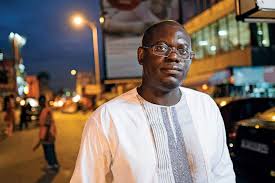
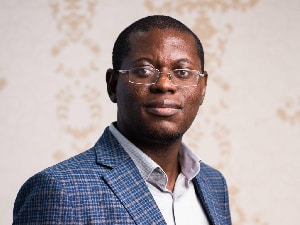
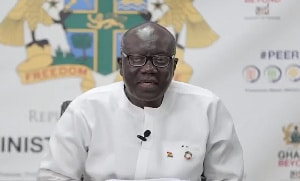
The Vice President of policy think tank, IMANI-Africa, Bright Simons, has stated that Ghana’s external creditors, such as China may not grant the country approval to restructure its debt due to the amount being spent on the National Cathedral project.
He claimed that government has decided to spend an amount ranging from $500 million to $1 billion on the construction of the National Cathedral project.
He made this assertion in an X post on December 5, when sharing his views on Ghana receiving clearance from its creditors for an external debt restructuring.
“I’m beginning to get the feeling that when creditors see that Ghana is hell bent on spending $500m to a $1 billion to turn its capital into a “New Jerusalem”, they feel emboldened to play hardball. It’s like, “these people got dough, but they wanna play us,” Mr Simons wrote.
I'm beginning to get the feeling that when creditors see that Ghana is hell bent on spending $500m to a $1 billion to turn its capital into a "New Jerusalem", they feel emboldened to play hardball. It's like, "these people got dough, but they wanna play us." pic.twitter.com/DO4470odUg
Finance Minister Ken Ofori-Atta said last Thursday that he was confident the country would reach a restructuring deal with its official creditors by the end of this week.
The “cut-off date” – the date after which new loans will not be restructured – and the comparability of treatment between creditors are the major outstanding issues, Ofori-Atta told reporters, adding that any cut-off date would be fine for Ghana.
No single creditor, whose committee is co-chaired by China and France, is holding up the debt restructuring, with all concerned about their own interests, he said.
Ghana defaulted on most of its external debts in December 2022, after it was locked out of international capital markets and its debt costs spiralled out of control, exacerbating an economic crisis in which its currency slid and inflation soared.
Also, Ken Ofori-Atta has called for a strategic reassessment of the current discussions on the construction of the National Cathedral, emphasizing its potential as a significant driver of economic growth.
During the Ghana Tourism Investment Summit 2023, Ofori-Atta pointed out the cathedral’s role as a robust infrastructure that could greatly enhance the tourism sector.
He envisioned the cathedral becoming a pilgrimage destination for millions of Christians across Africa, potentially attracting visitors with an average spending of $3,000 each, translating into substantial economic benefits for the country.
“As we look at something like the Cathedral that has economic benefits beyond what we see…In Africa, we have some 600 million people who are Christians so imagine Ghana as the new Jerusalem and these 600 million people floating through with $3,000 to spend, it is a very different reality.”
Despite the ongoing debates and controversies surrounding the cathedral project, Ofori-Atta urged a more constructive approach, suggesting that the government should carefully consider the cathedral’s potential to contribute to Ghana’s economic development.
“Even as we contend with it and fight about it, let’s think of this triangle and find a reason why we should also add that as part of the infrastructure base as we build a society with a strong, resilient, and robust future,” he emphasized.
The Finance Minister also reiterated the government’s commitment to transforming the tourism and arts industry, recognizing its immense economic potential for driving growth and generating employment opportunities.
He acknowledged the multiplying impact of the tourism sector, emphasizing its ability to positively influence other industries and enhance overall economic well-being.
National Cathedral
Conceived as a physical embodiment of unity, harmony and spirituality, the Ghana National Cathedral will be the nation’s ceremonial landmark, Ghana’s mother Church, where all denominations are welcomed to gather, worship and celebrate in spiritual accord.
The National Cathedral will serve as a venue for formal state occasions of a religious nature such as Presidential Inaugural Services, State Funerals, and National Thanksgiving Services, amongst others.
The cathedral will include; 5,000 permanent seat auditorium,which expands to 15,000 seats, Baptistery Chapel, Conference Center, Grand Ballroom and Restaurant, Music and Choir Areas, National Crypt and Chapels.
Not all Ghanaians are enthused about the construction of the cathedral amidst an ailing economy. They want government to focus such resources on more productive sectors of the economy which would provide more jobs to address the unemployment rate in the country.
So far, millions of dollars have been spent on the construction of the cathedral which has currently stalled due to lack of funds.
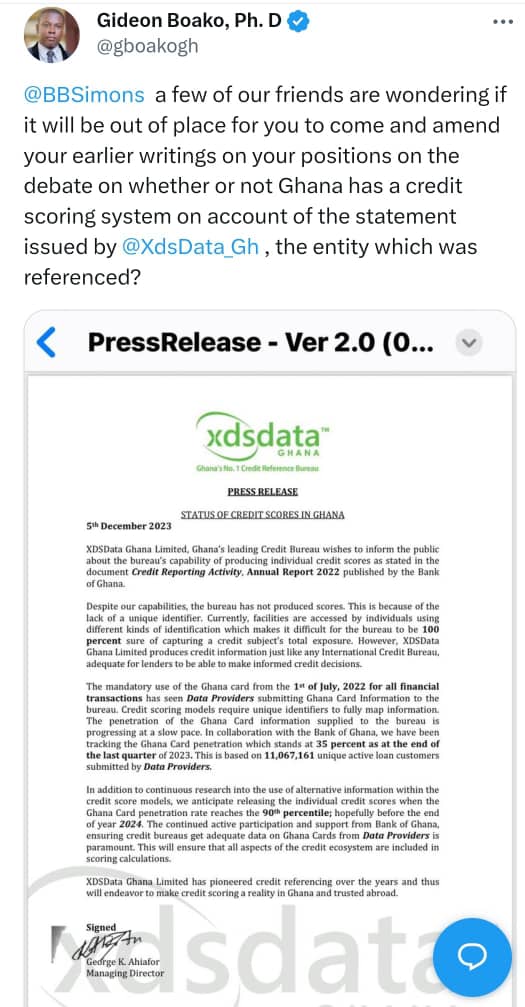
Spokesperson and economic adviser to the Vice President, Dr. Gideon Boako, has called on Bright Simons and Franklin Cudjoe to apologize for what he considers misleading comments regarding Vice President Bawumia‘s statements on the credit scoring system in Ghana.
During the 57th graduation ceremony at the Kwame Nkrumah University of Science and Technology, Vice President Bawumia praised the Ghana card for its potential in establishing a robust credit scoring system to uniquely identify borrowers.
In response, IMANI Ghana’s Vice President sought to undermine the accuracy of the Vice President’s information, a sentiment echoed by IMANI’s President, Franklin Cudjoe. They referenced credit bureau company XDSDATA Ghana Limited, claiming it already had the system the Vice President mentioned.
However, XDSData Ghana Limited clarified through a press release that it has not produced individual credit scores in the country. Dr. Boako, in a separate post on Twitter and Facebook, challenged Simons and Cudjoe to apologize for their comments.
XDSData acknowledges its capability to generate individual credit scores but highlights challenges due to the absence of a unique identifier. According to the Managing Director, George K. Ahiafor, Ghana Card penetration currently stands at 35%, tracked by the Bank of Ghana (BoG). Ahiafor anticipates the release of individual credit scores when Ghana Card penetration reaches 90%, expected by the end of 2024.
Presently, facilities are accessed using various forms of identification, making it challenging for the bureau to capture a credit subject’s total exposure accurately.
However, Mr. Ahiafor emphasized that XDSData produces credit information comparable to international credit bureaus, providing adequate data for lenders to make informed credit decisions.
I have read what my friend @BBSimons wrote about Ghana's credit scoring system. It may interest you to read the following in order to appreciate where we are as a country and where we are going as far as credit scoring is concerned.
He disclosed that the mandatory use of the Ghana Card for all financial transactions since July 1, 2022, has led to Data Providers submitting Ghana Card information to the bureau.
However, he said credit scoring models require unique identifiers for comprehensive mapping of information, and the slow pace of Ghana Card information penetration remains a challenge.
Mr. Ahiafor highlighted the importance of active participation and support from the Bank of Ghana to ensure credit bureaus receive adequate Ghana Card data from Data Providers.
He explained that this collaborative effort aims to incorporate all aspects of the credit ecosystem into scoring calculations.
Ghana is set to introduce a credit scoring system for individuals next year, with the Ghana Card becoming the anchor for the credit system.
Vice-President Mahamudu Bawumia has revealed ongoing discussions with Ghanaian automobile companies to facilitate citizens purchasing cars on credit, with Solar Taxi being one of the companies involved in the initiative.
The proposed credit scoring system aims to establish a reliable credit history, fostering trust and discipline within the financial sector. This announcement has sparked intense debate in the country, with some asserting that individual credit scoring is already in practice, prompting XDSData to clarify its position.
In the intricate realm of personal finance, a numerical indicator known as a credit score holds significant influence in shaping an individual’s financial journey. This score, reflecting one’s creditworthiness, is determined through a meticulous analysis of factors such as repayment history, types of loans, credit history length, debt utilization, credit mix, and recent account applications.
A credit score plays a pivotal role in a lender’s decision-making process, influencing eligibility for products like mortgages, personal loans, and credit cards, as well as determining associated interest rates.
The importance of a credit score in an individual’s financial life cannot be overstated. A higher credit score increases the likelihood of loan approval and secures more favorable interest rates. Conversely, lower credit scores may result in declined loan applications or higher interest rates, as lenders perceive higher risk.
Lenders are more inclined to approve individuals with higher credit scores for loans with lower interest rates, reflecting a perception of lower risk. On the flip side, those with lower scores may encounter challenges in obtaining credit or face less favorable terms.
Understanding the dynamics of credit scores empowers individuals to make informed financial decisions. Regularly monitoring one’s credit report, ensuring accuracy, and actively working towards improving creditworthiness can have a profound impact on long-term financial well-being.
In essence, a higher credit score not only opens doors to financial opportunities but also translates into potential savings over time.
Vice President of the policy think tankIMANI-Africa, Bright Simons, has responded to the government’s implementation of new taxes in 2024, focusing specifically on the introduction of an environmental tax targeting emissions.
He highlighted that manufacturers will face an $8 tax for each tonne of CO2 emitted during their processes.
In a somewhat critical tone, Simons commented on the Association of Ghana Industries, seemingly questioning their support for the government’s proposal for the Import Restrictions Bill.
He wrote on X: “Remember AGI was recently praising the government of Ghana for the import restrictions list? Okay, their time has come. Govt is slapping ~$8 tax for every tonne of CO2 emitted by manufacturers. Cement, fuel, steel, aluminum and all high-energy industries should get ready to be smacked!”
Bright Simons added that the Ghana Revenue Authority will be tasked with measuring the level of CO2 and taxing the companies accordingly.
“Oh, & GRA will be doing the measuring. You will be in your factory like that and they will show up with the measuring device, industry reference charts, & a nice smile pregnant with meaning. Like: Aban nsa, aka wo. Why, you thought it was going to be Al Gore’s Climate Trace?” he added.
Bright also added that some large manufacturers like GHACEM and others could be paying up to $24 million in taxes when these new taxes take effect.
He said: “If GHACEM, Ghana’s largest cement corp, with ~50% share, continues hitting its 3 million metric tonnes a year target, it will face new taxes of $24 million a year if Ghana strictly enforces the new carbon taxes it is introducing. If the Kumasi plant comes on stream, carbon taxes will total $36 million. AGI dey?”
Minority Leader and Member of Parliament for Ajumako-Enyan-Esiam, Dr. Cassiel Ato Forson, has disclosed a list of purported new taxes that the government plans to introduce in the upcoming year.
In a post shared on X on Sunday, December 3, 2024, he presented sections of a tax bill that the government is purportedly aiming to have parliament approve.
According to Dr. Ato Forson, among the proposed new taxes is a 20% levy on the local spirit, ‘akpeteshie.’ Additionally, the government is reportedly seeking to implement a GH¢100 annual tax on all petrol and diesel cars.
“The Akufo-Addo/Bawumia government is imposing a 20% tax on “akpeteshie” (they have run out of ideas). Petrol and diesel vehicle owners should also expect to pay a new annual tax of GHS100 per vehicle on all petrol and diesel cars (internal combustion engine vehicles).
“This tax will be imposed on all trotros, aboboyaas, okadas, taxis, commercial buses, trucks, ambulances, construction and heavy-duty vehicles, water tankers, private cars, etc.
“Once your vehicle is powered by petrol or diesel, the government will impose this tax on you. According to the government, this policy is aimed at promoting the use of cleaner and more eco-friendly sources of energy (like electric vehicles),” he wrote.
The documents alsoshow that the government is seeking to introduce a GH¢100 per tonne carbon dioxide emission tax on all companies in the country.
Vice President of IMANI-Africa, Bright Simons, in a thought-provoking response to recent speculation about a potential 500% increase in passport application fees, has taken to X (Twitter) to question the government’s transparency and accuracy in presenting facts when introducing policies.
Mr Simons, reacting to a publication by Aviation Ghana.com titled “Ghana to charge GHC 500 as passport application fee?”, expressed skepticism about the government’s motives. His tweet suggested that government officials might be manipulating facts to support their agenda, stating, “Anytime Ghanaian govt officials want to push a policy, the facts are the 1st victims!”
The article in question, reported strong indications that the Ministry of Foreign Affairs and Regional Integration was contemplating a significant upward adjustment of passport application fees. Presently, regular service costs GHC 100 (US$8), while expedited service is GHC 150 (US$13). The speculated proposal hints at a potential increase from US$8 to US$40.
Deputy Foreign Affairs Minister Kwaku Ampratwum-Sarpong, cited in the article, reportedly justified the potential fee hike, claiming that the current fees are insufficient to cover the expenses of procuring, processing, and issuing passports. He emphasized that Ghana’s passport is heavily subsidized, being the cheapest in the West African sub-region.
The Foreign Affairs Ministry is planning to shift from a biometric to a chip-embedded passport system, which will cost more. Also, they'll increase passport fees due to supply shortages. pic.twitter.com/tAhSbbI76n
“Our passport happens to be the cheapest in the whole West African Sub-region. Ghana passport cost 8 dollars, the next cheapest is Liberia [which charges] 40 dollars. The supplier of the Liberian and Ghanaian passport booklet is the same company. So our passport is heavily subsidized. The money that we are supposed to use to buy the computers and the printers to be able to provide quick service delivery is being used to subsidized the passport that people apply for, ” he is quoted to have said.
Mr Simons, however, countered these claims by pointing out discrepancies in this reasoning. He highlighted the importance of presenting accurate figures and questioned whether officials should give citizens a basis for mistrust by citing potentially false information.
1/ Anytime Ghanaian govt officials want to push a policy, the facts are the 1st victims! Foreign Ministry wants to increase passport fees by 500%. Excuse is that Ghana's fees are the cheapest in the region. Dep Minister cites a string of wrong facts to push agenda. pic.twitter.com/rGAuNOMFPn
“Foreign Ministry wants to increase passport fees by 500%. Excuse is that Ghana’s fees are the cheapest in the region. Dep Minister cites a string of wrong facts to push agenda. A. Nigeria charges ~$11/$18 for 32-page booklet & $25 for 64-page booklet (official exch rate; lower for market rate). B. Gambia charges $14.5 for 64-page booklet C. Ghana charges $8 for 32-page booklet & $12.5 for 64-page (standard) BUT $12.5/32-page & $16.5/64-page EXPEDITED, he wrote.
He added, “In short, depending on the size & mode of application (standard/expedited), Ghanaian passports can be more expensive than other countries’. Ghanaian passports may well be cheap comparatively. But should Officials give citizens a basis for mistrust by citing false figures?”
It’s crucial to note that the proposed fee increase, as reported by Aviation Ghana.com, is yet to be officially confirmed by the Ministry of Foreign Affairs and Regional Integration. The uncertainty surrounding the information adds an element of caution to the ongoing discussions. As citizens await official confirmation, Simons’ skepticism underscores the need for transparency and accuracy in government communications, particularly when proposing significant policy changes.
In addition to the potential fee increase, the article also touched on the government’s plans to introduce chip-embedded passports in 2024, gradually phasing out the current biometric passports. This shift aligns with international requirements and aims to enhance security.
Vice President of Imani Africa, Bright Simons, is calling on the government to provide a clear and transparent account of how funds generated from the Electronic Transaction Levy (E-Levy) have been utilized in terms of infrastructure and development.
This demand is based on the initial justification for the introduction of the E-Levy, which pledged that its proceeds would be dedicated to addressing the country’s infrastructure and development needs.
Speaking on X on Thursday, November 23, 2023, Mr. Bright Simons emphasized the need for accountability, stating, “18 months after the E-Levy came into force, I think Ghanaians deserve an account of where the massive infrastructure and transformation certain MPs promised during the debate are. Who disagrees?”
The introduction of the E-Levy was met with both support and opposition. Mr. Davis Ansah Opoku, a Member of Parliament (MP) for Mpraeso under the New Patriotic Party (NPP), advocated for its acceptance.
Mr. Opoku highlighted that the government carefully considered the financial implications of the E-Levy, emphasizing its importance in generating funds for essential development projects despite challenges posed by the COVID-19 pandemic.
Addressing the chiefs and people of Osubeng in the Kwahu South Municipality, Mr. Opoku acknowledged the concerns of Ghanaians but underscored the necessity of the E-Levy to fund critical projects outlined in the budget.
The e-levy policy faced rigorous debates and exchanges between the Minority and Majority in Parliament, ultimately taking effect on May 1, 2022.
Finance Minister Ken Ofori-Atta defended the E-Levy, asserting that it provided an opportunity for citizens to contribute to national development. He noted that despite parliamentary debates, Ghanaians largely supported the E-Levy, emphasizing the importance of explaining its merits and positive consequences to the public.
Vice President of IMANI Africa, Bright Simons, has asserted that certain politicians have unlawfully seized land belonging to the Labadi Beach Hotel, a property owned by the Social Security and National Insurance Trust (SSNIT).
He highlighted that individuals connected to the political sphere have encroached upon the hotel’s land, resulting in a depletion of the beachfront area, leaving only two acres of land remaining.
In a sequence of posts posted on X on Friday, November 10, 2023, the IMANI vice president further specified that one of these encroachments is associated with a prominent figure in the NPP.
“Labadi Beach Hotel, built in 1991 by Ghana’s biggest gold mine, is Gh’s most prestigious 5-star beach resort. Since SSNIT, the state pension fund & 100% owner, took over mgmt, political insiders have hijacked the beachfront leaving the hotel with just 2 acres. SSNIT is helpless.
“One of the beachfront encroachments is connected with a ruling party boss,” Bright Simons wrote.
Additionally, he disclosed that the information available to him suggests that a temporary structure established for the Year of Return initiative in 2019 has been converted into a permanent facility.
“Labadi Beach Hotel staff say the facility was meant to be a temporary event location for Year of Return. Now, it permanently blocks hotel residents’ view & bellows loud, disturbing, music every weekend,” he added.
One of the beachfront encroachments is connected with a ruling party boss. Labadi Beach Hotel staff say the facility was meant to be a temporary event location for Year of Return. Now, it permanently blocks hotel residents' view & bellows loud, disturbing, music every weekend.
Vice President of the policy think-tank IMANI-Africa, Bright Simons, has voiced concerns about a $40 million agreement related to cargo tracking at the ports.
This deal has left various stakeholders in a state of apparent unease. The government agencies involved include the Ghana Revenue Authority, Ghana Shippers Authority, the Ministry of Ports, and the Ministry of Trade, among others.
Simons’ disclosure follows a Finance Ministry statement denouncing the authenticity of a circulating letter titled “Re-enhancing Shipping Data Collection and Management in Ghana through Smart Port and Electronic Cargo Tracking,” which purportedly originated from the Finance Ministry.
Bright Simons said: “A deal estimated to be worth about $40m a year has all manner of govt bigshots throwing blows at each other. GRA, Ghana Shippers Authority, Ports, Trade Ministry, etc. Finally, the boss of bosses, Finance Ministry, has stepped in to declare one spunky contractor as fraudulent!”
Expounding on the nooks and crannies of the matter, Bright Simons, said the company that claims to have been validated by the government is a “mysterious entity”.
“The company that claims to have been mandated by Ghana to validate all cargo imports & which the Finance Ministry accuse of fraud & fakery, is a mysterious entity called Antaser, with a string of aliases across Africa (TPMS, BBVA, etc). Its adventures deserve Holywood treatment,” he said.
The Finance Ministry said the said letter noted that from September 15, 2023, all shipments to Ghana, including transit shipments are required to obtain an Electronic Cargo Transit number (ECTN/SPN) and submit it to Antaser Afrique BVBA for verification.
Shippers and stakeholders should be aware that the letter and its contents are fraudulent and ought to be disregarded, according to the Ministry.
The finance ministry thanked shipping agents and other interested parties for prompting them about the alleged letter in a statement released on October 31, 2023, and promised to notify the public of any new tax policies the government may be planning.
“We thank all stakeholders who alerted us and made enquiries and wish to assure them that, as is done with all policies, extensive consultation will be done with relevant stakeholders whenever the government wishes to introduce a new policy or tax,” parts of the statement read.
Vice president at IMANI Africa, has lent his support to the call made by former Special Prosecutor Martin Amidu regarding the need for the Office of the Special Prosecutor (OSP) to provide an explanation for its inaction in the ‘NLA/TekStart Africa Limited Procurement Malpractice and Abuse of Public Office for Private Profit’ investigation.
In a post shared on X on October 31, 2023, Simons asserted that the current Special Prosecutor, Kissi Agyebeng, should publicly inform the people of Ghana about the progress of the investigation concerning the lotteries scandal, which Amidu had indicated was nearing completion prior to his departure from the office.
The IMANI vice president further noted that he had actively participated in an inquiry into the scandal and expressed his view that the corruption within it ranks as one of the most severe instances he has ever encountered.
“I agree with Ghana’s former Special Prosecutor: the current Special Prosecutor must update us on the status of the scandalous National Lotteries Authority’s Nexgo project.
“I personally helped Joy FM to investigate Nexgo, one of the most brazen corruption cases I’ve ever seen,” he wrote.
What Martin Amidu said about the NLA scandal:
Former Special Prosecutor Martin Amidu has raised questions about why his successor, Kissi Agyebeng, has not finalized the investigation into the ‘NLA/TekStart Africa Limited Procurement Malpractice and Abuse of Public Office for Private Profit,’ which he had initiated.
Amidu stated that this investigation, which involves allegations against the CEO of the National Lotteries Authority (NLA) and other authority officials, was almost complete before he left his position. However, Agyebeng has not taken any action on it, and it has not been included in the Office of the Special Prosecutor’s semi-annual report.
In a statement reported by GhanaWeb, Amidu mentioned that all the witnesses and suspects associated with the scandal, where certain government officials at the NLA, including a CEO, are accused of using their positions for private gain in a deal exceeding US$25 million, had already been interrogated.
“Kissi Agyebeng needs to explain the reasons for consistently not listing as part of his half yearly report the almost completed investigation of the suspected 2018 procurement contract giving rise to procurement malpractices and abuse of public office for private profit involving the NLA, and the alleged Chinese entity of Messrs. Shenzhen Xinguodu Technology Limited to supply 30,000 units of NEXGO N5 Smart Point of Sales Terminals (POSTs) for an approved Contract sum by the Board of Twenty-Five Million, Twenty-Three Thousand US Dollars (USD25,023,000.00) which was allegedly represented in Ghana by its agent, Tekstart Africa Limited.
“Witnesses and suspects had been interrogated with witness statements, and suspect statements on caution taken from them, as the case may be. The relevant documentary materials had been obtained through requests for information and production of documents and filed on the case docket. The progress of the investigation is verifiable from the station diary of the OSP, and diary of action in the investigation docket,” he wrote.
He added, “The investigation was left with the interrogation of the three (3) prime suspects, Mr Derek Appiah, the Managing Director of TekStart Africa Limited, one Venesa Marfo associated with TekStart Africa Ltd, and finally the CEO of NLA to be completed and a decision made whether to prosecute or not”.
The evidence, according to Amidu, a former Attorney General and Minister of Justice, before he left office indicated that over GH¢20 million had been transferred from the NLA to TeskStart despite the lack of a formal agreement.
“The evolving investigation made it necessary to investigate the financial affairs of TekStart Africa Limited, a Ghanaian company reasonably suspected of collaboration with public officers in the NLA to use their public offices for private profit. The investigation evidence evolved showing the transfer of a sum of GH₵20,413,864.37 on 18 December 2018 from the NLA account at United Bank for Africa to TekStart Africa Limited’s account at the same bank. It transpired that there was no agency agreement or relationship whatsoever between Shenzhen Xinguodu Technology Limited and Tekstart Africa Limited. The evolving investigation also pointed to the irresistible fact that Tekstart Africa Limited was ordering the subject matter of the procurement contract directly from suppliers in Hong Kong and supplying them to the NLA and taking suspicious levels of fees for clearance and transportation from the Port of Tema to the NLA as though it was the agent of Shenzhen Xinguodu Technology Limited.”
Amidu went on to state that Kissi Agyebeng was the lawyer of the Managing Director of Tekstart Africa Limited, Derek Appiah; suggesting that he (the current special prosecutor) was the one who used all kinds of means to prevent the interrogation of the director.
He reiterated that the special prosecutor must explain to Ghanaians why the case has stalled.
Read Marting Amidu’s full statement on the NLA/TekStart Africa Limited Procurement Malpractice and Abuse of Public Office for Private Profit investigation below:
THE NLA/ TEKSTART AFRICA LIMITED PROCUREMENT MALPRACTICES AND ABUSE OF PUBLIC OFFICE FOR PRIVATE PROFIT
Kissi Agyebeng needs to explain the reasons for consistently not listing as part of his half yearly report the almost completed investigation of the suspected 2018 procurement contract giving rise to procurement malpractices and abuse of public office for private profit involving the NLA, and the alleged Chinese entity of Messrs. Shenzhen Xinguodu Technology Limited to supply 30,000 units of NEXGO N5 Smart Point of Sales Terminals (POSTs) for an approved Contract sum by the Board of Twenty-Five Million, Twenty-Three Thousand US Dollars (USD25,023,000.00) which was allegedly represented in Ghana by its agent, Tekstart Africa Limited. Witnesses and suspects had been interrogated with witness statements, and suspect statements on caution taken from them, as the case may be. The relevant documentary materials had been obtained through requests for information and production of documents and filed on the case docket. The progress of the investigation is verifiable from the station diary of the OSP, and diary of action in the investigation docket.
The evolving investigation made it necessary to investigate the financial affairs of TekStart Africa Limited, a Ghanaian company reasonably suspected of collaboration with public officers in the NLA to use their public offices for private profit. The investigation evidence evolved showing the transfer of a sum of GH₵20,413,864.37 on 18 December 2018 from the NLA account at United Bank for Africa to TekStart Africa Limited’s account at the same bank. It transpired that there was no agency agreement or relationship whatsoever between Shenzhen Xinguodu Technology Limited and Tekstart Africa Limited. The evolving investigation also pointed to the irresistible fact that Tekstart Africa Limited was ordering the subject matter of the procurement contract directly from suppliers in Hong Kong and supplying them to the NLA and taking suspicious levels of fees for clearance and transportation from the Port of Tema to the NLA as though it was the agent of Shenzhen Xinguodu Technology Limited.
The investigation was left with the interrogation of the three (3) prime suspects, Mr. Derek Appiah, the Managing Director of Tekstart Africa Limited, one Venesa Marfo associated with Tekstart Africa Ltd, and finally the CEO of NLA to be completed and a decision made whether to prosecute or not. Kissi Agyebeng wrote letters to the OSP as the lawyer for Mr. Derek Appiah, the Managing Director of Tekstart Africa Limited. Kissi Agyebeng’s client, Mr. Derek Appiah, from June to August 2020 consistently used subterfuges and excuses to avoid being interrogated. On the only or so occasion he came to the OSP he was accompanied by junior lawyers who indicated that Kissi Agyebeng insisted he wanted to be present in person for the interrogation of Mr. Derek Appiah to take place. Kiss Agyebeng confirmed this in writing to the OSP. The fact of his writing was recorded in the Letters Received Register of the OSP, the Station Diary, and also in the Diary of Action on the investigation docket.
In the course of the investigations the link between the NLA, Tekstart Africa Limited, and one Venesa Marfo emerged from my personal UK sources. This led the OSP to the discovery of a Sales Notice for the sale of Plot No. 5205 The Madison, 199-207, Marsh Wall, London, E24 9YT at an agreed price of £1,600,000 (One Million and Six Hundred Thousand Pounds Only) with the purchasers as Kofi Osei-Ameyaw/Venesa Marfo with addresses at 9 Sunflower Lane, Teshie Nunguah with telephone number 233-244-56-3894 and Hse. No. 8 7 th Road Tesano with telephone number 233-246-83-2924 respectively. The vendor of the property was listed as: LBS Properties Limited of the UK. The purchaser’s solicitor was one Samuel Tetteh Quaye in the UK. The transaction from the investigations later fell through but the findings were relevant for the OSP’s investigations of the abuse of public office for private profit at the NLA. The investigations further disclosed that coincidentally, one Venessa Marfo had been involved in several procurement transactions at the NLA including the NLA/Tekstart Africa Limited NEXGO transactions.
The people of Ghana, therefore, deserve an explanation for the reasons for which Kissi Agyebeng decided not to list the NLA/Tekstart Africa/ Venesa Marfo reasonably suspected corruption cases as part of his half-yearly report under Section 3 (3) of Act 959 since he has chosen to list all major pending cases which are not required to be listed for public consumption to give the false appearance that the persons involved must already be liable for corruption offences under Act 959.
Vice President of IMANI Africa, Bright Simons, has reacted to Justice William Atuguba’s (Rtd) description of the court’s judgement in the trial of the Member of Parliament for Assin North, James Gyakye Quayson, as ‘scandalous’.
In a post shared on X on Tuesday, October 24, 2023, Bright Simons said that comments by the former justice of the apex court of Ghana are serious and an indication that not all is well with the court.
He added that if care is not taken, the Supreme Court would ‘sink’ in the future.
“For a former Justice of the Apex Court and one-time senior-most Justice on that same court to break ranks this way, you can judge how low the standing of the Supreme Court is bound to sink if it does not do the necessary soul-searching,” he wrote.
Speaking at a public lecture on ‘Protecting Our Democracy: The Role of the Judiciary’, on Tuesday, Justice Atuguba described the ruling of the court on the trial of Assin North legislator James Gyakye Quayson as scandalous.
He clarified that the court should not have entertained the case initially since it had already been adjudicated by the High Court.
Such a decision, he argued, contradicts fundamental legal principles.
Furthermore, he emphasised that the Supreme Court should have upheld the High Court’s decision rather than initiating a new trial.
“The decision in the Gyakye Quayson case was scandalous. The Supreme Court re-adjudicated the matter already decided by the High Court,” he said.
Justice Atuguba asserted that the Supreme Court made an error in its decision to invalidate Quayson’s election victory.
This decision came despite the Member of Parliament’s clear renunciation of his Canadian citizenship in November 2020, just a month before the December 2020 election.
He pointed out the inconsistency of the court’s stance, questioning the rationale behind the court’s assertion that Quayson owed allegiance to Canada, especially when the court had cited the renunciation certificate issued in 2019 as evidence to the contrary.
Vice President of the policy think tankIMANI Africa, Bright Simons, has suggested that the government is coming to terms with the likelihood that there is no easy resolution to the $140 million judgement debt claim by GPGC, a subsidiary of the international commodities company Trafigura.
Consequently, he mentioned that the government is contemplating a strategy to restructure payments in upcoming years as part of the negotiation for a payment arrangement.
He wrote on X: “Our sources indicate that the govt of Ghana has begun to realize that it has to beat a legal retreat & start negotiating a payment plan with Trafigura re the $140m judgment debt as it has no other leverage with them. As usual, they want to shift payment tranches to future years.”
Background
Trafigura subsidiary is at risk of seizing Ghanaian state properties in London to fulfill a US$140 million award. This comes after a court ruled that there was no need to serve interim charging orders through diplomatic channels, as reported by the Global Arbitration Review.
In the United Kingdom, the High Court has dismissed the Government of Ghana’s challenge regarding the procedures used to serve the country’s proceedings related to a judgment debt claim by GPGC, a subsidiary of the international commodities company Trafigura.
The company had taken legal action against the Ghanaian government over the termination of two power agreements and was granted a judgment debt of US$140 million by a UK court.
Ghana argued that, under existing laws, the company should have served the government through diplomatic channels, contrary to a ruling that allowed alternative services.
The High Court ruled that Ghana’s attempt to use the State Immunity Act provisions as a basis for preventing Trafigura from serving them with judgment debt documents via postal and email methods was not valid.
Trafigura subsequently used email to send court documents through the finance ministry, with all correspondence duly acknowledged, and court dates were agreed upon, as the Government of Ghana instructed its legal representatives to engage with the company.
“Trafigura, a multinational commodities-trading company based in Singapore, is the majority owner of GPGC, a power company that secured the award in January 2021 after an arbitral tribunal found that Ghana had unlawfully terminated a contract for the installation and operation of two power plants,” Global Arbitration Review wrote in an October 13 publication.
In GPGC v The Government of the Republic of Ghana, GPGC was represented by James Willan KC and Catherine Jung of Essex Court Chambers, instructed by Stephenson Harwood.
Ghana was represented by Stephen Houseman KC and Luke Tattershall, also of Essex Court, instructed by White & Case.
The Vice President of IMANI-Africa, a policy think tank, Bright Simons, said that the government is having difficulty getting approval from an IMF team visiting the country for the second portion of a $3 billion loan that was agreed upon earlier this year.
Simon claimed in a tweet that the situation was getting worse because of arguments between the governor of the Bank of Ghana and lawmakers from the opposition. These lawmakers want Governor Ernest Addison and his deputies to step down because they believe the bank is being poorly managed.
The argument between the Central Bank governor of Ghana and the Opposition MPs, who he calls ‘hooligans,’ happened at a very bad time. The government is having trouble getting the IMF to approve the $600 million payment before they leave. This doesn’t make things easier, the person wrote on X (formerly Twitter).
The meeting was taking place during the protest, so the governor sent the director in charge of security from the Board of Governors to collect the opposition’s petition.
The Members of Parliament (MPs) refused the representative because they wanted to personally give the petition to the governor. The director had explained that Addison and his deputies were in a meeting with the IMF team at that time.
The Governor criticized the opposition MPs for their recent protest and called it “completely unnecessary”. The protest happened on October 3, 2023, and the MPs were demanding resignation.
He said he would not quit like the Minority MPs want him to.
The sweet aroma of Ghana’s famed cocoa harvest may soon be tinged with a hint of bitterness, as the nation is likely to grapple with the daunting reality of falling short of its cocoa production targets, Bright Simons has predicted.
He says his sources at the Ghana Cocoa Board have revealed that the country may not reach its target for production this year.
At the heart of this growing concern, he disclosed is the alleged politicization of the Cocoa Board (COCOBOD).
“Our sources say that even the 650,000 tons of cocoa Ghana is targeting this season, the lowest in 13 years, may not be met. Due to rampant politicisation of Cocobod, the state-owned monopoly & the appointment of political agents to key roles, the sector risks total collapse,” he said in Tweet.
COCOBOD, responsible for regulating and supporting cocoa production across the nation, has long been regarded as a linchpin of Ghana’s economic stability.
However, as the country strives to achieve its cocoa production objectives, concerns have emerged over whether political influences have begun to overshadow its operational efficiency.
Simons’ concerns echo the sentiments of many who see the potential for political agendas to derail the meticulous planning and execution required for a successful cocoa harvest.
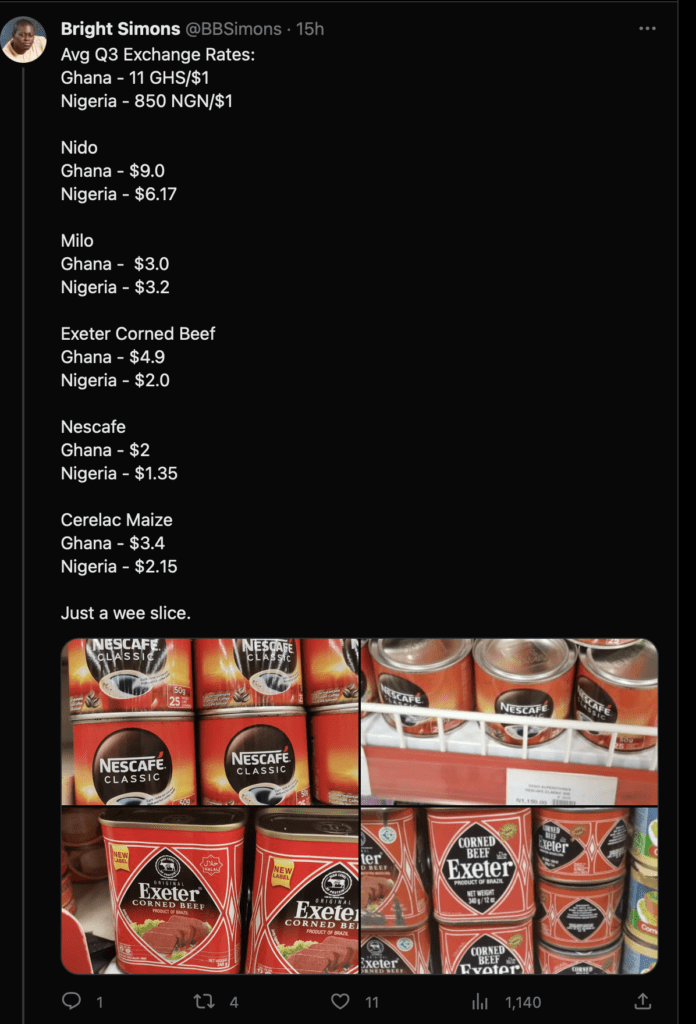
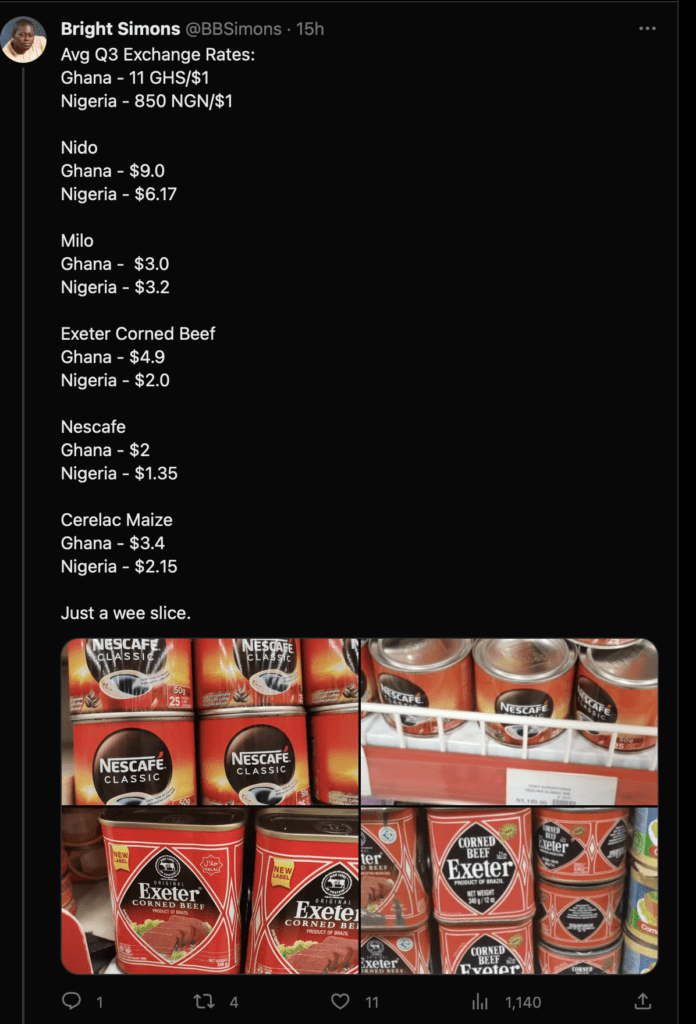
Ghanaian social innovator and entrepreneur, Bright Simons, has sparked a debate on social media after he compared the prices of some basic goods in Ghana and Nigeria.
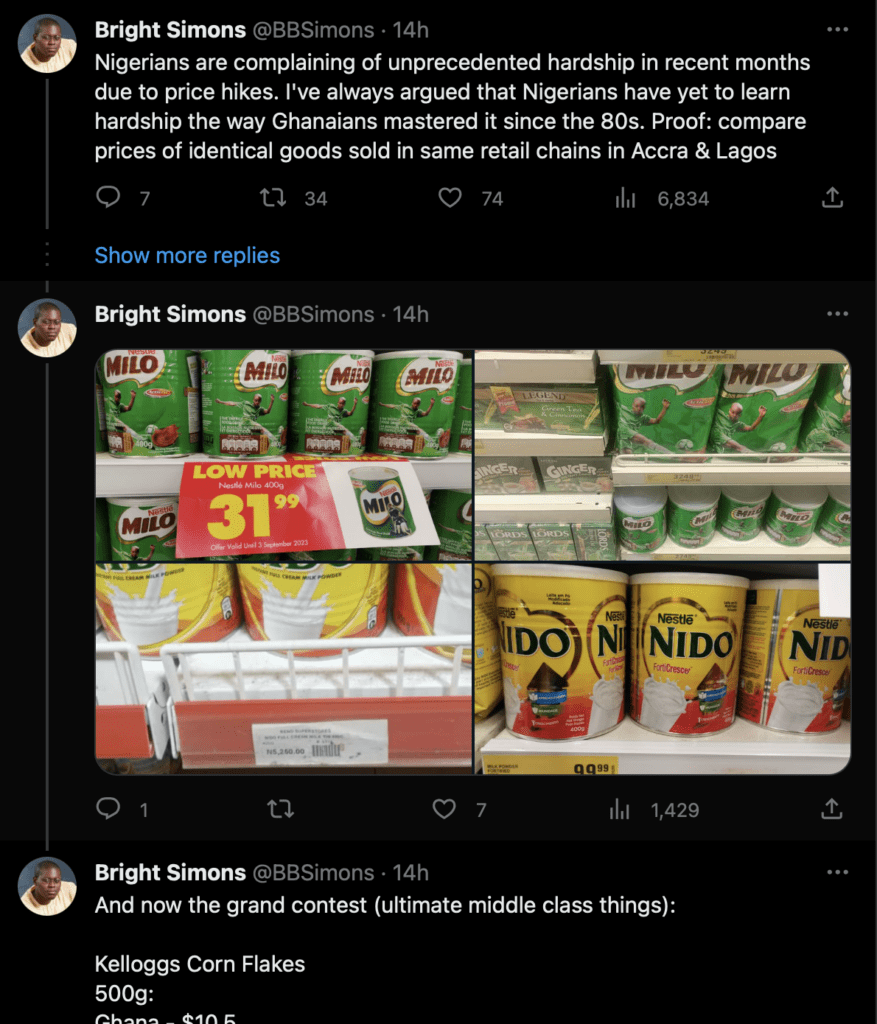
Simons, who is the president of mPedigree Network, a platform that fights counterfeit products, tweeted that Nigerians were complaining of unprecedented hardship in recent months due to price hikes.
He added that he had always argued that Nigerians had yet to learn hardship the way Ghanaians mastered it since the 80s.
He then provided a list of some identical goods sold in the same retail chains in Accra and Lagos, and showed how much more expensive they were in Ghana than in Nigeria.
According to Simons, the average exchange rates for the third quarter of 2023 is 11 Ghanaian cedis per US dollar and 850 Nigerian naira per US dollar.
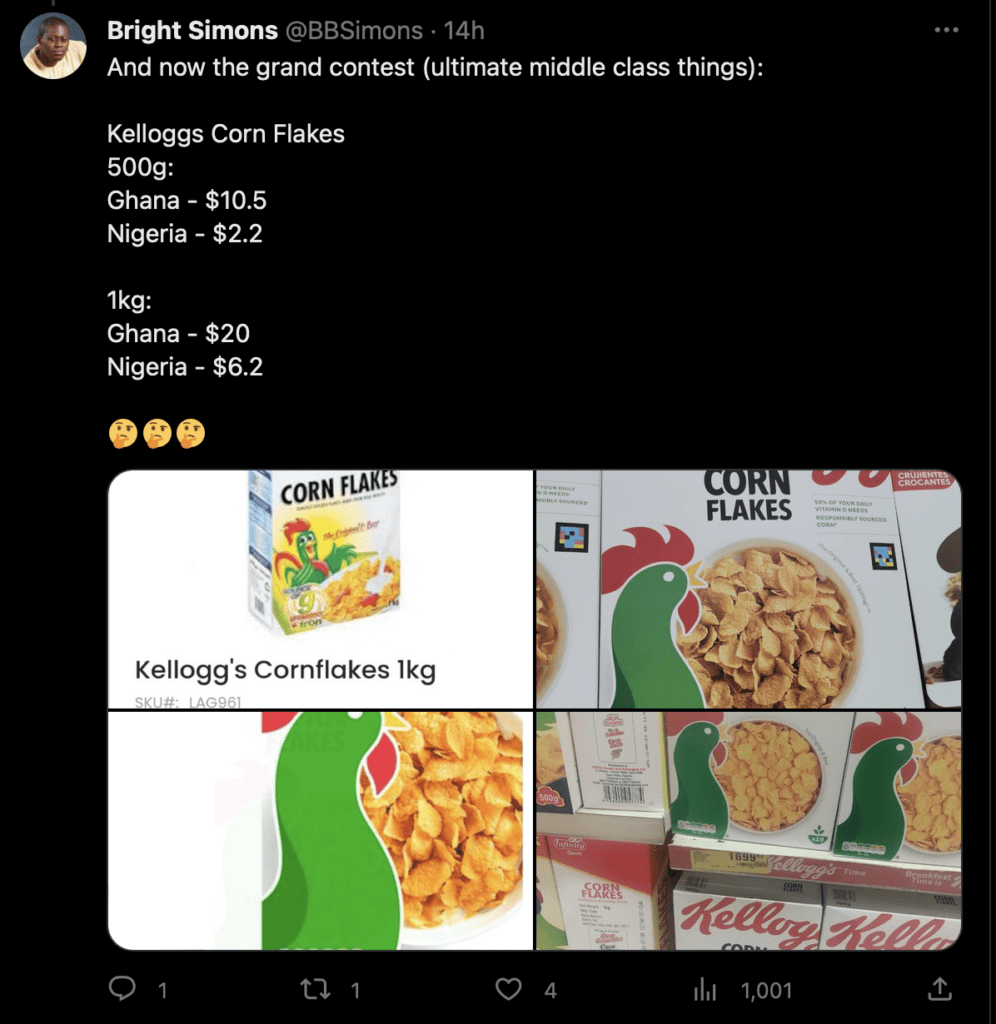
He then gave examples of some products such as Nido milk powder, Milo chocolate drink, Exeter corned beef, Nescafe coffee, Cerelac maize cereal, and Kelloggs corn flakes.
He claimed that these products were significantly cheaper in Nigeria than in Ghana, with some having more than four times the price difference.
He concluded his tweet by saying “Just a wee slice” and “And now the grand contest (ultimate middle class things)”.
Simons’ tweet generated mixed reactions from his followers, with some agreeing with his point and others challenging his data and methodology.
Some Nigerians argued that Simons was not taking into account other factors such as insecurity, income levels, purchasing power parity, inflation rates, taxes, subsidies, and quality standards.
They also pointed out that Nigeria had a larger population and market size than Ghana, which could affect the economies of scale and supply and demand.
They also asked him to consider other aspects of living standards such as health care, education, security, infrastructure, and governance.
Simons defended his tweet by saying that he was not trying to make a value judgment or a political statement, but rather to highlight a factual observation.
He said that he was interested in understanding why there was such a huge price gap between the two countries, and what implications it had for their economic development and regional integration.
He also said that he was open to constructive feedback and criticism, and invited his followers to share their views and insights on the issue.
President of IMANI Africa, Bright Simons, has alleged that each independent director serving on the Bank of Ghana’s board receives a monthly payment of US$8,000, equivalent to GH89852.36 Ghanaian Cedi.
As stipulated in the Bank’s 2022 annual report, the board consists of thirteen directors, including the governor, his two deputies, and ten other directors.
The IMANI president continued that, comparatively, this compensation money is higher than that of other countries like Nigeria and Kenya, Mr Simons said in a Twitter post on August 9, 2023.
Simons made this statement amid the controversy and discussions surrounding the Bank’s leadership and the distressing loss it has caused the state.
“The Bank of Ghana has 10 independent Directors. It seems some people, especially in the Political Opposition, are not happy that they are paid $8,000 a month (86,000 GHS).
Given the calibre of people needed to helm a central bank board, what would folks be comfortable with?” he quizzed.
“One approach might be to compare the case in other similar economies. In Kenya, there are 6 independent directors, with each earning ~260,000 KES a month ($2,000). In Nigeria, there are 7, each earning 2.3 million Naira ($3,000). But there are private boards paying way more,” he added in another tweet.
The ten independent directors are as follows: Dr. Samuel Nii-Noi Ashong – Non-Executive Director Mr. Joseph B. Alhassan – Non-Executive Director Dr. Kwame Owusu-Nyantekyi – Non-Executive Director Mr. Andrew Boye-Doe – Non-Executive Director Mrs. Comfort F. Ocran – Non-Executive Director Mr. Jude Kofi Bucknor – Non-Executive Director Dr. Regina Ohene-Darko Adutwum – Non-Executive Director Mr. Charles Adu Boahen – Non-Executive Director (Till November 24, 2022) Ms. Angela Kyerematen Jimoh – Non-Executive Director Prof. Eric Osei-Assibey – Non-Executive Director
The Annual Report and Financial Statement of the Bank of Ghana reveal that the institution incurred a loss of GH60.8 billion from its audited financial statement for the 2022 fiscal year.
BoG’s loss comes after it saw a GHS GHS¢1.2 billion profit in 2021.
But BoG leadership attributes this loss to the decline in the Group’s net worth position due to the impact of the Domestic Debt Exchange Programme (DDEP) and the impairment of some assets.
Meanwhile, the parliamentary Minority has issued a 21-day ultimatum to the bank’s leadership to step down due to this loss.
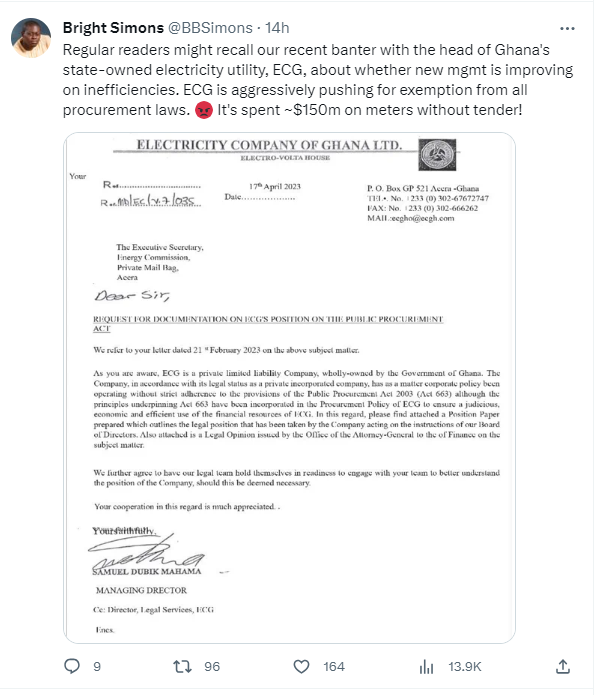
Vice President of IMANI Ghana, Bright Simons, has accused the Electricity Company of Ghana (ECG) of spending a colossal amount of $150 million of meters without a tender.
In a Twitter post on August 2, 2023, he noted that the company is “aggressively pushing for exemption from all procurement laws.”
Mr Bright Simons based his assertion on a letter dated April 17, 2023, from the ECG in response to his request for documentation on the company’s position on the Public Procurement Act on February 21, 2023.
According to the ECG, the Company, in accordance with its legal status as a private incorporated company, has as a matter corporate policy been operating without strict adherence to the provisions of the Public Procurement Act 2003 (Act 663) although the principles underpinning Act 663 have been incorporated in the Procurement Policy of ECG to ensure a judicious, economic and efficient use of the financial resources of ECG.
“We further agree to have our legal team hold themselves in readiness to engage with your team to better understand the position of the Company, should this be deemed necessary. Your cooperation in this regard is much appreciated,” the letter added.
Mr Simons has been questioning the efficiency of the new ECG management under the leadership of Managing Director, Samuel Dubik Mahama, in recent times.
Meanwhile, former Power Minister, Dr. Kwabena Donkor has advised the Electricity Company of Ghana (ECG) to increase its efficiency if it wants to prevent financial losses.
According to him, ECG usually incurred losses due to technical and commercial mishaps during power distribution. This, he says, negatively impacts profit.
“The way out is first ECG has to improve its efficiency. ECG losses about 30% of power they buy either in technical loses or commercialise loses and their margin is not 30%,” he said.
The government of Ghana allegedly paid an Israeli surveillance firm more than $2 million in 2021, according to Bright Simons, the Vice President of IMANI-Africa responsible for Research and Education.
Simons claims that Rayzone, a company that specializes in espionage technologies, received more than $2 million from the government in the pretense of fighting cybercrime.
“In the name of fighting cybercrime, the govt of Ghana paid more than $2 million in 2021 to an Israeli company, Rayzone, which specialises in tapping phones, snooping on people & advanced spyware. Recall that officials of the prev[ious] govt (government) were jailed for bungling a similar deal,” Bright Simons shared in a Twitter post on Tuesday, August 1, 2023.
In the meantime, a Bloomberg report from May 2023 accused Rayzone Group of utilizing data intended for advertisers to aid law enforcement in tracking individuals using their mobile phones via a device called Echo.
The private Israeli spy business allegedly used a flaw in a mobile phone network to enable their clients to monitor people all around the world, according to a report by the Bureau of Investigative Journalism and the UK Guardian.
According to the study, Rayzone was able to “geolocate” mobile phone users all across the world by gaining access to a global messaging system.
Data protection groups are alarmed by Rayzone’s actions because they believe the corporation is illegally assisting governments in invading the privacy of the general population.
In the name of fighting cybercrime, the govt of Ghana paid more than $2 million in 2021 to an Israeli company, Rayzone, which specialises in tapping phones, snooping on people & advanced spyware. Recall that officials of the prev govt were jailed for bungling a similar deal. pic.twitter.com/WVjGrYlQAM
Vice President of IMANI Africa, Bright Simons, has expressed his observation that the New Patriotic Party (NPP) is experiencing the loss of key members, particularly at the grassroots level, in some of its core areas.
According to Simons, this decline in core members can be attributed to internal issues within the party’s systems.
Simons highlighted the recent Assin North by-election as an example, where he believes the NPP experienced a decrease in support compared to previous elections. He also mentioned the Kumawu by-election that took place the previous month, noting that a significant number of NPP voters were lost from what is traditionally considered the NPP’s stronghold, while the National Democratic Congress (NDC) maintained its support base.
Mr. Simons further observed that the National Democratic Congress (NDC) seems to have an advantage in terms of its usual support base in the Assin North constituency.
This advantage stems from the fact that the New Patriotic Party (NPP) has experienced a decline in its traditional voting numbers in this particular constituency, which is considered a swing constituency.
Since 1996, the NPP has consistently garnered around 15,000 to 16,000 votes in the Assin North constituency, according to Mr. Simons.
“The core base [for NDC] is turning out and therefore they are sustained in their core base. The NPP on the order hand appears to be losing their core base in both elections.”
Mr Simons also linked the seeming depletion of the strong core of the NPP to “massive disgruntlement in their grassroots and to some extent the economic factors that are prevailing in the country.”
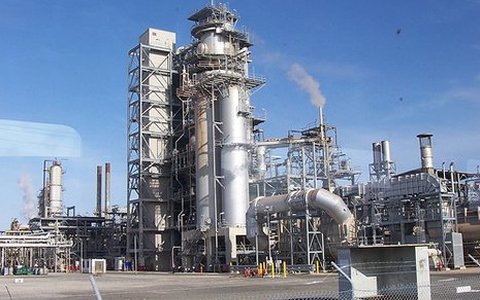
Management of the Tema Oil Refinery (TOR) has moved to reassure the public, particularly Civil Society Organisations (CSOs), that the TOR-Torentco partnership will bring significant benefits to Ghana’s oil industry.
In a statement addressing the concerns surrounding the collaboration, TOR management reaffirmed that the deal is in the country’s best interest.
The partnership between TOR, Ghana’s leading oil refinery, and Torentco, a reputable international energy company, has recently raised apprehension among Ghanaians.
Many individuals and CSOs have expressed fears regarding the potential implications for the country’s oil sector and national sovereignty.
Details of the Deal
In a stunning revelation, Vice President of IMANI Africa, Bright Simons, said the Public Procurement Authority is quietly leasing the Tema Oil Refinery to a shadowy group called Torentco Asset Management (TAM).
He explained that the refinery will be leased to TAM for 6 years where Torentco is allowed to refine up to 8 million barrels of oil a year by paying $1 million every year as annual rent.
He added that the group will also pay an additional rent amount of $1.067 million per month. Under the deal, Bright Simons said the group will pay $0.5 for each extra barrel if it refines more than 8 million barrels.
The CSOs had raised objections to the partnership, which they said had been carried out in obscurity and did not present the best opportunity or value to TOR.
They added that the partnership would render the refinery invalid at the end of its six year tenure.
However, TOR’s management is determined to alleviate these concerns and highlight the advantages that this partnership brings.
TOR’s management said in the statement that it is acutely aware of the concerns raised by Ghanaians, particularly the fear of relinquishing control over the oil industry to an international entity. To address this, TOR has emphasized that the partnership is founded on mutually beneficial terms, ensuring that Ghana’s interests remain safeguarded.
In a three-page report signed by the board and management, they explained that while they had wished to deal directly with a major multinational company, TOR’s accrued debts have made the refinery unattractive to any of them, thus their settling on Torentco.
Additionally, TOR said the partnership will allow the company to move from being an annual loss making entity to a sustained positive net cash flow during the lease, and demonstrate that crude oil can be processed at the refinery, achieving industry accepted yields if managed efficiently.
Moreover, the TOR-Torentco partnership will help curb the outflow of highly skilled personnel seeking opportunities in the Middle East and other regions.
TOR’s board and management stated that the transaction is already in its final stages of documentation and the company has an extensive list of ‘conditions precedent’ which Torentco must satisfy to demonstrate their ability to deliver all that is required in the transaction.
“If at any point they are unable to do so, the transaction will not become effective and TOR will be left to continue with its ongoing efforts to find a solution,” TOR stated.
Vice president of IMANI Africa, Bright Simons, has expressed worry over the diminished power of the Judiciary in checking the actions of the president and his appointees.
Mr Simons remarked that the expectations for the new Chief Justice of Ghana, who will be replacing Justice Kwasi Anin Yeboah following his retirement, have been set disappointingly low.
He stated, “Whether fair or not, the Ghanaian Judiciary in the last few years saw its reputation for checking abuse of power by the Executive sink to its lowest level in the 4th Republic. The bar has thus been set very low for the new Chief Justice.”
In a separate tweet, Simons advocated for a judicial system that empowers citizens in the country. This response was prompted by a GhanaWeb publication announcing the appointment of Justice Jones Dotse as the Acting Chief Justice (CJ) after Chief Justice Anim Yeboah’s retirement on May 24, 2023, without returning to the bench.
In an earlier tweet, Simons called for a more citizen-empowering judicial in the country.
His call was contained in a tweet to a GhanaWeb publication that announced the appointment of Justice Jones Dotse as Acting Chief Justice (CJ) after Chief Justice Anim Yeboah retired on May 24, 2023, and did not return to the bench.
Whether fair or not, the Ghanaian Judiciary in the last few years saw its reputation for checking abuse of power by the Executive sink to its lowest level in the 4th Republic. The bar has thus been set very low for the new Chief Justice. https://t.co/MkZIBD1kJK
In a tweet, he wrote “Ghana’s Chief Justice retires. The activist CSOs I work with recall his rejection of our amicus brief against the EC’s decision to refuse birth certs as proof of citizenship. His reason?”
He continued by adding “We had been criticizing the EC on the radio. We look forward to a more citizen-empowering judiciary.”
Background:
President Nana Addo Dankwa Akufo-Addo nominated a Supreme Court judge, Gertrude Torkornoo, as the next Chief Justice of Ghana.
The president indicated that it is important that he begins the processes for the replacement of the outgoing Chief Justice Kwasi Anin Yeboah now, so as not to create any vacuum.
If approved by the Parliament of Ghana, Justice Torkornoo will be the third appointment to the office of Chief Justice since Akufo-Addo became president in 2017.
She will also be the third female Chief Justice in the history of Ghana, following in the footsteps of Justices Georgina Theodora Wood and Sophia Akuffo.
Vice President of IMANI Africa, Bright Simons, has provided information indicating that the colours used in the Ghana flag originate from Ethiopia.
The late Theodosia Salomey Okoh is credited with creating the recognizable Red-Yellow-Green with Black Star flag of Ghana, therefore whenever her name is spoken, the Ghana flag immediately comes to mind.
The explanations for the choice of colours for the Ghanaian flag are given as the Red- signifying the blood and toil of our fathers who fought for independence for the country.
Gold-being the minerals and other extractive resources, the country can boast of.
Green- signifying the green vegetative cover of the country. Black- is the centre of Hope for the Ghanaian people.
But according to Mr Simons, in 1798, the tricolours (red-gold-green) heraldic banner of the old Abyssinian kings became the triangular pennant flag of the Empire of Ethiopia. At that time, the red was on top and the green was at the bottom.
2/ In fact, Ethiopia itself has changed its flag several times over the course of history. The latest one was *designed* by Abebe Alambo. BUT all the versions take their inspiration from the original Tricolor. Likewise, the "black star" in Ghana's flag was inspired by Garvey. pic.twitter.com/JSAGV05tB7
“The Mighty Menelik II, flush with victory after Adowa, converted the pennant into a rectangular flag in 1897, with the green still at the bottom and red remaining on top.
“But following an interregnum that will see the rises of Ras Tafari (Haile Salassie I) as Negus Nagast (king of kings), we see by 1914 a sudden change of colours. The green has risen to the top and the red demoted!” he wrote.
In Bright Simons’ submission, the reinvented flag by the of the Haile Selassie became known as the ‘pan African’ flag in the era when African leaders such as Nkrumah and the emperor himself, were fighting for a one African state.
“In fact, Ethiopia itself has changed its flag several times over the course of history. The latest one was ‘designed’ by Abebe Alambo. BUT all the versions take their inspiration from the original Tri-colours. Likewise, the “black star” in Ghana’s flag was inspired by Garvey.”
“Ghana, however, reverted to the Menelik design when it also chose the Abyssinian tricolour standard for its national flag,” he added.
He revealed the meaning behind the colours used.
Green represents fertility and natural abundance; Yellow represents hope; Red represents blood of the martyrs and Golden Pentagram stands for unity in diversity.
Vice president of IMANI Africa, Bright Simons, has alleged that ‘notorious gold smuggler’ Alistair Matthias still has access to top government officials.
He says the mining leases of Alistair Mathias, who said he smuggles $40 million worth of gold from Ghana in a documentary by Al Jazeera, are still valid.
In a tweet shared on Sunday, Simons said the gold smuggler still has strong ties in the government and the ruling New Patriotic Party (NPP).
The IMANI vice president was surprised that despite the revelation made by Alistair in the Al Jazeera documentary, the government of Ghana has not acted.
“Alistair Mathias’ revelations to undercover journalists posing as criminals in search of a money launderer have opened a can of worms in Ghana. Analysts see a web of corruption & intrigue entangling security chiefs, govt ministers & even a Supreme Court Judge.
“Even more intriguing is a link to cracks in the ruling party that led to a bizarre military operation against a gold mining company owned by Mathias’ one-time partners. Meanwhile, Mathias’ Ghana mining leases continue to be valid & his access to top govt officials continues,” parts of the tweets he shared read.
What Alistair Mathias said about Akufo-Addo:
Alistair Mathias, who smuggles $40 million worth of gold from Ghana every month, disclosed the kind of close relationship he has with Ghana’s president, Nana Addo Dankwa Akufo-Addo.
Alistair Mathias, who is a gold trader with expertise in designing money laundering schemes for Africans, said that his work has given him access to every president or head of state on the continent.
Speaking in the final episode of the undercover investigations of gold smuggling in Africa by the Investigative Unit of Al Jazeera, Alistair Mathis, who is one of the main characters in the video, boasted about his relationship with the Ghanaian president.
He (described as a financial architect) told the undercover reporters, who had posed as Chinese criminals seeking to launder dirty money from Africa, that his relationship with Akufo-Addo is a close one.
He also claims that the Ghanaian president is his lawyer.
“There’s no head of state or president that either of us can’t get to on this continent. Next door in Swaziland, the king is a close friend of mine. Zambia’s president is a close friend of my friend. DRC Congo, the president has invited me several times to come and build a refinery.
“Ghana’s president is a good friend of mine. In fact, he was my lawyer. Cyril Ramaphosa here; I know him. I know his kids,” he bragged.
Also, Kow Essuman, a legal counsel to President Nana Addo Dankwa Akufo-Addo, has urged Ghanaians to ignore allegations by Alistair Mathias, a Canadian gold smuggler, that the president is his law.
In a tweet shared on Sunday, April 16, 2023, Kow Essuman said that neither President Akufo-Addo nor his law firm has come in contact with Alistair Mathias.
He added that the statements made by the gold smuggler were mere fabrications.
“The President has not been in private practice since 2000, neither has the President nor his law firm, Akufo-Addo, Prempeh and Co, acted as a lawyer for this Alistair Mathias or Guldrest.
“The President does not know this Mathias or Guldrest. Ignore the spurious allegations,” the tweet he shared read.
Honorary Vice President of IMANI Africa, Bright Simons, claims that the government’s 85% participation rate in the domestic debt exchange programme does not accurately reflect the amount of debt that needs to be treated in order for the government to be able to pay off its debt in a sustainable manner.
He noted on JoyNews on Saturday that while the government had first stated that it was attempting to restructure 137.2 billion cedis in debt, on the 7th of February, as the program’s deadline drew near, the sum had been reduced to 130 billion cedis.
However, after the deadline, when participation had been finalized the government announced that the debt to be treated had once again been reduced to 97 billion cedis.
“Now what we’re saying is that these are gimmicks in a way and it’s nice to tell a good story and it’s true that this government has hit 85%. But the truth of the matter is that that was only because we reduced the total amount of bonds that you claim you now need to fix or you’re able to fix which is called the eligible debt.
“So you only get the 85% if you don’t use the final adjusted number which is the 130 billion, but if you use the 97 billion,” he explained.
He noted that while the 85% paints a good picture for the government’s programme, the drastic reduction in the debt base to be treated poses a big problem.
“The reason why that is important to the whole purpose of that exercise is because we can’t pay the debt. So if you’re only treating a small percentage of the problem then the bigger problem remains. So that is the key issue at stake.
“That 85% participation rate, it’s a good-looking number but it doesn’t reflect the reality of how much debt the government felt at the end of the programme, not at the beginning, at the end of the programme on 7th February was critical to be treated in order for the government to be able to continue to service its debt. That’s the argument that we are making,” he said.
Vice President of IMANI Africa, Bright Simons has called into question government’s announcement into how over 85 percent of eligible local bondholders signed up for the Domestic Debt Exchange programme (DDEP).
Simons is particularly curious about how 35 percent of bondholders signed on within a 24-hour duration citing ‘customized’ calculations on the part of government to suit the high final participation rate of 85 percent.
“So, the government of Ghana has decided to choose its own arbitrary number for tendered outstanding principal & declared an 80%+ participation rate. Great!
“So, that means maximum DEBT RELIEF. Creditors want no stories going forward about debt service. We will all see by mid-year budget,” he tweeted on February 14 before
offering further explanation in a follow-up tweet.
Bright Simons also explained how government through its consultants adjusted the matrix for calculating the participation rate to allow it arrive at a higher participation rate.
“I see that government of Ghana has been getting full worth from those high end consultants from Lazard. As soon as they saw resistance they began to adjust the principal of outstanding debt to ensure the right participation rate. From GHS137bn to GHS130bn to GHS97bn,” he tweeted.
He posited further that most analysts had pegged the highest rate government could arrive at was between 60 to 63 percent but the adjustments made a higher rate possible.
“So essentially if you use any of the old outstanding principal numbers (focus only on the grand total at the bottom), you get 60% to 63% participation rate, as per analysts’ projections. But who cares at this point,” he added.
The Ministry Finance on February 13 announced that over 80 percent of local bondholders signed on to the DDEP in a statement that stated the closure of the programme as February 10, 2023.
“The Government’s Domestic Debt Exchange Programme (DDEP) closed on Friday 10th February 2023 with over 80% participation of eligible bonds. The government wants to thank the people of Ghana for their forbearance and support throughout the very difficult times,” the statement said.
The ministry further emphasised that participation in the programme was voluntary and that the right of bondholders to self-exempt was never in doubt.
“However, under the circumstances, Government at the same time, always made a strong but humble appeal to bondholders to participate in the DDEP; seeing it as a very critical act of burden-sharing in the ongoing national effort to tackle the economic crisis, bring back microeconomic stability and guarantee sustainable growth and prosperity for the people of Ghana,” the ministry said.
While emphasising the significance of the exercise and the impact the economy would have felt if it was not undertaken, the ministry stressed that government’s commitment to honour payments to bondholders who elected not to participate in the exercise.
“We would like to stress that, all individual bondholders, especially our senior citizens should be rest assured that their coupon payments and maturing principles, like government bonds, will be honoured in line with government’s fiscal commitments,” the statement said
He claims that the board has acknowledged the possibility that cocoa bills may be challenging to refinance.
Bright Simons wrote on January 27, 2023, “Meanwhile, Cocobod finally recognizes that ambitions to raise $3 billion to refinance cocoa bills are a pipe dream,” on his Twitter page. Planned substantial write-offs should be taken into account by banks and other investors.
Earlier this week, the Bank of Ghana stated it had secured an agreement with the Ghana Cocoa Board and commercial banks to allow the of use COCOBOD’s deposits and placements held at the various banks to cater for retail customers who may not want to roll over their cocoa bills.
This comes after the cocoa regulator [COCOBOD] recently defaulted on payments of its matured 182-day bill for the first time, rolling over outstanding securities of GH¢940.4 million, without the consent of investors.
But the Central Bank in a statement issued on January 23, 2023, admitted that after a meeting held with COCOBOD, “it was agreed that all institutional investors will roll over their maturing cocoa bill for Tender 6155 adding that “financial institutions have agreed to roll over their cocoa bills investments.”
“To reduce the cash flow challenges on retail holders of cocoa bills, the Bank of Ghana, Cocobod and the commercial banks have agreed to allow banks to use Cocobod’s deposits/placements held at the various banks to cater for retail customers who may not want a roll-over of their cocoa bills,” the Central Bank said.
“We, therefore, expect that this short-term cash flow challenges facing Cocoa Board will be resolved soon to enable Cocobod meet its obligations to investors,” it added.
It, however, pointed out that the COCOBOD has assured the BoG that the outlook for the 2023 crop season looks promising while cocoa purchasing is also making headway.
According to a report by Oxfam, the transparency was based on how the previous administration approached the fund by consulting with civil society organizations (CSOs).
He added that as an actor in the CSO sector, he agreed with Oxfam: “I also find that the current IMF process is the opposite: with zero govt interest in openness & engagement.”
Mahama government goes to IMF
In 2015, Ghana’s economy was in trouble, hobbled by widening current account and budget deficits, rampant inflation, and a depreciating currency. Credit dried up as interest rates rose and banks’ bad loans piled up.
At the root of Ghana’s woes was out-of-control government spending, largely to pay salaries of an overgrown civil service.
The program
In early 2015, Ghana turned to the IMF for a $918 million loan to help stabilize the economy. IMF advisors, working with the Ghanaian government, developed a three-part program:
Extract from IMF report: Box 2: Ghana
Of all the case studies, Ghana represented the most successful example of meaningful engagement between CSOs and the IMF. This success was due to several factors which collectively amplified the power of Ghanaian civil society with respect to the IMF.
These included: the formation of a joint coalition of over 11 CSOs in 2014, known as the Civil Society Platform on the IMF Programme – now the Economic Governance Platform (EGP); structured preparation and capacity building among the coalition prior to and during IMF engagement; the support of Global North actors such as Oxfam in accessing IMF decision makers and political stakeholders at headquarters level; detailed research and published analysis of the issues up for discussion;*# and public-facing awareness and advocacy campaigns which included experts and stakeholders from different sectors.
These combined factors meant the coalition’s goals and concerns could not be ignored.
The Civil Society Platform on the IMF Programme [the Platform’) was principally responsible for ensuring the success of civil society negotiations with the IMF.
According to him, three groups representing individual bondholders are mobilizing to file a class action lawsuits against the government.
Individual bondholders were included in the DDE which was announced by Minister of Finance late last year after labour organizations forced government to remove pensions from the DDE programme.
“It was anticipated that adding individual/retail investors to Ghana’s debt default will increase the risk of litigation,” Simons noted in a January 7, 2023 tweet,
Adding: “At least 3 groups representing individual bondholders have commenced mobilisation to file class action lawsuits. One group is led by a former SEC Boss.”
Government is hoping to close a deal on debt restructuring at home in order to be able to access an International Monetary Fund (IMF) facility to support the failing economy.
Minister of Finance Ken Ofori-Atta on December 6 announced that government was restructuring bonds held by institutional investors, putting them into four groups stretching 15 years. With interest also spread in four tranches in four years.
The programme faced stiff opposition from major professional groups and workers union in the country because of its pension component.
Ken Ofori-Atta outlines Domestic Debt Exchange programme
Bright claims that no discussions on any issue have ever taken place in any kind of meeting with the corporation.
The truth concerning IMANI’s participation with Menzgold will eventually come to light, according to Nana Appiah Mensah, also known as NAM1, in a tweet on December 24. He claims he has evidence to support his assertions, including a previously recorded meeting with IMANI that has been securely “vaulted.”
NAM1’s tweet was in response to a statement made by the President of IMANI, Franklin Cudjoe, on December 24 that read, “NAM1 must be smiling and waving at us now. This life no balance”.
However, Bright Simons responded by saying “IMANI as an org has never met Menzgold or its founders/execs in any context. 2. No exec of IMANI has met them or Menzgold privately on ANY subject EVER. 3. The suggestion that some info in a “vault” relates to secret meetings is ENTIRELY false & borders on defamation.”
Bright Simons also noted that the claims by NAM1 were “perverse and actionable at law”.
Meanwhile, the IMANI Veep referenced a GhanaWeb article with the headline “Menzgold has become a public policy issue – IMANI suggests way forward” to point out that the only analytical work done on Menzgold by IMANI urged SEC, not BoG, to take the lead & questioned the gold-based business model. That is it.”
Between 2003 and 2006, Ghana received the second-highest amount of debt relief in Africa as a result of the HIPC program, and as a result, the percentage of government income used to service debt decreased from almost 40% to just over 10%.
Unfortunately, the rate at which the country accumulated debt soon outstripped the rate of growth in national output and government revenue. Between 2018 and 2021, domestic debt alone grew, on average, more than 26% per year.
Foreign borrowing also expanded dramatically from 2018 onwards, resulting in Ghana’s outstanding Eurobond debt more than tripling in just 3 years. Indeed, annual foreign borrowing exceeded $6 billion per year until the taps were shut in late 2021, when the government failed to raise a $1.5 billion facility in October of that year.
That failure triggered a spiraling loss of market confidence as investors looked more closely at Ghana’s books and saw clear signs of pending insolvency. For instance, debt servicing costs had started to consume more than 50% of domestic tax revenue (today, it tops 70%). A selloff of Ghana’s bonds then followed leading to massive losses for investors, belated ratings downgrades, and an estrangement of Ghana from the international capital markets.
In July of 2022, the government reversed earlier decisions not to return to the IMF for a bailout and soon thereafter faced up to the unsustainability of public debt. In October 2022, it began to explore a restructuring of its debt, as a precondition for securing an IMF program, and formed a five-member committee of eminent bankers to solicit viewpoints from across the financial industry. Repeated claims were made about the government’s commitment to a “market-led” (not just “market-friendly”) process that will embrace the perspectives of the country’s key creditors.
Then, almost out of the blue, Finance Ministry mandarins met finance industry stakeholders on December 2nd 2022, and abruptly announced an imminent debt restructuringin which many creditors on the domestic front stood to lose more than 60% of the value of their government of Ghana securities (i.e. debt instruments, mostly bonds). Not only had no report by the 5-member committee been disclosed to any of the creditor groups, none of the proposals presented by the government on December 2nd reflected any of the perspectives and suggestions the industry representatives had shared with the committee.
On 5th December, the government formally launched the debt restructuring program and set a two-week deadline for creditors to sign away billions of Cedis of asset value. Industry players were not even expected to seriously consult with legal and financial advisors. Theirs was merely to acquiesce.
Yet, the financial effect of the government’s initial proposal was far bigger than any tax or other fiscal burden ever imposed on any Ghanaian sector in one fell swoop. Had the proposals been accepted in the form presented, the financial industry and other creditors would have forgone nearly 27 billion GHS in 2023 alone.
In comparison, the government expects to receive, in 2022, 12.1 billion GHS from oil and gas; 1.19 billion GHS from donor grants; 12.75 billion GHS from personal income tax; 16.5 billion GHS from corporate taxes (by the end of September 2022, the government had made less than 10 billion GHS of this target amount); 15.4 billion GHS from VAT (barely 10 billion GHS accrued by end-September); and 8.573 billion GHS from import duties.
The same picture plays out in 2023, as readers can see below; no tax handle generates anywhere close to the amount of resources the government intends to mobilise from domestic investors through the debt restructuring exercise.
Bright Simons: 7 Flaws in Ghana’s debt restructuring and how to fix them The debt program therefore represents, undoubtedly, the largest single transfer of wealth from the Ghanaian private sector to the government in a single fiscal measure, in living memory. It is equivalent to doubling taxes on the entire corporate sector and giving the bill to only banks, insurance companies, pension funds and a few other investor categories to pay.
Whilst various exemptions since the original proposals were mooted have reduced the initial debt relief amount by some 15%, the “debt exchange” program still remains the biggest single domestic fiscal measure in the country’s history.
The least the government could have done before embarking on such a massive wealth transfer exercise was to have engaged closely with those whose wealth is being expropriated in the crafting of the overall program. This was not done. Instead, a fait accompli was presented to creditors.
Not surprising then to see the government postpone its unilateral deadlines twice, initially from 19th December to 30th December, and subsequently from 30th December to 16th January 2023.
In the rest of this short essay, we discuss the 7 main stumbling blocks in the way of a smooth debt restructuring program.
Poor Stakeholder Management As already hinted above, the poor stakeholder consultations characterizing the Ghanaian government’s approach strikingly differentiate it from the approach adopted in many other countries where similar exercises have taken place in the recent past. In the case of Jamaica, to name but one example, the Advisory Committee representing the interests of the creditors had full access to all financial data underlying the government’s assumptions. It held regular engagements on a wide range of design issues to inform and shape the overall strategy. And it was seen to be articulating the full range of concerns shared by all major creditors.
The Ghanaian government’s idea of consultations is a couple of meetings where monologues are exchanged and vague reassurances of “support” given, this having been how it has conducted all matters of policy since coming to power in 2017. Unfortunately, in a debt restructuring exercise of this magnitude, where such massive amounts of money are involved, its usual style simply won’t cut it.
Creditors are instead demanding to co-create the program through a formal committee process. Creditors are furthermore demanding the engagement of top-notch financial and legal experts to serve this advisory committee, paid for by the government. Failure to accede to these demands would likely lead to more feet-dragging by the major institutions holding a very significant proportion of the debt, and by implication the failure of the exercise.
Considering the government’s incredible good luck in not facing any actual organized opposition to the entire IMF and/or debt restructuring program, it is mindboggling how it has still succeeded in bungling the process so far by failing to engage critical stakeholders in good faith. Given the general sense of resignation across all factions of elite society about the inevitability of some kind of debt restructuring to salvage the economic situation, the government’s inability to build a strong national consensus around the measures needed for the recovery betrays a woeful lack of leadership.
Domestic investors may take some cold comfort from the fact that the government has not limited this practice to the home front. It announced a freeze on servicing external debt without bothering with the niceties of applying for consent from its foreign creditors.
It is true that there was no assurance that a “consent solicitation” of this nature would have been automatically granted. Zambia learnt that hard lesson in 2020. However, research shows that countries that default on their debt before initiating the restructuring process, as Ghana has done on the external front, tend to inflict greater losses on investors. This was the case in Russia in 2000 (50% NPV losses) and Argentina in 2005 (75% NPV losses), for instance.
By contrast, in situations where countries default only after the formal restructuring engagement has commenced, like Pakistan in 1998, Dominican Republic in 2005, and Uruguay in 2003, investors tend to face relatively lower losses (less than 5% NPV losses in the case of the Dominican Republic, for instance). Ghana’s decision to freeze debt servicing before prior consultations have, therefore, signalled an intent to be aggressive in the upcoming negotiations and to be dismissive of investor anxieties. Such vibes, unfortunately, could delay the reaching of an amicable settlement with foreign investors, thereby slowing the consummation of the provisional IMF deal announced on 13th December in the government’s preferred timeline of the 1st quarter of 2023.
It bears mentioning that the Ghanaian government’s timeline of weeks for the conclusion of the debt restructuring process, though not completely unrealistic, is highly optimistic.
Lebanon has been working on its restructuring program since early 2020; Zambia since late 2020; and Suriname since mid-2020. Belize needed 15 months to complete a homegrown program with only technical input, and no direct financial support, from the IMF.
Of course, there are also more encouraging episodes like Ecuador’s that took just 4 months to conclude (in the heat of the pandemic) and, also, the case of Argentina which required 5 months. Instructively, analysts have highlighted the sharp contrast between the Argentinian and Ecuadorian approaches; The latter did not allow a focus on haste to damage investor relations and thus obtained more quality concessions without the acrimony that characterised the Argentinian process.
However one looks at it, Ghana’s attempt to ram through the entire process in barely 3 weeks without even a formal creditor coordinating mechanism is somewhat unprecedented. A case can be made that haste is getting in the way of prudence.
2. Effective Burden-Sharing
Data from the IMF, Barclays Capital, and others on comparative debt relief levels recorded in various debt restructuring programs around the world reveal a worrying feature of Ghana’s debt crisis response plan: the government wants to shift too much of the common pain to investors.
Bright Simons: 7 Flaws in Ghana’s debt restructuring and how to fix them More than a few international analysts are complaining that the amount of government debt burden reduction being sought by Ghana relative to its overall public debt is considerably higher than was witnessed in many previous debt restructuring episodes around the world.
Bright Simons: 7 Flaws in Ghana’s debt restructuring and how to fix them Source: IMF & Barclays Capital Such a belief tends to quickly degenerate into suspicion that the debtor government is being strategic rather than fair and accommodating. Ghana’s behaviour is slowly beginning to resemble that of Greece during its 2011/2012 default episode, which eventually descended into legal squabbles and litigation.
Research by Moody’s shows that investors these days have, since 2015, become used to recovering on average more than 63% of the value of their investments during sovereign debt defaults instead of the 52% average recovery rate seen since 1983. The recovery rate in Ghana’s domestic exercise is lower than 45% for many creditors. The country’s unilateral debt service freeze signals for some analysts prospects of similar steep losses for external creditors too.
There is no doubt that investors have to take a major hit. They are better positioned to absorb financial losses than ordinary Ghanaian citizens are to suffer cuts in social services. But the government is even better placed to bear the mere political costs of cutting patronage spending and wasteful perks.
3. Credibility of the Fiscal Adjustment Strategy
Sovereign creditors get jittery from any sign that the sovereign debtor (Ghana in this case) is not willing to absorb its fair share of the harsh adjustments needed to balance the books and restore fiscal stability and macroeconomic health. Ghana’s seeming overreliance on debt relief and tax raises, and the authorities’ reticence in cutting expenditure by trimming wanton waste identified by many fiscal activists, appear to be steadily giving credence to such a suspicion.
Researchers, such as Veronique de Rugy and Jack Salmon, have shown however that fiscal adjustment programs that balance tax raises more robustly with meaningful expenditure cuts succeed 55% of the time versus only 38% for those that rely predominantly on tax raises.
Creditors worry about the credibility of the overall fiscal adjustment plan because they hate to be bitten twice. Supposing they give in to Ghana’s demands and accept the massive losses being proposed on the basis that half a loaf is better than none. If Ghana’s fiscal strategy turns out to be poor, they may end up losing the other half of the loaf should Ghana default again or start to show signs of future insolvency and the value of the already devalued debt they hold depress further.
The historical evidence does suggest that once a country has defaulted once, the prospects of a future default does go up, and, according to Tamon Asonuma, a subset of countries, about 24 or so of them being frontier economies, tend to default serially. On average, such countries have defaulted more than 4 times each at intervals of just a little over 3 years.
Thus, without considerable assurance about the fiscal consolidation strategy being pursued by the government, restructuring negotiations could drag out for months, as has been the case elsewhere.
4. Absence of Credit Enhancements in Exchange Instruments
Modern creditors have become used to receiving perks when sovereign debtors want debt relief through the exchange of new instruments for old. The new instruments can be enhanced in various ways to make up for the upfront losses. For example, when Seychelles defaulted in 2010 the new debt instruments it tendered to investors had a fresh guarantee backed by the African Development Bank (similar to how the US Treasury backed the “Brady Bonds” used in resolving the 1980s Latin America debt crisis). Even hard-handed Greece offered exchange notes that had English law protection to replace the old bonds that had less-valued domestic law protection. Russia, in a similar vein, added Eurobond features to its replacement bonds in 2000 in order to placate bond investors.
Ghana, by contrast, is pushing to insert single-limb collective action clauses into the new bonds that would make future defaults easier (because, unlike the case at present, a vote by a majority of creditors will impact all creditors). It is removing English law protection from the ESLA and Templeton bonds. And it is applying a total interest standstill that should all but eliminate tradeability of the new bonds in 2023 (an approach that demolishes the prospect of the new bonds providing the liquidity to satisfy redemption that some fund managers claim to be anticipating).
In short, the new lower-value bonds the government of Ghana is offering investors to replace their existing government bonds not only lack attractive enhancements, but they are also manifestly of lower quality in other respects too.
Everyone agrees with the general principle of debt restructuring leading to real liquidity relief and thus providing the government with fiscal room to reset the economy on a better trajectory of sustainable growth. The issue is one of fairness. Investors were actively courted to inject funds that made the government look good. If things have taken a turn for the worse, they can’t be milked twice to make the government’s life easy.
5. Lack of Legislative Guardrails
Much has been made of an advisory opinion by Ghana’s Attorney General suggesting that laws cannot be made to retrospectively attack the rights of creditors and that any such laws would be unconstitutional.
But this advice was quite pointless as that much has always been obvious. In the Greek debt default episode (2011 – 2012), which has become a benchmark of some sort, similar issues were exhaustively addressed. Eventually the statutes that were specially made for the occasion provided a kind of framework for government bankruptcy proceedings in relation to the voting mechanisms required to allow orderly resolution. They were not necessarily expropriation tools.
An example closer to home would be the 2016 law used to resolve Ghanaian banks, several of whom were founded before the law the passed. It would have been preposterous for anyone to argue that the law was being applied “retrospectively” to dispossess bank owners.
The simple fact of the current situation is that the government of Ghana needs to undergo some kind of bankruptcy process. The country is in completely uncharted waters. Rights and obligations are being improvised on the go. It helps to have laws passed on a bipartisan basis to clarify some of the grey areas and to elevate the weightiness of these momentous developments. To leave everything to the administrative fiat of the Finance Ministry is to seriously underestimate the scope of the crisis and its sociopolitical implications going forward.
6. Upside Sharing & Downside Mitigation
Because all debt restructuring programs are undertaken based on forward-looking assumptions, considerable uncertainty is usually a constraint on the calculations of the parties. For example, the government-debtor in making the case of its inability to service debts going forward does so based on macroeconomic projections several years into the future. But some of the anticipated trends could pan out differently. Growth may be higher, interest rates may rise, and inflation may stay stubbornly high.
The true value of the new bonds given to investors in place of their original holdings could thus fluctuate wildly based on how the macroeconomic winds blow. A government that anticipates hardship some years down the line could instead experience a commodity boom that dramatically transforms its finances. Or an influx of massive Chinese investment could change the original trajectory of public borrowing requirements. Or something else.
Moreover, some aspects of any economic improvement may well come from the fiscal room created by the debt restructuring and would in that sense have been partly paid for by investors.
Investors would hate to make massive sacrifices for the long-term only for the situation to abruptly improve and all the gains accrue to the government counterparty. Whilst this is not an easy concern to accommodate, the rise of contingency instruments has revamped the legal technologies available in crafting strategic options for both the government and its creditors to equitably share any windfalls or upside. Argentina in both 2005 and 2010, Ukraine in 2015, and Greece in 2012, all utilised so-called “GDP warrants” to offer investors assurance of higher earnings should the economy grow faster than the baseline. Grenada in 2015 tied its warrant offers to growth in government revenue, which is harder to game.
In a similar vein, some investors have sought protection from a worsening downturn that could exacerbate inflationary and interest rate conditions, whilst some government-debtors have sought to add additional cover for natural catastrophes and other severe reversals of fortune.
Ghana’s current proposals offer none of these creative possibilities. Perhaps it is time to think up one or two gaming-proof mechanisms.
7. Narrative Consistency
A sovereign debt default is a wealth destruction event of megaton proportions. In the panic, paranoia breeds. In such an environment, nothing muddies the waters like inconsistent messaging from the defaulting sovereign.
A. It started with the president and various of his assigns promising investors that there will be “no haircuts”. And then proceeding to unveil a debt exchange program with stiff haircuts. Current domestic bonds maturing, on average, within 3 years will be replaced with a new set maturing on average in more than 10 years. Coupon rates have been cut from an average of more than 20% down to an average of less than 10%. The only way to preserve the value of a bond after such heavy reprofiling (and thus avoid the equivalence of a principal haircut) would have been to increase coupon rates in latter years. Despite near-consensus among investors that there have been haircuts, government spin-doctors continue to persist in the false “no haircuts” narrative.
B. The government has made significant political capital from the decision to exclude treasury bills by presenting it as a gesture of compassion towards the many ordinary citizens who save through these instruments. The real reason of course is that with the bond market having collapsed, and the Eurobond market shut to Ghana, the only public financing lifeline available to the government is the treasury bill market. Some investors were thus surprised to see a caveat in the original exchange agreement hinting at the possible future inclusion of treasury bills in the exchange program.
Bright Simons: 7 Flaws in Ghana’s debt restructuring and how to fix them Extract from the Debt Exchange Prospectus C. Similar discrepancies between rhetoric and action can also be seen in the decision to abandon the earlier pledge to co-create the debt restructuring program with local creditors and the total reliance on foreign advisors and consultants when the actual process got underway.
It would be vitally important going forward that such twists and turns in the official narrative stop for the good of the program.
Conclusion: More Carrots than Sticks
On 24th December, the Ghanaian authorities announced a new deadline for the debt restructuring program of 16th January 2023. The announcement is the first acknowledgement that the government is beginning to take the concerns of creditors seriously.
In the new proposal, the authorities have increased the number of new instruments intended to replace the 69 extant bonds they are seeking to retire from 4 to 12. They also seem to have walked back on an earlier strategy to exempt non-institutional bondholders en masse. Coming on the back of a decision to exempt pension funds from the exercise, the revocation of the exemption for non-institutional bondholders has been interpreted variously as a shortfall-plugging mechanism and/or as an attempt to seal a loophole that would have allowed institutional holders to enjoy an exemption by transferring holdings to individuals and masking ultimate corporate beneficial shareholders through offshore trusts.
The new proposal, whilst showing capacity for flexibility, still falls short of the co-creation demands being made by creditors. It is not clear why the government prefers to engage with creditors without a coordinating mechanism such as a formal advisory committee representing the bulk of outstanding debt. Perhaps it fears that such a process might undermine its negotiation position by removing the “divide and conquer” option. The danger with the attempt to preserve the fragmentation of the creditor community is the likelihood of inertia being traded for lack of organised resistance.
At any rate, there are hints of external holders of domestic debt making preparations to litigate. A group holding derivatives that expose them to defaults on the underlying government of Ghana securities has already filed for an advisory opinion on whether Ghana is already in default.
With nearly 50% of domestic debt likely to fall under one or the other exemption even before formal, coordinated, negotiations, the government is watching in slow motion as bits and pieces of the estimated 22.5 billion GHS in possible liquidity relief for 2023 from the debt exercise start to vapourise.
It is natural in these circumstances for the Finance Ministry to harden its resolve and try and hold the line without further concessions. But such an approach would do little to deter holdouts. The leaked attorney general report has revealed major chinks in the government’s legal armor: there is very limited prospect that holdouts will get a worse deal from the Ghanaian courts. And given the one-year moratorium on interest payments affecting all creditors, the time delay penalty – stemming from litigation – is less onerous for holdouts if government chooses to outrightly default on their bonds.
The Finance Ministry has threatened to render old domestic bonds essentially useless by making it difficult for them to be treated as banking assets. But such threats seem foolhardy when the government’s number one risk management concern in this entire exercise is maintaining financial sector stability, for which cause it is even willing to relax prudential regulations.
There are further logistical complications stemming from the decision to allow exemptees like pension funds to enjoy the full value of old bonds, which presumably means the ability to trade them. Trying to implement elaborate rules on the GFIM trading platforms, including the CSD settlement system, to discriminate against certain old bonds could lead to serious confusion, and would at any rate take time as international contractors and IP owners are involved in managing the platform. And should holdouts exceed 40%, the logistical issues will merely compound.
In a previous essay, we pointed out how certain holders of government debt, like insurance companies, operate in a sensitive market such that any attempt by the government to selectively default on their holdings would trigger various other contagion effects. Similar to the banks, it is not in the government’s interest to take actions that could destabilise insurance companies due to the sensitive intermediation roles they play within the financial system.
All told, therefore, the authorities have very few sticks to coerce the kind of rapid capitulation they have been hoping for since the onset of the debt restructuring program. What they have going for them is the widespread convergence across the entire society on the view that debt restructuring is inevitable. The government should not squander this real benefit. Rather, it should look carefully at its stock of less expensive carrots and leverage them to the hilt. Most of its cards centre around the engineering of consensus by giving creditor groups the sense of truly being part of the solution rather than the problem. A time-bound co-creation process, supported by the industry’s preferred expert modellers, may be far less costly and program-derailing than the government fears. In fact, if designed effectively, it may even save time and considerably nudge the participation rate towards the highly optimistic 80% target the Finance Ministry has now set itself.
The government would do well to move decisively in addressing at least some of the issues raised in this essay well before the 16th January 2023 deadline. If by then teething issues still remain, it would be wise not to announce another new unilateral deadline. Whatever announcements it makes from here on out should be done with the full acquiescence of the leadership of the key creditor groups in a show of collective purpose.
Such optics are hugely critical in dispensing with the image of high-handed fiat the government’s tactics have to date painted. And, even more critically, they are needed to salvage what credibility remains in the government’s ability to steer a successful debt restructuring program and progress from there to successfully launch the new IMF deal.
Bright Simons, the vice president of IMANI Africa, has raised worry over the government’s decision to forego involving a formal advisory group that would have represented the majority of the outstanding debt during talks for the implementation of the IMANI Africa.
Even while he said the new plan put forth by the Finance Ministry in a press release dated December 24, 2022 was admirable, the modified terms still don’t reflect the necessary cooperation with creditors to direct the process.
“The new proposal, whilst showing capacity for flexibility, still falls short of the co-creation demands being made by creditors. It is not clear why the government prefers to engage with creditors without a coordinating mechanism such as a formal advisory committee representing the bulk of outstanding debt. Perhaps it fears that such a process might undermine its negotiation position by removing the “divide and conquer” option. The danger with the attempt to preserve the fragmentation of the creditor community is the likelihood of inertia being traded for lack of organised resistance,” Bright Simons noted in a write-up that identified 7 flaws in Ghana’s Debt Restructuring and how to fix them.
“The leaked attorney general report has revealed major chinks in the government’s legal armor: there is very limited prospect that holdouts will get a worse deal from the Ghanaian courts. And given the one-year moratorium on interest payments affecting all creditors, the time delay penalty – stemming from litigation – is less onerous for holdouts if government chooses to outrightly default on their bonds,” Bright Simons said.
The amended GH¢137.3 billion domestic bond exchange programme is expected to be published this week.
The amended terms would be set forth fully in an Amended and Restated Exchange Memorandum, a statement issued by the Finance Ministry dated 24th December, 2022 said.
As part of efforts by the government to restructure the debt programme, individual investors have been included.
Individual bondholders were originally exempted from the domestic debt exchange, however, after government excluded pension funds following pressure from organised labour, the programme is expanded to cover individual investments.
In addition to the modifications, there would be eight new instruments to the composition of the new bonds, for a total of 12 new bonds, one maturing each year starting January 2027 and ending January 2038.
The government is also setting a non-binding target minimum level of overall participation of 80 per cent of aggregate principal amount outstanding of eligible bonds among others.
He claims that in order to reach an agreement, nations and institutions that have undertaken debt restructuring have consulted investors and creditors.
However, in the instance of Ghana, the proposed initiative has faced strong opposition because, according to stakeholders, they weren’t consulted.
The Ghana Chamber of Trustees, the Ghana Medical Association, and the Trades Union Congress were among the organisations and unions that strongly opposed the initiative.
Bright Simons in a series of tweets on December 9, 2022, said “1 week after presenting creditors an offer to restructure Ghana’s debt, the govt is facing rejection by those who hold ~70% of the debt:
1. Securities dealers & funds
2. Private banks.
3. Insurance schemes
4. Pension funds
5. Non-resident investors
With 10 days b4 the deadline”
He further said that the “Success rate in sovereign debt restructuring is 90%+ so govt has a long way to go. It may have to contend with a “Dominica situation” where the process ended up taking months. Expert Trebesch shows that virtually all recent restructurings have been co-designed with creditors.
“Thus Ghana’s “take it or leave it” model with no menu of options to suit different creditor circumstances is highly unusual. Even stranger is the total lack of creditor input in the design of the program. Another serious credibility crisis is now brewing for govt,” he added.
He claims that in order to restore macroeconomic stability, the government is currently seeking an IMF program, and that investors and citizens around the world are instead watching for indications of a viable fiscal plan.
Bright Simons raised alarm about the government’s plan to impose higher consumption taxes on already-burdened citizens in a series of tweets on November 23.
Bright Simons has also questioned whether an evenly split Parliament, especially the Minority side, will throw their support behind a budget that seeks to impose more taxes on already burdened citizens.
He also indicated government’s inability to consult civil society groups and other relevant stakeholders ahead of the 2023 budget before lawmakers on November 24, 2022.
“The government of Ghana intends to present its budget for 2023 tomorrow. Given the intensity of the economic crisis, investors globally are looking for signs of a credible fiscal plan out of the mess. The government intends to increase consumption taxes. The Parliament is evenly split,” he wrote.
“Anyone who reads bbsimons.com know my analysis of the biggest challenge ahead in resolving the crisis: social and political consensus. It is thus shocking that tomorrow the government expects the Opposition and civil society to support a budget it has not consulted anyone on,” Mr Simons added.
Meanwhile, Finance Minister, Ken Ofori-Atta, has been under intense pressure from members of the governing New Patriotic Party to resign over the current economic challenges which has impacted almost all economic indicators.
The Minority in parliament have also filed a censure motion against Ken Ofori-Atta on some seven grounds.
He criticised government for doing very little to tackle the root cause of the country’s economic challenges and always thinking the problem is entirely imported.
Bright Simons argued that a bloated budget has triggered a debt crisis, but government seemed not bothered about cutting waste fast enough.
“Hundreds of millions of dollars have been splashed on capital projects, such as irrigation dams, that have simply been abandoned. And at the height of COVID the government was doling out millions of dollars to architects and contractors for esoteric projects, such as bible museums, without parliamentary approval as required by law,” Bright Simons bemoaned in a post.
Meanwhile, President Akufo-Addo weeks ago announced authorities have reached advanced stages of negotiations with the International Monetary Fund(IMF) on a bailout programme for Ghana.
Addressing the nation on the economy, Sunday, October 30, President Akufo-Addo said the country is on a steady path to unlock an IMF-supported programme by the end of the year.
“I am able to report to you, my fellow Ghanaians, that the negotiations to secure a strong IMF Programme, which will support the implementation of our Post COVID-19 Programme for Economic Growth and additional funding to support the 2023 Budget and development programme, are at advanced stages, and are going well.”
“We are determined to secure these arrangements quickly to bring back confidence and relief to Ghanaians. We are working towards reaching a deal with the IMF by the end of the year. This will give further credence to the measures government is taking to stabilize and grow the economy, as well as shore up our currency.”
In order to protect Ghanaians from the tough economic conditions, the finance minister announced in April of this year a 30% reduction in the wages and expenses of government appointees.
Bright Simons claimed that the act has not produced much, despite the fact that the Minister has not fully explained the effects of this action.
He said “in the first 9 months of this year, the government earned 51.5 billion GHS in income. Despite pledges to cut 30% of discretionary expenditures, it ended up spending nearly 90 billion GHS. This is despite escalating arrears (that is to say refusal to pay many overdue bills).”
He also noted that due to the country’s inability to borrow from the international market, “it has resorted to borrowing 41.2 billion GHS to plug the gap (fiscal deficit) and pay interest and principal due on debt.”
Bright Simons further reiterated that the government’s statement that the Russia-Ukraine war is to blame for the country’s crisis is ill-founded since Ghana is not directly related to these countries in terms of trade.
“Blaming the Russia-Ukraine conflict would only add up if Ghana were exceptionally exposed to that region. Fortunately, on many indicators such as trade and investment, Ghana is not even among the top 20 African countries with high levels of exposure. How then is inflation in Ghana the fastest rising in Africa behind only Sudan and Zimbabwe?” he asked.
He maintained that if the rumors were accurate, it would eventually have strengthened the cedi.
In his article titled “Ghana Should Not Set Up the IMF to Fail,” the IMANI Africa Vice President made the statement.
Bright Simons noted that the country’s current inflation rate is evidently a reason for the cedi’s depreciation as people seek to find ways to preserve the value of their assets.
He said: “there are multiple factors involved with complex interrelationships… the linkage becomes stronger when the effects are so pronounced.”
While many have attributed the rise to factors such as speculation and the activities of black-market operators, Bright Simons in the article said, “The government’s focus on speculators is wrongheaded because the conditions exist for the vast majority of rational economic actors to want to hedge against the currency. To focus one’s energies in such circumstances on the smaller number of actors with the financial heft, risk appetite and risk capital to profit from the situation is distracting.”
“Sometimes those speculating are following the herd or trying to find the right bandwagon. But profit is a major intention. In that sense, speculators can actually be stabilizing if they sense that the local currency will rise in the future and start to dump their inventories of foreign currencies forcing the rate to align with the long-run equilibrium rate. Many theorists even go as far as argue that speculation at variance with fundamentals is always loss-making and thus unsustainable,” he said.
He however calls on the government to cut wasteful expenditure and “lay a good ground for securing an IMF deal.”
An update on Ghana’s economy is overdue. So here goes. This essay is a series of notes to be read leisurely. Some key takeaways:
– Speculation is NOT the reason for the Cedi’s woes.
– The govt is not laying good ground for the IMF deal.
– Govt, cut WASTE!https://t.co/dAML9CIMbC
Bright Simons, vice president of IMANI Africa, has issued a warning to Ghanaian politicians, saying, “The software glitches at ECG are a reminder to Ghanaian leaders to think critically as they continue to push this erroneous idea of centralizing all civic services in one Ghana Card database.”
In response to a ransomware or zero-day exploit, he tweeted that the nation would shut down.
For the past few days, some ECG customers have been unable to add more electric power credit to their prepaid meters.
The problem which started on Monday is yet to be fixed.
The technical challenge has affected customers in 10 operational regional areas of the ECG in Volta, Kumasi, Accra, Takoradi, Tema, Cape Coast, Kasoa, Winneba, Swedru, Koforidua, Nkawkaw, and Tafo.
Meanwhile, the state-power distributor has announced the extension of working hours at all district offices across the country this weekend.
By the way, he added, the ECG software issues serve as a lesson to Ghanaian authorities to THINK CRITICALLY as they continue to promote the misguided notion of consolidating all municipal services into a single Ghana Card database.
The nation will shut down if a zero-day or ransomware exploit is used!”
For the past three days, consumers have been left stranded due to technical hitches the Electricity Company of Ghana is facing.
This has led to the disruption of the activities of both households and businesses.
Scores of customers have been spotted at various ECG retail shops in a bid to buy prepaid electricity.
The Public Utility Regulatory Commission(PURC) has assured customers that the commission is working closely with the Electricity Company of Ghana(ECG) to resolve utility service struggles.
The ECG announced on Thursday, September 29, 2022, that it is facing a technical challenge that has affected its prepaid metering systems. The electricity service provider said the challenge has interrupted the purchase of electricity credit.
The PURC, in a statement also issued on Thursday, said that the commission has noticed the concerns raised regarding vending problems and promised to work with the ECG to find a quick resolution to the matter.
“The Public Utilities Regulatory Commission(PURC) has noticed with concern, challenges experienced in vending, by consumers on ECash and PNS Metering Systems of the Electricity Company of Ghana(ECG). The Commission is closely monitoring the situation and in full discussions with the service provider to address the issues,” the statement read.
“The Commission wishes to assure all affected customers of its commitment to ensuring the delivery of a safe and reliable utility service provision and to have the issue resolved quickly,” it added.
Vice President of IMANI Africa, Bright Simons has painted a bleak picture about the state of Ghanaian banks as the country’s fiscal system is in distress.
Speaking at the 2022 Baah-Wiredu Memorial Lecture on Thursday, Bright Simons noted that some banks are on the verge of insolvency due to the government’s inability to protect the country’s fiscal space.
He explained that the situation as it is will cause “catastrophic problems” for the economy and the government will need more than its projected $ 1 billion for a financial sector clean-up.
“Some banks are already on the brink of capital distress, some banks are literally on the brink of insolvency in Ghana now because of the government’s attitude that well the fiscal authorities do not have money and so I do not have the $ 1 billion that I need to fix the problem, I am just going to leave it for now.
“We had a run on one or two banks because they keep failing clearing and the word goes out that they are failing clearing and because of that people start to pull out their monies, we are seeing that in the investment side…we know that the $1billion that the Governor says it is waiting for is not enough,” he said.
He added that asset quality reviews done on some banks revealed their distressing positions and urged the government to tread cautiously in dealing with the matter.
“When we do an asset quality review, things that were hidden pop up. Do you remember those days when they announce profits, a large amount and they were winning awards and all of a sudden we did an asset quality review and things started to become frightening…I think that the government has to be extremely careful,” he noted.
The government has since 2018 spent about GH₵25billion on the banking sector clean-up to save the deposits of customers.
Vice President of IMANI Africa, Bright Simons, has noted that some banks are on the verge of insolvency due to the government’s inability to protect the country’s fiscal space.
The dreary picture about the state of Ghanaian banks as the country’s fiscal system is in distress by Mr Simons while speaking at the 2022 Baah-Wiredu Memorial Lecture on Thursday suggests that the situation will cause “catastrophic problems” for the economy.
To remedy this, he suggested that the government injects more than projected $ 1 billion for a financial sector clean-up.
“Some banks are already on the brink of capital distress, some banks are literally on the brink of insolvency in Ghana now because of the government’s attitude that well the fiscal authorities do not have money and so I do not have the $ 1 billion that I need to fix the problem, I am just going to leave it for now.
“We had a run on one or two banks because they keep failing clearing and the word goes out that they are failing clearing and because of that people start to pull out their monies, we are seeing that in the investment side…we know that the $1billion that the Governor says it is waiting for is not enough,” he said.
He added that asset quality reviews done on some banks revealed their distressing positions and urged the government to tread cautiously in dealing with the matter.
“When we do an asset quality review, things that were hidden pop up. Do you remember those days when they announce profits, a large amount and they were winning awards and all of a sudden we did an asset quality review and things started to become frightening…I think that the government has to be extremely careful,” he noted.
The government has since 2018 spent about GH₵25billion on the banking sector clean-up to save the deposits of customers.
As Ghana wallows in an ailing economy, experts are banking their hopes on external economic restructuring measures to help salvage the situation.
Sources say the Finance Ministry is looking at considering a domestic approach to restructuring the current debt servicing modalities.
As deliberation continues between the government and the International Monetary Fund (IMF), stakeholders believe the domestic approach may not be the way to go.
This concern was raised by a senior director for the credit rating agency, Fitch, ahead of the further downgrade of Ghana from CCC to CC.
The Director, Mahin Dissanayake, told Reuters that any kind of domestic debt restructuring may not augur well for the country, especially the local banking sector adding that “the operating environment is looking very fragile.”
Vice President of IMANI Africa, Bright Simons supports this assertion.
Speaking on Newsfile on Saturday, Mr Simons suspected that the potential short-term benefits may compel leaders to consider the domestic approach in order to secure political capital.
According to him, some of these processes may lead to the enactment of some laws which the opposition parties may ride on to claim that government is overlooking Ghanaians to satisfy international interests.
This, he senses, could inform the opposition party to “litigate against the matter again on the political realm by asking you why are you doing for only domestic, why should only Ghanaians suffer when the trie came and we were all enjoying, the foreign investors were also enjoying… and all the other impact.”
This, coupled with other potential short-term impacts of the external debt restructuring mechanism, makes the format unattractive for government.
“The opposition will also have to take into account in their minds, the political gains they stand to make of the usual things that happen with debt restructuring – which is that we see GDP fall, sometimes higher spreads – may mean therefore that they may stand a better chance in the elections and all of that,” he told Samson Lardy Anyenini.
But the expert insists that government must man up and overlook these criticisms and undertake an external approach.
“Even outside the short-term, some will say shortsighted political gains that the opposition will be looking at, is the fact that indeed, analysts will tell you that if you do both external and domestic debt, you tend to see a better recovery overall.
Ghana was downgraded by Fitch on a growing concern that government will seek a debt restructuring as the financial downturn worsens.
Vice President of IMANI Africa, Bright Simons, has alleged that Ghanaians are being stressed with the ongoing SIM card re-registration exercise because of the selfish interest of persons at the National Identification Authority (NIA) and Ministry of Communication and Digitalisation.
According to Bright Simons, the re-registration exercise logically could be done together with the registration for the National Identification Cards (Ghana Card) but this is not being done because of the personal interest of some people at both the NIA and the ministry.
“Procurement is at the root of all the major scandals we have had in this country which involves money if you look closely. I can assure you that all the problems, we are facing with the SIM card (re-registration), the irrationality of the fact that people don’t have the Ghana Card but people are still insisting you should use the Ghana Card.
“If you delve into it very seriously (you will find out that) it is actually because there are private companies behind both sides – the people that are doing the Ghana Card stuff and the people that are doing the SIM registration stuff and they are competing amongst each other.
“So, the simplest thing which should have been that when I was doing my Ghana Card, you will take my phone number, send me a text message to establish that is actually my phone number. And then you will connect the data that has my biometric and that is the end of it, my card is registered. The reason why they will not allow you to do that (is because) it offends some people’s private interests. That is the only reason,” he said at the 2022 Baah-Wiredu Lecture in Accra.
Meanwhile, the National Communication Authority (NCA), on September 5, 2022, announced that persons who have not registered their SIM cards would be barred from receiving certain services, including all outgoing voice calls and data services.
The NCA explained in a statement that the move forms part of punitive actions ahead of the SIM re-registration deadline, which takes effect on September 30, 2022.
It added that persons who fail to register their SIM cards before the September 30 deadline would have their numbers blocked permanently.
But, the Executive Secretary of the National Identification Authority (NIA), Prof. Kenneth Agyeman Attafuah, has stated that his outfit cannot issue Ghana Cards to all persons who need them to register their SIM cards before the stated deadline.
This means that not all the nearly 2 million Ghanaian phone users who do not have the Ghana Card yet will be able to register their SIM cards before September 30, 2022 deadline.
According to Prof. Attafuah, the NIA currently does not have the capacity to print Ghana Card for Ghanaians who need them to register their SIM Cards, citinesroom.com reports.
“There is no way that NIA can register those people. It is technically physically impossible. We had said way back in March that it was impossible. I have said it is like expecting a maiden to make a baby every three months.
“That is not how the physical and logistical system has been designed to respond. We cannot do that,” he said.
Vice President of IMANI Africa, Bright Simons, has praised former Special Prosecutor, Martin Amidu for his commitment to the fight against corruption in Ghana.
Speaking at the 2022 Baah-Wiredu Lecture in Accra, the IMANI vice president said that Ghanaians are not celebrating Martin Amidu enough for his commitment to the fight against corruption.
He added that the former special prosecutor is the only person in Ghana who has in recent times put his political career on the line to fight corruption.
“We have not celebrated Mr. Amidu enough. There are few people in this country who can say with a straight face that they have done the heroics that he has done in this country.
“Remember when it was Woyome’s period, the president of the country is someone, he (Amidu) had known for many years, he was his vice-presidential candidate. You don’t appoint someone (as your) vice presidential candidate unless you think highly of the person.
“This president made him Attorney-General and when this matter (the issue of Woyome) came up, he wanted it to be addressed quietly but he (Amidu) refused to do that. He walked out of the office, put on his gown, went straight to court and filed processes to get the money back and then he got fired,” he said.
Also, Bright Simons said that through the actions of Amidu, when he was the Special Prosecutor, Ghana was saved from losing a lot of money through the Agyapa Royalties deal.
Even though there was extraordinary evidence that the deal was shrouded with corruption, the government was still going ahead with it, “until he (Amidu) decided to write a corruption risk assessment that declared that the whole transaction anathema”, he said.
He added that this action of Amidu made the foreign partners suspend the deal which ended up saving the country $150 million in income every year.
President Akufo-Addo, during his speech at the United Nations (UN) General Assembly, said that the Russia-Ukraine War was having a devastating impact on Ghana and other African countries.
“As we grappled with these economic challenges, Russia’s invasion of Ukraine burst upon us, aggravating an already difficult situation. It is not just the dismay that we feel at seeing such deliberate devastation of cities and towns in Europe in the year 2022, we are feeling this war directly in our lives in Africa.
“Every bullet, every bomb, every shell that hits a target in Ukraine, hits our pockets and our economies in Africa. The economic turmoil is global with inflation as the number one enemy this year,” the president said.
But speaking at the 2022 Baah-Wiredu Lecture in Accra, Bright Simons argued that the president’s assertion is not backed by data.
He intimated that there is evidence that Ghana is performing worse than other Africa surrounding it which means that there is more to the country’s challenges than the Russian-Ukraine war.
“When we start to do the comparative analysis, you cannot use some other factor that has had a uniform effect. I tried my best to give you factors that could have shown that Ghana has been affected more, and as you saw I struggled with the data.
“I went to jobs, I went to growth, I went to how many people were killed and none of it bears out that we were affected worse. So, if you are the worse performing in terms of currency, you cannot complain and say it is because of some factor that has affected everybody uniformly. It is as simple as that,” he said.
Vice-President of IMANI Africa, Bright Simons has described the 2021 Auditor-General’s report as empty and valueless.
Mr. Simons noted that the yearly Auditor-General’sreport is not detailed to effectively audit some of the government’s flagship programmes.
He said the auditor general’s reports in some instances are full of errors with no outright coverage of most essential aspects of the country’s economy.
He argued that for a national auditor report, auditing should revolve around what is causing the nation to be on its knees.
According to him, “a lot of people then make agitations when we have the Auditor General’s reports but the Auditor General’s reports are very hollow.”
“It has nothing in it, a lot of the issues that we really face in Ghana those of us that really work on them day by day, they do not get reported. I have given you few examples, look at one village, one dam when was the last time we had a serious analysis of the spending on one village, one dam in the auditor general’s report, look at one district one factory, look at the electoral registration, the EC, an organization that claims to have thrown away over 2000 laptops, nobody has done an asset audit to find out where that equipment went.
“The auditor general’s reports are not detailed as we think it is, sometimes there are errors and lack of quality and outright coverage…in a national auditor report, you go for materiality, what are the things that make difference to Ghana’s bottom lines,” he said during a speech at the 2022 Baah-Wiredu Memorial lecture on Thursday.
Mr. Simmonsfurther explained that the majority of the country’s spending does not pass through the central accounting system known as the Ghana Integrated Financial Management System (GIFMIS).
This, he noted has caused the country’s accounting system to be in disarray as a lot of the country’s money is not under control.
“A lot of the money is not passing through the central accounting system. In fact, it is quite frightening because when you look at the totals about 80% of the money is not passing through GIFMIS, it is kind of crazy but those are the numbers that the auditors find. These all discrepancies,” he added.
The 2022 Baah-Wiredu Memorial lecture was organised by the Ghana Institute of Public Policy Option in partnership with The Multimedia Group.
It took place at the Kofi Annan India ICT Centre under the theme: “Buying for the Public Good from the Public Purse. Redeeming Ghana’s Fiscal Sanity in the Asylum of Public Financial Reforms.”
Bright Simons, the Honourary Vice President of IMANI Africa, has blasted the Akufo-Addo administration for persistently peddling a misleading narrative about how the Russia-Ukraine war has affected Ghana.
He claims that there is no information available to suggest that the ongoing situation is negatively affecting Ghana.
Bright Simons asserted on September 21 at the 2022 Baah-Wiredu Lecture in Accra that because Ghana’s economy is not as vulnerable to that of Russia and other nations, the government’s reasoning for attributing the crisis to the country’s current economic difficulties is unconvincing.
“When we start to do the comparative analysis, you cannot use some other factor that has had a uniform effect. I tried my best to give you factors that could have shown that Ghana has been affected more, and as you saw I struggled with the data. I went to jobs, I went to growth, I went to how many people were killed and none of it bears out that we were affected worse,” he is quoted by Joy Business.
“So, if you are the worst performing in terms of currency, you cannot complain and say it is because of some factor that has affected everybody uniformly. It is as simple as that,” Bright Simons added.
The IMANI Vice president, however, blamed the current economic challenges on continuous wastage in expenditure by government and its other auxiliary agencies and institutions.
Meanwhile, President Nana Addo Dankwa Akufo-Addo recently speaking at the 77th United Nations General Assembly in New York reiterated the impact of the Russia-Ukraine war especially on African economies.
According to him, “Every bullet, every bomb, every shell that hits a target in Ukraine, hits our pockets and our economies in Africa. The economic turmoil is global with inflation as the number one enemy this year”
IMF bailout
Government has routinely explained that recent economic headwinds are attributable largely to the ravages of the COVID-19 pandemic, the ongoing Russia-Ukraine war and the banking sector clean-up.
The rippling effect has been an increase in the cost of living, record high inflation rates and downgrades of the economy by rating agencies such as S&P and Fitch – a situation which has dealt a heavy blow to government’s ability to access the international capital market.
The Cedi has also been on a free fall compelling the Bank of Ghana to resort to hiking its monetary policy rate to deal with the situation.
The worsening economic situation compelled the government in July to initiate contact with International Monetary Fund for an economic support programme.
Ghana is targeting an amount of US$3 billion over three years from the Fund once an agreement on a programme is reached.
Government hopes to complete negotiations by end of this year in order to receive the funds in the first quarter of 2023.
Honourary Vice President of IMANI Africa, Bright Simons, has criticized the Akufo-Addo government for constantly painting a false narrative about the impact of the Russia-Ukriane war on Ghana.
According to him, there is no available data that seeks to point out that Ghana is adversely being hit by the ongoing crisis.
Speaking at the 2022 Baah-Wiredu Lecture in Accra on September 21, Bright Simons argued that Ghana’s economy is not as exposed to that of Russia and other countries hence government’s justification for blaming the crisis on the current economic challenges in Ghana does not hold water.
“When we start to do the comparative analysis, you cannot use some other factor that has had a uniform effect. I tried my best to give you factors that could have shown that Ghana has been affected more, and as you saw I struggled with the data. I went to jobs, I went to growth, I went to how many people were killed and none of it bears out that we were affected worse,” he is quoted by Joy Business.
“So, if you are the worst performing in terms of currency, you cannot complain and say it is because of some factor that has affected everybody uniformly. It is as simple as that,” Bright Simons added.
The IMANI Vice president, however, blamed the current economic challenges on continuous wastage in expenditure by government and its other auxiliary agencies and institutions.
Meanwhile, President Nana Addo Dankwa Akufo-Addo recently speaking at the 77th United Nations General Assembly in New York reiterated the impact of the Russia-Ukraine war especially on African economies.
According to him, “Every bullet, every bomb, every shell that hits a target in Ukraine, hits our pockets and our economies in Africa. The economic turmoil is global with inflation as the number one enemy this year”
IMF bailout
Government has routinely explained that recent economic headwinds are attributable largely to the ravages of the COVID-19 pandemic, the ongoing Russia-Ukraine war and the banking sector clean-up.
The rippling effect has been an increase in the cost of living, record high inflation rates and downgrades of the economy by rating agencies such as S&P and Fitch – a situation which has dealt a heavy blow to government’s ability to access the international capital market.
The Cedi has also been on a free fall compelling the Bank of Ghana to resort to hiking its monetary policy rate to deal with the situation.
The worsening economic situation compelled the government in July to initiate contact with International Monetary Fund for an economic support programme.
Ghana is targeting an amount of US$3 billion over three years from the Fund once an agreement on a programme is reached.
Government hopes to complete negotiations by end of this year in order to receive the funds in the first quarter of 2023.
Vice President of IMANI Africa, Bright Simons, has labelled Sokoloan and Truecedi as two illegal financial institutions operating in Ghana.
According to him, Sokoloan, which has a branch in Nigeria, has now set up a shop in Ghana where unsuspecting victims work with them for loans.
He further said Truecedi, owned by Jain Finscap, is also an unregistered company in Ghana.
Taking to micro-blogging site, Twitter to share his grievances, Bright Simons asserted that regulators of financial institutions in the country were being inactive to chase out these illegal businesses.
“I thought the Ghanaian regulators would take cue but as with the ponzi schemes, they’re dormant. So the likes of Sokoloan have set shop in Ghana & milking new victims. One fintech called Truecedi claims to be owned by Jain Finscap. It is not even registered as a company in Gh,” Bright Simons’ tweet read.
Beware of loan providers operating without licences – BoG to Ghanaians
Meanwhile, the central bank has urged Ghanaians to desist from doing business with loan providers operating without licences in the country.
The operations of these unlicensed banks, the central bank said, were in contravention of the Banks and Specialized Deposit-Taking Institutions Act, 2016 (Act 930).
The Bank of Ghana added that these unlicensed entities mostly use mobile apps and social media for their activities.
In a press release copied to GhanaWeb, it said, “Bank of Ghana has observed that a number of unlicensed entities are engaged in the provision of loans to the Ghanaian public, in contravention of the Banks and Specialised Deposit-Taking Institutions Act, 2016 (Act 930). These illegal entities mostly employ the use of mobile applications and social media in their activities.
“The activities of these unauthorised entities amount to non-adherence of the consumer protection requirements and an abuse of customer data and privacy laws,” it stated.
Below are the banks providing loan services to Ghanaians without licence from the Bank of Ghana
It has been exactly two years since Vice President Dr. Mahamudu Bawumia said that the One District One Factory plan of the government was succeeding.
He pointed out that only 28 of the 76 factories covered under 1D1F were actually in use, while the other 48 were already-existing businesses that were receiving government assistance.
Taking to micro-blogging site, Twitter to share his grievances, Bright Simons asserted that regulators of financial institutions in the country were being inactive to chase out these illegal businesses.
“I thought the Ghanaian regulators would take cue but as with the ponzi schemes, they’re dormant. So the likes of Sokoloan have set shop in Ghana & milking new victims. One fintech called Truecedi claims to be owned by Jain Finscap. It is not even registered as a company in Gh,” Bright Simons’ tweet read.
Beware of loan providers operating without licences – BoG to Ghanaians
Meanwhile, the central bank has urged Ghanaians to desist from doing business with loan providers operating without licences in the country.
The operations of these unlicensed banks, the central bank said, were in contravention of the Banks and Specialized Deposit-Taking Institutions Act, 2016 (Act 930).
The Bank of Ghana added that these unlicensed entities mostly use mobile apps and social media for their activities.
In a press release copied to GhanaWeb, it said, “Bank of Ghana has observed that a number of unlicensed entities are engaged in the provision of loans to the Ghanaian public, in contravention of the Banks and Specialised Deposit-Taking Institutions Act, 2016 (Act 930). These illegal entities mostly employ the use of mobile applications and social media in their activities.
“The activities of these unauthorised entities amount to non-adherence of the consumer protection requirements and an abuse of customer data and privacy laws,” it stated.
Policy analyst, Bright Simons, has asserted that Ghana’s largest waste company, Zoomlion is the institution to undertake the towing levy of commercial vehicle drivers within the Ghana Private Road Transport Union (GPRTU).
According to him, GPRTU imposed the mandatory towing levy on its members after striking a deal with Zoomlion without their [members] consent.
In a tweet sighted by GhanaWeb, Bright Simons said, “After attempts to impose towing insurance on all Ghanaian motorists failed, Ghana’s largest waste company, Zoomlion, has cut a deal with the private commercial vehicles union to impose the service on all their members. No membership ballot was necessary.”
GPRTU introduces mandatory road tow levy for drivers
According to the General Secretary of GPRTU, Godfred Abulbire, the move which will take effect in October this year will help reduce road crashes in the country.
He noted that any driver who fails to subscribe to the mandatory road tow levy will be blocked from loading within GPRTU terminals.
“All our members will have to subscribe through the app. They will put in their details (name, phone number, car number and car type), then they will pay the fee…When the vehicle breaks down, they will call a toll free number and they will come and tow it,†he said.
“If any driver does not subscribe to the app, we will make sure he will not get access to the loading within all our terminals,” the GPRTU General Secretary added.
He stated that per the payment regime, taxis will be charged GH¢50, trotros GH¢80, long buses GH¢300, and articulated trucks, GH¢500.
The GPRTU on Tuesday, August 9, 2022, launched a mobile application that would capture the details of all drivers and their vehicles to facilitate the operationalization of their service.
This was in partnership with a private entity, Road Safety Management Service Limited (RSMSL).
Bright Simons, the Vice President of IMANI Africa, has questioned whether celebrities who endorse controversial financial schemes should also be held accountable when things go wrong.
His comments, posted on Twitter, came after musician Livingstone Etse Satekla, popularly known as Stonebwoy, was called out by media personality, Bridget Otoo for endorsing a new crypto scheme.
Stonebwoy tweeted a photo of a crypto scheme, Sidicoin, encouraging his followers to join the SidiCoinNFT because “every hardworking person deserves to make money.”
Bridget Otoo, quoted the tweet and questioned why after the controversy Menzgold created, Stonebwoy, who was an ambassador for the scheme, has once again introduced his fans to another scheme.
“You are part of the ambassadors of Menzgold who championed and led customers to lose money. Some have died as a result of the Menzgold scam. Do you think it is fair to introduce them to another “money making venture� Do you really care about them?†her tweet read.
The musician defended his tweet stating thus, “the core problem of the Menzgold saga has the least to do with ambassadors, please you stand in a good position as a Media Personality to seek the reality from NAM1 and the government.â€
But the mPedigree owner in joining the conversation noted that, some fans of the dancehall artiste, “seem worried about his seeming love for endorsing controversial financial & crypto schemes.â€
Simons asked, “should they (celebrities) have to add mandatory risk disclosure?†to ensure Ghanaians are protected.
“Should they have to add mandatory risk disclosure?” he added.
When Menzgold started in Ghana, some Ghanaian celebrities including Okyeame Kwame, Jackie Appiah, Stonebwoy, Joselyn Dumas, Kumi Guitar, and Becca, endorsed the gold dealership company owned by embattled businessman, Nana Appiah Mensah aka NAM1 before it was shut down in September 2018 by the Ghana Securities and Exchange Commission.
Some fans of Ghanaian afropop & dancehall artiste, Stonebwoy, seem worried about his seeming love for endorsing controversial financial & crypto schemes. Should celebrities be held accountable for the ethics of their endorsement? Should they have to add mandatory risk disclosure? pic.twitter.com/J9FoIBTQw8
You are part of the ambassadors of menzgold who championed and lead customers to lose money. Some have died as a results of the Menzgold scam. Do you think it is fair to introduce them to another “money making venture†? Do you really care about them? https://t.co/OPyK1scLH7
Vice President of IMANI Africa, Bright Simons, has expressed concerns over the unprofitability of the Ghana International Bank (GHIB), a subsidiary of the Bank of Ghana in London.
According to him, Ghana seems to have its state-owned enterprise gloom based on the performance of GHIB.
In a post shared on his Twitter handle, the Founder and President of mPedigree indicated that GHIB six years ago used to make a profit of US$17 million.
However, the performance of the bank has plummeted over the years to the extent that it is now making a loss of $16.5million.
Bright Simons said despite making such losses, the bank had also tripled its staff cost over the 6-year period.
“Ghana seems to have exported its State-owned Enterprise gloom. Most folks don’t pay attention to Ghana International Bank, a Bank of Ghana subsidiary in London. From profit of ~$17m 6yrs ago to a loss of ~$16.5m today. And, oh, they tripled staff costs during the same period,†he tweeted.
Ghana International Bank (GHIB) was incorporated in the United Kingdom in 1998 to finance international trade and serve as an intermediary for the flow of funds to and from Ghana.
Authorized and regulated by the Prudential Regulation Authority and Financial Conduct Authority, the bank is now owned by a consortium of major Ghanaian financial institutions, with the Central Bank of Ghana[Bank of Ghana] serving as the majority shareholder.
GHIB focuses on six key areas: treasury and global markets, trade finance, corporate and institutional banking, retail and small business banking, correspondent banking, and payment solutions. But our focus remains the same to support the economies of Ghana and the wider African continent.
Ghana seems to have exported its State-owned Enterprise gloom. Most folks don’t pay attention to Ghana International Bank, a Bank of Ghana subsidiary in London. From profit of ~$17m 6yrs ago to a loss of ~$16.5m today. And, oh, they tripled staff costs during the same period. 🤔 pic.twitter.com/gtCFz5DdIJ
Ghana seems to have exported its State-owned Enterprise gloom. Most folks don’t pay attention to Ghana International Bank, a Bank of Ghana subsidiary in London. From profit of ~$17m 6yrs ago to a loss of ~$16.5m today. And, oh, they tripled staff costs during the same period. 🤔 pic.twitter.com/gtCFz5DdIJ
Both commercial and investment banks around the globe saw a small dip in profits and then a surge in 2021. Private banks in Ghana reported nearly a $bn in profits in 2020 & saw a ~25% surge in profits in 2021. So can’t blame COVID. @kifiluSienupic.twitter.com/ZkIafSGFRF