Tag: British Medical Association

  • Senior doctors support a 48-hour strike next month

    Senior doctors support a 48-hour strike next month

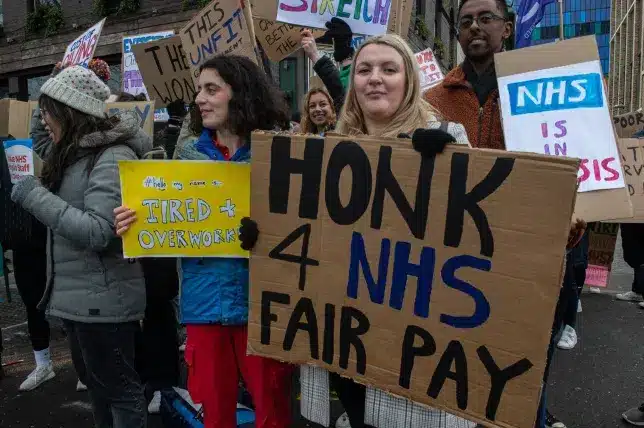
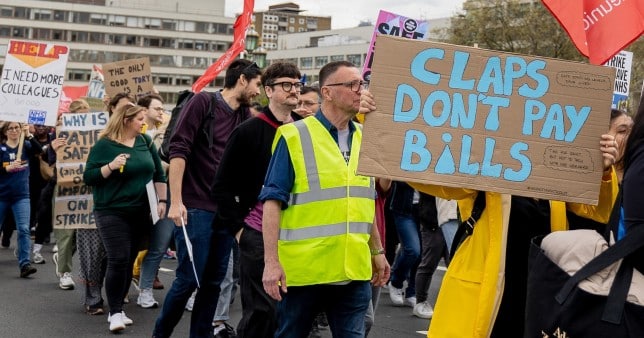
    NHS consultants have decided to walk out in protest over lower pay next month.

    On July 20 and 21, 86% of British Medical Association (BMA) members supported the walkout.

    More than 24,000 consultants in England participated in the election, with a 71% turnout, and 20,741 voting in favour of a strike.

    It will happen just a few days after the junior physicians’ five-day strike, which is scheduled to end on the 18th.

    BMA consultants committee chair Dr Vishal Sharma said the vote showed how ‘furious’ they were at being repeatedly devalued by the government – and calls for a ‘credible’ pay offer.

    The BMA says take-home pay for consultants in England has fallen by 35% since 2008/9.

    The industrial action will take the form of ‘Christmas Day cover’, meaning most routine and elective services will be cancelled but full emergency cover will remain in place.

    Dr Sharma added: ‘We know consultants don’t take the decision around industrial action lightly, but this vote shows how furious they are at being repeatedly devalued by government.

    ‘Consultants are not worth a third less than we were 15 years ago and have had enough.

    ‘Consultants don’t want to have to take industrial action, but have been left with no option in the face of a government that continues to cut our pay year after year.

    ‘However, it is not too late to avert strike action and the government simply needs to come back to us with a credible offer that we can put to our members.

    ‘We are simply asking for fairness to ensure there is a pay settlement that begins to reverse the real-terms pay decline we have suffered and a commitment to fully reform the pay review process to ensure it can make truly independent recommendations in the future that take into account historical losses so that we don’t find ourselves in this situation again.

    ‘But if they refuse, it is with a heavy heart that we will take action next month. We will prioritise patient safety and continue to provide emergency care, in-keeping with the level of services available on Christmas Day.

    ‘Consultants are the NHS’s most experienced, highly-skilled clinicians, and are responsible not just for providing specialist care patients, but also leading entire services and training the doctors of the future.

    ‘The government can and must fix consultant pay now and for the future. Failure to do so will lead consultants to leave the NHS and the country, or towards retirement before their time.

    ‘The loss of this expertise would be devastating for services, patients and the future of the NHS.’

    Earlier today the threat of further strikes by Royal College of Nursing (RCN) members ended because a ballot on further industrial action failed to meet the legal threshold.

    A Department of Health and Social Care spokesman said: ‘We hugely value the work of NHS consultants and it is disappointing the BMA consultants have voted to take strike action.

    ‘Consultants received a 4.5% pay uplift last financial year, increasing average earnings to around £128,000, and they will benefit from generous changes to pension taxation announced at budget.

    ‘Strikes are hugely disruptive for patients and put pressure on other NHS staff.

    ‘We’ve been engaging with the BMA consultants committee on their concerns already and stand ready to open talks again – we urge them to come to the negotiating table rather than proceeding with their proposed strike dates.

    ‘We urge the BMA to carefully consider the likely impact of any action on patients.’

    Sir Julian Hartley, chief executive of NHS Providers, said: ‘Trust leaders, staff and patients are dreading industrial action by consultants next month hard on the heels of a five-day strike by junior doctors.

    ‘A double whammy of consultants resorting to two days of Christmas Day cover and a full walkout by junior doctors days earlier in the longest single strike ever seen in the NHS means disruption for many thousands of patients and yet more pressure on overstretched services. This is a huge risk for the NHS to manage.

    ‘July will be the eighth consecutive month of industrial action across the NHS.

    ‘More than 651,000 routine operations and appointments have had to be postponed already since December due to industrial action across the NHS with knock-on delays for many thousands more.

    ‘We understand how strongly doctors feel – the high turnout in the consultants’ vote shows just how strongly – and why they are striking.

    ‘Trust leaders will continue to do everything they can to limit disruption and keep patients safe, but that’s getting harder and more expensive with every strike.

    ‘These strikes don’t have to go ahead. There’s still time for the government and the doctors’ unions to settle their differences and find a way through.

    ‘The urgency can’t be overstated. Trust leaders want the government and unions to sit down, facilitated by a third party if necessary, to find a way to end strikes.’
  • Doctors to embark on the ‘biggest disruptive NHS strike ever’ for four days

    Doctors to embark on the ‘biggest disruptive NHS strike ever’ for four days

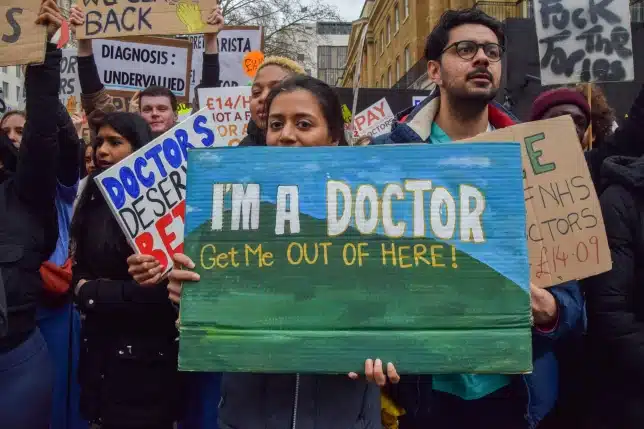
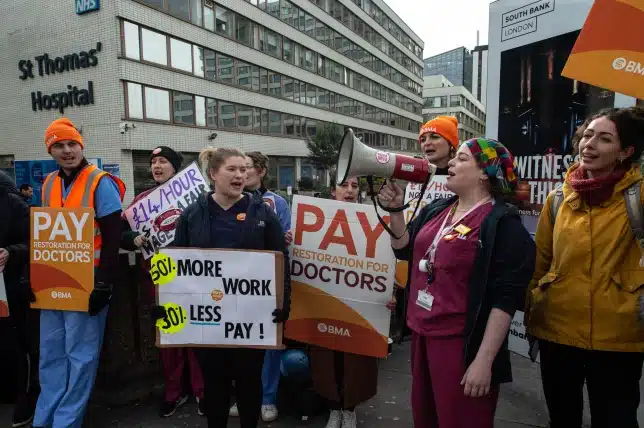
    Tomorrow will see the “biggest disruptive action in NHS history,” according to reports, as thousands of junior doctors go on strike.

    Health administrators have cautioned that when British Medical Association employees strike, it will have a significant impact on essential services.

    To prevent further burden on the already constrained systems, people are being cautioned to refrain from “risky behavior.”

    The strikes are predicted to affect close to 300,000 appointments.
    The event will start tomorrow and last until early Saturday morning.

    Patients have been urged to continue to use 999 and A&E for life-threatening conditions but to use NHS 111 online, pharmacies and GPs for non-urgent issues

    The strikes are the latest in a long-running dispute between public sector unions and the government across Britain and follow three days of walkouts in March.

    Junior doctors are trying to secure a pay rise of around 35 percent, and the union has argued that since 2008-2009 medics have experienced a real-terms pay cut of more than 25 percent.

    Matthew Taylor, the NHS Confederation chief executive said: ‘It is going to be an incredibly tough week. There will be 10-11 days where the NHS is not able to operate at full strength.

    ‘There is no point in hiding the fact that there will be risks to patients,’ he added, before urging the public: ‘Try to avoid risky behaviour because the NHS is not going to be able to provide the level of care it wants to provide.’

    With the health service set to lose the ‘largest part of their workforce’ due to strikes, Mr Taylor said the government and British Medical Association (BMA) need to start negotiations.

    Meanwhile, further strikes are feared in education after teaching unions rejected the government’s offer of a 4.5 percent pay rise and £1,000 one-off payment.

    Professor Sir Stephen Powis, national medical director for NHS England, said that while the service had been ‘preparing extensively’ for the strikes, ‘managing additional pressure’ was becoming more difficult.

    He said: ‘This is set to be the most disruptive industrial action in NHS history, and the strikes tomorrow will bring immense pressures, coming on the back of a challenged, extended bank holiday weekend for staff and services.

    ‘Emergency, urgent and critical care will be prioritised.’

    Writing in the Sunday Telegraph newspaper, health secretary Steve Barclay argued that the BMA’s pay demands were ‘widely out of step with pay settlements in other parts of the public sector’.

    Last month the health unions Unison, the Royal College of Nursing and GMB urged their members to back the government’s pay offer of a one-off bonus and consolidated pay rise of 5 percent for the 2023-24 financial year.

    Barclay said: ‘Unfortunately, the decision by BMA junior doctors’ leaders to maintain an unrealistic position meant we were unable to make progress with talks.

    ‘It seems they are intent on maintaining a militant stance rather than working with the government and NHS management to meet the best interests of their members and of patients.’

    The health secretary warned that the walkouts, which coincide with Easter school holidays, Ramadan and Passover, will pose a ‘considerable risk to patient safety’, echoing comments by senior NHS figures who are braced for severe delays to in-patient treatments.

    A three-day strike action by junior doctors in March resulted in more than 175,000 patient appointments and procedures being cancelled or postponed, placing added strain on the health service as it tries to clear a waiting list backlog of about 7mn patients.

    The NHS Confederation has estimated that as many as 250,000 operations and appointments could be cancelled or delayed as a result of the four-day strike.

  • Junior doctors call a four-day walkout after nurses accept a salary agreement

    Junior doctors call a four-day walkout after nurses accept a salary agreement

    The British Medical Association has confirmed that junior doctors will once again go on four days of strike action in the next month.

    After requesting a 35% wage hike, thousands of junior physicians went on strike earlier this month.

    Health Secretary Steve Barclay, who met with BMA leaders yesterday, claimed the wage claim is “unaffordable.”

    On April 11 and April 15, they will be on strike.

    A agreement supported by unions and offered to other NHS employees includes a 5% salary increase in April and a one-time payment of at least £1,655.

    This is in addition to the raise in wages they received last year of 4.75%.

    Nurses, ambulance staff, physios and other workers are being asked to vote on whether to accept that deal.

    Mandatory Credit: Photo by Loredana Sangiuliano/SOPA Images/Shutterstock (13825975z) A protestor holds a placard during the Budget Day Protest held in Central London. The Tories' budget day was held on 15 March and expected to see over 500,000 workers out on strike. Workers in the NEU, PCS, UCU, Aslef and BMA unions set to strike, including junior doctors in the British Medical Association. Budget Day Protest held in Central London, UK - 15 Mar 2023
    Steve Barclay said doctors are asking for an ‘unaffordable’ pay rise (Picture: Loredana Sangiuliano/SOPA Images/Shutterstock)
    LONDON, ENGLAND - MARCH 14: Striking junior doctors at Homerton Hospital in Hackney hold a rally on March 14, 2023 in London, England. Junior doctors in the UK will strike over pay and conditions for 72 hours from 13 March. (Photo by Guy Smallman/Getty images)

    The three biggest health unions – the Royal College of Nursing, Unison and the GMB – have all recommended their members accept it.

    But the BMA has insisted only a 35% increase will do to make up for 15 years of below-inflation rises.

    Dr Robert Laurenson, who co-chairs the BMA’s junior doctor committee, said: ‘It is with disappointment and great frustration that we must announce this new industrial action.

    ‘The government has dragged its feet at every opportunity.

    ‘It has not presented any credible offer and is refusing to accept that there is any case for pay restoration, describing our central ask as ‘unrealistic’ and ‘unreasonable’.

  • Junior doctors begin a three-day walkout before a massive week of strikes

    Junior doctors begin a three-day walkout before a massive week of strikes

    After it was discovered that junior physicians might make more money selling coffee than saving lives, they will start a three-day strike today.

    In the longest junior doctor protest history, members of the British Medical Association (BMA) in England will erect picket lines outside hospitals across the nation.

    Junior doctors could make more money “serving coffee than saving patients,” according to a BMA advertisement.

    On Budget Day (Wednesday), members of numerous unions will go on strike in what will be the largest single day of industrial action in years.

    Workers taking action include civil servants, teachers, university staff, London Underground drivers, and BBC journalists.

    Rallies and demonstrations will be held across the country, including a big protest in Westminster.

    Public sector unions have criticised the Government over its handling of the pay disputes, which have been escalating for months.

    Mandatory Credit: Photo by Tayfun Salci/ZUMA Press Wire/Shutterstock (13756270y) Nurses are seen at picket line outside St Thomas' Hospital as tens of thousands of nurses and ambulance staff go on strike in the biggest walk out action of NHS history over pay and conditions. Nurses and ambulance staff go on strkie in the UK, London, England, United Kingdom - 06 Feb 2023
    It has come after months of strike action across the UK (Picture: Tayfun Salci/ZUMA Press Wire/Shutterstock)

    Progress has been made in Wales and Scotland after negotiations with ministers, but unions say the Westminster Government is taking a completely different approach.

    The BMA said newly qualified medics earn £14.09 an hour, less than a barista in a coffee shop, adding that junior doctors in England will have suffered a 26% real-terms cut to their pay since 2008/09.

    An advertising campaign launched by the trade union says: ‘Pret a Manger has announced it will pay up to £14.10 per hour.

    A junior doctor makes just £14.09. Thanks to this Government you can make more serving coffee than saving patients. This week junior doctors will take strike action so they are paid what they are worth.’

    Workers on the picket line outside Royal Sussex County Hospital in Brighton during a strike by nurses and ambulance staff. Picture date: Monday February 6, 2023. PA Photo. Nurses in England who are members of the Royal College of Nursing (RCN) are striking along with ambulance workers from GMB and Unite. See PA story INDUSTRY Strikes. Photo credit should read: Gareth Fuller/PA Wire
    Junior doctors will go on strike from today (Picture: PA)

    Dr Becky Bates, a first-year junior doctor in the Midlands, said: ‘I thought by being a doctor I would be able to achieve financial independence, but instead I am still completely dependent on others.

    ‘With tuition fee loans, credit cards and personal loans, I’ve left medical school with over £100,000 debt, and now my wages are not even enough to allow me to fix my car when something goes wrong.

    ‘I come from a single-parent family. I don’t come from money, yet at 28 I am relying on my mother taking out credit card debt so I can meet these expenses. It’s humiliating for me and it’s not fair on her.

    ‘As a junior doctor, I can be responsible for more than 400 patients overnight – assessing them, prescribing medication, having really difficult conversations with families about end-of-life care, and I am the first port of call should something go terribly wrong. Yet our skills and responsibilities are completely devalued.

    ‘My situation is far from unique, and this is why me and the overwhelming majority of my colleagues have been forced to take to the picket line this week.’

    Dr Robert Laurenson and Dr Vivek Trivedi, BMA junior doctors committee co-chairs, said: ‘Is £14.09 an hour really all junior doctors are worth? These are people who can be providing life-saving care, having trained intensively at medical school, and racking up around £100,000 worth of debt in the process.

    ‘We are fully supportive of any worker getting an inflation-matching pay rise, and it is worth thinking on the fact that the Government has cut junior doctors’ pay by so much that they could earn more serving coffee.

    ‘Is it any surprise that junior doctors are looking for jobs abroad or in other fields when the Government is telling them they are worth more than a quarter less than they were in 2008?

    ‘Losing such valuable clinicians to other countries and professions when waiting lists are at record highs means patients will suffer even more than they are already.

    ‘This is why doctors are going on strike. We are fighting to restore our pay. We are fighting to restore our value. We are fighting to restore our workforce to make the NHS an effective healthcare system again.’

    Health Secretary Steve Barclay arriving in Downing Street, London, for a Cabinet meeting. Picture date: Tuesday January 31, 2023. PA Photo. Photo credit should read: Stefan Rousseau/PA Wire
    Health Secretary Steve Barclay said he was ‘incredibly disappointed’ unions wouldn’t enter pay talks (Picture: PA)

    Health and Social Care Secretary Steve Barclay said: ‘It is incredibly disappointing the British Medical Association (BMA) has declined my offer to enter formal pay negotiations on the condition strikes are paused.

    ‘I hugely value the hard work of junior doctors and urge unions to come to the negotiating table and cancel strikes which risk patient safety and impact efforts to tackle the backlog. I want to find a fair settlement which recognises the crucial role of junior doctors and the wider economic pressures facing the UK.

    ‘I’ve been having constructive and meaningful talks with unions representing nurses, ambulance workers and other non-medical staff, which have agreed to pause strike action, and negotiations will continue this week.

    ‘We have been working closely with NHS England on contingency plans to help protect patient safety during strikes, prioritising emergency, urgent and critical care – but there will inevitably be some disruption for patients.’

    NHS leaders have said they are very worried that the walkout by junior doctors will take disruption caused by recent strikes to the next level, posing a risk to patient safety and setting back work to bear down on care backlogs.