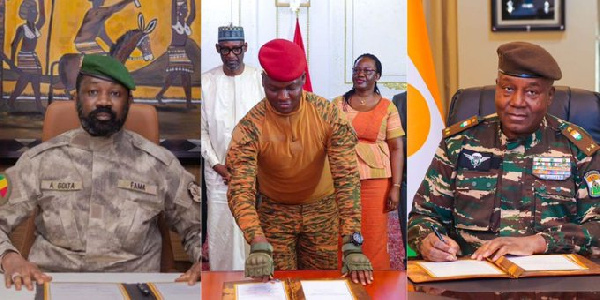
West African Sahel States, Mali, Niger, and Burkina Faso, all currently under military rule, have signed a security pact on Saturday. This pact pledges mutual support in the event of rebellion or external aggression.
These three nations have been grappling with the presence of Islamic insurgent groups linked to al Qaeda and Islamic State. Additionally, their relationships with neighbouring countries and international partners have been strained due to the recent coups.
The most recent coup in Niger exacerbated tensions between these three nations and the countries in the regional bloc, the Economic Community of West African States (ECOWAS). ECOWAS has threatened to use force to restore constitutional rule in Niger.
Mali and Burkina Faso have committed to assisting Niger if it faces an attack. The pact, known as the Alliance of Sahel States, states that any attack on the sovereignty and territorial integrity of one or more of the signatory parties will be considered aggression against all of them. The signatory states will provide assistance individually or collectively, which may include the use of armed force.
Mali’s junta leader, Assimi Goita, announced the establishment of the Alliance of Sahel States via his social media account, stating, “I have today signed with the Heads of State of Burkina Faso and Niger the Liptako-Gourma charter establishing the Alliance of Sahel States, with the aim of establishing a collective defence and mutual assistance framework.”
All three nations were previously members of the France-supported G5 Sahel alliance joint force, which also included Chad and Mauritania. The alliance was launched in 2017 to combat Islamist groups in the region. However, Mali left the alliance after a military coup, and Niger’s President Mohamed Bazoum declared the force “dead” following Mali’s departure in May of the previous year.
Relations between France and these three states have deteriorated since the coups. France has withdrawn its troops from Mali and Burkina Faso and is engaged in a tense standoff with the junta that seized power in Niger. The junta requested the withdrawal of French troops and its ambassador, a request that France has refused to acknowledge.
The man who led the latest coup in Burkina Faso has been named interim president until elections in July 2024.
A national forum declared that Capt Ibrahim Traoré would not be allowed to stand in the polls.
He seized power two weeks ago from Lt-Gen Paul-Henri Damiba, who staged a coup in January accusing the authorities of failing to deal with Islamist militants.
The insurgency intensified after the general’s takeover, prompting Capt Traoré to remove him by force.
Burkina Faso’s coup leader, Captain Ibrahim Traoré,will convene a so-called “national assembly” on October 14 and 15 to appoint a transition charter and most likely a new “transitional president”.
The announcement came Saturday after a decree was read on state television.
The assembly talks are set to take place in Ouagadougou, it is on that occasion that the “Transitional Charter” which will set out the steps to be taken by the country towards the convocation of elections, will be ratified.
Jihadist militants have killed thousands and forced 2 million to flee their homes since 2015.
Despite military operations, attacks increased since mid-March and continue to plunge many families into mourning.
“Terrorism is making things difficult for the Burkinabe people“, the uncle of a slain soldiers laments.
“We are with the new president and we pray that God assists him and also, we’re looking for equipment and personnel so that we get out of this. If not, a lot of our children will die”, Moumouni Zoundi alerts.
He was on one of the tourners attending Saturday the funeral of 27 soldiers who were slain in an ambush on September 26. Captain Ibrahim Traoré also attended the funeral.
The 27 soldiers were part of a supply convoy of more than 200 trucks heading to the town of Djibo, capital of the northern Sahel region, when they were attacked.
In addition to them, at least 10 civilians died, others are still unnacounted for.
The al Qaeda terrorist group claimed responsability for the attack. This military setback is seen as the catalyst for the 2nd coup.
Shortly after ascending to power, Junta leader Traoré argued soldiers lacked the basic logistics under his predecessor Damiba. It remains to be seen if he can turn around the crisis.
The French government has acknowledged violent attacks on its embassy in the Burkinabe capital of Ouagadougou on Saturday, October 1, 2022.
Several videos published on social media showed citizens attempting to enter the Embassy, while others started bonfires outside the premises.
A few hundred people are seen protesting outside the buildings, a day after Captain Ibrahim Traore’s group announced the overthrow of Lt. Col. Sandaogo Damiba.
The French Foreign Ministry has been very busy in the last few hours, denying any coordination with the overthrown Damiba to wage a counter-attack on the new junta.
According to an October 1, 2022 statement read on national TV, RTB, a member of the new junta, Sous-Lieutenant Jean-Baptiste Kabre, said the former leader of the MPSR – name of the junta, had refused to leave power quietly.
Kabre alleged that Sandaogo Damiba was planning a “counter-offensive” and claimed further that he’s doing this from a French base.
French embassy in Burkina Faso 🇧🇫 strongly denies allegations that Burkinabe authorities would be protected or safe guarded by the French army.
France 🇫🇷 has NOTHING to do with the events of the past hours in 🇧🇫 https://t.co/cghfSeq7Wm
In an October 1, 2022 statement from the French Ministry of Europe and Foreign Affairs, France denied the allegation and said it was not hosting Damiba in any of its facilities.
“France formally denies any involvement in the events underway since yesterday in Burkina Faso.
“The camp where the French forces are located has never hosted Paul-Henri Sandaogo Damiba, nor has our embassy,” the statement read.
Read the complete statement below:
STATEMENT BY THE SPOKESPERSON OF THE MINISTRY FOR EUROPE AND FOREIGN AFFAIRS
Burkina Faso
October 1, 2022
France formally denies any involvement in the events underway since yesterday in Burkina Faso.
The camp where the French forces are located has never hosted Paul-Henri Sandaogo Damiba, nor has our embassy.
PRESS SERVICE
Spokesperson Sub-Directorate
New junta leader Captain Traore’s announced the takeover of executive power and deposition of Damiba, barely 10 months after the later seized power from democratically elected Christian Roch Marc Kabore.
The junta dissolved the government and the transitional national assembly as well as imposed a curfew and closed all the country’s borders.
The overthrow was premised on continued deterioration of the insecurity situation even as terrorists continue to launch deadly raids on security forces and the local population.
The man who was overthrown in a coup in Burkina Faso, according to the self-proclaimed leader, is preparing a counterattack.
Lt Col Paul-Henri Damiba, per Col Ibrahim Traoré, is being held in one of the French Army’s bases, a claim that has been refuted by French officials.
Gunshots have been heard in Burkina Faso’s capital city Ouagadougou and helicopters are circling overhead.
Witnesses say troops have blocked main roads around the city and shops that had opened earlier are now shut.
Friday’s apparent takeover had been announced on national TV and was the second time this year that the country’s army had seized power.
On both occasions, the coup leaders said they had to step in because national security was so dire.
Burkina Faso controls as little as 60% of its territory, experts say, and Islamist violence is worsening. Since 2020 more than a million people have been displaced in the country due to the violence.
The African Union has demanded the return of constitutional order by July 2023 at the latest, agreeing with the regional group Ecowas that the ousting of leader Lt Col Damiba was “unconstitutional”.
Ecowas earlier said it was “inappropriate” for army rebels to seize power when the country was working towards the civilian rule.
The latest international criticism has come from the UN, whose chief António Guterres sayshe “strongly condemns” the coup.
For the second time in under 24 hours, the coup leaders have issued a statement on national TV, signed by their leader Col Ibrahim Traoré.
This time they claimed Lt Damiba was planning a counter-attack because of their own willingness to work with new partners in their fight against the Islamists. The statement did not name these potential new partners, but rights groups say troops in neighbouring Mali have been working closely with Russian mercenaries from the Wagner group – although both nations deny this.
On Friday evening flanked by rebel soldiers in fatigues and black facemasks, an officer had read an announcement on national TV stating that they were kicking out Lt Damiba, dissolving the government and suspending the constitution.
That statement was also read on behalf of an army captain called Col Traoré, who said Lt Col Damiba’s inability to deal with an Islamist insurgency was to blame.
“Our people have suffered enough, and are still suffering”, he said.
Little is known about Col Traoré, the 34-year-old soldier who led an anti-jihadist unit in the north called Cobra.
His statement effectively declared himself the interim leader of Burkina Faso. But in Friday’s announcement came the promise that the “driving forces of the nation” would in time be brought together to appoint a new civilian or military president and a new “transitional charter”.
Lt Col Damiba’s junta overthrew an elected government in January citing a failure to halt Islamist attacks, and he himself told citizens “we have more than what it takes to win this war.”
But his administration has also not been able to quell the jihadist violence. Analysts told the BBC recently that Islamist insurgents were encroaching on territory, and military leaders had failed in their attempts to bring the military under a single unit of command.
On Monday, 11 soldiers were killed when they were escorting a convoy of civilian vehicles in Djibo in the north of the country.
The African Union has urged the military to “immediately and totally refrain from any acts of violence or threats to the civilian population, civil liberties, human rights”.
The Economic Community of West African States (Ecowas) earlier condemned the move too, stating it “reaffirms its unreserved opposition to any taking or maintaining of the power by unconstitutional means”.
The United States said it was “deeply concerned” by events in Burkina Faso and encouraged its citizens to limit movements in the country. France issued a similar warning to its more than 4,000 citizens living in the capital city Ouagadougou.
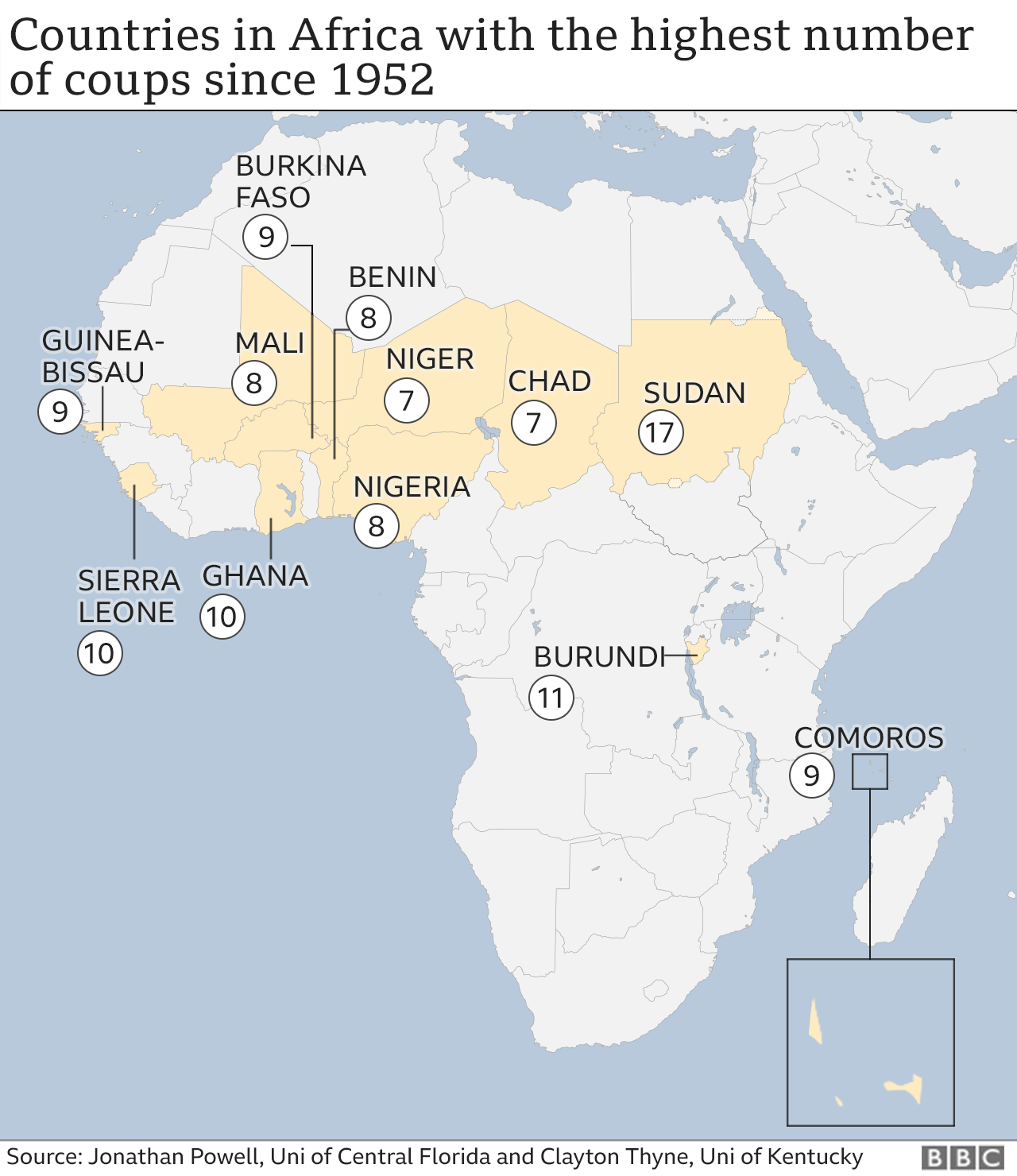
Burkina Fasohas had a series of coups in the not-too-distant past, with a total of nine in its history – only three African countries have had more.
There are reports that the current unrest in the capital might be a coup attempt, although a government source told the BBC it was a mutiny.
The last coup was in January 2022, when Lt Col Paul-Henri Sandaogo Damiba took over from former President Roch Kaboré amid concerns in the country about a jihadist insurgency.
Despite West Africa’s security and political volatility, Burkina Faso had, in the past, enjoyed a fragile stability.
Of late, there has been a wave of coups in West Africa, including in Mali and Guinea, as the region battles Islamist violence.
Are military takeovers on the rise in Africa?
Military coups were a regular occurrence in Africa in the decades that followed independence and there is concern they are starting to become more frequent.
This year has already seen two – a takeover by the army in Burkina Faso and the other a failed coup attempt in Guinea Bissau.
And 2021 witnessed a higher number of coups in Africa compared with previous years.
When is a coup a coup?
One definition used is that of an illegal and overt attempt by the military – or other civilian officials – to unseat sitting leaders.
A study by two US researchers, Jonathan Powell and Clayton Thyne, has identified over 200 such attempts in Africa since the 1950s.
About half of these have been successful – defined as lasting more than seven days.
Burkina Faso, in West Africa, has had the most successful coups, with eight takeovers and only one failed coup.
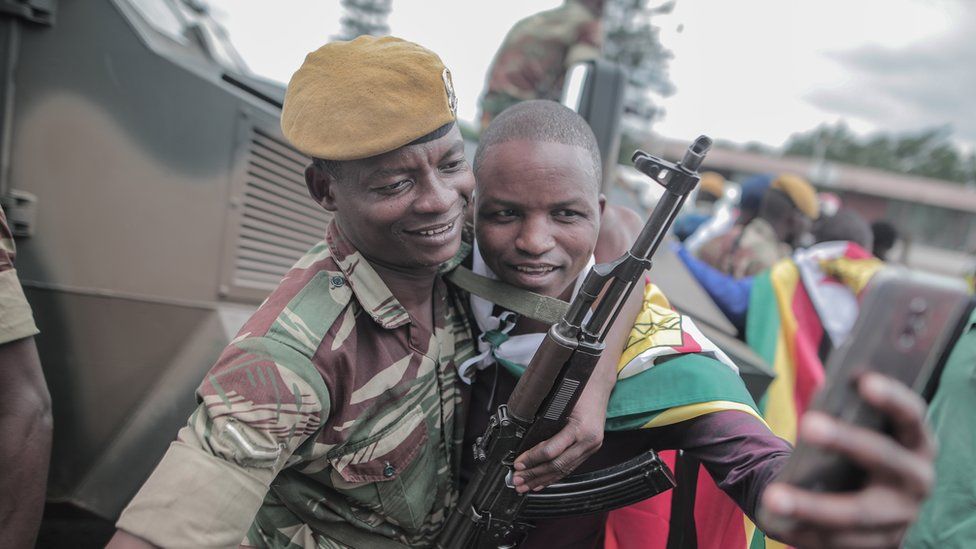
Image source, Getty ImagesImage caption, There were celebrations after the Zimbabwe army intervened against President Mugabe in 2017
Sometimes, those taking part in such an intervention deny it’s a coup.
In 2017 in Zimbabwe, a military takeover brought Robert Mugabe’s 37-year rule to and end. One of the leaders, Maj Gen Sibusiso Moyo, appeared on television at the time, flatly denying a military takeover.
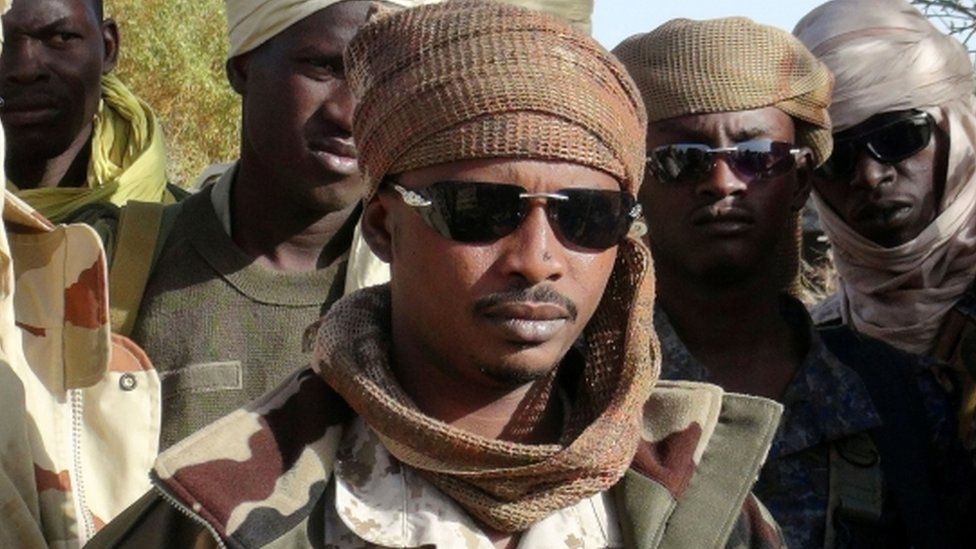
In April last year after the death of the Chadian leader, Idriss Déby, the army installed his son as interim president leading a transitional military council. His opponents called it a “dynastic coup”.
“Coup leaders almost invariably deny their action was a coup in an effort to appear legitimate,” says Jonathan Powell.
How often are there coups in Africa?
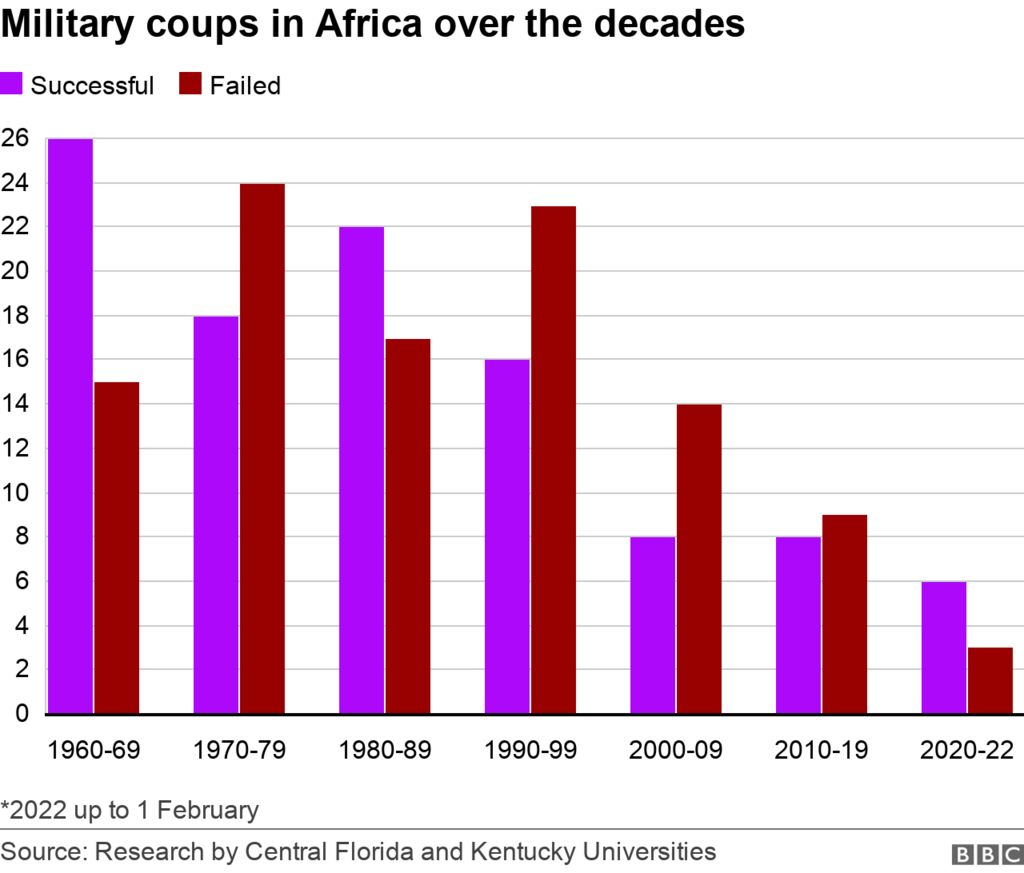
The overall number of coup attempts in Africa remained remarkably consistent at an average of around four a year in the four decades between 1960 and 2000.
Jonathan Powell says this is not surprising given the instability African countries experienced in the years after independence.
“African countries have had conditions common for coups, like poverty and poor economic performance. When a country has one coup, that’s often a harbinger of more coups.”
Coups dropped to around two a year in the two decades up to 2019.
We are only three years into the current decade and while in 2020 only one coup was reported in Mali, there was a noticeably higher than average number in 2021 with six coups or attempted coups recorded .
There were successful coups in Chad, Mali, Guinea and Sudan and failed military takeovers in Niger and Sudan.
In September 2021, the UN Secretary-General António Guterres voiced concern that “military coups are back,” and blamed a lack of unity amongst the international community in response to military interventions.
“Geo-political divisions are undermining international co-operation and… a sense of impunity is taking hold,” he said.
Judd Devermont from the US-based Center for Strategic and International Studies, believes a “lenient” approach by regional and international bodies “has enabled coup leaders to make minimal concessions while preparing for longer stays in power”.
Image source, ReutersImage caption, Mahamat Idriss Déby Itno succeeded his father as Chadian leader in April 2021
Ndubuisi Christian Ani from the University of KwaZulu-Natal says popular uprisings against long-serving dictators have provided an opportunity for the return of coups in Africa.
“While popular uprisings are legitimate and people-led, its success is often determined by the decision taken by the military,” he says.
Which countries have had the most coups?
Sudan has had the most coups and attempted takeovers amounting to 17 – six of them successful.
In 2019, long-serving leader Omar al-Bashir was removed from power following months of protests.
Bashir had himself taken over in a military coup in 1989.
Nigeria had a reputation for military coups in the years following independence with eight between January 1966 and the takeover by Gen Sani Abacha in 1993.
However, since 1999 transfers of power in Africa’s most populous nation have been by democratic election.
Burundi’s history has been marked by eleven separate coups, mostly driven by the tensions between the Hutu and Tutsi communities.
Sierra Leone experienced three coups between 1967 and 1968, and another one in 1971. Between 1992 and 1997, it experienced five further coup attempts.
Ghana has also had its share of military coups, with eight in two decades. The first was in 1966, when Kwame Nkrumah was removed from power, and in the following year there was an unsuccessful attempt by junior army officers.
Overall, Africa has experienced more coups than any other continent.
Of the 13 coups recorded globally since 2017, all but one – Myanmar in February 2021 – have been in Africa.
A security expert, Adib Saani has indicated that the national security apparatus of Ghana must be gravely concerned about the frequency of coups in West Africa.
In an interview with GhanaWeb, Adib Saani said it would be a mistake for Ghana to consider the recent military takeovers in Guinea, Mali, Burkina Faso as domestic. According to him, terrorist groups take advantage of the chaos caused by coups to set up camps.
“According to a US Department of State report published in 2002, usually terrorists take advantage of political upheavals in countries to establish foot forward like it happened in Suban in 1990s where Al-Qaeda established it’s base there and of course it happened in Somalia 1990s when Al-Shabab established a foot hold there,†he told GhanaWeb.
Adib Saani said the coups and the chaos associated with them in neighbouring countries would have serious effects on Ghana.
“Coups would have very serious effects (on Ghana); in the midst of all the chaos terrorist groups such as Al-Qaeda, Al-Shabab, ISIS in the Greater Sahara would take advantage of the confusion to reorganise, resupply logistics and of course move around and Ghana is certainly part of the whole area in which there could be movements,†he said.
He added that the porous borders of Ghana even made things worse.
“Terrorists from Burkina Faso can move into the country particularly owing to how porous our borders are, not coming to stage attacks but perhaps to establish sleeper cells for maybe attacks in the future,†Adib added.