Tag: BVDs

  • EC staffer pushing for removal of Jean Mensa, deputies interdicted

    EC staffer pushing for removal of Jean Mensa, deputies interdicted

    The Electoral Commission (EC) staff, Joseph Blankson Adumadzie, has alleged that he has, for some time, been suspended from his official duties over issues involving Biometric Verification Devices (BVDs).


    According to him, the old Biometric Verification Devices that were found at a refuse dump were mysteriously traced back to him. He added that he won the case in court due to the Commission’s failure to prove the allegations leveled against him.

    “For a while now, I don’t go to work. I have not resigned, I have not been sacked. I am on an interdiction. It’s a whole lot. It was about these BVDs. They were saying things that were not true about me, but I don’t want to go there. Yes, the old machines, but they are not with me, and it is not even true. That is the whole thing. They sued me and couldn’t prove anything. And for one year I won the case, and I have sued them,” he added.


    His disclosure comes barely seventy-two (72) hours after he formally petitioned President John Dramani Mahama to remove the Electoral Commission (EC) Chairperson, Jean Mensa, and her two deputies, Dr. Bossman Eric Asare and Samuel Tettey, over allegations of misconduct.

    However, he has clarified that his call for their removal is not based on his current situation, where he is yet to resume his duties as an EC staffer. Among the 12 counts of stated misbehaviour are allegations of cronyism, abuse of office, and gross incompetence.


    The petition, submitted by Joseph Blankson Adumadzie, emphasised that the credibility of Ghana’s electoral system is at stake due to the alleged illegal actions of the officials. According to a statement issued on Monday, November 24, by the petitioner, Article 146 of the 1992 Constitution provides the basis for requesting the removal of public officials, particularly those serving in independent constitutional bodies.


    The former Chief Justice, Gertrude Torkornoo, faced a similar challenge and was later replaced by President Mahama after an investigative committee found the allegations leveled against her to be valid.

    President Mahama earlier suspended the Chief Justice on Tuesday, April 22, after a prima facie case was established following separate petitions calling for her removal.


    A series of petitions were filed against Chief Justice Torkornoo, beginning with one from a group known as Shining Stars of Ghana. The group alleged that she violated Article 144 of the Constitution by personally recommending judges for promotion to the Supreme Court and further claimed she ruled on a case involving the Speaker of Parliament without granting him a hearing, despite his refusal to respond to the suit.


    Another petition, filed by a police officer who is also a lawyer, accused the Chief Justice of manipulating evidence and abusing her authority, following an incident during a Supreme Court session where he was reportedly reprimanded, arrested, and detained.

    However, court records suggest the lawyer’s conduct during proceedings prompted a unanimous caution from the bench, not just the Chief Justice.


    The third petition, submitted by a private individual, listed 21 alleged instances of misconduct and four claims of incompetence. Among the accusations was the misuse of public funds, specifically that she spent over GH¢261,000 and $30,000 on a family trip abroad in 2023 and misused an additional GH¢75,580 and $14,000 during another foreign assignment without proper accountability.


    Subsequent reports indicate that two more petitions were added, intensifying pressure on the judiciary. Chief Justice Gertrude Torkornoo, in her written response to President Mahama, strongly denied allegations of misconduct and abuse of office brought against her by a senior police officer, describing them as baseless and lacking grounds for her removal from office.


    Meanwhile, President John Dramani Mahama has sworn in Justice Paul Baffoe-Bonnie as Ghana’s Chief Justice. The swearing-in ceremony took place on Monday, November 18, at the Presidency.

    His swearing-in followed Parliament’s approval of his nomination after several deliberations. The Speaker of Parliament, Alban Bagbin, confirmed his approval on Thursday, November 11, during the 15th Sitting of the 3rd Meeting.


    “This Honorable House has accordingly approved the nomination of Justice Paul Baffoe-Bonnie as Chief Justice of the Republic, in accordance with Article 114 clause 1 of the 1992 Constitution respectively.

    “I will want to take this opportunity to, on behalf of the House, congratulate the nominee on his approval by Parliament. I urge the nominee to take all that has happened right up from the day of the nomination up to his prior approval by Parliament into consideration in his tenure of office. Once again congratulations,” he added.


    Parliament concluded his nomination after a headcount, where the Majority counted 163 and the Minority 69. On Monday, November 10, Justice Paul Baffoe-Bonnie appeared before the Appointments Committee of Parliament for his vetting.


    In October, President John Dramani Mahama submitted Justice Baffoe-Bonnie’s name to the Council of State for consideration in accordance with Article 144(1) of the Constitution, which requires the President to act in consultation with the Council of State and with Parliament’s approval when appointing a Chief Justice.


    Justice Baffoe-Bonnie, the most senior member of the Supreme Court, was appointed to the apex court in June 2008 by then-President John Agyekum Kufuor. He studied law at the University of Ghana and was called to the Bar in 1983.

    His judicial career spans roles as a Circuit Court Judge in Kumasi, a High Court Judge at Duayaw Nkwanta, and a Court of Appeal Judge before his elevation to the Supreme Court.


    Born on December 26, 1956, in Goaso, Justice Baffoe-Bonnie had his secondary education at Konongo Odumase Secondary School before pursuing law at the University of Ghana and the Ghana Law School.


    However, speaking on the floor of Parliament on Friday, November 7, Minority Leader Alexander Afenyo-Markin said it would be inappropriate to proceed with the vetting of Acting Chief Justice Paul Baffoe-Bonnie while the former Chief Justice awaits a court verdict on her pending lawsuit.


    In October, Gertrude Torkornoo initiated legal action to prevent the vetting and appointment of Justice Baffoe-Bonnie as Ghana’s next Chief Justice. She is seeking the nullification of all activities carried out by the Justice Gabriel Scott Pwamang Committee, which was set up under Article 146 to review petitions seeking her removal from office.


    She wants the court to overturn all proceedings undertaken by the Committee and to declare the Presidential Warrant authorizing her dismissal as unlawful and without legal effect. The legal move came as Parliament’s Appointments Committee prepared to vet Justice Baffoe-Bonnie for the top judicial position.


    Afenyo-Markin emphasized that commencing the vetting of the appointed Chief Justice would breach judicial propriety. According to him, given the ongoing disputes surrounding the revocation of the former Chief Justice from office, proceeding with the vetting process could undermine Articles 125 and 127 of the Constitution.


    “Proceeding to vet a new person to fill that office will be rendering the application of justice. We are not into blows; we are here to argue law and for you to determine. This kind of attack, ‘it will happen, it will happen,’ is inappropriate. They should take it easy,” Afenyo-Markin said.


    Article 125 gives judicial power only to the courts and not to Parliament or the Executive. Article 127, on the other hand, requires all other state institutions not to interfere with the Judiciary’s work but to protect its independence.


  • Ballot papers to Northern, 2 other regions and BVDs disseminated to police armories – EC

    Ballot papers to Northern, 2 other regions and BVDs disseminated to police armories – EC

    The Electoral Commission (EC) of Ghana has announced the dissemination of ballot papers for the Northern, Bono, and Bono East Regions to police armories, with the remaining ballot papers scheduled for delivery by the end of the day.

    Jean Mensa, Chairperson of the EC, disclosed during a meeting with the National Elections Security Task Force, chaired by the Inspector-General of Police, Dr. George Akuffo Dampare, on Tuesday that biometric verification devices (BVDs) are also being secured across the country.

    “As we speak, the BVDs have been sent to over 8 regional armories and are in safe keeping there,” Jean Mensa stated on November 26, 2024, adding that all devices will be under police protection by the weekend.

    She further noted that ballot papers for most regions and all registers have already been dispatched to the 16 regions, except for the Northern, Bono, and Bono East Regions, which are set to receive their ballot papers this afternoon.

    The EC has also recruited 210,000 temporary officials, including returning officers, deputy returning officers, presiding officers, and polling assistants, for the December 7 elections. These officials are being trained extensively, with the introduction of aide memoires to guide them in their roles.

    “They are undergoing extensive training for all categories of staff. This year, we have developed what we call the aide memoires, which are basic instructions on the key aspects of our work, based on feedback from our officers on the ground and various election observation missions,” Mensa explained.

    Both the EC and security officials have assured the public of a credible, transparent, and peaceful electoral process as preparations intensify ahead of the polls.

    “We will do all it takes to ensure this country continues to be at peace with herself,” Dr. George Akuffo Dampare added.

  • Ghana’s BVDs stand tall on global scale – EC

    Ghana’s BVDs stand tall on global scale – EC

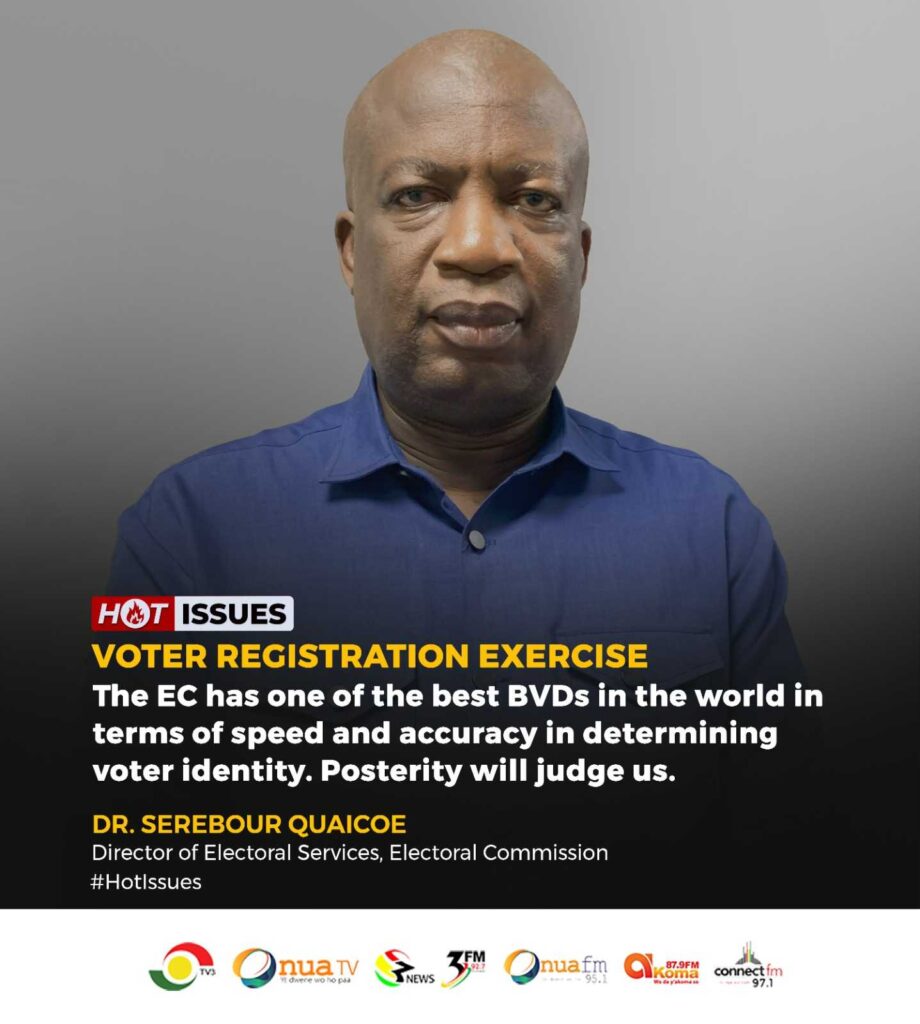
    The Director of Electoral Services at the Electoral Commission (EC), Dr. Serebour Quaicoe, has emphasized that Ghana’s Electoral Commission boasts one of the finest Biometric Verification Devices (BVDs) globally.

    Dr. Quaicoe highlighted the BVDs‘ robustness in accurately identifying voters and preventing electoral fraud.

    Despite encountering initial challenges at the onset of the limited voter registration exercise, Dr. Serebour affirmed the Commission’s dedication to producing a trustworthy voter register for the 2024 elections.

    Speaking on Hot Issues with Keminni Amanor on Sunday, May 19, the Director of Electoral Services asserted, “The EC has one of the best BVDs in the world in terms of speed and accuracy in determining voter identity. Posterity will judge us.”

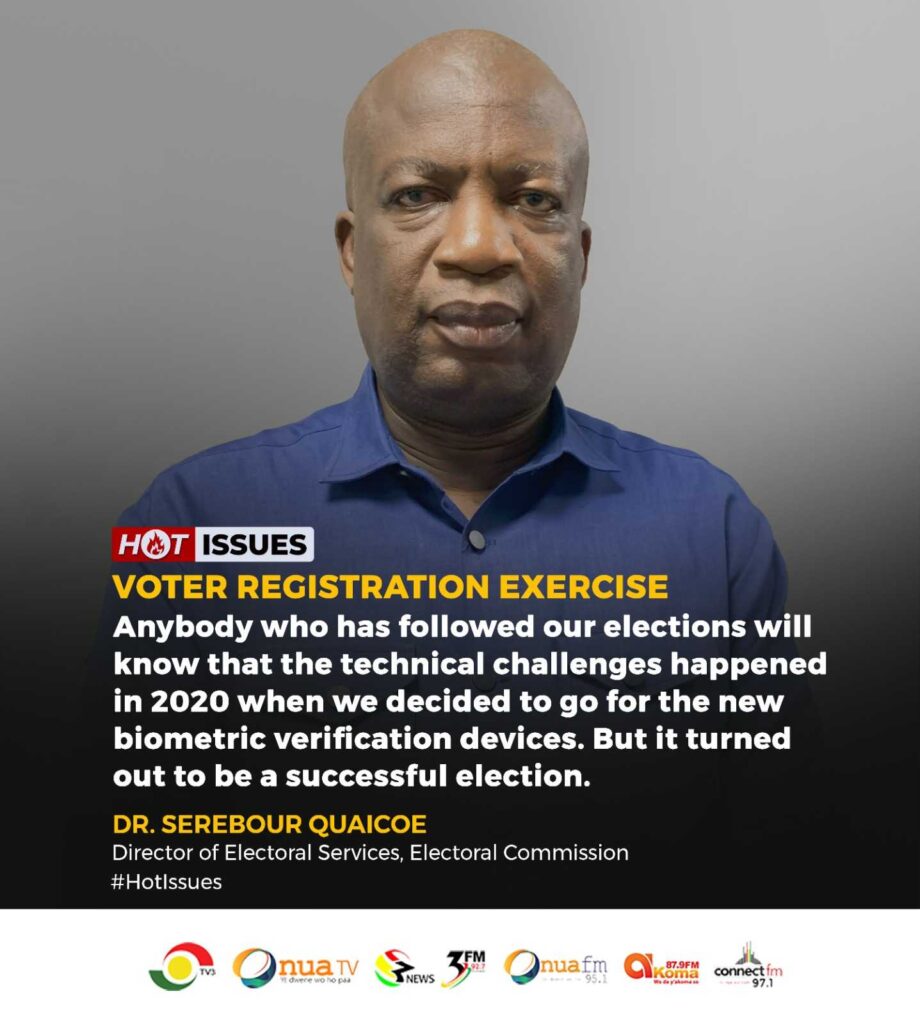
    Dr. Quaicoe noted that although technical issues arose during the adoption of new biometric verification devices in 2020, the elections were ultimately successful.

    Moreover, he stressed that the Commission‘s decision to transition its officers to offline registration mode was part of the agreed process with political parties.

    Furthermore, Dr. Quaicoe disclosed that as of the conclusion of Day 6 of the registration exercise, approximately 2,900 challenges had been raised against certain applicants nationwide, with efforts underway to address them promptly.

    In parallel, the EC aims to register around 623,000 first-time voters in the ongoing limited voter registration exercise across the country ahead of the December 7 national elections.

    The 21-day exercise, which commenced on Tuesday, May 7, spans all 258 district offices of the Commission and is slated to conclude on Monday, May 27, 2024.

    Additionally, the Commission has established an additional 785 centers to accommodate individuals facing accessibility challenges in reaching the EC’s district offices.

    Permanent centers will be established at the district offices, while mobile teams will facilitate registration in hard-to-reach Electoral Areas.

    The EC will furnish political parties with a list of registration centers no later than twenty-one days before the exercise.

    “Anybody who has followed our elections will know that the technical challenges happened in 2020 when we decided to go for the new biometric verification devices. But it turned out to be a successful election,” he added.

    “Going offline is part of the voter registration process, so it’s not something new. We did more offline registrations in 2020 than in 2024,” he told Keminni Amanor.

  • Come clear, not these lies and fantasies – IMANI to EC over BVDs at recycling plant

    Come clear, not these lies and fantasies – IMANI to EC over BVDs at recycling plant

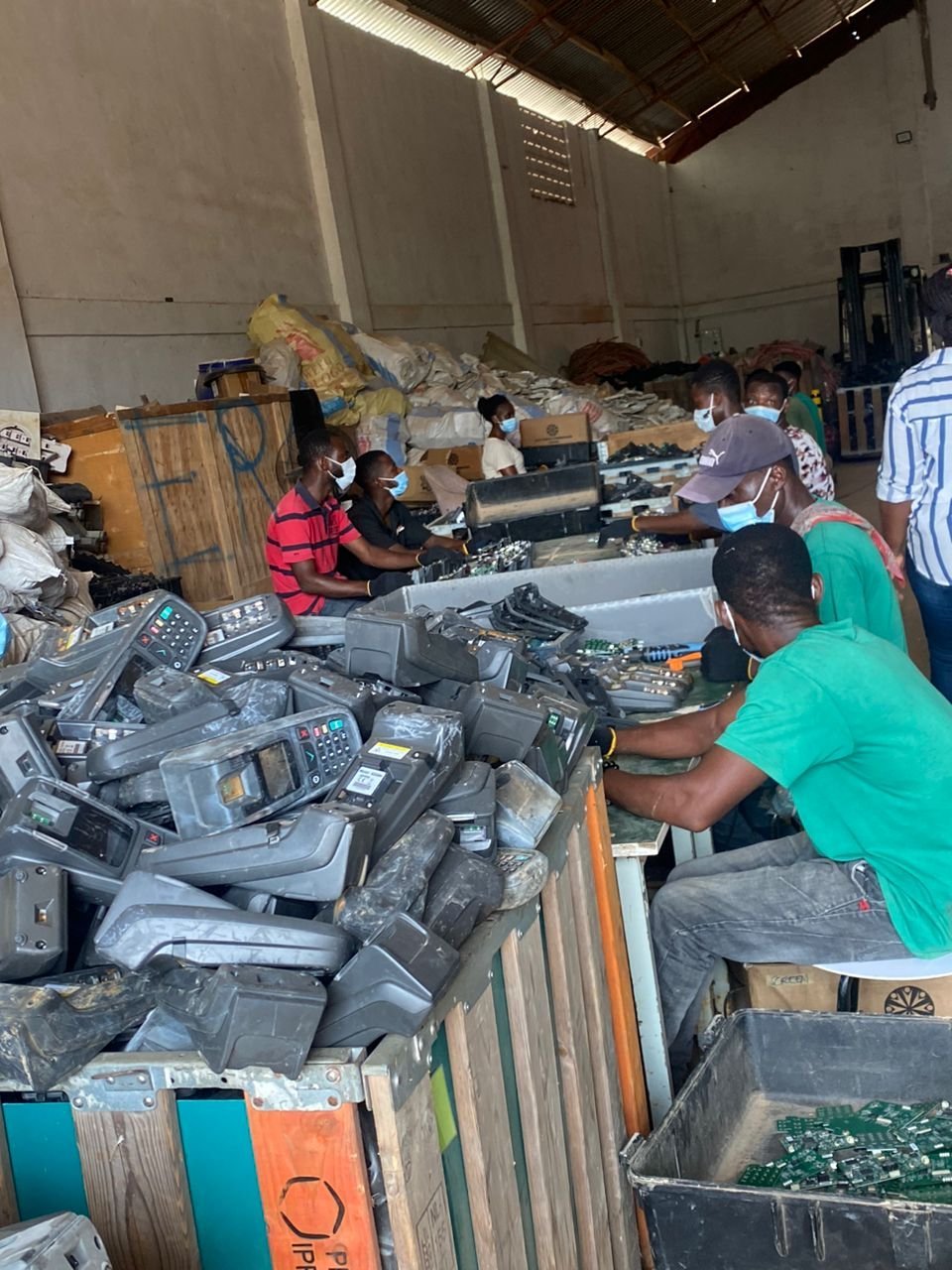
    IMANI Africa has expressed reservations regarding the Ghana Electoral Commission’s explanation concerning the unearthing of 10 outdated biometric verification devices (BVDs) at a recycling plant.

    In response to the EC’s assertion that the BVDs were antiquated and lawfully auctioned, IMANI Africa has called for additional details regarding the auction process.

    They are seeking clarification on the licensing of the auctioneers, the auction methodology, and the identities of the successful bidders.

    Moreover, IMANI Africa questions the wisdom behind procuring obsolete devices specifically tailored for electoral use and the involvement of a commercial recycling plant in managing potentially sensitive data.

    The think tank underscores the significance of transparency in the disposal of these BVDs to maintain public confidence in the electoral system.

    Key inquiries from IMANI Africa include the identities of auctioneers and successful bidders, the advertisement of the auction, and the authorization for recycling these devices in a facility lacking secure data-handling capabilities.

    “The EC claims that the 10 BVDs were auctioned and that they just somehow then found their way into a recycling plant. Who were the auctioneers? Are they registered auctioneers licensed to conduct auctions by the Auctioneers Registration Board?”

    “Who were the successful bidders? How was the auction advertised? Why would anyone want to buy ten used biometric devices that the EC claims have been “hard-coded” for electoral purposes, for which reason it has refused to use the thousands of devices bought in recent years?”

    “Why would a commercial recycling plant be interested in just ten devices? Who authorised the recycling of the devices in a facility without adequate secure data handling capabilities?” IMANI asked.

    IMANI also lunged at the EC, saying its press statement was “full of lies, half-truths, and pure fantasies.

    “The EC says that only ten biometric verification devices (BVDs) were ‘auctioned’. And that they ‘found their way’ into a recycling plant. The obvious questions that the media ought to ask are: a) Before the EC jettisoned the existing system, it had told Parliament that it had implemented a ‘2 BVDs per polling station’ policy and, therefore, had more than 70,000 BVDs in stock.

    “Then, in 2020, it proceeded to buy a brand-new set of biometric voter registration (BVR) kits with corresponding BVD kits and swore (despite video evidence collected by Bright Simons) that they never used any of the pre-existing devices in the 2020 mass voter registration exercise. Why, then, did they auction only 10 out of the over 70,000 devices? Why ’10’, and not 5, 100, or 1000?” IMANI wondered.

    “How have the remaining tens of thousands of devices been disposed of? Ghanaians who have been paying attention to the EC’s strange conduct under the current leadership know that the EC admitted to having lost some BVRs recently, but when pushed it insisted that they were only five in number. There is a clear pattern here. What exactly is going on?” the think tank asked.

  • We never spent $150m to purchase BVRs and BVDs in 2020 – EC

    We never spent $150m to purchase BVRs and BVDs in 2020 – EC

    The Electoral Commission (EC) has issued a statement urging the public to disregard any claims suggesting that it spent $150 million on acquiring Biometric Verification Devices (BVDs) and Biometric Voter Registration Kits (BVRs) in 2020.

    The EC’s response follows allegations made by Bright Simons, Vice President of IMANI Africa, in several articles, alleging that the election management body spent $150 million on BVDs.

    In the statement released on Friday, April 26, the EC clarified that prior to the circulation of the $150 million figure, the cost of the BVDs and BVRs procured by the commission in 2020 was quoted at $300 million.

    “In fact, the total cost for 74,500 BVDs, 8,500 BVRs, a new data centre and a data recovery centre amounted to $68, 661,912.67.”

    However, the EC clarified that the total cost for 74,500 BVDs, 8,500 BVRs, a new data center, and a data recovery center amounted to $68,661,912.67.

    Furthermore, the EC explained that in June 2018, the previous administration of the commission budgeted and received approval to invest $56 million for the refurbishment of BVDs and BVRs, a Data Center, and security enhancements under the voter registration and voter verification projects.

    The contract was aimed at the 2018 referendum and District Level Elections (DLE), including refurbishing 1,670 BVR kits and procuring 1,000 new BVDs for the Voter Registration project, and refurbishing 46,200 BVDs and acquiring 10,000 new BVDs for the Voter Verification Project.

    However, the current administration of the Commission decided to cancel the contract for total refurbishment and procurement of new BVDs, opting for a minimal maintenance arrangement.

    “The contract was specifically geared towards the conduct of the 2018 referendum and District Level Elections (DLE). The Voter Registration project included the refurbishment of 1,670 BVR kits and the procurement of 1,000 new BVDs while the Voter Verification Project included the refurbishment of 46,200 BVDs as well as the acquisition of 10,000 new BVDs.”

    “However, the current administration of the Commission made a strategic decision to cancel the contract for the total refurbishment and the procurement of new BVDs, opting for a minimal maintenance arrangement,” it further stated.

    In 2020, based on the experience with the equipment in the 2019 DLE, the current Commission applied for and received approval from the PPA to acquire new BVDs, BVRs, a Data Center, and a Data Recovery Center.

  • Thousands of BVDs used only during elections can’t be “scrap”, it is a lie – Bright Simons ‘fights’ EC

    Thousands of BVDs used only during elections can’t be “scrap”, it is a lie – Bright Simons ‘fights’ EC

    Bright Simons, the Vice President of IMANI Africa, has raised concerns about the Electoral Commission’s disposal of Biometric Verification Devices (BVDs), claiming that the devices were sold for recycling at a loss to the state.

    Mr Simons in a series of posts on X platform criticized the EC’s assertion that the devices were obsolete, arguing that they were only used during elections and therefore could not be considered scrap.

    In a series of tweets, Simons shared documents from Parliament, the Auditor-General, and the Ministry of Finance, which he claims expose the EC’s actions.

    He pointed out that millions of dollars were spent on the devices, which are now being sold for scrap at significantly lower prices. He also highlighted that thousands of devices purchased in 2016 and 2018 could not have been obsolete as they are only used during elections.

    However, the Electoral Commission has denied these allegations, stating that the 10 BVDs discovered at a recycling company in Madina, Accra, were outdated devices that had been legally auctioned.

    The Commission clarified that the devices were acquired before the 2012 elections and were used in the 2019 District Level Elections (DLE).

    Despite a previous administration’s plan to refurbish the devices, the current Commission decided to procure new equipment instead, citing the advice of its Biometric Infrastructure managers that the equipment was obsolete and no longer useful.

    The Commission emphasized that the auction of the devices was conducted transparently, with the proceeds duly deposited into the Consolidated Fund. It rejected any claims of wrongdoing and criticized IMANI Africa for allegedly misinforming the public.

  • BVDs found in Madina are outdated devices that had been legally auctioned – EC

    BVDs found in Madina are outdated devices that had been legally auctioned – EC

    The Electoral Commission has denied allegations that it discreetly disposed of 10 Biometric Verification Devices (BVDs) for recycling at a loss to the state.

    In a statement issued on Friday, April 26, the Commission clarified that the 10 BVDs discovered at a recycling company in Madina, Accra, were outdated devices that had been legally auctioned.

    According to the Commission, these obsolete BVDs were acquired before the 2012 elections and were used in the 2019 District Level Elections (DLE).

    The statement explained that the previous administration had planned to refurbish the outdated devices for the 2018 referendum and the 2019 DLE, despite being advised by the Commission’s Biometric Infrastructure managers that the equipment was obsolete and no longer useful.

    Contrary to the refurbishment plan, the current Commission decided to procure new equipment instead of repairing the obsolete 2012 devices.

    This decision was made to ensure the prudent use of resources and the integrity of the electoral process, ultimately saving the state millions of cedis.

    The Commission emphasized that the auction of the obsolete devices was conducted transparently, and the proceeds were duly deposited into the Consolidated Fund.

    It strongly refuted any claims of misconduct and criticized civil society group IMANI Africa for allegedly misinforming the public about the issue.

    Bright Simons, the Vice President of IMANI Africa, has raised concerns about the Electoral Commission’s disposal of Biometric Verification Devices (BVDs), claiming that the devices were sold for recycling at a loss to the state.

    Mr Simons in a series of posts on X platform criticized the EC’s assertion that the devices were obsolete, arguing that they were only used during elections and therefore could not be considered scrap.

    In a series of tweets, Simons shared documents from Parliament, the Auditor-General, and the Ministry of Finance, which he claims expose the EC’s actions.

    He pointed out that millions of dollars were spent on the devices, which are now being sold for scrap at significantly lower prices. He also highlighted that thousands of devices purchased in 2016 and 2018 could not have been obsolete as they are only used during elections.

  • EC interdicts 5 officials for their alleged involvement in stolen BVDs

    EC interdicts 5 officials for their alleged involvement in stolen BVDs

    Five officials of the Electoral Commission (EC) have been interdicted following allegations of theft involving Biometric Verification Devices (BVDs).

    The suspects have been turned over to the police for further investigation. Dr. Serebour Quaicoe, the Director of Electoral Services at the EC, provided this update on the missing devices, emphasizing that handing over the suspects to the police is a crucial step towards conducting a thorough investigation.

    Dr. Quaicoe reiterated the Commission’s commitment to ensuring justice is served and that individuals found guilty of stealing state assets are appropriately punished.

    “What I can say on authority is that we lost one BVD in North Tongu and what happened was that we normally package these things in ballot boxes. You put your systems and you seal. In the course of transporting, we got there, they couldn’t transport the ballot boxes.”

    “So we reported to the police. We have lost this and these are the suspects so investigate and let them go through the legal regime.

    “Whatever has to be done should be done. They have been interdicted they are now going through the investigations. So, the police I am told that they will be arraigned before court soon,” he is quoted to have said by Citinewsroom.

    On March 20, the Minority in Parliament urged the police to take urgent action following the alleged disappearance of seven biometric devices. They expressed concern about the potential impact on the upcoming December elections.

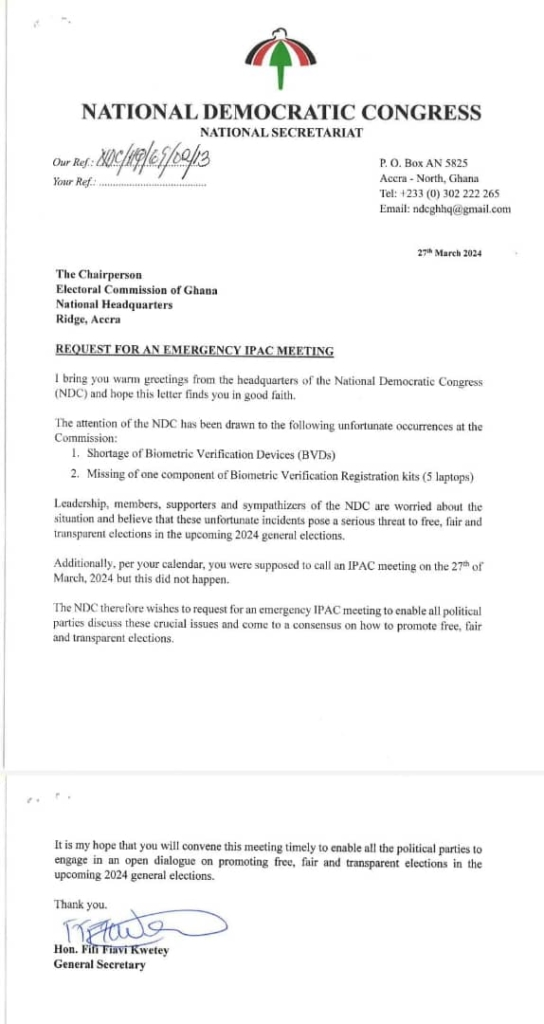
  • Missing BVDs: NDC calls for emergency IPAC meeting

    Missing BVDs: NDC calls for emergency IPAC meeting

    The National Democratic Congress (NDC) has called on the Electoral Commission (EC) to promptly convene an emergency Inter-Party Advisory Committee (IPAC) meeting to address concerns regarding the reported ‘disappearance’ of Biometric Verification Devices (BVDs) and related issues.

    The party stressed the importance of such a meeting for the EC to provide explanations and reassurances to political parties and their supporters.

    In a petition submitted to the Commission on Wednesday, March 27, the NDC expressed concern over these issues, fearing that they could potentially undermine the fairness and integrity of the upcoming December 2024 elections.

    The petition, signed by the party’s General Secretary, Fifi Fiavi Kwetey, urged the EC to give serious consideration to the concerns to maintain public trust in its operations.

    “Leadership, members and sympathisers of the NDC are worried about the situation and believe that these unfortunate incidents pose a serious threat to free, fair and transparent elections in the upcoming 2024 general elections.”

    “The NDC therefore wishes to request for an emergency IPAC meeting to enable all political parties to discuss these crucial issues and come to a consensus on how to promote free, fair and transparent elections,” an excerpt of the petition said.

    “Additionally, per your calendar, you were supposed to call an IPAC meeting to enable all political parties to discuss these issues and come to a consensus on how to promote free, fair and transparent elections,” it added.

    Additionally, the party pointed out that the Electoral Commission (EC) was slated to convene an IPAC meeting on March 27, as per its calendar for the year. However, this meeting did not occur as scheduled.