Tag: Cameroon

  • Cameroon fans upbeat despite defeat to Swiss

    They flinched at every threat from the opposition and rued missed opportunities.

    Cameroonian fans gathered in Yaounde in big numbers to watch their team take on Switzerland in the first game of Group G at the Qatar World Cup on Thursday (Nov. 24).

    Despite a Breel Embolo goal handing the Swiss victory, the Cameroonians remain unfazed.

    “We saw some excellent soccer in the first half, but in the second half it was not the case. We got sloppy and that’s why Embolo had the opportunity to put that first goal. We don’t blame him, he is a compatriot, he only played for his federation and we congratulate him.”

    Cameroon were the better side in the opening half and might have had the lead as Karl Toko Ekambi, Eric-Maxim Choupo-Moting and Martin Hongla all missed good chances as the Swiss struggled to find their footing.

    “Impossible is not Cameroonian. The president of the federation, Samuel Eto’o, said that we would come back with the cup. We lost the first game but there is still the second and third game. We are sure we will win them.

    Cameroon’s loss means no African country has won a match at the World Cup. Group G also has Brazil and Serbia.


    Source: BBC

  • World Cup: Disappointing start for Cameroon as they lose first match to Switzerland

    The Indomitable Lions of Cameroon have lost their first match against Switzerland in the Qatar 2022 World Cup. Karl Toko Ekambi and his team mates fell short to a lone goal in their Group G opener interestingly from a Cameroonian born Swiss player Breel Embolo.

    The 25 year old Swiss international, born in Yaoundé scored the only goal of the game in the second half. Embolo would not celebrate the goal even as excited team mates gathered around him. He instead raised his hand and pointed in the direction of Swiss fans and then to Cameroonian fans at the opposite corner of Al Janoub stadium.

    Cameroon with an impressive display in the first, would feel hard done by the result. The central African side were the better side in the first half having dominated possesion but the attacking line of Mbeumo Choupo Toko had to face an outstanding Swiss keeper.

    This result does not make the business of the Indomitable Lions easier as they will still have to face two tough opponents : Serbia in the next game and the eternal favorites Brazil and its 5 stars.

    For Switzerland, their win against Cameroon was a hard fought victory extending once again their record of not losing a World Cup opening game in their past five appearances on football’s biggest stage.


    Source: African News


  • World Cup 2022: Choupo-Moting says Cameroon need teamwork to qualify from group

    Forward Eric Maxim Choupo-Moting says teamwork will be more important than his own individual form if Cameroon are to qualify for the knock-out stages of the World Cup in Qatar.

    The 33-year-old comes into the tournament with 10 goals in his past 9 games for club side Bayern Munich, and he netted in Cameroon’s final warm-up match.

    The Indomitable Lions face a tricky draw in Group G alongside five-time winners Brazil, Serbia and Switzerland, who they play in their first game on Thursday (10:00 GMT).

    “Expectations are high. Of course, that’s normal,” Choupo-Moting told BBC Sport Africa.

    “To have success, we have to do it all together. And I believe in us because we have good quality, so we have to put it all together on the pitch.

    “Me personally, I will give my best as I do always. I know it can help the team a lot.

    “I know I have a lot of qualities and with my team-mates around, everyone can perform well.”

    Despite his fine form, Choupo-Moting is not assured of a place in Cameroon’s starting line-up.

    He spent most of the Africa Cup of Nations earlier this year on the bench – as Indomitable Lions captain Vincent Aboubakar was preferred and won the golden boot with eight goals – and Choupo-Moting came on at half-time in the Central African’s friendly against Panama last week, which ended in a 1-1 draw.

    Cameroon are making their eighth appearance at the World Cup finals, but have only qualified for the knock-out stages once, when they became the first African side to reach the quarter-finals in 1990.

    Despite that record and their tough draw, Choupo-Moting has faith in the quality of coach Rigobert Song’s squad.

    “Of course we want to qualify for the next round. That’s definitely our goal,” the former Stoke City and Paris Saint-Germain forward added.

    “We have a tough group – good teams, good opponents. But we have also a lot of quality and we believe in ourselves.

    “We will give our best to bring all of this on the pitch. And if we do it all together, I’m very positive that we will have good results.”

    First group opponents Switzerland lost their final warm-up match against Ghana 2-0, but Choupo-Moting is wary of their quality.

    “It’s always important to start a tournament positively and we want to win this match at all costs,” he said.

    “But it will be difficult, we are aware of that. The Swiss have a good team. They have had very good results recently in the Nations League.

    “They have individual talent as well, but we look at ourselves and we have a lot of quality too.”

    Source: BBC

  • Cameroon: Entrepreneur recycles charcoal into green gas

    Tonnes of coal waste are thrown away each year in Douala, the economic capital of Cameroon.

    The waste can pollute both the air and water supplies and is also a fire hazard.

    Eric Tankeu came up with a environmentally-friendly solution – recycling the charcoal and turning it into a usable “green gas”.

    Tankeu is no stranger to going green – for years he worked on different projects to help protect the environment.

    He says the “gas” project has helped to repurpose many hectares of forest by reusing the discarded charcoal waste.

    Tankeu explains that the “gas” is a synthetic gas, produced from carbon-containing materials. Not only charcoal waste, but also biomass, plastics, household waste or similar materials.

    The end product is bottled in a cylinder that can be used for a household stove.

    Tankeu explains that his “gas” stove offers a safer and more sustainable way of cooking food or heating water.

    A large part of Cameroon’s population has no access to electricity and domestic gas is expensive or even unavailable in some areas.

    As a result, many Cameroonians rely on firewood and coal for cooking and covering basic needs.

    According to Global Forest Watch (GFW), Cameroon’s forests are feeling the pressure.

    The platform provides data and tools for monitoring forests online.

    It says Cameroon lost 1.7 million hectares (4.2 million acres) of tree cover between 2002 and 2021, more than 5% of its total.

    The main causes were harvesting wood for fuel, logging, and conversion of forests into agricultural land, GFW reported.


    Source: African News

  • Cameroonian broadcasts his NBA dream on social media

    A basketball player from Cameroon, Nkwain Kennedy,  uses social media to display his skills and demonstrate his desire to compete in the premier National Basketball Association (NBA) tournament.

    In videos that he posts to his millions of followers on TikTok, Instagram and Facebook, Kennedy captures his intense training sessions in the humble settings of his village in Bamenda.

    The region is gripped by conflict between English-speaking secessionists and the mainly French-speaking government.

    But Kennedy appears unperturbed as he practises his drills on clay courts or works out using makeshift weights.

    He is hoping to eventually land a chance at the NBA where fellow Cameroonian Joel Embiid plays.

    Source: BBC

  • Samuel Eto’o optimistic about Cameroon winning 2022 World Cup

    Cameroonian Football Federation (FECAFOOT) President Samuel Eto’o is confident that his side will win the 2022 FIFA World Cup in Qatar.

    “Africa has always had the potential to achieve a successful World Cup, but we haven’t always shown our best face up to now,” Eto’o told ESPN.

    “During the years, African teams have acquired more and more experience, and I think they’re ready not only to participate in a World Cup, but also to win it.

    “Cameroun will win the World Cup final against Morocco.”

    Cameroon have been drawn in Group G alongside Brazil, Serbia and Switzerland.

    The tournament will kick off on November 20 with hosts Qatar taking on Ecuador in a Group A opener at Al Bayt Stadium.

    No country from Africa has ever made it past the quarter-finals, with only Cameroun (1990), Senegal (2002) and Ghana (2010) ever making it beyond the last 16 stage.

    The Lions of Teranga will be the first African team to take the stage against Netherlands in a Group B fixture at Al Thumama Stadium on November 21.

    Source: Football Ghana

  • Someone shut down my 2021 AFCON dream – CK Akonnor

    Charles ‘CK’ Akonnor discusses how someone did not want him at the helm of the Ghana national team and pushed for his sacking ahead of the 2021 Afcon.

    WHAT HAPPENED: The tactician was fired on September 13, 2021, after the Black Stars suffered a 1-0 loss away against South Africa in Group G’s 2022 World Cup qualifiers.

    The move happened about four months before the 2021 Africa Cup of Nations which was eventually held in Cameroon.

    THE BIGGER PICTURE:

    Milovan Rajevac was eventually appointed 11 days later, making a return to the team he had coached in 2010.

    However, his stay was short-lived as Ghana performed poorly at Afcon and collected just a point in their group. The then 67-year-old was shown the door with Otto Addo taking his place.

    The latter helped the Black Stars qualify for the 2022 World Cup.

    Akonnor has now stated he was hurt by the changes, insisting there was foul play.

    WHAT HE SAID: “[Being the head coach at the 2021 Afcon] was a dream but one way or the other, somebody shut it down, who that person is, I don’t know,” Akonnor told Joy Sports’ Prime Take.

    “I wouldn’t say so [I would have done better than what Rajevac did], but I had a plan and if that plan had worked, maybe we would have done better than we did.

    “At least, the FA should have allowed me to go to the Afcon and come back because my contract was even running out. I was hurt but I am better now.”

  • Africa’s oldest president absent at party to celebrate his 40th year in office

    At 89 years, Paul Biya of Cameroon is Africa’s oldest president and second longest serving Head of State.

    Over the weekend, parties have been held across the Central African country to commemorate the 40 years he has been in power.

    Reports indicate that the celebrations were held with life-sized portraits of Biya but he was not present at any of the events.

    Thousands of people danced in front of the city hall in the capital Yaoundé. It was draped in an enormous portrait of Mr Biya emblazoned with the slogan “An exceptional president,” a BBC Africa LIVE report noted.

    The main opposition leader Maurice Kamto said Cameroon under Mr Biya was a highly corrupt country where people’s basic rights were trampled upon in a ruthless and arrogant manner.

    The administration has become even more repressive since 2017 when separatists launched a violent uprising in English-speaking parts of the country, the BBC report added.


    Source: Ghanaweb

  • Cameroon’s Anglophone crisis – fuelled by student rejects and poor spelling

    In our series of letters from African journalists, Tony Vinyoh looks at how his cousin’s medical school rejection was one of the many examples of why a secessionist rebellion has dogged English-speaking parts of Cameroon for nearly six years.

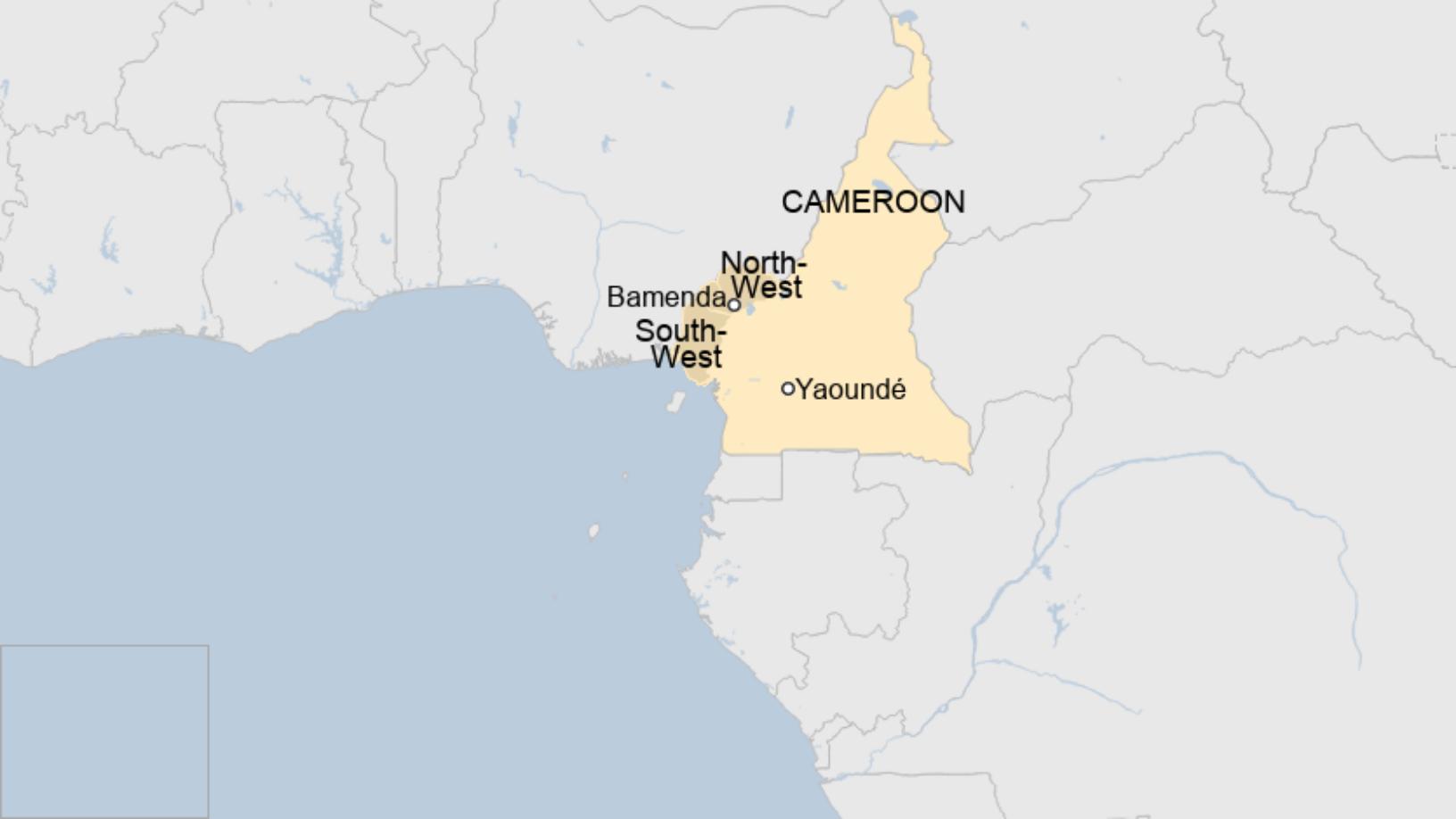
    It is easy to classify the war in Cameroon’s English-speaking regions of North-West and South-West as a clash over language. What this conflict really embodies, however, is a battle for fairness and access.

    When I accompanied my uncle and his daughter in 2016 to check her medical school entrance results, I knew she would not make it.

    At the entrance of a campus in Bamenda – the main city in the North-West region – were hundreds of science students, who had all passed their A-Levels, scrambling to find their names on the notice board. Most of them had not made it.

    Some were bemused, others cried, some laughed about it. Together, they were all sharing their first real experience of living as English-speaking Cameroonians.

    The odds were stacked against my cousin – and against all English-speaking Cameroonian candidates – trying to get into a government-run medical school.

    It was a stark example of their marginalisation by Cameroon’s French-speaking majority.

    Tony Vinyoh

    T Vinyoh

    Some Francophone students and even lecturers would hurl insults when they heard English or picked up the accent in our well-rehearsed French1px transparent line

    The medical school entrance paper my cousin sat was in English – with questions often poorly translated from French making some of them incomprehensible and marked by those who are not proficient in English. So very few English-speaking students are accepted.

    It effectively bars many English speakers from attending state-run universities, where students receive subsidised tuition. It is also common to hear allegations of bribery, which is rife throughout Cameroon, with wealthy parents “buying” a place for their child.

    We were just one of the many families going through disappointment in Cameroon’s Anglophone zone – and by November 2016 the demands for education, judicial and other reforms escalated into calls for a two-state federation. It later erupted into a secessionist war that has claimed tens of thousands of lives.

    Lost in translation


    The prevailing system means there are fewer doctors from North-West and South-West Cameroon practising at home. Even for the Francophone doctors who speak English, it is hard for them to relate to a culture and environment they were not raised in.

    Map

    1px transparent line

    Those I have met are dedicated to their work, but sometimes it takes more than desire to apply medicine. Medics at a hospital in the North-West region told me about a man who had surgery for testicular cancer and went home believing he was cured.

    His French-speaking doctor could not get it across that he had to return for a follow-up. He only came back when he started feeling pain. The man died.

    In rural areas, for example, not everyone can speak lingua francas like English or Pidgin.

    I once interviewed a woman in my village for an article I was writing about cataracts. She only spoke Lamnso, with which I am familiar but not fluent, so I employed a translator to put us both at ease.

    The fact that she did not consider me an outsider also allowed her to talk freely about her eye surgery and encourage others to try it.

    Some health professionals believe the government’s push to improve issues in the medical field has borne fruit over the last six years.

    There are now two functioning government-run medical schools in the two English-speaking regions – there was only one when my cousin applied – and an oversight committee to implement reforms. Students also report better translations of exam questions but nothing near professional standards.

    Trainers say more is being done to improve the cultural awareness of doctors and they are seeing more English-speaking Cameroonians in their classrooms than they ever met when in medical school themselves.

    While medicine may be slowly starting to improve, there is a lot more to achieve in public life.

    Harassment and humiliation


    Many Anglophones feel that French has been used as a language of intimidation from the earliest days of the union between French Cameroon and what was British-controlled territory.

    And since the uprising began, many more French-speaking police officers have been sent to patrol the streets of Bamenda, where they constantly check IDs. They get angry if someone cannot speak French, demand money at roadblocks and sometimes force young women to share their phone numbers.

    When I go around Bamenda with those fluent in administrative French, we have no bother with such harassment. I am in awe of the way their use of French gives me a pass in my hometown.

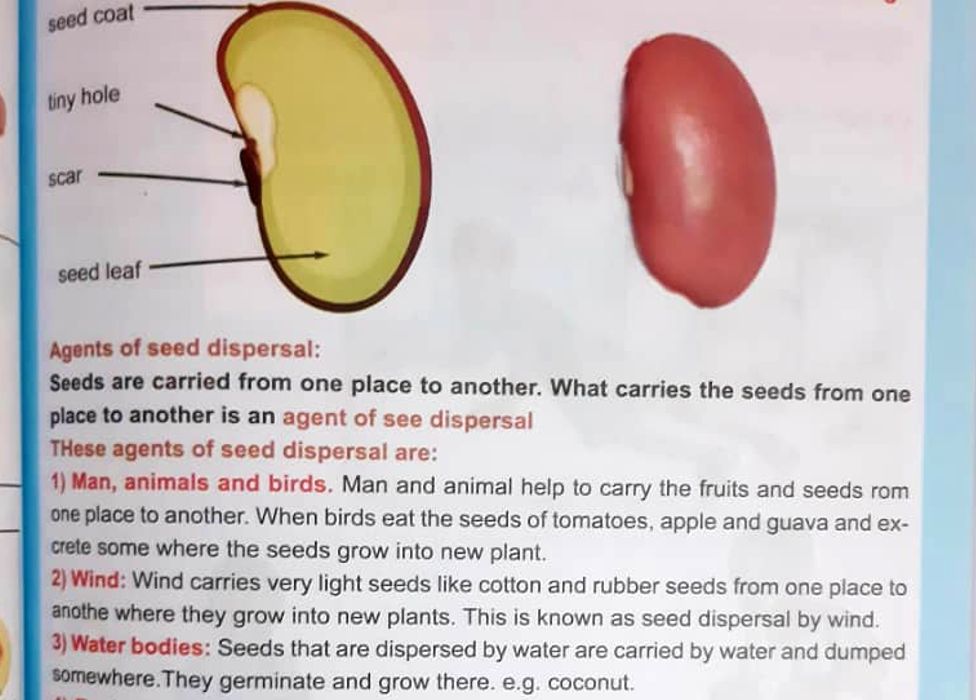
    A photo of a Cameroonian school text bookImage source, Tony Vinyoh

    Image caption, Silly mistakes and bad spelling are common in textbooks chosen by the government for Anglophone schools

    The challenge for Anglophones is that we simply cannot hide.

    While studying biochemistry at the University of Yaoundé, I – like many English-speaking students – never bothered asking questions in class because of the abuse we got. Some Francophone students and even lecturers would hurl insults when they heard English or picked up the accent in our well-rehearsed French.

    Thousands in state-run universities have to buy translated notes or pay for extra classes in English to compensate.

    Our parents are often humiliated by French-speaking civil servants when they have to travel to Yaoundé to chase up their unpaid pensions, victims of bureaucracy that seems intent on cheating them.

    More the Anglophone crisis:

    Set texts for Anglophone schools, chosen by the government, are often poorly edited and written – leading to falling standards.

    Yet it is ironic that in spite of the conflict prestigious private Anglophone schools have become sought-after by affluent Cameroonian parents who cannot speak a word of English themselves.

    They understand that the best opportunities will eventually go to graduates immersed in both cultures, speaking flawless English and French.

    A graduate who was raised speaking French at home while studying in English from nursery school is a formidable asset. They are the perfect fit for scholarships and international jobs in bodies like the UN.

    Even during a war that was triggered by discrimination, they are the right fit for global organisations trying to wade through Cameroonian bureaucracy.

    Some English-speakers see this influx as an opportunity for their children to learn French, but others are uneasy about the change.

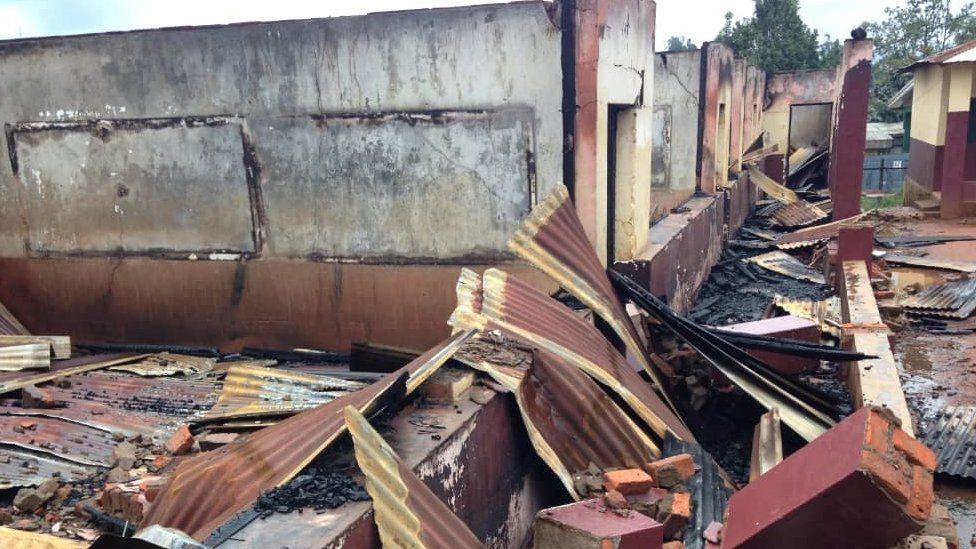
    A burnt-out school in Bamenda, CameroonImage source, Tony Vinyoh
    Image caption, Schools have been destroyed in the conflict – this one in Bamenda has now been rebuilt, but most lie abandoned

    With a focus on those who can pay fees upfront – and can extend generous donations – English-speakers are finding it more difficult to go to these schools.

    Until the late 1990s some parents in English-speaking areas, like my mother, still paid fees in instalments or with food crops like beans, maize and vegetables. Their children got an education and the food was used to feed students.

    The reality now is that the vast majority of children in the conflict-hit areas have gone from receiving a sub-standard education to little or no education at all.

    Would-be students with too much time on their hands have turned to crime, scamming and the all-too-easy life that bitcoin trading promises. At a time when they should be at school, many teenage girls are raising babies from unplanned pregnancies and rape.

    Back in 2016, after months of anguish, my uncle took out a huge loan and sent my cousin to Uganda to pursue her dream as she could not do it in her own country – and when she qualifies she may opt not to return home.

    The war is now also driving many healthcare workers, teachers and students away, a trend that will have dire consequences for the region and the economy.

    But what most in the English-speaking regions want – from those calling for federalism to those wanting secession – is to live in a country where their children will not have to start life with an insurmountable handicap.


    Source: BBC

  • The NGO in Cameroon making “gold” from e-waste

    In Cameroon, the processing of the tons of electronic waste produced each year is mainly in the hands of informal actors, trained on the job, “by observing from day to day”, admits Ismael Alioum.

    According to the scrap dealer, Chinese and Indian operators are very active in the sector and are mainly supplied by informal actors. Without gloves or a protective mask, the 46-year-old man hammers an old voltage regulator.

    “Iron and plastic are very sought after,” he explains, his hands full of mud. Besides him, three young men with screwdrivers and knives are also attacking old electronic devices.

    Watch video below

    Source: Cameroom.com.org

  • Priests, laypeople and a religious sister kidnapped in Cameroon’s west, freed

    5 priests, 1 religious sister and 3 laypeople who were kidnapped on Sept. 16 in the Cameroonian diocese of Mamfe are now free, the diocese announced.

    “It is with great joy that I announce the release” of five Catholic priests, one consecrated sister and two laypeople, Bishop Aloysius Fondong Abangalo wrote in his communiqué dated October 23.

    The Mamfe diocese located in South West region is one of two restive regions in Cameroon where separatists have been waging war to the federal authorities since 2017.

    On the evening of September 16, the Christians were abducted and St Mary’s Church in Nchang (South West region) was burned down.

    Murders, ransackings and kidnappings have become frequent in this region, where armed separatist groups regularly target schools and teachers in particular, but also Catholic and Protestant churches and their prelates. But the bishops of the region assure that Friday’s kidnapping is “completely unprecedented” in its scale.

    Last month, Archbishop Andrew Nkea, the president of the Ecclesiastical Province of Bamenda, did not give any details of the attack, did not attribute it to anyone in particular and said that the kidnappers had given “no concrete reason” for the act.

    In the communiqué issued by Bishop Aloysius Fondong Abangalo, Sunday, no information on the kidnappers was given.

    “Taking away the freedom of our brothers and sisters to make money at all cost is inhumane”, the bishop of Mamfe simply condemned.

    Source: African News

  • Cameroon: Recent floods continue to disrupt livelihoods

    The market town of Kousseri in the Far North Province of Cameroon, close to the border with Chad, has been struggling with major floods for a week.

    Two regional rivers have their confluence here, the Logone and Chari, and both are seeing exceptionally high water levels that are predicted to rise further.

    Sandbags were being used in an attempt to contain the rivers, but for many parts of Kousseri it was already too late.

    Homes in the town have been flooded and people were seen walking through knee-high muddy water, carrying possessions to try and save them from the floods.

    Families have been left homeless and have built temporary shelters from sticks and sheets on dry higher ground.

    “I’m in serious trouble,” told Kousseri resident Bouba Vira, whose family have been forced to abandon their home.

    Heavy rains caused enormous damage in August, and again the situation has become serious due to the rising flood waters.

    The Logone and Chari rivers separate Cameroon from neighbouring Chad which declared a state of emergency this week to help tackle the crisis.


    Source: Africa News

  • The ‘Franckistes’ shaking up Cameroonian politics

    In just a few weeks, Paul Biya will celebrate 40 years as president of Cameroon.

    The 89-year-old has shown no sign of wanting to give up the role, though critics claim he spends much of his time abroad, even as conflict in the English-speaking part of the country rages.

    There is, however, a huge political debate in Cameroon about who should eventually replace Paul Biya.

    Among the apparent contenders in the presidential elections scheduled for 2025 is one Franck Biya, the president’s son.

    The man himself has not spoken much about his ambitions but several groups of ‘Franckistes’ – or supporters of Franck – have sprung up.

    The vice-president of one of the groups, Shimenyi Amidou, said the movement was not about retaining political power in one family.

    “Franck Biya is a Cameroonian and has all the right to be a president. We are not looking at the position of the father. It’s not an issue of family,” he told the BBC’s Newsday programme.

    He also rejected claims that the president’s son was sponsoring the movement.

    “If you are a Franckistes in Cameroon it means you are having that zeal for a new Cameroon, for making Cameroon better than before,” he said.

    Source: BBC

  • Take advantage of AfCFTA – Mahama urges African countries

    Former President, John Dramani Mahama, has urged all African countries to take advantage of the African Continental Free Trade Area (AfCFTA).

    He stated that partaking in the free trade area will help develop their economies, as well as, stay competitive on the market; both locally and internationally.

    Speaking at a virtual forum on Thursday, October 13, 2022, John Dramani Mahama said, “We must advantage of AfCFTA, grow our values and get ready for increased international trade.”

    Meanwhile, Ghana, Egpyt, Cameroon, Mauritius, Rwanda, Tanzania and Kenya are the 7 countries participating in AfCFTA.

    The products traded include ceramic tiles, car batteries, pharmaceuticals, palm kernel oil, coffee, rubber, tea, components for air conditioners, among others.

    AfCFTA was introduced in 2018 with the aim of creating a single market for Africa, as well as, ensuring the free movement of goods and services on the continent.

    This free movement of goods and services will help expand Intra-African trade.

    This implies that goods will be sold at a relatively cheaper price because of the increase in production which will, in turn, create both direct and indirect jobs for the teeming unemployed youth.

    The free trade area also provides traders and importers an opportunity to stay competitive.

    Businesses when conducted in a free and safe environment will help reduce poverty in member states as well as create sustainable development.

  • African states divided on UN vote against Russia

    Twenty-six African countries have voted in favour of a UN resolution rejecting Moscow’s contentious referendums in four Ukrainian regions that it declared part of Russia.

    Nineteen countries abstained, including Eritrea that had previously voted to reject a UN resolution condemning Russia’s invasion of Ukraine.

    Russia’s perceived allies, including Mali, the Central African Republic, Ethiopia, Republic of Congo, South Africa, Sudan, Uganda and Zimbabwe are also among other African countries that abstained.

    Three of these countries hosted Russia’s top diplomat Sergei Lavrov when he toured the region in July.

    Burkina Faso, Cameroon, Equatorial Guinea and Sao Tome were absent from the assembly.

    Earlier this month, Ukraine’s Foreign Minister Dmytro Kuleba toured Africa to counter Russia’s apparent hold on the continent and persuade leaders to support Kyiv.

    He was forced to cut the visit short after Moscow heightened bombardments on Ukraine.

    Source: BBC

  • Defence exhibition, conference underway in Accra

    An International Defence Exhibition and Conference (IDEC) to enhance the capability of participants to address Africa’s security challenges is underway in Accra.

    The two-day event, which is also aimed at improving combined combat operations and regional development initiatives on the continent, is on the theme: “Strengthening international collaboration to combat terrorism and transnational organised crimes.”

    It is being participated by Defence Chiefs of Staff and senior officers and executives of security agencies and global partners, as well as advanced solution providers in the field of military technology and manufacturing.

    The delegates are from Brazil, Italy, South Africa, Kenya, Nigeria, Pakistan and Senegal.

    The rest are Cameroon, Ghana, Togo, Cote d’Ivoire, Egypt, Uganda, among other countries.

    Military gear, including weapons and vehicles, as well as defence technological tools, such as drones and communication equipment, are also on display at the event.

    The Dubai-based Great Minds Events and Exhibitions organised the event, in partnership with the Ghana Armed Forces (GAF) and the Gulf of Guinea Maritime Institute (GoGMI).

    Collaboration

    The Minister of Defence, Dominic Nitiwul, called for effective collaboration among armed forces on the continent and their counterparts around the globe to deal with terrorism and transnational crimes.

    He also said establishing strong cooperation and agreement among states worldwide would facilitate mutual legal assistance and extradition to help in the prosecution of cases transcending national borders.

    According to him, transnational organised crimes presented great challenge to the rule of law, economic and social development and the protection of human rights and security, as countries usually had to readjust on trade, economic growth and development after terrorist incursions.

    The minister said political turbulence and corruption continued to hinder Africa’s economic development and technological innovation.

    “It is, therefore, important that we build on the endeavours of Africa’s armed forces to enhance combined capabilities to counter the insecurities that plague the continent.

    “Insecurity directly affects the public financing capabilities of states and can obstruct economic development through tax evasion.

    “Our gathering here today is because our countries’ armed forces and security architecture have a huge stake in dealing with matters governing regional instabilities and security,” Mr Nitiwul said.

    Development

    The minister also said the measures and strategies put in place to revive economies across the African region would largely depend on how countries cooperated and collaborated to eradicate the menace of transnational crimes and terrorism, adding: “International trade cannot flourish without a secure sub-regional peace and security.”

    “My expectation is that concrete networks will be established at the sub-regional, continental and global levels to integrate our strategies and efforts at holistically dealing with these threats,” he added.

    Mr Nitiwul expressed the hope that the delegates would come up with meaningful and workable solutions to issues of transnational organised crime, terrorism and related threats to global peace and security.

    Strategy

    The Chief of the Defence Staff, Vice-Admiral Seth Amoama, said combating transnational crimes required a multi-dimensional strategy that safeguarded the citizenry and broke the financial strength of criminals and terrorist networks.

    Such collaboration, he added, disrupted illicit traffic networks, defeated transnational crime organisations, fought corruption, strengthened the rule of law, bolstered judicial systems and improved transparency.

    “The major outcomes that we expect from this conference and exhibition, in line with the theme, are a common understanding of the problem and developing a regional and international framework to deal, in particular, with the challenges of terrorism and transnational organised crimes, “ Vice-Admiral Amoama said.

    For his part, the Managing Partner at Great Minds Event, Noel Greenway, said peace and security had become a necessary tool for every nation, and that it could only be achieved through collaborations.

    IDEC, he said, provided an ideal platform for global defence suppliers to showcase their latest products and services and also meet defence buyers to negotiate fresh supplies.


  • Kenya aiming a “great dream” at the world volleyball championships

    It will be a “huge dream,” according to top scorer Sharon “Chumba” Chepchumba, if Kenya becomes the first African team to advance to the second round of the Women’s World Volleyball Championship.

    Chepchumba was overjoyed when her team increased their prospects by defeating Cameroon 3-0 on Tuesday in Arnhem.

    Victory in one of their final two group games should be enough to secure history for the Kenyans.

    “That will be a big dream for some of us, so we have to push harder to qualify, which would be a dream come true,” she told BBC Sport Africa.

    Kenya faces Italy, one of the favorites and the current Volleyball Nations League champions, on Thursday before meeting Puerto Rico, a match the East Africans are targeting, on Saturday.

    The team’s victory against Cameroon, with whom Kenya has swapped continental titles over the years, leaves coach Luizomar de Moura’s side fourth in their six-team pool, with the top four making the quarter-finals.

    “I believe in my teammates and the effort they showed [against Cameroon] was magical,” Chepchumba said after the game.

    “I’m really proud of my teammates because what we discussed and agreed is what they delivered.”

    Kenya and Cameroon are fierce African rivals – having swapped continental titles over many years – with Chepchumba saying the win meant even more because it came against the team that beat them in the last three African championships’ finals.

    “I don’t like it when Cameroon is beating us, so I just had to put up my efforts and make sure we won and get the respects,” she said.

    “We’ve been training hard for this, so I didn’t want to lose this match because it will determine so many things in my life and my teammates’ lives.”

    Kenya’s victory was vindication for Brazil’s De Moura, who has returned to take charge as part of a project backed by volleyball’s world governing body, the FIVB.

    “The victory means more than just the three points in the pool,” de Moura said.

    “It also gives Kenya the chance to move ahead in the FIVB rankings. In the African championships, Cameroon beat Kenya and passed us in the rankings so this victory shows we can be the greatest in Africa and compete at a high level.”

    Cameroonian regret

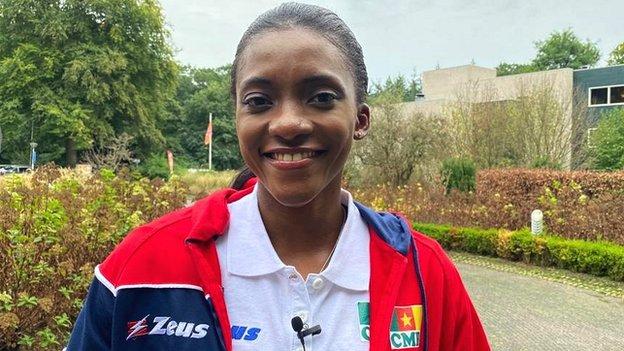
    Cameroon's Emelda Piatta Zissi
    Emelda Piatta Zissi still believes that Cameroon can turn their fortunes around

    For Cameroon, Tuesday night’s defeat was bitterly disappointing given they are the higher-ranked team and had hoped to give themselves a chance of taking the next step on the global stage.

    “It’s always hard to lose a match, especially when you know you are able to win it – so it’s really hard to take,” Cameroon’s Emelda Piatta Zissi told the BBC.

    “I think we lost concentration and [made] a lot of errors. This was one of the matches we were trying to focus on to win and we lost it.”

    Cameroon also has two matches remaining, against Puerto Rico and Belgium, with Piatta saying the team will need to return to a positive mindset.

    “It’s not over – we need to forget about this match and think about the next one. As a team, we always win together and lose together so we will be trying to fix what happened and correct it for the next game.”

    The body language at the end made it clear which team will take more confidence into their next outing – as Kenya danced on the court in celebration, while Cameroon traipsed off looking deflated.

  • ‘Dozens of foreigners are still hiding in my community’ – Akokoamong Assemblyman laments

    The Assembly member for Akokoamong Electoral Area in the Ejisu Municipality, Hon Daniel Owusu, has disclosed that dozens of foreigners are still hiding in the community at the blindside of authorities in the area.

    Some of these outlanders according to the assembly member are engaging in rogue operations including operating a school for men between the ages of 18 to 30.

    It is yet to be known by authorities as to what they are teaching the men who have been camped at secret places in the community.

    The foreigners suspected to hail from Cameroon, Niger, Burkina, and other neighboring countries have been camping secretly without the notice of authorities in the area.

    In an interview on the Kumasi-based OTEC 102.9 FM’s morning show, Nyansapo, on Monday, September 26, 2022, Hon Daniel Owusu said although police in the region have arrested some of these foreigners, dozens of them are still hiding in the community.

    “Sources in the community say there are many of these immigrants hiding in our area, and I must say the situation has sparked fear among us.”

    ARREST OF FOREIGNERS

    Police in the Ashanti Region on Thursday, September 22, 2022, arrested 48 foreigners suspected to be illegal immigrants living in a five-bedroom house at Akokoamong.

    The arrest follows a combined action by Security officials and community members who claimed to have observed the suspicious moves by these people in the past few months.

    The suspects have since been held at the Ejisu Divisional Police Command assisting investigations.


  • Nigeria braces for more floods as Cameroon opens dam

    Nigerians have been cautioned to brace themselves for more floods as Cameroon opens its Lagdo dam.

    The cautions comes after Nigeria’s National Emergency Management Agency (Nema) held an emergency meeting on Tuesday following deadly floods that could worsen after neighbouring Cameroon opened flood gates at a dam to release excess water.

    Since the start of the rainy season in July, at least 300 people have been killed and more than 100,000 others displaced.

    Nema Director General Mustapha Habib Ahmed said 13 Nigerian states are at risk.

    He said the spill-over effects from Cameroon’s Lagdo dam combined with heavy rainfall could affect more states – including the oil-producing Niger Delta.

    “The released water complicates the situation further downstream, as Nigeria’s inland reservoirs including Kainji, Jebba and Shiroro, are also expected to overflow between now and October ending,” Mr Ahmed said.

    Heavy rains in the north-eastern Yobe State have submerged roads and swept a major bridge linking the state capital and some local government areas, the authorities said.

    Source : BBC

  • Priests abducted as church burnt in Cameroon

    Eight people including Catholic priests, a nun and worshippers are being held in captivity by separatist fighters in Cameroon’s South West region.

    Their abductors also burnt down a church during the attack in Nchang, a community in the region. No group has claimed responsibility for the attack.

    The Catholic church authorities said they were shocked by this attack.

    Catholic bishops under the Bamenda Provincial Episcopal Conference said men and women of God had been “soft targets” of abductions and threats since 2016.

    Archbishop Andrew Nkea, the head of the Bamenda ecclesiastical province, told the BBC that the abductors were demanding ransom – adding that they were seeing the church as a “soft target so as to make money”.

    The North West and South West regions of Cameroon have suffered a bloody conflict between English-speaking separatists and the state for years.

    The violence has claimed more than 6,000 lives and displaced around a million people, according to the International Crisis Group think tank.

    Source: BBC

  • Stench from Lake Kuk in Cameroon causes panic among residents

    Mephitis emanating from Lake Kuk in North-West Cameroon has caused panic among some of the local villagers, according to BBC reports.

    Villagers who went to investigate the smell found that the water had changed colour.

    The Kuk village is not far from Lake Nyos, where a sudden gas escape from beneath the water in 1986 killed more than 1,600 people and thousands of livestock.

    Already, some villagers have left Kuk, but others have chosen to remain.

    Those currently present have linked the natural phenomenon to the recent death of a traditional ruler. In other words, the ancestors were responding to his passing.

    Kahn Elvis, a geology expert from the University of Yaoundé, said the smell could have been caused by the sudden release of magma from beneath the lake’s surface.

    The local authorities have urged people to be calm and said the strange smell and change in water colour was due to the recent heavy rains, Journal du Cameroon reports.

  • Dozens killed in clashes over land in Cameroon

    At least 30 people including women and children were killed during clashes over land between neighbouring communities in Cameroon’s South-West region, local authorities said on Monday.

    A spokesman for the Presbyterian Church in Cameroon said the fight between the Oliti and Messaga Ekol groups in Akwaya was very violent.

    The church released pictures that showed dead bodies lying on the ground.

    The violence started when attackers stormed a funeral ceremony in the village of Bakinjaw on Saturday and continued on Sunday, according to the communication officer of Akwaya district, Okumo Angwa.

    He added that people were burnt in their homes while others were beheaded in the attack.

    An MP, Aka Martin Tyoga, told the BBC that the attackers promised to return in two days. He said that investigations into the killings would take time as the area was remote.

    Cameroon’s two English-speaking regions, the South-West and North-West, are caught up in a separatist conflict that has already claimed more than 6,000 lives, according to the International Crisis Group.

    On Monday, a Human Rights Watch report said separatist fighters have killed at least seven people, raped one girl, and carried out scores of kidnappings since January. The rights group called for the prosecution and sanctioning of separatists fighters for these and other “grave human rights abuses”.

    Source: BBC

  • Cameroon’s ‘King Solomon’ dies aged 97

    Cameroon’s Mankon community are mourning their paramount ruler, Fon Angwafor III Solomon, who has died aged 97.

    Fondly referred to as King Solomon the Wise, he was an influential political figure who was one of the architects of the reunification of English-speaking Southern Cameroons and francophone La République du Cameroun in 1972.

    Fon Angwafor III Solomon went on to become an MP, then the first national president of the ruling CPDM party for decades – although he was rarely received in audience by the party leader, President Paul Biya.

    The late paramount ruler had also studied agriculture in neighbouring Nigeria, and together with his children cultivated a variety of crops and exotic fruits.

    Fon Angwafor has been through the thick and thin of Cameroonian politics. His palatial residence in the heart of Bamenda was burnt during the tense period when multi-party democracy was reintroduced in Cameroon.

    While several traditional rulers escaped from the current bloody conflict the English-speaking regions, he stayed put until his disappearance – which is how his death is being referred as.

    According to the tradition of the Mankon people, their king has simply disappeared. They believe Fon Angwafor III has spirited himself away to meet his ancestors.

    On the lighter side, many will remember him as a giant man with an extremely big shoe size that tickled many.

    Meanwhile, a new king has been chosen. He is Fru Asah Angwafor, an educationist.

    Source: BBC

  • MSF workers kidnapped in northern Cameroon

    Armed men in northern Cameroon have kidnapped five people working for Médecins Sans Frontières (MSF), local officials say.

    The abduction of the French medical charity employees took place during an attack in Cameroon’s Far North region that lies between Nigeria to the west and Chad to the east. 

    Militant Islamist groups are known to operate in the area but local officials say there is no evidence of a jihadist attack. 

    Those abducted are three aid workers of Chadian, Senegalese and French-Ivorian nationality, as well as two Cameroonian security guards.Article share tools

  • 34 killed as cholera epidemic spreads in Cameroon

    At least 34 people have died so far in a cholera epidemic that is sweeping the Central African nation of Cameroon, the United Nations Office for the Coordination of Humanitarian Affairs (OCHA) said on Monday.

    The epidemic has hit at least four regions, including the Littoral region where the commercial capital Douala is located. In the Southwest region, 28 people have died, and 1,055 others infected.

    There are 77 cases and four deaths in the Littoral region, the South region has 52 cases and two deaths and the Far North region has reported eight cases, OCHA said.

    Cholera cases were first reported in localities in the Littoral and Southwest regions of the country in early January.

    Last week, Cameroon’s Minister of Public Health Malachie Manaouda urged people to stay hygienic and report any infections to the hospital.

    Outbreaks of the water-borne disease occur regularly in Cameroon, mainly due to poor sanitation and a lack of access to clean drinking water.

    Cholera, which is spread by ingesting fecal matter, causes acute watery diarrhea and can kill within hours if not treated.

    Source: theeastafrican.co.ke

  • Cameroonians fight their government over 0.2% Mobile Money tax

    Cameroonians started the New Year with a new tax and it was the mobile network operators that sent them a reminder of the particular tax.

    That tax is the 0.2% Mobile Money tax, which is expected to be levied on the transfer and withdrawal of money via the platform.

    One network provider circulated the following message to subscribers: “Dear valued client, in the application of the Finance Law, starting 01 January 2022, a 0.2% tax is applied to transfer and withdrawals. Thanks for your understanding.”

    Here in Ghana, it took the stiff opposition of Minority lawmakers to torpedo the Electronic Transactions Levy (E-levy) Bill. Ghanaians would have started the year with a similar tax component pegged at 1.75%.

    When Parliament reconvenes later this month, it is expected that processes will be undertaken by the government side to pass the Bill into law.

    The NDC has stressed its continued opposition to the levy that was contained in the 2022 budget presented in Parliament by Finance Minister Ken Ofori-Atta in mid-November.

    Cameroon’s Mobile money law

    A leading business news portal, Busines in Cameroon, summarized the tax as follows: “According to the 2022 finance law, the tax applies to transactions carried out through all the traceable technical platforms (like internet, mobile phone, wire order, telex, fax) except for bank transfers and electronic transactions carried out to pay tax and customs duties.

    “The tax will also be applied to cash withdrawals from financial institutions or mobile telephony operators,” it added.

    On social media, Cameroonians are livid at the tax with the reason that the mobile money component in particular was unfair in many ways.

    What Ofori-Atta said about 1.75% levy on electronic transactions

    Ken Ofori-Atta introduced a new 1.75% levy on all electronic transactions such as Mobile money transactions, remittances and other electronic transactions.

    Fees and charges of government services have also been increased by 15%.

    The Finance Minister explained, “It is becoming clear there exists an enormous potential to increase tax revenues by bringing into the tax bracket, transactions that could be best defined as being undertaken in the informal economy.

    “As such government is charging an applicable rate of 1.75% on all electronic transactions covering mobile money payments, bank transfers, merchant payments, and inward remittances, which shall be borne by the sender except inward remittances, which will be borne by the recipient.

    “To safeguard efforts being made to enhance financial inclusion and protect the vulnerable, all transactions that add up to GH¢100 or less per day, which is approximately ¢3000 per month, will be exempt from this levy,” Ofori-Atta revealed.

    #EndMobileMoneyTax: Twitter campaign against tax

    One of the key voices against the tax is Rebecca Enonchong, a leader in African tech ecosystem, who tweeted as follows: “Can you imagine being charged a tax to withdraw your own cash out of your account? For millions of Cameroonians who hold their money in mobile money wallets, this became a reality on Jan.1.

    “This tax is regressive and will slow financial inclusion. #EndMobileMoneyTax. #WeSayNo.”

    Arrey Ntui, a security analyst with the Crisis Group also highlighted the draconian nature of the tax via a tweet: “Cameroon should pursue financial inclusion as cost of living skyrockets. The mobile money tax unfairly punishes Cameroon’s poorest people.

    “Cheque and bank transfers have no similar tax. Over four million humanitarian aid needers rely mostly on mobile money,” he added.

    Below are some reactions on Twitter

    Source: www.ghanaweb.com

  • Cameroon’s main port city battles mounting flood peril

    Douala was plunged into darkness, but cries pierced the silent night: the water was rising. Alerted by the neighbours, Hummel put some of his belongings to safety and hurriedly sent the children away. A few minutes later, the blackish liquid invaded the house.

    In mid-August, like every year during the rainy season, the informal neighbourhood of Makèpè-Missoké was invaded by water in the heart of Cameroon’s economic capital. Under the effect of global warming, floods are becoming more and more frequent in this port city of more than three million inhabitants, which is constantly expanding.

    “Burned-out TV, burned-out refrigerator. Everything is wasted,” sighs Hummel Tsafack, 35.

    “As soon as the thunder rumbles, we raise the beds. We are always afraid here. The water comes so quickly,” agrees his neighbour François, in his fifties. He still has a bitter memory of the flood of the summer of 2020 that paralyzed the city and devastated the neighbourhood.

    In his small house soaked with humidity, all the household appliances are out of order. On the floor, the concrete is dotted with a few holes. “This place, we’ve already cemented it seven times. Every time it floods, it breaks and we have to start over.”

    Population growth

    “We moved here because it was cheaper. We’re not going to move,” he warns. This precarious neighbourhood is in a flood zone that cannot be built on. But residents continue to pile in, driven by the lack of space in a city with a population growth rate of over 5.5% per year.

    Each year, nearly 110,000 new city dwellers move into the megalopolis and the gap between supply and demand for available land is growing.

    Douala is prone to flooding with nearly 250 km of rivers and heavy rainfall averaging 4,000 mm per year. It is located at the mouth of the Wouri River, on a low coastal plateau, bordering the Atlantic Ocean and is influenced by the tides.

    Meteorological data for the last 20 years indicate a decrease in rainfall, which masks an increase in extreme events, and very violent rain episodes, causing flooding.

    The temperature of the metropolis is increasing, as it is at the global level. According to the latest report of the UN climate experts (IPCC), coastal cities are in the front line of the climate crisis and risk being “wiped out by long-term flooding” and rising sea levels.

    According to the IPCC, floods will displace an average of 2.7 million people in Africa and flood-related costs could increase tenfold by 2050, to $60 billion a year, in the 136 largest coastal cities.

    Plastic waste

    In Makèpè-Missoké, plastic waste litters the river. “Look at all the garbage is thrown away by the residents. In addition to this, the soil is silting up and invasive plants are colonizing the riverbed. In case of heavy rains, the water overflows,” explains environmental specialist Didier Yimkwa.

    To address the problem, the city has built about 40 kilometres of drains since 2012. Some at-risk, unsanitary and precarious neighbourhoods have also been upgraded to allow access to city services, especially those for waste collection.

    But garbage and garbage are everywhere in Douala’s poor neighbourhoods, and the drains are often covered with plastic, preventing water from draining away.

    “It is estimated that 30% of waste is lost in nature,” said Dr. Joseph Magloire Olinga, Deputy Director of Studies and Environmental Protection in Douala.

    At the same time, another program has developed a hydrometeorological observatory to collect reliable local data on rainfall and prevent the risk of flooding. The participation of the French Development Agency and the World Bank is essential, says Olinga, who is in charge of monitoring the “Douala, sustainable city” project.

    “The response is not enough,” he admits, however. “We need a serious alternative in terms of land to accommodate the population. This involves the densification of the city centre, and the construction of high-rise buildings, but some sectors are blocked by real estate developers who have bought the land and no longer want to sell it,” he explains.

    Some flood-prone areas also continue to be allocated to real estate projects, which is the responsibility of the state.

    In neighbourhoods like Makèpè-Missoké, the goal is to learn to live with the risk of flooding. “But it is certain that some inhabitants for whom the threat is too great will also have to leave,” concludes Mr. Olinga.

    Source: africanews.com

  • Explosive kills 5 Cameroonian soldiers, civilian in troubled Anglophone region

    Authorities in Cameroon said five soldiers and a civilian were killed early Wednesday in the troubled English-speaking region of Northwest when an improvised explosive device hit their vehicle.

    The soldiers were part of a government convoy that had travelled to the remote sub-divisions of Njikwa and Ngie to install newly appointed sub-prefects.

    The blast occurred when they were returning from the installation ceremony, according to Northwest regional chief of communication, Louis Marie.

    The civilian killed was a government official. “They were killed by terrorists,” Marie said referring to armed separatists who are known to be operating in the area.

    Separatists have been clashing with government forces since 2017 in a bid to create an independent nation in Cameroon’s two English-speaking regions of Northwest and Southwest.

    Source: GNA

  • Cameroon authorities launch investigation into grisly road accident, death toll hits 37

    Investigation has been launched into the tragic accident that claimed the lives of 37 people on Sunday morning in Cameroon.

    The accident occurred when a public transport bus leaving Koutaba for Yaounde collided with a truck coming in the opposite direction in Ndikinimeki, along the Yaounde Bafoussam highway.

    Those who witnessed the accident reported that the bus driver immediately lost his life in a collision that dragged the bus and its passengers into a nearby ditch. About 20 people instantly died and many injured when the accident occurred at 2 am local time.

    “The bus was heading to Yaoundé, and the truck was going to the west. The truck hit the bus and that’s why it appears rattled. By the time when the bus rolled in there, the driver was already dead,2 a witness said.

    By the time we understood what happened, a second bus from the same company was coming from Yaounde skid and almost turned over at the same place according to security sources, but it was saved by the highway embankment and the passengers escaped unharmed.

    The victims were taken to Ndikinimeki and Makenene hospitals in the early hours of Sunday. The driver of the truck fled, according to the information received.

    The most serious cases have been evacuated to Bafoussam, Yaounde and Bafia for adequate care.

    Later, the Minister of Transport announced that the President of the Republic had ordered an investigation into the real cause of the accident.

    Authorities now hope the investigation will help bring to justice those involved as preliminary report indicates the accident was due to carelessness, over speeding and lack of control.

    The number of deaths now stand at 37 and about twenty injured. These figures my increase in the coming hours according to the authorities.

    Source: africanews.com

  • Provisional results show Cameroon’s ruling party wins sweeping victory in first-ever regional elections

    The ruling Cameroon’s People Democratic Movement (CPDM) won a sweeping victory in the first-ever regional elections held last Sunday, according to provisional results released by regional supervisory commissions on Wednesday.

    Fourteen political parties contested in the elections and CPDM won the majority of the 700 councillors voted in 58 divisional headquarters of the country.

    “The trends based on the echoes from the 10 regions are that our party is doing quite well. After all that is not surprising because, out of the more than 10,000 (municipal) councillors who voted, CPDM constituted more than 90 percent of the voters.” Elvis Ngolle Ngolle, Senior Communication Official of the Party and a former Minister told Xinhua on phone.

    “What we will do with the victory is that we will continue to push for a decentralised Cameroon where citizens are now direct participants in the making of decisions concerning the country at all levels,” Ngolle added.

    According to Cameroon Electoral Code, political parties have the right to file petitions on partial or total cancellation of the election operations in competent courts of law, after which final results will be proclaimed.

    The elections took place on Sunday, with authorities expressing satisfaction with the conduct of the polls, despite interruptions from armed separatists in the country’s restive English-speaking regions.

    The regional council which is the assembly for the affairs of the region will be effectively established in the 10 regions of the country in the days ahead, according to the electoral body Elections Cameroon (ELECAM).

    Source: GNA

  • Ghanaian referee Daniel Laryea selected for CHAN tournament in Cameroon

    Highly rated Ghanaian referee Daniel Nii Laryea has been selected for the 2020 Total African Nations Championship (CHAN), in Cameroon.

    The 33-year-old is the only Ghanaian referee who made the cut for the competition.

    He is expected to depart Accra on Friday, January 8 2021 for a refresher course prior to the tournament on January 11, 2021. The referees and their Assistants will undergo physical, theoretical and technical test during the course to get themselves ready for the competition.

    The 2020 CHAN tournament will be held in Cameroon from Saturday, January 16 to Sunday, February 7, 2021.

    The biennial tournament reserved for home-based players should have seen its sixth edition held in April of this year, but was rescheduled due to the Corona virus pandemic.

    Cameroon will use the CHAN to prepare for the 2022 Africa Cup of Nations (AFCON), which was postponed due to the pandemic.

    Source: Ghana Guardian

  • Barcelona legend Eto’o involved in road accident in Cameroon reports

    Former Barcelona and Inter Milan striker Samuel Eto’o is in stable condition after he was involved in a road accident around Nkongsamba-Douala road in Cameroon.

    Eto’o was said to be returning from a wedding celebration when his car was hit by a public transport bus on Sunday morning.

    Although the car was badly damaged in the front, the 39-year-old was immediately moved to a hospital where he is doing well under the doctors’ watch.

    “The crushed car Samuel Eto’o was in. I can confirm that he is fine, we spoke again. Doctors taking care of additional examinations,” a Cameroonian journalist tweeted.

    According to France Football, the Barcelona legend suffered a head injury but no life was lost in the crash.

    Eto’o who is a special adviser to Caf President Ahmad Ahmad announced his retirement from football in September 2019 after a playing career that spanned 22 years.

    He won several laurels across Europe which include four La Liga crowns, three Uefa Champions League titles, two Coppa Italia, the Fifa Club World Cup amongst others.

    On the international scene, Eto’o is the all-time top scorer in the Indomitable Lions’ history with 56 goals and the second-most capped player with 118 appearances after Rigobert Song (137 caps).

    The 39-year-old won two Africa Cup of Nations trophies in the 2000 and 2002, and he also has an Olympic Gold medal in his cabinet, after helping the Central African country win the football competition at the 2000 Summer Olympics in Australia.

    Source: goal.com

  • One ‘killed’ in Cameroon anti-government protests

    A protester was killed and others injured in Cameroon during anti-government protests held across the country on Tuesday, according to the opposition party’s lawyer.

    The lawyer, Robert Amsterdam, tweeted a video of a protester lying motionless.

    He wrote: “We are receiving reports that at least one protester has been shot and killed by police in Douala [the country’s biggest city] and many others injured and arrested.”

    The government had warned of a firm response to Tuesday’s protests called by opposition leader Maurice Kamto.

    The demonstrators were calling for an end to the Anglophone crisis and a reform of the electoral code.

    Mr Kamto has suggested if the two issues are not addressed, the protests will continue until President Paul Biya is forced from power.

    Mr Biya has been in power since 1982. He was re-elected in 2018 in an election that Mr Kamto claimed he won.

    Source: bbc.com

  • Cameroons 1990 World Cup captain Stephen Tataw dies

    Stephen Tataw, captain of Cameroon’s 1990 World Cup squad, has died at the age of 57.

    His death was confirmed on Friday, but the cause of death has not yet been made public.

    Tataw is famous for leading the Indomitable Lions to become the first African side to reach the quarter-finals of the FIFA World Cup.

    They achieved the feat at the 1990 tournament in Italy. The legendary team earned wins over Argentina, Romania and Colombia.

    Four years later in the United States, it was not such a fairy tale as they were knocked out in the first round, including a 6-1 thrashing by Russia.

    Tataw’s club career saw him play for Cameroonian sides Tonnerre Yaounde and Olympic Mvolye.

    He ended his playing time in Japan with Tosu Futures.

    Source: Ghana Soccernet

  • Liberian, Cameroonian arrested for printing fake monies

    The police have arrested two persons suspected to be involved in the production of fake currency notes in Accra.

    The suspects, identified as Kamara Seidu and Judith Koadue, from Liberia and Cameroon respectively are aged 40 years.

    Daily Graphic reports that Public Relations Officer of the Accra Regional Police Command, DSP Effia Tenge disclosed that the two were picked up on Wednesday, June 24, 2020, after a tip-off at a hotel along the Baatsona-Spintex Road.

    They were in possession of counterfeit GH¢50 notes and pieces of paper cut to the size of the same amount.

    DSP Tenge noted that the team retrieved several items used by Kamara and Judith to make the counterfeit notes in the hotel where the duo were lodging.

    The items included two bottles of a liquid substance, a white polythene bag containing some washing powder, cotton wool and gloves all suspected to be items used in processing the fake currency notes.

    DSP Tenge also disclosed that the police also found nine pieces of GH¢50 notes which were later found to be fake.

    Later when the police took the suspects to their residence at Nii Boi Town in Accra for a search, a pair of scissors, a cutter, 88 pieces of paper, cut into sizes of GH¢50, two bottles containing a liquid substance, two rolls of Sellotape, two bundles of white polythene bags and 60 sheets of paper all suspected to be materials for processing fake currencies, were also discovered.

    She said preliminary investigation had revealed the suspects were fraudsters who swindled their victims under the pretext of doubling their money.

    Source: www.ghanaweb.com

  • Cameroon’s Speaker of Parliament test positive for coronavirus

    For not wanting to comply with government instructions, the behavior of the Right Honorable Cavaye Yeguie Djibril exposed the lives of 167 deputies and their relatives.

    According to hospital sources, the President of the National Assembly of Cameroon has tested positive for Coronavirus. Indeed, the latter was part of an Air France flight declared to be high risk by the medical authorities of the Yaoundé Nsimalen international airport. The Minister of Health therefore immediately requested that all passengers on this flight observe 14 days of self-isolation.

    Concerned about his perch, Cavaye Yeguie Djibril had confused parliamentary immunity with sanitary immunity by rushing to the national assembly. He had been re-elected for the umpteenth time, president of the august chamber; as expected.

    Cavaye Yeguie Djibril attended at least 2 plenary sessions in the Cameroonian National Assembly. Are we moving towards the quarantine of the 167 deputies currently in the lower house of our parliament? The measure is more than necessary if the news of the status of the Right Honorable is confirmed.

    And if the 167 deputies are quarantined. How will we proceed to catch up with all the people with whom they have been in contact between Tuesday and today to put them in quarantine too? Question at zero francs.

    Grégoire Owona, Nourane Moluh Assana or Cabral Libii… who have taken selfies with the old king of the deputies for 28 years are called to run to the hospital to pass a test at Covid-19, before it is late!

    Source: www.afrinews.pro

  • Cameroonian becomes DR Congo’s second virus patient

    The health authorities in the Democratic Republic of Congo have confirmed that a second person has tested positive for the new coronavirus and is being treated in hospital:

    The patient is a 46-year-old Cameroonian national who lives in DR Congo with his family.

    He returned to the country from France on 8 March, and did not show symptoms of the virus.

    DR Congo’s health authorities say they have so far identified 117 people who have come into contact with both of the country’s confirmed cases.

    The news comes a day after doctors in DR Congo decided to return to work, ending a two-month strike.

    Correspondents say the medical union signed an agreement with the government to improve their working conditions and pay.

    Source: bbc.com

  • Children among 22 killed in attack on Cameroon village

    At least 22 people have been killed in an attack on a village in north-west Cameroon, the UN says.

    Over half those killed in Ntumbo were children, and local media report that several victims were burned alive.

    No-one has claimed responsibility for Friday’s incident, but an opposition party blamed the army.

    Cameroon’s government, which has been fighting separatists in the region for three years, denied involvement in the attack.

    James Nunan, an official from the UN’s humanitarian co-ordination agency Ocha, told the BBC that a pregnant woman was among those killed.

    Fourteen children, including nine under the age of five, were also among the dead, he said.

    Mr Nunan said the incident has “terrified” the local population.

    “Whichever group has done this has threatened that there will be more violence ahead,” he said. “The people we’ve spoken with are extremely traumatised and didn’t expect this.”

    In a statement, one of the country’s main opposition parties – The Movement for the Rebirth of Cameroon – blamed “the dictatorial regime” and the head of Cameroon’s security forces for the attack.

    Agbor Mballa, a leading figure in the separatist movement, also suggested that “state defence forces were responsible”.

    An army official described the allegations as “false” when asked about the incident by AFP news agency.

    Cameroon’s government has been accused of human rights abuses during the conflict, and US President Donald Trump has axed the country from a special trade program with America.

    The government says separatists have killed dozens of civilians and security forces, but no official figures exist for civilians and separatists killed by government forces.

    Source: bbc.com

  • Children make up more than half of dead in Cameroon village massacre

    A massacre in an anglophone region of Cameroon left up to 22 villagers dead including 14 children, the UN said Sunday, with an opposition party blaming the killings on the army.

    Armed men carried out the bloodshed on Friday in the village of Ntumbo in the Northwest region, James Nunan, a local official of humanitarian coordination agency OCHA, told AFP.

    “Up to 22 civilians were killed, including a pregnant woman and several children,” Nunan said, adding that 14 children — including nine under age five — were among the dead.

    Eleven of the children were girls, said Nunan, head of OCHA’s office for the Northwest and Southwest regions, which are home to the West African country’s large English-speaking minority.

    Separatists in the regions have been fighting the central government for three years.

    The Movement for the Rebirth of Cameroon, one of the country’s two main opposition parties, issued a statement saying: “The dictatorial regime (and) the supreme head of the security and defence forces are chiefly responsible for these crimes.”

    A key figure in the separatist movement, lawyer Agbor Mballa, in a Facebook post also accused “state defence forces” of carrying out the killings.

    An army official contacted by AFP early Sunday denied the allegations, saying simply: “False”. No other official response was immediately available.

    The three-year conflict between anglophone forces seeking to break away from French-speaking Cameroon has claimed more than 3,000 lives and forced more than 700,000 people to flee their homes.

    Friday’s killings followed elections on February 9 that were marred by violence in the regions blamed both on separatists and security forces.

    Armed separatists prevented people from voting, threatening reprisals, while government soldiers were a heavy presence.

    Separatists kidnapped more than 100 people and torched property in the run-up to the elections, Human Rights Watch (HRW) said on Wednesday.

    The government has not yet announced the results of the elections or turnout figures.

  • Thousands flee Cameroon after upsurge in conflict

    The UN refugee agency says about 8,000 people have fled from Cameroon into Nigeria in the past two weeks because of an upsurge in violence.

    The UNHCR said the refugees had trekked through savannah and forests to reach Nigeria.

    Some arrived with gunshot wounds.

    Fighting between Anglophone separatists and the security forces flared during elections held on Sunday.

    More than 600,000 people have been displaced and about 3,000 killed during the conflict which started in October 2017.

    SOurce:bbc.com

  • Thousands flee Cameroon after upsurge in conflict

    The UN refugee agency says about 8,000 people have fled from Cameroon into Nigeria in the past two weeks because of an upsurge in violence.

    The UNHCR said the refugees had trekked through savannah and forests to reach Nigeria.

    Some arrived with gunshot wounds.

    Fighting between Anglophone separatists and the security forces flared during elections held on Sunday.

    More than 600,000 people have been displaced and about 3,000 killed during the conflict which started in October 2017.

    SOurce: bbc.com

  • Cameroon conflict: ‘I go to a secret school’

    When his family recently fled a separatist rebellion in the country’s English-speaking regions, they thought they had found a place where he could go to school in safety.

    But that has turned out not to be the case as the school he attends in Douala, the biggest city in Cameroon, is at risk of closure because it is deemed illegal by the authorities.

    Such illegal schools are mushrooming in Douala, where the majority of people are French-speaking.

    ‘Raining bullets’

    Most schools in the Anglophone regions of North-West, including its capital Bamenda, and South-West have been shut down over the last three years, leaving more than 600,000 children out of school.

    “I left Bamenda because there was a war. They were killing people and they were shooting guns,” Mackjourney told the BBC.

    Read:Cameroon government shuts down hundreds of schools

    Those schools that did remain open were at risk of attack from separatist fighters.

    “We would sit in class and bullets would be raining on the roof. It was scary,” he said.

    Some enterprising people in Douala have stepped in to provide them with an education – at a price.

    Mackjourney walks 2km (a little more than a mile) every morning through a narrow, winding pathway in a marshy area to his school, a wood structure with no windows.

    From inside their classroom they can see the tall grass on all sides.

    The location has been chosen so that it is hard for the authorities to find.

    This is the second private school he has attended in Douala – the first was shut down by the government as it had not been approved.

    The authorities say schools must have a playground, a library, and classrooms to be officially registered.

    Read:Boko Haram kills four, abducts 18 in Cameroon

    More than 250 schools closed

    But the proprietors of these schools are willing to flout the regulations as there is money to be made from parents desperate to give their children an education.

    With annual fees as much as $200 (£150), almost four times the monthly national minimum wage, they can cash in on the chaos created by the conflict.

    “Just to pay the registration fee was not really easy for us,” said Mackjourney’s mother.

    Like other parents, she says the options for those who have fled the conflict are limited as it is increasingly difficult to get a place in an approved school.

    So far the authorities have shut down more than 260 schools since the start of the school year in September and critics say they are not offering alternatives.

    An official from the education department in Douala’s Wouri suburb, Sylvestre Fils Moukalla, said the government had taken steps to accommodate the fleeing students.

    “The Minister of Secondary Education gave Parent Teacher Associations (PTAs) the express authorisation to build more classrooms in various schools.

    Read:Youths in Cameroon protest older politicians running for office

    “These PTAs mobilised enormous resources to build new classrooms and as a result the problem of the influx has been resolved. In Wouri for instance, all the children have found a classroom,” he said.

    But the reality is that many of the available classrooms are already overcrowded.

    Home schooling

    Some parents too like the fact that the private schools teach their pupils in English – not French.

    This is the root cause of the conflict in the Anglophone regions, which are home to about 20% of Cameroon’s nearly 25 million people.

    The problems began in 2016 following the government’s decision to increase the use of French in schools and courts in the mainly English-speaking regions.

    A key component of the separatist struggle has been a school boycott, enforced through the kidnapping of students and teachers who flout the order.

    Read:Cameroon leader wants talks to end separatist crisis

    In February, 176 people, mostly students, were kidnapped before being released two days later.

    Some of those who have fled to Francophone areas, including Claude Ngwa, are turning to home schooling.

    “I decided to get a private teacher to see how we can manage to educate these children at home,” said Mr Ngwa, a bricklayer and father of seven.

    He believes it is cheaper to pay one teacher than pay individual school fees for his children.

    “It’s too difficult for us. We are suffering. I am really ashamed that these children should stay in the house.”

    Anyambod Emmanuel Anya, founder of the Protestant University of Central Africa based in Cameroon’s capital, Yaoundé, warns of a bleak future if no solution is found fast.

    “The future of the children has been mortgaged to poverty, mortgaged to illiteracy and mortgaged to long-term suffering,” he told the BBC.

    “That is the price we are paying as a result of this conflict,” he said.

    Source: bbc.com

  • Measles vaccination team in Cameroon attacked, motives questioned

    Members of measles vaccination teams in southern Cameroon have been attacked and beaten by locals who say the serums triggered side effects that sent 12 children to local hospitals.

    Many rural Cameroonians distrust vaccination campaigns, which have been organized as part of a national initiative to stop a measles outbreak that has afflicted a number of children.

    Thirty-four-year-old Samuel Amougou, a vaccination team member in Cameroon’s southern commercial town of Ebolowa, is still recovering from wounds he sustained from angry parents who oppose the vaccination campaign. He says Roman Catholic clergy transported him and five other vaccination team members to Ebolowa regional hospital after angry parents harassed them last Friday in front of a local government school.

    “They [the parents] did not want to hear any explanations. They did not allow me to speak. I just got blows [to] my face and all over my body, severe beatings on my face and all over my body,” Amougou said.

    Read:Boko Haram kills four, abducts 18 in Cameroon

    At the same hospital, Etala Suza, a 35-year-old trader and father of two, says his son also suffered side effects of the vaccine and has been hospitalized for several days.

    Suza said after his son came home from school feeling tired, running a fever and vomiting, he, Suza, was told about the vaccination campaign for children in all schools. Suza said he was told by the child’s driver that the youngster threw up several times in the car.

    Cameroon organized the national vaccination campaign last week to contain the current measles outbreak it said had infected more than 3,000 people, especially children. The health ministry reported that the most affected area was in the central African state’s northern border with Nigeria and Chad, where 17 children had died this month.

    The government said but for the south region where the towns of Ebolowa and Sangmelima are located, the vaccination campaign went well in the country’s nine other administrative regions.

    Nurse Christelle Manedji of the Ebolowa regional hospital said medical staff attended to 12 children who suffered side effects of the vaccine. She said none of them died, as some people had claimed on social media.

    Read:Cameroon government shuts down hundreds of schools

    Manedji said the first case they received was that of a 2-year-old whose diarrhea and vomiting led to severe fatigue; the second was that of a 3-year-old who had a convulsion and fever a day after she received a dose of the measles and rubella vaccine. She says they had been told to be ready to handle such cases during the vaccination campaign because there are normal reactions for some vaccinated babies.

    Many parents in Cameroon’s south region do not trust vaccinations. They say traditional healers carry out traditional treatments that protect children. Many prefer African traditional medical practitioners, who are more accessible and available than hospitals, which often are very far from home, understaffed and lack medication. Others say Western countries create vaccines to stop children from being able to have babies when they are of child-bearing age. Some say the vaccinations are trial drugs that may paralyze their babies. Others claim their religious practices prohibit them from having children vaccinated.

    Dr. Jeudi Debnet, the highest government officer supervising the vaccination campaign in Cameroon’s south region, says such allegations are unfounded. He said officials have given instructions for all affected children to be taken to the nearest health centers.

    Read:Jumia leaves Tanzania, 10 days after exiting Cameroon

    All the children who go to the hospital [are admitted] with some effects of the vaccines should be taken care free of charge. We use vaccines that are going to expire in 2021. There are the vaccines that we are already using in routine immunization programs, so we just took the same vaccines to use during the campaign,” Debnet said.

    Cameroon’s health ministry reports that progress has been made in persuading parents to have their children vaccinated. Vaccination coverage in towns is estimated at 80 percent, but in some villages in the country’s hinterlands, barely have three out of every 10 children are vaccinated.

    The last vaccination campaign, between Dec. 4 and Dec. 8, targeted 3.3 million children between the ages of nine months and five years of age. The government says it is still considering launching a catch-up exercise for measles. The disease is caused by a virus that is spread through the air by breathing, coughing, or sneezing.

    Measles is said to be highly contagious and can remain in the air, ready to infect, for up to two hours.

    Source: allafrica.com

  • Cameroon dialogue starts as Anglophone separatists pull out

    Cameroon starts a national dialogue on Monday in a bid to end a separatist conflict in the country’s anglophone provinces though key rebel leaders have already refused to participate.

    Nearly 3,000 people have died and half a million fled their homes since fighting broke out in 2017 between the army and armed fighters who want independence for Cameroon’s two English-speaking provinces.

    The talks, led by Prime Minister Joseph Dion Ngute, are scheduled from September 30 to October 4 at the Congressional palace in the capital Yaounde.

    President Paul Biya, who has been in power for 37 years, hopes the talks will end crisis that is also hurting the economy of the coffee and cocoa-producing Central African state.

    October 1 marks the second anniversary of the spiral towards conflict – the declaration of the self-described “Republic of Ambazonia” for Cameroon’s English-speaking minority.

    Even before it began, the national dialogue ran into trouble with many activists arrested and experts voicing scepticism that it would yield tangible results.

    English-speakers account for about a fifth of Cameroon’s population of 24 million, who are majority French-speaking.

    Read:Cameroon leader wants talks to end separatist crisis

    Anglophones are mainly concentrated in two western areas, the Northwest Region and the Southwest Region that were incorporated into the French-speaking state after the colonial era in Africa wound down six decades ago. Many locals here complain of discrimination and marginalisation.

    In a report published last week, the International Crisis Group (ICG) estimated that around 3,000 people have been killed by separatist violence and the military crackdown.

    The ICG said the talks do not include separatists or Anglophone leaders who support more federalist solutions.

    “It thus risks further frustrating Anglophones widening the gulf between the two sides and empowering hardliners,” the group said.

    “The government should make greater space for Anglophones, particularly federalists who are willing to attend. It should also seek a neutral facilitator.”

    Biya’s government has rejected both a return to more federalism and any proposed separation.

    But Anglophone supporters are also divided between those two options for their regions.

    The government’s dialogue spokesman George Ewane said Cameroonian authorities had held preliminary discussions with some separatists, adding that even hardliners were welcome to join the talks.

    ‘Smokescreen’

    Mark Bareta, a separatist leader who is very active on social media, was the one most open to dialogue and it was through him that invitations to the others were sent, Ewane said.

    But on Friday, Bareta announced that he was pulling out, saying that “the only way to have real negotiations is to hold them on neutral territory.”

    Read:Cameroon prisoners live stream riot

    Of the 16 separatist leaders invited, those heading armed groups such as Ebenezer Akwanga and Cho Ayaba are also snubbing the talks.

    Akwanga told AFP that the event was a “smokescreen for the international community rather than an attempt to secure a complete and lasting solution… to the annexation of our country, Southern Cameroons”.

    Most of the leaders have expressed willingness to hold talks with the government but in the presence of an international mediator and in a foreign country with the terms for secession the main item on the agenda, according to the ICG.

    However, more moderate Anglophones like Cardinal Christian Tumi, the influential archbishop of Cameroon’s commercial capital Douala, have welcomed the initiative and urged the separatists to participate.

    ‘We can’t talk to ghosts’

    An official from the Southwest region said traditional chiefs had asked armed groups to attend the talks but they had spurned the offer.

    The official, speaking on condition of anonymity, however asked the groups to “emerge from the woodwork”, adding that “measures have been taken to ensure the security of those who attend.

    “We cannot talk with ghosts,” the official said.

    Locals are meanwhile divided about the outcome of the talks.

    “No good can come of this. It’s a game,” said a hardcore secessionist who identified himself as Agbor.

    “If we must go for talks, it would be to discuss the terms of separation and not anything else,” he said.

    But Jeannette Benga, a prominent figure of civil society in Buea, the capital of the Southwest region, voiced hope that “the two come to an agreement.”

    Blaise Chamango, the head of an NGO said the five-day talks were not enough to “debate the anglophone crisis and the other major problems in Cameroon.”

    Source: aljazeera.com


  • Cameroon leader wants talks to end separatist crisis

    In a rare address to the nation, Cameroon’s President Paul Biya has announced plans for major talks to end the conflict in the English-speaking regions of the country, where separatist fighters are demanding independence.

    The two Angolophone regions argue they have been marginalised for decades by the central government and the French-speaking majority.

    Mr Biya outlined measures to quell the crisis, which began three years ago when lawyers and teachers in the North-West and South-West regions went on strike over attempts to impose French in schools and courts.

    According to BBC Monitoring, the 86-year-old leader said talks would be chaired by the prime minister and would include politicians, armed groups and victims:

    “The dialogue in question will mainly concern the situation in the North-West and South-West regions. Since it will focus on issues of national interest such as national unity, national integration and living together, it is obvious that it will not concern only the population of these two regions.”

    Read:Cameroon prisoners live stream riot

    Mr Biya, who has been in power since 1982, said consultations would be held before talks started at the end of the month. They would bring together a wide range of people to seek ways to end the violence:

    “In the coming days, delegations will also be dispatched to meet the diaspora to enable them to make their contribution to discussions on the resolution of the crisis.”

    The president reiterated his offer of a pardon to any separatists who voluntarily laid down their arms, the AFP news agency reports.

    UN chief António Guterres welcomed the announcement, urging all Cameroonians to take part in the dialogue.

    Since the crisis turned violent in 2017, it is estimated that nearly 2,000 people have been killed and more than 500,000 forced from their homes.

    Read:Constitutional crisis worsens in Cameroon

    The recent sentencing of 10 separatist leaders to life in prison has further exacerbated the crisis, leading to a lengthy lockdown in the Anglophone regions that has closed schools and shops.

    But the president, quoted by AFP, sought to play down the rulings, saying:

    “The secessionists’ propaganda wanted to present recent court decisions made against a number of our compatriots, in the context of this crisis, as an obstacle to the planned dialogue. That is not the case.”

    According to AFP, the self-proclaimed leader of Ambazonia, Sisiku Ayuk Tabe, one of those sentenced, had said he was open to dialogue if the army withdrew from the North-West and South-West regions.

    Source: bbc.com