
Tag: Canadian wildfires

  • More than 120 million people at risk as Code Red is declared in Washington, DC

    More than 120 million people at risk as Code Red is declared in Washington, DC

    Due to smoke from the current Canadian wildfires, air quality alerts are in effect for more than one-third of the US population.

    According to the US Department of Environmental Protection, there are over 120 million people in the Midwest and East Coast who are exposed to poor air, from Minnesota to Virginia.

    A number of dangerous wildfires that have been raging across Canada are the source of the smoke. There are now over 200 fires blazing across all of Canada.

    The fires have burned about 30,000 square miles of wilderness – an area roughly the size of South Carolina.

    Air pollution is measured by the air quality index (AQI), which determines the average amount of fine particulate matter (PM2.5) in the atmosphere.

    AQI ratings between 101 and 150 are considered unhealthy for sensitive groups, such as people suffering from heart or breathing. An AQI above 150 is considered unhealthy for all people.

    An AQI of over 300 is considered actively hazardous and likely to effect a region’s entire population.

    As of Thursday afternoon, Washington, DC had an AQI of 176, making it the second most polluted city in the world.

    On Wednesday, the Metropolitan Washington Council of Governments issued a ‘code red’ warning for the nation’s capital, warning all citizens to avoid long exposure to the air.

    The warning extended through Thursday, but will be lifted to a ‘code orange’ on Friday.

    ‘Air quality in the DC region is expected to improve tomorrow although it will still be unhealthy for sensitive groups,’ the local government said.

    Photos from DC show the city’s many monuments and landmarks enveloped in thick plumes of smoke, including the White House and the Capitol Building.

    The city with the worst air quality on Thursday was Detroit, Michigan, where the AQI peaked at 202 and was rated ‘very unhealthy.’

    Earlier in the week, Chicago, Illinois reported the worst air quality in the world as the index rose above 150.

    Some sensors in Pittsburgh and other parts of western Pennsylvania were detecting an AQI as high as 237.

    Officials in New York also warned citizens to take caution.

    ‘Air quality is unhealthy in every corner of the state of New York,’ Governor Kathy Hochul said at a news conference.

    Western, central, and northern New York were all placed under air quality warnings. The city of Buffalo saw a high AQI of 159 on Thursday.

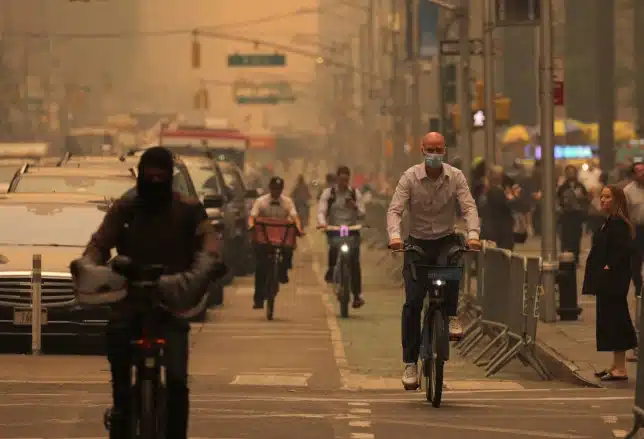
    New York City Mayor Eric Adams also warned New Yorkers to take precautions on Thursday, and advised citizens to wear masks and avoid exercising outside.

    The city and other parts of the Hudson Valley and Long Island reported ‘moderate’ AQI numbers, much lower than when a thick orange cloud of smog enveloped the city three weeks ago.

    Governor Hochul said there was ‘no end in sight’ for the Empire State. ‘This is our new reality,’ the governor said.
  • Smoke from Canadian wildfire finds its way to Norway

    Smoke from Canadian wildfire finds its way to Norway

    As stated by specialists, the smoke from the hundreds of wildfires blazing in Canada has already blanketed sections of the US and put some 75 million people under air quality advisories. It has also reportedly spread as far as Norway.

    Smoke plumes that originated in Canada have recently travelled as far as Greenland, Iceland, and Norway.

    Using extremely sensitive instruments, researchers at the Climate and Environmental Research Institute in Norway (NILU) have been able to identify the increase in smoke and then use forecast modelling to identify its source.
    Are you indeed Victor Shevchenko, or are you accepting this award on behalf of someone person? asked Zelensky.

    People in Norway may be able to smell and even notice the smoke as a light haze but, unlike parts of the US that have seen hazardous pollution, they should experience no health impacts, said Nikolaos Evangeliou, a senior scientist at NILU. “The fires traveling from such long distances arrive very diluted,” he told CNN.

    Over the coming days, the plume is expected to spread across swaths of Europe but it’s unlikely people will be able to smell or notice the smoke, Evangeliou said.

    It’s not unusual for wildfire smoke to travel long distances. “Smoke from wildfires such as those in Canada is injected at high altitudes thus staying in the atmosphere longer and able to travel over far distances,” he said.

    In 2020, smoke from California’s record-breaking wildfires was detected in Svalbard, a Norwegian archipelago located deep inside the Arctic Circle.

    The smoke brings negative climate impacts. Wildfire smoke moving over the Arctic deposits soot on the snow and ice, darkening the white surface, which allows it to absorb more heat. This, in turn, accelerates Arctic warming.

    The Arctic is already warming around four times faster than the rest of the world, which has global consequences, including influencing extreme weather events such as heatwaves, wildfires, and floods.

    The levels of soot arriving from the Canadian wildfires are not expected to have a direct impact on Arctic melting because they are too dilute, Evangeliou said. But the concern is that if fires in the high latitudes increase, which they have done over the past few decades and are projected to do further, then more soot will deposit, he added.

    As the climate crisis intensifies, wildfire seasons are expected to increase in severity, especially as droughts and heat become more common and more severe.