Tag: Cargo

  • Health Ministry receives GHS7.4m to clear medical supplies locked up at Tema Port

    Health Ministry receives GHS7.4m to clear medical supplies locked up at Tema Port

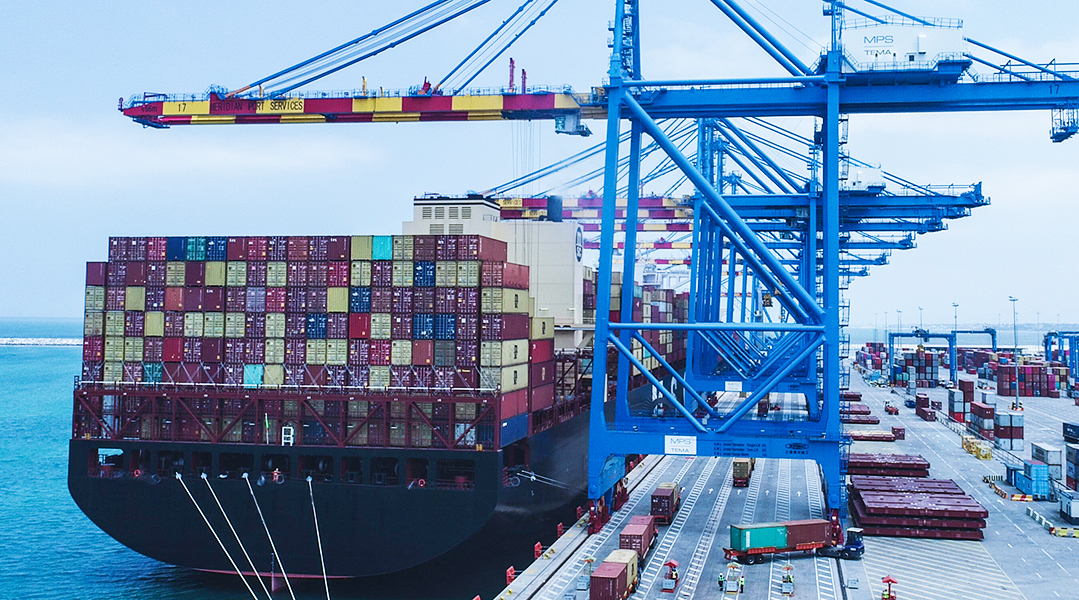
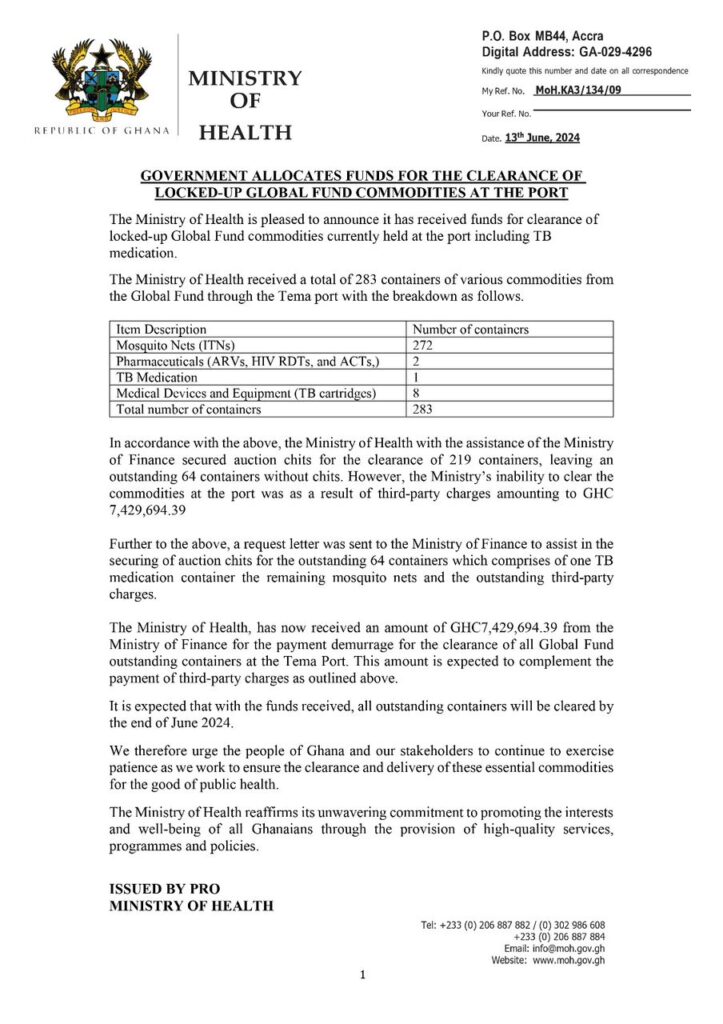
    The Ministry of Health (MoH) has announced the receipt of funds to clear Global Fund medical supplies currently held at Tema port.

    The Ministry indicated that it has received GH¢7,429,694.39 from the Ministry of Finance to cover demurrage costs for clearing all outstanding Global Fund containers at the Tema Port.

    In a statement issued Thursday, the MoH disclosed receiving 283 containers from the Global Fund through Tema port.

    This includes 272 containers of Mosquito Nets (ITNs), 2 containers of Pharmaceuticals (ARVA, HIV RDTs, and ACTS), and eight containers of Medical Devices and Equipment.

    Despite securing auction chits for 219 containers, 64 containers remain uncleared due to third-party charges amounting to GH¢ 7,429,694.39.

    “Further to the above, a request letter was sent to the Ministry of Finance to assist in the securing of auction chits for the outstanding 64 containers which comprise one TB medication container the remaining mosquito nets and the outstanding third-party charges,” the MoH stated.

    “In accordance with the above, the Ministry of Health with the assistance of the Ministry of Finance secured auction chits for the clearance of 219 containers, leaving an outstanding 64 containers without chits. However, the Ministry’s inability to clear the commodities at the port was as a result of third-party charges amounting to GH¢ 7,429,694,39.”

    The MoH has requested the Ministry of Finance’s assistance in securing auction chits for these outstanding containers.

    The Ministry urged patience from Ghanaians and stakeholders during this process, emphasizing its commitment to public health and service excellence.

  • Kenya Airways halts flights to DR Congo due to detained crew

    Kenya Airways halts flights to DR Congo due to detained crew


    Kenya Airways, Kenya’s national carrier, has halted its flights to Kinshasa due to the ongoing detention of its crew by the Democratic Republic of Congo (DRC)’s military concerning a contentious shipment of banknotes.

    The airline announced the suspension on Monday, indicating that it will be effective from Tuesday.

    Kenya Airways cited challenges in overseeing and supporting its operations in Kinshasa as reasons for the decision.

    “Due to the continued detention of KQ employees by the Military Intelligence Unit in Kinshasa, Kenya Airways is unable to support our flights without personnel effectively. As a result, we reached a difficult decision to suspend flights to Kinshasa effective April 30, 2024, until we can effectively support these flights,” said the carrier’s managing director, Allan Kilavuka, in the notice.

    “The continued detention of our employees has made it difficult for us to supervise our operations in Kinshasa, which include customer service, ground handling, cargo activities, and generally ensuring safe, secure, and efficient operations.”

    The decision made by KQ is expected to provide opportunities for other airlines operating the Nairobi-Kinshasa route, such as Ethiopian Airlines, Precision Air, ASKY Airlines, and South African Airways.

    Last week, Mr. Kilavuka disclosed that two employees of the airline were arrested and detained on April 19, 2024, due to alleged missing customs documentation related to valuable cargo intended for shipment on a KQ flight on April 12, 2024. However, the said cargo was not uplifted or accepted by Kenya Airways due to incomplete documentation.

    Mr. Kilavuka mentioned that military personnel in Kinshasa took the two employees to the military section of the air wing to provide statements but they were held without communication until April 23 when embassy officials and a KQ team were granted access to them.

    Although DRC authorities have yet to comment on the situation, sources reported to The EastAfrican newspaper that the issue revolves around the transportation of $8 million that was seized before being loaded onto the KQ plane.

  • No transit cargo loss to Lomé – Customs officials affirms

    No transit cargo loss to Lomé – Customs officials affirms


    The Customs division of the Ghana Revenue Authority (GRA) has refuted rumors suggesting that Ghana is losing transit cargoes to neighboring countries like Togo and Ivory Coast.

    Gerald Agbettor, Chief Revenue Officer and Officer in Charge of Transit at the Customs division of GRA, dismissed these claims during an appearance on the Eye on Port show on Metropolitan Television, based in Accra.

    Agbettor emphasized that Ghana is not experiencing losses in transit cargoes, citing data from customs declarations to support his assertion. He highlighted that the volume of transit trade in the country has shown growth.

    He elaborated that from January to March 2024, the transit trade witnessed a significant increase of 136,000 metric tons compared to the same period in 2023, rising from 308,000,000 metric tons to 444,000,000 metric tons in 2024.

    “Some time ago, I joined the chorus, especially transit business from the ports to the hinterlands, they say that Ghana is losing the transit trade to other places. By my background, I was able to have access to the data manifest and when I went through it, I saw transshipment to Benin, transshipment to Togo, and it became alarming. But the fact that it is transshipment on the manifest to Togo and Benin does not mean we are losing transit trade to them,” he explained.

    Mr. Agbettor also revealed that the diversion rate in Ghana is minimal. Nonetheless, he emphasized the importance of enhancing security measures at ports and transit terminals to promote equitable trade.

    Moreover, he commended the Ghana Ports and Harbour’s Authority for helping the Customs division of GRA save GH¢90 million in efforts to reduce diversion rates at the port.

    He noted that Ghana Link contributed significantly by installing dedicated monitoring devices on house-to-house containers moving from transit terminals to transit parks.

    “It is not really rampant, but it does not mean security should be relaxed, it should rather be tightened. A meeting was recently held with stakeholders to gather data from them so it can be used to best serve customers,” he said.

    Eric Adiamah, a Council member of the Ghana Institute of Freight Forwarders (GIFF) and a panelist on the show, echoed the sentiments of the Chief Revenue Officer regarding the flourishing state of transit in Ghana.

    Adiamah affirmed that the Port of Tema stands out as the top choice among landlocked countries along the West African coast. However, he disclosed that Ghana is experiencing some loss of transit volume to neighboring countries due to regulatory constraints and the high cost associated with transit operations, despite the Port of Tema’s commendable safety and security standards.

    “Transit business is thriving well. Only problem we see as operators of transit business is the cost of doing the business. The volumes as my brother has said are from data I have no access to, but on the ground what we know is that we are losing some volumes to neighbouring countries like Lomé. Meanwhile, between Togo port and Tema Port, when it comes to security and quality of service, the Port of Tema is way ahead,” he said.

    Mr. Adiamah said the regulations governing transit trade are sufficient to control the diversion of transit cargo at the ports and encouraged the GRA, Customs division to bolster its operational collaborations with freight forwarders in order to discourage them from participating in transit diversion.

    As a further disincentive to others, he urged that those apprehended for transit diversion offences must be made to face the full rigours of the law.

    “If the rules provided by the books are followed to the latter, monitored by customs and all the authorities, the rules as they stand now are enough to do the business. The new things they are bringing up, will not improve anything, they will not stop diversion, it will only worry people who do legitimate business,” he averred.

    The Officer in charge of transit explained that section 95, ACT 891, 2015, (6) of the Customs Act allowed for escorts for high risked goods under transit when the Commissioner deems it so.

    “There were suspicions that some high risk goods were likely to be diverted and because of that, we have to place escorts on them. So, it is not the entirety of the whole transit trade. High risk goods like rice, tomato paste, cooking oil, vegetable oil, ethanol, alcohol, diapers are being brought in more, hence, the directives from the Commissioner and Commissioner General that we should ensure that we put escort on them,” he explained.
  • Finance Ministry denies Smart Port and Electronic Cargo claim

    Finance Ministry denies Smart Port and Electronic Cargo claim

    The Ministry of Finance has refuted the existence of a new tax policy that necessitates shippers to acquire an Electronic Cargo Transit number.

    Reports had emerged from a letter that falsely indicated that all shipments to Ghana, including transit shipments, must obtain an Electronic Cargo Transit number (ECTN/SPN) and submit it for verification to Antaser Afrique BVBA.

    The Ministry of Finance in a statement dated October 31, denied the content of the letter and said, “The letter alleged that as from 15th September 2023, all shipment to Ghana, including transit shipment are required to obtain an Electronic Cargo Transit number (ECTN/SPN) and submit same to Antaser Afrique BVBA for verification.”

    “The Ministry wishes to inform all shippers and stakeholders that the letter and its content are fake and should be ignored.”

    The Ministry expressed gratitude to shipping agents and stakeholders who alerted them about the alleged letter, reaffirming their commitment to informing the public about any new tax policy that the government intends to implement.

    “We thank all stakeholders who alerted us and made enquiries and wish to assure them that, as is done with all policies, extensive consultation will be done with relevant stakeholders whenever government wishes to introduce a new policy or tax.”

  • Desist from under declaring cargo – GRA to importers

    Desist from under declaring cargo – GRA to importers

    The Ghana Revenue Authority‘s (GRA) Intelligence Unit has warned cargo importers and declarants to refrain from under-declaring, mis-describing, depreciating weight, and under-invoicing cargo.

    Mr Wisdom Xetor, Assistant Commissioner Intelligence, GRA, told Journalists that GRA had been doing some tracking and monitoring underground to uncover such operators and bring them to book.

    Mr Xetor said when importers and their agents were found to have engaged in any of the illegal acts, the GRA, as part of sanctions, could impose a 300 percent duty penalty on them and seize the items.

    He disclosed that currently, the GRA had intercepted at MPS Terminal Three, a container containing paper products after being monitored for two and a half months.

    He said the importers and declarants were suspected of engaging in under-invoicing, mis-describing, and devaluing weight.

    Mr. Xetor indicated that after taking statements from both the importer and agent and several meetings, they agreed to open the container on a certain date to physically examine the product, but the declarants did not show up.

    He said they, however, showed up when they realised that the GRA had blocked them from the system, making it impossible for them to do business with the Authority until the issue was thoroughly investigated.

    The Assistant Commissioner explained that even though they declared importing stationery, the scan picked the items as A4 papers, adding that they also entered about 68-line items, while it showed as one line item.

    He explained that while stationery attracted a five percent duty rate, A4 paper, which is classified as a finished product, has a 20 percent duty on it; therefore, mis-describing meant paying lower rates during clearing.

    He added that other importers also devalue the weight of their cargoes, stating, for instance, that instead of entering 18 metric tonnes, they would indicate eight.

    “We are therefore sending a clear message to the importing public that we are monitoring them, so they should declare the correct thing, as we will deal with them according to the law,” he added.

  • Tanzania intends to purchase a cargo plane

    With plans to utilize the Kilimanjaro International Airport (KIA) as a key cargo airport, the government is planning to buy a new special cargo aircraft.

    According to the Deputy Minister for Work and Transport, Mr Atupele Mwakibete, plans are aligned for the special cargo aircraft- Boeing 767-300F to arrive in the country in June 2023, to boost the cargo business.

    Mr Mwakibete was responding to a question asked in Parliament by Hai lawmaker, Saasisha Mafuwe who wanted to know why the government has not declared the KIA as a special airport to boost the country’s agribusiness by allowing cargo aircraft to land and takeoff without paying the fees.

    In his answer, Mr Mwakibete said in an effort to attract cargo business, the government was ready to review landing fees for all cargo aircraft as it had been proposed by the Hai representative.

    “Currently we do not have special cargo aircraft which have specific schedules to land at KIA,” he said.

    He, however, insisted that the cargo coming to KIA was being transported by passenger aircraft.

  • Ghana to experience 25 per cent drop in cargo berths

    The Ghana Ports and Harbours Authority (GPHA) anticipates a possible drop between 20 and 25 per cent of cargo berths at the port this year, especially cargoes that come into the country from the Russia-Ukraine regions.

    “Data gather from shippers indicates that due to the effect of the Russia-Ukraine war, cargo traffic into the country would dip as about 25 per cent of wheat and fertilizer import to the country were from Ukraine and Russia,” Mr Michael Luguje, GPHA Director-General stated.

    Mr Luguje stated during the seventh meeting of the Port Management Association of West and Central Africa (PMAWCA) Harbour Masters, and Port Facility Security Officers (PFSOS) in Tema.

    The three-day meeting brought together port management, harbour masters and port security officers from Ghana, Nigeria, Liberia, and Senegal among others in West and Central Africa to share ideas, identify common port challenges and adopt holistic measures to mitigate them.

    Mr Luguje, who is also the President of PMAWCA, called on importers to look for alternative places to import from, acknowledging, however, that sourcing from other places comes with additional costs, which would obviously lead to a reduction in quantities to import.

    He emphasised the need for port operators also to be resilient in their planning, by factoring in the risk of the extreme opposite of the current situation.

    “That extreme one could be you wake up one morning, and nothing is moving, how do you solve it, so now every budget we formulate we are assuming that we could wake up one day and have to deal with half of that budget how are we going to survive with the other half,” he said.

    The GPHA Director-General also charge port operators to develop a strategic plan and adopt measures in terms of cost planning, prudent management of revenue, and all the other remote resources including technology usage to ensure efficient operation.

    Mr Luguje also called for prudent efforts to minimize the use of fossil fuels and power and encourage port operators to consider investment in wind power, as well as develop an interest in electronic vehicles among others.

    Source: GNA