Residents of the Emena Constituency in the Ashanti Region are threatening turmoil if the police do not free three people who were detained for allegedly trying to stop a private developer from building a road through a cemetery. Tensions are rising in the area.
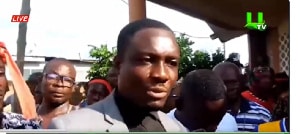
The young man said that the aforementioned construction had led to the exhumation of ancestors’ remains and the destruction of several cemeteries.
The residents of the town protested the road project’s damage to the cemetery in an effort to protect the burial grounds, which led to their arrest, according to a report filed by UTV. As a result, the private developer began building a road leading to his residence, directing it through the town cemetery.
In an interview with UTV, an assemblyman from the Emena Boadi Appiahdu Kokoben electoral district, Kenneth Owusu Bediako, offered his support for the young people, noting his own observation of three tombs that had been destroyed. He highlighted that it is forbidden to exhume grave remains.
“For me, I heard on Friday that they have brought grader to demolish our graves which has resulted in some graves of our fathers being exposed, so, I went to the police station to discuss with them, for myself I have witnessed about three graves that have been demolished…so, I support the steps that the youths have taken because it is a great taboo to exhume our grandfathers’ grave with a grader.”
Several residents voiced their concerns over the issue. One resident lamented, “What is painful is that someone has taken the law into his hands to exhume our graves, believing that his son, a Circuit Court Judge, will deliver justice on his behalf, disregarding the feelings of the community.”
Several residents voiced their concerns over the issue. One resident lamented, “What is painful is that someone has taken the law into his hands to exhume our graves, believing that his son, a Circuit Court Judge, will deliver justice on his behalf, disregarding the feelings of the community.”
Additionally, from another resident, “My father Kwaku Mensah’s grave is now exposed. We implore our leaders to intervene and protect our cemetery.”
Chur, a town in Switzerland, has a large monolithic granite block in the middle of the cemetery that has gone unnoticed for decades because no one seems to understand what it is.
The 13-ton stone monument, which dwarfs the neighboring gravestones, is now the source of shame and controversy.
A local journalist’s investigation has uncovered connections to Nazi Germany as well as Switzerland’s own tense relations with its adversaries during World War Two.
Chur’s cemetery is in the centre of town. Many people, like radio journalist Stefanie Hablützel, pass it every day on the way to work or out shopping.
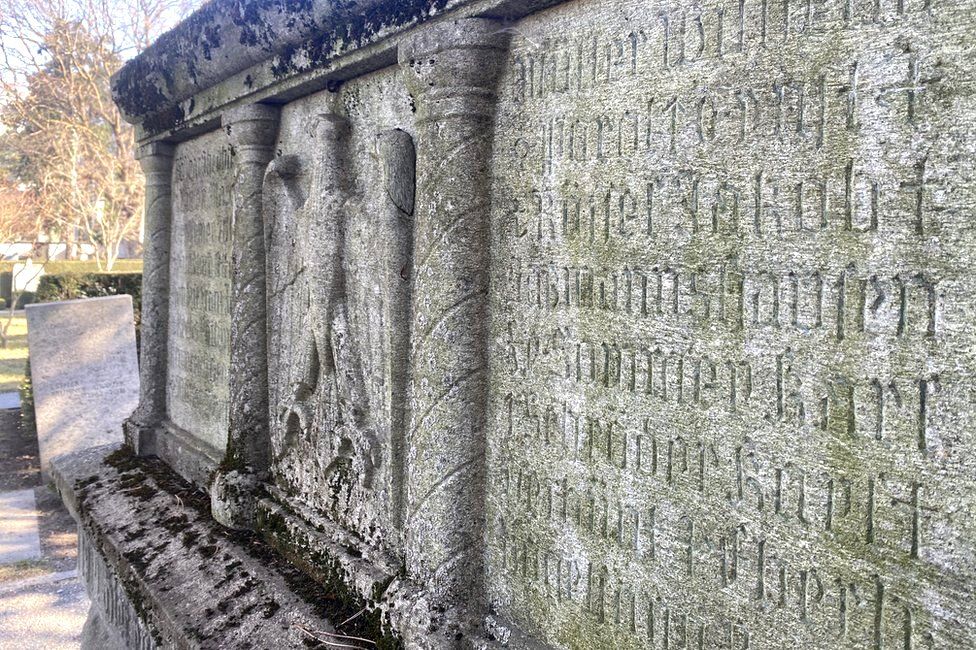
Nowadays the monument at the cemetery, untended, is covered in moss. The engravings on it are difficult to discern.
Image caption,The origins of the monument and its links to the Nazi presence in Switzerland were unknown
“At first sight it looks like a war memorial,” says Stefanie, pointing out some faint lettering: “1914 – 1918; hier ruhen deutsche Soldaten… here lie German soldiers.”
Why, though, would German soldiers be buried here?
In fact, thousands of wounded prisoners of war, French and British as well as German, were treated and interned in Switzerland during World War One. Some died from their injuries, others during the 1918 flu pandemic.
But Chur’s monument was not built until 1938. “That’s 20 years after these men died,” says Stefanie. “It wasn’t built to mourn these dead soldiers, it was built for propaganda reasons, for the Nazi regime.”
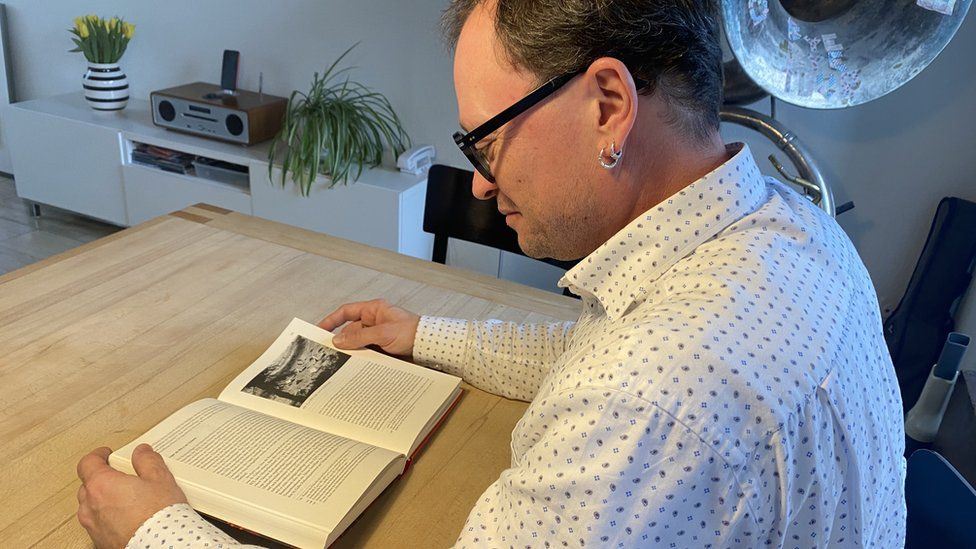
Swiss historian, Martin Bucher, explains that, as the Nazis grew in power in Germany, their propaganda involved cult-like worship of their war dead. In the 1930s the German War Graves Commission became part of Hitler’s propaganda machine. Its task, to create visible signs of Nazi power in Germany’s neighbours as well as at home.
There were many thousands of Germans living in Switzerland at the time, and, Martin says, they were organised. “In Switzerland all these organisations you know from Germany existed. The National Socialist Party, the German Labour Front, the Hitler Youth. They were all here, but only for Germans, not for Swiss people.”
Germany’s War Graves Commission submitted ambitious plans to build a vast mausoleum in the Swiss town of St Gallen. This was rejected by Swiss authorities. But the monument in Chur was approved. Polished and engraved in Munich, using the Nazis favourite Fraktur font, it was delivered to Chur on the eve of World War Two.
At the time, says Martin, Chur’s residents must have known what it was. “On Nazi holidays they put Swastikas on this monument… people would have seen it was a Nazi monument.”
Some were clearly unhappy. Stefanie uncovered an indignant letter to the local newspaper, written in 1938, asking: “Why do we have a Nazi stone in our cemetery?”
BBC
I didn’t realise how many Nazi organisations were present in the 1930s, here in ChurStefanie Hablützel Radio journalist
But some will have been supportive. Swiss sympathisers of Nazi Germany were well-documented in canton Graubünden, of which Chur is the capital. But homegrown Swiss fascist parties never really took off, getting only two seats in the Swiss parliament in 1935, and never standing again.
While Switzerland still has no official memorial to the Holocaust, parliament did approve plans for one in March last year. There are, however, around 50 unofficial monuments.
Throughout the war, Germans in Switzerland continued to be active in the Nazi party, and continued to display their Nazi sympathies. And the Swiss, hoping as usual to stay out of the fighting, made compromises with Berlin, banking Nazi gold, and turning away Jewish refugees.
Then, just one day after the war ended, neutral Switzerland got off the fence. “There was a huge purge,” says Martin. “The Swiss government tried to punish Swiss Nazis, there were trials.”
German Nazis, meanwhile, were expelled. “I think after that a lot of people were thinking it’s done now, the Nazis are away, no problem,” says Martin. “And I think they forgot this monument.”
Image caption,Historian Martin Bucher says Hitler’s propaganda machine was tasked with creating visible signs of Nazi power in neighbouring countries
So complete was this collective amnesia that today, among people like Stefanie, born decades after the war, the origins of the monument, and the Nazi presence in Switzerland, were a revelation.
“I grew up here in Chur,” she says. “And I didn’t realise how many Nazi organisations were present in the 1930s, here in Chur.”
Even local member of parliament Jon Pult was taken by surprise. “Switzerland wasn’t Nazi free, and I knew that,” he says. “But I didn’t know about this monument.
“I live maybe 500 metres from the cemetery where this stone is, and I walked past that stone probably a hundred times, and I never realised that it is of course a Nazi stone. Now that I know it’s very clear. I get it, I see it.”
So, what should happen now?
Despite a certain embarrassment, very few people have suggested tearing down the monument. But even fewer, says Stefanie, say it should be left just as it is.
Instead, consensus seems to be forming around a proposal to re-examine and publicise that period in Swiss history, just as Switzerland had to re-examine, and apologise for, its treatment of Jewish refugees during the war.
“I think it should stay in Chur,” says Martin, adding: “But I think it’s important to tell people why it is there. Maybe it can be a monument to remember all the people who died in the Second World War.”
Jon Pult agrees that Switzerland should “create a memorial” out of the monument “to remember the horrific crimes of the Nazis”.
But also, he says, the monument, and the information he expects to be placed in the cemetery with it, should serve as a warning.
“We should create a culture of knowledge about this, because as we know there is always a danger of fascist ideologies, totalitarian ideologies, as we see now for example in Russia.”
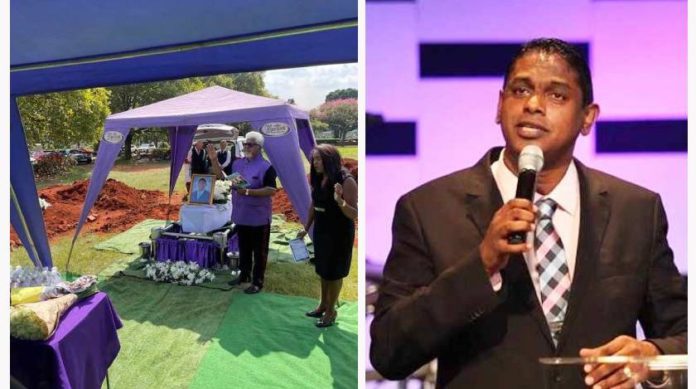
In Johannesburg’s Westpark Cemetery, Pastor Siva Moodley of South Africa was finally laid to rest in a dignified manner after waiting for a resurrection that never materialized for nearly 600 days.
Moodley, who founded The Miracle Centre in north Johannesburg, passed away on August 15, 2021. Yet, he was buried in a mortuary by his family and church because they believed he would be revived.
After nearly 600 days of waiting for a resurrection that never came, South African Pastor Siva Moodley was finally buried in a dignified manner at Westpark Cemetery in Johannesburg.
Moodley, who founded The Miracle Centre in the north of Johannesburg, passed away on August 15, 2021. His family and congregation, however, kept his body at a mortuary, believing he would be resurrected.
Cases of families and followers of clergymen believing in their resurrection are not uncommon.
In 2021, a Zambian self-proclaimed prophet died after his attempt to recreate Jesus’ resurrection backfired spectacularly. 22-year-old Pastor James Sakara died after he asked his followers to bury him alive for three days so that he could miraculously resurrect.
Sakara, a pastor at the Zion Church in the Zambian town of Chidiza, convinced his congregation that he could come back from the dead and resurrect on the third day.
Members of the church are reported to have performed a series of “spiritual exercises” to resurrect their prophet. Unfortunately, it was to no avail. Prophet James Sakara was unable to emulate Jesus and rise from the dead after three days.