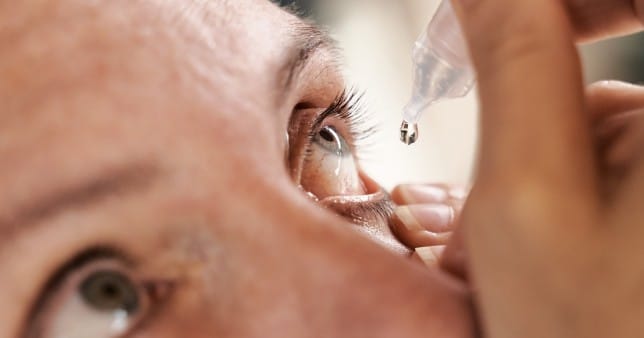
In the US, tainted eyedrops have caused the deaths of three persons and the need for eyeball removal in four more.
According to the Centers for Disease Control and Prevention (CDC), 68 or more persons have been affected by over-the-counter eyedrops made by EzriCare and Delsam Phama throughout 16 states. On March 14, the count was accurate.
The CDC reported that “three persons have died, eight have experienced vision loss, and four have had their eyeball surgically removed.”
37 of the patients received care at four different healthcare facility groups.
The majority of patients reported using artificial tears. The drops have caused a strain of Pseudomonas aeruginosa that ‘had never been reported in the United States prior to this outbreak’, according to the CDC.
It is ‘a rare strain of extensively drug-resistant’ Pseudomonas aeruginosa, the agency stated.
The outbreak is associated with several types of infections including of the eye. Eye infection symptoms include redness on the eye or eyelid and yellow, green, or clear discharge from the eye. Patients can also experience eye pain or discomfort, feeling that something is in the eye, blurry vision and increased sensitivity to light.
People who used the products and are not experiencing symptoms do not need to get tested.
Health officials are testing unopened bottles of EzriCare Artifical Tears to determine if the contamination took place in the manufacturing phase.
Patients and providers are advised to stop using EzriCare or Delsam Pharma artificial tears until the CDC and Food and Drug Administration release more information and guidance.
According to new capacity figures from the United States, hospitals in the United States are about as overcrowded as they were during the omicron surge. Department of Health and Human Services
A triple virus threat, or “tripledemic,” is a significant contributor.
According to Johns Hopkins University, flu cases are higher than usual, RSV is on the rise, and more coronavirus variants are emerging.
According to some paediatricians, the so-called “tripledemic” is particularly hard on children.
“We think it’s just a bad cold, and it isn’t. It can be so much worse,” said Dr. Edith Bracho-Sanchez, pediatrician at Columbia University Irving Medical Center.
She’s talking about the flu and its potential complications in children.
“The pneumonia that can come after, the ear infections that can come after, the dehydration that lands kids in the hospital, the sinusitis that can happen in older kids, even febrile seizures,” Bracho-Sanchez added.
Medical experts strongly recommend getting a flu shot.
Also, children as young as 6 months may be able to get an updated shot for COVID-19 soon.
For treatment, Walgreens is starting free home delivery of prescription Paxlovid.
The Centers for Disease Control and Prevention said vaccines and anti-viral therapies are still in the works for RSV, but pandemic mitigation strategies help stop all three viruses.
“It’s our individual choices that are going to help protect ourselves, our loved ones and our other community members,” said Dr. Keri Althoff, associate professor at Johns Hopkins Bloomberg School of Public Health.
Before Marian Akoto, 24, agreed to receive the injection, immunized peer volunteers had to provide proof of their advice in the form of a COVID-19 vaccination card.
The Centers for Disease Control and Prevention (CDC) recognises themes in news sources especially social media as a tool that may impact on vaccine confidence.
Its Confidence Insights August 2022 Report, says, a section of the public globally believes that vaccines are not safe or effective.
Marian’s initial posture towards the vaccine is not different from many especially PLHIV who are said to have a weakened immune system, because of their unique medical conditions.
But with timely and accurate communication on Covid-19, she was not left behind.
Currently, some 150,000 of 346,120 PLHIV in Ghana are on antiretroviral therapy to boost their immune system, according to 2019 National HIV estimates and projections.
PLHIV were part of the groups that were hardest hit by COVID-19.
To cater for their needs, she says an initiative called, “Reduce COVID-19 vaccine hesitancy and maximize vaccine uptake towards attaining the National HIV targets” was introduced.
The initiative trained youth-PLHIV to undertake a door-to-door education to convince and encourage members on the need to take the vaccine.
Madam Elsie Ayeh, President of NAP+ Ghana told GNA that a team of volunteers were formed in Kumasi and Accra to help convince their “community members” to take the vaccine.
She says to cure the claim of getting sick after taking the jab, the group carried along the outreach with meals to take before the vaccine is administered.
Nearly, 10, 000 PLHIVs at 11 communities in Accra and 13 communities in Kumasi, Ashanti Region were convinced and took the COVID-19 vaccine as a result of the project.
This has contributed to Ghana’s gains of administering 19,055,059 doses of all the five vaccine types, AstraZeneca, Sputnik-V, Moderna, Pfizer-BionNTech and COVID-19 Vaccine Janssen as of August 30, 2022, according to GHS.
She says none of the PLHIVs died of COVID-19 and members although facing the pandemic disruptions they were doing well.
Ms Catherine Bentum-Williams, PACTGH2022 Project Coordinator at Hope for Future Generations explains that the members of the group could not access their medication due to lockdown and other restrictions.
In other to cater for their needs, she says an initiative called “Reduce COVID-19 vaccine hesitancy and maximize vaccine uptake towards attaining the National HIV targets” was introduced.
The initiative trained youth-PLHIV to undertake a door-to-door education to convince and encourage members on the need to take the vaccine.
Ms Bentum-William says the project, which ended in August 2022, worked with closely with key partners including NPL+ and GHS to ensure easy access to vaccine centres at the convenience of the targeted group.
Other vulnerable populations like pregnant women and the aged benefited from the project activities.
The initiative supports the ideals of the Africa Health Strategy 2016 – 2030, Agenda 2063: The Africa We Want” and Sustainable Development, which talks about ensuring long and healthy lives and promoting the well-being of all in Africa
False videos and audios on the COVID-19 vaccine that circulated on social media prior to the vaccine roll-out programme heightened her fears.
These contents, which were wildly shared by prominent persons made claims about how people’s health conditions had worsened.
Strong partnerships with stakeholders
Dr Kwame Amponsa-Achiano, the Programme Manager for the Expanded Programme on Immunization (EPI) at the Ghana Health Service, told the Ghana News Agency that the main objective of the vaccine programme was to reduce morbidity, hospitalization, complication and death.
While more than six million people globally lost their lives, according to the World Health Organisation Ghana’s share stands at 1,450.
The country’s health sector, he states achieved these objectives through strong partnerships with many local and international partners and unique initiatives such as that NAP+ and Hope For Future Generations.
He says the inter-sectoral action for health engages other ministries, levels of government and non-state actors in a manner that demonstrates broad stewardship by ministries of health towards all actions conducive and necessary for health.
“Everybody realised that the pandemic was grinding the nation to a halt so there was that united front to find solutions. From vaccine development, cold chain storage and sensitization all hands were on the wheels to reduce protect lives. This is the power of partnership as enshrined in the sustainable development goal 17,” he said.