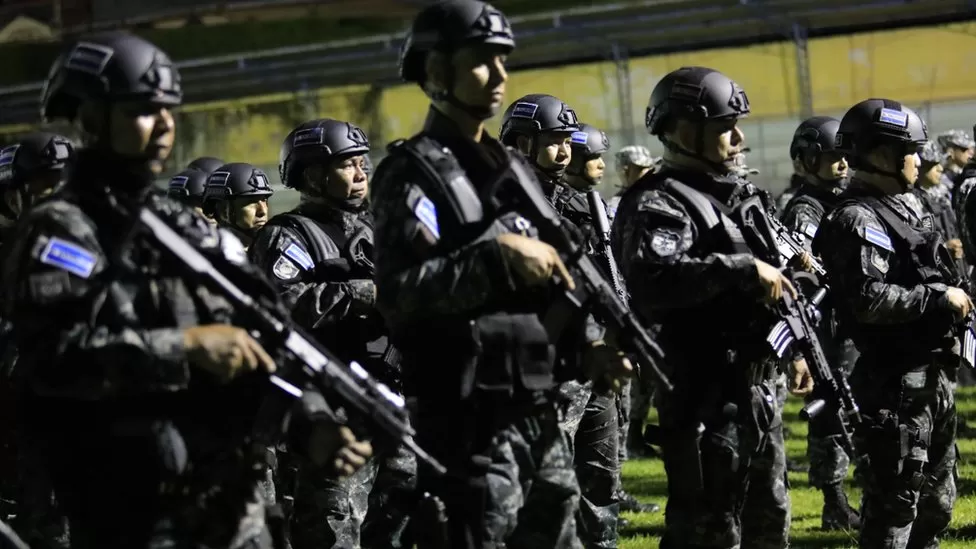
As part of the ongoing fight against gangs, El Salvadoran President Nayib Bukele has ringed the whole central Cabanas department with soldiers and police.
A security fence has been built by 7,000 soldiers and 1,000 police officers, according to Mr. Bukele’s post.
Stopping gang members from fleeing and disrupting their supply routes are the goals.
Since a state of emergency was established in March 2022 due to an increase in gang-related murders, more over 70,000 alleged members have been detained.
The dragnet of arrests has also resulted in the detention of thousands of individuals with no apparent connection to gang activities.
Concerns have also been raised regarding a new initiative by the nation’s parliament to permit mass trials.
President Bukele said that Cabanas, where gang members were hiding in the countryside, had “become the place with the largest number of terrorist cells” in a series of posts on X, formerly known as Twitter.
He emphasised that until “all the criminals” were arrested, the siege would not be lifted.
The president also asked visitors and locals to maintain their composure and go about their daily business.
According to the AFP news agency, soldiers-loaded lorries were spotted in the streets of the nearby towns of Tejutepeque and Ilobaso on Tuesday.
In the agricultural region of Cabanas, there are more than 160,000 residents.
Just over 1,000 sq km (390 sq miles) are covered by it.
A vast, brand-new prison in El Salvador has been used to house thousands of tattooed suspects of being part of gangs; there, they will ‘never return.
Since March of last year, more than 65,000 suspected gang members have been detained as a result of a governmentoperation in the Central American nation.
That happened when gang violence erupted, killing more than 60 people on the nation’s worst day since the civil war thirty years ago, including market patrons, bus passengers, and street sellers.
To help the jail system, which is becoming increasingly overburdened, the 40,000-capacity Facility for the Confinement of Terrorists in Tecoluca, San Vicente, was constructed.
The first 2,000 inmates were sent there last month at a time when nearly 2% of the adult population of El Salvador is in jail.
A second group of 2,000 prisoners were moved today to the facility, where human rights group and lawmakers alike have said is 4,000 too many.
The Center for the Confinement of Terrorism is designed to house the 10s of thousands of people arrested during government crackdowns (Picture: AFP)The country’s government has extended emergency powers to let the mass arrests continue (Picture: Getty Images South America)Guards have access to dining rooms and exercise facilities in the jail (Picture: Reuters)
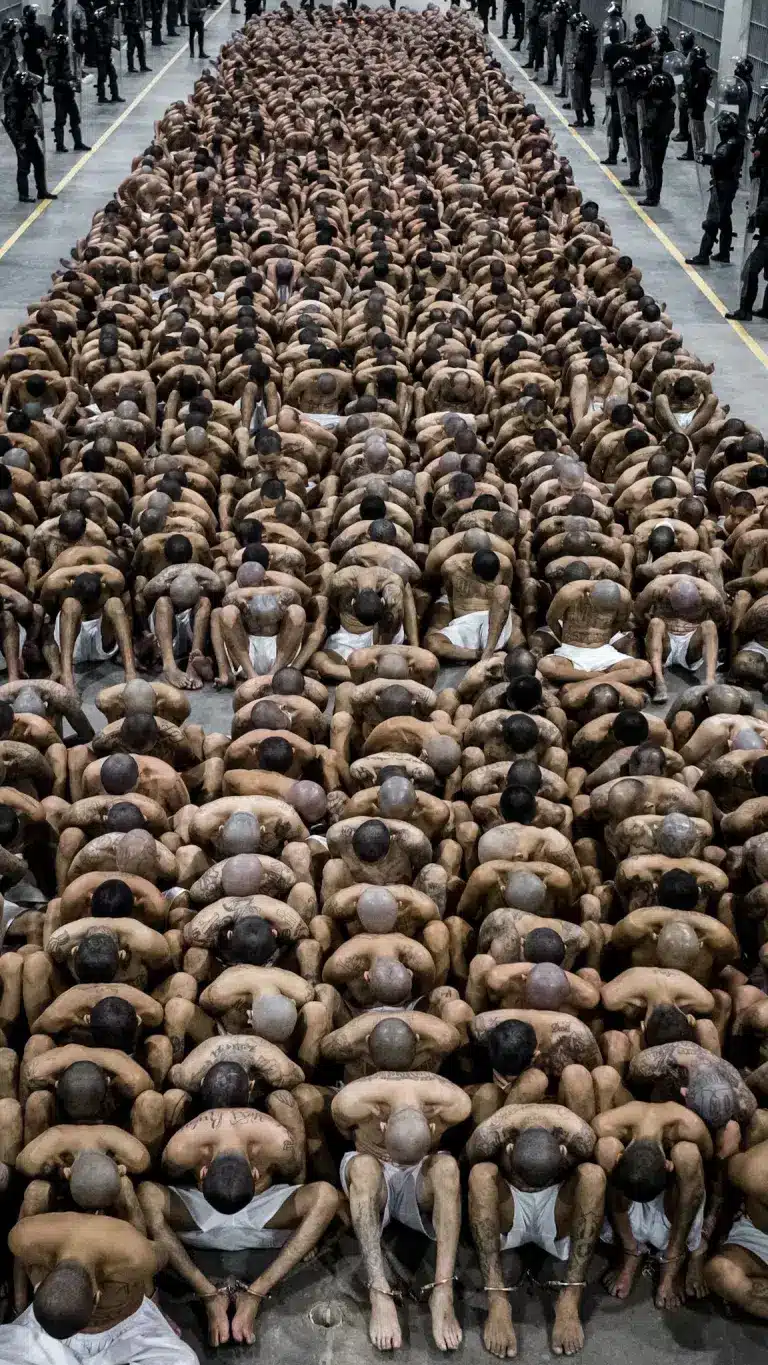
But El Salvador president Nayib Bukele boastfully shared photographs today of the lines upon lines of inmates sitting on the grey prison floor today.
‘This day, in a new operation, we moved the second batch of 2000 gangsters to the Terrorism Contention Centre (CECOT),’ he wrote on Facebook.
‘With this, there are now 4,000 gangsters inhabiting the world’s most criticised prison.’
Footage and photographs show thousands of barefoot men being led through the cavernous jail lined by guards in balaclavas.
They sit, seemingly endlessly, side-by-side in only white boxers. Their beds – stacked one on top of another – do not have mattresses.
‘This will be their new house, where they will live for decades, all mixed, unable to do any further harm to the population,’ Bukele, who campaigned on the promise of bringing law and order to El Salvador’s streets, said.
More than 100 prisoners must share 80 beds in each cell (Picture: AFP)One government minister described the men as a ‘cancer’ (Picture: Getty Images South America)
Minister for Justice and Peace Gustavo Villatoro added: ‘They are never going to return to the communities, the neighbourhoods, the barrios, the cities of our beloved El Salvador.’
Though, around 57,000 of those arrested are still awaiting formal charges or a trial. Only 3,500 people captured by the anti-crime dragnet have been released.
Villatoro added: ‘We are eliminating this cancer from society.’
The 2,000 men were transferred there as part of a security operation that started at dawn and involved 1,200 troops and three Air Force helicopters.
According to Public Works Minister Romeo Rodriguez, the Tecoluca prison is made of eight concrete buildings, each packed with 32 100sq m cells containing 80 bunk beds, two sinks and two toilets for between 100 inmates.
The mega-prison also has dining rooms, exercise facilities and table tennis courts inside – for the guards, at least.
The campus is 45 miles east of San Salvador, the country’s capital.
President Nayib Bukele said the men have been taken to the ‘world’s most criticised prison’ (Picture: AFP)Moving the prisoners involved more than 1,200 soldiers (Picture: Reuters)The cavernous prison is by the capital (Picture: Getty Images South America)
As it has done every month for nearly a year, El Salvador’s Congress today once again suspended some constitutional rights by extending its state of emergency.
The emergency decree loosens conditions for arrest, restricts free assembly and allows the government to listen in on citizens’ communications.
People no longer have to be told why they are being arrested, what rights they have or even be given access to a lawyer.
Bukele first requested emergency powers last March 27 after the explosion of gang activity.
The policy is widely popular among Salvadorans, with hatred for gang violence running deep in the country and killings now at an all-time low.
With an estimated 70,000 members in their ranks, gangs have controlled large swaths of the country for years, extorting and killing with impunity.
But human rights groups have grown increasingly concerned by the government’s heavy-handed treatment of detainees.
The first 2,000 inmates were transferred from the Izalco prison last month (Picture: Reuters)
They say there have been many instances of prisoner abuse within the dilapidated and overcrowded prisons and even innocent people have been swept up in the raids.
A data leak obtained by Human Rights Watch in January found evidence of violations of due process, little to no hope of justice and even dozens of deaths in custody.
‘The use of these broadly defined crimes opens the door to arbitrary arrests of people with no relevant connection to gangs and does little to ensure justice for violent gang abuses, such as killings and rape,’ the group said.