Tag: Chancellor Olaf Scholz

  • French battlegroup conducts NATO combat drill in Romania

    French battlegroup conducts NATO combat drill in Romania

    It is reported that about 600 French soldiers were deployed to take part in a military drill at a NATO battlegroup in Romania.

    The aim was to test the 30-nation military alliance’s readiness on its eastern flank amid Russia’s war in neighbouring Ukraine.

    The drill at a training range near Romania’s eastern town of Smardan on Wednesday involved some 200 military vehicles, including four French Leclerc battle tanks that practiced firing live ammunition.
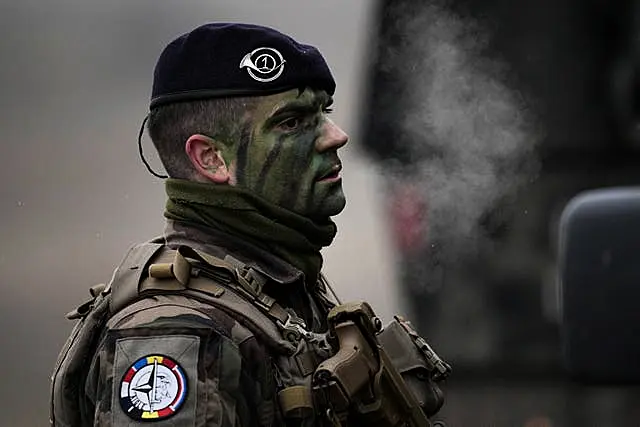
    A French serviceman takes part in an exercise at a training range in Smardan, eastern Romania
    A French serviceman takes part in an exercise at a training range in Smardan, eastern Romania (Vadim Ghirda/AP)

    Romania’s defense ministry said the main purpose of the exercise was to train the battlegroup “on the rapid deployment capability and execution of a combat mission” within a collective NATO defense operation.

    The Leclerc tanks used are the same model French President Emmanuel Macron said on Sunday he asked his defence minister to “work on” possibly sending to Ukraine.

    Kyiv has persistently requested tanks from its western allies to help its war efforts.

    After much hesitation, that request was finally granted by Germany on Wednesday when Chancellor Olaf Scholz said his government would provide German-made Leopard 2 battle tanks and also approve requests by other countries to do the same.
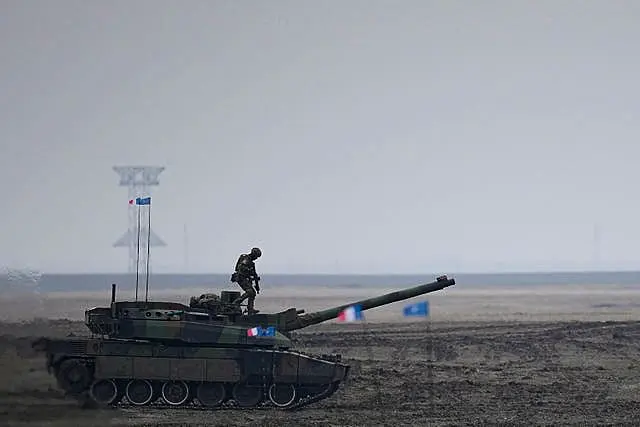
    A French serviceman stands on a Leclerc main battle tank during the exercise
    A French serviceman stands on a Leclerc main battle tank during the exercise (Vadim Ghirda/AP)

    In response to Russia’s invasion of Ukraine last February, Nato bolstered its presence on Europe’s eastern flank, including by sending additional multinational battlegroups to alliance members Romania, Hungary, Bulgaria and Slovakia.

    This month, the alliance deployed two surveillance planes to Romania, from where they will fly missions for several weeks to monitor Russian military activity near Nato’s borders.

    The Awacs aircraft, which Nato refers to as its “eyes in the sky”, belong to a fleet of 14 usually based in west Germany.

    Since the war started, Awacs have patrolled regularly over eastern Europe and the Baltic Sea region to track Russian warplanes.

  • ‘Utter nonsense’: Germany refutes Johnson’s claim it wanted Ukraine war to be over quickly

    Boris Johnson’s claim that Germany wanted Ukraine to “fold” in its war with Russia is “utter nonsense”, a German government spokesman has said.Earlier today, the former prime minister claimed other European nations took very different views on the war in Ukraine, with Germany allegedly preferring a quick Ukrainian defeat over a long conflict.

    He told CNN Portugal: “This thing was a huge shock… we could see the Russian battalion tactical groups amassing, but different countries had very different perspectives.

    “The German view was at one stage that if it were going to happen, which would be a disaster, then it would be better for the whole thing to be over quickly, and for Ukraine to fold.”

    The ex-PM also said France was in denial “right up until the last moment” when Russian forces crossed the border.

    However, Chancellor Olaf Scholz’s spokesman, Steffen Hebestrei, has refuted the claims and said Berlin had swiftly decided to send arms to Ukraine after Moscow launched its invasion.

    “We know that the very entertaining former prime minister always has a unique relationship with the truth; this case is no exception,” he said.

    Mr Hebestreit added: “This is utter nonsense.”

    Source: Skynews.com 

  • Scholz in China advocates for economic ties ‘as equals’

    During Chancellor Olaf Scholz’s visit to China, China’s Xi Jinping urged deeper economic cooperation with Germany.

    Following the Chinese leader’s consolidation of power, the trip has sparked controversy in Germany and concern throughout Europe.

    Mr Scholz mentioned “economic ties as equals, with reciprocity.”

    President Xi stated that the two countries should collaborate during “times of change and turmoil.”

    The chancellor’s visit – the first by a G7 leader since the coronavirus pandemic – follows an extraordinary and bitter row within the Berlin government.

    It had emerged that a Chinese company was poised to buy a significant stake in a part of the port of Hamburg. No fewer than six government ministers reacted furiously.

    The deal, they argued, would give China significant influence over critical German infrastructure. Germany’s security services also urged caution.

    But the German chancellor appeared insistent the deal should go ahead. He reportedly pushed through an agreement, albeit one that limited the size and influence of the stake, reducing it to 24.9%.

    No-one is quite sure why he seemed so determined. A former mayor of Hamburg, Mr Scholz remains close to the city authorities who argued that the deal represented vital investment.

    But plenty of other commentators suspect an ulterior motive; that Olaf Scholz did not want to turn up in Beijing without a “gift” for Xi Jinping.

    That has raised both eyebrows and concerns.

    Olaf Scholz

    Reuters
    We will seek co-operation where it lies in our mutual interest, but we will not ignore controversies… When I travel to Beijing as German chancellor, I do so also as a European
    Chancellor Olaf Scholz
    In Frankfurter Allgemeine Zeitung
    1px transparent line

    As has the chancellor’s decision to take with him a delegation of German business executives. That was standard practice for his predecessor, Angela Merkel, who pursued a policy of “Change through Trade”, believing that economic ties could influence political relations with countries like China and Russia.

    The chancellor’s visit comes hard on the heels of the National Congress of the Chinese Communist Party, at which President Xi tightened his grip on power and raised concerns in the West about his intentions towards Taiwan.

    “The signal that’s being sent is that we want to extend and intensify our economic co-operation – that must be questioned,” says Felix Banazsak, a politician from the Green Party, a partner in Mr Scholz’s coalition government.

    The Greens have long sought a tougher line on China. Just a few days ago the party’s foreign minister, Annalena Baerbock, sternly and publicly reminded him that his government came to power promising to readjust its China strategy.

    Mr Banazsak says his country must learn from its previous dependence on Russian energy: “We must make ourselves as independent as possible from individual states, particularly if these are states which do not share our values.”

    But Olaf Scholz will be painfully aware of the complexity and depth of his country’s ties with China, which remains Germany’s largest trading partner, although Germany imports more than it exports.

    More than a million German jobs depend on that relationship. Take as an example car giant Daimler, which sells more than a third of its vehicles in China.

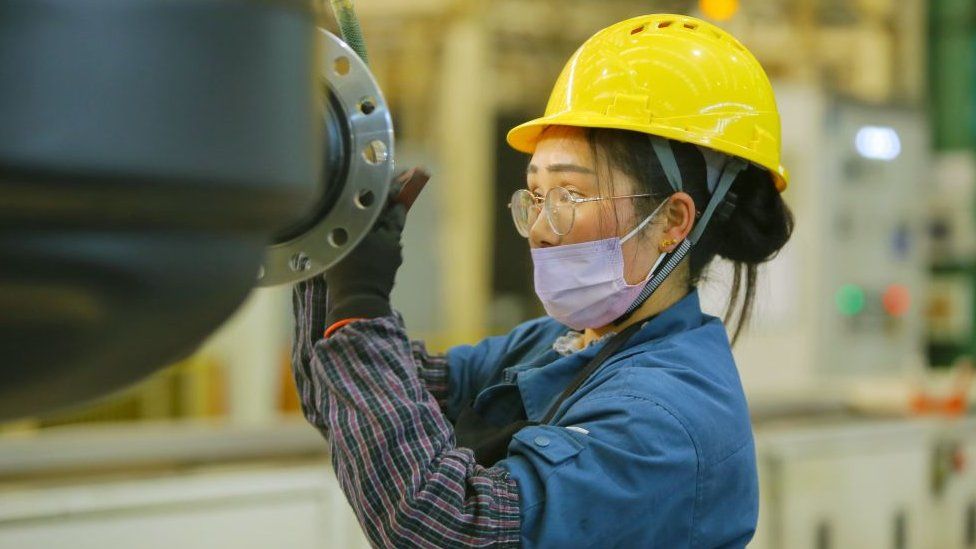
    A quality inspector makes the final inspection of a Daimler axle housing before packing it for export at the Daimler axle housing production plant in Qingdao, Shandong Province, China, January 20, 2022
    IMAGE SOURCE,GETTY IMAGES Image caption, German company Daimler is expanding its resources in China

    In the first half of this year, German businesses invested more in China than ever before. Chemical company BASF has just opened a new plant in south China and expects to invest €10bn (£8.6bn; $9.9bn) in the site by the end of this decade.

    On the eve of the visit, the head of the German Automotive Industry Association pointed to Germany’s reliance on China for raw materials and warned that “de-coupling” would be an economic and geo-strategic mistake.

    Her counterpart at the Association of Small and Medium Businesses also advised against a sudden change in course, saying “the advice can only be not to smash any Chinese porcelain now”.

    Chancellor Scholz is spending less than 12 hours in Beijing. His aim, he said ahead of his journey, was to find out how much co-operation was still possible – because “the world needs China” in the fight against the global pandemic and climate change.

    “If China is changing, then our approach to China must change,” he said.

    Many in Berlin and beyond will be looking for evidence of that Mr Scholz’s response to a shifting China may yet come to be the defining test of his chancellorship.

    Scholz trip ruffles feathers in Europe

    Germany is the EU’s most powerful economy and arguably most influential member, so what it says and does matters.

    I once suggested former Angela Merkel could be viewed at times like a European Donald Trump for the way she tended to put Germany first.

    Wider EU concerns were ignored in favour of lucrative German energy and trade contracts with Russia and China. She demanded EU austerity measures for Mediterranean member states during the eurozone crisis to protect German taxpayers from incurring shared debt.

    Olaf Scholz is Mrs Merkel’s successor in far more than just name, in the minds of many EU leaders.

    His massive aid package to help German businesses with high energy prices is viewed as giving them an unfair competitive advantage on the European single market.

    And his trip to China, announced but not co-ordinated with others in the EU, has ruffled feathers Europe-wide. France’s Emmanuel Macron recently warned Mr Scholz he risked becoming isolated.

    As Europe, and Germany first and foremost, weans itself off its dependency on Russian gas, the question is this: Is Berlin, blinded by the prospect of business deals, binding itself too close to China?

    French President Emmanuel Macron has been pushing for years for the EU to become less beholden to Beijing. Critics accused him of protectionism.

    But after global supply-chain breakdowns during the Covid-19 pandemic, the “weaponisation” of energy imports/exports after Russia’s invasion of Ukraine and Donald Trump’s presidency, it became clear Europe should no longer rely so heavily on the US in terms of security.

    With Mr Macron’s insistence on the continent becoming more cohesive and self-reliant, diversifying its trade partners began to seem sensible to Brussels. Olaf Scholz is viewed as worryingly out of step.

  • After an 11-hour session, the EU failed to reach an agreement on a gas price cap

    At least 15 EU countries seek a price cap in response to popular outrage over rising living costs, but Germany is adamantly opposed.

    Despite hours of squabbling, European Union leaders have failed to achieve an agreement on a proposal to help protect their citizens from rising energy prices.

    The group’s leaders emerged from their second summit in as many weeks at about 2 am in Brussels (00:00 GMT) with a “roadmap” to agreeing on a set of measures to lower energy bills, which have soared as a result of Russia’s invasion of Ukraine.

    While the announcement of the summit text made a public show of unity among the 27 member states, the absence of any decision on capping gas prices indicated negotiations would remain difficult.

    “We do now have a very good and solid roadmap to keep on working on the topic of energy prices,” European Commission President Ursula von der Leyen told reporters in the early hours of Friday morning.

    No timeframe was given on when a decision on price caps would be made, with EU energy ministers due to meet in Luxembourg on Tuesday for further discussions.

    The published text calls on the European Commission and EU countries to find ways to shield consumers from the high prices “while preserving Europe’s global competitiveness… and the integrity of the Single Market”.

    “There is a strong and unanimously shared determination to act together, as Europeans, to achieve three goals: lowering prices, ensuring the security of supply, and continuing to work to reduce demand,” said meeting host Charles Michel, the EU Council president.

    The EU has been squabbling for months over which joint initiatives to adopt in negotiations made more challenging by the varying energy mixes in each country.

    At least 15 EU states want a cap on gas prices amid growing public anger over the cost of living in countries including France and Belgium.

    But Germany, the EU’s biggest economy, has resisted the call, arguing a cap risked freezing Europe out of the gas market and reducing incentives for energy saving.

    Chancellor Olaf Scholz said the meeting outcome was a “good signal of solidarity” but there was frustration among other leaders.

    Before the war, the EU got 40 percent of its gas from Russia, but in July it agreed to cut Russian gas usage by 15 percent. The move prompted Moscow to cut supplies, further contributing to the rise in prices. European gas prices reached a record high of more than 343 euros ($335) per megawatt-hour in late August.

    “We are asked to show solidarity in sharing energy, but there is no solidarity on our calls for containing prices,” Italy’s outgoing Prime Minister Mario Draghi told his peers, an EU official familiar with the closed-door discussions told the Reuters news agency.

    Prime Minister Alexander de Croo of Belgium, which exports gas to neighbouring Germany, shared similar sentiments.

    “Solidarity should not just be on supply — it should also be on prices,” he told the gathering, according to the official.

    French President Emmanuel Macron, who had gone into the summit saying Germany was isolating itself, expressed satisfaction with the result.

    “The next two or three weeks will allow the commission to come up with these mechanisms” to be implemented.

    He said it sent a “very clear signal to the markets of our determination and our unity”.


  • Germany’s largest power producer to get rid of coal by 2030

    Energy firm RWE says it has reached a deal with the government to bring forward its phaseout of coal to 2030 in order to help achieve climate-protection goals.

    The government and German energy firm RWE announced on Tuesday that they had reached an agreement for the government to phase out coal by 2030, eight years earlier than originally planned.

    The move speeds up the closure of a number of large fossil fuel-fired power plants.

    With EU countries in the midst of a power crisis, the producer said it would have to keep its Neurath D and E power plant units on the grid “to strengthen the security of supply.” Neurath is a lignite-fired power station situated near the western town of Grevenbroich.

    In July, Chancellor Olaf Scholz’s government announced the temporary reactivation of 27 mothballed oil and coal-fired power plants to help fill the energy shortfall until March 2024.

    What RWE said about the coal phaseout

    RWE CEO Markus Krebber pointed out the need to maintain the supply while keeping in line with targets to phase out polluting fuel sources.

    “As more coal is needed in the short term, thereby leading to rising carbon dioxide emissions, we will need an earlier coal exit because this is the only way to continue to achieve the country’s climate protection goals,” Krebber explained at a press briefing.

    “Security of supply is the order of the day. At the same time, climate protection remains one of the key challenges of our time. RWE supports both,” Krebber said.

    “In the current crisis, we are contributing to the security of supply in Germany by temporarily increasing the use of our lignite-fired power plants and are thus also helping to displace gas from electricity generation,” RWE’s CEO said.

    The decommissioning of RWE’s Neurath D and E power plant unit would be pushed back to March 31, 2024. The process was initially planned to take place at the end of this year.

    According to the RWE statement, the early exit would have “a major impact” on many employees, with staff reductions expected to accelerate toward the end of the decade.

    What this means for coal-producing regions in western Germany

    In March of this year, RWE won a court victory, allowing the company to proceed with its lignite-mining operation in western Germany.

    The accelerated phaseout will prevent the eviction of residents from several villages and farms near the large lignite mine in Garzweiler. However, there is a notable exception.

    A farmer and two tenants had appealed a verdict that allowed RWE to clear forest, demolish buildings and excavate land at the edge of their property, effectively destroying the village of Lützerath.

    RWE said the coal under Lützerath was needed “to operate the lignite fleet at high capacity during the energy crisis.”


  • Politicians adopt a sombre attitude on German Unity Day

    On the anniversary of the unification of the former West and East Germany, Germany’s leading politicians gathered in the city of Erfurt to encourage unity amid a range of challenges.

    Germany’s celebrated its 32nd Unity Day on Monday. But this year, the tone of the festivities was more muted than in previous celebrations as the effects of the war in Ukraine and the cost of living crisis are felt more keenly across the country every day.

    The national holiday marks when the formerly divided Germany became one country again in 1990.

    Chancellor Olaf Scholz arrived at the ceremony in Erfurt, the capital of the eastern state of Thuringia, looking gaunt and pale after recently recovering from COVID-19.

    In a short speech, he recalled the words of former West German Chancellor Willy Brandt, also a Social Democrat (SPD), who said that things “must grow together that belong together.” Scholz also sought to assuage worries about a looming energy crisis, promising continued government involvement to protect consumers as much as possible.

    Like Scholz, Bundestag President Bärbel Bas used the occasion to call for solidarity in trying times.

    “Since 1990, we Germans have overcome many crises and upheavals,” she said. “The most important reason for that was and is: We stick together!”

    Bas acknowledged that “the celebrations come at a difficult time this year,” as inflation nears 10%.

    “The consequences of the war in Ukraine and of climate change are causing many people to worry,” she said, but added, “How we treat one another shows the strength of our country. We have to look after each other.”

    Bas counseled Germany’s political parties not to pick fights and instead to work together in trying times.