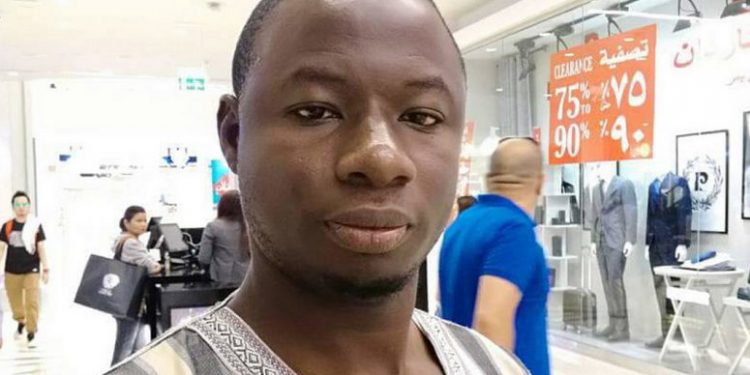
The suspect in the murder of investigative journalist Ahmed Suale, Daniel Owusu Koranteng, has had his charges amended to include abetment to murder.
This change was announced during a court hearing on Wednesday, April 2. Koranteng, who has been held in custody since his arrest, is accused of sharing photos of Ahmed Suale before his death and allegedly being present at the scene of the murder in January 2019.
Initially, he was charged only with murder when he first appeared in court on March 19, but now, the charges have been revised to include abetment to murder.
As the case progresses, the court has ordered that Koranteng remain in custody, with the next hearing scheduled for April 17.
Components like detonator cords and explosive charges used in attacks on U.N. and government forces in the Sahel have been traced back to West Africa’s commercial mining operations, including those in Ghana.
In a report by Reuters, sources reveal that Islamist militants in the Sahel region are discreetly tapping into Ghana’s northern territories to secure logistical support, food, and medical treatment, a trend that poses risks of deeper entrenchment of militant networks across West Africa.
According to Ghanaian security officials and regional diplomats cited by Reuters, militants from Burkina Faso cross into northern Ghana, taking advantage of porous borders to restock essential supplies and even seek medical care.
Despite this, Ghana has so far avoided the type of Islamist attacks that have plagued neighboring countries, partly because of militants’ strategy of maintaining Ghana as a logistical safe haven rather than a target. “You won’t destroy where you sleep, would you?” a Ghanaian security official reportedly told Reuters, noting that militants are often monitored and, in some cases, used as informants.
While Ghana has maintained close ties with Western nations and has worked actively to prevent militant violence within its borders, some analysts caution that the government’s low-profile approach may allow extremist networks to build roots in marginalized communities. Boniface Gambila Adagbila, Ghana’s ambassador to Burkina Faso, acknowledged the challenge, emphasizing that Ghanaian authorities are collaborating with Burkina Faso to curb cross-border movement of insurgents. Adagbila denied the existence of any informal non-aggression pacts between Ghana and the militants, asserting that Ghana is actively working to “flush them out.” Growing concern over Ghana’s mining sector
Concerns are also mounting over the role of Ghana’s mining sector in inadvertently supplying materials used by militants for improvised explosive devices (IEDs) across the Sahel. According to a recent report by the Small Arms Survey and corroborated by U.N. sources, explosive materials from commercial mining activities, such as detonators and ammonium nitrate, are sometimes diverted and end up fueling violence across West Africa. The Center for International Cooperation in Mali (CIC) has highlighted the risks associated with the vast unregulated artisanal mining industry across the region, noting that insurgents can access these materials more readily as they exploit poorly regulated supply chains.
Experts warn that the security implications for Ghana could intensify if militants strengthen their recruitment efforts in Ghanaian communities. Aaron Atimpe, an expert on extremist groups in West Africa, highlighted that militants crossing into Ghana “are not just using it as a rest and supply base; they are actively engaging and recruiting local residents.” While recruitment remains limited, the potential for expansion could destabilize the northern parts of the country. Regional impact and international concerns
The movement of militants into northern Ghana underscores the growing insecurity in the broader West African region, particularly the Sahel. Burkina Faso, at the heart of the insurgency, has ceded control of over half of its territory to various militant factions aligned with Al-Qaeda or the Islamic State.
The United Nations recently reported that instability in Burkina Faso, Mali, and Niger has effectively turned the Sahel into a new epicenter for global terrorism, leading to widespread displacement and violence. The crisis has led to international concerns over the potential spread of violence to the more stable coastal nations, including Ghana, Benin, and Ivory Coast.
Clingendael, a Netherlands-based think tank, reports that Ghana’s low-conflict status is partly due to joint operations with neighboring countries and discreet monitoring of extremist groups crossing its borders. “Yet, to avoid escalation, it also appears to have accepted de facto non-aggression with JNIM [Jama’at Nasr al-Islam wal Muslimin],” the organization noted, referencing a group that has made public its intent to expand further into West Africa. Preventive measures amid rising tensions
To counter potential spillover, Ghana has ramped up its efforts to control and monitor its northern borders and is reportedly collaborating with the United States and other Western partners. Additionally, Ghana’s military is conducting surveillance and joint training exercises with neighboring security forces to enhance cross-border security.
However, critics suggest that economic pressures and local grievances may still make Ghana’s border regions vulnerable to extremist influence. Limited economic opportunities, paired with strained government resources in northern Ghana, could make communities susceptible to recruitment efforts by militants who provide economic incentives.
The situation calls for urgent policy attention to improve border security and address vulnerabilities in Ghana’s mining industry, experts say, as the Sahel insurgency shows no signs of abating.
Amid ongoing discussions regarding the issue, The Independent Ghana reached out to the National Commission on Small Arms and Light Weapons for comment.
However, the Commission stated that it is currently unable to provide any remarks on the matter.
New allegations have surfaced against former US President Donald Trump, accusing him of exerting pressure on an employee to delete security footage at his Florida estate, Mar-a-Lago, in an attempt to obstruct the investigation into a case involving classified documents.
The new charges levied against Mr. Trump are related to his alleged mishandling of government documents at Mar-a-Lago. He now faces one count of wilful retention of defense information and two counts of obstruction.
According to prosecutors, the security footage captured unauthorized possession of files, which were then seen being moved. In connection with this incident, Mar-a-Lago staff member Carlos de Oliveira has also been indicted. He is alleged to have inquired about potential measures to delete the incriminating footage.
Both Mr. Trump and his close aide, Walt Nauta, have entered pleas of not guilty. Additionally, on Thursday, Walt Nauta received two additional charges of obstruction in relation to the same case.
The revised indictment provides detailed allegations concerning the collaborative efforts between Mr. Nauta and Mr. de Oliveira, the property manager at Mar-a-Lago, in their attempt to obstruct the investigation by the Justice Department.
According to the new court documents, Mr. Nauta and Mr. de Oliveira conspired to erase security camera footage following a subpoena from the Department of Justice, which sought surveillance recordings of the basement where confidential documents were believed to be held.
The court documents claim that Mr. de Oliveira sent a text message to another employee, who served as the director of information technology, stating that “the boss” desired the server to be deleted.
Allegedly, Mr. de Oliveira subsequently met with this IT employee in a secluded IT room and insisted on the confidentiality of their conversation. Under pressure, the IT employee acquiesced to Mr. de Oliveira’s request, despite asserting that he lacked the authority to do so.
The indictment paints a scene where Mr. de Oliveira navigated through bushes and foliage at the periphery of Mar-a-Lago, the renowned leisure resort known as the Winter White House, to reach the IT room and rendezvous with Mr. Nauta.
As per the indictment, Mr. de Oliveira asked his co-worker, “What are we going to do?” The lawyer representing Mr. de Oliveira has declined to offer any comments at this time.
In addition to the updated charges against Mr. Nauta and Mr. de Oliveira, the indictment alleges that Mr. Trump knowingly discussed a top-secret document with biographers during their visit to Mar-a-Lago for an interview.
“Look what I found… Isn’t it amazing? I have a big pile of papers, this thing just came up. Look,” Mr Trump allegedly said to one of his guests.
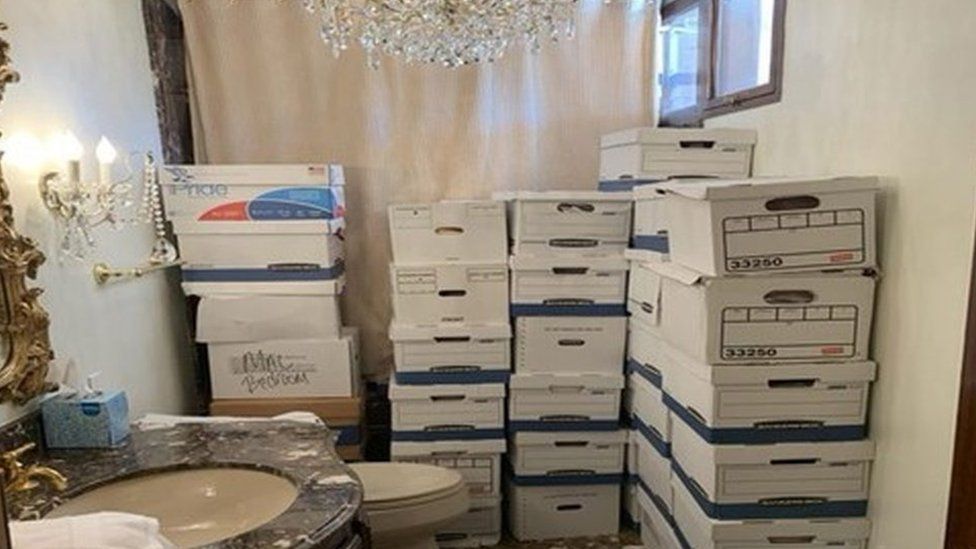
Image caption,The indictment included images of files allegedly stored in a shower
The documents case is led by special prosecutor Jack Smith, who earlier in the day met with Mr Trump’s lawyers over a separate investigation into alleged efforts to overturn the results of the 2020 election.
Mr Trump’s attorneys John Lauro and Todd Blanche met officials at Mr Smith’s office in Washington DC, US media reported.
The former president said earlier this month that he expected to be indicted in that case, but said on Thursday his lawyers received no indication of timing.
Mr Trump dismissed the fresh charges in the documents case in an emailed statement from his 2024 presidential campaign.
“Deranged Jack Smith knows that they have no case and is casting about for any way to salvage their illegal witch hunt,” the statement read.
The latest charge against Mr Trump adds to a growing list of legal problems for the property and reality TV mogul.
He currently awaits trial for a hush-money case in which he faces 34 felony counts, he faces civil charges in a defamation case against author E Jean Carroll, and Georgia prosecutors are still weighing whether or not to press charges over an alleged effort overturn the election results there.
Former Trump aide Stephen Moore told the BBC the charges against the former president amounted to “attacks” which were serving to solidify his nomination in the Republican presidential primaries.
“The more they indict him, the more his popularity goes up with Republicans”, he told BBC Radio 4’s Today programme.
Drama ensued during proceedings in an Accra Circuit Court on Monday, October 10, 2022, when the founder and leader of Heavenway Champion International Ministries was brought before the court.
Evangelist Patricia Oduro Koranteng was put before the court on charges of defrauding by false pretence and charlatanic advertisement in the media.
According to Angel FM’s court correspondent, Ama Brako Ampofo, the suspect took exception when the prosecutor mentioned her name while reading out her charges in court.
“When she was brought in, her name was mentioned as Patricia Oduro but when she entered the box, she objected that she is not Patricia Oduro Asiedu but her name is Reverend Doctor Patricia Oduro,” the correspondent narrated.
Charged on counts, Agradaa is said to have pleaded not guilty to all charges.
The court which denied her bail has scheduled her reappearance for Thursday, October 13, 2022.