Global energy giant Chevron has expressed interest in Ghana’s upstream petroleum sector, while Kosmos Energy has committed to expanding its investments to support industry growth, according to Energy and Green Transition Minister John Abdulai Jinapor.
The announcement comes at a crucial time as Ghana seeks to revive its oil and gas sector, which has faced a decline in recent years.
In a Facebook post on Thursday, March 27, the minister underscored the significance of attracting foreign investment to sustain the sector’s expansion. He reaffirmed the government’s dedication to creating a business-friendly environment to encourage more investment in oil production.
“We must take all necessary measures to reverse the downward trend in Ghana’s oil sector,” Jinapor stated.
With Chevron’s interest and Kosmos Energy’s renewed commitment, stakeholders are hopeful that the industry will regain momentum, contributing to economic growth and energy security.
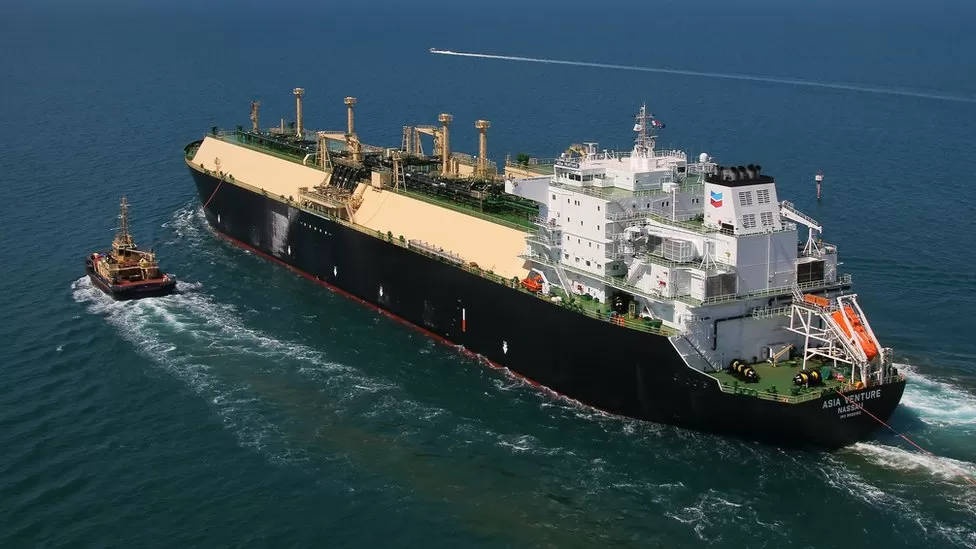
On the 7th of September, employees at two large natural gas plants in Australia will commence a strike. This could make natural gas prices higher around the world.
After talking with unions for several weeks, they finally reached an agreement on payment and working conditions.
Chevron, the big US energy company that runs the places, said it would “keep doing things to make sure everything stays safe and works properly, even if something goes wrong at our sites. ”
Concerns about potential work stoppages have recently caused the cost of gas bought and sold in bulk in Europe to increase.
The Wheatstone and Gorgon sites in Western Australia make more than 5% of the world’s LNG (liquified natural gas). There are currently about 500 workers at these two plants.
According to a strike plan seen by the BBC, workers will stop working for up to 11 hours each day during the industrial action.
Chevron said in a statement on Tuesday that although they don’t think strikes are needed to make a deal, they understand that employees have the right to go on strike if they need to.
It also mentioned that it would “keep negotiating to find solutions that are good for both workers and the company. ”
The Offshore Alliance is a group of two unions that represent energy workers, including those who work at Chevron. The group has been trying to make an agreement with Chevron on important things like how much they get paid, how secure their jobs are, their work schedules, and the standards for their training.
The workers were not happy with how the company was negotiating with the union and they were also upset that Chevron didn’t agree to use a common agreement that is normally used in their industry for the work they do.
According to energy analyst Saul Kavonic, he believes that the strike will not have much effect on gas prices worldwide.
But he cautioned that if the workers increase their strike, the cost of energy could go up a lot.
He said that if there was a very unlikely situation where there is a long-lasting problem with getting enough supplies, prices could go up to the same crisis levels as last year.
Samantha Dart, a senior energy analyst at Goldman Sachs, recently explained to the BBC that the issue lies with the facilities in Australia that make liquid natural gas. These facilities are providing natural gas to all of Asia.
“When countries in Asia don’t have enough of natural gas, they purchase it from the Atlantic Basin instead. This means that liquefied natural gas (LNG) that would have been sent to Europe is redirected to Asia due to the increased competition for supply. ”
When Russia invaded Ukraine last year, the prices of oil and gas went way up. As a result, people and businesses had to pay much more for their energy bills.
Last week, the prices of wholesale gas in Europe increased because people were worried about the possibility of a shortage in supply from Chevron and another Australian LNG plant owned by Woodside Energy.
On Thursday, Woodside announced that it made an initial agreement with the worker unions at its North West Shelf facility.
The Woodside and Chevron plants together provide about 10% of the world’s LNG.
A map is a visual representation of an area. It shows the features and locations of places on Earth.
Russia reduced the amount of natural gas it sent to Europe after the Ukraine war began in 2022.
That made prices higher everywhere and caused countries to look for different ways to get energy, like LNG.
Australia is a country that sells a lot of natural gas to other countries. This has helped to make energy prices lower worldwide.
LNG is a type of natural gas that has been purified and cooled to a very cold temperature of around -160C. It is made up of methane, which is the main component, and sometimes mixed with ethane.
This process changes the gas into a liquid form, which can be transported in tanks that have high pressure.
When the LNG reaches its target place, it is transformed into gas again and can be used just like regular natural gas for activities such as heating, cooking, and producing electricity.
The rising demand for oil and gas contributed to the oil giant ExxonMobil’s profits more than doubling in the first three months of this year.
The US energy company claimed that cost-cutting initiatives also helped to boost first-quarter profits to a record $11.4 billion (£9.1 billion), up from $5.5 billion the year before.
Despite declining oil prices and a $200 million loss from windfall taxes the corporation paid in Europe, the increase occurred.
Chevron, a rival US oil company, also announced an increase in profits.
It generated about $6.6 billion between January and March, a 5% increase from the same period last year. It also paid a windfall tax or “energy profits levy” in the UK worth $130 million.
Next week Shell and BP are both set to report their latest results.
Like other big energy companies Exxon has faced criticism about how much it has returned to shareholders off the back of high oil and gas prices.
It said shareholders would receive $8.1bn including dividends and $375m in share buybacks.
ExxonMobil said the rise in profits included a $3.4bn after-tax reduction to exit Russia.
“We delivered a first-quarter record despite the fact that energy prices and refining margins are softening a bit,” chief financial officer Kathryn Mikells told Reuters.
The biggest contributor to the better-than-expected earnings came from strong production growth, driven by the start-up of new offshore developments and refining facilities, she said.
Exxon is currently caught up in a legal case with the European Union – it is suing the EU in an attempt to stop its new windfall tax on oil firms.
It has accused Brussels of exceeding its legal authority, calling the measure “counter-productive” and argued, along with other players in the sector, that the tax would discourage investment.
Peter McNally, an industry analyst at Third Bridge research firm, said Exxon’s output had exceeded expectations. The firm’s oil and gas production was the highest since 2019.
“The key driver was surging oil production in Canada, but profitability was dragged lower by the collapse in US natural gas prices,” he said.
Mr McNally said the company’s refining business continued to be a “star performer”, delivering earnings of more than $4bn for the fourth consecutive quarter.
The Venezuelan government and opposition have reached a preliminary agreement to resolve the country’s political crisis.
During talks in Mexico, the two issued a joint statement asking for the release of billions of dollars frozen abroad to help fund social projects.
It comes after years of failed attempts to break the political impasse.
In response, the United States announced that it would allow the American oil company Chevron to resume some operations in Venezuela.
President Nicolás Maduro has become increasingly authoritarian since his election in 2013.
His crackdown on opposition activists ultimately led to the US imposing sanctions on his regime and recognising opposition leader Juan Guaidó as interim president in 2019 after a contested election.
Since then, several rounds of talks aimed at finding a way out of the political deadlock have gone nowhere – with the last negotiations failing just over a year ago.
But now, the government and the opposition – with the help of Norway as mediator – have drawn up an agreement that aims to ensure that billions of dollars frozen abroad will be gradually released by a UN-managed fund, to be put towards healthcare, education and food aid.
The funds were blocked by foreign banks over the alleged irregularities in the 2018 elections.
The progress made on Saturday has been welcomed by the US, who described it as a step in the right direction.
It also said oil company Chevron would be able to resume some activity in Venezuela, including importing Venezuelan crude in the US.
The agreement represents “hope for all of Latin America,” Mexican Foreign Minister Marcelo Ebrard said in comments cited by AFP.
The BBC’s South America correspondent Katy Watson warns, however, that it is still early days for the talks.
No progress has been made so far on one critical issue – the 2024 presidential election.
The Venezuelan opposition is calling for free elections, while President Maduro is seeking full recognition of his rule from the US and European countries.
Venezuela has been caughtin a downward spiral for years with growing political discontent further fuelled by skyrocketing hyperinflation, power cuts, and shortages of food and medicine.