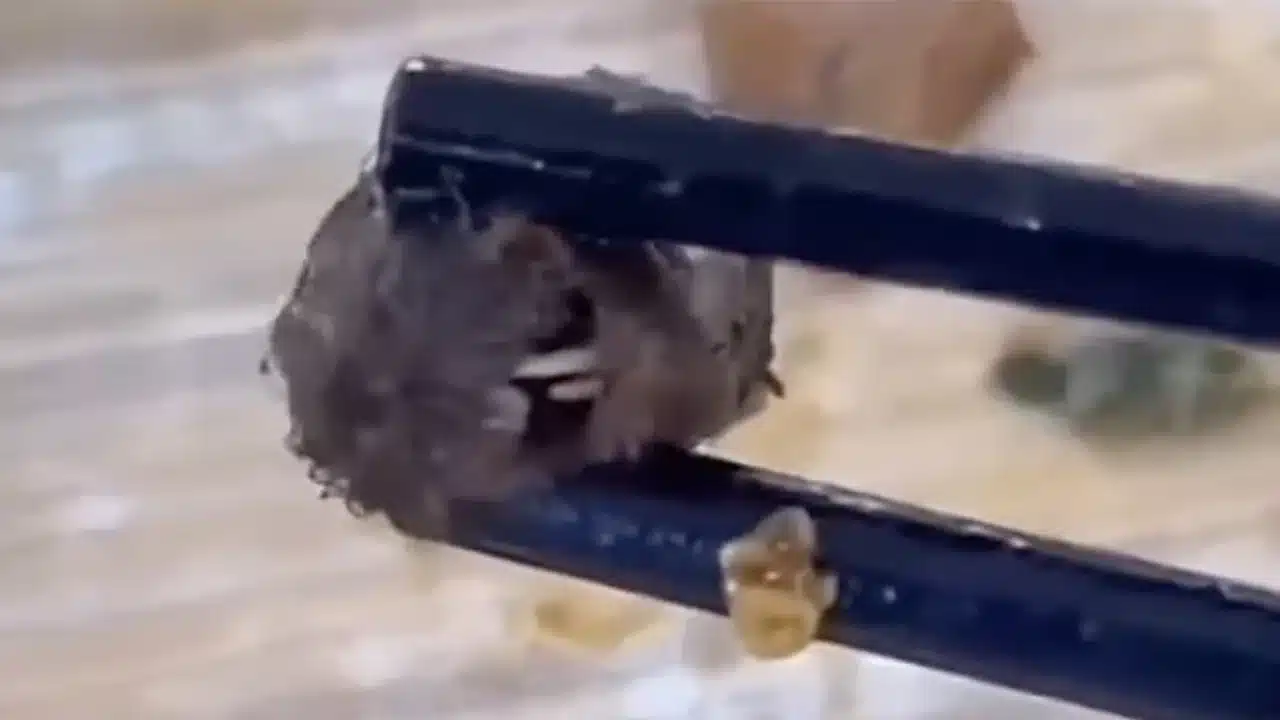
Chinese authorities have determined that an odd object discovered in a school meal was the head of a rat, contradicting earlier official assurances that it was duck neck in the most recent development to a food safety scandal that has rocked the country for weeks.
The controversy has also revealed the public’s strong mistrust of local governments in China, whose attempts to suppress bad news frequently fail.
On June 1, a student at the Jiangxi Industry Polytechnic College in the Jiangxi province’s southeast found something strange in his meal at the school canteen, which is when the issue got started.
In a video he posted on Chinese social media, the student picked up the dark hairy object with his chopsticks and complained to the canteen staff that he had found a rat’s head.
“This is duck meat,” a female staffer replied.
“Isn’t this rat’s teeth?” the student said, turning the object to reveal the tiny white pieces in the middle and the shape of a nose above.
“This is duck meat, duck meat,” the staffer insisted. “How could there be teeth in duck meat?”
The video went viral and caused a stir in China, where food safety has long been a major issue of public concern following scandals involving contaminated baby milk powder and “gutter oil” – recycled oil tainted with food waste or even sewage.
Chinese authorities have since tightened regulation and carried out periodic crackdowns, but food safety scandals, including in student canteens, have continued to make headlines and spark public outcries.
In the latest incident, the video sparked heated online discussions. Many comments sided with the student, citing the object’s uncanny resemblance to the head of a rodent, with seemingly identifiable eyes, nose, mouth and ears.
As public pressure mounted, the college issued a statement on June 3 claiming the object shown in the video was not a rat’s head, but a piece of duck neck, which is a popular delicacy in China.
“Our investigation found that the video was indeed shot at our school canteen but its content does not match the facts,” the statement said. It said the student had invited classmates to look at the object and confirmed it was duck neck, and had submitted a written clarification.
The school added that the local district’s market regulator had sent law-enforcement officers to the canteen to investigate.
On the same day, an official at the district’s market supervision bureau appeared on the Jiangxi Radio and Television Station, saying officers had “repeatedly compared the object and confirmed it was indeed a piece of duck neck.”
Meanwhile, a “clarification” video of the student circulated online. “I found out it was not a rat head but a duck neck, so I would like to clarify,” the student said in the video.
CNN has reached out to the school for comment.
The official findings and the student’s “clarification” failed to convince the public.
Instead, it fueled even more anger online, with users accusing the school and local officials of lying and pressuring the student to change his stance.
Some called for an investigation into what they believed to be a “cover-up” by the local authorities. Others reacted with sarcasm, and an outpouring of memes flooded the Chinese internet.
Many shared photoshopped images planting a mouse’s head onto the body of a duck (including a fusion of Disney characters Mickey Mouse and Donald Duck), claiming it was a newly discovered creature called “duckrat.”
Others reinvented the Chinese idiom “calling a deer a horse,” derived from a famous story in the Qin Dynasty, in which court officials pointed at a deer and called it a horse to prove their loyalty to a powerful eunuch.
“In ancient times we have ‘calling a deer a horse.’ Now we have ‘calling a rat a duck,’” said a post on Weibo with nearly 30,000 likes.
In the face of mounting public criticism and ridicule, the Jiangxi government announced on June 10 it had launched a provincial-level probe into the incident, with a task force joined by officials from education, public security and market supervision authorities.
A week later, the provincial investigation team concluded that the foreign object was not a piece of duck neck, and the local market supervision bureau and the school had reached a “wrong conclusion” because they did not investigate “diligently.”
Surveillance footage showed the object found by the student had been disposed of by canteen staff on June 1, according to the provincial team, which said it had checked the canteen’s purchase list, interviewed kitchen staff and students at the scene.
Animal experts who examined videos and photos of the item ruled it was the head of a rodent, the team said.
The canteen’s license has been revoked and the company that operates it had received a maximum penalty under food safety laws, the statement said. Officials at the college and the local market supervision bureau will also be punished, it added.
“This is how the government lost its credibility,” one Weibo comment said.
The controversy has also drawn the ire of the mouthpiece of the ruling Chinese Communist Party.
In a commentary, Xiakedao, an account under the overseas edition of the People’s Daily, censured local authorities for attempting to cover up the truth.
“So many administrative resources were wasted, and the credibility of the local government was damaged, and the loss has totally outweighed the gain!” it said.
“This kind of absurd incident of ‘calling a rat a duck’ cannot be repeated again!”