As Beijing increases its attention and rhetoric on national security, Chinese officials on Monday officially accused a government employee of spying for the CIA. This is the second high-profile espionage case to be made public this month.
The Ministry of State Security, the nation’s civilian intelligence organisation, stated in a statement that it is looking into a cadre at an unnamed ministry who was allegedly recruited by the CIA when he was studying in Japan.
According to the ministry, the 39-year-old Chinese national, only known by his last name Hao, met a representative of the US embassy in Japan while he was requesting a US visa.
According to the statement, the US official treated Hao to dinners, sent him gifts, and paid him to assist with the writing of a research paper in order to foster a close relationship.
The ministry asserted that after introducing Hao to a coworker, a representative of the US embassy requested him to go back to China to work for a “core and critical department.” The colleague eventually revealed himself to be a CIA agent.
According to the statement, Hao allegedly consented, signed an espionage contract with the US, and underwent training.
After arriving home in China, Hao was hired by a ministry and allegedly met with CIA officials several times to “provide intelligence and collect espionage funds,” according to the Chinese spy agency. It stated that more research is being done on the matter.
A worker at an unnamed Chinese military industrial organisation who was supposedly recruited while studying in Italy was found to be a spy for the CIA, according to a declaration made just 10 days earlier by the same ministry.
The Ministry of State Security made statements regarding both events on Wechat, China’s super app, where it had earlier this month created its first social media account with a public profile.
The covert organisation, which manages counterintelligence operations both domestically and abroad, has raised its prominence to deter espionage among Chinese citizens.
The ministry encouraged “all members of society” to take part in the fight against espionage in its first post on Wechat, and it promised awards and protection for those who shared information.
To combat what he perceives as mounting threats from “foreign forces,” particularly the United States, to undermine China’s progress and political stability, Chinese leader Xi Jinping has made national security a top priority.
Long-standing spying relationships between the US and China have intensified due to the recent deterioration in relations between the two greatest economies in the world.
Two US Navy sailors in California earlier this month were detained on suspicion of giving Chinese espionage agents confidential US military information.
Chinese officials attempted to become only the second country to send citizens to the moon on Wednesday by releasing additional information about their intentions for a human lunar trip.
According to state-run news agency Xinhua, Zhang Hailian, deputy chief engineer with the China Manned Space Agency (CMSA), disclosed the preliminary plan on Wednesday during an aerospace summit in the city of Wuhan.
The mission is a component of a plan to build a lunar research outpost and is anticipated to occur before 2030. According to Zhang, it will do moon exploration missions and other tests as well as look into the best way to construct the facility.
Two launch vehicles will send a moon surface lander and manned spacecraft into lunar orbit, before they dock with each other, according to state-run Global Times. After docking, the Chinese astronauts on board the spacecraft will enter the lander, which is used to descend to the moon’s surface.
While on the moon, they will collect samples and carry out “scientific exploration,” before leaving on the lander and reuniting with the spacecraft waiting in orbit – which will take them home to Earth, Global Times reported.
To prepare for the mission, Chinese researchers are busy developing all the necessary equipment including moon suits, manned lunar rovers, manned spaceships and moon landers, Xinhua reported.
The state media reports did not say how many astronauts China plans to send to the moon.
The lunar mission is the latest development in China’s push to advance its space program, which has seen several breakthrough moments in recent years.
China was late to the space race – it didn’t send its first satellite into orbit until 1970, by which time the United States had already landed an astronaut on the moon – but Beijing has been catching up fast.
In 2013, China successfully landed a rover on the moon, becoming only the third country to do so. At the time, Chinese leader Xi Jinping said “the space dream is part of the dream to make China stronger.”
Under Xi’s leadership, China has spent billions on its ambitious space program. While there are no official public figures on Beijing’s investment in space exploration, consulting firm Euroconsult estimated it to be about $5.8 billion in 2019.
That year, China sent a rover to the far side of the moon – a historic first. Then in 2020, it became only the third country to successfully collect rock samples from the moon.
China has also spent the past few years building its own Tiangong space station, which was completed in November. The station is only the second operational orbital outpost, alongside the International Space Station (ISS) – which Chinese astronauts have long been excluded from due to US political objections and legislative restrictions.
But the ISS is expected to end operations in 2030 – which could leave Tiangong the only outpost left. China has sought to open up its station to collaboration with international partners, including by hosting experiments from other countries.
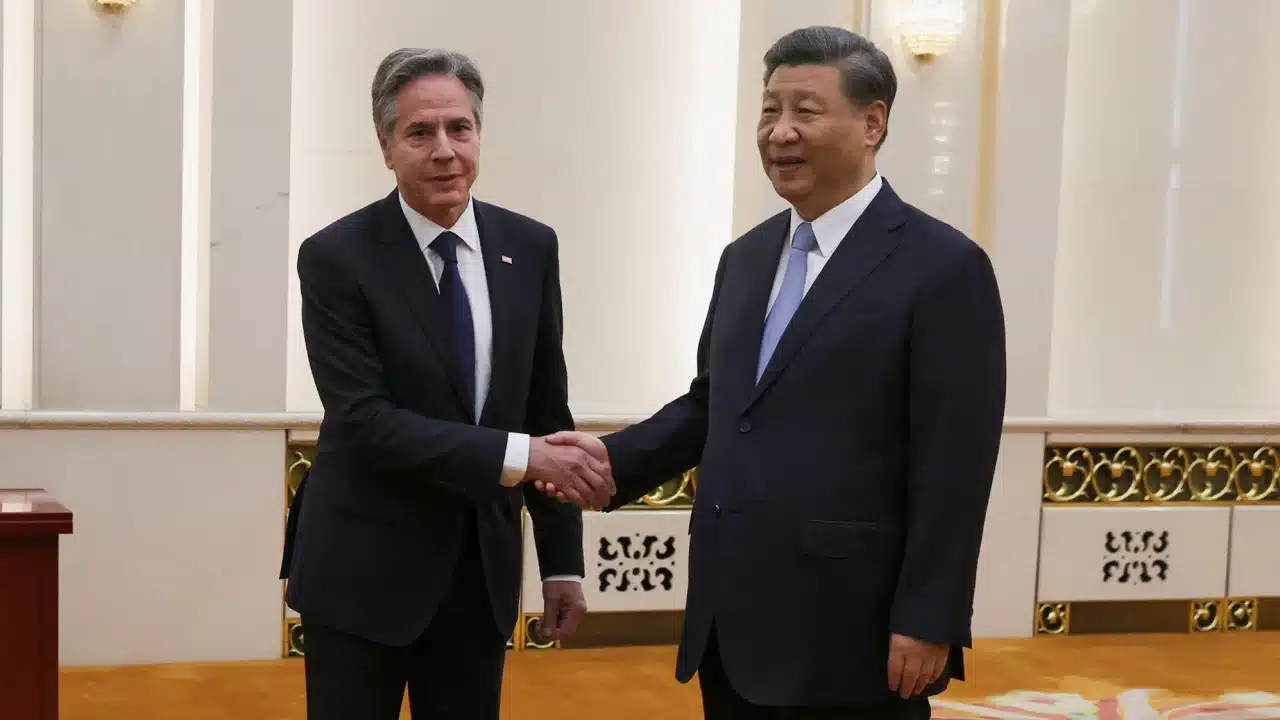
Meeting between Chinese President Xi Jinping and top American diplomat Antony Blinken on Monday in Beijing might be a key step towards mending US-China relations, which broke down earlier this year after a dispute over a Chinese surveillance balloon.
Blinken is the first US Secretary of State to travel to Beijing in five years, and his discussions with senior Chinese officials are regarded as a crucial litmus test for whether a detente can be established during a period of persistent mistrust.
Uncertainty around whether Xi and Blinken would meet during the two-day visit further highlighted the fraught US-China relations and a failure to schedule a face to face would have been seen by Washington as a slight, breaking with a number of previous visits from top American diplomats.
The meeting, which took place at Beijing’s cavernous Great Hall of the People, was only publicly announced by the US about an hour before it went ahead. It lasted roughly half an hour, beginning at 4:34 p.m. local time and ended at 5:09 p.m., a State Department official said.
“The world needs an overall stable Sino-US relationship, and whether China and the United States can get along has a bearing on the future and destiny of mankind,” Xi told Blinken according to a Chinese readout of the meeting.
“China respects the interests of the United States and will not challenge or replace the United States. Similarly, the United States must also respect China and not harm China’s legitimate rights and interests,” Xi added.
The two global powers have been increasingly at loggerheads over a host of issues ranging from Beijing’s close ties with Moscow to American efforts to limit the sale of advanced technologies to China.
Key among those concerns has been repairing fractured lines of communication, which have broken down over the past year, especially when it comes to high-level military exchanges – raising concerns in Washington that a mistake or accident could quickly spin into conflict.
Earlier this year a Chinese surveillance balloon – detected floating across the US and hovering over sensitive military sites before ultimately being shot down by an American fighter plane – sent relations plunging to a new low and resulted in Blinken scrapping an earlier Beijing visit.
This time, the diplomatic mission went forward.
A roughly three-hour meeting between Blinken and China’s top foreign affairs adviser Wang Yi earlier Monday underscored the deep challenges in overcoming the mistrust and friction that has come to characterize the relationship.
The Chinese government’s growing clout internationally and increasingly authoritarian controls at home have pushed the US to reframe how it manages its relations with the power in recent years.
Repeating Beijing’s typical rhetoric, Wang blamed Washington’s “wrong perception” of China as the “root cause” of the decline in the two sides’ relations and demanded the US stop “suppressing” China’s technological development and hyping the “China threat,” according to a readout from Chinese state broadcaster CCTV.
“We must reverse the downward spiral of China-US relations, promote a return to a healthy and stable track, and jointly find the right way for China and the United States to co-exist in the new era,” Wang said, adding that Blinken’s visit came at “a critical juncture in US-China relations, where a choice needs to be made between dialogue or confrontation, cooperation or conflict.”
Wang also reiterated that Taiwan is one of one of China’s “core interests,” over which it “has no room for compromise or backdown.”
The self-ruling democratic island, which China’s ruling Communist Party claims but has never controlled, has increasingly been another flashpoint in the US-China relationship.
During the meeting, Blinken underscored the need for the countries to “responsibly” manage their competition through “open channels of communication” to ensure it “does not veer into conflict,” State Department spokesperson Matthew Miller said in a statement.
The US would continue to use its diplomacy to “stand up for the interests and values of the American people,” Blinken said, according to the statement, which described the talks as “candid and productive” and said they including discussion of potential cooperation on shared transnational challenges.
Overall, Wang’s comments took a more combative tone than those of China’s Foreign Minister Qin Gang, who met with Blinken the previous day. Qin said both sides agreed to “advance dialogue, exchanges and cooperation” and “maintain high-level interactions,” according to a readout from Beijing.
Blinken’s Sunday meeting with Qin, which stretched more than five hours and then wrapped with a working dinner, resulted in progress “on a number of fronts,” with both sides showing a “desire to reduce tensions,” a senior State Department official told reporters Sunday.
“Profound differences” between the US and China, however, were also clear during the meeting, the official added.
Neither side have mentioned concrete agreements so far.
While Qin holds the title of Foreign Minister, he wields less power than Wang, who directs the country’s foreign policy through his position among party’s core leadership.
Blinken’s original scheduled visit in early February had been agreed on as a follow-up to an amicable face-to-face between US President Joe Biden and China’s Xi on the sidelines of the G20 in Bali in November.
That meeting – the first in person between the two leaders as presidents – was seen a pivotal step in restoring certain lines of communication, which Beijing last year severed last year following a visit from then-US House Speaker Nancy Pelosi to Taiwan.
Both the US and China have played down expectations of a major breakthrough during Blinken’s visit.
Ahead of the meeting, Washington was careful to manage expectations, with a senior State Department official last week telling reporters that he does not expect “a long list of deliverables.”
Meanwhile, both sides are also navigating how the meetings play to their respective domestic audiences.
In the US, how strongly to counter China has become the topic of heated political debate – with some lawmakers slamming the Biden administration for sitting down with Beijing.
China views Washington as actively trying to thwart its development, and is also very much aware the US is headed into a presidential election cycle, where hawkish rhetoric against it may intensify further.
Its officials also meet Blinken in an environment where China’s state media and official rhetoric have long portrayed Washington as a bad-faith actor responsible for destabilizing ties.