Goma, the capital of the Democratic Republic of the Congo‘s North Kivu province, has been declared to be experiencing a cholera outbreak.
The majority of the cases, according to North Kivu’s governor, Lt. Gen. Constant Ndima, have been reported in transitory camps housing internally displaced people affected by the ongoing war.
“A lot of patients who are suffering from diarrhoea, loss of fluids and some of them are vomiting.” Lt Ndima told journalists on Wednesday evening.
The governor says more than 600 cases and four deaths have been reported. However, non–governmental organisations offering support to the victims say the numbers are higher than official figures.
Those living in the camps have complained about the lack of food, shelter, latrines, and showers – optimal conditions for cholera to spread.
Cholera is usually caught by eating or drinking contaminated food or water and is closely linked to poor sanitation. The disease often causes acute diarrhoea and can kill within hours, if untreated.
Since the end of October, tens of thousands of people fleeing fighting with the M23 group have joined those already settled for months in sites for displaced people in Nyiragongo territory, a few kilometres north of Goma.
Without proper sanitation and access to clean safe water, cases could rise.
In October this year, the World Health Organizationsuspended the two-dose cholera vaccine in favour of a single one, due to a supply shortage. This type of protection is however limited.
Haiti’s UN humanitarian coordinator has revealed that , cholera has already claimed the lives of 283 people in the Caribbean country and more than 14,000 suspected cases have been reported. Due to the insecurity, about 155,000 people have been internally displaced.
As nearly 20,000 people in Port-au-Prince experience “catastrophic famine-like conditions” due to a cholera outbreak, gangs who control nearly 60% of the city’s population are tearing apart society, a senior UN official has warned.
Ulrika Richardson, the nation’s UN humanitarian coordinator, said at a news conference that the gangs are using “terrifying levels” of sexual violence “as a weapon” to control populations, instil fear, and punish them.
The fight for territory has “a human cost” and what people are facing on an everyday basis is “enormous”, she added, warning that if the issue is not addressed now, it will be “very difficult in terms of social cohesion and reconciliation”.
She said all but 1,000 of the 20,000 Haitians facing starvation are in the capital, Port-au-Prince, mainly in the Cite Soleil slum controlled by the gangs.
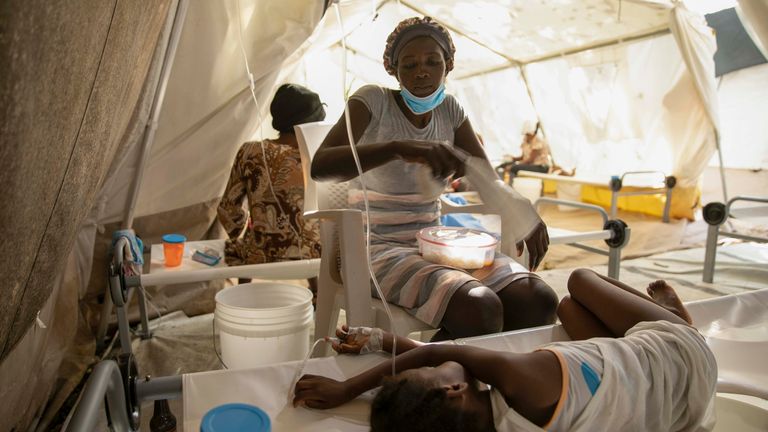
Image: A woman with her daughter who is stricken with cholera at a clinic in Port-au-Prince. Pic: AP
This comes as the cholera outbreak in the Caribbean nation “continues to be a worry”.
The illness has caused at least 283 deaths so far and close to 12,000 people have been treated in hospital since 2 October.
There are more than 14,000 suspected cases throughout the country, and infections have been confirmed in eight of Haiti’s 10 regions.
An emergency appeal aimed at raising more than $145m (£118m) to contain the spread of cholera in the nation was launched in November. Around $23.5m (£19.2m) has been donated so far, said Ms Richardson.
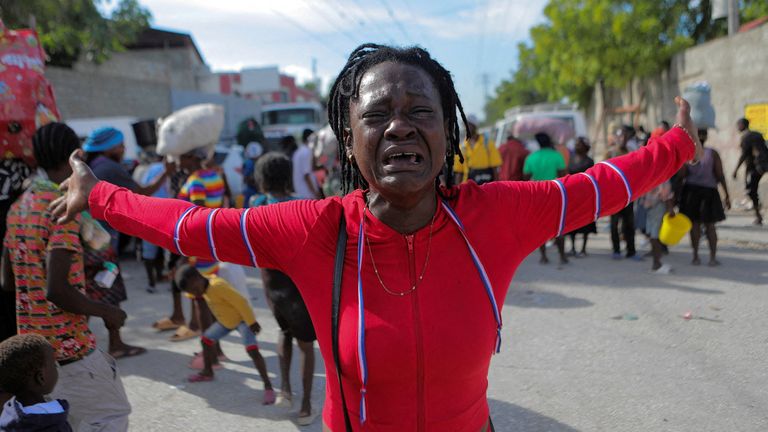
Image:Rose Delpe cries as people are displaced by gang war violence in Haiti
‘Massive displacement’
Political instability has simmered since the unsolved assassination last year of President Jovenal Moise, who had faced protests calling for his resignation over corruption charges.
Insecurity in the country has led to the “massive” internal displacement of 155,000 people fleeing their homes – a 77% increase since August.
Many are the “most vulnerable”, such as women and families, who are in temporary sites or being hosted in communities.
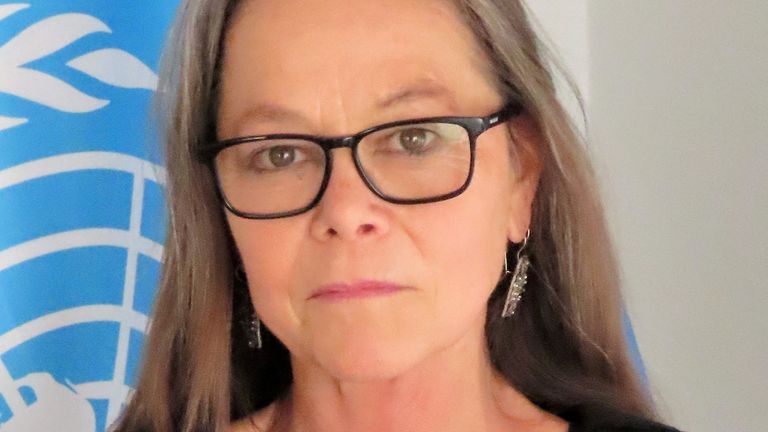
Image: Ulrika Richardson
Ms Richardson said they are working with institutions to figure out how to address the issue since those hosting the displaced have “meagre” resources.
School closures have affected around four million children, many of whom have not received proper education since the start of the COVID-19 pandemic, according to the humanitarian chief.
In a more positive development, more than half of schools have now opened, said Ms Richardson. Although, there is “disparity” in that most of them are in the south.
“We have logistical challenges, you can imagine, and the security challenge, but we are able to be present and we are able to help people,” she said.
“We are obviously focusing on the most vulnerable, but we also try not to lose focus on the real structural root causes.
“So, we have corruption, we have impunity, we have governance, and all of that needs to really be at the centre also of our thinking as we go forward.”
Haiti’s health ministry has announced that, a deadly resurgence of cholera has claimed 136 lives so far.
According to the Haitian Health Ministry’s statement, 89 of those infected died in hospitals or cholera treatment centres, while 47 died at home.
To address the crisis, the Haitian government is collaborating with international health organisations.
“We have been receiving 250 people a day lately. There’s a surge in cases in most parts of the metropolitan area. This is very concerning for us as we have a limited capacity with around 350 beds in our cholera treatment centers,” said Alexandre Marcou, a communications officer for medical NGO Médecins Sans Frontières, speaking to CNN on Wednesday.
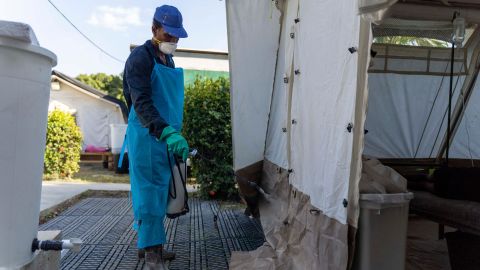
A worker disinfects around a clinic run by Doctors Without Borders in Cité Soleil, Port-au-Prince, Haiti, October 7, 2022. Richard Pierrin/AFP/Getty Images
People who live in areas with shortages of safe drinking wateror inadequate sanitation are vulnerable to cholera, which can result from consuming bacteria-contaminated food or water.
Although vaccines exist and symptoms can be “easily treated,” according to the World Health Organization, cholera remains an insidious killer through dehydration in the developing world.
Just one month ago, the Health Ministry had documented only eight cholera deaths, all in the densely populated capital Port-au-Prince.
Critical Haiti gas terminal freed after weeks of talks with G9 gang leader
Now, according to Marcou, the virus is spreading in remote areas of the country, which health services struggle to access and monitor.
“These places are harder to know what is going on there in real time due to the current crisis. It is clear the situation is getting worse and worse every day,” he said.
Until this year, the disease appeared to have been largely stamped out of the country, after a nationwide public health effort.
The last outbreak began in 2010, when cholera spread from a camp of United Nations peacekeepers into the population.
That outbreak ultimately reached 800,000 cases and claimed at least 10,000 lives. Though the UN has acknowledged its involvement in the outbreak, it has not accepted legal responsibility. Rights organizations have not stopped calling for financial compensation for victims.
The number of deaths from cholera in Malawi rose to 183 at the end of October from 110 at the beginning of the month, the health ministry announced on Monday.
The rate of infections has been rising, with the cumulative number of cases since the outbreak began in March now at 6,056, the ministry said in a statement.
Cholera is an acute diarrhoeal infection usually caught by eating or drinking contaminated food or water and is closely linked to poor sanitation.
Malawi’s health ministry attributed the deaths to poor food hygiene among the communities, lack of safe water and a lack of and improper use of toilets.
Health Minister Khumbize Chiponda also noted that some patients were not seeking treatment for religious reasons, while others were visiting hospitals when it was already late.
He appealed to religious institutions to encourage their members to seek proper health services to avoid “unnecessary” loss of lives.
As officials battleto control an outbreak that has claimed the lives of more than 117 people so far, the number of cholera cases in Malawi has more than tripled in the previous two months.
According to the UN, nationwide cases have increased from 1,000 to more than 4,200 since August.
The first case of cholera, which spreads mainly through contaminated food and water, was reported in March in southern Malawi.
But the disease has now spread to 22 of Malawi’s 28 districts. Experts have warned that the situation could be worsened by the onset of the rainy season in November.
The government has been conducting a mass cholera vaccination in the southern Africa nation, which is one of the poorest in the world.
Data from the World Health Organizationshow that this is the worst outbreak so far this year globally.
The country’s cholera response plan currently has a funding gap of more than $13m (£11.8m).
Malawi is currently facing one of its worst economic periods and has witnessed street protests sparked by shortages in fuel, electricity, and forex, as well as drugs and medical supplies.
The Greater Accra Region, the hotbed of cholera outbreaks in Ghana, has not recorded any case of the disease since the outset of the rains, the Regional Health Directorate has revealed.
The Regional Director of Health, Dr Charity Sarpong, said in an interview that it was due to a number of measures that had been put in place over the years.
The measures, she said, included education and awareness creation at the community and district levels on the need to wash hands regularly and also keep surroundings clean.
She said although the region was noted as a hotspot for cholera, especially during the rainy season, it was yet to record any cholera case even though the rains had set in.
Cholera, a bacterial disease causing severe diarrhoea and dehydration, has killed hundreds of people over the years in the Greater Accra Region.
It is usually spread in water and could be fatal, if not treated right away.
Key symptoms are diarrhoea leading to dehydration. Rarely, shock and seizures may occur in severe cases.
Statistics
Between 2014 and 2015, Ghana experienced one of its worse cholera outbreaks.
By the end of January 2015, when the outbreak was contained, over 28,000 cases with 243 deaths had been recorded in all the then 10 regions of the country.
The Greater Accra Region was the worst affected, recording almost 98 per cent of all the cases.
In other years, according to statistics from the Ghana Health Service (GHS), 9,542 cholera cases with 100 deaths were recorded in 2010 across the country; 10,628 cases with 105 deaths were recorded in 2011; 28,975 cases with 243 deaths in 2014; 618 cases with five deaths in 2015, and 150 cases in 2016.
Besides, between 1998 and 2017, epidemiological surveillance reported 82,754 cholera cases in the country, with 519 deaths.
Risk factors
Dr Sarpong stated that over the years, poor sanitation, open defecation, and the lack of safe drinking water were some of the risk factors that predisposed communities and people to the outbreaks.
She said community sensitisation to the risk factors had helped to contain the possible outbreak in the region, while the GHS had integrated disease surveillance response into its system to be able to pick diseases that could create epidemic for quick response.
Dr Sarpong called on the public to continue to practise good hygiene protocols such as hand washing, keeping houses and surroundings clean, eating hot foods, among others.
She also called on stakeholders, including the media, to help in educating the communities so that they would be aware of the need to keep cholera at bay.
She said through all these, the GHS was also strengthening early detection and rapid response systems in tackling cholera while hospitals had been adequately prepared to handle cholera cases to prevent an outbreak.
The Ministry of Health of Somalia has announced 25 new suspected cases of cholera, with no deaths, for epidemiological week 39 (23-29 September) in 2019.
According to a dispatch compiled by the World Health Organisation (WHO) no suspected cholera cases were reported between epidemiological weeks 1 and 7 due to the closure of the main cholera treatment center from which the data was collected.
The cumulative total number of suspected cholera cases since the beginning of this outbreak in December 2017 is 8778, including 46 associated death cases.
During this reporting period, all of the cases were reported from a total of 18 districts in Banadir region. Of the 25 cases reported during week 39, 60% of the cases (15) are children below 5 years of age.
The cholera outbreak has been contained in the districts of Jubaland, Hirshabelle and South West States following the implementation of oral cholera vaccination (OCV) campaigns and other health interventions in these areas. Active transmission is still reported in Banadir region.
Over the past two weeks there has been a minimal decreased in the number of cholera cases. The most affected districts in Banadir are Madina and Hodan.
The overall reduction in the number of new cholera cases is attributed to improved implementation of preventive interventions including OCV and strengthening water, sanitation and hygiene (WaSH) activities in the hot spots.
Of the 813 stool samples tested since December 2017, a total of 161 samples tested positive for Vibrio cholerae.