After more than ten years, Syria will restore its diplomatic post in Tunisia.
The choice was made in response to Tunisia’s president Kais Saied’s declaration that his nation will reopen its embassy in Damascus.
Relations between Syria and Arab nations have lately improved. President Bashar al-Assad has met with Saudi Arabia and traveled to Oman and the United Arab Emirates.
Later this week nine Arab countries are due to meet in Riyadh to discuss moves to end Damascus’s isolation since the start of Syria’s long civil war.
A treasure hunter is more convinced than ever that there is a cover-up and is equally committed to proving it as a result of the court-ordered disclosure of a vast collection of official photographs, videos, maps, and other documents relating to the FBI’s covert search for gold from the Civil War.
In Dents Run, Pennsylvania, where local lore holds that an 1863 shipment of Union gold vanished on its way to the U.S. Mint in Philadelphia, Dennis Parada engaged the FBI in a legal battle to compel the agency to turn over records of its excavation. The FBI has long maintained that the dig at Dents Run, where they went after cutting-edge testing suggested tonnes of gold might be buried there, turned up nothing.
Parada and his advisers, who have spent countless hours poring over the newly released government records, believe otherwise. They accuse the FBI of distorting key evidence and improperly withholding records in an apparent effort to conceal the recovery of a historic, extremely valuable gold cache. The FBI defends its handling of the materials.
Parada’s dispute with the FBI is playing out in federal court, where a judge overseeing the case must decide whether the FBI will have to release its operational plan for the gold dig and other records it wants to keep secret. The judge could also order the FBI to keep looking for additional materials to turn over to the treasure hunter.
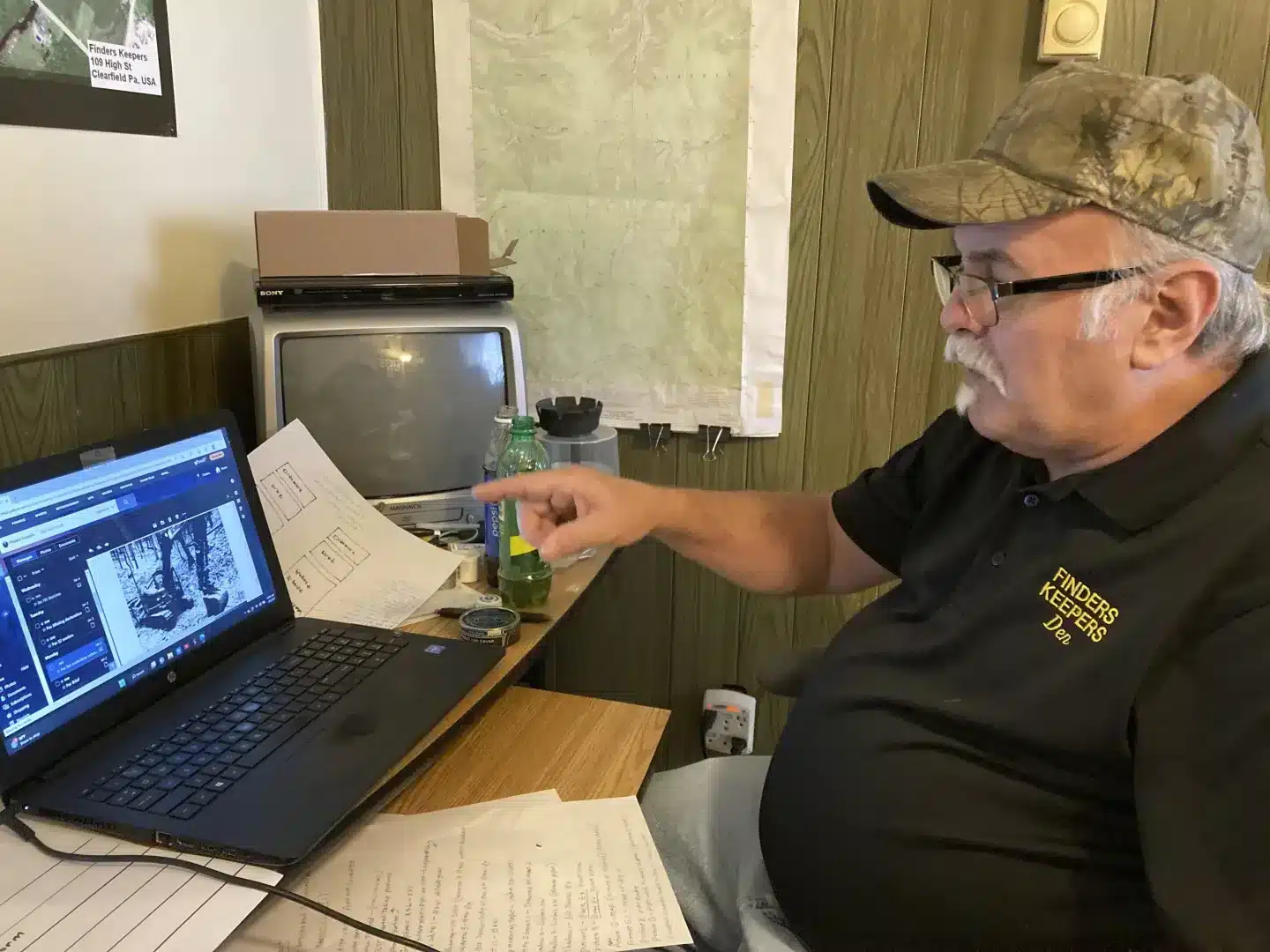
“We feel we were double-crossed and lied to,” Parada said in an interview at his cramped, wood-paneled office, where huge drill bits and high-end metal detectors compete for space with rusty miners’ picks, Civil War-era cannon parts and other odds and ends he’s dug up over the years.
“The truth will come out,” said Parada, co-founder of the treasure-hunting outfit Finders Keepers. Solving the mystery is not his only goal — he had hoped to earn a finder’s fee from the potential recovery of hundreds of millions of dollars worth of gold.
An FBI spokesperson declined to answer questions about the agency’s gold dig records or respond to the coverup allegations, citing the ongoing litigation. Last year, the FBI released a statement publicly acknowledging for the first time that it had been looking for gold in Dents Run. The statement said the FBI did not find any, adding the agency “continues to unequivocally reject any claims or speculation to the contrary.”
There is little evidence in the historical record to suggest that an Army detachment lost a gold shipment in the Pennsylvania wilderness — possibly the result of an ambush by Confederate sympathizers — but the legend has inspired generations of treasure hunters, Parada among them.
He and his son spent years looking for the fabled gold of Dents Run, eventually guiding the FBI to a remote woodland site 135 miles (220 kilometers) northeast of Pittsburgh where they say their instruments identified a large quantity of metal. The FBI brought in a geophysical consulting firm whose sensitive equipment detected a 7- to 9-ton mass suggestive of gold.
Armed with a warrant, a team of FBI agents came in March 2018 todig up the hillside. An FBI videographer was on hand to document it, at one point interviewing a Philadelphia-based agent on the FBI’s art-crime team who explained why the FBI was in the woods of one of Pennsylvania’s most sparsely populated counties.
“We’ve identified through our investigation a site that we believe has U.S. property, which includes a significant sum of base metal which is valuable … particularly gold, maybe silver,” the agent said on the video, his face blurred by the FBI to protect his privacy.
Calling it a “155-year-old cold case,” he said the FBI had corroborated Parada’s information about the location of the reputed gold through “scientific testing.” He stressed the test results did not prove the presence of gold. Only a dig would help law enforcement “get to the bottom of this story once and for all,” the agent said.
Parada obtained the video and other FBI records through a Freedom of Information Act lawsuit, hoping they would help answer lingering questions about what took place at Dents Run five years ago. Parada was mostly kept away from the dig site while the FBI did its work.
He suspects the agency conducted a clandestine, overnight dig between the first and second days of the court-authorized excavation, found the gold, and spirited it away. Residents have previously told of hearing a backhoe and jackhammer overnight — when the dig was supposed to have been paused — and seeing a convoy of FBI vehicles, including large armored trucks. The FBI has denied it conducted an overnight dig.
Parada and a consultant, Warren Getler, have focused on a handful of FBI photos and an accompanying photo log that have them questioning the FBI’s official gold dig timeline. At issue is the presence or absence of snow in the images and the timing of a storm that briefly disrupted operations. For example, an FBI image that was supposed to have been taken about an hour after the squall does not show any snow on a large, moss-covered boulder at the dig site. That same boulder is snow-covered in a photo that FBI records indicate was taken the next morning — some 15 hours after the storm.
They accuse the FBI of altering the sequence of events to conceal an overnight excavation.
“We have compelling evidence a night dig took place, and that the FBI went to some large effort to cover up that night dig,” said Getler, co-author of “Rebel Gold,” a book exploring the possibility of buried Civil War-era caches of gold and silver.
There are other seeming anomalies in the records, according to Finders Keepers’ legal motion. Among them:
— The FBI initially turned over hundreds of photos, but rendered them in low-resolution, high-contrast black-and-white, making it impossible to tell the time of day they were taken or even, in some cases, what they show. The treasure hunters went back and requested several dozen of the photos in color, which the FBI provided.
— The agency did not provide any video of the second and final day of the dig. Nor did it produce any photos or video showing what the FBI’s own hand-drawn map described as a 30-foot-long, 12-foot-deep trench — which the treasure hunters claim could have only been dug overnight. Government lawyers acknowledged these gaps in the photo and video record but did not elaborate in a court filing last week.
— The consulting firm hired by the FBI to assess the possibility of gold produced a report on its findings, but the version given to the treasure hunters seems to be missing key pages.
— The FBI did not provide any of its agents’ travel and expense invoices, which could shed further light on the dig timeline.
The records released so far “cast doubt on the FBI’s claim to have found nothing and raise serious and troubling questions about the FBI’s conduct during the dig and in this litigation, where it has gone to great lengths to distort critical evidence,” Anne Weismann, a lawyer for Finders Keepers, wrote in a legal filing that seeks records, including the FBI’s operational plan, that she says were improperly withheld.
The Justice Department did not address the treasure hunters’ most explosive claims of a possible coverup in its latest legal filing. The government instead told a federal judge in Washington, D.C., that the FBI had satisfied its legal obligation to the treasure hunters to search for its records of the dig, and asked for the case to be closed.
“I will stick at this until the end, until I know everything that happened to that gold,” he said. “How much, where it went to, who has it now. I gotta know.”
Learn how to navigate and strengthen trust in your business with The Trust Factor, a weekly newsletter examining what leaders need to succeed.
The head of the WorldHealth Organization, Tedros Adhanom Ghebreyesus, stated that Eritrean troops in Ethiopia’s northern Tigray region “murdered” his uncle.
Tedros revealed he was about to postpone the event after learning that his uncle had been “murdered by the Eritrean army” during a press conference with the UN correspondents association on Wednesday.
Tedros said: “I spoke to my mother and she was really devastated, because he was the youngest from their family and he was almost the same age as me, a young uncle.”
The WHO chief added that his uncle “was not alone. In the village, when they killed him in his home, from the same village more than 50 people were killed. Just arbitrary.
“I hope the peace agreement will hold and this madness would stop,” he said.
Last weekend, I found out that my uncle was murdered by #Eritrean army in his own house. It is another painful loss for my family due to the ongoing violence in #Tigray, Ethiopia. Peace is all the people and families need.
Ethiopia’s government and Tigrayan rebels signed a ceasefire deal on 2 November, after two years of fighting that has brought widespread human misery.
The conflict has caused an untold number of deaths, forced more than two million people from their homes and drove hundreds of thousands to the brink of famine.
But the ceasefire makes no mention of the presence on Ethiopian soil or any possible withdrawal of Eritrean troops, who have backed Ethiopian Prime Minister Abiy Ahmed’s forces and been accused of atrocities.
Tedros hails from Tigray, and the former Ethiopian health and foreign minister has repeatedly called for peace and for unfettered aid access to the region.
At a press conference on 2 December, Tedros raised concerns for areas still under the control of troops from neighbouring Eritrea.
A lack of basic medicine is killing patients in Ethiopia’s Tigray region, which is the epicentre of a 23-month civil war and is under blockade. Both sides have agreed to peace talks in South Africa, and a doctor pleads for the humanitarian crisis to be one of the first issues addressed.
Dr Fasika Amdeslasie speaks in a matter-of-fact voice, but what he has to say is devastating.
“We have a lack of anaesthesia drugs, lack of intravenous fluids, lack of antibiotics and so you see complications arising [with] the patients and you see them dying helplessly – your arms folded,” the surgeon says on a WhatsApp call using a rare satellite internet connection from the Tigrayan capital, Mekelle.
The patients are helpless but the doctors are too.
Nevertheless, there is barely a hint of emotion as Dr Fasika, who works at Mekelle’s main Ayder Hospital, relates the impact of the conflictin Tigray on the region’s health service.
For most of the past two years Tigray has been isolated from the rest of the world.
Fighting started in November 2020 when federal Ethiopian forces tried to wrest control of the region from the Tigray People’s Liberation Front (TPLF). An effective blockade began when the TPLF mounted a counter-offensive and recaptured much of Tigray in June 2021.
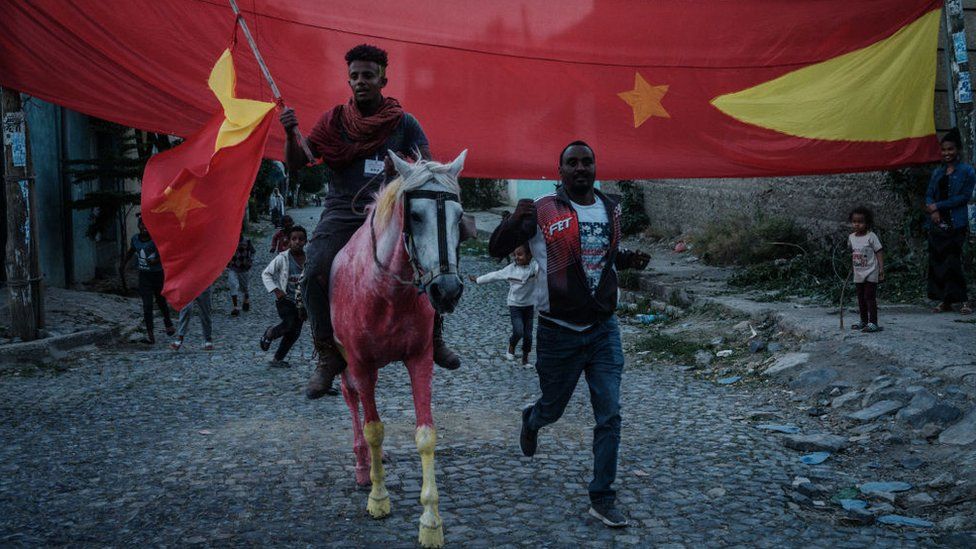
Image source, AFPImage caption, Tigrayan troops were welcomed back to Mekelle in June 2021 but that is when the region was cut off from the rest of the world
Deliveries ground to a halt, banking services stopped and telephone connections were largely cut making it almost impossible to phone anyone up. The UN says that currently 5.4 million people – around three-quarters of Tigray’s population – need some kind of food aid as the fighting has disrupted supplies.
The sick are not exempt, even though they are not directly involved in the conflict.
Some drugs and other vital equipment have come through the World Health Organization and the International Committee of the Red Cross – but their arrival has been sporadic and supplies stopped completely when fighting resumed in August, ending a five-month humanitarian ceasefire.
“We don’t have medicine for our patients, we don’t have surgical materials to do surgery, we don’t have vaccines to vaccinate children, we don’t have insulin to give to diabetic patients,” Dr Fasika tells the BBC’s Newsday programme, listing the impact the last 16 months have had.
“So all kinds of patients are suffering. We are telling them to return home without treatment.”
Drugs to treat cancer patients have not been available at all and they cannot get radiotherapy as the equipment for that is in the federal capital, Addis Ababa. Travelling there is impossible.
“Basically cancer patients are doomed to die,” says the 41 year old, who was once the dean of the medical school.
‘Patients do not have time’
Medics have also had to watch those suffering from kidney failure deteriorate as supplies for dialysis have only come through intermittently.
“The last arrival was June and there has been a complete blockage since August and now this week we are running out of materials for the 25 patients we have,” according to Dr Fasika.
He says that 90 kidney patients have died “in front of the doctors” and he wonders what will happen to the 25 who remain.
Regarding diagnosis, the hospital laboratory lacks the chemical reagents vital for the tests, meaning that often doctors cannot tell what is wrong with patients.
Added to this, the unreliable electricity supply and the absence of fuel for the generators means that the hospital can go days without power.
Fasika Amdeslasie
I have run out of emotion because it is a living reality, I am just describing what I face daily”
Throughout the grim catalogue of what he and his fellow medics are dealing with, Dr Faseka’s even voice does not reveal the weight of what he is describing.
“I have run out of emotion because it is a living reality, I am just describing what I face daily.
“We are protecting ourselves emotionally. We will not know how much burden we are carrying until we are relieved. Otherwise it’s a natural defence mechanism not to think about it – you don’t dwell there and you do what you have to do.”
But the doctors and nurses themselves are also having to deal with the fact that, as federal employees, they have not been paid since May last year. Dr Fasika gets sent money from friends and family abroad, but this comes at a price as money changers charge a high commission for having to smuggle the cash into Tigray.
“This hospital is my life,” Dr Fasika says, explaining what motivates him despite the difficult conditions.
“Professionalism calls you. If you can go and talk to patients and counsel them and do what you can, then that’s the most important thing. Not only me but all the professionals here.”
When it comes to possible peace talks between the federal government and the TPLF, Dr Fasika shies away from getting involved in the politics.
But he is worried that as the talks are a political process they will be drawn out as the different sides debate the details.
“The talks may take time, but our lives, the children’s lives and the patients’ lives may not have that time. So I wish they do things on the humanitarian situation first.
“Humanitarian law has to be respected. Why does it fail in Tigray when it is not failing in Ukraine? Is it because we are not important people?”