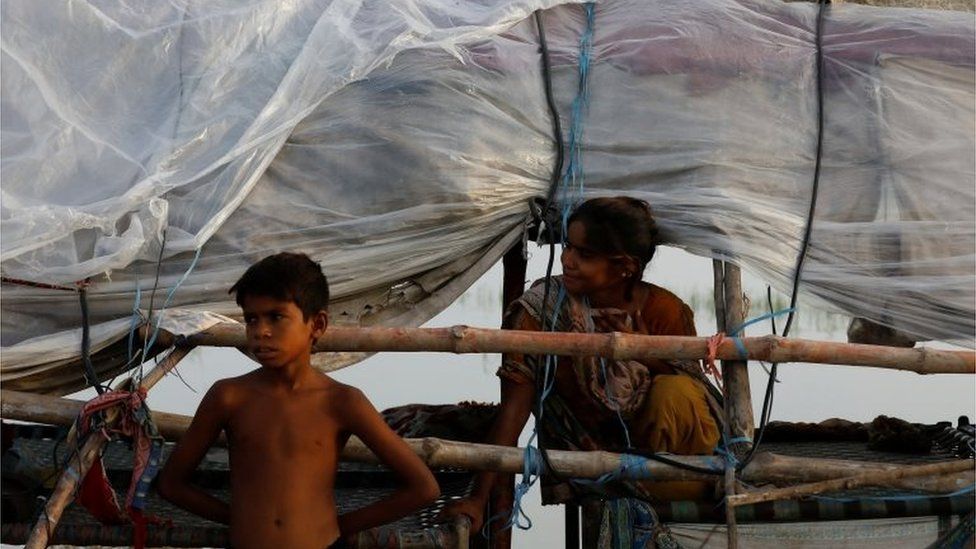
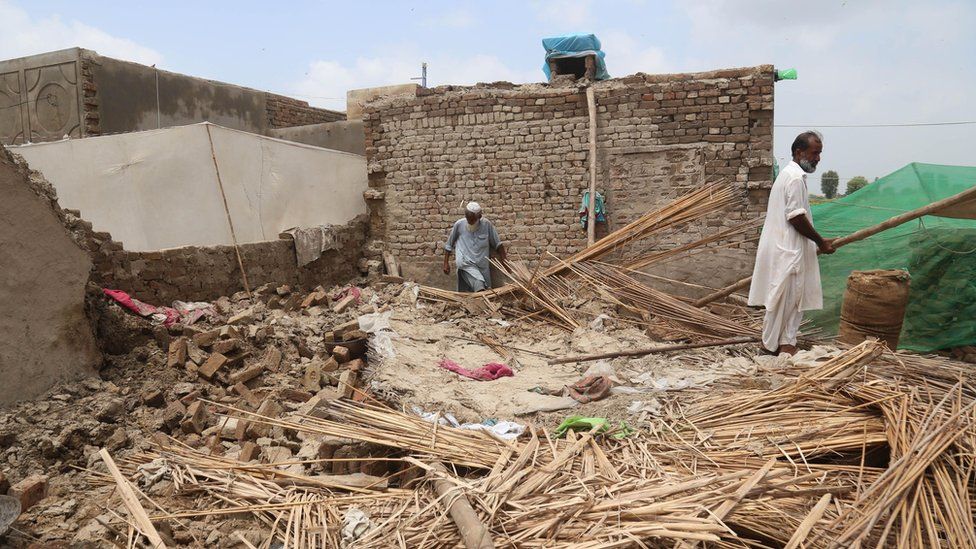
A new study has found that climate change severely worsened the heavy rains that caused large-scale flooding across swathes of Nigeria and Niger this year, killing hundreds of people.
The floods were recorded as the worst-ever in the two countries.
The report by World Weather Attribution says extreme seasonal rainfall and the release of water from dams caused the flooding from June to October.
They concluded the event was made 80 times more likely by climate change.
Almost 1.5 million people were displaced, hundreds of thousands of homes were swept away and over half a million hectares of farmland was devastated by the floods.
We don’t have time to choose between stopping emissions and removing CO2 from the air. We need to do both to survive.
In 2015, I visited Fiji, Kiribati, and Tuvalu, which had just been hit by a cyclone. There, I learned a slogan — “1.5 to stay alive” — which refers to the 1.5 degrees Celsius (2.7 degrees Fahrenheit) threshold for global warming that, in theory, would avoid disastrous consequences. People living on the Pacific islands are well aware of the grave threat to humanity posed by climate change.
Six months later, I met these new comrades again at climate negotiations in Paris. While speaking at an event, I referred to “1.5 to stay alive”. I saw people shaking their heads. They told me their slogan had changed. Now, it was “1.5, we might survive”.
This was the sad reality seven years ago. It is even more so today. World leaders are gathered at the United Nations climate change conference in Sharm el-Sheikh. It is past time for them to take action. This means rapidly reducing emissions through just transition pathways.
However, because we have delayed reducing emissions for so long, it also means acting to restore the climate system and removing existing carbon dioxide (CO2) pollution already causing extreme harm. Leaders must act to accelerate research for carbon dioxide removal strategies and enact equitable policy frameworks that ensure solutions are guided and owned by affected communities. This work can happen at the same time that the crucial work of mitigation takes place.
The significant 1.2C (2.2F) of warming we are already experiencing, compared with pre-industrial times, is destroying lives and livelihoods, making parts of our world uninhabitable. These horrific effects are felt especially in the Global South,where people who have made negligible contributions to greenhouse gas emissions are paying the first and most brutal price.
Leaders of the world’s most powerful nations and corporations have chosen to ignore the pleas, with half-hearted responses that fail to offer the scale and pace required. Millions of people stand on the brink.
Enter carbon dioxide removal. While I wish we had acted early enough through emissions reductions so there was not a need for carbon dioxide removal, I recognise now that these strategies must be part of the climate solution. Science agrees. The Intergovernmental Panel on Climate Change – the global scientific body informing the UN on climate change – says we must remove between 100 and 1,000 gigatons of CO2 build-up in our atmosphere in this century, even as we also pursue all other decarbonisation paths.
To be clear, just a decade ago, supporting carbon removal was unthinkable for activists like me. Many, including myself, thought these strategies would be an excuse for the fossil fuel industry to avoid action.
Today, while there is a global consensus that we need to get off fossil fuels, we have no time left to wait. Even if we stop all emissions tomorrow, the problem remains. In fact, the choice between reducing emissions or removing carbon dioxide is one we simply do not have. Rather, affected communities demand we do both, urgently, and equitably.
When considering carbon dioxide removal, I have feared the effects of intervening in nature. It does not help that CO2 removal is mostly a Global North-led effort in the early stages of pilots — sometimes with exaggerated claims of efficacy. These efforts often have inadequate levels of transparency and accountability.
Still, the idea of climate restoration – giving to the earth as much or more than we take – itself is squarely in line with ancient wisdom and indigenous knowledge, as well as with the needs of affected communities. Protection is step one. Clean-up and revitalisation are step two.
Carbon dioxide removal also suffers from being confused with carbon capture and sequestration – a technology and approach led by fossil fuel industry giants that is not delivering on its promise to reduce emissions but instead has been used by these corporations to pollute more. Consider Shell’s Quest facility in Canada, built with $1bn in government grants, and Chevron’s Gorgon facility, built with $60m in government funding.
We must not confuse the two. While carbon capture and sequestration allow for the same bad actors that have gotten us into this mess to continue emitting, carbon removal represents a mindset that allows us to clean up pollution while also transitioning from fossil fuels.
There are, in fact, many forms of carbon removal available. Some are nature-based, or, what some have called “rewilding”. These solutions include planting trees, restoring mangroves, cultivating seaweed or growing algae blooms in the open ocean. There are also more technological solutions that claim to augment and speed up natural processes and bring them to larger scales.
For all solutions, be they natural or technological, it is important that we accelerate science-led research in a transparent and accountable manner. All risks must be considered, including those of no action.
It is also critical that free, prior and informed consent is secured on the lands of the communities involved. Policy frameworks around carbon removal – and particularly that which occurs in the Global South – should be evolved to include systems whereby solutions and profits from solutions are guided and owned by the most affected communities. For ocean-based solutions, which have fewer chances of land conflict, we must also ensure that benefits flow to affected communities globally.
So, not only must we act urgently, but we must act thoughtfully. It is our collective moral responsibility as a global community to move forward together. As my friends on the Pacific islands told me: “1.5, we might survive”. Let this COP be the one at which we reset our ambition to restore and thrive.
DISCLAIMER: Independentghana.com will not be liable for any inaccuracies contained in this article. The views expressed in the article are solely those of the author’s, and do not reflect those of The Independent Ghana
The latest Afrobarometer survey shows that, climate change is making life worse for Ghanaians and want urgent action from government and citizens as well.
Ghanaians say the government and ordinary citizens share responsibility for fighting climate change.
While fewer than half of citizens have heard of climate change, a majority of those who are aware of the phenomenon say it is making life in the country worse and requires urgent government action.
Citizens also call on other key stakeholders – including business and industry, developed countries, and ordinary citizens – to do a lot more to limit climate change.
In Ghana, 44% of adults say they have heard of climate change.
Among Ghanaians who are aware of climate change, six out of 10 (60%) say it is making life worse, a 12-percentage-point increase since 2020.
More than three-fourths say that ordinary citizens can help curb climate change (77%) and believe that the government needs to take immediate action to limit climate change, even if it causes some job losses or other harm to the economy (87%).
Views are divided as to whether the government (43%) or ordinary citizens (42%) have the primary responsibility for fighting climate change and limiting its impact.
Far fewer place this responsibility mainly on business and industry (9%), rich or developed countries (3%), and traditional leaders (2%).
But a slim majority (53%) say the government is performing “fairly badly” or “very badly” in handling climate change.
Strong majorities say the government (81%), business and industry (74%), developed countries (69%), and citizens (67%) “need to do a lot more” to limit climate change.
The G7-led plan aims to rapidly provide prearranged insurance and protection funding after devastating events occur.
A G7-led plan dubbed “Global Shield” to provide funding to countries suffering climate disasters has been launched at the United Nations COP27 summit, although some questioned the effectiveness of the planned scheme.
Coordinated by Group of Seven president Germanyand the Vulnerable Twenty (V20) group of climate-vulnerable countries, the plan launched on Monday aims to rapidly provide prearranged insurance and disaster protection funding after events such as floods, droughts and hurricanes hit.
Backed by 170 million euros ($175m) in funding from Germany and 40 million euros ($41m) from other donors including Denmark and Ireland, the Global Shield will in the next few months develop support to be deployed in countries including Pakistan, Ghana, Fiji and Senegal when events occur.
Some countries and campaigners were cautious, however, concerned that the plan risked damaging efforts to secure a substantive deal on financial help for so-called “loss and damage” – the UN jargon for irreparable damage wrought by global warming.
German Development Minister Svenja Schulze said the Global Shield aimed to complement, not replace, progress on loss and damage.
“It is not a kind of tactic to avoid formal negotiation on loss and damage funding arrangements here,” Schulze said. “Global Shield isn’t the one and only solution for loss and damage. Certainly not. We need a broad range of solutions.”
Some research suggests that by 2030, vulnerable countries could face $580bn per year in climate-linked “loss and damage”.
Ghana’s Finance Minister Ken Ofori-Atta, who chairs the V20 group of vulnerable countries, called the creation of the Global Shield “long overdue”.
“It has never been a question of who pays for loss and damage, because we are paying for it,” he said in recorded remarks at the summit in the Egyptian resort town of Sharm el-Sheikh.
“Our economies pay for it in lost growth prospects, our enterprises pay for it in business disruption, and our communities pay for it in lives and livelihoods lost.”
‘We are not yet persuaded’
Yet some vulnerable countries questioned the scheme’s focus on insurance, with insurance premiums adding another cost tocash-strapped countries that have low carbon emissions and contributed least to the causes of climate change.
“We are not yet persuaded, especially of the insurance elements,” Avinash Persaud, the special envoy on climate finance to Barbados Prime Minister Mia Mottley, told the Reuters news agency.
“Using insurance is a method in which the victim pays, just in installments in the beginning,” he said, adding that loss and damage finance should be grant-based.
It was not immediately clear how much of the Global Shield funding announced so far was in grant form.
Michai Robertson, a negotiator for the Alliance of Small Island States – which is championing calls for a new UN loss and damage fund in the talks this week – said even subsidised insurance premiums could enable insurance companies in wealthy countries to profit off poor and vulnerable nations’ suffering.
“There’s an inherent injustice about them profiting off of our loss and damage,” he said.
‘Life and death’
A formal loss and damage funding stream would likely go further, also covering longer-onset climate impacts such as sea level rise and threats to cultural heritage.
The V20 bloc, made up of 58 developing nations, released research this year that estimated countries had lost some $525bn to climate impacts since 2000.
Ninety-eight percent of the nearly 1.5 billion people in V20 countries do not have financial protection, it said.
“We’re talking about people living under the poverty line; they’re not going to be buying insurance,” Rachel Cleetus, lead economist at the Union of Concerned Scientists’ climate programme, told the AFP news agency.
“Insurance can help you up to a point but climate change is now creating conditions in many parts of the world that are beyond the bounds of what’s insurable,” she said, referring to sea level rise, desertification and the mass displacement of populations.
Teresa Anderson of ActionAid International said the scheme showed that the global community recognised the need to act on loss and damage, but said it was a “distraction” from negotiations on a dedicated funding mechanism for climate damages.
“Everyone knows that insurance companies, by their very nature, are either reluctant to provide coverage, or reluctant to payout,” she said.
“But when it comes to loss and damage, this is a matter of life and death.”
President Yoweri Museveniof Uganda has accused Western countries of reprehensible double standards when it comes to climate change commitments.
Mr Museveni highlighted the partial dismantling of a wind farm in Germany to make way for the expansion of a coal mine in a social media post.
He stated that the move made a mockery of Western climate commitments.
The Ugandan leader also said European countries were happy to take Africa’s resources for their own energy needs but were against the development of fossil fuel projects which were for the benefit of Africans.
Uganda is due to start exporting oil within three years.
Due to the global energy crisis, some European countries have recentlydecided to increase coal production – a move heavily criticized by climate change activists.
Efforts to reduce carbon dioxide emissions are on course as the World Bank is set to release up to fifty million United States dollars (US$50,000,000.00) to Ghana to fight carbon dioxide emissions.
Speaking at an event on Ghana’s Forest Solutions to Climate Change, Climate Change Manager of the World Bank, Mr. Erwin DeNys, noted that the payment is in
exchange for a six million hectare area of the West African Guinean Forest being predicted to reduce carbon dioxide emissions by about ten million tonnes by 2024.
The event was organised by the Ministry of Lands and Natural Resources at the ongoing twenty- seventh session of Conference of Parties (COP27) of the United
Nations Framework Convention on Climate Change (UNFCCC), in Sharm El Sheikh, Egypt, on Wednesday, November 9, 2022.
The gesture is to commend Ghana for being an important and active member of the Forest Carbon Partnership Facility since its establishment in 2008.
Ghana is one of the first countries to transition to emission reduction programmes and results-based payments, according to Mr De Nys.
According to Mr. De Nys, the nation will soon receive US$4.8 million for over 970,000 tons of confirmed and documented emission reductions between June and December 2019.
He mentioned that the payment will be used to reward stakeholders in emission reduction, and boost confidence in Ghana’s REDD+ process.
In order to further cut emissions and achieve social inclusion, Mr. De Nys added that Ghana will also profit from the World Bank’s Enabling Access to Benefits while Lowering Emissions (EnABLE) programme.
On his part, the Minister of Lands and Natural Resources, Samuel Abu Jinapor, urged strategic cooperation to close the financing gap for climate change.
He emphasised that the current financial sources are insufficient to address the scale of the issue, and because the $100 billion climate finance pledge made in
Copenhagen was not met, there is an urgent need for stakeholders to collaborate in order to close the gap between ambition and action.
Mr. Jinapor called on governments and all actors to deliver action beyond pledges and declarations. “We are at a stage in the climate struggle where mere talk, commitments, declarations, and/or pledges are not enough.
Consistent with the clarion call of COP27, this is the time the world must “walk the talk” and get on with action and implementation of the many years of unfulfilled climate action promises,” the Minister said.
He said Ghana was committed to forest and nature-based solutions to climate change, which is evidenced by the over 547,000 hectares of degraded forests cultivated between 2017 and 2021, and the over thirty million trees planted under the Green Ghana Project, as well as the verified and validated emission reductionunder the Ghana REDD+ Strategy.
He expressed his confidence in COP27, which has been termed action and implementation COP, to deliver real action towards limiting global warming to the one point five degrees Celsius (1.5oC) target set out in the Paris Agreement.
The UNDP’s Principal Advisor on Climate and Forests, Tim Claris, who also spoke at the event, commended Ghana for its forest solutions to climate change and said the country deserves to be rewarded for actions being taken
in the forestry sector.
Indonesia’s capital, Jakarta, faces such challenges due to climate change that the plan is to build a new capital city more than 1,000 kilometres away.
Jakarta is sinking.
Notorious for traffic gridlock and poor air quality, Indonesia’s sprawling capital faces such a perfect storm of climate and environmental challenges that the government has decided to move it somewhere safer.
Increasingly severe rainfall and flooding, rising sea levels, and land subsidence have conspired to make the Southeast Asian megacity a challenging place for its more than 10.5 million people to live.
A quarter of the city — located on the western tip of the densely populated island of Java — could be underwater by 2050.
So, the Indonesian government is bidding farewell to Jakarta and plans to relocate to a new capital: Nusantara — a purpose-built city more than 1,000km (620 miles) away in Borneo island’s East Kalimantan province.
As world leaders gather for the COP27 summit in Egypt and thrash out ways and timeframes to avert what UN Secretary-General Antonio Guterres told them was the “collective suicide” of climate change, Jakarta’s fate vividly demonstrates how people in the developing world are already suffering from, and adapting to, a climatically-changed reality.
Indonesian national police rescue residents from flooding that inundated Jakarta in February 2021 [Bagus Indahono/EPA]
Relocating a capital city is a daunting task although plans appear to be advanced, according to the official ibu kota negara (the nation’s capital) website.
President Joko Widodo plans to host Indonesia’s 79th independence day celebrations in Nusantara in August 2024, where core infrastructure for an initial 500,000 residents will have been completed, according to the website.
Bambang Susantono, a former Indonesian transport minister who is leading the new capital city development project, is upbeat about the gargantuan task.
Creating a new city from “scratch” was an advantage, Susantono wrote on his LinkedIn page recently, as it allowed control over the master plan, quality of engineering work, and the application of the latest technology.
“In Nusantara, we do climate change adaptation at scale,” he wrote, pointing out that 65 percent of the city will remain tropical forest.
“Given these facts, I believe Nusantara will be a prime example of how cities and countries can respond to climate change,” he wrote.
Critics are not so sure.
Goodbye, Jakarta. Welcome to Nusantara
Indonesian President Joko Widodo gestures with Governor of East Kalimantan Isran Noor during their visit to the planned location of Indonesia’s new capital [File: Akbar Nugroho Gumay/Antara Foto via Reuters]
Climate change did not cause Jakarta to sink — that is due to unsustainable groundwater depletion that has resulted in subsidence — but the city is being swamped by rising sea levels, which have been caused by planet-warming greenhouse gases.
Whether to move or not is “a big question for many”, said Edvin Aldrian, professor of meteorology and climatology at the Agency for Assessment and Application of Technology BPPT Indonesia.
Building a new capital might also amount to “only moving the problem”, said Aldrian, who also teaches at the University of Indonesia, Bogor Agricultural Institute and Udayana University in Bali.
Moving will not stop the increasingly extreme rainfall and flooding, which is “getting heavier and heavier” either in Jakarta or, in the future, in Nusantara, he adds.
“I’m afraid that there are many floods already in Kalimantan.”
Aldrian has warned that about 40 percent of Jakarta lies below sea level and the northern part of the city is sinking at a rate of 4.9cm (almost 2 inches) each year.
Subsidence is due mainly to the city’s use of groundwater sucked up through water wells. Although heavy rains should replenish underground aquifers and shore up Jakarta’s foundations, urban sprawl creates a concrete boundary that prevents the aquifers from being replenished, while the streets often flood.
And “while the capital’s land surface is sinking, the sea is rising,” he added.
Below, groundwater is being depleted, but three bodies of water above ground threaten the city, as he explains:
Torrential rain over the city has become more common, causing an increase in severe floods. Added to that, heavy rain in higher terrain nearby flows down into Jakarta, flooding the city’s canals and waterways. And then there is the sea, where rising waters threaten the city, particularly at high tide.
The New Year’s Eve storm of 2020 that turned Jakarta into a mucky swimming pool in just a few hours demonstrates for Aldrian the challenges posed by climate change.
Rain clouds were estimated to have formed for many kilometres above the city, whereas a normal height for cloud cover would be about 3 to 4km, he says. When the rain fell, it was like nothing he had ever seen.
Some areas saw rainfall at an intensity of 377mm (almost 15 inches) in a day, inflicting some of the worst flooding ever to hit Jakarta.
“You can’t do anything. You are isolated in your home…. Cars can’t move, electricity and communications are down, and drinkable water supplies have become contaminated by overflowing drains and sewers,” he told Al Jazeera.
“The problem is not during the flood it is afterwards”, he adds, explaining that all the costs are in cleaning up the mess.
Asia’s sinking megacities
What has occurred in Jakarta is also affecting other megacities in South and Southeast Asia, where, according to a recent study led by Singapore’s Nanyang Technological University, coastal cities are sinking faster than in other parts of the world.
Indonesian youths play in flood water in a neighbourhood in Jakarta after overnight rains caused rivers to burst their banks, inundating thousands of homes and paralysing parts of the city’s transport networks [File: Achmad Ibrahim/Reuters]
Vietnam’s economic hub Ho Chi Minh City, Myanmar’s Yangon, Bangladesh’s port city of Chittagong, China’s Tianjin, and the Indian city of Ahmedabad are among the cities most steadily subsiding under the weight of their populations and the effect of urbanisation.
Like Jakarta, they too are contending with rising sea levels.
Learning from Jakarta’s challenges, Nusantara’s city planners want to create a green city that can cope with and mitigate the effects of climate change.
Widodo announced the plan to relocate the capital from flood-prone Java to a 2,560-square-kilometre (almost 990 square miles) site on the forested island of Borneo in 2019.
Work is already underway and a completion date of 2024 has been set for the first of four phases of development: the relocation of key administrative elements, including the president’s office, according to a report on the move by scholars Anuar Nugroho and Dimas Wisnu Adrianto.
The second phase is a decade-long process, from 2025-35, to develop a foundational capital city area, followed by a third phase, from 2035-45, to develop the overall infrastructure — physical and socioeconomic.
The final phase is to establish Nusantara’s reputation globally as a “World City for All”, according to Nugroho and Adrianto, and an “economic Super Hub driving the economy of the nation” with the creation of 4.8 million jobs by 2045.
Plans for the city available on the ibu kota negara (the nation’s capital) website look and sound impressive: Eco-friendly construction of all high-rise buildings; 80 percent of travel in the city will involve public transport or “active mobility”, such as walking and cycling; and all important facilities will be located within 10 minutes of a public transport hub.
Residents will also have access to recreational green space as well as social and community services within 10 minutes of their homes. Zero poverty is to be achieved by 2035, and there will also be 100 percent digital connectivity for all residents and businesses.
A computer-generated image released in 2022 showing the design illustration for Indonesia’s future presidential palace in East Kalimantan [Nyoman Nuarta/handout via AFP]
Renewable energy will provide all energy needs, and the city will achieve net zero emissions by 2045. Ten percent of the city’s area will be devoted to food production, 60 percent of the city’s waste will be recycled by 2045, and 100 percent of wastewater will be treated by the city’s water management system by 2035.
With such a list of envy-inducing initiatives, the city also aims to be among the top 10 cities on the Global Liveability Index by 2045.
Computer-generated images depict the future city as covered in trees with water features, wide pedestrian avenues, electric vehicles on carless roads, and futuristic buildings that appear to borrow a virtual world aesthetic.
Such a green city does not come cheap.
The cost of building the new capital is estimated to be more than $34bn and three international firms — United States-based engineers AECOM, global consulting firm McKinsey and Japanese architects and engineers Nikken Sekkei — have been brought in to help design its high-tech and environmentally-friendly elements, according to news reports.
Indonesia will build the new city with state funds and is seeking investors.
But the issue of who should pay for the damage created by the climate crisis – such as the inundation of megacities like Jakarta due to rising sea levels – has emerged as a key issue at COP27.
People in the most vulnerable countries in the world have done little to contribute to the change in their climates, but are suffering the effects earlier and more severely than countries whose industries and consumption patterns are responsible for the lion’s share.
“It evokes the question,” Bethany Tietjen of the Climate Policy Lab at Tufts University wrote last week in The Conversation.
“Why should countries that have done little to cause global warming be responsible for the damage resulting from the emissions of wealthy countries?”
Jakarta is still sinking
Critics point out that the new city is being built on an island with vast tracts of rainforest that are a crucial carbon sink and there are fears the new capital might eventually face some of the same issues as the old capital.
Building a state-of-the-art capital on Borneo also does not solve the crises faced by the millions who will remain in Jakarta.
“It’s a very ambitious plan,” said Tiza Mafira, head of Climate Policy Initiative (CPI) Indonesia.
Mafira says while she is in favour of the country’s administrative and political centre being separated from its business hub, moving away will not solve the issues facing Jakarta, which still must be tackled.
Improved spatial planning, safeguarding groundwater, and, basically, re-thinking Jakarta as a city, is the no small task that is required, Mafira said.
“In order to solve that root of the problem, you would need to rethink, re-green Jakarta,” she told Al Jazeera.
“It is possible to re-green Jakarta,” she added.
“It would take some transition. You would not only have to re-green whatever area is left to re-green, but you would also need to reassess the function of some areas,” she adds.
“Some areas would need some hard decisions. If a mall was built that wasn’t supposed to be built, then it would have to go … and be replaced with a park, for example.”
What also might need re-thinking is the decision to build in Kalimantan.
“It’s literally a forest … you would have to cut down an existing forest in order to build this capital city,” Mafira said.
There is also the real possibility that Nusantara turns out to be more of a white elephant in Borneo than a green-city alternative to Jakarta.
Mafira speaks of capital cities that end up being “a seat of administration, but nobody really wants to live there”.
Myanmar’s capital, Naypyidaw, comes easily to mind.
“There has to be a whole cultural and social shift that will make it actually a comfortable place to live, that people would want to move to,” Mafira said.
Otherwise, “they end up moving back and forth between their home and that capital city”, she said, noting the possible effect on climate through increased air traffic as people commute between their homes in Jakarta and their jobs in the new capital.
‘We have to be hopeful’
Chisa Umemiya, research manager at the Institute for Global Environmental Strategies in Japan, emphasises community involvement as the essential ingredient in the success of decision-making around climate change.
Umemiya wonders about the extent of the Indonesian government’s consultation with local communities on the project.
“My point is that from a community inclusion point of view, it’s really essential to have such a discussion,” she told Al Jazeera, drawing parallels with earlier research she conducted on forest preservation in Thailand.
On an international level too, Umemiya says, solutions to climate change need to include the input of local communities.
Particularly communities in the developing world, she says, as the climate change debate has too often and or too long been “framed around the needs or interests of developed countries”.
“Of course, reducing emissions is the solution. But who does that? To me, responsibility lies mostly in developed country and not developing country,” she said.
“I really see a gap there, to involve more views coming from the community level and especially from developing countries, and especially from Southeast Asia, where climate impact is enormous.”
Tiza Mafira, of the CPI, echoes that sentiment, noting that climate change has long affected people in the developing world — Jakarta’s problems have been evident for years — but the crisis is just now being acknowledged because richer countries are also beginning to experience the effects.
“We’re only now starting to see a larger level of ambition because it now has begun to affect, glaringly, the industrialised and developed countries,” she said.
“I can’t remember who said it, but I’m echoing the sentiment that we’ll see accelerated ambitions at COP [the UN’s climate change Conference of the Parties] once the industrialised countries are truly suffering the consequences of the climate crisis,” she added
“And it’s unfortunate that it has to come to that, because we could have prevented this sooner.”
On Jakarta’s future and successfully mitigating the effect of climate change, Aldrian says: “Of course, we have to be hopeful.”
The UN’s weather and climate body outlines ‘chronicle of climate chaos’ as COP27 talks get under way in Egypt.
The past eight years are on track to be the hottest ever recorded, a United Nations report has found, as UN chief Antonio Guterres warned that the planet was sending “a distress signal”.
The UN’s weather and climate body released its annual state of the global climate report on Sunday with another warning that the target to limit temperature increases to 1.5C (2.7F) was “barely within reach”.
The acceleration of heat waves, glacier melts and torrential rains has led to a rise in natural disasters, the World Meteorological Organization said as the UN’s COP27 climate summit opened in the Red Sea resort town of Sharm el-Sheikh, Egypt.
“As COP27 gets under way, our planet is sending a distress signal,” said Guterres, who described the report as “a chronicle of climate chaos”.
Representatives from nearly 200 states gathered in Egypt will discuss how to keep the rise in temperatures to 1.5C, as recommended by the Intergovernmental Panel on Climate Change (IPCC), a goal some scientists say is now unattainable.
Earth has warmed more than 1.1C since the late 19th century with roughly half of that increase occurring in the past 30 years, the report showed.
This year is on track to be the fifth or sixth warmest ever recorded despite the impact since 2020 of La Nina, a periodic and naturally occurring phenomenon in the Pacific that cools the atmosphere.
“All the climatic indications are negative,” World Meteorological Organization head Petteri Taalas told Al Jazeera from Sharm el-Sheikh. “We have broken records in main greenhouse gas concentrations, carbon dioxide, methane and nitrous oxide [levels].”
“I think the combination of the facts that we are bringing to the table and the fact that we have started seeing impacts of climate change worldwide … are wake-up calls, and that’s why we have this climate conference,” he said.
Surface water in the ocean hit record high temperatures in 2021 after warming especially fast during the past 20 years. Surface water is responsible for soaking up more than 90 percent of accumulated heat from human carbon emissions.
The report warned that more than 50 percent of the ocean surface experienced at least one marine heatwave in 2022.
Sea level rise has also doubled in the past 30 years as ice sheets and glaciers melted at a fast pace. The phenomenon threatens tens of millions of people living in low-lying coastal areas.
“The messages in this report could barely be bleaker,” said Mike Meredith, science leader at the British Antarctic Survey.
In March and April, a heatwave in South Asia was followed by floods in Pakistan, which left a third of the country underwater. At least 1,700 people died, and eight million were displaced.
In East Africa, rainfall has been below average in four consecutive wet seasons, the longest in 40 years, with 2022 set to deepen the drought.
China saw the longest and most intense heatwave on record and the second-driest summer. Similarly in Europe, repeated bouts of high temperatures caused many deaths.
‘Loss and damage’ talks
The UN warning was made as delegates at the summit agreed to hold discussions on compensation by rich nations to poorer ones most likely to be affected by climate change.
“This creates for the first time an institutionally stable space on the formal agenda of COP and the Paris Agreement to discuss the pressing issue of funding arrangements needed to deal with existing gaps, responding to loss and damage,” COP27 President Sameh Shoukry told the opening session.
Poorer nations least responsible for climate-warming emissions but most vulnerable to its impacts are suffering the most and are, therefore, asking for what has also been called “climate reparations”.
This item, added to the agenda in Egypt on Sunday, is expected to cause tension. At COP26 last year in Glasgow, high-income nations blocked a proposal for a loss and damage financing body and instead supported three years of funding discussions.
The loss and damage discussions now on the agenda at COP27 will not involve liability or binding compensation but they are intended to lead to a conclusive decision “no later than 2024”, Shoukry said.
Boris Johnson referred to himself as “the spirit of Glasgow COP26,” calling for the legacy of last year’s climate summit, which was held in the UK, to be “taken forward” as a “joint global endeavor.”
In his first appearance at the COP27 climate summit in Egypt, BorisJohnson slammed net zero “naysayers” who want to “frack the hell out of the British countryside.”
On the first day of the summit in Sharm el-Sheikh, the former prime minister said the fight against climate change had become a “collateral victim” of the Ukraine war, causing “naysayers to adopt a corrosive cynicism about net zero.”
In a swipe at other Conservatives – including his successor Liz Truss who had planned to lift the ban on fracking in England – Mr Johnson declared that it is “not the moment to ban the campaign for net zero” despite the ongoing energy crisis.
Returning to the international stage, he also warned that countries “should not be lurching back to an addiction or a dependence on hydrocarbons” if they wish to keep global warming to 1.5C, adding: “The solution is to move ahead with a green approach.”
Mr Johnson said nations must join together to “tackle this nonsense head on”.
“This is not the moment to give in to Putin’s energy blackmail,” the former PM told the audience.
“Yes, of course, we do need to use hydrocarbons in the transitional period and, yes, in the UK there is more that we can do with our own domestic resources.
“However, this is not the moment to abandon the campaign for net zero, this is not the moment to turn our backs on renewable technology.”
Mr Johnson also seemed to reject calls for climate reparations – sometimes referred to as “loss and damage” payments – which is a policy widely expected to dominate talks in Egypt.
“Let’s look to the future, to trigger private sector involvement, I’d much rather look at what we can do now to help countries going forward,” he said.
‘I am here as a footsoldier’
Describing himself as “the spirit of Glasgow COP26”, the former prime minister called for the legacy of last year’s climate summit hosted in the UK to be “taken forward” as a “joint global endeavour”.
“Glasgow was a big moment, I want to see that legacy, it’s crucial the steering wheel is yanked back a bit to tackling climate change, clean green solutions to achieve net zero, that’s what I’m here to do,” he said.
“We have got to end the defeatism, end Putin’s energy blackmail, keep up our campaign to end global dependence on hydrocarbons and keep 1.5C alive.”
Probed on why he confirmed his attendance at COP27 before Prime Minister Rishi Sunak had, Mr Johnson replied: “I am here as a footsoldier and a spear carrier of the Conservatives… I am here in a purely supportive role and to remind people of the work we did in Glasgow which I think was fantastic.”
Last week, Mr Sunak reversed his decision to skip the COP27 climate, bowing to pressure from environmental campaigners and MPs.
PM arrives for COP27 in Egypt
‘Glad PM is here’
Having originally said he would not attend due to “other pressing domestic commitments” back home – including preparing for the autumn statement on November 17 – Mr Sunak changed his position on Thursday, saying there is “no long-term prosperity without action on climate change”.
Asked if he was concerned when Mr Sunak’s position was not to attend the climate conference, Mr Johnson added: “Look, the PM is here and I am glad he is here. He has made an outstanding speech the other day and I think he is on the right line.”
Mr Johnson added that he supports what the government is doing back in the UK to help people facing rising bills.
“In the short term of course you have to abate the cost, the impact for those who are feeling it – and that is why I support what the government is doing, what Rishi is doing, to help people through tough times,” he said.
“People are struggling, people are hurting, they can feel the impact of the spike in energy prices. The answer is not to renew our addition to hydrocarbons, it’s to accelerate the adoption of green solutions,” Mr Johnson said.
Ahead of the US midterm elections this week, Mr Johnson also noted that “it is very important for the rest of the world that America stays with the programme on climate change”.
ather around the world, the former PM suggested that soaring temperatures back in July in the UK may have influenced the “unexpected political turmoil” in Westminster which saw him being ousted from Number 10.
“Temperatures in London reached 40 degrees, which is unprecedented and unbearable, perhaps even contributing who knows to unexpected political turmoil that we saw in Westminster at that time,” he said.
World leaders are attending the latest UN climate talks in Egypt amid tensions over who will pay for the damage caused by global warming.
US President Joe Biden and French President Emmanuel Macron are among those others at the event.
The climate summit will end on Friday 18 November.
Baroness Scotland, Secretary General of the Commonwealth, has told Sky News that “armageddon” is beckoning and 115 people are dying each day from the effects of climate change.
She told Sky News that if we do not act, “we will not have a planet worth living on”.
She said: “Just look at what’s happened in the last few months to countries like Bangladesh – 60% of the country under water.
“Antonio Guterres (UN secretary general) talked about it as ‘monsoons on steroids’.
“This was Armageddon. More than $40bn of damage. And you’ve got thousands of people affected and millions of people who are going to be now put in a position of real devastation and hunger.”
Baroness Scotland went on: “All of us, all of humanity, has to be focused on this.
“And if we have to drive everybody else to do that, which they must do, then we will.
“But those of us who understand it have to speak out. We have to be able to say to everybody, this is everybody’s business and you can’t run away from it, because if you do, our whole humanity is at risk. This is about saving the planet.
“We’ve got 115 people dying every single day as a result of climate change.
The fight against climate change can become “a global mission for new jobs and clean growth”, Rishi Sunak will tell world leaders at the COP27 summit.
The prime minister will also say it is essential nations stick to commitments made at COP26 in Glasgow a year ago.
The UN’s climate change chief said a key aim to limit global temperature rises is “still within reach”.
Mr Sunak is making his first outing on the international stage in Egypt after becoming UK PM last month.
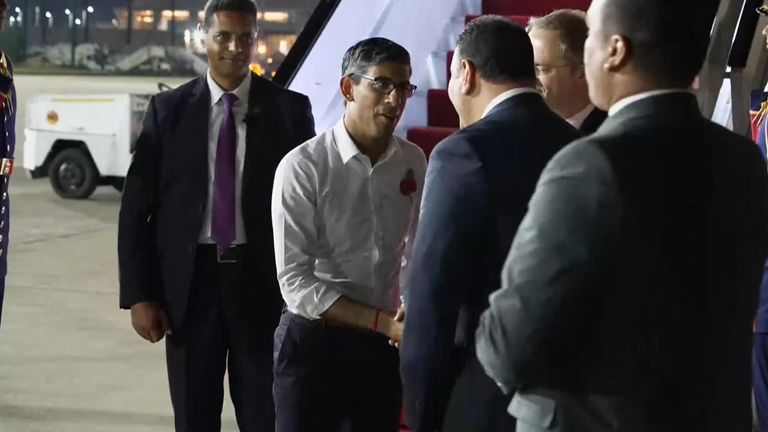
He arrived in Sharm el-Sheikh on Sunday night and will join other world leaders at the UN summit, including US President Joe Biden and France’s Emmanuel Macron.
Mr Sunak will unveil more than £200m funding to protect forests and for green technologies in developing nations.
He reversed a decision not to attend COP27 earlier this week after a backlash from opposition MPs and campaigners. He initially declined the invite as he said he was too busy preparing the November budget.
In his opening address on Monday, Mr Sunak will urge global leaders to “move further and faster” to avoid the worst impact of climate change by limiting global warming to 1.5C above pre-industrial levels.
He will say Russia’s invasion of Ukraine has “reinforced” the importance of ending dependence on fossil fuels, but will argue the move can give a boost to new green industries.
“The world came together in Glasgow with one last chance to create a plan that would limit global temperature rises to 1.5C. The question today is: can we summon the collective will to deliver on those promises?” he will say.
“By honouring the pledges we made in Glasgow, we can turn our struggle against climate change into a global mission for new jobs and clean growth. And we can bequeath our children a greener planet and a more prosperous future.”
Mr Sunak will also meet French President Mr Macron at the conference, where the topic of migrants crossing the English Channel in small boats is likely to be raised. The prime minister has said reducing the number of crossings is a “key priority”.
Downing Street said Mr Sunak will announce a further £65.5m for the clean energy innovation facility which provides grants to researchers and scientists in developing countries working on clean technologies – from biomass-powered refrigeration in India to lithium-ion batteries in Nigeria.
It said the UK will also commit £90m for conservation in the Congo Basin rainforest, and £65m to support indigenous and local communities.
But Labour’s Ed Miliband said Mr Sunak “had to be dragged kicking and screaming” to go to the summit and it was “implausible for him to claim the mantle of climate leadership”.
The shadow climate change secretary said the government should drop plans to issue more licences for North Sea exploration and end its opposition to onshore wind.
As COP27 got under way, the UN itself warned that meeting the critical target of limiting temperature rises to 1.5C would take an “extraordinary effort”.
“The science tells us that is it still within reach,” said the UN’s new climate chief, Simon Stiell. “We cannot lift the pressure.”
Speaking to the BBC World Service’s Newshour programme, Mr Stiell said just 29 states had strengthened their climate pledges since last year, which was “not enough”.
His remarks came after the UN’s weather and climate body released a report showing that the rate at which sea levels are rising has doubled since 1993.
UN Secretary General Antonio Guterres described the report as a “chronicle of climate chaos” and urged governments at COP27 to answer the planet’s “distress signal” with “ambitious, credible climate action”.
Image source, Rex Features
Image caption,
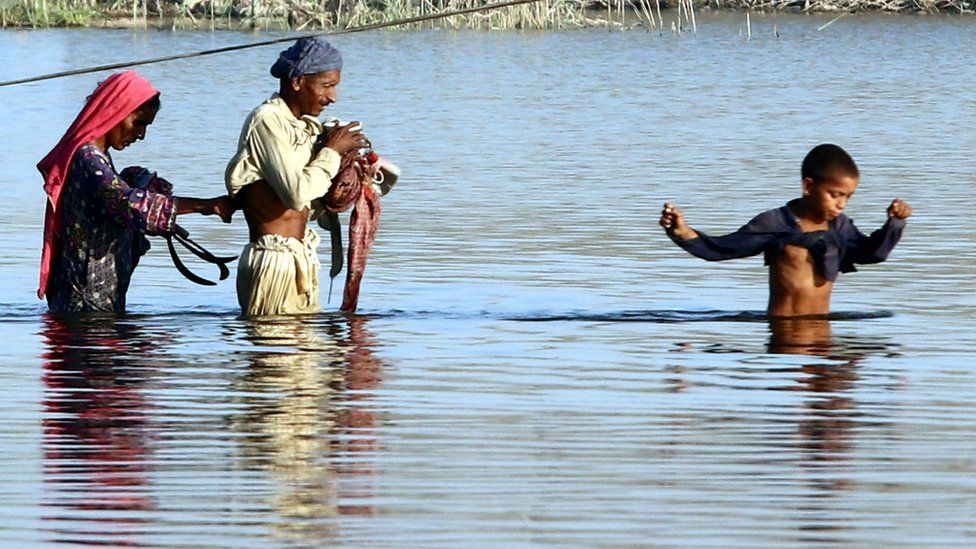
Vulnerable countries increasingly being hit by extreme storms, floods and droughts, such as Pakistan’s devastating flooding this year
Global temperatures have risen 1.1C and are heading towards 1.5C, according to the UN’s climate scientists, the Intergovernmental Panel on Climate Change (IPCC).
If temperatures rise 1.7 to 1.8C above 1850s levels, the IPCC estimates that half the word’s population could be exposed to life-threatening heat and humidity.
Rich countries are also falling short in providing the finance needed to help developing nations adapt to a changing climate and develop cleanly, the UN has warned.
But Mr Stiell said the conference was off to a “hopeful start” after developing nations successfully lobbied to put on the agenda the thorny issue of “loss and damage”.
This debate revolves around compensation money paid by wealthy countries to the states worst affected by climate change.
Speaking to the BBC, David Panuelo, President of the Federated States of Micronesia, said bigger nations needed to “come good with their nationally-determined contributions”.
Highlighting China, India, Mexico, Indonesia and Brazil, Mr Panuelo said there are “many countries that need to come forward with… commitments to help meet this challenge that global communities are facing now”.
The most important safeguard against major glacier retreat would be to drastically reduce carbon emissions globally.
According to a UNESCO report, some of the world’s most famous glaciers, including those in the Dolomites in Italy, the Yosemite and Yellowstone parks in the United States, and Mount Kilimanjaro in Tanzania, will vanish by 2050 due to global warming, regardless of the temperature rise scenario.
According to UNESCO, which monitors 18,600 glaciers across 50 World Heritage Sites, one-third of those are expected to disappear by 2050.
While the rest can be saved by keeping global temperature rise below 1.5 degrees Celsius (2.7 degrees Fahrenheit) relative to pre-industrial levels, in a business-as-usual emissions scenario, about 50 percent of these World Heritage glaciers could almost entirely disappear by 2100.
The study “shows these glaciers have been retreating at an accelerated rate since 2000 due to CO2 emissions, which are warming temperatures”, UNESCO said.
World Heritage glaciers, as defined by UNESCO, represent about 10 percent of the world’s glacier areas and include some of the world’s best-known ones, whose loss is highly visible as they are focal points for global tourism.
Inevitable shrinking
The report’s lead author, Tales Carvalho, said World Heritage glaciers lose on average some 58 billion tonnes of ice every year – equivalent to the annual volume of water used in France and Spain together – and contribute to almost 5 percent of global observed sea level rise.
Carvalho said the most important protective measure to prevent major glacier retreat worldwide would be drastically reducing carbon emissions.
UNESCOrecommends that given the inevitable further shrinking of many of these glaciers in the near future, local authorities should make glaciers a focus of policy by improving monitoring and research and by implementing disaster risk-reduction measures.
“As glacier lakes fill up, they can burst and can cause catastrophic floods downstream,” Carvalho noted.
Countries have pledged to keep global warming to 1.5C above pre-industrial levels – a goal the world is set to miss on current emission trends.
“This report is a call to action,” said UNESCO head Audrey Azoulay in advance of the COP27 climate summit in Egypt starting on Monday.
“Only a rapid reduction in our CO2 emissions levels can save glaciers and the exceptional biodiversity that depends on them. COP27 will have a crucial role to help find solutions to this issue.”
Professor Joseph Shevel, the President of the Galilee International Management Institute, Israel, has urged Ghana to increase investment in education and training to spur sustainable growth in agriculture to ensure food security in the face of looming water crisis due to climate change.
He warned that the worsening situation of dwindling waterbodies owing to global warming could plunge the country into “civil war” if immediate actions were not taken to mitigate it, particularly in the area of agriculture.
He said 50 per cent of Ghana’s population was into agriculture but contributing only 20 per cent to Gross Domestic Product (GDP) in the midst of abundant rainfall and waterbodies, making the sector “inefficient.”
In contrast, he said with very little rainfall and only three per cent of the population doing agriculture in Israel, the sector was thriving and serving the entire country.
He attributed Israel’s success to high investment in education and training and challenged universities in Ghana to lead the change.
Prof Shevel was speaking on the topic: “Emerging higher education frontiers experiences from Israel, lessons for African Higher Education Institutions” at an International Symposium organised by the University of Cape Coast (UCC) as part of its 60th Anniversary celebration.
It was on the theme: “60 Years of Quality Education, Expanding Frontiers: Experiences and Lessons from International Partners,”
chaired by Professor Johnson Nyarko Boampong, the Vice Chancellor.
Prof Shevel said: “Half of Israel is desert and experiences less than one hundredth of millimeters of rainfall per year while the southern part experiences 20 millimeters a year. But in Ghana, you can have 20 millimeters in one day.”
“In Israel, 90 per cent of the water is reused. It is not a secret and it is also not unholy because it is Israel. Most of our agriculture today use recycled water.”
Israel produces oranges, watermelon, lemons and grapes in the desert through the dripping system.
“And if we can do it there, we can do it here. It is only a matter of know-how and the universities can lead it,” he said.
In 2017 alone, Israel exported 60 million flowers to Europe on Valentine’s Day and Ghana could do same with the necessary training, Prof Shevel said.
Israel was the only country in the Middle East with no oil and mineral resources, including water, but it had a bigger GDP than all the other countries in the bloc due to education, he said.
While Ghana invested less than two per cent of GDP in education, Israel invested 7.3 per cent.
Prof Shevel said Israel was the number one in the world in research and development and had the biggest share in the technology industry with 63 different companies through education.
“Education generally is a problematic field for politics because we see the results of education usually in the next generation but politicians want to see the results before the next election,” he observed.
Ghana, he said, had also been successful in some areas in which Israel had failed, hence the need to share experiences and learn from each other for mutual growth.
Prof Boampong, on his part, emphasised the need for institutions of higher learning to establish global partnerships in order to create mutually beneficial relationships.
He noted that it was through such international collaborations that the UCC attained it current status as the topmost ranked university in Ghana and West Africa, and the fourth in Africa.
The event was attended by delegations from the Bucknell University, University of Cincinnati, University of Rhode Island, University of Limerick, Millersville University, and International Youth Fellowship of Korea.
They took turns to share their experiences and beneficial collaborations with the UCC and the areas they had thrived.
A documentary on the environment and climate change produced by Ghanaian youth videographers has been selected as part of films that will be showed at the upcoming climate talks in Egypt (COP 27) – the first in the history of the country.
The documentary consists of 12 separate films that highlight the impact of climate change on the environment and livelihoods, particularly among coastal communities hit by tidal waves and rising sea levels.
The film also captures climate change mitigation measures executed by individuals and organisations, including the adoption of climate-smart agriculture systems to improve food production.
The films were produced as part of the Ghana Youth Videography Programme and facilitated by the UN Youth Climate Report, a platform that showcases actions being taken by youth around the world on climate change.
During a screening of the film at the Ghana Institute of Management and Public Administration (GIMPA) last Friday, Mr Mark Terry, Executive Director, of Youth Climate Report, said the film would be shown to UN Policy makers at COP27 on November 9, 2022.
He said all 12 films were approved by the UN and had been added to the UN’s Geographic Information System map of the world.
Mr Terry said the youth played an important role in the fight against climate change, adding that the documentary was one of the ways to ensure that the views of the youth were considered in the climate talks.
“The idea is to amplify the voice of the youth particularly those in Ghana. We want to hear the stories of climate change and the impacts that they have here,” he said.
Professor Magnus Mfoafo-M’Carthy, a member of the Project Team, said policymakers must realise that the youth also had a voice because “they also have something that they bring on the table.”
He said the Film would create awareness of climate change and elevate Ghana to the world in terms of climate action.
“It elevates Ghana to the point of having that conversation that Ghana is taking climate change seriously,” Prof. Mfoafo-M’Carthy said.
Africa will host the 27th Conference of the Parties of the United Nations Framework Convention on Climate Change (COP 27) in November this year, which will be the second time the continent is hosting global climate talks after hosting COP 17 in South Africa in 2011.
Although African countries have contributed to less than four per cent of global emissions, their citizens are the most affected by climate change.
The continent is increasingly battling with extreme drought, erratic rainfall, rising sea levels, flooding and other challenges that impact food systems and contribute to hunger and poverty.
Finance Minister, Mr Ken Ofori-Atta, will on Sunday, chair the G20 Ministers of Finance annual dialogue in Washington DC.
The meeting, aimed at tackling climate change issues affecting vulnerable economies, is part of the ongoing IMF-World Bank annual meetings.
It will be attended by Finance Ministers from Africa, Asia, the Caribbean, Latin America, the Middle East, and the Pacific.
The dialogue comes on the background of the Climate Vulnerable Economies Loss report, which noted that V20 economies lost about $525 billion in two decades.
Therefore, the V20 Finance Ministers’ dialogue will discuss debt repayments to finance climate action and climate prosperity plans.
This is to support ongoing initiatives between G7 and G20 countries to tackle global climate finance, loss and damage issues.
The dialogue will also tackle issues of V20 as an official group within the IMF and World Bank as well as IMF’s newly created resilience and sustainability trust.
In a press statement on the chairmanship of the dialogue, Mr Ofori-Atta, said: “Ghana welcomes the challenge of leading the world’s biggest grouping of climate-vulnerable economies to find ways to protect economic growth amidst growing risks posed by climate change.”
“We aim to keep our economies thriving, provide jobs for our people and protect our industries, while advocating for solutions to the climate crisis.”
Formed in 2015, the V20 Group of Finance Ministers is a dedicated cooperation of economies systematically vulnerable to climate change.
V20 Group members are also states of the Climate Vulnerable Forum (CVF). V20 Group membership stands at 58 economies, representing some 1.5 billion people, including Afghanistan, Bangladesh, Barbados, Benin, Bhutan, Burkina Faso, Cambodia, Chad, Colombia, Comoros, Costa Rica, Côte d’ivore, Democratic Republic of the Congo, Dominican Republic, Eswatini, Ethiopia, Fil.
Others are: The Gambia, Ghana, Grenada, Guatemala Guinea, Guyana, Hat, Honduras, Kenya, Kiribati, Kyrgyzstan, Lebanon, Liberia, Madagascar, Malawi, Maldives, and Marshall Islands.
The rest are: Mongolia, Morocco, Nepal, Nicaragua, Niger, Palau Palestine, Papua New Guinea, Philippines, Rwanda, Saint Lucia, Samoa, Senegal, South Sudan, Sri Lanka Sudan, Tanzania, Timor-Leste, Tunisia, Tuvalu, Uganda, Vanuatu Viet Nam and Yemen as a UN non-member observer State.
Finance Minister, Ken Ofori-Atta, has called for increased focus on the economic impact of climate change to developing nations.
He said a spotlight on the canker was needed to get the world and developed countries in particularly to fully appreciate the adverse effects of climate change to humanity and economies in particular.
Mr OforiAtta also met with the Director for the Africa Department of the IMF, Abebe Aemro Selassie, to advance discussions on ongoing IMF-assisted programme negotiations with the fund.
Climate change
Addressing the G-24 Ministers and Governors Meetings as part of ongoing Wold Bank/International Monetary Fund (IMF) Meetings in Washington D.C., Mr Ofori-Atta said over the past two decades, climate change had wiped off more than $525 billion from developing countries.
This, he said made it imperative for urgent actions to tackle the menace.
The Finance Minister was addressing 108th Meeting of Ministers and Governors of the Group of 24 on the theme: ‘Securing a Sustained Post-Pandemic Recovery.’
Delegation
The Finance Minister is leading a delegation from Ghana to the Annual Meetings of the World Bank/IMF in Washington, D.C. of the United States of America.
The delegation comprises the Minister of State at the Ministry of Finance, Charle Adu Boahen, the Minister of Information, Kojo Oppong Nkrumah, the Bank of Ghana Governor (BoG), Dr Ernest Addison, and the First Deputy Governor, Dr Maxwell Opoku-Afari.
The delegation is also expected to advance negotiations with the IMF on a fund-assisted programme that addresses Ghana’s macroeconomic and structural challenges.
Addressing the G-24 Meetings said, “there is the need to put a spotlight on the economic consequences of climate change, particularly as it relates to developing countries who are the least contributors to climate change. “Climate change has wiped out a fifth of the wealth of climate-vulnerable countries over the last two decades – meaning that vulnerable countries have lost approximately $525 billion because of anthropogenic global warming,” he said.
He said it was saddening to note that these losses, which were attributable to global warming as a result of human activity as opposed to the natural climate cycle.
Mr Ofori-Atta described the losses as horrific effects on lives and livelihoods.
Consequently, he said climate-vulnerable countries required an economic cooperation through climate prosperity plans.
He said the plan must facilitate the flow of climate financing into “our economies with a focus on building climate resilience in our economies, expanding on our adaptive capacity as we increase our mitigation efforts and increasing investments in disaster risk reduction and insurance.”
Additional benefits
An annual event, this year’s World Bank/IMF Annual Meetings provides the world the platform to discuss critical areas where the international community and international financial institutions such as the IMF and the World Bank Group could scale up their support for emerging economies.
This forum comes against the backdrop of a confluence of adverse shocks heightened by debt vulnerabilities, persistent inflation, and deep concern about the impending impact of climate change.
As part of the discussions, it was agreed that Ghana’s negotiated program must reposition the country towards a resilient macroeconomic environment, whilst ensuring that the most vulnerable segments of the population are protected from the impact of any potential fiscal adjustments.
The second round of formal negotiations will continue after the Annual Meetings, between the Government of Ghana team, led by the Honourable Minister for Finance, Ofori-Atta; and the IMF team, led by the IMF Mission Chief, Stéphane Roudet.
The negotiations will prioritize the implementation of policies that create the conditions for a stable macroeconomic environment, sustainable growth and debt sustainability.
To combat climate change, New Zealand has suggested charging the greenhouse gases that farm animals emit when they urinate and burp.
By 2025, farmers will begin to pay for agricultural emissions under a groundbreaking system.
The country’s farming industry accounts for about half of its emissions.
But farmers have been quick to criticize the plan, with one lobby group saying it would “rip the guts out of small-town New Zealand”.
Prime Minister Jacinda Ardern said money raised from the proposed levy will be pumped back into the industry to finance new technologies, research, and incentive payments for farmers.
“New Zealand’s farmers are set to be the first in the world to reduce agricultural emissions, positioning our biggest export market for the competitive advantage that brings in a world increasingly discerning about the provenance of their food,” she told reporters while announcing the proposals from a farm in Wairarapa.
The pricing has not yet been decided on, but the government says that farmers should be able to make up the cost of the levy by charging more for climate-friendly produce.
But some farmers have condemned the plans, saying they could prompt many of them to sell up.
Federated Farmers national presidentAndrew Hoggard said the plan will “rip the guts out of small-town New Zealand”, leading to farms making way for trees.
He added that the body was “deeply unimpressed” with the government’s interactions with farmers while examining alternative proposals.
Farmers will now be selling their land “so fast you won’t even hear the dogs barking on the back of the ute (pickup truck) as they drive off”, he added.
Some have also argued that the plans could actually increase emissions if food production was to move to countries with less efficient farming methods.
In 2019, methane in the atmosphere reached record levels, around two-and-a-half times above what they were in the pre-industrial era.
They say there can be no new projects if there is to be a chance of keeping global temperature rises under 1.5C.
Both the Intergovernmental Panel on Climate Change (IPCC), the global body for climate science, and the International Energy Agency (IEA) have expressed such a view.
Business Secretary Jacob Rees-Mogg says the new exploration will boost energy security and support skilled jobs.
And supporters of new exploration insist it is compatible with the government’s legal commitment to reach net zero greenhouse gas emissions by 2050. They say the North Sea fossil fuel will replace imported fuel and so have a lower carbon footprint in production and transportation.
Licences are being made available for 898 sectors of the North Sea – known as blocks.
“Putin’s illegal invasion of Ukraine means it is now more important than ever that we make the most of sovereign energy resources,” Mr Rees-Mogg said in a statement.
The licensing process will be fast-tracked in parts of the North Sea that are near existing infrastructure and so have the potential to be developed quickly, according to the North Sea Transition Authority. It says the average time between discovery and first production is close to five years but that gap is shrinking.
Both campaigners and the oil industry agree that the reserves will not be large enough to have a significant impact on the prices consumers pay for energy in the UK.
“This government’s energy policy benefits fossil fuel companies and no one else,” said Philip Evans, energy transition campaigner for Greenpeace UK.
“New oil and gas licences won’t lower energy bills for struggling families this winter or any winter soon nor provide energy security in the medium term.”
North Sea oil and gas production peaked about 20 years ago and since then the UK has gone from producing more oil and gas than it needs, to importing it from other countries.
Offshore Energies in the UK, which represents the oil and gas industry says there could be as much as 15 billion barrels of oil left in the North Sea. It says that new fields will be less polluting than their predecessors and in a statement said there would be an environmental “bonus”.
The decision to launch a licensing round follows the publication of the government’s “Climate Compatibility Checkpoint”, which “aims to ensure” the new exploration aligns with the UK’s climate objectives.
More than 100 international non-governmental organisation (NGOs) have already signed a petition organised by the Egyptian Human Rights Coalition, which consists of 12 groups.
“We emphasise that effective climate action is not possible without open civic space,” a petition launched by the coalition says. “As host of COP27, Egypt risks compromising the success of the summit if it does not urgently address ongoing arbitrary restrictions on civil society.
“Moreover, we stress the importance of the right to freedom of expression and independent reporting to foster efforts to address the climate crisis.”
In a joint statement in July, three dozen groups expressed concern that Egypt would largely maintain its prohibition on protests during the conference aimed at slowing climate change.
Under Egypt’s President Abdul Fattah al-Sissi, there has been a widespread crackdown on dissent. Rights groups estimate the country has had as many as 60,000 political prisoners, many detained without trial.
They say that activists are routinely intimidated and that new laws make it practically impossible for many civil society groups to function.
“You will have activists from everywhere in the world coming to COP, but Egyptian activists are either blocked from going or they’re in jail,” a leading human rights campaigner in Cairo told the BBC, asking not to be named for fear of reprisal.
“Basically, nobody is safe in Egypt,” the campaigner said.
The Egyptian authorities says they hope to use their presidency of COP27 to urge the international community to act on pledges of support for developing countries to cope with the devastating impacts of climate change.
“They are the most deserving of our support,” Foreign Minister Sameh Shoukry told the UN General Assembly this month.
After a tumultuous decade since the 2011 uprising that overthrew then-President Hosni Mubarak, the country is also looking to boost its standing on the world stage.
‘PR tool’
However, critics, such as the Egyptian human rights campaigner, say the government sees the event as a way of “whitewashing its reputation”.
A few hundred less high-profile prisoners have been released in recent months since Mr Sisi unveiled a new pardon committee, in a move that many link to Egypt’s hosting of COP.
Amnesty’s new report focused on how Egyptian authorities have used a National Human Rights strategy launched a year ago “as a PR tool to deflect attention from its real human rights record”.
Meanwhile, HRW researched instances of repression against environmental groups.
Following interviews with academics, scientists and activists, it said that government restrictions amounted to human rights violations and left in doubt Egypt’s ability to meet basic climate commitments.
A spokesperson for the Egyptian foreign ministry dismissed the report as “deplorable and counterproductive” saying it contained “inaccuracies”, and questioned the use of unnamed sources.
Sameh Shoukry, who will act as president of COP, has said that space will be set aside in Sharm el-Sheikh for protests to take place.
This week, Ambassador Wael Abul-Magd, assisting him, told journalists that civil society environmental groups would be represented at the talks.
“We don’t believe in tokenism,” he said in a virtual briefing. “We are involving these stakeholders across the board in every step of the way.”
However, Egyptian activists told the BBC that many local groups had been unable to register for the conference.
They questioned the independence of those who had been given access in a special process overseen by the government and facilitated by the UN. One called the lack of transparency “a scandal”.
According to the authors, the main causes of the increase were fires and deforestation for agricultural purposes.
The scientists say that a “collapse” in law enforcement in recent years has encouraged forest clearing.
The research findings have been submitted for publication but have yet to be independently reviewed.
As home to the largest tropical forest on Earth, the Amazon plays a critical role in maintaining the Earth’s climate by storing massive amounts of carbon in trees and soils.
Over the last few decades, the forest has been under growing pressure as land has been cleared in Brazil and neighbouring countries, primarily for farming.
Last year researchers published data indicating that the eastern part of the forest was being cut down at such a rate that more carbon was being released than absorbed by the trees and vegetation.
Now the same scientists believe that an explosion of a forest clearing in the western part of the Amazon has also turned that region into a source. of carbon emissions
Using small planes, the researchers have collected hundreds of air samples from different parts of the forest over the last ten years.
Their new study shows that in 2019, carbon emissions increased by 89% compared to the annual average of emissions between 2010 and 2018. In 2020, the picture was even worse, with an increase of 122%.
While fires played a role, the main factor was the removal of trees by land clearing, which increased by 75% in 2020.
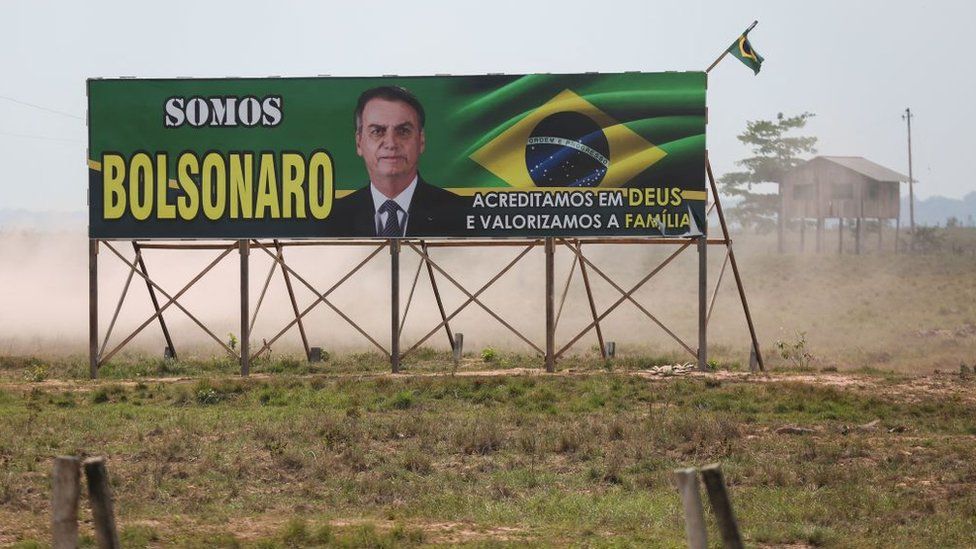
IMAGE SOURCE, GETTY IMAGES Image caption, Deforestation is set to play a big role in Brazil’s upcoming election with President Bolsonaro seeking another term
The researchers link this rise in deforestation to a rapid decline in prosecutions by law enforcement agencies, which saw fines for illegal forest clearances fall by 89% in 2020.
The scientists say that this is down to the policies of President Jair Bolsonaro, who took office in 2019. He has canceled fines and penalties related to deforestation and pushed hard for the expansion of agriculture in Brazil.
“We hypothesize that the consequences of the collapse in enforcement led to increases in deforestation, biomass burning and degradation producing net carbon losses and enhancing drying and warming of forest regions,” the new study says.
The researchers say that this rapid increase in emissions from the forest has also had an impact on the climate around the trees.
“In consequence of this big deforestation, in the wet season of 2020 we saw a decline of 26% in rainfall during January, February, and March, while the temperature has gone up by 0.6C,” said lead author Dr Luciana Gatti, from Brazil’s National Institute for Space Research (INPE).
“The emissions come from deforestation and degradation and also from this climate change promoted by the human destruction of the forest. And this is a very alarming scenario,” she told BBC News.
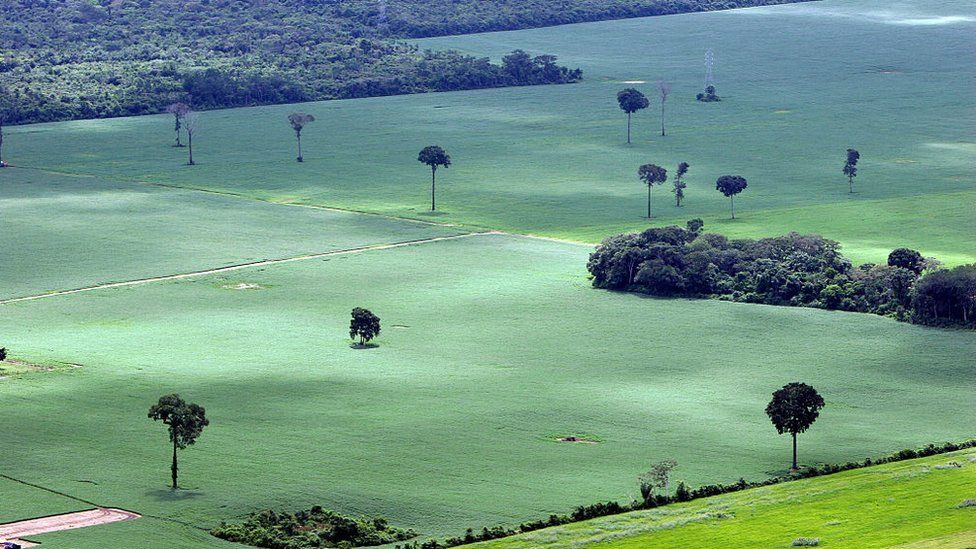
IMAGE SOURCE, GETTY IMAGES Image caption, Clearing land for soybeans has been a major factor in the loss of forests
Environmental campaigners say that this hands-off approach to prosecuting illegal deforestation has continued this year, with over 8,500 sq km lost between August 2021 and July 2022, an area larger than the US state of Delaware.
“The collapse in law enforcement in the Brazilian Amazon has allowed land grabbers and illegal loggers to continue unchecked with devastating consequences for people, wildlife, and the planet,” said Mike Barrett from WWF.
“The Amazon is getting dangerously close to a crucial tipping point which could see large areas transform from a resilient, moist rainforest into a dry, fire-ravaged, and irreversibly degraded state.”
The outcome could have significant implications for the Amazon, as scientists like Dr Gatti fear it may be reaching a point where it would continually emit more carbon than it absorbs.
She said that action by consumers and governments around the world was also critical to prevent this from happening.
“We need to have an international commitment with countries in international commerce, that they don’t buy the products that result in the destruction of nature,” she said.
President Akufo-Addohas urged international leaders to work together to address the many issues the world is facing.
We don’t have the luxury of choosing which problems to solve, the President stated on Wednesday during his address to the 77th UN General Assembly.
Since “none of them can wait,” according to the President, it will be wise to treat each issue with equal priority.
President Akufo-Addo emphasized issues including insecurity, climate change, economic and energy difficulties, among others, and emphasized that each one needs urgent response.
“History will judge us harshly if we do not seize the opportunity to make the changes that will enable us to deal with the many problems that we face,” he stated on Wednesday.
The President also used the platform to bemoan the unfair treatment of African countries on the international financial market.
According to him, avenues that are available to powerful nations are not the same for developing countries,consequently, impeding growth in these countries.
“The tag of Africa as investment risk is a self-fulfilling prophecy created by the prejudice of the international money markets which denies us access to cheaper borrowing, pushing us deeper into debts.
“The financial market has been set up and operates on rules designed for the benefit of rich and powerful nations and during times of crisis, the façade of international cooperation under which they purport to operate disappears,” he opined.
The objective puts the nation, which ranks among the top polluters globally per capita, more in line with other wealthy nations.
But critics say government plans to reach the target are lacking detail.
Some have been demanding a higher goal as well as a ban on new fossil fuel projects in the country.
But Prime Minister Anthony Albanese had lauded the new law – the Climate Change Bill – as an end to a decade of climate policy inaction.
The Labor government’s climate bill cleared the Senate by 37 votes to 30 after accepting minor amendments by independent David Pocock.
Climate change minister, Chris Bowen, told parliament “today is a good day for our parliament and our country, and we’re going to need many more of them”, The Guardian reported.
The former government had angered allies with its short-term emissions reductions target – which was about half what the UN’s Intergovernmental Panel on Climate Change (IPCC) says is needed if the world has any chance of limiting warming to 1.5C.
But there is strong support within the parliament for greater action on climate change.
Many independents campaigned on the issue of climate change and wanted a 2030 target of at least 50%.
Meanwhile, the Greens party said the passing of the bill was a “small step” in tackling the climate crisis.
Mark Howden, vice chair of the IPCC, told the BBC in June the new commitment is a big improvement on the previous target.
“[It] would be equivalent to taking all of our cars off the road or taking agriculture out of our economy,” he said.
It could take Australia’s carbon emission from 24 tonnes per person down to around 14 tonnes per person, he said.
While it won’t make Australia a global leader on the climate, “we’re no longer a laggard”, Mr Howden said.
Canada is aiming for a reduction of 40% by 2030 from 2005 levels, while the United States has a target of up to 52%.
In recent years, Australia has suffered severe drought, historic bushfires, successive years of record-breaking floods, and six mass bleaching events on the Great Barrier Reef.
The country is racing towards a future full of similar disasters, the latest UN IPCC report warns.
New research also shows that natural disasters have cost Australian households on average more than A$1,485 (£870; $1,000) in the past year.
A report by the Insurance Council of Australia blames the soaring costs of catastrophic flooding in the east of the country in February and March. The report says costs will continue to rise for years to come because of extreme weather.
Pakistan is facing “a monsoon on steroids”, the UN’s secretary general has warned, after floods submerged a third of the country.
Antonio Guterres urged the world to come to Pakistan’s aid as he launched a $160m appeal to help the tens of millions affected in the disaster.
He blamed “the relentless impact of epochal levels of rain and flooding”.
At least 1,136 people have been killed since June and roads, crops, homes and bridges washed away across the country.
This year’s record monsoon is comparable to the devastating floods of 2010 – the deadliest in Pakistan’s history – which left more than 2,000 people dead.
Image source, Reuters Image caption, Makeshift relief camps have sprung up all over Pakistan to cope with the many displaced
In a video message, Mr Guterres called South Asia a “climate crisis hot spot” where people were 15 times more likely to die from climate impacts.
“Let’s stop sleepwalking towards the destruction of our planet by climate change. Today, it’s Pakistan. Tomorrow, it could be your country.”
He said the UN appeal aimed to provide 5.2 million people with food, water, sanitation, emergency education and health support.
Officials estimate that more than 33 million Pakistanis – one in seven people – have been affected by the flooding.
Sadia, a student in Quetta, the capital of Balochistan province, said she felt helpless as her family were cut off in their home village of Jhal Magsi, about eight hours away.
“You can’t find a single home that is safe now,” she told the BBC’s Outside Source programme. “They are under the sky with no help.
“Right now, we are in need of first aid relief like tents, some shelter and some basic food, they can’t cook anything. And they need clean water to drink.”
Image source, EPA Image caption, Clearing up in Sindh – countless properties have been damaged or destroyed
On Monday, Pakistan’s climate change minister Sherry Rehman described the situation as a “climate-induced humanitarian disaster of epic proportions”.
Pakistan produces less than 1% of global greenhouse gas emissions but ranks consistently in the top 10 countries most vulnerable to the effects of climate change.
Many factors contribute to flooding, but a warming atmosphere caused by climate change makes extreme rainfall more likely.
The world has already warmed by about 1.2C since the industrial era began and temperatures will keep rising unless governments around the world make steep cuts to emissions.
Pakistan’s planning minister says estimates suggest the floods have caused at least $10bn (£8.5bn) of damage, and many people face serious food shortages. The country was already suffering from an economic crisis.
Vaste swathes of rich agricultural land have been devastated in this year’s monsoon, damaging food supplies and sending prices soaring.
“Things are so expensive because of this flood that we can’t buy anything,” Zahida Bibi, a shopper at a market in Lahore, told AFP news agency.
The flood situation is most severe in provinces such as Sindh and Balochistan, but mountainous regions in Khyber Pakhtunkhwa have also been badly hit.
Thousands of people have been ordered to evacuate villages cut off in northern Swat Valley, where bridges and roads have been swept away – but even with the help of helicopters, authorities are still struggling to reach those trapped.
“Village after village has been wiped out. Millions of houses have been destroyed,” Prime Minister Shehbaz Sharif said on Sunday after flying over the area in a helicopter.
Aid is starting to arrive after Pakistan launched its own appeal for help. The United Arab Emirates and Turkey have delivered tents and medicines, while the US and Britain have pledged their support.
Earlier on Monday, the International Monetary Fund said it had approved a $1.2bn loan for the country.
The Tibetan Plateau, also known as the “Water Tower” of Asia, supplies freshwater to nearly 2 billion people. Experts fear that the region could see a near-total freshwater storage collapse by 2050.
By the middle of this century, the entire Tibetan Plateau, also known as the “Water Tower” of Asia, will lose a substantial part of its water storage, a study has revealed. The study is the most comprehensive research on the issue to date, and was published in the Natural Climate Change journal.
The Amu Darya basin — which supplies water to central Asia and Afghanistan — shows a decline of 119% in water-supply capacity. The Indus basin — which supplies water to northern India and Pakistan — shows a 79% decline in water-supply capacity. Combined together, this impacts a quarter of the world’s human population.
A team of scientists from Penn State, Tsinghua University and the University of Texas at Austin found that climate change in recent decades has led to a severe depletion in terrestrial water storage (TWS), which includes all of the above- and below-ground water, to the tune of 15.8 gigatons per year in certain areas of the Tibetan Plateau.
Based on this pattern, the team has predicted that under a moderate carbon emissions scenario — SSP 2-4.5 emissions, the entire Tibetan Plateau could experience a net loss of about 230 gigatons by the mid-21st century.
“The prognosis is not good,” said Michael Mann, professor of atmospheric science at Penn State University.
“In a ‘business as usual’ scenario, where we fail to meaningfully curtail fossil fuel burning in the decades ahead, we can expect a near collapse — that is, nearly 100% loss — of water availability to downstream regions of the Tibetan Plateau. I was surprised at just how large the predicted decrease is, even under a scenario of modest climate policy,” Mann told DW.
Sensitivity to climate change
The Tibetan Plateau’s unique high-elevation terrain and atmospheric circulation dominated by monsoons and upper-level westerly winds generate precious freshwater resources in this region. While the area is relatively undisturbed by human activities, it remains an important regulator of the Asian monsoon system. Despite its crucial role in water availability and supply, the region is highly sensitive to climate change.
“Terrestrial water storage across this region is crucial in determining water availability, and it is highly sensitive to climate change,” said Di Long, associate professor of hydrologic engineering at Tsinghua University.
The study’s findings are particularly important because a detailed look at how climate change has affected the TWS of the Tibetan Plateau had not been conducted before. However, advances in Gravity Recovery and Climate Experiment (GRACE) satellite missions have provided unprecedented opportunities to quantify TWS changes on a large scale.
‘Need for bold climate policy’
Earlier, the absence of reliable future projections of TWS limited guidance on policymaking over the climate change hotspot.
“By examining the interactions between climate change and the TWS, this study serves as a basis to guide future research and the management by governments and institutions of improved adaptation strategies,” said researcher Di Long.
The Tibetan Plateau is sometimes called “the roof of the world” and it contains a rich network of streams and rivers that supply drinking water to a large portion of Asia.
“Even in a best-case scenario, further losses are likely unavoidable, which will require substantial adaptation to decreasing water resources in this vulnerable, highly populated region of the world,” said Mann.
Seven river basin systems were studied in the research, supported by the National Natural Science Foundation of China and the Second Tibetan Plateau Scientific Expedition and Research Program.
The Amu Darya basin, Indus, GangesBrahmaputra, SalweenMekong, Yangtze and Yellow rivers were selected for this analysis because of large populations and water demand in the downstream areas. It was found that in the GangesBrahmaputra, SalweenMekong and Yangtze basins, total water demand in the downstream areas can be met by other factors.
However, in the Amu Darya and Indus basins, the changes in the upstream TWS will seriously threaten downstream water availability.
Geopolitical conflicts facilitate crisis
The issue of dam construction over shared water resources, aggravated by climate change, could result in potential conflicts between the countries. Although the latest study informs about the climate-induced water crisis in West and South Asian countries, several studies in the past have documented the impacts of dam building on rivers originating from the Tibetan Plateau.
The Mekong also springs up from the Tibetan Plateau and flows to the South China Sea through Myanmar, Thailand, Laos, Cambodia, and Vietnam. Around 60 million people depend on the river for fishing, farming and transportation. Hundreds of hydropower dams have been built up and down the river since 2010, and most of them are in China and Laos.
“China’s eleven-dam cascade blocks half of the sediment flow in the Mekong — half of the 165 million tons of sediment per year. There is no mitigation that can allow the sediment to flow forward,” said Bryan Eyler, Southeast Asia Program Director at the Stimson Center.
“The dam construction on the main stream of the Mekong has been done without any consultation with the downstream countries. Downstream countries don’t even know when a new dam has been constructed,” Eyler told DW.
A 2020 study from the Lower Mekong Initiative, which used river gauge evidence from the Mekong River Commission and the remote sensing process, suggests that for five months in 2019, China’s dams held so much water that they entirely prevented the annual monsoon-driven rise in river level at Chiang Saen in Thailand.
The water shortages could result in geopolitical conflicts. “We fear there will be a full-scale issue in the coming years between India and China with glaciers melting in the Tibetan plateau. Tibet’s geography and ecological importance should be understood by India and China both,” said Tenzin Lekshey, spokesperson for the Central Tibetan Administration, the Tibetan government-in-exile in India led by the Dalai Lama.
Water could fast emerge as a potential flashpoint between India and China, two of the world’s most populous countries. But it has far-reaching consequences for the entire continent.
Australia’s new leader has vowed to take the country in a new direction, with a big shift in climate policy.
Anthony Albanese, who won Saturday’s election with the opposition centre-left Labor Party, said Australia could become a renewable energy superpower.
He is to be sworn in as PM on Monday, but it is not clear whether his party will have a majority in parliament.
Climate change was a key concern for voters, after three years of record-breaking bushfire and flood events.
Outgoing PM Scott Morrison, the leader of an ousted Liberal-National coalition, thanked the “miracle of the Australian people” after conceding.
Vote counting is still going on, and it is unclear whether Labor can get 76 seats to secure a majority in the 151-member lower house of parliament.
Final results may not be known for several days, as electoral officials have just started counting nearly three million postal votes.
If the election results in a hung parliament, Greens and independents – who have been campaigning for radical climate change action – could wield greater influence in framing the new government’s policies on the issue.
Speaking to the BBC’s Shaimaa Khalil shortly after his election victory, Mr Albanese, 59, said: “We have an opportunity now to end the climate wars in Australia.
“Australian businesses know that good action on climate change is good for jobs and good for our economy, and I want to join the global effort.”
Mr Albanese, who will be heading Australia’s first Labor government in almost a decade, also promised to adopt more ambitious emissions targets.
However, he has so far refused calls to phase out coal use, or to block the opening of new coal mines.
From rock art in southern Africa to pyramids along the River Nile, humans have been leaving their mark across the continent for millennia.
But extreme weather events, the rise in sea levels and other challenges associated with the changing climate are threatening to destroy invaluable cultural landmarks, a recent study warns.
Writing in the Azania journal, researchers from the UK, Kenya and the US say that “significant intervention” is needed to save these heritage sites.
As if to underline the warning, in recent weeks archaeologists in Sudan have been trying to stop floodwater from the River Nile from reaching the UN-designated World Heritage Site at al-Bajrawiya.
The river floods every year, but people working in the area have never seen the water spread so far.
The authors of the Azania report have identified a number of sites that they consider under threat.
Suakin, Sudan
Suakin, in north-eastern Sudan, was once an extremely important port on the Red Sea.
Its story began 3,000 years ago, when Egyptian pharaohs turned the strategically located port into a gateway for trade and exploration.
Suakin later became a hub for Muslim pilgrims on their way to Mecca and played a significant role in the Red Sea’s slave trade.
It also became part of the Ottoman Empire, though it lost its prominence as a port once Port Sudan was developed further north at the beginning of the 20th Century.
Much of Suakin is in decay but it still contains fine examples of houses and mosques, the UN’s cultural organisation, Unesco, says.
Professor Joanne Clarke from the UK’s University of East Anglia is currently working on research to quantify the speed at which the loss is being caused by the rise in the sea level and coastal erosion.
“What we do know is that the Red Sea coast will be impacted in the coming decades, which means what currently survives will be lost [without intervention],” she says.
Lamu Old Town, Kenya
The Old Town in Lamu is the oldest and best-preserved Swahili settlement in East Africa, according to Unesco.
Unlike other towns and villages along the East African coast, many of which have been abandoned, Lamu has been continuously inhabited for more than 700 years.
It has also become a significant centre for the study of Islamic and Swahili cultures, the UN adds.
However, Lamu has been “severely impacted by shoreline retreat”, meaning it has lost the natural protection once offered by sand and vegetation.
This is partly about the change in sea levels but Prof Clarke also blames the construction of the huge Lamu port to the north of the Old Town, “which is destroying the mangrove forests that protect the island from flooding”.
“So a lot of what we would call natural heritage is a protection for cultural heritage. And as we destroy the natural heritage, we also leave cultural heritage sites exposed.”
Coastal sites, Comoros Island
The Comoros, a volcanic archipelago off the East African coast, has several well-preserved sites, including a medina and a palace dating back hundreds of years.
But it is one of the places “most threatened” by sea level rise in Africa, Prof Clarke says.
In a plausible scenario of moderate-to-high global carbon emissions, “significant parts of the African coastal zone will be inundated by 2100”, according to the study.
“By 2050, Guinea, The Gambia, Nigeria, Togo, Benin, Congo, Tunisia, Tanzania and the Comoros will all be at significant threat of coastal erosion and sea-level rise.”
Coastal forts and castles, Ghana
The coast of Ghana is dotted with fortified trading posts, founded between 1482 and 1786, that stretch 500km (310 miles) along the coast.
The castles and forts were built and occupied at different times by traders from Portugal, Spain, Denmark, Sweden, Holland, Germany and the UK.
That infrastructure played a role in the gold trade and, later, in the rise and fall of the slave trade between Africa and the Americas.
But the forts are located in areas that are highly vulnerable to the impact of storm surges and the rise in the sea level.
Prof Clarke says some examples of that architecture, such as Fort Prinzenstein in Keta, eastern Ghana, are being “eroded into the sea”.
Comparing current images of the fort with ones shot 50 years ago, it is possible to see the way that the structure has crumbled.
Rock art at Twyfelfontein, Namibia
Climate change can increase humidity in relatively arid areas, and create the conditions for the proliferation of fungi and microbial life on rocks.
That is what is happening at sites such as Twyfelfontein in Namibia’s Kunene region, which has one of the largest concentrations of rock art in Africa.
Unesco describes it an “extensive and high-quality record of ritual practices relating to hunter-gatherer communities in this part of southern Africa over at least 2,000 years”.
In the 15th and 16th Centuries, it was one of the centres for the propagation of Islam across West Africa.
But climate change has affected the availability of high-quality mud used by the original residents for those constructions.
Local people, who have also seen their income drop due to crop failures, have to rely on cheaper materials which is “radically changing the town’s appearance”, the study says.
Prof Clarke says that “climate change has the ability to be a threat multiplier. It has indirect impacts which are arguably more serious than the direct impact”.
‘Unbelievably wonderful sites’
Some countries are better placed to deal with the impact of climate change on their cultural heritage.
Egypt, for example, sits on a low-lying region at “severe risk of flooding in the coming decades” yet is well-equipped to deal with some of the challenges.
There are places like the self-declared republic of Somaliland which has some ancient cave drawings but needs more help in protecting them.
Archaeologically, some of the “most unbelievably wonderful sites” exist there, Prof Clarke says.
Her research aims to shed light on those sites, which are little known to the rest of the world, and she fears “will disappear and no-one will know”.
Best known as a vast, cold tundra, Russia’s sprawling Siberia region is being transformed by climate change that has brought with it warmer temperatures, forest fires and growing swarms of hungry moth larvae.
Spanning millions of square kilometres east of the Urals to the Pacific Ocean, the area has been particularly hard hit this year by extreme weather, which scientists say is the result of global warming.
Photographs of wildflower fields in local media last month were a rare sight so early in the year in the normally chilly region — and ice cream sales were up 30 per cent.
“This winter was the hottest in Siberia since records began 130 years ago,” said Marina Makarova, the chief meteorologist at Russia’s Rosgidromet weather service.
“Average temperatures were up to six degrees centigrade higher than the seasonal norms.”
Then spring came and with it much warmer temperatures. Makarova says April saw some days reach 30 C or higher.
The warmer temperatures didn’t just bring wildflowers and boosted ice cream sales.
Rainfall was up by a third in eastern Siberia, sparking devastating floods that forced thousands to be evacuated, particularly in the town of Tulun and the surrounding area.
– ‘Huge moths’ –
Swarms of the Siberian silk moth, whose larvae eat away at conifer trees in the region’s forests, have grown rapidly amid the rising temperatures.
The moths are usually inactive during winter and eat in spring, summer and autumn periods which are now lengthening.
“In all my long career as a specialist, I’ve never seen moths so huge and growing so quickly,” said Vladimir Soldatov, a moth expert, who warns of “tragic consequences” for forests.
The larvae, which are taking over larger areas of forest, strip trees of their needles and make them more susceptible to forest fires.
The moth “has moved 150 kilometres north compared to its usual territory and that’s because of global warming,” Soldatov told AFP.
In the Krasnoyarsk region of eastern Siberia, more than 120,000 trees have had to be treated to kill the larvae, according to the regional forest protection centre.
Another insect pest, the bark beetle that bores into tree trunks, has also recently colonised the region. It has flourished since 2003 as the climate became milder.
With the snow melting earlier in the year in northern Siberia, exposed dry vegetation and soil means fires can spread easily, said Alexei Yaroshenko, who heads the forest section at Greenpeace Russia.
From January to mid-May, fires devastated 4.8 million hectares in Siberia, among them 1.1 million hectares of the high-latitude boreal forest, according to a Greenpeace report published Tuesday.
This year’s fires follow on from exceptionally severe blazes last summer.
– Forest fires ‘doubled’ –
Climate change has led the number of forest fires to “double in 10 years,” said Vyacheslav Kharuk, the head of the forest monitoring laboratory at the Forest Institute in the city of Krasnoyarsk.
The fires risk cutting the capacity of far-northern boreal forests to retain carbon dioxide and methane, which will lead to higher emissions of greenhouse gases that contribute to climate change.
According to research by Kharuk’s laboratory, between 2000 and 2009, around three million hectares of forest caught fire every year. Between 2010 and 2019, the average was six million hectares.
In years to come “the area of the fires will increase to double or four times the size,” he predicted.
The news is not all bad: the changing nature of Siberia’s landscape will attract new species of birds and animals, Kharuk added.
“Our steppes are getting greener. Our lakes are warming up. Siberia is becoming a more appealing region for animals and for us, too.”
But, he says, the number of extreme weather events means he is already starting to “miss our winters with temperatures of minus 40 degrees centigrade”.
More than three billion people will be living in places with “near un-liveable” temperatures by 2070, according to a new study.
Unless greenhouse gas emissions fall, large numbers of people will experience average temperatures hotter than 29C.
This is considered outside the climate “niche” in which humans have thrived for the past 6,000 years.
Co-author of the study Tim Lenton told the BBC: “The study hopefully puts climate change in more human terms”.
Researchers used data from United Nations population projections and a 3C warming scenario based on the expected global rise in temperature. A UN report found that even with countries keeping to the Paris climate agreement, the world was on course for a 3C rise.
According to the study, human populations are concentrated into narrow climate bands with most people residing in places where the average temperature is about 11-15C. A smaller number of people live in areas with an average temperature of 20-25C.
People have mostly lived in these climate conditions for thousands of years.
However should, global warming cause temperatures to rise by three degrees, a vast number of people are going to be living in temperatures considered outside the “climate niche”.
Mr Lenton, climate specialist and director of the global Systems Institute at the University of Exeter, conducted the study with scientists from China, the US and Europe.
He told the BBC: “The land warms up faster than the ocean so the land is warming more than three degrees. Population growth is projected to be in already hot places, mostly sub-Saharan Africa, so that shifts the average person to a hotter temperature.
“It’s shifting the whole distribution of people to hotter places which themselves are getting hotter and that’s why we find the average person on the planet is living in about 7C warmer conditions in the 3C warmer world.”
Areas projected to be affected include northern Australia, India, Africa, South America and parts of the Middle East.
The study raises concerns about those in poorer areas who will be unable to shelter from the heat.
“For me, the study is not about the rich who can just get inside an air-conditioned building and insulate themselves from anything. We have to be concerned with those who don’t have the means to isolate themselves from the weather and the climate around them,” Mr Lenton said.
Mr Lenton says the main message from the team’s findings is that “limiting climate change could have huge benefits in terms of reducing the number of people projected to fall outside of the climate niche.
“It’s about roughly a billion people for each degree of warming beyond the present. So for every degree of warming, we could be saving a huge amount of change in people’s livelihoods.”
Countries will have to increase their carbon-cutting ambitions five fold if the world is to avoid warming by more than 1.5C, the UN says.
The annual emissions gap report shows that even if all current promises are met, the world will warm by more than double that amount by 2100.
Richer countries have failed to cut emissions quickly enough, the authors say.
Fifteen of the 20 wealthiest nations have no timeline for a net zero target.
Hot on the heels of the World Meteorological Organization’s report on greenhouse gas concentrations, the UN Environment Programme (Unep) has published its regular snapshot of how the world is doing in cutting levels of these pollutants.
The emissions gap report looks at the difference between how much carbon needs to be cut to avoid dangerous warming – and where we are likely to end up with the promises that countries have currently committed to, in the Paris climate agreement.
The UN assessment is fairly blunt. “The summary findings are bleak,” it says. “Countries collectively failed to stop the growth in global greenhouse gas emissions, meaning that deeper and faster cuts are now required.”
The report says that emissions have gone up by 1.5% per year in the last decade. In 2018, the total reached 55 gigatonnes of CO2 equivalent. This is putting the Earth on course to experience a temperature rise of 3.2C by the end of this century.
Just last year, the Intergovernmental Panel on Climate Change warned that allowing temperatures to rise more than 1.5 degrees this century would have hugely damaging effects for human, plant and animal life across the planet.
This report says that to keep this target alive, the world needs to cut emissions by 7.6% every year for the next 10 years.
“Our collective failure to act early and hard on climate change means we now must deliver deep cuts to emissions – over 7% each year, if we break it down evenly over the next decade,” said Inger Andersen, Unep’s executive director.
The report pays particular attention to the actions of the richest countries. The group of the 20 wealthiest (G20) are responsible for 78% of all emissions. But so far, only the EU, the UK, Italy and France have committed to long-term net zero targets.
Seven G20 members need to take more action to achieve their current promises. These include Australia, Brazil, Canada, Japan, the Republic of Korea, South Africa and the US.
For example, Brazil’s plans were recently revised, “reflecting the recent trend towards increased deforestation”.
Three countries – India, Russia and Turkey – are all on track to over-achieve their plans by 15% but the authors of the report say this is because the targets they set themselves were too low in the first place.
For three others – Argentina, Saudi Arabia and Indonesia – the researchers are uncertain as to whether they are meeting their targets or not.
That leaves China, the EU and Mexico as three countries or regions that are set to meet their promises or nationally determined contributions (NDCs), as they are called, with their current policies.
Without serious upgrades to most countries’ plans, the UN says the 1.5C target will be missed by a significant amount.
“We need quick wins to reduce emissions as much as possible in 2020, then stronger NDCs to kick-start the major transformations of economies and societies,” says Inger Anderson.
“We need to catch up on the years in which we procrastinated,” she added. “If we don’t do this, the 1.5C goal will be out of reach before 2030.”
The report outlines some specific actions for different countries in the G20.
So for Argentina it’s recommended that they work harder to shift the public towards widespread use of public transport in big cities. China is urged to ban all new coal-fired power plants, something that recent research casts doubt on.
The biggest focus of action is the energy system. To get a sense of the massive scale of change that is needed, the study says the world will have to spend up to $3.8 trillion per year, every year between 2020 and 2050 to achieve the 1.5C target.
The impression that time is running short is reinforced by the report – and UN negotiators gearing up to meet in Madrid next week at COP25 are feeling the pressure to increase their ambitions on carbon.
“This is a new and stark reminder by the Unep that we cannot delay climate action any longer,” said Teresa Ribera, Spain’s minister for the ecological transition.
“We need it at every level, by every national and subnational government, and by the rest of the economic and civil society actors. We urgently need to align with the Paris Agreement objectives and elevate climate ambition.
“It would be incomprehensible if countries who are committed to the United Nations system and multilateralism did not acknowledge that part of this commitment requires further climate action. Otherwise, there will only be more suffering, pain, and injustice.”