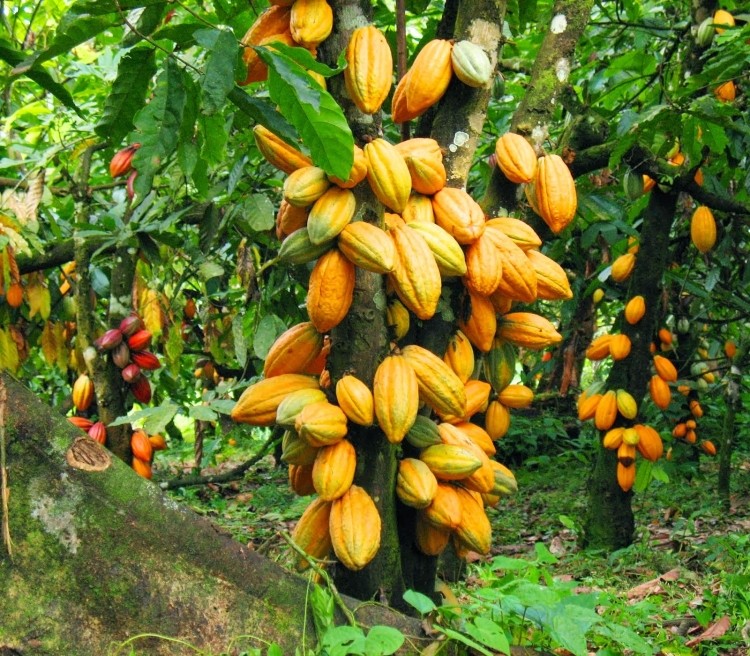
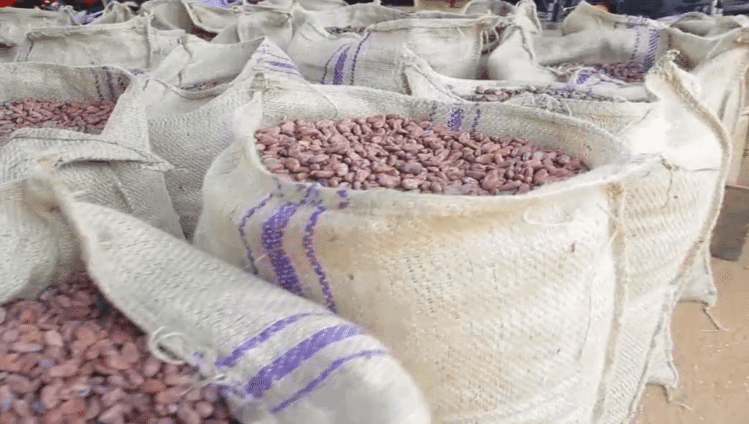
Cocoa farmers will earn an extra GH₵400 per 64kg bag following a new price announced by the government for the 2025/2026 crop season.
The new price, which is now GH₵3,625 per bag, equivalent to GH₵58,000 per tonne, represents a 12.27 per cent increase over the GH₵3,228.75 per bag price announced in August.
This was revealed by the Minister for Finance, Cassiel Ato Forson, while speaking at an emergency meeting of the Producer Price Review Committee (PPRC) on cocoa in Accra on Thursday, October 2.
The upward adjustment is believed to be an effort to match local prices with gains in the global cocoa market. Meanwhile, Ghana Cocoa Board (COCOBOD) has expressed its commitment to ensuring that cocoa farmers receive a meaningful and fair boost in their income, despite the hike in the dollar.
Recently, the government disclosed its intention to reintroduce free fertilisers, aimed at supporting farmers to increase production.
Finance Minister, Dr. Ato Forson, noted, “In preparation for the new season, COCOBOD has made available jute sacks and related logistics for the smooth take-off of the 2025/2026 crop Season.
“Ladies and Gentlemen, and to the cocoa farmer, I am pleased to announce that President John Mahama’s administration has reintroduced the free cocoa fertiliser programme as an additional support to the Ghanaian cocoa farmer, beginning the 2025/2026 crop year.”
Dr. Forson added that every single farmer will benefit from this initiative.“Beginning this crop year, President Mahama’s administration will supply free cocoa fertilisers (both liquid and granular), free insecticides, free spraying machines, free fungicides, and free flower inducers to farmers,” he added.
Farmers were therefore cautioned against smuggling.“Government strongly advises cocoa farmers to apply these inputs solely for the purpose of improving cocoa yield and their income. Please do not smuggle them,” he said.
Minister for Foreign Affairs, Honourable Samuel Okudzeto Ablakwa, and the Ambassador of the Kingdom of Morocco, Her Excellency Imane Ouaadil, on July 28, handed over two thousand (2,000) tons of fertilizer, equivalent to 40,000 bags of fertilizer, to the Ministry of Food and Agriculture.
According to the Foreign Ministry, the fertilizer was donated to the West African country by the Kingdom of Morocco during the official visit of Mr Okudzeto Ablakwa to Morocco last month as part of the two countries’ commitment to sustainable agriculture to enhance food security.
Deputy Minister for Food and Agriculture, John Setor Dumelo, received the donated fertilizers on behalf of the Minister for Food and Agriculture, Eric Opoku. He expressed gratitude to the Morrocan government for the donation. He assured that farmers will receive the fertilizers to aid crop production.
“Yesterday, 40,000 bags of fertilizer was donated to Ghana by the Kingdom of Morocco through the Ministry of Foreign Affairs. On behalf of my boss Hon Eric Opoku, I want to say a big thank you to Hon Ablakwa and Her Excellency Ouaadil for this kind gesture. We at the Ministry of Agriculture will ensure the fertilizers get straight to the deserving farmers as soon as possible,” he wrote in a post on the X platform on July 29.
Stakeholders in the agricultural sector have bemoaned the absence of a single chemical fertiliser plant in the country. The Institute for Fiscal Studies noted that the absence of such a plant is having an adverse impact on crop production and the contribution of the agricultural sector to the country’s economy i.e. the Gross Domestic Product (GDP). The sector’s contribution to the country’s GDP declined from 26.9% in 2010 to 22.7% in 2023.
In March this year, Senior Research Fellow at the Institute for Fiscal Studies, Dr. Said Boakye said, “We need to establish several fertiliser manufacturing plants to ensure that adequate and affordable fertiliser is available to farmers, which will help boost agricultural productivity.”
“The sad reality is that Ghana lacks a single chemical fertiliser plant. In our rice studies, we have been comparing with Vietnam, where they have more than 7,000 plants. Vietnam’s success in achieving high agricultural productivity is largely due to fertilisers being readily available to farmers at no cost, along with incentivized prices,” he added.
The Institute for Fiscal Studies has entreated the government to allocate significant funding to establish a fertiliser manufacturing plant.
COCOBOD has noted that it would not secure any syndicated loan to finance cocoa purchases for the 2025/26 crop season. According to them, the shortage of cocoa beans on the global level has informed such a decision.
“We’re not doing syndication…this year [2025], we’re not doing syndication. What has necessitated us not to do syndication is that we’re experiencing a global shortage of the cocoa bean.”
He made these revelations during an interview with Accra-based radio station, Citi FM, on Monday, August 4. The Head of Public Affairs at COCOBOD, Jerome Kwaku Sam, stated explicitly stated, that the Board had not sought syndicated financing for the 2024/2025 season and had no intention of doing so this year.
“…To be very honest, last year [2024], we didn’t do syndication, and this year [2025], we’re not doing syndication.
Mr Sam further noted that the move also reflects a strategic effort to reduce costs under prevailing market conditions.
“We’re not doing syndication whereby we’re going to incur additional expenses and what have you. That is out of the system or table for now,” he emphasized.