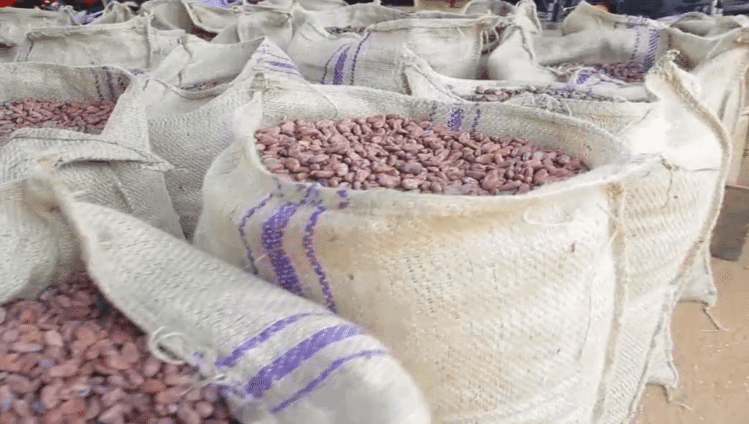
The International Cocoa Organization (ICCO) has released its Cocoa Market Report for March 2023, which shows that Ghana has produced more cocoa than Ivory Coast for the first half of the 2022/23 crop season.
According to the report, Ghana’s purchases of graded and sealed cocoa beans reached 566,846 tonnes by 9 March 2023, an 18 percent increase from the same period of the previous season. In contrast, Ivory Coast’s cumulative arrivals of cocoa beans at ports were 1.779 million tonnes by 31 March 2023, a 4.8 percent decrease from the previous season.
The report states that the difference of 89,000 tonnes in Ivory Coast‘s ports arrivals and the increase of 85,360 tonnes in Ghana’s purchases resulted in a slightly negative net effect on the total supply of cocoa beans from the world’s top-two cocoa producers. The total supply for the first half of 2022/23 was estimated at 2,345,846 tonnes, slightly down by 0.2 percent compared to the previous season.
The report also notes that the current situation may change as the mid-crop progresses. However, it indicates that Ghana has overtaken Ivory Coast in cocoa production, a remarkable development in the global cocoa market.
Cocoa industry analysts have commented that this is a significant achievement for Ghana, which has been implementing various initiatives to boost its cocoa production and quality. Some of these initiatives include modern farming techniques, better access to credit and markets, increased investment in infrastructure, free seedlings, subsidised fertilisers and pesticides, training for farmers, elimination of child labour, and guaranteed minimum price for cocoa beans.
However, the report also highlights some challenges facing the cocoa industry, such as climate change and disease outbreaks, which have affected cocoa production in recent years. The report urges more investment in research and development to address these challenges.
The report also shows that cocoa bean stocks held in Intercontinental Exchange (ICE) Futures licensed warehouses in Europe and the United States are high compared to the previous season. However, they have declined compared to the levels seen at the start of the 2022/23 season.
Regarding futures price developments, the report shows that prices of the front-month cocoa futures contract were higher year-on-year on both the London and New York markets in March 2023. The average price in London was US$2,553 per tonne, up by 12 percent compared to March 2022. The average price in New York was US$2,778 per tonne, up by 8 percent compared to March 2022.
The Minority in Parliament has supported former PresidentJohn Mahama and his assertions on the cocoa industry.
John Mahama claims the country’s cocoa sector is on the verge of collapse because of the mismanagement of the sector by the government.
Addressing party supporters and branch executives at the start of his two-day campaign tour of the Western North Region, Mr Mahama said the government’s failure to adjust the producer price of cocoa annually delayed payment of farmers for cocoa beans combined with other factors to destroy the sector.
Ghana Cocoa Board(COCOBOD) refuted claims by the former that the cocoa sector in Ghana has collapsed. It described such statements as misleading and detrimental to the cocoa sector, which forms the foundation of Ghana’s economy.
Reacting to this development, Ranking Member on Parliament’s Food, Agriculture and Cocoa Affairs Eric Opoku accused COCOBOD of peddling falsehood.
“Ghana COCOBOD must know that they cannot seek refuge in lies to cover the havoc they have wrecked on the cocoa sector, the untold hat ships unleashed on the Ghanaian cocoa farmer and the crass incompetence, mismanagement, recklessness and insensitivity demonstrated so far.”
The Minority accuses President Akufo-Addo’s government of worsening COCOBOD’s plight from the state where it met it.
“In 2017, the NDC handed over a prosperous and thriving cocoa industry with buffers in the cocoa stabilization fund, farmers’ welfare fund, depreciation fund, farmers’ housing fund, and others including GH₵29 million set aside for the rolling out of the cocoa farmers pension scheme envisaged under the P.N.D.C.L 81.
“Shockingly, the Akufo-Addo’s government has dissipated all these buffers within 6 years, leaving nothing for the industry to lean on in times of difficulties.
“Again, the Board has been incurring losses since Nana Addo assumed office. COCOBOD is yet to explain why the cocoa industry cannot be profitable under the Nana Addo/Bawumia government. Available records indicate the following; Year Losses GH₵’million 2017 395.0 2018 78.2 2019 320.6 2020 426.0″
The group went ahead to tout the NDC’s records in the cocoa sector.
“In the entire four-year period of President John Mahama, producer price of cocoa was increased by 124.1 per cent (from GH₵212 in 2013/14 to GH₵475 in 2016/17) contrasted with 68.4 per cent in the last six years under Nana Addo (from GH₵475 in 2017/18 to GH₵800 in 2022/23).
It must be noted that the highest jump in producer price in the last two decades happened under John Mahama in the 2014/15 season (from GH₵212 to GH₵345 – 62.7%).”
John Dramani Mahama’s assertion that Ghana’s cocoa industry has collapsed has been refuted by the Ghana Cocoa Board (COCOBOD).
The former president had claimed that it now takes three months for farmer to receive their cash for cocoa beans.
Mahama also added that the cocoa farmers no longer enjoy free fertiliser as they used to during the period of the NDC.
But in a statement, COCOBOD said, “The notion of a collapsing cocoa industry. Such statements are misleading and detrimental to a vital sector like cocoa, which forms the foundation of Ghana’s economy. We, therefore, wish to use the opportunity to make some clarifications and also set the records straight.
“It is widely acknowledged that galamsey operations pose a significant danger to our nation, and any attempts to justify or rationalise the conversion of a piece of land, especially a cocoa farm, into a Galamsey site, like the former president sought to do, must be met with contempt.”
The statement added “this menace has the potential to negate all the investments made by the government to modernise cocoa farming and improve productivity. It is, therefore, crucial that prominent figures in our society exercise caution when making public statements that rationalize cocoa farmers trading their farms for temporary monetary benefit through illegal mining.
“Management also wishes to place on record, that the Former President’s statement regarding the increase in cocoa producer prices every year during his administration is inaccurate, since the records available point to the opposite. Specifically, there was no upward adjustment of the producer price of cocoa in the 2012/2013 Crop Season. Similarly, the producer price of the preceding season was maintained for the 2015/2016 Crop Season, with no upward adjustment.”
The cocoa industry in Ghana is currently facing one of its greatest dangers ever as illegal gold miners keep attacking cocoa plantations, including those that have recently undergone rehabilitation thanks to a national initiative.
The Ghana Cocoa Board (COCOBOD) had warned that the industry could head for a disaster if the illegal activities were not checked.
Raising the alarm, the Executive Director of Cocoa Health and Extension Services, Rev. Edwin Afari, said the National Cocoa Rehabilitation Programme being undertaken by COCOBOD at a cost of about GH¢4.8 billion was under severe threat from illegal mining (gamalsey) activities.
“Recently, I was around the Boinso area in the Aowin municipality of the Western Region and for about 36.5 hectares that we did, they have cut down all of them for galamsey,” he told journalists in Cape Coast last Friday on the margins of a ceremony to award 15 visually impaired cocoa farmers from the Central, Western and Brong Ahafo cocoa regions for their immense contribution to cocoa production.
He said the situation had gone from bad to worse over the past 10 years, and consequently, appealed to the Minerals Commission to refrain from giving mining concessions to miners in cocoa growing areas, while urging all stakeholders to help curb the negative impact of galamsey on cocoa production in the country.
Rev. Afari stated that illegal mining activities were alarming in the Western South cocoa region, including the Wassa Akropong corridor, and parts of the Ashanti Region including Manso Adubia, Antoakrom, and Anyinam in the Eastern Region where a lot of hectares of juvenile cocoa farms had been destroyed.
Rehabilitation programme
On September 24, 2020, President Nana Addo Dankwa Akufo-Addo launched the National Cocoa Rehabilitation Programme at Sefwi Wiawso in the Western North Region, with the objective of rehabilitating farms affected by the Cocoa Swollen Shoot Virus Disease (CSSVD) which had become unproductive.
The programme, which had earlier been successfully piloted in some of the worst CSSVD-affected cocoa growing areas had since been expanded to all other cocoa growing regions.
Under the programme, COCOBOD bears the full cost of the two-year-long rehabilitation process which involves the cutting of the diseased trees, treating the farms and replanting with disease-tolerant, early bearing, high-yielding cocoa varieties.
In addition, COCOBOD gives GH¢1,000.00 per hectare to each farmer whose farm is affected by the disease, while in the case of tenancy, both the affected tenant farmers and their landowners are compensated.
Maiden awards
The awards ceremony, the first of its kind, was organised by COCOBOD with support from the Agricultural Manufacturing Group Limited (AMG Ghana) and Mondelez Cocoalife International, all companies operating in the cocoa value chain.
Aged between 50 and 78 years, the farmers have been working for 15 to 60 years, with seven of them still active.
Each of them received six bags of fertiliser, two pairs of Wellington boots, two machetes, chocolates and other cocoa products, and an undisclosed amount.
One of the awardees, Kofi Esuon, was however honoured posthumously.
Efforts hampered
Rev. Afari said the project to rehabilitate swollen shoot-affected cocoa farms and moribund cocoa farms were being derailed by galamsey activities.
“We haven’t even accounted for the harvesting that will be coming. It is just the investment; the compensation that we give to the landowners and farmers; planting of plantain suckers, cocoa trees, extension services, among others,” he further stated, adding “all the work we have done in there has gone to waste.”
Dramatic change
On a larger scale, Rev. Afari indicated that many forest areas where cocoa was grown had been taken over by illegal mining activities.
He stated that apart from the rehabilitated farms, illegal miners were buying out huge tracts of land meant for cocoa farming for illegal mining.
“Even if you don’t sell your farm to them, they dig around it, preventing you from accessing the farm,” he stated.
Stringent measures needed
He said if stringent measures were not taken to reverse the situation, national cocoa volumes produced could be significantly affected.
“When we lose several hectares of cocoa we have planted, Ghana is going to suffer,” he stated.
He indicated that another area of concern was the ageing cocoa farmer population, which according to surveys in the seven cocoa producing regions, averagely hovered around 55 years.
That, he noted, did not augur well for the sustainability of cocoa production.
Rev. Afari encouraged other professionals to enter into cocoa farming, saying “whether you are a doctor, engineer, nurse, development expert, you can venture into cocoa farming.”
Production
Touching on production figures, he said: “We did 1.47 million tonnes last two years but last year was not good because of the weather and so we came down to about 683,000 tonnes.”
This year, he said COCOBOD was targeting 850,000 tonnes and, hopefully, move on to a million or more next year.
Rev. Afari called on other stakeholders including farmers, chiefs and the media to support efforts at promoting the economic value of the farms, which had more lasting economic value than selling the land to illegal miners.
Disadvantaged farmers
Rev. Afari said the award initiative was to appreciate disadvantaged cocoa farmers for their continuous contributions to the cocoa industry and to encourage them to give of their best.
He commended the awardees for their strength of mind and resilience in the face of challenges and for contributing their quota to national development.
“If you work diligently with your heart and mind, that is a special kind of sight,” he stated.
The executive director indicated that this year, COCOBOD would focus on cocoa pruning, undertake pollination and pest control exercises to help increase the country’s production.
Increase production
The Director, Agronomy at COCOBOD, Samuel Asare Ankamah, stated that the awards would ultimately encourage the increase in productivity.
The Central Regional Chief Farmer, Nana Kwesi Ofori, who chaired the function, said the perseverance and commitment of the visually impaired farmers in the face of adversity was commendable and urged other farmers to take inspiration from their works to do more.
He expressed the hope that the initiative would not be a “nine-day wonder” but would be sustained to encourage even more farmers with disabilities to produce more.
Gratitude
Kwesi Adu, who spoke on behalf of the awardees, thanked COCOBOD for the gesture.
Another awardee, Vida Boakye, called for subsidised inputs to help them increase production.