Tag: COCOBOD

  • Cocoa farmers to receive 27k sprayers and 89k PPEs from COCOBOD

    Cocoa farmers to receive 27k sprayers and 89k PPEs from COCOBOD

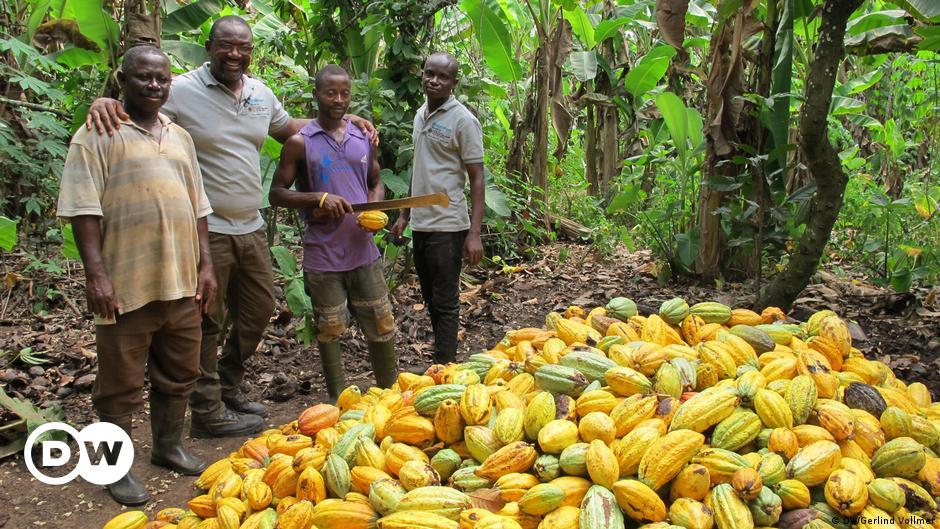
    About 27,000 motorised spraying machines and 89,000 personal protective equipment (PPE) are expected to be distributed by the Ghana Cocoa Board (COCOBOD) to cocoa farmers.

    This was announced by the Board Chairman of the Ghana Cocoa Board (COCOBOD), Dr. Samuel Ofosu Ampofo, on Thursday, March 12. He explained that it is to assist Ghanaian cocoa farmers despite current sectoral challenges.

    “COCOBOD has decided that, in spite of all the challenges, all the interventions we are putting in place to assist the cocoa farmers, we will continue to do them. We will supply free fertilizer and insecticide.

    “As we speak with you, we have procured 27,000 spraying machines to be given to farmers. We have also been able to buy 89,000 PPEs to be given to farmers,” he stated.

    Meanwhile, cocoa farmers who have been owed since November last year are set to receive the monies owed to them as the Ghana Cocoa Board (COCOBOD) moves to clear the outstanding arrears.

    Engaging the press on Thursday, March 13, the Head of Public Affairs at the Ghana Cocoa Board (COCOBOD), Jerome Sam, disclosed that the Board has disbursed approximately GH¢4.2 billion to Licensed Buying Companies (LBCs) for onward payment to cocoa farmers.

    He added, “Some of the payments are recent, while others are older. Since 2023, when we experienced challenges with the syndicated loan, Licensed Buying Companies sometimes stepped in to pre-finance cocoa purchases. COCOBOD later reimburses them for those purchases.


    “That is why some farmers are not owed by the LBCs, while others still have outstanding payments. As COCOBOD, we are working tirelessly to ensure that every cedi owed to the Licensed Buying Companies is paid so they can also settle any outstanding debts with their cocoa farmers”.

    Last month, an amount of GHC237 million has been paid to cocoa farmers for 50,000 metric tonnes of cocoa by the Ghana Cocoa Board (COCOBOD).

    In a Facebook post on Wednesday, February 18, head of Public Affairs at the Ghana Cocoa Board (COCOBOD), Jerome Kwaku Sam wrote, “I’m happy to report COCOBOD has started payment of the 50,000 metric tonnes. An amount of GHC237 million has been paid.”

    Last week, the Ghana Cocoa Board’s commenced payments to Licensed Buying Companies to clear outstanding arrears owed Ghanaian cocoa farmers who sold and delivered their cocoa beans without receiving payment.

    This followed several calls by cocoa farmers demanding payment for months of prolonged arrears from the government. On the floor of Parliament on Thursday, February 5, the Minority caucus raised concerns about the sustainability of the cocoa sector if the demands of cocoa farmers are not addressed.

    Although LBCs have paid over GH¢620 million to cocoa farmers, a significant amount remains. Speaking to the media, Head of Corporate Communications at COCOBOD, Jerome Kwaku Sam “In November, we paid over GH¢6 billion, in December more than GH¢5 billion, and in January another GH¢6 billion.

    “This month alone, we have paid over GH¢620 million, and we are continuing to pay the LBCs so they can clear outstanding payments to farmers”.

    The President of the Ghana National Association of Cocoa Farmers (GNACOF), Stevenson Anane Boateng, has lamented the government’s hesitation to pay them for the cocoa sold out to them.

    He said, the situation has rendered a number of cocoa farmers broke since November last year and are calling for intervention“The government is buying our cocoa but has refused to pay us. Since November, we have not been paid. They accept the cocoa, but they don’t pay us,” he lamented during an interview on Frontline on Rainbow Radio 87.5FM.

    When asked what might have caused the delay, he responded: “We don’t know. We are not part of the government, so please, you need to ask them why they have refused to pay cocoa farmers. This is troubling, and we want the government to address our concerns.”

    Meanwhile, the Ghana National Cocoa Farmers Association (GNACOFA) has cautioned the government that failure to introduce a pension scheme, improve health insurance, and ensure access to quality healthcare will leave farmers with no option but to take action themselves.

    GNACOFA has made a formal call for swift reforms aimed at improving the welfare and security of cocoa farmers across the country, noting that they currently do not have sufficient social protection.

    The Association urged the government to establish a pension scheme for cocoa farmers, broaden and enhance their health insurance benefits, and guarantee access to quality healthcare services.

    Anane Boateng called on the government to respond without delay, warning that inaction would force farmers to mobilise for a nationwide protest to push their demands.

    Meanwhile, in August 2025 Finance Minister, Dr. Ato Forson announced at a press conference after a meeting with the Producer Price Review Committee that Cocoa farmers in the country will soon receive free fertiliser and other inputs from the government starting from the 2025/2026 crop season.

    According to Mr Forson, the government’s decision to reintroduce free fertilisers is aimed at supporting farmers to increase production.

    “In preparation for the new season, COCOBOD has made available jute sacks and related logistics for the smooth take-off of the 2025/2026 crop Season. Ladies and Gentlemen, and to the cocoa farmer, I am pleased to announce that President John Mahama’s administration has reintroduced the free cocoa fertiliser programme as an additional support to the Ghanaian cocoa farmer, beginning the 2025/2026 crop year.”

    Dr. Forson added that every single farmer will benefit from this initiative.

    “Beginning this crop year, President Mahama’s administration will supply free cocoa fertilisers (both liquid and granular), free insecticides, free spraying machines, free fungicides, and free flower inducers to farmers.”

    Farmers were therefore cautioned against smuggling. “Government strongly advises cocoa farmers to apply these inputs solely for the purpose of improving cocoa yield and their income. Please do not smuggle them,” he said.

    Minister for Foreign Affairs, Honourable Samuel Okudzeto Ablakwa, and the Ambassador of the Kingdom of Morocco, Her Excellency Imane Ouaadil, on July 28, handed over two thousand (2,000) tons of fertilizer, equivalent to 40,000 bags of fertilizer, to the Ministry of Food and Agriculture.

    According to the Foreign Ministry, the fertilizer was donated to the West African country by the Kingdom of Morocco during Mr. Okudzeto Ablakwa’s official visit to Morocco last month, as part of the two countries’ commitment to sustainable agriculture to enhance food security.

    Deputy Minister for Food and Agriculture, John Setor Dumelo, received the donated fertilizers on behalf of the Minister for Food and Agriculture, Eric Opoku. He expressed gratitude to the Moroccan government for the donation. He assured that farmers will receive the fertilizers to aid crop production.

    “Yesterday, 40,000 bags of fertilizer was donated to Ghana by the Kingdom of Morocco through the Ministry of Foreign Affairs. On behalf of my boss Hon Eric Opoku, I want to say a big thank you to Hon Ablakwa and Her Excellency Ouaadil for this kind gesture. We at the Ministry of Agriculture will ensure the fertilizers get straight to the deserving farmers as soon as possible,” he wrote in a post on the X platform on July 29.

    Agricultural stakeholders have long raised concerns over Ghana not having a single chemical fertiliser plant.

    According to the Institute for Fiscal Studies, this gap is affecting crop yields and weakening the sector’s overall contribution to the economy, with agriculture’s share of GDP falling from 26.9% in 2010 to 22.7% in 2023.

  • COCOBOD disburses additional  GHS4.2bn to settle cocoa farmers’ arrears

    COCOBOD disburses additional GHS4.2bn to settle cocoa farmers’ arrears

    The government has disbursed an additional GH¢4.2 billion to the Ghana Cocoa Board (COCOBOD) to be given to Licensed Buying Companies (LBCs) for onward payment to cocoa farmers who have been owed since November last year.

    This comes at a time when some cocoa farmers continue to wallow in discontent over the producer price cuts in mid-February.

    Speaking in an interview with Citi Business News, the Head of Public Affairs at COCOBOD, Jerome Sam, highlighted his outfit’s commitment to clearing all outstanding debt before the end of the 2025/2026 cocoa season, expected around August.

    “We hope to complete all payments before the close of the season, which is expected to end around August or September,” he stated.

    He continued that the GH¢4.2 billion was released by COCOBOD around last week to the Licensed Buying Companies to facilitate payments to farmers.

    He explained that while some farmers are still owed, others have already received payment due to existing financing arrangements between COCOBOD and the Licensed Buying Companies.

    Jerome Sam added that COCOBOD remains focused on improving liquidity within the cocoa purchasing system to ensure prompt payments to farmers and sustain production across the country’s cocoa-growing areas.

    “Some of the payments are recent, while others are older. Since 2023, when we experienced challenges with the syndicated loan, Licensed Buying Companies sometimes stepped in to pre-finance cocoa purchases. COCOBOD later reimburses them for those purchases.

    “That is why some farmers are not owed by the LBCs, while others still have outstanding payments. As COCOBOD, we are working tirelessly to ensure that every cedi owed to the Licensed Buying Companies is paid so they can also settle any outstanding debts with their cocoa farmers,” he explained.

    Cocoa farmers picket over price cuts

    Aggrieved cocoa farmers picketed at the headquarters of the Ghana Cocoa Board (COCOBOD) in Accra, on Friday, February 20, over a slash in producer prices and delayed payments, which they say have placed them in economic and financial distress.

    With placards bearing inscriptions of government betrayal and chanting slogans, they called on authorities and all stakeholders to protect their livelihoods.

    Some of the inscriptions read: “We worked, you lied,” “Government celebrates, but our families mourn,” and “We can’t pay our kids’ school fees,” among others.

    Article image 1

    The distressed farmers expressed deep concerns through their chants and placards, stating that despite their significant contribution to the economy, their income has been eroded. They warned that unless urgent measures are taken, they may lose their livelihoods, a situation likely to push many farmers away from cocoa farming and potentially affect future production levels which is likely to affect the economy.

    They are demanding an upward review of the prices and expedited processing to ensure the settlement of outstanding payments owed to them by Licensed Buying Companies operating under COCOBOD’s supervision.

    “The prices were not reduced under the previous regimes; why is this administration reducing them. We have no problem with the government; they should just leave the prices to remain the same,” a frustrated woman told journalists.

    According to the farmers, delays in payment and the recent downward adjustment in cocoa prices have made it increasingly difficult to cover basic household needs, including school fees, healthcare, and farm maintenance.

    “We depend entirely on cocoa. When payments are delayed, or prices drop, our families suffer,” one protester said, adding that many farmers are struggling to prepare for the next crop season due to a lack of funds.

    President Mahama speaks on price cuts

    President John Dramani Mahama defended the upward revision of cocoa prices, describing it as a critical measure to shield the country from sliding into fresh debt running into billions of dollars.

    Delivering the 2026 State of the Nation Address (SONA) in Parliament on Friday, the President said the decision formed part of difficult but necessary steps aimed at stabilising the economy and preventing a return to recent fiscal turmoil.

    “We revised the prices of cocoa to achieve competitive pricing. Failure to do this would have meant borrowing billions in borrowed funds. This unplanned expenditure would have taken us right back to the very devasting economic problem we have only recently began to escape,”

    He further assured cocoa farmers that these adjustments are not merely fiscal corrections but the foundation of a structural overhaul, the benefits of which will be realised in the long term.

    “I can firmly assure farmers that the reforms announced by the government will see the total transformation of the sector and ensure they achieve more from the cocoa… These are difficult decisions, but, Mr Speaker, I had to take them,” he said.

  • We never sponsored Black Stars with GHS12m – COCOBOD

    We never sponsored Black Stars with GHS12m – COCOBOD

    The Ghana Cocoa Board (COCOBOD) has responded to reports suggesting that it provided a GH¢12 million sponsorship package to the Ghana national football team, Black Stars. 

    According to reports, COCOBOD reallocated money intended for cocoa farmers for football-related activities.But the Board in a press statement  has described such claims as “false, misleading, and without any factual basis.”

    “The Ghana Cocoa Board (COCOBOD) wishes to categorically state that the claim suggesting COCOBOD has donated $12 million to the Black Stars while neglecting cocoa farmers is false, misleading, and without any factual basis. At no point has COCOBOD diverted funds meant for farmer payments to support the Black Stars”.

    “We urge the public to disregard this misinformation and rely only on official COCOBOD communication channels for accurate and verified information,” parts of the statement read.

    Additionally, COCOBOD emphasised that it  remains fully committed to its core mandate of prioritising the welfare of cocoa farmers, including the prompt payment for cocoa purchases, provision of inputs, extension services, and sustained investment in the sector.

    The cocoa industry has recently experienced major global price swings. Prices rose to record highs of over $10,000 per tonne in 2024 before declining following improved production forecasts and market adjustments. These changes have created uncertainty for both farmers and policymakers.

    President Mahama stressed that decisions on cocoa pricing and reforms must take into account the conditions farmers face, since their earnings depend largely on producer prices announced annually by the Ghana Cocoa Board.

    He noted that policies affecting cocoa farmers directly influence rural incomes, access to education, and household welfare, adding that reforms must focus on sustainability, fairness, and long-term sector growth.

    The summit, organised with support from the Ghana Tree Crops Authority, seeks to attract investment into major tree crops such as cocoa, cashew, rubber, coconut, and oil palm as part of efforts to diversify Ghana’s agricultural sector and increase value addition.

    President Mahama reaffirmed the government’s commitment to improving the cocoa industry through better pricing systems, increased productivity, and measures aimed at ensuring farmers receive fair compensation for their produce.

    He added that aligning policies with the lived experiences of farmers will be key to protecting the future of Ghana’s cocoa sector and maintaining its competitiveness on the global market.

    President John Mahama has unveiled major reforms that will have Ghana buying its cocoa with local currency and ending the export of unprocessed mineral ores by 2030, signaling a bold move toward greater economic independence.

    At the conclusion of his high-level side event, “Accra Reset’s Addis Reckoning,” held alongside the 39th African Union Assembly of Heads of State, President Mahama outlined urgent measures aimed at freeing Ghana’s cocoa industry from long-standing reliance on restrictive foreign financing.

    “One of the key decisions we’ve made is to stop accepting foreign funding for the purchase of our cocoa. We are going to raise domestic bonds. We have enough Cedis in Ghana to pay for our cocoa,” President Mahama declared, outlining a radical departure from decades-old practices.

    The President explained that Ghana’s cocoa crisis highlighted long-standing problems in the system. When the government set the cocoa price while international cocoa was $7,200 per ton and the Ghana Cedi was 11.5 to the dollar, changes in the market caused big losses as prices dropped to $4,200 and the Cedi strengthened to 10.7 per dollar.

    President Mahama also pointed out that relying on foreign funding has limited Ghana’s ability to add value to its cocoa.

    “You know what the collateral for the funding is? Our own cocoa beans. You collateralise the beans with the financier, buy them, ship them, and they pay you the international market price,” he explained.

    “You know the interesting part? We have the capacity to process 400,000 tons of those beans in Ghana, but because they are collateralised, we cannot even allocate them to local processors. We must ship all the beans outside.”

    Under the new arrangement, Ghana will raise domestic bonds in Ghana Cedis to purchase cocoa directly from farmers, eliminating the need to pledge the beans as collateral.

    This will immediately unlock 400,000 tons of cocoa beans for local processors, creating thousands of jobs and retaining significantly more value within Ghana’s economy.

    President Mahama went further, setting an ambitious yet firm deadline to end the export of unprocessed minerals from Ghana.“I say by 2030, there won’t be any raw mineral ores leaving Ghana. You’re not going to ship raw manganese ore out of Ghana. You’re not going to ship raw bauxite ore out of Ghana. You’re not going to ship raw iron ore out of Ghana. You must process all that locally,” he stated emphatically.

    The announcement represents what President Mahama says is a comprehensive application of the Accra Reset philosophy, his continental initiative aimed at scaling up development across Africa by asserting sovereignty over natural resources and building domestic processing capacity.

    The President framed his bold moves in the context of mounting pressure from Africa’s youthful population, which is increasingly desperate for economic opportunities.

    “That is the only way we can provide opportunities for our young people. Our young people are less patient than our generation. They want to see that progress and prosperity today,” he said.

    He connected the urgency of implementation directly to the migration crisis: “That is why Accra Reset needs that urgency to stop our young people from braving the dangers of the Sahara and the Mediterranean as they try to reach Europe in search of opportunity.”

    Acknowledging that continental transformation requires immediate action rather than endless planning, President Mahama endorsed a proposal for rapid implementation through willing partners.

    “We come with the decisions. We agree. We do the frameworks. What is missing is urgency and implementation. We take time. And we behave like time is waiting for us,” he said, channelling concerns raised during the discussion.

    “That is why Accra Reset is a good idea. But let’s implement urgently. If parts of the continent are not ready, let’s form a coalition of the willing to move this as quickly as possible. And let all the others follow and join.”

    The Accra Reset initiative, introduced by President Mahama, aims to reshape Africa’s economic ties with the rest of the world, focusing on processing resources locally, building industries, and taking control of the continent’s natural wealth to boost prosperity for Africa’s 1.4 billion people.

    Ghana’s statements in Addis Ababa show that the country plans to set an example, putting real actions in place that other African nations can follow as part of a wider movement across the continent.

    “From Addis, we must stop talking and start implementing,” President Mahama concluded, crystallising the theme of the gathering he dubbed “the Addis reckoning.”

    Meanwhile, Chairman of Parliament’s Finance Committee and Member of Parliament for Bolgatanga Central, Isaac Adongo has indicated that COCOBOD requires GH¢30 billion in working capital to remain operational.

    Isaac Adongo disclosed on Thursday, February 19, during a press briefing to address concerns surrounding the recently announced cocoa prices.

    “COCOBOD requires over GH¢30 billion in working capital for it to survive, not the GH¢60 billion left behind. If you look at the accounts, you realise that there is a big hole in there,” he stated.

  • Disgruntled cocoa farmers picket at COCOBOD headquarters over producer price cuts

    Disgruntled cocoa farmers picket at COCOBOD headquarters over producer price cuts

    Aggrieved cocoa farmers picketed at the headquarters of the Ghana Cocoa Board (COCOBOD) in Accra, on Friday, February 20, over a slash in producer prices and delayed payments, which they say have placed them in economic and financial distress.

    With placards bearing inscriptions of government betrayal and chanting slogans, they called on authorities and all stakeholders to protect their livelihoods.

    Some of the inscriptions read: “We worked, you lied,” “Government celebrates, but our families mourn,” and “We can’t pay our kids’ school fees,” among others.

    The distressed farmers expressed deep concerns through their chants and placards, stating that despite their significant contribution to the economy, their income has been eroded. They warned that unless urgent measures are taken, they may lose their livelihoods, a situation likely to push many farmers away from cocoa farming and potentially affect future production levels which is likely to affect the economy.

    They are demanding an upward review of the prices and expedited processing to ensure the settlement of outstanding payments owed to them by Licensed Buying Companies operating under COCOBOD’s supervision.

    “The prices were not reduced under the previous regimes; why is this administration reducing them. We have no problem with the government; they should just leave the prices to remain the same,” a frustrated woman told journalists.

    According to the farmers, delays in payment and the recent downward adjustment in cocoa prices have made it increasingly difficult to cover basic household needs, including school fees, healthcare, and farm maintenance.

    “We depend entirely on cocoa. When payments are delayed, or prices drop, our families suffer,” one protester said, adding that many farmers are struggling to prepare for the next crop season due to a lack of funds.

    The demonstration at COCOBOD headquarters follows similar protests in cocoa-growing regions, particularly in the Western North Region, where farmers marched through major towns to protest the reduced farmgate price.

    The unrest comes amid broader challenges facing Ghana’s cocoa sector, including global price volatility, declining output in some regions, and financial pressures on COCOBOD.

    Meanwhile, the new cocoa producer prices set by the government for the remainder of the 2025/26 cocoa season took effect on Friday, February 13.

    This was confirmed in a statement issued to the Ghana News Agency on Tuesday, which indicated that the new price would apply to all cocoa purchased nationwide.

    The statement mentioned that under the revised prices, the producer price to be paid at all buying centres is GH¢1,241.76 per load of 30 kilograms of Grade I and II cocoa beans, naked ex-scale.

    It continued that the newly approved price per bag of 64 kilograms gross is GH¢2,587.00, adding that a tonne of cocoa, comprising 16 bags, now attracts a total payment of GH¢41,392.00.

    Although COCOBOD has announced payments to Licensed Buying Companies to facilitate farmer payments, many producers say the relief has yet to reach them at the farmgate level.

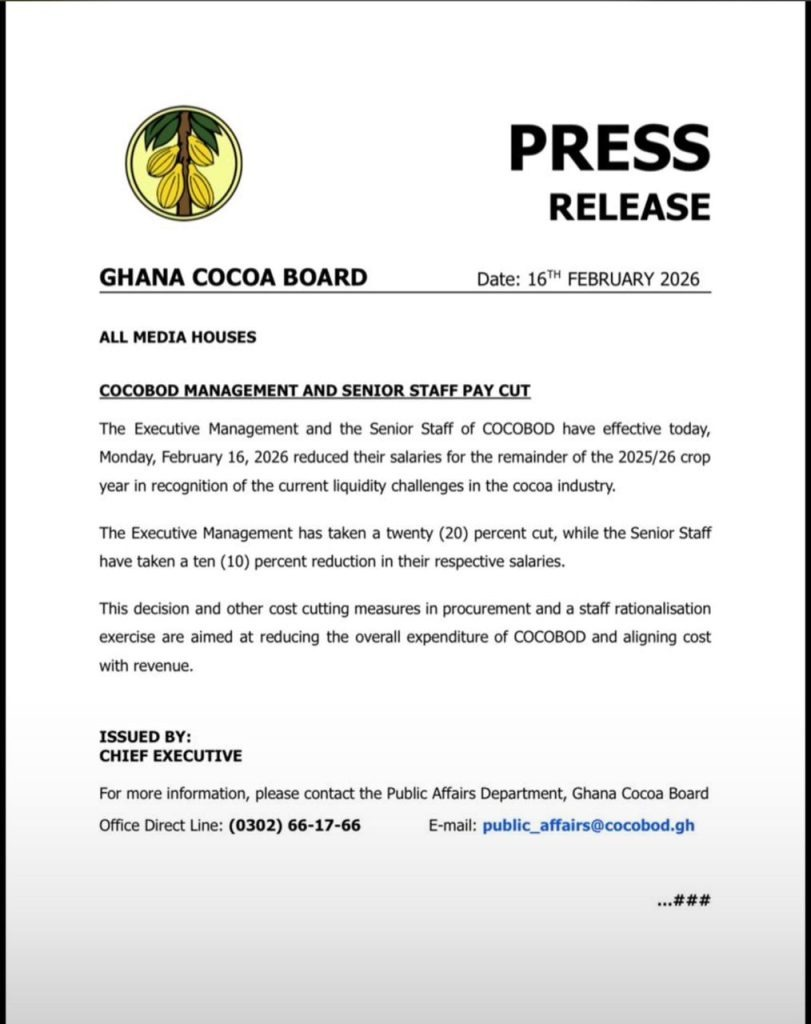
    Barely a week ago, COCOBOD announced a salary cut for some staff members and top management as part of efforts to resolve its cash flow challenges.

    The announcement was contained in a formal press release issued by the Chief Executive, Dr. Ransford A. Abbey, and dated Monday, February 16.

    The release noted that the cuts would take effect on the same day the announcement was made, explaining that the leaders of the government’s cocoa-regulating agency would bear the reductions for the remainder of the 2025/26 crop year.

    According to the statement, “The Executive Management and the Senior Staff of COCOBOD have, effective today, Monday, February 16, 2026, reduced their salaries for the remainder of the 2025/26 crop year in recognition of the current liquidity challenges in the cocoa industry.”

    It continued, “The Executive Management has taken a twenty (20) percent cut, while the Senior Staff have taken a ten (10) percent reduction in their respective salaries,” as part of a broader cost-containment measure aimed at aligning expenditure with revenue.

    Management indicated that additional steps, “other cost-cutting measures in procurement and a staff rationalisation exercise, are aimed at reducing the overall expenditure of COCOBOD and aligning costs with revenue.”

    Meanwhile, the statement did not disclose how much the salary cuts would save the sector or the size of the liquidity gap.

    The announcement comes at a time of heightened strain in the cocoa industry, marked by rising operational costs, financing pressures, concerns over farmer welfare, and intensified public scrutiny over cocoa pricing and COCOBOD’s financial position.

    In recent weeks, the sector has been at the centre of national debate, particularly over producer prices and the sustainability of cocoa farming.

    Industry observers have also pointed to the heavy financing burden associated with cocoa purchases, operational commitments, and exposure to global price volatility.

    Last year, the Ghana Cocoa Board (COCOBOD) announced that it would not secure any syndicated loan to finance cocoa purchases for the 2025/26 crop season.

    According to them, the shortage of cocoa beans at the global level informed such a decision.

    “We’re not doing syndication…this year [2025], we’re not doing syndication. What has necessitated us not to do syndication is that we’re experiencing a global shortage of the cocoa bean,” he said.

    He made these remarks during an interview with Accra-based radio station Citi FM on Monday, August 4. The Head of Public Affairs at COCOBOD, Jerome Kwaku Sam, explicitly stated that the Board had not sought syndicated financing for the 2024/2025 season and had no intention of doing so this year.

    “…To be very honest, last year [2024], we didn’t do syndication, and this year [2025], we’re not doing syndication.”

    Mr. Sam further noted that the move also reflects a strategic effort to reduce costs under prevailing market conditions.

    “We’re not doing syndication whereby we’re going to incur additional expenses and what have you. That is out of the system or table for now,” he emphasised.

  • COCOBOD needs GHS30bn to keep running – Majority

    COCOBOD needs GHS30bn to keep running – Majority

    The Ghana Cocoa Board (COCOBOD) requires GH¢30 billion in working capital to remain operational, according to Isaac Adongo, Chairman of Parliament’s Finance Committee and Member of Parliament for Bolgatanga Central.

    Isaac Adongo disclosed on Thursday, February 19, during a press briefing to address concerns surrounding the recently announced cocoa prices.

    “COCOBOD requires over GH¢30 billion in working capital for it to survive, not the GH¢60 billion left behind. If you look at the accounts, you realise that there is a big hole in there,” he stated.

    The farmgate price of cocoa was reduced from GH¢3,625 to GH¢2,587 per bag to align with movements on the international market.


    The reduction is part of the government’s reforms to revive the Ghana Cocoa Board, which faces several challenges, triggering the Ghanaian cocoa fraternity and cocoa farmers repeatedly call on the government to settle months of unpaid arrears.


    Ghana, the world’s second-largest cocoa producer after Côte d’Ivoire, depends heavily on cocoa as a major source of foreign exchange and livelihoods for more than 800,000 farming households.

    The sector also supports millions of people through transportation, processing, and other related economic activities.


    The cocoa industry has recently experienced major global price swings. Prices rose to record highs of over $10,000 per tonne in 2024 before declining following improved production forecasts and market adjustments. These changes have created uncertainty for both farmers and policymakers.


    President Mahama stressed that decisions on cocoa pricing and reforms must take into account the conditions farmers face, since their earnings depend largely on producer prices announced annually by the Ghana Cocoa Board.

    He noted that policies affecting cocoa farmers directly influence rural incomes, access to education, and household welfare, adding that reforms must focus on sustainability, fairness, and long-term sector growth.


    The summit, organised with support from the Ghana Tree Crops Authority, seeks to attract investment into major tree crops such as cocoa, cashew, rubber, coconut, and oil palm as part of efforts to diversify Ghana’s agricultural sector and increase value addition.


    President Mahama reaffirmed the government’s commitment to improving the cocoa industry through better pricing systems, increased productivity, and measures aimed at ensuring farmers receive fair compensation for their produce.


    He added that aligning policies with the lived experiences of farmers will be key to protecting the future of Ghana’s cocoa sector and maintaining its competitiveness on the global market.


    President John Mahama has unveiled major reforms that will have Ghana buying its cocoa with local currency and ending the export of unprocessed mineral ores by 2030, signaling a bold move toward greater economic independence.

    At the conclusion of his high-level side event, “Accra Reset’s Addis Reckoning,” held alongside the 39th African Union Assembly of Heads of State, President Mahama outlined urgent measures aimed at freeing Ghana’s cocoa industry from long-standing reliance on restrictive foreign financing.


    “One of the key decisions we’ve made is to stop accepting foreign funding for the purchase of our cocoa. We are going to raise domestic bonds. We have enough Cedis in Ghana to pay for our cocoa,” President Mahama declared, outlining a radical departure from decades-old practices.


    The President explained that Ghana’s cocoa crisis highlighted long-standing problems in the system. When the government set the cocoa price while international cocoa was $7,200 per ton and the Ghana Cedi was 11.5 to the dollar, changes in the market caused big losses as prices dropped to $4,200 and the Cedi strengthened to 10.7 per dollar.


    President Mahama also pointed out that relying on foreign funding has limited Ghana’s ability to add value to its cocoa.


    “You know what the collateral for the funding is? Our own cocoa beans. You collateralise the beans with the financier, buy them, ship them, and they pay you the international market price,” he explained.


    “You know the interesting part? We have the capacity to process 400,000 tons of those beans in Ghana, but because they are collateralised, we cannot even allocate them to local processors. We must ship all the beans outside.”


    Under the new arrangement, Ghana will raise domestic bonds in Ghana Cedis to purchase cocoa directly from farmers, eliminating the need to pledge the beans as collateral.

    This will immediately unlock 400,000 tons of cocoa beans for local processors, creating thousands of jobs and retaining significantly more value within Ghana’s economy.


    President Mahama went further, setting an ambitious yet firm deadline to end the export of unprocessed minerals from Ghana.
    “I say by 2030, there won’t be any raw mineral ores leaving Ghana. You’re not going to ship raw manganese ore out of Ghana. You’re not going to ship raw bauxite ore out of Ghana. You’re not going to ship raw iron ore out of Ghana. You must process all that locally,” he stated emphatically.

    The announcement represents what President Mahama says is a comprehensive application of the Accra Reset philosophy, his continental initiative aimed at scaling up development across Africa by asserting sovereignty over natural resources and building domestic processing capacity.


    The President framed his bold moves in the context of mounting pressure from Africa’s youthful population, which is increasingly desperate for economic opportunities.


    “That is the only way we can provide opportunities for our young people. Our young people are less patient than our generation. They want to see that progress and prosperity today,” he said.


    He connected the urgency of implementation directly to the migration crisis: “That is why Accra Reset needs that urgency to stop our young people from braving the dangers of the Sahara and the Mediterranean as they try to reach Europe in search of opportunity.”


    Acknowledging that continental transformation requires immediate action rather than endless planning, President Mahama endorsed a proposal for rapid implementation through willing partners.


    “We come with the decisions. We agree. We do the frameworks. What is missing is urgency and implementation. We take time. And we behave like time is waiting for us,” he said, channelling concerns raised during the discussion.


    “That is why Accra Reset is a good idea. But let’s implement urgently. If parts of the continent are not ready, let’s form a coalition of the willing to move this as quickly as possible. And let all the others follow and join.”


    The Accra Reset initiative, introduced by President Mahama, aims to reshape Africa’s economic ties with the rest of the world, focusing on processing resources locally, building industries, and taking control of the continent’s natural wealth to boost prosperity for Africa’s 1.4 billion people.


    Ghana’s statements in Addis Ababa show that the country plans to set an example, putting real actions in place that other African nations can follow as part of a wider movement across the continent.


    “From Addis, we must stop talking and start implementing,” President Mahama concluded, crystallising the theme of the gathering he dubbed “the Addis reckoning.”

  • Playback: Majority Caucus addresses cocoa price situation

    Playback: Majority Caucus addresses cocoa price situation

    The Majority Caucus in Parliament held a press briefing today, Thursday, February 19, to address concerns surrounding the recently announced cocoa prices. The farmgate price of cocoa was reduced from GH¢3,625 to GH¢2,587 per bag to align with movements on the international market.

    The reduction is part of the government’s reforms to revive the Ghana Cocoa Board (COCOBOD), which faces several challenges, triggering the Ghanaian cocoa fraternity and cocoa farmers repeatedly call on the government to settle months of unpaid arrears.

    Watch playback here:

    Ghana, the world’s second-largest cocoa producer after Côte d’Ivoire, depends heavily on cocoa as a major source of foreign exchange and livelihoods for more than 800,000 farming households. The sector also supports millions of people through transportation, processing, and other related economic activities.

    The cocoa industry has recently experienced major global price swings. Prices rose to record highs of over $10,000 per tonne in 2024 before declining following improved production forecasts and market adjustments. These changes have created uncertainty for both farmers and policymakers.

    President Mahama stressed that decisions on cocoa pricing and reforms must take into account the conditions farmers face, since their earnings depend largely on producer prices announced annually by the Ghana Cocoa Board.

    He noted that policies affecting cocoa farmers directly influence rural incomes, access to education, and household welfare, adding that reforms must focus on sustainability, fairness, and long-term sector growth.

    The summit, organised with support from the Ghana Tree Crops Authority, seeks to attract investment into major tree crops such as cocoa, cashew, rubber, coconut, and oil palm as part of efforts to diversify Ghana’s agricultural sector and increase value addition.

    President Mahama reaffirmed government’s commitment to improving the cocoa industry through better pricing systems, increased productivity, and measures aimed at ensuring farmers receive fair compensation for their produce.

    He added that aligning policies with the lived experiences of farmers will be key to protecting the future of Ghana’s cocoa sector and maintaining its competitiveness on the global market.

    President John Mahama has unveiled major reforms that will have Ghana buying its cocoa with local currency and ending the export of unprocessed mineral ores by 2030, signaling a bold move toward greater economic independence.

    At the conclusion of his high-level side event, “Accra Reset’s Addis Reckoning,” held alongside the 39th African Union Assembly of Heads of State, President Mahama outlined urgent measures aimed at freeing Ghana’s cocoa industry from long-standing reliance on restrictive foreign financing.

    “One of the key decisions we’ve made is to stop accepting foreign funding for the purchase of our cocoa. We are going to raise domestic bonds. We have enough Cedis in Ghana to pay for our cocoa,” President Mahama declared, outlining a radical departure from decades-old practices.

    The President explained that Ghana’s cocoa crisis highlighted long-standing problems in the system. When the government set the cocoa price while international cocoa was $7,200 per ton and the Ghana Cedi was 11.5 to the dollar, changes in the market caused big losses as prices dropped to $4,200 and the Cedi strengthened to 10.7 per dollar.

    President Mahama also pointed out that relying on foreign funding has limited Ghana’s ability to add value to its cocoa.

    “You know what the collateral for the funding is? Our own cocoa beans. You collateralise the beans with the financier, buy them, ship them, and they pay you the international market price,” he explained.

    “You know the interesting part? We have the capacity to process 400,000 tons of those beans in Ghana, but because they are collateralised, we cannot even allocate them to local processors. We must ship all the beans outside.”

    Under the new arrangement, Ghana will raise domestic bonds in Ghana Cedis to purchase cocoa directly from farmers, eliminating the need to pledge the beans as collateral. This will immediately unlock 400,000 tons of cocoa beans for local processors, creating thousands of jobs and retaining significantly more value within Ghana’s economy.

    President Mahama went further, setting an ambitious yet firm deadline to end the export of unprocessed minerals from Ghana.

    “I say by 2030, there won’t be any raw mineral ores leaving Ghana. You’re not going to ship raw manganese ore out of Ghana. You’re not going to ship raw bauxite ore out of Ghana. You’re not going to ship raw iron ore out of Ghana. You must process all that locally,” he stated emphatically.

    The announcement represents what President Mahama says is a comprehensive application of the Accra Reset philosophy, his continental initiative aimed at scaling up development across Africa by asserting sovereignty over natural resources and building domestic processing capacity.

    The President framed his bold moves in the context of mounting pressure from Africa’s youthful population, which is increasingly desperate for economic opportunities.

    “That is the only way we can provide opportunities for our young people. Our young people are less patient than our generation. They want to see that progress and prosperity today,” he said.

    He connected the urgency of implementation directly to the migration crisis: “That is why Accra Reset needs that urgency to stop our young people from braving the dangers of the Sahara and the Mediterranean as they try to reach Europe in search of opportunity.”

    Acknowledging that continental transformation requires immediate action rather than endless planning, President Mahama endorsed a proposal for rapid implementation through willing partners.

    “We come with the decisions. We agree. We do the frameworks. What is missing is urgency and implementation. We take time. And we behave like time is waiting for us,” he said, channelling concerns raised during the discussion.

    “That is why Accra Reset is a good idea. But let’s implement urgently. If parts of the continent are not ready, let’s form a coalition of the willing to move this as quickly as possible. And let all the others follow and join.”

    The Accra Reset initiative, introduced by President Mahama, aims to reshape Africa’s economic ties with the rest of the world, focusing on processing resources locally, building industries, and taking control of the continent’s natural wealth to boost prosperity for Africa’s 1.4 billion people.

    Ghana’s statements in Addis Ababa show that the country plans to set an example, putting real actions in place that other African nations can follow as part of a wider movement across the continent.

    “From Addis, we must stop talking and start implementing,” President Mahama concluded, crystallising the theme of the gathering he dubbed “the Addis reckoning.”

  • Cocoa: New prices to take effect tomorrow

    Cocoa: New prices to take effect tomorrow

    The new cocoa producer prices set by the government for the remainder of the 2025/26 cocoa season will take effect from tomorrow, Friday, February 13.

    This was confirmed in a statement issued to the Ghana News Agency on Tuesday, which indicated that the new price would apply to all cocoa purchased nationwide.

    The statement mentioned that under the revised prices, the producer price to be paid at all buying centres is GH¢1,241.76 per load of 30 kilograms of Grade I and II cocoa beans, naked ex-scale.

    It continued that the newly approved price per bag of 64 kilograms gross is GH¢2,587.00, adding that a tonne of cocoa, comprising 16 bags, now attracts a total payment of GH¢41,392.00.

    Meanwhile, barely a week ago, COCOBOD announced a salary cut for some staff members and top management as part of efforts to resolve its cash flow challenges.

    The announcement was contained in a formal press release issued by the Chief Executive, Dr. Ransford A. Abbey, and dated Monday, February 16.

    The release noted that the cuts were to take effect on the same day the announcement was made, explaining that the leaders of the government’s cocoa regulating agency would take the reductions for the remainder of the 2025/26 crop year.

    According to the statement, “The Executive Management and the Senior Staff of COCOBOD have, effective today, Monday, February 16, 2026, reduced their salaries for the remainder of the 2025/26 crop year in recognition of the current liquidity challenges in the cocoa industry.”

    It continued, “The Executive Management has taken a twenty (20) percent cut, while the Senior Staff have taken a ten (10) percent reduction in their respective salaries,” as part of a broader cost-containment measure aimed at aligning expenditure with revenue.

    Management indicated that additional steps, “other cost-cutting measures in procurement and a staff rationalisation exercise, are aimed at reducing the overall expenditure of COCOBOD and aligning costs with revenue.”

    Meanwhile, the statement did not disclose how much the salary cuts would save the sector or the size of the liquidity gap.

    The announcement came at a time of heightened strain in the cocoa industry, marked by rising operational costs, financing pressures, concerns over farmer welfare, and intensified public scrutiny over cocoa pricing and COCOBOD’s financial position.

    In recent weeks, the sector has been at the centre of national debate, particularly over producer prices and the sustainability of cocoa farming.

    Industry observers have also pointed to the heavy financing burden associated with cocoa purchases, operational commitments, and exposure to global price volatility.

    Last year, the Ghana Cocoa Board (COCOBOD) announced that it would not secure any syndicated loan to finance cocoa purchases for the 2025/26 crop season.

    According to them, the shortage of cocoa beans at the global level informed such a decision.

    “We’re not doing syndication…this year [2025], we’re not doing syndication. What has necessitated us not to do syndication is that we’re experiencing a global shortage of the cocoa bean,” he said.

    He made these remarks during an interview with Accra-based radio station Citi FM on Monday, August 4. The Head of Public Affairs at COCOBOD, Jerome Kwaku Sam, explicitly stated that the Board had not sought syndicated financing for the 2024/2025 season and had no intention of doing so this year.

    “…To be very honest, last year [2024], we didn’t do syndication, and this year [2025], we’re not doing syndication.”

    Mr. Sam further noted that the move also reflects a strategic effort to reduce costs under prevailing market conditions.

    “We’re not doing syndication whereby we’re going to incur additional expenses and what have you. That is out of the system or table for now,” he emphasised.

    His remarks followed the recent announcement by Finance Minister Dr. Cassiel Ato Forson on a new producer price for cocoa.

    The producer price of cocoa for the 2025/2026 season was increased to $5,040 from $3,100, representing a 62.58% increase in dollar terms.

    This information was made available by the Finance Minister, Dr. Cassiel Ato Forson, on Monday, August 4. He explained that the decision was made following an engagement with the Producer Price Review Committee (PPRC) on cocoa.

    According to the Minister, the adjustment is intended to fulfill the National Democratic Congress (NDC) government’s pledge of setting the fee on the board (FOB) at 70% of the price.

    “The Producer Price Review Committee (PPRC) on cocoa, under my chairmanship, met and agreed on the producer price for cocoa for the 2025/2026 season, which opens on Thursday, 7th August 2025. Subsequently, the government is pleased to announce an increase in the producer price of cocoa from $3,100 per tonne to $5,040 per tonne.

    “Let me repeat, subsequent to this meeting, the Bank of Ghana is pleased to announce an increase in the producer price of cocoa from $3,100 per tonne to $5,040 per tonne. It is instructive to note that the government has, by this decision, increased the producer price significantly by 62.58% in U.S. dollar terms.

    “This increase in the producer price represents 70% of the gross Fee from the Board of $7,200 per tonne and aligns with the NDC’s manifesto and President Mahama’s promise to pay the cocoa farmer 70% of the FOB price. It is significant to note that for the 2024/2025 crop season, the previous administration set an FOB value of $4,850 per tonne of cocoa and the producer price at $3,100 per tonne, representing 63.9% of the FOB,” the minister added.

  • COCOBOD reviews over 10k employee records

    COCOBOD reviews over 10k employee records

    An internal audit of staff at the Ghana Cocoa Board (COCOBOD) will be conducted in the coming days as part of reforms to revive the struggling cocoa sector.

    The exercise is expected to improve operational efficiency and ensure prudent use of resources within the organisation. The Head of Public Affairs at COCOBOD, Jerome Sam disclosed this while addressing the media on Thursday, February 19.

    “It is not even about the numbers. If we unearth that the over 10,000 staff are each productive and efficient in what they are doing, that is fine.

    “But if, upon a forensic or Human Resource audit, it is revealed that we can operate effectively with 5,000, 1,000 or even 500 people, and that will ensure the sustenance of the industry, then so be it,” Jerome Sam added.

    He noted that, “The HR audit will ascertain whether we indeed have over 10,000 permanent staff, as the Chief Executive was presented with. Beyond that, it will determine whether all these staff members warrant the portfolios they currently occupy. This is important, and it will be done”.

    A new producer price for cocoa has been announced by the government to stabilise the sector and support farmers. Finance Minister Dr. Cassiel Ato Forson, while addressing the Press on Thursday, February 12, explained that the decision was influenced by prevailing circumstances within the international cocoa trade.

    “As a result of that, the PPRC thereby announces that effective today, Thursday 12th February 2026, the new producer price for the remainder of the 2025–2026 crop season will now be 41,392 Ghana Cedis per ton and 2,587 Ghana Cedis per bag,” he said.

    The new price approved by the Producer Price Review Committee (PPRC) will take effect from Today Thursday, February 12, with the revised price translating to GH¢2,587 per bag.

    This development comes in the aftermath of an emergency Cabinet meeting convened by President John Dramani Mahama On Wednesday, February 11, 2026 to address thousands of cocoa farmers across the country who have been left unpaid for months, with some struggling to afford even basic meals.

    Meanwhile, the Government has directed the Ghana Cocoa Board to commence immediate payment to all affected cocoa farmers who are owed money.

    The Finance Minister revealed that the Cabinet has approved comprehensive reforms to guarantee fair prices to cocoa farmers, secure the financial viability of the cocoa sector, and ensure the long-term sustainability of the industry.

    “To bring relief to unpaid cocoa farmers, Cabinet has accordingly directed the Ghana Cocoa Board to commence immediate payment of all affected cocoa farmers,” he added.

    The Ghana Cocoa Board is dealing with about 50,000 metric tonnes of cocoa that remain unsold at the ports, while Licensed Buying Companies (LBCs) are owed roughly GH¢2.04 billion ($185 million) by the regulator.

    Several farmers have gone without payment since November 2025, compelling many to cut down on meals, pull their children out of school, and neglect routine farm upkeep. The situation has further escalated, with reports indicating that some farmers have held purchasing clerks over unpaid cocoa transactions.

    The delays in payment have been attributed to several issues, including the loss of international financial support, a disparity between Ghana’s farmgate pricing and the sharp drop in global cocoa prices, as well as inherited forward sales agreements signed when prices were significantly lower.

    Under the planned reforms, the government intends to submit a new Cocoa Board bill to Parliament aimed at introducing an automatic system for adjusting producer prices.

    The draft legislation seeks to synchronise cocoa producer prices with global market price trends, currency exchange fluctuations, and other essential indicators.

    Importantly, the proposed bill will ensure that cocoa farmers receive no less than 70% of the gross FOB (Free on Board) price.

    “Cabinet has therefore decided on the following reforms to guarantee a fair price to the cocoa farmer, secure the financial viability of the cocoa sector, and ensure the long-term sustainability of the cocoa industry,” Dr Ato Forson stated.

    In May 2025, COCOBOD CEO Dr. Randy Abbey expressed deep concern over the limited results achieved from a major cocoa rehabilitation initiative, despite the significant financial investment it received.

    He revealed that although $263 million was borrowed to restore 156,000 hectares of cocoa farms damaged by disease, only 40,000 hectares had been rehabilitated when he took over leadership.

    “If we had successfully done this 156,000 hectares, it would have contributed up to 200,000 tonnes to our production; we took all this money, and all we have to show is just 40,000 hectares completed,” he said, speaking to farmers in Nkawie in the Ashanti Region.

    The rehabilitation program was introduced after nearly 40 percent of cocoa farms were found to be infected, prompting urgent intervention by COCOBOD’s previous administration—a move Dr. Abbey said was well-intentioned.

    However, he added that the project later received an additional GHS700 million, and he questioned how the funds were applied, given the modest progress achieved. He disclosed that the matter is now under scrutiny by the relevant investigative institutions.

    “There are agencies responsible for the investigation of these things. I am saddened by what has happened because it was the golden opportunity to turn things around in the sector,” he noted.

    To reverse the trend and bolster production, Dr. Abbey said COCOBOD was focused on rehabilitating 21,000 hectares of abandoned cocoa farms at the time.

    He affirmed his personal commitment to seeing it through, stating, “We have left some in the bush, and that is what I am trying to go and work on them and be able to hand them over so we can add them to the productive stock of farms we have.”He also mentioned that the new management inherited road contracts worth GHS21 billion and debt of GHS4.4 billion, posing additional challenges to the sector’s recovery.

  • Cocoa farmers receive GHS237m payment from COCOBOD

    Cocoa farmers receive GHS237m payment from COCOBOD

    An amount of GHC237 million has been paid to cocoa farmers for 50,000 metric tonnes of cocoa by the Ghana Cocoa Board (COCOBOD).

    In a Facebook post on Wednesday, February 18, head of Public Affairs at the Ghana Cocoa Board (COCOBOD), Jerome Kwaku Sam wrote, “I’m happy to report COCOBOD has started payment of the 50,000 metric tonnes. An amount of GHC237 million has been paid.”


    Last week, the Ghana Cocoa Board’s commenced payments to Licensed Buying Companies to clear outstanding arrears owed Ghanaian cocoa farmers who sold and delivered their cocoa beans without receiving payment.


    This followed several calls by cocoa farmers demanding payment for months of prolonged arrears from the government. On the floor of Parliament on Thursday, February 5, the Minority caucus raised concerns about the sustainability of the cocoa sector if the demands of cocoa farmers are not addressed.


    Although LBCs have paid over GH¢620 million to cocoa farmers, a significant amount remains. Speaking to the media, Head of Corporate Communications at COCOBOD, Jerome Kwaku Sam “In November, we paid over GH¢6 billion, in December more than GH¢5 billion, and in January another GH¢6 billion.


    “This month alone, we have paid over GH¢620 million, and we are continuing to pay the LBCs so they can clear outstanding payments to farmers”.


    The President of the Ghana National Association of Cocoa Farmers (GNACOF), Stevenson Anane Boateng, has lamented the government’s hesitation to pay them for the cocoa sold out to them.


    He said, the situation has rendered a number of cocoa farmers broke since November last year and are calling for intervention“The government is buying our cocoa but has refused to pay us. Since November, we have not been paid. They accept the cocoa, but they don’t pay us,” he lamented during an interview on Frontline on Rainbow Radio 87.5FM.


    When asked what might have caused the delay, he responded: “We don’t know. We are not part of the government, so please, you need to ask them why they have refused to pay cocoa farmers. This is troubling, and we want the government to address our concerns.”


    Meanwhile, the Ghana National Cocoa Farmers Association (GNACOFA) has cautioned the government that failure to introduce a pension scheme, improve health insurance, and ensure access to quality healthcare will leave farmers with no option but to take action themselves.


    GNACOFA has made a formal call for swift reforms aimed at improving the welfare and security of cocoa farmers across the country, noting that they currently do not have sufficient social protection.


    The Association urged the government to establish a pension scheme for cocoa farmers, broaden and enhance their health insurance benefits, and guarantee access to quality healthcare services.


    Anane Boateng called on the government to respond without delay, warning that inaction would force farmers to mobilise for a nationwide protest to push their demands.


    Meanwhile, in August 2025 Finance Minister, Dr. Ato Forson announced at a press conference after a meeting with the Producer Price Review Committee that Cocoa farmers in the country will soon receive free fertiliser and other inputs from the government starting from the 2025/2026 crop season.


    According to Mr Forson, the government’s decision to reintroduce free fertilisers is aimed at supporting farmers to increase production.


    “In preparation for the new season, COCOBOD has made available jute sacks and related logistics for the smooth take-off of the 2025/2026 crop Season. Ladies and Gentlemen, and to the cocoa farmer, I am pleased to announce that President John Mahama’s administration has reintroduced the free cocoa fertiliser programme as an additional support to the Ghanaian cocoa farmer, beginning the 2025/2026 crop year.”


    Dr. Forson added that every single farmer will benefit from this initiative.


    “Beginning this crop year, President Mahama’s administration will supply free cocoa fertilisers (both liquid and granular), free insecticides, free spraying machines, free fungicides, and free flower inducers to farmers.”


    Farmers were therefore cautioned against smuggling. “Government strongly advises cocoa farmers to apply these inputs solely for the purpose of improving cocoa yield and their income. Please do not smuggle them,” he said.


    Minister for Foreign Affairs, Honourable Samuel Okudzeto Ablakwa, and the Ambassador of the Kingdom of Morocco, Her Excellency Imane Ouaadil, on July 28, handed over two thousand (2,000) tons of fertilizer, equivalent to 40,000 bags of fertilizer, to the Ministry of Food and Agriculture.


    According to the Foreign Ministry, the fertilizer was donated to the West African country by the Kingdom of Morocco during Mr. Okudzeto Ablakwa’s official visit to Morocco last month, as part of the two countries’ commitment to sustainable agriculture to enhance food security.


    Deputy Minister for Food and Agriculture, John Setor Dumelo, received the donated fertilizers on behalf of the Minister for Food and Agriculture, Eric Opoku. He expressed gratitude to the Moroccan government for the donation. He assured that farmers will receive the fertilizers to aid crop production.


    “Yesterday, 40,000 bags of fertilizer was donated to Ghana by the Kingdom of Morocco through the Ministry of Foreign Affairs. On behalf of my boss Hon Eric Opoku, I want to say a big thank you to Hon Ablakwa and Her Excellency Ouaadil for this kind gesture. We at the Ministry of Agriculture will ensure the fertilizers get straight to the deserving farmers as soon as possible,” he wrote in a post on the X platform on July 29.


    Agricultural stakeholders have long raised concerns over Ghana not having a single chemical fertiliser plant.


    According to the Institute for Fiscal Studies, this gap is affecting crop yields and weakening the sector’s overall contribution to the economy, with agriculture’s share of GDP falling from 26.9% in 2010 to 22.7% in 2023.
  • COCOBOD announces salary cuts for senior staff, executive Management over liquidity challenges

    COCOBOD announces salary cuts for senior staff, executive Management over liquidity challenges

    Ghana Cocoa Board (COCOBOD) has announced a salary cut for some staff members and top management as part of efforts to resolve its cash flow challenges.

    The announcement was contained in a formal press release issued by the Chief Executive, Dr Ransford A. Abbey, and dated  Monday, February 16.

    The release noted that the cuts were to take effect on the same day the announcement was made, explaining that the leaders of the government’s cocoa regulating agency for the remainder of the 2025/26 crop year

    According to the statement, “The Executive Management and the Senior Staff of COCOBOD have, effective today, Monday, February 16, 2026, reduced their salaries for the remainder of the 2025/26 crop year in recognition of the current liquidity challenges in the cocoa industry.”

    It continued that “The Executive Management has taken a twenty (20) percent cut, while the Senior Staff have taken a ten (10) percent reduction in their respective salaries” as part of a broader cost-containment measure aimed at aligning expenditure with revenue.

    Management indicated that additional steps, “ other cost-cutting measures in procurement and a staff rationalisation exercise are aimed at reducing the overall expenditure of COCOBOD and aligning costs with revenue.”

    Meanwhile, the statement didn’t disclose how much the salary cuts will save the sector or the size of the liquidity gap.

    The announcement comes at a time of heightened strain in the cocoa industry, marked by rising operational costs, financing pressures, concerns over farmer welfare, and intensified public scrutiny over cocoa pricing and COCOBOD’s financial position.

    In recent weeks, the sector has been at the centre of national debate, particularly over producer prices and the sustainability of cocoa farming.

    Industry observers have also pointed to the heavy financing burden associated with cocoa purchases, operational commitments, and exposure to global price volatility.

    Meanwhile, on February 12, the government announced a 28% cut in farmgate prices for cocoa.

    At the start of the 2025/26 cocoa season (August 2025), the producer price was GH¢51,660 per tonne (about GH¢3,625 per 64kg bag).

    However, the government announced a cut to GH¢41,392 per tonne (GH¢2,587 per bag), explaining that the move was due to a sharp fall in global cocoa prices and liquidity pressures within COCOBOD.

    The price cuts have been met with widespread disapproval, discontent and anger, particularly from cocoa farmers and other stakeholders. Cocoa farmers say the cuts will only worsen their already difficult situation with rising input costs.

    Other farmers have expressed that the reduction will push many of them into poverty and force others to quit cocoa production.

    On the other hand, the Minority in Parliament have also strongly condemned the cuts, labelling it as “a betrayal of cocoa farmers.” According to them, this decision by the government is a move to short-change farmers; consequently, they are demanding that the producer price be restored to GH¢51,660 per tonne.

    They also called for the dismissal of COCOBOD’s Chief Executive, Dr. Randy Abbey, arguing that the government should have absorbed the financial pressures instead of passing them on to farmers.

    “This places an unfair burden on our cocoa farmers, who are already struggling with rising costs,” said Mr Kojo Oppong Nkrumah, Ranking Member on Parliament’s Economy and Development Committee.

    “The minority will not remain silent on this matter, and we are prepared to support farmers should they decide to protest against the reduction in the producer’s price,” he said at a press conference in Parliament House, Accra.

    The Minority’s demand for Dr. Abbey’s dismissal is not new, as a petition was filed with President Mahama on Monday, February 9, 2026, accusing the COCOBOD CEO of alleged gross incompetence, arrogance, and intimidation.

    In addition the government has announced plans to absorb the outstanding $150 million financial loss incurred by the Ghana Cocoa Board (COCOBOD).

    Addressing the media on Thursday, the Minister for Finance, Dr. Ato Forson, disclosed that the decision was reached after consultations with Cabinet.

    He emphasised that all cocoa farmers who are yet to be paid would receive their outstanding payments in the coming days following the government’s intervention.

    “Cabinet has directed COCOBOD to commence immediate payment of all affected cocoa farmers,” he said.

    The Ghana Cocoa Board (COCOBOD) is dealing with about 50,000 metric tonnes of cocoa that remain unsold at the ports, while Licensed Buying Companies (LBCs) are owed roughly GH¢2.04 billion ($185 million) by the regulator.

    Several farmers have gone without payment since November 2025, compelling many to cut down on meals, pull their children out of school, and neglect routine farm upkeep. The situation has further escalated, with reports indicating that some farmers have held purchasing clerks over unpaid cocoa transactions.

    The delays in payment have been attributed to several issues, including the loss of international financial support, a disparity between Ghana’s farmgate pricing and the sharp drop in global cocoa prices, as well as inherited forward sales agreements signed when prices were significantly lower.

    Under the planned reforms, the government intends to submit a new Cocoa Board bill to Parliament aimed at introducing an automatic system for adjusting producer prices.

    The draft legislation seeks to synchronise cocoa producer prices with global market price trends, currency exchange fluctuations, and other essential indicators.

    Importantly, the proposed bill will ensure that cocoa farmers receive no less than 70% of the gross FOB (Free on Board) price.

    “Cabinet has therefore decided on the following reforms to guarantee a fair price to the cocoa farmer, secure the financial viability of the cocoa sector, and ensure the long-term sustainability of the cocoa industry,” Dr Ato Forson stated.

  • Government to absorb COCOBOD’s $150m losses

    Government to absorb COCOBOD’s $150m losses

    The government has announced plans to absorb the outstanding $150 million financial loss incurred by the Ghana Cocoa Board (COCOBOD).

    Addressing the media on Thursday, the Minister for Finance, Dr. Ato Forson, disclosed that the decision was reached after consultations with Cabinet.

    He emphasised that all cocoa farmers who are yet to be paid would receive their outstanding payments in the coming days following the government’s intervention.

    “Cabinet has directed COCOBOD to commence immediate payment of all affected cocoa farmers,” he said.

    As part of reforms to revive the worsening crises at COCOBOD a new producer price for cocoa has been announced by government with the aim of stabilising the sector and supporting farmers.

    The decision according to the Finance Minister was influenced by prevailing circumstances within the international cocoa trade.

    “As a result of that, the PPRC thereby announces that effective today, Thursday 12th February 2026, the new producer price for the remainder of the 2025–2026 crop season will now be 41,392 Ghana Cedis per ton and 2,587 Ghana Cedis per bag,” he said.

    The new price approved by the Producer Price Review Committee (PPRC) will take effect immediately, with the revised price translating to GH¢2,587 per bag.

    The Finance Minister revealed that the Cabinet has approved comprehensive reforms to guarantee fair prices to cocoa farmers, secure the financial viability of the cocoa sector, and ensure the long-term sustainability of the industry.

    “To bring relief to unpaid cocoa farmers, Cabinet has accordingly directed the Ghana Cocoa Board to commence immediate payment of all affected cocoa farmers,” he added.

    The Ghana Cocoa Board (COCOBOD) is dealing with about 50,000 metric tonnes of cocoa that remain unsold at the ports, while Licensed Buying Companies (LBCs) are owed roughly GH¢2.04 billion ($185 million) by the regulator.

    Several farmers have gone without payment since November 2025, compelling many to cut down on meals, pull their children out of school, and neglect routine farm upkeep. The situation has further escalated, with reports indicating that some farmers have held purchasing clerks over unpaid cocoa transactions.

    The delays in payment have been attributed to several issues, including the loss of international financial support, a disparity between Ghana’s farmgate pricing and the sharp drop in global cocoa prices, as well as inherited forward sales agreements signed when prices were significantly lower.

    Under the planned reforms, the government intends to submit a new Cocoa Board bill to Parliament aimed at introducing an automatic system for adjusting producer prices.

    The draft legislation seeks to synchronise cocoa producer prices with global market price trends, currency exchange fluctuations, and other essential indicators.

    Importantly, the proposed bill will ensure that cocoa farmers receive no less than 70% of the gross FOB (Free on Board) price.

    “Cabinet has therefore decided on the following reforms to guarantee a fair price to the cocoa farmer, secure the financial viability of the cocoa sector, and ensure the long-term sustainability of the cocoa industry,” Dr Ato Forson stated.

    In May 2025, COCOBOD CEO Dr. Randy Abbey expressed deep concern over the limited results achieved from a major cocoa rehabilitation initiative, despite the significant financial investment it received.

    He revealed that although $263 million was borrowed to restore 156,000 hectares of cocoa farms damaged by disease, only 40,000 hectares had been rehabilitated when he took over leadership.

    “If we had successfully done this 156,000 hectares, it would have contributed up to 200,000 tonnes to our production; we took all this money, and all we have to show is just 40,000 hectares completed,” he said, speaking to farmers in Nkawie in the Ashanti Region.

    The rehabilitation program was introduced after nearly 40 percent of cocoa farms were found to be infected, prompting urgent intervention by COCOBOD’s previous administration—a move Dr. Abbey said was well-intentioned.

    However, he added that the project later received an additional GHS700 million, and he questioned how the funds were applied, given the modest progress achieved. He disclosed that the matter is now under scrutiny by the relevant investigative institutions.

    “There are agencies responsible for the investigation of these things. I am saddened by what has happened because it was the golden opportunity to turn things around in the sector,” he noted.

    To reverse the trend and bolster production, Dr. Abbey said COCOBOD was focused on rehabilitating 21,000 hectares of abandoned cocoa farms at the time.

    He affirmed his personal commitment to seeing it through, stating, “We have left some in the bush, and that is what I am trying to go and work on them and be able to hand them over so we can add them to the productive stock of farms we have.”He also mentioned that the new management inherited road contracts worth GHS21 billion and debt of GHS4.4 billion, posing additional challenges to the sector’s recovery.

  • PLAYBACK: Ato Forson outlines cocoa sector reforms agenda

    PLAYBACK: Ato Forson outlines cocoa sector reforms agenda

    The Minister for Finance, Dr. Ato Forson, addressed the nation today, Thursday, February 12, over the government’s reforms in saving Ghana’s cocoa sector. The Ghana Cocoa Board (COCOBOD) faces several challenges, with the Ghanaian cocoa fraternity and cocoa farmers repeatedly calling on the government to settle months of unpaid arrears.

    According to the Finance Minister, Dr. Cassiel Ato Forson, the GH¢32 billion in arrears the sector is experiencing is the result of indiscriminate contract awards by the previous administration.

    These contracts were awarded during the tenure of the New Patriotic Party (NPP) without proper checks or budget allocations to fund them. He disclosed that despite these challenges, COCOBOD’s financial pressures have not eased, as its weakened balance sheet prevents it from meeting its obligations.

    “When COCOBOD awards a contract, they have to pay the contractors, not the Finance Ministry. The previous government awarded contracts anyhow, without any sources to pay for these contracts. The COCOBOD CEO inherited GH¢32 billion worth of arrears. He cannot pay it in one year because he doesn’t have the resources. COCOBOD cannot go out and borrow because of its balance sheet, so how is it supposed to pay that?,” he added.Explore powerful AI tools designed for modern traders wertbundor login.

    Watch the livestream below:

    https://www.youtube.com/watch?v=n4ThGAoXtyE

    In May 2025, COCOBOD CEO Dr. Randy Abbey expressed deep concern over the limited results achieved from a major cocoa rehabilitation initiative, despite the significant financial investment it received.

    He revealed that although $263 million was borrowed to restore 156,000 hectares of cocoa farms damaged by disease, only 40,000 hectares had been rehabilitated when he took over leadership.

    “If we had successfully done this 156,000 hectares, it would have contributed up to 200,000 tonnes to our production; we took all this money, and all we have to show is just 40,000 hectares completed,” he said, speaking to farmers in Nkawie in the Ashanti Region.

    The rehabilitation program was introduced after nearly 40 percent of cocoa farms were found to be infected, prompting urgent intervention by COCOBOD’s previous administration—a move Dr. Abbey said was well-intentioned.

    However, he added that the project later received an additional GHS700 million, and he questioned how the funds were applied, given the modest progress achieved. He disclosed that the matter is now under scrutiny by the relevant investigative institutions.

    “There are agencies responsible for the investigation of these things. I am saddened by what has happened because it was the golden opportunity to turn things around in the sector,” he noted.

    To reverse the trend and bolster production, Dr. Abbey said COCOBOD is currently focused on rehabilitating 21,000 hectares of abandoned cocoa farms.

    He affirmed his personal commitment to seeing it through, stating, “We have left some in the bush, and that is what I am trying to go and work on them and be able to hand them over so we can add them to the productive stock of farms we have.”He also mentioned that the new management inherited road contracts worth GHS21 billion and debt of GHS4.4 billion, posing additional challenges to the sector’s recovery.

    Meanwhile, cocoa farmers will earn an extra GH₵400 per 64kg bag following a new price announced by the government for the 2025/2026 crop season.

    The new price, which is now GH₵3,625 per bag, equivalent to GH₵58,000 per tonne, represents a 12.27 per cent increase over the GH₵3,228.75 per bag price announced in August.

    This was revealed by the Minister for Finance, Cassiel Ato Forson, while speaking at an emergency meeting of the Producer Price Review Committee (PPRC) on cocoa in Accra on Thursday, October 2.

    The upward adjustment is believed to be an effort to match local prices with gains in the global cocoa market. Meanwhile, Ghana Cocoa Board (COCOBOD) has expressed its commitment to ensuring that cocoa farmers receive a meaningful and fair boost in their income, despite the hike in the dollar.

    Recently, the government disclosed its intention to reintroduce free fertilisers, aimed at supporting farmers to increase production.Finance Minister, Dr. Ato Forson, noted, “In preparation for the new season, COCOBOD has made available jute sacks and related logistics for the smooth take-off of the 2025/2026 crop Season.

    “Ladies and Gentlemen, and to the cocoa farmer, I am pleased to announce that President John Mahama’s administration has reintroduced the free cocoa fertiliser programme as an additional support to the Ghanaian cocoa farmer, beginning the 2025/2026 crop year.”

    Dr. Forson added that every single farmer will benefit from this initiative.“Beginning this crop year, President Mahama’s administration will supply free cocoa fertilisers (both liquid and granular), free insecticides, free spraying machines, free fungicides, and free flower inducers to farmers,” he added.

    Farmers were therefore cautioned against smuggling.“Government strongly advises cocoa farmers to apply these inputs solely for the purpose of improving cocoa yield and their income. Please do not smuggle them,” he said.

    Minister for Foreign Affairs, Honourable Samuel Okudzeto Ablakwa, and the Ambassador of the Kingdom of Morocco, Her Excellency Imane Ouaadil, on July 28, handed over two thousand (2,000) tons of fertilizer, equivalent to 40,000 bags of fertilizer, to the Ministry of Food and Agriculture.

    According to the Foreign Ministry, the fertilizer was donated to the West African country by the Kingdom of Morocco during the official visit of Mr Okudzeto Ablakwa to Morocco last month as part of the two countries’ commitment to sustainable agriculture to enhance food security.

    Deputy Minister for Food and Agriculture, John Setor Dumelo, received the donated fertilizers on behalf of the Minister for Food and Agriculture, Eric Opoku. He expressed gratitude to the Moroccan government for the donation. He assured that farmers will receive the fertilizers to aid crop production.

    “Yesterday, 40,000 bags of fertilizer were donated to Ghana by the Kingdom of Morocco through the Ministry of Foreign Affairs. On behalf of my boss, Hon Eric Opoku, I want to say a big thank you to Hon Ablakwa and Her Excellency Ouaadil for this kind gesture. We at the Ministry of Agriculture will ensure the fertilizers get straight to the deserving farmers as soon as possible,” he wrote in a post on the X platform on July 29.

    Stakeholders in the agricultural sector have bemoaned the absence of a single chemical fertiliser plant in the country. The Institute for Fiscal Studies noted that the absence of such a plant is having an adverse impact on crop production and the contribution of the agricultural sector to the country’s economy, i.e., the Gross Domestic Product (GDP). The sector’s contribution to the country’s GDP declined from 26.9% in 2010 to 22.7% in 2023.

    In March 2025, Senior Research Fellow at the Institute for Fiscal Studies, Dr. Said Boakye, said, “We need to establish several fertiliser manufacturing plants to ensure that adequate and affordable fertiliser is available to farmers, which will help boost agricultural productivity.”

    “The sad reality is that Ghana lacks a single chemical fertiliser plant. In our rice studies, we have been comparing with Vietnam, where they have more than 7,000 plants. Vietnam’s success in achieving high agricultural productivity is largely due to fertilisers being readily available to farmers at no cost, along with incentivized prices,” he added.

    The Institute for Fiscal Studies has entreated the government to allocate significant funding to establish a fertiliser manufacturing plant.COCOBOD has noted that it would not secure any syndicated loan to finance cocoa purchases for the 2025/26 crop season. According to them, the shortage of cocoa beans on the global level has informed such a decision.

    “We’re not doing syndication…this year [2025], we’re not doing syndication. What has necessitated us not to do syndication is that we’re experiencing a global shortage of the cocoa bean.”

    He made these revelations during an interview with Accra-based radio station, Citi FM, on Monday, August 4. The Head of Public Affairs at COCOBOD, Jerome Kwaku Sam, stated explicitly stated, that the Board had not sought syndicated financing for the 2024/2025 season and had no intention of doing so this year.

    “…To be very honest, last year [2024], we didn’t do syndication, and this year [2025], we’re not doing syndication.

    Mr Sam further noted that the move also reflects a strategic effort to reduce costs under prevailing market conditions.“We’re not doing syndication whereby we’re going to incur additional expenses and what have you. That is out of the system or table for now,” he emphasized.

  • Govt agrees on urgent reforms in cocoa sector after emergency Cabinet meeting – Kwakye Ofosu announces

    Govt agrees on urgent reforms in cocoa sector after emergency Cabinet meeting – Kwakye Ofosu announces

    Minister of State in charge of Government Communications, Felix Kwakye Ofosu, announced that Cabinet has agreed on urgent interventions to fast-track payments to cocoa farmers nationwide.

    He indicated that the approval followed prolonged Cabinet meeting on Tuesday February to tackle the sector’s liquidity challenges.

    Speaking to the press after the emergency Cabinet session, Kwakye Ofosu revealed that the reforms are designed to achieve substantial growth in domestic cocoa processing.

    “We have just concluded a lengthy cabinet meeting, which was an emergency session that discussed the cocoa sector and matters arising there. And at the end of the emergency session, decisive measures have been agreed upon regarding expedited payments of cocoa farmers, regarding the implementation of the most drastic reforms in the cocoa sector,” the Minister stated.

    The urgent intervention follows months of delayed payments to farmers who supplied cocoa beans since November 2025, with COCOBOD reportedly owing Licensed Buying Companies more than GH¢10 billion.

    Mr. Kwakye Ofosu indicated that COCOBOD will undergo broad restructuring aimed at improving efficiency, strengthening transparency, and ensuring better sector management.

    The Minister for Finance is scheduled to address the nation at 11:00 a.m. on Wednesday, where he is expected to present the detailed implementation strategy and financial plan for the reforms.

    The worsening crisis at the Ghana Cocoa Board (COCOBOD) prompted President John Dramani Mahama to convene an emergency Cabinet meeting today, Wednesday, February 11, to address the challenges facing the sector.

    The Minister of State in charge of Government Communications, Felix Kwakye Ofosu, disclosed this development in a Facebook post on Tuesday, February 10.

    The Ghana Cocoa Board (COCOBOD) faces several challenges, with the Ghanaian cocoa fraternity and cocoa farmers repeatedly calling on the government to settle months of unpaid arrears.

    According to the Finance Minister, Dr. Cassiel Ato Forson, the GH¢32 billion in arrears the sector is experiencing is the result of indiscriminate contract awards by the previous administration.

    These contracts were awarded during the tenure of the New Patriotic Party (NPP) without proper checks or budget allocations to fund them. He disclosed that despite these challenges, COCOBOD’s financial pressures have not eased, as its weakened balance sheet prevents it from meeting its obligations.

    “When COCOBOD awards a contract, they have to pay the contractors, not the Finance Ministry. The previous government awarded contracts anyhow, without any sources to pay for these contracts. The COCOBOD CEO inherited GH¢32 billion worth of arrears. He cannot pay it in one year because he doesn’t have the resources. COCOBOD cannot go out and borrow because of its balance sheet, so how is it supposed to pay that?,” he added.

    In May 2025, COCOBOD CEO Dr. Randy Abbey expressed deep concern over the limited results achieved from a major cocoa rehabilitation initiative, despite the significant financial investment it received.

    He revealed that although $263 million was borrowed to restore 156,000 hectares of cocoa farms damaged by disease, only 40,000 hectares had been rehabilitated when he took over leadership.

    “If we had successfully done this 156,000 hectares, it would have contributed up to 200,000 tonnes to our production; we took all this money, and all we have to show is just 40,000 hectares completed,” he said, speaking to farmers in Nkawie in the Ashanti Region.

    The rehabilitation program was introduced after nearly 40 percent of cocoa farms were found to be infected, prompting urgent intervention by COCOBOD’s previous administration—a move Dr. Abbey said was well-intentioned.

    However, he added that the project later received an additional GHS700 million, and he questioned how the funds were applied, given the modest progress achieved. He disclosed that the matter is now under scrutiny by the relevant investigative institutions.

    “There are agencies responsible for the investigation of these things. I am saddened by what has happened because it was the golden opportunity to turn things around in the sector,” he noted.

    To reverse the trend and bolster production, Dr. Abbey said COCOBOD is currently focused on rehabilitating 21,000 hectares of abandoned cocoa farms.

    He affirmed his personal commitment to seeing it through, stating, “We have left some in the bush, and that is what I am trying to go and work on them and be able to hand them over so we can add them to the productive stock of farms we have.”He also mentioned that the new management inherited road contracts worth GHS21 billion and debt of GHS4.4 billion, posing additional challenges to the sector’s recovery.

    Meanwhile, cocoa farmers will earn an extra GH₵400 per 64kg bag following a new price announced by the government for the 2025/2026 crop season.

    The new price, which is now GH₵3,625 per bag, equivalent to GH₵58,000 per tonne, represents a 12.27 per cent increase over the GH₵3,228.75 per bag price announced in August.

    This was revealed by the Minister for Finance, Cassiel Ato Forson, while speaking at an emergency meeting of the Producer Price Review Committee (PPRC) on cocoa in Accra on Thursday, October 2.

    The upward adjustment is believed to be an effort to match local prices with gains in the global cocoa market. Meanwhile, Ghana Cocoa Board (COCOBOD) has expressed its commitment to ensuring that cocoa farmers receive a meaningful and fair boost in their income, despite the hike in the dollar.

    Recently, the government disclosed its intention to reintroduce free fertilisers, aimed at supporting farmers to increase production.Finance Minister, Dr. Ato Forson, noted, “In preparation for the new season, COCOBOD has made available jute sacks and related logistics for the smooth take-off of the 2025/2026 crop Season.

    “Ladies and Gentlemen, and to the cocoa farmer, I am pleased to announce that President John Mahama’s administration has reintroduced the free cocoa fertiliser programme as an additional support to the Ghanaian cocoa farmer, beginning the 2025/2026 crop year.”

    Dr. Forson added that every single farmer will benefit from this initiative.“Beginning this crop year, President Mahama’s administration will supply free cocoa fertilisers (both liquid and granular), free insecticides, free spraying machines, free fungicides, and free flower inducers to farmers,” he added.

    Farmers were therefore cautioned against smuggling.“Government strongly advises cocoa farmers to apply these inputs solely for the purpose of improving cocoa yield and their income. Please do not smuggle them,” he said.

    Minister for Foreign Affairs, Honourable Samuel Okudzeto Ablakwa, and the Ambassador of the Kingdom of Morocco, Her Excellency Imane Ouaadil, on July 28, handed over two thousand (2,000) tons of fertilizer, equivalent to 40,000 bags of fertilizer, to the Ministry of Food and Agriculture.

    According to the Foreign Ministry, the fertilizer was donated to the West African country by the Kingdom of Morocco during the official visit of Mr Okudzeto Ablakwa to Morocco last month as part of the two countries’ commitment to sustainable agriculture to enhance food security.

    Deputy Minister for Food and Agriculture, John Setor Dumelo, received the donated fertilizers on behalf of the Minister for Food and Agriculture, Eric Opoku. He expressed gratitude to the Moroccan government for the donation. He assured that farmers will receive the fertilizers to aid crop production.

    “Yesterday, 40,000 bags of fertilizer were donated to Ghana by the Kingdom of Morocco through the Ministry of Foreign Affairs. On behalf of my boss, Hon Eric Opoku, I want to say a big thank you to Hon Ablakwa and Her Excellency Ouaadil for this kind gesture. We at the Ministry of Agriculture will ensure the fertilizers get straight to the deserving farmers as soon as possible,” he wrote in a post on the X platform on July 29.

    Stakeholders in the agricultural sector have bemoaned the absence of a single chemical fertiliser plant in the country. The Institute for Fiscal Studies noted that the absence of such a plant is having an adverse impact on crop production and the contribution of the agricultural sector to the country’s economy, i.e., the Gross Domestic Product (GDP). The sector’s contribution to the country’s GDP declined from 26.9% in 2010 to 22.7% in 2023.

  • President Mahama meets with cabinet over cocoa sector crisis

    President Mahama meets with cabinet over cocoa sector crisis

    The worsening crisis at the Ghana Cocoa Board (COCOBOD) has prompted President John Dramani Mahama to convene an emergency Cabinet meeting today, Wednesday, February 11, to address the challenges facing the sector.

    The Minister of State in charge of Government Communications, Felix Kwakye Ofosu, disclosed this development in a Facebook post on Tuesday, February 10.

    The meeting is expected to find a lasting solution to to the challenges facing Ghana’s cocoa sector, including low production, pricing issues, and the welfare of cocoa farmers.

    The Ghana Cocoa Board (COCOBOD) faces several challenges, with the Ghanaian cocoa fraternity and cocoa farmers repeatedly calling on the government to settle months of unpaid arrears.

    According to the Finance Minister, Dr. Cassiel Ato Forson, the GH¢32 billion in arrears the sector is experiencing is the result of indiscriminate contract awards by the previous administration.


    These contracts were awarded during the tenure of the New Patriotic Party (NPP) without proper checks or budget allocations to fund them. He disclosed that despite these challenges, COCOBOD’s financial pressures have not eased, as its weakened balance sheet prevents it from meeting its obligations.


    “When COCOBOD awards a contract, they have to pay the contractors, not the Finance Ministry. The previous government awarded contracts anyhow, without any sources to pay for these contracts. The COCOBOD CEO inherited GH¢32 billion worth of arrears. He cannot pay it in one year because he doesn’t have the resources. COCOBOD cannot go out and borrow because of its balance sheet, so how is it supposed to pay that?,” he added.


    In May 2025, COCOBOD CEO Dr. Randy Abbey expressed deep concern over the limited results achieved from a major cocoa rehabilitation initiative, despite the significant financial investment it received.


    He revealed that although $263 million was borrowed to restore 156,000 hectares of cocoa farms damaged by disease, only 40,000 hectares had been rehabilitated when he took over leadership.


    “If we had successfully done this 156,000 hectares, it would have contributed up to 200,000 tonnes to our production; we took all this money, and all we have to show is just 40,000 hectares completed,” he said, speaking to farmers in Nkawie in the Ashanti Region.


    The rehabilitation program was introduced after nearly 40 percent of cocoa farms were found to be infected, prompting urgent intervention by COCOBOD’s previous administration—a move Dr. Abbey said was well-intentioned.


    However, he added that the project later received an additional GHS700 million, and he questioned how the funds were applied, given the modest progress achieved. He disclosed that the matter is now under scrutiny by the relevant investigative institutions.


    “There are agencies responsible for the investigation of these things. I am saddened by what has happened because it was the golden opportunity to turn things around in the sector,” he noted.


    To reverse the trend and bolster production, Dr. Abbey said COCOBOD is currently focused on rehabilitating 21,000 hectares of abandoned cocoa farms.


    He affirmed his personal commitment to seeing it through, stating, “We have left some in the bush, and that is what I am trying to go and work on them and be able to hand them over so we can add them to the productive stock of farms we have.”
    He also mentioned that the new management inherited road contracts worth GHS21 billion and debt of GHS4.4 billion, posing additional challenges to the sector’s recovery.


    Meanwhile, cocoa farmers will earn an extra GH₵400 per 64kg bag following a new price announced by the government for the 2025/2026 crop season.


    The new price, which is now GH₵3,625 per bag, equivalent to GH₵58,000 per tonne, represents a 12.27 per cent increase over the GH₵3,228.75 per bag price announced in August.


    This was revealed by the Minister for Finance, Cassiel Ato Forson, while speaking at an emergency meeting of the Producer Price Review Committee (PPRC) on cocoa in Accra on Thursday, October 2.


    The upward adjustment is believed to be an effort to match local prices with gains in the global cocoa market. Meanwhile, Ghana Cocoa Board (COCOBOD) has expressed its commitment to ensuring that cocoa farmers receive a meaningful and fair boost in their income, despite the hike in the dollar.


    Recently, the government disclosed its intention to reintroduce free fertilisers, aimed at supporting farmers to increase production.
    Finance Minister, Dr. Ato Forson, noted, “In preparation for the new season, COCOBOD has made available jute sacks and related logistics for the smooth take-off of the 2025/2026 crop Season.


    “Ladies and Gentlemen, and to the cocoa farmer, I am pleased to announce that President John Mahama’s administration has reintroduced the free cocoa fertiliser programme as an additional support to the Ghanaian cocoa farmer, beginning the 2025/2026 crop year.”


    Dr. Forson added that every single farmer will benefit from this initiative.“Beginning this crop year, President Mahama’s administration will supply free cocoa fertilisers (both liquid and granular), free insecticides, free spraying machines, free fungicides, and free flower inducers to farmers,” he added.


    Farmers were therefore cautioned against smuggling.“Government strongly advises cocoa farmers to apply these inputs solely for the purpose of improving cocoa yield and their income. Please do not smuggle them,” he said.


    Minister for Foreign Affairs, Honourable Samuel Okudzeto Ablakwa, and the Ambassador of the Kingdom of Morocco, Her Excellency Imane Ouaadil, on July 28, handed over two thousand (2,000) tons of fertilizer, equivalent to 40,000 bags of fertilizer, to the Ministry of Food and Agriculture.


    According to the Foreign Ministry, the fertilizer was donated to the West African country by the Kingdom of Morocco during the official visit of Mr Okudzeto Ablakwa to Morocco last month as part of the two countries’ commitment to sustainable agriculture to enhance food security.


    Deputy Minister for Food and Agriculture, John Setor Dumelo, received the donated fertilizers on behalf of the Minister for Food and Agriculture, Eric Opoku. He expressed gratitude to the Moroccan government for the donation. He assured that farmers will receive the fertilizers to aid crop production.


    “Yesterday, 40,000 bags of fertilizer were donated to Ghana by the Kingdom of Morocco through the Ministry of Foreign Affairs. On behalf of my boss, Hon Eric Opoku, I want to say a big thank you to Hon Ablakwa and Her Excellency Ouaadil for this kind gesture. We at the Ministry of Agriculture will ensure the fertilizers get straight to the deserving farmers as soon as possible,” he wrote in a post on the X platform on July 29.


    Stakeholders in the agricultural sector have bemoaned the absence of a single chemical fertiliser plant in the country. The Institute for Fiscal Studies noted that the absence of such a plant is having an adverse impact on crop production and the contribution of the agricultural sector to the country’s economy, i.e., the Gross Domestic Product (GDP). The sector’s contribution to the country’s GDP declined from 26.9% in 2010 to 22.7% in 2023.


    In March 2025, Senior Research Fellow at the Institute for Fiscal Studies, Dr. Said Boakye, said, “We need to establish several fertiliser manufacturing plants to ensure that adequate and affordable fertiliser is available to farmers, which will help boost agricultural productivity.”


    “The sad reality is that Ghana lacks a single chemical fertiliser plant. In our rice studies, we have been comparing with Vietnam, where they have more than 7,000 plants. Vietnam’s success in achieving high agricultural productivity is largely due to fertilisers being readily available to farmers at no cost, along with incentivized prices,” he added.


    The Institute for Fiscal Studies has entreated the government to allocate significant funding to establish a fertiliser manufacturing plant.
    COCOBOD has noted that it would not secure any syndicated loan to finance cocoa purchases for the 2025/26 crop season. According to them, the shortage of cocoa beans on the global level has informed such a decision.


    “We’re not doing syndication…this year [2025], we’re not doing syndication. What has necessitated us not to do syndication is that we’re experiencing a global shortage of the cocoa bean.”


    He made these revelations during an interview with Accra-based radio station, Citi FM, on Monday, August 4. The Head of Public Affairs at COCOBOD, Jerome Kwaku Sam, stated explicitly stated, that the Board had not sought syndicated financing for the 2024/2025 season and had no intention of doing so this year.


    “…To be very honest, last year [2024], we didn’t do syndication, and this year [2025], we’re not doing syndication.


    Mr Sam further noted that the move also reflects a strategic effort to reduce costs under prevailing market conditions.
    “We’re not doing syndication whereby we’re going to incur additional expenses and what have you. That is out of the system or table for now,” he emphasized.,

  • COCOBOD begins disbursing funds to LBCs to settle cocoa farmers’ outstanding arrears

    COCOBOD begins disbursing funds to LBCs to settle cocoa farmers’ outstanding arrears

    Ghanaian cocoa farmers who sold and delivered their cocoa beans without receiving payment are set to receive relief in the coming days following the Ghana Cocoa Board’s decision to commence payments to Licensed Buying Companies to clear outstanding arrears.


    This update follows several calls by cocoa farmers demanding payment for months of prolonged arrears from the government. On the floor of Parliament on Thursday, February 5, the Minority caucus raised concerns about the sustainability of the cocoa sector if the demands of cocoa farmers are not addressed.

    Although LBCs have paid over GH¢620 million to cocoa farmers, a significant amount remains. Speaking to the media, Head of Corporate Communications at COCOBOD, Jerome Kwaku Sam “In November, we paid over GH¢6 billion, in December more than GH¢5 billion, and in January another GH¢6 billion.


    “This month alone, we have paid over GH¢620 million, and we are continuing to pay the LBCs so they can clear outstanding payments to farmers”.


    The President of the Ghana National Association of Cocoa Farmers (GNACOF), Stevenson Anane Boateng, has lamented the government’s hesitation to pay them for the cocoa sold out to them.


    He said, the situation has rendered a number of cocoa farmers broke since November last year and are calling for intervention
    “The government is buying our cocoa but has refused to pay us. Since November, we have not been paid. They accept the cocoa, but they don’t pay us,” he lamented during an interview on Frontline on Rainbow Radio 87.5FM.


    When asked what might have caused the delay, he responded: “We don’t know. We are not part of the government, so please, you need to ask them why they have refused to pay cocoa farmers. This is troubling, and we want the government to address our concerns.”


    Meanwhile, the Ghana National Cocoa Farmers Association (GNACOFA) has cautioned the government that failure to introduce a pension scheme, improve health insurance, and ensure access to quality healthcare will leave farmers with no option but to take action themselves.


    GNACOFA has made a formal call for swift reforms aimed at improving the welfare and security of cocoa farmers across the country, noting that they currently do not have sufficient social protection.


    The Association urged the government to put in place a pension scheme for cocoa farmers, broaden and enhance their health insurance benefits, and guarantee access to quality healthcare services.


    Anane Boateng called on the government to respond without delay, warning that inaction would force farmers to mobilise for a nationwide protest to push their demands.


    Meanwhile, in August 2025 Finance Minister, Dr. Ato Forson announced at a press conference after a meeting with the Producer Price Review Committee that Cocoa farmers in the country will soon receive free fertiliser and other inputs from the government starting from the 2025/2026 crop season.


    According to Mr Forson, the government’s decision to reintroduce free fertilisers is aimed at supporting farmers to increase production.


    “In preparation for the new season, COCOBOD has made available jute sacks and related logistics for the smooth take-off of the 2025/2026 crop Season. Ladies and Gentlemen, and to the cocoa farmer, I am pleased to announce that President John Mahama’s administration has reintroduced the free cocoa fertiliser programme as an additional support to the Ghanaian cocoa farmer, beginning the 2025/2026 crop year.”


    Dr. Forson added that every single farmer will benefit from this initiative.


    “Beginning this crop year, President Mahama’s administration will supply free cocoa fertilisers (both liquid and granular), free insecticides, free spraying machines, free fungicides, and free flower inducers to farmers.”


    Farmers were therefore cautioned against smuggling. “Government strongly advises cocoa farmers to apply these inputs solely for the purpose of improving cocoa yield and their income. Please do not smuggle them,” he said.


    Minister for Foreign Affairs, Honourable Samuel Okudzeto Ablakwa, and the Ambassador of the Kingdom of Morocco, Her Excellency Imane Ouaadil, on July 28, handed over two thousand (2,000) tons of fertilizer, equivalent to 40,000 bags of fertilizer, to the Ministry of Food and Agriculture.


    According to the Foreign Ministry, the fertilizer was donated to the West African country by the Kingdom of Morocco during the official visit of Mr Okudzeto Ablakwa to Morocco last month as part of the two countries’ commitment to sustainable agriculture to enhance food security.


    Deputy Minister for Food and Agriculture, John Setor Dumelo, received the donated fertilizers on behalf of the Minister for Food and Agriculture, Eric Opoku. He expressed gratitude to the Moroccan government for the donation. He assured that farmers will receive the fertilizers to aid crop production.


    “Yesterday, 40,000 bags of fertilizer was donated to Ghana by the Kingdom of Morocco through the Ministry of Foreign Affairs. On behalf of my boss Hon Eric Opoku, I want to say a big thank you to Hon Ablakwa and Her Excellency Ouaadil for this kind gesture. We at the Ministry of Agriculture will ensure the fertilizers get straight to the deserving farmers as soon as possible,” he wrote in a post on the X platform on July 29.


    Agricultural stakeholders have long raised concerns over Ghana not having a single chemical fertiliser plant.


    According to the Institute for Fiscal Studies, this gap is affecting crop yields and weakening the sector’s overall contribution to the economy, with agriculture’s share of GDP falling from 26.9% in 2010 to 22.7% in 2023.
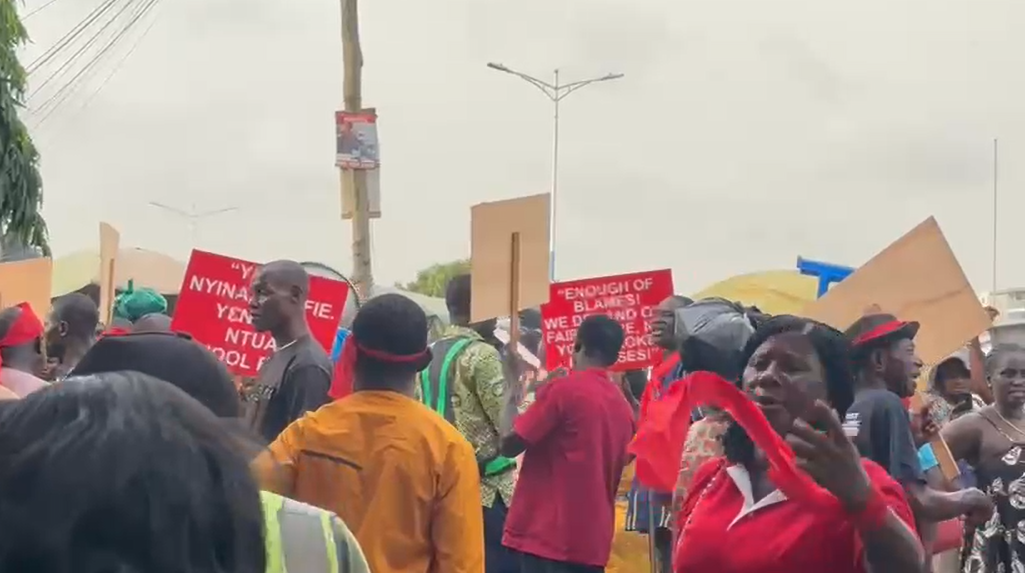
  • Randy Abbey’s GHS20m defamation case against Abronye DC thrown out by High Court

    Randy Abbey’s GHS20m defamation case against Abronye DC thrown out by High Court

    The Accra High Court has thrown out a defamation case brought by COCOBOD Chief Executive Officer, Dr Ransford Anertey Abbey, widely known as Randy Abbey.

    The court struck out the case after finding that it was improperly filed, as it was initiated through COCOBOD’s Legal Department instead of a private lawyer.

    The decision was handed down on Monday, January 19, 2026, by Justice Halimah El-Alawa Abdul Baasit at the High Court, General Jurisdiction 2, in Accra.

    Dr Abbey filed the suit on August 26, 2025, in his capacity as an individual against Kwame Baffoe, also called Abronye, accusing him of making broadcasts and publications that he claimed were defamatory and damaging to his reputation.

    The action was pursued in Dr Abbey’s personal capacity, seeking compensation for the alleged harm caused to his reputation by the publications.

    Despite this, the writ of summons and statement of claim were prepared and filed by COCOBOD’s Legal Department, with the organisation’s Legal Director representing the plaintiff.

    The defendant raised a preliminary objection, arguing that the case was invalid because a state institution’s legal department could not legally act for an individual in a personal defamation matter where the institution was not a party to the suit.

    When the case came up for ruling, the defendant’s lawyer chose not to proceed with an earlier application after the court granted that option. Justice Abdul Baasit then went ahead to deliver her ruling.

    In an extensive decision, the court stated that defamation is a personal wrong (in personam) meant to protect the reputation of an individual, not that of an organisation.

    Justice Abdul Baasit explained that even though the alleged publications were linked to Dr Abbey’s position as COCOBOD CEO, the institution was not listed as a party to the case. For that reason, COCOBOD’s Legal Department had no lawful authority to file the writ or act on behalf of Dr Abbey in his personal case.

    “The Plaintiff having sued in his personal capacity ought to procure the service of a private legal practitioner to represent him,” the judge ruled.

    The court determined that the participation of COCOBOD’s Legal Department made the writ of summons and statement of claim procedurally flawed, since state legal resources cannot be used for matters of a purely personal nature.

    Justice Abdul Baasit therefore struck out the writ of summons and statement of claim in full, declaring them incompetent before the court.

    The court also directed that no costs should be awarded against either side.

    Meanwhile, legal commentators, including lawyer Oliver Barker-Vormawor, say the ruling affirms long-established principles on the use of public resources and the role of state legal departments, especially in personal actions brought by public officials.

    The decision highlights the clear difference between cases filed in an official capacity for a public institution and those pursued personally, even when the issues relate to an official position.

    At the time this report was filed, there had been no immediate response from Dr Abbey or his lawyers on whether a new case would be filed with a private lawyer.

    The ruling was delivered in open court and has since been certified as a true copy by the High Court registry.

    In September last year, Abronye DC, was referred to the NPP’s National Disciplinary Committee over alleged misconduct. This was contained in a petition submitted by the party’s General Secretary, Justin Kodua Frimpong.

    According to the letter,  Abronye DC damaged the party’s image and unity, hence the recent development.“Unbecoming of a member” and “gravely detrimental to the image, unity, and integrity of the organisation,” part of the letter read.

    The charges against Abronye DC included making derogatory remarks against the party’s flagbearer hopeful, Kennedy Agyapong, where he was said to have stated that ‘even the elephant has more wisdom than Honourable Agyapong.

    Additionally, Abronye DC has also been accused of disclosing while manipulating the contents of a disciplinary committee report, which investigated the factors behind the NPP’s lost in the 2024 elections. Although the report by the committee has been withheld from the general public.

    In a related development, the New Patriotic Party directed petitions against Deputy Director of Communications, Ernest Owusu Bempah, to the National Council for consideration.

    This was announced in a statement released by on Tuesday September 24 2025, after the party said it received several petitions from members demanding his removal from office over a conduct of “grave concern”

    “The Party reaffirms its unwavering commitment to upholding discipline, safeguarding its values, and ensuring that all matters are handled with fairness and transparency” the statement signed by the general secretary Justin Kodua indicated. The National Council is the highest decision-making body between congresses.Reacting to the petitions, Mr. Owusu-Bempah noted “All the statements I have made have been about leadership. I said Kennedy Agyapong will deal with galamsey even if it involves his mother or sister. I did not insult anyone”.

  • Cocoa smuggling drains almost $1bn from Ghana’s coffers – COCOBOD

    Cocoa smuggling drains almost $1bn from Ghana’s coffers – COCOBOD

    Cocoa smuggling to neighbouring Togo and Côte d’Ivoire between 2022 and 2025 has cost Ghana a total of US$1.1 billion, according to the Director of Special Services at COCOBOD, Jake Kudjo Samahar.

    During an interaction with stakeholders in the cocoa sector in the Oti and Volta regions,he disclosed that a total of 7,128.13 tonnes of cocoa were lost to smuggling between the 2020 and 2025 crop years in the Volta and Oti regions.

    Speaking to the media, he noted that the tonnage keeps decreasing each year, adding that the recorded losses have consistently dropped from the 2020/21 crop year to the 2024/25 crop year.

    “The tonnage recorded for 2020/21 crop year was 7,215.19, which reduced to 5,656.25 in 2021/22, further downward to 874.31 in the 2022/23 crop year, while 2023/24 recorded 468.75 tonnes with 2024/25 crop year recording 87.06 tonnes. We are losing a lot of revenue because if you look at within three years from 2022-2025, Ghana has lost almost $1.1 billion through cocoa smuggling into neighbouring Togo and Côte d’Ivoire,” he stated.

    Meanwhile, Finance Minister, Dr. Cassiel Ato Forson has linked the debt crisis facing the Ghana Cocoa Board (COCOBOD)to certain financial decisions taken by past officials.

    In an interview on Friday, November 14, Dr. Cassiel Ato Forson noted that the GH¢32 billion in arrears the sector is experiencing is the result of indiscriminate contract awards by the previous administration.

    According to him, these contracts were awarded during the tenure of the New Patriotic Party (NPP) without proper checks or budget allocations to fund them. He disclosed that despite these challenges, COCOBOD’s financial pressures have not eased, as its weakened balance sheet prevents it from meeting its obligations.

    “When COCOBOD awards a contract, they have to pay the contractors, not the Finance Ministry. The previous government awarded contracts anyhow, without any sources to pay for these contracts. The COCOBOD CEO inherited GH¢32 billion worth of arrears. He cannot pay it in one year because he doesn’t have the resources. COCOBOD cannot go out and borrow because of its balance sheet, so how is it supposed to pay that?”

    As part of efforts by the Board to combat the smuggling of cocoa from the country, informants who assist the Ghana Cocoa Board (COCOBOD) in its anti-smuggling operations will receive one-third of the value of any confiscated cocoa. According to the Board, these rewards will be paid without undue delay.

    In a statement, it wrote, “Under this arrangement, informants and anti-smuggling agents will receive one-third (1/3) of the assessed value of confiscated cocoa as their reward. This reviewed scheme is designed to ensure the sustainability of the anti-smuggling campaign while maintaining strong public participation in the collective effort to curb cocoa smuggling”.

    Individuals have been urged to contact the Special Anti-Smuggling Task Force through the hotline on 0308-040-107. The Board has assured that it will treat with strict confidentiality any information received from informants.Ghana continues to grapple with cocoa smuggling, a practice that undermines the country’s revenue.

    Meannwhile, Minister for Foreign Affairs, Honourable Samuel Okudzeto Ablakwa, and the Ambassador of the Kingdom of Morocco, Her Excellency Imane Ouaadil, on July 28, handed over two thousand (2,000) tons of fertilizer, equivalent to 40,000 bags of fertilizer, to the Ministry of Food and Agriculture.

    According to the Foreign Ministry, the fertilizer was donated to the West African country by the Kingdom of Morocco during the official visit of Mr Okudzeto Ablakwa to Morocco last month as part of the two countries’ commitment to sustainable agriculture to enhance food security.

    Deputy Minister for Food and Agriculture, John Setor Dumelo, received the donated fertilizers on behalf of the Minister for Food and Agriculture, Eric Opoku. He expressed gratitude to the Morrocan government for the donation. He assured that farmers will receive the fertilizers to aid crop production.

    “Yesterday, 40,000 bags of fertilizer was donated to Ghana by the Kingdom of Morocco through the Ministry of Foreign Affairs. On behalf of my boss Hon Eric Opoku, I want to say a big thank you to Hon Ablakwa and Her Excellency Ouaadil for this kind gesture. We at the Ministry of Agriculture will ensure the fertilizers get straight to the deserving farmers as soon as possible,” he wrote in a post on the X platform on July 29.

    Stakeholders in the agricultural sector have bemoaned the absence of a single chemical fertiliser plant in the country. The Institute for Fiscal Studies noted that the absence of such a plant is having an adverse impact on crop production and the contribution of the agricultural sector to the country’s economy i.e. the Gross Domestic Product (GDP). The sector’s contribution to the country’s GDP declined from 26.9% in 2010 to 22.7% in 2023.
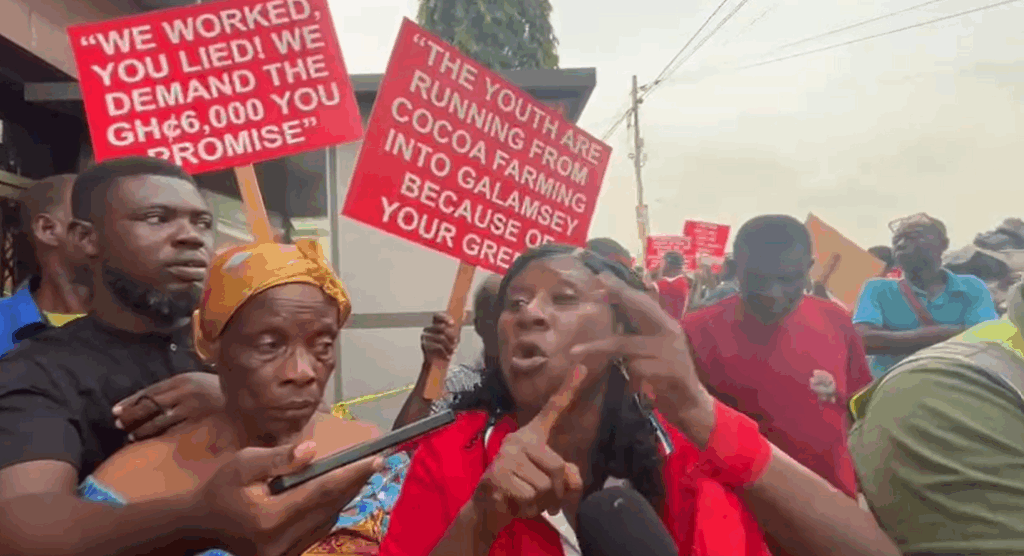
    In March this year, Senior Research Fellow at the Institute for Fiscal Studies, Dr. Said Boakye said, “We need to establish several fertiliser manufacturing plants to ensure that adequate and affordable fertiliser is available to farmers, which will help boost agricultural productivity.”

    “The sad reality is that Ghana lacks a single chemical fertiliser plant. In our rice studies, we have been comparing with Vietnam, where they have more than 7,000 plants. Vietnam’s success in achieving high agricultural productivity is largely due to fertilisers being readily available to farmers at no cost, along with incentivized prices,” he added.

    The Institute for Fiscal Studies has entreated the government to allocate significant funding to establish a fertiliser manufacturing plant.

    COCOBOD has noted that it would not secure any syndicated loan to finance cocoa purchases for the 2025/26 crop season. According to them, the shortage of cocoa beans on the global level has informed such a decision.

    “We’re not doing syndication…this year [2025], we’re not doing syndication. What has necessitated us not to do syndication is that we’re experiencing a global shortage of the cocoa bean.”

    He made these revelations during an interview with Accra-based radio station, Citi FM, on Monday, August 4. The Head of Public Affairs at COCOBOD, Jerome Kwaku Sam, stated explicitly stated, that the Board had not sought syndicated financing for the 2024/2025 season and had no intention of doing so this year.

    “…To be very honest, last year [2024], we didn’t do syndication, and this year [2025], we’re not doing syndication.

    Mr Sam further noted that the move also reflects a strategic effort to reduce costs under prevailing market conditions.

    “We’re not doing syndication whereby we’re going to incur additional expenses and what have you. That is out of the system or table for now,” he emphasized.

  • COCOBOD debt crisis: GHS32bn arrears caused by reckless past contracts – Ato Forson

    COCOBOD debt crisis: GHS32bn arrears caused by reckless past contracts – Ato Forson

    The debt crisis facing the Ghana Cocoa Board (COCOBOD) has been linked to certain financial decisions taken by past officials.

    In an interview on Friday, November 14, Finance Minister, Dr. Cassiel Ato Forson, noted that the GH¢32 billion in arrears the sector is experiencing is the result of indiscriminate contract awards by the previous administration.

    According to him, these contracts were awarded during the tenure of the New Patriotic Party (NPP) without proper checks or budget allocations to fund them. He disclosed that despite these challenges, COCOBOD’s financial pressures have not eased, as its weakened balance sheet prevents it from meeting its obligations.

    “When COCOBOD awards a contract, they have to pay the contractors, not the Finance Ministry. The previous government awarded contracts anyhow, without any sources to pay for these contracts. The COCOBOD CEO inherited GH¢32 billion worth of arrears. He cannot pay it in one year because he doesn’t have the resources. COCOBOD cannot go out and borrow because of its balance sheet, so how is it supposed to pay that?”


    In May this year, COCOBOD CEO Dr. Randy Abbey expressed deep concern over the limited results achieved from a major cocoa rehabilitation initiative, despite the significant financial investment it received.


    He revealed that although $263 million was borrowed to restore 156,000 hectares of cocoa farms damaged by disease, only 40,000 hectares had been rehabilitated when he took over leadership.


    “If we had successfully done this 156,000 hectares, it would have contributed up to 200,000 tonnes to our production; we took all this money, and all we have to show is just 40,000 hectares completed,” he said, speaking to farmers in Nkawie in the Ashanti Region.


    The rehabilitation program was introduced after nearly 40 percent of cocoa farms were found to be infected, prompting urgent intervention by COCOBOD’s previous administration—a move Dr. Abbey said was well-intentioned.

    However, he added that the project later received an additional GHS700 million, and he questioned how the funds were applied, given the modest progress achieved. He disclosed that the matter is now under scrutiny by the relevant investigative institutions.


    “There are agencies responsible for the investigation of these things. I am saddened by what has happened because it was the golden opportunity to turn things around in the sector,” he noted.


    To reverse the trend and bolster production, Dr. Abbey said COCOBOD is currently focused on rehabilitating 21,000 hectares of abandoned cocoa farms.


    He affirmed his personal commitment to seeing it through, stating, “We have left some in the bush, and that is what I am trying to go and work on them and be able to hand them over so we can add them to the productive stock of farms we have.”


    He also mentioned that the new management inherited road contracts worth GHS21 billion and debt of GHS4.4 billion, posing additional challenges to the sector’s recovery.

    Meanwhile, cocoa farmers will earn an extra GH₵400 per 64kg bag following a new price announced by the government for the 2025/2026 crop season.

    The new price, which is now GH₵3,625 per bag, equivalent to GH₵58,000 per tonne, represents a 12.27 per cent increase over the GH₵3,228.75 per bag price announced in August.

    This was revealed by the Minister for Finance, Cassiel Ato Forson, while speaking at an emergency meeting of the Producer Price Review Committee (PPRC) on cocoa in Accra on Thursday, October 2.

    The upward adjustment is believed to be an effort to match local prices with gains in the global cocoa market. Meanwhile, Ghana Cocoa Board (COCOBOD) has expressed its commitment to ensuring that cocoa farmers receive a meaningful and fair boost in their income, despite the hike in the dollar.

    Recently, the government disclosed its intention to reintroduce free fertilisers, aimed at supporting farmers to increase production.

    Finance Minister, Dr. Ato Forson, noted, “In preparation for the new season, COCOBOD has made available jute sacks and related logistics for the smooth take-off of the 2025/2026 crop Season.

    “Ladies and Gentlemen, and to the cocoa farmer, I am pleased to announce that President John Mahama’s administration has reintroduced the free cocoa fertiliser programme as an additional support to the Ghanaian cocoa farmer, beginning the 2025/2026 crop year.”

    Dr. Forson added that every single farmer will benefit from this initiative.“Beginning this crop year, President Mahama’s administration will supply free cocoa fertilisers (both liquid and granular), free insecticides, free spraying machines, free fungicides, and free flower inducers to farmers,” he added.

    Farmers were therefore cautioned against smuggling.“Government strongly advises cocoa farmers to apply these inputs solely for the purpose of improving cocoa yield and their income. Please do not smuggle them,” he said.

    Minister for Foreign Affairs, Honourable Samuel Okudzeto Ablakwa, and the Ambassador of the Kingdom of Morocco, Her Excellency Imane Ouaadil, on July 28, handed over two thousand (2,000) tons of fertilizer, equivalent to 40,000 bags of fertilizer, to the Ministry of Food and Agriculture.

    According to the Foreign Ministry, the fertilizer was donated to the West African country by the Kingdom of Morocco during the official visit of Mr Okudzeto Ablakwa to Morocco last month as part of the two countries’ commitment to sustainable agriculture to enhance food security.

    Deputy Minister for Food and Agriculture, John Setor Dumelo, received the donated fertilizers on behalf of the Minister for Food and Agriculture, Eric Opoku. He expressed gratitude to the Morrocan government for the donation. He assured that farmers will receive the fertilizers to aid crop production.

    “Yesterday, 40,000 bags of fertilizer was donated to Ghana by the Kingdom of Morocco through the Ministry of Foreign Affairs. On behalf of my boss Hon Eric Opoku, I want to say a big thank you to Hon Ablakwa and Her Excellency Ouaadil for this kind gesture. We at the Ministry of Agriculture will ensure the fertilizers get straight to the deserving farmers as soon as possible,” he wrote in a post on the X platform on July 29.

    Stakeholders in the agricultural sector have bemoaned the absence of a single chemical fertiliser plant in the country. The Institute for Fiscal Studies noted that the absence of such a plant is having an adverse impact on crop production and the contribution of the agricultural sector to the country’s economy i.e. the Gross Domestic Product (GDP). The sector’s contribution to the country’s GDP declined from 26.9% in 2010 to 22.7% in 2023.

    In March this year, Senior Research Fellow at the Institute for Fiscal Studies, Dr. Said Boakye said, “We need to establish several fertiliser manufacturing plants to ensure that adequate and affordable fertiliser is available to farmers, which will help boost agricultural productivity.”

    “The sad reality is that Ghana lacks a single chemical fertiliser plant. In our rice studies, we have been comparing with Vietnam, where they have more than 7,000 plants. Vietnam’s success in achieving high agricultural productivity is largely due to fertilisers being readily available to farmers at no cost, along with incentivized prices,” he added.

    The Institute for Fiscal Studies has entreated the government to allocate significant funding to establish a fertiliser manufacturing plant.

    COCOBOD has noted that it would not secure any syndicated loan to finance cocoa purchases for the 2025/26 crop season. According to them, the shortage of cocoa beans on the global level has informed such a decision.

    “We’re not doing syndication…this year [2025], we’re not doing syndication. What has necessitated us not to do syndication is that we’re experiencing a global shortage of the cocoa bean.”

    He made these revelations during an interview with Accra-based radio station, Citi FM, on Monday, August 4. The Head of Public Affairs at COCOBOD, Jerome Kwaku Sam, stated explicitly stated, that the Board had not sought syndicated financing for the 2024/2025 season and had no intention of doing so this year.

    “…To be very honest, last year [2024], we didn’t do syndication, and this year [2025], we’re not doing syndication.

    Mr Sam further noted that the move also reflects a strategic effort to reduce costs under prevailing market conditions.

    “We’re not doing syndication whereby we’re going to incur additional expenses and what have you. That is out of the system or table for now,” he emphasized.

  • COCOBOD to pay one-third of seized cocoa value to informants

    COCOBOD to pay one-third of seized cocoa value to informants

    Informants who assist the Ghana Cocoa Board (COCOBOD) in its anti-smuggling operations will receive one-third of the value of the confiscated cocoa. According to the Board, rewards will be paid without undue delay. 

    This was disclosed on COCOBOD’s on Wednesday, October 8. The announcement forms part of efforts by the Board to combat the smuggling of cocoa from the country. 

    “Under this arrangement, informants and anti-smuggling agents will receive one-third (1/3) of the assessed value of confiscated cocoa as their reward.This reviewed scheme is designed to ensure the sustainability of the anti-smuggling campaign while maintaining strong public participation in the collective effort to curb cocoa smuggling,” it wrote.

    Individuals have been urged to contact the Special Anti-Smuggling Task Force through the hotline on 0308-040-107. The Board has assured that it will treat with strict confidentiality any information received from informants.Ghana continues to grapple with cocoa smuggling, a practice that undermines the country’s revenue.

    Meanwhile, cocoa farmers will earn an extra GH₵400 per 64kg bag following a new price announced by the government for the 2025/2026 crop season.

    The new price, which is now GH₵3,625 per bag, equivalent to GH₵58,000 per tonne, represents a 12.27 per cent increase over the GH₵3,228.75 per bag price announced in August.

    This was revealed by the Minister for Finance, Cassiel Ato Forson, while speaking at an emergency meeting of the Producer Price Review Committee (PPRC) on cocoa in Accra on Thursday, October 2.

    The upward adjustment is believed to be an effort to match local prices with gains in the global cocoa market. Meanwhile, Ghana Cocoa Board (COCOBOD) has expressed its commitment to ensuring that cocoa farmers receive a meaningful and fair boost in their income, despite the hike in the dollar.

    Recently, the government disclosed its intention to reintroduce free fertilisers, aimed at supporting farmers to increase production.

    Finance Minister, Dr. Ato Forson, noted, “In preparation for the new season, COCOBOD has made available jute sacks and related logistics for the smooth take-off of the 2025/2026 crop Season.

    “Ladies and Gentlemen, and to the cocoa farmer, I am pleased to announce that President John Mahama’s administration has reintroduced the free cocoa fertiliser programme as an additional support to the Ghanaian cocoa farmer, beginning the 2025/2026 crop year.”

    Dr. Forson added that every single farmer will benefit from this initiative.“Beginning this crop year, President Mahama’s administration will supply free cocoa fertilisers (both liquid and granular), free insecticides, free spraying machines, free fungicides, and free flower inducers to farmers,” he added.

    Farmers were therefore cautioned against smuggling.“Government strongly advises cocoa farmers to apply these inputs solely for the purpose of improving cocoa yield and their income. Please do not smuggle them,” he said.

    Minister for Foreign Affairs, Honourable Samuel Okudzeto Ablakwa, and the Ambassador of the Kingdom of Morocco, Her Excellency Imane Ouaadil, on July 28, handed over two thousand (2,000) tons of fertilizer, equivalent to 40,000 bags of fertilizer, to the Ministry of Food and Agriculture.

    According to the Foreign Ministry, the fertilizer was donated to the West African country by the Kingdom of Morocco during the official visit of Mr Okudzeto Ablakwa to Morocco last month as part of the two countries’ commitment to sustainable agriculture to enhance food security.

    Deputy Minister for Food and Agriculture, John Setor Dumelo, received the donated fertilizers on behalf of the Minister for Food and Agriculture, Eric Opoku. He expressed gratitude to the Morrocan government for the donation. He assured that farmers will receive the fertilizers to aid crop production.

    “Yesterday, 40,000 bags of fertilizer was donated to Ghana by the Kingdom of Morocco through the Ministry of Foreign Affairs. On behalf of my boss Hon Eric Opoku, I want to say a big thank you to Hon Ablakwa and Her Excellency Ouaadil for this kind gesture. We at the Ministry of Agriculture will ensure the fertilizers get straight to the deserving farmers as soon as possible,” he wrote in a post on the X platform on July 29.

    Stakeholders in the agricultural sector have bemoaned the absence of a single chemical fertiliser plant in the country. The Institute for Fiscal Studies noted that the absence of such a plant is having an adverse impact on crop production and the contribution of the agricultural sector to the country’s economy i.e. the Gross Domestic Product (GDP). The sector’s contribution to the country’s GDP declined from 26.9% in 2010 to 22.7% in 2023.

    In March this year, Senior Research Fellow at the Institute for Fiscal Studies, Dr. Said Boakye said, “We need to establish several fertiliser manufacturing plants to ensure that adequate and affordable fertiliser is available to farmers, which will help boost agricultural productivity.”

    “The sad reality is that Ghana lacks a single chemical fertiliser plant. In our rice studies, we have been comparing with Vietnam, where they have more than 7,000 plants. Vietnam’s success in achieving high agricultural productivity is largely due to fertilisers being readily available to farmers at no cost, along with incentivized prices,” he added.

    The Institute for Fiscal Studies has entreated the government to allocate significant funding to establish a fertiliser manufacturing plant.

    COCOBOD has noted that it would not secure any syndicated loan to finance cocoa purchases for the 2025/26 crop season. According to them, the shortage of cocoa beans on the global level has informed such a decision.

    “We’re not doing syndication…this year [2025], we’re not doing syndication. What has necessitated us not to do syndication is that we’re experiencing a global shortage of the cocoa bean.”

    He made these revelations during an interview with Accra-based radio station, Citi FM, on Monday, August 4. The Head of Public Affairs at COCOBOD, Jerome Kwaku Sam, stated explicitly stated, that the Board had not sought syndicated financing for the 2024/2025 season and had no intention of doing so this year.

    “…To be very honest, last year [2024], we didn’t do syndication, and this year [2025], we’re not doing syndication.

    Mr Sam further noted that the move also reflects a strategic effort to reduce costs under prevailing market conditions.

    “We’re not doing syndication whereby we’re going to incur additional expenses and what have you. That is out of the system or table for now,” he emphasized.

  • Attorney-General’s office has not lost any evidence in ongoing Adu-Boahene trial – Srem-Sai

    Attorney-General’s office has not lost any evidence in ongoing Adu-Boahene trial – Srem-Sai

    Deputy Attorney-General, Justice Srem Sai, has objected to allegations that the Attorney-General’s office has lost evidence in the ongoing criminal case involving former National Signals Bureau (NSB) Director-General, Kwabena Adu-Boahene.

    These claims surfaced from the defence team representing Adu-Boahene and his co-accused at a case Management Conference held on Thursday, June 26. Adu-Boahen’s legal team, under the leadership of lawyer Samuel Atta Akyea, alleged that the bank statements provided by the prosecution were incomplete, with essential pages allegedly missing.

    They suggested that these omissions might contain exculpatory evidence, and accused the Attorney-General’s office of “cherry-picking” documents to support its case while withholding material that could potentially clear the accused.

    In response to this, the Attorney-General’s office, in a statement shared on its official (X) yesterday, August 28, revealed that, his outfit is still in possession of the rightful evidence against the accused.

    Also, Justice Srem Sai continued that all the necessary documents needed to prove the charges levelled against all the accused have been filed. The said documents include contracts, bank records, property ownership documents, INTERPOL reports, and witness testimonies.

    “The Attorney-General’s office has not lost any evidence regarding the ongoing Republic v Adu-Boahene criminal trial.

    As of June 18, we had filed all the documents which we intend to rely on to prove the charges against the 4 Accused Persons in the case.

    The documents include contracts of sale, bank wire transfer records, bank account statements, company registration documents, property ownership records and purchase receipts, INTERPOL stolen vehicle records, investigative caution statements and charge statements of each Accused Person, records of asset non-declaration, a flow chart of money movements through a complex web of bank accounts, and testimonies of our 3 witnesses” he noted.

    According to him, Adu-Boahen’s legal team are in the wrong and illusory to believed government h as lost evidence in their against against their client. There is no cherry picking as all accused persons have been duly served.

    “Further, court-certified copies of each of these documents have been duly served on each of the Accused Persons. So, it is not even realistic that the documents could be lost to jeopardise the prosecution of the case”.

    On the current status of the case, the Deputy A-G revealed that before the court went on recess, three prosecution witnesses had already testified, proof that the case is still on track and not disrupted by a lack of evidence.

    ” …Before the start of the legal vacation on July 31, the first of our 3 prosecution witnesses had completed testifying and had been cross-examined by the lawyers of 3 of the 4 Accused Persons” adding that “The trial will resume in earnest in mid-October when the courts return from the legal vacation”.

    Read the full post below:

  • Ghana keeps 2025/2026 cocoa price unchanged despite Côte d’Ivoire’s raise

    Ghana keeps 2025/2026 cocoa price unchanged despite Côte d’Ivoire’s raise

    Ghana Cocoa Board (COCOBOD) has said that the price paid to farmers for cocoa will stay the same for the 2025/2026 season.

    This decision comes even though cocoa prices have changed in some areas and the global market remains unstable.

    In a letter dated April 8 and sent to the Licensed Cocoa Buyers’ Association of Ghana (LICOBAG), COCOBOD explained that the decision was made after carefully reviewing the cocoa sector’s current financial and operational situation.


    “This decision comes after careful consideration of the operational and financial implications for the cocoa industry,” said Dr. James Kofi Kutoati, Acting Deputy Chief Executive, Operations.

    At the moment, cocoa farmers in Ghana earn GH₵3,100 for each 64kg bag of cocoa, which adds up to GH₵49,600 per tonne. This is a very slight increase of 0.03% from the price set in September for the 2024/2025 season.

    COCOBOD explained that keeping the price steady is meant to help maintain stability and ensure the long-term growth of the cocoa industry.

    It also said the decision fits with current global market trends and is aimed at supporting cocoa farmers.

    While Côte d’Ivoire, Ghana’s neighbor, has recently raised its cocoa price, Ghana has decided not to make any changes for now.

    Still, COCOBOD said it may consider adjusting prices, fees, and margins for industry players later in the season.

  • Roads Minister, COCOBOD CEO engage to address funding stalled cocoa roads projects

    Roads Minister, COCOBOD CEO engage to address funding stalled cocoa roads projects

    Minister for Roads and Highways, Hon. Kwame Agbodza, and the Chief Executive Officer of COCOBOD, Dr. Ransford Abbey, have met to explore sustainable funding solutions for stalled cocoa roads projects across the country.

    The high-level discussions, held earlier today, focused on securing financial resources to complete critical road infrastructure in cocoa-growing regions.

    As a key outcome of the meeting, a joint technical committee has been established, comprising experts from both the Ministry of Roads and Highways and COCOBOD. The committee has been tasked with rationalizing the cocoa roads portfolio, assessing outstanding commitments, and determining COCOBOD’s financial exposure regarding these projects.

    The committee is expected to submit a comprehensive report within three weeks, detailing recommendations on resource allocation and strategies for the completion of ongoing and stalled cocoa roads projects.

    This rationalization process will include a thorough review of financial commitments and measures to ensure efficient use of available funds, providing a clear roadmap for addressing infrastructure deficits in cocoa-growing areas.

    Hon. Kwame Agbodza reaffirmed the government’s dedication to delivering quality road infrastructure, emphasizing its importance to economic growth in cocoa-producing communities.

    “Improving road access in these regions is crucial for boosting productivity, ensuring smooth transportation of cocoa produce, and ultimately contributing to Ghana’s economic growth,” he stated.

    This initiative is expected to accelerate the completion of vital road networks, enhancing accessibility and supporting the nation’s cocoa industry.

  • ECG, COCOBOD and BoG drowning in debt – Ato Forson

    ECG, COCOBOD and BoG drowning in debt – Ato Forson

    Finance Minister Dr. Cassiel Ato Forson has revealed that the Bank of Ghana (BoG) is currently facing a negative equity of GHS55 billion, a financial burden inherited from the previous administration.

    He stressed the urgency of government intervention to restore stability to the central bank’s finances.

    Speaking on Channel One TV on Wednesday, March 12, Dr. Forson explained that the BoG’s financial position remains deeply in deficit.

    “The Bank of Ghana has a negative equity as we speak under the previous administration. They have a negative equity of GHS55 billion, and so their balance sheet is such that they will need the government to bail them out with some money so that they will be able to move from a negative equity to a positive equity,” he stated.

    Dr. Forson also highlighted the significant debts owed by key government agencies, including the Road Fund, COCOBOD, and the Electricity Company of Ghana (ECG).

    He revealed that the Road Fund has accumulated a debt of GHS5.5 billion, COCOBOD owes GHS32 billion, while ECG’s outstanding payments to suppliers amount to GHS68 billion, in addition to a $1.73 billion debt to Independent Power Producers (IPPs).

    “Road Fund owing about GHS5.5 billion, then you have the likes of GETFund, DACF they have their own debt. Then COCOBOD, ECG. COCOBOD owes GHS32 billion, ECG owes GHS68 billion. They owe contractors who have done work,” he stated

    He further pointed out that ECG’s financial struggles stem from its inability to fully remit collected revenue.

    Dr. Forson warned that if these mounting debts—particularly in the energy sector are not urgently addressed, they could have severe consequences on the country’s financial stability.

    “ECG’s situation is so bad that they are supposed to collect the power that they consume. Unfortunately, they buy the power they are supposed to sell to consumers like yourself, collect the money and pay, but the data we’ve seen so far shows ECG collects like GHS1.5 billion, keeps GHS500 million, and pays only GHS1 billion.

    “As a result, they are unable to pay IPPs, and as we speak, the government of Ghana through ECG owes IPPs $1.73 billion. Coupled with the $1.70 billion, they also owe suppliers another GHS68 billion,” stated Dr. Forson.

  • COCOBOD, farmers to lose $495m at the completion of rolled-over contracts – Mahama

    COCOBOD, farmers to lose $495m at the completion of rolled-over contracts – Mahama

    COCOBOD and Ghanaian cocoa farmers are set to lose a staggering $495 million by the time all outstanding rolled-over contracts are fulfilled, President John Dramani Mahama has disclosed.

    Delivering the 2025 State of the Nation Address in Parliament, he attributed the losses to poor financial decisions and mismanagement within the cocoa sector in recent years.

    “The hope of cocoa farms is also highly indebted. Its balance sheet indicates a total debt of GH¢32.5 billion, of which GH¢9.7 billion is due to be paid at the end of September 2025,” Mahama stated.

    He revealed that in the 2023/24 crop season, COCOBOD was unable to supply 333,767 metric tonnes of cocoa that had already been sold at $2,600 per tonne. Instead, the contracts were deferred to the 2024/25 season, leading to significant financial setbacks.

    “This implies that for every tonne of cocoa delivered this year, in fulfillment of the rolled-over contract, COCOBOD and cocoa farmers are going to lose $4,000 in revenue,” he added.

    So far, COCOBOD has supplied 210,000 tonnes under the deferred contracts, incurring a revenue loss of $840 million. The remaining deliveries are expected to result in an additional $495 million loss, further deepening the financial strain on the cocoa sector.

    Beyond these losses, Mahama pointed to excessive spending on road projects under the Cocoa Roads Programme, which has worsened COCOBOD’s financial position. He disclosed that while commitments for cocoa roads amount to GH¢21.7 billion, only GH¢4.4 billion of this figure is reflected in COCOBOD’s official debt records.

    “This debt has arisen mainly because of the decision in 2019 and 2020 to award road contracts worth over a billion dollars because of the election,” he noted.

    COCOBOD’s worsening financial position has raised serious concerns about Ghana’s economic stability. A 2021 Auditor-General’s report put the regulator’s debt at GH¢12.3 billion ($1 billion) as of September 2020, but the situation has since deteriorated.

    Earlier this year, COCOBOD defaulted on payments for its 182-day treasury bill, rolling over GH¢940 million ($79 million) in outstanding securities, and later restructured debts amounting to GH¢7.93 billion ($661 million).

    Ghana had initially planned to secure $1.2 billion in syndicated loans for the 2023/24 cocoa season, but this was later revised to $800 million due to IMF-imposed debt management restrictions, marking the lowest financing secured in nearly two decades.

  • Govt to pay GHC9.7bn in September to settle part of COCOBOD debt – Mahama

    Govt to pay GHC9.7bn in September to settle part of COCOBOD debt – Mahama

    The government is set to pay GH¢9.7 billion by the end of September 2025 to settle part of COCOBOD’s growing debt, President John Dramani Mahama has revealed.

    Addressing Parliament during the 2025 State of the Nation Address, he detailed the financial distress facing the cocoa sector, warning that mismanagement and poor decisions in recent years have plunged COCOBOD into severe debt.

    “The hope of cocoa farms is also highly indebted. Its balance sheet indicates a total debt of GH¢32.5 billion, of which GH¢9.7 billion is due to be paid at the end of September 2025,” Mahama stated.

    He explained that COCOBOD’s financial struggles worsened after it failed to deliver 333,767 metric tonnes of cocoa sold in the 2023/24 crop season at $2,600 per tonne. The contracts were instead rolled over into the 2024/25 season, creating massive revenue losses for both the cocoa regulator and farmers.

    “This implies that for every tonne of cocoa delivered this year, in fulfillment of the rolled-over contract, COCOBOD and cocoa farmers are going to lose $4,000 in revenue,” he added.

    So far, COCOBOD has supplied 210,000 tonnes under the rolled-over contract, leading to an estimated revenue loss of $840 million. By the time all outstanding contracts are fulfilled, Mahama warned, COCOBOD and farmers would have lost a total of $495 million.

    Beyond the immediate revenue shortfalls, the president highlighted the additional financial burden caused by cocoa road commitments, which amount to GH¢21.7 billion. However, only GH¢4.4 billion of this figure is included in COCOBOD’s overall debt.

    “This debt has arisen mainly because of the decision in 2019 and 2020 to award road contracts worth over a billion dollars because of the election,” Mahama noted.

    COCOBOD’s financial decline has intensified concerns about Ghana’s economic outlook, particularly its ability to meet debt obligations. A 2021 Auditor-General’s report had placed COCOBOD’s debt at GH¢12.3 billion ($1 billion) as of September 2020, but the situation has significantly worsened in the years since.

    Earlier this year, COCOBOD defaulted on payments for its 182-day treasury bill, rolling over GH¢940 million ($79 million) in outstanding securities, and later restructuring debts totaling GH¢7.93 billion ($661 million).

    Ghana had initially planned to secure $1.2 billion in syndicated loans for the 2023/24 cocoa season, but this was later reduced to $800 million due to IMF-imposed debt management restrictions, marking the lowest financing secured in 18 years.

  • COCOBOD, GRA seizes 1,115 smuggled gallons of cocoa near Togo

    COCOBOD, GRA seizes 1,115 smuggled gallons of cocoa near Togo

    A truck carrying 1,115 gallons of cocoa beans has been intercepted at the Ave-Havi border in the Volta Region, near Togo, through a joint operation by the Ghana Cocoa Board (COCOBOD) and the Ghana Revenue Authority (GRA).

    Driven by Ibrahim Fatawu, the vehicle, registered as AS 2103-W, was found transporting the smuggled cocoa.

    As part of continuous efforts to combat illegal exports of Ghana’s premium cocoa, authorities uncovered the smuggled beans hidden in gallons inside the truck.

    COCOBOD’s Director of Special Services, Mr. Charles Amenyaglo, explained that the cocoa was being smuggled for sale in Togo to bypass Ghana’s regulated pricing system.

    Now under the custody of COCOBOD and GRA, the seized consignment remains subject to further investigations.

    Expressing his concerns, Mr. Amenyaglo remarked, “This interception is a proof that cocoa smuggling remains a serious issue in Ghana and we are intensifying our efforts to track down these illegal operations and protect our farmers and the economy.”

    The Board’s Head of Security has reiterated its dedication to safeguarding Ghana’s cocoa industry from illegal trade. “We remain vigilant and will continue working with security agencies to prevent the smuggling of cocoa, which threatens the livelihoods of our hardworking farmers and the economy as a whole.”

    Strict legal consequences await those caught in cocoa smuggling, as authorities have issued a strong warning against such activities.

    The latest interception underscores COCOBOD and the government’s determination to protect Ghana’s cocoa sector from illegal trade.

    To further safeguard the nation’s cocoa resources, COCOBOD’s management is urging the public to report any suspicious activities related to cocoa smuggling.

  • Prices of cocoa have not increased – COCOBOD

    Prices of cocoa have not increased – COCOBOD

    The Ghana Cocoa Board (COCOBOD) has addressed a viral flyer circulating on social media, claiming an increase in cocoa prices.

    The board firmly rejected these claims, clarifying that no such price hike has been declared.

    COCOBOD confirmed that the current cocoa prices remain unchanged, and no official announcements regarding price adjustments have been made.

    In a statement shared on its Facebook page on February 17, 2025, COCOBOD called on the public and stakeholders to ignore the misleading flyer and urged caution against the spread of misinformation.

    The board reassured everyone that any updates about cocoa prices would be shared through its official channels.

    The flyer falsely suggested that the Minister of Food and Agriculture, Eric Opoku, had declared that cocoa farmers would receive 70% of the global market price.

    COCOBOD has denied this assertion, clarifying that no such announcement was ever made.

    “Our attention has been drawn to a false flyer circulating on social media, claiming that the Minister for Food and Agriculture has announced an increase in cocoa prices. This information is completely untrue. We urge our cherished stakeholders and the public to disregard this fake news and rely only on official communication from COCOBOD and the ministry,” the statement read.

  • Charges against former COCOBOD CEO Opuni, Seidu Agongo dropped by the State

    Charges against former COCOBOD CEO Opuni, Seidu Agongo dropped by the State

    The criminal charges against former CEO of COCOBOD, Dr. Stephen Kwabena Opuni, and businessman Seidu Agongo have been dropped, with the State formally requesting the withdrawal of all charges.

    This development marks the end of an eight-year-long legal battle for the two individuals, who had been facing a range of serious allegations.

    State Attorney Enam Loh Mensah informed the court on Tuesday, “My Lord, pursuant to this, the Republic has filed notice of withdrawal.”

    The charges, which included allegations of defrauding the State by false pretenses, willfully causing financial loss, and violating public procurement laws, were initially leveled against the accused in 2018. The pair had consistently denied the charges, which involved claims of fraudulent activity in the procurement of sub-standard fertilizer.

    Counsel for the two accused, Samuel Cudjoe and Benson Nutsukpui, confirmed in court that they had been served with the notice of withdrawal.

    Agongo, who is the CEO of Agricult Ghana Limited, was accused of selling substandard fertilizer to COCOBOD. Dr. Opuni, in turn, was alleged to have waived proper testing and certification procedures for the fertilizer, which was then distributed to farmers and purportedly resulted in poor yields.

    The charges stemmed from an accusation that the duo caused a financial loss of GH¢271.3 million to the State. Throughout the legal proceedings, both men denied all charges and were granted bail set at GH¢300,000 each.

    The case, which began in March 2018, saw numerous twists and turns. At various points during the trial, the defense team suggested that the case was politically motivated, with accusations of bias against the judiciary.

    One such instance occurred in March 2020, when the defense team accused the trial judge, Justice Clemence Honyenuga, of bias after he publicly praised President Nana Akufo-Addo’s leadership. Justice Honyenuga, who was also the Paramount Chief of the Nyagbo Traditional Area, had made the statement during a visit by the President to the Volta Region.

    “We wish to congratulate you on the excellent manner in which you are governing this dear country of ours. It is our hope that with your vision and the gains made in your first term, Ghanaians will consider giving you another four years,” Justice Honyenuga, also known as Torgbui Nyagasi, said.

    The defense lawyers for Dr. Opuni argued that the judge’s comments, even in his role as a traditional leader, indicated his support for President Akufo-Addo, thereby compromising his neutrality and fairness in the case.

    However, Justice Honyenuga rejected their request to recuse himself from the case, calling it “incompetent and misconceived.”

    After Justice Honyenuga retired, the case was reassigned to Justice Kwasi Anokye Gyimah. In April 2023, Justice Gyimah ruled to start the trial afresh rather than proceed with the previous proceedings, which were clouded by the many allegations and disputes.

    “It would be unfair for the court to ignore the allegations and adopt the previous proceedings as it is. In order for the court to have a first-hand information of the trial and the demeanor of witnesses, the court will start the trial ‘De Novo’,” he stated, signaling a fresh approach to the case.

  • Joseph Boahen Aidoo steps aside as COCOBOD boss

    Joseph Boahen Aidoo steps aside as COCOBOD boss

    Joseph Boahen Aidoo, Chief Executive Officer of the Ghana Cocoa Board (COCOBOD), has officially resigned from his position, effective January 7, 2025.

    His decision follows a directive issued on January 13, 2025, which called for the dissolution of boards across all State-Owned Enterprises (SOEs).

    In a letter addressed to President John Dramani Mahama on January 16, Mr. Aidoo explained that stepping down would facilitate a smooth transition and enable stakeholders and partners to establish connections with the incoming leadership. This decision comes despite his renewed mandate being set to expire in July 2025.

    Mr. Aidoo pledged his unwavering support for the cocoa sector and assured his cooperation during the transition period.

    He also expressed gratitude to former President Nana Addo Dankwa Akufo-Addo for granting him the opportunity to serve as COCOBOD’s CEO for the past eight years.

    “I hereby tender my resignation as Chief Executive of the Ghana Cocoa Board, effective January 7, 2025,” his letter concluded.”

  • We’ll protest on Dec 7 if you don’t pay our GHS3bn arrears – Cocoa Road Contractors to govt

    We’ll protest on Dec 7 if you don’t pay our GHS3bn arrears – Cocoa Road Contractors to govt

    The Cocoa Road Contractors have threatened to boycott the upcoming general elections and stage a protest on election day.

    This planned demonstration is in response to the government, the Ministry of Agriculture, and the Ghana Cocoa Board’s (COCOBOD) failure to settle over GH¢3 billion owed to them.

    Explaining their decision to protest, the contractors emphasized that all efforts to secure their payments have been unsuccessful.

    In an interview on Peace FM on November 27, 2024, the contractors stated that they would only rescind their plans if their demands are fully met.

    “We will boycott the elections and stage demonstrations on the election day if our demands are not met,” one said.

    The Cocoa Road Contractors lamented COCOBOD’s repeated promises, which they claim have not been honored. They have also urged their members to join the movement to ensure their grievances are addressed.

    “We have constructed these roads for a very long time without payment, so we demand our money as a matter of urgency,” a contractor stated.

    The Vice Chairman of the Ghana Chamber of Construction Industry (GCCI), Nana Opare Kwarfo, has expressed support for the contractors’ demands.

    He noted that their united stance could prompt the government to act swiftly on the matter. However, he cautioned that staging a protest on election day might have broader implications and should be reconsidered.

    He also appealed to contractors to remain calm, assuring them that the GCCI is actively engaging with the relevant authorities to resolve the issue.

    “Boycotting the elections and staging demonstrations will aggravate things, especially in the ongoing negotiations period, so we urge them to hold on with their agitations as we try to find solutions to their problems,” he said.


  • COCOBOD successfully converts shea to biodiesel

    COCOBOD successfully converts shea to biodiesel

    The Ghana Cocoa Board (COCOBOD), in partnership with the Cocoa Research Institute of Ghana (CRIG), has successfully developed biodiesel from shea butter, according to CEO Joseph Boahen Aidoo.

    While addressing a gathering of chiefs and cocoa farmers in Offinso, Konongo Odumase, and Juaso in the Ashanti Region, Mr. Aidoo shared that CRIG’s research has significantly shortened the growth period of shea plants, reducing it from 35-40 years to just three years.

    He explained that this breakthrough has the potential to transform shea farming in northern Ghana, creating new economic opportunities for farmers.

    Mr. Aidoo also pointed out that as shea farming expands, the market value of shea butter may decrease. To optimize its economic impact, he instructed CRIG to explore the possibility of using shea butter for biodiesel production.

    Although the production of biodiesel has been successfully achieved, it has not yet entered the commercial phase.

    He expressed hope that this innovation could play a key role in the renewable energy sector and benefit cocoa farmers, many of whom use premixed fuel for their farming equipment.

    Looking ahead, Mr. Aidoo predicted that Ghana could eventually stop importing premixed fuel as local farmers cultivate enough shea nuts to support biodiesel production.

    “We now have shea nut seedlings that grow within just three years, and we are providing them to farmers in the northern parts of the country,” he said.

    “This biodiesel works like premixed fuel, the same kind used in machines on our cocoa farms – whether for spraying, weeding, or pruning.”

    Mr. Aidoo added that ongoing research is focused on ensuring the biodiesel is suitable for use in vehicles.

    As part of this effort, COCOBOD has initiated a shea plantation in Bole, located in the Savannah Region, and has also established an extensive nursery to cultivate premium seedlings for local farmers.

    Transforming shea butter into biodiesel presents an exciting opportunity to broaden the economic benefits of shea farming in the area.

  • Address deforestation, unpaid allowance, others – Cocoa farmers to COCOBOD

    Address deforestation, unpaid allowance, others – Cocoa farmers to COCOBOD

    A group of Ghanaian cocoa farmers has formally appealed to the Ghana Cocoa Board (COCOBOD), urging it to tackle persistent challenges in the industry, including deforestation, child labour, hazardous pesticide use, and the delay in paying farmers’ living allowance.

    The farmers’ complaint, supported by the University of Ghana School of Law, Civic Response, and the Corporate Accountability Lab, seeks to hold COCOBOD accountable by testing a grievance mechanism established as a condition for securing a $600 million loan from the African Development Bank in 2019.

    The 30 farmers contend that despite COCOBOD’s regulatory oversight, these issues have plagued the cocoa sector for over a decade, adversely affecting the well-being of farmers and their communities.

    Phidelia Gameli, one of the farmers, stressed the need for COCOBOD to prioritize farmer welfare. “Improving the welfare of cocoa farmers should be at the forefront of COCOBOD’s responsibilities,” Gameli told Citi Business News.

    The complaint highlights environmental and social challenges in the cocoa industry, noting that deforestation, limited progress toward agroforestry, excessive use of toxic pesticides, and child labour remain widespread. It argues that these issues are exacerbated by opaque supply chains and low prices paid to farmers, calling for an overhaul to ensure fairer and safer practices.

    Additionally, the complaint points to a pressing issue of cocoa bean smuggling. Ghana reportedly lost 120,000 metric tons of cocoa beans to smuggling between 2022 and 2023, posing a substantial threat to the industry and national economy. This trend, linked to higher cocoa prices in neighboring countries, underscores a need for improved regulatory action.

    In 2018, COCOBOD launched an Environmental and Social Management System (ESMS), including a grievance and redress mechanism. The ESMS is intended to help COCOBOD identify and manage environmental, social, health, and safety risks across all its operations, including those involving contractors and associated entities. However, the farmers claim the system has yet to produce the needed results, prompting this collective action.

  • Fight against cocoa smuggling is a shared responsibility – COCOBOD

    Fight against cocoa smuggling is a shared responsibility – COCOBOD

    The Ashanti Regional Deputy Manager of COCOBOD, Emmanuel Adjei, has emphasized that the collective efforts of all key stakeholders are crucial in combating the smuggling of cocoa beans to neighboring countries.

    He expressed concern about the rising trend of cocoa smuggling, which, along with illegal mining, sand winning, and bush burning, is having a detrimental impact on cocoa production in Ghana.

    Addressing an anti-smuggling meeting at Nkawie, which brought together over 110 stakeholders from the Atwima enclave, Mr. Adjei highlighted the importance of collaboration across the cocoa value chain to effectively combat the activities of smugglers.

    This event was organized by the Municipal Directorate of the Cocoa Health and Extension Division (CHED) of COCOBOD and aimed to educate participants on strategies to combat cocoa smuggling in their respective areas.

    The meeting attracted a diverse group of attendees, including farmers, buyers, cooperative societies, security personnel, and other stakeholders from Atwima Nwabiagya North and South, Kwanwoma, and parts of Atwima Mponua, who engaged in discussions and shared their perspectives.

    Mr. Adjei pointed out that cocoa smuggling had significantly reduced Ghana’s production target from 750 metric tonnes to just 400 metric tonnes last year.

    He underscored the urgent need for the effective implementation of the Ghana Cocoa Traceability System (GCTS), an initiative supported by the European Union and being executed by CHED in collaboration with the Ghana Armed Forces and other security agencies.

    He cautioned farmers against falling prey to unlicensed buyers offering to purchase cocoa beans at prices above the government-approved rate. He explained that if a buyer proposes a price of 3,200 cedis for a headload instead of the sanctioned 3,000 cedis, it is indicative of smuggling and should be reported to authorities to prevent farmers from facing legal consequences for conspiracy or abetting the crime.

    “If a Buyer proposes 3,200 for a headload instead of the approved 3,000 cedis, it showed smuggling and must be reported for legal action before the farmer is held for conspiracy or abetment of crime”, he told the participants.

    The Cocoa Officer for the Atwima enclave, Nii Koi Kotey, called on stakeholders and community members to unite in the fight against cocoa smuggling, emphasizing the role of patriotic and responsible citizens who benefit from cocoa revenue in this critical effort.

  • 74,813 rehabilitated farms boost cocoa yields to 1,408 kg/ha in 2024 – COCOBOD CEO

    74,813 rehabilitated farms boost cocoa yields to 1,408 kg/ha in 2024 – COCOBOD CEO

    The Chief Executive Officer of the Ghana Cocoa Board (COCOBOD), Mr. Joseph Boahen Aidoo, has announced an improvement in cocoa yields, attributing the success to the rehabilitation of 74,813 farms, covering 67,385 hectares.

    This initiative has led to an increase in cocoa productivity from 450 kg per hectare in 2016 to 1,408 kg per hectare in 2024. Speaking at a press briefing to highlight the achievements of the cocoa sector since 2017, Mr. Aidoo outlined the extensive measures implemented to boost yields and support farmers.

    He noted that COCOBOD had registered 792,954 cocoa farmers, alongside mapping 1.24 million hectares of cocoa farms. This effort has allowed for better resource allocation and streamlined payment processes, ensuring that farmers receive timely and transparent payments for their produce.

    To address ongoing challenges in cocoa production, COCOBOD has intensified the Cocoa Rehabilitation Programme, which involves replanting diseased and unproductive farms. So far, 44,480 farms covering 40,150.40 hectares have been successfully rehabilitated and are ready to be handed over to their owners. These rehabilitated farms are expected to significantly contribute to the revival of Ghana’s cocoa sector in the coming years.

    In addition to rehabilitation efforts, COCOBOD has distributed millions of cocoa seedlings and introduced mechanization initiatives such as motorized pruners, which have helped to enhance farm efficiency and improve tree health.

    In August this year, Mr. Aidoo acknowledged that COCOBOD had to revise its cocoa production forecast for the 2023/2024 season, reducing it from 810,000 metric tonnes to 650,000 metric tonnes. He attributed this shortfall to unfavourable weather conditions in the southwestern part of the country, which impacted production negatively.

    Meanwhile, the COCOBOD has highlighted the introduction of the Living Income Differential (LID) in 2019, a government initiative aimed at improving the earnings of cocoa farmers. The LID requires buyers to pay an additional US$400 per ton of cocoa on top of the floor price.

    This measure has generated over USD 1.2 billion in additional income for farmers, significantly enhancing their financial stability.

  • Cocoa smuggling surges due to global market volatility – COCOBOD CEO

    Cocoa smuggling surges due to global market volatility – COCOBOD CEO

    The Chief Executive Officer of the Ghana Cocoa Board (COCOBOD), Joseph Boahene Aidoo, has attributed the trend of cocoa bean smuggling in the country to the volatility of the international market trading system.

    This statement follows COCOBOD’s recent announcement that Ghana lost 120,000 metric tons of cocoa beans to smuggling between 2022 and 2023.
    At a press conference in Accra on Monday, October 14, Mr. Aidoo expressed his concerns about the detrimental effects of smuggling on Ghana’s cocoa industry.

    He noted that, despite the joint efforts of COCOBOD and various governmental agencies, little progress has been made in addressing this illegal trade.
    Cocoa bean smuggling, a long-standing issue in Ghana, has intensified in recent years, largely due to the attractive prices available in neighboring countries.

    Mr. Aidoo elaborated that fluctuations and instability in the international cocoa market including rapid changes in prices, demand, and supply are driving this illicit activity.

    He explained that unstable market conditions incentivize individuals and groups to engage in illegal practices, such as smuggling cocoa to take advantage of more favorable prices abroad.

    The situation has been exacerbated by poor harvests in both Ghana and Ivory Coast, the world’s top two cocoa producers, resulting in a four-year supply deficit.

    Consequently, global cocoa and chocolate prices have surged this year.
    In contrast to Ghana, cocoa prices are higher in Ivory Coast and Togo, primarily due to a more stable CFA franc currency and a less regulated market.

    By the end of June this year, Ghana had only produced 429,323 metric tons of cocoa since the season began in September, representing less than 55% of the average output for the same period in previous years.

    This decline suggests that production for 2023/24 is set for its most significant drop in over two decades.
    To date, more than ten individuals have been sentenced to prison for smuggling this year, with sentences ranging from three months to ten years.

  • 120,000 metric tons of cocoa smuggled out of Ghana in the last 2 years – COCOBOD

    120,000 metric tons of cocoa smuggled out of Ghana in the last 2 years – COCOBOD

    Ghana’s cocoa industry is facing a severe challenge, with over 120,000 metric tons of cocoa beans smuggled out of the country between 2022 and 2023, according to Joseph Boahene Aidoo, CEO of the Ghana Cocoa Board (COCOBOD).

    The alarming figure highlights the growing issue of cross-border smuggling, which threatens both the livelihoods of cocoa farmers and the nation’s economy.

    Speaking at a press briefing in Accra on Monday, October 14, Mr. Aidoo disclosed that the increasing trend of smuggling is driven by higher cocoa prices in neighboring countries, making it more lucrative for smugglers to divert Ghanaian cocoa beans for better profits.

    “The current international market pricing system is creating an imbalance. Smugglers are exploiting this by moving cocoa out of Ghana to countries where the price is more attractive,” Mr. Aidoo explained. “Between last year and this year, Ghana has lost between 100,000 and 120,000 metric tons of cocoa through illegal channels.”

    He warned that the situation is undermining efforts to boost Ghana’s cocoa production and export earnings. Despite interventions by COCOBOD and government agencies, the fight against smuggling has been less effective than anticipated. The CEO emphasized that the illegal trade not only reduces Ghana’s cocoa export figures but also deprives farmers of their hard-earned income.

    “This illicit activity is detrimental to the nation. Cocoa farmers are losing out, and the country is missing valuable revenue that could support critical sectors of the economy,” Aidoo said. He pointed out that the 2022-2023 cocoa season has been particularly affected by the smuggling activities.

    The CEO called for urgent regional cooperation between Ghana and its neighboring countries to close the gaps that smugglers are exploiting. He also stressed the need for enhanced border security and the deployment of advanced monitoring systems to track the movement of cocoa across borders.

    While COCOBOD is working to address the issue, Mr. Aidoo admitted that without a coordinated response across the region, Ghana’s cocoa industry could continue to suffer significant losses. “Stronger partnerships and stricter controls at the borders are crucial if we are to stop this damaging trend,” he concluded.

  • 160K tons of cocoa lost in 2023/24 cocoa season due to smuggling – COCOBOD

    160K tons of cocoa lost in 2023/24 cocoa season due to smuggling – COCOBOD

    More than a third of Ghana’s 2023/24 cocoa production has been lost to smuggling, revealed a senior official from Cocobod during an interview with Reuters. Payment delays and lower local prices have driven some farmers to sell to increasingly advanced trafficking networks.

    With poor harvests in both Ghana and Ivory Coast—leading cocoa producers globally—the market is now facing a four-year supply shortfall, causing cocoa and chocolate prices to surge this year.

    Ivory Coast and Togo offer higher prices for cocoa due to a stable CFA franc and fewer regulations compared to Ghana.

    By June’s end, Ghana’s cocoa production had reached only 429,323 metric tons, amounting to less than 55% of the usual output at this stage, signaling the largest drop in over two decades.

    Charles Amenyaglo, head of special services at Cocobod and leader of the anti-smuggling task force, stated that smuggling-related losses surged more than threefold in the 2023/24 season.

    “Conservatively, I will say we lost 160,000 tons,” he said, adding that the task force also intercepted about 250 tons, up from 17 tons in 2022/23.

    “The data is alarming,” said Abubakar Omae, general secretary of Ghana’s cocoa and coffee farmers association.

    While more than 10 people have been sentenced to between three months and 10 years in prison for smuggling this year, Amenyaglo said Ghana’s military will soon be deployed to tackle smugglers.

    Smuggling rings, which offer farmers higher prices, began to take hold in 2022, when Ghana was at the height of an economic and currency crisis.

    Amenyaglo said significant quantities of cocoa were crossing into Togo, Burkina Faso and even Mali.

    “We’ve seen cocoa in tipper trucks covered by quarry chippings and in drums disguised as palm oil,” he said. “We’ve seen pontoon boats carting cocoa…but the shocker is when we saw a fuel tanker loaded with cocoa. The ‘Don’t tamper’ seal was still on.”

    Cocobod has failed to pay for beans on time during the season due to problems with the syndicated loan it uses to finance purchases.

    “This comes back to (the) money issue … If we’re liquid and actively on the field, smuggling can be curtailed,” said Samuel Adimado, president of the Ghanaian cocoa buyers’ group.

    Ghana began the 2024/25 season ahead of schedule, introducing a new funding model and raising the farmgate price by 45%.

    Farmers are optimistic that these changes will reduce smuggling, but they worry that a depreciating currency might diminish the benefits of the price increase.

    “We’ve invested a lot to raise cocoa production in Ghana, not for cocoa sectors in Togo or Ivory Coast to blossom,” Amenyaglo said.

  • COCOBOD financially stable to buy cocoa beans – Minister

    COCOBOD financially stable to buy cocoa beans – Minister

    Minister for Food and Agriculture, Bryan Acheampong, has dismissed claims that the Ghana Cocoa Board (COCOBOD) lacks the financial capacity to buy cocoa beans from farmers.

    He firmly rejected the notion, stating that it is a misconception.

    Speaking at a press conference, the minister emphasized that COCOBOD remains financially capable of making cocoa purchases.

    His remarks came as he announced the new producer price for cocoa for the 2024/2025 season.

    The price has been raised from GH¢20,928 per tonne at the start of the 2023/2024 season to GH¢48,000 per tonne, or from GH¢1,308 per 64kg bag to GH¢3,000 per 64kg bag.

    The minister in his submission said “I am not too sure why you will say COCOBOD has no money. It is a wrong impression. It should never be put out there. COCOBOD is well positioned to buy cocoa beans from farmers and trade same.”

    “Nowhere has the government reported or COCOBOD mentioned that it has no money to buy cocoa.”

  • COCOBOD revamps effort to combat cocoa smuggling – Joseph Boahen Aidoo

    COCOBOD revamps effort to combat cocoa smuggling – Joseph Boahen Aidoo

    The Ghana Cocoa Board (COCOBOD) has expressed its commitment to ramping up efforts to tackle cocoa smuggling across the nation’s borders, with the assistance of the military.

    The Board acknowledged being greatly concerned by the rising incidents of cocoa smuggling within the country.

    COCOBOD’s Chief Executive, Joseph Boahen Aidoo, shared this information with journalists following a meeting with cocoa farmers from various cultivation areas at the GNAT Hall in Kumasi last Friday.

    “We have written to the Minis­ter of Defense, requesting military intervention, while the police and other security forces have been assisting,” he stress.

    Aidoo noted that there had been several arrests related to cocoa smuggling and “recently cocoa being transported out of the country in tankers for fuel was intercepted.”

    He mentioned that the military involvement was now necessary to address the issue more effectively and indicated that, “the military has expressed readiness to lead the operation and the Defense Ministry is fully aware” adding that COCOBOD would sponsor the national anti-cocoa smuggling campaign.

    The stakeholder consultative dialogue aimed at fostering Ghana’s cocoa sector which had in recent years been fraught with financial and environmental challenges.

    Additionally, he noted that the intensified exercise was crucial for safeguarding the country’s cocoa export industry, and to also ensure that it meets its international export targets.

    He expressed confidence that the military’s intervention would help curb the problem, and assured of the government’s commitment to protecting the cocoa sector and would do everything to prevent its collapse.

    Aidoo used the occasion to allay the fears of cocoa farmers and Ghanaians about the looming Eu­ropean Union (EU) regulation on deforestation that takes effect from December 30, 2024.

    Moreover, he said the defor­estation regulation that came into force on June 29, 2023, required companies trading in cattle, co­coa, coffee, oil palm, rubber, soya and wood, as well as products derived from these commodities, to conduct extensive diligence on the value chain.

    This, he said, was to ensure the goods did not result from recent (post 31 December 2020) deforestation, forest degradation or breaches of local environmen­tal and social laws.

    He said companies should consider the impact of the defor­estation regulation on their supply chain due diligence to prepare for the new obligations.

    Aidoo mentioned that Ghana was really prepared because, “it is the only cocoa growing country in Africa with a traceability system to track prod­ucts from the forests in order to curb the EU market’s impact on global deforestation and forest degradation.”

  • COCOBOD reduces 2024/25 cocoa season output by 19.8% to 650,000 metric tonnes

    COCOBOD reduces 2024/25 cocoa season output by 19.8% to 650,000 metric tonnes

    The Ghana Cocoa Board (COCOBOD) has announced a reduction in its cocoa production target for the upcoming 2024/2025 season.

    The new season, set to begin on September 10, 2024, will open with a revised self-financing plan aimed at sustaining the sector amid challenging weather conditions.

    COCOBOD’s Chief Executive, Joseph Boahen Aidoo, disclosed that the initial production target of 810,000 metric tonnes has been reviewed downward by 19.8% to 650,000 metric tonnes. This significant reduction is attributed to the unprecedented dry spell that has affected cocoa-growing regions in Ghana, particularly the Bono and Western North areas.

    Speaking on the difficulties faced by farmers, Mr. Aidoo noted, “This is occasioned by what is happening in West Africa. There is a dry spell. Very unusual. It’s cloudy but it’s not raining.” The harsh weather conditions have made it difficult for farmers to maintain a successful planting season, contributing to the lower-than-expected output.

    In response to the challenges, COCOBOD has outlined measures to boost production over the next six years. Mr. Aidoo revealed that the organization is working towards producing an additional 200,000 metric tonnes of cocoa beans by replacing old, unproductive trees and supporting farmers with essential resources such as fertilizers and extension officers.

    “We have put in place an elaborate measure to support the farmers with fertilizers and extension officers. For the first time in many years, COCOBOD has helped the farmers with pruning,” he said.

    The Chief Executive expressed optimism about the long-term benefits of these interventions, highlighting the importance of cocoa as a key economic asset. “Cocoa trees are economic trees that bring in foreign earnings. It is the reason why COCOBOD has made it a point to always support farmers to keep the plants alive and flowery,” he added.

    Meanwhile, Ghana’s Finance Minister, Dr. Mohammed Amin Adam, has indicated that the government will seek external funding to further support the cocoa sector, reinforcing the significance of cocoa to the nation’s economy.

  • COCOBOD faces loan repayment crisis as cocoa smuggling soars

    COCOBOD faces loan repayment crisis as cocoa smuggling soars

    COCOBOD is facing the risk of defaulting on loans taken to support cocoa farming as smuggling activities continue to rise, according to Joseph Boahen Aidoo, CEO of Ghana COCOBOD.

    Addressing the media in Kumasi, Mr. Aidoo raised concerns about the impact of increasing cocoa smuggling on the repayment of loans that fund various interventions for farmers.

     These loans have been used to purchase essential inputs like fertilisers, pesticides, and cocoa seedlings.

    “This year, we supplied more than enough fertilisers, such as liquid fertiliser, insecticides, and fungicides. Cocobod also funded the pruning of cocoa farms,” he explained.

    However, with cocoa being smuggled out of the country, he questioned how COCOBOD would manage to repay these loans.

    Mr. Aidoo revealed that smugglers are employing new methods, including using fuel tankers to transport cocoa out of Ghana. 

    “Given the severity of the issue, military involvement is now deemed crucial,” he added, explaining that COCOBOD has requested the assistance of the Ministry of Defence to tackle the problem.

    The CEO emphasised that cocoa is vital to Ghana’s economy, providing the foreign exchange necessary to support the nation’s balance of payments. 

    “We cannot afford to lose our cocoa exports, especially since we heavily support local farmers,” he stressed.

    The Anti-Cocoa Smuggling Program, funded by COCOBOD, will be led by the armed forces to clamp down on illegal activities. 

    Mr. Aidoo expressed optimism that these efforts, along with other initiatives to boost cocoa production, will yield positive results in the coming year, benefiting both the industry and farmers.

  • Russian gov’t purchases smuggled cocoa from Ghana – COCOBOD CEO

    Russian gov’t purchases smuggled cocoa from Ghana – COCOBOD CEO

    Ghana’s COCOBOD is stepping up efforts to address the growing problem of cocoa smuggling across the nation’s borders, with military assistance from the Ghana Armed Forces.

    COCOBOD’s Chief Executive, Joseph Boahen Aidoo, revealed that the organization has formally requested help from the Ministry of Defense as the situation becomes increasingly difficult to manage, despite the police’s efforts.

    Speaking in Kumasi, Aidoo explained that smugglers have been getting more sophisticated, citing an incident where cocoa was discovered hidden in fuel tankers attempting to leave the country.

    “We have written to the Minister of Defense, requesting military intervention. While the police and other security forces have been assisting, there have already been several arrests related to cocoa smuggling. Recently, cocoa being transported out of the country in tankers meant for fuel was intercepted,” he said.

    Given the severity of the issue, military involvement is now deemed crucial.

    “Cocoa is the backbone of Ghana’s economy. It brings in the foreign exchange needed to support our balance of payments. We cannot afford to lose our cocoa exports, especially since we heavily support local farmers,” Aidoo emphasized.

    The national Anti-Cocoa Smuggling Program will be spearheaded by the armed forces, with COCOBOD funding the initiative.

    Aidoo emphasized the importance of protecting Ghana’s cocoa industry, which is vital to the country’s economy.

    “This year, we supplied more than enough fertilizers, such as liquid fertilizer, insecticides, and fungicides. Cocobod also funded the pruning of cocoa farms. If cocoa is smuggled out of the country, how are we going to repay the loans we took to invest in our farmers?” he questioned.

    The loss of cocoa to smuggling not only threatens the nation’s foreign exchange but also compromises the investments COCOBOD has made in supporting local farmers with inputs like fertilizers and pesticides.

    He also questioned how the country could repay the loans it had taken to provide these resources if cocoa continues to be smuggled out.

    He explained that the Russian military group Wagner, stationed in Burkina Faso, Niger, and other Francophone countries, is involved in buying smuggled cocoa from Ghana and Côte d’Ivoire.

    With Russia banned from European markets, smuggled cocoa has found its way into new channels, heightening the urgency for tighter border controls.

    “Russia has been banned from entering the European market, which has led them to resort to smuggling cocoa. Countries like Burkina Faso and Niger, which do not grow cocoa, are now exporting cocoa. Where are they getting it from?” he asked.

    Confident that military intervention will make a difference, Aidoo reassured that the government is fully committed to safeguarding the cocoa sector.

    He also expressed optimism that the ongoing efforts to improve cocoa production will begin to show significant results in the coming year, benefiting both the industry and Ghana’s farmers.

  • COCOBOD’s self-sufficiency false, international aid needed for 2024-25 cocoa season production – Bright Simons

    COCOBOD’s self-sufficiency false, international aid needed for 2024-25 cocoa season production – Bright Simons

    The Ghana Cocoa Board’s (COCOBOD) report on financial self-sufficiency has come under scrutiny as experts argue that the state-owned cocoa giant will still require international banking support to fulfil its commitments.

    According to policy analyst and Honorary Vice President of IMANI Africa, Bright Simons, COCOBOD’s much-publicized decision to move away from 32 years of reliance on syndicated loans from international banks is proving impractical, with the board admitting it will still need to engage in some form of external syndication to meet delivery obligations.

    In a post on X, Mr Simons pointed out that COCOBOD’s attempt to position itself as self-sufficient by opting for domestic funding alone is not sustainable.

    “Ghana’s state-owned cocoa behemoth (and sole approver of cocoa trading and exporting licenses), Cocobod, finally backs down & acknowledges that it will still need to do a syndication deal of some sort with some international banks to fulfill delivery commitments that it has so far struggled to do,” Mr Simons stated.

    COCOBOD’s Chief Executive Officer, Joseph Boahen Aidoo, has noted that the board would no longer seek offshore loans to finance the upcoming cocoa season, describing the decision to self-finance as a bold step towards financial independence, aiming to save $150 million in interest payments and other costs associated with syndicated loans.

    “For the first time in COCOBOD’s history, we want to wean ourselves from the offshore syndication,” Aidoo said. He emphasized the need for the board to take control of its finances after 32 years of borrowing from a consortium of international banks.

    The move to rely on local banks for cocoa production funding has been presented as a cost-saving measure, but Simons suggests this is a reactive step after COCOBOD failed to close a deal with international banks before the cocoa harvest season, expected to open soon.

    This situation is compounded by concerns about the stability of Ghana’s currency, the cedi. Leeuwner Esterhuysen, an economist at Oxford Economics Africa, highlighted the pressure on foreign exchange reserves due to the need for COCOBOD to convert local currency raised from domestic financiers into foreign exchange to import fertilizers and other inputs for cocoa production.

    “This means that there will be an initial outflow of forex to purchase inputs and an eventual inflow of forex when the cocoa is sold,” he explained. However, this approach leaves the cedi vulnerable to further weakening, which could disrupt efforts to stabilize the currency.

    While the pivot to local banks has been touted as a strategic move, experts like Bright Simons maintain that international transactions remain crucial for the board to meet its operational demands. This suggests that COCOBOD’s reliance on foreign financing may not be entirely over, despite the board’s ambitions.

  • Ban import, increase production and focus on exporting it – Nana Yaa Jantuah 

    Ban import, increase production and focus on exporting it – Nana Yaa Jantuah 

    Former General Secretary of the Convention People’s Party (CPP), Nana Yaa Jantuah is advocating for a strategy to boost Ghana’s cocoa industry.

    She suggests that the country should focus on increasing local cocoa production and exports, while implementing a ban on cocoa imports to enhance the industry.

    “We haven’t been able to promote our cocoa effectively as a country. In my opinion, considering that we have cocoa, we should ban the import of cocoa. We need to increase our cocoa production and focus on exporting it. The government should invest more in our local industries.”

    Nana Yaa Jantuah’s remarks follow allegations from the Minority in Parliament that the Ghana Cocoa Board (COCOBOD) was rejected by international banks when attempting to secure a $1.5 billion loan for the 2024/2025 cocoa season.

    COCOBOD has denied these allegations, asserting that several banks have shown interest in the loan.

    In an appearance on Adom FM’s morning show, Dwaso Nsem, on Friday, Nana Yaa Jantuah argued that while borrowing from international banks is not inherently problematic, COCOBOD needs to prove its financial stability.

    “There is nothing wrong with borrowing from international banks, but if they claim it’s untrue, then they should demonstrate their financial capacity for making the decision not to borrow, which would sustain the industry. If not, it’s like saying you won’t need financial aid when your own country is at the IMF.”

  • International banks haven’t rejected us – COCOBOD

    International banks haven’t rejected us – COCOBOD

    The Ghana Cocoa Board (COCOBOD) has firmly denied allegations that it was rejected by international banks in its bid to secure a $1.5 billion loan for the upcoming 2024/2025 cocoa crop season.

    The denial comes amid claims from the Minority in Parliament, who have raised concerns about COCOBOD’s financial health, asserting that international lenders had declined the board’s loan request, casting doubt on the organization’s management.

    In response to these assertions, COCOBOD issued a statement on Friday, August 22, categorically rejecting the claims made by the Minority.

    According to the board, the allegations of loan rejection are baseless and misrepresent the facts. COCOBOD clarified that international banks had, in fact, responded positively to their earlier Request for Proposals (RFP), submitting term sheets for the loan in question.

    “The assertion by the Minority Caucus that the international banks have rejected the Ghana Cocoa Board’s request and that COCOBOD was ‘chased away’ from the market is false,” the statement read.

    It emphasized that COCOBOD continues to engage with financial institutions, noting that “nothing in this process indicates a lack of confidence in COCOBOD’s creditworthiness from these financial institutions.”

    The Minority’s concerns stemmed from what they perceive as diminishing confidence in COCOBOD’s management and financial mismanagement in recent years. They argued that the alleged refusal of the loan request was a troubling sign of the organization’s declining reputation on the international stage.

    In their view, COCOBOD’s decision to seek domestic funding instead of relying on external syndicated loans was a ‘face-saving’ maneuver to hide deeper financial troubles.

    COCOBOD, however, strongly refuted these claims, calling them “falsehoods, inaccuracies, and misrepresentations.” The board explained that while it is indeed shifting towards self-financing as part of a long-term strategy, this decision does not reflect financial instability but rather a move toward reducing dependency on high-interest syndicated loans. COCOBOD described the Minority’s narrative as “categorically untrue.”

    The organization also pointed out that, despite its intentions to wean itself off syndicated borrowing, it still has existing contracts that require fulfillment through this process. COCOBOD is, therefore, continuing to engage with international banks to honor these commitments.

    Ultimately, COCOBOD reassured the public that it remains financially sound and that its decision to transition toward domestic funding is part of a broader strategy aimed at long-term stability for Ghana’s cocoa sector. The board reiterated its commitment to fulfilling its financial obligations and maintaining confidence among its international partners.

  • Paying 2023 syndicated loan was a struggle for COCOBOD – Wa East MP

    Paying 2023 syndicated loan was a struggle for COCOBOD – Wa East MP

    Deputy Ranking Member on Parliament’s Food and Agriculture Committee, Dr. Seidu Jasaw, has raised alarm over COCOBOD‘s financial health, revealing that the organization faced significant challenges in repaying its 2023 syndicated loan.

    Speaking on the matter, the Wa East MP warned that these financial difficulties are a reflection of deeper systemic issues within the institution, potentially endangering the future of Ghana’s cocoa industry.

    Dr. Jasaw attributed COCOBOD’s repayment struggles to mismanagement and inefficient resource allocation under the current administration.

    He expressed concern that the organization’s financial instability could worsen if these issues were not addressed promptly.

    His comments came in response to a recent announcement by COCOBOD’s CEO, Joseph Boahen Aidoo, who stated that for the first time in over three decades, COCOBOD would not seek offshore syndicated loans to finance the purchase of cocoa beans for the 2024/2025 crop season. Aidoo claimed that the organization would self-finance its operations, aiming to procure around 650,000 metric tonnes of cocoa.

    However, Dr. Jasaw questioned the CEO’s narrative, suggesting that the real reason COCOBOD is not pursuing external loans is that the international market has lost confidence in the organization due to its recent struggles with loan repayments.

    “The syndicated banks refused them the loan because COCOBOD’s financial position is not good at all,” Dr. Jasaw said. “They also have concerns about production. COCOBOD struggled in paying back last year’s syndicated loan, and the Ministry of Finance had to step in with about $70 million in July to assist with the repayment.”

    He emphasized that COCOBOD’s financial strains are more serious than the leadership is willing to admit, accusing the organization of masking its financial troubles as a deliberate policy shift to reduce reliance on international loans.

    “This is a dire situation. I expected COCOBOD to be forthcoming with the information so that Ghanaians could scrutinize it. But when you try to spin it as a deliberate policy shift when it is really about your inability to solve a crisis, I think that is disingenuous, and Ghanaians shouldn’t be taken for granted,” Dr. Jasaw said.

    His warning serves as a call for greater transparency within COCOBOD and immediate reforms to address the underlying financial mismanagement threatening one of Ghana’s most critical industries.

  • COCOBOD to self-finance 2024/2025 cocoa season; ends 32-year loan cycle

    COCOBOD to self-finance 2024/2025 cocoa season; ends 32-year loan cycle

    The Ghana Cocoa Board (COCOBOD) has announced its decision to self-finance the upcoming 2024/2025 cocoa season, ending its reliance on an annual syndicated loan from foreign banks for the first time in 32 years.

    Speaking at a press conference in Accra, COCOBOD’s Chief Executive Officer, Joseph Boahen Aidoo, explained the rationale behind the bold decision.

    “For the first time in COCOBOD’s history, we want to wean ourselves from the offshore syndication. Since 1992, COCOBOD has always relied on external borrowing from a consortium of banks, but after 32 years, it is time we learned our lessons and took control of our finances,” Mr. Aidoo said.

    The decision so self-finance, he revealed, had been under consideration since last year, and with recent developments, COCOBOD determined that the time was ripe to move away from the syndicated loan model.

    “We were assessing the whole situation, and we concluded that we have to take a bold measure,” Mr. Aidoo stated.

    This ends the longstanding practice of securing offshore loans to purchase cocoa beans for export.

    Mr. Aidoo noted that by not accessing the offshore loan this year, the board could save around $150 million in interest payments and other costs associated with receiving a loan facility.

    While COCOBOD’s move to self-finance is expected to bring significant savings, it also raises concerns about Ghana’s foreign exchange reserves and the stability of the cedi.

    The syndicated loan which usually ranges from $1.2 billion to $1.8 billion has traditionally been a major source of foreign currency inflows for the country, and its absence could exert pressure on the Cedi’s exchange rate.

    Amid this concern, COCOBOD has revised its production target for the upcoming season, lowering it from 810,000 tonnes to 650,000 tonnes. This adjustment is due to adverse weather conditions in key cocoa-growing regions, particularly in Brong Ahafo and Western North, where unusual dryness has affected cocoa trees.

    Despite the challenges, Mr Aidoo reassured Ghanaians that the cocoa sector remains sustainable. He dismissed concerns that the industry could collapse within five years, stating that COCOBOD is implementing various initiatives to address issues like climate change, pests, diseases, and illegal mining.

  • COCOBOD not producing enough cocoa to meet contractual obligations – Ato Forson

    COCOBOD not producing enough cocoa to meet contractual obligations – Ato Forson

    The Minority Leader in Parliament, Dr. Cassiel Ato Forson, has voiced serious concerns over COCOBOD‘s inability to meet its international cocoa supply commitments, a situation he attributes to mismanagement by the organization’s current leadership.

    In a tweet on Thursday, August 22, Dr. Forson warned that COCOBOD’s failure to produce sufficient cocoa for its contractual obligations could have severe repercussions for Ghana’s standing in the global cocoa industry.

    Dr. Forson highlighted that COCOBOD is now struggling to access the international market due to its inability to produce the necessary quantity and quality of cocoa.

    He explained that this shortfall could result in penalties, diminished trust from international partners, and a loss of Ghana’s reputation as a leading cocoa exporter.

    “This is a sharp decline from the achievements seen under previous administrations,” Dr. Forson stated, suggesting that poor decision-making by COCOBOD’s current management is undermining the organization’s capacity to deliver.

    The Minority Leader further called on the government to intervene promptly to address the crisis at COCOBOD before it causes lasting damage to Ghana’s cocoa industry.

    He urged for transparent and efficient leadership to restore the organization’s ability to meet its obligations and maintain its crucial role in the country’s economy.

    Without decisive action, Dr. Forson warned, the long-term consequences could be dire, not only for the cocoa sector but for the entire nation.

  • COCOBOD denied offshore loan request due to declined confidence in management – Minority

    COCOBOD denied offshore loan request due to declined confidence in management – Minority

    The Minority in Parliament have expressed worry over COCOBOD’s inability to secure funds offshore to purchase cocoa for the 2024/2025 crop season.

    According to the Minority, this development is a significant indicator of the declining confidence that global financial institutions have in COCOBOD under its current management.

    raised concerns over COCOBOD’s financial health, claiming that international banks have rejected the organisation’s request for a loan to purchase cocoa for the 2024/2025 crop season.

    However, the NDC MPs in a statement, emphasized that this situation could have serious repercussions for the cocoa sector, which is a crucial part of Ghana’s economy.

    They warned that without the necessary funding, COCOBOD might struggle to meet its cocoa purchasing targets for the upcoming season, potentially leading to a negative impact on cocoa farmers and the broader economy.

    “For the first time in 32 years, International Banks have rejected Ghana Cocoa Board’s (COCOBOD) request for a prepayment loan to finance the purchase of cocoa.”

    “In June 2024, COCOBOD issued a Request for Proposal of $1.5 billion loan to purchase up to 650,000 metric tonnes of cocoa for the 2024/2025 crop year. But this request did not attract any interest from the international banks due to the poor health of COCOBOD and the collapse of the cocoa sector under its present management.”

    “From a production level of 969,000 metric tonnes inherited from the NDC in the 2016/2017 crop year, cocoa production has declined to just a little over 400,000 metric tonnes for the 2023/2024 cocoa season. The significant decline in cocoa production in the last eight years and the mismanagement of the cocoa sector have impacted COCOBOD’s ability to meet its contractual obligations,” an excerpt of the statement said.

    The Minority called on the government to address the underlying issues that have led to this loss of confidence in COCOBOD, urging for a review of the current management practices and for measures to be put in place to restore the organisation’s credibility with international financial institutions, ensuring that the cocoa sector remains strong and stable.

    The Minority also believes that the refusal of the loan request highlights the mismanagement and poor financial decisions that have plagued COCOBOD in recent years.

    They noted that, COCOBOD has traditionally relied on offshore syndicated loans to finance the purchase of cocoa beans, but the rejection by international banks this time around points to a loss of trust in the organisation’s ability to manage its finances effectively.

  • COCOBOD can’t borrow from foreign banks due to its financial instability – Minority

    COCOBOD can’t borrow from foreign banks due to its financial instability – Minority

    Minority Leader Cassiel Ato Forson has labeled the Ghana Cocoa Board’s (COCOBOD) decision to refrain from borrowing from foreign banks as a strategic maneuver to cover up its dwindling creditworthiness.

    In a statement released on August 21, Forson described the move as a tactic to obscure COCOBOD’s current financial instability.

    “The announcement by COCOBOD that it has taken a bold decision not to borrow from foreign banks to finance cocoa purchases after 32 years is false, unmeritorious, contrived and face-saving,” portions of the statement said.

    Joseph Boahen Aidoo, CEO of COCOBOD, has announced that for the first time in 30 years, the board will not seek offshore syndicated loans to fund the purchase of cocoa beans for the 2024/2025 season.

    COCOBOD plans to finance the procurement of about 650,000 metric tonnes of cocoa beans entirely through its own resources.

    The board emphasized that this approach is part of a broader strategy to reduce reliance on high-interest loans from international lenders.

    However, Dr. Ato Forson has criticized this decision, asserting that COCOBOD’s absence from the foreign loan market is due to its diminished creditworthiness and inability to fulfill its cocoa supply commitments.

    “Clearly, the banks came to the conclusion that out of the projected production of 650,000 metric tonnes of cocoa for the 2024/2025 crop year, which is doubtful, 250,000 metric tonnes will be used to service existing rolled-over contracts, leaving only 400,000 metric tonnes to honour COCOBOD’s obligations for the 2024/2025 crop year. This raised the ability to pay questions for the banks, hence their refusal to participate,” he added.

    Dr. Ato Forson has condemned the decision to abandon a 32-year tradition of offshore syndicated loans for COCOBOD, accusing the Akufo-Addo/Bawumia administration of undermining Ghana’s economic stability.

    He argued that this longstanding practice has been crucial in providing reliable foreign exchange for the Ghana Cedi, and its removal reflects poorly on the current government’s management.

    Forson highlighted the administration’s financial mismanagement, citing significant losses over the past seven years: GHS 395 million in 2017, GHS 78.2 million in 2018, GHS 320.6 million in 2019, GHS 426 million in 2020, GHS 2.4 billion in 2021, GHS 3.2 billion in 2022, and GHS 4.2 billion in 2023.
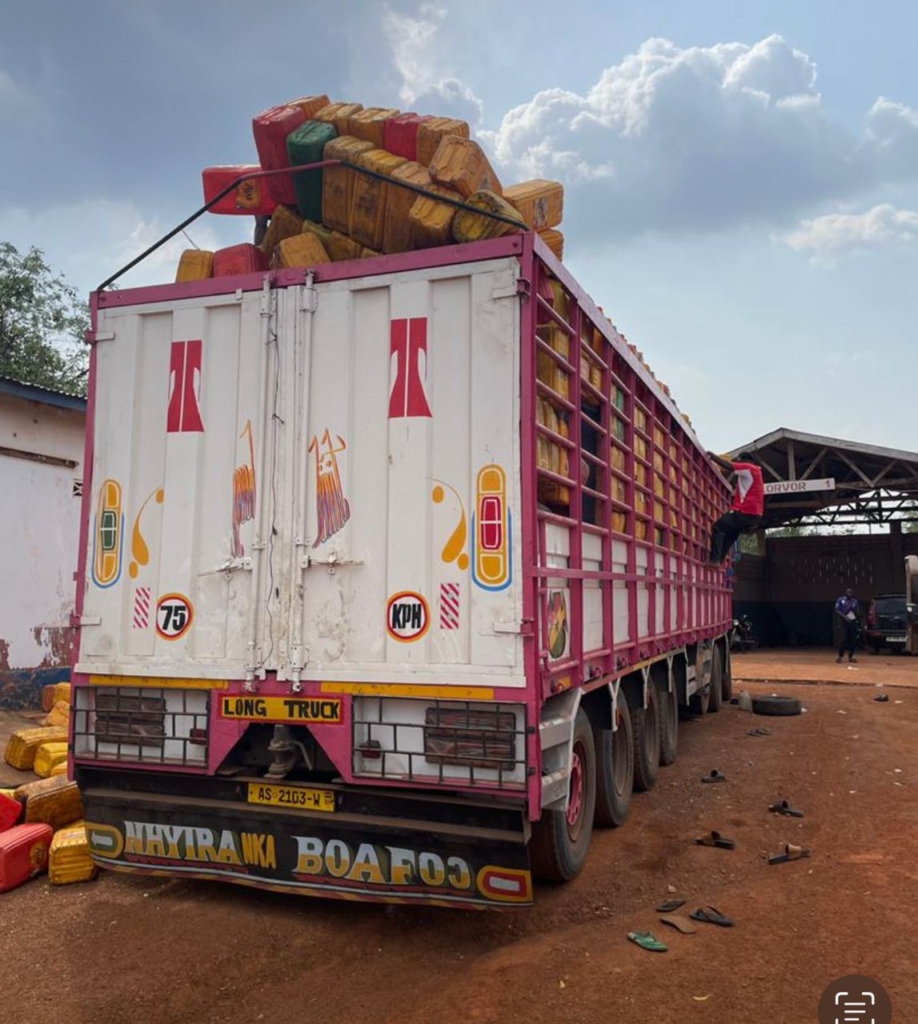
    He warned that Ghana’s cocoa sector is in crisis and called for urgent reform, competent management, and a new strategic direction.