Tag: COCOBOD

  • Opuni-Agongo Trial: COCOBOD Director ‘face off’ with Prosecution over cocoa yield dynamics

    Opuni-Agongo Trial: COCOBOD Director ‘face off’ with Prosecution over cocoa yield dynamics

    The Director of Research, Monitoring and Evaluation at COCOBOD has countered the prosecution’s attempt to attribute fluctuations in cocoa yields solely to the use of specific fertilisers, citing various factors influencing cocoa production.

    A former Executive Director of the Cocoa Health and Extension Division (CHED) of COCOBOD, Dr Francis Baah, testifying in the trial of former COCOBOD Chief Executive Dr Stephen Opuni and businessman Seidu Agongo, emphasized that cocoa yields can vary due to multiple factors, including weather conditions, farming practices, and fertiliser usage.

    During the trial, Dr Baah dismissed the notion of any single fertiliser being solely responsible for changes in cocoa production, clarifying that COCOBOD procures and utilises multiple fertilisers each season.

    In response to questions from counsel for Seidu Agongo, Dr Baah stressed the need for comprehensive studies before attributing cocoa yield changes to specific fertilisers.

    “Would your Monitoring & Evaluation Department blame any particular fertiliser for the rise, fall and or stagnation of cocoa production in any particular production year from 2013/14 till date?” he was asked.

    His response: “No! Unless there is a study or report to identify the culprit.”

    He also highlighted the complex nature of cocoa production, emphasizing the role of various environmental and management factors.

    Regarding the fluctuation in cocoa yields over recent years, Dr Baah reiterated that blaming any individual or fertiliser for these changes would be oversimplifying a complex situation.

    Dr Baah’s testimony sheds light on the intricate dynamics of cocoa production, challenging the prosecution’s singular focus on fertiliser usage.

    The trial proceedings will resume at the Accra High Court on April 8, 2024.

    Below is a transcript of an except of the cross according to theheraldghana.com

    Q. In 2021, the yield jumped to 1,047,384.94; that is correct?

    A. That is correct

    Q. The following year, 20211/2022, it fell by almost 40% to 683,268.94; that is correct?

    A. That is correct

    Q. Would it be right for anybody sitting anywhere to say that it was as a result of fertilisers that were bought by your chief executive in 2021/2022?

    A. That would not be the case; it is a combination of [a] myriad of factors.

    Q. Please explain to this honourable court why your chief executive for that year should not be blamed for the fall from 1,047,384.94 to 683,268.94.

    A. I would not blame my chief executive because he does not have any control over the elements and factors that determine production, including the world market price.

    Q. Will you attribute the fall in production from the 2020–2021 cocoa season to the 2021–2022 cocoa season to any fertiliser procured under the supervision of your Chief Executive at the time?

    A. I will not. The changes or the vagaries in production figures is impinged on, as I have explained before, by a basket of factors.

    Q. 2022/2023, it fell further to 656,139.87; that is true?

    A. That is true

    Q. Who do you blame for that?

    A. I am not in the position to blame anybody

    Q. Which fertiliser do you blame for that?

    A. I blame no input.

    Q. When you take out the production of 2022/2023, which is 656,139.87, from the production of 2016/2017, which is 969,510.69, you will get 313,370.82 metric tonnes; that is correct?

    A. That is correct.

    Q. Tell this honourable court, as far as you are aware, has anybody been held responsible for the two years of 2021/2022 and 2022/2023 for the production of cocoa?

    A. I don’t know of anybody being held responsible.

    Q. Would it be appropriate for the managers of COCOBOD for 2021/2022 and 2022/2023 to be held responsible for [the] fall in production when you yourself have said that production is a result of a basket of issues and that no agronomy practice, husbandry, or management can determine the production?

    A. I do not think it would be appropriate unless there is clear evidence of dereliction of duties on the part of any staff.

    Q. Can any particular fertiliser or chemical be held responsible for the fall that we have seen in 2021/2022 and 2022/2023?

    A. I do not think so.

  • COCOBOD hasn’t approved procurement of GHC4.5k  iPad keyboards – Management

    COCOBOD hasn’t approved procurement of GHC4.5k iPad keyboards – Management

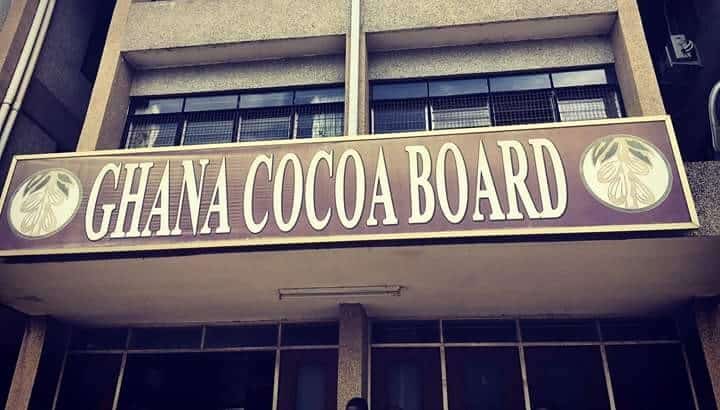
    Ghana Cocoa Board (COCOBOD) has responded to widespread concerns regarding a circulated memo proposing the procurement of iPad keyboards for its Board of Directors.

    The memo, originating from the Information Systems Department, sought approval for the purchase of iPad keyboards priced at Four Thousand Five Hundred Cedis (GH¢4,500.00) each for the board.

    This led to significant criticism both online and offline.

    However, in a statement released on April 1, 2024, COCOBOD management clarified that the memo was merely a proposal request and had not been authorized for procurement.

    It clarified that the request was made in light of adopting the “CONVENE” app to enhance productivity and reduce paper usage during board meetings.

    The statement emphasized that the request is still pending approval, and that no transactions have taken place.

  • Poor weather conditions adversely impacting cocoa production – COCOBOD

    Poor weather conditions adversely impacting cocoa production – COCOBOD

    The Public Affairs Manager of the Ghana Cocoa Board (COCOBOD), Fiifi Boafo, has attributed the decrease in cocoa production to adverse weather conditions.

    Boafo highlights the substantial impact of weather patterns on cocoa cultivation, particularly emphasizing heavy rainfall at the commencement of the cocoa season as a significant concern.

    While recognizing the necessity of rainfall for cocoa production, he underscores that excessive precipitation this season impeded the fruiting process, leading to a diminished harvest.

    Additionally, Mr Boafo points out the adverse effects of severe harmattan conditions on cocoa pods, exacerbating the situation further.

    Mr Boafo made these observations during a discussion on Ghana’s struggling cocoa industry on JoyNews’ PM Express on Wednesday, March 27.

    He indicated, “The major contributory factor for low cocoa production is the weather situation we’ve experienced this cocoa season. It started with a heavy rainfall. Then it got to a time where you expected the pods you had to develop for you to harvest then we experienced severe harmattan.

    “So this El Niño challenge is largely a contributory factor to the low production we experienced this year,” he told host Evans Mensah.

    Furthermore, Boafo draws attention to the prevalence of swollen shoot disease, which has affected approximately 590,000 hectares of cocoa farms in Ghana.

    He explains that these affected farms are currently under rehabilitation and not yielding cocoa beans.

    He noted, “At the moment, about 590,000 hectares of cocoa farms in Ghana have been affected by swollen shoot and so it is affecting production. Indeed, we are rehabilitating some of these affected farms. And since the only known solution is cutting the affected trees, all the affected farms are not fruiting at the moment“.

    Ghana, renowned as one of the world’s leading cocoa producers, has been contending with dwindling cocoa production in recent years.

    Challenges stemming from unpredictable weather patterns, illegal mining, and smuggling, among other factors, exacerbate the existing pressures on the industry, impacting both local and global markets.

    Currently, there is a global shortage of cocoa beans, leading to a significant surge in cocoa prices, with one tonne fetching an unprecedented $10,000.

    However, despite the price hike, Ghana may not reap substantial benefits due to the notable decline in cocoa production this year, as indicated by research.

  • Shrewd COCOBOD operators backing out of forward deals to leverage hike in cocoa prices – Bright Simons

    Shrewd COCOBOD operators backing out of forward deals to leverage hike in cocoa prices – Bright Simons

    Vice President of IMANI Africa, Bright Simons, has alleged that Ghana to sell a portion of its future cocoa production in exchange for securing loans.

    Taking to the X platform, he highlighted that the surge in cocoa prices, rising fourfold, has prompted some individuals within Ghana’s cocoa regulator, COCOBOD, to either cancel or renegotiate the existing forward contracts.

    According to Mr. Simons, these individuals seek to exploit the lucrative spot market prices, where cocoa can be sold immediately.

     He expressed concerns about the potential repercussions of such actions on Ghana’s future relationships with banks.

    Renegotiating contracts, he warned, could undermine trust and credibility with financial institutions, potentially affecting Ghana’s ability to obtain favorable loan terms in the future.

    “Ghana sells fwd some of its cocoa to collateralise loans. The price of cocoa has quadrupled, so some shrewd operators at Cocobod are looking to back out of various forward deals & squeeze the most out of the spot market. Shrewd, but what about future relationships with the banks?,” he added.

    Ghana, the world’s second-largest cocoa producer, sealed an $800 million loan deal towards the end of last year with a consortium of eight banks, led by Cooperatieve Rabobank UA.

    According to Bloomberg, sources familiar with the matter, who requested anonymity due to the sensitive nature of the issue, revealed that Cocobod lacks sufficient cocoa beans to support the final $200 million drawdown from the commodity-backed facility.

    A spokesperson for Cocobod, Fiifi Boafo, stated that it would not be “prudent” to pursue the additional drawdown. “Management has decided to avoid an overstretch in the repayment,” he added.

    Ghana’s funding woes coincide with an anticipated shortfall in the cocoa harvest for the 2023/24 season, projected to reach only about 422,500 to 425,000 tons—half of the initial forecast.

    Without timely payments from Cocobod, farmers risk being unable to afford essential resources like seedlings, chemicals, and fertilizers necessary for cultivating healthy crops.

    Traditionally, Cocobod conducts an investor roadshow between June and July each year, culminating in the signing of a syndicated facility agreement in September, just before the commencement of the new harvest season in October.

    However, complications arose last year due to Ghana’s debt restructuring, delaying negotiations until December.

    Consequently, Cocobod secured the loan at an unprecedented interest rate of 8%, much higher than previous rates. Originally slated for disbursement in January, the final tranche remains inaccessible.

    Among the participating banks in the syndicated loan were Standard Chartered Plc and Societe Generale SA, further complicating Cocobod’s financial predicament.

  • COCOBOD initiates transfer of 44,769 farms to beneficiary farmers in Cocoa sector

    COCOBOD initiates transfer of 44,769 farms to beneficiary farmers in Cocoa sector

    The Ghana Cocoa Board (COCOBOD) is preparing to transfer approximately 44,769 farms to more than 29,441 beneficiary farmers across the nation.

    This initiative, announced by COCOBOD’s Chief Executive, Joseph Boahen Aidoo, is designed to provide support to farmers within 51 cocoa districts.

    According to reports from the Daily Guide network, these farmers will receive assistance from students at the Bunso Cocoa College to establish their farms using products and knowledge gained from the college.

    Previously focused on training COCOBOD staff, particularly in extension and technical services, the Bunso Cocoa College has been revamped into a diploma-granting institution.

    This transformation aims to bolster the sustainability of the cocoa sector by equipping graduates with expertise in cocoa agronomy, traceability, sustainability, and other pertinent areas.

    A significant aspect of this overhaul is the establishment of the governing council of the Bunso Cocoa College. Comprising 10 members, including Chairman Dr. Ebenezer Owusu and Deputy Chief Executive Dr. Mercy Asamoah, this council seeks to enhance the institute’s governance framework.

    Additionally, it will supervise the creation of specialized training programs to furnish students with contemporary skills, benefiting both the learners and society as a whole.

  • Parliament raises concerns about COCOBOD’s projected loss of GHS2.6b

    Parliament raises concerns about COCOBOD’s projected loss of GHS2.6b

    Parliament has revealed that the Ghana Cocoa Board (COCOBOD) is projected to report a loss of GHS2.6 billion.

    This raises concerns because such a significant loss could make it challenging for COCOBOD to meet its loan payments on time.

    In a post shared by @StatsGH on X, “COCOBOD is expected to declare a loss of GHS2.6 billion. This raises concerns about possible challenges in meeting loan payments.”

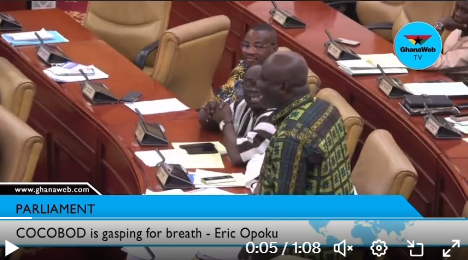
    In the aftermath of President Nana Akufo-Addo’s State of the Nation Address earlier this week, Eric Opoku, the Minority Spokesperson on the Food, Agriculture, and Cocoa Affairs Committee of Parliament, voiced his apprehensions about the deteriorating state of COCOBOD during an engagement with the media

    Opoku expressed concern about COCOBOD’s financial distress, stating, “Do you know in this country where COCOBOD is in distress? Is choked by debts? COCOBOD has been taking loans from the banks and they are unable to pay?”

    Contrary to President Akufo-Addo’s assertion in his State of the Nation Address that rice importation into Ghana decreased between 2021 and 2023, Eric Opoku contested this claim, stating, “The President created an erroneous impression that importation of rice in Ghana has been on the decline. That is not true.”

  • Vote NPP out of office for collapsing cocoa sector – Economist to farmers

    Vote NPP out of office for collapsing cocoa sector – Economist to farmers

    A Chartered Economist and member of the National Democratic Congress (NDC), Bernard Oduro Takyi (BOT), has urged farmers to oppose the New Patriotic Party (NPP) government in the upcoming 2024 elections, attributing the decline of the agriculture sector to their policies.

    BOT highlighted that government budget statements and data from the Ghana Statistical Service indicate a contraction in the agricultural sector since President Akufo-Addo assumed power.

    According to him, figures from the budget reveal that the agricultural sector experienced growth during the Mahama era but started to decline under Akufo-Addo‘s administration.

    Specifically pointing to the cocoa sector, BOT noted a significant downturn under Akufo-Addo, attributing it to the discontinuation of free fertilizers for cocoa farmers by the current government, emphasizing the negative impact on the sector.

    BOT also criticized the suspension of the Cocoa road projects initiated by the Mahama administration to rehabilitate feeder roads in Cocoa-growing areas, claiming that Akufo-Addo halted these projects to tarnish the image of the former COCOBOD boss, Dr. Opuni.

    He alleged that the government spent substantial amounts on an audit by Kroll and Associates yet failed to publish the report confirming the project as a clean contract.

    Encouraging cocoa farmers affected by the Akufo-Addo government’s policies to protest, BOT declared, “The cocoa sector has collapsed under President Akufo-Addo. Farmers should vote the NPP government out on December 7 as their way of expressing protest.”

    Additionally, BOT assured farmers that the cocoa road projects would resume under the next NDC/John Mahama government.

    The Chartered Economist made these remarks during an interview on Accra-based Power FM.

  • COCOBOD’s indebtedness will lead to its collapse – Minority warns

    COCOBOD’s indebtedness will lead to its collapse – Minority warns

    The Minority in Parliament has raised serious concerns about the potential collapse of the Ghana Cocoa Board (COCOBOD) due to its considerable indebtedness to banks.

    According to the Minority, COCOBOD’s 2024 budget anticipates a substantial loss of 2.6 billion Ghana Cedis, heightening fears of potential defaults on loan payments.

    Following President Nana Akufo-Addo’s State of the Nation Address earlier this week, Eric Opoku, the Minority Spokesperson on the Food, Agriculture, and Cocoa Affairs Committee of Parliament, voiced his apprehensions about the deteriorating state of COCOBOD in an interview with Citi News.

    Mr Opoku expressed concern about COCOBOD’s financial distress, stating, “Do you know in this country where COCOBOD is in distress? Is choked by debts? COCOBOD has been taking loans from the banks and they are unable to pay?”

    Furthermore, Opoku highlighted the challenges faced by workers, revealing that approximately 35,000 employees of the Produce Buying Company (PBC) are now unemployed due to the collapse of the firm.

  • Swift action needed to avert collapse of COCOBOD – Minority to govt

    Swift action needed to avert collapse of COCOBOD – Minority to govt

    The Minority in Parliament is expressing serious concerns about the potential collapse of the Ghana Cocoa Board (COCOBOD) as a result of its substantial indebtedness to banks.

    As indicated by the Minority, COCOBOD’s 2024 budget foresees a significant loss of 2.6 billion Ghana Cedis, raising worries about possible defaults on loan payments.

    In the aftermath of President Nana Akufo-Addo’s recent State of the Nation Address, Eric Opoku, the Minority Spokesperson on the Food, Agriculture, and Cocoa Affairs Committee of Parliament, conveyed his concerns about COCOBOD’s precarious financial situation in an interview with Citi News.

    Opoku expressed apprehension about COCOBOD’s financial distress, stating, “The President created an erroneous impression that importation of rice in Ghana has been on the decline. That is not true.”

    Contrary to President Akufo-Addo’s claim in his State of the Nation Address that rice importation into Ghana decreased between 2021 and 2023, Eric Opoku disputed this assertion, saying, “The President created an erroneous impression that importation of rice in Ghana has been on the decline. That is not true.”

    Additionally, Opoku highlighted the challenges faced by workers, revealing that approximately 35,000 employees of the Produce Buying Company (PBC) are now unemployed due to the collapse of the firm.

  • Cocoa output plummets 40%, fueling record-high prices in 2023/24

    Cocoa output plummets 40%, fueling record-high prices in 2023/24

    Sources from Ghana’s cocoa sector regulator, COCOBOD, indicate that the anticipated cocoa output for the 2023/24 season is likely to significantly miss expectations, with an estimated 40 percent shortfall from the target of 820,000 metric tons.

    Contributing factors to this decline include adverse weather conditions, smuggling activities, illegal gold mining, and the prevalence of swollen shoot disease.

    Expressing concerns over the production shortfall, the first source informed Reuters that strong seasonal winds and insufficient rainfall have worsened the situation, with the current output forecasted to be around 500,000 tons for the season.

    Addressing the challenges, the source noted, ‘Unfortunately, the cause of the decline could not be remedied immediately through human intervention.’

    In the preceding 2022/23 season, COCOBOD reported a loss of approximately 150,000 tons of cocoa attributed to smuggling and illegal gold mining, locally referred to as galamsey. Additionally, the regulator revealed earlier this month that the cocoa swollen shoot virus had ravaged around 500,000 hectares of cocoa farmlands.

    Efforts to address these production challenges are underway, according to the first source, who cited ongoing farm rehabilitation projects, the commencement of the rainy season, and collaborative endeavors with security agencies to combat smuggling activities.

    Despite the current challenges, the second source maintains optimism regarding Ghana’s potential for production recovery. However, COCOBOD did not provide comment on the matter.

    The decrease in cocoa production from both Ghana and Cote d’Ivoire, alongside mounting deficits, has propelled global cocoa prices to unprecedented levels.

    Traders are grappling with heightened demand and pricing volatility, with London cocoa futures surpassing the psychological threshold of £5,000 and New York cocoa breaching the $6,000 mark.

    The surge in cocoa prices is starting to impact retail markets, with chocolate manufacturers like Hershey anticipating a slowdown in consumer demand due to rising costs.

    Samuel Adimado, president of Ghana’s cocoa buyers group, described the current production forecast as ‘devastating,’ noting that member firms are adjusting their operations to remain viable amid these challenges.

    Highlighting the alarming trend, the first source emphasized that escalating global cocoa prices have incentivized smuggling activities, potentially leading to even greater losses in the current season.

  • Opuni trial: Court finds out how Adu-Ampomah hid positive test result on lithovit

    Opuni trial: Court finds out how Adu-Ampomah hid positive test result on lithovit

    In court, it was revealed that the COCOBOD Committee, chaired by Dr. Yaw Adu-Ampomah, was formed after the Economic and Organised Crime Office (EOCO) informed him that a test by the Ghana Standards Authority (GSA) had confirmed lithovit as a fertilizer.

    This committee, which did not invite the accused, Dr. Stephen Opuni and Seidu Agongo, based its findings on disputed reports, excluding the positive GSA test result. The EOCO investigation, however, was ongoing during the committee’s work.

    The EOCO investigation, led by Mr. Paul Agyei Gyang, included a positive GSA test result, known to Dr. Adu-Ampomah, who was then the Deputy Chief Executive of COCOBOD. Despite this, the COCOBOD committee, formed in 2017, did not consider this information.

    Mr. Gyang confirmed that the first negative GSA test was done in an inappropriate department, leading to a second test in the correct department, which confirmed lithovit as a fertilizer. This discrepancy in test results was not addressed by the COCOBOD committee.

    Seidu Agongo rejected the first test result and requested a second test, which confirmed lithovit’s status as a fertilizer. This information was not shared with the COCOBOD committee, leading to questions about the committee’s findings and process.

    Overall, the revelations in court raise concerns about the handling of the lithovit case and the credibility of the COCOBOD committee’s report.

    The head of the Material Science Department of GSA, Mrs Baah Mantey, wrote in her statement to investigators that, from the second scientific report, “the results revealed that that sample contained some amounts of nitrogen, phosphorus and potassium, and so the sample was identified as fertilizer.”

    “Please tell the court if you know. Was the complainant informed about the result of the second test?” Benson Nutsukpui asked the EOCO investigator.

    “Yes, my Lord, as I told the court about the people, he himself was equally informed,” the witness replied.

    Read excerpts of the proceedings on February 21, 2024

    Q. Who was the complainant in the matter that was brought before EOCO?

    A. My Lord, if my memory serves me right, deputy chief executive in charge of agronomy and quality control. In the person of Dr. Adu Ampomah.

    Q. When you said that your executive director had discussions with the deputy chief executive- agronomy and quality control- on the second test, who was that person who was the deputy chief executive- agronomy and quality control- at COCOBOD then?

    A. My Lord, it is Dr Adu Ampomah

    Q. You also told this court that after you received the second report, the directorate brought the scientists together; that is correct?

    A. Yes, my Lord, that is correct.

    Q. Who else was in this discussion with the scientists?

    A. My Lord, the head of the chemistry department of the University of Ghana

    Q. And any other person?

    A. That is all I can remember for now.

    Q. Sir, did the directorate of EOCO have the occasion to communicate this second test to other interested parties?

    A. My Lord, if anything of that happened, it should be at the management level of which I may not be privy.

    Q. Please tell the court if you know. Was the complainant informed about the result of the second test?

    A. Yes, my Lord, as I told the court about the people, he himself was equally informed

    Q. Was he invited?

    A. Yes.

    Q. To where?

    A. To EOCO office.

    Q. What was he invited to the head office for?

    A. My Lord, as an interested party, it was only reasonable that management invited him to let him know what the results were

    Q. Sir, cast your mind back, this invitation to Dr. Adu Ampomah, was it on or before your meeting with the scientists?

    A. I think initially, the scientists were invited to explain the reason they had two different results. I think thereafter, some few days or so, he was also invited.

    Q. Can you recall around what date the scientists were invited?

    A. It’s unfortunate, my Lord, I can’t recall

    Q. Please look at exhibit H, page 3, just at the top, the first two lines, the executive summary; it says that a committee was constituted in October 2017; that is correct?

    A. Yes, my Lord.

    Q. Please what date was that committee constituted?

    A. From the report October 4, 2017.

    Q. As of October 4, 2017, this matter was under investigation by EOCO

    A. Yes, my Lord.

    Q. Tell this court on that date, October 4, 2017, did you receive the second report of the testing at EOCO?

    A. Yes, My Lord, the second report came in somewhere in June or July 2017

    Q. Sir, what is the date of that report exhibit 133?

    A. July 26, 2017.

    Q. So, as of October 4, 2017, EOCO has received this report?

    A. Yes, my Lord

    Q. And also discussed it with the scientists as of October 4, 2017

    A. Yes, my Lord

    Q. From the nature of the operations of EOCO how long after July 26, 2017, EOCO would have to inform the interested parties the results of the second test?

    A. By our operations, as soon as the report comes, parties have to be informed.

    Q. So tell this court by October 4, 2017, was Dr Adu Ampomah informed about the result of the second test?

    A. I believe so, my Lord.

    Q. You have exhibit H, look on the cover; it is dated November 7, 2017; that is correct?

    A. Yes, my Lord, that is correct.

    Q. Look at page 106 of Exhibit H. The two reports from the standards authority and the University of Ghana, which concluded that Lithovit they examined did not have the necessary ingredients are in that report, which is Exhibit H; that is true?

    A. Yes, my Lord, it is true

    Q. Take some few minutes and glance through and see if the report exhibit 133 A2/A3 (the second test result from Ghana Standards Authority) is in it or captured in exhibit H

    A. My Lord, after having a cursory look at the document, it is not there; I only found the first report from Ghana Standards Authority, which was forwarded to EOCO on June 5, 2017, and another cover letter from the University of Ghana Chemistry Department.

    Q. After your cursory look at exhibit H, you found that exhibit 133 is not in it; that is correct?

    A. Yes, my Lord, exactly so.

    Q. And look at page 3 of Exhibit H, and tell this honourable court who is the chairman of the committee that produced Exhibit H?

    A. My Lord, Dr Adu Ampomah, deputy chief executive- agronomy and quality control- was the chairman.

    Q. At all times that EOCO was doing [an] investigation into this matter, who was their contact point, or who were they reporting to at COCOBOD?

    A. Dr Adu Ampomah.

    Q. Tell this honourable court if, back in 2017, you personally or the investigative team knew about the existence of this committee.

    A. My Lord, I’m for the first time hearing of this committee. I can’t tell if management was informed.

    Q. EOCO handed over the docket to the police in June 2018. Is that the case?

    A. My Lord, the docket was handed to the police, but I can’t remember whether June or July.

    Q. But can you remember the year?

    A. Somewhere in 2018 or 17, there about,

    Q. Yesterday, we talked about the investigator’s statement you wrote. Was the handing over the docket earlier or after the investigator’s statement you wrote?

    A. My Lord, the statement was together with the docket.

    Q. If I told you that your statement was written on June 15 2018, when would you have handed over the docket?

    A. 2018, my Lord

    Q. By the time you were handing over the docket to the police, did EOCO receive that report, exhibit H on EOCO’s file?

    A. My Lord, the investigative team did not receive anything like that; I don’t know if management did.

    Q. By the mode of operations in EOCO, if management received a copy, would it be minuted down to the investigating team?

    A. Exactly so, my Lord.

    Q. What documents were handed over to the police from EOCO?

    A. My Lord, we had directive to hand over all dockets involving COCOBOD cases of which this docket was part, and in this docket, complainant, witnesses and suspects and all relevant documents which we have gathered, including test reports, i.e. the three test reports received from the scientists.

    Q. So, EOCO would consider exhibit 133 relevant on the docket?

    A. yes, my Lord, you are right.

    Q. On March 15, 2021, under cross-examination, Mr Thomas Prempeh Mercer told the court that the docket that the police received had only two test reports, the ones that had only negative results. Would that be correct?

    A. My Lord, I would be surprised.

    Q. I know you would be surprised, but I’m asking if EOCO did not give the police exhibit 133.

    A. My Lord, the report was inclusive

    Q. Mr Thomas Prempeh Mercer indeed admitted reading your investigator’s statement; tell this honourable court: did he or anybody on the police investigative team contact you to find out about exhibit 133, which you wrote about in your statement?

    A. No, my Lord, nobody contacted me.

    Q. From June 2018 till today, you have remained in the employment of EOCO that is correct?

    A. Yes, my Lord.

    Q. Has your office sent you any signal or notice to request an explanation as to why exhibit 133 not being on the police docket?

    A. My Lord, nobody has contacted me.

    Q. In the normal cause of investigation, an investigator’s statement, which you wrote, would be the beginning of the investigative work of the one taking over

    A. Yes, my Lord, you are right

    Q. And in normal investigative work, if you wrote about another test result and if it can’t be found, you would be contacted. That is also true?

    A. Ye, my Lord.

    Q. Can you explain how come you were never contacted in respect of investigations you did and exhibit 133?

    A. My Lord, it would be very difficult for me to explain

    Q. Tell this court what is your impression about this development in relation to exhibit 133 that I have taken you through this morning?

    A. My Lord, as I have told this court, I’m only surprised, but I can’t explain

    Q. Sir, EOCO took statements from a lot of people; that is correct?

    A. That is correct.

    Q. Sir, cast your mind back to [the] file you took statements from people?

    A. Yes, my Lord, a lot of people.

    Q. And it included farmers?

    A. Yes, my Lord.

    Q. Would the name Obeng Emmanuel or Emmanuel Obeng come to mind?

    A. The name I might have forgotten, but we had interactions with farmers

    Q. Do you remember the number of farmers you took statements from?

    A. The farmers we took statements from, we had them through Dr. Adu Ampomah

    Q. When you say you had them through Dr Adu Ampomah, what exactly do you mean?

    A. It means my Lord, he mentioned them as those people we could contact

    Q. Did the investigative team make any request to A2 and A3 to bring you farmers who used the product?

    A. My Lord, I don’t think we did

    Q. Apart from Dr. Adu Ampomah’s witnesses, did the investigative team find farmers on your own to question about the product?

    A. I think so

    Q. Can you remember how many you got?

    A. My Lord, two or three

    Q. Did you take statements from them?

    A. Some we contacted said they were scared to give statements, some did not give statements. We had statements from about two or three, if my memory serves me right

    Q. Can you remember whether two or three were the ones you got through Dr Adu Ampomah or not?

    A. My Lord, I can’t remember

    Q. As an investigative team, how often are your meetings with Dr Adu Ampomah?

    A. My Lord, as the deputy executive director in charge of agronomy and quality control, most of the time, he was dealing directly with the executive director of EOCO; we would only go there when there was the need and directives given to us

    Q. How many times did you have directives as an investigative team you went there as an investigative to meet Dr Adu Ampomah during the course of this investigation?

    A. My Lord, we were not dealing with this case; we were dealing with about 8 different dockets involving COCOBOD, so when there is a directive to meet him on any of those dockets, we did, not only on this docket.

    Q. On all these, how often would you say during the course of the investigation you were seeing Adu-Ampomah?

    A. My Lord, I can’t remember.

    Q. Of the 8 cases that you were investigating, how many are being prosecuted?

    A. I can’t be very sure about it.

    Q. But this is the only one you [know] at this time?

    A. For that matter, this is the only one I know.

    Q. Do you know whether DSO Akrasi gave a statement to the police?

    A. My Lord, he was invited to assist the new team which took over from us, so I won’t be surprised if he gave a statement.

    Q. If he did, in whose custody would it be?

    A. It would be in the custody of the police.

    Q. Would EOCO have a copy?

    A. I can’t tell my Lord.

    Q. Would Akrasi report to EOCO his involvement with the police team?

    A. Yes, my Lord, he has to report to EOCO

    Q. And would you, as the team leader, be briefed on it?

    A. My Lord through the briefing that is why I got to know that he was invited to assist the police

    Q. On February 8 2021, Chief Inspector Prempeh told the court that he had a petition to investigate this matter and that the petition was signed by the Senior Minister, Hon. Yaw Osofo Marfo. Did EOCO also receive a petition to deal with this matter

    A. No, my Lord.

    Q. After you gave your statement and handed over the docket, were you ever involved in the investigation on lithovit fertilizer?

    A. No, my Lord

    Q. Was EOCO, your institution, involved in any further investigation on this matter?

    A. No, my Lord, EOCO was not involved

    Q. Is there anything else you know about this investigation that I have not asked you about?

    A. No, my Lord

    Benson: My Lord, that would be all for the witness
  • Ghana’s cocoa production for 2023/24 season to fall by 40% – Report

    Ghana’s cocoa production for 2023/24 season to fall by 40% – Report

    Ghana’s cocoa sector is facing a significant setback in the 2023/24 season, with an expected 40% drop in cocoa output compared to the target of 820,000 metric tons.

    The decline is attributed to adverse weather conditions, smuggling, illegal gold mining, and the prevalence of the cocoa swollen shoot disease.

    A source from Ghana’s cocoa regulator, COCOBOD, according to JoyNews, informed Reuters that strong seasonal winds and inadequate rainfall have worsened the situation, with the projected output for the season now around 500,000 tons. The source expressed concern, stating that immediate human intervention cannot remedy the decline.

    In the previous season (2022/23), COCOBOD reported a loss of approximately 150,000 tons due to smuggling and illegal gold mining. The cocoa swollen shoot virus also devastated about 500,000 hectares of cocoa farmlands.

    Efforts are underway to address these challenges, including farm rehabilitation projects, the onset of the rainy season, and collaboration with security agencies to curb smuggling.

    Despite the current challenges, there is optimism about Ghana’s potential for production recovery. However, COCOBOD was not available for comment.

    The decline in cocoa production from both Ghana and Cote d’Ivoire has led to global cocoa prices reaching record highs. Traders are experiencing increased demand and pricing volatility, with London cocoa futures exceeding £5,000 and New York cocoa surpassing $6,000.

    The rise in cocoa prices is starting to impact retail markets, with chocolate manufacturers like Hershey expecting a slowdown in consumer demand due to higher costs.

    Samuel Adimado, president of Ghana’s cocoa buyers group, described the production forecast as ‘shattering,’ noting that member firms are adjusting their operations to cope with the challenges.

    Highlighting the alarming trend, the source emphasized that the higher global cocoa prices have incentivized smuggling, potentially leading to even greater losses in the current season.

  • COCOBOD CEO emphasizes competitive prices as key solution to cocoa smuggling

    COCOBOD CEO emphasizes competitive prices as key solution to cocoa smuggling


    Joseph Boahen Aidoo, the Chief Executive Officer (CEO) of the Ghana Cocoa Board (COCOBOD), emphasized the organization’s dedication to providing cocoa farmers with competitive prices as a means to combat cocoa smuggling.

    During his appearance before the Public Accounts Committee (PAC) of Parliament on Tuesday to address infractions highlighted in the Auditor-General’s Report for the year ending December 2022, Mr. Aidoo highlighted the effectiveness of COCOBOD’s collaboration with national security agencies in combating the issue. However, he stressed that offering favorable prices remains the most effective long-term solution.

    According to Aidoo, ensuring good cocoa prices would act as a deterrent for farmers involved in smuggling Ghana’s cocoa to neighboring countries.

    “We have made a lot of arrests. We have arrested people smuggling cocoa in jerrycans among others. But that will not solve the problem. The solution is bringing a new price,” he stressed. 

    In 2023, Ghana allegedly lost approximately 150,000 metric tonnes of cocoa beans, amounting to around $600 million in revenue during the last crop season, due to smuggling activities to neighboring Burkina Faso and Togo.

    In September of the same year, the government raised the purchase price of a bag of cocoa from GH¢800 per 64 kilograms (kg) to GH¢1,308.

    From GH¢12,800 per tonne to GH¢20,943 per tonne of raw cocoa beans, represents a 63.5% increase.

  • COCOBOD reports loss of 150,000 metric tonnes of Cocoa to smuggling in 2023

    COCOBOD reports loss of 150,000 metric tonnes of Cocoa to smuggling in 2023

    The Ghana Cocoa Board informed Parliament’s Public Accounts Committee that the company suffered a loss of over 150,000 metric tonnes of cocoa beans due to smuggling in 2023.

    Joseph Boahen Aidoo, the CEO of COCOBOD, disclosed this during his appearance before the committee on Tuesday morning.

    Aidoo further stated that cocoa production has declined as a result of illegal mining activities (galamsey) and disease outbreaks. To tackle these challenges, COCOBOD is working in collaboration with national security and other stakeholders, as well as implementing farm rehabilitation programs.

    However, minority members of the Public Accounts Committee are calling for the immediate resignation of Joseph Boahen Aidoo, citing his alleged inability to address the current challenges facing the institution.

    Ibrahim Murtala Muhammed, Member of Parliament for Tamale Central, questions why officials, including President Akufo-Addo and the CEO of COCOBOD, continue to hold their positions.

    “As the country that produced the highest quality of cocoa, even at a point in time we were producing more cocoa than the Ivory Coast. And it got to a stage that Ivory Coast overtook us, this is what happens, it’s always like a twin relationship, sometimes we overtake them, sometimes they overtake us. One thing that they have never overtaken us is the quality of the cocoa that we produce. Why is it that we are no longer producing the highest quality of cocoa?”

    When told that officialdom attribute the decline in fortunes to galamsey, Murtala sharply disagreed.

    “What galamsey? The issue of galamsey didn’t start today, and I remember as a member of COCOBOD, issues came up and that was the reason why, frontally, under the leadership of Dr. Opuni and President Mahama it was fought frontally. I will not say we didn’t have galamsey, but the level of havoc that galamsey was causing to our cocoa is not as it is today.

    “This President, indeed told everybody, that galamsey should be used as the only standard to determine whether he should continuously be in office or not, and he said that he was putting his presidency on the line. Today, every independent institution, including state institutions have admitted that galamsey is worse off. So this man should not be in office, he is unfit for remaining in office,” he said of President Akufo-Addo.

    “If you have a chief executive of an institution such as the Cocoa board who admitted on national television that he has failed, why should he continuously be in office? Because if you say that, yes, smuggling has been a problem. It was so much last year and this year it has escalated, what then is your responsibility? Your responsibility is to find solutions and everything he said today is about blaming others for the problems.”

  • Decline in global cocoa price caused loss of GHS2bn in 2021 – COCOBOD

    Decline in global cocoa price caused loss of GHS2bn in 2021 – COCOBOD

    The Chief Executive of the Ghana Cocoa Board (COCOBOD), Joseph Boahen Aidoo, has attributed the organization’s GH¢2 billion loss in 2021 to the decline in the international market price of cocoa.

    He highlighted that the global cocoa price had witnessed a substantial decrease of over 30% in recent years, contributing significantly to the incurred losses.

    During his appearance before the Public Accounts Committee (PAC) in Accra on Tuesday, Mr. Aidoo discussed the measures being explored to recover from these losses and restore profitability.

    He reassured the committee that comprehensive plans are in progress to address the challenges arising from the declining cocoa prices, with strategies being implemented to mitigate further financial setbacks.

    Mr. Aidoo emphasized the impact of the international market price on COCOBOD’s financial situation, stating, “Chairman we are on the path of a turnaround. COCOBOD’s financial situation is dictated by the international market Price, that’s the world cocoa price, and we all know that from 2017 to the date in question, the price of cocoa in the world market has collapsed by 30%. And in 2020 that is also when we had our highest production.

    “So when prices collapsed at the time when we had increased yield. That is the direct cost and inventory go up whereas the revenue generated goes down.

    “That is what explains the huge deficit for the particular year. Essentially yes we had record production, the prices at the international market did not favour us,” he stated.

  • COCOBOD to allocate part of $200M World Bank loan to recover cocoa-swollen shoot virus-infested plantations

    COCOBOD to allocate part of $200M World Bank loan to recover cocoa-swollen shoot virus-infested plantations

    Ghana’s Cocoa Board (COCOBOD) plans to utilize a portion of a $200 million World Bank loan to restore plantations devastated by the cocoa swollen shoot virus, which leads to decreased yields and tree fatalities, according to the regulator’s Deputy Chief Executive in charge of operations.

    The disease has decimated approximately 500,000 hectares of farmland and diminished cocoa production in the West African nation, which is the world’s second-largest cocoa producer after its neighbor Ivory Coast.

    Ghana’s cocoa output fell to 600,000 metric tons last year, down from a peak of 1.048 million tons in the 2020/21 season, due to the cocoa swollen shoot virus, aging plantations, illegal mining, and smuggling, which have all had a negative impact on the sector.

    A project information document indicates that a total of $132.8 million from the loan secured by the government last year, along with counterpart funding, will be used by Cocobod to rehabilitate farms and enhance knowledge about the virus strains.

    “The rehabilitation will take a minimum of five years to start getting economic production,” Cocobod’s Emmanuel Opoku told Reuters, adding that efforts had been hampered by the country’s economic crisis and the board’s limited funds.

    The board will intervene by taking control of disease-infected farms, removing and replacing sick cocoa trees, nurturing them to a fruiting stage, and then returning them to farmers.

    In 2018, COCOBOD utilized a portion of a $600 million Africa Development Bank (AfDB) loan to revitalize aging plantations and those impacted by the disease.

    However, the program, originally intended to cover 156,000 hectares of plantations, was affected by Ghana’s most severe economic crisis in a generation, marked by soaring inflation and sharp depreciation of the cedi currency, Opoku explained.

    He mentioned that the AfDB initiative benefited over 88,000 hectares of farmland, with 40,000 hectares set to be returned to farmers in the “coming days.”

    Alhassan Bukari, president of the country’s Cocoa, Coffee, and Sheanut Farmers’ Association, emphasized the need for aggressive rehabilitation efforts, as many farmers have been affected.

    Ghana’s graded and sealed cocoa arrivals dropped by 35% between the start of this season on September 1 and January 31 this year due to the intensity of the seasonal dry Harmattan wind and what COCOBOD described as production challenges.

  • COCOBOD to rebuild disease-infested cocoa farms with parts of  $200m loan World Bank loan – Management

    COCOBOD to rebuild disease-infested cocoa farms with parts of $200m loan World Bank loan – Management

    The Ghana Cocoa Board (COCOBOD) plans to utilize a portion of a $200 million World Bank loan to revitalize cocoa farms affected by disease in the country.

    Last year, Ghana’s cocoa production experienced a significant drop to 600,000 metric tons from 1.048 million tons in the 2020/21 season.

    The decline is attributed to various factors, including the widespread cocoa swollen shoot virus, aging plantations, and illegal mining and smuggling activities in the sector.

    The cocoa swollen shoot virus has affected not only Ghana but also other cocoa-producing regions globally, leading to the loss of approximately 500,000 hectares of farmland and reducing cocoa output in the world’s second-largest cocoa producer.

    “The board will take over disease-infested farms, cut and replace sick cocoa trees, aiding growth to a fruiting stage before handing them back to farmers.”

    Deputy CEO of COCOBOD, Dr Emmanuel Opoku, mentioned that the World Bank loan would be used to rehabilitate plantations impacted by the cocoa swollen shoot virus.

    The initiative involves taking over disease-infested farms, replacing sick cocoa trees, and nurturing them to a fruiting stage before returning them to farmers. The rehabilitation process is anticipated to span six years, with a minimum of five years to start economic production.

    Last year, the government secured $132.8 million of the loan, and the counterpart funding will support COCOBOD’s farm rehabilitation efforts and contribute to advancing knowledge about the virus strains. COCOBOD’s Emmanuel Opoku emphasized that the rehabilitation process is a long-term endeavor, requiring patience as it takes a minimum of five years to achieve economic production.

  • 87% of cocoa road contracts since 2020 were awarded through a non-competitive process – Auditor-General

    87% of cocoa road contracts since 2020 were awarded through a non-competitive process – Auditor-General

    The Auditor-General has disclosed that a significant portion, 87%, of road contracts within the Cocoa Road Improvement Programme (CRIP II) between 2015 and 2021 were awarded through “non-competitive routes.”

    This approach led to higher construction costs compared to contracts awarded through competitive tendering, as outlined in the June 2023 Performance Audit Report on Cocoa Road Construction during the specified period.

    During CRIP II, the Ghana Cocoa Board (COCOBOD) awarded a total of 266 road contracts, covering a combined length of 4,100km for rehabilitation, upgrading, and construction in cocoa-growing areas. Among these contracts, only 33 underwent competitive bidding, while 175 were awarded through single-source procurement, and 58 through restricted tendering, indicating a significant reliance on non-competitive procurement methods.

    The report highlighted that the reasons provided by COCOBOD for utilizing these procurement methods did not align with the requirements of the Public Procurement Act. Additionally, it noted that while some positive outcomes were achieved with completed cocoa roads, there were areas requiring improvement to ensure the Programme’s sustainability.

    One key issue identified was the lack of prioritization of road projects under CRIP II to match the available funding. Although COCOBOD sought input from subsidiaries and the Department of Feeder Roads to identify critical roads, proper prioritization processes were not evident. As a result, more road projects were implemented than the budget for CRIP could support.

    Furthermore, the estimates used by COCOBOD for cocoa road projects were deemed inadequate for implementation, being based on line diagrams rather than detailed designs. This led to significant variances between estimated costs and contract sums, ranging from 4.68% to 99.7%.

    Inspections revealed defects in completed roads, such as potholes, disintegrating surfaces, and cracks in concrete drains. Consultants failed to visit project sites regularly and issued only a few defect notices to contractors without adequate follow-up for rectification, as noted in the report.

    “The consultants cited non- payment of fees by COCOBOD as the reason for their inadequate supervision,” it said.

    The delays in road works under CRIP I and CRIP II were attributed to COCOBOD’s failure to make timely payments to contractors, according to the audit report. Additionally, the Board did not have alternative funding plans to address payment gaps, nor did it ensure contractors worked diligently to meet project deadlines.

    To address these issues, the report recommended that COCOBOD develop and implement a detailed plan and strategy to prioritize road projects based on factors such as budget, road conditions, and cocoa production areas. It also suggested that the General Services Department of the Board consult with the Ghana Highway Authority and the Department of Feeder Roads to make appropriate adjustments to estimates when budgeting for the program to ensure adequate resource allocation.

    Furthermore, the report recommended that COCOBOD seek expert advice to analyze procurement options and ensure better value for money. It also advised prioritizing supervision of road works and providing necessary resources to consultants for active supervision and rectification of defective works.

    “COCOBOD should suspend awarding new contracts until all existing contracts are completed and paid for,” it added.

    To address the challenge of poor road conditions in cocoa-growing areas, the Government initiated the Cocoa Road Improvement Programme (CRIP) in 2015.

    This collaborative effort involved the Ministry of Roads and Highways, with COCOBOD serving as the implementing agency and financier. The primary goal of the program is to enhance 2,900km of roads to facilitate the efficient and rapid transportation of cocoa beans from farms to purchasing centers and seaports.

    This initiative aims to minimize post-harvest losses in the cocoa sector.

  • Parliament to investigate debt owed cocoa roads contractors 

    Parliament to investigate debt owed cocoa roads contractors 

    Speaker of Parliament, Alban Bagbin, has unveiled plans to establish a high-powered committee to investigate the issue of unpaid arrears to cocoa road contractors.

    Bagbin revealed that he has received numerous petitions from both cocoa road contractors and contractors associated with the Roads and Highways Ministry concerning the government’s prolonged delay in disbursing their outstanding payments.

    The Concerned Cocoa Road Contractors Association of Ghana has expressed frustration over the government’s failure to settle debts owed to them for their work on various roads throughout the nation.

    Bagbin proposed the formation of a committee to thoroughly investigate the matter and emphasised the importance of enhanced collaboration between both parliamentary caucuses in addressing this issue.

    “I have received many petitions from contractors regarding non-payment of their labour, a lot of arrears from both COCOBOD and Roads and Highways. In fact, I propose setting up a high-powered committee to investigate that matter because it is very important.”

  • Our mass sprayers have not become impotent, blind – COCOBOD

    Our mass sprayers have not become impotent, blind – COCOBOD

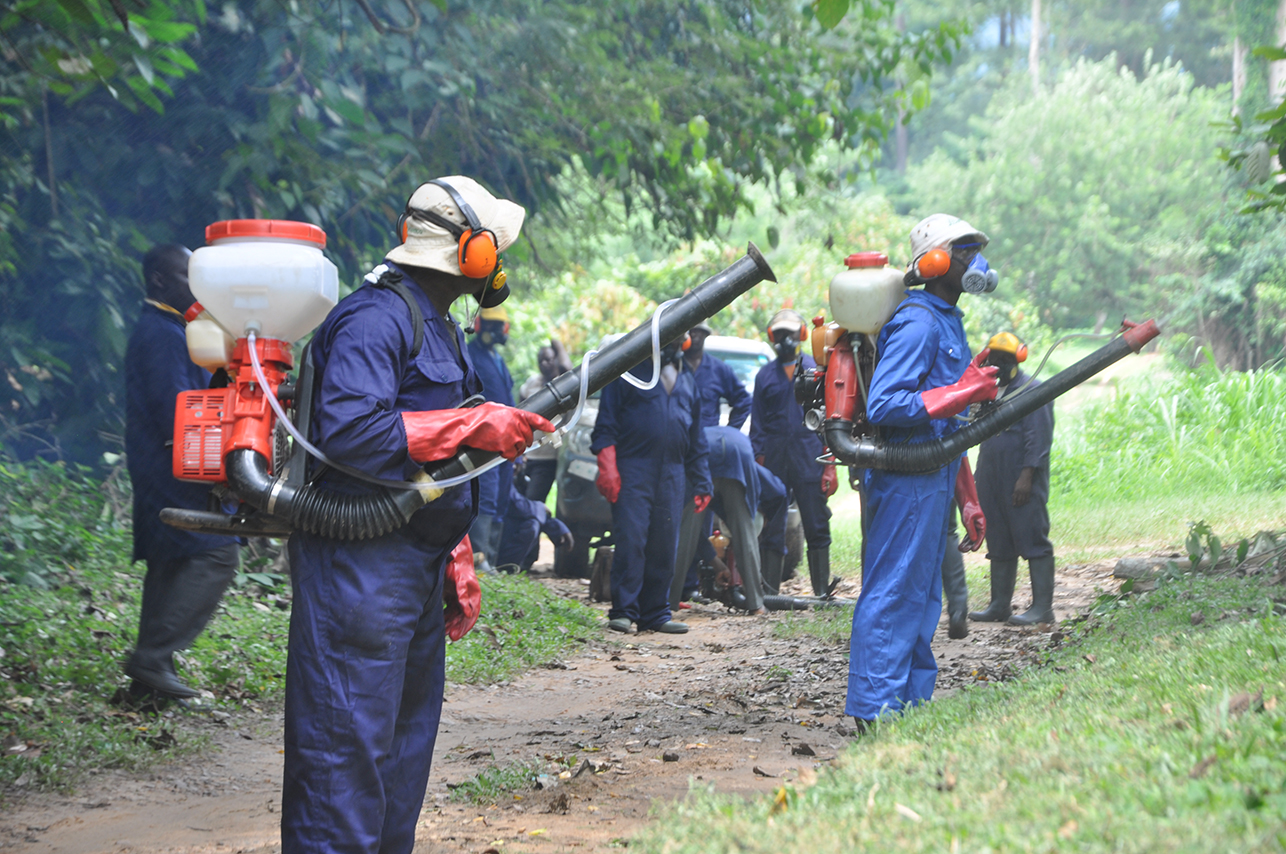
    The Ghana Cocoa Board (COCOBOD) has dismissed allegations of neglecting to provide essential medical care to its contracted mass cocoa sprayers in response to concerns raised by the Ghana National Association of Cocoa Farmers regarding the adverse health effects of agrochemical exposure.

    Addressing these concerns, the head of the Public Relations Department at COCOBOD, Fiifi Boafo, clarified in an interview with Citi News that the board regularly conducts medical check-ups for contracted farmers engaged in cocoa spraying.

    Contrary to the claims made by the cocoa farmers’ association, Boafo refuted the allegations, asserting that the Cocoa Clinic has not encountered any cases exhibiting symptoms such as blindness or impotence among the contracted sprayers.

    “We find it a bit surprising to hear these complaints because these are not complaints that we are aware of.”

    “Let me put on record that for the spraying of cocoa farms, COCOBOD hires over 57,000 people every year who help the farmers with the spraying of their farms across the country. These persons, at the end of every session, apart from the fact that COCOBOD Research Institute goes round the country and takes samples and does an evaluation of the spraying that is done for the farmers, we also take some of them to the Cocoa Clinic for examination.

    “So allegations that some people are suffering impotency and blindness are not things that the Cocoa Clinic has identified,” Mr Boafo said.

  • GRA dismisses claims of auctioning COCOBOD’s agrochemicals, fertilizers

    GRA dismisses claims of auctioning COCOBOD’s agrochemicals, fertilizers

    The Ghana Revenue Authority (GRA) has dismissed claims suggesting it is auctioning agrochemicals, fertilizers, and related items due to COCOBOD’s alleged failure to pay duties.

    The GRA labeled such reports as deceptive and urged the public to disregard them.

    In an official statement, the GRA clarified that the agrochemicals and other items were initially imported by COCOBOD, overstayed at the State Warehouse, and were consequently placed on the Uncleared Cargo List (UCL).

    “Management of the Ghana Revenue Authority (GRA) has sighted a publication in the Herald newspaper on “GRA auctioning COCOBOD’s chemicals, fertilizers, others” dated 2nd February 2024. “Management of the Ghana Revenue Authority (GRA) has sighted a publication in the Herald newspaper on “GRA auctioning COCOBOD’s chemicals, fertilizers, others” dated 2nd February 2024.

    “The said article states that Ghana Cocoa Board (COCOBOD) is unable to pay import duties on some agrochemicals, fertilizers and implements to be used in enhancement of cocoa farming and this has led to an auction of these items by GRA resulting in dire implications to the cocoa season.

    “Management would like to use this opportunity to state that, this article is disingenuous and misleading and seeks to draw conclusions not founded on facts.”Management would like to use this opportunity to state that, this article is disingenuous and misleading and seeks to draw conclusions not founded on facts,” it added.

    Despite being gazetted as required by law, these essential commodities vital for COCOBOD’s operations were not assigned to another entity.

    Acknowledging COCOBOD’s crucial role in Ghana’s economy, the GRA carefully considered their request and returned the items to them, without auctioning.

    The statement emphasized that COCOBOD has duly paid the necessary duties on the agrochemicals, emphasizing that no COCOBOD agro product has undergone auction.

    GRA urged the public to dismiss the inaccurate publication, emphasizing its commitment to fair application of tax laws while recognizing COCOBOD’s significant contribution to the country’s development.

    The GRA assured the public of its dedication to revenue mobilization with integrity, fairness, and professionalism.

    Below is the GRA’s full statement.

    Management of the Ghana Revenue Authority (GRA) has sighted a publication in the Herald newspaper on “GRA auctioning COCOBOD’s chemicals, fertilizers, others” dated 2nd February 2024. The said article states that Ghana Cocoa Board (COCOBOD) is unable to pay import duties on some agrochemicals, fertilizers and implements to be used in enhancement of cocoa farming and this has led to an auction of these items by GRA resulting in dire implications to the cocoa season.

    Management would like to use this opportunity to state that, this article is disingenuous and misleading and seeks to draw conclusions not founded on facts.

    The facts are that in April and May 2023, some agrochemicals and other items were imported into the country by COCOBOD. These items overstayed at the State Warehouse and as a result were sent to the Uncleared Cargo List (UCL). Thereafter, the items were gazetted as the law demands. However, because the agro products are essential commodities needed for effective running of the operations of COCOBOD, they were not allocated to a different entity. As such, although the containers were under UCL, GRA carefully considered the request from COCOBOD and the key role it plays in the economy of Ghana and restored the items to them.

    COCOBOD has therefore paid the required duties on the agro chemicals. No agro product of COCOBOD has therefore been auctioned.

    We therefore entreat the general public to disregard this false publication and to verify any such information before publication. We further state that GRA recognizes the contribution of COCOBOD to the development of the country and will therefore not carry out any action that is detrimental to its operations while at the same time ensuring that the Tax laws are applied fairly.

    Management of GRA wishes to assure the public that we are committed to our mandate of revenue mobilization with integrity, fairness and professionalism.

  • Ghana imports cocoa to help chocolate production companies – COCOBOD

    Ghana imports cocoa to help chocolate production companies – COCOBOD

    Ghana Cocoa Board (COCOBOD) has justified the approval of requests by companies to import Cocoa beans from Ghana’s neighboring countries. 

    In a statement, COCOBOD clarified that this has been a practice since 2001, thus the reports making rounds on social media are a misrepresentation of matters. 

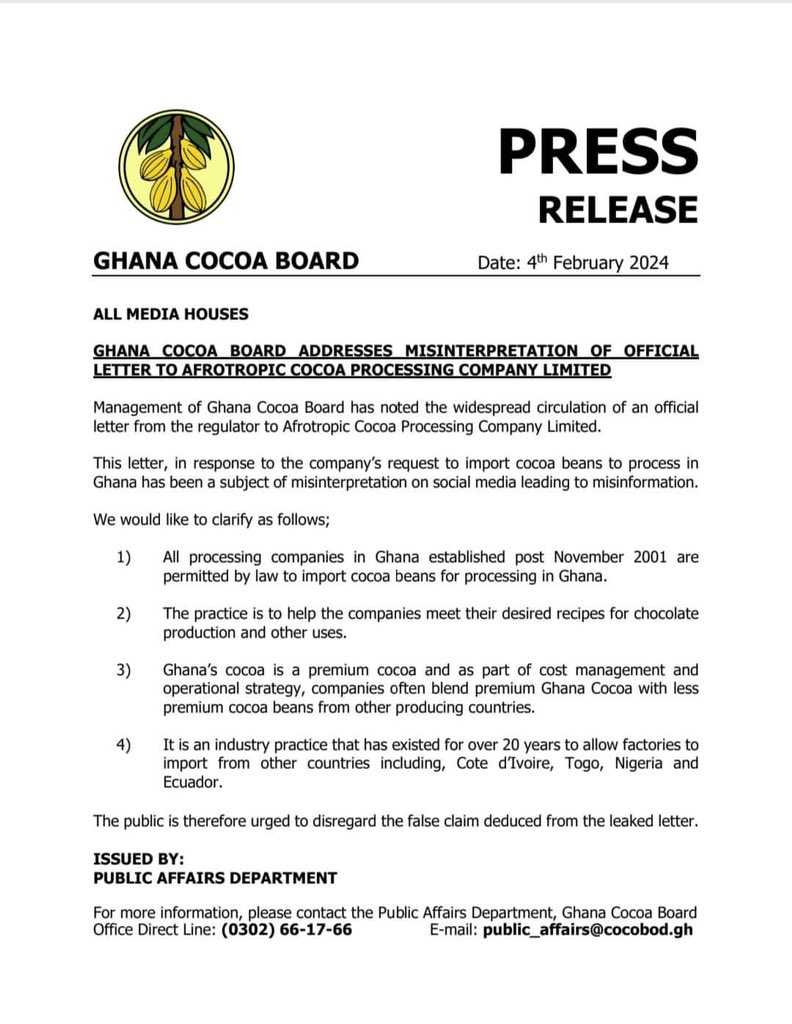
    “Management of Ghana Cocoa Board has noted the widespread circulation of an official letter from the regulator to Afrotropic Cocoa Processing Company Limited. 

    “This letter, in response to the company’s request to import cocoa beans to process in Ghana has been a subject of misinterpretation on social media leading to misinformation,” COCOBOD said.

    In their explanation, COCOBOD indicated that it authorizes the import of Cocoa products from other countries to help chocolate producing companies to cut down on their cost and also help the companies meet their desired recipes for chocolate production and other uses.

    “Ghana’s cocoa is a premium cocoa and as part of cost management and operational strategy, companies often blend premium Ghana Cocoa with less  premium cocoa beans from other producing countries.

    “It is an industry practice that has existed for over 20 years to allow factories to import from other countries including, Côte d’Ivoire, Togo, Nigeria and Ecuador. The public is therefore urged to disregard the false claim deduced from the leaked letter,” COCOBOD further said.

  • Ghana has been importing cocoa beans since 2001 – COCOBOD

    Ghana has been importing cocoa beans since 2001 – COCOBOD

    The Ghana Cocoa Board (COCOBOD) has dismissed media reports regarding a leaked official letter approving the importation of 2,500 metric tonnes of cocoa beans from Cote d’Ivoire and Nigeria as “misinformation.”

    In a statement dated Sunday, February 4, COCOBOD clarified that such arrangements have been in existence since November 2001, spanning over two decades.

    The leaked official letter by MP for South Dayi, Nelson-Rockson Dafeamekpor, circulating widely, pertains to the approval of Afrotropic Cocoa Processing Company Limited’s request to import 2,500 metric tonnes of cocoa beans from Cote d’Ivoire and Nigeria.

    To clarify the ‘misinterpretation’ in a February 4 statement, COCOBOD said the practice is nothing new.

    “All processing companies in Ghana established post-November 2001 are permitted by law to import cocoa beans for processing in Ghana. It is an industry practice that has existed for over 20 years to allow factories to import from other countries, including Cote d’Ivoire, Togo, Nigeria, and Ecuador,” COCOBOD clarified.

    COCOBOD emphasised that the practice is a component of cost management and that it assists the companies in fulfilling their “desired recipes for chocolate production and other uses.”

    “Ghana’s cocoa is a premium cocoa, and as part of cost management and operational strategy, companies often blend premium Ghana Cocoa with less premium cocoa beans from other producing countries.”

  • FLASHBACK: Over 15,500 tonnes of cocoa beans imported into Ghana by Mahama govt in 2016

    Several Ghanaians have expressed worry after a document shared by Member of Parliament (MP) for South Dayi, Nelson-Rockson Dafeamekpor, revealed that Ghana, known to be one of the major producers of cocoa, is now importing cocoa beans from Ivory Coast and Nigeria.

    The MP shared a letter by Ghana Cocoa Board (COCOBOD) to Afrotropic Cocoa Processing Plant approving the importation of 2,500 tonnes of cocoa beans from Ivory Coast and 1,000 tonnes of cocoa beans from Nigeria.

    The cocoa beans are only to arrive in Ghana through the Tema port, the letter signed by Chief Executive of COCOBOD, Joseph Boahen Aidoo on January 25, 2024, communicated.

    It is important to note that this is not the first time that Ghana has imported cocoa beans from other African countries.

    In 2016, then Finance of Minister, Seth Terkper, announced to Parliament that the country imported 15,500 tonnes of cocoa beans from Cote D’Ivoire in the 2014/2015 crop year.

  • Corruption, money laundering hits COCOBOD as CEO awards huge contracts to his son (flashback)

    Corruption, money laundering hits COCOBOD as CEO awards huge contracts to his son (flashback)

    In November 2020, Chief Executive Officer of COCOBOD, Mr Joseph Aidoo was accused of money laundering and nepotism in a contract awarded to his son, Joseph Seth Aidoo Jnr.

    Agri-Plus Horizon Farm Limited, established in 2017, secured an exclusive contract in which they were granted the sole source for supplying 75,000 liters of Transform Akate Insecticide at a rate of US$103.5 per liter, totaling US$7,762,500.00.

    Agri-Plus Horizon Farm Limited also sub-contracted the contract at US$80.80357 to Aedis Holding Limited (AEDIS), a company owned by one Joseph Seth Aidoo Jnr, believed to be the son of the Chief Executive Officer of COCOBOD, Mr Joseph Aidoo.

    AEDIS also further subcontracted Dow Agrosciences Limited (DOW) Limited, a company based in UK to supply the said insecticide.

    Ghana Cocoa Board (COCOBOD) reacted to allegations of nepotism, corruption, and money laundering in the Agri-Plus deal in a press statement dated Tuesday, November 17, 2020.

    They denied the claims of nepotism, corruption and money laundering.

    Read a copy of COCOBOD’s reaction below

    RE: ALLEGATIONS OF NEPOTISM, CORRUPTION AND MONEY LAUNDERING AT GHANA COCOA BOARD

    Our attention has been drawn to a document circulating on several online and social media platforms purported to emanate from the Financial Intelligence Centre, Ghana, which alleges wrong doing by COCOBOD awarding a contract for the procurement of Transform Akate Insecticide from Agri-Plus Horizon Farm Limited through the sole sourcing method.

    The document further alleges that there is suspicion that the decision by COCOBOD to sole source the contract to Agri-Plus may have been founded on the grounds of nepotism and / or trade based money laundering.

    Sole Sourcing

    We wish to state that the decision to sole source insecticides and other chemicals for COCOBOD operations is based on COCOBOD’s need for specific purposes. COCOBOD only procures insecticides or chemicals that have been tested and certified by the Cocoa Research Institute of Ghana (CRIG).

    It should therefore be noted that different insecticides have different active ingredients (the killing agent), different levels of concentration of active ingredients, different rates of applications per hectare of cocoa farm and different manufacturing sources.

    Some products have systemic effect while others take effect on contact with the insect. Some products are also formulated as cocktails and have both systemic and contact properties combined.

    A company that holds the CRIG certificate for a particular product has proprietary right in the product and consequently COCOBOD can procure the product from only that company.

    At the beginning of each crop season COCOBOD decides on the various insecticide and chemicals to be procured for the season based on the projected threats to the crop for that year. The insecticide application is varied periodically to reduce the chances of the insects developing resistance to a particular insecticide.

    In the case of Transform Akate Insecticide mentioned in the document, Agriplus Horizon Farms Limited is the company that holds the CRIG certificate for the product.

    Approval was, therefore, sought from the Public Procurement Authority to procure the product amongst others through the sole sourcing method for COCOBOD’s operations.

    Nepotism

    We wish to state categorically that the suspicion that the decision by COCOBOD to sole source the contract to Agri-Plus may have been founded on grounds of nepotism is completely baseless and untrue.

    The Chief Executive of Ghana Cocoa Board, Hon Joseph Boahen Aidoo is not in any way related to Joseph Seth Aidoo Junior mentioned in the document in relation to Agri-Plus Limited. The said Joseph Seth Aidoo Junior is neither a son of Hon Joseph Boahen Aidoo nor are they related in any way.

    We therefore urge the general public not to give the allegations contained in the said document any weight.

    SIGNED
    FIIFI BOAFO
    HEAD OF PUBLIC AFFAIRS

  • GRA initiates auction for COCOBOD’s chemicals, fertilizers, and more

    GRA initiates auction for COCOBOD’s chemicals, fertilizers, and more

    Ghana Cocoa Board (COCOBOD) is grappling with a severe financial crisis, leading to the auction of its essential agro products crucial for the upcoming cocoa season. This predicament arises from COCOBOD’s failure to settle a substantial GH¢3.9 billion duty owed to the Ghana Revenue Authority (GRA).

    The auctioned goods, including agrochemicals, fertilizers, and implements, are integral for disease control, pest management, and overall yield enhancement in cocoa farming. The supply contracts, initially Cost, Insurance, and Freight (CIF) to Tema, saw COCOBOD unable to meet payment obligations to suppliers, resulting in the abandonment of goods and their subsequent auction by Customs.

    The exorbitant duty demands by GRA have made the products unaffordable for both suppliers and COCOBOD, posing significant threats to agronomic practices and potentially resulting in low cocoa yields, with broader implications for Ghana’s economy.

    The financial plight of COCOBOD stems from the withdrawal of tax exemptions by the government in July 2023, necessitating the payment of import duty on all the board’s imports into the country. This move strained COCOBOD’s finances, leading to the abandonment of 73 containers of agro products at the port of Tema.

    Efforts by COCOBOD’s management to reverse the tax exemption withdrawal have reportedly been acknowledged by the Ghanaian Parliament. However, the implementation timeline remains uncertain, leaving the fate of the auctioned goods in limbo.

    To address financial challenges, COCOBOD recently extended an invitation to holders of its short-term debt securities to exchange them for longer-term debt securities. This restructuring effort reflects the broader financial struggles faced by the institution.

    The International Monetary Fund (IMF) is reportedly supporting economic reform programs by the Akufo-Addo government to address COCOBOD’s losses. The successful implementation of these programs is crucial for the disbursement of the $3 billion IMF bailout, with the first installment of about $600 million already received.

    Amid the financial turmoil, COCOBOD, through Calbank, announced the launch of a debt securities exchange program. This program invites holders of short-term debt securities (Cocoa Bills) to exchange them for longer-term debt securities (Bonds). COCOBOD’s financial challenges extend beyond the duty dispute, with reports indicating over-staffing and difficulties in paying for services rendered.

    As stakeholders closely monitor these developments, Finance Minister Ken Ofori-Atta recently announced a program to restructure COCOBOD’s debt. The unfolding situation underscores the delicate balance required to ensure the stability of Ghana’s crucial cocoa sector, urging stakeholders to carefully review the Exchange Program documents for further details and seek professional advice before making investment decisions.

  • Farmers to receive rehabilitated farms from COCOBOD

    Farmers to receive rehabilitated farms from COCOBOD

    The Ghana Cocoa Board (COCOBOD) is set to officially transfer rehabilitated farms across cocoa regions to farmers next month, aiming to boost cocoa production and increase annual cocoa stocks for higher farmer incomes.

    At the launch of the 2024 National Chocolate Week Celebration in Accra, Emmanuel Ray Ankrah, Deputy CEO of COCOBOD, spoke about the importance of productivity enhancement programs like pruning and mass-spraying to ensure cocoa production growth.

    Despite challenges such as illegal mining and climate change contributing to cocoa bean shortages, Mr. Ankrah highlighted COCOBOD’s success in productivity initiatives over the past seven years.

    He emphasized the commitment to promoting local cocoa consumption and supporting small-scale processors for innovation and diversification.

    The focus on the youth as a potential market, initiatives like Chocolate City, and nationwide campaigns aim to raise awareness about cocoa’s nutritional benefits and cultural significance.

    COCOBOD’s efforts since 2017 have increased local cocoa processing, with a goal to raise per capita consumption from 0.45kg to at least 1kg within a 5–7-year period.

    Mr. Ankrah stressed the need to consolidate gains and cited Europe and the Americas as benchmarks for further growth in Ghana’s cocoa industry.

  • IMF commends Ghana Cocoa Board’s turnaround strategy for financial viability

    IMF commends Ghana Cocoa Board’s turnaround strategy for financial viability

    The International Monetary Fund (IMF) has acknowledged that the Ghana Cocoa Board (COCOBOD) has implemented a turnaround strategy aimed at enhancing transparency, efficiency, and financial sustainability.

    COCOBOD, responsible for facilitating cocoa production and holding an export monopoly, has historically faced losses due to a lack of systematic mechanisms for setting producer purchase prices (PPPs), significant quasi-fiscal activities (such as road construction and input subsidy programs), and substantial administrative costs.

    The accumulated debt of COCOBOD in recent years became burdensome, necessitating a restructuring.

    The IMF reports that COCOBOD’s turnaround strategy primarily focuses on streamlining development spending, aligning the PPP setting process with the Board’s financial constraints, and improving oversight.

    The IMF finds these efforts broadly consistent with its own recommendations.

    Quasi-fiscal Initiatives

    The document stated that COCOBOD has assessed current cocoa road contracts with the intention of substantial rationalization, taking into account factors such as their progress, performance, and termination expenses.

    “Additional rationalisation may be pursued in case of financing pressures. The board also intends to scale down fertilizer and pesticide subsidy programmes”.

    Price setting

    The IMF announced that the government and COCOBOD will initiate the implementation of a designated range for Producer Purchase Price (PPP) as a percentage of the Free on Board (FOB) export price.

    This range, subject to biennial reviews, aims to ensure an equitable distribution of export proceeds among farmers and various stakeholders in the value chain. Additionally, it is designed to secure a reliable revenue stream for COCOBOD, covering both operational and financial costs.

    For the upcoming 2024 and 2025 seasons, the authorities have established the minimum and maximum PPP (inclusive of Living Income Differential cost) at 60% and 70% of the contract FOB price.

    Oversight

    The document clarified that the government will enhance the Ministry of Finance’s supervision of COCOBOD’s finances, which includes the establishment of a specialized cocoa desk within the Ministry of Finance.

  • Former DCE allegedly dupes UEW graduate GHS4.5k after promising job offer 

    Former DCE allegedly dupes UEW graduate GHS4.5k after promising job offer 

    A University of Education, Winneba graduate, Benedict Amankwah, has accused the former District Chief Executive for Sekyere East, Mary Boatemaa Marfo, of taking an amount of GHS4,500 from him in exchange for a job. However, the job never came.

    He is thus seeking a reimbursement of the said amount. The graduate stated that he handed over the mentioned sum to the former DCE during her tenure to facilitate his job placement with COCOBOD. However, Madam Marfo did not fulfill her promise, and he was left without the expected outcome.

    He mentioned that while providing home tuition to sustain himself, a friend of his mother introduced him to a relative of the former DCE, who then guided him to Madam Boatemaa.

    “We went to her at the office to have discussions and she explained that there is an opportunity available at COCOBOD and the amount involved in facilitating it was GHS90,000. She assured that she could get the process started if I am able to pay half of the amount,” he alleged on Sompa FM’s Sompa Nkomo programme.

    He added that he confided in one of the students he was teaching who later informed her parent. The concerned parent subsequently loaned him an amount of GH¢4,500 which he paid to the DCE through her driver.

    “I sent the money to Mr Nketiah where the DCE was called. She told us that she was in a meeting and thus sent her driver, Sobolo to come for the money. I did not hand the money over to her but she called to confirm receipt of the money.

    “There was another lady who was also included and she would usually call us to assure us that she was still in the process. I gave her the money in 2021 but the job never came.

    “Now if we call her she does not pick up. The last time I spoke to her was January last year, she assured me that she would pay in February but it has been over a year now without any positive response,” he narrated.

    According to Benedict, he has since repaid the loan he contracted through his home teaching.

    A member of the Sompa crew announced that the DCE had confirmed the issue but had assured them on a phone call to refund the money by November 15, last year.

  • Clash erupts between police, COCOBOD Anti-Illegal Mining team in Ashanti Region

    Clash erupts between police, COCOBOD Anti-Illegal Mining team in Ashanti Region

    Tensions escalated on January 11, 2023, in Brofoyedru, Ashanti Region, as a near-violent clash unfolded between the police and the Ghana Cocoa Board’s (COCOBOD) Anti-Illegal Mining team.

    The COCOBOD team, engaging with cocoa farmers and miners to combat illegal mining’s harmful effects on cocoa farms, discovered allegations of police officers extorting money from illegal miners.

    A confrontation ensued when COCOBOD officials questioned ten police officers returning from illegal mining sites, leading to a pursuit.

    The conflict intensified at a police barrier in Brofoyedru, with threats of violence from the police.

    Despite attempts to conceal their identity, COCOBOD officials successfully documented the police vehicle details and identified officers involved—P. A. Abdellah and one Amidu.

    “The COCOBOD team was informed that the Police have arrived, going round taking money and removing parts of the excavators from the miners. The Police later met COCOBOD officials on their way who tried to stop them but the police refused, upon reaching a barrier at Brofoyedur, they were obstructed by one of the COCOBOD’s vehicles and the two teams clashed, one of the Senior Police Officers threatened to shoot the COCOBOD officers in the heat of confrontation” Head of COCOBOD’s team, Prof. Michael Kwateng narrated.

    Prof. Michael Kwateng, head of the COCOBOD Anti-Illegal Mining Unit, expresses concern over multiple reports implicating the police in illegal mining, causing distress among farmers facing continuous cocoa farm invasions.

    Despite the frustrations, he emphasizes COCOBOD’s steadfast commitment to combat illegal mining and protect farmers and their essential cocoa farms.

    Urgently, COCOBOD officials call on Inspector General of Police Dr. George Akuffo Dampare to conduct a comprehensive investigation into the alleged involvement of police officers in illegal mining.

    The impact of illegal mining and smuggling resulted in COCOBOD falling short of its projected purchase of 850,000 tonnes of cocoa last year.

  • COCOBOD Anti-Illegal Mining Team clashes with Police officers believed to be aiding illegal miners

    COCOBOD Anti-Illegal Mining Team clashes with Police officers believed to be aiding illegal miners

    On Thursday, January 11, 2023, tensions escalated dramatically as a near-violent clash unfolded between the police and the anti-illegal mining unit of the Ghana Cocoa Board (COCOBOD) in Brofoyedru, Ashanti Region.

    The COCOBOD Anti-Illegal Mining Unit was in Old Atatam and surrounding areas in the Fomena District to engage with cocoa farmers and miners, stressing the vital importance of safeguarding cocoa farms against the detrimental impacts of illegal mining.

    Surprisingly, farmers and miners disclosed that a group of police officers had been extorting money from illegal miners on a weekly basis, effectively endorsing and facilitating illicit mining activities.

    The situation intensified when ten police officers from the Obuasi District Command, in a police vehicle with the registration number GP 3401, were observed returning from the illegal mining sites.

    Efforts by COCOBOD officials to interrogate the police personnel further fueled the confrontation, leading to a chase.

    Upon reaching a police barrier at Brofoyedru, a vehicle carrying a COCOBOD official, positioned ahead of the team, stopped to block the escaping police vehicle.

    The escalation took a dangerous turn when the police threatened to open fire on COCOBOD officials if they did not yield.

    Despite the police’s attempts to conceal their identity, the COCOBOD Anti-Illegal Mining team successfully documented the vehicle details, including registration number GP 3401, and identified two officers involved—P. A. Abdellah and one Amidu.

    “The COCOBOD team was informed that the Police have arrived, going around taking money and removing parts of the excavators from the miners. The Police later met COCOBOD officials on their way who tried to stop them but the police refused, Upon reaching a barrier at Brofoyedur, they were obstructed by one of COCOBOD’s vehicles and the two teams clashed, One of the Senior Police Officers threatened to shoot the COCOBOD officers in the heat of confrontation.” Head of COCOBOD’s team, Prof. Michael Kwateng, narrated.

    Prof. Michael Kwateng, who leads the COCOBOD Anti-Illegal Mining Unit, emphasised the multitude of reports implicating the police in illegal mining activities. This has caused distress among farmers as their cocoa farms continue to face incessant invasions.

    Nevertheless, he reiterated COCOBOD’s steadfast commitment to combating illegal mining, emphasising the imperative to protect farmers and their crucial cocoa farms.

    COCOBOD officials are urgently appealing to Inspector General of Police Dr. George Akuffo Dampare to initiate a comprehensive investigation into the alleged involvement of police officers in illegal mining.

    Despite COCOBOD’s initial projection to purchase 850,000 tonnes of cocoa last year, the actual figures fell short due to the impact of illegal mining and smuggling.

  • COCOBOD raises alarm on impact of Nawara Mining Company’s activities on farms

    COCOBOD raises alarm on impact of Nawara Mining Company’s activities on farms

    The Ghana Cocoa Board (COCOBOD) has vehemently condemned Nawara Mining Company for inflicting substantial harm on cocoa farms in the Fanteakwa South District and Abuakwa North municipality of the Eastern Region.

    The rebuke comes in response to a petition filed by a group of farmers, alleging that the mining company forcibly seized control of their cocoa farms, asserting that the land falls under their concession.

    Tension among farmers heightened as the company initiated new prospecting activities, digging approximately a hundred holes in areas dedicated to cocoa cultivation.

    Nevertheless, the cocoa farmers affected contend that these farms have been their means of livelihood for numerous years, emphasizing the detrimental consequences of their destruction.

    Fearing the loss of their farms, some of the farmers have entered negotiations for compensation from the mining company, resulting in the substantial loss of cocoa farms.

    The leader of the affected cocoa farmers, Humphrey Ayisi, stated that the mining company has destroyed over 10,000 acres of cocoa farms in the enclave in the last few years.

    He said this is having a severe impact on the livelihoods of farmers.

    “Cocoa sector employs over 750,000 families in Ghana. Globally it employs over 2 million workforce but surface mining and galamsey are destroying everything that if we are not careful, it will destroy our source of livelihood, agriculture, and water,” Humphrey Ayisi said.

    He added “The cocoa that the mining company is destroying affects Ghana. We have not gotten specific data but when you look at the destruction caused to cocoa farms over the years till date in this area, we are taking in access to 10,000 acres.”

    He called on the government to ban Nawara Mining Company from undertaking mining activities in cocoa-growing communities in the area.

    “The company should first reclaim the land, ensure that the polluted river birim is made clean and there should also be a ban on mining in cocoa growing communities.”

    Nawara Company however explains that farmers affected by its current prospecting activities have been compensated.

    “We met the chiefs before we met the farmers for engagement. Wherever we did prospecting, we paid compensation to farmers. As we speak, there are more farmers trooping into our sites for us to do prospecting. So as we speak, there is no farmer that we have not compensated. Every single farmer has been compensated. We are doing almost hundred (100) holes for prospecting. We have done the first (20) holes which have affected five farmers and we have paid their compensation. This week we have done 6 holes and we are paying compensation for the farmer,” the company said.

    In an interview, Prof. Michael Kwateng, the Head of the Anti-illegal Mining Unit of Ghana COCOBOD, was displeased by the destruction of the cocoa farms by the Nawara Mining Company.

    He called on the Minerals Commission for due diligence before granting mining concessions in cocoa-growing areas.

    Highlighting a critical factor contributing to the issue, Prof. Kwateng pointed out that mining concessions covering cocoa farms are sometimes allocated to miners without the consent of COCOBOD, violating clear legal provisions of the Economic Plants Protection Act.

    He said the law stipulates that all relevant stakeholders, including COCOBOD, EPA, Minerals Commission, Forestry Commission, and Ghana Water Company, must endorse a land area after proper prospecting before designating it as a mining concession.

    Prof. Kwateng reiterated COCOBOD’s commitment to addressing issues related to the unlawful destruction of cocoa trees through the Economic Plant Protection Act.

    COCOBOD had aimed to purchase 850,000 tonnes of cocoa this year but has fallen short, unable to reach even 700,000 tonnes due to the influence of illegal mining and smuggling.

  • Angry youth destroy ECG meters belonging to COCOBOD over death of 2 footballers at Yadzo

    Angry youth destroy ECG meters belonging to COCOBOD over death of 2 footballers at Yadzo

    The agitated youth, who previously staged a protest at the office and residence of the District Chief Executive for Kadjebi, Wilson Agbanyo, over the death of two youngsters, have vandalized the Ghana Cocoa Board (COCOBOD) office at Papase in the Oti Region.

    The ECG meters supplying power to the facility, along with other lighting installations, have been vandalised.

    The cause of the attack is unclear, but it is believed to be linked to recent protests and disturbances in the area related to the death of the two youngsters from Yadzo.

    The Ministry of National Security has refuted allegations of intentionally targeting and causing the deaths of two individuals in the Akan Constituency within the Oti Region.

    This response comes in the wake of the tragic incident in the Yadzo community of the Oti Region on Monday, where two footballers reportedly lost their lives while being pursued by National Security Operatives.

    The pursuit allegedly occurred as the individuals were attempting to transport cocoa beans to Togo.

    In a statement issued on December 27, the National Security Ministry explained that “the incident leading to the death of the two persons was purely accidental and not borne out of a targeted operation.”

    Meanwhile, military personnel have been deployed to the district to ensure law and order following the destruction of ECG meters.

  • BoG receives initial $541m tranche of cocoa syndicated loan

    BoG receives initial $541m tranche of cocoa syndicated loan

    The first tranche of the Cocoa Syndicated Loan, amounting to approximately $541 million, has been successfully credited to the Bank of Ghana’s account on December 22, 2023.

    This initial inflow represents a significant portion of the overall $800 million loan, with the second tranche of about $200 million scheduled for transfer to the Central Bank’s account in January 2024.

    Parliament played a crucial role in advancing the loan process by approving the Trade Facility Agreement for the Ghana Cocoa Board (COCOBOD) in November 2023.

    The approval was based on the recommendation of the Finance Committee of Parliament, enabling COCOBOD to proceed with finalizing paperwork with participating banks.

    Under the agreed-upon terms endorsed by Parliament, COCOBOD will incur an interest rate of nearly 8%, inclusive of the one-month Secured Overnight Financing Rate (SOFR), currently hovering around 5.3%, along with a margin of 2.65%.

    The funds received by the Bank of Ghana will be converted into cedis and subsequently transferred to COCOBOD.

    These financial resources are earmarked to support the procurement of cocoa beans from farmers through licensed buying companies for the upcoming 2023/2024 crop season.

    This financial injection is expected to have an immediate impact on the Bank of Ghana’s reserves, potentially enhancing its ability to strengthen the cedi. Furthermore, the news of COCOBOD’s collaboration with various banks has already contributed to the stabilization of the cedi in the foreign exchange market.

  • First tranche of Cocoa Syndicated Loan hits BoG’s account

    First tranche of Cocoa Syndicated Loan hits BoG’s account

    The first tranche of the Cocoa Syndicated Loan, amounting to about $541 million, has been credited to the Bank of Ghana’s account, according to reports.

    This represents a portion of the $800 million loan, and the second tranche of approximately $200 million is expected to be transferred to the Central Bank’s account in January 2024.

    The Trade Facility Agreement for the Ghana Cocoa Board (COCOBOD) was approved by Parliament in November 2023, allowing COCOBOD to finalize the paperwork with participating banks.

    Under the terms of the agreement, COCOBOD will pay an interest rate of nearly 8%, including the one-month Secured Overnight Financing Rate (SOFR) and a margin of 2.65%.

    The funds are expected to support the purchase of cocoa beans from farmers through license buying companies for the 2023/2024 crop season.

    The inflow of funds is likely to bolster the Bank of Ghana’s reserves and strengthen its ability to support the Ghanaian cedi. News of the deal is already contributing to the stabilization of the cedi.

  • ‘Broke’ COCOBOD wants to spend over GHC300m on torchlights – Asunafo South MP fumes

    ‘Broke’ COCOBOD wants to spend over GHC300m on torchlights – Asunafo South MP fumes

    The National Democratic Congress’ Asunafo South MP, Eric Opoku has strongly criticized the allocation of GH¢302 million in the 2024 budget for the purchase of solar torchlights by Ghana Cocoa Board (COCOBOD).

    The torchlights are to be distributed free of charge to cocoa farmers across the country.

    However, Mr. Opoku is emphasizing that the allocated funds are inappropriate, considering that COCOBOD is currently facing financial constraints and is unable to pay contractors.

    “After increasing your own expenditure, your allowances, by 589%. This is how you have expended cocoa farmers money. Mr Speaker, even this year, what is surprising now that we are in crises, everybody is complaining about the state of affairs at COCOBOD. We know COCOBOD is struggling and stumbling. COCOBOD is casting for breath. Mr Speaker, you have provided in your budget that you are going to use 302, 910.00 to purchase torchlights, solar torchlights. Is that your priority at this time . Solar torchlight in your own budget. So you didn’t read the budget, is here. Your own budget you are committing 302.910.00, 3 trillion old cedis to buy solar torchlights at the time that you cannot even pay contractors.” he expressed.

    Ahead of the approval of a $803 million loan between COCOBOD and several banks, Mr. Opoku expressed concerns to the Ghanaian parliament on Friday, November 17, 2023, during a debate, stating that COCOBOD was experiencing “reckless mismanagement” in spite of being in a “crisis” and “struggling to survive.”

    He claimed that since the New Patriotic Party (NPP) took office in 2017, the Board’s chances have been deteriorating.

    “We [Mahama government] handed over COCOBOD to them [Akufo-Addo government] in 2017. In 2017, they incurred a loss of GH¢395 million. In 2018, the loss came down to GH¢78.2 million. In 2019, it increased to GH¢320 million. In 2020, it increased to GH¢428 million. In 2021, it is GH¢2.4 billion. In 2022, it jumped to GH¢2.3 billion, yet the Minister [of Food and Agriculture] is saying that COCOBOD is back on track, where he is projecting a loss of GH¢2.6 billion this year, yet you say that this company is on track?”.

  • COCOBOD signs $800m syndicated loan with banks, to draw down $600m this week – Report

    COCOBOD signs $800m syndicated loan with banks, to draw down $600m this week – Report

    Ghana’s Cocoa Marketing Board (COCOBOD) has finalized an $800 million syndicated loan with banks, and it anticipates accessing the initial $600 million as early as this week, according to the deputy chief executive officer, per reports from Reuters.

    The annual syndicated loan is a crucial funding source for Ghana, the world’s second-largest cocoa producer, supporting bean purchases from farmers.

    Delays in reaching this year’s agreement were attributed to Ghana’s severe economic crisis and efforts to restructure its bilateral and commercial debts.

    “I joined COCOBOD in 2018 and this is the hardest transaction we have had,” COCOBOD Deputy CEO Ray Ankrah told Reuters.

    “It’s been signed and we are working on the drawdown. We’re drawing down $600 million by the end of this week and we expect to draw down the $200 (million) in the middle to the end of January,” he said, adding that the terms of the loan had not changed from those presented to parliament last month.

    In November, Ghana’s parliament approved the transaction, allowing the Cocoa Marketing Board (COCOBOD) to finalize paperwork with participating banks for an $800 million syndicated loan.

    The terms include an interest rate of nearly 8%, comprising the one-month Secured Overnight Financing Rate (SOFR) at approximately 5.3% and a margin of 2.65%.

    The drawdown of the initial $600 million this week is expected to bolster Ghana’s reserves, potentially supporting the local cedi by reducing demand for dollars amid slow progress in restructuring bilateral debt.

    Ghana and Ivory Coast are anticipating smaller cocoa crops due to adverse weather conditions, with COCOBOD officially forecasting about 800,000 tons for the 2023/24 season.

    However, industry sources estimate Ghana’s harvest will be closer to 600,000 tons. The $800 million loan is considered one of the lowest in a decade, and COCOBOD plans to capitalize on record-high global cocoa prices by selling part of the country’s crop on the spot market.

  • Ahamanso residents observe peace after clash between farmers, COCOBOD taskforce

    Ahamanso residents observe peace after clash between farmers, COCOBOD taskforce

    The District Chief Executive for Kadjebi in the Oti Region, Wilson Agbenyo, has reported that calm has been restored at Ahamanso Junction following a clash between residents and the task force of the Ghana Cocoa Board (COCOBOD) and officers of National Security.

    According to Mr. Agbenyo, the task force had arrested an individual suspected of smuggling cocoa beans, leading to anger among some residents. Allegedly, the residents then attacked a National Security officer, resulting in a confrontation.

    “I was in a meeting when I received a call informing me about an incident at Ahamanso Junction in my district. I promptly contacted the NIB officer, Mr. Oware, instructing him to go to the scene and report the situation to me. Within an hour, he briefed me on the events. Every year during the cocoa season, National Security and COCOBOD deploy officers and teams to the border towns, and this year was no exception.”

    “I was informed that around 6:00 a.m., a man on a motorbike was accosted and questioned about his destination with the cocoa. It was reported that he informed the officers that he was going to sell it at the PBC [Produce Buying Company], and they requested to accompany him. While en route from Ahamaso Junction, the motorbike rider swerved and attempted to flee, but the National Security apprehended him,” the DCE said.


    Wilson Agbenyo added that two of the three people who sustained gunshot wounds received treatment at the St. Mary Theresa Hospital in Papase and have been discharged. The third person, who is still admitted, suffered a tibia fracture and is being prepared for transfer to the Ho Teaching Hospital to consult with an orthopedic surgeon.

  • 3 farmers sustain gunshot wounds during clash with COCOBOD taskforce at Ahamanso

    3 farmers sustain gunshot wounds during clash with COCOBOD taskforce at Ahamanso

    Three individuals have been shot in Ahamanso Junction in the Oti Region following a clash between the COCOBOD task force and some farmers over the sale of cocoa beans.

    The victims sustained gunshot wounds during the altercation, and the circumstances surrounding the shooting remain unclear. The injured individuals were promptly transported to the St Mary Theresa Hospital in Papase.

    The Principal Medical Officer at the hospital, Dr. David Amankwa Kodua, reported that two out of the three injured individuals were in serious condition upon arrival and required immediate stabilization.

    “As of now, they are stable, one of them, who is around 36 years old, received a gunshot wound to the right lower limb, and after investigating further – the bullet there confirmed that indeed it was a gunshot wound,” he said.

    He noted that arrangements were being made to transfer him to the Ho Teaching Hospital, where orthopedic surgeons would provide the necessary medical attention.

    However, one of the injured farmers, has been discharged as he showed stable vital signs.

    “The other two, one of them was even discharged. He was very, very stable. And the one who is also on the award, which we can manage here, has some lacerations which we are sutured. For him, the X-ray did not show the bullet inside,” Dr Kodua added.

  • COCOBOD pursues UBA Ghana for $4.33m unpaid 2020 cocoa purchases

    COCOBOD pursues UBA Ghana for $4.33m unpaid 2020 cocoa purchases

    According to reports, the Ghana Cocoa Board (COCOBOD) is getting ready to take legal action against UBA Ghana for not fulfilling its pledge to pay $4.33 million for the purchase of cocoa in 2022.

    Vice President of policy think tank IMANI Africa Bright Simons claims that when UBA Ghana made an offer at the last minute, COCOBOD’s management had already completed the annual loan agreement.

    “6 months down the line they hadn’t paid,” Bright Simons wrote via X on December 12, 2023, while sharing a Fitch ratings verdict of the bank issued on September 15, 2023.

    “Cocobod management says they have told their lawyers to force UBA to cough up the cash or take them to Court for damages. UBA management have been tight-lipped about what they saw in Cocobod’s books that spooked them or whether their group level went hard on them on their risk exposures,” he added.

    Meanwhile, COCOBOD, grappling with debt obligations, secures record-high loan for cocoa purchases. Several international banks commit to lending Ghana Cocoa Board approximately $800 million at nearly 8 percent interest. Observers question the need for recurrent loans despite Ghana’s significant role in global cocoa production and export.

  • Fertilizer worth $3.5m was bought by COCOBOD using fake scientific report – Court told

    Fertilizer worth $3.5m was bought by COCOBOD using fake scientific report – Court told

    New revelations have emerged regarding the questionable actions of the second prosecution witness, Dr. Alfred Arthur, leading to his suspension as a scientist at the Cocoa Research Institute of Ghana (CRIG) under COCOBOD.

    The soil scientist is accused of bypassing the proper procedure for testing fertilizer and providing misleading information to his superiors regarding the certification of the product “Cocoa Nti” manufactured by the Morocco-based OCP Group.

    His actions reportedly influenced COCOBOD‘s CEO, Joseph Boahen Aidoo, to purchase 100,000 bags of “Cocoa Nti” for $3.5 million based on the contentious report.

    Dr. Arthur was suspended following an ad-hoc committee’s investigation in 2016, chaired by Rev. Father Dr. E.O.K. Oddoye, the Deputy Executive Director in Charge of Cocoa. The committee found Dr. Arthur and Alex Afrifa guilty of misconduct.

    In 2013, Dr. Arthur visited the manufacturers of “Cocoa Nti” in Morocco and swiftly prepared a report on the product upon his return, bypassing proper scientific testing procedures.

    When COCOBOD received Dr. Arthur’s scientific report without the knowledge of his superiors, a letter dated March 2, 2018, was sent to the Public Procurement Authority on March 5, 2018, seeking approval for the sole-sourcing purchase of the fertilizer.

    The CEO of COCOBOD, Joseph Boahen Aidoo, proceeded to acquire 100,000 bags of “Cocoa Nti” for $3.5 million, relying on the controversial report authored by Dr. Alfred Arthur and his team.

    The committee’s report, which led to the suspension of Dr. Alfred Arthur, is now part of the evidence presented in the ongoing trial of former COCOBOD Chief Executive, Dr. Stephen Opuni, and businessman Seidu Agongo.

    During cross-examination by lawyer Benson Nutsukpui, the lead counsel for Alhaji Agongo, Dr. Gilbert Anim Kwapong, the Executive Director of CRIG at the time, confirmed that he signed the committee’s report and forwarded it to the Deputy Chief Executive Agronomy and Quality Control at COCOBOD.

    Dr. Anin Kwapong stated that CRIG found Dr. Arthur’s response to the queries regarding the fertilizer testing untenable.

    “Exhibit 17A, the committee found as a fact that there is no delegation of OCP (Morocco, Ministry of Food and Agriculture, Enepa Ventures) paid a visit to COCOBOD to submit a fertilizer sampling for Cocoa Nti, that’s true,” he was asked, and he answered, “My Lord, that is correct”.

    He also said the committee “found as a fact”, that although Dr Arthur visited Morocco at the invitation of OCP and Enepa ventures, there was no evidence of COCOBOD officially requesting CRIG to test any fertilizer formulation.

    The committee, he said, also found that the payment for the testing of Cocoa Nti was done in March 2016.

    “Sir when you were being interrogated by police you told them that the two errant scientists were dealt with by the CTCM (Committee for Testing of Chemicals and Machines),” Lawyer Benson Nutsukpui asked the witness.

    “It was the directorate that dealt with the two errant scientists,” he answered.

    After the investigation, Dr. Alfred Arthur was initially transferred from CRIG headquarters at Tafo to one of CRIG’s substations at Bunso. However, he returned to CRIG at Tafo in January 2017, serving as the acting head of the soil department.

    This move occurred after Dr. Franklin Manu Amoah, the first prosecution witness, returned to CRIG as the Executive Director. Dr. Anim Kwapong, the Executive Director at the time of the incident, was transferred to COCOBOD headquarters without a specific designation.

    Subsequently, Dr. Kwapong was transferred to the Cocoa Health and Extension Division (CHED) of COCOBOD and retired as the Director of Monitoring and Evaluation of CODAPEC/HiTECH on December 11, 2022.

  • “Stop misleading court,” – Defence counsels tell state attorney in COCOBOD trial

    “Stop misleading court,” – Defence counsels tell state attorney in COCOBOD trial

    In a surprising turn of events during the trial of former COCOBOD boss, Dr. Stephen Kwabena Opuni, and two others, Principal State Attorney Stella Ohene Appiah faced accusations of attempting to mislead the High Court with false information.

    The defence lawyers raised objections, asserting that she misrepresented facts while discrediting their concerns about the court registrar’s failure to provide the record of proceedings related to Justice Clemence Honyenuga.

    Dr. Opuni, businessman Seidu Agongo, and Agricult Ghana Limited are facing a total of 27 charges, including defrauding by false pretence, causing financial loss to the state, corruption by public officers, and contravention of the Public Procurement Act in the purchase of Lithovit liquid fertiliser between 2014 and 2016.

    Despite pleading not guilty, they are each on GH¢300,000.00 self-recognizance bail.

    During the court session on Wednesday, November 22, the Principal State Attorney claimed that the parties had been provided with the record of proceedings.

    “The last sitting of every week, which happens to be on a Thursday, parties were served records on either the following Monday or Tuesday,” she said, pointing to the era of the previous judge, Justice Clemence Honyenuga.

    However, both defense counsels, fully attentive, were determined not to let any ‘falsehood’ become part of the court records. Swiftly, they rose to their feet to ensure that the facts were presented accurately.

    Samuel Codjoe, counsel for the first accused, had previously informed the court multiple times that their hands were metaphorically tied behind them. He accused the registrar of intentionally withholding the proceedings, emphasizing the challenges they faced in obtaining necessary documentation which he said “has made it impossible to conduct our defence because we require the records to enable us to complete our examination.”

    However, he pointed out that, despite a repeated order on November 21, the registrar provided him with about 3,000 pages of documents in a disorderly manner around 4 pm on November 22. This was despite the fact that the order was initially given on July 12.

    Benson Nutsukpui, counsel for the second and third accused persons, further emphasized that as of November 22, he had not yet received the record of proceedings.

    “There is no chronology in this bundle of paper. It has nothing to do with we counsel not performing our duty at all. We send letters, and we don’t get the copies. The bundle of papers does not qualify to be record of proceedings. It’s unfortunate that, the impression seems to be created in this particular matter is that the registry does not obey rules of practice,” Mr. Benson said as he pointed to the proceedings beside his learned colleague Samuel Codjoe.

    Stella Ohene Appiah, however, persisted in asserting that the parties to the case had access to the proceedings. She even went so far as to say that the defense had attached proceedings in the appeal against the rejection of the submission of no case, which she said was heard by the higher court.

    “We are saying that we have always had proceedings from the court until the court was differently constituted,” she asserted but Mr. Codjoe interjected, “Counsel is misleading the court. Because, the appeal on the submission of no case has not been determined.”

    The Principal State Attorney decided to reframe his submission.

    “My Lord, submission of no case filed by counsel went all the way to the Supreme Court, and there was a review. After the decision of the trial court, calling upon the accused persons to open their defense, they filed an application invoking the supervisory jurisdiction of the Supreme Court to quash the decision of the high court, and to prohibit the trial judge from further hearing the case.

    “This application went all the way to the review bench of the Supreme Court. As I said earlier, proceedings were attached to this application. This is what I meant when I said the submission of no case went to the Supreme Court.”

    But Samuel Codjoe still rebutted: “When the prosecution says that, when we applied for certiorari (judicial review) to quash the decision of the high court at the Supreme Court, we attached the records of proceedings, that is false.

    “One, the application is on the docket for everybody to see. When you apply for a judicial review, you don’t attach the record of proceedings; we attach the ruling. And if there are one or two proceedings, you attach. It’s very easy for my learned friend to verify from the case docket.”

    Nevertheless, Stella Ohene Appiah insisted on promoting the narrative that all parties received weekly proceedings. The defense counsels for the accused individuals refuted her claims, advising her to speak solely for the prosecution.

    Lawyer Codjoe emphasized that they only obtained specific proceedings when applying to support certain motions. He asserted that his side had never received the record of proceedings without applying for it, unlike how the court treated the prosecution.

    Upon this clarification, the Principal State Attorney backtracked, acknowledging that the prosecution made just one application for the proceedings. She stated that since then, they had been given copies of the records of proceedings without reapplying under Justice Honyenuga.

    Both Samuel Codjoe and Benson Nutsukpui challenged Stella Ohene Appiah to provide proof that they had been served with records of proceedings in the past, as the court would always have evidence of that. Stella Ohene Appiah appeared taken aback by this challenge.

    While murmuring, the trial judge, Justice Aboagye Tandoh, sensed that the principal state attorney had been found wanting.

    The judge intervened, asking the defense counsel to abandon their demand for evidence to allow the court to make progress.

    The judge also acknowledged the necessity for the court record to be kept in an orderly and paginated manner, as argued by Lawyer Codjoe.

    “Every document is supposed to be paged. Anything short of this cannot be the record of proceedings,” Justice Tandoh noted.

  • COCOBOD set to sign record-high loan amidst escalating debt crisis – Report

    COCOBOD set to sign record-high loan amidst escalating debt crisis – Report

    Ghana is set to secured its annual loan to fund cocoa purchases at a historically high interest rate, a consequence of this year’s debt restructuring that diminished investor appeal for the West African nation.

    Two individuals familiar with the deal’s terms revealed that international banks have committed to lending the Ghana Cocoa Board (Cocobod) $800 million for cocoa purchases from farmers at an interest rate approaching 8%. This marks the most expensive syndicated facility obtained by Cocobod since the inception of the annual loans in 1992-93, according to the sources who requested anonymity as the transaction is not yet public.

    Traditionally, Cocobod has secured loans at more favorable rates than the government, averaging around 2%. However, this year’s negotiations were complicated by Ghana’s debt restructuring, a prerequisite for accessing a $3 billion government bailout from the International Monetary Fund.

    As the world’s second-largest producer of cocoa, Ghana heavily relies on foreign funding to compensate farmers for beans that are subsequently exported. This external financing is also crucial for the central bank to maintain a stable supply of foreign exchange and stabilize the national currency, the cedi.

    Typically, Cocobod conducts an investor roadshow between June and July, finalizing the syndicated facility in September before the commencement of the new harvest in October. However, this year, the loan is anticipated to be signed at the end of the month, involving eight participating banks, including Coöperatieve Rabobank UA as the lead arranger, along with Standard Chartered Plc and Societe Generale SA.

    The loan amount is the lowest in at least 16 years, reflecting challenges faced by Cocobod in raising funding and falling short of the $1.2 billion required to purchase beans from growers in the current season. Consequently, Cocobod has arranged to borrow $400 million from cocoa traders such as Olam Group Ltd. and Barry Callebaut AG to bridge the gap.

    Additionally, the board plans to leverage higher cocoa prices this year by selling on the spot market to fulfill its liquidity needs, according to the sources. Spokespeople for Coöperatieve Rabobank UA, Standard Chartered Plc, and Societe Generale SA declined to comment, and Fiifi Boafo, a spokesperson at Ghana Cocoa Board, also refrained from providing comments when contacted by phone.

  • Minority accuses COCOBOD CEO of falsehood in cocoa forward sale

    Minority accuses COCOBOD CEO of falsehood in cocoa forward sale

    The Minority in Parliament has accused Joseph Boahen Aidoo, the CEO of COCOBOD, of spreading falsehoods regarding the 2023/24 cocoa forward sales.

    The caucus alleges that Aidoo lied about the proceeds from the sales, despite criticism from former President John Dramani Mahama, who accused the government of shortchanging cocoa farmers.

    The Minority is demanding an apology from Aidoo for justifying what they perceive as mistreatment of cocoa farmers.

    Documents submitted to Parliament, according to the minority, contradict the CEO’s claims, revealing that only 36.2% of the projected cocoa output for the 2023/24 season was sold forward.

    “It has now emerged that the CEO of COCOBOD told deliberate falsehood in his desperate attempt to justify the rip-off that the Akufo-Addo/Bawumia government has meted out to our hard working cocoa farmers. Former President Mahama was spot on when he said that the insensitive Akufo-Addo/Bawumia government is shortchanging cocoa farmers whose toil and sacrifices continue to sustain the country’s economy.

    “The incompetent and dishonest CEO of COCOBOD in his bid to deceive our hard working farmers, threw truth and integrity to the dogs and sought to attack the credibility of President Mahama for exposing this grand heist. The Minority Group wishes to state for the record that Joseph Boahen Aidoo has lied to cocoa farmers and the entire nation. He had no basis whatsoever to impugn ill motive into what was a statement of fact by the respected former President. He therefore owes President Mahama, hardworking cocoa farmers and the entire nation an unqualified apology,” part of the statement read.

    The group added that in the coming days, they will be embarking on a series of engagements with cocoa farmers across the country on the matter.

    “In the coming days, the Minority Group in Parliament shall, in conjunction with the NDC Communications Bureau, embark on a series of engagements with cocoa farmers across the country. Our hard working farmers deserve to know the whole truth about this gross injustice that has been meted out to them by the corrupt and insensitive Akufo-Addo/Bawumia/NPP government,” the statement added.

    Below is the full statement by the ranking member, Eric Opoku:

    COCOBOD CEO LIED OVER COCOA FORWARD SALES; HE MUST RENDER AN UNQUALIFIED APOLOGY TO PRESIDENT MAHAMA IMMEDIATELY

    1. The Minority in Parliament has come by indisputable evidence that exposes a blatant lie peddled by the Chief Executive Officer of COCOBOD, Joseph Boahen Aidoo, about Ghana’s 2023/24 cocoa forward sales.

    2. It would be recalled that, shortly after the announcement of the farm-gate price of cocoa for the 2023/24 cocoa season, former President Mahama criticized government for shortchanging cocoa farmers by pegging the farm-gate price at a paltry GHS1,308 despite a 46-year record-high surge in the world market price.

    3. President Mahama’s comments were grounded on the fact that, our hard working cocoa farmers deserve far more of the international market price, than they were given by the insensitive Akufo-Addo/Bawumia government, particularly given the unbearable cost of living and hardships they currently reeling under.

    4. However, in a so-called Open Letter to former President Mahama dated 12th September, 2023, the Chief Executive Officer of COCOBOD Joseph Boahen Aidoo, took issues with President Mahama. He questioned President Mahama’s understanding of how the producer price of cocoa is determined and claimed that the former President erroneously used $3,600 as the world market price to calculate the producer price.

    5. In that statement, the COCOBOD CEO claimed that consistent with practice, Ghana’s cocoa beans are “mostly sold forward”, and that “the 2023/24 crop was sold between October 2022 and March 2023 at international prices; ranging between $2,200 per ton and $2,400 per ton.” The incompetent and dishonest COCOBOD CEO went on to say that, “the international price of cocoa then began to increase in April 2023, when a greater percentage of the 2023/24 crop had already been sold.”

    6. It has now emerged that the CEO of COCOBOD told deliberate falsehood in his desperate attempt to justify the rip-off that the Akufo-Addo/Bawumia government has meted out to our hard working cocoa farmers.

    7. According to documents submitted to Parliament by COCOBOD as part of processes for the approval of the syndicated loan for cocoa purchases for the 2023/24 crop season, it was disclosed that only 36.2% of our cocoa for this season was sold forward and used as collateral to secure the $800 million syndicated loan.

    8. Specifically, Paragraph 7.2 of the Joint Memorandum to Parliament by the Minister for Food and Agriculture and the Minister of Finance on the approval of the terms of the $800 million syndicated facility partly reads; “The facility does not add to Ghana’s debt stock. The loan is backed by cocoa sales contracts, and the quantity of cocoa collateralized for its repayment is about 36.20% of the anticipated production”.

    9. For the avoidance of doubt, 36.2% of the projected cocoa output for the 2023/24 season translates to a paltry 307,700 tons. This volume of cocoa cannot by any stretch of imagination constitute a “greater percentage” of our projected annual production volume (i.e 850,000 tons) as claimed by the CEO of COCOBOD in his deceitful response to President Mahama.

    10. Simply put, the incompetent and dishonest CEO of COCOBOD lied to the good people of Ghana when he claimed that a “greater percentage” of Ghana’s cocoa for the 2023/24 season was sold forward at a price of $2,600.

    11. COCOBOD further disclosed to Parliament that the remainder of 63.8% of our 2023/24 cocoa output, which translates to 542,300 tons would be sold on the market at spot prices, which has been ranging between $3,600 and $4,000. This is contained at paragraph 4.2 of the Joint Memorandum. If COCOBOD succeeds in selling the remainder at the minimum spot price of $3,600 per ton as a worst case scenario, COCOBOD would have shortchanged our hard working cocoa farmers to tune of $542,300,000 (GHC6.5billion).

    12. As a matter of fact, further information submitted to Parliament indicates that, COCOBOD has already sold part of the remaining 63.8% of our cocoa output for the 2023/24 season at spot prices ranging between $3,500 and $3,770 per ton from October to mid-November 2023.

    13. Clearly, Former President Mahama was spot on when he said that the insensitive Akufo-Addo/Bawumia government is shortchanging cocoa farmers whose toil and sacrifices continue to sustain the country’s economy.

    14. The incompetent and dishonest CEO of COCOBOD in his bid to deceive our hard working farmers, threw truth and integrity to the dogs and sought to attack the credibility of President Mahama for exposing this grand heist.

    15. The Minority Group wishes to state for the records, that Joseph Boahen Aidoo has lied to cocoa farmers and the entire nation. He had no basis whatsoever to impugn ill motive into what was a statement of fact by the respected former President. He therefore owes President Mahama, hardworking cocoa farmers and the entire nation an unqualified apology.

    16. In the coming days, the Minority Group in Parliament shall in conjunction with the NDC Communications Bureau, embark on a series of engagements with cocoa farmers across the country on this subject. Our hard working farmers deserve to know the whole truth about this gross injustice that has been meted out to them by the corrupt and insensitive Akufo-Addo/Bawumia/NPP government.

    SIGNED.
    HON. ERIC OPOKU
    (MP for Asunafo South and Ranking Member for Food and Agriculture)

  • Minority MPs, NDC to engage farmers over farm-gate price of cocoa for 2023/24 cocoa season

    Minority MPs, NDC to engage farmers over farm-gate price of cocoa for 2023/24 cocoa season

    Ranking Member on Parliament’s Food and Agriculture Committee, Eric Opoku, has indicated that the Minority Group in Parliament, in conjunction with the NDC Communications Bureau, will embark on a series of engagements with cocoa farmers across the country over Ghana’s 2023/24 cocoa forward sales.

    Eric Opoku made this known after calling on the Chief Executive Officer of COCOBOD, Joseph Boahen Aidoo, to render an unqualified apology to former President John Mahama for criticizing him over his comments on Ghana’s 2023/24 cocoa forward sales.

    Shortly after the announcement of the farm-gate price of cocoa for the 2023/24 cocoa season, former President Mahama criticized government for shortchanging cocoa farmers by pegging the farm-gate price at a paltry GHS1,308 despite a 46-year record-high surge in the world market price.

    In an Open Letter to former President Mahama dated 12th September, 2023, Mr Joseph Boahen Aidoo, questioned President Mahama’s understanding of how the producer price of cocoa is determined and claimed that the former President erroneously used $3,600 as the world market price to calculate the producer price.

    Chief Executive Officer of COCOBOD, Joseph Boahen Aidoo

    In that statement, the COCOBOD CEO claimed that consistent with practice, Ghana’s cocoa beans are “mostly sold forward”, and that “the 2023/24 crop was sold between October 2022 and March 2023 at international prices; ranging between $2,200 per ton and $2,400 per ton.”

    The statement added that “the international price of cocoa then began to increase in April 2023, when a greater percentage of the 2023/24 crop had already been sold.”

    But according to the MP for Asunafo South, Eric Opoku, the Minority in Parliament has come by indisputable evidence that exposes a blatant lie peddled by the Chief Executive Officer of COCOBOD

    “It has now emerged that the CEO of COCOBOD told deliberate falsehood in his desperate attempt to justify the rip-off that the Akufo-Addo/Bawumia government has meted out to our hard working cocoa farmers,” he wrote in a statement.

    According to Mr Opoku, in documents submitted to Parliament by COCOBOD as part of processes for the approval of the syndicated loan for cocoa purchases for the 2023/24 crop season, it was disclosed that only 36.2% of our cocoa for this season was sold forward and used as collateral to secure the $800 million syndicated loan.

    “Specifically, Paragraph 7.2 of the Joint Memorandum to Parliament by the Minister for Food and Agriculture and the Minister of Finance on the approval of the terms of the $800 million syndicated facility partly reads; “The facility does not add to Ghana’s debt stock. The loan is backed by cocoa sales contracts, and the quantity of cocoa collateralized for its repayment is about 36.20% of the anticipated production”.

    “For the avoidance of doubt, 36.2% of the projected cocoa output for the 2023/24 season translates to a paltry 307,700 tons. This volume of cocoa cannot by any stretch of imagination constitute a “greater percentage” of our projected annual production volume (i.e 850,000 tons) as claimed by the CEO of COCOBOD in his deceitful response to President Mahama,” he added.

    Mr Opoku further highlighted that COCOBOD also disclosed to Parliament that the remainder of 63.8% of our 2023/24 cocoa output, which translates to 542,300 tons would be sold on the market at spot prices, which has been ranging between $3,600 and $4,000.

    He asserts that if COCOBOD succeeds in selling the remainder at the minimum spot price of $3,600 per ton as a worst case scenario, COCOBOD would have shortchanged our hard working cocoa farmers to tune of $542,300,000 (GHC6.5billion).

    “As a matter of fact, further information submitted to Parliament indicates that, COCOBOD has already sold part of the remaining 63.8% of our cocoa output for the 2023/24 season at spot prices ranging between $3,500 and $3,770 per ton from October to mid-November 2023,” he continued.

    Per the information privy to him, Mr Opoku concluded that former President Mahama was spot on when he accused the government of shortchanging cocoa farmers whose “toil and sacrifices continue to sustain the country’s economy.”

    “The incompetent and dishonest CEO of COCOBOD in his bid to deceive our hard-working farmers, threw truth and integrity to the dogs and sought to attack the credibility of President Mahama for exposing this grand heist.”

    He iterated that Mr Joseph Boahen Aidoo has lied to cocoa farmers and the entire nation.

    “He had no basis whatsoever to impugn ill motive into what was a statement of fact by the respected former President. He therefore owes President Mahama, hardworking cocoa farmers and the entire nation an unqualified apology,” Mr Opoku added.

  • Apologise to Mahama for lying about forward cocoa sales – Eric Opoku tells COCOBOD boss

    Apologise to Mahama for lying about forward cocoa sales – Eric Opoku tells COCOBOD boss

    Ranking Member on Parliament’s Food and Agriculture Committee, Eric Opoku, has called on the Chief Executive Officer of COCOBOD, Joseph Boahen Aidoo, to render an unqualified apology to former President John Mahama for criticizing him over his comments on Ghana’s 2023/24 cocoa forward sales.

    Shortly after the announcement of the farm-gate price of cocoa for the 2023/24 cocoa season, former President Mahama criticized government for shortchanging cocoa farmers by pegging the farm-gate price at a paltry GHS1,308 despite a 46-year record-high surge in the world market price.

    In an Open Letter to former President Mahama dated 12th September, 2023, Mr Joseph Boahen Aidoo, questioned President Mahama’s understanding of how the producer price of cocoa is determined and claimed that the former President erroneously used $3,600 as the world market price to calculate the producer price.

    Chief Executive Officer of COCOBOD, Joseph Boahen Aidoo

    In that statement, the COCOBOD CEO claimed that consistent with practice, Ghana’s cocoa beans are “mostly sold forward”, and that “the 2023/24 crop was sold between October 2022 and March 2023 at international prices; ranging between $2,200 per ton and $2,400 per ton.”

    The statement added that “the international price of cocoa then began to increase in April 2023, when a greater percentage of the 2023/24 crop had already been sold.”

    But according to the MP for Asunafo South, Eric Opoku, the Minority in Parliament has come by indisputable evidence that exposes a blatant lie peddled by the Chief Executive Officer of COCOBOD

    “It has now emerged that the CEO of COCOBOD told deliberate falsehood in his desperate attempt to justify the rip-off that the Akufo-Addo/Bawumia government has meted out to our hard working cocoa farmers,” he wrote in a statement.

    According to Mr Opoku, in documents submitted to Parliament by COCOBOD as part of processes for the approval of the syndicated loan for cocoa purchases for the 2023/24 crop season, it was disclosed that only 36.2% of our cocoa for this season was sold forward and used as collateral to secure the $800 million syndicated loan.

    “Specifically, Paragraph 7.2 of the Joint Memorandum to Parliament by the Minister for Food and Agriculture and the Minister of Finance on the approval of the terms of the $800 million syndicated facility partly reads; “The facility does not add to Ghana’s debt stock. The loan is backed by cocoa sales contracts, and the quantity of cocoa collateralized for its repayment is about 36.20% of the anticipated production”.

    “For the avoidance of doubt, 36.2% of the projected cocoa output for the 2023/24 season translates to a paltry 307,700 tons. This volume of cocoa cannot by any stretch of imagination constitute a “greater percentage” of our projected annual production volume (i.e 850,000 tons) as claimed by the CEO of COCOBOD in his deceitful response to President Mahama,” he added.

    Mr Opoku further highlighted that COCOBOD also disclosed to Parliament that the remainder of 63.8% of our 2023/24 cocoa output, which translates to 542,300 tons would be sold on the market at spot prices, which has been ranging between $3,600 and $4,000.

    He asserts that if COCOBOD succeeds in selling the remainder at the minimum spot price of $3,600 per ton as a worst case scenario, COCOBOD would have shortchanged our hard working cocoa farmers to tune of $542,300,000 (GHC6.5billion).

    “As a matter of fact, further information submitted to Parliament indicates that, COCOBOD has already sold part of the remaining 63.8% of our cocoa output for the 2023/24 season at spot prices ranging between $3,500 and $3,770 per ton from October to mid-November 2023,” he continued.

    Per the information privy to him, Mr Opoku concluded that former President Mahama was spot on when he accused the government of shortchanging cocoa farmers whose “toil and sacrifices continue to sustain the country’s economy.”

    “The incompetent and dishonest CEO of COCOBOD in his bid to deceive our hard-working farmers, threw truth and integrity to the dogs and sought to attack the credibility of President Mahama for exposing this grand heist.”

    He iterated that Mr Joseph Boahen Aidoo has lied to cocoa farmers and the entire nation.

    “He had no basis whatsoever to impugn ill motive into what was a statement of fact by the respected former President. He therefore owes President Mahama, hardworking cocoa farmers and the entire nation an unqualified apology,” Mr Opoku added.

    Meanwhile, the Minority Group in Parliament, in conjunction with the NDC Communications Bureau, will embark on a series of engagements with cocoa farmers across the country on this subject.

  • Parliament of Ghana authorises COCOBOD’s $800 million financing deal

    Parliament of Ghana authorises COCOBOD’s $800 million financing deal

    The government of Ghana agreed to borrow $800 million for the Ghana Cocoa Board (COCOBOD) from banks and financial institutions.

    This approval will help COCOBOD buy nearly half of the cocoa beans it expects to need for the 2023/2024 harvest.

    Meanwhile, the leader of the smaller group in Parliament, Dr. Cassiel Ato Forson said in the House that he was only agreeing to the COCOBOD loan because he wanted to help the poor cocoa farmers.

    He said he can’t understand how much money COCOBOD has been losing every year.

    He said that COCOBOD is not being managed well and needs attention from the country.

    “Mr Smith” Speaker, COCOBOD requires some attention. They need people in the country to pay attention to them. I’m not saying this because my brother Bryan is a minister now. You just got a job as a cocoa Agriculture Minister but Mr. Speaker, I’m approving the loan for the farmer because it’s the right thing to do. Besides that, we should have said no to this. He said we should have said no to it and then asked COCOBOD to check how they are managing Ghana Cocoa Board.

    Some people from a small group are worried about how COCOBOD is being managed poorly.

    Source: The Independent Ghana

  • Parliament gives go-ahead for COCOBOD’s $800 million loan

    Parliament gives go-ahead for COCOBOD’s $800 million loan

    Parliament has granted approval for an $800 million loan agreement between the Ghana Cocoa Board (COCOBOD) and a consortium of banks and financial institutions.

    The loan is intended to fund the purchase of cocoa beans for the 2023/2024 Crop Season, covering approximately 47 percent of the projected 850,000 tonnes of cocoa beans.

    COCOBOD has reassured that it has implemented concrete measures to secure adequate funds for its annual cocoa purchases in the 2023/2024 crop season.

    In response to a Reuters report stating that the firm borrowed up to $200 million from cocoa traders to address its funding gap, COCOBOD clarified that it has adopted a two-prong financing strategy to meet the necessary funds for the purchasing season.

    A statement from COCOBOD in response to the Reuters report indicated that it had had firm assurances from its bankers of making funds available in time for the purchasing season and that a “Cocoa syndicated Loan has been laid in Parliament for consideration and approval.”

    The 2023/2024 loan facility disbursement is proposed to be utilized for cocoa purchases and related operations as listed below:

    Farmers’ services cost

    – cocoa diseases and pest controls

    – fertilizer distribution and application

    – farmer pension scheme

    – cocoa roads

    – industry inputs (jute sacks, twine, stencil ink, passbooks.)

    – child education support

    Share of Net FOB 

    -payments to farmers

    – buyer’s margin

    – hauler’s margin

    – international marketing operations (storage and shipping operations)

    – disinfestation/grading and sealing cost

    -finance cost

    -COCOBOD and divisions cost

    other costs/scale inspection and phytosanitary inspections

    -rehabilitation

    -planting of coffee and sheanut operations

  • State Prosecutor ‘fumbles’ as key witness in COCOBOD trial mounts witness box

    State Prosecutor ‘fumbles’ as key witness in COCOBOD trial mounts witness box

    The state prosecutor, Principal State Attorney Stella Ohene Appiah, appeared to struggle when she confronted the seventh prosecution witness, Peter Okyere Boateng, a seasoned expert on matters related to COCOBOD.

    During the cross-examination, she seemed ill-prepared to challenge the witness’s testimony, allowing him to effectively educate her on the intricacies of COCOBOD’s operations.

    Peter Okyere Boateng, a former Deputy Executive Director of CHED at COCOBOD, has been testifying in the ongoing trial of former COCOBOD Chief Executive, Dr. Stephen Opuni, and businessman Seidu Agongo.

    They are facing charges related to alleged financial loss to the state and violations of the Public Procurement Act in the procurement of Lithovit liquid fertilizer between 2014 and 2016.

    During the proceedings on Wednesday, Stella Ohene Appiah attempted to undermine the witness’s assertion that Lithovit had remarkable effects on farms.

    She suggested that Lithovit was not the only fertilizer used by farmers, but her line of questioning appeared ineffective in challenging the witness’s expertise.

    But Mr. Okyere Boateng, who was in charge of monitoring and evaluation at CHED told the court, “That is not true. We have educated the farmers that, one particular fertilizer is appropriate for one particular farm. No farmer who has been trained by CHED, will mix any type of fertilizer with other fertilizer. The farmers are well educated. This is a technical issue.”

    “I’m putting it to you that, not only Lithovit Liquid fertilizer had been applied by the farmers on their farms, but Sidalco and other granular fertilizers have also been used,” prosecution insisted.

    The witness replied, “Yes. I have said it here, that COCOBOD gives out different types of fertilizers and it’s a fact. But as I just said, each farmer gets a particular fertilizer be it granular or liquid or foliar for a particular farm. So in my report, I even compared performances of farms that have been applied with different types of fertilizers. But none of the farmers will apply more than one fertilizer on a single farm. Let me explain further that, yes, a particular farmer may get more than one particular fertilizer, but they will be meant for different farms.”
    The witness had to take additional time to further enlighten the prosecution, who seemed to draw a distinction between cocoa yields and the production of cocoa.

    “As I said, if you talk about CHED, yes, we don’t compile data on cocoa yield. Which is the same as the production that I have talked about. Yield and production are the same. Though at times we may use yield as a unit area production. As I sit here, I know that, the yield on production that was realized during the period of application of LLF, in 2016/2017 was the second highest production in the history of cocoa production in Ghana up to 2019/2020 and the figure was nine hundred and sixty-nine thousand metric tons.”

    Again on Thursday, November 9, 2023, Stella Ohene Appiah contested the assertions made by the witness, implying a notable disparity between the fertilizers provided to farmers and the one supposedly tested by the Chemistry Department of the University of Ghana.

    “So you see, you have no basis for your statement that the product tested by the University of Ghana is not the same used by farmers,” the prosecution said.

    Mr. Okyere Boateng stated, “My Lord what I just said was a basis for me to say that. My Lord in July [2022] I gave evidence, what I said was that, the University of Ghana is my alma mater and that it is an institution of academic excellence, but from the observations, I made in the field, particularly in the cocoa farms on which the Lithovit fertilizer was applied and the high commendations given by the farmers on whose farms the fertilizer was applied, I knew that the fertilizer was a very good product, and therefore it wouldn’t be the same product that was taken to the University of Ghana for testing. My Lord, that is what I said, and I did not go challenging the work of the University of Ghana.”

    Simultaneously, the University of Ghana’s test findings faced disapproval from the state’s own witness involved in the product, Dr. Emmanuel Yaw Osei-Twum. During his court appearance and under cross-examination, he discredited the report submitted as evidence by the prosecution, highlighting that the document had been altered.

    “No we did not. We did not write those in ink, we did not put in those vertical lines. Our original report did not have those,” the state witness said in October 2020.

    Moreover, the lithovit sample presented as evidence by the prosecution—asserting it was the exact product tested by COCOBOD’s CRIG—was dismissed by the state’s prominent witness, Dr. Yaw Adu-Ampomah.

    During cross-examination in November 2019, Dr. Adu-Ampomah, a former Deputy Chief Executive of COCOBOD, contested the exhibit submitted by the Attorney General, affirming that it did not correspond to the lithovit fertilizer he requested CRIG to examine.

    “My Lord I don’t know where this [exhibit] is coming from,” Dr Adu-Ampomah told the court, adding, “this is not what came in 2013; I don’t know whether this is the sample that you are showing to me”.

  • COCOBOD assures adequate funding secured for Cocoa purchases

    COCOBOD assures adequate funding secured for Cocoa purchases

    The Ghana Cocoa Board (COCOBOD) has reassured its stakeholders that it has made the necessary arrangements to secure sufficient funding for cocoa purchases in the upcoming 2023/24 crop season.

    In response to recent media publications regarding funding concerns, COCOBOD issued a statement highlighting  that “the Board has so far received firm response from our bankers in this regard, and the Cocoa syndicated Loan has been laid in Parliament for consideration and approval.”

    Clarifications were made in the statement that COCOBOD had planned a two-pronged financing approach for the 2023/2024 crop season to diversify its funding sources for annual cocoa purchases.

    The strategy involved a pre-financing arrangement with international buyers to raise $400 million for purchases at the season’s outset in September 2023.

    These initial funds were expected to be supplemented by an additional $800 million loan from a syndicate of lenders by the end of November 2023.

    However, after several weeks of engagements with buyers, the arrangement was terminated.

    “Thus, since the beginning of the season, cocoa purchases have been financed with non-collateralised cocoa sales proceeds. COCOBOD is therefore still in the process of securing the syndicated loan for the 2023/24 crop season,” the statement said.