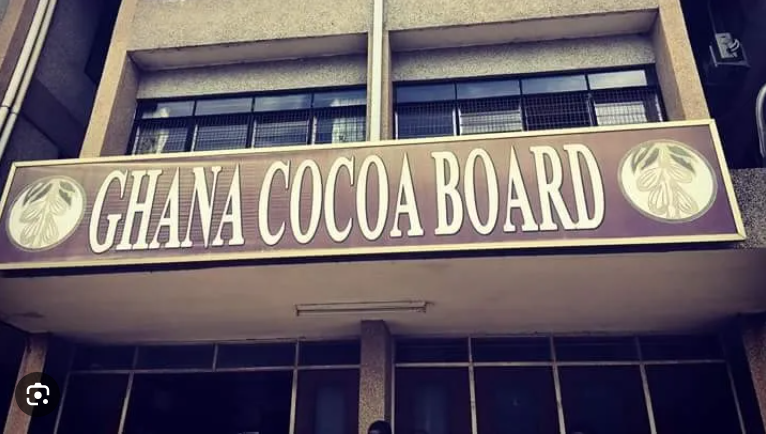
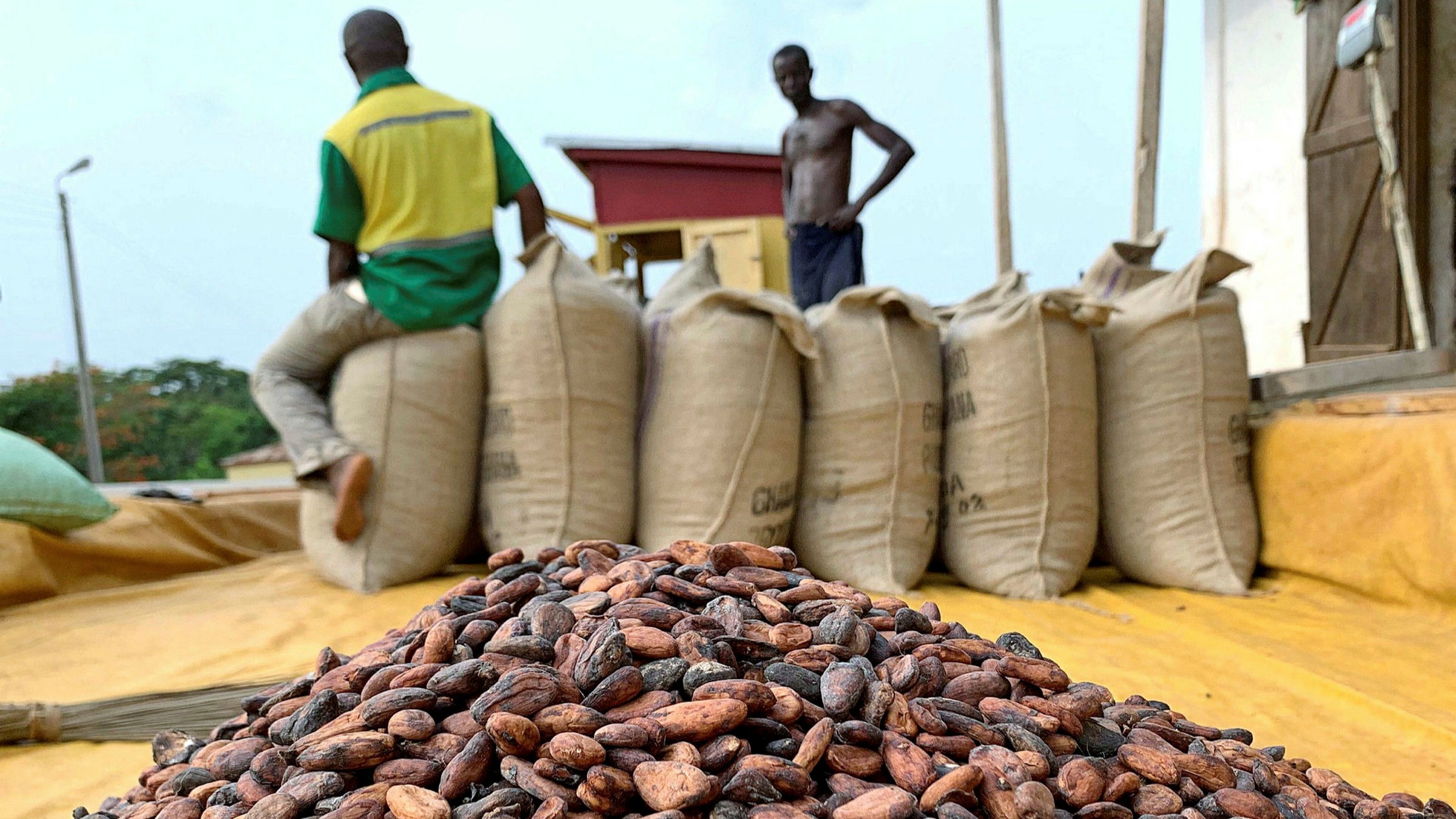
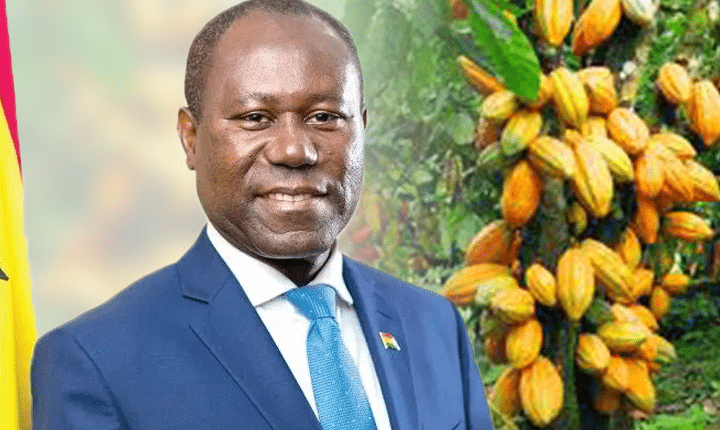
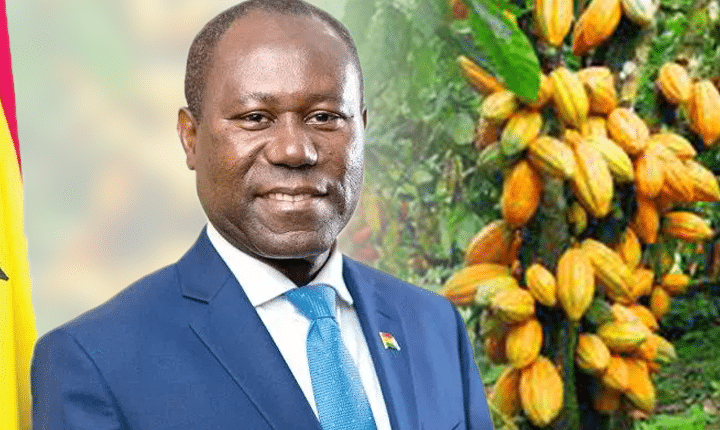
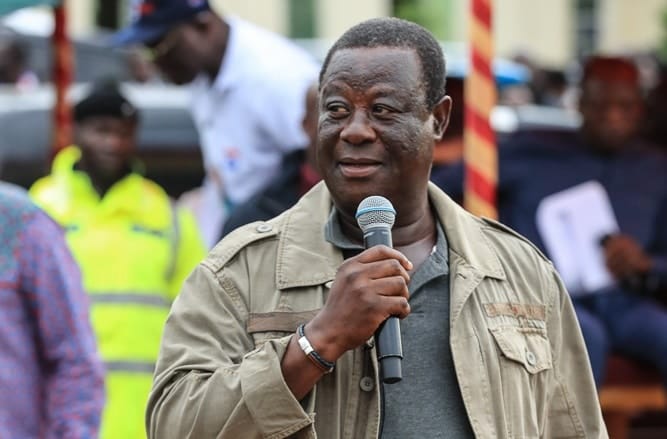
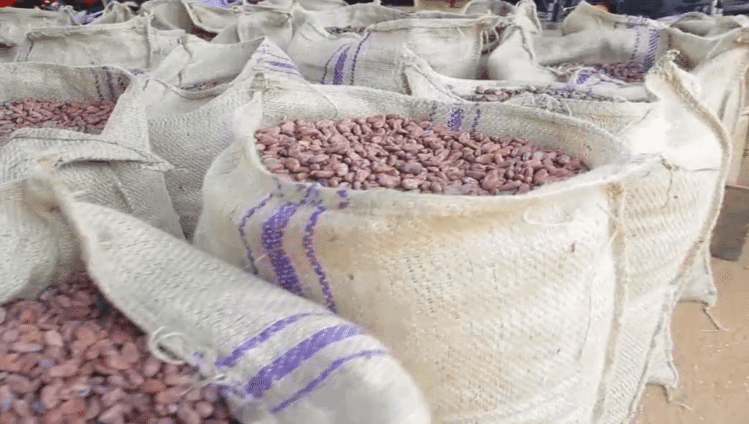
Head of the Anti-illegal Mining Unit at Ghana COCOBOD, Prof. Michael Kwateng, has issued a stern warning about the potential cancellation of Cocoa road projects if illegal mining activities persist, leading to the destruction of cocoa farms.
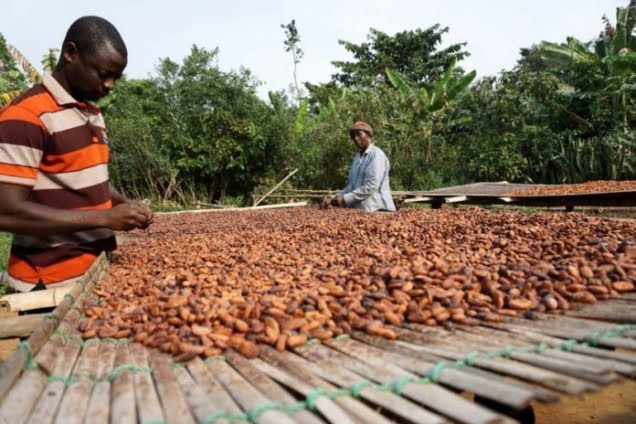
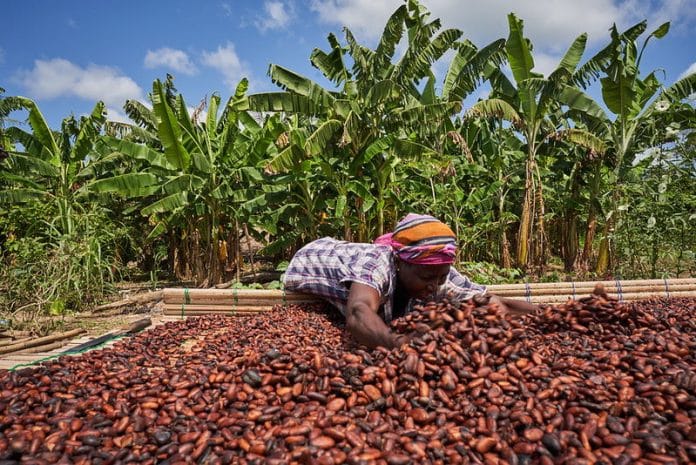
Prof. Kwateng emphasized the adverse effects of galamsey activities on cocoa production, highlighting a significant reduction in the projected cocoa output. COCOBOD, aiming to purchase 850,000 tonnes of cocoa this year, has fallen short, unable to reach even 700,000 tonnes due to the influence of illegal mining and smuggling.
Facing financial challenges resulting from this decline, COCOBOD has shifted its focus. The current priority is the completion of ongoing Cocoa Road construction projects.
Prof. Kwateng indicated that once these projects are completed, COCOBOD may refrain from awarding new contracts, indicating a potential halt to future cocoa road initiatives.
“Illegal mining is having negative implications on cocoa production. This year we projected to purchase 850,000 tonnes, but as we speak now, we have not hit even 700,000 tonnes, which means galamsey and smuggling are affecting cocoa production.”
He added “I have recommended that cocoa road projects should be cancelled because illegal miners have destroyed the cocoa farms. So very soon COCOBOD will stop cocoa road projects,” Prof. Kwateng said.
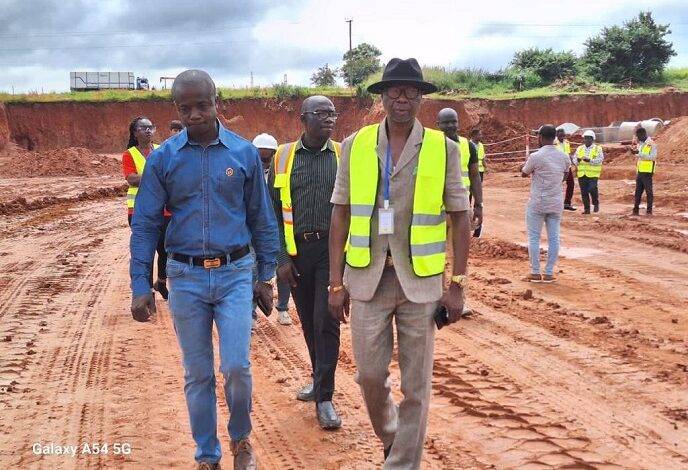
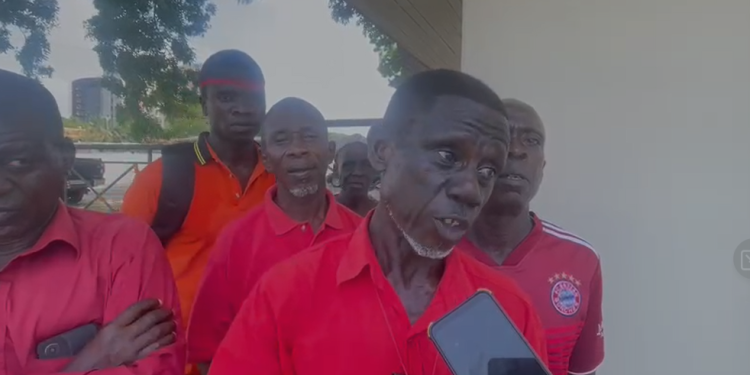
Prof. Kwateng delivered a crucial message during an engagement between the Anti-Illegal Mining Unit of COCOBOD, local chiefs, and cocoa farmers in Akyem Asafo, Eastern region.
The meeting was prompted by a petition from cocoa farmers in Akyem Asafo who expressed concern about the Chief of Akyem Asafo, Nana Barima Boampong Darkwanin, seizing 860 acres of cocoa farms. The land, originally designated for military bases, was instead repurposed for illegal mining.
Prof. Michael Kwateng, addressing the Chiefs and farmers, underscored the legal consequences outlined in the Economic Plant and Protection Act, Article 47. This legislation prohibits the sale of cocoa farms and any destruction of cocoa plants without the consent of Ghana COCOBOD. Individuals found violating this law are susceptible to legal consequences.
The Concerned Farmers Association of Akyem Asafo lamented the ongoing destruction of their cocoa farms for illegal mining, emphasizing the erosion of their livelihood. They urgently called for COCOBOD’s intervention to combat this menace.
The Ghana Cocoa Board (COCOBOD) has refuted claims of discontinuing the cocoa syndication loans for the 2023/2024 crop season.
Instead, it clarified that it is currently in the process of securing $800 million from a consortium of banks to facilitate cocoa purchases.
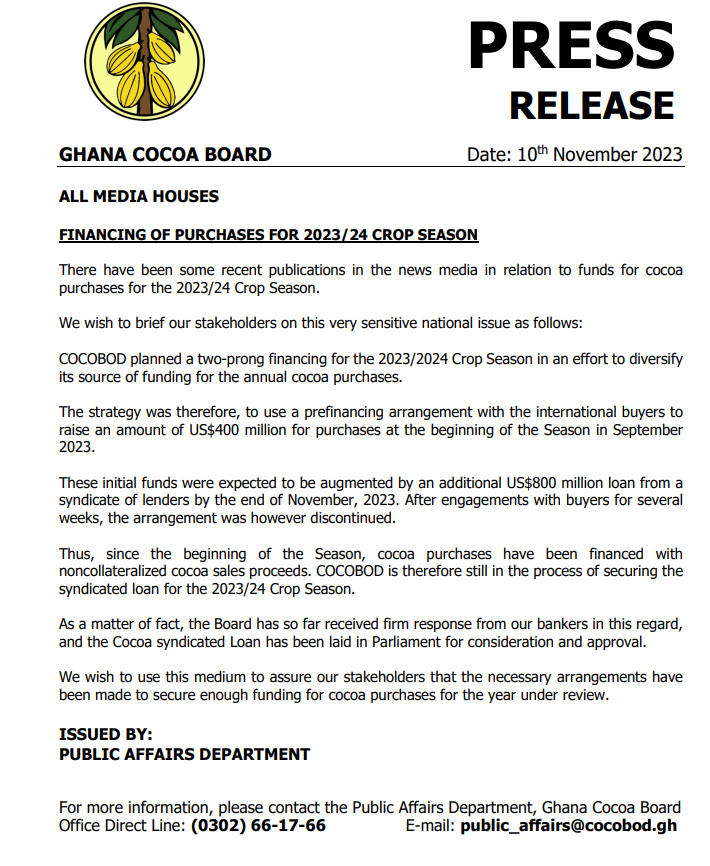
“Since the beginning of the Season, cocoa purchases have been financed with non-collateralised cocoa sales proceeds. COCOBOD is therefore still in the process of securing the syndicated loan for the 2023/24 Crop Season”, it said in a press release.
The statement further clarified that COCOBOD had initially intended to raise an additional $400 million.
“The strategy was therefore, to use a pre-financing arrangement with the international buyers to raise an amount of $400 million for purchases at the beginning of the Season in September 2023”.
“These initial funds were expected to be augmented by an additional US$800 million loan from a syndicate of lenders by the end of November, 2023. After engagements with buyers for several weeks, the arrangement was however discontinued”, it added.
The statement confirmed that the Company’s Board has received positive feedback from bankers regarding the Cocoa Syndicated Loan, which has been presented in Parliament for review and endorsement.
“We wish to use this medium to assure our stakeholders that the necessary arrangements have been made to secure enough funding for cocoa purchases for the year under review”, it said.
Ranking Member of the Food, Agriculture, and Cocoa Affairs Committee of Parliament, Eric Opoku is adamant that the Ghana Cocoa Board (COCOBOD) must provide a detailed account of the $1.3 billion Cocoa Syndicated loan it secured in 2022. The demand for transparency comes ahead of the anticipated approval of a new $800 million loan slated for this year.
Opoku emphasizes the need for COCOBOD to justify the allocation of funds from the previous loan before seeking approval for the new financial arrangement.
“What we do is that before we approve the new facility, they have to convince us as to how they used the previous one. And probably, it is one of the reasons they haven’t been able to bring the facility to us, why they are. We’ve heard of the GH¢800 million arrangements, but it hasn’t come to parliament yet,” he says.
Opoku, quoted by citinewsroom.com, expresses concerns about what he perceives as years of mismanagement at COCOBOD. He emphasizes the importance of ensuring that funds are utilized in the best interest of cocoa farmers and the broader Ghanaian populace.
“When it comes, they must be answerable for how they utilized the first facility they took, the GH¢1.3 billion. And if we are not convinced that that money was used in the best interest of our cocoa farmers and that matter Ghanaians, they will have difficulty getting approval for this one,” he asserts.
COCOBOD, currently seeking a $400 million loan from cocoa traders to support its operations for the 2023/2024 season, faces scrutiny over the prolonged process of the Syndicated loan.
Opoku criticizes the financial arrangement, highlighting the organization’s struggle to settle debts and raising concerns about fund allocation.
“For six continuous years, COCOBOD has been making losses. How can they set aside money to finance their activities? Don’t forget that the loan that we take, we don’t use all the money to buy cocoa. Part of it is used to pay their salary, part of it is used to pay their administrative cost,” he explains.
Opoku further quotes the Minister for Finance, revealing that 53% of the total cocoa proceeds are allocated to administrative costs, with just over 40% directed towards farmers.
“So, you can imagine what is happening. All mismanagement and COCOBOD is now undischarged, insolvent.”
Peter Okyere Boateng, the seventh defense witness, has refuted the claims made by the third prosecution witness, Dr. Yaw Adu-Ampomah, that a farmer informed him that lithovit liquid fertilizer is occasionally consumed when there is no access to clean drinking water.
It’s worth noting that this farmer, who allegedly made this statement, did not include this information in his witness statement when he appeared before the Economic and Organized Crime Office (EOCO). Nevertheless, the prosecution strongly emphasized this oral narrative to challenge the effectiveness of the fertilizer.
Interestingly, the farmer in question, Nana Obeng Akrofi, who also serves as a board member of the Ghana Cocoa Board (COCOBOD), informed EOCO that he experienced a yield increase of two additional cocoa bags after applying lithovit liquid fertilizer on his 10-acre farm.
However, during cross-examination, conducted by Seidu Agongo’s counsel, Benson Nutsukpui, Mr. Okyere Boateng, the former Deputy Executive Director of Cocoa Health Extension Division (CHED) at COCOBOD, asserted in an Accra High Court that despite the liquid nature of the product, no farmer trained by CHED would ever consider drinking lithovit liquid fertilizer, as alleged.
“Did you meet any of the farmers drinking lithovit as water,” the witness was asked on Thursday, November 2, 2023.
“My Lord a big no,” the witness stated, stressing, “I wouldn’t expect any farmer who has gone through CHED extension education to even taste any agrochemical let alone drinking it.
“My Lord, let me add that the farmers have been trained to look at every agrochemical as a potential poison irrespective of the actual toxicity level or sidal effect, that is the cleaning ability.”
During further questioning, counsel inquired whether the witness, during his visits to cocoa farms, had ever received any complaints from farmers that the lithovit fertilizer was indistinguishable from regular water.
“My Lord I never received any form of complaint from the farmers that I met on the farms, rather it was all commendations and singing of praises of the efficacy of the fertilizer,” he told the court president over by Justice Aboagye Tandoh.
Mr Okyere Boateng, also said his regional managers did not complain to him about the efficacy of lithovit
“My Lord I have said here severally that all regional managers including the Eastern region praise lithovit and lobbied for more supply, and therefore I never received any complaint. Though I personally did not go to the Eastern region, they never brought any report that seems to complain. So far as I’m concerned there is no complaint about lithovit fertilizer that came to me.”
Meanwhile, the witness has also maintained that he never met the second accused person, Seidu Agongo, nor any official from his company Agricult Ghana Limited before the court processes.
“My Lord I have already said it in my evidence that I had never met the A2 being described here until I came to this honourable court,” he said.
Former COCOBOD Chief Executive Dr. Opuni, businessman Seidu Agongo, and Agroindustrial Company Agricult Ghana Limited are currently facing trial on 27 charges. These charges include allegations of willfully causing financial loss to the state and violating the Public Procurement Act in connection with the procurement of Lithovit liquid fertilizer during the period from 2014 to 2016.
The case has previously been presided over by two different judges. The third trial judge, Justice Aboagye, has faced accusations of bias and unfair treatment toward the primary accused.
Despite this, the trial judge has dismissed a motion requesting his recusal from the case.
An audio recording has emerged, featuring the Member of Parliament for Awutu Senya East, Mavis Hawa Koomson, criticizing fellow Member of Parliament and New Patriotic Party (NPP) flagbearer hopeful, Kennedy Ohene Agyapong, on a WhatsApp platform.
In the viral voice note, Hawa Koomson is heard accusing Kennedy Agyapong of being a braggart, using the help he provides to people as a means to insult them. She claims that she has personally refused help from Agyapong in the past due to his reputation for being outspoken and likely to use such assistance against the recipient in the future.
Amongst the jaw-dropping revelations made by the fisheries Minister is the alleged GHC500 million to be claim by the Assin North MP.
“Kennedy as you see him has over GHC500 MILLION to collect from COCOBOD. Even Electricity Company of Ghana, he has been supplying them with meters and electric poles since President Kufour time, The party (NPP) has really helped him”
“So I am not part of those Kennedy Agyapong gives help. That is why when he came to Christ for All Mission to brag and I heard about it I called KT Hammond and Afenyo Markin that these are the lies Kennedy has come to Kasoa to peddle so I want to confront him. Thankfully to God, I met him at KT Hammond’s office where I confronted him and told him my mind because I know I don’t have my hand in his mouth,” she said.
Hawa Koomson also mentions an incident in 2012 when Agyapong claimed to be giving out cars, and she chose not to accept the offer because she did not want to be subject to potential insults from him in the future. She further asserts that she is not among those who receive help from Kennedy Agyapong.
The statement was made in response to an attack by a pro-Ken NPP member on the party’s WhatsApp platform in the Awutu Senya East Constituency.
Hawa Koomson, who openly supports Vice President Dr. Mahamudu Bawumia in the NPP flagbearer contest, accuses Kennedy Agyapong of not being a true member of the party. She questions his loyalty, citing his threats to abandon the party and move abroad if he is not elected as the flagbearer.
Furthermore, Hawa Koomson alleges that Agyapong has profited from NPP contracts and is now using his financial assistance to the party as a means to push for his election as the flagbearer. These accusations have likely stirred up controversy within the party and may impact the dynamics of the ongoing flagbearer contest.
Vocal criticKevin Taylor has levelled serious allegations against Kennedy Agyapong, a flagbearer aspirant for Ghana’s ruling New Patriotic Party (NPP). Taylor claims that Agyapong has been awarded approximately 70% of all contracts from the Ghana Cocoa Board (COCOBOD).
According to Taylor, Kennedy Agyapong has benefited immensely from President Nana Addo Dankwa Akufo-Addo’s administration. Taylor states, “He is the one who has gotten more money under this administration than anyone else. When you go to COCOBOD, 70% of the contracts, they give it to Kennedy Agyapong.”
Agyapong has also reportedly held key positions, including a place on the Ghana Gas board. Taylor goes further to claim that the approval for such roles came directly from Akufo-Addo and Vice President Mahamudu Bawumia.
Taylor went on to question Agyapong’s wife, alleging that she was made the board chair of the Ghana Shippers Authority with Akufo-Addo’s approval.
He made these remarks on his online show, With All Due Respect, while reacting to Agyapong’s recent comments about the NPP’s alleged looting of public funds.
“So if Kennedy tells you NPP members are thieves, who are the thieves? He is a first class criminal, because as we speak today, he is still serving a criminal. Kennedy Agyapong is serving Bawumia, he is serving Akufo-Addo, he is serving NPP as the board chair of Ghana Gas. So if Kennedy stands in front of you and tells you NPP members are thieves, they are stealing from Ghana like there is no tomorrow, he is basically still working for the Akufo-Addo administration,” Taylor lashed out.
Kennedy Agyapong, on October 2, 2023, was reported to have made accusations of corruption against his own party. He claimed that the magnitude of the NPP’s alleged looting of public funds was as if “there was no tomorrow”.
“The way the NPP is looting this country, you will think there is no tomorrow. You steal all this money and stash same abroad, what do you mean? The youth of this country are not working, yet you are intimidating people. I will put my life on the line and defend them,” he is reported to have said.
However, Agyapong later clarified that the reports surrounding his allegations had been taken out of context. He stated that the video from which these reports stemmed was “culled from a private meeting” he had with party communicators in Kumasi, Ashanti Region. In a statement, Agyapong emphasised that he remains a committed member of the NPP and accused the media of creating a “deadly impression” of the party.
Ken Agyapong has spoken out about his government's alleged looting. Join the #OccupyBoGProtest on Tuesday October3, to demand the change we deserve. Let's come together and make our voices heard! 🗣️💪 It's time to stand up for a better Ghana. #GhanaYouth#OccupyBoGProtest 🇬🇭 pic.twitter.com/IjPZqrTocq
In an effort to enhance cocoa yields, COCOBOD has provided training to 100,000 individuals for the purpose of artificially pollinating cocoa trees.
These individuals are tasked with supplementing the work of dwindling insect populations responsible for pollination in cocoa farms. The decline in insect populations, as stated by COCOBOD, is a result of certain farming practices.
One of the primary culprits in this issue is the improper use of unapproved weedicides and insecticides by some farmers.
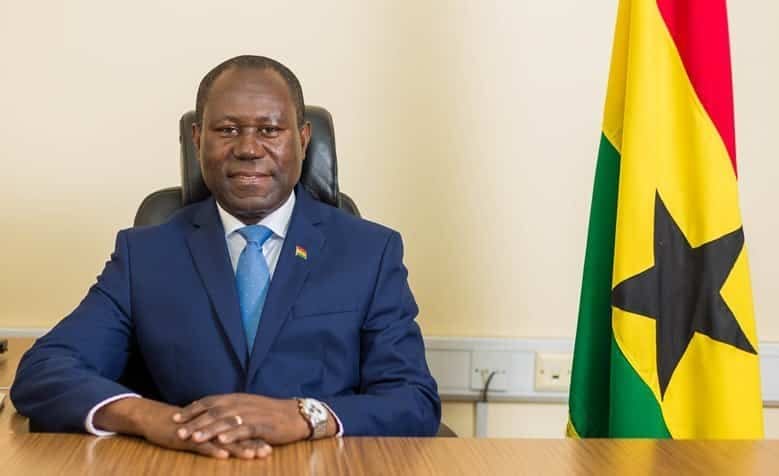
During a local gathering in Tepa, where he addressed community leaders, farmers, and residents of the Ahafo Ano North Municipal in the Ashanti Region, Joseph Boahen Aidoo, CEO of COCOBOD, encouraged farmers to make use of these trained pollinators.
He emphasized that when artificial or hand pollination is effectively carried out, farmers can expect to harvest no less than 20 bags of cocoa per acre.
Mr. Aidoo cautioned against the use of unapproved agricultural practices that negatively impact cocoa yields. He highlighted pruning as a highly effective method and encouraged farmers to adopt it, as it has consistently proven to increase yields.
He explained that pruning enhances farm ventilation, significantly contributing to cocoa farm health.
Regarding cocoa pod disease, Mr. Boahen Aidoo advised affected farmers to reach out to COCOBOD district offices for guidance.
In terms of disease management, the CEO mentioned that COCOBOD’s initial intervention step is to cut down all cocoa trees on affected farms.
“After cutting down these trees, COCOBOD will then plant new cocoa trees in addition to plantain trees at no cost to the farmer. Again, COCOBOD will then manage the new farm for two years before handing it over to its owner.
This initiative aims to motivate farmers to report and assist in controlling cocoa pod disease, which is incurable and can have a detrimental impact on cocoa production, as stated by the CEO of COCOBOD.
The CEO mentioned that areas affected by the disease in the Ahafo Ano region of the Ashanti Region include Betsiako, Tebrikrom, Wioso, Pobiso, and Jepp Nkwanta.
Regarding the pension scheme for farmers, he made an appeal for farmers to enroll in the program. The scheme, currently in a pilot phase in New Edubiase within the Adansi South District of the Ashanti Region, is designed to improve the lives of cocoa farmers in their later years.
He noted that the government has allocated a fund from cocoa bean sales for the scheme, with each farmer indirectly contributing. The CEO strongly recommended that every cocoa farmer participate in the scheme to enjoy its benefits.
During the gathering, Nana Atwenewa Ampem II, the Omanhene of the Tepa Traditional Council, expressed gratitude to the government for its various social interventions aimed at enhancing the lives of Ghanaians.
He specifically cited the cocoa roads initiative, which has improved rural road networks, and requested its expansion to cover more areas. He also called on COCOBOD to monitor the activities of Produce Buying Companies, as there have been reports of some companies cheating farmers.
The durbar was attended by over 800 farmers from the Ahafo Ano North municipality, and several dignitaries, including heads of departments and agencies in the region.
President of the Concerned Cocoa Farmers Association, Nana Boateng Bonsu, has stated that Ghana Cocoa Board (COCOBOD) needs to be dissolved because it is failed.
Following concerns raised by the International Monetary Fund (IMF) that the state-owned company’s enormous annual losses posed a serious threat to the industry and government’s fiscal efforts, Finance Minister Ken Ofori-Atta announced last week that his office and the Bank of Ghana were in contact to set up a monitoring desk at COCOBOD to ensure discipline in the company’s expenditure.
“Both the Governor of the Central Bank and the Minister of Finance – myself, will now be on the Board and we are also setting up a desk at the Finance Ministry that will interact with the finance division of COCOBOD to make sure the issues of fertilizers, cocoa road are all brought into an ambit of discipline. Those begin to tell you how we are getting into the issue of expenditure,” Mr Ofori-Atta said.
Mr Bonsu, in response to that move, however, said: “Cocobod is a collapsed institution”, insisting: “We know it, we foresaw it and said it several times but they never listened”.
“So, for this situation, we don’t need Ken Ofori-Atta and his people. What are they coming to do?” he wondered.
“If they had something better to offer, by now, Ghana’s economy would have shot up”, Mr Bonsu noted.
He said: “They have nothing to offer. Cocoa farmers are capable of doing their own things” and demanded that “they should forget about Ken Ofori-Atta and his people”.
“If they know COCOBOD has collapsed, we should know so that cocoa farmers can sell their products directly to the buyer to make our money rather than relying on the government, because the government has nothing better to offer the farmers,” he said.
“Right now, a lot of farmers are cutting down their cocoa trees and shifting to different crops all because they’ve realised that they have been enslaved for so many years”, Mr Bonsu revealed.
In his view, “COCOBOD has put wax in their ears and are not listening to the farmers”.
He complained that COCOBOD takes decisions willy-nilly without the input of the farmers.
“There’s nothing happening on the ground. There is no dialogue between farmers and COCOBOD. Anything that comes to them and they think it is beneficial to them or us, they just implement. There is nothing like an engagement or ‘let’s sit down with the farmers since they are those on the ground and see what they want’”, he told Joy News on Monday, 23 October 2023.
COCOBOD was established through an ordinance in 1947 with the primary objective of promoting and facilitating the production, processing, and marketing of high-quality cocoa, coffee, and sheanut products in the most efficient and cost-effective manner.
Initially, COCOBOD was provided with ¢27 million, which represented Ghana’s share of the net profit from the West African Produce Control Board, serving as its initial working capital.
The roots of COCOBOD can be traced back to the cocoa crisis of 1937. The Board initially operated from rented premises, utilizing the old facilities of the Export Produce Control Board on 28th February Road in Accra. Subsequently, it leased a portion of the Swan Mill, constructed by the United Africa Company Limited, at an annual cost of approximately ¢4,500. Afterward, COCOBOD acquired its own building.
In 1957, Ghana’s first President, Dr. Kwame Nkrumah, laid the foundation stone for Cocoa House at 41 Kwame Nkrumah Avenue in Accra, which was intended to serve as office space for the Board. The construction of Cocoa House was not only aimed at eliminating rental expenses but also stood as a tangible symbol of the Board’s confidence in the future of the cocoa industry, serving as a living tribute to the dedication of Ghanaian farmers.
Cocoa House, a six-story building constructed at a cost of nearly ¢2 million, was officially commissioned in November 1960 by the late President. Besides housing COCOBOD, Cocoa House also accommodated offices for various foreign and local organizations, including Ethiopian Airlines and ARB Apex Bank.
President of the Concerned Cocoa Farmers Association, Nana Boateng Bonsu, has urged the government to clarify the status of the Ghana Cocoa Board (COCOBOD).
Bonsu emphasizes that this information is crucial for farmers to decide whether to sell their products directly to buyers.
He believes that direct engagement with buyers could yield higher revenues for farmers, rather than relying on government negotiations.
During an interview on JoyNews’ PM Express on October 23, 2023, Mr. Bonsu stated, “If they know COCOBOD has collapsed, we should know so that cocoa farmers can sell their products directly to the buyer to make our money rather than relying on the government because the government has nothing better to offer the farmers.”
Additionally, he highlighted that certain farmers are opting to uproot their cocoa trees and transition to cultivating alternative crops in pursuit of increased earnings.
“Right now, a lot of farmers are cutting down their cocoa trees and shifting to different crops all because they’ve realised that they have been enslaved for so many years,” President of Concerned Cocoa Farmers Association stated.
He also criticized COCOBOD for failing to heed farmers’ concerns and not engaging in any meaningful dialogue with them.
“Cocobod has put wax in their ears and are not listening to the farmers. There’s nothing happening on the ground. There is no dialogue between farmers and Cocobod. Anything that comes to them [Cocobod] and they think it is beneficial to them or us, they just implement. There is nothing like an engagement or ‘let’s sit down with the farmers since they are those on the ground and see what they want’,” he opined.
The Ghana COCOBOD‘s Deputy Chief Executive responsible for operations has refuted claims suggesting the organization’s negligence.
According to him, the company has different steps it takes before approving activities.
His comment was prompted by the fact that the Ministry of Finance is in the process of forming a team to oversee the operations of the COCOBOD
Dr Opoku said claims that COCOBOD has not been good with money are not correct.
”I don’t have a lot to talk about. What I want to say is that if you look at the COCOBOD organization, someone from the Finance Ministry or the minister’s assistant is part of the board. This means that the minister always represents. The Governor of Bank of Ghana is also part of the board. ”
Dr Opoku later stated that there are already government officials on COCOBOD’s board. So, any accusation made against them is not true and has no basis.
We work under a group led by someone chosen by the government, and the Minister of Finance is also one of the members of this group. We also have the Minister of Agriculture as a member of the board. In this situation, the deputy minister represents the minister. Therefore, I believe COCOBOD has not done anything wrong.
We (COCOBOD) cannot spend any money without approval from the board and our supervisory minister. It is hard to believe when someone accuses us of being careless.
Doctor Opoku said that COCOBOD had appeared before Parliament a few times, and he doesn’t think they found anything wrong with COCOBOD. He also mentioned that COCOBOD has auditors who check our accounts and understand how COCOBOD operates.
Finance Minister Ken Ofori-Atta has confirmed the establishment of a monitoring desk jointly operated by the Ministry of Finance and the Bank of Ghana (BoG) to oversee the financial matters of the Ghana Cocoa Board (COCOBOD).
The purpose of this initiative is to instill financial discipline in COCOBOD’s expenditure.
COCOBOD, tasked with supervising cocoa production and exports in the country, has been facing substantial annual losses, which the International Monetary Fund (IMF) has identified as a significant threat to both the sector and the government’s fiscal endeavors.
Per reports from JoyNews, the Minister emphasized that the procurement of fertilizers and the construction of cocoa roads will be closely monitored to ensure strict adherence to budgetary constraints.
“Both the Governor of the Central Bank and the Minister of Finance – myself, will now be on the Board and we also setting up a desk at the Finance Ministry that will interact with the finance division of COCOBOD to make sure the issues of fertilizers, cocoa road are all brought into an ambit of discipline. Those begin to tell you how we are getting into the issue of expenditure,” he said.
The Finance Minister is in London for negotiations with the nation’s external creditors, seeking their agreement to a 40 percent reduction in the planned restructuring of Ghana’s $10 billion debt.
A successful outcome of these negotiations would pave the way for the disbursement of the second tranche of the International Monetary Fund (IMF).
Mr. Ofori-Atta expresses his optimism that a favorable agreement will be reached before the year’s end.
“I am sure most people were expecting to be sometime next year but I think we will be able to do it before next year.”
In the meantime, President Akufo-Addo remains hopeful that the Ghanaian economy is on a path to recovery, even in the face of the challenges his administration has encountered.
He points out that inflation, a significant contributing factor, is steadily decreasing, signaling a favorable economic outlook.
As a result, he is confident in achieving a single-digit inflation target before the conclusion of his term in 2024.
The family of the late Michael Ashie, one of the three individuals who tragically lost their lives due to suffocation while carrying out maintenance work on a faulty fuel reservoir at the COCOBOD office in Koforidua, has expressed their full cooperation with the Ghana Police Service, who have initiated an investigation into this unfortunate incident.
The deceased individuals, Michael Ashie, Jonathan Kokroko, and Paul Ocloo, were technical experts contracted by the management of the PBC workshop to perform repairs on the faulty fuel reservoir at the Koforidua COCOBOD Office. Regrettably, they reportedly suffocated while engaged in their tasks on Monday, October 9.
Health professionals at St. Joseph’s Hospital in Koforidua Effiduase, who confirmed the deaths of these three individuals after their bodies were retrieved from the underground tank and transported to the hospital, are also collaborating with the police. They intend to provide the police with an autopsy report in due course.
Ishmael Kotey Ashie, the son of the deceased Michael Ashie, described the incident as shocking to the family, which they are gradually recovering from.
“It was shocking news, but all the same, we have to embrace whatever news has come, and we are standing strong. I am trying to keep my mother and my sister together,” he said.
Meanwhile, the management of COCOBOD in the Eastern Region is still waiting for confirmation from the national headquarters before briefing the media on the incident.
Bright Simons, the Vice President of the policy think-tank IMANI-Africa, has asserted that the decrease in Ghana’s cocoa syndicated loan amount does not reflect prudence on COCOBOD’s part but rather signals a decline in banking confidence.
In prior years, Ghana received varying amounts for its cocoa syndicated loan, including $650 million in 2023, $900 million in 2007, $2 billion in 2011, $1.5 billion in 2012, $1.8 billion in 2016, and $1.3 billion in 2020 and 2022. However, the expected amount for 2023 has dwindled to $800 million.
Simons contends that Ghana had built a strong reputation over the years concerning the Cocoa Syndicated Loan, but this reputation is waning due to the current state of the economy.
He wrote on his Twitter page on September 25: “Since Ghana secured the first receivables-backed syndicated loan of ~$143m for the 1992/1993 cocoa season from international banks, the facility has become one of the country’s credit badges. This massive drop shows a national business reputation built over decades cracking badly.”
The Cocoa Syndicated loan aims to support initiatives in the cocoa sector, which is one of Ghana’s top export commodities.
The Ghana Cocoa Board has faced numerous challenges, primarily concerning its substantial debt burdens. To address this issue and attain a degree of debt stability, the government initiated the restructuring of cocoa bills. This move also aligns with Ghana’s commitments within the ongoing International Monetary Fund program.
The Minority in Parliament has strongly called for the immediate resignation of Joseph Boahen Aidoo, the Chief Executive Officer of the Ghana Cocoa Board (COCOBOD). They allege mismanagement of the cocoa sector and a decline in the welfare of cocoa farmers.
They argue that Aidoo is no longer fit for the position of CEO. Addressing the media in the Ashanti Region, Minority Leader Dr. Cassiel Ato Forson voiced apprehensions regarding the cocoa sector’s condition, despite the announcement of a 68 percent increase in the producer price.
“Clearly, something is amiss at COCOBOD because we are seeing the production of cocoa coming down to the lowest in the last fifteen years, and we have also seen them recording massive losses since 2017. Last year, according to their own audit report, we declared a loss of GH¢2.4 billion in one year, and so I don’t see why the CEO should be in office despite these happenings,” citinewsroom.com quoted Ato Forson.
The Minority has accused Aidoo of incompetence and corruption, claiming that he has not implemented necessary reforms to improve the cocoa sector.
Furthermore, the Minority has criticized the government for allegedly offering cocoa farmers a meager increase in the price of a bag of cocoa to GHC1,300.
They argue that cocoa farmers should have received at least GHC2,500 per bag.
Eric Opoku, Deputy Ranking Member on the Food, Agriculture, and Cocoa Affairs Committee of Parliament, expressed disappointment with the government’s pricing approach. He emphasized that this season should have allowed cocoa farmers to receive more substantial rewards for their produce and lamented that cocoa farmers are currently receiving insufficient compensation under the existing pricing scheme.
The Minority in Parliament is calling for the immediate resignation of Joseph Boahen Aidoo, the Chief Executive Officer of the Ghana Cocoa Board (COCOBOD).
According to the Minority, Aidoo’s management of the cocoa sector has been marred by mismanagement, leading to the worsening conditions of cocoa farmers.
They assert that he is no longer suitable for the CEO position.
Addressing the media in the Ashanti Region, Minority Leader Dr. Cassiel Ato Forson emphasized that despite the announcement of a 68 percent increase in the producer price, the cocoa sector is facing significant challenges and is in a state of decline.
“Clearly, something is amiss at COCOBOD because we are seeing the production of cocoa coming down to the lowest in the last fifteen years and we have also seen them recording massive losses since 2017. Last year, according to their own audit report, we declared a loss of GH¢2.4 billion in one year and so I don’t see why the CEO should be in office despite these happenings.”
The Minority has leveled accusations of incompetence and corruption against Aidoo, asserting that he has failed to implement necessary reforms aimed at enhancing the cocoa sector.
Additionally, the Minority has criticized the government for what they deem as shortchanging cocoa farmers by setting the price of a cocoa bag at GHC1,300. According to them, cocoa farmers should have received a minimum of GHC2,500 per bag.
During an interview on Eyewitness News, Eric Opoku, the Deputy Ranking Member on the Food, Agriculture, and Cocoa Affairs Committee of Parliament, strongly criticized the government for providing cocoa farmers with what he described as inadequate compensation.
He expressed deep concern over the remuneration given to cocoa farmers, emphasizing that this season presents an ideal opportunity for cocoa farmers to reap substantial benefits from their produce.
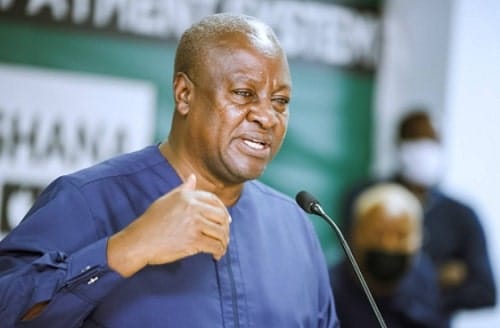
The Ghana Cocoa Board (COCOBOD) has criticized former President John Dramani Mahama‘s remarks regarding the government’s decision to raise the cocoa bag price to GH₵1,300.
Mahama had labeled the government as “insensitive” to farmers’ concerns, asserting that the increase fell short.
In a statement dated September 12, COCOBOD CEO Joseph Boahen Aidoo suggested that Mahama should be well-acquainted with the cocoa producer price determination process.
Aidoo clarified that for the 2023/24 crop, cocoa had been sold at international prices ranging from $2,200 to $2,400 per tonne between October 2022 and March 2023.
“Since you have had the privilege of being in government before as the number one gentleman of the country, it is expected that you would be familiar with the process for determining the producer price of cocoa.
“I am, therefore, surprised that you chose, rather erroneously, to use the current international market price of cocoa at $3,600 per tonne as the basis for your calculation in your post on the recently announced producer”.
It was reported by COCOBOD that the 2023/24 crop was sold at international prices between October 2022 and March 2023, ranging between $2,200 per tonne and $2,400 per tonne.
“You are fully aware that Ghana’s cocoa beans are mostly sold forward. This means that the 2023/24 crop was sold between October 2022 and March 2023 at international prices; ranging between $2,200 per tonne and $2,400 per tonne. The international price of cocoa then began to increase in April 2023, when a greater percentage of the 2023/24 crop had already been sold,” COCOBOD said in its statement.
The Ghana Cocoa Board (COCOBOD) has initiated the rollout of a contributory scheme within the framework of the new three-tier pension system designed for cocoa farmers.
After nearly four decades since the establishment of the Contributory Insurance for Farmers scheme, this year marks a pivotal moment as the fund anticipates its inaugural contribution, following multiple previous unsuccessful attempts.
Enshrined in section 26 (clause 1) of the Ghana COCOBOD Act 1984 PNDCL 84, the Contributory Insurance for Farmers scheme is aimed at enhancing the livelihoods of farmers by enabling them to save for their retirement. Additionally, it serves as an incentive for young individuals to engage in cocoa farming.
COCOBOD expects to generate approximately 70.4 million cedis through this fund in the year 2023.
During the inauguration of the 2023/2024 cocoa season in Tepa, President Akufo-Addo declared that enrollment for the scheme has commenced, with the hope of attracting more cocoa farmers to participate.
He attributed the successful implementation of the scheme to the digitalization of the sector.
“The scheme represents the first successful realization of section 26 (clause 1) of the Ghana COCOBOD Act 1984 PNDCL 84, which outlines the establishment of this scheme,” President Akufo-Addo stated.
“This achievement has been made possible through the adoption of a cocoa management system, which has supplied the essential data and digital infrastructure for the scheme’s triumph.”
Joseph Boahen Aidoo, the Chief Executive Officer of COCOBOD, expressed confidence that these new financial measures, including the pension scheme, would boost productivity in the cocoa sector. He conveyed his gratitude on behalf of the farmers to the government for implementing strategic policies to enhance the industry.
In parallel, Ghana is actively developing a robust cocoa traceability system to meet the European Union’s requirements regarding deforestation regulations. The Ghana Cocoa Traceability System (GCTS) is currently undergoing testing in the Assin-Fosu Cocoa District to demonstrate its effectiveness, a collaborative effort between COCOBOD and GIZ.
Mr. Boahen Aidoo highlighted that Ghana stands out as the only nation worldwide with a National Traceability System, underscoring its commitment to sustainable cocoa production and responsible sourcing practices.
“Beginning 1st January, 2025 the European Union will commence its regulations to ensure any cocoa imported into their market could be traced. We are the only country with a robust traceability system as we ready ourselves for the implementation of the new rules,” he said.
The government has instructed the Ghana Cocoa Board(COCOBOD) to advance the start of the upcoming 2023/2024 season, effective from Friday, September 8, 2023. This directive, as announced by Joseph Boahen Aidoo, the Chief Executive, in a statement issued in Accra, is in response to recent disruptions in the internal cocoa market and is aimed at protecting the interests of cocoa farmers.
The official opening ceremony for the new season is scheduled for Saturday, September 9, 2023. Consequently, the 2023 Light Crop Season concluded at the close of business on Thursday, August 31, 2023.
“In order to assist the Licensed Buying Companies (LBCs) to obtain the final returns from up-country, Ghana Cocoa Board has decided that returns on the declared purchases will be accepted up to 1600 hours on Thurday September 7, 2023,” it said.
It stated that everyone was to strictly comply with the foregoing arrangements and take note of them.
The Ghana Cocoa Board (COCOBOD) has reported an impressive 97 percent participation rate in its Debt Exchange Programme, with bills totaling over GH¢7 billion being tendered. This outcome was achieved at the conclusion of the program on Friday, August 25, 2023.
In July of the same year, COCOBOD initiated its Cocoa Bills Exchange Programme with the aim of restructuring debts amounting to nearly ¢8 billion.
It’s worth noting that COCOBOD has rescheduled settlements to take place on September 4, 2023, instead of the originally planned date of Thursday, August 31, 2023.
“We refer to the debt securities exchange programme launched by the Ghana Cocoa Board (“COCOBOD”) on 14th July 2023 (the Exchange Programme). COCOBOD announces today the results of the Cocoa Bills exchange programme which closed at 4:00 p.m. on 25th August 2023” a statement from CAL Bank said.
“Approximately 97.38% of eligible holdings tendered their Eligible Bills in the Invitation to Exchange as determined by the Central Securities Depository (“CSD”)”, it added.
The statement clarifies that any capitalized terms used in this document without specific definitions should be interpreted according to their meanings as provided in the Exchange.
COCOBOD expressed satisfaction with the outcomes, noting that a significant majority of the Eligible Holdings had participated in the tender process.
“To provide sufficient time to settle the New Cocoa Bonds in an efficient manner, COCOBOD is extending the Settlement Date of the exchange from the previously announced 1st September 2023 to 4th September 2023”.
The issuance date, interest accrual schedules, and payment schedules for the New Cocoa Bonds will be adapted to align with the actual Settlement Date.
With the exception of the provisions in this paragraph, the terms and conditions outlined in the Invitation to Exchange remain unchanged and unaltered. Given that the Invitation Period has concluded, COCOBOD will not entertain new submissions except at its sole discretion, and revocations or withdrawals are not permitted.
Federated Commodities Limited (FEDCo),a licenced cocoa buying company, presented a cheque for GH16 million as a premium to certified cocoa farmers for the 2022/2023 crop season at Assin Fosu in the Central Region.
The premium is to encourage the farmers to work hard towards increasing production and also adopt best farming practises. It forms part of the company’s corporate social responsibility.
As part of the disbursement, each farmer from selected cocoa districts would receive GH50 per bag.
However, cocoa farmers from Asankragua and Samreboi, would receive GH64 per bag as premium.
The company paid 30 percent of the amount due to each cocoa farmer through mobile money transactions, while the remaining 70 percent would be paid through cash payments.
Mrs Maria Adamu-Zibo, managing Director of FEDCo, made this known at the official premium announcement at Assin Fosu in the Central Region.
She indicated that the company, together with its partners,had disbursed GH 150 million in a number of communities on projects and cash premium.
“This year alone, we have supplied 20,000 MT of sustainable beans to our clients and trained over 27,000 farmers,” she said.
The company, Mrs Adamu-Zibo indicated, had embarked on several projects, including the supply of shade trees, farm inputs and tricycles to some communities, saying, “We have also piloted farmer trainings in soap making, grass cutter rearing and demonstration plots”.
She also called on the government and stakeholders to create an enabling environment for the growth of the cocoa sector.
“The youth need to see farming as a business opportunity, where they can choose to farm or engage in auxiliary services such as labour support, input supply, alternative cocoa farming methods, organic cocoa, cocoa processing and transformation,” she stated.
She admonished cocoa farmers to adopt good agricultural practises and also protect the soils from degradation.
Nuruddin Essilfie,Head of Sustainability at FEDCo, indicated that the company had embarked on other sustainability programmes such as afforestation, accessible soil and sustainable environment project, child labour monitoring projects, and tricycle projects.
He expressed worry about farmers leasing their land for illegal mining activities, and therefore, called on the government to put in more efforts in the fight against illegal mining as their action was negatively affecting the sector.
The sweet aroma of Ghana’s famed cocoa harvest may soon be tinged with a hint of bitterness, as the nation is likely to grapple with the daunting reality of falling short of its cocoa production targets, Bright Simons has predicted.
He says his sources at the Ghana Cocoa Board have revealed that the country may not reach its target for production this year.
At the heart of this growing concern, he disclosed is the alleged politicization of the Cocoa Board (COCOBOD).
“Our sources say that even the 650,000 tons of cocoa Ghana is targeting this season, the lowest in 13 years, may not be met. Due to rampant politicisation of Cocobod, the state-owned monopoly & the appointment of political agents to key roles, the sector risks total collapse,” he said in Tweet.
COCOBOD, responsible for regulating and supporting cocoa production across the nation, has long been regarded as a linchpin of Ghana’s economic stability.
However, as the country strives to achieve its cocoa production objectives, concerns have emerged over whether political influences have begun to overshadow its operational efficiency.
Simons’ concerns echo the sentiments of many who see the potential for political agendas to derail the meticulous planning and execution required for a successful cocoa harvest.
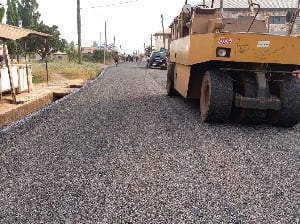
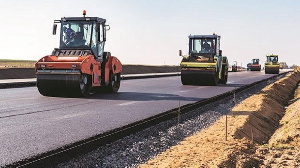
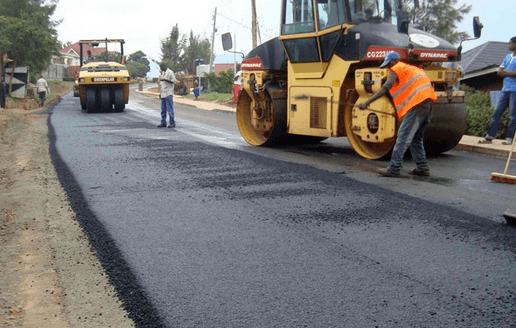
The Ghana Cocoa Board (COCOBOD) has announced its intention to cease the construction of cocoa roads after the current ongoing projects are concluded.
COCOBOD had launched the Cocoa Road Programme with the aim of addressing transportation challenges related to delivering agro-inputs to cocoa farmers and facilitating the evacuation of cocoa beans.
Joseph Boahen Aidoo, the CEO, revealed during the 50th Anniversary Celebration Symposium of the Cocoa Clinic that this change in policy is a result of discussions with the European Union and the International Monetary Fund (IMF).
Both of these entities, he explained, had raised questions about COCOBOD’s involvement in road construction and suggested a focus on its core functions instead.
“The EU sent a team last year to do due diligence on sustainable production and when they came, they wanted to know why COCOBOD was involved in cocoa roads construction because it is not a core business of COCOBOD, and they insisted that we take that venture out of our equation; and, of course, the IMF is also saying the same thing”.
“They say that we can continue with what we are currently constructing and not start new ones”, Mr Boahen said.
In order to improve farmers’ access to healthcare, he also described plans for building healthcare facilities in cocoa-growing areas, noting instances of farmers having to travel far for care as motivation.
“I have had the experience where a woman, who was in labour and couldn’t deliver, had to be carried in a hammock and travelled over 28 kilometres and couldn’t survive.
“And, when we look at the countryside to see how our cocoa farmers struggle to access health delivery, you will be touched to do something; and that is why, as an institution, it is important to bring health services and facilities as close to these farmers as possible”.
Ghana Cocoa Board (COCOBOD) has announced its intention to cease the construction of cocoa roads after the ongoing projects are finished.
The Cocoa Road Programme was launched by COCOBOD with the aim of resolving transportation difficulties related to delivering agricultural inputs to cocoa farmers and streamlining the evacuation of cocoa beans.
During the 50th Anniversary Celebration symposium of the Cocoa Clinic, CEO Joseph Boahen Aidoo conveyed that this change in policy originates from discussions held with the European Union and the International Monetary Fund (IMF).
Both entities, he said, questioned COCOBOD’s involvement in road construction, urging a focus on core functions.
“The EU sent a team last year to do due diligence on sustainable production and when they came, they wanted to know why COCOBOD was involved in cocoa roads construction because it is not a core business of COCOBOD, and they insisted that we take that venture out of our equation; and, of course, the IMF is also saying the same thing”.
“They say that we can continue with what we are currently constructing and not start new ones”, Mr Boahen said.
He also outlined plans for establishing healthcare centres in cocoa-growing communities to enhance medical accessibility for farmers, citing instances of arduous journeys for healthcare as a driving factor.
“I have had the experience where a woman, who was in labour and couldn’t deliver, had to be carried in a hammock and travelled over 28 kilometres and couldn’t survive.
“And, when we look at the countryside to see how our cocoa farmers struggle to access health delivery, you will be touched to do something; and that is why, as an institution, it is important to bring health services and facilities as closer to these farmers as possible”.
The Ghana Cocoa Board (COCOBOD) has declared that it will cease its involvement in the construction of cocoa roads nationwide once the ongoing projects are completed.
Initially launched to address the logistical difficulties in supplying agro-inputs to cocoa farmers and transporting cocoa beans to Take Over Centres, the Cocoa Road Programme by COCOBOD is undergoing a shift in policy.
Speaking at the 50th Anniversary Celebration symposium of the Cocoa Clinic, the CEO of COCOBOD, Joseph Boahen Aidoo, revealed that this change is the outcome of negotiations with the European Union and the International Monetary Fund (IMF).
“Last year, the EU conducted a thorough examination of sustainable production practices. During their assessment, they raised questions about COCOBOD’s involvement in cocoa road construction, citing that it falls outside our core responsibilities. The IMF has expressed similar sentiments. Both entities recommend that we focus on our ongoing construction projects and refrain from initiating new ones.”
Nonetheless, Joseph Boahen Aidoo also unveiled COCOBOD’s intention to establish healthcare facilities within various cocoa-growing communities across the nation, aimed at enhancing healthcare accessibility for cocoa farmers.
“I have personally witnessed the plight of a woman in labor, unable to give birth, being transported over 28 kilometers in a hammock, ultimately leading to a tragic outcome. Observing the challenges our cocoa farmers endure to access healthcare in rural areas has spurred us to take action. As an organization, we recognize the importance of bringing healthcare services and facilities as close as possible to these farmers.”
The Ghana Cocoa Board (COCOBOD) has made an important announcement regarding an extension of the closing date for its debt exchange offer programme.
This initiative is designed to manage debt securities and provide investors with improved investment opportunities.
The decision to extend the closing date was prompted by an error in the previously announced date, which coincided with a statutory public holiday.
To rectify this, COCOBOD clarified that the voluntary cocoa bills exchange programme, launched on July 14, 2023, will now close on August 3, 2023, at 4 pm.
The original offer period was initially set to end on July 31, 2023, and August 4, 2023. However, the correction was necessary due to August 4, 2023, being declared a statutory public holiday by the Minister of Interior.
This extension aims to ensure that all participants have ample time and opportunity to take part in the debt exchange programme, offering holders of COCOBOD’s short-term debt securities the chance to swap their bills for longer-term debt securities issued by COCOBOD.
“We refer to the debt securities exchange programme launched by the Ghana Cocoa Board (COCOBOD) on 14th July, 2023 (the Exchange Programme). It would be recalled that the transaction timetable provided in press releases and the exchange memorandum in relation to the Exchange Programme (the Exchange Memorandum) states that the offer period for the Exchange Programme opened at 4pm on 14th July, 2023 and closes at 4pm on 31st July, 2023 and 4th August, 2023. The date in the press release was in error; therefore, the 4th August date is the correct closure date,” a statement from COCOBOD read.
“Subsequently, by a press release issued on 26th July, 2023, the Minister of Interior has declared 4th August, 2023 as a statutory public holiday and mandated that the day should be observed as such throughout the country. In compliance with the directive regarding the observation of 4th August, 2023 as a statutory public holiday, we urge all persons who intend to participate in the Exchange Programme to submit their applications by 4pm on 3rd August, 2023 instead of 4th August, 2023, which is now a public holiday,” it added.
All other dates in the transaction schedule, as stated in the Exchange Memorandum, will remain the same, according to COCOBOD, unless specifically extended by COCOBOD, in its sole discretion, and with the Securities and Exchange Commission’s prior consent.
Additionally, it stated that the window for exchanging chocolate bills had ended.
The GH7.93 billion exchange program intends to replace current bonds with updated ones that have revised terms in an effort to improve the organization’s debt management and give investors a more alluring investment alternative.
If their offers are approved, holders will get five distinct bonds, each with a different maturity date between 2024 and 2028 and a total principal amount equal to the principal of the tenderized cocoa bills.
The timing of this event coincides with local banks’ recent calls for better conditions in the reorganization of cocoa bill holdings. Five new bonds have been proposed by the government to replace the bills, prompting worries about how this would affect the holders’ financial records.
The Public Accounts Committee (PAC) of Parliament has issued a two-week ultimatum to COCOBOD (Ghana’s Cocoa Board) for the submission of its audited report concerning cocoa roads.
This report will encompass details about the contracts awarded by COCOBOD for cocoa roads, the current status of these projects, and the payments made to the contractors involved.
Minority Chief Whip, Governs Kwame Agbodza, voiced his exasperation during the committee meeting over COCOBOD and the Ministry of Agriculture’s persistent refusal to provide these reports to Parliament.
He noted that cocoa road contractors are also concerned about the outcome hence the need to have the report for assurance.
“We just want information because it is getting worse. This is Parliament, we need to do something about it …so it is not witch-hunting it is just to find a solution to a problem affecting everybody in the country,” he said.
PAC Chair James Klutse Avedzi on the back of this development, cited the constitution which empowers committees of Parliament to demand documents from institutions.
He, therefore, directed COCOBOD to submit the report in two weeks.
“We want you to give us that report. Whether it has been submitted somewhere or not, we are demanding it. Well, we give you two weeks,” he said.
COCOBOD’s invitation to holders to voluntarily exchange their short-term cocoa bills for fresh ones is just another haircut, according to Director of Business Operations at Dalex Finance, Joe Jackson.
This, in his opinion, is yet another example of the government’s inability to cover its expenses.
He clarified that the government is using the call to exchange as a means of spreading out the maturities that are due in August over a five-year period because it is unable to pay them off by the due dates.
“Just like we did with domestic bonds, the government and COCOBOD have come up to say, we can’t pay our bills. Remember that the last Cocoa Bill was issued in February 2023 at a rate of 32.22 percent per annum and this was supposed to have been paid in August, but it will not be paid and any interest and the principal will be rolled up into one figure,” he was quoted by citinewsroom.com.
The payment of both principal and interest will be done starting in 2024 through to 2028.
“Let’s say you have Cocoa Bills worth GH¢68 and interest worth about GH¢32 which adds up to GH¢100, 5 percent of that will be paid in 2024, 20 percent in 2025, 25 percent in 2026, 25 percent in 2027, and 25 percent in 2028 which means that the monies that you should have received this year plus interest, will be spread over the five years starting in 2024. This is another haircut,” he elaborated.
Joe Jackson however blamed the Ghana COCOBOD for the default of its bills. “This is truly a COCOBOD problem. COCOBOD has badly managed its affairs, and it hasn’t even published its accounts since 2020, and it is the one that took the money supposedly to purchase cocoa but unfortunately doing other things that are not in its original remit,” he lamented.
While many have bemoaned COCOBOD’s high employee size, the organization’s operations have received a number of critiques.
The corporation invited owners of its short-term debt securities (cocoa bills) to swap them for longer-term debt securities on July 14, 2023.
“COCOBOD is offering Eligible Holders accrued and unpaid interest (“Accrued Interest Payable”) on their Eligible Bills validly tendered and accepted by the COCOBOD, calculated from and including the last interest payment date up to, but excluding, the Settlement Date, which amount will be paid to such Eligible Holders in the form of capitalized interest (rounded down to the nearest GHS1.00) added to the principal amount of the New Bonds and distributed across the New Bonds in the same proportion as the Exchange Consideration Ratios (as defined),” parts of the release read.
The Boankra Integrated Logistics Terminal (BILT), also known as the Boankra Inland Port project in the Ejisu Municipality, Ashanti Region, will be completed and handed over to the government in November 2024.
This announcement was made by Mr. Isaac Afum, the Chief Executive Officer of Ashanti Ports Services Limited (APSL) and the project’s concessionaire.
During a visit to the project site, Mr. Afum expressed satisfaction with the progress, stating that the Ghanaian contractor, Justmoh Construction Limited, is on track to meet the deadline. About 80% of the filling work in the terminal area has been completed.
Once finished, the Boankra Inland Port will feature an inland clearance depot, customs bonded and unbonded estates, commercial areas, vehicle parking, light industrial areas, and an administration block complex.
The project aims to provide services to importers, exporters, and facilitate efficient transit traffic to and from neighboring landlocked countries such as Burkina Faso, Mali, and Niger.
Mr. Afum emphasized that the completion of the project will not only enhance business opportunities in the region but also generate employment for the youth, both directly and indirectly. He expressed gratitude to President Akufo-Addo for supporting and entrusting a local concessionaire with the development of the Boankra Inland Port.
Ghana Cocoa Board, COCOBOD, has invited holders of its cocoa bills (short-term debt securities) to voluntarily exchange them for longer-term debt securities.
The exchange program includes bonds with an extended principal maturity date.
While eligible holders have the option to participate in the exchange, COCOBOD retains the sole discretion to settle the eligible bills either fully or partially.
The subscription to receive new bonds is also voluntary for eligible holders.
COCOBOD is offering Eligible Holders accrued and unpaid interest (“Accrued Interest Payable”) on their Eligible Bills validly tendered and accepted by the COCOBOD, calculated from and including the last interest payment date up to, but excluding, the Settlement Date, which amount will be paid to such Eligible Holders in the form of capitalized interest (rounded down to the nearest GHS1.00) added to the principal amount of the New Bonds and distributed across the New Bonds in the same proportion as the Exchange Consideration Ratios (as defined) set forth in the table below.
Eligible Holders whose validly submitted Offers are accepted by the COCOBOD will receive on the Settlement Date the New Bonds with an aggregate principal amount (rounded down to the nearest GHS1.00) equal to the principal amount of Eligible Bills tendered plus Accrued Interest Payable, which aggregate principal amount will be allocated in accordance with the consideration ratios described in the New Bonds and Exchange Consideration per principal amount of Eligible Bills tendered (including the Accrued Interest Payable in respect thereof).
Eligible Holders whose offers or exchange instructions are accepted will receive the five New Bonds in the above-mentioned ratios, each maturing on a one per year basis consecutively from and including 2024 through and including 2028.
As is customary with listed corporate securities, the New Bond Documentation does not restrict the ability of the New Bonds to be traded or transferred in the secondary markets.
The Ghana Cocoa Board (COCOBOD) has introduced a Debt Securities Exchange Program, encouraging voluntary exchange of Cocoa Bills.
This represents an aggregate principal of approximately GHC 7.93 billion for longer-term debt securities with averagely lower coupon rates to be issued by COCOBOD.
The bonds, it stated, will be issued pursuant to the terms of the programme documents.
This include an exchange memorandum dated July 14, 2023 (the Exchange Memorandum); a trust deed dated July 14, 2023 and entered into between COCOBOD as issuer and Consolidated Bank Ghana Limited (CBG) as trustee for the holders of the Bonds) as well as an agency agreement dated July 14, 2023 and entered into by COCOBOD as issuer, CBG as bond trustee and paying bank, and the Central Securities Depository as transfer agent, calculation agent and registrar in respect of the Bond.
Holders of the Cocoa Bills whose offers are accepted by COCOBOD will receive five different Bonds with an aggregate principal amount rounded down to the nearest ¢1.00 equal to the principal amount of Cocoa Bills tendered in addition to any accrued and unpaid interest due on such Cocoa Bills.
The five bonds will mature on a one-per-year basis consecutively from and including 2024 to and including 2028.
The reasons for undertaking the Exchange Programme have been explained by the chief executive of COCOBOD in a letter dated July 11, 2023 from the chief executive to all holders of the Cocoa Bills.
All holders of the Cocoa Bills are advised to read the contents of the Programme Documents carefully and consult a dealer, investment adviser or other professional for appropriate advice before making an investment decision.
Again, offers may be submitted from today July 14, 2023, until 4pm on July 31, 2023, unless otherwise extended by COCOBOD in its sole discretion and with the prior approval of the Securities and Exchange Commission.
It said an offer once made cannot be revoked or withdrawn at any time except in the limited circumstances described in the Exchange Memorandum.
This announcement is for informational purposes only and is not an invitation to exchange to any holders of the Cocoa Bills. The invitation to exchange the Cocoa Bills is only being made pursuant to the Exchange Memorandum.
Meanwhile, CalBank has been appointed as arrangers for the Exchange Programme.
The Ghana Cocoa Board (COCOBOD) has launched an exchange scheme for debt securities via which it is requesting thatownersof its short-term debt securities, also known as Cocoa Bills, volunteer to trade their Cocoa Bills.
This indicates that COCOBOD will issue longer-term debt instruments with normally lower coupon rates, with an approximate total principle of $7.93 billion.
It stated that the provisions of the programme agreements will control the issuing of the bonds.
This include an exchange memorandum dated July 14, 2023 (the Exchange Memorandum); a trust deed dated July 14, 2023 and entered into between COCOBOD as issuer and Consolidated Bank Ghana Limited (CBG) as trustee for the holders of the Bonds) as well as an agency agreement dated July 14, 2023 and entered into by COCOBOD as issuer, CBG as bond trustee and paying bank, and the Central Securities Depository as transfer agent, calculation agent and registrar in respect of the Bond.
Holders of the Cocoa Bills whose offers are accepted by COCOBOD will receive five different Bonds with an aggregate principal amount rounded down to the nearest ¢1.00 equal to the principal amount of Cocoa Bills tendered in addition to any accrued and unpaid interest due on such Cocoa Bills.
The five bonds will mature on a one-per-year basis consecutively from and including 2024 to and including 2028.
The reasons for undertaking the Exchange Programme have been explained by the chief executive of COCOBOD in a letter dated July 11, 2023 from the chief executive to all holders of the Cocoa Bills.
All holders of the Cocoa Bills are advised to read the contents of the Programme Documents carefully and consult a dealer, investment adviser or other professional for appropriate advice before making an investment decision.
Again, offers may be submitted from today July 14, 2023, until 4pm on July 31, 2023, unless otherwise extended by COCOBOD in its sole discretion and with the prior approval of the Securities and Exchange Commission.
It said an offer once made cannot be revoked or withdrawn at any time except in the limited circumstances described in the Exchange Memorandum.
This announcement is for informational purposes only and is not an invitation to exchange to any holders of the Cocoa Bills. The invitation to exchange the Cocoa Bills is only being made pursuant to the Exchange Memorandum.
Meanwhile, CalBank has been appointed as arrangers for the Exchange Programme.
The trial of former CEO of Ghana Cocoa Board (COCOBOD), Stephen Opuni, has been adjourned to July 25th following the assignment of a new judge to the case.
His Lordship Justice Aboagye Tandoh is now the third judge to preside over the case.
This development occurred after the Court of Appeal overturned the decision of Justice Anokye Gyimah, who had recently taken over the case but refused to adopt proceedings from the initial judge, Justice Hornyenugah.
Justice Anokye Gyimah was subsequently reassigned, leading to the case being handed over to the new judge, Justice Aboagye Tandoh.
During their first appearance before Justice Aboagye Tandoh, the parties informed him about the Court of Appeal’s decision.
Opuni’s lawyers have indicated their intention to further appeal to the Supreme Court. In light of this, the judge adjourned the case to July 25th, allowing the parties to request the records of the ruling and paving the way for the trial to continue.
The former COCOBOD CEO Dr. Stephen Opuni has been charged with willfully causing financial loss to the state to the tune of 2.1billion cedis in three separate contracts for the supply of fertilisers from Germany.
TheGhana Chamber of Construction Industries (GhCCI) has stated that the difficulties experienced by contractors have been made worse by the Minister of Roads and Highways, Kwasi Amoako-Atta.
Cocoa road contractors’ have petitioned Speaker of Parliament, Alban Bagbin over Ghana COCOBOD’s refusal to pay their four billion Cedis debt.
The aggrieved contractors say the delay has resulted in some members losing valuable properties, while others have developed complicated health conditions.
They have therefore givenCOCOBOD 21 day’s ultimatum to meet their demands.
Speaking on Starr Today with Emmanul Agyabeng Wednesday the Chief Executive Officer of Ghana Chamber of Construction Industries, Emmanuel Cherry stated that its better the Road Minister keeps mute if there is nothing better for contractors.
“The Minister for Roads and Highways Honorable Kwasi Amoako-Atta made a specific declaration that before 31st December 2022 contractors we will be paid, that was the statement he released. But let’s ask ourselves this question: has he been able to honor that? That is a question hanging on his integrity.
“So it’s better he doesn’t come out to say anything at all. Because anytime he comes out to make declarations and nothing happens you have endangered the little thing that contractors enjoy with their service providers and financial institution and opens them up to different attacks and ridicule,” Mr. Cherry stated.
He continued: “Because immediately that happens they also come on contractors thinking they have been paid so they need their money. So these are some of the challenges. So honorable Amoako Atta has worsened the plight of contractors as we see in this country.”
During a press conference in Accra on Sunday, June 18, Finance Minister Ken Ofori-Atta stated that several structural reforms are currently in progress regarding the $3 billion International Monetary Fund (IMF) deal.
He explained that these reforms align with the government’s Public Financial Management Strategy, which aims to shift operations from Central Government to General Government.
This shift, he said, is critical as it facilitates clear oversight over key state institutions including Metropolitan, Municipal and District Assemblies (MMDAs), State Owned Enterprises (SOEs) especially Cocobod and Electricity Company of Ghana ECG, and others in the energy sector- and other quasi-State Institutions, whose operations have a significant and direct fiscal impact on Ghana’s economy.
To put it in perspective, he said “about 25% of our assessed debt burden emanates from noncentral Government operations, mainly from State Owned Enterprises (SOEs) such as COCOBOD and those in the Energy Sector.
“Our ability to institute better governance standards of these institutions to address their liabilities and promote their growth will be significantly improved, especially in this period of collective reform.
“Crucially, we must all remain committed to the agreed wide-ranging and strong structural reforms designed to address structural weaknesses and build resilience in key areas including tax policy and tax administration, expenditure commitment control and arrears clearance, financial stability, financial sector plans, review of statutory funds, governance and corruption, debt management, fiscal credibility, and energy sector/cocoa sector SOEs reformation.”
Mr Ofori-Ofori-Atta further indicated that “with legacy debt in the Energy Sector reaching about US$2 billion as at the end of May 2023, and an estimated shortfall of US$5.9 billion between 2023 and 2025, due to the current conditions of SOEs and Independent Power Producers (IPPs) in the value chain in the sector, the sector has been prioritised for comprehensive reforms.
“It is expected that structural reforms in the sector should reduce the shortfall by at least US$2.95 billion over the period.”
It is recalled that Fitch Ratings earlier said that the energy sector in Ghana represented the largest driver of Ghana’s national debt, with the country owing independent power producers a staggering $1.58 billion.
Fitch Ratings also revealed that while Ghana initially approached the IPPs to restructure their debts as part of the External and Domestic Debt Restructuring, the companies objected to the proposal.
The Head of Public Affairs at COCOBOD, Stephen Fiifi Boafo has warned cocoa farmers who practice illegal mining (galamsey) should desist from the act as it jeopardizes their future pension funds.
According to him, illegal miners are robbing farmers of their lifetime earnings, as well as a legacies that could bequeath to their generations. He said though perpetrators of illegal mining activities make juicy promises to cocoa farmers, luring them to give away their cocoa farms, these innocent farmers have ended up being in an impoverished situation with nothing to depend on upon retirement.
The Head of Public Affairs therefore appealed to cocoa farmers to resist any attempt by illegal miners to convince them to sell off their lands which eventually deprives them of their lifetime investments.
Mr. Boafo made the observation while addressing a ceremony organised by management of Goldfields Ghana Limited at Damang to hand over agro-inputs to some beneficiary cocoa farmers in their catchment communities.
Mr. Boafo reminded farmers about the several measures government, in collaboration with Ghana Cocoa Board and theNational Pension Regulatory Authority (NPRA) is implementing to better the lives of cocoa farmers, especially in retirement.
“The introduction of the Cocoa Farmers Pension Scheme is meant to secure your future and provide you with a decent means of livelihood when you retire. As with other pension schemes, your monthly earnings will depend on your contributions which means that if you sell off your cocoa farms for mining activities, you are denying yourself and future generations the opportunity to earn decent livelihoods”, he added.
He noted that apart from the introduction of the Pension Scheme, COCOBOD is also implementing several interventions such as cocoa mass spraying, cocoa rehabilitation, pruning, hand pollination and highly subsidized fertilisers to support farmers.
These, according to him, come at huge cost to Government, hence the need to safeguard the future of the cocoa industry by eradicating illegal mining. Mr. Fiifi Boafo therefore expressed joy at the gesture extended to cocoa farmers by Goldfields Ghana Limited under their Cocoa Farmers Foundation Support Programme, adding that it is worth emulating by other mining companies.
He noted that over the years both mining and cocoa production had co-existed peacefully until the upsurge of activities of illegal mining.
Mr. Fiifi Boafo was of the view that the example of Goldfields Ghana Limited is an attestation that responsible mining can go a long way to help improve our ecosystem and support other environmental activities, including farming. “Let me take this opportunity to commend the management of Goldfields Ghana Limited for this kind gesture to our cocoa farmers. It is my hope that our beneficiary farmers will respond same by meticulously applying these inputs on their farms in order to obtain yields”
In all, about 240 beneficiary farmers received agro inputs under the Gold Fields Ghana Farmers Foundation Support Programme.
Management of the Ghana Cocoa Board (COCOBOD) has refuted reports indicating that a number of enumerators who worked with the institution were suddenly dismissed without any form of notice.
In a rejoinder dated May 22, 2023, COCOBOD accused the Anchor newspaper of linking an official notice from its outfit to enumerators about their contract to Ghana’s IMF deal and funding challenges.
Clarifying the misreportage, COCOBOD revealed that the contract staff hired as enumerators whose specific role was the collection of data and registration onto the Cocoa Management System (CMS) were issued six-month contracts, not permanent employment.
“This was made known to them at the time of their recruitment,” the rejoinder titled “Bankrupt COCOBOD abruptly sacks officers” added.
Per management’s statement, the enumerators’ services were no longer required as the enumeration and the registration of cocoa farmers for the CMS and the onboarding onto the first phase of the CFPS were successfully completed on May 15, 2023.
In view of this and as a standard practice, a letter from COCOBOD to all enumerators was sent to serve as the official two-week notice of the end of contracts although some enumerators had the opportunity to have their contracts extended.
This letter, COCOBOD says, has been “misconstrued” and presently finds the claim made by The Anchor Newspaper that “information concerning this matter is sketchy”, rather unfortunate.
“The point must be reiterated that prior to the notice of the end of contract, COCOBOD had informed and explained to the contract staff concerned, to make them sufficiently aware of the matter. There was no need, therefore, to stir a storm out of a teacup.
According to management, the newspaper made no attempt whatsoever to reach COCOBOD for any information or clarification.
Following the clarification, COCOBOD has advised the public to disregard the content of the article “which is not only speculative but also misleading and avoidable.”
Chief Executive Officer (CEO) of Ghana Cocoa Board (COCOBOD), Joseph Boahen Aidoo, has proclaimed his support for Dr. Mahamadu Bawumia’s presidential ambition, as well as emphasizing the importance of his expertise and vision for the digital era.
According to him, the rapid evolution of the world and the transformative power of technology calls for a leader who can harness the potential of the fourth industrial revolution and drive Ghana’s progress in the digital space.
He added that in an era marked by unprecedented advancements and breakthroughs, the world has witnessed remarkable shifts from the n period to the agricultural and industrial revolutions it is crucial to have a leader who comprehends the possibilities and opportunities that lie ahead.
“For the sake of the future let’s support Dr Bawumia.
“The world is evolving at an unprecedented pace. We’ve come a long way from the Neolithic era to the Agricultural and Industrial Revolutions. Now, we stand at the cusp of the 4th Industrial Revolution – the age of digitization. With technology changing the way we work and live, it’s more important than ever to have a leader who understands the potential of this new economic era.
“With his vision, we can build a nation that will be at the forefront of revolutionizing the digital space for the benefit of future generations,” he said in a Facebook post on May 10, 2023.
Dr. Mahamudu Bawumia has declared his intention to contest for the New Patriotic Party (NPP) presidential flagbearership bringing the official number of people who have declared their intentions to contest to nine.
They include the former Minister of Trade and Industry, Alan Kyerematen; the former Minister of Food and Agric, Dr. Owusu Akoto Afriyie; Member of Parliament for Assin Central, Kennedy Agyapong; former MP for Essikado-Ketan, Joe Ghartey; and a former MP for Mampong, Francis Addai-Nimoh.
Aspirant flagbearer of the oppositionNational Democratic Congress(NDC), Dr. Kwabena Duffuor, has stated that the large reduction in Ghana’s cocoa production is concerning, given that the commodity represents the foundation of the economy.
Ghana achieved a historic feat of more than 1.14 million tons of cocoa production, about 45% increase in the 2020/2021 crop season.
However, dropped significantly in the 2021/2022 crop season though COCOBOD was yet to provide official figures.
The International Cocoa Organization (ICCO) recent report said cocoa production during 2021/2022 dropped in the two world leading cocoa countries – Cote D’Ivoire (-6%) and Ghana (-34%) owing to multiple factors including devastating effect of swollen shoot disease and climate change.
Ghana Cocoa Board (COCOBOD) has forecasting about 750,000 tons of cocoa production in the 2022/2023 crop season higher than the 2021/2022 production.
According to Dr. Kwabena Duffuor, his sources indicate Ghana may not meet this target for the season.
He said current happenings in the cocoa sector will ultimately affect the economy and cocoa farmers.
“Our leaders have failed us. What I am hearing is that Ghana may not be able to get 500,000 metric tons of cocoa this year. In 2010/2011, we had one million metric tons. We decided to sustain the gains and increase it so we become number one producer of cocoa in the world. We came up with a policy to distribute 20 million free cocoa seedlings to farmers annually. It was captured in the 2011 budget and we started implementing it. So hearing that we may not get 500,000 metric tons saddens me. It means cocoa farmers are going to suffer”.
Dr. Duffuor stated that “NDC is going to win the election at all cost and when we assume power, we will resume the distribution of 20 million free cocoa seedlings annually so we beat Ivory Coast to occupy the top spot as world largest producer of cocoa. We can’t let the cocoa industry collapse. It is the backbone of the economy”.
Dr. Kwabena Duffuor said this when addressing delegates of the NDC in Akim Manso in Asene Manso Akroso constituency in the Eastern region as part of his 4-day campaign tour.
At Upper West Akyem Constituency, Dr. Duffuor assured Cocoa farmers in the area that the next NDC government will help bring to life an abandoned 48-million-dollar Jute Factory at Adeiso.
The factory established by an Indian group call Ganges in partnership with government in 2008 sits on a 12-acre size land at the Upper West Akyem District.
When completed would be the largest jute factory in Africa with a monthly capacity of 600,000 sacks. This would have reduced Ghana’s $215million annual spending on importation of jute sacks to about $70 million.
Again, the factory was expected to provide job opportunities for 2,000 people.
Successive governments after President Kuffuor made efforts to ensure the project is completed for operationalization of the factory, however, the Akufo-Addo led government has failed to pay attention to the final stage of completion leaving the fledging factory to rot in the bush.
Chiefs, cocoa farmers and youth in the area continue to demand state attention to the factory but to no avail.
The Minority in Parliament has supported former PresidentJohn Mahama and his assertions on the cocoa industry.
John Mahama claims the country’s cocoa sector is on the verge of collapse because of the mismanagement of the sector by the government.
Addressing party supporters and branch executives at the start of his two-day campaign tour of the Western North Region, Mr Mahama said the government’s failure to adjust the producer price of cocoa annually delayed payment of farmers for cocoa beans combined with other factors to destroy the sector.
Ghana Cocoa Board(COCOBOD) refuted claims by the former that the cocoa sector in Ghana has collapsed. It described such statements as misleading and detrimental to the cocoa sector, which forms the foundation of Ghana’s economy.
Reacting to this development, Ranking Member on Parliament’s Food, Agriculture and Cocoa Affairs Eric Opoku accused COCOBOD of peddling falsehood.
“Ghana COCOBOD must know that they cannot seek refuge in lies to cover the havoc they have wrecked on the cocoa sector, the untold hat ships unleashed on the Ghanaian cocoa farmer and the crass incompetence, mismanagement, recklessness and insensitivity demonstrated so far.”
The Minority accuses President Akufo-Addo’s government of worsening COCOBOD’s plight from the state where it met it.
“In 2017, the NDC handed over a prosperous and thriving cocoa industry with buffers in the cocoa stabilization fund, farmers’ welfare fund, depreciation fund, farmers’ housing fund, and others including GH₵29 million set aside for the rolling out of the cocoa farmers pension scheme envisaged under the P.N.D.C.L 81.
“Shockingly, the Akufo-Addo’s government has dissipated all these buffers within 6 years, leaving nothing for the industry to lean on in times of difficulties.
“Again, the Board has been incurring losses since Nana Addo assumed office. COCOBOD is yet to explain why the cocoa industry cannot be profitable under the Nana Addo/Bawumia government. Available records indicate the following; Year Losses GH₵’million 2017 395.0 2018 78.2 2019 320.6 2020 426.0″
The group went ahead to tout the NDC’s records in the cocoa sector.
“In the entire four-year period of President John Mahama, producer price of cocoa was increased by 124.1 per cent (from GH₵212 in 2013/14 to GH₵475 in 2016/17) contrasted with 68.4 per cent in the last six years under Nana Addo (from GH₵475 in 2017/18 to GH₵800 in 2022/23).
It must be noted that the highest jump in producer price in the last two decades happened under John Mahama in the 2014/15 season (from GH₵212 to GH₵345 – 62.7%).”
Ghana Cocoa Board (COCOBOD) has refuted claims by former President John Dramani Mahama that the cocoa sector in Ghana has collapsed.
The former President had reportedly claimed that the producer price and mismanagement had led to the collapse of the cocoa sector, thereby justifying farmers giving up their cocoa farms to illegal mining due to low remuneration.
However, COCOBOD has described such statements as misleading and detrimental to the cocoa sector, which forms the foundation of Ghana’s economy.
The management of COCOBOD in a statement reacting to the former President’s claim acknowledged that galamsey operations posed a significant danger to Ghana and argued that any attempts to justify or rationalize the conversion of a cocoa farm into a Galamsey site must be met with contempt.
The management of COCOBOD also stated that the Former President’s statement regarding the increase in cocoa producer prices every year during his administration is inaccurate since records available point to the opposite.
COCOBOD went on to state that the cocoa industry is not collapsing as portrayed by the former President. Ghana recorded its highest-ever cocoa production volume of 1,045,500 metric tonnes in the 2020/21 Crop Season. COCOBOD continues to invest in interventions that will ensure not just the sustenance but the growth of the industry, including the Hand Pollination Programme, the Mass Pruning Programme, and the Cocoa Rehabilitation Programme.
Furthermore, COCOBOD said it was enrolling cocoa farmers across the country on the Cocoa Farmers Pension Scheme (CFPS) for the first time in the history of the industry to ensure a decent retirement.
COCOBOD said it remained committed to supporting farmers and ensuring the sustainability of the cocoa industry and called on the general public to support its efforts.
Read the entire statement below;
RE-AKUFO-ADDO COLLAPSED COCOA SECTOR
The attention of the Management of Ghana Cocoa Board (COCOBOD) has been drawn to publications on certain media platforms citing statements made by former President John Dramani Mahama, alluding to a collapse of Ghana’s cocoa sector.
The Former President made these statements while touring the Western North Region, claiming the producer price and mismanagement have collapsed the cocoa sector. Mr Mahama justified farmers giving their cocoa farms to illegal mining due to low remuneration.
Management of COCOBOD refutes the notion of a collapsing cocoa industry. Such statements are misleading and detrimental to a vital sector like cocoa, which forms the foundation of Ghana’s economy. We, therefore, wish to use the opportunity to make some clarifications and also set the records straight.
It is widely acknowledged that Galamsey operations pose a significant danger to our nation, and any attempts to justify or rationalise the conversion of a piece of land, especially a cocoa farm, into a Galamsey site, like the Former President sought to do, must be met with contempt.
This menace has the potential to negate all the investments made by the government to modernise cocoa farming and improve productivity. It is, therefore, crucial that prominent figures in our society exercise caution when making public statements that rationalize cocoa farmers trading their farms for temporary monetary benefit through illegal mining.
Management also wishes to place on record, that the Former President’s statement regarding the increase in cocoa producer prices every year during his administration is inaccurate, since the records available point to the opposite. Specifically, there was no upward adjustment of the producer price of cocoa in the 2012/2013 Crop Season. Similarly, the producer price of the preceding season was maintained for the 2015/2016 Crop Season, with no upward adjustment.
Indeed, within a three-year period of the Former President’s administration, i.e. the 2010/2011 to 2012/2013 crop season, there was a total of six (6) percent increase in the producer price. In contrast, within the last three years, there has been a 23 percent, 0 percent and a 21 percent increase in the producer price of cocoa.
It is important to note that the producer price is largely determined by international market prices as well as other industry costs, and every effort is made to arrive at a producer price that is fair to farmers even when international market conditions are unfavourable.
We further wish to put on record and also assure the general public that the cocoa industry is not collapsing as being portrayed by the Former President. Ghana recorded its highest-ever cocoa production volume of one million and forty-five thousand five hundred metric tonnes (1,045,500) in the 2020/21 Crop Season. A cocoa industry which holds the position as the second highest producer in the world cannot also be said to have collapsed.
COCOBOD continues to invest in interventions which will ensure not just the sustenance but the growth of the industry. Notably, the Hand Pollination Programme that increases pod count; the Mass Pruning Programme to enhance pests and disease control and induce flowering as well as the Cocoa Rehabilitation Programme which seeks to deal with the Cocoa Swollen Shoot virus disease that has ravaged about 45% of our cocoa tree stock. This is the biggest intervention that has ever been made to reverse the major threats that face the industry.
Currently, through a facility from the African Development Bank (AfDB), a total of 38515.54 hectares of otherwise diseased and unproductive cocoa farms have been fully rehabilitated so far, and some 59151.44 hectares have also been treated. The process of restoring other diseased farms is ongoing across the country.
For the first time in the history of the industry, COCOBOD is enrolling cocoa farmers across the country onto the Cocoa Farmers Pension Scheme (CFPS) to ensure a decent retirement.
COCOBOD remains committed to supporting farmers and ensuring the sustainability of the cocoa industry, and we will continue to work closely with our stakeholders to achieve our goals.
We call on the general public to support our efforts.
John Dramani Mahama’s assertion that Ghana’s cocoa industry has collapsed has been refuted by the Ghana Cocoa Board (COCOBOD).
The former president had claimed that it now takes three months for farmer to receive their cash for cocoa beans.
Mahama also added that the cocoa farmers no longer enjoy free fertiliser as they used to during the period of the NDC.
But in a statement, COCOBOD said, “The notion of a collapsing cocoa industry. Such statements are misleading and detrimental to a vital sector like cocoa, which forms the foundation of Ghana’s economy. We, therefore, wish to use the opportunity to make some clarifications and also set the records straight.
“It is widely acknowledged that galamsey operations pose a significant danger to our nation, and any attempts to justify or rationalise the conversion of a piece of land, especially a cocoa farm, into a Galamsey site, like the former president sought to do, must be met with contempt.”
The statement added “this menace has the potential to negate all the investments made by the government to modernise cocoa farming and improve productivity. It is, therefore, crucial that prominent figures in our society exercise caution when making public statements that rationalize cocoa farmers trading their farms for temporary monetary benefit through illegal mining.
“Management also wishes to place on record, that the Former President’s statement regarding the increase in cocoa producer prices every year during his administration is inaccurate, since the records available point to the opposite. Specifically, there was no upward adjustment of the producer price of cocoa in the 2012/2013 Crop Season. Similarly, the producer price of the preceding season was maintained for the 2015/2016 Crop Season, with no upward adjustment.”
Vivian Boadi, the Produce Buying Company‘s (PBC) deputy CEO and finance director, has stated that the company’s current state should not be blamed on management.
“The losses didn’t start in 2020 or 2021. The losses of PBC started way back in 2013. And that is where I would want everybody to know that it’s not as it’s being portrayed that the current management is the cause of the company’s downward trend of the market share,” Madam Boadi stated in an interview on JoyNews.
JoyNews’ investigations have since revealed that the country’s biggest indigenous cocoa-buying company, PBC, risks a possible collapse following its steep decline in market share from 30.88 per cent to 8 per cent over the last five years.
In January last year, the management of the company hinted at downsizing its staff because it was unable to meet financial and operational obligations to its workers.
In August 2022,managementissued a memo it was unable to pay salaries to staff. It’s now a tale of huge debts, fallen revenue, tonnes of cocoa beans stuck in the farms and produce clerks engaged in double trading to survive.
To this end, Madam Boadi said although the firm was on the verge of collapse, she maintained that management made efforts to sustain the company in the face of bankruptcy.
She disclosed that the decision made by the PBC in 2022 to lay off some of its staff was in an attempt to cut down expenditures.
The PBC Deputy CEO explained that at a point in 2021, there was 1200 staff enlisted on the payroll of the PBC, but there has been a reduction to 748 staff members.
However, she further claimed that management has come to the realisation that the business could still be able to operate effectively if the number of 748 staff is further reduced.
Subsequently, Madam Boadi stated that because they cut down on expenses, the Company was able to gain a major profit of ¢1.5 million, which made it possible for the company to thrive despite encountering financial challenges.
Also, she stressed that “If you check from 2021, we paid staff salary the whole twelve months. We didn’t have any problem with cash flow. In 2022, we had issues. Even at that time, the company was even able to go to CBG to borrow some money to be able to do the pre-seasonal purchases before the COCOBOD seed fund came.”
However, the Public Affairs Manager of COCOBOD, Fiifi Boafo has also expressed his concern about the fall of PBC.
He explained that the PBC, despite its challenges remained a trusted license-buying company, and that “COCOBOD has been working in ensuring that we are able to help them with capital for their business.”
A pension scheme project being tested by the Ghana Cocoa Board(COCOBOD) has received positive feedback from cocoa farmers in Anomawobidi and Wassa Manso in the Western region’s Mpohor and Ahanta West Districts.
Launched at New Edubiase in the Ashanti Region in August 2021, the scheme, when operational, would target about 800,000 registered cocoa farmers benefitting from a retirement plan to promote their lives.
A separate engagement was held between the farmers and Mr Fiifi Boafo, the Head of Public Affairs, COCOBOD, at Anomawobidi and Wassa Manso, to discuss the modalities, processes of registration, and benefits for farmers under the Cocoa Management System.
Some of the farmers, who spoke with the Ghana News Agency, said they were “really in love” with the initiative which would give them relief in their old age.
They, however, wished that COCOBOD would institute prudent management systems that ensure the sustainability of the scheme no matter which government was in power.
Mr Vincent Fynn, a cocoa farmer, pleaded that a school policy be activated along with the scheme, to enable the farmers to access scholarships for their children’s education.
“We have many brilliant children here, but due to the lack of finances, many of them cannot climb higher on the educational ladder…we really need directions and assistance to end the cycle of poverty among rural farmers like me,” he said.
Mr Benedict Ghansah, another farmer, complained about the poor road network, lack of potable water and electricity in the Anomawobidi community and stressed the need for COCOBOD to redeem their promise to help address the situation.
Giving further details of the scheme, Mr Boafo said a five per cent contribution would be deducted from every bag of cocoa sold at the depot, after which the government and COCOBOD would add one per cent to support the scheme.
“For example, if a bag of cocoa is GHS800, five percent will give you GHS40.00 and this is what is set aside for it to grow so that at old age you will benefit from a lump sum,” he explained.
He said the fund was regulated and bound by law and no government could change it.
He further indicated that the National Pensions Regulatory Authority (NPRA), had already developed the modalities with nine trustees in place to ensure the prudent management of the scheme.
The goal was to provide life security for organised cocoa farmers during their retirement age, giving them a year-on-year withdrawal benefits to help meet some pressing needs.
“Each contributor is also entitled to a lump sum and monthly benefits at the ripe age of the scheme, and we are using the cocoa registration card as a basis for membership, and you should be a cocoa farmer to benefit from the programme,” he said.
Additionally, the cocoa card is what would be used for the distribution of farm inputs and called on farmers who had not yet registered, to do so on time.
He said the tier 3 Pension Scheme was managed by Trustees to ensure transparency and good governance and encouraged the farmers to sustain the enthusiasm demonstrated for the successful roll out of the scheme.
The Ghana Cocoa Board (COCOBOD ) has indicated that, the inability of the institution to pay cocoa farmers their desired price for their farm produce is not enough justification for some farmers to enable and facilitate the smuggling of cocoa beans to neighboring countries.
In a one-on-one interview with Daniel Oduro on the Lowdown show on GhanaWeb TV, Fiifi Boafo, Head of Public Affairs, acknowledged that the inability of COCOBOD to meet the price demand of cocoa farmers for their beans is a significant factor for which some farmers smuggle cocoa beans to neighboring countries, however, the reason is not defensible since farmers and the state lose a lot of revenue when cocoa is smuggled.
The Public Relations Officer questioned farmers on where they expected government to generate revenue from to meet their projected price if they encourage cocoa smuggling.
“If we spend resources to buy facilities and finance all the other initiatives to increase productivity and they are smuggled out of the country, where do you expect us to get money to pay for all these services and match up the price?” Fiifi Boafo asked.
Fiifi Boafo added that relatively, Ghanaian cocoa farmers although are paid less for their produce are more privileged than farmers in Cote D’Ivoire. He explained that, farmers in Cote D’Ivoire are not provided fertilizers and other incentives by the government but in addition to the competitive price paid for cocoa, Ghanaian farmers are provided with fertilizers.
He explained, “We buy fertilizers, insecticides and provide other incentives for farmers to enable them carry on with their activities, but farmers in Cote D’ Ivoire do not enjoy such privileges, they are paid and they must cater for such needs by themselves.”
The rise of cocoa-smuggling activities in Ghana has been a hot topic for some weeks now as COCOBOD said It was decreasing revenue and production of the commodity.
Speaking to the PRO of COCOBOD, Fiifi Boafo touched on some effects the smuggling of cocoa from Ghana to neighbouring counties has had on the revenue generation of the company.
Lamenting the low yields of cocoa from the Volta Region this year, he said “When you go to Volta Region, it’s the worst of all. In Volta Region the cocoa that we bought this year, if you compare to last year which was our lowest in recent years, it is not even up to 10 percent of what we did last year.”
COCOBOD has launched the Cocoa Farmers Pension Scheme, with the goal of enrolling 800,000 cocoa farmers in the scheme.
Farmers from 15 communities, out of the seventy cocoa districts across Ghana, have been captured by the Cocoa management System (CMS), to start phase one of the scheme.
Among the communities to start the scheme are Juaso, New Edubiase, Antoakrom, Bekwai, Obuasi, Nyinahin and Tepa.
Section 27 of the COCOBOD Law 1984 (PNDC Law 81), enjoins the Board of Directors to implement a contributory insurance and welfare scheme that provides a decent pension for cocoa farmers.
The scheme is regulated by the National Pension Regulatory Authority and governed by a ten-member board of trustees which includes four cocoa farmers.
It is a regulated pension scheme for the sole benefit of registered cocoa farmers.
The requirement of the scheme has it that, there is no specific age entry and it only requires a registered cocoa farmer with a cocoa card issued by COCOBOD through the Cocoa CMS.
Per the scheme, a registered farmer makes a mandatory contribution of five percent of his or her produce, while COCOBOD pays a minimum top-up contribution of one percent of the farmers’ produce on behalf of the farmer.
Complementing the scheme is the eligibility of the farmer to add an additional voluntary contribution, ranging from 2.5% -10% of his or her produce.
Mr. Daniel Aidoo Mensah, Chairman of the Board of Trustees of the Scheme, at a programme to officially roll out the scheme in Kumasi, said the essence of the scheme was to afford cocoa farmers a befitting retirement package.
“The primary aim of the scheme is to ensure a decent pension for cocoa farmers, improve their welfare and make farming attractive to the youth.”
Mr Mensah explained that, while on the scheme, a contributor may decide after five years, to retire from it and enjoy full benefit, but a young farmer who signed onto it may opt to retire at age 55 or decide to remain on it and retire later.
He said it was more advantageous if a young farmer joined the scheme and maintained good standing with regard to contributions.
Mr Mensah called on farmers to avail themselves to be enrolled in the scheme.
Police in Mamprobi have arrested three unscrupulous persons involved in cocoa smuggling.
The arrest was part of an operation to clampdown on people engaged in the activity.
According to police authorities at Mamprobi, on the night of March 6, while Ghanaians were engaged in several legally sanctioned activities to commemorate Ghana’s 66th birthday after colonial rule, some nation wreckers decided to take advantage of the celebrant mood of everyone to a engage in illegal operation to the detriment of our country’s economy.
These enemies of the state thus, chose the Laterbiokorshie cluster of schools as a conducive site to re-bag truck loads of over 600 bags of cocoa beans from Ghana COCOBOD sacks into fertilizer sacks earmarked to be smuggled out into neighboring Togo.
Based on a tip off born out of a well laid down intelligence in the district, the commander of the Mamprobi Police, Chief Superintendent Alfred Kudah led an able team under his control to the site and successfully, arrested 3 people involved in the Unlawful act, impounded the truck used for the operation and then handed the cocoa over to Ghana COCOBOD for preservation.
On 9 March 2023, the detective in charge, Chief Inspector Baba Naporo Issifu, arraigned the accused persons before the Accra Circuit Court 6, where they were granted bail pending trial. The other accomplices on the run are being pursued to be put before court.
In recent times, the Mamprobi Police District has proven to be among the leading Police Districts in the country to be relied on in terms of crime combat. Chief Superintendent Alfred Kudah since his assumption of duty as commander, has played an instrumental role in ensuring this.
He has been behind several successful stories chalked in the area regarding combating crime. He has ensured the arrest and prosecution of notorious land guards, armed robbers and narcotic drug peddlers.
Ghana Cocoa Board (COCOBOD) has drawn the attention of the European Union to its unfavorable cocoa pricing legislation.
Chief Executive Officer of the Board, Mr Boahen Aidoo, while engaging a four-member delegation from the European Union in Accra this week, stated that the right price must be paid for Africa’s cocoa.
For him, a revision is imperative since “cocoa is the only crop which has preserved Ghana’s forest and supported global effort.”
Ghana is the second largest supplier of cocoa in the world. The Anglophone country is ranked after Côte d’Ivoire.
A review of the cocoa pricing legislation by the EU is key since it is the largest importer of cocoa, accounting for 60% of world imports.
The National Buffer Stock Company in 2022 revealed that of the $130 billion global chocolate industry, cocoa exported from Africa rakes in only a small slice.
On his part, Head of Cooperation, EU delegation to Ghana, Massimo Nina, who led the delegation, admitted that the present current pricing framework does not ensure the wellbeing of cocoa farmers as they are not able to rake in enough profit.
He gave the assurance that the European Union would take the necessary steps to improve the livelihoods of farmers it receives cocoa from.
In November 2022, the EU contributed €25 million to enhance the economic, social and environmental sustainability of cocoa production in Côte d’Ivoire, Ghana and Cameroon.
With regards to pricing, COCOBOD has introduced the Living Income Differential (LID) policy to mitigate poverty among cocoa farmers in Côte d’Ivoire and Ghana.
Again, the Board has put in place the Cocoa Management System (CMS) to ensure cocoa traceability and sustainability, an initiative that has received commendation from the European Union.
“I must say your processes towards ensuring sustainability, traceability and elimination of child labour within the sector are on a good track,” Massimo Nina said.
Meanwhile, COCOBOD has assured its commitment to maintaining its status as the best producer of premium quality cocoa in the world, while ensuring that cocoa cultivation is devoid of deforestation and use of services of children in cocoa farms.
A truck carrying 275 bags of dried cocoa beans on its way to Togo has been intercepted at the Aflao Border by the National Intelligence Bureau’s (NIB) Aflao Division.
The accused, Francis Ewuah, the driver, andEbenezer Tetteh, the truck owner, both 35 years old, have been detained by police prison pending investigations.
Cocoa smuggling through unapproved routes is rampant along the Ghana-Togo frontiers due to the porous nature of the borders.
At about 7pm last Monday, the 13th of March, the Aflao Division of the National Intelligence Bureau, NIB had a tip-off that some persons were transporting cocoa beans from Osinase in the Eastern Region through Aflao to neighboring Togo.
Upon reaching the Aflao-Togo Border, the NIB intercepted the truck with registration number GX 8579 22.
After a search on the vehicle, two hundred and seventy five bags of cocoa beans were found and upon interrogation, the two suspects admitted their involvement in the crime.
The Director in Charge of Special Services of the Ghana COCOBOD, Charles Amenyaglo briefed the media on the operation.
Mr. Amenyaglo commended the Aflao NIB command for its vigilance which led to the arrest of the suspects.
He appealed to the public to be vigilant and help the security agencies to arrest people who smuggle cocoa into Togo through illegal routes.
The truck has since been impounded by the Police and the suspects remanded for further investigations after appearing in Court.
On Wednesday, March 15, a group calling itself the 1993/1994 retrenched Ghana Cocoa Board (COCOBOD) Officers Association has petitioned parliament alleging COCOBOD had underpaid its employees’ benefits.
The group bemoans that members were laid off in the years 1993 and 1994 without due diligence by COCOBOD.
However, following legal action against the dismissal, the court directed COCOBOD to pay the required benefits to the former workers.
Speaking to journalists, the spokesperson of the group,William Boafo said the funds paid by COCOBOD do not correspond to their entitlements hence the need for the Speaker of Parliament and the Office of the Special Prosecutor to probe the matter.
“We were at various departments, and various divisions working in various areas throughout the country and we were laid off in 1993 and some in 1994. It became a court issue and in 2019 the court gave a ruling that COCOBOD should pay us our benefits but in 2020 COCOBOD started issuing cheques to us, and it was nothing to write home about.”
Mr Boafo added that some of the former workers received as low as GH¢400 which was woefully inadequate. He added that several pleas and meeting with officials of COCOBOD to rectify the anomaly has proved futile.
He revealed that over 14, 000 workers were affected by the retrenchment by COCOBOD.