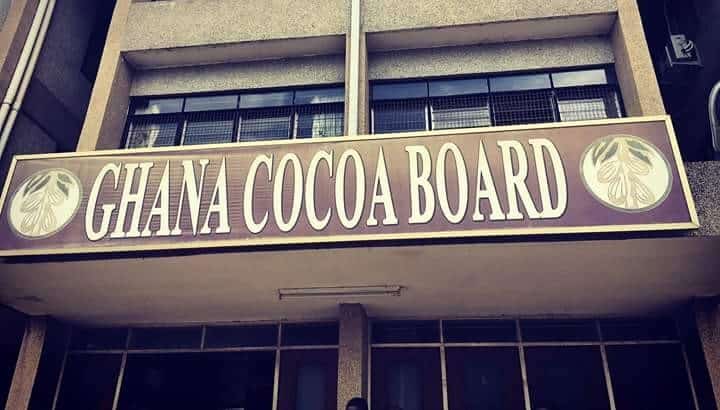
The Ghana Cocoa Board (COCOBOD) is lamenting over the economic impact of illegal mining activities.
He said activities of illegal mining (galamsey) operators in some cocoa growing areas of the country, which it describes as making farming expensive.
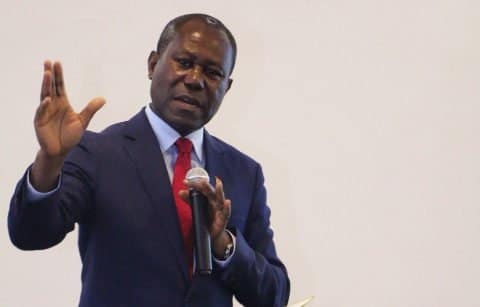
According to the Chief Executive of COCOBOD, Joseph Boahen Aidoo, the menace is adversely affecting water resources, used for irrigation, thereby destroying the environment.
He was speaking to joy Business after inaugurating a committee to promote the consumption of cocoa in the country.
The nine member committee chaired by the Deputy Director of Public Affairs of COCOBOD, Fiifi Boafo, is to ensure adequate promotion of cocoa products and domestic consumption in all sectors of the economy.
“The issue of Galamsey has become a serious concern for not only cocobod but the whole country and when you look at the impact on our farmers and irrigation, it is very serious”.
“Now we struggle to get surface water for irrigation processes and I can tell you that very soon the rivers we rely on for our irrigation will be filled with silt and we can’t even get water to do irrigation”, he mentioned.
He added that the activities of the illegal miners has made farming very expensive in the last couple of years, especially “for our cocoa farmers because of these water crises and all that.”
Menawhile, the country’s consumption of cocoa and chocolate products have increased significantly from an average of 0.5 to one kilogramme annually, according to the Ghana Cocoa Board.
This, it describes as a huge milestone, considering the low level of consumption in the country previously.
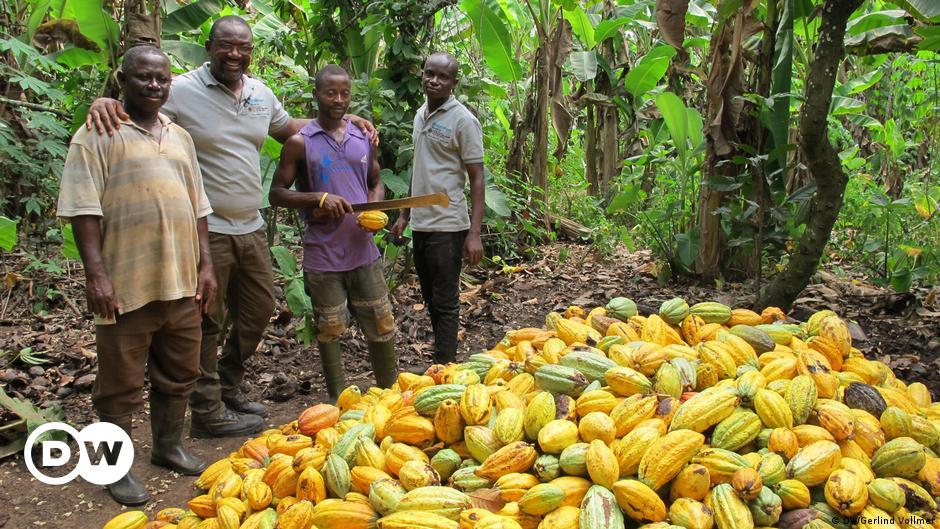
15 visually impaired cocoa farmers from three cocoa-producing districts have received awards from the Ghana Cocoa Board (COCOBOD) for their significant contributions to the development of the cocoa sector in Ghana.
Seven of the farmers, who range in age from 50 to 78, are still actively farming after working for 15 to 60 years.
They came from the Central Region’s Asikuma, Assin Fosu, Twifo Praso, and Dunkwa; the Western Region’s Manso Amenfi, Elubo, and Daboase; and the Brong Ahafo Region’s Berekum.
Mr Kofi Esuon, an awardee, was honoured posthumously at the novel awards ceremony held in Cape Coast on Friday.
With support from the Agricultural Manufacturing Group Limited (AMG Ghana) and Mondelez Cocoalife International, each of the blind farmers received undisclosed sums of cash, six bags of fertilizer, two pairs of Wellington boots, two cutlasses, chocolates, and other Cocoa products.
Rev Edwin Afari, Executive Director of Cocoa Health, and Extension Division, COCOBOD, said the gesture was a novelty to reward and motivate less privileged cocoa farmers, particularly Persons with Disabilities (PWDs), who were indispensable to Ghana’s cocoa value chain.
He commended the blind farmers for defying all odds to commit to cocoa farming, the backbone of the country’s economy and many individual families.
“Disability is not inability and so you can do everything you put your mind to.
“Sight is not in eyes alone but also in the heart and mind; if you work diligently with your heart and mind, that is a special kind of sight,” he noted.
Rev Afari expressed concern over the ageing population of cocoa farmers, citing the attendant looming dire impact on the economy and general development.
He expressed worry that many young people were not interested in agriculture despite the vast prospects in the sector.
He, admonished the youth, including professionals from all fields, to venture into agriculture, particularly cocoa to create wealth for themselves and the country.
He indicated that this year, COCOBOD would focus on cocoa pruning, and undertake pollination and pest control exercises to help increase the country’s production.
“We did 1.47 million tonnes last two years but last year was not too good because of the weather and so we came down to about 683,000 tonnes.
“We are targeting 850,000 tonnes this year and we are doing very well for the main crop season,” he indicated, adding that the company was always available to offer support to all cocoa farmers facing challenges on their farms.
While commending the partners supporting them, Rev Afari indicated that the awards would be expanded to include other PWDs when they got more sponsors.
Nana Kwesi Ofori, the Central Regional Chief Farmer, urged the public to take inspiration from the commitment and achievements of the blind farmers.
He also appealed to COCOBOD, government and civil society organisations to support PWDs to thrive in the cocoa industry.
“Let this not be a nine-day wonder. It should continue to motivate everybody,” he said.
Some of the awardees who spoke with the Ghana News Agency after the event expressed excitement and gratitude for the honour and recognition.
Mr Kwesi Adu said “I was farming before I went blind, but I never gave up. I motivated myself even harder, and with the support of the people around me, I am doing better than others.
“I am grateful to COCOBOD for their support,” he added.
It appears the Lawyers for businessman Seidu Agongo are peeved over what has been described as unlawful conduct by a retired justice of the Supreme Court, Justice Clemence Honyenuga.
They, thus, have made the strongest move yet to get the retired justice to recuse himself from the ongoing trial at the High Court.
The judge is being accused of deliberately putting hurdles in the way of the accused so that they falter and get jailed on trumped-up charges.
In a motion filed on Friday, February 17, the embattled businessman called the entire trial, which has lasted over four years, a sham.
The retired judge has been presiding over the trial of former COCOBOD Chief Executive, Dr. Stephen Opuni, and businessman Seidu Agongo, as well as Agricult Ghana Limited, who are facing 27 charges, including willfully causing financial loss to the state in contravention of the Public Procurement Act in the purchase of Lithovit liquid fertiliser between 2014 and 2016. A copy of the affidavit sighted by Newstitbits.com made copious reference to the May 7, 2021 ruling on the submission of no case, in which Justice Honyenuga in his closet unilaterally and “curiously rejected” as many as 18 evidentiary documents that the accused persons said exonerated them of any wrongdoing.
“That by rejecting the exculpatory evidence and marking them as rejects thus ensuring that we can never rely on the said exhibits at the trial while at the same time calling on us to open our defence in respect of the very same matters means that this Court has already sealed our fate and only wants us to go through a sham of a trial when it has already predetermined our guilt even before we are heard especially when similar evidence tendered by the Prosecution was spared the wrath of this Court.”
Mr. Agongo described the actions of Justice Honyenuga in that ruling as a “clear assault” on his constitutional rights to fair trial as well as being against the rules of natural justice and, “as a result, disqualifies the said trial Judge from continuing with the further conduct of the proceedings in this matter”.
Justice Honyenuga was also accused of being selective in applying the laws.
According to him, the judge “unfairly, capriciously, discriminatorily, and prejudicially” applied the hearsay rules “only against the Accused Persons”.
He cited the case of two farmers whose statements were taken and tendered in evidence in a similar manner but by two different parties. He noted that the farmer whose statement was tendered by the accused was rejected, but the same court accepted the one tendered by the prosecution and used same in his ruling against the accused.
Academic Exercise
“That I am advised by Counsel and I verily believe the same to be true that a fair minded trial Court in a criminal matter must be interested in evidence that enures to the benefit of an accused person and not seek to capriciously put such evidence beyond the use of an accused as this Court had done in rejecting and marking as rejects all these documents to the effect that we cannot rely on them in our defence at the trial.”
He is therefore convinced that no matter the evidence that would be adduced, “our fates are sealed and any further trial proceedings before the same judge will just be an academic exercise”.
Justice Honyenuga was once again accused of “clearly being influenced by extrajudicial considerations” in the matter before him.
The businessman also cited a recent event in court to buttress his reason to get the judge to back off.
On February 14, 2023 when the case was called, Mr. Agongo was not in court due to ill health.
The judge had previously ordered the registrar of the court to go to the 37 Military Hospital, where the accused was on admission, to ascertain the veracity of his claim.
“As I indicated, I have limited time to conclude this matter but such medical excuses are delaying the trial of this case. I must state emphatically that this court has the discretion to accept or reject medical evidence and I must also add that the second accused is on bail and he is still subject to this court’s discretion. And I must also add that this court has enormous powers to deal with any situation in this court,” the judge said in part before adjourning the case.
But he said comments made by the judge were terrifying and suggested that the judge did not trust him.
“That I was simply terrified to have read the above sentiments expressed and the threat issued by the said Justice C.J. Honyenuga (JSC), who obviously did not care whether or not I was unwell because he must by all means conclude this matter and considers my ill health as an impediment to his goal,” Agongo’s affidavit read.
“…his present threats to me would lead any independent observer, unfortunately, to the only irresistible conclusion that the said Justice C.J. Honyenuga (JSC) cannot be an arbiter in this matter; and must, respectfully, recuse himself in the interest of justice.”
When the motion was brought to the attention of the court on February 20, the judge admitted that issues raised in the motion were very serious.
“In view of the very serious matters raised, I am adjourning this case to Thursday 10:00am. I would have abridged the time to Wednesday the 22nd February to hear the motion but I am aware that the Supreme Court will give a ruling in the review filed by the first accused.”
Find excerpts of Agongo’s affidavit below
21. That I am advised by Counsel and I verily believe the same to be true that a fair minded trial Court in a criminal matter must be interested in evidence that enures to the benefit of an accused person and not seek to capriciously put such evidence beyond the use of an accused as this Court had done in rejecting and marking as rejects all these documents to the effect that we cannot rely on them in our defence at the trial.
22. That by rejecting the exculpatory evidence and marking them as rejects thus ensuring that we can never rely on the said exhibits at the trial while at the same time calling on us to open our defence in respect of the very same matters means that this Court has already sealed our fate and only wants us to go through a sham of a trial when it has already predetermined our guilt even before we are heard especially when similar evidence tendered by the Prosecution was spared the wrath of this Court.
23. That I am advised by Counsel and I verily believe the same to be true that when this Court, presided over by Justice C.J. Honyenuga (JSC), suo motu decided to reject the exhibits, all of which had been admitted at the trial with the agreement of the Prosecution in not objecting to their being tendered, the said Court ought to have given the Accused Persons, including the Applicants herein, a hearing on the matter prior to making a decision which the said Judge failed to do.
24. That for the trial Court on its own to exclude all the exculpatory evidence without giving us a hearing is clearly an assault our constitutional rights to fair trial and against the rules of natural justice and, as a result, disqualifies the said trial Judge from continuing with the further conduct of the proceedings in this matter.
25. That while this Court did not explain what it meant by saying in its Ruling that because the matter is a “sensitive” one we should open our defence, I am advised by Counsel and I verily believe the same to be true that the sensitivity of a criminal case is not a legally recognized ground on which to call upon an accused person to open a defence in a criminal matter; and to that extent the trial Judge has shown that he is clearly being influenced by extrajudicial considerations in this matter.
26. That apart from having unlawfully excluded those exhibits as this Court did; this Court in its Ruling of 7th May, 2021, also made sweeping definite final and conclusive findings against us, the Applicants, at the stage of submission of no case to answer as though the said Ruling was the final judgment of this Court after full trial, when the said Court was yet to hear us; demonstrably leaving no room in this Court’s mind for the statutory reasonable doubt that we are required to raise as to our guilt on the charges laid against us.
27. That at page 40 of the Ruling (Exhibit “SA 2”), for instance, this Court states “…of course, this cannot be the Lithovit Fertilizer the 2nd and 3rd accused [Applicants herein] knew that what they supplied to COCOBOD cannot be Lithovit fertiIizer. “
28. That at page 42 of Exhibit “SA 2″, the trial Judge stated further ” … In the instant case, the 2nd and 3rd accused knew that the representation they made and supplied COCOBOD with 700,000 litres, and 1,000,000 litres of Lithovit were (sic) false because they knew that the liquid substance they had supplied to COCOBOD were (sic) not Lithovit fertilizers. “
29. That again the trial Judge, Justice C.J. Honyenuga (JSC), stated at page 43 to 44 of the Ruling that ” … In the instant case, the 2nd and 3rd accused knew that the liquid substances they supplied to COCOBOD were false and they knew that they were not the Lithovit Foliar fertilizer from Germany. PW7’s testimony supports the assertion that the liquid substance was prepared from their (accused’s) own warehouse with(sic) any scientific formular. From the GSA and UG (1) it is clear that this liquid substance was intentionally prepared using insignificant portions of the genuine Lithovit Fertilizer from Germany, (urea was then added to it to pass off as Lithovit fertilizer from Germany. “
30. That at page 45 of Exhibit “SA 2” the said trial Judge continued thus ….. Is a result of the representations made by the 2nd and 3rd accused that they had supplied COCOBOD with Lithovit Foliar Fertilizer from Germany tested and approved by CRIG and COCOBOD, both the Audit, Inspectorate and Finance Departments believed that they were paying for genuine Lithovit fertilizer from Germany but did not know that they were paying for a liquid substance that could not be described as Lithovit Foliar fertilizer.”
31. That on page 54 of the Ruling, Justice C.J. Honyenuga (JSC) stated further that “… All these were perpetuated to facilitate the 2nd and 3rd accused’s [Applicants herein] business and defraud COCOBOD. Indeed these acts were all perpetuated to facilitate and intentionally, voluntarily to aid the 2nd and 3rd accused [Applicants herein] to perpetrate fraud on COCOBOD by supplying a different product from what was tested and approved… However, the 1st accused although he knew the correct state of affairs and knowingly facilitated and aided the 2nd and 3rd accused [Applicants herein] to defraud COCOBOD… there was no way COCOBOD would have been defrauded of such huge amounts. “
32. That at page 55 of the Ruling, Justice C.J. Honyenuga (JSC) continued his assault on the Applicants herein by stating “… The 1st accused made things easier for the 2nd, and 3rd accused to succeed in their enterprise of defrauding.”
33. That the said trial Judge continued his onslaught at page 59 of the Ruling thus: “… It is in evidence that these colossal amounts were paid through the 1st accused as the CEO of COCOBOD to the 2nd and 3rd accused [Applicants] who supplied Lithovit liquid fertilizer which was not tested nor approved by COCOBOD and which scientific reports which PW5 tendered as exhibit H from the Ghana Standard Authority and University of Ghana Chemistry Department that the Foliar liquid fertilizer is worthless. It is a fact that the state is the owner of these monies paid out and her coffers were depleted without receiving any value for its money. This indeed constitutes financial loss to the state… The actions of the 1st, 2nd and 3rd accused were willful.”
34. That on page 60 of the Ruling, Justice C.J. Honyenuga (JSC) continued thus “…it is safe to conclude that that the 1st, 2nd and 3rd accused intentionally engaged in a conduct which injured the state financially … It was an adulterated product and therefore could not have been tested and approved product from Germany. It was an intentional conduct to merit the charge.”
35. That at page 64 of the Ruling, Justice C.J. Honyenuga (JSC) stated “In the instant case the prosecution had proved that the accused persons acted together and the purpose was to cause financial loss to the state as earlier proved under the substantive offence. “
36. That t am convinced beyond any doubts that with the above categorical and determinative statements made by Justice C.J. Honyenuga (JSC), even before we could be heard, after he found ways of putting very vital evidence that would have assisted us to raise any doubts as to our guilt beyond our use at the trial by marking them as rejects at the submission of no case stage; we (Applicants) stand no chance before him no matter what manner of evidence we adduce before the said Court as, for all practical purposes, our fates are sealed and any further trial proceedings before the same judge will just be an academic exercise.
37. That by the above statements the court has again deprived us of our constitutional rights to be condemned only after the Court has heard both sides of the matter
38. That these deliberate hurdles placed in the way of the Accused Persons in this matter notwithstanding the 1st Accused (not a party to this Application) eventually opened his defence on 2nd December,2021, by calling DW1, Mr. Charles Tetteh Dodoo, and has so far called six (6) other witnesses; Dw7 currently testifying.
39. That midway through the evidence of the DW7, Justice C.J. Honyenuga (JSC), on the 16th of December, 2021, ordered all accused persons, including the Applicants herein, to file Witness Statements together with any documents the Accused might rely on at the trial; with a further order that each witness, together with the Accused Persons, including the Applicants, shall have a day to give their evidence-in-chief and the cross-examination of each witness shall not exceed two sitting days.
40. That the trial Judge, Justice C.J. Honyenuga (JSC), imposed these new restrictions on the Applicants in the conduct of our defence even though no such restrictions were imposed on the Prosecution when it conducted its case.
4t. That when the 1st Accused after the 16th December,2021, Ruling/Orders brought an Application in the Supreme Court for Certiorari and Prohibition, Justice C.J. Honyenuga (JSC), quite extraordinarily, personally swore to and filed an Affidavit in Opposition denouncing the 1st Accused and the allegations made in his said Application before the Supreme Court; thereby clearly descending into the arena of conflict or taking issues personally with the 1st Accused, with whom the Applicants herein have been jointly charged with conspiracy.
42. That I have always attended Court on this matter until the 31st of January, 2023, when I was absent on account of ill health. I had attended the Korle Bu Teaching Hospital for medical care; and the Court adjourned the matter to 2nd February, 2023, for me to furnish proof of having sought such medical attention.
43. That on the 31st of January, 2023, I was given Three (3) days excused duty and scheduled to attend a review on 7th February, 2023; and as such I was unable to attend Court on the 2nd of February, 2023, but my lawyers furnished the Court with the Medical Note I had been given from the Korle Bu Teaching Hospital on 31st January,2023; upon which the court adjourned the case to 6th February, 2023, for continuation.
44. That on 6th February,2023, I attended Court though I was still seriously unwell on the insistence of my lawyers in order that we are not accused of delaying the proceedings; and at the end of the day’s proceedings the matter was adjourned to 8″‘February, 2023, for continuation.
45. That on 7th February, 2023, I duly attended my medical review session as scheduled but was still unwell and had to be taken to the 37 Military Hospital at night on the said 7th of February,2023, where I was admitted until 11th February, when I was discharged, and therefore could not attend Court on the 8th of February, 2023; I attach herewith evidence of my attendance at the 37 Military Hospital marked as Exhibit (SA 3).
46. That I am informed by Counsel and I verily believe the same to be true that on the said 8th of February, 2023, Justice C.J. Honyenuga (JSC) expressed his grave displeasure at having to adjourn the matter due to my absence from Court on account of being on admission at the Hospital and “with a heavy heart” adjourned the matter to 13th February, 2023, while ordering the Registrar of the Court to verify from the 37 Military Hospital whether I was indeed admitted there and for my lawyers also to furnish the Court with proof of my said admission on the l3th of February,2023.
41. That I am informed by Counsel and I verily believe the same to be true that on 13th February,2023, though the Court was furnished with the Medical Advisory Certificate given to me from the 37 Military Hospital upon my discharge on 11th February, 2023, which confirmed the dates of my admission at the said Hospital and gave me a week’s excused duty, Justice C.J. Honyenuga (JSC) adjourned the matter to 14th February, 2023, in order to receive the report of the Registrar as to whether or not I had in truth been admitted at the said Hospital; a clear indication that the said judge disbelieved the fact of my ill health and or admission.
48. That I am again informed by Counsel and I verily believe the same to be true that on the 14th of February, 2023, Justice C.J. Honyenuga (JSC) was incensed that I was absent and given a week’s excused duty and unable to hide his indignation, delivered himself in the following words or in words of similar nature: “At the last adjourned date, I expressed my difficulty in having to adjourn the case because of the absence of the 2nd accused on medical excuse duty. As I indicated, I have limited time to conclude this matter but such medical excuses are delaying the trial of this case. I must state emphatically that this court has discretion to accept or reject medical evidence and I must add that the 2nd accused is on bail and he is still subject to this court’s discretion. And I must also add that this court has enormous powers to deal with any situation in this court.”
49. That I am also informed by Counsel and I verily believe the same to be true that the Registrar’s report to the Court on the said 14th of February,2023, was to the effect that the Adjutant of the 37 Military Hospital, who was the appropriate person to have responded to the Registrar’s query, was otherwise engaged at the time the Registrar visited the said Hospital and as a result the Registrar was asked to wait till 11:00am when he would have been attended to, but Justice C.J. Honyenuga (JSC) would seem to have taken this report to mean disrespect towards him and stated thus: “At the last adjourned date, I also indicated that I was giving the 2nd accused the benefit of the doubt for his absence from court. I will, again, give him the final benefit of the doubt, especially when the effort of the Registrar who was to verify from the 37 Military Hospital whether or not the 2nd accused was on admission, ended in a fiasco.”
50. That I was simply terrified to have read the above sentiments expressed and the threat issued by the said Justice C.J. Honyenuga (JSC), who obviously did not care whether or not I was unwell because he must by all means conclude this matter and considers my ill health as an impediment to his goal.
51 That the said trial Judge’s conduct in unlawfully excluding vital evidence critical to our defence; setting up a personal battle with the 1st Accused, with whom we are jointly charged; sending the Registrar of the Court to the Hospital to confirm whether I had been on admission despite documentation from the Hospital to that effect; and his present threats to me would lead any independent observer, unfortunately, to the only irresistible conclusion that the said Justice C.J. Honyenuga (JSC) cannot be an arbiter in this matter; and must, respectfully, recuse himself in the interest of justice.
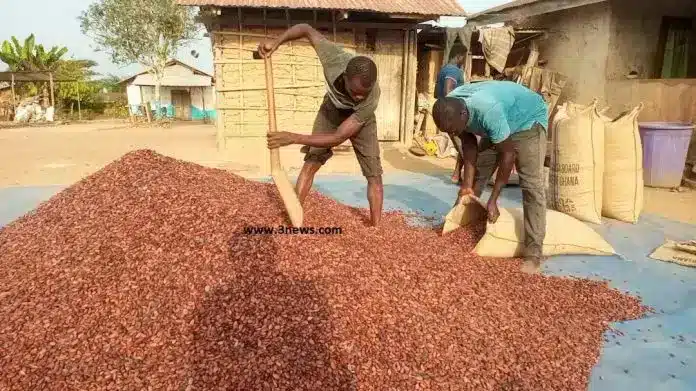
Cocoa farmers have been urged to take pruning of their farms seriously to help maximise crop yield and increase beans production on their farms.
Mr Ebenezer Agyin, Ashanti Regional Manager, Cocoa Health and Extension Division (CHED) of the COCOBOD, who made the call, said pruning was an effective farm hygiene exercise, which prevented diseases and pests and could reduce crop loses to about 40 percent.
He said Ghana’s cocoa production rate which shot up to 1,000,000 metric tonnes in 2021, was as a result of effective pruning exercise carried out by the COCOBOD across the country.
Addressing the Susu Biribi Women in Cocoa Association at Kwamang in the Afigya Kwabre North District in the Ashanti Region, he said the COCOBOD was poised to assist farmers with the requisite technical expertise to increase crop yields in the 2023 season.
Mr Agyin and a team of CHED officers had gone to the community to present quantities of chocolate products to the farmers as part of activities to climax the National Chocolate week celebrations in Ghana.
The products were made available by the World Cocoa Foundation, an international membership organization that promotes sustainability in the cocoa sector, and the COCOBOD.
The COCOBOD, according to Mr. Agyin, was supporting farmers with fuels to operate the motorised sprayers to enhance effective spraying exercises against insects and other cocoa diseases.
On farm rehabilitation exercise under the cocoa swollen shoot virus disease, he said the COCOBOD would engage affected farmers directly instead of relying on the rehabilitation assistants.
He explained that absenteeism on the part of some of the rehabilitation assistants, had left most of the farms to remain in bushes.
It was, therefore, imperative that COCOBOD engaged the farmers directly, entrust all farm maintenance activities and channel payments due them for the exercise.
Madam Christiana Amponsah, Ashanti Regional Coordinator for Gender, CHED, said women played major role, in cocoa production and that was why the COCOBOD saw the need to honour such women on the occasion of the National Chocolate Week.
She said about 30 per cent of cocoa produced in the country were from women.
However, this enormous contribution of women in cocoa production was often not recognized.
Madam Amponsah said it was important to carry women along the cocoa value chain to ensure sustainable increase in production.
Madam Mary Blankson, Financial Secretary to the Susu Biribi Women in Cocoa Association, commended the COCOBOD for presenting the products to the Association.
She called on the government to continually support farmers with farming incentives to boost production.
The ill health of a witness has compelled the Accra High Court to postpone the trial of a former executive of the Ghana Cocoa Board (COCOBOD) Dr. Stephen Kwabena Opuni.
It came up during proceedings that the witness — Peter Okyere Boateng, a former Deputy Director of the Cocoa Health and Extension Division (CHED) of COCOBOD — had a health condition that made it difficult for him to sit for more than 30 minutes.
Mr Boateng, who was under cross-examination, stood up after one hour, and the defence lawyers requested the adjournment of proceedings due to the condition of the witness.
The presiding judge, Justice Clemence Honyenuga, then expressed his reservations over the numerous adjournments and delays in the trial, which started in March 2018.
Counsel for Dr Opuni, Samuel Codjoe, responded that the witness had a genuine medical condition which had been confirmed with a medical report.
“This is a witness who is a pensioner. He is not well, and cannot sit for long because he has a problem with his back,” counsel said.
He then produced the medical report upon request by Justice Honyenuga, but that also led to disagreements between the lawyers.
The prosecutor, Stella Ohena Appiah, a Principal State Attorney, raised issues that the witness had been testifying since July 2022, with no issue of a chronic back condition only for a medical report dated September 9, 2022, to surface.
Justice Honyenuga queried why the health condition of the witness predated the medical report.
“I expected that the medical report will be dated in July or earlier and not in September,” Justice Honyenuga said.
Lawyer’s response
In response, Mr Codjoe refuted the assertion of the prosecution, describing it as a “misrepresentation of facts”.
He said the witness had earlier refused to show up for the trial due to the health condition.
He said when the witness finally showed up in court in July last year, the defence team immediately informed the court of his condition, with the court insisting on a medical report to back the claims.
“The report came in September 2022 with the doctor saying that the patient was under his care. He has been visiting the hospital for a long time. He has a back problem, and the records are there to back it,” counsel said.
Justice Honyenuga eventually adjourned the trial to Monday, February 13.
On the next adjourned date, Justice Honyenuga said the witness would testify for one hour.
“There will be a short break to enable the witness to rest for the court to continue for another one hour,” Justice Honyenuga said.
Not guilty
Dr Opuni is standing trial with Seidu Agongo, Chief Executive Officer (CEO) of Agricult Ghana Limited, an agrochemical company.
State prosecutors have accused the two of causing financial loss of more than GH¢271 million to the state in a series of lithovit foliar fertiliser transactions.
It is the case of the prosecution that the fertiliser was substandard, and has accused Agongo of allegedly using fraudulent means to sell the fertiliser to COCOBOD for onward distribution to cocoa farmers.
The prosecution has further accused Dr Opuni of using his position as CEO of COCOBOD (November 2013 to January 2017) to facilitate the alleged acts of Agongo by allowing the lithovit liquid fertiliser not to be tested and certified as required by law.
Dr Opuni and Agongo have pleaded not guilty to the charges, and are on self-recognisance bail in the sum of GH¢300,000 each.
Minister for Information, Kojo Oppong Nkrumah, has entreated Ghanaians to consume and process more cocoa.
Delivering the keynote address at the launch of this year’s National Chocolate Week Celebrations in Accra on Tuesday, February 7, 2023, Mr Nkrumah said while continuing with efforts to boost domestic production of cocoa, it is important to take advantage of this year’s celebration to step up efforts to increase processing of cocoa locally.
“One of the ways to do this is to guarantee the light crop for the local producers so that they do not have to buy the main crop for domestic processing. As we know, the main crop is comparatively more expensive. If we are serious about boosting local production then we must move quickly to ensure that local processors are able to fully meet their bean needs from the light crop,” he said.
Mr. Nkrumah charged COCOBOD to use policy instruments to ensure that financing support is provided for domestic processors.
“The financial sector should be incentivized to provide financing for the domestic processors using the cocoa beans as security and escrowing into an account of the off-takers. The challenge of financing domestic processors will be lightened via this channel,” he added.
He said although the incentives offered by the Ghana Free Zones Authority are endearing enough to attract more domestic processors, they aren’t well known. These incentives should be better highlighted by the Free Zones Authority and COCOBOD to attract more processors to set up in the freezones area and then process.
On the matter of stimulating domestic consumption of cocoa products, Mr. Nkrumah suggested the following:
“We need to promote more chocolatiers to join the value chain. The more domestic chocolatiers and nuanced products there are on the local market, the better our chances of deepening the local taste and demand. The red carpet of incentives as we would give a foreign direct investor should be rolled out for local chocolatiers as well.”
“Secondly, the thirty-five percent (35%) tax on butter and liquor (raw materials for chocolatiers) should be re-considered. This will make it less expensive to finance operations. It will also make the final products more affordable on the market.”
“And finally, we should support initiatives across Africa to stimulate consumption among school children. Sectors of our economy making super profits can be encouraged to finance such initiatives which will serve as an investment for the growth of a future market in Africa for our cocoa.”
The core purpose of the Chocolate Week Celebration is to promote local consumption of chocolate and other cocoa-based products among others.
The Information Minister who is also the MP for Ofoase Ayirebi praised stakeholders on the cocoa value chain for their respective roles in working to build a robust cocoa economy.
The National Chocolate Day Celebration was instituted in 2005 to coincide with Valentine’s Day which falls on 14th February every year to boost the domestic consumption of Ghana chocolate and other cocoa-based products among others. What used to be a day celebration, was transformed into a week-long celebration in 2022 due to the numerous benefits the country stands to gain if the cocoa industry is nationally promoted.
He claims that the board has acknowledged the possibility that cocoa bills may be challenging to refinance.
Bright Simons wrote on January 27, 2023, “Meanwhile, Cocobod finally recognizes that ambitions to raise $3 billion to refinance cocoa bills are a pipe dream,” on his Twitter page. Planned substantial write-offs should be taken into account by banks and other investors.
Earlier this week, the Bank of Ghana stated it had secured an agreement with the Ghana Cocoa Board and commercial banks to allow the of use COCOBOD’s deposits and placements held at the various banks to cater for retail customers who may not want to roll over their cocoa bills.
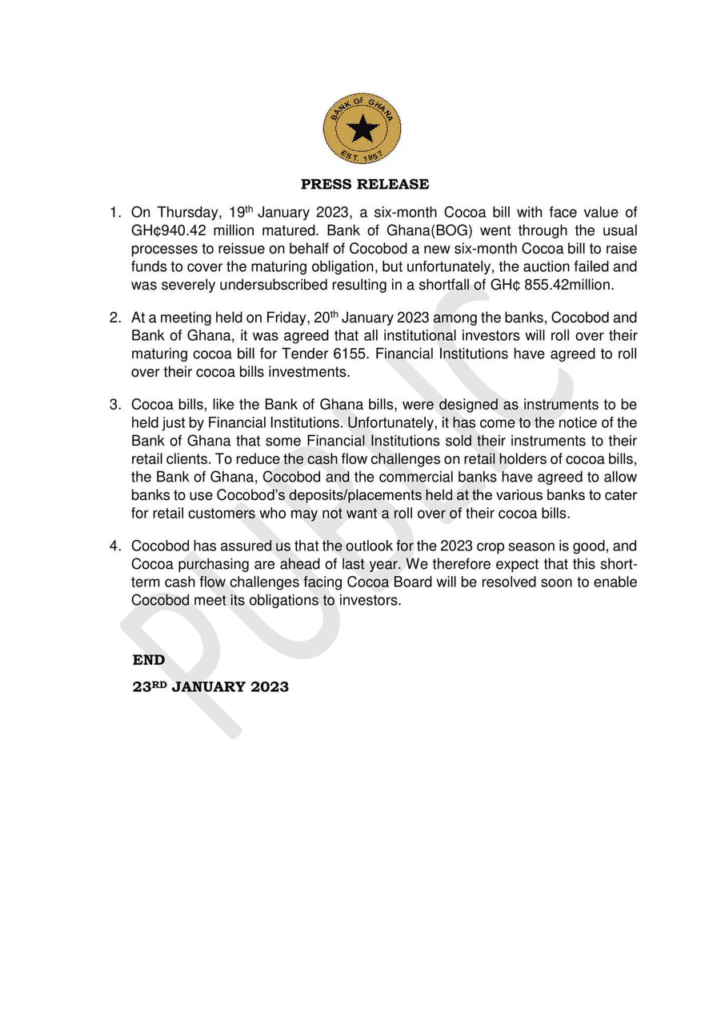
This comes after the cocoa regulator [COCOBOD] recently defaulted on payments of its matured 182-day bill for the first time, rolling over outstanding securities of GH¢940.4 million, without the consent of investors.
But the Central Bank in a statement issued on January 23, 2023, admitted that after a meeting held with COCOBOD, “it was agreed that all institutional investors will roll over their maturing cocoa bill for Tender 6155 adding that “financial institutions have agreed to roll over their cocoa bills investments.”
“To reduce the cash flow challenges on retail holders of cocoa bills, the Bank of Ghana, Cocobod and the commercial banks have agreed to allow banks to use Cocobod’s deposits/placements held at the various banks to cater for retail customers who may not want a roll-over of their cocoa bills,” the Central Bank said.
“We, therefore, expect that this short-term cash flow challenges facing Cocoa Board will be resolved soon to enable Cocobod meet its obligations to investors,” it added.
It, however, pointed out that the COCOBOD has assured the BoG that the outlook for the 2023 crop season looks promising while cocoa purchasing is also making headway.
In order to serve retail consumers who might not want a rollover of their cocoa bills, the Ghana Cocoa Board (COCOBOD), the Bank of Ghana, and the commercial banks have reached an agreement that permits banks to utilise COCOBOD’s deposits/placements with the banks.
This comes after the BoG first instructed banks not to reimburse customers for their maturing cocoa bills investments due to COCOBOD’s cash flow issues.
The Central Bank stated in a statement that it anticipates the short-term cash flow issues COCOBOD is currently experiencing would be resolved quickly to allow the cocoa regulator to fulfill its investment responsibilities.
“COCOBOD has assured us that the outlook for the 2023 crop season is good, and Cocoa purchasing are ahead of last year. We therefore expect that this short-term cash flow challenges facing Cocoa Board will be resolved soon to enable COCOBOD to meet its obligations to investors.”
On Thursday, January 19, 2023, a six-month Cocoa bill with face value of ¢940.42 million matured.
The Central Bank said “BoG went through the usual processes to reissue on behalf of COCOBOD a new six-month Cocoa bill to raise funds to cover the maturing obligation, but unfortunately, the auction failed and was severely undersubscribed resulting in a shortfall of¢ 855.42million”.
“At a meeting held on Friday, 20th January 2023 among the banks, COCOBOD and Bank of Ghana, it was agreed that all institutional investors will roll over their maturing cocoa bill for Tender 6155. Financial Institutions have agreed to roll over their cocoa bills investments”, it explained.
It added that “cocoa bills, like the Bank of Ghana bills, were designed as instruments to be held just by financial institutions. Unfortunately, it has come to the notice of the Bank of Ghana that some Financial Institutions sold their instruments to their retail clients. To reduce the cash flow challenges on retail holders of cocoa bills, the Bank of Ghana, COCOBOD and the commercial banks have agreed to allow banks to use COCOBOD’s deposits/placements held at the various banks to cater for retail customers who may not want a rollover of their cocoa bills”.
A private legal practitioner, Bobby Banson, has highlighted the contract that exists between banks and their clients.
According to him, financial institutions have no right to debit the account of customers without their consent.
He made this assertion after a number of COCOBOD bill investors had their returns rolled over, thus, locking up their funds for another six months.
But Mr Banson, throwing more lights on the predicament, said the move was illegal.
“Once the money hits your account and you get an alert, the position of the law is that the bank does not have the right to withdraw the money, unless it is an irregular credit to the account, but once the money is legally attained, the bank doesn’t have rights to debit it.
“So unfortunately for the banks that sent the alerts outs, and now sending an alert reverting that transfer, they would some questions to answer to their customers,” he stated.
JoyNews learnt that monies paid to investors who purchased cocoa bills on maturity on Thursday, January 19, 2023, were withdrawn from individual investors’ accounts without their consent.
COCOBOD issued the bill to raise funds. Many had bought the bills expecting to be paid back their monies with interest on Thursday January 19, 2023.
JoyNews understands the monies were actually paid on Thursday, January 19, 2023, only to be reversed on Friday, January 20, 2023.
Reports say, the banks have all day been under pressure from affected customers.
The banks have pointed to a directive from the Bank of Ghana ordering them to unilaterally roll over the bonds without first seeking the consent of investors.
Cocoa farmers at Ohiampeanika in the Amenfi West District of the Western Region have vehemently denied using child labour on their farms.
They have, therefore, threatened to sue Al Jazeera, an international media organization that published a television story to the effect that cocoa farmers in the area engage children to work on their farms.
The TV report by the Qatar-based media organization which went viral indicated, among others, that a visit to the farming community revealed children working on cocoa farms.
The farmers, who are infuriated by the video circulating, have described the news item as stage-managed.
“The Al Jazeera video circulating is false. They visited us and told us they were from Ghana Cocoa Board (COCOBOD) and that they were to listen to our problems to help solve them not knowing they had ulterior motives “, they lamented.
The visibly angry farmers asserted that what the international media organization did has dented the country’s cocoa sector in the eyes of the international community, adding: “We will go all out to sue them”.
A former Assembly member for the area, Samuel Ofori Asare, who featured in the Al Jazeera video, said the media house never told them they were going to do a news story.
“We were here one Sunday when they came and said they were from COCOBOD and that they want to meet the farmers to know their challenges and the kind of support they (the visitors) could offer.
“After listening to the farmers, the Al Jazeera pressman indicated that they wanted some of the farmers whose farms were nearby to go with them to demonstrate how the cocoa is planted and harvested,” he noted.
He said one of the farmers called Owusu Gyan alias Daffa, whose farm was nearby, opted to go with them.
“As they were going, the pressmen from Al Jazeera asked if they could get some children to go with them so they can carry the baskets into which the cocoa pods would be harvested,” he added.
He said Daffa’s brother’s three children who are all in school and had closed from church on that Sunday were asked to change quickly and went to the farm with them.
He continued: “So in the farm, the Al Jazeera journalists who spoke through a Ghanaian interpreter, would tell the farmers what to do as they were filming.
“So they will tell a farmer to use the cutlass to harvest the pods from the tree and give it to the children to open them and the journalists were filming.
“So as for us, we are here waiting for the support they promised only to hear that there had been an Al Jazeera TV report indicating that farmers in this community use child labour on their farms.
“In fact, we were surprised and we want the whole world to know that cocoa farmers here do not engage children to work on their farms and so all should disregard that report. Ghanaian cocoa farmers don’t use child labour on their farms,” he stressed.
The Director of Special Services at COCOBOD, Charles Amenyaglo said what transpired was criminal and that a report had subsequently been lodged with the police.
He appealed to all those who played a part in the story to cooperate with the police particularly when they are called to give their statements.
The Member of Parliament for South Dayi, Rockson-Nelson Dafeamekpor, has questioned whether the Chief Justice, Justice Kwasi Anin-Yeboah, has the power to extend the contract of justices of the Supreme Court of Ghana.
A Supreme Court Judge, Justice Clemence Jackson Honyenuga, announced in court on Thursday, July 28, 2022, that Chief Justice Anin-Yeboah had extended his retirement to enable him to complete the ongoing criminal trial of former COCOBOD Chief Executive, Dr. Stephen Opuni.
“The Chief Justice, as the Administrative Head of the Judiciary, has the power under the Constitution to grant an extension to a retiring judge.”
“In pursuant to Article 112(2) of the Constitution, 1992, the chief justice has granted me a limited time to conclude this case. In the circumstances, this court shall, in addition, sit on Tuesdays at 11 a.m. for early disposal of this four-year-old case. In view of the pending vacation, the case is adjourned to October 3, 2022, at 10 a.m. for continuation,” he said.
But Dafeamekpor, in a tweet he shared on November 15, insinuated that the move by the chief justice was wrong since the President of the Republic is the only appointing authority and he alone can extend the contract of his appointees.
He also questioned whether the vetting and approval of the president’s appointees are valid after their retirement age.
“In re the extension of time of Hoenyenuga JSC by the CJ: the Constitutional Question is: Can the CJ extend the life of a Supreme Court Judge beyond his statutory 70yr tenure?
“Remember, the Prez is the Appointing authority. Also, is the Parliamentary vetting valid beyond 70yrs?” the MP’s tweet read.
View the MPs tweet below:
In re the extension of time of Hoenyenuga JSC by the CJ: the Constitutional Question is: Can the CJ extend the life of a Supreme Court Judge beyond his statutory 70yr tenure? Remember, the Prez is the Appointing authority. Also, is the Parliamentary vetting valid beyond 70yrs?
— Rockson-Nelson Dafeamekpor, Esq. MP. (@etsedafeamekpor) November 15, 2022
The prosecuted former COCOBOD Chief Executive, Dr. Stephen Kwabena Opuni, has challenged the authority of the trial Judge, Clemence Honyenuga, to hear the charges against him.
His Lordship Honyenuga was expected to have retired last September but had a six-month extension from the Chief Justice.
This extension by the Chief Justice, lawyers for Dr. Opuni argued, is unconstitutional and a usurpation of the powers of the President of the Republic.
They maintained that “the power to extend the tenure of a Supreme Court judge is not exercised by the Chief Justice, who is not the appointing authority.”
“The only person who can grant an extension to the tenure of your lordship as contained in article 145(4) is the President and not the Chief Justice”, Samuel Cudjoe argued.
Notwithstanding that the Chief Justice is the administrative head of the Judiciary, Mr Cudjoe submitted that the Chief Justice “cannot grant an extension to the tenure of a judge who has attained the mandatory constitutional retirement age.”
This position was, however, sharply contested by the Director of Public Prosecutions (DPP), Yvonne Atakora Obuobisa, who described it as baseless in law.
“It is our case that the CJ has power under the 1992 Constitution to grant power to a Justice of the Superior Court to sit for a limited period of time”, she submitted.
Relying on articles 139(c) and 145(2)(a) and (4), the DPP argued that the Chief Justice not only had the authority to appoint Judges to Courts but to also give such limited extension to Judges due for retirement to enable them to complete cases commenced under them before their retirement age.
“In very simple terms, this means that your lordship on attaining the age of 70 years may continue in office for a period not exceeding six (6) months in relation to the case of Republic v Stephen Opuni, Seidu Agongo and Agricult Ghana Ltd. that was commenced before you prior to your attainment of the age of 70.”
The DPP thus submitted that the question of who has the authority to grant the extension had been clearly answered by the Constitutional provisions cited.
Therefore, “no ambiguity or confusion as to whether it is the President or the Chief Justice who grants an extension to a Judge previously determining a case to continue with that matter for a limited period” could be raised.
The High Court presided by His Lordship Clemence Honyenuga dismissed the application and adjourned the case to November 16, 2022, for continuation.
“The Chief Justice as the Administrative Head of the Judiciary has the power under the Constitution to grant an extension to a retiring Judge.”
Speaker of Parliament Alban Bagbin has noted that the government erred in choosing to invest GH25 billion to collapse nine local banks rather than utilizing GH5 billion to save them.
In a recent interview with the legislative press corps, Mr. Bagbin highlighted that “it is the priority of every country to ensure they are in charge of the banking sector,” adding, “So, if we had Ghanaians with banks facing issues, it is incumbent on us to make them successful.”
On Sunday, October 30, 2022, he informed the media, “I think our colleagues in government erred in not seeing it that way.
He said: “They tried and ensured that Ghanaians making it in the sector lost out and instead of using about GH¢5 billion to help the banks to survive, we ended up losing GH¢25 billion, and we have still not been able to sanitise the system and there is still a lot of work to be done.”
Mr Amoabeng, whose bank was also collapsed in the first term of the Akufo-Addo government, told Nana Otu Darko on CTV’s morning show, Dwabre Mu, on Tuesday, 4 October 2022: “I was pained by the collapse of Heritage Bank because it was young.”
“The Bank of Ghana had issued a licence to Heritage Bank and Heritage Bank had not operated for long and, so, unlike UT Bank, it had no bad loans or anything and it was a wholly-owned Ghanaian company that we had to nurture to grow,” he explained.
“Secondly, the owners of Heritage Bank found it fit to appoint a solid board,” he noted, adding: “I mean, the chairman was [Prof] Kwesi Botchwey. When it comes to finance in this country, he is the safest hands you can get; he’s seen it all.”
“As chairman, the board members run the bank, not the owner, so, I don’t know Seidu Agongo – as I told you, I haven’t met him before – but I know Kwesi Botchwey and I know his track record. So, if you have a bank that hasn’t got any baggage, it’s fresh and it’s got a board headed by Kwesi Botchwey, then it means its closure was a worse decision than UT Bank’s,” he further noted.
“As for UT Bank, we owed and they could have bailed [us out] but decided not to bail; that’s an option. That is why I mentioned that Heritage Bank, for example, was collapsed out of sheer wickedness,” he added.
Mr Amoabeng observed that the “unfortunate thing is, the Bank of Ghana is supposed to be independent but I don’t think they were independent with their decision on Heritage Bank because, if they were independent, why do you issue a licence and withdraw it?”
“When you were issuing the licence, didn’t you know the owners and the board?” he asked.
“It means they were told to withdraw the licence,” he deducted.
“And it’s not a fair way but it’s another dangerous path that Ghana has taken,” he regretted, noting: “Every institution has been politicised including even the army.”
“And that is why I am saying that for Heritage Bank, the institution that is supposed to be independent of the government [BoG], even though in principle, issues a licence and then withdraws that licence when the company hasn’t even done anything wrong,” Mr Amoabeng added.
Mr Amoabeng made similar comments a couple of years ago, saying he found it “extremely odd” for the Bank of Ghana to have collapsed Heritage Bank Limited, which had no bad loans on its books and was being run by the “right people” within the industry.
In his view, the revocation of the licence of the Ghanaian-owned bank, whose founder, Mr Seidu Agongo, has always argued was above board, as far as its books were concerned, was not only politically motivated but also “extremely unfair and unfortunate.”
Asked directly by TV3’s Paa Kwesi Asare in an interview on Business Focus: ‘Do you think, as many think, that some of the decision to close down certain banks was politically motivated?’ Mr Amoabeng answered: “A few of them; specifically Heritage Bank.”
“I don’t understand the issue because the Chairman of the Board is Dr Kwesi Botchwey. I have a lot of respect for him when it comes to finance in this country and managing Boards and he will not, in my estimation, ever accept to be Chairman of a bank that is not right and dealing in all sorts of things. I can say that for him,” Mr Amoabeng, whose bank was also among the nine Ghanaian banks that were collapsed in the central bank’s financial clean-up exercise during President Nana Akufo-Addo’s first term of office, noted.
“So,” Mr Amoabeng noted, “I find it extremely odd that a bank – and it had not started doing business for it to have bad loans and all those things – and for you to say that the owner didn’t have what it takes [doesn’t meet the fit-and-proper criterion] or however they put it, I mean the owner doesn’t run the bank, he’s a Ghanaian, he’s got the money, he’s appointed the right people to run the bank for him, so, what is the excuse?”
“I find that extremely, extremely unfair,” Mr Amoabeng asserted, adding: “Maybe I don’t have all the facts, but from where I stand, I find it really unfortunate.”
The Bank of Ghana revoked Heritage Bank’s licence on Friday, 4 January 2019, on the basis that Mr Agongo, the majority shareholder, among other things, used proceeds realised from alleged fraudulent contracts he executed for the Ghana Cocoa Board (COCOBOD), for which he has been facing prosecution together with former COCOBOD CEO Stephen Opuni, for the past four years.
Announcing the withdrawal of the licence, the Governor of the central bank, Dr Ernest Addison, told journalists – when asked if he did not deem the action as premature, since the COCOBOD case was still in court – that: “The issue of Heritage Bank, I wanted to get into the law with you, I don’t know if I should, but we don’t need the court’s decision to take the decisions that we have taken. We have to be sure of the sources of capital to license a bank; if we have any doubt, if we feel that it’s suspicious, just on the basis of that, we find that that is not acceptable as capital. We don’t need the court to decide for us whether anybody is ‘fit and proper’. Just being involved in a case that involves a criminal procedure makes you not fit and proper”.
However, Mr Agongo responded with a press statement in which he said that the “not fit and proper” tag stamped on him by the central bank was “capricious, arrogant, malicious and in bad faith.”
According to Mr Agongo, “In purportedly making the determination, the central bank obviously had little regard for the time-honoured principle that a person is presumed innocent until proven guilty by a court of competent jurisdiction,” adding that: “The fact that I have a case pending before the High Court is a matter of public knowledge but my guilt or innocence is yet to be determined by the Honourable Court.”
“The determination that I am not a fit and proper person to be a significant shareholder of HBL because the central bank suspects the funds are derived from illicit or suspicious contracts with Cocobod is not only calculated to pre-judge the outcome of the criminal proceedings but also violative of the principle of presumption of innocence to which every individual is entitled. Since when has suspicion become a substitute for credible evidence?” Mr Agongo asked.
Also, the erstwhile Prof Botchwey Board issued a statement on the matter in which it said: “Heritage Bank was by the Bank of Ghana’s own admission, a solvent bank. It never received liquidity support from the Bank of Ghana. Its corporate governance record had never been impugned by the Bank of Ghana. We believe we have been done a grave injustice and a terrible precedent set that does not bode well for the future.”
Dr. Ernest Addison, the governor of the Bank of Ghana, has assured that the central bank has enough cash on hand to maintain the economy’s general stability until the start of the anticipated IMF program and other financing guarantees anticipated from stakeholders.
He asserts that efforts are being made to ensure that the central bank has some liquidity, notwithstanding the continuing economic difficulties that the entire globe and Ghana in particular are experiencing.
As everyone knows, we received the 750 million dollars from the AfriExim Bank, and on October 26, 2022, we will receive the 790 million dollars from the COCOBOD syndicated loan, providing some liquidity for the Central Bank.
“I am aware of the recent developments in terms of liquidity in the banking sector. As I said, I took note of the advice from Washington on the financial stability issue that there has to be targeted liquidity support to preserve financial stability without undermining the inflation control objectives. So, this is really the context we should have the discussion on all the complaints of we need liquidity and BoG not supplying liquidity.”
“Yesterday I met the CEOs and I have assured them that we will provide the necessary liquidity to ensure that we don’t have a system of a liquidity problem. But we do that within the context of keeping inflation low”.
The Governor made this statement when the management of the Bank met with stakeholders within the foreign exchange market, including the Managing Directors of the universal banks in the country.
Also present at the meeting were the Association of Forex Bureau Operators to deliberate on measures to streamline, sanitise and provide clarity on the supply of forex in the country.
Following a meeting with banks and foreign exchange bureaus that resulted in feasible plans, Dr. Ernest Addison, governor of the Bank of Ghana (BoG), has reassured the market that the rapid depreciation of the cedi versus the US dollar will soon stabilize.
The Governor claims that speculation is mostly to blame for the current steep depreciation, which has seen the local currency plunge by more than 50% against the US dollar since the beginning of the year.
He did, however, emphasize that there would be sufficient foreign exchange availability for the market with the US$750 million from the AfriExim Bank and US$790 million from the COCOBOD syndicated loan coming online.
“Clearly, this type of movement does not reflect changes in the fundamentals. It is clear that the market is not functioning properly. We are seeing speculations taking over under very disorderly market conditions and it appears now the black market is rather driving exchange rates. This, we cannot allow to continue,” he said when he met managing directors of commercial banks and members of the Association of Forex Bureau Operators last Tuesday.
Dr. Addison also assured banks that the central bank has enough liquidity to supply into the system until conclusions with the International Monetary Fund (IMF) is concluded.
“I am aware of the recent developments in terms of liquidity in the banking sector. As I said, I took note of the advice from Washington on the financial stability issue that there has to be targeted liquidity support to preserve financial stability without undermining the inflation control objectives. So this is really the context we should have the discussion on all the complaints of we need liquidity and BoG not supplying liquidity.
“Yesterday, I met the CEOs, and I assured them that we will provide the necessary liquidity to ensure that we don’t have a system of liquidity problem. But we do that within the context of keeping inflation low,” he said.
Dr. Addison further stated that the central bank is bent on restoring order in the forex market by making sure the interbank market takes full control to enforce regulations surrounding forex trading so as to streamline the supply of foreign currency in the country.
The Governor, therefore, charged the Association of Forex Bureau Operators to be law compliant and cautioned them to desist from determining forex rates which had contributed to the speculation of rates, thus, creating unnecessary panic in the market, contributing to the rapid depreciation of the local currency.
Members of the Association of Forex Bureau Operators commended the Bank of Ghana for its role in clamping down on illegal forex dealers, as they say it will bring some sanity in the sector and ensure only licensed forex operators deal in exchange transactions.
To this effect, the bank, on Thursday, revoked the licences of two forex bureaus in Accra for breaching provisions in the Forex Bureau Act.
The two companies – Trade House Forex Bureau Ltd and Aiport City Forex Bureau Ltd – which are under the same ownership, according to Head of Other Financial Institutions Supervision Department at the Bank of Ghana, Yaw Sapong, were not issuing electronic receipts and not taking identity cards of customers, a practice they have been previously cautioned about.
The Ghana cedi (GH) experienced increased selling pressure in the third quarter of 2021, which led to a 1.77 percent quarter-over-quarter (QoQ) depreciation against the US dollar – as opposed to a 0.59 percent depreciation in the second quarter of 2021 and an appreciation of 0.55 percent in the first quarter of 2021.
As the economy rebounded due to increasing oil prices, the demand for forex during the time period came from the manufacturing, energy, and commercial sectors, according to a research.
Although the Ghanaian local currency – the cedi – is confronted with heightened risk, Databank has maintained its year-end forecast for the interbank Bank of Ghana (BoG) reference rate at GH¢6.05/USD (± 10Pesewas).
Currently, the imminent depreciation risks emanate from threats of a taper-induced selloff which heightened since the third quarter of 2021, as well as rising import demand. Last week the cedi depreciated against the dollar, trading at GH¢6.08 compared to GH¢6.07 the previous week, amid increased FX demand from investors repatriating bond maturity proceeds.
Per the outlook, Databank said: “We maintain our year-end forecast for the interbank BoG reference rate at GH¢6.05/USD (± 10 Pesewas). A potential taper-induced outflow of foreign portfolio investments amid the rising import demand is a depreciation risk in the fourth quarter of 2021.”
“The Ghana cedi (GH¢) endured increased selling pressure in 3Q21, which resulted in a 1.77 percent quarter-on-quarter (QoQ) depreciation against the US dollar – as against depreciation of 0.59 percent in the second quarter of 2021 and an appreciation of 0.55 percent in the first quarter of 2021. During the period, demand for forex came from the commerce, manufacturing, and energy sectors as the economy recovered with higher oil prices.”
Following the tapering policy announcement by the US Fed, there has been an upturn in the Dollar Index (DXY) – pushing above 94 points as of the end of September 2021 against 92 points prior to the announcement. The rising DXY indicates a global strengthening of the US dollar against major currencies, with more upside potential.
“We also observe a steep increase in US benchmark yields, narrowing the carry trade opportunities for investors in emerging and frontier markets. We view these developments in the global financial markets as a depreciation risk to the GH¢ as foreign capital inflows reduce in favour of the less risky US Treasury securities and the benchmark US dollar,” Databank stated.
Ghana’s external account balance remained resilient during the first 8-months of 2021, with gross forex reserves at US$11.4billion (5.2 months of imports) as of August-2021. The trade surplus narrowed by 35.6 percent YoY to US$874million (1.2 percent of GDP) compared to 2.0 percent of GDP in August-2020 as contraction in the mining sector weighed on export revenues. Concurrently, the ongoing recovery in economic activity increased the total import bill by 8.6 percent YoY, reducing the trade surplus.
However, the investment company said the Eurobond issued in the first half of 2021 combined with 70 percent balance of payment (BoP) allocation of the US$1billion special drawing rights (SDRs) boosted gross reserves and strengthened the BoG’s support for the cedi; while the US$1.5billion inflows from the COCOBOD syndicated loan should add an extra layer of support for the cedi to anchor the US$GH¢ around the GH¢6.0 mark by the full year 2021.
The BoG’s fortnightly forward forex auction results show that the central bank has increased its intervention on the forex market.
Chief State Attorney, Evelyn Keelson, had a field day in court after she was permitted to dissect the medical records of former COCOBOD Chief Executive Dr. Stephen Opuni, to the utter disbelief of her colleague lawyers in the courtroom.
Evelyn Keelson had earlier put up a spirited defence of her resolve to delve into the health status of an accused person when other lawyers rejected the move because the health issue was not the substantive case of why the parties were in court.
Even though she was cleared to ask questions bothering on Dr. Opuni’s health condition, she failed to get the court to reject an excuse notice issued to the former COCOBOD boss.
Dr. Opuni underwent four surgeries on his left eye, specifically his retina, and was given six weeks to rest the left eye to ensure proper healing.
This was brought to the attention of the court on October 11, after the two-month legal vacation, as his counsel, lawyer Samuel Codjoe asked the court for an adjournment.
“My lord, this explains the absence of the first accused in court. My lord, as a result of his absence due to ill health, we pray that this court adjourns this case till the six weeks’ notice,” he said. He also informed the court that his client wants to exercise his right under Article 19 (3), which demands that the trial is conducted in his presence.
But Chief State Attorney Evelyn Keelson, who advocated for a virtual trial of the accused, who is recuperating from a retinal surgery, said that the excuse notice was not binding on the court and also insisted that the medical director who issued the notice be summoned to give “further and better particulars” about the medical records of Dr. Opuni.
The court yielded to the demand of the Chief State Attorney and summoned the medical director, who appeared before the court on October 17.
When he appeared before the court presided over by the retired Supreme Court judge, Justice Clemence Honyenuga, the medical director explained that patients who undergo retinal operations need about six months to completely heal.
“The healing process of epiretinal membrane surgery is between three and six months. Anybody here can check the healing process online,” he told the court.
Early on, the medical director, who is an opthalmologist (an eye surgeon) with several decades of experience, told the court the precarious situation Dr. Opuni was facing.
“He was given post-operative advice for the six weeks excuse duty; the first 14 days of the six weeks, he had to stay head down because of the gas Gas tamponade [inserted in the eye because of the surgery to keep the retina in correct position]. A few days after the operation, he developed high intraocular pressure on the operated left eye and severe photophobia.”
According to him, the intraocular pressure was managed with glaucoma medication, and he was advised to wear dark glasses and avoid light. He has to go for weekly checks for the intraocular pressure to be managed.
The court admitted into evidence the medical folder of Dr Opuni as well as two different Optical Coherence Tomography (OCT) test results.
The medical expert said if the high pressure was not managed properly, it would lead to Dr Opuni going blind. “The whole eye can become like stone, so for that reason, he was asked to come every week for us to control the eye pressure.”
The trial judge, Justice Clemence Honyenuga (Rtd), felt “constrained” by the compelling expert account of the medical director who issued the excuse notice and therefore shelved his initial plan of holding a virtual trial, let alone a physical trial.
But when the Chief State Attorney was cleared to cross-examine the medical director, she suggested that once Dr. Opuni was able to visit the clinic every week, he could attend to other duties as well.
“So when he wears his dark glasses, he can attend to duties he is mandated to attend to without any harm,” she asked.
But the medical director explained to her that:
“He wears dark glasses because of photophobia. It can’t correlate with the eye, why because his natural lens is on the right eye, but the left is the artificial lens. The capacity of the artificial lens to absorb light is zero. So focusing on bright things cannot be comfortable.
“All the same, the six weeks is not for the photophobia; it is the retina; with the fragility of the retina, anything can happen.”
The medical director, whose facility gets referrals from The Gambia, Burkina Faso, Togo, Benin, etc., went on to admonish patients to adhere strictly to post-operative advice.
Nonetheless, the Chief State Attorney asserted: “I am putting it to you that the same way Dr. Opuni can attend to a clinic, he can attend to court in this courtroom and sit quietly with his shades without any damages to his retina.”
But the medical director insisted that the excuse notice was to ensure proper healing “and not for the patient to blame the surgeon or the whole clinic” if something goes wrong.
He further stated that the six weeks’ notice was crucial and ought to be observed in every surgery of the retina.
Both counsel for Dr. Opuni and Seidu Agongo, who earlier stated that it was unhealthy to discuss someone’s health status in public, and noted that the cross-examination of the medical director had no bearing on the substantive case, declined when they were invited by the judge to take their turn.
Counsel for Dr. Opuni, lawyer Samuel Codjoe had previously advised Evelyn Keelson to be mindful that “no one has a monopoly over good health”.
Meanwhile, Justice Clemence Honyenuga, who is on retirement and has been given limited time to dispose of the case, has adjourned the hearing to November 7.
The former COCOBOD Chief Executive, Dr. Stephen Opuni, and businessman Seidu Agongo as well as Agricult Ghana Limited, have been facing 27 charges, including defrauding by false pretences, willfully causing financial loss to the state, corruption by public officers and contravention of the Public Procurement Act in the purchase of Lithovit liquid fertiliser between 2014 and 2016.
They have pleaded not guilty to the charges and are on a GH¢300,000.00 self-recognisance bail each.
The Ghana Civil-society Cocoa Platform and the cocoa Platforme Ivoirienne pour le cacao durable are two platforms for civil society organizations (CSOs) that have praised the governments of Ghana and the Ivory Coast for their decision to skip the upcoming World Cocoa Foundation Partners meeting.
The Plateforme Ivoirienne pour le cacao durable and the Ghana Civil-society, which are made up of farmers, farmer-based organizations, cooperatives, small-scale processors, the media, and CSOs working in the cocoa sector, applauded the two governments for their decision to skip the meeting that was scheduled to take place from Wednesday, October 26, to Thursday, October 27, 2022, in Brussels.
“We may not always agree with COCOBOD and CCC’s judgments, but we fully support this move and the grounds offered for the decision,” the CSOs said in a statement on Monday, October 24, 2022.
The statement noted that: “Côte d’Ivoire and Ghana account for 65 per cent of global cocoa production, but farmers in these two countries earn less than 6 per cent of the chocolate industry’s total revenue valued at about US$130 billion per annum.”
While “new studies have shown that the share of cocoa growers in the overall chocolate industry has drastically reduced over the years as traders, brands and retailers have accumulated super profits.
“This fell to 16 per cent in the 1980s and today, farmers receive around 6 per cent of the value. This has led to high levels of poverty and hardship for cocoa growers in two of the largest cocoa producing countries in the world.”
Both platforms indicated that: “Today, producers are not living, they are only surviving.”
They continued that: “By boycotting this flagship gathering of the private sector in Brussels, the governments of Côte d’Ivoire and Ghana are sending a strong signal, but it is also a cry from the heart. The issue of cocoa pricing must be put at the center of the discussion on cocoa sustainability.”
They added: “We fully support this position and hope that the world will take notice and denounce the private sector for their nefarious and unfair cocoa pricing practices.”
The world’s two largest producers of cocoa will not attend the gathering, which is the premier international conference on cocoa sustainability, according to Reuters.
Both the Ghana Cocoa Board (COCOBOD) and the Coffee and Cocoa Council (CCC) of the Ivory Coast have stated that the reason for their boycott of global chocolate corporations is because these businesses oppose policies that would increase the income of farmers.
Therefore, “the Chief Executive [Joseph Boahen Aidoo] is not attending the World Cocoa Foundation (WCF) meeting in Belgium and none of the executives at Cocobod will be there,” he affirmed.
Boafo accused the multinational chocolate companies of waging a silent war against a farmers’ premium, the Living Income Differential, as a direct rejection will give them bad publicity.
Adding his voice, the Director General of Ivory Coast’s Coffee and Cocoa Council (CCC), Yves Brahima Kone, also said he will not be in attending this or any other industry meetings.
He further stated that sustainability programmes launched since 2008 and aimed at tackling issues such as child labour have also benefited companies more than farmers.
Two premiums paid on Ghana and Ivory Coast cocoa beans to help alleviate farmer poverty have in recent years suffered massive discounts by chocolate companies, eroding the intended purpose.
The origin differential, an additional premium paid for the quality and reliability of cocoa beans and the Living Income Differential is a fixed amount of $400 agreed on for every tonne of cocoa sold by Ivory Coast and Ghana.
In July both regulators said they would no longer sell cocoa with a negative origin differential, fixing it at zero for Ivory Coast and at +20 pounds sterling ($22) per tonne for Ghana.
COCOBOD and CCC explained that some of the world’s major chocolate makers and cocoa traders are pushing for origin differentials as low as negative 200 pounds sterling per tonne.
“We are considering new ways to address this issue with the industry, including banning access to our cocoa farms for their sustainability programs,” The Director General of CCC said.
The World Cocoa Foundation Partnership meeting will be held from October 26-27 at The Hotel in Brussels, Belgium.
Ivory Coast and Ghana will not be attending the World Cocoa Foundation Partnership meeting scheduled to be held in Brussels from October 26-27.
The meeting which is the leading global conference on cocoa sustainability will miss the world’s two largest cocoa-producing countries due to pricing issues, Reuters reported.
Both Ghana Cocoa Board, COCOBOD, and Ivory Coast’s Coffee and Cocoa Council, CCC, have cited multinational chocolate companies resisting measures that aim to improve farmers’ income as the reason for their boycott.
According to the Head of Public Affairs for Cocobod, Fiifi Boafo, “The major chocolate brands have resisted and tried to find means to circumvent payment of the LID”.
Therefore, “the Chief Executive [Joseph Boahen Aidoo] is not attending the World Cocoa Foundation (WCF) meeting in Belgium and none of the executives at Cocobod will be there,” he affirmed.
Boafo accused the multinational chocolate companies of waging a silent war against a farmers’ premium, the Living Income Differential, as a direct rejection will give them bad publicity.
Adding his voice, the Director General of Ivory Coast’s Coffee and Cocoa Council (CCC), Yves Brahima Kone, also said he will not be in attending this or any other industry meetings.
He further stated that sustainability programmes launched since 2008 and aimed at tackling issues such as child labour have also benefited companies more than farmers.
Two premiums paid on Ghana and Ivory Coast cocoa beans to help alleviate farmer poverty have in recent years suffered massive discounts by chocolate companies, eroding the intended purpose.
The origin differential, an additional premium paid for the quality and reliability of cocoa beans and the Living Income Differential is a fixed amount of $400 agreed on for every tonne of cocoa sold by Ivory Coast and Ghana.
In July both regulators said they would no longer sell cocoa with a negative origin differential, fixing it at zero for Ivory Coast and at +20 pounds sterling ($22) per tonne for Ghana.
COCOBOD and CCC explained that some of the world’s major chocolate makers and cocoa traders are pushing for origin differentials as low as negative 200 pounds sterling per tonne.
“We are considering new ways to address this issue with the industry, including banning access to our cocoa farms for their sustainability programs,” The Director General of CCC said.
The World Cocoa Foundation Partnership meeting will be held from October 26-27 at The Hotel in Brussels, Belgium.
Ghana’s request for a financial bailout from the International Monetary Fund (IMF) team, led by Stéphane Roudet, has indicated that there has been considerable progress.
The IMF team leader said both teams had a constructive conversation in identifying concrete policies that will restore macroeconomic stability after meeting with Ghana’s Finance Minister, Ken Ofori-Atta, and Bank of Ghana Governor, Dr. Ernest Addison, in Washington, DC.
“The Ghanaian team and IMF officials had very fruitful discussions on the authorities’ post-COVID economic growth agenda and related laws and reforms that may be supported by a new IMF agreement.
“We made good progress in identifying specific policies that would restore macroeconomic stability and lay the foundation for stronger and more inclusive growth. The IMF team and the Ghanaian authorities remain fully committed to reaching an agreement on a framework and policies for an IMF-supported program as soon as feasible. Discussions will continue in the weeks ahead, with a follow-up mission to take place expeditiously,” Stéphane Roudet said in a statement after the meeting.
The Finance Minister had earlier assured Ghanaians that the economy is in good shape despite the continuous depreciation of the Cedi.
Speaking to a journalist of Accra-based Asaase Radio from Washington DC, Ken Ofori-Atta said, “It is a bit perplexing because as you know, typically we go to markets at the beginning of the year and get our two billion.
“But that we were not able to do, we were able to then get US$750 from AfriExim in the summer, August or so, to stabilize it. Then we moved on traditionally as we do, the ASL, the annual syndicated loan of COCOBOD, and that came in very strongly. So, it is quite perplexing to see where it is going.”
“The support we are getting from countries like Germany, France etc. we are confident that we will get the resources needed. So, we really would want people to know not to panic or be rushing to put pressure on the currency. I think it is unnecessary and we are in good shape.
“Of course, typically in October, people are importing for Christmas and maybe there is a rush for that. But my expectation is that once we also conclude the fund, that would lead to the Fund’s disbursement early next year.”
The Cedi has recently been classified by Bloomberg as the worst-performing currency against the US Dollar.
Currently, the Cedi is trading at around GH₵13 – GH₵14 to a dollar at some forex bureaus.
The Member of Parliament for Bolgatanga Central, Isaac Adongo, accused the Bank of Ghana of double standards over the revocation of Heritage Bank’s license during the financial sector clean-up exercise.
At a presentation at Takoradi Technical University on Thursday, 17 October 2019, Adongo said: “Three weeks before the revocation of the license of Heritage Bank, the Bank of Ghana Governor invited the MD of Heritage of Bank, the Board Chairman of Heritage Bank, our own venerable Prof Kwesi Botchwey and the 70 percent shareholder of the bank, Seidu Agongo, to a meeting at the conference room of the Bank of Ghana.”
“In that meeting, Dr. Addison recommended that Heritage Bank should merge with UMB,” he added.
The MP for Bolgatanga Central, Mr Isaac Adongo has accused the Bank of Ghana Governor, Dr. Ernest Addison of double standards as far as the revocation of the license of Heritage Bank is concerned.
According to the opposition lawmaker, Dr. Addison tried forcing Heritage Bank to merge with UMB three weeks prior to the revocation of the license of Agongo’s bank on grounds that he was being prosecuted in a criminal case, thus, failing the fit-and-proper test.
At a presentation at Takoradi Technical University on Thursday, 17 October 2019, Adongo said: “Three weeks before the revocation of the license of Heritage Bank, the Bank of Ghana Governor invited the MD of Heritage of Bank, the Board Chairman of Heritage Bank, our own venerable Prof Kwesi Botchwey and the 70 percent shareholder of the bank, Seidu Agongo, to a meeting at the conference room of the Bank of Ghana”.
“In that meeting, Dr. Addison recommended that Heritage Bank should merge with UMB”.
The MP said that the meeting took place in mid-December 2018 at which the Governor “pressured” Heritage Bank to kowtow to the merger with UMB. B
“But after due diligence conducted by KPMG, Heritage Bank noticed that UMB was in a difficult position to become a merger partner. As a result, the Board of Heritage Bank declined the offer by the Bank of Ghana.
“Days later, the Bank of Ghana revoked the license of Heritage Bank Limited, the bank they were pressurizing to merge and willing to supervise a merger between it and UMB”, Mr Adongo said.
He, thus, wondered: “So, at the time that the Governor invited Seidu Agongo for merger talks with UMB, didn’t he know he was in court? If the Heritage Bank-UMB merger had materialized, it meant the Governor would have had no problem with that even though Seidu Agongo was still the 70 percent shareholder of Heritage Bank and was still being prosecuted?”
“So, all the reasons are equivalent to announcing the death of a man who has been killed by witches and finding a name for the sickness”, he noted.
The BoG revoked Heritage Bank’s license on Friday, 4 January 2019 on the basis that the majority shareholder, Mr Agongo, among other things, used proceeds realised from alleged fraudulent contracts he executed for the Ghana Cocoa Board (COCOBOD), for which he and former COCOBOD CEO, Dr Stephen Opuni are being tried, to set up the bank.
Announcing the withdrawal of the license, the Governor of the central bank, Dr Ernest Addison told journalists – when asked if he did not deem the action as premature, since the COCOBOD case was still in court – that: “The issue of Heritage Bank, I wanted to get into the law with you, I don’t know if I should, but we don’t need the court’s decision to take the decisions that we have taken. We have to be sure of the sources of capital to license a bank; if we have any doubt, if we feel that it’s suspicious, just on the basis of that, we find that that is not acceptable as capital. We don’t need the court to decide for us whether anybody is ‘fit and proper’, just being involved in a case that involves a criminal procedure makes you not fit and proper”.
However, Mr Agongo responded with a press statement in which he said that the “not fit and proper” tag stamped on him by the central bank was “capricious, arrogant, malicious and in bad faith”.
According to Mr Agongo, “In purportedly making the determination, the central bank obviously had little regard for the time-honored principle that a person is presumed innocent until proven guilty by a court of competent jurisdiction”, adding that: “The fact that I have a case pending before the High Court is a matter of public knowledge but my guilt or innocence is yet to be determined by the Honourable Court.”
“The determination that I am not a fit and proper person to be a significant shareholder of HBL because the central bank suspects the funds are derived from illicit or suspicious contracts with Cocobod is not only calculated to pre-judge the outcome of the criminal proceedings but also violative of the principle of presumption of innocence to which every individual is entitled. Since when has suspicion become a substitute for credible evidence?” Mr Agongo asked.
Also, the erstwhile Prof Botchwey Board issued a statement on the matter in which it said: “Heritage Bank was by the Bank of Ghana’s own admission, a solvent bank. It NEVER received liquidity support from the Bank of Ghana. Its corporate governance record had never been impugned by the Bank of Ghana. We believe we have been done a grave injustice and a terrible precedent set that does not bode well for the future.”
In order to avoid the detrimental effects that the new GH800.00 per bag of cocoa beans will have, the Coalition for Cocoa Sector Reforms (CCSR) GH has requested that the government, through COCOBOD, review the 2022/23 producer price announced.
Through the FOB pricing process, which was utilized to determine the price for the commodity for the past two decades, farmers were consistently guaranteed over $100.00 from the world market price for each bag of cocoa sold.
However, it is regrettable and unexpected that the government paid farmers less than $80.00 for a bag of cocoa this year.
“This is rather a decrease in producer price than an increase hence COCOBOD must come again. In these times of increasing inflation, prices of inputs, fuel and economic hardship, this treatment to our hardworking cocoa farmers must change”.
This was in a statement jointly signed by Ayisi Kumah Thomas Kwesi, and Mr Hedidor Alexander Yaw, President and Secretary of the coalition respectively and copied to the Ghana News Agency in Accra.
It said the analysis carried out by the Coalition showed that, further reduction of Cocoa price was disincentive to cocoa farmers and would lower productivity, given the fact that both Cost of living and Cost of production had increased astronomically in Ghana, owing to inflation and rapid depreciation of the cedi against the Dollar.
It said hopes of cocoa farmers would be shattered by the new price especially when neighbouring Ivory Coast who had comparatively maintained relative stable currency and economy.
“It is clear and beyond all doubts that with this lowering of cocoa prices (dollar terms), Government and COCOBOD will render Cocoa farming unattractive to the youth by worsening the economic plight of cocoa farmers.”
“Cocoa farmers are already impoverished and overwhelmed by our current economic situation and to further reduce the price of Cocoa will worsen their plight.”
“This is an industry that has supported this country for over 30years with revenue from exports, but there seems to be a clear lack of foresight, or an ill-will in the management and sustenance of the sector by its current managers: COCOBOD. ”
The statement said the decision of reducing cocoa price (in dollar terms) came in the midst of reports of cocoa farmers selling their arable land to illegal mining operatives (Galamsey), neighboring country Ivory Coast raising its farm gate price to CFA900 equivalent to GH¢852.00, increasing prices of inputs, increased unemployment, and ageing farmer population.
The statement said about 19,000 acres of cocoa lands were lost to galamsey activities last year and it would not be surprising that the figure would be tripled in the ensuing year, while cocoa beans would be further smuggled along the border towns, with farms receiving little or no investments.
It said the credibility of COCOBOD in acquiring future loans would be impaired and eventually the industry would suffer existential threat and called on government to review the current situation
“We believe that any government interested in discouraging smuggling, fighting against galamsey, increasing annual cocoa volumes, and improving the lives of its gallant cocoa farmers should rather increase prices to discourage negative tendencies and sustain the economy.”
“Before the dust could settle on the topic of this Cocoa price reduction, BOG came with a hike in monetary policy rate to tighten the economy”.
“This came after drawing down on the $1.13bn syndicated cocoa loan to be used to shore up its Forex reserves and stabilize our currency. The hike in monetary policy rate which will directly or indirectly increase lending rates, the cost of goods and services including cost of cocoa inputs. Closure of shops in Kumasi and the intentions of GUTA to also close shops in Accra is evident of an expected increased cost of living which farmers cannot escape”.
It said the once revered once revered cocoa industry that had pillared the country for over three decades and hitherto provided dignified living conditions to its farmers, purchasing clerks and District
Managers of LBC’s, Depot Keepers and Port Officers, was suffering an imminent collapse if good measures were not taken.
“In this period of rising youth unemployment, it will be sad to witness the collapse of another vibrant sector of our economy and we therefore call on all stakeholders in the supply chain to throw their weight behind CCSR GH to compel government and COCOBOD to review the price or come out with a bonus package.”
“Though the significant depreciation of the cedi has been a major contributory factor to the degrading economic fundamentals, the dichotomy is that increased exchange differential gives government room to relieve cocoa farmers with a higher producer price for the season. The voices of Cocoa farmers must be heard for if there’s No cocoa, there will not be COCOBOD.”
The Coalition for Cocoa Sector Reforms (CCSR) GH has called on government through COCOBOD to reconsider the 2022/23 producer price announced to avoid negative implications impact the new GH¢800.00 per bag of cocoa beans will have.
“Farmers over the last two decades were always assured of over $100.00 out of the world market price for each bag of cocoa sold through the FOB pricing mechanism used in setting the price for the commodity. It is however unfortunate and surprising that government this year awarded to farmers, less than $80.00 for a bag of cocoa”
“This is rather a decrease in producer price than an increase hence COCOBOD must come again. In these times of increasing inflation, prices of inputs, fuel and economic hardship, this treatment to our hardworking cocoa farmers must change”.
This was in a statement jointly signed by Ayisi Kumah Thomas Kwesi, and Mr Hedidor Alexander Yaw, President and Secretary of the coalition respectively and copied to the Ghana News Agency in Accra.
The statement said the producer price announced by the Minister of Food and Agriculture was not only low, but demotivating and should therefore be reviewed.
It said the analysis carried out by the Coalition showed that, further reduction of Cocoa price was disincentive to cocoa farmers and would lower productivity, given the fact that both Cost of living and Cost of production had increased astronomically in Ghana, owing to inflation and rapid depreciation of the cedi against the Dollar.
It said hopes of cocoa farmers would be shattered by the new price especially when neighbouring Ivory Coast who had comparatively maintained relative stable currency and economy.
“It is clear and beyond all doubts that with this lowering of cocoa prices (dollar terms), Government and COCOBOD will render Cocoa farming unattractive to the youth by worsening the economic plight of cocoa farmers.”
“Cocoa farmers are already impoverished and overwhelmed by our current economic situation and to further reduce the price of Cocoa will worsen their plight.”
“This is an industry that has supported this country for over 30years with revenue from exports, but there seems to be a clear lack of foresight, or an ill-will in the management and sustenance of the sector by its current managers: COCOBOD. ”
The statement said the decision of reducing cocoa price (in dollar terms) came in the midst of reports of cocoa farmers selling their arable land to illegal mining operatives (Galamsey), neighboring country Ivory Coast raising its farm gate price to CFA900 equivalent to GH¢852.00, increasing prices of inputs, increased unemployment, and ageing farmer population.
The statement said about 19,000 acres of cocoa lands were lost to galamsey activities last year and it would not be surprising that the figure would be tripled in the ensuing year, while cocoa beans would be further smuggled along the border towns, with farms receiving little or no investments.
It said the credibility of COCOBOD in acquiring future loans would be impaired and eventually the industry would suffer existential threat and called on government to review the current situation
“We believe that any government interested in discouraging smuggling, fighting against galamsey, increasing annual cocoa volumes, and improving the lives of its gallant cocoa farmers should rather increase prices to discourage negative tendencies and sustain the economy.”
“Before the dust could settle on the topic of this Cocoa price reduction, BOG came with a hike in monetary policy rate to tighten the economy”.
“This came after drawing down on the $1.13bn syndicated cocoa loan to be used to shore up its Forex reserves and stabilize our currency. The hike in monetary policy rate which will directly or indirectly increase lending rates, the cost of goods and services including cost of cocoa inputs. Closure of shops in Kumasi and the intentions of GUTA to also close shops in Accra is evident of an expected increased cost of living which farmers cannot escape”.
It said the once revered once revered cocoa industry that had pillared the country for over three decades and hitherto provided dignified living conditions to its farmers, purchasing clerks and District
Managers of LBC’s, Depot Keepers and Port Officers, was suffering an imminent collapse if good measures were not taken.
“In this period of rising youth unemployment, it will be sad to witness the collapse of another vibrant sector of our economy and we therefore call on all stakeholders in the supply chain to throw their weight behind CCSR GH to compel government and COCOBOD to review the price or come out with a bonus package.”
“Though the significant depreciation of the cedi has been a major contributory factor to the degrading economic fundamentals, the dichotomy is that increased exchange differential gives government room to relieve cocoa farmers with a higher producer price for the season. The voices of Cocoa farmers must be heard for if there’s No cocoa, there will not be COCOBOD.”
Volta/Oti Regional Chief Cocoa Farmer, Nana Kwame Abass, says farmers in the two regions have accepted the new cocoa price announced by the government.
He said although farmers aimed to receive GHS1,000 per bag, they noted that interventions such as the supply of plantain suckers, nursery of cocoa, mass spraying, supply of wellington boots, fungicide and others by government reduced the price to the GHS800.
Addressing a meeting in Hohoe, Nana Abass said they were, however, looking forward to an increase in the ensuing years.
He noted that but for the incentives from government, the cocoa farmer would have received a higher amount than what was agreed on by government and other stakeholders.
He said they had not received an increment last year due to the COVID-19 pandemic and other factors hence were not expecting the GHS140 cedis increment from the old price of GHS660.
He appealed to farmers not to be discouraged with the new price but to continue to work hard to produce more.
Nana Abass said the smuggling of cocoa to neighbouring Togo and Ivory Coast was affecting production in the regions.
He called on government and the COCOBOD to ensure prompt payment to farmers to avert farmers handing over their produce to foreigners, who had cash-in-hand.
Nana Abass called on the COCOBOD to also monitor the people or company involved in the purchase of the cocoa from the farmers since the smuggling could also be orchestrated by them.
Dr Owusu Afriyie Akoto, Minister of Agriculture, this month announced that a bag of 64kg gross weight of cocoa was now being sold at GHS800.
Mr Wisdom Delali Amexame, Administrator and Intelligence Manager, COCOBOD, said the new cocoa price announced by the government was good.
He noted that all money taken from the syndicated loan had 89 per cent going to the farmers, while the rest would be used for the construction of cocoa roads, fertilisers, chemicals and staff welfare.
Mr Amexame said some farmers, despite the efforts from the government, were still smuggling cocoa into neighbouring countries.
He said although there were talks about the price of cocoa being higher in Togo, it was worth noting that there were no interventions in that country unlike the situation in Ghana.
He noted that electronic scales had been deployed to prevent unapproved adjustments from buyers of cocoa beans from farmers.
Mr Seth Kpabitey, Quality Control Officer, COCOBOD, said one of the initiatives by COCOBOD to ensure that the commodity met international standards and expectations of customers was to ensure that the beans were thoroughly dried, well fermented, free from mold and free from stored-product insects.
He said the value-chain in the export of cocoa was guaranteed and certified with easily traceable pathways with COCOBOD certifying all chemicals used.
Mr Kpabitey noted that farmers in the two regions must be commended for adhering to directives and producing quality cocoa for the nation.
Mr Linus Kofi Fiakeye, Regional Manager in charge of Cocoa Health and Extension Division, said they had formed farmer groups to educate and train them to ensure quality yields.
Mr Fiakeye said they also focused on the cutting off disease farms, overage farms, pruning and seedling distribution adding that they also engaged in mass spraying and crediting fertilisers to farmers and called on farmers to capitalise on available interventions to produce more and earn more.
Mr Samuel Fato, District Chief Cocoa Farmer, Papase, said farmers tend to smuggle their cocoa because they were being owed for more than months after purchasing the produce and pleaded for timely supply and enough chemicals.
Mr Emmanuel Senyo Agbenyo, on behalf of the Hohoe Municipal Chief Executive, pledged the Assembly’s support in collaborating with the security agencies to curb the menace of cocoa smuggling in the Municipality and the region.
He said the government was committed to the welfare of the farmers despite challenges to ensure that farmers were taken care of as well as making interventions that would better their lot.
The Ghana Police Service, Ghana Immigration Service and the Customs Excise and Preventive Service pledged their support to liaising with COCOBOD and farmers to arrest cocoa smugglers.
Assistant Superintendent of Immigration (ASI) Seth Amoako Danquah, Wli Border Post, noted that despite the many unapproved routes in the Municipality, they would continue to liaise with other security agencies to intensify patrols on the routes to prevent cocoa smuggling.
He said the youth were mostly culprits and urged the farmers to be on the lookout for the activities of the youth in their communities.
The Chief State Attorney, Evelyn Keelson, ruffled feathers in court on Tuesday when she requested that former COCOBOD boss Dr. Stephen Opuni who is recuperating from eye surgeries, should be tried virtually.
Dr. Opuni, who had four different surgeries on his left eye in September, has been advised to rest his eye to ensure proper healing.
The former COCOBOD Chief Executive, Dr. Stephen Opuni, and businessman Seidu Agongo as well as Agricult Ghana Limited, have been facing 27 charges, including defrauding by false pretences, willfully causing financial loss to the state, corruption by public officers and contravention of the Public Procurement Act in the purchase of Lithovit liquid fertiliser between 2014 and 2016.
They have pleaded not guilty to the charges and are on a GH¢300,000.00 self-recognisance bail each.
When the High Court reconvened on October 11, counsel for Dr. Opuni, Mr. Samuel Codjoe, informed the court that his client was unable to make it to court because he had been excused for six weeks due to ill health and had been advised not to get involved in any activity.
Counsel showed the court medical records as well as the excuse notice to that effect and prayed for adjournment, stressing that his client was not waiving his right under Article 19 (3).
But the Chief State Attorney was averse to the adjournment and therefore contested it.
Evelyn Keelson, who has been at the forefront of the prosecution’s case, having signed the charge sheet which formed the basis for the trial in 2018, suggested means the court can circumvent Article 19 (3) cleanly.
“My lord, in the alternative, this court can sit virtually to accommodate the first accused…It is, therefore, our submission that this court, in the exercise of its discretion, can proceed with the case without infringing on Article 19(3) since the doctor’s opinion for the accused to stay for six weeks is not binding on this court,” Evelyn Keelson told the court presided over by Justice Clemence Honyenuga who recently retired from the Supreme Court.
She had earlier conceded: “My lord, I have seen a medical report indicating that the first accused has had surgery on his left eye, and in that report, the medical director has indicated that he needs six weeks to rest the eye for proper healing.”
Evelyn Keelson, nonetheless, told Justice Honyenuga, “respectful my lord, this statement by the medical director is not binding on this honourable court. My lord, the medical director did not indicate the basis for the six weeks he has indicated in the report.”
She, therefore, prayed to the court to invite the medical director who gave the excuse notice to Dr. Opuni to give further and better particulars to his request.
Lawyer Samuel Codjoe however, told Evelyn Keelson that her submissions were “not only factually inaccurate but seek to infringe on the right of the first accused.”
He pointed out paragraph 10 of the medical report to the. Chief State Attorney to counter her claim that the doctor didn’t give reasons for the excuse duty.
“My lord, the chief state attorney has not gotten any medical knowledge to speak the way she is doing.
“My lord, we don’t have any problem with inviting the medical doctor because no one has a monopoly over good health.
“My lord, what is unfortunate is that the prosecution is saying the first accused, who is sick and is not supposed to engage in any activity, should sit in a virtual trial. So he should lie down or what? My lord, this is unacceptable even in military regimes,” he asserted.
Lawyer Codjoe further remarked, “My lord, the prosecution is saying that despite the fact that the first accused is ill, the first accused should be put on trial. This will take us back to the dark days when we did not have a constitution.”
Meanwhile, retired Justice Clemence Jackson Honyenuga, who is sitting with additional responsibility as a High Court judge, ordered the medical director to appear before him on the next adjourned date “in order to clear any doubts about the medical report before this court”.
The retired judge has therefore directed the Registrar of the Court to ensure that the doctor is served with the order for him to tell the court about the medical records of Dr. Opuni.
The sitting was adjourned to Monday, October 17 2022.
Dr. Opuni has been instructed to rest his eye to facilitate adequate recovery after undergoing four different procedures on his left eye in September.
Dr. Stephen Opuni, the former COCOBOD Chief Executive, businessman Seidu Agongo, and Agricult Ghana Limited are all accused of violating the Public Procurement Act and defrauding by false pretenses in connection with the purchase of Lithovit liquid fertilizer between 2014 and 2016. These charges also include willful financial loss to the government and corruption by public officials.
They have pleaded not guilty to the charges and are on a GH¢300,000.00 self-recognisance bail each.
When the High Court reconvened on October 11, counsel for Dr. Opuni, Mr. Samuel Codjoe, informed the court that his client was unable to make it to court because he had been excused for six weeks due to ill health and had been advised not to get involved in any activity.
Counsel showed the court medical records as well as the excuse notice to that effect and prayed for adjournment, stressing that his client was not waiving his right under Article 19 (3).
But the Chief State Attorney was averse to the adjournment and therefore contested it.
Evelyn Keelson, who has been at the forefront of the prosecution’s case, having signed the charge sheet which formed the basis for the trial in 2018, suggested means the court can circumvent Article 19 (3) cleanly.
“My lord, in the alternative, this court can sit virtually to accommodate the first accused…It is, therefore, our submission that this court, in the exercise of its discretion, can proceed with the case without infringing on Article 19(3) since the doctor’s opinion for the accused to stay for six weeks is not binding on this court,” Evelyn Keelson told the court presided over by Justice Clemence Honyenuga who recently retired from the Supreme Court.
She had earlier conceded: “My lord, I have seen a medical report indicating that the first accused has had surgery on his left eye, and in that report, the medical director has indicated that he needs six weeks to rest the eye for proper healing.”
Evelyn Keelson, nonetheless, told Justice Honyenuga, “respectful my lord, this statement by the medical director is not binding on this honourable court. My lord, the medical director did not indicate the basis for the six weeks he has indicated in the report.”
Lawyer Samuel Codjoe however, told Evelyn Keelson that her submissions were “not only factually inaccurate but seek to infringe on the right of the first accused.”
He pointed out paragraph 10 of the medical report to the. Chief State Attorney to counter her claim that the doctor didn’t give reasons for the excuse duty.
“My lord, the chief state attorney has not gotten any medical knowledge to speak the way she is doing.
“My lord, we don’t have any problem with inviting the medical doctor because no one has a monopoly over good health.
“My lord, what is unfortunate is that the prosecution is saying the first accused, who is sick and is not supposed to engage in any activity, should sit in a virtual trial. So he should lie down or what? My lord, this is unacceptable even in military regimes,” he asserted.
Lawyer Codjoe further remarked, “My lord, the prosecution is saying that despite the fact that the first accused is ill, the first accused should be put on trial. This will take us back to the dark days when we did not have a constitution.”
Meanwhile, retired Justice Clemence Jackson Honyenuga, who is sitting with additional responsibility as a High Court judge, ordered the medical director to appear before him on the next adjourned date “in order to clear any doubts about the medical report before this court”.
The retired judge has therefore directed the Registrar of the Court to ensure that the doctor is served with the order for him to tell the court about the medical records of Dr. Opuni.
The sitting was adjourned to Monday, October 17 2022.
The Ghana Chamber of Construction Industry (GhCCI) is demanding a total of GH¢ 10 billion as debt arrears owed by government for various development projects executed by its members.
They have therefore threatened to go to court if government failed to fulfill its financial obligation to the contractors to retrieve their monies.
The Chief Executive Officer of GhCCI, Mr Emmanuel Cherry, disclosed this at a news conference in Accra yesterday to brief the media about the outcome of the chamber’s 4th annual general conference held at Koforidua in the Eastern Region.
It was on the theme; “financing and funding methodology for infrastructure development: The case of GhCCI and delayed payments with associated interest and matters arising”.
According to Mr Cherry, the debt government owed the contractors had been in existence since 2016 adding “This does not include interest and other associated costs.”
“This debt includes roads fund, COCOBOD, consolidated fund as well as Ghana Education Trust Fund (GETFund). We’re even being charitable because if we should log all together with interest upon interest on delay payments, it will be more than that. So just imagine, government owing contractors such portfolios, you can imagine what it can do for the economic fibre of the country,” he added.
He stated that, the delay in payment had taken a toll on their businesses and causing most of its members to incur more debts on the loans they acquired in executing the projects.
“We’ve waited for too long and the time has come. We know government has tried but the approach is not the best so that’s the reasons why we are saying, the chamber together with the government through the Ministry of Finance will be calling for a stakeholder engagement.
“We have certain recommendations and solutions that we want to table and we believe if government should buy into that, it will help us all collectively to settle some of this course once and for all. But if it should drag, we have no other choice than to fight for the collective interest of our members,” he said.
Mr Cherry called on government through GETFund, Ghana Road Fund and Ghana Cocoa Board to make payment plan available to the contractors, consultants and suppliers for them to schedule project execution to reduce agitation and forestall negative perceptions of the principle of first come first paid method adopted.
He also called for lists to be made available to the GhCCI for transparency and good practices in payment management and monitoring.
The Chairman of GhCCI, Mr Emmanuel Tetteh Martey urged government through the Ministry of Roads and Highways to as a matter of urgency appoint a representative of the chamber to serve on the classification and Re-classification Committee.
He charged the government through the Minister of Finance to disclose the inflows from the E-levy and proportion that had gone into infrastructure Development since its inception and as a matter of urgency pass the new Ghana Building
Regulation which had been prepared by the Ministry of Works and Housing into law, to ensure standards was followed in the construction industry.
“We also entreat government to take a serious and exceptional view of the current ‘galamsey’ menace in Ghana which is having a toll on the infrastructural projects of the country and we will fully support government in it’s desire to bring it to an end using legitimate processes and systems,” Mr Tetteh Martey added.
A group of international financial institutions and the Ghana Cocoa Board (COCOBOD) have agreed to a US$1.31 billion trade finance facility to fund cocoa purchases for the 2022–2023 cocoa season.
The facility, which carries a 1.75% interest rate, will also be used to pay for operational expenses throughout the crop season.
On August 23, 2022, COCOBOD released the facility to the market with a debut price of US$1 billion, but due to oversubscription, decided to increase the price to US$1.13 billion.
The signing ceremony for this year’s facility took place at the Cocoa House in Accra.
Mr Joseph Boahen Aidoo, the Chief Executive of COCOBOD, in a virtual welcome address at the signing said despite the challenges facing the cocoa sector, brought on by the global financial difficulties, the sector had once again shown leadership.
“But we went into the international market this year with the best minds. We were able to launch an amount of 1 billion US dollars in August and today we have 1.13 billion US dollars committed for signing,” he stated.
He gave assurance that the funds will be used “effectively and efficiently” to support cocoa farmers and the industry.
“In spite of all the challenges, we also want to assure the sector minister, the minister of finance and the entire country that we will make sure that we improve upon our performance. Already the outlook is good for this crop season…. We will work hard and make sure that we make the whole country proud,” he said.
Mr Peter Mac Manu, the Chairman of the Board of Directors of Ghana Cocoa Board (COCOBOD), who also chaired the signing event said he was delighted about the attainment of the facility.
“…From where Ghana is sitting right now, people thought it will be very difficult for us to get the signing ceremony executed. But cocoa is cocoa, and we call it the ‘golden pod’, so it must always shine,” he said.
“We have done this syndication for the past 30 years. I’m happy that it continues to have the confidence of the financiers because we have never defaulted, and we will not default,” he assured.
Mr Ken Ofori-Atta, the Minister of Finance, who witnessed the signing event expressed gratitude to the board and management of COCOBOD and the financial partners, particularly, the Standard Charted bank for “shepherding” the facility to its success.
He said the signing gives reason for optimism in the Ghanaian economy.
“So, I believe it is time for us to have the kind of optimism that will raise Ghana and a black star up where it should be. Yes there continues to be a great future for our country and I think this will ring around the globe and give impetus to our negotiations [with the International Monetary Fund],” he said.
Similarly, Dr Ernest Addison, the Governor of the Bank of Ghana, expressed confidence that the finance facility will help stabilise the economy.
“Every Ghanaian has suffered from the impact of the depreciation of the currency, which has raised the cost of living and we are looking forward to being able to minimise the impact of the depreciation of the currency on the standard of living of Ghanaians, and this particular inflow helps very much in achieving that objective,” he said.
The Standard Chartered Bank, Coöperatieve Rabobank, Industrial and Commercial Bank of China (ICBC), MUFG Bank Ltd, Natixis and Ghana International Bank plc were the Initial Mandated Lead Arrangers for the facility.
Bank of China Limited, London branch joined the facility as Senior Mandated Lead Arranger, while DZ BANK AG Deutsche Zentral-Genossenschaftsbank, Frankfurt am Main and the Arab Bank for Economic Development in Africa (“BADEA”) joined as Mandated Lead Arrangers. Ecobank joined as Arranger. The OPEC Fund, United Bank for Africa PLC, Ahli United Bank B.S.C. and Federated Hermes Inc joined as Lead Managers. AfrAsia Bank Limited, Citibank N.A, Absa Bank Ghana Limited and GCB Bank Plc joined as Managers.
The Ghana Police Service says it has begun investigations into an alleged money doubling scam which was perpetrated by Patricia Asiedua, popularly known as ‘Nana Agradaa’.
In a Facebook post on Saturday, the Police said the suspect, who is the leader of the Heaven Way Church at Weija, reportedly committed the crime against some members of her congregation.
According to the Police, the aggrieved members launched a series of reports which have subsequently compelled the Police to probe the matter.
In its social media post, the Police, therefore, urged members of the general public to assist with investigations, while remaining calm.
“The investigation was initiated following reports that have come to the attention of the Police on the matter.
We would like to urge anyone with information that can assist the investigation to report to the Accra Regional Police Command at Accra Central close to the COCOBOD building. While investigation continues, we urge everyone, especially those who might have been affected to remain calm and not take the law into their own hands” the statement emphasised.
On Saturday, social media was awash with videos of aggrieved church members of ‘Nana Agradaa’, accusing their leader of swindling them.
In a spree of comments monitored by JoyNews, the betrayed congregants said they took her for her words and gave out various sums of money with the hopes of receiving multiple folds as she had promised.
Some of the victims of the supposed scam said they have traveled from very long distances to meet Nana Agrada to collect their money after her promises failed.
Meanwhile, scores of social media users have criticised the affected church members for being too gullible and vulnerable.
According to them, ‘Nana Agradaa’, as she is popularly called has gained notoriety for swindling her unsuspecting clientele, and therefore her congregants should have known better in dealing with her.
Others have however laid the blame at the doorstep of the Police, for failing to keep the former spiritualist in check, after claiming she had repented and had now become a minister of the gospel.
The Minister for Food and Agriculture, Dr. Owusu Afriyie Akoto, has admitted that the government is currently failing in the fight against illegal small-scale mining, popularly known as ‘galamsey’.
He, however, said that the government remains unwavering in its resolve to stop ‘galamsey’ and it is confident that it will end the menace soon.
“… yes, you say that we have failed in galamsey but it is an ongoing battle. And we think that, as a government, we are going to win at the end of the day.
“Because there is a lot of goodwill amongst the stakeholders. The traditional authorities and other stakeholders know the harmful effect of galamsey on all aspects of life. So, ultimately, we will get together to control it,” Dr. Afriyie Akoto told journalists at a press conference in Accra on Tuesday, October 10, 2022.
The minister also refuted the assertions that ‘galamsey’ is crippling Ghana‘s food production and has particularly destroyed many cocoa farms, leaving just a little.
“… if you are talking about little of cocoa, it is not a little. Galamsey is nibbling at the edges because COCOBOD has done a survey which shows that 2 percent of areas under cocoa are being affected by galamsey. 98 percent is not little left,” he noted.
Meanwhile, President Nana Addo Dankwa Akufo-Addo has refuted suggestions that his government is not committed to the fight against illegal small-scale mining (‘galamsey’).
According to Akufo-Addo, his government has been committed to the fight against the menace since his first day in office and its determination to curb it even cost his party, the New Patriotic Party (NPP), some votes in the 2020 General Elections.
The president, who made these remarks at a meeting with the National House of Chiefs and some Municipal Metropolitan and District Chief Executives (MMDCEs) in Kumasi, intimated that the votes he and his party lost showed that he really put his presidency on the line to fight ‘galamsey’.
“Since I took office on January 7th, 2017, nearly six years ago, I have made it a central feature of my presidency to lead in the fight to rid our country of this menace, which we all now call galamsey. Indeed, it was an important aspect of my inaugural address that day. It has not been easy; it has not been popular and we have not gotten the immediate results that I was looking for.
“Indeed, in the last election of 2020, my stance on the issue cost my party and I significant losses in the mining communities. It turned out that my statement that I was putting my presidency on the line in the fight against galamsey was neither bumbazed nor reckless. It was the simple truth,” he said.
Akufo-Addo also urged chiefs across the country to get themselves into the fight against illegal small-scale mining since they are the custodians of land in the country.
Ghana Cocoa Board (COCOBOD) has begun addressing the issue of cocoa farmers providing their farmlands to illegal small scale miners whose activities are having adverse effects on the environment.
It recently emerged that illegal small-scale mining activities have been taking place on cocoa farms with the knowledge of farmers.
Some farmers are now encouraging illegal mining, also known as galamsey, due to the incredibly high profits they are making as compared to what they receive when they harvest their cocoa.
According to reports, others are selling their farms for between GH¢10,000 and GH¢25,000 due to external forces.
Speaking to the media, Director of Public Affairs at COCOBOD, Fiifi Boafo, said a sensitization programme is ongoing to encourage farmers to reach out to COCOBOD for legal representation when their lands are being sought after.
“There are some traditional authorities who are actually aiding this because they tell farmers they are owners of the land, so it should be given back to them because they [chiefs] are being enticed by illegal miners. So they want to get the money quickly and eject these people from the land.
The farmers do not want to give out these farms but with their level of exposure to go to court and resources not available to them, they are handicapped. That is why they give in. Our sensitization is ongoing, and I think that it has helped with that realization that this is not the way to go. We are also giving the farmers legal representation when they fall on us for support,” he revealed.
There have been reports that the price of cocoa is discouraging farmers from engaging in agriculture production, thereby wanting to engage in illegal mining.
In response, Fiifi Boafo says such challenges are not extreme enough to push farmers into leasing their farmlands.
He explained that “I do not believe in the idea that based on economies of scale, that is why the farmers are giving out their farms. Sometimes it is out of ignorance and the wish to get things immediately without thinking about the effects of it”,
Mr Boafo, however, admitted that the remuneration for cocoa farmers can be improved.
Government recently increased the producer price for cocoa beans by 21% to GH¢800 for the 2022/2023 cocoa crop season.
The new pricing regime will take effect from Friday, October 7, 2022.
Until the announcement, a bag of cocoa was selling for GH¢660 in Ghana.
While revealing the new price, Minister for Agriculture, Dr. Owusu Afriyie Akoto, said the cedi depreciation against the dollar prevented the government from increasing the figure beyond 21%.
Meanwhile, to ensure farmers do not give out their farmlands to illegal small-scale miners, COCOBOD is sponsoring a law to take into consideration what actually goes into the farm and the true value of the portion of land.
Government has pledged to continue implementing initiatives to build a robust, resilient, and sustainable cocoa industry where cocoa farmers and their communities will thrive.
According to the central financial institution, the increment for the fourth time is anticipated to reduce inflation, which has been on the rise recently as a result of the depreciation of the cedi and the increases in tariffs.
“Inflation remains elevated and the balance of risk remains on the upside. Although the forecasts are for monthly inflation to continue to slow down, the risks are on the upside, emanating largely from the pass-through effects from the cedi depreciation, upward adjustment in utility tariffs, and rising inflation expectations.”
“The Committee remains committed to re-anchoring inflation expectations and returning to a disinflation path. Under the circumstances, the MPC decided to increase the policy rate by 250 basis points to 24.5 percent,” Governor of the Bank of Ghana, Dr Ernest Addison, explained.
Speaking to the press on Thursday, October 6, 2022, Dr Addisonstated that the MPC recognizes the fact that the current condition is optimal and will be interim until agreements are reached on an IMF-supported programme.
“The Committee assesses that the engagement with the IMF has been positive and early conclusion of programmes discussions will help re-anchor stability,” he added.
As of January, the policy rate stood at 14.5 percent. In March, the rate was increased to 17 per cent.
In May, Ghana’s policy rate was elevated to 19%. The rate was maintained from then until August, when the Monetary Policy Committee of the Bank of Ghana increased the rate to 22 per cent.
Data shows that whenever the policy rate was revised, inflation soared.
In January, Ghana’s inflation stood at 13.9%. The year-on-year inflation rate rose to 19.4% in March. An inflation rate of 27.6% was recorded in May by the Ghana Statistical Service (GSS).
The country’s inflation rate kept rising in subsequent months; June (29.8%), July (31.7%), and August (33.9%).
To stabilize the Ghana Cedi, one of the factors leading to a hike in inflation, government has secured and received a $750 million loan facility from Afreximbank
Dr Addison also noted that the arrangement with gold and oil companies to buy repatriated foreign exchange gains, estimated at US$83.9 million so far, will assist in stabilizing the exchange rate, as will the signature of the $1.13 billion COCOBOD syndicated loan.
The recent revision in policy rates is expected to make loans received from financial institutions more expensive.
Should that be the case, individuals interested in setting up a business or expanding their businesses, which requires large amounts of capital, will be discouraged from doing so.
“The difficulty in the economic system which is substantiated by the high cost of goods and the continuous increase in petroleum products should have compelled the cocoa board to increase the price of cocoa for the 2022/2023 cocoa season to at least 40%,” said Mark Ewusi Arkoh, national youth organizer for the PNC.
Instead of GHS 800.00, this would have increased cocoa prices to a minimum of GHS 925.00.
According to the PNC, the “increment is a pittance compared to the hard toil of the Ghanaian Cocoa Farmer this season” urging COCOBOD as a matter of urgency to review the price upward.
“Farmers find it difficult to manage the proceeds from this price. If cocoa farmers are not happy, productivity in this sector is also negatively affected. Many farmers are getting disappointed by the day.
“That being said, the government should quickly come in to review this price increment not only to save our third-best export commodity but
to save our water bodies.”
Background
The government has pegged the producer price for cocoa at GH¢800 per bag of 64kg.
The new price takes effect Friday, October 7, 2022, for the 2022-2023 crop season.
The upward adjustment shows a 21 percent increase from GH¢10,560 per tonne to GH¢12,800 per tonne.
Minister for Food and Agriculture, Dr. Owusu Afriyie Akoto announced at a press briefing in Accra Wednesday, October 5, 2022.
The producer price of cocoa, which accounts for 89.99% of the net FOB value, has increased by 21%, from GH660 per 64kg bag (GH10,560 per tonne) to GH800 (GH12,800.00 per tonne), according to the Producer Price Review Committee (PPRC).
On October 7, 2022, the new price becomes effective.
“The 21% rise in the producer price of cocoa is a testament to Government’s resolve to ensure farmers earn a decent income and make cocoa farming lucrative. Government will continue to implement initiatives to build a robust, resilient, and sustainable cocoa industry where cocoa farmers and their communities will thrive”, the Minister of Agriculture, Dr. Akoto Afriyie said at a press conference in Accra yesterday.
Read Also: Cocoa price up by 21%; 64kg bag now GH¢800 from GH¢660
Speaking on Atinka FM’s AM Drive with host Kaakyire Ofori Ayim, the 2018 National best farmer, Charles Gyamfi commended government for increasing the producer price of cocoa despite challenges in the economy.
According to him, this shows that government is concerned about the welfare of cocoa farmers.
“We welcome the new price and I must say cocoa farmers are grateful to government and COCOBOD for the new price. We were even expecting GHS750 and so we are grateful for the GHS800,” Charles Gyamfi said.
The 2018 National Best Farmer, Charles Gyamfi, also asked cocoa farmers who smuggle their produce to sell in Côte d’Ivoire to consider the fact that COCOBOD produces free cocoa seedlings and fertilizer for them and desist from the act.
Some farmers have threatened to engage in this illegal act following the announcement of the producer price for the 2022/2023 crop season.
A bag of cocoa was previously selling for GH¢660 in Ghana until the government on announced an increment in the producer price by 21% to GH¢800 for the 2022/2023 cocoa crop season.
The new pricing regime is expected to take effect today, Friday, October 7, 2022.
But some farmers have been unhappy with the rate of increase.
Speaking to Citi News on this, the Public Affairs Manager at COCOBOD, Fiifi Boafo, called on security services stationed at the borders to arrest persons who engage in the act.
“If persons are engaged in illegality, our expectation is that the law will take its course,” he said.
Mr. Boafo also believes there are enough incentives in place for police to enforce the law.
“The understanding is that if you are transporting cocoa along our borders, there is a percentage that is paid to the policemen who will arrest you for this illegality, and I am sure that the policemen, when they meet you smuggling cocoa will obviously arrest you because there is something to enjoy from that.”
According to the central bank, the action is anticipated to reduce inflation, which has been on the rise recently as a result of the depreciation of the cedi, increases in tariffs, and Ghana’s anticipation of accessing an IMF-supported program.
While spending have generally been on track, revenue performance has fallen short of projections, making it more difficult to implement fiscal policy.
“Financing the budget so far has been predominately done by the banking sector with the central bank absorbing a larger share. Persistent uncovered auctions and portfolio reversals by non-resident investors continue to pose risks to the financing of the budget resulting in the monetization of the budget deficit by the central bank,” he explained.
“The MPC recognises the fact that the current condition is optimal and will be interim until agreements are reached on an IMF-supported programme. The Committee assesses that the engagement with the IMF has been positive and early conclusion of programmes discussions will help re-anchor stability”
Dr. Addison, however, added that the outlook for the Ghana Cedi has improved aided by the recent disbursement of a $750 million loan facility from Afreximbank.
He also attributed the signing of the $1.13 billion COCOBOD syndicated loan and the agreement with gold and oil firms to purchase repatriated foreign exchange earnings estimated at US$83.9 million thus far will help stabilise the exchange rate.
“Inflation remains elevated and the balance of risk remains on the upside. Although the forecast are for monthly inflation to continue to slow down, the risks are on the upside emanating largely from the pass-through effects from the cedi depreciation, upward adjustment in utility tariffs and rising inflation expectations.”
“The Committee remains committed to re-anchoring inflation expectations and returning to a disinflation path. Under the circumstances, the MPC decided to increase the policy rate by 250 basis points to 24.5 percent.”
BoG Governor and Chairman of Committee, Dr. Ernest Addison made the announcement at a press conference held on October 6, 2022.
Fiifi Boafo, the director of public affairs at the Ghana Cocoa Board (COCOBOD), has stated that his organization has started a campaign to educate farmers about the dangers of handing up their land to galamsey, or unlawful small-scale mining.
In light of the difficulties facing the cocoa industry, he said that the majority of farmers give away their farms in exchange for money due to ignorance.
He claimed that the move puts the nation’s cocoa farming and production in danger.
Fiifi Boafo stated that his outfit was ready to represent cocoa farmers in court about any legal matters.
He, therefore, called on cocoa farmers to seek support from COCOBOD when faced with the challenge.
Speaking on Citi TV Point of View programme, the Director of Public Affairs at COCOBOD said, “COCOBOD is sponsoring a law to take into consideration what actually goes into the farm and the true value of it so that anyone moving in to take a cocoa farm and operating mining illegally there will have to pay the true value of the farm and this will serve as a disincentive.”
“The farmers do not want to give out these farms but with their level of exposure to go to court and resources not available to them, they are handicapped. That is why they give in. Our sensitization is ongoing, and I think that it has helped with that realization that, this is not the way to go. We are also giving the farmers legal representation when they fall on us for support,” he added.
“The remuneration for cocoa farmers can be improved. In as much as the farmers’ income can be improved, I do not believe in the idea that based on economies of scale, that is why the farmers are giving out their farms. Sometimes it is out of ignorance and the wish to get things immediately without thinking about the effects of it,” he said.
Attempts to politicize cocoa prices, according to COCOBOD’s head of public affairs, Fiifi Boafo, will not be beneficial to Ghana.
The Ghana Cocoa Board’s (COCOBOD) Fiifi Boafo, the director of corporate affairs, has warned Cassiel Ato Forson, the ranking member of the parliament’s finance committee, to refrain from any attempts to politicise the cost of cocoa.
Ato Forson said the 21% increase in the producer price of cocoa, which has been pegged at GHC800 per bag is too small.
Talking to the sit-in host of The Asaase Breakfast Show on Thursday (6 October), Boafo said such utterances will not inure to the benefit of Ghana.
“Ato Forson said the cocoa day event that was organised, was poorly attended, an event that had over 2,000 persons present, that tells you what he sought to portray,” Boafo said.
“He made a point that, if you juxtaposed what Ivorian farmers are receiving and what Ghanaian farmers are receiving, we should pay our farmers more.
“I don’t think we should politicise pricing of cocoa because if you do so, it does not inure to the benefit of our country,” Boafo said.
Cocoa producer price increased by 21% per tonne
Meanwhile, the government has increased the producer price of cocoa to GHC12, 800.00 per tonne, which translates into GHC800 per bag of 64 kg gross weight for the 2022/ 2023 cocoa crop season.
This represents an increase of 21% from GHC10, 560 per tonne, taking effect from Friday 14 October 2022.
Announcing the new cocoa price, Dr Owusu Afriyie Akoto, Minister for Food and Agriculture, and chairman of the Producer Price Review Committee (PPRC), said that the new producer price of cocoa represents 89.99% of the net freight on board (FOB) value.
“The 21% rise in the producer price of cocoa is a testament to the government’s resolve to ensure farmers earn a decent income and make cocoa farming lucrative. The government will continue to implement initiatives to build a robust, resilient, and sustainable cocoa industry where cocoa farmers and their communities will thrive,” Afriyie Akoto said.
Last year, government maintain the producer price at GHC660 as the farm-gate price for a bag of 64kgof cocoa for the 2021/2022 crop season. This was in spite of the fall in the world market price of cocoa, among other factors, such as the effects of the COVID-19 pandemic on the global economy.
In effect, the decision maintained the producer price at GHC105, 600 per tonne, representing 87.15% of the FOB value, as a demonstration of its commitment to improving the livelihoods of cocoa farmers.
Mass spraying
The minister assured farmers that government will continue to assist cocoa farmers through the mass spraying program to control pests and diseases and the rehabilitation of infected cocoa farms.
In order to boost farm productivity, the government will also help cocoa farmers by making necessary inputs like fertilizers available for purchase. The government is committed to continuing to offer high-yielding, early-bearing, and drought-tolerant planting materials that have received certification.
“The government will also assist cocoa farmers by making the requisite inputs such as fertilizers available for farmers to buy to increase farm productivity. Government is committed to continuing to supply certified planting materials that are drought tolerant, early bearing and high-yielding,” he said.
EU due diligence
To help the country comply with EU due diligence requirements, the government is developing the Cocoa Management System (CMS) through COCOBOD.
The minister noted that the government is still committed to preventing child labour and deforestation from occurring during the production of Ghanaian cocoa.
After its completion, the CMS will create a legally binding national traceability system that will be open and accountable. By doing this, it will be possible to trace every single batch of Ghanaian cocoa beans back to the farm where they were grown. According to the EU’s due diligence requirements, this is a crucial requirement.
“Once completed, the CMS will establish a national mandatory traceability system that will be transparent and accountable. This will ensure that all Ghana cocoa beans are traceable from the port of shipment to the plot of land that produced the beans. This is a key requirement under the European Union Due Diligence requirements,” he said.
“I am pleased to inform you that the first component of the CMS, which involves the establishment of a reliable farmer database (farm mapping and enumeration), is expected to be completed by the end of October 2022,” the minister stated.
The Ghana Cocoa Board (COCOBOD) says it is rolling out a number of interventions to ensure that, cocoa farmers do not lose their farmlands to illegal small-scale mining, otherwise known as galamsey.
It comes on the back of concerns that several factors are pushing cocoa farmers to exchange farmlands for illegal mining, thereby threatening the cultivation and production of cocoa in the country.
Speaking on The Point of View on Citi TV, the Director of Public Affairs at COCOBOD, Fiifi Boafo, said among other things, the Board is assisting the farmers legally.
“COCOBOD is sponsoring a law to take into consideration what actually goes into the farm and the true value of it so that anyone moving in to take a cocoa farm and operating mining illegally there will have to pay the true value of the farm and this will serve as a disincentive”, he said.
He thus encouraged cocoa farmers to seek support from COCOBOD when faced with the challenge.
“The farmers do not want to give out these farms but with their level of exposure to go to court and resources not available to them, they are handicapped. That is why they give in. Our sensitization is ongoing, and I think that it has helped with that realization that, this is not the way to go. We are also giving the farmers legal representation when they fall on us for support.”
Mr. Boafo admitted that the producer price of cocoa ought to be increased to cushion farmers, but rejected suggestions the low cocoa price in Ghana is contributing to the exchange of farmlands for galamsey.
He disclosed that, farmers are selling farms between GH¢10,000 and GH¢25,000, but quickly cautioned farmers to desist from going into such paltry deals.
“The remuneration for cocoa farmers can be improved. In as much as the farmers’ income can be improved, I do not believe in the idea that based on economies of scale, that is why the farmers are giving out their farms. Sometimes it is out of ignorance and the wish to get things immediately without thinking about the effects of it”, he stressed.
The COCOBOD Public Affairs Director also stated that some traditional authorities are coercing farmers to give out farmlands.
“There are some traditional authorities who are actually aiding this because they tell farmers they are owners of the land, so it should be given back to them because they [chiefs] are being enticed by illegal miners. So they want to get the money quickly and eject these people from the land.”
The minority in parliament has argued that paying cocoa farmers fair rates for their crop is the least that the Akufo-Addo administration can do in light of the country’s high inflation and general misery.
The government was criticized by the opposition members as being insensitive because, in their opinion, cocoa producers are suffering from extreme hardship.
In a press statement issued by Ranking Member on the Finance Committee of Parliament, Dr Cassiel Ato Forson, reacting to the 1.13bn Syndicated loan agreement signed y the Ghana Cocoa Board and the Ministry of Finance, the Minority said the international price of cocoa has appreciated slightly, above the previous year levels, so this Government should not, in this dire economic situation remain insensitive to the plight of cocoa farmers, stakeholders and Ghanaians in general.
“We wish to assure our hard-working cocoa farmers, that a future NDC government will not short-change them, and only wait to increase cocoa prices in an election year as we saw in 2020 and which they appear to be planning to repeat,” the statements aid.
Below is the full statement…
Farmers and stakeholders are running out of patience for COCOBOD. Every year cocoa prices are announced at the opening of the season. 1st October is internationally recognised as the start of the cocoa season worldwide as affirmed by the UN body for cocoa, the International Cocoa Organisation — ICCO.
2. This year COCOBOD opened the cocoa season without a producer price for cocoa. After wasting scarce resources to organise a cocoa day that,was poorly attended, farmers and stakeholders in the cocoa industry are left in suspense about the price.
3. We wish to send a loud and clear message to this government; cocoa farmers are fed up and demand their cocoa price now.
4. After all this uncertainty, government should not announce any price below GHS 1000 per bag, or GHS16,000 per tonne. Ghanaians are all witnesses to the historic depreciation of the Cedi. In 2021, COCOBOD used an exchange rate of GHS 6 to the $1. We wish to
remind them that the dollar is now more than 10. Even at the dollar equivalent price, famers and all stakeholders including LBCs and Haulers should receive higher prices and margins this year.
5. On Friday 30th September 2022, Ivory Coast announced a price of 900 CFA which is equivalent o GHS852 per bag or GHS13,632 per tonne. If this government fails to raise cocoa prices, it could trigger massive smuggling, particularly at a time when we need every single dollar
6. With significant volumes of cocoa purchased in October, the Ivorian price now leading Ghana by a whopping GHS192, Ghana could be losing cocoa to smuggling as a result of the needless delay in announcing the producer price.
7. Considering extreme inflation and hardship in the country, the least this insensitive government can do is to pay cocoa farmers remunerative cocoa prices.
8. In addition, the international price of cocoa has appreciated slightly, above the previous year levels, so this Government should not, in this dire economic situation remain insensitive to the plight of cocoa farmers, stakeholders and Ghanaians in general.
9. We wish to assure our hard-working cocoa farmers, that a future NDC government will not short-change them, and only wait to increase cocoa prices in an election year as we saw in 2020 and which they appear to be planning to repeat.
Very late and very little: 2022 syndicated loan
10. The Syndicated loan was signed on 3rd October 2022, for the first time in 30-years. The Syndicated Loan is typically signed
before October so that the draw down is timed to the start of the season. However, this government has added late signing of syndicated loans to its plethora of failures.
11. Parliament approved up to $1.3 billion syndicated loan. However, COCOBOD could only get $1.13bn. This is purely due to the lack of confidence in the Ghanaian economy resulting from the generally agreed incompetence and gross mismanagement of the
Ghanaian economy.
12. With huge and unprecedented debt overhang at COCOBOD, will the syndicated loan go into purchase of cocoa and related operations? Or will LBCs suffer the same faith of borrowing very expensive loans to buy cocoa from farmers, only for COCOBOD
not to pay them, as we have seen since 2017?
13. During the just ended season, COCOBOD took a loan of $1.3billion to buy 850 tonnes of cocoa. Actual production is about 700,000, the lowest production in more than 10 years. Another unprecedented failure. Yet LBCs complain that COCOBOD is still owing them for cocoa delivered. Where is the money?
14. This Government is collapsing the cocoa sector as it has done to every other sector. They must be reminded that Cocoa is the backbone of the Ghanaian economy. Ghanaians are saying enough of the mismanagement.
15. The NDC Caucus in Parliament demands an urgent intervention from the President on the policy alternatives we have provided in this statement so our suffocating cocoa sector would be salvaged.
Government has increased the Producer Price of Cocoa by 21 per cent for the 2022/2023 crop season.
This translates into GH₵12,800 per metric tonne up from GH₵10,560. The new price takes effect from Friday October 7, 2022.
Dr. Owusu Afriyie Akoto, the Minister of Food and Agriculture announced the price at a press conference in Accra.
The producer price represents 89.99 per cent of the net FOB value. This figure translates into GH¢800 per bag of 64 kg. gross weight.
He said the 21 per cent rise in the producer price of
cocoa was a testament to the Government’s resolve to ensure farmers earn a decent income and make cocoa farming lucrative.
The Minister said the Government would continue to implement initiatives to build a robust, resilient, and sustainable cocoa industry where cocoa farmers and their communities would thrive.
He said to ensure a decent standard of living for Ghanaian cocoa farmers after retirement, the Government would from November 2022 move from the pilot phase to the implementation phase of the Cocoa Farmers pension scheme.
Dr Akoto said the Committee had also approved the rates and fees for all other stakeholders in the supply chain.
These include the Buyers margin, Hauliers’ rate, warehousing, and internal marketing costs, as well as fees for disinfestation, grading and sealing and scale inspection.
He said the Government would continue to support
cocoa farmers through the pests and diseases control programme (Mass Spraying) and rehabilitation of diseased cocoa farms.
“The Government will also assist cocoa farmers by making the requisite inputs such as fertilizers available for farmers to buy to increase farm productivity,” he added.
The Minister said the Government was committed to continuing to supply certified planting materials that are drought tolerant, early bearing and high yielding.
He said the European Union would soon legislate Regulations on due diligence on Deforestation and Forest Degradation and this placed enormous responsibility on the country to ensure that cocoa was sustainably produced in Ghana.
“Issues of deforestation and forest degradation remain important in meeting the EU due diligence requirements,” he said.
He said the Government had not relented in ensuring that cocoa produced in Ghana was free from deforestation and child labour.
Dr Akoto said the Government through COCOBOD was developing the Cocoa Management System (CMS) to enable Ghana to meet the EU due diligence requirements.
Once completed, the CMS will establish a national mandatory traceability system which will be transparent and accountable.
This will ensure that all Ghana cocoa beans are traceable from the port of shipment to the plot of land that produced the beans.
He said this was a key requirement under the European Union Due Diligence requirements.
The Minister said the first component of the CMS, which involved the establishment of a reliable farmer database (farm mapping and enumeration), was expected to be completed by the end of October 2022.
He assured stakeholders that COCOBOD had made available funds, jute sacks and related logistics for the smooth take-off of the 2022/23 Main Crop Season.
The Akufo-Addo government has announced a 21 percent increase in the producer price of cocoa.
The announcement comes after the minority caucus of Parliament warned Ghana Cocoa Board (COCOBOD) and thus the government against any attempt to short-change cocoa farmers by announcing prices that are below GH¢1000 per a bag of cocoa.
“After all this uncertainty, government should not announce any price below GH¢1000 per bag, or GH¢16,000 per tonne. Ghanaians are all witnesses to the historic depreciation of the Cedi. In 2021, COCOBOD used an exchange rate of GH¢6 to $1.
“We wish to remind them that the dollar is now more than 10. Even at the dollar equivalent price, farmers and all stakeholders including LBCs and Haulers should receive higher prices and margins this year,” parts of a statement issued by minority’s Ranking Member on the Finance Committee of Parliament, Dr. Cassiel Ato Forson, on Wednesday, October 3, 2022 read.
In a statement issued, on the same day, by the Minister of Food and Agriculture, Dr. Owusu Afriyie Akoto, the government said that the 21 percent increase translates to GH¢800 per bag of 64 kg. gross weight and takes effect from Friday, October 14, 2022.
“The 21% rise in the producer price of cocoa is a testament to government’s resolve to ensure farmers earn a decent income and make cocoa farming lucrative. Government will continue to implement initiatives to build a robust, resilient and sustainable cocoa industry where cocoa farmers and their communities will thrive.
“To ensure a decent standard of living for Ghanaian cocoa farmers after retirement, government will from November 2022 move from the pilot phase to the implementation phase of the Cocoa Farmer’s pension scheme.
“The Scheme remains an unprecedented achievement under His Excellency Nana Addo Danquah Akufo Addo,” parts of the statement read.
Read the full statement below:
REVIEW OF THE PRODUCER PRICE OF COCOA FOR THE 2022/23 COCOA SEASON WEDNESDAY, 5TH OCTOBER 2022
Introduction
The Producer Price Review Committee (PPRC), under the Chairmanship of Hon. Dr. Owusu Afriyie Akoto, met and agreed on the Producer Price of Cocoa for the 2022/2023 season which opens, Friday, 14th October, 2022.
Producer Price
We are pleased to announce that Government has increased the producer price of cocoa by 21% from GH¢10,560 per tonne to GH¢12,800.00 per tonne. The producer price represents 89.99% of the net FOB value. This figure translates into GH¢800 per bag of 64 kg. gross weight and takes effect from Friday, 14th October, 2022.
The 21% rise in the producer price of cocoa is a testament to Government’s resolve to ensure farmers earn a decent income and make cocoa farming lucrative. Government will continue to implement initiatives to build a robust, resilient and sustainable cocoa industry where cocoa farmers and their communities will thrive.
To ensure a decent standard of living for Ghanaian cocoa farmers after retirement, Government will from November 2022 move from the pilot phase to the implementation phase of the Cocoa Farmer’s pension scheme. The Scheme remains an unprecedented achievement under His Excellency Nana Addo Danquah Akufo Addo.
Other Rates and Fees
The Committee has also approved the rates and fees for all other stakeholders in the supply chain. These include the Buyers’ margin, Hauliers’ rate, warehousing and internal marketing costs, as well as, fees for disinfestation, grading and sealing and scale inspection.
Government Support and Commitment
Government will continue to support cocoa farmers through the pests and diseases control programme (Mass Spraying) and rehabilitation of diseased cocoa farms. Government will also assist cocoa farmers by making the requisite inputs such as fertilizers available for farmers to buy to increase farm productivity. Government is committed to continuing to supply certified planting materials that are drought tolerant, early bearing and high-yielding.
Ladies and Gentlemen, as you may be aware, the European Union will soon legislate Regulations on due diligence on Deforestation and Forest Degradation. This places enormous responsibility on us to ensure that cocoa is sustainably produced in Ghana. Issues of deforestation and forest degradation remain important in meeting the EU due diligence requirements.
Once completed, the CMS will establish a national mandatory traceability system which will be transparent and accountable. This will ensure that all Ghana cocoa beans are traceable from the port of shipment to the plot of land that produced the beans. This is a key requirement under the European Union Due Diligence requirements.
I am pleased to inform you that the first component of the CMS, which involves the establishment of a reliable farmer database (farm mapping and enumeration), is expected to be completed by the end of October 2022.
Before I resume my seat, I wish to assure all stakeholders that COCOBOD has made available funds, jute sacks and related logistics for the smooth take-off of the 2022/23 Main Crop Season.
The Minority Caucus of Ghana’s Parliament has berated the Ghana Cocoa Board (COCOBOD) for its treatment of cocoa farmers and stakeholders in the cocoa value chain in Ghana.
In a statement issued by its Ranking Member on the Finance Committee of Parliament, Dr. Cassiel Ato Forson, the minority said that farmers and other stakeholders in the cocoa sector are becoming very frustrated with the actions and inactions of the government.
It said that even though the 2022 cocoa season has already started the government has failed to set the price of cocoa.
“Farmers and stakeholders are running out of patience for COCOBOD. Every year cocoa prices are announced at the opening of the season. 1st October is internationally recognised as the start of the cocoa season worldwide as affirmed by the UN body for cocoa, the International Cocoa Organisation – ICCO.
“This year COCOBOD opened the cocoa season without a producer price for cocoa. After wasting scarce resources to organise a cocoa day that, was poorly attended, farmers and stakeholders in the cocoa industry are left in suspense about the price,” parts of the statement read.
The minority also warned COCOBOD and thus the government against any attempt to short-change cocoa farmers by announcing prices that are below GH¢1000 per a bag of cocoa.
“After all this uncertainty, government should not announce any price below GH¢1000 per bag, or GH¢16,000 per tonne. Ghanaians are all witnesses to the historic depreciation of the Cedi. In 2021, COCOBOD used an exchange rate of GH¢6 to $1. We wish to remind them that the dollar is now more than 10. Even at the dollar equivalent price, farmers and all stakeholders including LBCs and Haulers should receive higher prices and margins this year,” it added.
According to him, the trustees and implementers of the scheme would be rolling out from district to district to register cocoa farmers onto the scheme to enjoy the pension scheme’s benefit.
Mr Mac Menu was speaking at this year’s cocoa day grand durbar which also coincided with the COCOBOD 75th anniversary on the theme “COCOBOD @75: sustaining our environment, wealth and health”, held at Suhum in the Eastern region.
He said that, though the past and previous years had been challenging globally with the cocoa sector having suffered greatly, Ghana COCOBOD had not relented on its effort to push for policies that enhanced the welfare of cocoa farmers, assuring that his outfit would continue to be innovative and pragmatic in the midst of the challenges faced.
He said it had been three years since the implementation of the living income inferential, a pricing mechanism spearheaded by Ghana and Ivory Coast to secure a $400 premium on every tone of cocoa sold to be paid directly to the cocoa farmers.
Meanwhile, he said unfavorable market prizes as well as a deliberate attempt by buyers, among others, had undermined the initiative which sought to guarantee a decent income for farmers.
But he promised that his outfit would not relent on ensuring the implementation of the policy as well as reviving dead cocoa farms, adding that collaboration with all stakeholders was underway to ensure the eradication of poverty among cocoa farmers.
For his part, the Eastern Regional Minister, Seth Kwame Acheampong, commended cocoa farmers for their contribution to Ghana’s economy over the past years.
He said the contribution of the cocoa industry to the economy and growth of the country could not be underestimated, adding that cocoa production had by far and largely remained the backbone of Ghana’s economy, contributing significantly to the country’s export, while employing a large number of people as well as support the livelihood of in the value change production.
Mr Acheampong, however, he said though cocoa production had existed in Ghana for years making a positive economic impact, the industry was confronted with the imminent danger of the sale of cocoa farms for illegal mining activities.
The practice, he said if not checked could wipe away all the gains made in the country by the cocoa sector.
He, therefore, called on the chiefs, the cocoa farmers, and the cocoa farming communities to say no to the sale of farmlands for cash to the detriment of their future and livelihoods.
The minister said all efforts must be made to protect the farmlands by encouraging the youth to rather go into cocoa farming instead of indulging in illegal mining so that they could also reap the benefits.
He, therefore, encouraged COCOBOD to strengthen its engagement with key stakeholders for the improvement of the sector.
Also for his part, the chairman for the occasion, Okyehene, Osagyefo Amoatia Ofori Panin urged COCOBOD to expand its cocoa scholarship scheme to benefit all cocoa farmers across the country.
The NDC MPs want the government to raise the price of a bag of cocoa beans from the current 666 cedis to 1000 cedis.
Actually, the uncertainty is becoming really concerning but, allow me to add that given these uncertainties, the government should not declare a price lower than GHC16,000 per metric tonne, or a thousand cedis every bag.
A new cocoa farmgate price for the 2022–2023 crop season, which started on October 1, 2022, was not disclosed by the Ghanaian government.
The Ghana Civil-Society Cocoa Platform (GCCP), an independent campaign and advocacy platform for civil society actors in the cocoa sector wants Ghana Cocoa Board (COCOBOD) to announce an increase in the Producer Price of Cocoa to ¢838 from the current ¢660 a bag for the 2022/2023 crop season.
But addressing the media in parliament minority spokesperson on finance, Dr. Cassiel Ato Forson revealed Ghanaian cocoa farmers are smuggling their produce to Ivory Coast where prices are high as a result of the delay in announcing the new prices.
The former deputy finance minister argued payment of premium price to farmers is non-negotiable if the smuggling is to stop.
“It will surprise you that on Friday, 30th September 2022, our neighbouring country, Ivory Coast announced a price of 900 CFA franc which is equivalent to GHC852 per bag or GHC13,632 per metric tonne. Eventhough their currency is not depreciating at this rate as we have observed in Ghana. Let me caution that if this government fails to raise the Cocoa prices it could trigger massive smuggling, particularly at a time when we need every single dollar.”
“Today, one thing that this country needs most foreign Exchange, the dollar, and so we cannot afford to allow our cocoa to leave the borders of our country. And we can only do that if indeed we preserve the farmgate price by giving the farmers a good price.”
The Akufo-Addo administration should at the very least pay cocoa farmers remunerative cocoa prices, according to the minority in parliament given the country’s tremendous inflation and misery.
Because, in their opinion, cocoa growers are suffering from extreme hardship, the opposition members accused the administration of being callous.
In a press statement issued by Ranking Member on the Finance Committee of Parliament, Dr Cassiel Ato Forson, reacting to the 1.13bn Syndicated loan agreement signed y the Ghana Cocoa Board and the Ministry of Finance, the Minority said the international price of cocoa has appreciated slightly, above the previous year levels, so this Government should not, in this dire economic situation remain insensitive to the plight of cocoa farmers, stakeholders and Ghanaians in general.
“We wish to assure our hard-working cocoa farmers, that a future NDC government will not short-change them, and only wait to increase cocoa prices in an election year as we saw in 2020 and which they appear to be planning to repeat,” the statements aid.
Below is the full statement…
Farmers and stakeholders are running out of patience for COCOBOD. Every year cocoa prices are announced at the opening of the season. 1st October is internationally recognised as the start of the cocoa season worldwide as affirmed by the UN body for cocoa, the International Cocoa Organisation — ICCO.
2. This year COCOBOD opened the cocoa season without a producer price for cocoa. After wasting scarce resources to organise a cocoa day that,was poorly attended, farmers and stakeholders in the cocoa industry are left in suspense about the price.
3. We wish to send a loud and clear message to this government; cocoa farmers are fed up and demand their cocoa price now.
4. After all this uncertainty, government should not announce any price below GHS 1000 per bag, or GHS16,000 per tonne. Ghanaians are all witnesses to the historic depreciation of the Cedi. In 2021, COCOBOD used an exchange rate of GHS 6 to the $1. We wish to
remind them that the dollar is now more than 10. Even at the dollar equivalent price, famers and all stakeholders including LBCs and Haulers should receive higher prices and margins this year.
5. On Friday 30th September 2022, Ivory Coast announced a price of 900 CFA which is equivalent o GHS852 per bag or GHS13,632 per tonne. If this government fails to raise cocoa prices, it could trigger massive smuggling, particularly at a time when we need every single dollar
6. With significant volumes of cocoa purchased in October, the Ivorian price now leading Ghana by a whopping GHS192, Ghana could be losing cocoa to smuggling as a result of the needless delay in announcing the producer price.
7. Considering extreme inflation and hardship in the country, the least this insensitive government can do is to pay cocoa farmers remunerative cocoa prices.
8. In addition, the international price of cocoa has appreciated slightly, above the previous year levels, so this Government should not, in this dire economic situation remain insensitive to the plight of cocoa farmers, stakeholders and Ghanaians in general.
9. We wish to assure our hard-working cocoa farmers, that a future NDC government will not short-change them, and only wait to increase cocoa prices in an election year as we saw in 2020 and which they appear to be planning to repeat.
Very late and very little: 2022 syndicated loan
10. The Syndicated loan was signed on 3rd October 2022, for the first time in 30-years. The Syndicated Loan is typically signed
before October so that the draw down is timed to the start of the season. However, this government has added late signing of syndicated loans to its plethora of failures.
11. Parliament approved up to $1.3 billion syndicated loan. However, COCOBOD could only get $1.13bn. This is purely due to the lack of confidence in the Ghanaian economy resulting from the generally agreed incompetence and gross mismanagement of the
Ghanaian economy.
12. With huge and unprecedented debt overhang at COCOBOD, will the syndicated loan go into purchase of cocoa and related operations? Or will LBCs suffer the same faith of borrowing very expensive loans to buy cocoa from farmers, only for COCOBOD
not to pay them, as we have seen since 2017?
13. During the just ended season, COCOBOD took a loan of $1.3billion to buy 850 tonnes of cocoa. Actual production is about 700,000, the lowest production in more than 10 years. Another unprecedented failure. Yet LBCs complain that COCOBOD is still owing them for cocoa delivered. Where is the money?
14. This Government is collapsing the cocoa sector as it has done to every other sector. They must be reminded that Cocoa is the backbone of the Ghanaian economy. Ghanaians are saying enough of the mismanagement.
15. The NDC Caucus in Parliament demands an urgent intervention from the President on the policy alternatives we have provided in this statement so our suffocating cocoa sector would be salvaged.
He lamented the tendency of leaders in “this part of the world” to loathe and even occasionally despise successful businesspeople they perceive as being beyond their reach.
The eminent businessman and entrepreneur said that since political leaders do not comprehend that a nation’s inhabitants should control the crucial financial sectors of the economy, such as banking, investments, insurance, and pensions, it is destined to experience poverty.
“When a country loses control over the key financial sectors, other countries and foreign entities take control, and independence is lost,” he said.
Speaking on the theme; “The Independence of Ghanaians” Dr. Nduom touched on work and happiness, probity, accountability and transparency, zero tolerance for corruption and Ghana Beyond Aid.
He recounted how a former Ghanaian military ruler, the late General Ignatius Kutu Acheampong championed the Ghanaian ownership of what he called “the commanding heights” of the economy, he was onto something.
“Operation Feed Yourself was and remains a popular policy from the Acheampong era. I know that there are some people who make the claim that the policy did not come from the late General himself but what does it matter? We will achieve a lot as a nation if we do not care who takes credit for the good things we do”, he opined.
The business magnate further noted that for Ghana to gain control of the economy, the current or future administration must muster the courage to implement (not debate or discuss – we are beyond talking) the following:
1. Take firm steps to ensure indigenous Ghanaian control (ownership) of the financial sector – banking, insurance, investment, pension and others at all levels. This is a must. No country has prospered in this world by relying on foreign-owned financial institutions or the World Bank or the IMF. None. Gaining control of the commanding heights of the economy starts from here. That is why Kwame Nkrumah to his credit made sure Ghana Commercial Bank, Agricultural Development Bank and other state-owned institutions were promoted and encouraged to support the indigenous enterprises.
2. All infrastructure contracts signed by the state must have a minimum 25% of value go to an indigenous Ghanaian and his/her enterprise.
3. All Cocoa roads and projects funded by COCOBOD must be given to indigenous Ghanaians and their companies.
4. Ban completely, the importation of chocolate, soft drinks, fruit juices, fruits, poultry and meats.
5. Ban the importation of rice and sugar.
6. Immediately ban the serving of any imported food or drink at all state functions.
7. School feeding programmes must only use locally produced food and drinks.
8. All professional services agreements – architectural, technology, financial etc., must have at least 25% indigenous Ghanaian participation.
9. All new and renewed concessions for gold, bauxite, oil and gas, diamond, timber must have a minimum of 25% indigenous Ghana ownership.
10. The digitalization agenda must be placed firmly, 100% in the hands of indigenous Ghanaians and their companies.
11. Give full rights and recognition to Ghanaians who by necessity have become citizens of other countries – to vote, be employed by the state and compete for elective offices. It beats my imagination why we promote drafting football players born in other countries to Ghanaians but do not encourage professionals in other fields who have acquired citizenship in other countries to come and participate fully in the private and public sectors. Ghana loses a lot by shutting these experienced and knowledgeable people out of high-level public-sector positions. I should know. I was one of them.
On Tuesday, 4 October 2022, Mr. Amoabeng, whose bank also failed during the first term of the Akufo-Addo administration, said to Nana Otu Darko on CTV’s morning program, Dwabre Mu, “I was upset by the fall of Heritage Bank since it was young.”
He said, “The Bank of Ghana had awarded a licence to Heritage Bank and Heritage Bank had not been operating for long so, unlike UT Bank, it had no bad loans or anything and it was a wholly-owned Ghanaian firm that we had to foster to expand.
“Secondly, the owners of Heritage Bank found it fit to appoint a solid board”, he noted, adding: “I mean, the chairman was [Prof] Kwesi Botchwey. When it comes to finance in this country, he is the safest hands you can get; he’s seen it all”.
“As chairman, the board members run the bank, not the owner, so, I don’t know Seidu Agongo – as I told you, I haven’t met him before – but I know Kwesi Botchwey and I know his track record.
“So, if you have a bank that hasn’t got any baggage, it’s fresh and it’s got a board headed by Kwesi Botchwey, then it means its closure was a worse decision than UT Bank”, he further noted.
“As for UT Bank, we owed and they could have bailed [us out] but decided not to bail; that’s an option. That is why I mention that Heritage Bank, for example, was collapsed out of sheer wickedness”, he added.
Mr Amoabeng observed that the “unfortunately thing is the Bank of Ghana is supposed to be independent but I don’t think they were independent with their decision on Heritage Bank because, if they were independent, why do you issue a licence and withdraw it”
“When you were issuing the licence, didn’t you know the owners and the board?” he asked.
“It means they were told to withdraw the licence”, he deducted.
“And it’s not a fair way but it’s another dangerous path that Ghana has taken”, he regretted, noting: “Every institution has been politicised including even the army”.
“And that is why I am saying that for Heritage Bank, the institution that is supposed to be independent of the government, even though in principle, issues a licence and then withdraws that licence when the company hasn’t even done anything wrong”, Mr Amoabeng added.
Mr Amoabeng made similar comments a couple of years ago saying he found it “extremely odd” for the Bank of Ghana to have collapsed Heritage Bank Limited, which had no bad loans on its books and was being run by the “right people” within the industry.
In his view, the revocation of the licence of the Ghanaian-owned bank, whose founder, Mr Seidu Agongo, has always argued was above board, as far as its books were concerned, was not only politically motivated but also “extremely unfair and unfortunate”.
Asked directly by TV3’s Paa Kwesi Asare in an interview on Business Focus: ‘Do you think, as many think, that some of the decision to close down certain banks was politically motivated?’ Mr Amoabeng answered: “A few of them; specifically Heritage Bank”.
“I don’t understand the issue because the Chairman of the Board is Dr Kwesi Botchwey. I have a lot of respect for him when it comes to finance in this country and managing Boards and he will not, in my estimation, ever accept to be Chairman of a bank that is not right and dealing in all sorts of things. I can say that for him”, Mr Amoabeng noted.
“So”, Mr Amoabeng noted: “I find it extremely odd that a bank – and it had not started doing business for it to have bad loans and all those things – and for you to say that the owner didn’t have what it takes [doesn’t meet the fit-and-proper criterion] or however they put it, I mean the owner doesn’t run the bank, he’s a Ghanaian, he’s got the money, he’s appointed the right people to run the bank for him, so, what is the excuse?”
“I find that extremely, extremely unfair”, Mr Amoabeng asserted, adding: “Maybe I don’t have all the facts, but from where I stand, I find it really unfortunate”.
The Bank of Ghana revoked Heritage Bank’s licence on Friday, 4 January 2019 on the basis that Mr Agongo, the majority shareholder, among other things, used proceeds realised from alleged fraudulent contracts he executed for the Ghana Cocoa Board (COCOBOD), for which he has been facing prosecution together with former COCOBOD CEO Stephen Opuni, for the past four years.
Announcing the withdrawal of the licence, the Governor of the central bank, Dr Ernest Addison, told journalists – when asked if he did not deem the action as premature, since the COCOBOD case was still in court – that: “The issue of Heritage Bank, I wanted to get into the law with you, I don’t know if I should, but we don’t need the court’s decision to take the decisions that we have taken.
“We have to be sure of the sources of capital to license a bank; if we have any doubt, if we feel that it’s suspicious, just on the basis of that, we find that that is not acceptable as capital. We don’t need the court to decide for us whether anybody is ‘fit and proper’, just being involved in a case that involves a criminal procedure makes you not fit and proper”.
However, Mr Agongo responded with a press statement in which he said that the “not fit and proper” tag stamped on him by the central bank was “capricious, arrogant, malicious and in bad faith”.
According to Mr Agongo, “In purportedly making the determination, the central bank obviously had little regard for the time-honoured principle that a person is presumed innocent until proven guilty by a court of competent jurisdiction”, adding that: “The fact that I have a case pending before the High Court is a matter of public knowledge but my guilt or innocence is yet to be determined by the Honourable Court”.
“The determination that I am not a fit and proper person to be a significant shareholder of HBL because the central bank suspects the funds are derived from illicit or suspicious contracts with Cocobod is not only calculated to pre-judge the outcome of the criminal proceedings but also violative of the principle of presumption of innocence to which every individual is entitled. Since when has suspicion become a substitute for credible evidence?” Mr Agongo asked.
Also, the erstwhile Prof Botchwey Board issued a statement on the matter in which it said: “Heritage Bank was by the Bank of Ghana’s own admission, a solvent bank. It never received liquidity support from the Bank of Ghana.
“Its corporate governance record had never been impugned by the Bank of Ghana. We believe we have been done a grave injustice and a terrible precedent set that does not bode well for the future”
European Union Ambassador, Mr Irchad Razaarly, says there is no ban on Ghana’s cocoa into the European market as speculated in the media space.
“We want more cocoa, and we are supporting Ghana and Cote d’Ivoire to produce cocoa and other commodities in a socially and environmentally sustainable manner,” he said.
The Ambassador said this on Monday at the second edition of the Orange Cocoa Day on the theme: ” Exploring How Improved Access to Land and Tree Tenure Promote Sustainability in the Cocoa Value Chain.”
The event was organised by the Embassy of the Netherlands together with the European Union Delegation to Ghana in partnership with the European Forest Institute, Solidaridad West Africa, Meridia, and others.
Mr Razaarly said the call for sustainable cocoa production was growing globally and particularly in Europe, stressing that EU citizens were increasingly demanding measures to ensure that cocoa and other commodities were produced in an environmentally sustainable way.
He said the EU had proposed a regulation, which was aimed at reducing the impact of products placed on the Union’s market for six commodities – palm oil, soya, wood, cattle, cocoa, and coffee.
The purpose of the regulation, the Ambassador said, was to minimise the EU’s contribution to global deforestation and to promote the consumption of products from deforestation-free supply chains.
Touching on EU ongoing support, Mr Razaarly said the Union had supported COCOBOD to roll-out the Cocoa Management System through a sensitisation campaign, training of extension staff to verify the data collected and the provision of equipment.
“We work with COCOBOD and the Forestry Commission on the mapping and deforestation risk assessment. Ghana has good experience in Forest Law Enforcement, Governance and Trade, which could be replicated in the cocoa sector”
He re-iterated the EU’s commitment to the dialogue on sustainable cocoa and support to the sector and stated that Ghana’s efforts towards sustainability were aligned with the Union’s priorities.
“Providing a decent living income for cocoa farmers and ensuring the sustainability of the value chain, both in terms of labour rights and environmental protection, are key priorities for the EU,” he said.
Ms Katja Lasseur, the Deputy Dutch Ambassador to Ghana, said the theme was timely because investment in the cocoa sector thrived when the lands were secured free of any litigation.
“As part of our global strategy, the Netherlands will continue to support efforts to promote the sustainability of the cocoa sector and improve land and tree tenure arrangements that mostly affect cocoa farmers across Ghana’s cocoa growing areas,” she said.
Nana Kwaw Asante Bediatu II, the Sefwi Divisional Chief of Asempaneye, called for better remuneration of farmers to motivate other prospective farmers to venture into cocoa farming.
He called for more investment in the documentation of farmlands to ensure the sustainability of cocoa production for socio-economic development.
The participants called for a dialogue to address challenges in the sector, saying, farming and production of cocoa beans were largely poorly regulated in the country.