A politician from Ecuador who was assassinated will run for president by his running companion.
After an event in Quito for his campaign, Fernando Villavicencio was shot three times in the head. Police claim that all suspects are from Colombia.
His Constructe party announced that Andrea Gonzalez would be their nominee for president.
The party also stated that selecting a vice presidential candidate for the August 20 election was in underway.
The capital’s Sunday presidential debate will feature Ms. Gonzalez, 36, whose career has primarily focused on environmental issues.
According to the party’s social media posts, “millions of Ecuadorians will accompany her in this purpose” and she will “guarantee the legacy” of Mr. Villavicencio.
According to the party, “the most trusted of those who have shared the struggles of comrade Fernando Villavicencio” will be the candidate for vice-presidency.
As he exited a public event in the nation’s capital on Wednesday, Mr. Villavicencio, 59, a former journalist and member of the national assembly, was shot three times in the head.
In a gunfight with the police, one attacker was killed while several others managed to flee.
His passing has shaken a country that, for the most part, has avoided the decades of drug-gang violence, cartel battles, and corruption that have plagued many of its neighbours. However, crime has dramatically increased recently due to the expansion of the Mexican and Colombian drug cartels.
Mr. Villavicencio was one of just a few candidates to claim ties between organised crime and government officials in Ecuador during his campaign, which concentrated on corruption and gangs.
His widow, Veronica Sarauz, stated during a news conference on Saturday that she held the government accountable for her husband’s passing.
His personal guards didn’t do their duty, according to the woman, and the state still needs to provide numerous explanations for all that occurred.
“I don’t want to believe they sold my husband to be killed in this notorious way,” she said.
Ms. Sarauz also expressed her disappointment that Ms. Gonzalez had been chosen to run for president in place of her husband.
Six Colombians who belonged to organised criminal organisations have reportedly been detained, according to Interior Minister Juan Zapata.
The FBI has been requested by Ecuadorian President Guillermo Lasso to assist in the investigation of Mr. Villavicencio’s death.
Meanwhile, three criminals from a maximum security prison in the port city of Guayaquil who were deemed to be very dangerous by Ecuadorian officials have been transferred.
Among them was Jose Adolfo Macias, or “Fito,” the head of one of Ecuador’s most important organised criminal organisations, from whom Mr. Villavicencio claimed he had received death threats.
Despite not being in the lead and polling in the centre of the pack, Mr. Villavicencio, a married father of five, was one of eight candidates in the first round of voting.
“This crime can’t go unpunished,” his sister Patricia Villavicencio remarked. There is no justice, no protection, and we are in pain with a damaged soul.
“We had only been in the air for a little over a minute when the engine started wheezing. “We could see the propeller slowing down and the plane losing altitude,” recalls Diego Londoo, 30, of the isolated Colombian Amazon town of Mit, who was travelling to San Jose del Guaviare from his home three months prior when the plane abruptly lost power.
“It was all very fast, in a matter of minutes we were back on the ground, and nothing happened,” he says, brushing off the close encounter as a common event for any traveller in the region.
While this year’s mishap amounted to nothing serious – crew and passengers were able to resume their flight after a checkup at the engine – Londoño says he was involved in a more serious accident in 2019, when the cargo plane he was travelling in emergency-landed shortly after taking off from San Jose del Guaviare and causing him minor injuries as the cargo fell on top of him.
“It happens all the time here,” he says.
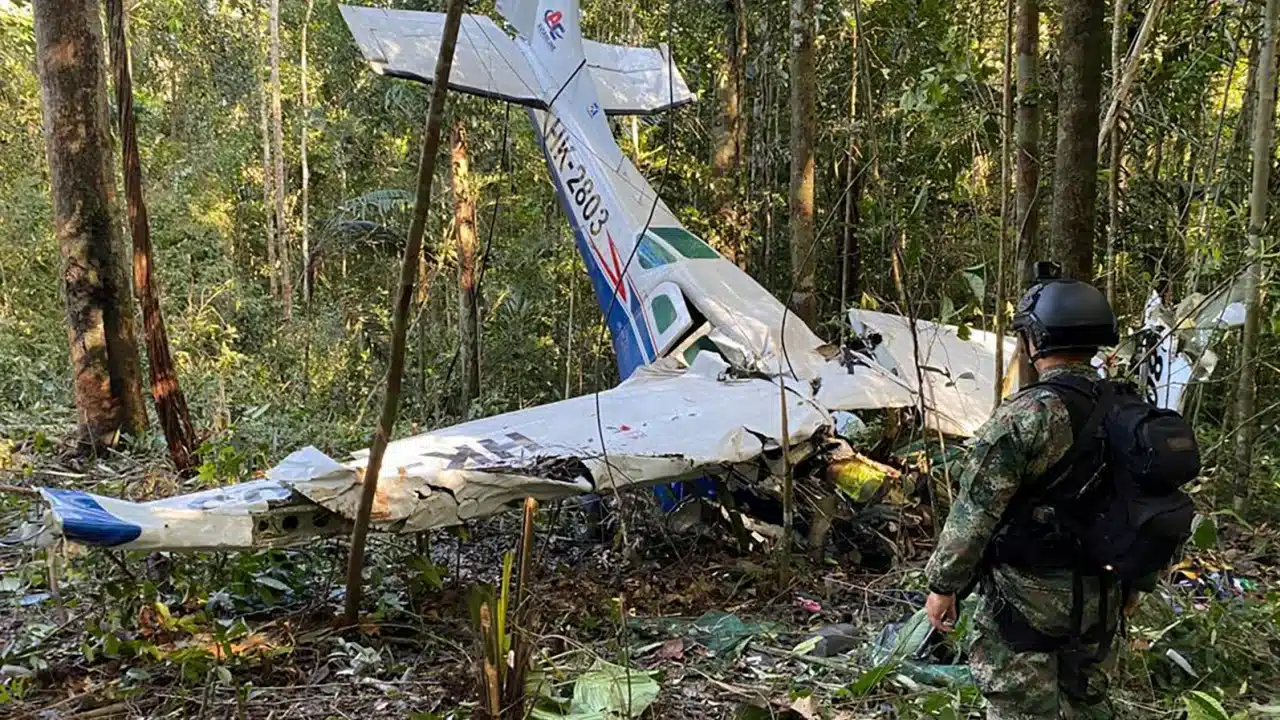
As Colombia waits for a sign of life from the four indigenous children who vanished into the jungle following a plane crash on May 1, accusations are emerging that dangerous flying incidents are all too common in the remote Amazon – an area where air travel is often the only connection between population centers.
The three adults onboard, including the pilot and the children’s mother, Magdalena Mucutuy, died in the crash. But only traces of the children have been found in the surrounding forests: a baby bottle, a makeshift shelter, a dirty diaper and even what appeared to be small footprints.
These discoveries have fueled hopes that 13-year-old Lesly Jacobombaire Mucutuy, Soleiny Jacobombaire Mucutuy, 9, Tien Ranoque Mucutuy, 4, and infant Cristin Ranoque Mucutuy survived. However, a massive search by hundreds of soldiers and indigenous scouts has so far been fruitless, more than four weeks since the crash.
Indigenous advocates have said the tragedy is a result of governmental negligence. Following news of the crash, the Organization of Indigenous People in the Colombian Amazon issued a statement accusing Bogota of failing to enforce safety checks and protocols for planes in the region. The organization’s president Julio Cesar Lopez told CNN he hoped for a congressional investigation that would prevent future tragedies.
The skies over the Amazon have seen many accidents. Of 641 accidents registered by Colombia’s civil aviation authority since 1996, 56, or 8.74% of the total, took place in the Amazon region, even though less than 2% of the Colombian population lives there.
Londoño’s escape earlier this year, barely a hiccup in the rollercoaster of Amazonian aviation, is not counted in the statistics.
Pilots working in the area must contend with aging planes and a wild terrain, experts say.
“This is a factory of very good pilots: if you fly here, you must be pretty good,” says Jose Miguel Calderon, a charter pilot in Mitú who regularly flies single engine Cessnas like the one that crashed with the four children.
Calderon dismisses the idea that his job is particularly high risk, but he concedes flying in the Colombian Amazon is not for the faint hearted. Mitú’s airport is the only paved runway in an area larger than Switzerland, and Calderon’s definition of a good place to land is any opening in the vegetation that is dry enough not to trap his engine’s wheels in the mud.
The planes themselves are often of the older sort. The 206 that crashed with the kids was over 40 years old, but some of the aircraft still used in the Amazon can be up to 80 years old, according to Calderon.
In a statement to CNN, the Colombia’s Civil Aviation authority said, “Colombian law does not establish a maximum age for aircrafts operating in the country as long as they comply with all maintenance protocols. Moreover, this type of older airplanes are often the most apt to operate in the limited infrastructure of the airfields in the Colombian Amazon. The institution is aware of these situations and promotes a safety program to mitigate risks related to flying in older aircrafts.”
But even when the pilot manages to lift the old plane off the dirt track used as runway, navigation can be challenging. “We don’t have cruise controls, or any sort of computer; sometimes all you see is just the blue of the sky and the green of the forest,” says Calderon.
Pilots do have long wave radios or GPS systems, the rest is left to the intuition and experience of local pilots, who often travel with no comms for a large stretch of their route – an issue that the military search teams currently combing the forest for the missing children have also experienced.
“About 50-60 miles south of San Jose del Guaviare we lose contact with the base,” says Major Juan Valencia, a Blackhawk helicopter pilot who’s flying as part of the search and rescue mission to locate the missing kids.
“The main risk for me is that you can’t emergency land,” Valencia told CNN. While in most of the world it’s always possible to find a clear, flat strip to land a damaged aircraft such as a highway or a rural field, the rainforest is often so thick that pilots performing emergency landings in the area must attempt a sort of controlled crash on the top of the tree cover.
The same plane that carried the four children had previously crashed two years prior, in 2021, due to an engine malfunction. It performed a controlled crash landing, causing considerable damage to the propeller, engine and one wing.
After being repaired, the plane crashed again on May 1 under similar circumstances, on a route with no good options for emergency landing.
“The route from Araracuara to San Jose del Guaviare this plane was travelling, 150 miles of the route’s 220 miles are just forest…When an emergency happened, the pilot had nowhere to go,” Valencia says.
Unfortunately, despite the considerable risks of flying in the Amazon, air travel is often the only way to get around, as few roads cross the through the jungle and waterways are even more dangerous. Most settlements in the region are only accessible with a plane.
The small Amazonian community of Tapurucuara, for instance, is about 20 kilometers (15 miles) from Mitú. No roads connect the two settlements, so transit from one to the other requires either an 8-hour hike on forest paths that are often under water, or a seven-minute charter according to Londoño and Calderon.
Mitù itself is only reachable via air or on a three-week boat journey from Calamar, the small settlement at the end of the only highway that links the Amazon Forest with central Colombia.
“Historically, the Amazon was not part of the agenda for Colombian governments,” say Nelly Kuiru, an indigenous activist and documentary filmmaker from La Chorrera, another indigenous settlement in the thick of the forest.
La Chorrera saw an economic boom fueled by the rubber industry in the early 1900s, but the tide receded with the spread of synthetic rubber during World War War II. The local population live off hunting, fishing, and subsistence farming, and plans to boost the local economy with eco-tourism have been hampered by the lack of connectivity; La Chorrera can only be reached by a commercial plane once every 15 days.
Kuiru also experienced danger when travelling in the Amazon. “It’s chaotic, dangerous. Once I was taking a European friend to La Chorrera, and the plane we were travelling on had the door shut from the inside with a rope because the lock was damaged… my friend could not believe it!” she recalled to CNN.
In a statement to CNN, the Colombian civil aviation authorities recognized air travel in the Amazon is riskier than in other regions of the country, due to lack of maintenance and the age of the fleet. The institution said it’s prioritizing restructuring airports over rejuvenating the fleet.
This year the Colombian government budgeted the equivalent of over $200 million to boost airports across the Amazon region over the next 30 years, and to open eight new commercial flight routes Amazon region.
President Gustavo Petro, the first progressive president of Colombia and an outspoken environmentalist, has made protecting and developing the Amazon a priority of his government. New resources are being thrown to the region from both his government and international partners; earlier this month, the Colombian Ministry of Foreign Affairs said that the United Kingdom had agreed to contribute 13 million pounds ($16 million) to combat deforestation in the Colombian Amazon.
But Kuiru believes increased funding also carries its own risk, if not properly managed. She would like more resources made available for grass-roots projects presented by the indigenous communities, rather than grandiose environmental funds where local people who live in the Amazon have little control.
For now however, Kuiru’s focus is firmly set onto the four missing kids and the three adults who perished in the crash. One of them, Herman Mendoza, was a personal acquaintance of hers, which only spurs even more determination to demand change for transport in the region.
“This tragedy needs to send a message,” she said, “We can’t let his death grow unpunished.”