State media, a mouthpiece for the ruling Chinese Communist Party – has made no mention of the protests.
However, the English-language edition of the Global Times has published an article taking aim at Western media for allegedly fanning discontent around China’s zero-Covid policy.
Quoting an academic at Fudan University, it writes: “Due to ideological differences, it has become almost an instinct of Western countries and media to criticize communist governments with an aim to subvert the latter with color revolutions”.
But in what some may interpret as an indirect response to the protests, it also writes that the country’s Covid measures “are never static” and “are under constant adjustment”.
Xinhua news agency also emphasizes the need to prioritise the welfare of the people when implementing Covid policies, while the China Daily says local administrations are being urged to “rectify Covid control malpractices”.
The Chinese yuan fell to its lowest level in nearly 15 years on Tuesday as investors fled Chinese assets amid concerns about Xi Jinping’s dramatic move to consolidate power in a major reshuffle of Communist Party leaders.
On the tightly controlled domestic market, the yuan dropped sharply, hitting the weakest level since late 2007. It was lastdown 0.6% at around 7.3 per dollar. The currency has lost 15% against the US dollar this year.
In trading outside of mainland China, the yuan briefly plunged to around 7.36 per dollar early Tuesday, the lowest level on record, according to Refinitiv, which has data going back to 2010. It later pared losses, trading at 7.33 by 3:35 p.m. Hong Kong time (3.35 a.m. ET).
The currency was pegged at 8.28 to the US dollar for years until 2005 when China moved to a “managed floating exchange rate.” It then appreciated steadily, climbing to a peak of nearly 6.01 in 2014.
The declines came alongside a historic market rout for Chinese assets worldwide. On Monday, Chinese stocks plummeted in Hong Kong and New York, wiping out billions of dollars in market value. Hong Kong’s benchmark Hang Seng (HSI) Index closed down 6.4%.
The Nasdaq Golden Dragon China Index, which tracks many popular Chinese companies listed on Wall Street, dived more than 14%. On Tuesday, the Hang Seng (HSI) slipped further and was down 0.2% in afternoon trading.
The huge sell-offs came just days after the ruling Communist Party unveiled its new leadership for the next five years. In addition to securing an unprecedented third term as party chief, Xi packed key positions with staunch loyalists.
A number of senior officials who have backed market reforms and opening up the economy were missing from the new top team, stirring concerns about the future direction of the country and its relations with the United States.
International investors spooked by the outcome of the leadership reshuffle dumped Chinese assets despite the release of stronger-than-expectedChinese GDP data on Monday. They’re worried that Xi’s tightening grip on power will lead to the continuation of Beijing’s existing policies and further dent the economy, which despite the rebound last quarter is still growing way below the official 5.5% target for this year.
On Sunday, a pro-democracy activist from Hong Kong was dragged into the grounds of the Chinese consulate in Manchester and beaten.
Unidentified men stormed the consulate and forced a man inside the compound before he was able to flee with the assistance of police and other demonstrators.
The protester told the BBC: “They dragged me inside, they beat me up”.
A consulate spokesperson said protesters had displayed an insulting portrait of China’s president.
The Foreign Office said it was urgently seeking clarity on the incident. Greater Manchester Police has launched an investigation.
Speaking after the incident, the protester, called Bob, told BBC Chinese that “mainlanders” – people from mainland China, as opposed to Hong Kong – came out of the consulate and destroyed their posters.
“As we tried to stop them, they dragged me inside, they beat me up,” he said, adding that he was then pulled out by the UK police.
“It’s ridiculous. They [the attackers] shouldn’t have done that. We are supposed to have the freedom to say whatever we want here [in the UK].”
After the incident, the crowd remained angry. Protesters shouted at the men from the consulate and the British police, arguing they could have done more.
Consulate staff had previously asked the protesters to move to the opposite side of the street.
There were two police officers at the protest, but several more appeared within minutes of the altercation beginning.
They gathered at the gates of the compound trying to break up the fighting and move protesters back.
One police officer entered the consulate grounds and pulled the man who had been dragged inside back out.
At least eight men – some of whom were wearing helmets and protective vests – then returned to the consulate building.
The consulate is on UK soil, but cannot be entered without consent. Any offense committed on diplomatic premises is subject to UK law, but employees may hold diplomatic immunity.
Reacting on Twitter, former Conservative leader Iain Duncan Smith said the UK government should demand a full apology from the Chinese ambassador, and that those involved should be sent back to China.
The demonstrators were protesting as the Communist Party congress began in Beijing.
President Xi Jinping, who is set to secure a third term in power, said he had turned the situation in Hong Kong from “chaos to governance”, referring to China’s suppression of pro-democracy protests there.
A spokesperson for the consulate said the protesters had “hung an insulting portrait of the Chinese president at the main entrance”.
“This would be intolerable and unacceptable for any diplomatic and consular missions of any country. Therefore, we condemn this deplorable act with strong indignation and firm opposition,” the spokesperson added.
At the 20thCommunist Party Congresslater this month, Xi Jinping will begin a historic third term.
Given that China’s leaders opted in 2018 to remove the two-term limit in place since the 1990s, Mr. Xi will basically be able to stay in power indefinitely.
Under Mr Xi’s rule since 2012, China has become more authoritarian at home, cracking down on dissent, critics, and even influential billionaires and businesses. Some have described him as “the most authoritarian leader since Chairman Mao”.
Under his rule, China has established “re-education” camps in Xinjiang that have been accused of human rights abuses against Uyghurs and other minority ethnic groups. It has tightened its grip on Hong Kong and vowed to “reunite” with Taiwan, by force if necessary.
In a clear sign of his influence, the Communist Party voted in 2017 to write his philosophy – called “Xi Jinping Thought on Socialism with Chinese Characteristics for the New Era” – into its constitution. Only party founders Mao Zedong and Deng Xiaoping, the leader who introduced economic reforms in the 1980s, have made it into the all-important fundamental law of the land.
Princeling, peasant, president
Born in Beijing in 1953, Xi Jinping is the son of revolutionary veteran Xi Zhongxun, one of the Communist Party’s founding fathers and a former vice-premier.
Because of his illustrious roots, Mr Xi is considered a “princeling” – a child of elite senior officials who have risen up the ranks.
But his family’s fortunes took a dramatic turn when his father was imprisoned in 1962. A deeply suspicious Mao, fearing a rebellion in party ranks, ordered a purge of potential rivals. Then in 1966 came the so-called Cultural Revolution when millions were branded as enemies of Chinese culture, sparking violent attacks across the country.
Mr Xi’s family suffered too. His half-sister – his father’s first daughter through an earlier marriage – was persecuted to death, according to official accounts, though a historian familiar with the party elite said she had probably taken her own life under duress, according to a New York Times report.
A young Xi was pulled out of a school attended by children of the political elite. Eventually, at 15, he left Beijing and was sent to the countryside for “re-education” and hard labour in the remote and poor north-eastern village of Liangjiahe for seven years.
But far from turning against the Communist Party, Mr Xi embraced it. He tried to join several times but was rebuffed because of his father’s standing.
He was finally accepted in 1974, starting out in Hebei province, then occupying ever more senior roles as he slowly made his way to the top.
In 1989, at the age of 35, he was party chief in the city of Ningde in southern Fujian province when protests demanding greater political freedom began in Beijing’s Tiananmen Square.
The province was far from the capital but Mr Xi, along with other party officials, reportedly scrambled to contain local offshoots of the massive demonstrations underway in Beijing.
The protests – an echo of a rift within Communist Party ranks – and the bloody crackdown that ended them have effectively now been scrubbed from the country’s history books and public record. China even lost the bid to host the 2000 Olympics because of the abuses in Tiananmen Square. Estimates of the number killed range from hundreds to many thousands.
Almost two decades later, however, Mr Xi was put in charge of the 2008 Summer Olympicsin Beijing. China was keen to show it had moved on and was a worthy host – and it appeared to be working, with the Games symbolising China’s rise as a growing power.
As for Mr Xi, his increasing profile in the party propelled him to its top decision-making body, the Politburo Standing Committee, and in 2012 he was picked as China’s president.
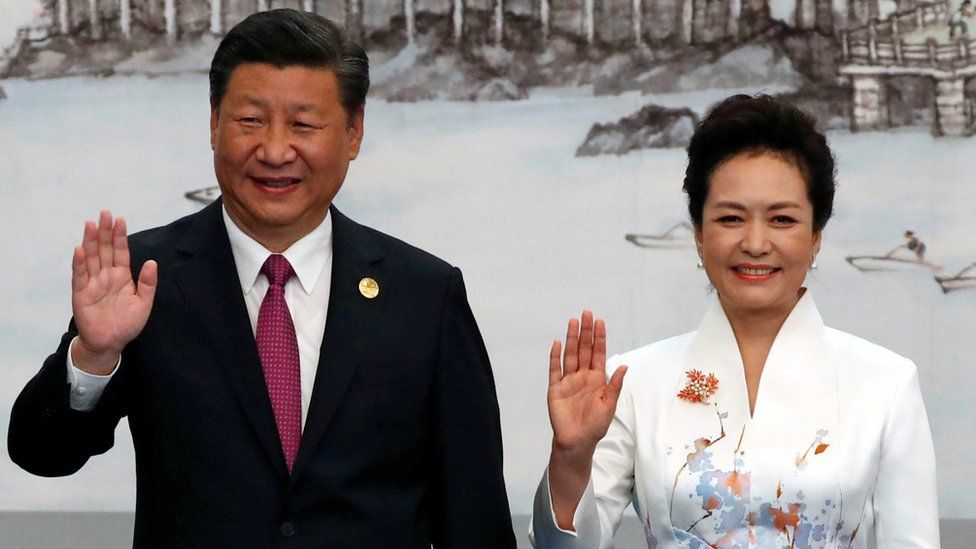
IMAGE SOURCE, REUTERS Image caption, Mr Xi’s wife, Peng Liyuan (right), is a famous folk singer in China
Mr Xi and his wife, Peng Liyuan, a famous singer, have been heavily featured in state media as China’s First Couple.
This is a contrast from previous presidential couples, where the first lady has traditionally kept a lower profile.
The couple has a daughter, Xi Mingze, but not much is known about her apart from the fact that she studied at Harvard University.
Other family members and their overseas business dealings have been the subject of scrutiny in the international press.
China Dream
Mr Xi has vigorously pursued what he has called a “great rejuvenation of the Chinese nation” with his China Dream vision.
Under him, the world’s second-largest economy has enacted reform to combat slowing growth, such as cutting down bloated state-owned industries and reducing pollution, as well as the multi-billion dollar One Belt One Road infrastructure project aimed at expanding China’s global trade links.
The country has become more assertive on the global stage, from its growing forcefulness in the South China Sea to its exercise of soft power by pumping billions of dollars into Asian and African investments.
Some of this economic growth, however, which in past decades has increased meteorically – has now slowed substantially, worsened by the Chinese leader’s uncompromising “zero-Covid” strategy that has locked out the rest of the world since the pandemic.
The country’s once-booming property market is in a deep slump and the outlook for the global economy has weakened sharply in recent months.
A bitter and damaging trade war with the US shows no sign of ending.
‘Most authoritarian leader since Mao’
Since reaching top office, Mr Xi has overseen a wide-reaching corruption crackdown extending to the highest echelons of the party. Critics have portrayed it as a political purge.
Under his rule, China has also seen increasing clampdowns on freedoms.
In Xinjiang province, human rights groups believe the government has detained more than a million Muslim Uyghurs over the past few years in what the state defines as “re-education” camps. China denies accusations from the US and others that it is committing genocide there.
Beijing’s grip over Hong Kong, too, has grown under Mr Xi.
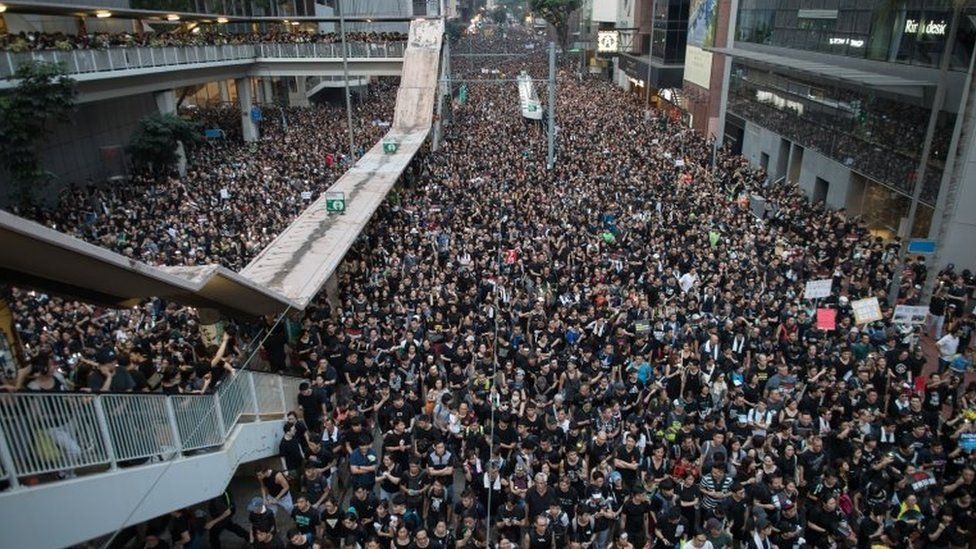
IMAGE SOURCE, EPA Image caption, Thousands turned out in Hong Kong to take part in protests against a planned extradition law
Mr Xi put an end to pro-democracy protests in 2020 by signing the National Security Law, a sweeping edict that gives Beijing powers to reshape life in the former British colony, criminalizing what it calls secession, subversion, and collusion with foreign forces, with the maximum sentence of life in prison.
The law has led to mass arrests of prominent pro-democracy activists and politicians, as well as the closure of prominent news outlets including Apple Daily and Stand News.
Under Mr Xi’s leadership, China has also intensified its focus on the self-ruled island of Taiwan, vowing “reunification” and threatening to use military force to prevent any move towards formal independence there.
Given China’s power and influence, the world will be watching Mr Xi as he embarks on his third term as president. With no heir apparent, the 69-year-old is arguably the most powerful leader China has had since the death of Mao Zedong in the 1970s.
A rare and dramatic protest against President Xi Jinpingin Beijing has spurred an internet search for the mystery protester’s identity, as well as appreciation for the action.
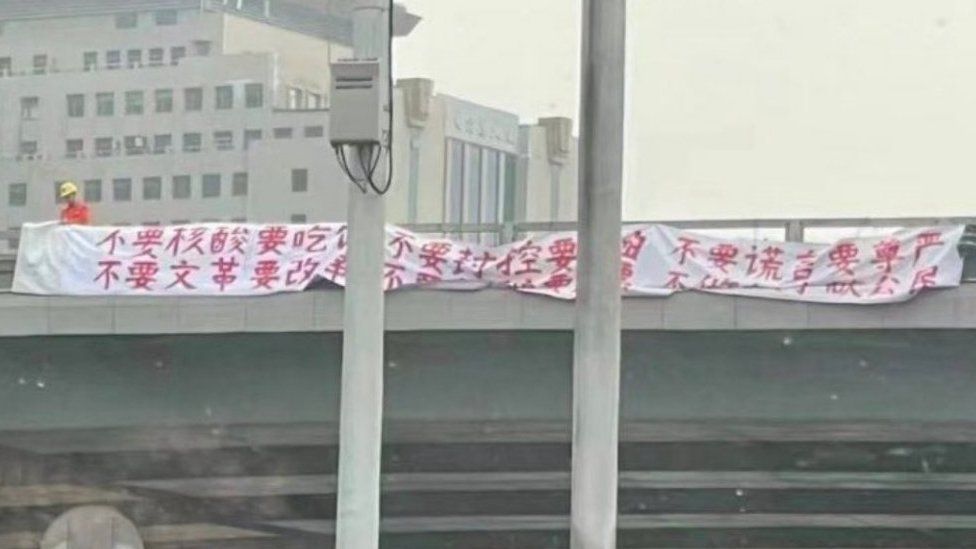
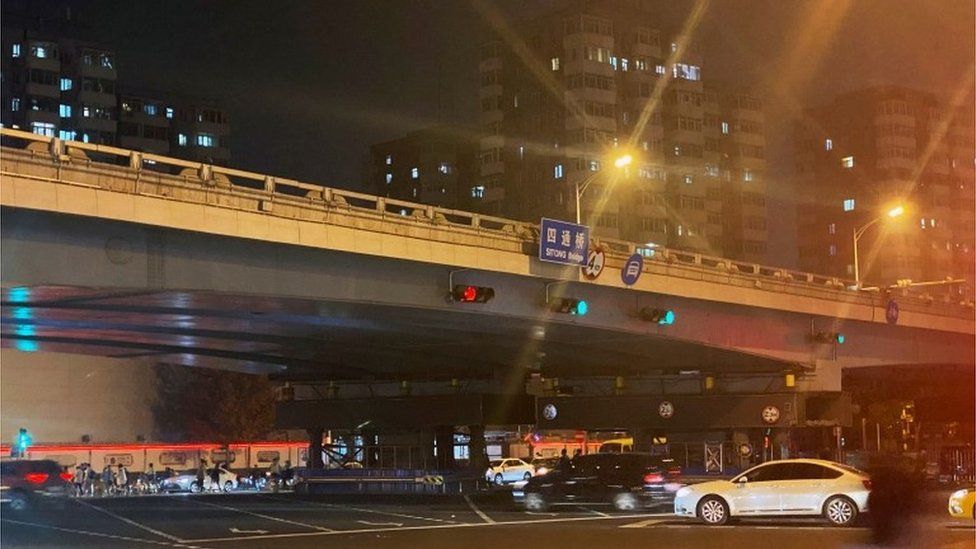
The protester had climbed the Sitong bridge in Beijing’s Haidian area and draped two enormous banners asking for an end to China’s draconian zero-Covid policy and Mr Xi’s removal.
While state media have remained silent, photos and videos of Thursday’s event have circulated widely online, prompting a swift crackdown by censors on social media platforms and the WeChat app used by most Chinese.
Thursday’s protest took place on the eve of a historic Communist Party congress, where Mr Xi is due to be handed a third term as party chief, cementing his hold on power.
The person also set what appeared to be car tyres on fire, and could be heard chanting slogans into a loudhailer.
Reports say one person has been arrested in connection to the protest. Pictures of the incident showed police officers surrounding the person, who wore a yellow hard hat and orange clothing.
The BBC has asked local police for comment.
Many have praised the lone protester’s actions, calling them a “hero” and referring to them as the “new Tank Man” – a reference to the unknown Chinese man who stood in front of tanks during the 1989 Tiananmen protests.
IMAGE SOURCE,TWITTER Image caption, The protester is believed to be the man dressed in an orange worksuit
Online sleuths have attempted to track the person down, focusing on a Chinese researcher and physicist hailing from a village in the northern province of Heilongjiang. A BBC check with village officials confirmed that a man with that name used to live there.
He had posted what appeared to be a manifesto on the popular research site ResearchGate. This was later taken down, though others have since uploaded copies of it.
In the 23-page document, he called for a strike and acts of civil disobedience – such as smashing Covid testing stations – on Sunday. This was to stop “the dictator Xi Jinping from illegally continuing in office, so that China can embark on the road to democracy and freedom”.
Some Chinese have congregated on the man’s two Twitter accounts, posting what they claimed were his pictures and writing hundreds of grateful messages.
“You’re a hero and you have my respect,” wrote one person, while another said: “Salute to the hero of the people! Hope you can safely return!”
The man’s name is among the material related to the protestthat has been censored online. No references to the incident could be found on Chinese social media site Weibo as on Friday morning.
Footage and pictures of the protest and related keywords including “Haidian”, “Beijing protester” and “Sitong bridge” were quickly scrubbed. Phrases tangentially related to the protest, including “bridge” and “hero”, also returned limited results.
IMAGE SOURCE,REUTERS Image caption, By Thursday evening all traces of the protester’s actions had been removed
Although Chinese media have not reported on the incident, former Global Times editor Hu Xijin appeared to refer to it when he tweeted on Thursday evening that the “vast majority” of Chinese people supported Communist Party rule and were “hoping for stability and opposing upheaval”.
Many Chinese have reported that their accounts on social media platformsor WeChat – China’s biggest messaging app – had been temporarily banned after they shared pictures of the protest or posted messages alluding to the protest.
The BBC has reached out to Tencent, WeChat’s parent company, for confirmation.
Such dramatic protest – and public criticism of the government – is rare in China, though China’s tough “zero Covid” policy has fuelled growing public frustration.
In 2018 a woman who defaced a poster of Mr Xi, saying she opposed his “tyranny”, was later admitted to a psychiatric hospital.
The Beijing protester’s actions come at an especially politically sensitive time, with thousands of police officers expected to be mobilised across the capital ahead of the week-long party congress.
China’s ruling Communist Party is expected to hand a third five-year term to Xi Jinping, arguably the most powerful Chinese leader since Mao Zedong in the 1970s.
The decision – which comes after a two-term limit was abolished in 2018 – would further tighten his grip on China.
It is possible that Mr Xi, 69, will remain in power for the rest of his life.
The historic move is due at a Communist Party Congress in Beijing beginning on 16 October – one of the most important meetings in the party’s history.
Xi Jinping currently holds three top positions
As General Secretary, he is the chief of China’s Communist Party.
As president, he is China’s head of state.
As Chairman of China’s Central Military Commission, he commands the country’s armed forces.
He is also referred to as Paramount or Supreme leader.
Mr Xi is likely to retain the first two titles, party General Secretary and Central Military Commission chairman at the party congress – which takes place every five years – and the presidency at the annual National People’s Congress in Spring 2023.
What happens at the Congress?
Some 2,300 delegates will gather in Tiananmen Square’s Great Hall of the People for about a week.
About 200 of them will be selected to join the party’s central committee, plus around 170 alternate members.
The central committee will elect 25 people to the party’s Politburo.
And the Politburowill appoint the members of the Politburo standing committee.
These are the elite of the elite.
There are currently seven members, including the party’s General Secretary Xi Jinping.
They are all men.
Not all of the action takes place at the congress itself.
The central committee is expected to meet the day after the main congress ends.
Why is it important?
Mr Xi will lead the world’s second-largest economy and one of its biggest military forces.
Some analysts say he is likely to push China towards a more authoritarian political stance in a third five-year term.
“China under Mao was a totalitarian system. We’re not there yet, but we’re moving in that direction.”
Professor Tsang says the Congress could see changes to the party’s constitution, with “Xi Jinping thought” being further enshrined as the party’s guiding philosophy.
“Xi Jinping thought” is Mr Xi’s brand of Chinese socialism, an assertively nationalist philosophy that is highly sceptical of private business.
Under his leadership, the Chinese authorities have cracked down on powerful companies in several sectors of the economy.
“If that happens, they’ll effectively make him a dictator,” Prof Tsang says.
China’s top leadership team, to be unveiled at the congress, will set a huge range of policies.
Any hint of China’s future direction will be followed closely around the world, particularly on the key challenges: economic, political, diplomatic, and environmental.
China’s economic challenge
China’s economy has boomed in recent decades.
But it now faces serious economic disruption from Covid lockdowns, rising prices, and a major property crisis.
Growing fears of a global recession triggered by the war in Ukraine have also damaged confidence.
Economic growth under Mr Xi’s leadership is lower than under previous presidents Jiang Zemin and Hu Jintao.
Some analysts say the legitimacy of the communist government rests heavily on its ability to deliver higher incomes and good jobs for Chinese workers.
So bad economic performance in the next five years could spell serious political trouble for Mr Xi.
The congress will set the stage for a shake-up of key economic roles including central bank governor and premier.
Zero Covid
China’s zero Covid approaches to the pandemic is one of Xi’s landmark policies.
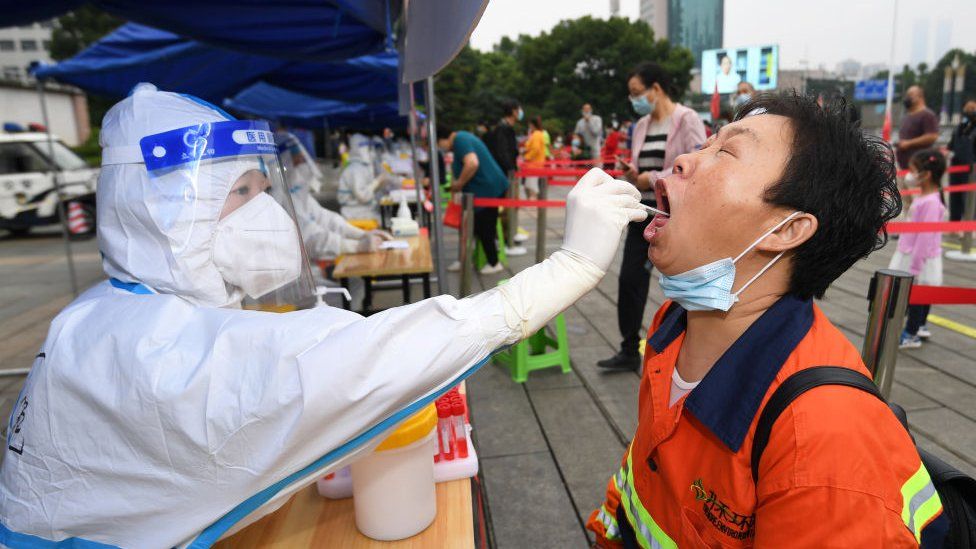
While much of the world has been returning to normal, China’s authorities have intensified their efforts to contain outbreaks, with strict lockdowns, mass testing, and lengthy quarantines.
Reports say that more than 70 cities including Shenzen and Chengdu have been under full or partial lockdown measures in recent weeks, with tens of millions of residents affected, huge numbers of businesses disrupted, and reports of public discontent.
IMAGE SOURCE,GETTY IMAGES Image caption, Medical staff testing residents in Guiyang, Guizhou Province
Mr Xi has vowed to “resolutely fight against any words and acts that distort, doubt or deny” his Covid policy.
A major outbreak in the run-up to the Congress, or during the meeting itself, risks damaging Mr Xi’s image of competence.
Some observers say the party may use Congress to declare victory over the pandemic and end the zero Covid policy.
Alternatively, the party may argue that China – unlike other countries – values people’s lives more than the economy, in which case the policy will continue.
Taiwan and the West
Mr Xi has also favoured a hardline approach to relations with the West, particularly over Taiwan.
A visit to Taiwan by the Speaker of the US House of Representatives in August prompted China to launch military exercises, including live missile firing, around the island.
China sees Taiwan as a breakaway province that will eventually be under Beijing’s control. Taiwan sees itself as distinct from the mainland.
Mr Xi has said “reunification” with Taiwan “must be fulfilled” by 2049, the centenary of the People’s Republic – and has not ruled out the possible use of force to achieve this.
Taiwan is of huge strategic importance to the West, part of the so-called “first island chain”, which includes a list of territories that have been allied to the US for decades.
DISCLAIMER: Independentghana.com will not be liable for any inaccuracies contained in this article. The views expressed in the article are solely those of the author’s and do not reflect those of The Independent Ghana
The former justice minister of ChinaFu Zhenghua, who led multiple anti-corruption campaigns, has been imprisoned for bribery.
In July, Fu pleaded guilty to collecting 117 million yuan ($14.7 million; $16.5 million) in gifts and cash.
Chinese media reported he’d received a suspended death sentence to be commuted to a life sentence in two years.
His conviction comes amid a sudden crackdown on officials ahead of a key Communist Party congress next month.
China’s ruling party holds the event once every five years and this time President Xi Jinping is expected to be given a historic third term and consolidate his hold on power.
Fu’s jailing follows the sentencing of three former police chiefs this week. All four men are not only accused of corruption but also of being disloyal to Mr Xi.
They are all alleged to have been part of a corrupt political circle led by another ex-security figurehead, Sun Lijun, who is currently awaiting his sentence.
Fu was China’s justice minister from 2018 to 2020, after a career where he worked his way up from being a policeman to the deputy head of China’s Ministry of Public Security.
He led several high-profile investigations into corrupt politicians – including a probe that broughtdown Zhou Yongkang, one of the most powerful officials in recent years to be convicted of bribery.
In October last year, the party’s internal watchdog announced it was investigating Fu for “serious violations of discipline and national laws”.
He was dismissed from public office and then in March this year expelled from the Community Party. He was arrested a month later on corruption charges.
Prosecutors said he took advantage of his authority to seek gains for others and himself on business contracts, official positions, and even legal cases.