A resurgence of chieftaincy conflict in Bawku has reportedly resulted in multiple fatalities, including that of an 11-year-old girl.
According to a report by Asaase Radio, the girl lost her life in her home on October 27, 2024. The renewed violence flared up over the weekend, with gunfire reported in various locations.
On the same day as the girl’s death, three individuals were shot near the Ghana Highways Authority office.
Local sources indicate that since the outbreak of shooting on October 26, the death toll has risen to approximately 15, with around 20 others sustaining injuries.
Some of the injured have been transported to the Tamale Teaching Hospital for treatment.
Efforts by security forces in Bawku to restore order are hampered by a shortage of personnel and inadequate resources. Reports suggest that the military units deployed in the region lack sufficient vehicles to respond quickly to the incidents.
Meanwhile, the Ghana Police Service is struggling to manage the escalating violence that has spread across several neighborhoods due to a lack of resources.
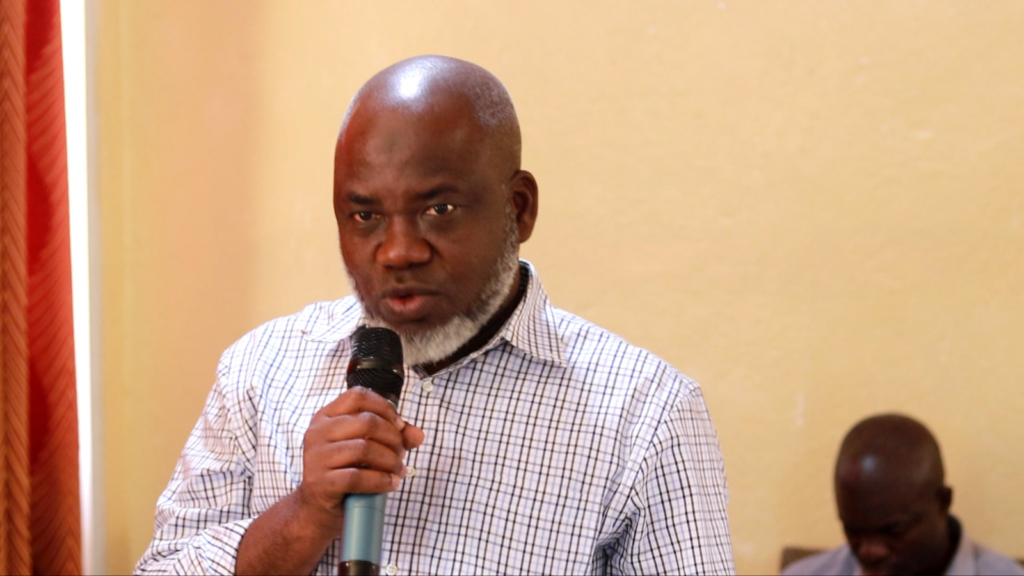
Former Auditor-General, Daniel Yaw Domelevo, has voiced his concerns about the prevalent issue of conflict of interest among public officials in Ghana.
His comments follow the Airbus scandal, where Special Prosecutor, Kissi Agyebeng identified former President John Dramani Mahama as “Government Official 1,” but found no evidence of corruption in a deal facilitated by Mahama‘s brother, Foster Adams Mahama.
Previously, the United Kingdom’s Serious Fraud Office had imposed a €3.9 billion fine on Airbus SE for bribery in securing aircraft sales in 13 countries, including Ghana.
In an interview with Citi News, Mr Domelevo attributed the frequent conflicts of interest in Ghana to the stalled passage of the Conduct of Public Officeholders Bill.
He singled out politicians as the primary offenders, suggesting that their involvement in such conflicts is why they are hesitant to pass the bill.
“I believe that the reason that bill is not going through is because the people who are supposed to facilitate that bill know that they are the highest or the biggest culprits.
“They have been involved in several issues of conflict of interest, family and friends, business, et cetera which that bill is aimed at addressing.
“So if we are serious with ensuring that public officers do the right thing, that Conduct of Public Office Holders’ bill must be passed.”
Upper West Regional Minister, Dr. Hafiz Bin Salih, has given assurance to the chiefs and people of the region, particularly in Jirapa, that he will work to maintain the existing peace in the municipality.
While addressing kingmakers, the Minister emphasized that Jirapa has the potential to become the fastest-developing municipality in the region.
He highlighted the numerous educational and institutional facilities in the area, stating that peace is crucial for the community to realize its developmental potential.
”Chieftaincy conflict has never been a friend to us, what they bring in their wake is poverty, misery and lack of development and we don’t want that for our beloved Jirapa,” he said.
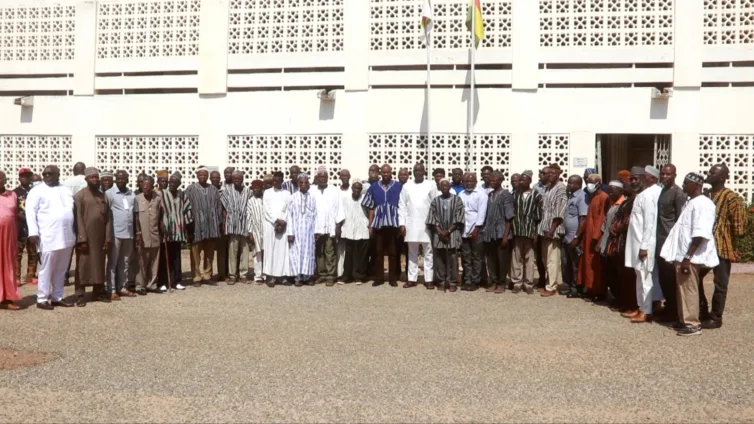
The Jirapa skin and elders, including the chief of Tugo, Naa Daniel Tangba, visited the office of the Upper West Regional Minister to inform him of the successful completion of the final funeral rites for the late paramount chief of Jirapa, Naa Ansolee Ganaa II.
During the meeting, they unanimously endorsed the Jirapa regent, Naa Justice Dinah Donglabong, as the successor. Additionally, the delegation invited the Regional Minister to the coronation of Naa Justice Donglabong Dinah scheduled for December 30, 2023.
Dr. Hafiz Bin Salih commended the Kingmakers for the efficient and peaceful manner in which they conducted their activities to arrive at a decision.
He encouraged the kingmakers and all individuals involved in the nomination, enskinment, and out-dooring of the new chief to adhere to due process.
”Let’s do things in conformity to the dictates of the laws of Ghana. As you go back to jirapa to continue the processes, you have to be measured and do things in moderation.”
“For us here, we don’t have a side we are supporting. What we know is to ensure that there is peace and harmony in Jirapa,” he added
Dr. Bin Salih warned, ”We will not allow any individual or any group of persons to disturb the peace we are enjoying in Jirapa”.
Principal State Attorney at the Office of the Attorney General’s Department in the Upper West region, lawyer Saeed Abdul Shakur, was clear and unequivocal regarding the stance of the Upper West Regional Security Council on chieftaincy issues.
”We also want to make it clear that we do not have a hand or whatsoever in the chieftaincy matters in Jirapa. We don’t have a side as chieftaincy matters are concerned. The welfare of the people is the principal responsibility of the regional minister ably supported by the rest of us,” he disclosed.
Lawyer Saeed Abdul Shako advised that individuals dissatisfied with any issues related to chieftaincy matters should seek redress through the appropriate channels, emphasizing resorting to the judicial process instead of taking the law into their own hands.
He highlighted four channels for resolving grievances: the Judicial Council of the Upper West Regional House of Chiefs, the Judicial Council of the National House of Chiefs, and the Supreme Court.
Additionally, he issued a warning that the state will take strong action against anyone or group of persons going against the established legal processes.
As battle between the Sudanese army forces and the paramilitary Rapid Support Forces (RSF) continues, evidence of major damage in another area of the West Darfur region of Sudan has emerged.
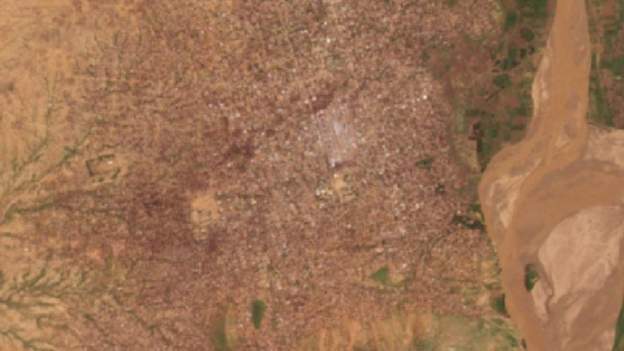
Nasa data from 27 June shows what appear to be a number of fires concentrated in the area of Murnei, about 80km (50 miles) south of the regional capital of El Geneina, which itself suffered extensive damage in mid-May.
We found satellite images showing the damage in Murnei occurred between 26 June and 28 June, with an image from yesterday showing smoke still visible at one location.
The heat signatures earlier in the week were picked up by Nasa’s Fire Information for Resource Management System (FIRMS). It’s not clear exactly which buildings might be burning, as there’s little information coming out of that area.
It is the latest to suffer destruction from the conflict in the wider Darfur area, which has seen particularly intense fighting in recent weeks.
Tens of thousands of civilians have fled across the border into Chad, since the fighting began.
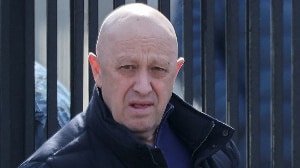
The uprising within the Wagner force in Russia presents a diplomatic dilemma for Mali and the Central African Republic (CAR). These countries have been confronted with a complex situation as the forces of the mercenary group have become increasingly influential in their protracted internal conflicts.
As the Wagner fighters barrelled towards Moscow on Saturday after seizing a southern city overnight, spokespeople for the governments of Mali and CAR declined to comment on the turmoil and how it might affect their security strategies against armed groups.
Both countries have sought closer ties with Russia and military support to battle the armed fighters, saying in the past that their military cooperation agreements are with Russia rather than with Wagner.
“[Wagner’s] presence in Mali is sponsored by the Kremlin and if Wagner is at odds with the Kremlin … naturally Mali will suffer the consequences on the security front,” said Malian political analyst Bassirou Doumbia.
Mali, where military authorities seized power in coups in 2020 and 2021, is battling a years-long operation against armed groups affiliated with ISIL (ISIS) and al-Qaeda. It has said Russian forces there are not Wagner mercenaries but trainers helping local troops with equipment bought from Russia.
But the alliance has soured relations with the United Nations and alienated Western powers, who have said the fighters are Wagner forces and have alleged that they have committed possible war crimes alongside Malian soldiers.
The governments in Mali and Russia have denied the allegations.
Wagner’s continued presence in Mali amid the continuing insurrection in Russia could prove problematic for Bamako’s relations with Moscow, which last year committed to send Mali shipments of fuel, fertiliser and food worth about $100m.
“[The] exact consequences for Mali really depend on factors largely unknown such as the organisational autonomy of Wagner and their chain of command, and, of course, whether things escalate or not between [Russian President Vladimir] Putin and Wagner,” said Yvan Guichaoua, senior lecturer at the Brussels School of International Studies.
He said there were no reports of unexpected troop movements in Mali as of Saturday morning.
Rebel insurgencies
The power struggle in Russia could also have significant ramifications for CAR, where hundreds of Russian operatives, including many from Wagner, have been helping the government fight several rebel insurgencies since 2018.
Both CAR and Mali have been drawn increasingly into Russia’s orbit in recent years as the Kremlin sought greater influence in Francophone Africa to the dismay of former colonial power France, which has faced anti-French protests in the region and worsening relations with several West African governments.
In February, French President Emmanuel Macron described the deployment of Wagner troops in Africa as the “life insurance of failing regimes in Africa” that will only sow misery.
A suspension of Wagner operations in Africa could impact the group’s finances. The United States last October accused the mercenaries of exploiting natural resources in CAR, Mali and elsewhere to fund fighting in Ukraine – a charge Russia rejected at the time.
Wagner began operating in Africa and the Middle East when it was founded in 2014 and was thought to have about 5,000 fighters, but has grown significantly since then.
The paramilitary group made a name for itself internationally through its involvement in Russia’s annexation of Ukraine’s Crimean Peninsula in 2014, a move widely viewed as illegal by the international community.
The group has also been involved in the continuing Russia-Ukraine war that began in February 2022 after Wagner forces were deployed in Ukraine on March 28, 2022. The group has 50,000 active fighters in Ukraine, according to British intelligence.
According to the US National Security Council, while about 80 percent of its troops in Ukraine were withdrawn from prisons, it was stated that Wagner was effective in Russia’s alleged capture of Bakhmut in eastern Ukraine’s Donetsk region.
Wagner has also sent fighters outside Ukraine to various conflicts in the Middle East and Africa, including the war in Syria. The group has cemented strong ties with several African governments over the past decade with operations in at least eight African nations, according to leaked US documents.
Chairman of the Upper East Regional Peace Council, Alhaji Sumaila Issaka, has condemned the recurrent conflicts in Bawku, describing them as unfortunate.
He said the sporadic shooting and killing of innocent people were unnecessary and criminal.
“We don’t know who is fighting who, is it Mamprusis fighting Kussasis or Kussasis fighting Moshies, or vice versa or is it an ‘all for all war’ or people want to sell their arms, because those dying belong to all the tribes”, Mr Issaka said.
He said the Bawku area was cosmopolitan with different tribes living together.
The Regional Peace Council Chairman, who shared his experience with the Ghana News Agency after a recent working visit to the Bawku Municipality and its environs, said he had to take a long detour from Binduri district to Garu to Pusiga District before arriving at Misiga, just to avoid volatile areas.
He said businesses at the shops, markets, vehicular and human movement within Bawku had virtually slowed to a halt except the Highways area towards the middle of the Township, where commercial vehicles load passengers and goods.
Meanwhile, the Upper East Regional Coordinating Council in collaboration with the Regional Security Council (REGSEC) at its emergency meeting on Monday, September 19, reviewed the security situation in the area, as part of efforts to enforce additional measures, following recent shootings and fighting in Bawku.
In a letter signed by the Chief Director, Regional Coordinating Council, Mr Inusah Abubakari Alhaji, on behalf of the Regional Minister and copied to the Bawku Municipal Security Council, REGSEC directed that, “only the Ghana Police Service, Ghana Immigration Service and the Military are allowed to use official motor bikes between 6 am to 6 pm.”
Other measures include a temporary ban on Tricycle, commonly called ‘Yellow Yellow’ operations until further notice and extension of curfew to cover Nayoko, Kpalgu and Manga communities.