Tag: Conservatives

  • UK Conservatives push for increased salary requirements on work visas

    UK Conservatives push for increased salary requirements on work visas

    The Conservative Party has announced plans to push for higher salary thresholds on all work visas, proposing an increase to £38,700. They intend to introduce these changes as amendments to the government’s immigration bill currently under parliamentary review.

    Shadow Home Secretary Chris Philp emphasized the party’s commitment to ending what he described as the “era of mass migration.”

    Additionally, the Conservatives are calling for stricter marriage visa regulations. Under their proposal, immigrants would only be allowed to bring their partners to the UK if they have been married for at least two years, are both at least 23 years old, and are not first cousins.


    Responding, a Home Office spokesperson said: “The Tories had 14 years to reform immigration and asylum, yet they left a system in chaos and our borders weaker.”

    Since April 2024, the minimum salary requirement for work visa applicants has been raised to £38,700—a nearly 50% increase from the previous threshold of £26,200. However, exemptions apply to certain professions, including those in health and social care.

    The previous Conservative government initially planned to raise the salary threshold for sponsoring family members to £38,700 but later revised it to £29,000.

    Shadow Home Secretary Chris Philp stated that the Conservatives had intended to implement the £38,700 threshold for UK-based immigrants seeking to bring a foreign spouse but alleged that Labour had suspended the policy.


    Too many people arriving on work visas end up in minimum wage jobs, Philp told BBC Radio 4’s Today programme, so a new focus should be on “a much smaller number of very high-skilled migrants, rather than mass low-skilled migration”.
    “For 20 or 30 years now, we’ve seen huge numbers arriving in the UK, often coming to work on low wages and in low-skilled jobs and it’s time, we think, that ends,” he said.


    “We think actually it’s bad for the taxpayer, because recent OBR analysis shows that people coming here on lower wages actually cost the general taxpayer money because they consume more in services than they pay in tax.
    “It obviously puts pressure on public services, and in some cases, can undermine social cohesion as well.”


    During the initial debate on the bill, Home Secretary Yvette Cooper told MPs the Border Security, Asylum and Immigration Bill would be effective, unlike the Conservatives’ plan to deport asylum seekers to Rwanda, which Labour ditched as “a failed gimmick”.


    The Border Security Bill sets out Labour’s plan to treat people smugglers like terrorists and repeals most of the Conservative’s Illegal Migration Act 2023, which laid the legal groundwork for the Rwanda policy.
    A Home Office spokesperson pointed out that the Conservatives had the opportunity to introduce all the measures they’re now suggesting during the party’s 14 years in government “including the three they passed whilst Chris Philp was a Home Office minister”.


    “The Labour government is getting a grip on the system,” they said.
    “As part of our Plan for Change, Labour’s Border Security Bill will bring in counter-terror style powers to disrupt the criminal smuggling gangs making millions out of small boat crossings, as well as ensuring police and immigration officers have the powers they need to act where anyone poses a public safety threat.
    “As with all proposed amendments to government bills, these will be examined as part of the Parliamentary process.”]

  • Liberals accuses conservatives for using AI to craft changes to jobs bill prior to votes

    Liberals accuses conservatives for using AI to craft changes to jobs bill prior to votes

    Members of Parliament will spend considerable time voting on more than 200 revisions to the government’s jobs bill on Thursday and Friday in Canada.

    The amendments are the changes that the Conservatives wanted to make to Bill C-50 last year, but only a few of them were approved by the House of Commons committee.

    Liberals believe that Conservatives used artificial intelligence to create many changes to slow down the government’s plans.

    The Tories say they didn’t do it.

    The Canadian Sustainable Jobs Act requires the government to support energy workers in learning new skills for clean technology jobs.

    Energy Minister Jonathan Wilkinson says the bill makes sure that the government is responsible and talks to the people who will be most affected as the world moves from using fossil fuels to using renewable energy sources.

    We need to make plans for five years, report regularly, and talk with labor and Indigenous leaders.

    The Liberals say their bill won’t destroy energy jobs. Instead, it will show how to make more jobs in renewable energy.

    Conservative critic Shannon Stubbs calls it a plan for big changes to the economy by the Liberals.

    She believes that focusing on renewable energy instead of oil and gas will cause lots of energy workers to lose their jobs.

    The proposed law was approved for further discussion in October, but the Conservatives didn’t support it.

    In November, the discussion about natural resources became very messy and chaotic. Members of Parliament argued and shouted at each other to be quiet.

    During the last meeting in December, it was very noisy. Two MPs didn’t hear the proposal and voted the wrong way.

    At the meeting, the Conservatives suggested 19,600 changes to the 18-page bill. The number went down to 200 after the bill left the committee and went back to the House of Commons.

    Government House leader Steven MacKinnon said on Thursday that those changes were made by a computer program called AI.

    The Liberals have not discussed the bill again since December. They took it off the list of things to talk about to avoid having to vote for a long time, right after the Conservatives made them vote for 30 hours straight on how the government should spend money.

    MacKinnon said the Conservatives need to wait a bit, but now it’s time for the bill to move forward.

    MrSmith is an engineer who works at a large company. Poilievre’s team will need to vote on hundreds of amendments that were not changed by a computer program or artificial intelligence. The computer program was used by some members of the parliament.

    This is not how Canadians can make progress. It’s not how we can address climate change. And it’s not how we can create jobs for Canadian workers.

    MacKinnon said the changes didn’t offer any helpful ideas for the bill.

    In March, during a meeting about something else, Stubbs said that the Bill C-50 changes were not made by a computer.

    “Let me make it clear. ” “Stubbs said that the things were not made by a computer. ”

    On Thursday, she said that the Liberals added the bill to the schedule at the last moment to try to rush it through.

    “The ‘just transition’ is a plan to force a big change in the economy. It will impact energy, agriculture, construction, transportation, and manufacturing in Canada. ”

    Wilkinson said that Stubbs’s accusations are so unbelievable and ridiculous.

    The voting process will be faster because Speaker Greg Fergus made a decision to group the amendments together and vote on them all at once.

    He used past decisions from other people to support his choice, including decisions by Conservative MP Andrew Scheer when he was the Speaker in 2012. Scheer is now in charge of the Conservative party in the House.

    Instead of 207 separate votes, it’s expected there will be no more than 64. However, it could take over 15 hours to finish all of them because each one is about 15 minutes long.

    The first vote was taken just before 6 pm on Thursday.

    The 30-hour marathon in December had votes happening all the time, even overnight with no breaks. The Liberals passed a motion in February that stops this from happening this time.

    At midnight, a minister can ask to stop the votes until 9 a. mThe next day, to keep MPs and staff at Parliament safe and healthy.

  • British Conservatives expected to lose next election handily to Labour – Survey

    British Conservatives expected to lose next election handily to Labour – Survey

    The Conservative Party, led by British Prime Minister Rishi Sunak, is likely to lose by a lot in the upcoming national election. A new prediction says the Labour Party could win over 400 seats.

    The YouGov model predicts which party will win in different areas based on how many people they think will vote for them. It says that the Conservatives will win 155 seats and Labour will win 403 seats. Britain’s parliament has 650 places for politicians to sit.

    Surveys have shown that Labour is ahead of the Conservatives by a lot of points. Sunak has said that he plans to hold an election in the second half of the year.

    The Conservatives have been in charge since 2010, but there have been five different prime ministers during that time because of the Brexit vote and the COVID crisis.

    The poll showed that Sunak is having a hard time getting support after cutting taxes last month. This is happening before the local elections in May. The prediction showed that the Conservatives are not doing as well, and Labour is doing better compared to when YouGov last made a similar prediction in January.

    YouGov predicts that the Conservative Party will win less seats than they did in 1997 when they lost to the Labour Party led by Tony Blair.

    According to YouGov, some well-known Conservative politicians like finance minister Jeremy Hunt and former leadership candidate Penny Mordaunt might not win their seats in the election.

    The model predicted that Labour would not win as many seats as it did when Blair was in charge. It also predicted that the majority of seats they would win would be less than what they won in 1997.

    YouGov talked to 18,761 adults in the UK from March 7-27 for the survey. The number is a lot bigger than typical surveys, and YouGov said the way they did it correctly guessed the results of the last two elections.

    The model predicted that in the election, Labour would get 41 percent of the votes and Conservatives would get 24 percent. However, it mentioned that the results might be different from the usual polls because it included people who are not planning to vote.

  • Sir Keir Starmer: Sunak will be a ‘weak’ prime minister

    Sir Keir Starmer has dropped the gloves in his latest remarks about the new Prime Minister, after previously congratulating Rishi Sunak.

    Mr Sunak has only ever fought one leadership election battle, which he was “thrashed” by Liz Truss, the Labour leader told his shadow cabinet.

    “Rishi Sunak stabbed Boris Johnson in the back when he thought he could get his job. And in the same way, he will now try and disown the Tory record of recent years and recent months and pretend that he is a new broom,” Sir Keir said, according to a readout of the meeting.

    “But he was also the chancellor who left Britain facing the lowest growth of any developed country, the highest inflation, and millions of people worried about their bills. And now he plans to make working people pay the price for the Tories crashing the economy.”

    He said Mr Sunak is a “weak prime minister who will have to put his party first and the country second”.

    Acknowledging the Tories could expect a “bounce” in the opinion polls, he said he knew Labour’s huge lead in recent surveys was no more than an “enjoyable story”


  • Blackford writes to Starmer on the next general election

    The SNP’s Westminster leader, Ian Blackford, has written to Labour leader Sir Keir Starmer, asking him to table a motion of no confidence.

    Writing to Sir Keir, Mr Blackford said: “As opposition leaders, we simply cannot stand idly by as the Tories attempt to impose their third prime minister in the space of three months. Now is the time to act.”

    He added that the “rules of Westminster” means that only the leader of the Opposition – Sir Keir – can submit a formal no-confidence motion.

    Mr Blackford acknowledges that the SNP and Labour will have different goals from the election but he hopes “we can act together to stop this shambles”.

    Meanwhile, the Liberal Democrats are trying to use a “presentation bill” to amend the law which repealed the Fixed Terms Parliament Act to call for a general election this year.

    The likelihood of this working is probably quite slim.

    Wendy Chamberlain, the Liberal Democrats’ chief whip, said: “We future of our country cannot be left to another Conservative stitch-up. It must be in the hands of voters who deserve a say through a general election now.”


  • Labour: Starmer rules out new oil and gas licences

    Sir Keir Starmer has said that a Labour government would not issue further gas and oil licences.

    It comes after his party helped clinch Liz Truss’s doom last week with a vote to outlaw fracking. Tory whips transformed it into a confidence vote in the government, and while Ms Truss survived the vote, the pandemonium that followed – with reports of MPs being abused – meant she was gone within 24 hours.

    Speaking to LBC this morning, Sir Keir said: “We accept there’s got to be a transition, so where there is oil and gas already being yielded that needs to continue as part of the transition, but no new sites, no new fields to be opened.

    “We need to transition to renewables. We can do it … we can double our onshore wind, we can triple our solar energy and we can quadruple our offshore wind – and the sooner we do that, the better.

    “I do think that new nuclear, as well, and hydrogen is part of the equation.”

    Sir Keir was asked about a number of topics.

    He said, “it was a straight no” when asked if the UK would rejoin the EU if Labour took power.

    And he said the only way to get people a “sustainable pay rise” is to grow the economy.

    Sir Keir said to do this institutions like the OBR and Bank of England need to be respected.

    He also said that there was “not a great deal” between Labour and the Conservatives on immigration – although he did say he would scrap the Rwanda scheme.

    Sir Keir said: “Now we don’t have free movement anymore, then you either have a pure numbers game or you have a points-based system that says ‘well, for certain types of jobs, certain types of roles here, you would get a number of points. I think that makes sense.

    “So, in that sense, not a great deal between the major parties on immigration.

    “We would have a slightly different approach and I would particularly want to welcome really good students.”

  • Liz Truss conjured enemy alliance to distract from the Tory rebels within

    Her withering attack on an ‘anti-growth alliance’ went down best in the hall, but for all the external – perhaps imagined – enemies, it is the enemy within that will continue to cause Liz Truss difficulties in the weeks and months ahead.

    “Moving On Up” was a bullish choice of entrance music.

    The 90s pop classic blaring from the speakers as Liz Truss stepped out onto the conference stage for her first speech as leader.

    But while the M People track echoed her conference slogan “Getting Britain Moving”, the rest of the song’s lyrics may have raised some eyebrows.

    “You’re movin’ on out”, “there’s no way back”, the song goes, “move right out of here, baby, go on pack your bags” – surprisingly apt for a fractious conference where the dominant conversation has been about whether the Truss premiership is over before it has even really begun.

    This speech than a chance to speak to both her party members and to voters, who have taken a look at the Conservatives under Liz Truss and don’t appear to much like what they see.

    With Labour now commanding huge leads in the polls – one suggesting the opposition now has a 33-point lead – this prime minister has to get voters to give her a hearing if she has any hope of staving off the mutinous mood brewing in her party.

    Not surprising then that her message to voters was not a million miles from what Sir Keir Starmer said in Liverpool last week – that she understands what they’re going through, that she’s been through struggles herself and that she’s on their side.

    “I have fought to get where I am today”, she said. “I have fought to get jobs, to get pay rises, and to get on the housing ladder. I have juggled my career with raising two wonderful daughters.

    “I know how it feels to have your potential dismissed by those who think they know better.”

    So a message that she is not part of a privileged elite but on the side of working people. Her sole focus, she said, was “growth, growth, growth” to “build our country for a new era”. Lower taxation, getting a grip on public finances, and bringing forward economic reforms to “grow the pie so everyone gets a bigger slice”.

    But there are many things that could blunt that message in the coming months: decisions to give big tax cuts to big business; the knock-on effects of her economic plan on inflation and interest rate rises; the pressure of public sector spending and rows over public sector pay, to name a few. And while the prime minister U-turned on her plan to abolish the 45p rate of tax for the top 1% of earners, the surrounding controversy may have already stained her reputation with working voters.

    Prime Minister Liz Truss has promised ‘an iron grip on the nation’s finances’

    For her parliamentary party, there was a mixed message. For while she acknowledged there had been difficulties and she had “listened”, she also signalled she was in “complete lockstep” with her chancellor and was pressing ahead with her plan. “Whenever there is change, there is disruption,” she said.

    “Not everyone will be in favour, but everyone will benefit from the result – a growing economy and a better future. That is what we have a clear plan to deliver.” The showdown then between Ms Truss and the rebel alliance led by Michael Gove looks guaranteed to grind on.

    It was in her message for party members, however, that Ms Truss really hit her stride. Rather than attacking MP rebels, as her home secretary did on Tuesday, or previous governments, as her chancellor did on Monday, Ms Truss defined the enemy as the opposition, which she bundled into something akin to an ‘axis of evil’ coalition to the delight of the hall.

    “I will not allow the anti-growth coalition to hold us back. Labour, Lib Dems, and the SNP. The militant unions and the vested interests dressed up as think tanks. The talking heads, the Brexit deniers, and Extinction Rebellion. They prefer protesting to doing. They prefer talking on Twitter to taking tough decisions. The taxi from North London townhouses to the BBC studio to dismiss anyone challenging the status quo.”

    This was perhaps her best received moment of the speech as she gave party activists an external enemy to distract from the infighting of her own party.

    But for all the external – perhaps imagined – enemies, it is the enemy within that will continue to cause the prime minister difficulties, and the lack of detail or new announcements in her speech was unusual.

    Leaders typically launch a new eye-catching policy in conference set pieces. That Ms Truss didn’t announce anything new reflects perhaps that she knows she is constrained by the markets and by her party. For all her promises of growth, growth, growth, she is a PM who wants to try to reduce spending as she looks for government savings in the face of her ballooning debt pile.

    This is also a prime minister who is facing a very organised band of rebels in parliament who are determined to pick off parts of her plan they don’t much like. They have already forced a U-turn on the 45p rate cut and are now looking to bounce a reluctant-looking prime minister into lifting benefit payments by inflation rather than earnings in order that the four million claimants don’t face a real term cut in their incomes.

    When Ms Truss kicked off her premiership, an ally told me it would be a “shock and awe” start. On that, she didn’t disappoint. But what her speech showed on Wednesday is how constrained this leader has already become.

    Today’s speech will not answer the question posed by her entrance music – it won’t determine whether she moves on up from this low point, or is moved out by her party. It is fair to say she did not leave the hall weaker than she went in, which her team will see as a victory of sorts.

    But there is no doubt she ends her first party conference as leader diminished by a torrid four days of division and infighting. It was not the start she hoped for. How it all ends is still so unclear.


  • The current crisis presents Starmer with an open goal

    Sir Keir Starmer’s challenge today can be best summed up by the following tortured football analogy.

    The other team have not only left the goal wide open, but the goalkeeper has also wandered off the pitch.

    The strikers are repeatedly kicking themselves in the face.

    The other players have either turned on each other, collapsed, or abandoned the game entirely.

    Parts of the pitch are on fire.

    All Sir Keir has to do is calmly take the ball and walk it over the line.

    It should be an easy win, even for a leader whose party has often questioned his ability to make an impact on the electorate, fearing his cautious approach just doesn’t cut through.

    In normal times this might have held him back, but these are far from normal times.

    The Conservatives have done a lot of the work for him.

    Under Boris Johnson, they forfeited much of their moral authority – and in a matter of days under Liz Truss, the party’s economic credibility hangs in the balance.

    In his conference address, there doesn’t need to be sparkling oratory or groundbreaking policy ideas.

    He simply needs to present a credible alternative to a government in crisis.

    DISCLAIMER: Independentghana.com will not be liable for any inaccuracies contained in this article. The views expressed in the article are solely those of the authors’ and do not reflect those of The Independent Ghana

    Source:Skynews

  • New poll: Labour is in the lead by 13 points

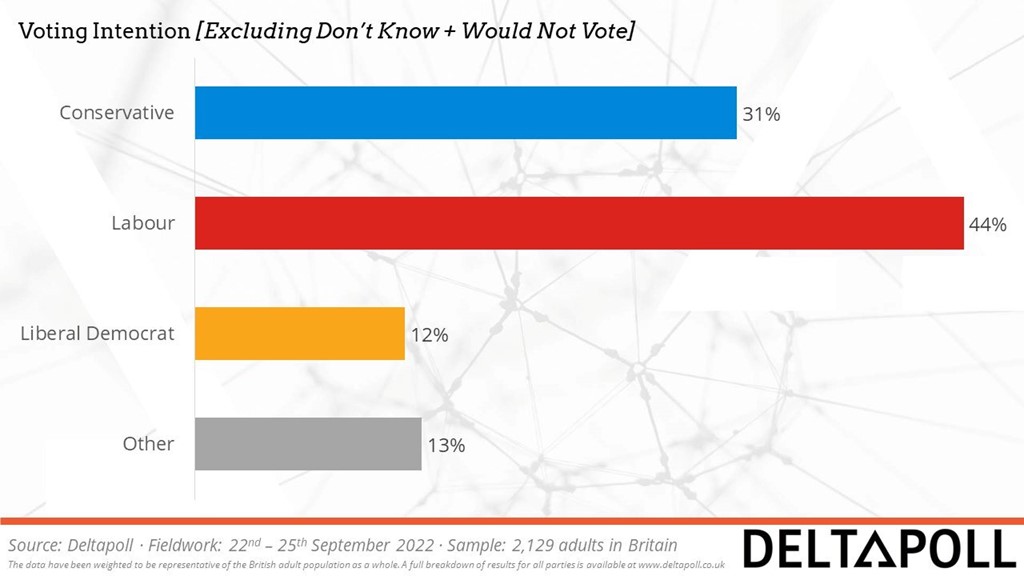
    A new poll from Deltapoll has given Labour a 13-point lead over the Conservatives.

    It comes after a YouGov survey gave Sir Keir Starmer’s party a 17-point lead over the Tories.

    The Deltapoll poll was carried out between Thursday last week and Sunday and asked 2,129 adults across the UK who they would vote for.

    Some 44% said Labour – an increase of two points when compared to the week before.

    A total of 31% said Conservative – a fall of one point.

    The Lib Dems were up two points to 12%, while 13% of people didn’t know – a drop of three points.

  • What can we expect from Starmer’s conference speech?

    The mood at Labour conference turned from cautiously confident to gleeful as shadow ministers toured the drinks receptions last night. 

    A YouGov poll dropped at around 10 pm giving the party a thumping 17-point lead – the biggest for 20 years.

    Of course, it is only one poll, and Sir Keir Starmer’s top team insists they are not complacent about the need to win back people’s trust.

    But some could not resist letting the excitement show, one former minister saying “it feels like the mid-90s” when Tony Blair was two years away from a landslide.

    Many other Labour figures are keenly aware that a lot could happen before the next election in two years’ time, but there is a palpable sense that Labour scent power.

    Rachel Reeves, the shadow chancellor, told the conference that a Labour government “is on its way”.

    Today, Wes Streeting told Sky News that his message to mortgage lenders and worried homeowners is that “the cavalry is coming” – in the shape of a Labour government – at the next election.

    There are big questions about how Labour will finance its plans, given they have pledged to keep the income tax cut announced by Kwasi Kwarteng despite a bleak economic outlook.

    Today’s speech cannot promise huge investments in public services. The message is that Labour is the party of “sound money”, while the Conservatives have squandered that reputation – as the turmoil in the financial markets has demonstrated.

    Also buoying the party is the number of businesses attending and sponsoring events.

    Shadow ministers say they have been inundated with requests for meeting with corporations keen to hear about Labour’s plans.

    After months of hammering Boris Johnson on his personal integrity, Labour insiders say Sir Keir “relishes” the fight on the economy.

    They say he needs to do three things – show the party has changed, interrogate the government’s record, and lay out the country he wants to build.

    If his speech is to hit the mark today, voters will need to believe there is progress on all those fronts in the months ahead.

    DISCLAIMER: Independentghana.com will not be liable for any inaccuracies contained in this article. The views expressed in the article are solely those of the authors’ and do not reflect those of The Independent Ghana

    Source: Sky news