Tag: Constitution

  • Ghanaians’ reluctance to back anti-corruption efforts  a major hindrance – Special Prosecutor

    Ghanaians’ reluctance to back anti-corruption efforts a major hindrance – Special Prosecutor

    The Special Prosecutor, Kissi Agyebeng, has expressed doubts about Ghana’s readiness to fight corruption, citing a lack of collective will to fully support anti-corruption initiatives.

    During the Constitution Day Public Lecture, themed A Few Good Men: Suppressing and Repressing Corruption and State Capture in Aid of Development,” he pointed out the mixed signals in public attitudes toward corruption enforcement.

    He voiced concern that while many Ghanaians agree on the importance of combating corruption, there are groups actively working to undermine the work and authority of the Office of the Special Prosecutor (OSP).

    “There have been attempts to discredit the principles of the office and its officers, unjustly attended by formidable resistance and push back. Often the attacks on the office and its principals are done by persons who are at the short end of investigation or prosecution, and the associates of such persons.

    “The effect of the existential challenge confronting the OSP is that though the nation collectively acknowledges that we must fight corruption, yet there is also a section that the flagship agency designed, even if imperfectly, to fight corruption, is not needed and should be disbanded while others actively undermine it and its principal officers,” he stated.

    Mr Agyebeng pointed out what he referred to as a “curious cycle,” where the public criticizes the OSP regardless of whether it takes action or remains inactive.

    “This has translated into a rather curious cycle; there is an outcry when the OSP acts and an outcry when it is seen as not acting. It is as if we do not know what we want. The situation in Ghana now appears to be like ‘we must fight corruption but we must not fight corruption, that is our state now,” Kissi Agyeben added.

  • 8-member Constitution Review Committee sworn in by Mahama

    8-member Constitution Review Committee sworn in by Mahama

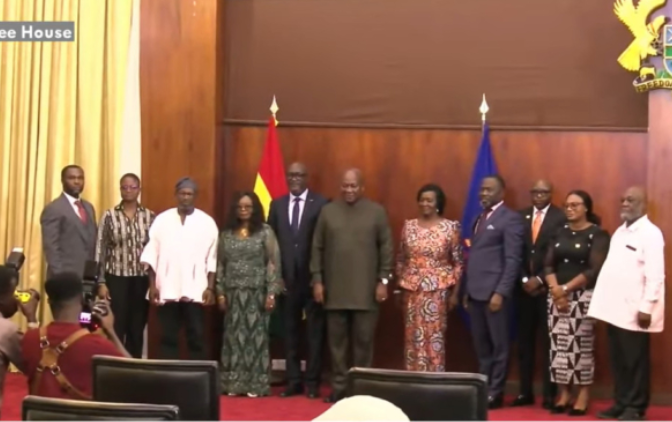
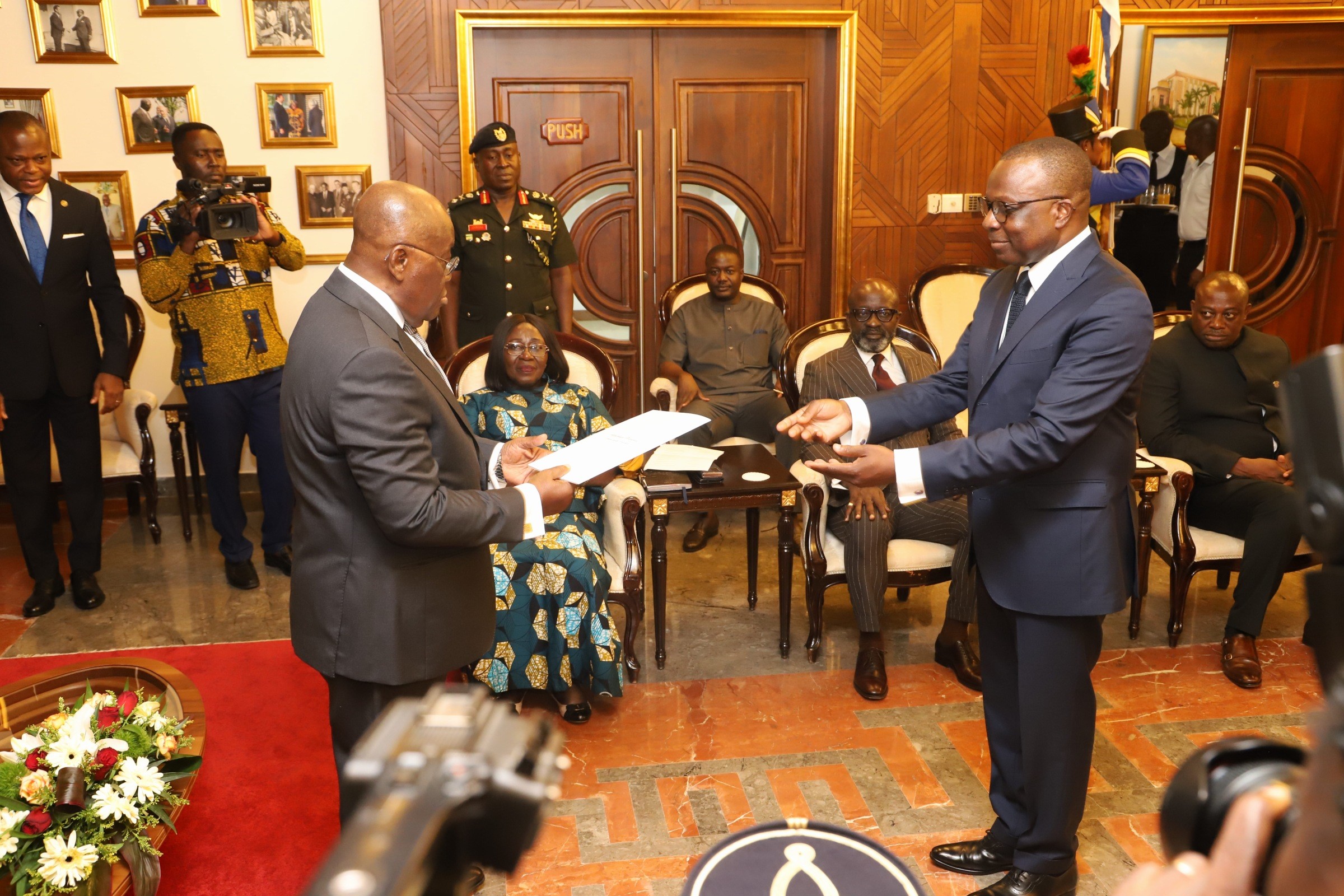
    President John Mahama has officially inaugurated an eight-member committee tasked with reviewing Ghana’s 1992 Constitution, marking a significant step in shaping the country’s democratic future.

    At a ceremony held at Jubilee House on Thursday, Attorney General and Minister of Justice, Dr. Dominic Ayine, emphasized the importance of the committee’s work, highlighting the careful selection of its members.

    “You have been carefully selected for this important work on behalf of our country. The easier part of the job is to follow the prescribed method for altering the constitution. The more challenging aspect, and I can say this without fear of contradiction, is to recommend substantive provisions to add to or replace elements of the current constitution,” he noted.

    President Mahama clarified that the review is not a response to failure but a proactive measure to refine the nation’s governance framework.

    “The call for constitutional reform is not an admission of failure, but an acknowledgment of progress, a recognition that our democracy must be dynamic, responsive, and ever attuned to the needs of our people,” he stated.

    The committee, chaired by legal scholar Prof. H. Kwasi Prempeh, includes Justice Sophia Adinyirah, Prof. Kwame Karikari, Mrs. Charlotte Osei, Dr. Godwin Djokoto, Ibrahim Tanko Amidu, Dr. Esi Ansah, and Dr. Rainer Akumperigeya, who serves as secretary.

    Calls for constitutional reform have been growing, with various stakeholders—including former parliamentarians, the Centre for Democratic Development (CDD-Ghana), and the University Teachers Association of Ghana (UTAG)—advocating for changes to address key governance issues.

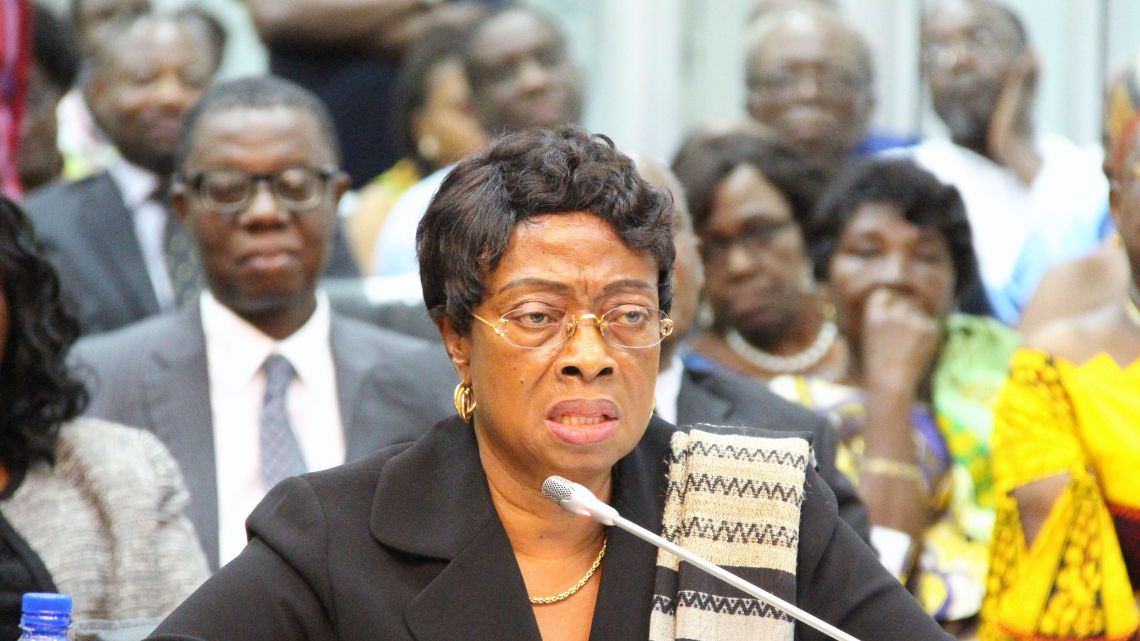
    Dr. Kojo Pumpuni Asante, Director of Policy Engagement and Partnerships at CDD-Ghana, has stressed the need for a multi-stakeholder approach in the review process. Meanwhile, former Chief Justice Sophia Akuffo has specifically called for revising presidential appointment powers, warning that they contribute to an “imperial presidency.”

    With the review process underway, citizens have been urged to participate actively, contributing ideas to shape a governance structure that reflects the evolving needs of the nation

  • Mahama appoints Felix Gyamfi as acting Director-General at National Service Authority

    Mahama appoints Felix Gyamfi as acting Director-General at National Service Authority

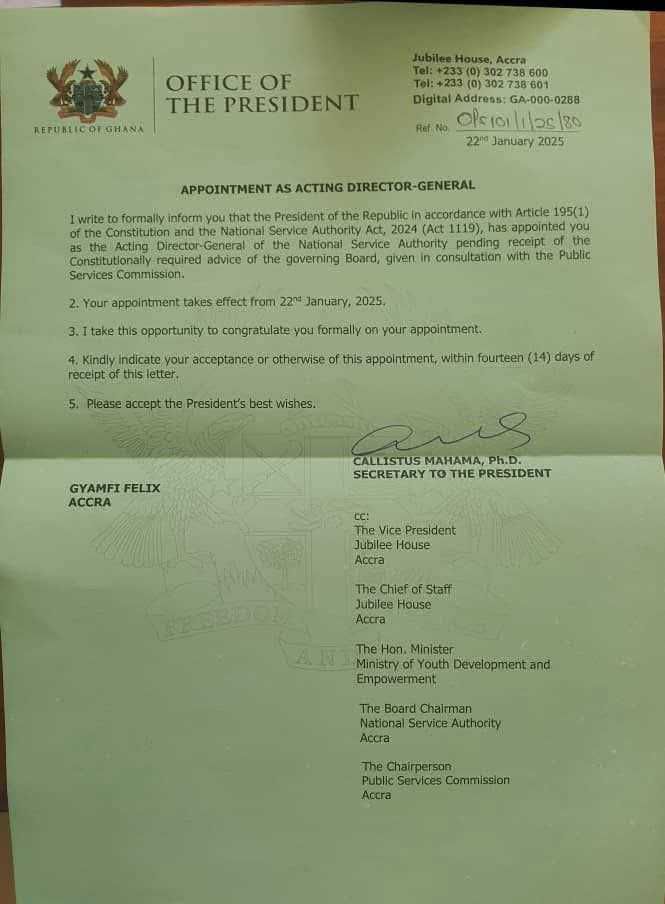
    Felix Gyamfi has been designated as the Acting Director-General of the National Service Authority, effective January 22, 2025.

    The announcement was communicated through an official correspondence signed by Callistus Mahama, Secretary to President John Dramani Mahama.

    The appointment complies with Article 195(1) of the Constitution and the stipulations of the National Service Authority Act, 2024 (Act 1119).

    According to the letter, the appointment is contingent on the constitutionally required recommendation of the Authority’s governing Board, provided in consultation with the Public Services Commission.

    Mr. Gyamfi has been directed to confirm his acceptance of the position within 14 days.

    The National Service Authority is a pivotal institution dedicated to equipping Ghanaian youth with the tools needed for national progress, career readiness, and meaningful service to the nation.

  • The Constitution is not broken, needs to be tweaked and massaged – Sophia Akuffo

    The Constitution is not broken, needs to be tweaked and massaged – Sophia Akuffo

    Former Chief Justice Sophia Akuffo has emphasized the need to regularly review Ghana’s 1992 Constitution, stating it must be “nursed, nurtured, tweaked, and massaged” to stay relevant to modern needs.

    Speaking on Joy News’ PM Express on January 7, she compared the Constitution to a car requiring periodic servicing. “I’ve never agreed with the former president that the Constitution is so perfect that it doesn’t need to be reviewed,” she asserted, highlighting the importance of continuous evaluation.

    Justice Akuffo suggested that after 33 years of guiding Ghana’s democracy, the Constitution should be reassessed to address outdated provisions. “From time to time, we need to take a look to see whether it continues in every respect to suit current-day purposes,” she said.

    She also supported resuming the constitutional review process, which started over a decade ago but was left incomplete. “It’s just unfortunate that it came to an unceremonious pause. We need to take a second look at it. There are certain parts that are not working the way we had anticipated, and there are ways it can be better.”

    Drawing a parallel, she explained, “The reason you take your car frequently and regularly to the workshop to service it is to make sure that, at all times, your car is fixed for your purpose.”

    Justice Akuffo clarified that her call for review did not imply the Constitution was fundamentally flawed. “It’s not a broken Constitution. I fully agree with that,” she noted, while underscoring the need for modernization.

    Her remarks align with former President John Mahama’s recent advocacy for resuming the constitutional review process. “I am fully in agreement with President Mahama that there should be a review. After all, there is nothing wrong with reviewing or revising a Constitution to ensure every provision serves the purposes of the people.”

    Her comments come as Ghana experiences growing calls for constitutional reform, underscoring the importance of collective engagement in refining the nation’s foundational document.

  • We will not attend Parliamentary sessions until December polls are over – NDC MPs

    We will not attend Parliamentary sessions until December polls are over – NDC MPs

    The Member of Parliament for Odododiodoo, Edwin Nii Lante Vanderpuye, has announced that the National Democratic Congress (NDC) minority caucus will not return to Parliament until after the upcoming elections.

    This comes after the majority caucus requested a recall of Parliament, following the Supreme Court’s decision to overturn Speaker Alban Bagbin’s declaration of four seats as vacant.

    On November 12, 2024, the Supreme Court ruled in favor of Majority Leader Alexander Afenyo-Markin’s challenge, striking down Bagbin’s ruling.

    The core issue was Bagbin’s interpretation of Article 97(1)(g) of the Constitution, which he cited to justify the vacant seat declaration.

    Afenyo-Markin argued that the Speaker had overstepped by preventing judicial review and halting by-elections in the affected constituencies.

    While the Speaker contended that legislative matters should not fall under judicial review, the court rejected his stance.

    In a Channel One TV interview, Vanderpuye criticized what he called the “unnecessary spending” by the Majority, stating that the NDC MPs would prioritize election preparations and only return to Parliament after the December elections.

    “They should not waste the taxpayers’ money by asking us to come to Parliament in the next three weeks. We are not coming. We are concerned about elections, and we shall only come to Parliament after the elections. That should be at the back of their minds,” he said in a report by citinewsroom.com.

    He emphasised, “We want them to understand one fact that as far as we are concerned, issues about minority or majority are determined by the numbers in the house, so when we resume, the numbers will tell whether we are the majority, or they are the majority. This is not about the Supreme Court.

    “…It is not for the NPP or the Supreme Court to define for us who are majority or minority in Ghana’s Parliament. We have our own procedures for determining who is a majority or who is a minority. When they were declared majority by Speaker Bagbin, did they go to the Supreme Court to seek that declaration?”

  • Promote democratic values, respect for constitutional order – French Ambassador to Ghana

    Promote democratic values, respect for constitutional order – French Ambassador to Ghana

    The French Ambassador to Ghana, Jules Armand Animbossou, has called on Ghanaians to prioritize democratic values and respect for constitutional order as the December 7, 2024, general elections approach.

    Ambassador Animbossou emphasized that Ghana’s commitment to democracy serves as an example to the region and is essential for the nation’s continued stability.

    Speaking at the Annual Cocktail event with the French business community and the launch of the France-Ghana Economic Report 2023-2024 in Accra, he expressed his hope for a peaceful, transparent, and credible election process. “Ghana is known for being the beacon of democracy in the region and beyond, and it is important that it continues to promote democratic values and respect for constitutional order. I wish Ghana fair and transparent elections,” he said.

    Meanwhile, President Nana Addo Dankwa Akufo-Addo has reiterated his administration’s zero-tolerance policy against any attempts to destabilize Ghana’s democracy. In his final National Best Farmer Awards address, the president underscored his commitment to safeguarding the peace and security of the nation as it prepares for this critical electoral period.

    President Akufo-Addo highlighted Ghana’s longstanding democratic values, noting that maintaining electoral integrity remains a top priority. He reflected on the sacrifices made by previous leaders, civil society groups, and citizens in building Ghana’s stable democracy, which now serves as a model across Africa and beyond. He urged all Ghanaians to protect this legacy.

    “As we approach the 2024 general elections, let me make one thing absolutely clear again. I am unwavering in my commitment to free, fair and transparent elections. Ghana’s democracy is a treasure we have all fought to build and a legacy that must be protected,” he affirmed.

    The president further emphasized that any efforts to disrupt peace or undermine democracy will face legal consequences, asserting, “The sovereign will of the Ghanaian people will be upheld, and any attempts to disrupt the peace or undermine the democratic process will be met with the full weight of the law. Let there be no doubt, that our democracy will remain strong and the people’s choice will prevail.”

  • Minority’s motion to vacate four MPs’ seats baseless – Prof Oquaye

    Minority’s motion to vacate four MPs’ seats baseless – Prof Oquaye

    Former Speaker of Parliament, Professor Aaron Mike Ocquaye, has expressed strong criticism of the Minority in Parliament regarding their push to remove four MPs who are running as independent candidates in the upcoming December elections.

    The Minority is calling for the seats of Agona West MP Cynthia Morrison, Suhum MP Kwadwo Asante, and Amenfi Central MP Peter Yaw Kwakye Ackah to be declared vacant. They are also advocating for the Fomena seat to be declared vacant following the Independent MP’s decision to run under the NPP’s banner for the 2024 elections.

    In an interview with Joy News, Prof. Ocquaye, who himself removed an NPP MP from the chamber under similar circumstances four years ago, asserted that the NDC lacks valid grounds to initiate a motion targeting members of the opposition party.

    “It’s wrong because the benefit is not his [Haruna Iddrisu] the law doesn’t stand to his inurement. That’s why I talked about the husband and wife. He has no locus because he doesn’t belong to the party involved. Is it you who should say there’s a problem in my house?

    “You say I have a problem with my wife and I’m saying I have no problem with my wife, what are you talking about.”

    On Tuesday, Alban Bagbin, the Speaker of Parliament, postponed the ruling on the Minority’s request to declare the seats of four Members of Parliament (MPs) vacant.

    The petition, led by former Minority Leader Haruna Iddrisu, seeks to invoke Article 97 (1)(g) of the Constitution. This article states that an MP must vacate their seat if they abandon the political party under which they were elected or if they choose to remain in Parliament as an independent candidate.

  • Declare seats occupied by MPs running independent vacant – Haruna Iddrisu petitions Bagbin

    Declare seats occupied by MPs running independent vacant – Haruna Iddrisu petitions Bagbin

    The Speaker of Parliament, Alban Bagbin, has received a petition from Haruna Iddrisu, the Member of Parliament for Tamale South, requesting the declaration of four parliamentary seats as vacant.

    The constituencies in question are Agona West, Suhum, Amenfi Central, and Fomena.

    This information was revealed by Alexander Kwamina Afenyo-Markin, the Majority Leader and MP for Effutu, during a session in Parliament on Tuesday, October 15, 2024.

    He noted that he became aware of the petition after receiving a copy of the memo sent to the Speaker by the Tamale South MP.

    “This morning, I got a memo which is addressed to Mr Speaker by the respected Member for Tamale South (Haruna Iddrisu), I got a copy. He has sent a notice of petition to Mr Speaker to declare some seats vacant.

    “He (Haruna Iddrisu) has listed Agona West, Suhum, Amenfi Central, and Fomena. He relies on Order 99 and also anchors the specification of Order 18 and he intends to move the House to consider this matter,” he said.

    The Majority Leader expressed his opposition to the former Minority Leader’s actions and has initiated legal proceedings against them.

    This petition by Haruna Iddrisu follows the filing of nominations by the MPs for Agona West and Suhum, both members of the New Patriotic Party (NPP), who are running as independent candidates in the upcoming 2024 parliamentary elections.

    Additionally, the independent MP for Fomena has submitted his nomination to contest the elections under the NPP ticket, while the Amenfi Central MP, representing the National Democratic Congress (NDC), has also filed to run as an independent candidate.

    Article 97 [1(g) & (h)] of the 1992 Constitution states that “a member of Parliament shall vacate his seat in Parliament if he leaves the party of which he was a member at the time of his election to Parliament to join another party or seeks to remain in Parliament as an independent member; or if he was elected a member of Parliament as an independent candidate and joins a political party.”


  • Defects in Ghana’s Constitution undermine democracy, it needs reform – Bagbin

    Defects in Ghana’s Constitution undermine democracy, it needs reform – Bagbin

    Speaker of Parliament Alban Sumana Kingsford Bagbin has stressed the importance of reforming Ghana’s 1992 Constitution, citing its limitations and challenges.

    Drawing from Afrobarometer’s 2024 report, Bagbin highlighted the growing disillusionment among Ghanaian youth with democracy, warning of the potential threats this poses to the nation’s stability.

    He pointed out that the constitution’s heavy concentration of power in the executive disrupts the balance among the branches of government, hampering democratic governance.

    While the constitution has played a key role in maintaining political stability, Bagbin argued it has also impeded Ghana’s broader development.

    Bagbin made these remarks during the University of Ghana Alumni Lecture in Accra, where he spoke on the theme, “30 Years of Parliamentary Democracy: The Journey Thus Far.”

    “The focus of the first brains behind drafting this constitution was to achieve political stability. If my guess is right, I must admit we have succeeded in doing just that at the expense of development. We now have to move on to focus on development. I don’t need to call on, but we must take up a constitutional transformation.”

    “I agree with Ghanaians who say that there is nothing to reform. We have to transform everything. This constitution has many defects and the time to fix those defects has been long overdue.

    “While the defects are too many, I will just highlight three of them that have impacted the work of parliament. One is the excessive executive power,” he stated.

  • Govt to spend about GHS500m on addressing drought in Northern Ghana

    Govt to spend about GHS500m on addressing drought in Northern Ghana

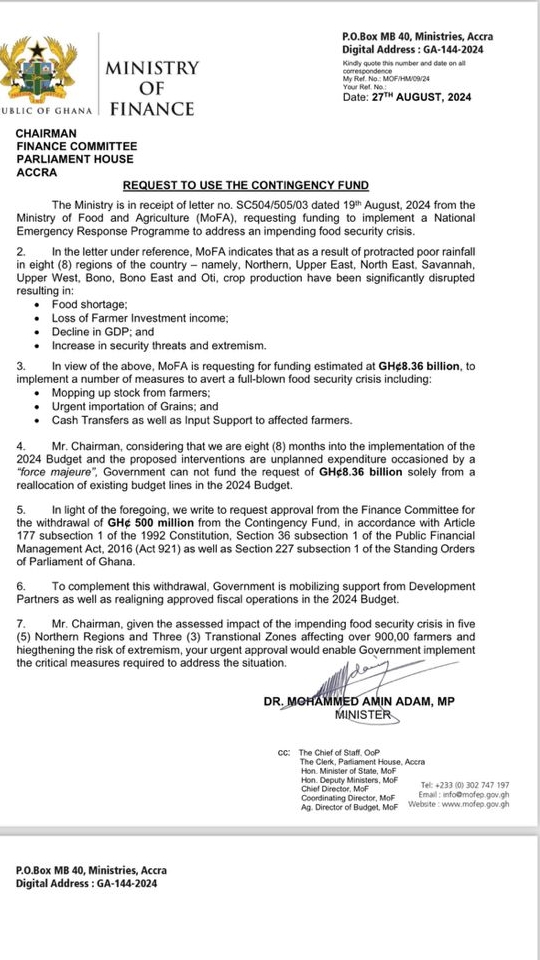
    At the Mid-Year Budget Review, Finance Minister, Dr. Mohammed Amin Adam sought Parliament’s approval to withdraw GH₵500 million from the Contingency Fund.

    This request is part of the government’s emergency response to the looming food insecurity crisis, driven by a severe dry spell affecting eight regions of Ghana.

    The appeal comes shortly after President Akufo-Addo directed the Finance Ministry to secure an GH₵8 billion relief package to support farmers severely impacted by the ongoing drought.

    In a letter to Parliament’s Finance Committee, Dr. Amin Adam explained that with only four months left in the fiscal year, the unplanned nature of the GH₵8.36 billion expenditure, due to “force majeure,” makes it impossible to fully cover this amount through reallocations within the existing 2024 Budget.

    Consequently, he requested the Finance Committee’s approval to withdraw GH₵500 million from the Contingency Fund, citing constitutional and legislative provisions, including Article 177(1) of the 1992 Constitution, Section 36(1) of the Public Financial Management Act, 2016 (Act 921), and Section 227(1) of Parliament’s Standing Orders.

    This sum will be supplemented by additional resources mobilized from Development Partners and by realigning certain aspects of the 2024 Budget.

    The Ministry emphasized that the National Emergency Response Programme, supported by these funds, will enable the government to implement critical measures to mitigate the crisis.

    In a letter to Parliament’s Finance Committee, the Minister indicated that “considering that we are eight (8) months into the implementation of the 2024 Budget and the proposed interventions are unplanned expenditure occasioned by a “force majeure”, Government cannot fund the request of GH¢8.36 billion solely from a reallocation of existing budget lines in the 2024 Budget.”

    In response to the situation, the government has already imposed an immediate ban on the export of key grains such as maize, rice, and soybeans.

    During an August 26 press briefing, the Minister for Food and Agriculture, Bryan Acheampong, stressed that this ban is necessary to ensure the availability of these essential crops on the domestic market.

    This decision follows alarming reports indicating that 435,872 farmers have already suffered losses estimated at GH₵3.5 billion due to the prolonged dry conditions.

  • Number of ministers should be capped at 25 – Constitutional Review Consultative Committee

    Number of ministers should be capped at 25 – Constitutional Review Consultative Committee

    The Constitutional Review Consultative Committee, established by the Minister of Parliamentary Affairs, Osei Kyei-Mensah-Bonsu, has made a series of significant recommendations aimed at reforming the executive and legislative branches of the Ghanaian government.

    Led by lawyer Clare Kasser-Tee, the committee was tasked with reviewing the 2011 report of the Constitution Review Commission.

    One of the committee’s notable recommendations is capping the number of ministers at 25. In recent years, Ghana has seen a high number of ministers, with the current administration under President Nana Addo Dankwa Akufo-Addo reaching as many as 110 ministers.

    Main candidates in the 2024 presidential election have promised to significantly reduce this number, with former President John Mahama proposing 60 ministers and Vice President Mahamudu Bawumia suggesting 50.

    Additionally, the committee proposed that the President of Ghana should pay taxes. This recommendation, if implemented, would reflect the principle of equality before the law and align with the rule of law. Currently, Article 68(5) of the constitution exempts the president from paying income tax. The committee suggests amending this article so that the president pays taxes on his salary and emoluments, setting an example for the rest of the citizenry. This change would also require consequential amendments to the country’s income tax law.

    The committee also recommended the abolition of Deputy Minister positions. Furthermore, it suggested that ministers should not be Members of Parliament, diverging from the current constitutional mandate that requires the majority of ministers to be lawmakers.

    Another key recommendation is to cap the size of Parliament at 277 members. The proposed amendment to Article 93 of the Constitution states, “There shall be a Parliament of Ghana which shall consist of not more than two hundred and seventy-seven elected members.”

    These recommendations were presented to Osei Kyei-Mensah-Bonsu on June 13, 2024, for preliminary suggestions or firm resolve for the review of the 1992 Constitution. The event, themed “Building consensus and promoting ownership for the review of the Constitution,” was organized by the Ministry of Parliamentary Affairs.

    The committee’s mandate included reviewing submissions, proposals, and reports from various constitutional review platforms, including the Kwame Nkrumah University of Science and Technology (KNUST), the Institute of Economic Affairs (IEA), the University of Ghana Law School, the University of Professional Studies (UPSA), and the Ghana Institute of Management and Public Administration (GIMPA).

    Additionally, the committee is tasked with making recommendations to the Ministry of Parliamentary Affairs and its partners and collaborators, including the National Commission on Civic Education (NCCE), Africa Centre for Economic Transformation (ACET), Centre for Democratic Development (CDD), Institute of Democratic and Economic Governance (IDEG), and the National Development Planning Commission (NDPC), among others.

    The proposed reforms aim to enhance the efficiency and effectiveness of Ghana’s governance structures, promoting accountability, and ensuring a more streamlined and representative government.

  • EC advances Constitutional procedures enabling November elections

    EC advances Constitutional procedures enabling November elections

    Electoral Commission (EC) has revealed that over 50 percent of political parties have given their nod to the proposal for holding this year’s presidential and parliamentary elections in November, as opposed to the usual December schedule.

    During an Inter-Party Advisory Committee (IPAC) meeting on Monday, January 29, the National Democratic Congress (NDC) and some other political parties, including those opposing the change, expressed reservations about the proposed time frame. The NDC, particularly, raised concerns about the feasibility of organizing a smooth election within the suggested schedule.

    While the NDC opposed the proposal, the governing New Patriotic Party (NPP) has not yet made a final decision on the matter.

    Dr. Edward Omane Boamah, the Director of Elections and ICT for the NDC, urged caution on the part of the EC. He emphasized that considering the extensive tasks that the EC needs to accomplish between now and the upcoming elections, taking on the proposed schedule might overwhelm the commission.

    “As an institution, if it wanted to add the needed parliamentary processes to change the date for the elections, it’s something that we all discussed, and we are all men and women of faith. So we take issues of religion seriously, and we felt that it’s something that should be subjected to a broader national discussion so that all shades of opinion can be factored into it for the appropriate decision to be taken.

    “And with all that said, for the election day being a holiday, we felt it is not really necessary but if others think it must be done, even though we have too many holidays in the year, if others feel it must be done, it can be considered,” he said.

    Mr. Boamah urged the EC to stick to the current date for the general elections, emphasising that the EC could have pushed these reforms in the previous years and not in an election year.

    Speaking in an interview, the Deputy Chairman of the EC in charge of Corporate Services, Dr Bossman Asare stated that this new timeline will allow the election management body to easily mobilise for a runoff in case the polls end this year with no clear winner in the first round of elections.

    According to him, based on what transpired at the IPAC meeting on Monday, the majority of the political parties were supportive of the change of the dates from December to November and expressed their view that if it would be possible for the EC to be able to implement it this year, that will be good.

    Dr. Asare, however, stated that most of the parties suggested that if the EC is unable to implement the process this year, then it should begin in 2028.

    “So in principle, all the parties that attended IPAC yesterday were for it for 2028. But for 2024, almost about 60% of the parties, more than half of the parties, said if it will be possible for the EC to go through the legal processes to have it implemented this year, let’s go ahead,” he said.

    Reacting to whether the EC would be able to come through on all the legal requirements and changes to be able to hold the elections in November, the EC Deputy Chairman said “Yes, very much so. Looking at our calendar, we are pretty sure that we will be able to do everything, whatever it takes to ensure that we go through the legal process.”

    He clarified that the EC is not the final determinant, but the implementation has to go through the Attorney General, to the parliamentary system before it will be approved.

    “But as I said, as far as we are concerned, whatever we need to do, whatever is necessary, whatever is proper that must be done to ensure that we are able to consummate it and have the elections, we are well able to do that,” Dr Asare said.

  • Pervasive public sector corruption cause of Ghana’s poor state – Afari-Gyan

    Pervasive public sector corruption cause of Ghana’s poor state – Afari-Gyan

    Former Electoral Commissioner of Ghana, Dr Kwadwo Afari-Gyan, has drawn attention to the deeply rooted issue of pervasive public sector corruption as a primary contributor to the country’s current challenges. 

    In a candid assessment, Afari-Gyan expressed concern over the detrimental impact of corruption on Ghana’s development, emphasizing the urgent need for comprehensive anti-corruption measures.

    Afari-Gyan, a respected figure in Ghana’s political landscape, made these remarks during a recent public forum on Ghana’s Constitution Day marked on January 8, 2024. 

    He underscored how corruption has become a significant impediment to progress, hindering the effective utilization of resources and eroding public trust in government institutions.

    “Over the years, we have become poorer as a nation and as a people due mainly to pervasive corruption, particularly in the public sector and public life. Unfortunately, some of our key institutions are becoming institutions of dubious integrity,” he remarked.

    The former Electoral Commissioner urged both the government and citizens to collectively address the issue, emphasizing that combating corruption requires a united front. He called for the enforcement of existing anti-corruption laws, the establishment of robust accountability mechanisms, and the promotion of a culture of integrity within public institutions.

    Afari-Gyan’s remarks come at a crucial time for Ghana as the country grapples with economic challenges, infrastructural deficiencies, and public dissatisfaction. He stressed that addressing corruption is not only a moral imperative but also essential for fostering an environment conducive to sustainable development.

    “Some people will say that these are perceived and not real ailments of our democracy, but that doesn’t change the picture at all because for purposes of trust and confidence in public institutions and public office holders, perception is as important as reality,” Dr. Afari-Gyan emphasized.

    Highlighting the obstacles at hand, Dr. Afari-Gyan acknowledged the increasing demands for constitutional amendments. However, he recognized the time-consuming nature of the process required for such modifications. Dr. Afari-Gyan emphasized the crucial role of public trust in sustaining a robust democracy amid the existing challenges.

  • Ghana’s constitution: Akuapem Twi version launched

    Ghana’s constitution: Akuapem Twi version launched


    The Akwapem Twi version of Ghana’s Constitution has been launched in Accra with a call on Ghanaians to do away with linguistic imperialism.

    The 1992 Constitution in Akuapem Twi, the first of its kind in the history of Ghana, was done by Kwasi Opare, a distinguished lawyer. It took him eight years to translate the national legal document from English to Akuapem Twi.

    The translation captures all the preamble, the entire 26 chapters and two schedules. It has also adopted transliteration and the use of neologism, using Akan spellings.

    Speaking at the launch, Professor Kofi Agyekum, Acting Dean, School of Performing Arts, University of Ghana (UG), noted that although Ghanaians were proud to have attained independence in 1957, the country was still under linguistic bondage because of linguistic imperialism.

    The former head of Linguistics, UG, described linguistic imperialism as “phenomenon in which the minds and lives of the speakers of a language are dominated by another language to the point where they believe that they can and should use only that foreign language.”

    He noted that linguistic imperialism had compelled the country to have all its official documents in the colonial master’s language.

    “Sadly, our constitution, the pillar of our undertaking as a state, is also in English. Where is our identity and cultural heritage then?” He quizzed.

    He therefore urged citizens to safeguard, protect and document Ghana’s languages for future generations.

    “We should not allow linguistic imperialism to thrive. It will trample on our linguistic human rights. Let us embark on active language decolonization through translation like this one,” he stressed

    Prof. Agyekum lauded Kwasi Opare, “who dreamt so big towards language decolonization to translate the 1992 constitution into Akuapem Twi.”

    According to him, countries such as Brazil, Bolivia, South Africa, and Tanzania had taken the lead by translating their national constitution into some indigenous languages.

    He said the translation of the Constitution in Akuapem Twi would not pose any problems for Akan speakers and readers, saying the national legal document was user-friendly and would be useful in various homes.

    Prof. Agyekum noted that “our indigenous Ghanaian language can serve us all in diverse ways of life if we are anxious to develop it to the maximum.

    Akan was being used in education, media, arts and culture, religion, commerce and trade, and ICT, he said.

    Prof. Agyekum therefore called on chiefs and traditional authorities to be very proud of their cultural identity and the work done by Mr Kwasi Opare. “Elsewhere, this huge translation project should have been a national project and the same was sponsored by the state.”

    He appealed to traditional authorities to take a keen interest in Ghana’s indigenous languages in forms of communication.

    “It would be lovely to listen to speeches delivered by our kings, chiefs and queen mothers in our indigenous languages. This will implant the love of our mother tongue into current and future generations.

    If we do not start to cherish and use our mother tongue now, and all of us are interested in foreign languages at the expense of our own, it will be chaotic. We will be on the path of language shift, language attrition, language loss and finally language death.”

    Prof. Agyekum said: “to avoid such a catastrophic situation, let us maintain our languages and cultures through the translation and publication of essential documents like the 1992 Constitution, a Ghanaian Bible of a sort.”


    During the launch event, Nana Ansah Kwaw IV, Chief of Adumasa, praised Kwasi Opare for his remarkable achievement and urged the National Commission on Civic Education to coordinate a widespread unveiling of the Akuapem Twi Constitution.

    Mr. Kwasi Opare, the translator, emphasised that this national legal document would facilitate a better understanding and appreciation of the law among all citizens.

    Mr. Opare also expressed his appreciation for the significant role played by the late Appenteng Sackey, a former lecturer at the University of Ghana, whose efforts contributed to the introduction of the Constitution in Akuapem Twi.

    The initial copies of the Constitution in Akuapem Twi were made available for purchase at a cost of GHC 2,000.

  • 2,000 workers needed to replace retirees – Dr Adams government

    2,000 workers needed to replace retirees – Dr Adams government

    The Department of Parks and Gardens’ Chief Horticultural Officer, Dr. Daniel Kingsford Adams, has stated that his organization needs roughly 2,000 new employees to become lively once more.

    He explained the human resources dilemma as being caused by the staff’s impending retirement of 90% of the workforce over the next five years.

    However, he pointed out that despite the department receiving ten new hires, the personnel size is still insufficient.

    Among other challenges of the Department of Parks and Gardens, Dr Adams further stated that, “Since I took over last year, the ministry, through the effort of the sector minister, Dan Botwe, provided us with new vehicles, including two big trucks, a Landcruiser Prado, a tractor, two pickups and working machines. Other than that, the department had no vehicles.”

    “We have also been provided with about 10 workers but we need a staff strength of about 2,000 to make the department vibrant once again,” he said.

    The 1992 Constitution and Section 12 of PNDCL 327, which specifies the duties, are where the department derives its authority, according to a story in the Daily Graphic.

    The department’s responsibility is to maintain the horticultural vegetation that lines the median and shoulders of all national roadways.

  • More jobs to be created through  ‘wee’ cultivation in Ghana – Nana Agyemang

    More jobs to be created through ‘wee’ cultivation in Ghana – Nana Agyemang

    The Chief Executive Officer of the Hempire Association of Ghana, Nana Kweku Agyemang, has praised the House’s decision on the passage of the Narcotics Control Commission Bill 2023 on Wednesday, July 12, 2023, which permits the production of cannabis for industrial reasons.

    For the numerous young people who are unemployed in the nation, he claims that the large-scale industrial cultivation of cannabis will produce both direct and indirect jobs.

    On Wednesday, July 12, 2023, Mr. Agyemang stated on TV3’s News 360 that the passage of the measure will also aid in raking in substantial sums of money for the nation through the taxation of this product.

    He emphasized that the industrialisation of cannabis in Ghana would improve the local economy.

    Mr Agyemang said, “What we are looking at is tens of thousands of direct jobs and indirect jobs across the country, it is something that we need. We have graduates who are leaving the universities and they are being told there are no jobs for them, they should go and fend for themselves but the establishment of this industry is something that could pull in their resources and the knowledge they have learned in the universities.”

    “It is also great for the economy because now, the government of Ghana can have something whereby they will generate revenue internally from the taxes. If you look at other countries and what those governments have been making from the taxes alone, it has been huge, humongous,” he stated.

    The Narcotics Control Commission Amendment Bill 2023 was passed by Parliament on July 12, 2023, and it made significant modifications to the industrial and medical cultivation of cannabis.

    The modified measure gives the Ministry of Interior the power to award permits for cannabis growing.

    This action follows a judgment by the Supreme Court in July 2022, which nullified Section 43 of the measure because there was insufficient parliamentary discussion before it was passed into law.

    The 1992 Constitution’s Article 106(5) and (6) were declared to be violated by the court in a 4-3 majority judgment.

    The repealed clause had previously permitted the Minister to issue licenses for the growing of cannabis, or “wee” as it is known in Ghana, with a THC content that did not exceed 0.3% on a dry weight basis.

    The cultivation of cannabis for industrial purposes is prohibited by the 1961 Single Convention on Narcotic Drugs, save for the production of fiber and seed.

    Another cannabis plant species, Cannabis indica, has unique chemical properties and applications.

    Numerous commercial and industrial products, including food, ropes, fabrics, paper, plastics, composite materials, building materials, jewelry, cosmetics, and biofuels, are made from hemp.

  • Mali junta to hold vote on new constitution

    Mali junta to hold vote on new constitution

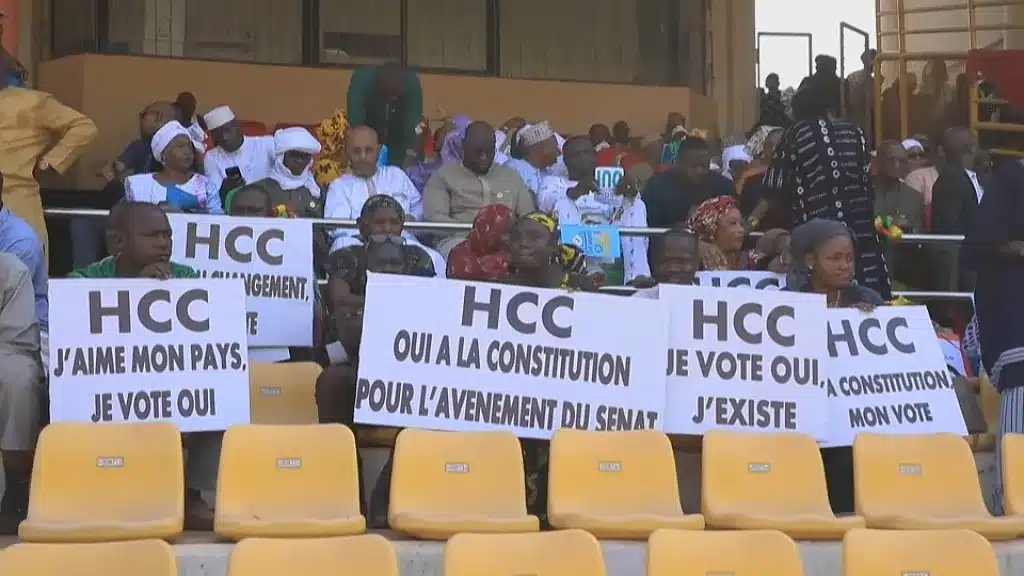
    On Sunday June 18, 2023, Malians will participate in the polls to express their verdict on the constitution proposed by the governing junta, raising speculation about the potential candidacy of the country’s authoritarian leader.

    The vote is the first organized by the military since it seized power in August 2020 of a country gripped for years by a political, security and economic crisis.

    Those problems remain largely unresolved, meaning the vote could be disrupted.

    It is a checkpoint on the road to a return of civilian rule in March 2024, under commitments made by the military itself.

    Boris Johnson fury as committee finds he ‘deliberately misled’ MPs

    But less than nine months before the deadline, Mali has no clarity on the future role of the military, including junta leader Colonel Assimi Goita.

    Malians will vote on the draft constitution from 0800 GMT on Sunday, with green ballots for the “yes” vote and red for “no”.

    The results are expected within 72 hours.

    The authorities have invested heavily in the reform.

    Jihadist groups continue to carry out bloody attacks on civilians and the military

    It purports to fix the country’s current constitution, enacted in 1992 and often blamed for Mali’s problems.

    The large Sahel nation faces jihadist violence, poverty, derelict infrastructure and decaying schools.

    If approved, the new constitution would strengthen the position of the military, emphasizing “sovereignty”, the junta’s mantra since coming to power and its subsequent break with the former colonial power France.

    Presidential power boost

    Above all, it strengthens the powers of the president, while also providing for an amnesty for those who carried out coups before it was enacted.

    It has fuelled persistent speculation that Goita will run for president, despite promises by the military rulers that he will not stand.

    The reform has drawn wide-ranging opposition, from former rebels and imams to political opponents.

    Influential religious organizations oppose the continuation of secularism enshrined in the current constitution.

    In the north, former rebels who, unlike the jihadists, signed a major peace deal with the state also reject it.

    Some political elites are unhappy with the strengthening of the executive around the president.

    Sidi Toure, spokesman for the Party for National Rebirth (Parena), described a “personalisation of power, a personality cult”.

    “If a new constitution is put in place, it must redress these excesses, balance the powers instead of concentrating them in the hands of the president alone.”

    “The draft constitution was made by the Malians,” the junta leader said at a campaign rally Tuesday, adding that the text was “the result of work by consensus”.

    Security concerns

    Beyond the legitimacy of the text, the issue of the vote itself is at stake.

    Mali’s future is uncertain, with no clarity on the future role of the military, including junta leader Colonel Assimi Goita.

    Voters could face jihadist violence in the north and center, where groups continue to carry out bloody attacks on civilians and the military.

    “Mali has more urgent challenges, we must rally Malians for the war against terrorism, for the war against poverty,” Toure said.

    One researcher, who like many others spoke on condition of anonymity, argued the old constitution was satisfactory.

    “The problem with the 1992 constitution is that it was never really applied… it cannot be the cause of the crisis,” the researcher said.

    Turnout is widely expected to be low.

    “Generally, Malians do not vote. Since 1992, turnout has rarely exceeded 30 percent,” said political scientist Abdoul Sogodogo.

    Observers say a vote for “yes” is almost certain.

    “Malians say that presidents from democratic regimes did not necessarily shine. Corruption has reached a certain level. People want to see something else,” said Brema Ely Dicko, a sociologist at Bamako University.

    Supporters of the reform are betting on the strong popularity of Goita and the so-called transitional authorities.

    “Some actors present this referendum as support for the transition,” said Sogodogo, the political scientist.

    “That means that the debate on the content is obscured.”
  • Make post-secondary degree a criteria for becoming MP – Afenyo-Markin

    Make post-secondary degree a criteria for becoming MP – Afenyo-Markin

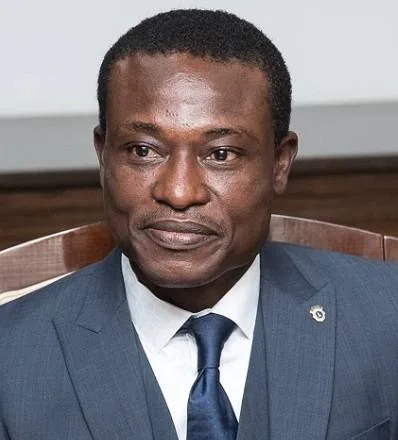
    Alexander Afenyo-Markin, the deputy majority leader, has called for a review of Article 94 of the 1992 constitution in order to make post-secondary education a requirement for individuals seeking to become member of Parliament.

    The constitutional provision specifies, among other things, the standards by which someone can be regarded as qualified for or disqualified from serving as a member of Parliament.

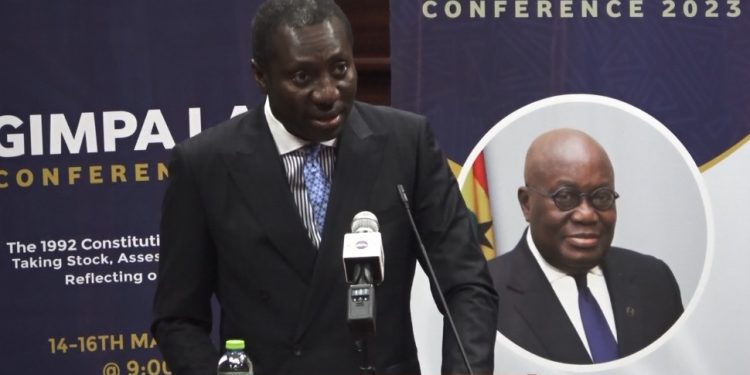
    Speaking at the 2023 GIMPA Law Conference, Afenyo-Markin, noted that the public has been critical of many happenings in Parliament including debates which occur on the floor.

    He believes that making post-secondary education a criterion for entering Parliament will ensure improvement in the quality of persons who get to be Members of Parliament.

    “We have often heard the members of the public talking about the quality of debates and sometimes our grammar is marked, our reasoning powers are questioned and I agree. It is fair. It is part of your bona fide as critical observers…looking at or interrogating what we do in the Chamber. For that purpose, I think that it wouldn’t be far-reaching to suggest perhaps that Article 94 be looked at.

    “Maybe not talking about university degrees….first degree as a minimum qualification, but we can look at post-secondary education. Somebody may have some post-secondary education which may not even be a tertiary training but would have gathered some experience. We may have to look at that all aimed at ensuring that those who enter Parliament have the necessary capacity to do that,” Afenyo-Markin said.

  • Ghana to partner with IPU, others to fight intolerance and promote diversity – Bagbin

    Ghana to partner with IPU, others to fight intolerance and promote diversity – Bagbin

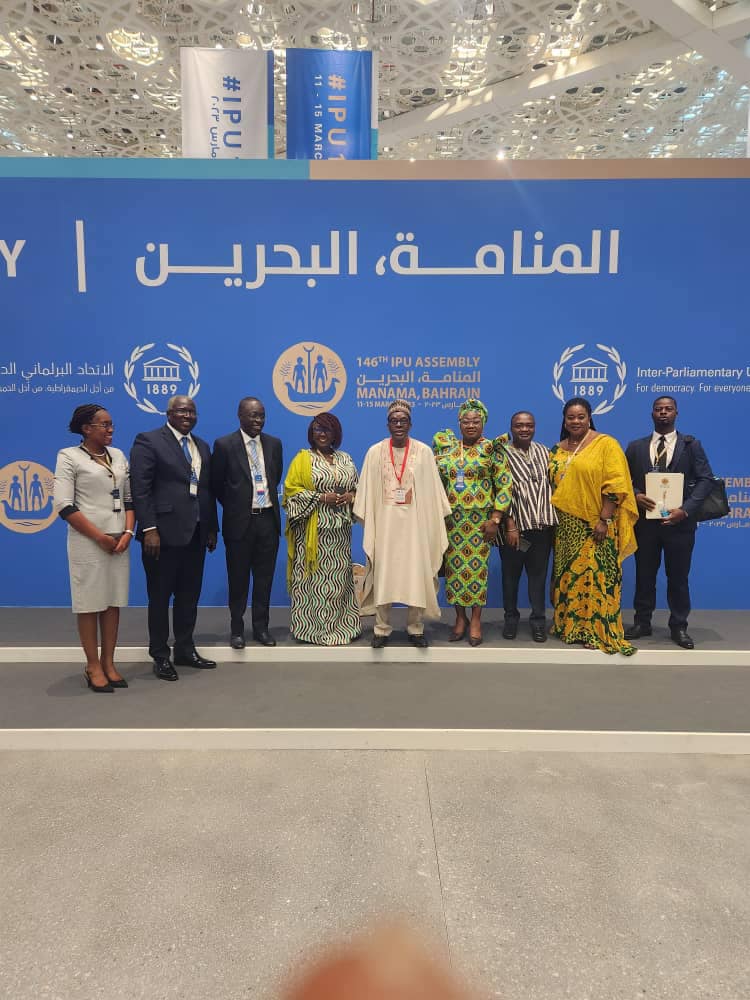
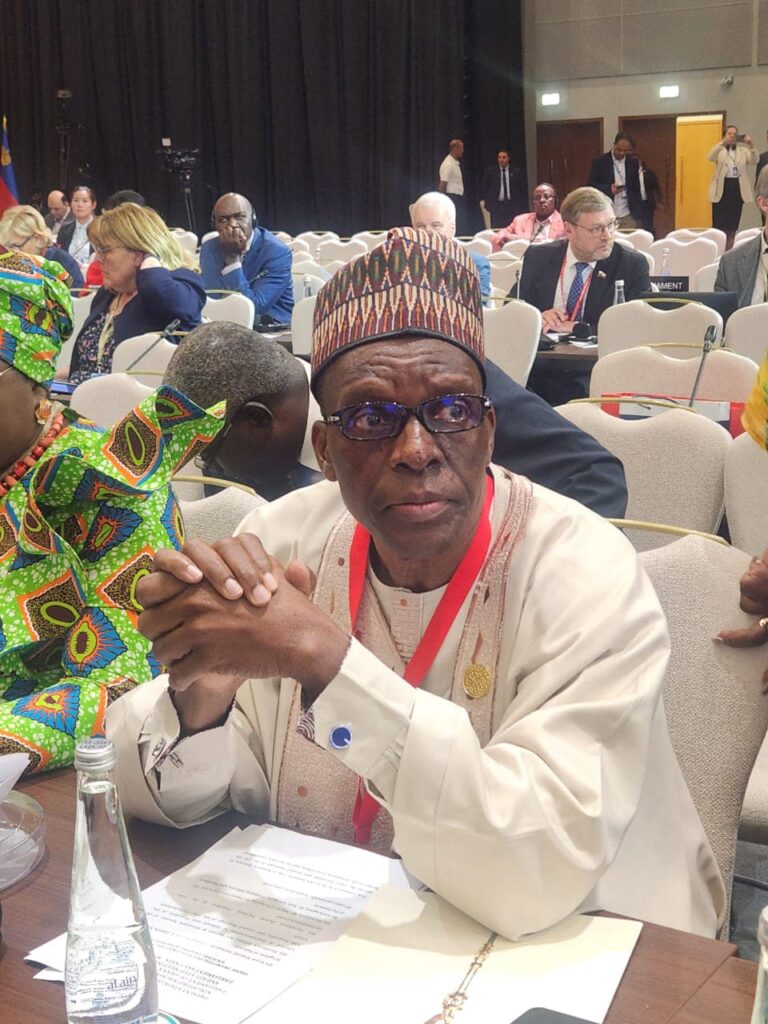
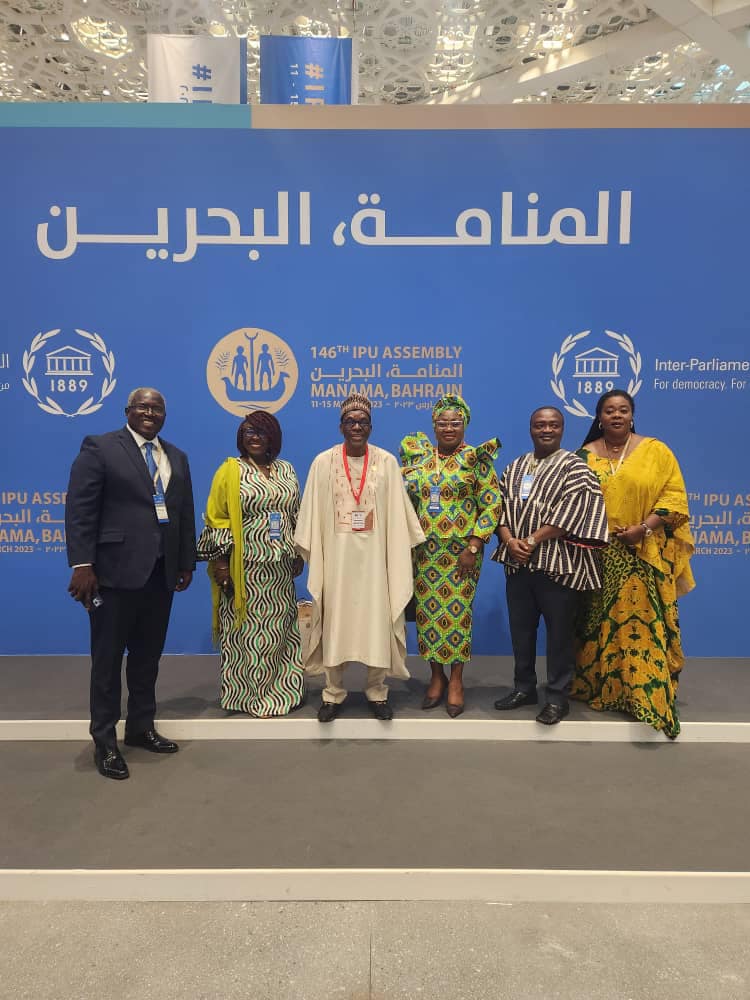
    The Speaker of parliament, Rt Hon Alban Sumana Kingsford Bagbin, has assured of the nation’s commitment to collaborate with the Inter-Parliamentary Union (IPU) to fight intolerance and promote peaceful co-existence in societies.

    According to him, this is the only sure way for the world to know true peace and prosperity.

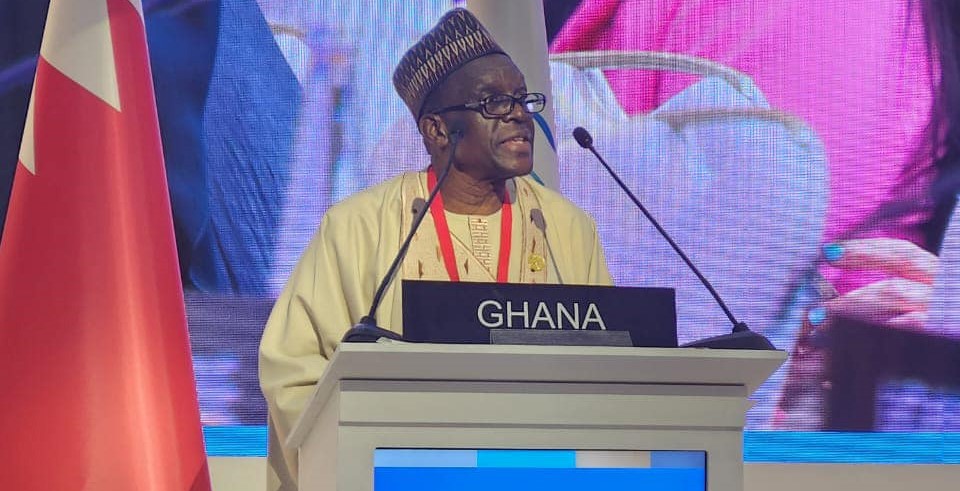
    In a speech at the ongoing 146th IPU Assembly in Manama, Bahrain, on Monday, March 13, 2022, the Speaker touted the values of good democratic governance, which the Ghanaian parliament is translating for the utmost benefit of its people.

    Explaining further, Speaker Alban Bagbin said this is evident in the large gender parity delegation the Ghanaian parliament sent to the conference to further the course of the theme and humanity as a whole.

    “The IPU can rely on the Parliament of Ghana to achieve the theme of this Assembly. The Parliament,of Ghana will partner with the IPU and all members to fight intolerance and promote peaceful co-existence and inclusive societies. The Parliament of Ghana is translating the values and principles of good democratic governance into concrete benefits for the people,” he said.

    “This explains why a large gender parity delegation of four ladies, four men, three of whom are from government and three from the opposition, led by the Speaker from Ghana, is here to work with the IPU and its members to craft out resolutions that will further the course of the theme and humanity as a whole,” he added.

    Rt Hon Bagbin also added charged legislators worldwide to encourage tolerance and inclusive development through the laws they promulgate.

    “As legislators, it behoves on us to encourage tolerance and inclusive development through the laws we make and, particularly, through the tools of our oversight of the Executive to ensure that our respective countries are set on the paths of peace, security and sustainability. We have to commit ourselves to holding governments of our countries to contain corruption, eliminate waste, ignorance and greed. This is the smooth road to building fair, just and prosperous societies.”

    He also noted to participants and the world at large to be mindful of the need to co-exist.

    “We must, therefore, not only learn to co-exist in peace, but we must also work to promote inclusive growth and development by consciously working to prop up the development of the least developed nations. Underdevelopment and poverty are some of the main drivers of intolerance, such as xenophobia, terrorism, conflicts, etc.”

    Some 2,700 delegates drawn from more than 179 countries across the globe have gathered in the Kingdom of Bahrain for the conference under the theme, “Promoting peaceful co-existence and inclusive societies: Fighting intolerance.”

  • Muslim leaders call for a vote against the newly proposed constitution

    Muslim leaders call for a vote against the newly proposed constitution

    On Tuesday, a significant group of Mali’s religious leaders urged their followers to oppose a new constitution that would uphold the country’s junta’s commitment to secularism.

    Mali’s proposed constitutional amendment is intended to allow the West African country to transition back to civilian governance from military authority.

    The plebiscite for the new constitution was initially slated for March 19, but the junta has not commented on the timeline due to growing skepticism about the day.

    Elections that would result in the return of civilian control will be held in February 2024, according to the junta’s stated agenda.

    A constitutional draft received by junta leader Colonel Assimi Goita late last month stated an “attachment to the republican form and to the secularism of the state”.

    “Secularism is not opposed to religion and to beliefs,” the drafts says, adding its aim was to “promote and reinforce living together based on tolerance, dialogue and mutual understanding”.

    But the Mali League of Imams and Scholars for Islamic Solidarity called Tuesday for the “removal of pure and simple of the word” secularism and for it to be replaced with “multi-confessional state”.

    It called on all “patriotic Muslims” to vote against the draft constitution in its current form.

    Mali is a Muslim-majority country.

  • 1992 Constitution must be reviewed immediately  – Sophia Akuffo

    1992 Constitution must be reviewed immediately – Sophia Akuffo

    A former Chief Justice, Sophia Akuffo, stated that while Ghana’s present Constitution has served the nation well, a revision is long required.

    She made the observation in an interview where she expressed her views about the freedoms that the 1992 Constitution gave to citizens.

    “Nobody tells me what to think, except God and nobody can tell me what to do with my time and what to say about anything going on in this country,” he said reacting to her recent decision to join an anti-government picketing event.

    “Thank God we have a constitution, flawed though it might be, but at least the right to say what I want to say and the freedom of conscience, that’s mine and nobody will trample on it however influential they are,” she said.

    She also told host of the Upfront programme on Joy News earlier his week that a constitutional review was long overdue, positing that it should have been implemented incrementally over the years to make it a stronger guiding document.

    In her opinion, the 1992 Constitution and how it was birthed should have given Ghana the perfect grounds to build successive governance architectures but that has not been the case.

    Asked in an interview with Joy News (February 15) whether she was disappointed in the current New Patriotic Party (NPP) government, the former CJ said: “I have been disappointed with every single government we have had under this (1992) constitution…

    “… because after all that we went through with the military and everything and we centered the constitution as guiding principle, at least constitutionalism should have been what should have been guiding us.

    “But we have eroded so many standards, principles. It is not only the NPP government, a far as I am concerned, every government has failed us,” she emphasized.

    Evolution of Ghana’s Fourth Republic

    President John Agyekum Kufuor completed his second term in office in 2009 having taken office in 2000 from late Jerry John Rawlings. It was Rawlings who kick started the Fourth Republic in 1993, serving two terms till 2001.

    The election to replace Kufuor was a two-horse race between Nana Addo Dankwa Akufo-Addo and late John Evans Atta-Mills. The latter contesting for the third consecutive time beat Akufo-Addo in a runoff vote.

    Mills died while in office paving the way for his then Vice President John Dramani Mahama to become president. Mahama won the 2012 polls but lost his re-election bid to Akufo-Addo in 2016.

    Akufo-Addo beat him in 2020 with both men seeking re-election, that is their final terms in office.

  • Akufo-Addo delivers SONA on February 28

    Akufo-Addo delivers SONA on February 28

    The State of the Nation Address (SONA) will be delivered by President Akufo-Addo in Parliament on February 28, 2023.

    The address will be done pursuant to Article 67 of the 1992 Constitution.

    President Akufo-Addo will be expected to present his plans for the next 2 years of his governance.

    This includes government programs and what strategies the government intends to implement, how to achieve them, and also how to rally the people of Ghana towards accelerated national development and progress among others.

    This was revealed by the Majority Leader when he presented the business statement for the third week ending February 24.

  • Possible violation of National Constitution – Haruna Iddrisu on DDE

    Possible violation of National Constitution – Haruna Iddrisu on DDE

    Leader of the Minority in Parliament, Haruna Iddrisu, has revealed that his side of the House is working to subject the debt exchange programme to legal scrutiny.

    Speaking to the media, he noted that Finance Minister Ken Ofori-Atta may have breached Article 181(5) of the Constitution, which requires the government to seek approval from Parliament before announcing any haircut on all
    government bonds, loans, and instruments.

    “We are even beginning to elevate this matter to a legal constitutional matter as to whether or not the Minister of Finance, suo moto, by himself as an individual can undo what the sovereign Parliament of Ghana has done pursuant to Article 181(5) of the constitution,” he said.

    “All those loans, all those bonds, all those instruments whose terms and conditions were approved by Parliament, including the debt of domestic bonds, contractual relationships have been entered into. How can the Finance Minister allocate to himself the mandate to do this even without providing information to Parliament or with its prior approval?” he questioned.

    Article 181(5) of the 1992 Constitution requires that all international business or economic transactions to which
    the government is a party must be laid before Parliament for approval
    before they can come into effect.

    Mr Iddrisu, therefore, urged the government to halt ongoing processes related to its debt exchange program, which is intended to keep the country from defaulting on its debt.

    At a press conference on Monday, Mr Iddrisu noted that there is “total confusion, rejection, and disapproval of the initiative” since it was launched by Finance Minister
    Ken Ofori-Atta in December last year.

    According to him, the opposition is justified since the programme poses a major risk to financial institutions, insurance companies, as well as individual bondholders who have recently been included in the programme.

    “The programme will exacerbate the already perilous financial sector that we have in Ghana,” he added.

    The Tamale South legislator, therefore, said, “We in the NDC, the Minority group, call on President Nana Addo Dankwa Akufo-Addo to immediately suspend the ongoing debt exchange programme.”

    In an attempt to secure a deal with the International Monetary Fund (IMF), the government has proposed that all bondholders will not receive any interest in 2023.

    As per government estimates, dividends will begin to be paid next year, in 2024, at a discounted rate of 5%. Due to this, bondholders who wish to transfer their bonds will not be able to get back their full principal.

    The proposal, however, has been rejected by many bondholders since its announcement. Their view is that if the proposal is implemented, they will suffer a great deal of loss, and some may even lose money on their investments.

    The Minority’s call seeks to add to the numerous voices urging the government to restrain from implementing the debt exchange programme. Mr Haruna Iddrisu believes that unemployment will heighten and support for the private sector will dwindle if the programme is implemented in its current state.

    In the meantime, the government has extended the deadline for the domestic debt exchange programme to January 31, 2022. This is the fourth time the government has extended its deadline, and according to the Finance Ministry, the programme has been suspended yet again due to “pending further stakeholder engagement with institutional and individual investors.”

  • Ashanti Region: Man sues Ghana police over alleged unlawful arrest

    Ashanti Region: Man sues Ghana police over alleged unlawful arrest

    The head of the Huahi Royal Family of Boadi in the Ashanti Region has filed a suit against the Inspector General of Police (IGP) over his unlawful arrest by officers of the Ghana Police Service.

    According to him, before his release, he was humiliated, subjected to torture and embarrassed at a palace instead of being processed for court.

    “In my case, following my arrest on 18th November, 2021, the police failed, neglected or refused to caution or charge me for any offence but rather subjected me to torture, physical assault and humiliation on my personality and dignity.

    “That I am advised by counsel and I respectfully concur with the advice that the police has no right, power or authority to arrest, restrict or detain a suspect without officially cautioning or charging him, and that any such arrest, restriction or detention contrary to the rules and procedures enshrined in the Constitution amounts to flagrant disregard for the Constitution and a breach of the constitutionally guaranteed rights of the suspect,” the plaintiff stated in his application.

    It is the case of the plaintiff that by this act, the police officers violated his right to personal liberty, human dignity, right against unlawful arrest, detention or restriction and torture, as well as right to administrative fairness.

    The plaintiff added that despite a petition to the Police Service to interrogate the matter, no concrete solutions had been reached, hence the suit.

    Reliefs

    Badu is asking the court to declare as unconstitutional his arrest, adding that the police violated his fundamental human rights guaranteed under the 1992 Constitution. As part of his reliefs, he asks for the following:

    “An order directed at the respondents to pay me an amount of GH¢500,000 as compensation for my unlawful arrest and restriction pursuant to Article 14(5) of the 1992 Constitution.”

    “An order directed at the respondents to compensate the applicant for the inconvenience, embarrassment, waste of time and violation of his fundamental human rights to dignity and administrative justice to a tune of GHC500,000.”

    He is also asking for an order perpetually restraining the respondents, particularly all police officers involved in the misconduct under the authority of the respondent, from unlawfully arresting, restricting and/or detaining him ever again.

  • One Minister, one Deputy is what we need now – Kwabena Agyepong

    One Minister, one Deputy is what we need now – Kwabena Agyepong

    In the midst of the current economic crisis, Mr. Kwabena Agyei Agyepong , a flagbearer candidate for the New Patriotic Party (NPP), has reinforced calls on the Government to cut the number of ministers in order to give a good message to the populace.

    He denounced the appointments of multiple deputy ministers, saying each minister should not have more than one deputy to reduce the cost of running the Government and enhance efficiency.

    Speaking on a news programme monitored by the Ghana News Agency, Mr. Agyepong said the framers of the 1992 Constitution did not envisage larger Governments, hence their decision to peg the number of cabinet ministers at 19.

    “I have never believed in having multiple deputy ministers. I think the President has one Vice President, so every minister should have one deputy.

    “Small, lean, mean Government means that you are going to be efficient, more effective and the President will have a handle of his Government. It is important that we do these things, especially in financial distress,” he said.

    President Nana Addo Dankwa Akufo-Addo, at the beginning of his second term in office in 2017, trimmed down the number of ministries in his second administration from 36 to 29 and scrapped 41 ministerial positions.

    The President had appointed 126 ministers in his first term.

    With Ghana’s economy taking a nosedive, there have been persistent calls on the President to further downsize his Government to reduce costs.

    Mr. Agyepong said the scrapping of more ministerial positions would send a positive signal to the people about the Government’s readiness to sacrifice.

    “The quantum may not be enough, but it sends a moral message and signal to the rest of the people,” he said.

    Mr. Agyepong said the political class must demonstrate sacrifice and selflessness to win the trust of the people and rally them to develop the country.

    “It is all about service, sacrifice, and selflessness. If you don’t have these character traits, you don’t have any business going into politics,” he said.

    Mr. Agyepong said governance and development issues that had bedevilled the country could not be blamed on the Constitution but on bad leadership.

    He bemoaned what he described as the lack of patriotism and readiness to serve among the political class and the people at large, saying: “We need the kind of leaders that are prepared to take difficult decisions and so that all of us will be doing what is right; putting our country first before everything.”

  • State has primary responsibility to fight corruption — CHRAJ

    Mr. Richard A. Quayson, Deputy Commissioner, Commission on Human Rights and Administrative Justice (CHRAJ) has stated that the State has the primary responsibility to fight corruption and make its practice a high risk.

    He added that the conversation on corruption should start with the Directive Principle of State Policy that dealt specifically with corruption and Chapter 24 of the Constitution.

    He said Article 34 (8) mandated the State to play the leading role in the fight against corruption.

    Mr. Quayson was speaking at the 2022 International Anti-Corruption Day Symposium organised by the commission which was on the topic: “Curbing Corruption through a Rigorous Conduct of Public Officers Law: The Perspective of CHRAJ”.

    The CHRAJ Deputy Commissioner deduced that corruption was a system that thrives where effective preventative and enforcement systems are lacking.

    He said the Code of Conduct (COC) for Public Officers can only be effective to curb corruption in Public Office when “we have in place a framework that delegates authority for implementation, compliance, enforcement, and sanctioning powers to specified integrity agency or agencies, which have in place rules, policies and procedures for inter-agency cooperation”.

    It is, therefore, important that all prohibited unethical conduct was adequately defined so officials know what behaviors are prohibited and what constitutes violations, and which agency is responsible for enforcing compliance, as well as prevention and detection systems, he said.

    Mr. Quayson noted that the lack of clarity in these and other areas corruption to thrive while handicapping institutions responsible for prevention and detection.

    It also lowers the credibility of the Public Office and the Government as a whole and erodes the trust that people want to have in public institutions and the Government.

    The CHRAJ Deputy Commissioner said equally important was that the range of sanctions and penalties for breaches of the Code are proportionate, dissuasive, and effective, stressing “we should not use a Code of Conduct law to criminalize conduct”.

    Mr. Quayson said findings from the 2021 Ghana Integrity of Public Services Survey (GIPSS) revealed that corruption was still rife in Public Service, stressing that public trust appears to continue to diminish.

    He said the findings reveal that a greater proportion of adults in Ghana have more confidence in religious and traditional justice systems relative to the formal one.

    He said data from the GIPSS survey indicates that seven in every 10 representing 69.9 percent of adults hold the view that the religious and traditional leaders’ system effectively protected the rights of every citizen, a figure that was 10.8 percentage points higher than those who agreed that the formal justice system effectively protects the rights of every citizen 59.1 percent.

    “This, obviously, should not be allowed to continue, and the ball is now in our court,” stressing that the public does not demand that public servants should be angels.

    Mr. Quayson said their revulsion is with the unruly manner we appear to manage their interests and their scarce resources, adding “it may not always be the case, but appearances and perception alone can create disaffection and erode public confidence in public service”.

    He said “the Government and Public Service owe it to the people in whose name and on whose behalf, we exercise the powers of the State to put our house in order and restore confidence and hope to our people”.

  • Minority reintroduces motion for vote of censure against Health Minister

    The minority has reintroduced a motion to kick out the health minister, Kwaku Agyeman-Manu over his involvement in the Sputnik-V vaccines procurement scandal.

    The private members on the motion, according to the Parliament’s Order Paper, are James Avedzi, Mubarak Muntaka, Ahmed Ibrahim, and others.

    The motion was filed against the minister on the following conduct;

    1. Undertaking International Business or Economic Transaction (procurement and supply of vaccines) as Minister for Health with the Private Office of His Highness Sheik Ahmed Dalmook Al Maktoum without prior approval of Parliament contrary to article 181 of the 1992 Constitution of the Republic of Ghana;

    2. Signing Procurement Agreement with the Private Office of His Highness Sheik Ahmed Dalmook Al Maktoum and S.L. Global Ltd without prior approval of the Board of the Public Procurement Authority under sections 40 and 41 of the Public Procurement Act, 2003 (Act 663) as amended by Act 914 which constitutes Criminal Offence under the law;

    3. Dishonest Procurement of Sputnik-V vaccines from the Private Office of His Highness Sheik Ahmed Dalmook Al Maktoum and S.L. Global Ltd at the cost of US$ 19.00 and US$18.5 respectively when the ex-factory price of the Sputnik-V vaccine generally announced was US$10 confirmed by the Minister to the Committee responsible for Health.

    4. Knowingly procuring Sputnik-V vaccine from the Private Office of His Highness Sheik Ahmed Dalmook Al Maktoum and S.L. Global Ltd at the cost of US$19.00 and US$18.5 respectively per dose. Nevertheless, informs the Committee responsible for Health that the ex-factory price of the Sputnik- V does not exceed US$10.00 per dose;

    5.Causing payment in the sum of US$2,850,000.00 (Cedi the equivalent of GH$16,331,640.00) to the Private Office of His Highness Sheik Ahmed Dalmook Al Maktoum under void agreement with the Private Office of His Highness Sheik
    Ahmed Dalmook Al Maktoum, yet fibbed and misrepresented to the Ad Hoc Committee on Oath that no payment was made under the Agreement to the Private Office of His Highness Sheik Ahmed Dalmook Al Maktoum and thereby committing a crime, to wit perjury; and

    6.The above conduct, being in direct breach of the Constitution and Laws passed by this Honourable House, the Minister for Health be removed from office as Minister by a Vote of Censure passed in accordance with article 82 of the 1992 Constitution.

  • Ofori-Atta likely to face ’empty’ Parliament on budget day

    GhanaWeb has gathered that Ken Ofori-Atta, the embattled Finance Minister, will be meeting an empty Parliament when he appears on November 24, to read the 2023 budget statement.

    According to sources, both majority and minority MPs are likely not to be present on the day of the budget presentation, which will make it impossible for the minister to present the budget to the House because there will be a lack of quorum as required by the Constitution.

    Ken Ofori-Atta had already indicated that he was going to present the budget despite some NPP MPs and the Minority MPs wanting him out of office.

    The minister after facing censure committee on Friday told an Accra-based Joy News that Ghanaians should expect him to present the budget on November 24.

    When he was quizzed by journalists that will he go to Parliament to present the 2023 budget, he responded, “yeah, expect so. That seems to be a weird question.”

    Ken Ofori-Atta further stated that he has not heard officially that some NPP MPs have indicated boycotting his budget presentation.

    “I don’t know; I haven’t heard that officially…,” Ofori-Atta stressed.

    The 98 NPP MPs insist that they will boycott the budget presentation if the minister appears before the House.

    “We’ve gone back to (our demand for the President to) sack him now and therefore should the budget be presented under the stamp of the Finance Minister, we’ll not participate because as far as we’re concerned we’re never going to do business with him,”

    The Asante Akim North MP further explained on JoyNews’ PM Express programme on Tuesday, November 15, 2022, that they will only participate in the budget presentation and appropriation if the President appoints someone else other than Ken Ofori-Atta to present the budget.

    “We’re not saying we won’t do the President’s business. We’re saying we won’t do President’s business through Ofori-Atta. So if anybody else comes with President’s business, we’ll participate,” Appiah-Kubi said.

  • Martin Kpebu is a full NDC member, the party sponsored his demo – Abronye alleges

    The Bono Regional Chairman of the ruling New Patriotic Party (NPP), Kwame Baffoe, a.k.a. Abronye DC, has alleged that renowned legal practitioner Martin Kpebu, who has been calling for President Nana Addo Dankwa Akufo-Addo to step down, is a member of the opposition National Democratic Congress (NDC).

    Abronye DC alleged that Kpebu was given money by the NDC to organise his recent NanaMustGo (Kume Preko Reloaded) demonstration to get President Nana Addo Dankwa Akufo-Addo to step down for his poor management of Ghana’s economy.

    Speaking in a Neat FM interview monitored by GhanaWeb, Abronye added that Kpebu, who claims to be incorruptible, refused to give the other organisers of the demonstration their share of the funds given to them by the NDC.

    “The call for the president to step down is a call by the NDC. Because under the Constitution if the president steps down automatically the Speaker (of Parliament) becomes president for the next 3 months.

    “Martin Kpebu, who is known to be an NDC member, is the one championing this course. He is a full member of the NPP… He is doing this (call for Akufo-Addo to step down) for the NDC. He went for the budget for this demonstration from the NDC – they gave him everything. He should come and swear that it is not the NDC who gave him the money for the demonstration,” he said in Twi.

    “He even stole all the money given to him by the NDC. He refused to give the other organisers their share. You (Kpebu) are saying that people are corrupt, but you refuse to give the other organisers of the demonstrations what is due them,” he added.


  • Minority leadership whips its 136 MPs for vote of censure on November 10

    Parliament will this week give effect to the vote of censure filed by NDC MPs in the House to determine the fate of Finance Minister, Ken Ofori-Atta.

    The debate and vote on the censure motion will be taken on Thursday 10th November, 2022 following the expiration of the seven-day notice mandated by the Constitution.

    Speaking to Journalists, Deputy Minority Whip, Ahmed Ibrahim said all NDC MPs have been instructed not to miss sittings in order to get the required number to carry out their objective, thus removing the Finance Minister, Ken Ofori-Atta from office.

    According to Mr. Ibrahim, there would be consequences if a member fails to show up.

    “The Minority Chief Whip, Muntaka Mubarak has sounded a note of caution to all Minority MPs that all the 136 MPs must be in the chamber on Thursday, so any member who absents himself on Thursday is at his own risk…On Thursday, whether we want Ken Ofori-Atta to be impeached or censored, the opportunity is being given to us,” he said.

    According to him, the Finance Minister will also be allowed to defend himself on the same day.

    For the vote of censure to succeed, 183 MPs must vote for it. With the Minority having only 136 MPs, 46 NPP MPs must join them.

    Mr. Ahmed Ibrahim believes the NPP MPs will not back down on their calls to get the Finance Minister sacked.

    “Whether the Majority is going to walk the talk to make sure that the motion that they staged, they still stand by it, is over to them. But I strongly believe that per the information and signals I am picking this morning, they are still going to walk the talk,” he said.

    The Banda MP said it is important to remove Mr. Ofori-Atta now before the economic situation worsens. He urged the Finance Minister to step down before the vote of censure.

  • Alban Bagbin pushes for continuous education of MPs on parliamentary tacts

    The Speaker of Parliament, Alban Bagbin, has underscored the need for members of the house to be educated on how motions are couched.

    This comes after an objection raised by the Deputy Majority Leader, Alexander Afenyo Markin against a motion of vote of censure on the Finance Minister, Ken Ofori-Atta.

    “We need to sit together, dialogue and exchange views on the constitution and standing orders for the practice and procedures of the house”, he said.

    Alban Bagbin, further pushed the improvement of knowledge of members on the procedures of the house.

    “Beyond that, we have the rulings of speakers and literature on the laws and customs of Parliament. The fact that the concept of democracy has remained the say of separation of powers and checks and balances, we need to have continuous education of these matters for us to play our role well.”

    On Thursday, Alexander Afenyo-Markin raised an objection to a motion of a vote of censure filed against the Finance Minister, Ken Ofori-Atta.

    The Minority in Parliament had filed the vote of censure against the Finance Minister citing seven reasons which include conflict of interest and fiscal recklessness leading to the sharp depreciation of the Ghana Cedi.

    But speaking on the floor of Parliament, Mr. Afenyo-Markin argued that the reasons given by the Minority were unjustified, adding that the Minister of Finance has not been heard on the allegations.

    “If you go through our order paper in this House, clearly committees bring reports, we submit applications and motions are advertised on their own. So a motion for a censure against the Finance Minister…Mr. Speaker, we should not forget that we are in a political space. The Minister has been condemned long before he is heard. The respondent in this application has been condemned with allegations, not facts. We all want a fair hearing.”


  • Mahama explains why NDC could not submit pink sheets in the 2020 election petition

    For the first time, former President John Dramani Mahama has opened up about why he and the National Democratic Congress (NDC) could not provide the needed evidence to make their case in the 2020 election petition.

    On December 30, 2022, the former president dragged the Electoral Commission led by Jean Mensa (1st Respondent) and Akufo-Addo (2nd Respondent) to the apex court over the 2020 presidential elections on an allegation that the results announced by the EC were not the accurate results.

    The petition details “serious violations of the 1992 Constitution by the Electoral Commission and its Chairperson and Returning Officer for the Presidential Election, Mrs. Jean Adukwei Mensa in the conduct of their constitutional and legal responsibility.”

    The petitioner sought, among others, a declaration from the Supreme Court to the effect that “the purported declaration of the results of the 2020 Presidential Election on December 9 2020, is unconstitutional, null and void and of no effect whatsoever.”

    But the seven-member panel of the Supreme Court on March 4, 2021, held that the petition filed by former President John Dramani Mahama was unmeritorious and unanimously dismissed all other applications moved by the petitioner, including two reviews.

    Speaking in a VOA interview monitored by GhanaWeb, John Dramani Mahama intimated that NDC could not make its case because the pink sheets used by the EC to record the election results did not make room for the people to be verified before they could vote.

    “In the last elections, a lot of things went wrong. On the pink sheets that we record the results, they did not make allowance for the number of people biometrically registered.

    “And that is why when we went to court, and they said, why don’t you bring your pink sheet? It would have been useless because you bring the pink sheet, and there is no recording of the number of people verified.

    “It is only when you have that recording which must match up with the number of ballots in the box (that you can make a case). And so, if the Electoral Commission gives you a form that does not make provision for the people verified then what is the need for us to put our figures in the verification machine,” he said.

    The former president further stated that most of the challenges in the 2020 elections have still not been resolved.

    He added that the NDC has taken a cue from what happened in the 2020 election and has decided to go into the next election with its “own referrer”.


  • My clients are not guilty – NPP’s Freddie Blay defends Aisha Hung’s accomplices

    The immediate past national chairman of the governing New Patriotic Party (NPP), Mr Freddie Blay, has expressed shock at the backlash he and his firm has received because of their decision to defend some foreign nationals standing trial for alleged illegal mining offences.

    Law firm Blay and Associates is the law firm defending the four accomplices of En Huang, popularly known as Aisha Huang, who has been charged with the others for engaging in illegal mining activities in Ghana.

    The decision of Mr Blay’s firm to defend these foreign nationals, when his party and government is battling an ongoing galamsey menace has raised eyebrows but the astute lawyer in a radio interview said every accused person is entitled to legal representation.

    Mr Blay who is a stalwart of the NPP due to his immediate past position says it is rather unfortunate that he has been subjected to attacks.

    Speaking to Joy FM on Wednesday, October 12, Mr Blay said, “My clients are not guilty; we’ve sworn an oath to defend them.

    They came to instruct us and we as professionals, we have sworn an oath to defend our clients to the best of our knowledge and ability and that is exactly what we are doing in accordance with the Constitution of this country.

    “They are not guilty. They’ve been brought before the court, they’ve pleaded not guilty and are being defended,” Mr Blay said as quoted by Graphiconline.

    According to him, the four accused persons may have a relationship with Aisha Huang because in 2017 they bought a supermarket from her.

    Meanwhile, the Attorney-General, Godfred Dame has assured Ghanaians that his outfit will not relent in its effort to prosecute all illegal miners in the country, adding that, for Aisha Huang, who has gained notoriety for the galamsey trade she will pay for both her past and present offences.

    Godfred Dame was speaking to the press after the now-famous galamsey kingpin Aisha Huang was denied bail on Tuesday, October 11.

    “In respect of Aisha Huang, we have filed most of the documents we will rely on. We have filed witness statements with four witnesses, we need about four more. But the Judge in her discretion decided to adjourn to 24th October for us to come and conduct the case management conference and we are ready to conduct the trial on a day by day basis and the Judge has also indicated the inclination to conduct the trial in that manner. So we are happy with the progress of the matter. And it is important to indicate to the world our full commitment to prosecute all these illegal mining offences. It is something that is of utmost importance to the nation.”

    Aisha Huang, a Chinese national, previously deported/repatriated for dealing in illegal mining in 2018 was re-arrested this year.

    She is currently standing trial with three other Chinese nationals for mining without a license and engaging in the sale and purchase of minerals.

    All three were remanded into the custody of the National Investigation Bureau pending the final determination of their case.

  • Establish a debt limit in the constitution to control borrowing – Dr. Atuahene

    Banking and Corporate Governance Consultant, Dr. Richmond Akwasi Atuahene, has urged Parliament to place a cap on borrowing in the constitution.

    This he believes will prevent the borrowing spree that has led the country into the economic quagmire it finds itself in.

    According to him, the failure to quickly establish a debt limit would result in the current situation repeating itself over and over again in the future.

    Speaking on JoyNews’ PM Express, Dr. Atuahene said it is about time Ghana followed in the steps of Kenya and Germany by establishing a debt limit.

    “But let me finally say this. In the long term, we need to put a debt limit in the constitution. As you were saying, Kenya has now done it, 50%, you cannot go more than that because we keep on going and going and going and then we come back.

    “I believe the people who look at the constitution who said the constitution doesn’t need to be amended let me assure them German has it, even Americans who borrow and over borrow they have set a debt cap. Unfortunately for Ghana, this one will borrow and borrow and borrow,” he said.

    He further bemoaned the failure of successive governments to use borrowed money to expand and provide sustainable infrastructure to support the Ghanaian economy.

    He noted that most often borrowed monies are used to pay compensations instead of being invested into productive ventures that may earn the country foreign exchange.

    This he says must be avoided at all cost.

    “But if you borrow and you don’t even put in some strategic investment that will work to pay itself, I’m sorry we’ll have this argument, this discussion the next 20 years, the next 40 years because our infrastructure cannot even support the expansion of the economy, but we keep on saying that we’re building the economy,” he said.

    He added, “If you borrow to consume then you’re going to have this challenge that we have. Because it is a country that we don’t want to borrow to expand the infrastructure or the system that will bring the foreign exchange or bring the currency. But if you borrow to support some payment and what have you, refinancing, at the end of it all we’re going to have a problem.”

  • President approves promotion for 25 top prison officers

    President Akufo-Addo, has approved the promotion of 25 senior prisons officers in the Ghana Prisons Service (GPS).

    The decision is in accordance with Article 207(3) of the 1992 Constitution.

    Out of the 25, four Deputy Directors of Prisons (DDP) have been promoted to Directors of Prisons (DOP), while 21 Assistant Directors of Prisons (ADP) have been moved to the positions of Deputy Directors of Prisons (DDP).

    The four new DOPs are Samuel Kwame Owusu-Amposah, formerly the Eastern Regional Commander; Benedict Bob-Dery, formerly the Bono Regional Commander; Gloria Essandoh, until this promotion, the Chief Legal Officer, and Joana Fofo Tackie-Otoo, who until now was the Greater Accra Regional Commander of Prisons and Commandant of the Prisons Officers Training School.

    The remaining 21 ADPs who have been moved to Deputy Director of Prisons (DDP) are Brandford Gilbert Hama, Daniel Boi-Tawiah Abbey, William Kular, Emmanuel Aidoo, David Ofosu-Addo, Millicent Owusu and Francis Selorm Hagbe.

    The others are Nathaniel N. Agyeman Onyinah, Sophia Osei-Bonsu, Thompson Otyokpo, Eric Ainoo Ansah, Edward Ashun, Paul Teye Ademan and Edmund Ahia Armah.

    The rest are Joseph Asabre,  Issaku Yahaya, Alfred M. Cudjoe, Augustine Ohene-Tutu,  Samuel Fiifi Dontoh, Christiana Asiedu (Mrs), and  Christopher Hayibor.

    Meanwhile, the Director-General of Prisons, Mr Isaac Egyir, has congratulated all the newly promoted officers on their new positions and reminded them that promotions came with higher responsibilities.

    “All must therefore ensure that these promotions will be brought to bear on your performances,” a press statement issued in Accra and signed by the Chief Public Relations Officer of the GPS, Chief Superintendent of Prisons Courage Atsem, concluded.

    Source: Ghanaian Times

  • Current constitution doesnt meet needs of Ghanaians Agyemang-Duah

    A governance expert, Professor Baffuor Agyemang-Duah, has pointed out why the current Constitution does not fully serve the interest of Ghanaians.

    According to him, the current Supreme law of the land concentrates power in the political class instead of vesting these powers in the people.

    His comments were captured on TV3’s major news bulletin on Thursday, April 28, hours after President Akufo-Addo had delivered his address on the 30th anniversary of the referendum that births the Fourth Republic.

    ”In my humble opinion [the Constitution] does not meet the needs of the people,” the one-time Senior United Nations Nations official stressed.

    He explained further: “For a constitution to meet the basic needs of the people that constitution should be seen in action at the grassroots level. Democracy is best when it emerges from the bottom to the top. What we have today, is a democracy that is literally a top-down democracy.”

    President Akufo-Addo in the address raised a number of issues, one of which was the need t amend the Constitution if need be.

    He explained that Constitutions are living documents that needed to be amended to reflect contemporary realities, admonishing the citizenry to reject people who call for coups.

    What Akufo-Addo said:

    “The Constitution is a living document and so whenever circumstances require, we should be prepared to make the necessary amendments to affect the needs of contemporary and future times.

    “Several attempts to take Ghana down the path of multiparty democracy were met with stiff opposition and cynical response. They will rather have authoritarian rule foisted on the citizens claiming Ghana was underdeveloped and we needed to get things done in a hurry.

    “They claimed that democracy was cumbersome and will divide Ghanaians along tribal lines. However, the word was widespread and unanimous to have a decade-long ban on party-political activities imposed in 1981 lifted and the return to multiparty democracy established. The Ghanaian people wanted a living condition of freedom where there was respect for individual liberty.”

    He added: “Simply because they have no respect for the Ghanaian people, they are either unwilling to subject themselves to the open scrutiny of the Ghanaian people or because they know that that they will be rejected by the Ghanaian people.

    “Thus, seeking a shortcut to office in power. Let us resist such persons for our common good.”

    Source: www.ghanaweb.com