Tag: convoy

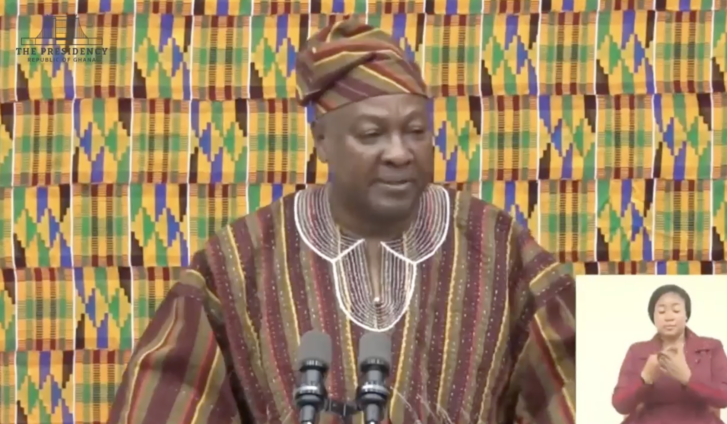
  • President Mahama swears in two new representatives for diplomatic mission

    President Mahama swears in two new representatives for diplomatic mission

    Two new ambassadors assigned to represent Ghana in Japan and Ethiopia have been sworn in by President John Dramani Mahama. Speaking during the commissioning ceremony conducted on Wednesday, May 13, President Mahama urged the newly sworn-in envoys, Humphrey Chatio Ajongbah and McArios Akanbeanab Akanbong, to strengthen diplomatic relations abroad by promoting the country’s economic interests.

    President Mahama advised, “As a way, your Ministry has designed key performance indicators that you might follow. The job of ambassadors has changed from just diplomacy and protocol to working in the economic interests of our country abroad”.

    Ghana, Japan, and Ethiopia share longstanding diplomatic relationships. In 2027, Ghana and Japan will celebrate 70 years of diplomatic relations. On Monday, February 9, five new ambassadors were sworn in to represent Ghana abroad.

    During the swearing-in ceremony, the new ambassadors were charged by President Mahama to prioritise economic diplomacy as part of efforts to attract foreign investment.


    “As heads of mission you are required to reflect this national reset agenda by moving from passive representaion to purposeful engagement from routine reporting to proactive problem solving and from presence to impact. Your mission plans must be firmly aligned with Ghana’s development prorities,” he urged.


    The ⁠recently sworn-in include: Ambassador to the Kingdom of Saudi Arabia, Alhaji Said Saleh Sinare, Ambassador to the Republic of Mali, Lt. Col. Al Hajj Umar Sanda Ahmed, Mr Kofi Attor, Ambassador to the Republic of Cuba, Mr Emmanuel Opeku, Ambassador-in-Situ, and High Commissioner to the Republic of Malta, Mrs. Regina Appiah-Sam.


    On Thursday, September 4, 2025, fifteen (15) of Ghana’s appointed envoys were sworn in. They are: Benjamin A. Quashie will oversee the operations of Ghana’s diplomatic mission in the Republic of South Africa, while Kojo Bonsu takes charge of the People’s Republic of China.

    Kulsoume Sinare Baffoe will head affairs in the Kingdom of Spain.
    Hammed Rashid Tunde Ali will be in the United Arab Emirates, Hon. Captain George Kofi Nfojoh in the Togolese Republic, and Grace El Mahmoud Marabe in Dubai, United Arab Emirates. Prof. Ohene Adjei will head the mission in the Federal Republic of Germany, and Abdul Nasiru-Deen in the Republic of Turkey.


    Theresah Adjei-Mensah in the Czech Republic, and Prof. Kwasi Obiri-Danso in India. Dora Francisca Edu-Buandoh, Ph.D., will serve in Canada, Dr. Margaret Miewien Chebere in Denmark, Labik Joseph Yaani in Equatorial Guinea, Nii Amasah Namoale in the Federative Republic of Brazil, and Dr. Felix Kumah Godwin Anebo in the Republic of Senegal.


    .The twenty-three individuals are expected to promote Ghana’s foreign policy and protect the welfare of Ghanaians overseas. Speaking at the induction ceremony for the 15 distinguished individuals, President Mahama noted that their “appointment is a mark of the confidence reposed in you and a recognition of your years of dedicated service, sterling achievement, and exemplary contributions both in the public and private sectors”.


    He urged the envoys to uphold transparency in carrying out their duties. Additionally, the President disclosed that taxpayers would no longer bear the cost of expensive properties rented by diplomatic missions abroad.


    According to him, the country cannot afford more than $15 million per year in property rental costs for diplomatic missions.
    He called the practice wasteful and one that can no longer be tolerated under the ruling National Democratic Congress (NDC) Reset Agenda.
    The President added that the Cabinet has given the nod to the government’s new initiative, Strategic Transition from Rental to Developing (STRIDE).


    The STRIDE policy is to reduce unnecessary losses the country absorbs on renting properties abroad for its diplomatic missions, hence, ensuring Ghana’s foreign missions are accommodated in state-owned properties.
    “From my latest briefing, a transaction advisor has been appointed, standard developments are being prepared, and funding mechanisms are already being negotiated.

    This shift will ensure that our missions abroad are housed in proper homes owned by the republic, reducing wasteful expenditure while safeguarding Ghana’s dignity on the international stage.


    “Ghana cannot continue spending more than $15 million every year on renting properties abroad for our diplomatic use. This is not a judicious use of taxpayers’ resources, and the Reset Agenda is an immediate reversal of this trend,” he stated.


    On Monday, September 1, 2025, Ghana’s historic five hundred (500) Key Performance Indicators (KPI) for heads of missions was launched by President John Dramani Mahama.


    The initiative is to provide heads of mission with a clear framework for assessing their work and supporting the President’s Reset Vision for the country.


    Delivering his keynote address, President Mahama stated that Ghana’s mission had advanced into paths of economic engagement, facilitating trade, attracting investment, and promoting innovation.


    Thus, he charged the heads of missions to promote investments in Ghana’s priority sectors, industrialization, renewable energy, digital services, agro-processing, infrastructure and tourism.


    “I charge you to expand our export markets, especially for value-added goods such as processed food, shea butter, textiles, crafts, and digital services. I charge you to move the life of our diaspora not only as remittance of money, but also as investors, innovators, and partners in Ghana’s development,” he said.


    The 500 KPIs cover areas such as securing scholarships and promoting exchange programmes with foreign institutions to build human capacity as well as increasing tourist arrivals by a least 10 per cent each year to create jobs and strengthen foreign reserves.


    They also require strict compliance with financial and procurement rules, enhancing national security through stronger intelligence sharing and partnerships with foreign agencies, navigating Permanent Joint Commissions for Cooperation (PJCC) with major partners, and shifting from renting office spaces to building permanent infrastructure to cut down rent costs.


    He stressed that the performance of the heads of missions will be judged not by ceremonial protocols, but by the level of investment, trade, and opportunities they can attract for the country.


    President Mahama explained that the Government’s Reset Agenda also focuses on governance, particularly restoring public trust through transparency and accountability.


    He added that as Ghana’s envoys abroad, the heads of mission are expected to reflect these principles, managing the nation’s missions with integrity, efficiency, and professionalism.


    “Our citizens abroad must experience fairness and respect, for our diplomacy’s credibility is inseparable from the credibility of our governments,” he added.
  • First direct aid convoy reaches Gaza from Jordan amidst humanitarian crisis

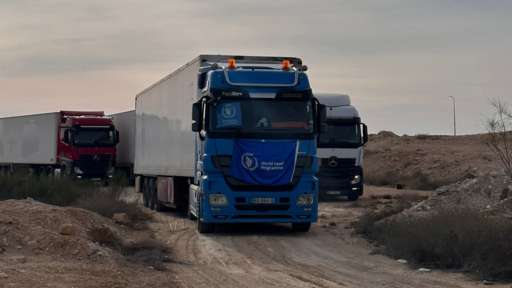
    First direct aid convoy reaches Gaza from Jordan amidst humanitarian crisis

    A convoy of 46 trucks, carrying over 750 metric tons of food, successfully reached Gaza today, marking the first direct aid delivery from Jordan since the onset of hostilities.

    Previously, aid had only been possible through Egypt.

    The UN’s World Food Programme (WFP) and the Jordan Hashemite Charity Organization organized the convoy, which crossed through the Kerem Shalom crossing between Israel and Gaza.

    With half of Gaza’s population reportedly facing starvation, WFP calls for an immediate ceasefire and the opening of all border crossings.

  • Sudan: Attack on US diplomatic convoy in Khartoum

    Sudan: Attack on US diplomatic convoy in Khartoum

    A U.S. Embassy convoy was attacked in Sudan, according to Washington’s top ambassador, who also condemned “indiscriminate military operations” as the nation’s armed forces and a potent adversary continued to use heavy weapons in populated areas.

    The convoy of clearly marked embassy vehicles was attacked on Monday April 17 2023, and preliminary reports link the assailants to the Rapid Support Forces, the paramilitary group battling Sudan’s military, U.S. Secretary of State Antony Blinken told reporters. Everyone in the convoy was safe, Blinken said.

    The convoy attack in Khartoum, along with earlier assaults on aid workers and the EU envoy’s residence in the Sudanese capital, signaled further descent into chaos since the battle by two rival generals for control of Africa’s third-largest country erupted over the weekend.

    More than 185 people have been killed and more than 1,800 wounded, according to U.N. figures, which did not include a breakdown of civilians and combatants. The Sudan Doctors’ Syndicate said Tuesday that at least 144 civilians were killed and more than 1,400 wounded since Saturday.

    The overall death toll could be much higher because clashes in Khartoum have prevented the removal of bodies in some areas. The two sides have been using tanks, artillery and other heavy weapons in densely populated areas.

    Late Monday, fighter jets swooped overhead and anti-aircraft fire lit up the skies as darkness fell. Fighting resumed early Tuesday around each side’s main bases and at strategic government buildings — all of which are in residential areas.

    Satellite images from Maxar Technologies taken Monday showed damage across Khartoum, including security service buildings. Tanks stood guard at a bridge over the White Nile River and other locations in the capital.

    Satellite images from Planet Labs PBC, also taken Monday, showed some 20 damaged aircraft at Khartoum International Airport, which also has a military side. Some had been completely destroyed, with one still belching smoke. At the El Obeid and Merowe air bases, north and south of Khartoum, several fighter jets were among the destroyed aircraft.

    Top diplomats have urged the two rival generals — armed forces chief Gen. Abdel-Fattah Burhan and RSF leader Gen. Mohammed Hamdan Dagalo — to halt fighting.

    The State Department said late Monday that Blinken spoke by phone separately with the two generals.

    “I made very clear (in my calls) that any attacks or threats or dangers posed to our diplomats were totally unacceptable,” Blinken told reporters at the Group of Seven wealthy nations meeting in Japan on Tuesday,

    He appealed for an immediate 24-hour cease-fire, as a foundation for a longer truce and a return to negotiations. “Indiscriminate military operations have resulted in significant deaths and injuries, recklessly endangering civilians, diplomats, including U.S. personnel, and humanitarian personnel,” he said.

    Dagalo said in a series of tweets Tuesday that he had approved a 24-hour humanitarian truce after speaking to Blinken while the Sudanese military said more troops would join the battle and that it would “widen the scope of its operations” against the RSF.

    Burhan and Dagalo, former allies who jointly orchestrated an October 2021 coup, have dug in, demanding the other’s surrender. The violence has raised the specter of civil war just as Sudanese were trying to revive the drive for a democratic, civilian government after decades of military rule.

    The Sudanese military blamed the RSF, which grew out of the notorious Janjaweed militias in Sudan’s Darfur region, for the attack on the U.S. convoy and an earlier assault on the home of the EU envoy in Khartoum.

    The European Union’s foreign policy chief, Josep Borrell tweeted Monday that the EU ambassador to Sudan “was assaulted in his own residency,” without providing further details.

    The RSF denied involvement in the attack on the ambassador’s home, instead blaming the military. However, a Western diplomat in Cairo said the residence was ransacked by armed men in RSF uniforms. No one was hurt but the armed men stole several items, said the diplomat who spoke on condition of anonymity because he was not allowed to talk to media.

    Under international pressure, Burhan and Dagalo had recently agreed to a framework agreement with political parties and pro-democracy groups, but the signing was repeatedly delayed as tensions rose over the integration of the RSF into the armed forces and the future chain of command.

    Both generals have a long history of human rights abuses and their forces have cracked down on pro-democracy activists.

    Only four years ago, Sudan inspired hope after a popular uprising helped depose long-time autocratic leader Omar al-Bashir.

    But the turmoil since, especially the 2021 coup, has frustrated the democracy drive and wrecked the economy. A third of the population — around 16 million people — now depends on humanitarian assistance in the resource-rich nation.

  • Attack on Burkina Faso convoy kills 11 soldiers

    Burkina Faso’s government says 11 soldiers were found dead and around 50 civilians are missing following a suspected jihadist attack on a convoy.

    Twenty-eight other people, including 20 soldiers, were wounded in the Monday attack and a search for the missing people is ongoing.

    The vehicles, which were escorted by a military patrol, had been taking supplies to residents in the north of the country.

    The ambush followed an attack on another army-supported convoy on Sunday that wounded four people.

    Burkina Faso’s military government took power in a coup last January, promising to end an Islamist insurgency which has killed thousands of people and displaced two million more since 2015.

    Source: BBC