Commonly referred to as COP27, the conference has urged member states to take action on past climate change commitments with UN Secretary-General Antonio Guterres warning the world is “on a highway to climate hell”.
Indigenous leaders told Al Jazeera that they, too, need to have a prominent role in the process.
“Having us at the decision-making table is critical,” Jamie Lowe, CEO of Australia’s National Native Title Council, told Al Jazeera.
“We are at an unprecedented moment on Earth and we need unprecedented collaboration to work through solutions together.”
While stakeholders such as Indigenous groups have been given an opportunity to present at COP27, any final agreements and negotiations are restricted to UN member states.
Lowe – who is from the Gunditjmara and Djab Wurrung peoples – told Al Jazeera that this separation of decision-making powers constituted a “disconnect”.
“Decision makers go off into another room and make the decisions about our peoples’ future,” he said.
“We need to be at the decision-making table and making calls on what happens in regard to the globe and climate change.”
Drought, fire, floods
As parts of eastern Australia succumb to widespread flooding, two years after catastrophic bushfires burned communities to the ground and killed millions of native animals, Indigenous Australians are concerned their voice continues to be ignored despite the rapid rate of climate change.
Indigenous people successfully managed the land with which they have a unique spiritual and cultural relationship for more than 60,000 years. But 200 years after the British colonised Australia the environment has been devastated.
Nearly half of Australia’s bushland has been cleared, and Australia has the highest rate of mammal species extinction of any continent, with 500 species at risk of disappearing forever.
Les Schultz, from the Ngadju and Mirning peoples, is the chair and founder of Ngadju Conservation Aboriginal Corporation.
Also in attendance at COP27,he agreed with Lowe that Indigenous peoples need to be at the decision-making table in the fight against climate change.
“We [Indigenous peoples] look after 80 percent of the world’s biodiversity – we should be at the table,” he said.
Schultz helped establish one of the first Indigenous ranger programmes in Australia, which draws on traditional land management practices to reduce catastrophic bushfires, such as “cool burning”, a preventive fire burning technique.
“The Indigenous rangers are continuing thousands of years of practice so we have that knowledge base,” he told Al Jazeera.
“Indigenous rangers are extremely successful in Australia. There are a lot of benefits to the Australian Indigenous ranger program that could be copied across the globe in response to climate change.”
Along with the protection of biodiversity, Schultz said it was vital that Indigenous cultural heritage was protected.
In 2020, mining giant Rio Tinto destroyed the sacred Juukan Gorge cave which contained evidence of 46,000 years of Indigenous inhabitancy dating back to before the last Ice Age.
“We are also seeing a lot of cultural sites being desecrated,” said Schultz. “With ranger programmes in place a lot of that could be prevented.”
Chris Bowen, Australia’s minister of climate change and energy told COP27 the country was back as a ‘constructive, positive and willing climate collaborator’ [Peter Dejong/AP Photo]
Joshua Gorringe, the general manager of Mithaka Aboriginal Corporation, was also in Egypt and agreed with Schultz.
“Something the world has really got to consider is a lot of these First Nations peoples have been on the land and worked with the land,” he said.
“Yet a lot of Western agriculture works against the land. With better land practices we will get back to a more sustainable future.”
Gorringe, from the Mithaka peoples, said that Indigenous cultural practices were inherently centred on caring for the environment, which he referred to as “country”.
“Part of the culture is caring for the country and the way we managed that was that we worked with the country not against it,” he said.
“A lot of our ceremonies are connected to the way the land works with us, not against us. A lot of these practices really need to start being listened to.”
Priceless environment
Gorringe told Al Jazeera that his attendance at COP27 was to highlight the impact not only of mining, but also hydraulic fracturing – or “fracking” – on his traditional lands.
Fracking – a process which uses small explosions to break up shale rock formations to extract gas and oil – has been criticised for its potentially devastating environmental and health effects.
While a ban on fracking was recently reintroduced in the United Kingdom by new Prime Minister Rishi Sunak, energy company Origin was recently given permission to frack the delicate riverine region of Gorringe’s traditional homelands.
“In the world that we are in now where we are talking rising sea levels and climate damage surely the dollar is not worth as much as what the environment is,” he said.
“We successfully managed the country for 60,000 plus years and in just 200 years all that management practice has gone out the window because governments and other people thought they could manage it better. And the world is paying the consequences now.”
Australia’s efforts in tackling climate change are ranked 55 out of 63 countries, according to the global Climate Change Performance Index, up four places from last year when the country came last.
Not only is Australia’s 2030 emissions reduction target one of the weakest, it has also yet to start phasing out coal and gas production. Australia is currently the fifth-largest producer and the second-largest exporter of coal in the world.
In 2017, former Prime Minister Scott Morrison – then treasurer – even brandished a lump of coal in parliament in support of the coal industry, including the establishment of the giant Adani coal mine.
However, the government of Anthony Albanese, which was elected in May, has committed to addressing climate change, with the prime minister declaring shortly after his election victory that Australia had an opportunity to become “a renewable energy superpower”.
“Australia is back as a constructive, positive and willing climate collaborator,” climate change minister Chris Bowen told COP27, although he was later criticised for refusing to join a pledge to end public support for fossil fuel projects overseas.
Back home in Australia, the government is touting its recent “Rewiring the Nation” project, which includes a 1.5 billion Australian dollar ($1bn) pledge to fast-track renewable wind power in the state of Victoria.
While supportive of such initiatives, First Nations Clean Energy Network spokesperson Ruby Heard told Al Jazeera that in the race to combat climate change, Indigenous peoples should not continue to be overlooked as they had been in the past.
“It is a rapid transition, and it needs to be a rapid transition for our environment. But we have to take the time to do this part right,” Heard said.
“We are trying to avoid some of the mistakes and some of the problems that we’ve seen in the mining industry where our communities haven’t been given a fair go and they haven’t shared in benefits.”
Shifting mindset
Australia’s vast land mass may be attractive to green energy companies wishing todevelop banks of solar and wind power, and mine renewable energy resources for batteries and solar panels.
However, Heard – from the Jaru peoples – said that it was vital to develop business partnerships with Indigenous peoples and retain respect for sacred cultural sites.
There was outrage over miner Rio Tinto’s destruction of ancient rock shelters in the Juukan Gorge [File: Richard Wainwright/EPA]
“We really want to see co-ownership of projects,” she told Al Jazeera.
“We want our people to not just receive royalties for projects on their land but be more active participants in these projects and have a financial stake in them and have some ownership over them as well.
“We want to see our First Nations people have the option to say no if they don’t want a project on their lands or at least to be able to redirect the project away from significant sacred sites.”
Still, Heard is confident that green energy companies will be more respectful of Indigenous peoples than fossil fuel mining conglomerates.
“With renewable energy comes a slightly different mindset. It does tend to be a lot more socially and community focused,” she said.
“We are feeling really hopeful about resetting those relationships and taking this in a different direction – a better direction.”
Climate change was the main cause of the floods that killed over 600 people in Nigeria this year, according to scientists.
In a study revealed on Wednesday, scientists claim that the floods that affected Nigeria, but also Niger, Chad, and neighbouring countries were directly linked to human activity.
According to the experts the floods between June and October this year displaced more than 1.4 million people and were 80 times likelier to occur because of human activity.
The report comes as COP27 climate talks continue in Egypt’s Sharm el-Sheikh, where developing nations are demanding rich polluters pay for climate-change-linked calamities.
Africa is home to some of the countries least responsible for carbon emissions but hardest hit by weather extremes, with the Horn of Africa currently in the grips of a severe drought.
Ghanaian environmental activist Gideon Commey has taken the fight against illegal mining, also known as “galamsey”, to the climate change conference (COP27) at Sharm el-Sheikh in Egypt.
The founder of Ghana Youth Environmental Movement staged a one-man protest at the ongoing COP27 to draw the attention of the international community on what he describes as the government’s failure to tackle the galamsey menace.
“I staged the one-man protest at #COP27 yesterday as an activist who deeply cares about the climate, and a concerned Ghanaian citizen frustrated and angry at the current state of our water bodies and forests because of galamsey (illegal small-scale mining).
“The attention the video has received and overall support for the campaign has been overwhelming. This shows I spoke the minds of thousands of Ghanaians who are exhausted and feeling hopeless about the lack of conviction, leadership and action from our political leaders,” Commey posted on Facebook.
“This in turn gives me hope about what our youth can do if we rise, speak truth to power and hold leaders accountable. Thank you everyone! I’m also grateful to Collins Gameli Hodoli for providing me with direct support without which I wouldn’t have been successful yesterday,” he added.
The Minister of Lands and Natural Resources, Mr Samuel Abu Jinapor, Saturday co-chaired the first ministerial meeting of the Forests and Climate Leaders’ Partnership with the United States’ Special Presidential Envoy for Climate, Secretary John Kerry, at the ongoing COP27 in Sharm El- Sheikh, Eqypt.
The meeting, attended by 28 ministers and five observer countries, was to develop a framework for 2023 and beyond, to achieve the objectives of the Partnership.
Mr Jinapor pledged the Government’s commitment to working with members of the Partnership to deliver on forests and nature-based solutions to climate change.
He gave the assurance of using his leadership on the new Partnership to showcase Ghana’s climate actions and that of other countries as they synergise to work on addressing forest losses.
Forests and nature-based solutions could deliver up to a third of global climate solutions, and “Ghana, as a respected member of the international community, is fully committed to supporting global climate action,” he said.
The Forests and Climate Leaders’ Partnership (FCLP) is a new political forum that brings together governments and partners to implement solutions to reduce forest losses, increase restoration, and support sustainable development.
It creates a platform for heads of state, governments and their ministers to combine political efforts to accelerate global action to halt and reverse forest losses and land degradation by 2030.
The members work towards delivering sustainable development and promoting an inclusive rural transformation.
Malawian President Lazarus Chakwera has joined other African leaders in criticising wealthy nations for not wanting to pay for climate loss and damage.
Speaking to the BBC at the ongoing COP27 meeting in Egypt, President Chakwera said African countries had contributed little to pollute the climate and that wealthier countries should take on more responsibility.
“That’s why we’re saying if you’re really serious about this [then] it’s not about charity. This is paying for what you have deliberately used and benefitted you and you don’t want to pay up,” he said.
He also accused wealthy nations of not matching their promises with actions in the fight against climate change.
“Many came hesitantly, including myself, because of this. From COP1 all the way to COP27what has happened? Why are we continuously going around the same issue over and over again? It’s because somebody does not want to pay up,” he said.
“To think that your home, all you’ve ever known, could just be gone – can you imagine that?”
An international student at Aberystwyth University has spoken of the “terrifying” impact climate change is having on her country.
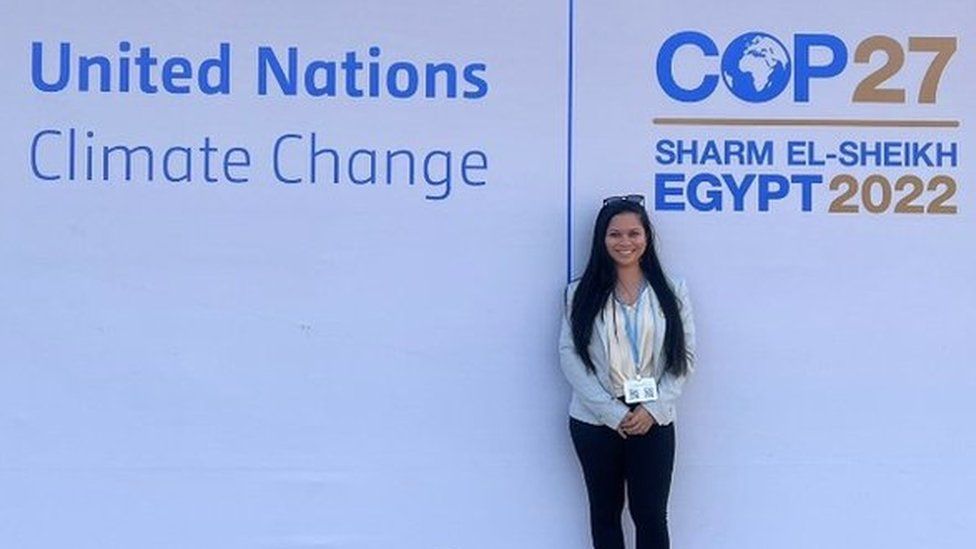
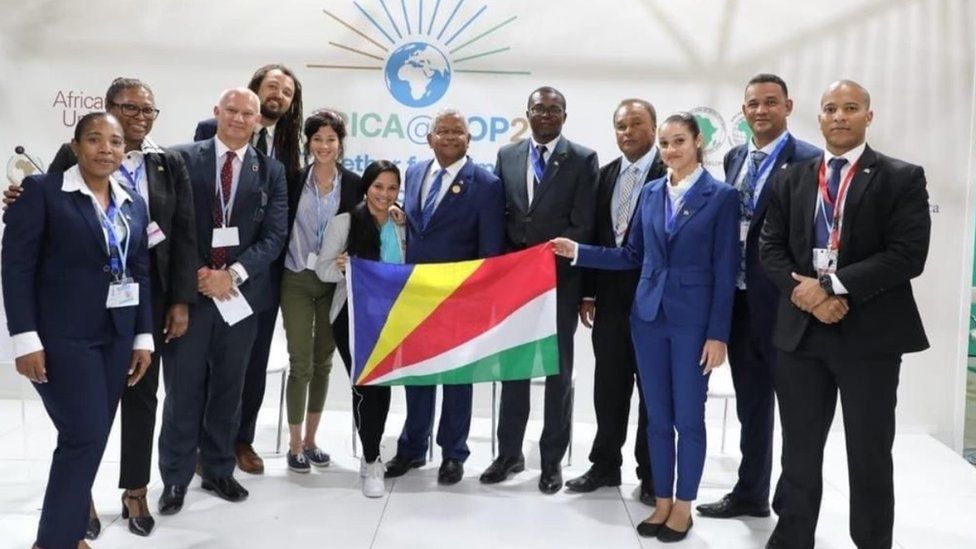
Nathalia Lawen, 21, is attending the COP27summit in Egypt as part of a delegation from the Seychelles.
The islands’ president warned they could “disappear” without quick action on rising seas and extreme weather.
Growing up with “the ocean as my backyard” meant Nathalia was drawn to climate activism from a young age.
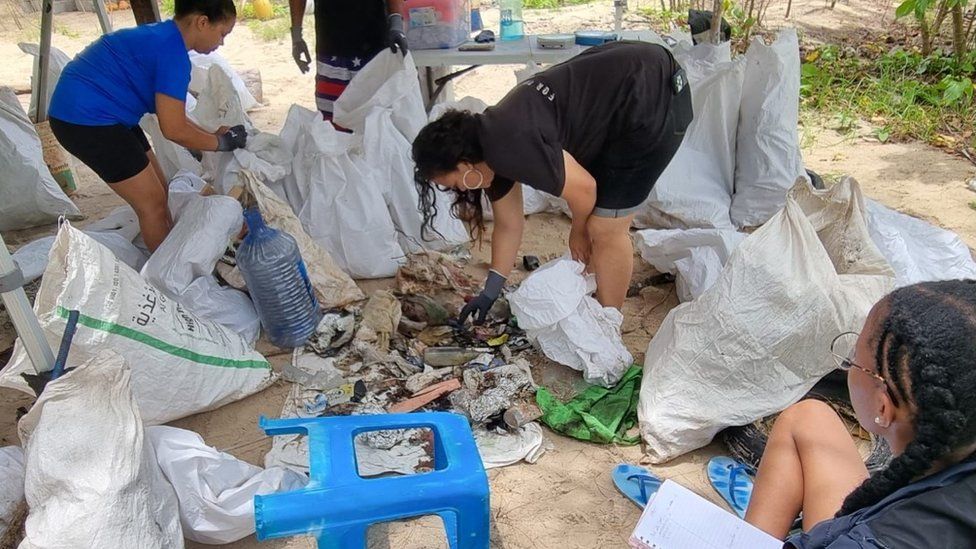
She organised and led beach cleans and became a youth ambassador for Peace Boat, a charity which travels the world raising awareness of environmental issues.
Small island nations such as the Seychelles, an archipelago in the Indian Ocean off east Africa, are already being hit by the worst impacts of climate change, she explained.
Image source, Nathalia Lawen Image caption, Nathalia has spoken out about the situation in her country
More unpredictable and extreme weather, ocean acidification and depleted fish stocks all combine with the existential threat of rising sea levels.
“If we don’t do something now our children and grandchildren will never know what the Seychelles is like and that terrifies me,” she said.
“It’s not just about land, but culture and traditions too.
“How do you begin to quantify what will be lost?
“Some countries claim it’s not their problem, but climate refugees and migration will become a bigger issue affecting the whole world.”
President of the Seychelles Wavel Ramkalawan told the COP27 summit countries like his were suffering the most from climate change, despite their “minimal” contribution to causing it.
Image source, Nathalia Lawen Image caption, Volunteers often clear up items washed up on beaches
The islands’ mangrove forests soaked up more than the country’s entire emissions, “making us a zero contributor to the destruction of the planet, but our islands are disappearing,” he said.
A key talking point at this year’s negotiations in Sharm-el-Sheikh is how much developed nations should financially compensate less developed ones now feeling the effects.
Nathalia said she was pleased the topic known as “loss and damage” had made it onto the agenda.
“I really appreciate that we’re having this conversation as I think countries really need to listen to us because the playing field is not level and we should acknowledge that,” she added.
Image source, Nathalia Lawen Image caption, Nathalia is at the conference with a delegation from her country
She is attending COP27 by invitation of the Seychelles government and will speak at a number of side events.
Nathalia said she wanted to push for action on protecting the health of the world’s oceans but also to “gather up as much knowledge as I can and apply it to my degree in Aberystwyth”.
She is in her second year, studying economics and climate change at the university in Ceredigion – its seaside setting a key attraction.
‘Be brave – even though your voice shakes’
Image source, Nathalia Lawen
Image caption, Nathalia Lawen is a student in Aberystwyth
Climate change’s effects were also becoming apparent in Wales, she suggested – the recent unseasonably warm autumn, and increase in extreme weather events a warning sign.
But she had also been impressed by local climate activism, including a march through the town ahead of COP27.
She sent a message to young people gathering from schools across Wales for a Youth COP event in Cardiff on Thursday, where they will hold workshops with environmental organisations, politicians and the Welsh government.
“Don’t think you’re too little or too young to address what’s important to you.
“Be brave – even though your voice shakes – shout it out loud and people will listen,” she said.
Energy Minister Dr Matthew Opoku Prempeh has said that Ghana is committed to mitigating and addressing the negative impact of climate change on the country and increase access to energy for socio-economic development.
To achieve this, the National Energy Transition Framework has been developed after wide consultation with all stakeholders within the energy space.
Dr Opoku Prempeh, who made this known during the COP27 in Egypt November 8, 2022, added that Ghana is in pole position to achieve universal electricity access by 2024, which is remarkable given that the Sustainable Development Goals ( SDGs) put the year to achieve this at 2030.
“Ghana is a signatory to the Paris Agreement, and is committed to its nationally determined target to address the adverse impact of climate change and increase access to energy for socio-economic development. The energy sector is one of the high emitting sectors and therefore requires critical decisions if Ghana is to achieve net zero ambitions.
Consequently, the National Energy Transition Framework has been developed [ in consultation with stakeholders] for Ghana’s energy transition,” Dr Prempeh said.
With respect to access to electricity, Dr Opoku Prempeh revealed that Ghana’s electricity access rate stands at an impressive 88.5% and a 100% is targeted to be achieved in 2024.
“Ghana aims to achieve Universal Electricity Access by 2024 well ahead of the SDG target. Currently Ghana stands at 88.54 of electricity access rate,” he added.
The Conference of Parties ( COP27) which discusses climate change issues is currently ongoing in Egypt. Ghana’s President is in attendance and has called on richer countries to redeem their pledges on cutting down harmful emissions and helping poor countries deal with climate change.
Thanks for reading from MyNewsGH as a news publishing website from Ghana. You are free to share this story via the various social media platforms and follow us on; Facebook, Twitter, Instagram etc.
According to Mrs Cynthia Asare Bediako, per reports from a state media house, the majority of the delegation, consisting of state and none-state actors, were funded by development partners.
“It is the responsibility of MESTI to coordinate and register persons attending the annual meeting. This does not mean the government is sponsoring all of these delegates. Delegates traveling on government’s ticket are not many.”
“Their funding is sourced from different agencies, including Global Environment Facility- UNFCCC, World Bank, Climate Vulnerability Forum, UNDP and UNICEF. These agencies also sponsor some government of Ghana officials to participate in the conference,” she said.
COP27 is the meeting of countries to take action towards achieving the world’s collective climate goals under the Paris Agreement and the Convention.
Building on the outcomes and momentum of COP 26 in Glasgow last year, the nations are expected to demonstrate at COP 27 that they are in a new era of implementation by turning their commitments under the Paris Agreement into action.
The conference is from 6th to 8th November, 2022, in Sharm el-Sheikh, Egypt.
Responding to the question of the high number of delegates, she said but for inadequate funding, Ghana required “many people to participate in the many technical negotiations at the annual conference”.
“The more people attend the conference the better it is for Ghana because they will learn and understand the issues. They will then support the implementation of the climate plans.
“The COP is also a platform to raise funds and forge partnerships for technical support. We need more technical hands to help,” she said.
At the Pre-COP Press Conference on Thursday, 3rd November 2022, Dr Kwaku Afriyie, the Minister of MESTI, explained that out of a total of 322 people attending, 226 were from government institutions.
About 72 were non-state actors and 24 from Climate Vulnerable Forum.
“Half of the number on the government platform are NGOs and partner institutions,” he clarified.
“Therefore, the actual government staff attending the COP is about 150.
The people attending this will be participating in diverse programming, including negotiations, workshops, side events and bilateral meetings,” he said.
Ghana is said to require between US$ 9.3 and US$ 15.5 billion of investment to implement the 47 nationally determined contribution measures from 2020 to 2030.
South Africais heavily dependent on coal for energy, but frequent power outages are one of the nation’s largest issues. How then can it increase its electricity supply while using fewer fossil fuels and switching to greener sources?
The precariousness of South Africa’s national electricity grid was highlighted in a single tweet by the state-owned power company Eskom one morning last month.
Before many people had even had a chance to eat breakfast, the newsflash read: “Stage four loadshedding was implemented at 05:30 due to breakdowns of five generators at five power stations overnight.”
Despite being Africa’smost developed economy, the country has been experiencing load-shedding – or an organised series of rolling blackouts – for the past 15 years. But this outage felt like something new.
Five units at five different power stations simultaneously suffering breakdowns is an indication of the fragility of the electricity infrastructure and shocked many.
“This is scary because you cannot have five units at five power stations failing overnight. What was happening?” asks energy expert Lungile Mashele.
“Your units are a reflection of how they are maintained… They tell a story that Eskom is not resilient, that Eskom has not been doing the necessary maintenance and that all interventions that they have been putting in place over the last couple of years have come to nought,” she tells the BBC.
Eskom has 14 coal-fired power stations, which produce around 80% of the country’s power. Most of them are old, inefficient and prone to breakdowns.
The two newer coal-fired power stations, whose construction started in 2007, are plagued by cost overruns and design flaws and are still not operating at capacity.
As a result of all these problems, South Africa has a shortfall of around 4,000-6,000MW of power every day – about 10% of current use.
The resulting blackouts are a source of deep anger and resentment for many South Africans.
The power-cuts are a huge problem for businesses, big and small. Roads become gridlocked when traffic lights stop working, people can’t cook when they get home from work and food rots when the fridge has no power.
And things could get worse as most of the old coal plants are being decommissioned as part of plans to move away from fossil fuels.
In October, the 1,000MW Komati power station in Mpumalanga province became the first to shut down. On the positive side, Komati will be repurposed into a renewable energy generation site using solar and wind power, and it has already secured funding of nearly $500m (£440m) from the World Bank to financethe project.
However, much more funding will be needed as more coal-fired power stations are going to be closed down in the coming years. Overall, Eskom plans to decommission half of its 45,000MW installed capacity by 2035.
The need to find replacement energy sources is urgent.
Luckily, South Africa is blessed with abundant wind and sunshine but it will require time, and lots of money, to harness their power.
In 2010, the government established the Independent Power Producer’s Procurement Programme (IPP), which looks for private sector investment into the country’s energy market from renewable sources such as onshore wind, solar power, biomass and small hydroelectric plants.
Some progress has been made. Speaking at a recent wind energy conference in Cape Town, Energy Minister Gwede Mantashe said that IPP projects had created more than 6,000MW of electricity capacity.
But that is not nearly enough.
In 2020, just 7% of the country’s energy came from renewable sources, according to the International Energy Agency.
South Africa’s energy woes and how to solve them are a global problem.
The country is among the world’s biggest emitter of greenhouse gases, such as the carbon dioxide produced by coal-fired power stations.
This is why there is a concerted effort from wealthier countries to help finance the country’s move away from coal.
The proposed $8.5bn deal announced at the last COP meeting in Glasgow was seen as an important first step in supporting South Africa.
But a year on, the deal is still subject to negotiations between South Africa and Germany, France, the UK, the US and the European Union, and what exactly happens could have far-reaching ramifications.
Its success or failure could influence whether or not other developing nations decide to decarbonise their economies.
But whatever happens, the development of renewable sources is not going to be a quick fix for South Africa’s massive energy shortfall.
Ahead of this year’s meeting in Egypt, President Cyril Ramaphosa mapped out a five-year plan to move from coal to greener sources of energy, but said it would cost $84bn – an astronomical sum.
Unveiling the plan, the president highlighted the need to decarbonise, create jobs and generate power at the same time. The aim is that the money will come from private investors as well as grants from donor nations.
In the meantime, the country is looking at another fossil fuel to answer the immediate problem of not having enough power.
Located 250km (155 miles) south-west of the buzzing commercial hub of Johannesburg is the quiet old mining town of Virginia. Where miners used to dig up gold, engineers are now sucking up precious helium and methane, even though that is also a greenhouse gas.
The Virginia Gas Project, owned by Johannesburg Stock Exchange-listed company Renergen, oversees vast gas fields covering some 190,000 hectares.
“There is gas in pretty much every direction that you look,” Renergen head Stefano Marani says as he walks around the plant, which used to be farmland.
Methane and helium are plentiful.
Gas was discovered in the 1950s, but is only now being produced on a commercial scale.
The gas extracted has a number of uses but most crucially for South Africa right now is that it can be used for power generation. Mr Marani believes that it can be added to the energy mix very quickly.
But it will not be a magic solution for the country’s chronic power problem and goes against moves to decarbonise power production.
And there is no speedy solution to Eskom’s infrastructure problems.
“The country is going to go through a tough time,” admitted the public utility’s Jan Oberholzer at a recent conference. “We need another year or year-and-a-half to get out of this.”
South Africa’s path to a cleaner and more secure energy is not straightforward and requires commitment and money – the success of which will be closely watched around the world.
The UN’s weather and climate body outlines ‘chronicle of climate chaos’ as COP27 talks get under way in Egypt.
The past eight years are on track to be the hottest ever recorded, a United Nations report has found, as UN chief Antonio Guterres warned that the planet was sending “a distress signal”.
The UN’s weather and climate body released its annual state of the global climate report on Sunday with another warning that the target to limit temperature increases to 1.5C (2.7F) was “barely within reach”.
The acceleration of heat waves, glacier melts and torrential rains has led to a rise in natural disasters, the World Meteorological Organization said as the UN’s COP27 climate summit opened in the Red Sea resort town of Sharm el-Sheikh, Egypt.
“As COP27 gets under way, our planet is sending a distress signal,” said Guterres, who described the report as “a chronicle of climate chaos”.
Representatives from nearly 200 states gathered in Egypt will discuss how to keep the rise in temperatures to 1.5C, as recommended by the Intergovernmental Panel on Climate Change (IPCC), a goal some scientists say is now unattainable.
Earth has warmed more than 1.1C since the late 19th century with roughly half of that increase occurring in the past 30 years, the report showed.
This year is on track to be the fifth or sixth warmest ever recorded despite the impact since 2020 of La Nina, a periodic and naturally occurring phenomenon in the Pacific that cools the atmosphere.
“All the climatic indications are negative,” World Meteorological Organization head Petteri Taalas told Al Jazeera from Sharm el-Sheikh. “We have broken records in main greenhouse gas concentrations, carbon dioxide, methane and nitrous oxide [levels].”
“I think the combination of the facts that we are bringing to the table and the fact that we have started seeing impacts of climate change worldwide … are wake-up calls, and that’s why we have this climate conference,” he said.
Surface water in the ocean hit record high temperatures in 2021 after warming especially fast during the past 20 years. Surface water is responsible for soaking up more than 90 percent of accumulated heat from human carbon emissions.
The report warned that more than 50 percent of the ocean surface experienced at least one marine heatwave in 2022.
Sea level rise has also doubled in the past 30 years as ice sheets and glaciers melted at a fast pace. The phenomenon threatens tens of millions of people living in low-lying coastal areas.
“The messages in this report could barely be bleaker,” said Mike Meredith, science leader at the British Antarctic Survey.
In March and April, a heatwave in South Asia was followed by floods in Pakistan, which left a third of the country underwater. At least 1,700 people died, and eight million were displaced.
In East Africa, rainfall has been below average in four consecutive wet seasons, the longest in 40 years, with 2022 set to deepen the drought.
China saw the longest and most intense heatwave on record and the second-driest summer. Similarly in Europe, repeated bouts of high temperatures caused many deaths.
‘Loss and damage’ talks
The UN warning was made as delegates at the summit agreed to hold discussions on compensation by rich nations to poorer ones most likely to be affected by climate change.
“This creates for the first time an institutionally stable space on the formal agenda of COP and the Paris Agreement to discuss the pressing issue of funding arrangements needed to deal with existing gaps, responding to loss and damage,” COP27 President Sameh Shoukry told the opening session.
Poorer nations least responsible for climate-warming emissions but most vulnerable to its impacts are suffering the most and are, therefore, asking for what has also been called “climate reparations”.
This item, added to the agenda in Egypt on Sunday, is expected to cause tension. At COP26 last year in Glasgow, high-income nations blocked a proposal for a loss and damage financing body and instead supported three years of funding discussions.
The loss and damage discussions now on the agenda at COP27 will not involve liability or binding compensation but they are intended to lead to a conclusive decision “no later than 2024”, Shoukry said.
Nyombi Morris, a young environmental activist from Uganda, had great expectations for participating in the fight for environmental justice when she traveled to Egypt for the UN’s COP27 climate meeting.
But his expectations were quickly dashed by Egypt’s strict security measures, as rights organizations fear the North Africannation has suppressed rallies with “dozens” of arrests.
“I was so happy when they announced that COP would be in Africa,” said Morris, who founded the Earth Volunteers youth organisation campaigning for “climate justice”.
“I thought maybe I would get a chance to be in the room where the negotiations are taking place.”
Instead, “with the questions we received at the airport, it will not be easy for us to continue with our plan”, the 24-year-old said.
In 2008, when Morris was 10, devastating flash floods hit Uganda’s eastern Butaleja district — an area where the illegal extraction of riverbank sand for construction was common. Some 400 people, including Morris’s family, lost their homes.
Morris, who has said the digging “exacerbated flooding already made worse by climate change”, said they had to move to the capital Kampala.
“I am here to represent my mother who lost a farm, who lost a home,” he said. “I am here to ask for compensation for my community.”
– ‘Abusive security measures’ –
Activists wanting to demonstrate at COP27, held in the Egyptian resort town of Sharm el-Sheikh, must request accreditation 36 hours in advance, providing information such as the names of the protest organisers and details of the proposed march.
Approved demonstrations are only allowed during working hours and in a specific purpose-built area.
That accreditation process is risky, Morris fears.
“When they started asking about our locations, where we will be staying, our passports, our names, we were worried,” he said.
“What if they follow one of us and (we) get arrested?”
He cited the case of Indian climate activist Ajit Rajagopal, who was arrested after setting off to march from Cairo to Sharm el-Sheikh. He was later released after an international outcry.
Human Rights Watch on Sunday warned that “dozens of people” calling for protests had been detained.
“Egypt’s government has no intention of easing its abusive security measures and allowing for free speech and assembly,” the watchdog said.
Rights groups say at least 138 people have been arrested ahead of a rally slated for November 11 — planned nationwide but not in Sharm el-Sheikh — against what they decry as repression and sharp increases in the cost of living.
– ‘Watching online’ –
Africa is home to some of the countries least responsible for planet-heating emissions but hardest hit by an onslaught of weather extremes.
On top of security restrictions, Morris lamented that activists like him were excluded from the talks.
“I am watching online because our ‘observers’ badges don’t allow us to enter,” he said.
Tina Stege, Climate Envoy for the Marshall Islands, today told Sophy Ridge on Sunday that her home has “no time to lose” in the fight against climate change.
She says: “Sea levels are rising – it is already happening.
“We’ve been impacted by this crisis and we’re already seeing islets that have disappeared.
“We’re having to think about when people may have to move to higher ground – we don’t have any higher ground.”
She adds this is an “existential issue.”
“We don’t accept a future in which we have no future, and it is for that reason that we’re here at COP27 – making the case and fighting for our future.”
She adds: “We really have no time to lose.”
Ms Stege says what is needed now is “delivery” on climate pledges.
“That is what leads to success. Every COP needs to be a success.”
She says it “cannot be a PR exercise… the COPs have produced some real and significant progress – the commitment to 1.5C is there because we have engaged in this process.”
Ms Stege says the process could be “a lot better”, adding: “We need a lot more action”.
But she says it is a process that gives small countries a “voice”.
Morocco signed a “green partnership” deal with the European Union in Rabat, Tuesday (Oct 18). The two parties hope the agreement will bolster cooperation on renewable energy.
Morocco’s top diplomat Nasser Bourita welcomed Tuesday the EU Commission deputy head Frans Timmermans. The statesmen officially launched in Rabat, the European Union and Moroccan “green partnership” deal aimed at bolstering cooperation on renewable energy.
The sun-baked North African country is seeking to offer alternatives for European nations trying to wean themselves off fossil fuels.
“First of all, the context shows that we are on the eve of COP27 and this is an important moment to show that the discussion on climate change is first and foremost a question of will and vision, but it is also a question of action”.
“Actions to transform commitments into reality and what Morocco is trying to do through this green partnership”, Nasser Bourita concluded.
The memorandum of understanding, is the “first of its kind” according to Frans Timmermans.
It is also set to boost cooperation in the fight against climate change, with private sector involvement.
“It aims to foster the transition to a decarbonised industry through investment in green technology, renewable energy production, sustainable mobility and clean production in industry,” it reads.
In 2009, Morocco adopted an energy strategy aimed at increasing the share of renewables in electricity production to over 52 percent of the country’s energy mix — up from around a fifth today.
The COP27 also known as the 27th session of UN Climate Change Conference will take place in Sharm el—Sheikh Egypt, in November.
A documentary on the environment and climate change produced by Ghanaian youth videographers has been selected as part of films that will be showed at the upcoming climate talks in Egypt (COP 27) – the first in the history of the country.
The documentary consists of 12 separate films that highlight the impact of climate change on the environment and livelihoods, particularly among coastal communities hit by tidal waves and rising sea levels.
The film also captures climate change mitigation measures executed by individuals and organisations, including the adoption of climate-smart agriculture systems to improve food production.
The films were produced as part of the Ghana Youth Videography Programme and facilitated by the UN Youth Climate Report, a platform that showcases actions being taken by youth around the world on climate change.
During a screening of the film at the Ghana Institute of Management and Public Administration (GIMPA) last Friday, Mr Mark Terry, Executive Director, of Youth Climate Report, said the film would be shown to UN Policy makers at COP27 on November 9, 2022.
He said all 12 films were approved by the UN and had been added to the UN’s Geographic Information System map of the world.
Mr Terry said the youth played an important role in the fight against climate change, adding that the documentary was one of the ways to ensure that the views of the youth were considered in the climate talks.
“The idea is to amplify the voice of the youth particularly those in Ghana. We want to hear the stories of climate change and the impacts that they have here,” he said.
Professor Magnus Mfoafo-M’Carthy, a member of the Project Team, said policymakers must realise that the youth also had a voice because “they also have something that they bring on the table.”
He said the Film would create awareness of climate change and elevate Ghana to the world in terms of climate action.
“It elevates Ghana to the point of having that conversation that Ghana is taking climate change seriously,” Prof. Mfoafo-M’Carthy said.
Africa will host the 27th Conference of the Parties of the United Nations Framework Convention on Climate Change (COP 27) in November this year, which will be the second time the continent is hosting global climate talks after hosting COP 17 in South Africa in 2011.
Although African countries have contributed to less than four per cent of global emissions, their citizens are the most affected by climate change.
The continent is increasingly battling with extreme drought, erratic rainfall, rising sea levels, flooding and other challenges that impact food systems and contribute to hunger and poverty.
More than 100 international non-governmental organisation (NGOs) have already signed a petition organised by the Egyptian Human Rights Coalition, which consists of 12 groups.
“We emphasise that effective climate action is not possible without open civic space,” a petition launched by the coalition says. “As host of COP27, Egypt risks compromising the success of the summit if it does not urgently address ongoing arbitrary restrictions on civil society.
“Moreover, we stress the importance of the right to freedom of expression and independent reporting to foster efforts to address the climate crisis.”
In a joint statement in July, three dozen groups expressed concern that Egypt would largely maintain its prohibition on protests during the conference aimed at slowing climate change.
Under Egypt’s President Abdul Fattah al-Sissi, there has been a widespread crackdown on dissent. Rights groups estimate the country has had as many as 60,000 political prisoners, many detained without trial.
They say that activists are routinely intimidated and that new laws make it practically impossible for many civil society groups to function.
“You will have activists from everywhere in the world coming to COP, but Egyptian activists are either blocked from going or they’re in jail,” a leading human rights campaigner in Cairo told the BBC, asking not to be named for fear of reprisal.
“Basically, nobody is safe in Egypt,” the campaigner said.
The Egyptian authorities says they hope to use their presidency of COP27 to urge the international community to act on pledges of support for developing countries to cope with the devastating impacts of climate change.
“They are the most deserving of our support,” Foreign Minister Sameh Shoukry told the UN General Assembly this month.
After a tumultuous decade since the 2011 uprising that overthrew then-President Hosni Mubarak, the country is also looking to boost its standing on the world stage.
‘PR tool’
However, critics, such as the Egyptian human rights campaigner, say the government sees the event as a way of “whitewashing its reputation”.
A few hundred less high-profile prisoners have been released in recent months since Mr Sisi unveiled a new pardon committee, in a move that many link to Egypt’s hosting of COP.
Amnesty’s new report focused on how Egyptian authorities have used a National Human Rights strategy launched a year ago “as a PR tool to deflect attention from its real human rights record”.
Meanwhile, HRW researched instances of repression against environmental groups.
Following interviews with academics, scientists and activists, it said that government restrictions amounted to human rights violations and left in doubt Egypt’s ability to meet basic climate commitments.
A spokesperson for the Egyptian foreign ministry dismissed the report as “deplorable and counterproductive” saying it contained “inaccuracies”, and questioned the use of unnamed sources.
Sameh Shoukry, who will act as president of COP, has said that space will be set aside in Sharm el-Sheikh for protests to take place.
This week, Ambassador Wael Abul-Magd, assisting him, told journalists that civil society environmental groups would be represented at the talks.
“We don’t believe in tokenism,” he said in a virtual briefing. “We are involving these stakeholders across the board in every step of the way.”
However, Egyptian activists told the BBC that many local groups had been unable to register for the conference.
They questioned the independence of those who had been given access in a special process overseen by the government and facilitated by the UN. One called the lack of transparency “a scandal”.