Tag: coronavirus in Africa

  • ‘I shared my coronavirus status to prevent stigma’

    Zambia’s Information Minister Dora Siliya says she publicly shared her Covid-19 test results to fight stigma associated with the respiratory illness caused by coronavirus.

    She told BBC’s Newsday programme that she was afraid the stigma would impede the fight against the virus like it did for HIV in Zambia.

    Ms Siliya said she felt that if her test results had leaked it would undermine the fight against stigma.

    “I felt if I did not share my status in terms of the Covid, people will be treating this the same way they do with HIV.”

    The minister said some Zambians still don’t believe Covid-19 is real.

    She said behaviorial change has only been seen among the elite in the city, but those in rural areas still think coronavirus only affects those who travel abroad.

    “There are people who still think it is a disease for those other people.”

    Source: bbc.com

  • Zambia minister’s contacts tested for coronavirus

    Zambia’s Information Minister Dora Siliya has said that most of her contacts have been tested after she was diagnosed with Covid-19.

    The minister, who announced her test results via Twitter on Saturday, had urged everyone she had come into contact with to cooperate with health officials to keep everyone else safe.

    Ms Siliya said she was asymptomatic and was self-isolating with close monitoring by medics.

    She had been participating in public education on coronavirus prevention before she tested positive.

    The minister said she had followed all regulations but still tested positive and has urged the public to adhere to safety measures.

    In her latest update on Twitter, she lauded health officials:

    Source: bbc.com

  • Go on strike, lose your jobs Nigerian governor threatens doctors

    Irked by their threats of strike due to delay in salary adjustment and other requests, the Kaduna state governor, Nasir El-Rufai, Friday warned resident doctors in the state to desist from such idea, noting that anyone who goes on strike would lose his/her job.

    Disclosing this in a statement, Muyiwa Adekeye, special adviser on media to the governor, quoted el-Rufai as saying every health worker willing to do their job will be required to sign registers at their duty posts.

    Read the statement below: “The government rejects the strike threat and will regard persons who fail to show up at their assigned places of work as having forfeited their employment.”

    “Every health worker that is willing to work is required to sign the register at the Ministry of Health and the health institutions to which they are deployed.

    “The ministry of health has the mandate of the government to ensure that residents of Kaduna state are not deprived of public health services.”

    “Every effort will be made to ensure that health facilities keep functioning, staffed by willing workers who will be guaranteed free and safe access to health facilities.”

    “Those who are not willing to work are strongly warned against criminal actions such as attempts to impede access to workplaces, harass willing workers or to sabotage facilities and equipment.”

    Source: vanguardngr.com

  • Nigerias coronavirus cases hit 7,016

    Confirmed cases of coronavirus in Nigeria have increased to 7,016.

    That was after the country reported 339 new cases on Thursday, May 21.

    This is according to the Nigeria Center for Disease Control (NCDC) in a tweet on May 21.

    It says 1,907 persons have been discharged.

    However, deaths have increased to 211.

    Breakdown of New Cases

    139-Lagos

    28-Kano

    28-Oyo

    25-Edo

    22-Katsina

    18-Kaduna

    14-Jigawa

    13-Yobe

    13-Plateau

    11-FCT

    8-Gombe

    5-Ogun

    4-Bauchi

    4-Nasarawa

    3-Delta

    2-Ondo

    1-Rivers

    1-Adamawa

    Source:  Daily Guide Network

  • Ten South Sudan ministers test positive for virus

    Ten ministers in South Sudan are now confirmed to have contracted coronavirus.

    Information Minister Michael Makuei has told the BBC that all former members of the high-level task force on coronavirus – apart from the health minister – have tested positive for Covid-19, the respiratory illness caused by the virus.

    But he has denied reports that President Salva Kiir – who was also a member of the team – had also tested positive.

    It comes just days after first Vice-President Riek Machar announced he had tested positive alongside his wife, Defence Minister Angelina Teny.

    They tested positive after coming into contact with a former member of the team, who has Covid-19.

    All the ministers infected are now in self-isolation and the government says they are in good health.

    Dozens of bodyguards and staff of the officials also tested positive and are quarantined.

    South Sudan has seen a sharp rise in coronavirus cases in recent days with 481 confirmed cases and six deaths.

    There are fears the virus could cause havoc in South Sudan, whose healthcare system is barely functioning following decades of conflict, while hundreds of thousands are living in camps for displaced people.

    Source: bbc.com

  • Egyptian employees face 1% coronavirus pay cut

    The Egyptian government has announced a raft of financial measures to help pay for the economic damage caused by the Coronavirus pandemic.

    Under a new draft law every working Egyptian will face a pay cut of 1% while the elderly will face a half percent cut in their pensions.

    The measures will be in force for a year from July. People with a monthly income of less than $125 (£102) will be exempt.

    People who work in tourism – which has been particularly badly affected may also be excluded.

    Source: bbc.com

  • Coronavirus in South Africa: Two-day-old baby dies

    A two-day-old baby has died with coronavirus in South Africa – one of the world’s youngest victims of the virus.

    The mother had tested positive for Covid-19 and the child subsequently tested positive, the health minister said.

    The baby was born prematurely and needed help with breathing, he added.

    The country’s death toll now stands at 339, and the number of confirmed cases has climbed to 18,003.

    The latest modelling predicts that up to 40,000 people might die in South Africa over the next few months.

    “Sadly we have recorded the first neonatal mortality related to Covid-19. The baby was two days old and was born prematurely,” South Africa’s Health Minister Dr Zweli Mkhize said.

    “The baby had lung difficulties which required ventilation support immediately after birth.

    “We extend a special word of comfort to the mother of this child and salute the neonatologists, nurses and all allied and technical personnel who had the difficult task of caring for the neonate to the end,” he added.

    Asked by the BBC whether this was the youngest victim of coronavirus in Africa, the director of the Africa Centre for Disease Control (CDC) Dr John Nkengasong said: “To the best of our knowledge that is the first case that the Africa CDC is aware of.”

    Other young victims of coronavirus, include a three-day-old who died on 5 May in the UK. In that case the mother and baby tested positive for coronavirus after she gave birth.

    The baby was born with a low heart rate and the coroner listed the primary cause of death as severe hypoxic ischaemic encephalopathy, meaning the brain was starved of blood and oxygen, while maternal Covid-19 was listed as a secondary cause.

    Mr Mkhize also said that the two-year-old baby was one of 27 new deaths recorded in South Africa in the last 24 hours.

    The country has the highest number of cases of Covid-19 in Africa. However, Egypt and Algeria have had more fatalities, with 680 and 568 respectively.

    South Africa has had some of the strictest lockdown measures in the world, including a ban on cigarettes and alcohol, but is now easing some restrictions.

    Source: bbc.com

  • Two-day-old baby dies from coronavirus in South Africa

    A two-day-old baby born became the youngest victim of coronavirus in South Africa after being born prematurely to a coronavirus positive mother.

    It is the country’s first neonatal death.

    Health Minister Zweli Mkhize said the premature baby had lung problems and required ventilation immediately after birth.

    “The mother had tested positive for Covid-19 and the child subsequently tested positive for Covid-19 as well. It is important to appreciate the complexities of the underlying condition of prematurity,” he said on Wednesday.

    South Africa, which has the highest coronavirus infections in Africa, reported 27 new deaths bringing the total fatalities to 339.

    Some 803 new coronavirus cases were announced on Wednesday evening taking the total to 18,003 while 8,950 people have recovered.

    Source: bbc.com

  • UN chief praises Africa’s ‘swift’ coronavirus response

    UN Secretary General António Guterres has praised Africa’s “swift” response to the coronavirus pandemic, with reported cases much lower than initially feared.

    He said in a statement, “Most [African countries] have moved rapidly to deepen regional coordination, deploy health workers, and enforce quarantines, lockdowns and border closures. Most [African countries] have moved rapidly to deepen regional coordination, deploy health workers, and enforce quarantines, lockdowns and border closures”.

    “They are also drawing on the experience of HIV/Aid and Ebola to debunk rumours and overcome mistrust of government, security forces and health workers.”

    They are also drawing on the experience of HIV/AIDS and Ebola to debunk rumours and overcome mistrust of government, security forces and health workers.”

    The AFP news agency reports him telling RFL radio in France that the developed world could learn from Africa’s response.

    “Most African governments and organisations took in time very brave prevention measures which provide a lesson for some developed nations that did not,” he is quoted as saying.

    However, he warned in his statement that it still might be early days for the pandemic in Africa and recommended international help to strengthen the continent’s health systems and food supplies to avoid a financial crisis.

    The continent has so far confirmed 88,855 coronavirus cases, including 2,848 deaths.

    The number of fatalities has been relatively low compared to about 323,000 deaths worldwide.

    Source: bbc.com

  • Africa’s Covid-19 cases rise to 88,172, disease agency says

    The number of confirmed Covid-19 cases across Africa rose from 84,634 Monday afternoon to 88,172 by Tuesday afternoon, the Africa Centres for Disease Control and Prevention (Africa CDC) said on Tuesday.

    The continental disease control and prevention agency, which noted that the virus has so far spread into 54 African countries, also disclosed that some 33,863 people who have been infected with the Covid-19 across the continent had recovered as of Tuesday afternoon.

    The death toll due to the Covid-19 pandemic across the African continent also rose from 2,766 on Monday afternoon to 2,835 by Tuesday afternoon according to Africa CDC.

    Africa CDC currently estimates fatality rates of Covid-19 cases to be around 3.4 per cent of all cases in the continent.

    It said that the northern African region is the most affected area both in terms of positive Covid-19 cases as well as the number of deaths.

    Source: theeeastafrican.co.ke

  • Virus fight just one front against epidemics in Africa

    African nations grappling to contain Coronavirus are scrambling to stop the outbreak worsening the impact of other killer diseases.

    Across the continent, countries regularly face surges from a raft of diseases that flourish in the humid weather and prey on weak health systems.

    Malaria strikes down hundreds of thousands each year, typhoid, measles and cholera are endemic to many areas, tuberculosis and HIV are particularly prevalent in southern Africa and the “meningitis belt” stretches from Senegal to Ethiopia.

    Some countries like Nigeria or the Democratic Republic of Congo (DRC) are especially susceptible and were already facing a constant battle on many fronts—even before the arrival of coronavirus.

    In these volatile nations, factors from neglected healthcare facilities to rapid population growth, growing numbers flocking to cities, and climate change have combined to make the situation worse.
    In DRC, Lassa fever’s far more deadly cousin Ebola has killed 3,000 since an outbreak started in August 2018 and new infections have stopped officials from declaring the crisis over.

    Since January 2019 over 6,000 children across the country of 85 million have died from measles and 50,000 have fallen ill with it this year alone, Doctors Without Borders (MSF) says.

    Dire warnings

    The World Health Organization (WHO) and other aid groups have sounded repeated alarms about the impact the coronavirus crisis could have on the fight against other diseases.

    Malaria deaths could double if measures like mosquito nets are neglected, polio could roar back if vaccination programmes are halted, AIDS and tuberculosis fatalities could reach a million if anti-retroviral therapies are disrupted.

    Years of vaccination campaigns have helped to bring some of the deadliest diseases under control—but there are fears that added burdens from coronavirus and challenges of social distancing could interrupt these efforts.

    In Nigeria’s chaotic megacity of Lagos, where around 20 million people live crammed together, immunisation rates have reached up to 90 percent thanks to widespread pushes to boost awareness.

    But those major successes risk being lost.

    “Many medical facilities have closed down, people are afraid to go to the hospitals, and some of the regular vaccination activities are disturbed,” Dr Anisur Rahman Siddique, who heads Unicef’s immunisation programmes in Nigeria, told AFP.

    “We need to keep on checking,” he said, pointing especially to a possible rise in measles.

    Polio threat

    Officials in numerous countries have warned that a focus on tackling coronavirus could rob attention from other pressing threats.

    A lawmaker in Angola called on the government to step up sanitation and fumigation in poor neighbourhoods to maintain the fight against malaria.

    Niger’s health minister, Illiassou Mainassara, has promised to distribute eight million mosquito nets and provide preventative treatments to over four million children this year.

    Nigeria, one of the last countries in the world to report wild poliovirus infections along with Afghanistan and Pakistan, was set to be declared officially free of the scourge in June after three years without a case.

    WHO says that 2,500 of its staff and personnel from partner organisations are still continuing surveillance for any outbreaks of polio in Africa’s most populous nation.

    But the “hard choice” was made to halt door-to-door vaccination campaigns that had already been hit by insecurity in the north of the country.

    ‘Business as usual’

    But what can be seen as a weakness could actually turn out to be a strength—and the experience of coping with these recurring epidemics could give countries a boost in handling coronavirus.

    The same WHO network in Nigeria that has been used to combat polio and other diseases is now be used to help track and test for possible coronavirus outbreaks in remote areas.

    In eastern Congo, the epicentre of the country’s Ebola outbreak, around 20 coronavirus cases had been registered by mid-May and the spread seems to have slowed.

    “The response against Covid-19 in the east of the country appears to have born fruits,” a government report said.

    Christian Happi, a professor at the infectious disease institute at Nigeria’s Redeemer’s University, told AFP that for Africa the fight against coronavirus was just “business as usual”.

    “We don’t have the same technologies, we may not have resources, but we have the human skills to fight it: it’s something we are used to,” he said.

    “Medical workers are experienced, they know how to manage these kind of emergency situations, there is less panic, fighting epidemics is part of our life.”

    In Nigeria, Lassa fever, a haemorrhagic disease mainly spread by rats, has since January killed 200 people from around 5,000 infections—a figure that grows higher each year.

    Source: AFP

  • South Africa health minister fights Covid-19 lockdown criticism

    South African Health Minister Zweli Mkhize on Tuesday fought off criticism against the Covid-19 lockdown, saying the measure has effectively stalled the exponential spread of the coronavirus.

    With the lockdown, South Africa’s healthcare sector has won time to prepare for the rising wave of infections and deaths, Mr Mkhize said.

    “Had we done nothing, estimates show that by this point, as many as 80,000 South Africans would have been infected, and nearly 2,000 of our brothers and sisters would have lost their lives,” the minister said, citing scientific models and estimates.

    CRITICISM

    He was responding to rising criticism from the opposition that some lockdown restrictions are too harsh, nonsensical and not based on scientific principles, and thus should be brought to an end.

    The criticism comes at a time when the Western Cape province accounts for 60 percent of the national cumulative cases, with cases increasing exponentially on a daily basis as compared to the rest of the country, Mr Mkhize said in a statement.

    The Western Cape province is governed by the opposition Democratic Alliance (DA), which is spearheading the campaign to halt the lockdown.

    As of Tuesday, South Africa has recorded 17,200 confirmed Coronavirus cases, up by 767 from Monday, and 312 deaths, an increase of 26, said Mr Mkhize.

    EPICENTRE

    The Western Cape remains the epicentre of the Covid-19 pandemic with 10,639 cases and 187 deaths.

    “Our mortality rate of 1.8 percent remains well below the global average, which is currently 6.6 percent, and our recovery rate is 42.4 percent, which is above the global average,” he said.

    “Had we not traded freedom for time, hospitals would now be overwhelmed, and our concern would have been drawn away from saving lives by the need to excavate mass graves for those we would have lost,” Mr Mkhize said.

    WARNING

    He warned against ending the lockdown abruptly, saying if people are allowed to flood back to the way life was before, infections would surge, effectively undoing everything that has been sacrificed thus far.

    In the weeks to come, different areas will experience different levels of lockdown, according to Mr Mkhize.

    This district-based approach is seen as the most practical and implementable measure to balance the epidemiology of the virus with the economic risks of a continuous hard lockdown, he said.

    Districts with low transmissions will be put on a vigilance programme to maintain low levels of the virus infection while those with high transmissions will be classified as hotspots where restrictions are necessary and strong teams of medical experts will be deployed, the health minister said.

    Source: theeastafrica.co.ke

  • Coronavirus: World Health Organization members agree response probe

    World Health Organization (WHO) member states have agreed to set up an independent inquiry into the global response to the coronavirus pandemic.

    The resolution, approved without objection by the WHO’s 194-member annual assembly meeting virtually in Geneva, also allows for the inquiry to look into the health body’s own role.

    The United States in particular has been highly critical of its response.

    The EU presented the resolution on behalf of 100 nations.

    What is in the resolution?

    It calls for an “impartial, independent and comprehensive evaluation” of the international response.

    This will also focus on the WHO’s “timelines pertaining to the Covid-19 pandemic”. The body has faced criticism that it was late to declare a health emergency.

    The resolution also calls for the world to ensure “transparent, equitable and timely access” to any treatments or vaccines, and pushes for the WHO to investigate the “source of the virus and the route of introduction to the human population”.

    “As I see no requests for the floor, I take it that there is no objection and the resolution is therefore adopted,” declared the assembly’s president, Keva Bain, the Bahamas ambassador.

    Why is the WHO under pressure?

    President Donald Trump has labelled the organisation a “puppet” of China and suspended funding for the WHO. The US is the largest donor.

    He has also accused China of trying to cover up the outbreak – something it strongly rejects – and said the WHO had failed to hold Beijing to account.

    The president on Monday published a letter he sent to WHO head Dr Tedros Adhanom Ghebreyesus outlining specific issues the US has.

    Source: bb.c.om

  • Tanzanian president accused of coronavirus cover-up

    A Tanzanian opposition party, ACT, has accused the president of “broadcasting a select few statistics” to falsely claim that there’s been a big drop in the number of coronavirus patients in hospitals.

    President John Magufuli told an applauding church congregation on Sunday that there had been a “sharp decline”, adding, “God has answered your prayers.”

    That was despite a report days before by the US embassy in Tanzania saying many hospitals had been “overwhelmed”.

    On Monday, the ACT said in a statement it “will not simply assume that the president is right in saying we are winning the battle against coronavirus, just because he says so”.

    It wants the government to release “the full set of data” on infection and death rates, and adds that the last such report was made more than a fortnight ago.

    “Transparency is essential. President Magufuli must commit to this core principle of governance. He owes it to the people of Tanzania,” the statement adds.

    Source: bbc.com

  • Bauchi discharges 20 more Coronavirus patients

    Bauchi State Government has discharged 20 more patients who recovered from Coronavirus, The PUNCH reports.

    This was contained in an update by the state Health Ministry on Monday.

    The newly discharged patients bring the total number of coronavirus recoveries in the state to 89.

    According to the update, the 20 patients were discharged on Sunday after weeks of receiving treatment at the state Isolation Centre.

    It also said their results came out negative twice for the virus before they were allowed to rejoin the society.

    Meanwhile, the state has confirmed three new infections with cases now 215.

    Source: punchng.com

  • Nigeria impounds British plane for breaking Coronavirus flight ban rules

    Nigeria impounded a plane operated by a British company for allegedly contravening a flight ban imposed to prevent the spread of the coronavirus, the aviation minister said on Sunday.

    Passenger flights into the country, with the exception of ones to evacuate people or repatriate Nigerian citizens, have been banned for weeks. The ban will remain in place until at least June 4.

    Flights for essential services, such as the delivery of food supplies and items for humanitarian use, are permitted.

    Aviation Minister Hadi Sirika said on Twitter on Sunday that a plane had been impounded after the rules were broken.

    Sirika said a UK company “was given approval for humanitarian operations but regrettably we caught them conducting commercial flights”.

    The message added: “The craft is impounded, the crew being interrogated. There shall be the maximum penalty.”

    James Oduadu, an aviation ministry spokesman, told Reuters later in a telephone interview that the plane was operated by a company called FlairJet.

    FlairJet, a British private charter company that is an affiliate of Flexjet, in a statement, said the matter was an “evolving situation”.

    “We are continuing to respectfully work with the Nigerian authorities to resolve this situation,” it said.

    Source:af.reuters.com
  • Food insecurity rising in Africa over coronavirus AGRA

    The Alliance for a Green Revolution in Africa (AGRA), has noted that the impact of the coronavirus outbreak is gradually leading to food insecurity on the African continent.

    AGRA noted that the measures introduced by governments, which include restrictions on movement of persons, to deal with the COVID-19 are affecting the ability of farmers to harvest and sell their produce.

    In Ethiopia for example, the government has projected that food production in the upcoming season could be lower by 8% due to the COVID-19 crisis.

    “Government-mandated restrictions around the movement of people and the need for social distancing continues to pose challenges for farmers, especially in Southern Africa, where countries are in the harvest season and workers must gather for harvesting, cleaning and packing crops for transport.

    “To address these challenges, some farmers and traders are using social media and farm-based sales to bridge production and market gaps during the pandemic.

    “Kenya is leading the way in these efforts. Post-harvest trainings, which help farmers meeting international quality standards, are being conducted via digital platforms through village-based organizations.

    “In Rwanda, AGRA has partnered with others to expand mechanization so as to reduce manual labour requirements and thus enable social distancing,” a statement said.

    The statement added: “In East Africa, farmers are still feeling the impact from locust invasions, while eradication efforts continue. Ongoing flood conditions in Kenya and Uganda are shortening the planting season.

    “However, the high rainfalls have also created an opportunity for “dry season” crops using the abundant residual moisture. In Southern Africa, recurring climate shocks are significantly contributing to reduced food production and driving staple food prices up.”

    The UN has increased its original appeal for COVID-19 response funds from $2 billion in mid-March to $6.7 billion in mid-May, as humanitarian experts have noted acceleration of the food insecurity crisis.

    David Beasely, Executive Director of the World Food Programme warned in April “I was already saying that 2020 would be the worst year since the second world war” Already, the COVID-19 pandemic, has “taken us to uncharted territory”, he said. “Now, We are looking at widespread famines of biblical proportions.”

    Source: laudbusiness.com

  • Madagascar records its first COVID-19 death

    Madagascar on Sunday announced the first death of a patient suffering from the novel coronavirus, nearly two months after it was first detected in the country.

    The 57-year-old hospital worker died on Saturday and had underlying diabetes and high blood pressure before he was infected, an official from the anti-coronavirus task team said.

    “It is with great sadness that we have to share with all our compatriots, that there is an individual, aged 57, who died from Covid-19,” professor Hanta Vololontiana said on public television.

    He was a car park attendant at a hospital in the eastern city of Toamasina.

    The Indian Ocean island which has reported 304 cases has hit the headlines over a home-grown herbal concoction that President Andry Rajoelina claims can cure people infected with the virus.

    Several African countries have ordered or expressed interest in the purported remedy, which is known as Covid-Organics.

    The tonic drink is derived from artemisia — a plant with proven efficacy in malaria treatment — and other indigenous herbs.

    But the World Health Organization has warned against “adopting a product that has not been taken through tests to see its efficacy”.

    Source: AFP via Africanews

  • Nigeria records 288 fresh cases of coronavirus, total rises to 5,445

    Nigeria has recorded 288 new cases of COVID-19, bringing the total number of confirmed infections in the country to 5,445.

    Announcing the new development on Friday night, the Nigeria Centre for Disease Control (NCDC) said the country recorded the new cases of COVID-19 in the last 24 hours.

    The NCDC also said that four new patients have been confirmed dead to the virus in the country, bringing the total number of deaths to 171.

    Till date, 5,445 cases have been confirmed, 3,959 are active cases, 1320 cases have been discharged and 171 deaths have been recorded in 34 states and the Federal Capital Territory.

    The 288 new cases are reported from 15 states- Lagos(179), Kaduna (20), Katsina (15), Jigawa(15), Borno (13), Ogun(11), Kano(8), FCT(7), Niger (4), Ekiti(4), Oyo (3), Delta (3), Bauchi(3), Kwara (2), Edo(1)

    The centre has also urged Nigerians to remember that there is no specific cure for COVID-19 as Clinical trials are ongoing to assess the safety and the efficacy of drug & vaccine candidates for public use.

    According to the European Centre for Disease Prevention and Control, since 31 December 2019 and as of 15 May 2020, 4 405 680 cases of COVID-19 (in accordance with the applied case definitions and testing strategies in the affected countries) have been reported, including 302 115 deaths.

    Cases have been reported from:

    Africa: 75 685 cases; the five countries reporting most cases are South Africa (12 739), Egypt (10 829), Morocco (6 607), Algeria (6 442) and Ghana (5 530).

    Asia: 732 064 cases; the five countries reporting most cases are Turkey (144 749), Iran (114 533), China (84 029), India (81 970) and Saudi Arabia (46 869).

    America: 1 943 455 cases; the five countries reporting most cases are United States (1 417 889), Brazil (202 918), Peru (80 604), Canada (73 401) and Mexico (42 595).

    Europe: 1 645 366 cases; the five countries reporting most cases are Russia (252 245), United Kingdom (233 151), Spain (229 540), Italy (223 096) and Germany (173 152).

    Oceania: 8 414 cases; the five countries reporting most cases are Australia (6 989), New Zealand (1 148), Guam (154), French Polynesia (60) and Northern Mariana Islands (19).

    Other: 696 cases have been reported from an international conveyance in Japan.

    Source: vanguardngr

  • Coronavirus: Kenya records 23 new cases, 3 more deaths

    The number of people in Kenya who have tested positive for the Covid-19 has risen to 781 following the confirmation of 23 more cases.

    The 23 are five females and 18 males all aged between 24 and 84 years.

    Making the announcement Friday afternoon, Health Chief Administrative Secretary Rashid Aman said 11 of the new cases were reported in Nairobi, five in Mombasa, three in Kajiado while Wajir and Kiambu recorded two each.

    The new cases were discovered after the ministry conducted tests on 2,100 samples. Two of those who tested positive in Kajiado were truck drivers.

    Dr Aman also announced that three more patients succumbed to the disease bringing the total number of Covid-19 deaths in the country to 45.

    Source: theeastafrica.co.ke

  • Coronavirus: ‘Nearly 1,000 African medics infected’

    The World Health Organization (WHO) has tweeted that nearly 1,000 health workers in the African region have been infected with coronavirus:

    The WHO urged governments to make sure that doctors and nurses had personal protective equipment (PPE).

    Anyone who comes into close contact with patients who may or do have coronavirus should wear some form of protection.

    Clinicians carrying out tasks that could generate airborne droplets of saliva loaded with the virus should use an even higher standard of protection, including disposable gowns, filtering respirators and face-shielding visors.

    But global demand for PPE is at unprecedented levels.

    Source: bbc.com

  • Coronavirus: Tanzania hit by sugar shortage after price controls

    Tanzania has run short of sugar over the last three weeks causing frustration among traders and consumers.

    Most shops have not stocked the commodity – and those selling it are charging nearly double the normal price.

    The government attributes the shortage to the coronavirus pandemic, which it says disrupted importation schedules.

    But it also blames some business people for hoarding sugar to create a false scarcity so that they can sell it at a higher price.

    Tanzania imposed price controls for the commodity last month after local production fell because of poor weather conditions, Bloomberg reported.

    The price of a kilogramme for domestic consumption was set at 2,700 Tanzanian shillings ($1.17; £0.94), but traders said it was unprofitable.

    On Monday, around 1,500 tonnes of sugar arrived at the port of Dar es Salaam.

    The director of the Tanzania Sugar Board, Kenneth Bengesi, said the consignment would soon start to be distributed across the country.

    Tanzania consumes 590,000 tonnes of sugar annually for both domestic and industrial consumption, according to data from 2016. But the country produces an average of 300,000 tonnes every year.

    Sugar shortages are not rare in the East African country.

    Poor rains and price disagreements between the government and traders have in the past caused scarcity and sharp increases in prices.

    Source: bbc.com

  • Nigeria Catholic Church offers centres to treat virus

    The Catholic Bishop Conference of Nigeria has offered all its health facilities across the country as isolation and treatment centres for coronavirus patients.

    The Director of the Catholic Health Secretariat in Nigeria, Emmanuel Okechukwu, told the BBC that the church had more than 440 heath facilities and they were willing to allow them to be used for testing, isolation and treatment centres.

    Nigeria has been struggling with bed spaces and has called for the donation of properties from organisations and individuals.

    The head of the coronavirus response team in Nigeria, Boss Mustapha, has called on state governments to take advantage of the facilities.

    Nigeria has 4,641 confirmed cases of coronavirus – though there are concerns regarding low levels of testing.

    Source: bbc.com

  • West ‘condescends Africa over traditional medicine’

    Madagascar’s President Andry Rajoelina has hit back at critics of an untested herbal tonic that he is promoting as a treatment for coronavirus, despite it not having gone through clinical trials.

    Last week, the World Health Organization (WHO) issued a warning against people using untested remedies for coronavirus.

    Africans deserve access to medicines that have gone through proper trials even if they are derived from traditional treatments, it said.

    The African Union (AU) has also said it wanted to see the scientific data on the “safety and efficacy” of the product.

    Nevertheless, the tonic, known as Covid-Organics, has been sent to several African countries. Nigeria has become the latest country to say it would receive it.

    Speaking to French news channel, France 24, Mr Rajoelina said that criticism of the drink, known as Covid-Organics, showed what he called Western nations’ condescending attitude to traditional African medicine.

    “If it wasn’t Madagascar, and if it was a European country that had actually discovered this remedy, would there be so much doubt? I don’t think so,” he said.

    But there is no peer-reviewed data to show that Covid-Organics is effective.

    The tonic was tested on fewer than 20 people over three weeks, a presidential aide told the BBC – which is not in line with WHO guidelines on clinical trials.

    A meeting of 70 experts on African traditional medicine has agreed that clinical trials for all medicines must be carried out, the WHO’s Africa region has tweeted.

    There has also been warning from experts that the drink could give people a false sense of security which could lead people to expose themselves to the virus.

    Meanwhile, the head of Nigeria’s government task force on coronavirus has said President Muhammadu Buhari has given the go-ahead for the importation of Covid-Organics.

    But officials said the import would be subjected to standard validation processes before it would be used on coronavirus patients.

    Source: bbc.com

  • Coronavirus: Tunisia records zero new cases

    Tunisia recorded no new cases of Covid-19 for the first time since early March, health authorities said on Monday, as government announced it will further relax restrictions on movement and businesses.

    The north African country which confirmed its first case on 2 March has reported 1,032 cases in total and 45 deaths.

    The authorities say 745 patients have recovered and only 11 are still in the hospital.

    Tunisia started relaxing a nationwide lockdown last week, reopening parts of the food, construction and transport sectors and allowing half of government employees to return to work.

    Shopping malls, clothing stores and hairdressers are due to re-open on the 24 May.

    The government said it expected the economy to shrink by up to 4.3%, the steepest drop since independence in 1956.

    The key tourism sector could lose $1.4bn and 400,000 jobs this year due to the coronavirus pandemic, Reuters reports.

  • Coronavirus: How secret burials in South Africa could help tackle Covid-19

    A ban on large funerals in South Africa has forced people to give up many traditions, but they have also rediscovered old ones, including “secret burials”, as the BBC’s Pumza Fihlani reports from Johannesburg.

    All it took was one funeral and 40 people were infected with coronavirus.

    On 21 March, less than a week after President Cyril Ramaphosa had declared a national state of disaster and banned large gatherings to help contain the spread of coronavirus, around 100 people attended a funeral ceremony in Majola village, Eastern Cape.

    The village, which lies in the sleepy rural community of AmaMpondomise, is now the epicentre of the virus in the area. The 21 March funeral, along with two others in the city of Port Elizabeth, account for 200 Covid-19 cases in the province – about a quarter of the total.

    ‘Defying authority’

    Under the current provisions, 50 people are allowed to attend a funeral, but the number is too small for some.

    Eastern Cape Health Department spokesperson Sizwe Kupelo says some families have been “defying” the authorities, causing a spike in cases.

    “We are gravely concerned about funerals in the province,” Mr Kupelo is quoted as saying by News24.

    “We have welcomed submissions made by traditional leaders to the national health minister to have all deceased receive the same treatment; that is, to be transported directly from the mortuary to the cemetery.”

    But it is very hard to change these deeply engrained traditions and there are reports that large gatherings for funerals continue.

    “Funerals, like weddings and initiation celebrations in traditional communities are important rites of passage, they mark the most important moments in a person’s life,” explains cultural expert Professor Somadoda Fikeni.

    “Africans have embedded in their social fabric the issue of social support and human solidarity – community and kinship.”

    Everyone pays their respects

    For most black South Africans, funerals combine traditional African and Christian elements.

    When a family is bereaved, people will travel long distances to attend both the funeral and the days of ritual in the run-up. These include repeatedly visiting the family at home to pay respects and to lend a helping hand with the preparations.

    Livestock also needs to be slaughtered in order to feed the anticipated guests, the cooking needs to be done, often at close quarters, and in rural areas, the grave needs to be dug, with people sometimes sharing the same pick and shovel.

    Those who attend the ceremonies are not necessarily intimately known to the bereaved family. They could be from the local church, the burial society, or simply a passer-by who hears of the tragedy and wants to show their support.

    Everyone is welcome.

    ‘Transmission belt for virus’
    On the day of the funeral, hundreds gather for a church service, sitting in close proximity. When the day’s proceedings are done community members form a human chain to deliver the food to the hundreds who have come to commiserate. And the guests eat together, again in close proximity.

    “It’s a transmission for belt for the virus,” warns Mr Fikeni.

    In a bid to find an alternative and safer way to bury relatives, AmaMpondomise King Zwelozuko Matiwane issued a ban on all funeral services in his kingdom with the aim of re-introducing the ancient practice of ukuqhusheka, or secret burial.

    His spokesperson, Nkosi Bhakhanyisela Ranuga, says the decision was made after consulting local traditional leaders.

    “We are trying to protect our people in this pandemic.

    “When following this custom [of ukuqhusheka] this means people are called on to bury either on the same or the next day and with only those who were present at the time of passing,” he tells the BBC.

    Cleansing ceremony

    The AmaMpondomise kingdom runs across four towns, Qumbu, Tsolo, Ugie and Maclear, and surrounding villages.

    “By returning to this ancient practice this would mean only immediate family members will able to bury a person. After the burial, the family would still be able to hold an intimate customary cleansing ceremony when they return from the burial site,” explains Mr Ranuga.

    These ceremonies are done through a ritual offering to cleanse the family of a “dark cloud of death”. They are usually private affairs with only close family present.

    Source: bbc.com

  • Oyedepo declares churches open, says anyone against will die

    Bishop David Oyedepo of Living Faith Church has once again kicked against the continued closure of Churches in Nigeria due to coronavirus pandemic.

    Days ago, the clergyman spoke against the closure of Churches while markets are allowed to operate after the Federal Government eased the lockdown period.

    In the video below, Bishop Oyedepo stated that the doors to Churches are declared open and that anyone against it will die.

    “The doors to churches across Nations are again declared opened this morning. Can I tell you this? Hunger is far more devastating than any virus that will ever visit the earth.

    “It kills silently. There is no vaccine for hunger. There is no medical solution to hunger.

    Hunger has no treatment than to have food and Spiritual famine is far more devastating.

    “That is what the devil is looking for but he has failed. The church is back on its feet. Anyone who hates to see that dies for it.

    “The church of Christ on the earth is liberated. Spiritual famine shall not have its way.

    “Can I tell the world, no one has the answer to a problem like Jesus”, he said.


    Source: mynigeria.com

  • Coronavirus: WHO warns 190,000 could die in Africa in one year

    As many as 190,000 people across Africa could die in the first year of the coronavirus pandemic if crucial containment measures fail, the World Health Organization (WHO) warns.

    The new research also predicts a prolonged outbreak over a few years.

    “It likely will smoulder in transmission hot spots,” says WHO Africa head Matshidiso Moeti.

    This patchier and slower pattern of transmission sets Africa apart from other regions, WHO experts say.

    Other factors taken into account are the region’s younger populations who have “benefitted from the control of communicable diseases such as HIV and tuberculosis”, as well as lower mortality rates.

    The WHO’s warning comes as Africa’s most populous nation, Nigeria, plus others including South Africa and Ivory Coast, have begun relaxing some of their lockdown measures.

    Their estimates are based on prediction modelling, and focus on 47 countries in the WHO African region – Egypt, Libya, Tunisia, Morocco, Eritrea, Sudan, Somalia and Djibouti are not included.

    Across the whole of the African continent more than 2,000 coronavirus deaths have been recorded by Africa’s Centre for Disease Control. By comparison, 140,000 have died in Western Europe, where the virus took hold several weeks earlier.

    “Covd-19 could become a fixture in our lives for the next several years unless a proactive approach is taken by many governments in the region,” Dr Moeti says in a WHO statement.

    “We need to test, trace, isolate and treat.”

    Source: bbc.com

  • Nigerians with no masks face arrest in virus hot-spot

    Residents of Ogun state in Nigeria face arrest if found not wearing face masks in public, according to police spokesman Abimbola Oyeyemi.

    The state is considered as a coronavirus hot-spot and was under a 35-day lockdown that ended last week.

    Governor Dapo Abiodun had ordered mandatory mask-wearing as a precaution to stop the spread of coronavirus. The order took effect on 1 May and local leaders say people are not complying.

    Enforcement will begin this weekend, the police said. Those arrested will be quarantined for 14 days while doing community work.

    Ogun state has so far recorded 100 coronavirus cases and is at a high risk because of its proximity to commercial capital, Lagos.

    Source: bbc.com

  • Coronavirus: Africa records over 54,000 cases with 2,073 deaths

    There are now more than over 42,500 confirmed cases of coronavirus across the continent, with a number of African countries imposing a range of prevention and containment measures against the spread of the pandemic.

    According to the latest data by the John Hopkins University and Africa Center for Disease Control on COVID-19 in Africa, the breakdown remains fluid as countries confirm cases as and when.

    The whole of Africa has rising cases with Lesotho the country holding out as of May 1.

    Confirmed cases = 54,083

    Number of deaths = 2,073

    Recoveries = 18,412

    Infected countries = 53

    Virus-free countries = 1 (Lesotho)

    Countries in alphabetical order

    Algeria 5,128

    Angola 36

    Benin 140

    Botswana 23

    Burkina Faso 736

    Burundi 15

    Cameroon 2,267

    Cape Verde 218

    Central African Republic 94

    Chad 253

    Comoros 8

    Congo-Brazzaville 274

    DR Congo 897

    Djibouti 1,133

    Egypt 7,981

    Equatorial Guinea 439

    Eritrea 39

    Eswatini 153

    Ethiopia 191

    Gabon 504

    (The) Gambia 18

    Ghana 3,091

    Guinea 1,927

    Guinea-Bissau 564

    Ivory Coast 1,571

    Kenya 607

    Lesotho 0

    Liberia 189

    Libya 64

    Madagascar 193

    Malawi 43

    Mali 650

    Mauritania 8

    Mauritius 332

    Morocco 5,548

    Mozambique 81

    Namibia 16

    Niger 781

    Nigeria- 3,526

    Rwanda 271

    Sao Tome and Principe 187

    Senegal 1,492

    Seychelles 11

    Sierra Leone 231

    Somalia 928

    South Africa 8,232

    South Sudan 74

    Sudan 930

    Tanzania 480

    Togo 135

    Tunisia 1,026

    Uganda 101

    Zambia 153

    Zimbabwe 34

    Source: africanews.com

  • I did not test positive for coronavirus Lagos health commissioner

    Lagos State Health Commissioner, Prof Akin Abayomi, says he is not infected with coronavirus.

    The commissioner had earlier on Thursday announced that 10 persons associated with the Lagos State Government House, Marina, tested positive for the virus.

    But he stated on Friday via Twitter that he did not test positive for the disease while urging the public to disregard false reports claiming otherwise.

    “I hereby implore the general public to disregard the fake and misleading news circulating in the media to the effect that I have tested positive for COVID-19 infection. It is evident that the fake news is calculated at causing panic and unnecessary anxiety amongst the populace,” Abayomi wrote while urging Lagosians to remain vigilant and continue to play their role by wearing masks in public places, avoiding crowd as well as observing good hygiene and social distancing in order to curtail the spread of COVID-19 in the state.

    Meanwhile, the Nigeria Centre for Disease Control on Thursday night announced three-digit cases in the state, the highest in a day for any state in Nigeria.

    The Centre said 183 new infections were reported in Lagos, bringing the total cases to 1491 including 406 recoveries and 33 fatalities.

    Source: punchng.com

  • Coronavirus could kill up to 190,000 in Africa in first year if not contained WHO

    The novel coronavirus could kill between 83,000 and 190,000 people in Africa in the first year and infect between 29 million and 44 million in the first year if it is not contained, the World Health Organization (WHO) said on Thursday.

    The projections are contained in a new WHO Africa study based on assumptions that no containment measures are put in place, which has fortunately not been the case, WHO Africa head Matshidiso Moeti told reporters in a teleconference.

    Most countries on the continent have imposed restrictions on public gatherings, international travel and curfews among other measures meant to curb the spread of the virus.

    The virus hit Africa later than other continents and transmission rates are lower than elsewhere. Still, this could translate into a prolonged, years-long outbreak, WHO said.

    “COVID-19 could become a fixture in our lives for the next several years unless a proactive approach is taken by many governments in the region. We need to test, trace, isolate and treat,” Moeti said in a separate statement.

    The organisation warned that small countries, as well as Algeria, South Africa and Cameroon, could be severely affected.

    Notably, the WHO Africa study covered only the 47 countries that belong to the WHO Africa region and not the entire continent. The body’s regional definition excludes Djibouti, Somalia, Sudan, Egypt, Libya, Tunisia and Morocco.

    As of 1259 GMT, the 47 countries had 35,097 cases of the novel coronavirus and 1,231 deaths, according to a Reuters tally based on government statements and WHO data.

    Under the projected no-containment scenario, “there would be an estimated 3.6 million5.5 million COVID-19 hospitalisations, of which 82,000167,000 would be severe cases requiring oxygen, and 52,000107,000 would be critical cases requiring breathing support,” WHO Africa said.

    Africa has less than one intensive care bed and one ventilator per 100,000 people, a Reuters survey found on Thursday.

    Human resources are also a challenge.

    “We are very concerned that almost 1,000 African health workers have been infected with COVID-19. We know that most African countries already have a severe shortage of healthcare workers,” Moeti told reporters.

    Source: Aljazeera

  • Coronavirus: Tougher measures as Kenya’s cases jump by 47

    Kenya has hit another record high in terms of the number of coronavirus cases recorded daily, reporting 47 more positive test results on Wednesday.

    The Health ministry said 32 of the new cases were recorded in Mombasa, 11 in Nairobi, two in Busia in western Kenya, central Kiambu County one and coastal Kwale County one.

    While announcing a total of 582 confirmed cases since Kenya’s first case on March 13, Health Cabinet Secretary Mutahi Kagwe said two more people had died, raising the death toll to 26.

    He said the two people aged 68 and 76 died at their homes in Mombasa, raising more concerns cases that go unnoticed as people stay at home.

    “One patient in Kenyatta National Hospital came to Kenya from Tanzania, through Loitokitok, using matatus. This shows us the danger we are in and further tells why the measures in the transport system have been put in place,” he said.

    The CS also reported that eight more people had been discharged, raising the country’s total number of recoveries to 190.

    Tougher measures

    The government announced tougher measures to contain the spread of the virus, with Eastleigh estate in Nairobi and Old Town in Mombasa emerging as hotspots.

    As such, CS Kagwe announced the cessation of movement into and out of the two areas and said markets, restaurants and eateries would be shut effective May 6.

    The orders will remain for 15 days in both areas.

    Mr Kagwe noted that public transporters would not operate in these areas and but that activities within their borders would not be restricted amid mass testing to establish the extent of infection and identity contacts.

    The minister noted that “these measures are not intended to punish but protect the people in those areas”.

    Statistics

    In Africa, the coronavirus had infected at least 50,502 people and killed over 1,921, according to case tracker Worldometer’s count on May 5.

    Since the first case was reported in Wuhan, China, on December 31, 2019, at least 3,746,445 people worldwide had been infected by May 6.

    The total number of deaths worldwide was 258,962 and that of recoveries at 1,250,449.

    The number of active cases stood at 2,237,034, with two per cent or 49,282 of them being critical and the rest mild.

    Worldometer’s count showed that the number of closed cases was 1,509,411, with 83 per cent or 1,250,449 being the number of recoveries or those discharged.

    Source: theeastafrican.co.ke

  • Coronavirus: Tougher measures as Kenya’s cases jump by 47

    Kenya has hit another record high in terms of the number of coronavirus cases recorded daily, reporting 47 more positive test results on Wednesday.

    The Health ministry said 32 of the new cases were recorded in Mombasa, 11 in Nairobi, two in Busia in western Kenya, central Kiambu County one and coastal Kwale County one.

    While announcing a total of 582 confirmed cases since Kenya’s first case on March 13, Health Cabinet Secretary Mutahi Kagwe said two more people had died, raising the death toll to 26.

    He said the two people aged 68 and 76 died at their homes in Mombasa, raising more concerns cases that go unnoticed as people stay at home.

    “One patient in Kenyatta National Hospital came to Kenya from Tanzania, through Loitokitok, using matatus. This shows us the danger we are in and further tells why the measures in the transport system have been put in place,” he said.

    The CS also reported that eight more people had been discharged, raising the country’s total number of recoveries to 190.

    Tougher measures

    The government announced tougher measures to contain the spread of the virus, with Eastleigh estate in Nairobi and Old Town in Mombasa emerging as hotspots.

    As such, CS Kagwe announced the cessation of movement into and out of the two areas and said markets, restaurants and eateries would be shut effective May 6.

    The orders will remain for 15 days in both areas.

    Mr Kagwe noted that public transporters would not operate in these areas and but that activities within their borders would not be restricted amid mass testing to establish the extent of infection and identity contacts.

    The minister noted that “these measures are not intended to punish but protect the people in those areas”.

    Statistics

    In Africa, the coronavirus had infected at least 50,502 people and killed over 1,921, according to case tracker Worldometer’s count on May 5.

    Since the first case was reported in Wuhan, China, on December 31, 2019, at least 3,746,445 people worldwide had been infected by May 6.

    The total number of deaths worldwide was 258,962 and that of recoveries at 1,250,449.

    The number of active cases stood at 2,237,034, with two per cent or 49,282 of them being critical and the rest mild.

    Worldometer’s count showed that the number of closed cases was 1,509,411, with 83 per cent or 1,250,449 being the number of recoveries or those discharged.

    Source: theeastafrican.co.ke

  • Nigeria virus patients protest against ‘poor care’

    Dozens of coronavirus patients held a protest outside a treatment centre in the north-eastern Nigerian state of Gombe, saying the authorities were not taking good care of them.

    The patients complained of lack of drugs and proper feeding.

    They mingled with members of the community during the Tuesday evening demonstration and blocked a nearby highway in the village of Kwadon – about 8km (five miles) from the state capital.

    The state’s health commissioner, Ahmed Gana, told the BBC that the patients were asymptomatic and did not require drugs. The authorities also deny the allegation about a lack of proper feeding.

    Officials later persuaded the demonstrators back into the treatment centre, but are worried about a possible spread of the virus to villagers who came out to witness the protest.

    They have urged those who might have contacted the protesting patients to self-isolate for at least 14 days.

    Gombe state has so far confirmed about 100 coronavirus cases against a national tally of 2,950.

    Source: bbc.com

  • Coronavirus: ‘A third world war without the bombs’ – Raila Odinga

    African Union official and former Kenyan Prime Minister Raila Odinga is the latest politician to deploy the language of war when it comes to talking about coronavirus.

    Mr Odinga, who is the AU’s high representative on infrastructure, said the pandemic was like “a third world war without the bombs”.

    “Even in the Second World War we did not have the extent of casualties that we have witnessed within a short period of time,” he told South Africa’s public broadcaster SABC.

    “The effects are going to be far-reaching to the continent.”

    He warned that the continent will likely be left on its own in the post-coronavirus era.

    “African countries will wake up to this reality that nobody is going to help them because everybody has been affected. Europe is on its knees, the US is crying, even China is crying.

    “About 85% of Africa’s trade is with the external world and most of it is commodities which we are exporting. We now need to look internally into intra-Africa trade,” he said.

    The Africa Centres for Disease Control and Prevention has said 48,022 people have been infected with Covid-19 in Africa. That number includes 1,878 deaths and 16,019 recoveries.

    Source: bbc.com


  • Nigerias coronavirus cases hit 2,950

    Confirmed cases of coronavirus in Nigeria have reached 2,950.

    This was after Nigeria recorded 148 new cases of coronavirus.

    The Nigeria Centre for Disease Control (NCDC) made this known in a tweet late on May 5.

    NCDC added that deaths related to the virus were 98.

    According to the Centre, 481 persons have been discharged.

    Below is the breakdown of the new cases

    43-Lagos

    32-Kano

    14-Zamfara

    10-FCT

    9-Katsina

    7-Taraba

    6-Borno

    6-Ogun

    5-Oyo

    3-Edo

    3-Kaduna

    3-Bauchi

    2-Adamawa

    2-Gombe

    1-Plateau

    1-Sokoto

    1-Kebbi

    Source: africanews.com

  • Governments urged to improve access to water for Africans

    The World Health Organization (WHO) Africa Regional Office has called on governments, private sector partners, innovators, scientists and communities to invest in access to water for health facilities and households in the region.

    The office said the outbreak of Coronavirus (Covid-19) has shunned the light on the inequalities in access to basic services, adding that the situation provides an opportunity to improve access to water for vulnerable communities on the Continent.

    “This year, as we battle the Covid-19 pandemic, the life-saving importance of clean hands has never been more prominent,” said WHO Regional Director for Africa, Dr Matshidiso Moeti.

    In a statement to mark World Hand Hygiene Day on May 5, Dr. Moeti said hand hygiene, along with physical distancing; respiratory etiquette and disinfecting surfaces are the basic preventive measures for a range of diseases, including Covid-19.

    She said the theme for the Day, “nurses and midwives, clean care is in your hands” was selected because infection prevention and control, including hand hygiene, is important especially in health facilities as part of ensuring quality patient care.

    “We are also working with sub-regional nursing associations and other partners and have trained more than 3000 health workers via interactive virtual seminars, including demonstrating good hand hygiene,” she said.

    Dr. Moeti observed the need for an urgent scale-up of access to water across the continent as more than one in four health-care facilities have no water service and less than 50% of households having basic hand washing facilities with soap and water.

    “Over the past 20 years, progress on access to water in Sub-Saharan Africa is mixed,” she said.

    “The number of people using unimproved sources remained the same. The number using surface water decreased by one third,” she added.

    The number of people travelling 30 minutes or more roundtrip to collect water, has also more than doubled, with this burden falling mainly on women and girls.

    The WHO Regional Director said her office is, therefore, working with countries, the World Food Programme (WFP) and other partners to ensure health workers have essential supplies, such as personal protective equipment, including gloves.

    “In recent weeks, we delivered replenishments to more than 50 African countries,” she said.

    Dr. Moeti further noted that an increasing number of facilities are producing alcohol-based hand rubs locally, but said it was not a substitute for safe, reliable water supply.

    “In response to Covid-19, more and more hand washing points are being set-up, and we need to look at longer-term solutions to sustainably increase access,” she urged.

    Source: un.org

  • Coronavirus: Most Africans ‘will go hungry in 14-day lockdown’

    More than two-thirds of people surveyed in 20 African countries said they would run out of food and water if they had to stay at home for 14 days.

    Just over half of the respondents said they would run out of money.

    The Africa Centres for Disease Control and Prevention research was conducted to help governments map out future policies on how to tackle coronavirus.

    It warns that if measures are not adapted to local needs, there is a risk of unrest and violence.

    The report, Using Data to Find a Balance, shows the difficulties of maintaining strict lockdown policies on the continent.

    The research was conducted between late March and mid-April in 28 cities in 20 countries to assess the impact of the crisis and people’s attitudes to restrictions that had already been imposed in some areas.

    Several African countries which had responded swiftly to the coronavirus threat are now easing restrictions.

    “The proliferation of peaceful protests demanding government relief is evidence of the strain some people are already under, and highlights gaps in current responses,” the report says.

    But it found that there was currently general support for restrictions that had been put in place.

    Opposition was highest to measures such as closing workplaces and shutting down markets.

    According to the survey, the lowest-income households expected to run out of food and money in less than a week.

    In Nigeria and Kenya, social media users noted that hunger in urban area was forcing them to violate stay-at-home orders, it said.

    The findings chime with a story that viral last week of a Kenyan widow who was found cooking stones for her eight children to make them believe she was preparing food for them, saying: “I could do nothing because I had nothing.”

    The researchers have recommended that governments need to communicate more effectively with their citizens and properly inform them about the reasons behind the measures that are being taken.

    “What we’ve learnt from Ebola and other outbreaks is that countries need to decentralise the response to the community level and increase their capacity to identify and diagnose cases,” said Matshidiso Moeti, Africa director of the World Health Organization (WHO), which also commissioned the research.

    Governments in Africa have been facing a dilemma when deciding how best to respond to the pandemic.

    Millions need to leave their homes every day to go and work to feed their families.

    “Countries now must find a balance between reducing transmission while preventing social and economic disruption,” the report says.

    So far Africa has recorded nearly 50,000 cases of Covid-19, the respiratory infection caused by coronavirus, with just under 2,000 deaths.

    The report recommends that while caseloads remain low, countries on the continent need to “build public health capacity to test, trace, isolate, and treat cases” as the necessary foundation for reopening societies.

    Source: bbc

  • 22-year-old man stabbed to death in Nigeria over face mask

    Tragedy struck at the Coca Cola Market in Onitsha, Anambra State, yesterday, when a 22-year-old man, Mr Cletus Chisom, was reportedly stabbed to death by a security guard monitoring the use of face mask in the market.

    The suspect, Ibuchi Nwoju, who hails from Abia State, but resides in Onitsha, allegedly committed the offence following an altercation with the deceased.

    An eye witness said the sister to the deceased was at the market with her mother to purchase some items when the suspect stopped her from entering the market for failure to put on a facemask.

    Her mother was said to have later bought the facemask for her daughter after the suspect insisted she would only be allowed access to the market with a facemask.

    However, trouble was said to have ensued after the girl reportedly rushed home and returned with her elder brother, who confronted the suspect. The witness said it was during their argument that the suspect drew a knife and stabbed the deceased in the chest, leading to his death.

    Anambra State Police Public Relations Officer, PPRO, Mr Haruna Mohammed, who confirmed the incident, said the Commissioner of Police, Mr John Abang, has ordered for immediate transfer of the case to the State CID, Awka for investigation.

    He said: “Today (yesterday) at about 8:45 am, Police operatives from Okpoko Division in Onitsha arrested a private security guard attached to Coca-Cola Market, Onitsha, one Ibuchi Nwoju, aged 26 years, of Asa village, Abia State, but resides in Onitsha, Anambra State.”

    “Suspect allegedly had an altercation with one Cletus Chisom, aged 22 years, of Ekekwe Street, Awada and stabbed him with a knife in his chest.”

    “Consequently, the victim became unconscious and was rushed to Goodnews Hospital, Onitsha where he was confirmed dead on arrival by a medical doctor.”

    “The corpse has been deposited at Toronto Hospital Mortuary, Onitsha for autopsy.”

    Source: vanguardngr.com

  • Coronavirus: Kenyan researchers ‘await approval for clinical trials’

    Kenyan researchers are awaiting approval for clinical trials of three drugs in the treatment of Covid-19, the Daily Nation newspaper reports.

    The researchers plan to conduct trials on Remdesivir, anti-malaria drug hydroxychloroquine and Lopinavir/ritonavir, the newspaper reports.

    Remdesivir is an antiretroviral drug originally developed as an Ebola treatment.

    Kenya’s lead investigator in the study Loice Achieng Ombajo is quoted as saying the trials are part of an international trial, though she did not mention who is sponsoring the study.

    She said they are waiting for approvals from the Poisons and Pharmacies Board and the National Council of Science, Technology and Innovation.

    “We’ll be conducting that [the trials] at different centres in the country to help determine if there is any drug that would work,” Dr Ombajo is quoted as saying.

    Kenya has reported 490 coronavirus cases and 24 deaths.

    Source: bbc.com

  • COVID-19: Comoros records first case, Lesotho has no case

    One of the few African countries without any reports of coronavirus has now confirmed its first case.

    Comoros’ President Azali Assoumani said the patient is a man who came in contact with a French-Comorian national who’d recently travelled to France before being hospitalised on April 23.

    His condition is improving and the authorities are tracing those who came into contact with him, President Assoumani said.

    Lesotho is the only remaining African country that hasn’t reported any cases.

    There have been reports of people dying from “respiratory distress” in Comoros, but the president last week said no case had been registered in the country’s three islands.


    Source: BBC

  • Kenya’s mass testing met with public defiance

    A coronavirus mass testing campaign by Kenya’s health ministry has recorded a low turnout after encountering unwillingness among members of the public.

    The government had targeted to test thousands of people in two hotspots in the capital, Nairobi, but only hundreds turned up.

    Most of those who spoke to local media said they fear exhibiting symptoms during the procedure, and being taken to quarantine centres where they will incur costs for their upkeep.

    Health ministry official Rashid Aman on Sunday said the tests are free of charge. He defended the quarantining of those who test positive yet displayed no symptoms, saying they needed to be isolated so as not to transmit the virus.

    A section of Kenyan leaders has been calling for door-to-door mass testing. Other leaders have said mass testing will only succeed if the government takes up the cost of upkeep for those under quarantine and improve conditions in the isolation centres.

    Source: bbc.com

  • Nigeria’s mass deaths linked to coronavirus

    The recent mass deaths reported in Nigeria’s Kano state have been linked to coronavirus by the head of the presidential task force.

    Nasiru Sani Gwarzo told journalists that samples taken from bodies that were yet to be buried turned positive.

    He said initial mapping showed that the virus may have spread as people visited the sick and attended burials.

    “It is necessary for people of Kano to wake up from their slumber… this is a serious issue,” he was quoted as saying by local media.

    The mysterious deaths were first mentioned by grave diggers who noticed an increase in burials at the cemetery. The Kano state government initially linked the deaths to underlying medical conditions.

    The country has 2,558 confirmed cases of the virus, with Kano the second leading in the number of cases after the commercial city of Lagos.

    Source: bbc.com

  • Nigerians cautious as coronavirus lockdown eased

    In Nigeria, businesses have reopened on the first working day after the easing of a lockdown imposed on key urban areas in a bid to restart Africa’s largest economy.

    But in the commercial hub, Lagos, traffic jams were absent, indicating that many are remaining indoors.

    The lockdown began five weeks ago to contain the spread of coronavirus.

    But last week, President Muhammadu Buhari said the measures had imposed “a very heavy economic cost”.

    As many in the big cities live a hand-to-mouth existence, the lockdown led to fears that it could leave people hungry as it cut off their means to earn money.

    Other African nations also loosen up

    The country’s economy is also predicted to suffer because of a collapse in the oil price. Standard Chartered Bank has forecast that in light of the impact of coronavirus Nigeria’s economy will only grow by 0.2% this year.

    Nigeria is one of several African countries beginning to loosen restrictions. Egypt, Rwanda, South Africa and Tunisia have also relaxed their coronavirus lockdowns.

    Lagos bus stop on Monday
    Image captionThere were few commercial buses on Monday leaving commuters stranded

    In Lagos, as well as the lack of cars on the road, there are also fewer yellow public buses plying their routes.

    The bus stops, which are normally bustling with commuters, had a few stranded passengers, who then tried to cram on to any vehicles that stopped .

    The lockdown, imposed on 30 March in Lagos, neighbouring Ogun state and the capital, Abuja, meant that many businesses were closed as people were required to stay indoors, except for essential journeys. Markets were allowed to stay open for limited hours.

    But some have expressed concerns that the government’s decision to ease restrictions has been premature as the number of new conronavirus cases does not appear to be tailing off.

    Fear of new spread

    “Only the living can enjoy their money,” said Joy Ugochukwu who works with an auditing firm in Lagos’ Victoria Island business district.

    She said she was delaying her return to work despite a message from her employer asking her to resume on Monday.

    “The virus is going to increase now everyone is rushing out,” she said.

    A ban on large gatherings is still in place and there is a curfew between 20:00 and 06:00. People are also required to wear a face mask in public.

    In Lagos, offices have been told to shut by 15:00 while commercial buses must carry not more than two passengers per seat.

    The government says this is the first phase of easing the lockdown and that the situation will be assessed in the next two weeks.

    Nigeria has recorded 2,558 cases of coronavirus and 87 deaths.

    Source: bbc.com

  • Tanzanian president promises to import coronavirus ‘cure’

    The president of Tanzania says he will send a plane to Madagascar to import a herbal tonic which has been touted as a cure for coronavirus by the country’s president.

    Congo-Brazzaville’s president has also promised to import the drink.

    It is produced from the artemisia plant – the source of an ingredient used in a malaria treatment.

    The World Health Organization has said there is no proof of any cure and has advised people against self-medicating.

    The drink was launched as Covid-Organics was being marketed after being tested on fewer than 20 people over a period of three weeks, the president’s chief of staff Lova Hasinirina Ranoromaro told the BBC.

    In response to the launch of Covid-Organics, the WHO said, in a statement sent to the BBC, that the global organisation did not recommend “self-medication with any medicines… as a prevention or cure for Covid-19”.

    It reiterated earlier comments by WHO head Tedros Adhanom Ghebreyesus that there were “no short-cuts” to finding effective mediation to fight coronarvirus.

    International trials were under way to find an effective treatment, the WHO added.

    In March, the US-based National Center for Complementary and Integrative Health warned against purported coronavirus remedies, including herbal therapies and teas – saying the best way to prevent infection was to avoid exposure to the virus.

    Speaking on TV, Tanzania’s President John Magufuli said he was already in contact with the government of Madagascar and would despatch an aircraft to the island nation to collect the medicine.

    “I am communicating with Madagascar, and they have already written a letter saying they have discovered some medicine. We will despatch a flight to bring the medicine so that Tanzanians can also benefit. So as the government we are working day and night,” he said.

    Mr Magufuli has already been widely criticised for his reaction to the coronavirus pandemic.

    He has encouraged the public to continue gathering in places of worship, while much of the world has faced lockdown.

    Tanzania’s delay in enforcing stricter measures to prevent further spread of coronavirus in the country, could have led to the spike in positive cases, according to the WHO.

    The country has 480 confirmed cases of coronavirus while Congo-Brazzaville has 229 and Madagascar has 135.

    Source: bbc.com

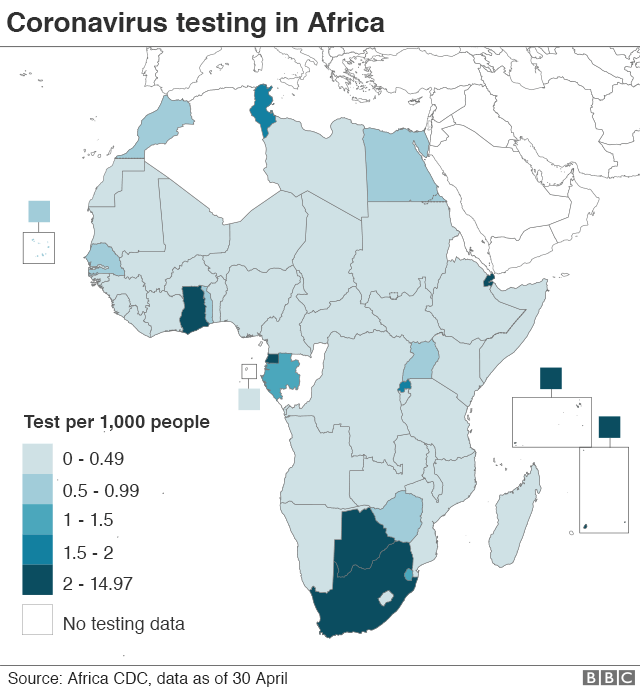
  • Coronavirus: Which African countries are ahead on testing?

    Testing plays a major role in the response to the coronavirus, as it helps us understand how far the disease has spread.

    The Africa Centres for Disease Control and Prevention, which co-ordinates pandemic responses across the continent, says there is a large gap in testing rates between nations.

    So which countries are succeeding in testing, and which are lagging behind?

    Who is testing most and least?

    Some of Africa’s smaller nations have achieved significantly better rates of testing than their larger neighbours.

    Mauritius and Djibouti, for example, have both achieved high rates of testing per capita.

    Ghana has also been praised for its level of testing, which its government says will help contain the spread of the virus once the lockdown is lifted.

    Coronavirus testing in Africa

    South Africa has also pursued a relatively aggressive testing strategy, and has so far managed over 200,000 tests. But this is way behind the numbers in countries like South Korea, Italy and Germany.

    There are concerns that Africa’s most populous country, Nigeria, is not testing nearly enough – although the government insists it’s focusing on “clusters” of positive cases.

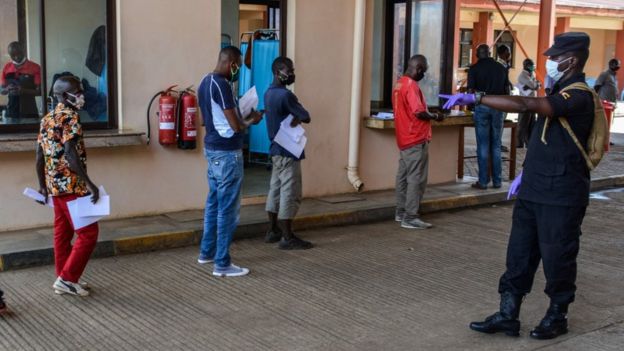
    Social distancing in Uganda
    Social distancing in Uganda | Getty Images

    The BBC’s Nigeria-based correspondent Chi Chi Izundu says the authorities are scaling up testing.

    “The aim is to be at 5,000 a day – but they’ve not even got to 1,000.”

    It’s worth adding that there are some countries on the continent where testing data is not available, such as Eritrea and Algeria.

    Some don’t have testing capacity, while others for various reasons won’t give out data.

    For example, President Magufuli of Tanzania has said releasing such data creates fear. His country has only released information intermittently, sometimes just giving out the numbers of people who have recovered from the virus.

    What are the obstacles to more testing?

    Getting hold of the chemical reagents needed to process tests can be difficult, as African countries don’t produce their own and need to compete for limited global supplies.

    John Nkengasong of Africa’s Centres for Disease Control says “the collapse of global co-operation and a failure of international solidarity has shoved Africa out of the diagnostics market”.

    He says African countries might have funds, but “70 countries imposing restrictions on exports of medical materials” has made it difficult to buy necessary goods.

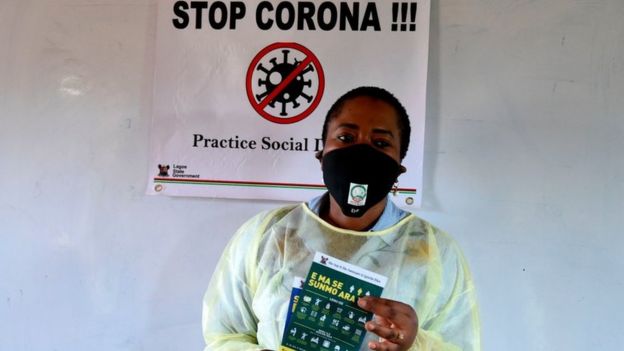
    Nigeria coronavirus outbreak
    A person holding a flyer in Nigeria, which tells people how to curb the spread of the virus | Getty Images

    There are also other barriers to increasing testing, including the lockdown measures to restrict movement, which can make it difficult for people to get to test sites.

    However, Ngozi Erondu, assistant professor at the London School of Hygiene and Tropical Medicine, says the bigger issue is the equipment.

    “It is not having enough kits and reagents,” she says.

    Nigeria’s Centre for Disease Control currently has 18 testing laboratories which can process tests that tell you if you have the disease. But it has put out an urgent plea for essential testing equipment.

    Kenya has also admitted to facing challenges in getting testing kits, swabs and reagents, and its overall testing figure has fallen recently as a result.

    The head of one of Kenya’s regional governments said recently that there were only 5,000 testing kits in the country, and that they were expecting 24,000 more.

    A meeting in Lagos State to plan for tackling coronavirus
    A meeting in Nigeria’s Lagos state to plan for tackling coronavirus | Getty Images

    There are also other social and political factors which could be barriers to greater testing.

    “In some communities there could be a stigma attached to having the coronavirus,” says Ngozi Erondu. “It’s also the case that local leaders may push back against testing if they are up for an election.”

    The African Union and the Africa Centres for Disease Control have launched an initiative, the Partnership to Accelerate COVID-19 Testing (PACT), which focuses on tracking, testing and tracing.

    The initiative aims to roll out about one million tests in four weeks across the whole continent.

    The earlier coronavirus outbreaks in Asia and Europe gave African states time to consider their responses, and the experience of handling epidemics such as Ebola has also helped them.

    But acquiring testing kits in a competitive global market, getting tests to where they need to be and setting up the labs to process samples is not a simple task for countries with less economic clout and weaker healthcare systems.

    Source: bbc.com

  • Coronavirus: Nigeria eyes 2 million tests in 3 months

    Nigeria Centre for Disease Control is looking to test two million Nigerians over the space of three months.

    This was revealed by the Director-General of the health agency, Chikwe Ihekweazu who revealed that NCDC was planning to ramp up testing.

    Ihekweazu who stated the NCDC was not only trying to improve testing but to bring test centres closer to home and build quality health infrastructures, noted that these things would take time.

    The NCDC boss who is concerned about how well the response to the virus will be promised to near millions in testing figures over the next quarter.

    He thanked the Presidential Taskforce on COVID19 and Health Ministry for their efforts.

     Source: MyNigeria

  • Kenya coronavirus cases reach 435, mass testing setback in Mombasa

    Kenya recorded 24 new coronavirus cases bringing the total tally to 435. 17 of the cases were recorded in Nairobi (10 in Eastleigh, 7 in Kawangware). Five in Mombasa. and two in Migori County.

    A 51-year-old woman in Mombasa became the 22nd victim whiles two more recoveries bring the total to 152. These figures were given by Health CAS Mercy Mwangangi in April 2 briefing on the virus situation.

    A total of 1195 tests conducted in the last 24 hours, one of the highest in a day. It also comes two days after mass testing was rolled out in parts of the capital and Mombasa. The exercise, however, suffered an early setback with low turnout, especially in Mombasa.

    According to records, although the target was 24,000 residents, only 131 showed up for the test rolled out on Thursday. The Health CAS cautioned small businesses that seem to have gone back to work, saying “the disease is still with us”.

    Businesses flouting the rules set in place to curb disease spread will be closed. Dr Mwangangi noted that there has been a decrease in the number of patients visiting hospitals for other illnesses.

    While this would ordinarily be good news, the CAS said citizens should not be afraid to seek medical assistance when needed, the Standard Digital portal said in its report.

    Source: africanews.com

  • Comoros announces first coronavirus case

    One of the few African countries without any reports of coronavirus has now confirmed its first case.

    Comoros’ President Azali Assoumani said the patient is a man who came in contact with a French-Comorian national who’d recently travelled to France before being hospitalised on 23 April.

    His condition is improving and the authorities are tracing those who came into contact with him, President Assoumani said.

    Lesotho is the only remaining African country that hasn’t reported any cases.

    There have been reports of people dying from “respiratory distress” in Comoros, but the president last week said no case had been registered in the country’s three islands.

    Source: bbc.com