South Korea held parliamentary elections on Wednesday amid the Coronavirus outbreak.
According to Yonhap News Agency, polling for 300 seats of the country’s National Assembly started at 6 a.m local time [2100GMT] and will continue until 6 p.m. [0900GMT].
Some 44 million people are expected to cast their votes wearing faces masks and gloves.
They will also check their temperature and sanitize their hands before entering the polling station.
More than 11 million people were allowed to cast their vote in advance to avoid crowds.
The government has also decided to lift quarantine rules to allow around 50,000 self-isolators to cast their votes after the regular polling ends, the agency reported
According to local media the ruling Democratic Party is expected to secure majority seats following recent response to the COVID-19 outbreak in the country.
South Korea has so far confirmed 10,591 coronavirus cases with 225 fatalities, while 7,616 patients have successfully recovered.
South Korea held parliamentary elections on Wednesday amid the Coronavirus outbreak.
According to Yonhap News Agency, polling for 300 seats of the country’s National Assembly started at 6 a.m local time [2100GMT] and will continue until 6 p.m. [0900GMT].
Some 44 million people are expected to cast their votes wearing faces masks and gloves.
They will also check their temperature and sanitize their hands before entering the polling station.
More than 11 million people were allowed to cast their vote in advance to avoid crowds.
The government has also decided to lift quarantine rules to allow around 50,000 self-isolators to cast their votes after the regular polling ends, the agency reported
According to local media the ruling Democratic Party is expected to secure majority seats following recent response to the COVID-19 outbreak in the country.
South Korea has so far confirmed 10,591 coronavirus cases with 225 fatalities, while 7,616 patients have successfully recovered.
US President Donald Trump has said he has instructed his administration to halt funding to the World Health Organization (WHO).
He said the WHO had “failed in its basic duty” in its response to the coronavirus outbreak.
He accused the UN body of mismanaging and covering up the spread of the virus after it emerged in China, and said it must be held accountable.
Mr Trump has previously accused the WHO of being biased towards China.
The US president has himself come under criticism at home over his handling of the outbreak.
“I am directing my administration to halt funding while a review is conducted to assess the World Health Organization’s role in severely mismanaging and covering up the spread of the coronavirus,” Mr Trump told a news conference at the White House.
“The WHO failed in its basic duty and it must be held accountable,” he added.
America is the WHO’s biggest single funder, providing $400m (£316m) last year – just under 15% of its total budget.
“With the outbreak of the Covid-19 pandemic, we have deep concerns whether America’s generosity has been put to the best use possible,” the president said.
The US is the worst-affected country in the coronavirus pandemic with 592,743 cases and 25,239 deaths.
President Trump accused the WHO of having failed to adequately assess the outbreak when it first emerged in the city of Wuhan.
“Had the WHO done its job to get medical experts into China to objectively assess the situation on the ground and to call out China’s lack of transparency, the outbreak could have been contained at its source with very little death,” he told reporters.
“This would have saved thousands of lives and avoided worldwide economic damage. Instead, the WHO willingly took China’s assurances to face value… and defended the actions of the Chinese government.”
Correspondents have pointed out, however, that Mr Trump himself praised China’s response to the outbreak and downplayed the danger of the virus at home.
What about the lockdowns?
Speaking in the Rose Garden at the White House, President Trump also said that plans to reopen the country were “close to being finalised”.
“I will be speaking to all 50 governors very shortly and I will be authorising each individual governor of each individual state to implement a plan,” he said.
“The federal government will be watching them closely. We will hold governors accountable, but will be working with them to make sure it goes really well.”
Mr Trump caused a furore on Monday when he said that he, and not state governors, had the authority to lift lockdowns and restart the economy.
Experts agree it is the governors who are responsible for policing their states under US law.
Earlier on Tuesday, New York Governor Andrew Cuomo accused President Trump of “spoiling for a fight”.
New York state has the most cases, with almost 190,000 cases and over 10,000 deaths. However, there are signs of improvement with the number of people there needing hospital treatment falling for the first time.
A day after extending a nationwide lockdown, India has relaxed restrictions on farming, banking and public works, but transport services and most businesses remain closed.
The rules which come into effect on 20 April, are expected to ease the supply chain and alleviate economic impact.
The lockdown which began on 25 March to contain the spread of the coronavirus will now end on 3 May.
India has reported 9,756 active cases and 377 deaths so far.
Although the country recorded its first case at the end of January, the numbers began to spike only by early March.
It was one of the first countries to impose heavy travel restrictions, including suspending most visas and eventually stopping all international flights. It also banned trains and flights within the country when the lockdown began.
But the continued restrictions will likely prove to be a challenge to implement. The news of the extension on Tuesday prompted thousands of migrant workers to take to the streets in some cities, demanding they be allowed to return home to their villages.
What has changed?
Apart from the restrictions on both international and domestic travel, schools, colleges, malls, cinema halls and most businesses except those providing essential services such as groceries and pharmacies will remain shut. All public gatherings social, political or religious are also still banned.
But the government has said it will allow agricultural businesses to open.
This includes dairy, aquaculture, tea, coffee and rubber plantations, as well as shops selling farming products such as fertilisers or machinery.
Public works programmes, which are a crucial source of employment for daily-wage earners, will also reopen, but under strict instructions to follow social distancing norms.
Trucks, trains and planes carrying cargo will also be allowed to operate as India has faced a supply crunch in recent weeks with goods being stuck at state borders.
Banks will also reopen, as will government centres distributing social security benefits and pensions.
Who do the new rules affect?
Most of the rules affect those involved in farming or businesses that support it. Agriculture employs more than 50% of Indians, and with the winter crop just harvested, getting food from the villages to the cities has become important to avoid shortages.
E-commerce will also benefit as courier services will restart from 20 April and once restrictions on cargo are lifted, many goods that were in short supply are likely to be available again. This is especially likely to help small or boutique retailers who rely on online orders for food items or other products such as tea and coffee.
The self-employed such as plumbers, electricians and carpenters will also be allowed to work, which will be welcome news to people working from home.
And roadside eateries on highways will also reopen with social distancing norms in place so lorry drivers transporting cargo have regular access to food.
But the government has said none of these new rules will apply in what they call “containment zonesâ€. State and district officials will actively take steps to identify virus hotspots and demarcate such zones, which will, in effect be sealed off, allowing only emergency vehicles or police to enter or leave these areas. And the new rules will not apply in these areas.
The Japanese city of Osaka is urging its residents to donate plastic raincoats to help hospitals that are running short of personal protective equipment.
Mayor Ichiro Matsui said some health workers had resorted to wearing rubbish bags when treating patients.
“If doctors get infected, we can never beat coronavirus,†Mr Matsui said, adding that there was a severe shortage of protective gear.
A notice on the Osaka city website said any colour and style of raincoat was acceptable as long as they were meant for adults, Reuters news agency reported.
Osaka has nearly 900 cases, making it the second hardest-hit after Tokyo, according to media reports.
A state of emergency was imposed in Tokyo and six other areas, including Osaka, last week. Japan has confirmed more than 8,000 cases and 166 deaths.
Four out of the seven Guineans who tested positive for COVID-19 in Tamale in the Northern region have tested negative after the first phase of their treatment.
The Northern Regional Health Director, Dr. John B. Eleeza, who confirmed the development to journalists, said the first sample of the patients were taken for testing and when the results came back three of them still tested positive whiles four tested negative.
“ We have given them the first phase of medication and they have completed it , we tested them and three came out positive whiles the remaining 4 tested negative,†he said.
He disclosed that another sample will be taken and tested to be sure that they all recover and test negative to the virus.
Dr. Eleeza noted that should the second test come out negative , the patients will be handed over to the regional coordinating council for them to decided if they should be deported back to their country.
The health director was optimistic that the four who tested negative will not be infected again because the seven patients live in separate rooms and they have educated them to adhere to the social distancing rules.
Tamale, the northern regional capital, recorded 10Â COVID-19Â cases at the Tamale Teaching Hospital recently.
The patients who tested positive included eight Guineans and two persons from Burkina Faso.
The patients traveled from Burkina Faso and Togo respectively through unapproved routes to Ghana.
They then lodged at a hotel (name withheld ) in Tamale for a couple of days before two of them were picked following a tip-off by residents.
The Northern Regional Minister, had said the 10 foreigners were put under mandatory quarantine in Tamale under the direction of the Regional Security Committee for 14 days.
According to him, samples of the patients were sent to the Komfo Anokye Teaching Hospital (KATH) and the results came back positive on the 11th day of their quarantine.
Meanwhile, one of the Guinean COVID-19 patients , a lady who tested positive in Tamale has reportedly escaped.
There is currently a manhunt by the security to apprehend her after she scaled the wall of the guesthouse being used to quarantine them.
International creditors must relieve African countries of debt payments this year to help them deal with the Coronavirus pandemic, French President Emmanuel Macron said in a wide-ranging interview with RFI on Wednesday in which he also urged Russia to get behind UN calls for a global ceasefire.
A moratorium on African countries’ debt payments is “an indispensable step” to help the continent weather the coronavirus crisis, the French president told Radio France Internationale (RFI), FRANCE 24’s sister station, calling for the debt to be eventually written off.
“We must give African economies some breathing space by suspending debt payments during this crisis,” Macron explained, describing the moratorium as a “global first”.
The French president’s comments come as his finance minister says major international creditors have reached a preliminary agreement to relieve the world’s poorest countries of debt payments this year.
Macron urged finance officials for the US, China and other G20 nations to finalise that agreement when they meet online on Wednesday.
In his interview, the French leader said he had secured the agreement of three of the five permanent members of the United Nations Security Council to back a call by the UN for a global ceasefire so the world can focus on the coronavirus pandemic.
The UN’s Secretary-General Antonio Guterres called for the world truce on March 23, warning that in war-torn countries, health systems have collapsed and the small number of health professionals left were often targeted in the fighting.
Macron said President Xi Jinping of China, US President Donald Trump and British Prime Minister Boris Johnson had all confirmed to him they would back the plea.
The French leader said he was hopeful of securing Russian President Vladimir Putin’s agreement in the coming hours.
“I spoke to him at the start of this initiative. I haven’t spoken to him since I got the firm confirmations of the other leaders. I will do in the next few hours,” Macron told RFI.
“I think that for sure President Putin will agree and the day he says he does, we’ll be able to hold this video conference and relay this call in a solemn, forceful and efficient way.”
Bishop Gerald Glenn, the pastor of New Deliverance Evangelistic Church in Virginia has died, the church announced on Sunday.
Glenn had tested positive for coronavirus, according to a video posted by his daughter Mar-Gerie Crawley.
Despite warnings from the Centers for Disease Control and Prevention to avoid mass gatherings and maintain social distancing, Glenn said in a sermon on March 22, “I firmly believe that God is larger than this dreaded virus,” and announced he was not afraid to die.
It was the next day that Virginia Gov. Ralph Northam issued his executive order banning all public and private gatherings of 10 people or more.
On April 4, Glenn’s daughter posted a video, announcing that both he and his wife, Marcietia Glenn, had tested positive for coronavirus.
The church’s post announcing Gerald Glenn’s death, asked that others would allow the “First Family to grieve in their own way.”
“While they are mourning the heartbreaking earthly absence of their family patriarch & spiritual father, they also have family members who are struggling to survive this dreaded pandemic,” the church’s Facebook post read.
Final arrangements for Glenn are expected to be made within the next few days, the church said.
Bishop Gerald Glenn, the pastor of New Deliverance Evangelistic Church in Virginia has died, the church announced on Sunday. Glenn had tested positive for coronavirus, according to a video posted by his daughter Mar-Gerie Crawley.
Despite warnings from the Centers for Disease Control and Prevention to avoid mass gatherings and maintain social distancing, Glenn said in a sermon on March 22, “I firmly believe that God is larger than this dreaded virus,” and announced he was not afraid to die.
It was the next day that Virginia Gov. Ralph Northam issued his executive order banning all public and private gatherings of 10 people or more.
On April 4, Glenn’s daughter posted a video, announcing that both he and his wife, Marcietia Glenn, had tested positive for coronavirus.
The church’s post announcing Gerald Glenn’s death, asked that others would allow the “First Family to grieve in their own way.”
“While they are mourning the heartbreaking earthly absence of their family patriarch & spiritual father, they also have family members who are struggling to survive this dreaded pandemic,” the church’s Facebook post read.
Final arrangements for Glenn are expected to be made within the next few days, the church said.
The Kenya National Nurses Association has demanded that protective equipment for health workers dealing with coronavirus patients is fixed before it is distributed.
Kenyan nurses have been asking for more pay and protective gear for those handling coronavirus patients.
Some county governors promised special allowances for the health workers.
Personal protective equipment for people working within 2m (6ft) of a coronavirus patient has become a concern for health workers all over the world who are demanding eye protection, surgical masks, aprons and gloves.
The Kenya National Nurses Association Chair Alfred Obengo visited a factory where protective gear is being made and tweeted that he saw “some gaps” that he ordered be rectified by Friday:
Today morning, I was part of the delegation from MOH to assess the quality of PPEs from EPZ.
However we observed some gaps which we ordered be rectified before Friday. We’re committed ensure our frontline warriors have the right regalia and artillery. https://t.co/JwvWUa4Udn
Somalia has registered a spike in confirmed Covid-19 cases after 35 People tested positive for the virus in the last 24 hours.
The Federal Minister for Health, Dr Fawzia Abikar Nur, said the country now has 60 confirmed cases from 25.
“We hereby confirm 35 new cases of the novel coronavirus, bringing the total number of Covid-19 cases in the country to 60,†the Minister told the media in the capital Mogadishu.
Three of the new cases were in the breakaway region of Somaliland.
“32 of the new cases were registered in Mogadishu, while two cases were recorded in Hargeisa and one was found in Borama.â€
Hargeisa is the capital city of the self-declared Republic of Somaliland, a region which unilaterally announced separation from the rest of Somalia in 1991. Borama is one of the major towns in Somaliland.
In the daily Covid-19 update, Minister Nur explained on Monday that 52 of the confirmed cases were recovering in their houses, being self-isolated.
One more patient is recuperating at an isolation centre in the Halane camp, the base of the African Union Mission in Somalia (Amisom).
CURFEW
Meanwhile, on Sunday, the government announced a night curfew in Mogadishu effective April 15th.
General Abdi Hassan Hijar, the commander of Somali Police Force, said the move is meant to contain the spread of coronavirus in the capital.
The curfew will be enforced from 8 pm in the evening till 5 am in the morning.
A medical researcher, Dr. Bamidele Iwalokun, has described the lockdown extension announced by President Muhammadu Buhari to further curb the spread of COVID-19 pandemic in Nigeria as very necessary.
Iwalokun, a Deputy Director of Research at the Nigeria Institute of Medi-Cal Research (NIMR), Yaba, expressed his views in an interview with the News Agency of Nigeria (NAN) in Lagos on Tuesday.
NAN reports that Buhari had, in a televised broadcast on Monday, announced another 14 days extension of the lockdown in Lagos, Ogun and the Federal Capital Territory, Abuja.
“The lockdown extension is necessary as the epidemic curve of confirmed COVID-19 cases is on the rise. “The pattern and trajectory of these cases suggest community transmission, a substrate for surge and countrywide spread.
“So, other states also need a lockdown and the government should scale up the surge plan and revise the logistics of distributing palliatives. “Worthy to mention is the scale up of diagnostic, treatment, isolation and quarantine centres at state and local government levels as well as our borders,†he said.
Iwalokun, who is also of the Department of Molecular Biology and Biotechnology in NIMR, said that more volunteer health workers should be engaged at the various centres across the country to support the existing workers.
He added that more research was needed to generate new data to advance the knowledge about the clinical conditions inflicted by the virus on Nigerians.
“More volunteer health workers are needed to man the various COVID-19 centres with appropriate training. “Also, more research should be carried out to accelerate the recovery and improving the prognosis of hospitalised patients with case-specific supportive treatments,†he said.
Iwalokun, however, advised the state governments to further harmonise their efforts with the local officials to strengthen community compliance to the lockdown.
“States like Lagos, Ogun and the FCT should strengthen community compliance through the Ministry of Local Government and Community Affairs. “This will improve public health education campaign and can also be integrated into the social palliative programmes,†the medical researcher said.
Former member of the Normalisation Committee for Ghana Football, Lawyer Dua Adonteng has described calls from clubs for support for government’s assistance as ‘inappropriate.’
The astute lawyer believes other measures like pay cut could help reduce the financial burdens brought on clubs by the coronavirus.
All football clubs in Ghana have been left inactive due to the outbreak of COVID-19 leaving clubs financially stricken.
“Clubs call on government for financial assistance is inappropriate,” Lawyer Duah Adonteng told Sikka Sports. “It will be ideal for pay cut to ease the financial burden that will entangle the clubs,” he added.
Last week General Manager of Techiman Eleven Wonders Takyi Arhin expressed the need for government to support clubs in these difficult times.
“After everything we had to take loans to pay our players. Now that football is back, we have coronavirus, even Pharmaceutical companies and GUTA are calling on government, aren’t we also Ghanaians to call on government?,” said Takyi Arhin. “So it’s fair to ask government for help.”
Other clubs have also joined calls for support including King Faisal Babies.
Ghana International Kwadwo Asamoah has donated $20,000 to the Komfo Anokye Teaching Hospital (KATH) towards the COVID-19 fight in Ghana.
The player who is currently in Italy says the donation is his contribution to the global pandemic which has brought sporting activities across the globe to a halt.
Asamoah who hails from the Ashanti Region believed it was appropriate to make donation to the region he grew up in.
The presentation of the cheque was done by Kwadwo Asamoah’s father today, April 14.
Kwadwo Asamoah has been one of Ghana’s finest players the last decade, playing for big sides such as Juventus and Inter Milan in that period.
He has also featured prominently for the Black Stars in the last few years, even though injuries has forced him to go in and out of the national side on a few occasions.
Ghana has so far recorded 636 cases of the coronavirus with 8 people confirmed dead from the disease.
Spanish club Atletico Madrid will be forced to offload some of its best players after the coronavirus pandemic, according to reports in Spain.
The Madrid club, according to the AS tabloid, are in line to sell Ghanaian midfielder Thomas Teye Partey and three other players in order to survive financially.
Despite having a contract that ends in 2023, the midfielder has a 50 million euros release clause in his contract which appeals to a lot of suitors.
According to AS, the Rojiblancos have penciled four players they will sell when all this COVID-19 crisis is over in order to survive and Thomas Partey is among them.
Thus, the Colchoneros will put 4 players on the market and not the least. Disappointing, Frenchman Thomas Lemar has hardly impressed since his arrival in Madrid will be part and Diego Costa
Ghana’s national team, the Black Stars, may not play until 2021 as international matches could be cancelled due to the global coronavirus pandemic, says a FIFA vice president dealing with its impact on the sport.
The Black Stars were scheduled to play Sudan in back-to-back Africa Cup of Nations qualifiers in March but the matches were cancelled due to the outbreak of the deadly disease.
Further matches against South Africa and Sao Tome & Principe were scheduled for May and June respectively but all are in doubt because of the coronavirus.
CAF, Africa’s football governing body, has to agree on a new date to reschedule the matches before the 2021 Africa Cup of Nations takes place early next year in Cameroon.
FIFA has already postponed international fixtures including World Cup qualifiers due to take place in March and June.
As a result of the postponements of the international matches, FIFA has set up a working group to deal with the implications of the virus on the fixture calendar.
Victor Montagliani, who is also the president of the governing body of football in North and Central America and the Caribbean (CONCACAF), heads the working group.
He says the matches scheduled for the international windows in September, October and November could be under threat, too.
Asked by the Associated Press if he saw national teams playing in 2020, he said: “I personally think that might be a bit of a challenge, not so much because of just the health issues around the world and the various degrees of preparedness, but also committing to international travel as soon as we come back.
“I think that domestic football is a priority. September is still in the books, but I would garner to say that I’m not sure it’s there on solid ground the way things are trending right now.”
Montagliani also said he does not think supporters will be able to attend matches as soon as domestic football returns, adding: “If we get the green light to play a football match, I highly doubt that first football match will be with fans. I just can’t see that. I think that would be taking a massive risk.
“I’m pretty sure it’ll be a phased in approach, just like the rest of society is going to be is then in terms of us trying to get back to normal here.”
Emmanuel Agyemang Badu is a Ghana midfielder playing for Hellas Verona in Italy – where, like most countries, football is on hold during the coronavirus crisis.
In March, his sister Hagar was shot and killed in the city of Berekum. He has not being able to go back to Ghana to see his family because of the pandemic.
2019 and 2020 have been the toughest years of my life.
I nearly died, I got a lot of injuries – and then I lost my sister in a very painful way.
It’s very difficult for me and my family. The guy who shot my sister is on the run; they haven’t got him yet, because things are going slowly because of this virus.
It was a disaster.
I live alone here in Verona. My girlfriend and my child are not here with me, and I’m in the middle of this pandemic.
I need to thank my family and friends and our team and my agent.
My coach has called me every day to check up on me – as well as the team manager and the president. They have all been wonderful.
Without them it would have been a disaster.
I have been in a room for 34 days. My sister has been killed painfully and I couldn’t go to see what happened.
But this is the job I have chosen. This is how the situation has been.
I just need to abide with it it, take care of myself, be mentally tough and live with it right now – because right now I can’t do anything.
Near-death experience
In August I came close to dying myself.
We were in pre season, everything was going well. It was a week before the league started.
The morning after a game I came to the gym to do some gym work. That night I came home and was struggling to breathe.
I didn’t take it seriously at first – I thought it was tiredness.
In the morning they gave me some painkillers. But the next night it was even worse.
At 2am I called the doctor and fortunately he was awake. He sent a physio who was closer to me and he came – and immediately said, “we need to go to the hospital”.
Eventually they found out that I had a blood clot in my lungs. I had to stop playing football for three to four months.
It was a very dramatic time for me but in certain times like this you need to be strong, thank god I’m back on my feet and doing well now.
It was very serious, I think if I hadn’t got the physio and the doctor to check up on me it would’ve been a disaster.
Helping the home country
I’m in the middle of this pandemic here in Italy, so I know how people are struggling and suffering. This is the time for me to help.
I bought some masks, gloves and sanitizers for a hospital in Kumasi – the women and children’s ward.
And I played in Berekum for a long time, so I bought some for the hospitals there, and for the police and Muslim community.
And in the village I was born, I donated a lot of stuff to the police and the hospitals.
They’re saying prevention is better than cure, so I wanted them to have these things to be safe and be very careful of this dangerous virus.
The numbers are increasing, so next week I need to send some more stuff to hospitals.
We will keep doing it until we see this virus is gone. I am in the middle of it here and I know how much I’m struggling here so we all need to help and take care of people in Africa.
Living through lockdown
It has been a very frustrating season.
From August to December I didn’t do anything. I came back training with the team for 3-4 weeks and started having some very reduced playing time – but then the virus happened.
I can’t do anything about it – I just thank God that I have my life.
I’m doing very well now – no injuries; life is more precious than football so right now we need to take care of ourselves. Be safe and pray that this thing goes fast, so we can all get back to doing what we love to do.
The first 18 days I was in isolation because we played against Sampdoria and unfortunately most of their players tested positive so we needed to be isolated.
After that 18 days, I started going to the small market to get food, but that is the only place you can go.
From there I just come back home. It’s very difficult, but it’s not me alone.
The whole world is in this mess now, so I just need to abide by this, take the precautions and save myself.
A lot of rumours are going around over when the league will restart but we don’t know anything.
They told us to just stay at home and train at home, so that’s the only thing we can do now.
The situation is a dicey one for the big men in charge. It’s not an easy thing.
The first priority is to make sure we are safe from this virus, and then after that you can have football at any time.
Let’s think about the dangerous virus now. Afterwards we can see when football can start.
Hearts of Oak Managing Director Frederick Moore says the Coronavirus shutdown has hit the club’s finances.
The Ghana Premier League was suspended last month after the country recorded more cases
Ghana football has struggled after the airing of a documentary which exposed bribery and corruption in the local game.
There has been no competitive football since 2018 and this latest development is a huge blow.
“Last year we had competition but it was a third of what we would have actually experienced in a proper football season,” he told BBC World Service’s Newsday programme.
“The impact of that is that it lost some glitter in the minds of people about football. Also, more importantly, the funding – the sponsorship – almost dried up for most of the clubs and it meant club owners had to dig deep into their own pockets.
“So when 2019/2020 came in, with the launch of the season and everything that went on, it was really encouraging to see football coming back.”
Many older people are being “airbrushed” out of coronavirus figures in the UK, charities have warned.
The official death toll has been criticised for only covering people who die in hospital – but not those in care homes or in their own houses.
Work and Pensions Secretary Therese Coffey told the BBC the daily figure was based on hospital deaths because “it’s accurate and quick”.
Meanwhile, scientists will begin a review of the UK lockdown later.
The evaluation will be passed to the government – but ministers have said it was unlikely restrictions would change.
The latest figures from the Office for National Statistics, which include every community death linked to Covid-19 in England and Wales, showed a total of 406 such deaths registered up to 3 April had occurred outside of hospitals.
That would have added an extra 11% to the official UK figures, based solely on deaths in hospitals, that were being reported at that time.
Of those extra deaths, 217 took place in care homes, 33 in hospices, 136 in private homes, three in other communal establishments and 17 elsewhere.
Northern Ireland’s chief medical officer has said details about the number of coronavirus-related deaths in care homes remain unclear, but it was reported last week that there were cases of Covid-19 in 20 care homes across the nation.
Industry leaders from Age UK, Marie Curie, Care England, Independent Age and the Alzheimer’s Society have written to Health Secretary Matt Hancock demanding a care package to support social care through the pandemic.
They have also called for a daily update on deaths in the care system.
It comes after the government confirmed there had been coronavirus outbreaks at more than 2,000 care homes in England – although they did not specify the number of deaths that had occurred.
The figures prompted the charity Age UK to claim coronavirus is “running wild” in care homes for elderly people.
“The current figures are airbrushing older people out like they don’t matter,” Caroline Abrahams, the charity’s director, said.
Meanwhile, Britain’s largest care home operator said coronavirus was present in two-thirds – 232 – of the group’s care homes.
Its director, Sir David Behan, told BBC Radio 4’s Today programme that coronavirus deaths represented about one-third of all deaths at HC-One’s care homes over the last three weeks. HC-One has 329 care homes throughout England, Scotland and Wales.
About 410,000 people live in care homes in the UK, living in 11,300 care homes for older people supplied by 5,500 different providers.
Addressing why deaths in care homes are not being included in the government’s data, Ms Coffey told BBC Radio 4’s Today programme that the figures published weekly by the ONS is a “fair” way of establishing the “unfortunate picture” of where deaths are occurring.
England’s care home regulator, the Care Quality Commission, has said it will begin recording deaths in adult social care from this week – asking care providers to give daily updates on the number of confirmed and suspected cases.
Labour’s shadow social care minister Liz Kendall said daily figures were essential to dealing with the “emerging crisis” in care homes and called for the government to offer social care “whatever resources it needs”.
Conservative peer and former work and pensions minister Baroness Altmann told Today that “one or two” people in care homes had said to her they felt as though older people are being treated “like lambs to the slaughter”.
“They [care homes] are left without protective equipment, they are left without testing,” she said.
She added that “the mark of a civilised society” was “how it treats it most vulnerable and oldest citizens”.
It comes after Ms Abrahams said care homes were “underprepared” for the outbreak, adding that the lack of personal protective equipment (PPE) and testing was leading to the spread of coronavirus across the care home sector.
However, Ms Coffey told the Today programme that the care sector was not being left behind, adding that PPE was being delivered “to over 26,000 care settings across the country including care homes, home care providers and also hospices”.
On Monday, the UK’s chief medical adviser Prof Chris Whitty told the daily Downing Street coronavirus briefing that 92 homes in the UK reported outbreaks in one day.
The Department of Health and Social Care later confirmed 2,099 care homes in England have so far had cases of the virus.
Care England has estimated there have been nearly 1,000 deaths from coronavirus in care homes, leaving social care as “the neglected front line”.
The Labour Party has called on the government to publish daily figures of deaths in care homes to highlight the “true scale” of the spread of the virus, which causes the Covid-19 disease.
The issue has regularly been raised by journalists at the daily Downing Street briefing and the government response has been that the number announced each day is based on hospital figures as this can be quickly gathered and analysed – whereas deaths in the wider community take much longer to be collated after death certificates are issued by doctors.
The government says it is following the international standard by quoting the hospital figures each day – and that the fuller ONS figures can lag many days behind.
The latest care homes to confirm residents have died with symptoms of the virus include a home in Drumchapel, Glasgow, a specialist dementia home in Selston, Nottinghamshire, and a home in County Durham where 13 residents have died.
The Department of Health’s official death number of deaths of people in hospital with coronavirus rose to 11,329 on Monday – up by 717 in a day.
Lockdown review The BBC’s science editor David Shukman said the Scientific Advisory Group for Emergencies (Sage) meeting later in the day will evaluate various ways coronavirus is unfolding in the UK.
It will look at hospital admissions, the approach to testing, data on intensive care capacity and deaths, the effectiveness of lockdown tactics, and whether or not the public should be advised to wear face masks outdoors.
Meanwhile, the government has defended itself after reports it missed three chances to bulk-buy PPE for healthcare workers treating virus patients.
Health workers in 25 EU countries are set to receive deliveries of kit worth £1.3bn in the coming days, according to the Guardian.
The paper reports the UK missed three opportunities to join the scheme and has not taken part in talks on future purchases.
The Department of Health said it would “consider participating in future EU joint procurement schemes on the basis of public health requirements at the time”.
“We will continue to work with European countries and others in order to make sure that we can increase the capacity within the NHS,” they said.
Toyota Motor Corp (7203.T) on Monday said it plans to restart limited production at vehicle plants in France and Poland from April 22 after closing them due to the coronavirus pandemic.
Most other plants in Europe, North America, Latin America and Asia will remain closed for now, it said in a news release.
A new study showed that some women who delivered babies in the city in recent weeks had been inflicted with the coronavirus without displaying symptoms.
NewYork-Presbyterian and Columbia University Medical Center screened more than 200 women for the illness upon admission between March 22 and April 4, according to the study.
Among the 33 patients who tested positive, 29 of them had no symptoms.
One patient with a swab that was negative for SARS-CoV-2 on admission became symptomatic after giving birth, and was tested again 3 days after the initial test.
SARS-CoV-2 is the severe acute respiratory syndrome that causes COVID-19.
The first diagnosed case of COVID-19 in an obstetrical patient was on March 13, 2020, according to doctors in the study.
The study, doctors claim, underscores the risk of COVID-19 among asymptomatic obstetrical patients. It also warns the true prevalence of infection may be underreported because of false-negative results of tests to detect SARS-CoV-2.
“The potential benefits of a universal testing approach include the ability to use COVID-19 status to determine hospital isolation practices and bed assignments, inform neonatal care, and guide the use of personal protective equipment,†the study says.
“Access to such clinical data provides an important opportunity to protect mothers, babies, and health care teams during these challenging times.â€
British foreign minister Dominic Raab is set to announce on Thursday that the lockdown in the country will stay in place until at least May 7, the Times reported.
Raab, deputizing for Prime Minister Boris Johnson who is recovering from COVID-19, earlier on Monday said he did not expect the government to make any changes to the lockdown measures currently in place until it was confident they could be made safely.
A total of 11,329 people have died in hospitals across the UK after testing positive for coronavirus, according to a health ministry statement on Monday.
Fast asleep, swaddled in a towel and snug in a pink beanie, a baby born during a pandemic in a Thai hospital needs one last item to ensure its health a face shield.
Bangkok hospitals are using the shields on newborns in their maternity wards to prevent the spread of the coronavirus.
Thailand has detected 2,613 cases of the virus, with 41 deaths — a relatively low number despite being the first country outside China to record an infection.
Bangkok is now under an effective lockdown, silencing the usual boistrous and boozy Thai new year Songkran festival this week while an overnight curfew has kept all but essential vehicles off the streets.
Extraordinary measures have also been rolled out at Praram 9 Hospital, where newborns are being fitted with face shields, a precaution taken at other maternity wards across the capital.
The tiny face guards have been designed by the hospital for use when the baby makes its first journey home.
The Italian Football Federation hopes that players can be tested for coronavirus at the start of May in preparation for the season to restart.
Serie A has been suspended since 9 March because of the global pandemic.
There is no set date for when the campaign can resume in Italy, with 12 full rounds and four outstanding fixtures still to play.
“As soon as the conditions are right, we’ll finish the championship,” said federation president Gabriele Gravina.
Speaking to Sky Sports Italia, he added: “Soon, there will be a meeting. We will establish the procedure which we will then communicate.
“We will start, I hope, at the beginning of May with tests to ensure that players are negative and training can follow.
“Will we play through the summer? We don’t have a deadline but the idea is to finish the championships.”
Italy has been one of the countries hardest hit by the coronavirus crisis, and players at a number of clubs have been infected.
Juventus lead the Italian top flight, one point ahead of Lazio and nine clear of third-placed Inter Milan.
Brescia president Massimo Cellino, whose side are bottom of the table, has said he is ready to forfeit the club’s remaining games if the season resumes.
Last week, German teams became the first from Europe’s top leagues to return to training, with precautions in place.
Tottenham Hotspur have no intention of letting striker Harry Kane leave the club this summer and would not sell to a domestic rival.
Kane, 26, signed a six-year contract with Spurs in June 2018.
Last month, he said he would not stay at the north London club “just for the sake of it”, and there are reports chairman Daniel Levy would be open to selling him for about £200m.
Manchester United are long-time admirers of the England captain.
Tottenham were one of the first Premier League clubs to furlough staff in response to the coronavirus pandemic, with Levy warning that “people need to wake up to the enormity” of the crisis.
However, the club subsequently reversed that decision following criticism from supporters, with only board members now taking salary reductions.
There are suggestions that because of financial worries, Levy would sanction Kane’s sale if the fee was in the region of the world record £200m Paris St-Germain paid Barcelona to sign Brazil forward Neymar in 2017.
However, there is uncertainty over the summer transfer market given the present shutdown of football across Europe, with all the major clubs facing a financial headache.
Around half of deaths from COVID-19 are happening in care homes, according to data from some European countries.
Figures from five European countries suggest that care home residents have accounted for between 42% and 57% of all deaths related to COVID-19, the illness caused by the coronavirus.
The figures are contained in a report by academics at the London School of Economics, which focuses on Italy, Spain, France, Ireland and Belgium.
This would suggest that the daily figures announced by the UK government are vastly under-estimated, as they only include deaths in hospitals where a patient had tested positive for the virus.
Almost two million people worldwide have been infected with the disease and around 120,000 have died after testing positive for it, according to data from US university Johns Hopkins.
A mother with coronavirus has given birth while in a medically induced coma.
Angela Primachenko, 27, from Vancouver, Washington, caught COVID-19 in March and was placed on a ventilator when she was 33 weeks pregnant, according to her twin sister.
The respiratory therapist’s condition deteriorated to the point where doctors put her into a coma at Legacy Salmon Creek Medical Center and later helped deliver her baby while she was under.
The baby, named Ava, tested negative for COVID-19 but has had to be kept apart from her mother temporarily.
Mrs Primachenko shared a photo of her newborn on Sunday, writing: “Baby Ava is still in the NICU and i still haven’t been able to see her in person.”
The next day, the now mother-of-two announced she had been discharged from hospital, writing: “7 days in the hospital. 10 days intubated. Thousands of prayers later I am home and it feels so good!!!!!”
On March 30, her twin sister launched a fundraiser to help with the medical costs, raising almost $50,000 (£39,800) so far.
Patients with COVID-19 have suffered strokes and other neurological symptoms, according to the first scientific study to analyse the effects of the disease on the brain.
The study found that neurological effects were seen in just over a third of all cases of hospitalised COVID-19 patients, but affected more than 45% of those with severe infections.
It isn’t yet clear if the coronavirus is causing the strokes directly or as a result of the body’s inflammatory response, and leading neurologists say more research is needed.
They warn that as well as respiratory symptoms, doctors need to consider potential neurological effects when assessing new patients.
The study was carried out by researchers at Huazhong University in Wuhan, and the Barrow Neurological Institute in Arizona.
The team analysed cases in Wuhan in China, the original epicentre of the outbreak, between 16 January and 19 February – including 214 hospitalised patients whose diagnoses were laboratory-confirmed.
Just over a third of these patients, 78 (36.4%), had neurological symptoms as well as respiratory symptoms.
“Compared with patients with non-severe infection, patients with severe infection were older, had more underlying disorders, especially hypertension, and showed fewer typical symptoms of COVID-19, such as fever and cough,” they found.
The study, in the journal JAMA, was published alongside an editorial by leading neurologists which notes the similarity of the coronavirus to SARS – which researchers have shown caused strokes.
However, unlike in SARS patients, the new study found that neurological symptoms could occur very early within the infection.
Some patients presented at hospital without a fever but had neurological issues including losing their taste or smell, as well more significant impacts such as impaired consciousness, headaches and dizziness.
The scientists warn that the disease may infect the “nervous system and skeletal muscle as well as [the] respiratory tract” which could provide healthcare workers with an additional way to diagnose patients.
COVID-19 has “now reached pandemic status and is common all over the world” said the neurologists in their editorial.
“With so many affected patients, we can expect as neurologists to be confronted with these patients commonly in coming months and years.”
Uganda has begun serving local Chinese residents with the same hostility meted out to some Africans in China.
In a video, a business owner in Uganda is seen giving orders not to allow access to any Chinese citizens into their premises.
Horrible videos and pictures have been flying across the internet showing how Africans in China are been denied access to their hotels and apartments on the basis that may be carrying the Coronavirus.
The African Union and other international organizations have condemned the inhumane act by China on African residents and called for a seizure.
Watch Video Below:
In a video, a business owner in Uganda is seen giving orders not to allow access to any Chinese citizens into their premises.
Horrible videos and pictures have been flying across the internet showing how Africans in China are been denied access to their hotels and apartments on the basis that may be carrying the Coronavirus.
The African Union and other international organizations have condemned the inhumane act by China on African residents and called for a seizure.
Watch Video Below:
Ugandans start reciprocating by kicking Chinese citizens out of business premises just like Africans are being denied entry into business premises in China. pic.twitter.com/5ZsT0IpZCp
Italy, the worst-hit country in Europe, has recorded its lowest number of new coronavirus-related deaths in more than three weeks.
Authorities say 431 people died with COVID-19 in the past day – the lowest in a 24-hour period since 19 March – bringing the total to 19,899.
For the ninth consecutive day, the number of patients admitted into intensive care with the virus was down, and the number taken to hospital overall also fell.
As Italy began its fifth week under lockdown, more than 4,000 people were diagnosed, continuing a general flattening of the so-called curve.
But officials have noted the nation has also increased the number of people being tested in recent days, with more positive cases, but allowing for more effective quarantine measures for those once they know they are infected.
On Sunday, the country passed the one million mark in testing, doubling the number since the end of March.
Image: Italy has recorded its lowest daily number of deaths for three weeks
Overall, 156,363 people have been confirmed to have the virus, although it is claimed the true number could be as much as 10 times that, particularly in the hard-hit Lombardy area.
Image: For the ninth consecutive day, the number of patients in Italy admitted into intensive care was down
Meanwhile, Italy’s civil protection agency has arranged for rescued migrants to be placed in quarantine to check for coronavirus infections on ships or on land.
More than 1.8 million people worldwide have now been infected, and over 113,000 have died, according to the Johns Hopkins University, which is tracking the pandemic.
Coronavirus: The infection numbers in real time
Spain has now overtaken Italy in terms of cases, with more than 166,000 – second only to the United States – and almost 17,000 people in Spain have died with the virus.
The country’s latest fatality figure rose for the first time in three days on Sunday, to 619, bringing the total to 16,972.
More than 60,000 patients have recovered.
Spain also recorded its lowest daily growth in confirmed infections in three weeks, as it prepares to loosen its strict lockdown measures and allow some workers to return to their jobs.
Those who can work from home are strongly being encouraged by authorities to continue doing so.
Retail shops will remain closed, other than supermarkets, fruit stands, bakeries, butchers, newsstands and pharmacies.
In the UK, another 737 people with COVID-19 died in hospitals, taking the total passed the 10,000 mark – to 10,612.
The total number of infections in Britain now stands at 84,279.
In the Republic of Ireland, the number of deaths has risen by 14 to 334. There are 9,655 infections.
In France, the number of deaths – which includes figures from hospitals and nursing homes – rose by 561 to 14,393 as of Sunday.
But for the fourth day in a row, slightly fewer people were admitted into intensive care.
However, the country’s health authority said it was important to remain vigilant because hospitals were still taking in a very large number of patients.
Russia reported its largest daily increase of cases on Sunday – 2,186 – since the outbreak began.
Moscow and many other regions have been in lockdown for almost two weeks, but the number of cases reached 15,770 – while the number of deaths rose to 130.
Authorities in the capital have clamped down on those venturing outside without a reason, such as to buy food or medicine, get medical treatment, walk the dog, or take out the rubbish.
Around 3.5 million people there, in a city of 12.5 million, reportedly left their homes for more than six hours on Friday, according to a track analysis of their mobile phones – and more than 1,300 fines have been issued for breaking rules.
Moscow is preparing to introduce digital permits next week to control movement to help enforce the lockdown.
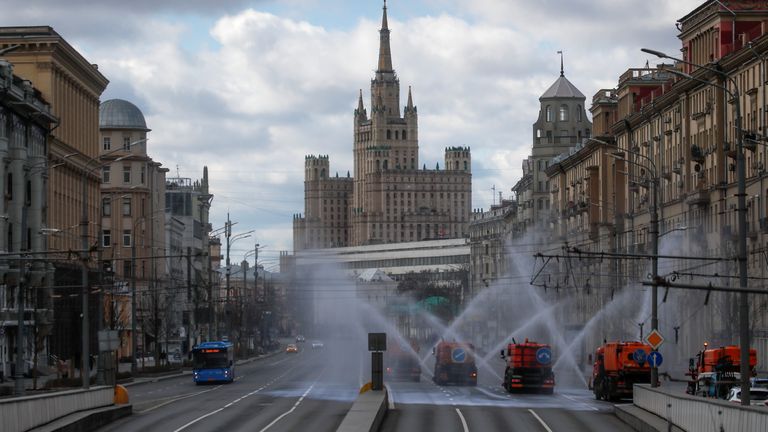
Image: Vehicles spray disinfectant while sanitising a road in Moscow
In Japan, two workers’ groups have issued a joint statement warning about a “collapse of emergency medicine,” which may lead to the collapse of medicine overall.
The Japanese Association for Acute Medicine, and the Japanese Society for Emergency Medicine have said healthcare facilities are being stretched amid a surge in coronavirus patients.
The statement said many hospitals were turning people away who were brought in by ambulance, including those suffering strokes, heart attacks and external injuries.
It said that some who were not accepted, later turned out to have the virus.
Japan – which has declared a state of emergency and is asking people to stay at home – has nearly 7,000 cases, and 108 deaths, but the numbers are growing.
However there is better news for Australia, with its chief medical officer saying the country is “in a good place” in its fight against the disease, as deaths rose by just three, to 59.
It now has 6,289 confirmed cases.
Brendan Murphy has said there is “no place in the world I would rather be than Australia at the moment”.
Statement by the Measles & Rubella Initiative: American Red Cross, U.S. CDC, UNICEF, UN Foundation and WHO
“As COVID-19 continues to spread globally, over 117 million children in 37 countries may miss out on receiving life-saving measles vaccine. Measles immunization campaigns in 24 countries have already been delayed; more will be postponed.
“During this challenging period, the Measles & Rubella Initiative (M&RI) expresses solidarity with families, communities, governments and emergency responders and joins our global immunization and health partners, including those within Gavi, the Vaccine Alliance and the Global Polio Eradication Initiative (GPEI) in our collective focus and fight against the threat of COVID-19. The pandemic sweeping the globe requires a coordinated effort and commitment of resources to ensure frontline health workers around the world are protected, as they face and respond to this new threat. At the same time, we must also champion efforts to protect essential immunization services, now and for the future.
“The World Health Organization (WHO) has issued new guidelines endorsed by the Strategic Advisory Group of Experts on Immunization — to help countries to sustain immunization activities during the COVID-19 pandemic. The guidelines recommend that governments temporarily pause preventive immunization campaigns where there is no active outbreak of a vaccine-preventable disease. M&RI partners, which include the American Red Cross, the U.S. Centers for Disease Control and Prevention, UNICEF, the United Nations Foundation and WHO, strongly agree with these recommendations. We also urge countries to continue routine immunization services, while ensuring the safety of communities and health workers. The recommendations also ask governments to undertake a careful risk-benefit analysis when deciding whether to delay vaccination campaigns in response to outbreaks, with the possibility of postponement where risks of COVID-19 transmission are deemed unacceptably high.
“The M&RI supports the need to protect communities and health workers from COVID-19 through a pause of mass campaigns, where risks of the disease are high. However, this should not mean that children permanently miss out. Urgent efforts must be taken now at local, national, regional and global levels to prepare to close the immunity gaps that the measles virus will exploit, by ensuring that vaccines are available and that they reach children and vulnerable populations, as quickly as possible, to keep them safe.
“Despite having a safe and effective vaccine for over 50 years, measles cases surged over recent years and claimed more than 140,000 lives in 2018, mostly of children and babies all of which were preventable. Against this already dangerous backdrop, preventive and responsive measles vaccination campaigns have now been paused or postponed in 24 countries to help avert further spread of COVID-19. Campaigns expected to take place later in 2020 in an additional 13 countries may not be implemented. Together, more than 117 million children in 37 countries, many of whom live in regions with ongoing measles outbreaks, could be impacted by the suspension of scheduled immunization activities. This staggering number does not include the number of infants that may not be vaccinated because of the effect of COVID-19 on routine immunization services. Children younger than 12 months of age are more likely to die from measles complications, and if the circulation of measles virus is not stopped, their risk of exposure to measles will increase daily.
“The M&RI salutes the heroism of health and emergency workers across the globe, and we recognize the vital role they play in delivering clear, trusted information, as well as preventive and supportive care within their communities. We must invest in health workers and ensure they are protected from infection and empowered as part of sustainable and functioning primary health systems. They are the first line of defense against global epidemics. We also recognize the role of parents and caregivers in ensuring their children are vaccinated by following physical distancing recommendations in line with national guidance. Finally, we call on countries and local leaders to implement effective communication strategies to engage communities, ensure supply and demand for vaccination remains strong, and help assure a healthy life for every child especially in this challenging time.â€
President Donald Trump has claimed “total” power to lift the nationwide coronavirus lockdown, contradicting governors and legal experts.
“The president of the United States calls the shots,” Mr Trump said during a combative press conference in which he feuded with reporters.
But the US Constitution says the states maintain public order and safety.
Ten states on the US East and West coasts are planning to lift their strict stay-at-home orders.
The US is the global epicentre of the coronavirus pandemic with 682,619 confirmed cases and 23,608 deaths.
What did President Trump say?
Mr Trump, a Republican, told the daily White House coronavirus briefing on Monday that his administration was finalising a plan to reopen the US economy, which has been largely shut down to slow the spread of the coronavirus.
The Trump administration has signalled 1 May as a potential date for easing the restrictions.
The current White House recommendations for Americans to avoid restaurants and non-essential travel and keep in-person gatherings to no more than 10 people expire on 30 April.
But when journalists queried whether Mr Trump had the authority to over-ride stay-at-home orders imposed on a state-by-state basis, he said: “When somebody is the president of the United States, the authority is total.
“It’s total. The governors know that.”
He added: “That being said, we’re going to work with the states.”
The president insisted “numerous provisions” in the US founding charter give him such power, without specifying which ones.
But legal experts say the president does not have the authority to reverse a public health restriction put in place at the state or local level.
Asked by the BBC’s Jon Sopel if he was concerned about the possibility of having to close the economy again if a second wave of coronavirus strikes, Mr Trump said: “It does weigh on my mind.”
He told reporters the number of deaths from the virus in the US had begun to plateau, indicating that social distancing efforts had succeeded.
During the briefing, the White House played a video montage lambasting the media coverage, touting the president’s handling of the pandemic and clips of governors praising the Trump administration.
Several news outlets, which have been broadcasting the daily briefings live, quickly cut away.
Families in parts of rural England say they have become totally dependent on volunteers delivering food to them during the coronavirus crisis.
About 1.5 million households are at least a half-hour round trip from a food store on foot or by public transport, government data suggest.
In urban areas, the average is less than 15 minutes, excluding time in the shop.
The Countryside Alliance said local food volunteers were “plugging gaps” in rural communities.
Under lockdown restrictions, shopping for food is one of only four reasons why people are allowed to leave their home.
In rural England, many households face long distances to go food shopping, which becomes more difficult if a family has to self-isolate because of COVID-19.
“Without these deliveries from volunteers my children would starve,” said Catherine Boyes, a mother of six who lives on a farm on the edge of the North York Moors National Park.
She said she had struggled to get a regular delivery from a supermarket due to surging demand and is reliant on the Pickering Help Network to deliver supplies.
“My eldest son has cystic fibrosis so we can’t go to the shops and risk coming into contact with this hideous disease,” she said.
“This crisis really has brought out how isolated we are.”
Families across the country are facing difficulties receiving regular home deliveries from the big supermarkets.
Tesco has said it will not be able to meet all requests for home deliveries.
Sainsbury’s has said it will prioritise vulnerable people for delivery slots while Asda has said if people can shop safely in stores they should do so to free up deliveries for those who need them.
The global Coronavirus cases surpassed 1.9 million on Monday, according to a running tally by U.S.-based Johns Hopkins University.
The Hopkins data showed that the global number of deaths reached 118,459, while the number of people who recovered stands at 446,002.
As a total of 1,904,566 cases are recorded worldwide, the U.S. has the most cases with more than half a million infections — over 572,000. It also has the highest number of deaths with more than 23,000, becoming the new epicenter of the COVID-19.
While Italy has the second-highest death toll with 20,465, Spain is the second country with the highest cases, 169,496.
China, ground zero of the virus, most recently reported 3,345 deaths and over 83,200 cases, but those figures raise question in and outside China.
Recently, according to the Hopkins data, daily fatalities remain in single digits in China and it recorded the most recoveries from the epidemic with above 78,000.
Overall, the virus has spread to 185 countries since it first emerged in China in December.
Despite the rising number of cases, most who contract the virus suffer mild symptoms before making a recovery.
Austria is to reopen thousands of shops on Tuesday as it seeks to ease restrictions brought in to stem the spread of the coronavirus.
Garden centres, DIY stores and small shops will open as part of a step-by-step plan to restart the economy.
However strict social distancing rules remain in place, with people urged to stay at home as much as possible.
It comes as some other European countries ease restrictions imposed over the pandemic.
Spain has allowed some citizens to return to work and Denmark is reopening schools for younger children.
Italy – Europe’s hardest-hit country with more than 20,000 deaths – will allow a narrow range of firms to resume operations on Tuesday.
However, French President Emmanuel Macron has extended the lockdown there for another four weeks until 11 May.
In a televised address, he said the current restrictions had slowed the virus but not beaten it.
The World Health Organization has welcomed the slowing down of infections in some European countries but warned against lifting restrictions too early.
Director-general Dr Tedros Adhanom Ghebreyesus has cautioned that easing measures too quickly “could lead to a deadly resurgence”.
Austria was one of the first European countries to follow neighbouring Italy in imposing strict lockdown measures about a month ago and the government says it has managed to flatten the curve of new infections. It has so far reported about 14,000 cases and 368 deaths.
Last week, Chancellor Sebastian Kurz unveiled plans to gradually lift restrictions.
In an open letter to the country on Saturday, he said he wanted to “come out of this crisis as quickly as possible and fight for every job in Austria”.
From Monday, shops under 400 sq m (4,300 sq ft) in size will be allowed to reopen along with hardware stores and garden centres.
Larger shops, shopping centres and hairdressers are due to be reopened from 1 May while restaurants and hotels could reopen from mid-May if health conditions allow, Mr Kurz has said.
In his address on Monday evening, President Macron said the outbreak in France was “beginning to steady… (and) hope is returning”.
The daily number of deaths rose slightly taking the country’s total to just under 15,000.
“The eleventh of May will be the start of a new phase,” Mr Macron said. “It will be progressive and the rules can be adapted according to our results.”
He said schools would gradually reopen after the new extension but restaurants would stay closed and there could be no festivals until mid-July. He said the most vulnerable people should remain in isolation even after the rules were eased.
Spain’s health ministry said on Monday that the daily number of deaths had dipped slightly, with 517 reported in the previous 24 hours, compared with 619 announced on Sunday. The official death toll is now 17,489.
The number of new infections continues to fall, with the total now at 169,496.
“We are still far from victory, from the moment when we will recover normality in our lives,” Prime Minister Pedro Sánchez warned over the weekend.
“We are all keen to go back out on the streets… but our desire is even greater to win the war and prevent a relapse,” he added.
Italian Prime Minister Giuseppe Conte said last week that the lockdown would continue until 3 May, but that a few types of shops and businesses would be allowed to reopen on Tuesday. They would include bookshops, stationers and shops selling children’s clothes.
In Germany, Chancellor Angela Merkel will hold talks on Wednesday with regional leaders on how to exit the country’s lockdown. Germany has recorded more than 130,000 cases and 3,194 deaths.
In a live televised address early on Tuesday morning, India’s prime minister extended the nationwide lockdown until May 3 to contain Novel Coronavirus pandemic.
Narendra Modi assured that in the second phase of the lockdown, certain services would be relaxed somewhat in certain areas.
“We have taken strict measures since the start. We had started our screening process, even before the first case was reported and had announced a 21-day countrywide lockdown before the country touched a 500 cases mark. The nation did not wait for the problem to grow big before taking measures,” said Modi.
He also emphasized that the interests of migrant workers and the poor would be kept in mind this time. He said the government was assisting in seasonal crop harvests which were delayed due to lockdown.
Despite the lockdown, India is seeing a surge in cases. The country crossed the 10,000 mark on Monday. According to data compiled by the U.S.-based Johns Hopkins University, India has so far reported 10,453 COVID-19 cases and 358 deaths.
The number of Coronavirus cases in Israel has topped 11,800, with 117 deaths, the Health Ministry said Tuesday.
In the last 24 hours, one person died and 282 people tested positive for COVID-19, raising the total number of cases to 11,868, including 181 who are in critical condition.
As many as 9,459 tests were administered during the said period.
Meanwhile, at least 2,000 patients have recovered from the virus so far.
The government has taken a number of steps to stem the spread of the virus, including closing all educational institutions and banning gatherings of more than 10 in open or closed public areas.
All businesses except supermarkets, pharmacies, gas stations and banks remain shut since March 15.
Tel Aviv also banned the entry of foreign citizens except those with Israeli residency.
Since appearing in China last December, the virus has spread to at least 185 countries and regions, according to figures compiled by U.S.-based Johns Hopkins University.
More than 1.92 million cases have been reported worldwide with an excess of 119,700 deaths and over 457,500 recoveries.
U.S. President Donald Trump lashed out Monday at weeks of criticism over his handling of the Novel Coronavirus outbreak in the country.
Speaking at a White House coronavirus task force briefing, Trump said the Centers for Disease Control and Prevention (CDC) issued a travel notice on Jan. 6 for Wuhan, the Chinese city where the virus originated last December, due to its spread.
He recalled that the CDC also issued a Level I travel health notice on Jan. 11 and there was not a single confirmed case then.
“People wanted me to act. I am supposed to close down the greatest economy?” he said.
Trump said that on Jan. 17, the CDC began implementing public health entry screenings at three major airports that received a great volume of passengers from Wuhan at his instruction.
“You remember what happened, when I did act. I was criticized by [House Speaker] Nancy Pelosi, Sleepy Joe. In fact, I was called xenophobic,” he said, referring to presidential candidate Joe Biden.
The first case of COVID-19 in the U.S. was reported on Jan. 21 and the CDC activated an operation center in response to the outbreak. The first death occurred on Feb. 29 in Washington state.
“On Jan. 31, I issued a travel restriction on China. Nobody died and I issued. You cannot get earlier than that,” he said. “I got brutalized over it by the press because I was way too early.”
On March 11, Trump announced a ban on travelers to the U.S. from Europe during a televised address to the nation as part of measures to stem the spread of the virus.
Trump has long been criticized by Democrats and several media outlets for his “poor” handling of the outbreak, with some citizens claiming the president has the blood of the people who died from the virus on his hands.
“Everything we did was right,” he added.
As of Monday evening, more than 23,600 people in the U.S. have died from the novel coronavirus and more than 581,000 have been infected, according to data from Johns Hopkins University.
The U.S. is the country with the highest number of cases and deaths worldwide.
The virus has spread to 185 countries, infecting nearly 2 million people since first emerging in Wuhan, China late last year. The global death toll is nearly 120,000, while about 450,000 people have recovered.
Techiman XI Wonders owner Nana Ameyaw has had his business hit by the coronavirus and that has affected paying of salaries.
The traditional ruler, who is into the cashew export business, is feeling the pinch of the current shutdown.
“We had to meet the owner of Techiman Eleven Wonders at his village on Sunday on how to pay these salaries and Nana Ameyaw told us if even we have to go for a loan facility to pay them we have to because his cashew business has halted-a previous consignment sent to China has not being sold and no export has been done as well,” CEO Albert Commey told Oyerepa FM.
“March salaries are outstanding for both players, technical and administrative staff which is close to 50 people.
“If it should remain like this, paying April salary too will be very difficult and we shouldn’t forget these players are also breadwinners of their various families.
“We will be happy if football could get it’s share of government’s stimulus package so we can pay salaries. It’s not easy for us.
“Looking at the scary nature of Covid-19, you just have to sacrifice for everything.”
The members of the NPP branch in Japan have expressed utmost displeasure at the horrible treatment meted out to African nationals in China in the wake of the deadly coronavirus.
According to reports, African nationals were evicted from their apartments and hotels to live in the streets even though they have no history of travelling outside the country or being in contact with any infected persons.
In a press statement issued by Kwaku Adu, the Acting Communications Director of the NPP Japan branch, they urged the Chinese community to refrain from their actions to avoid any counter actions from their camp.
Read the full statement below:
Widespread accounts shared by most Africans on social media in the wake of the anti-African sentiments in Guangzhou province of China has raised concerns both in the print and electronic media.
Africans have been evicted from their homes by landlords and turned away from hotels, despite many claiming to have no recent travel history or known to have contact with COVID-19 patients.
There are other reported incidences where Africans sleep on the streets of Guangzhou beside their luggages.
Aggravating the situation is a clear violation of human rights by the state police in videos circulating as police continues to harass Africans on the streets and forced them to test for COVID-19 even if they do not have any travel history.
Through this medium we are registering our displeasure as Ghanaians and other African nationals have become targets of suspicion and subjected to forced evictions, arbitrary quarantines and mass coronavirus testing as China steps up its fight against imported infections.
Following the series of attacks and inhumane treatment on Africans, most of them have turned to begging and sleeping in streets and under bridges.
We cannot sit aloof whiles the dignity of our fellow brethren are not respected and have been thrown into the dustbins.
Prior to these happenings, many Africans in China have long complained of targeted racism, in the form of Chinese holding their noses as they walk past them, racially offensive adverts on their national television and other social media platforms and Chinese actors performing blackface in a nationwide gala.
As Africans, we are more than the word “brave†and can instigate violence in equal measure the actions and deeds of Chinese to Africans in the Guangzhou province if these inhumane and demeaning behaviour does not stop immediately.
We fully back the summoning of the Chinese Ambassadors by the Ghanaian foreign minister and urge other African countries to do same.
In the wake this, we call on the African Union, African embassies in China and other countries, the United Union as well as international organizations to condemn these acts of injustices and call the Chinese authorities to order.
Issued by:
Kwaku Adu
(Acting Communications Director, NPP Japan branch)
There are 70 coronavirus vaccines in development globally, with three candidates already being tested in human trials, according to the World Health Organization, as drugmakers race to find a cure for the deadly pathogen.
The furthest along in the clinical process is an experimental vaccine developed by Hong Kong-listed CanSino Biologics Inc. and the Beijing Institute of Biotechnology, which is in phase 2.
The other two being tested in humans are treatments developed separately by U.S. drugmakers Moderna Inc. and Inovio Pharmaceuticals Inc., according to a WHO document.
Progress is occurring at unprecedented speed in developing vaccines as the infectious pathogen looks unlikely to be stamped out through containment measures alone. The drug industry is hoping to compress the time it takes to get a vaccine to market — usually about 10 to 15 years — to within the next year.
Drugmakers big and small have jumped in to try to develop a vaccine, which would be the most effective way to contain the virus. Pharmaceutical giants like Pfizer Inc. and Sanofi have vaccine candidates in the preclinical stages, according to the WHO document.
CanSino said last month it received Chinese regulatory approval to start human trials of its vaccine. Cambridge, Massachusetts-based Moderna — which has never put out a product — received regulatory approval to move quickly to human trials in March, skipping the years of animal trials that are the norm in developing vaccines. Inovio began its human trials last week.
Thinking of what do after all this Coronavirus brouhaha is over?
Well Okyeame Kwame has reveled his saying he will organize the first ever party of his life.
The Rap Doctor took to his Instagram page and posted a beautiful photo of his family with a caption: “After this corona is overpowered, I will organize the first party of my life. We will call it the touch party.
The UK is likely to be among the European countries worst affected by coronavirus, one of the government’s senior scientific advisers has said.
The warning, from Sir Jeremy Farrar, comes as UK deaths from the virus are expected to pass 10,000 on Sunday.
In response, Business Secretary Alok Sharma said countries were on “different trajectories”.
Meanwhile, Prime Minister Boris Johnson has been discharged from hospital after being treated for coronavirus.
On the advice of his medical team, Mr Johnson will not immediately return to work and will continue his recovery at his country residence, Chequers, a No 10 spokesman said.
He had three nights in intensive care before returning to a general ward on Thursday.
On Saturday, the UK recorded 917 new coronavirus deaths, taking the total number of hospital deaths to 9,875.
The figure does not include deaths outside of hospitals, such as in care homes or in the community.
Ministers are continuing to urge people to stay at home over the Easter weekend to curb the spread of the virus, despite warm and sunny weather across parts of the UK.
Wellcome Trust director Sir Jeremy Farrar told the BBC’s Andrew Marr Show the UK was likely to be “one of the worst, if not the worst affected country in Europe”.
Currently Italy has the highest number of deaths of any European country – with more than 19,000 deaths – followed by Spain, France and the UK, according to data compiled by Johns Hopkins University.
Germany has kept deaths below 3,000 so far.
Sir Jeremy, a member of the government’s Scientific Advisory Group for Emergencies (Sage), told the BBC’s Andrew Marr Show the “remarkable” scale of testing in Germany had been key to keeping the number of hospital admissions for coronavirus lower than in the UK.
Sir Jeremy said testing allowed countries to isolate people with Covid-19, preventing them from transmitting the virus to others, as well as buying time for hospitals to prepare.
“Undoubtedly there are lessons to learn from that,” he added.
The UK government has said it wants to do 100,000 coronavirus tests a day by the end of April but has faced criticism for not increasing the number more quickly.
Sir Jeremy said a second or third wave of the virus “was probably inevitable” and treatment and a vaccine was “our only true exit strategy”.
He said a vaccine could be available by autumn but it would take longer to ramp up manufacturing to the scale required to vaccinate many millions of people.
“I would hope we would get [that] done in 12 months but that is in itself an unprecedented ambition,” he said.
Asked whether he agreed with Sir Jeremy’s analysis of the UK’s death rate, Business Secretary Alok Sharma said: “Different countries are at different stages of this cycle.”
“What we have done with the advice that we have now set out to people, to stay at home, is precisely because we want to make sure that we have a flattening of the curve, that infection rates aren’t going up, and ultimately people’s lives are being saved,” he told the programme.
“We are starting to see these measures work,” he added, but said it was too early for them to be lifted yet.
Prof Keith Neal, emeritus professor in the epidemiology of infectious diseases at the University of Nottingham, said it was likely the UK would have one of the largest numbers of coronavirus deaths because it had the second largest population in western Europe after Germany.
“The important figure is the death rate per million and not the total number of deaths. On this count Belgium seems to be heading for a serious
By last Tuesday, the death toll from coronavirus in New York City had passed that of the 9/11 attacks on the World Trade Center.
The figure was reached only three weeks after the first coronavirus death in the city.
The outbreak has placed New York at the centre of the global pandemic and put an unprecedented strain on the city’s emergency workers and frontline staff.
Over the course of Tuesday, six of those people – two doctors, an undertaker, two senior care home staff and a food delivery worker – kept diaries of their day and shared them with the BBC.
This is their story.
Midnight, Tuesday 7 April
Kathleen Flanagan returns from a late shift at a nursing home. The TV is on in the living room, playing the sitcom That ’70s Show. As has become the custom in her household she shouts “Hello” to let her family know that she is home and to make sure they avoid contact with her.
She heads downstairs into the laundry room, takes off her clothes and showers.
Everything she has worn at work must go into the washing machine before she sees her husband and children.
When she heads back up the stairs, she is greeted by a bouquet of sunflowers in the kitchen. A card from her eight-year-old son reads: “Keep kicking butt Mom!”
Two of her three sons are asleep on the couch waiting for her. She cooks eggs and spinach for dinner and shares details of her day with her husband – the good news is that coronavirus patients in one of the centres she oversees are starting to look better, but in another the situation is getting worse.
She opens her laptop to do some work and falls asleep somewhere between 01:00 and 02:00.:57
Doctor Jennifer Haythe is woken by a call from the intensive care unit at her hospital, letting her know about a Covid-19 patient whose condition is deteriorating.
The 46-year-old hangs up the phone and tosses and turns in bed, worrying about the patient. She rethinks the plan for them and then is met by the increasingly familiar feeling of loneliness.
‘Like 9/11 every day’: A New York paramedic’s diary
Like many healthcare professionals working with coronavirus patients, Jennifer is living separately from her family. She is staying in an apartment in Greenwich Village, while her husband and children are in their house upstate.
Faced with an eerie silence outside and missing her loved ones, she does a deep breathing exercise: “In for four, hold for seven, out for eight.” It must work because she falls asleep.
02:00
Outside the city, in the New York state town of Corinth, Faith Willett, a director of nursing at a care home, is woken by a member of staff reporting a high fever. She advises her to self-isolate and contact a doctor as soon as possible.
Faith feels sick and struggles to fall back to sleep. She scrolls through her phone to see the latest news on the coronavirus outbreak, paying close attention to local updates that might be worrying residents and their families.
In deserted Times Square, a Muslim woman prays on Tuesday The news feels so surreal that the 46-year-old nurse wonders if she’s asleep. She wakes her husband to ask if she’s dreaming. “No, babes, you’re awake,” he replies. He tells her to get some rest.After a few hours of disturbed sleep, she wakes to her alarm. She grabs her computer and scans the latest updates from her colleagues. She can breathe a sigh of relief. There are no confirmed cases – for now.
05:00
Funeral director Steven Baxter is already out of the house. His hours have completely changed since the virus struck, as he and funeral workers across New York struggle to keep up with the rising number of fatalities.
The days of wearing a suit to work are gone. He now dons “scrubs” that he can throw out afterwards, without risking cross-contamination. The trainers he wears to work are always kept outside.
He sets off to a nursing home, where he has to collect the body of yet another coronavirus victim. It is the first of several such visits he will have to make that day.
06:30
Back in Greenwich Village, doctor Jennifer Hayth wakes up to her alarm. She opens her eyes with the fleeting hope that the past few weeks have been a bad dream.
She has a shower and gets ready for work. There are no dogs for her to walk, no husband to kiss goodbye and no children to prepare breakfast for.
She heads to a coffee shop where a woman walking her dog notices her doctor’s uniform and thanks her. In the cafe, the only other customer – a retired police officer – pays for her coffee.
The Cat Stevens song Peace Train comes on the radio as she drives to work at Columbia University Medical Center. She hasn’t heard it for a while and it makes her feel energised. She looks over the highway at the USNS Comfort – a Navy hospital ship docked in New York City where coronavirus patients are being treated – and thinks to herself that it seems almost majestic.
Arriving at work, she puts on her mask, gown, gloves and other equipment required for working with coronavirus patients and heads over for another day in the ICU.
07:00
Nurse Kathleen Flanagan wakes to a hug from her eight-year-old son. Before she leaves the house, he performs a dance to the song High Hopes by the band Panic! At the Disco.
She listens to it again in the car, applying the lyrics to her own life.
Mama said don’t give up, it’s a little complicated…
Had to have high, high hopes for a living
As she listens to the song, she passes the traffic light where last month she received a phone call that changed everything. A colleague at a nursing and rehabilitation centre in New York City told her that two residents had fevers and respiratory symptoms – the first signs of coronavirus in any of the six facilities she oversees.
She was heading to a different centre at the time and was faced with the decision of whether to help remotely or change her plans and put herself on the frontlines of the outbreak. She turned her car around.
Her normal job does not include direct patient care. But three weeks later, she continues to take a hands-on role at the centres with coronavirus patients in spite of the risks.
08:45
At another nursing home in Glens Falls, New York, Faith Willett has been at work for about an hour and there is already cause for concern.
Before leaving the house this morning, she said her personal mantra aloud to herself in the shower: “We’ve got this.” Like every day in recent weeks, she hoped there would be no signs of coronavirus in the centre.
But as a nurse walked out of a resident’s room during the routine morning checks, Faith could tell from her eyes it was bad news – the resident had a high temperature and was getting short of breath while reading her Bible.
Image captionCoronavirus has forced carers like Faith Willett to go against all their natural instincts
All the staff at the home know this might end up being the day the virus made its way in. Masks need to be issued and the door to the resident’s room must be closed, with only designated caregivers in full protective equipment allowed in.
Faith considers the order.
You should never close a door to a resident’s room unless they ask you to – it’s a violation of their rights; it’s forced isolation; it’s mistreatment, she thinks. But she reminds herself that they must go against all their instincts as caregivers to save lives.
A nurse in full protective equipment goes into the room to perform the test. There are tears in the nurse’s eyes but they soften as she walks in. She completes the test, packages it and takes it to the lab. Faith admires the woman’s bravery for being able to do it.
09:00
Steven Baxter is sorting through death certificates and other documentation at Gannon Funeral Home in Manhattan. The phone line has just opened so he is preparing for another day of calls from families who have lost loved ones to the virus.
The 53-year-old recently converted the chapel in the funeral home into a morgue. He has a rule: the dead need to be treated with respect and given adequate space. But the number of bodies coming in is hard to keep up with.
Later today he will need to take the bodies of eight Covid-19 patients to be cremated, and to chase a supplier about cremation boxes, which are increasingly in short supply.
It will be about three weeks before the person he collected this morning can be cremated – the pandemic has put a strain on the system, creating major backlogs.
All his days are merging into one at the moment. The “removal” this morning was like any other in the time of coronavirus – he put on a respirator and other protective equipment, and used disinfectant spray as he worked to ensure he was safely transferring the body.
09:34
People not directly on the frontline are also performing critical jobs to prevent the virus spreading.
Since the pandemic began, doctor Michael Morgenstern has swapped his subway commute for a walk upstairs. This morning, he logs on to video conferencing platform Zoom for his first appointment of the day.
Many of his patients are elderly and part of his role now is explaining the risks of coronavirus to them, and the precautions they should take.
Image copyrightGETTY IMAGESImage captionPeople queue at a food distribution centre in Harlem
The first patient wants to go out and visit two other doctors. Michael asks the son, who is also on the call, to try to see if the appointments can be conducted over the phone or through a video platform.
He is concerned about people exposing themselves to the virus and has spent much of his morning up to now working on a petition calling for the public to wear non-medical face masks, in line with recommendations from the Centers for Disease Control.
He repeats the mantra “an ounce of prevention is worth a pound of cure” to himself as he works.
His legs shake as he begins his second appointment of the day. He’s nervous about what’s happening in the world.
10:00
Faith Willett gets a call from the nurse who fell ill – she can’t get tested and has instead been labelled “presumed positive”.
Faith is angry about the lack of testing for a frontline worker. She worries that the residents may have been exposed and then finds herself wondering – selfishly, she thinks – if she too might have been.
Five other people working at the home have been tested for Covid-19 because of symptoms – four were negative and the fifth is pending.
Faith and her colleagues all worry about the same thing: they don’t want to be the person who brings the virus into the facility.
11:00
At another nursing and rehabilitation home, Kathleen Flanagan has spent much of the morning checking on residents with coronavirus symptoms.
The hospital calls to discuss returning one long-term resident, assuring her that he is alert and responsive.
Two others are at the hospital. One is not doing well. When asked who his next of kin are, she replies: “We are his family.”
She urges the doctor to fight for him.
Image copyrightAFPImage captionAt the Wyckoff Heights Medical Center, a hospital worker takes a moment to pause
11:23
Michael Morgenstern sees his next patient via video call. An elderly person with cancer.
The cancer appears to be spreading but while the patient is continuing with chemotherapy, they are holding off on adding radiation treatment for now because of the Covid-19 risk.
Michael is worried. He advises relatives who are still going outside to consider wearing face masks when they are around the patient.
He continues to see patients and work with volunteers for his coronavirus campaign throughout the morning. One of the patients was born only shortly after the Spanish flu pandemic of 1918, he thinks to himself.
12:00
Doctor Jennifer Haythe is carrying out rounds in the ICU. Everyone she sees is a Covid-19 patient. They are all on ventilators.
She passes colleagues but can only see their eyes. In them she sees stress, but also hope and courage.
Image copyrightEPAImage captionA patient is transported through Jennifer’s hospital in Manhattan
As she attends to sick and dying patients she thinks about what it must be like for them and their families.
“A hospital without visitors. What is that?” she asks herself.
12:30
Sarujen Sivakumar, a 22-year-old Lebanese-born delivery team manager for Eat Offbeat – a catering company led by immigrants and refugees – heads out to work.
Like many businesses across New York, his company has had to re-model amid the pandemic and now sells coronavirus “care packages” of a week’s worth of meals and snacks.
As he begins his journey, he is struck again by how quiet the city is. In the six years since he arrived here as a refugee, he has never seen it like this. There are no groups talking to each other, no performers at the subway station. He feels almost as if he is in a video game.
Before the outbreak, he would greet his colleagues with special handshakes and hugs. But as he walks into the kitchen today, he knows he has to keep his distance.
13:00
At the Glens Falls nursing home, it is visiting time.
Faith and her colleagues bring residents into the dining room where there are big windows through which they can see their relatives.
Families wait outside in their cars and take turns coming to the windows. They have agreed to limit their visits to 10 minutes each.
As emotional reunions take place through the glass, Faith observes the range of tears being shed – joy, laughter, sadness and, of course, fear.
13:45
The chefs at Sarujen’s company say they are too scared to take the train to work any more, but also worry about how they would survive financially if the company stops running.
Sarujen knows how hard he and others at the company worked to get where they are today. He worries that if it closes, it won’t be the same again in the future.
There is little time to talk about it in depth as they have deliveries to get on with.
14:30
Steven Baxter heads to a funeral home to collect the body of another coronavirus victim.
He received a call the previous day from a man whose father had died. He couldn’t afford what the company was charging for a cremation and needed someone else to take over.
As he collects the body, Steven is angry about what he sees as exploitation of victims of a health crisis. He believes the price that was being charged is four times the average in the city.
16:20
It’s the news everyone had been dreading. The result for the fifth employee tested at Faith Willett’s home comes back positive.
She tells herself there’s no time to feel – she needs to act.
She begins the difficult process of alerting residents and their families.
Image copyrightAFPImage captionMessages in support of medical staff have appeared outside Mount Sinai West Medical Center
17:00
While speaking to a patient earlier in the day who was unable to get a mask, doctor Michael Morgenstern shows him how to fashion one out of a T-shirt.
He decides others may also need to see how to do this so shoots a video and shares it online.
18:00
As Sarujen drops off his last package, he gets a call asking him to join a team meeting about the future of the company.
At the meeting, they agree that the delivery drivers will take the chefs to and from work so they can avoid trains.
He is happy that he can continue working but exhausted from stress over the virus and the day’s concerns over his job.
20:00
Steven Baxter returns home from the funeral home but his day isn’t over.
His twin sons are playing basketball in the backyard. They ask him if he has to shower. When he says yes, they know what sort of day he must have had.
For the next few hours, he deals with calls from more bereaved families. He doesn’t have time to speak with his wife, who is also a funeral director.
He falls asleep before his children. He has to be at another nursing home to collect another body at 04:00.
20:22
Jennifer has a hot bath and is ready to crawl into bed. Even though her hours haven’t changed, she feels much more exhausted than before.
As she responds to more texts about patient care, she reviews how she feels. Achy, tired, sore throat. She wonders if she should get tested.
20:40
Faith Willett gets a call from a nurse who says she can’t do an upcoming shift. She isn’t unwell but news has got around about today’s positive result at the nursing home.
The nurse’s skills and training are invaluable. Faith can’t understand the woman’s decision, which she sees as jumping ship at a time of crisis.
21:00
Jennifer watches an episode of TV sitcom Friends. It is all she can manage to watch these days – she struggles to focus on anything too heavy.
She has a goodnight FaceTime with her children before turning out the lights. She hasn’t seen them in person for eight days.
As she closes her eyes, she makes a mental note: “Thank the cast of Friends when this is over.”
22:00
Kathleen Flanagan has been home for about an hour. It was the usual routine – a shout of “hello” to the family again, clothes in the washing machine again, a shower again.
She has time for only one meal a day at the moment. Today it was eggs and spinach, again.
She goes to sleep with The Office playing on Netflix. It is her winding-down time before she has to start again. But her phone stays close in case anyone needs her.
23:58
There are only a few hours before Faith has to start work again. She has been trying to get some rest but is woken by an email reminder from the department of health about an upcoming call about the virus.
There has been no news from her nursing home of new or worsening symptoms. But that doesn’t mean she can relax.
Throughout this day, Tuesday 7 April, another 779 people died of coronavirus in New York state – a new high.
The US recorded at least 2,074 deaths Friday, the largest increase in coronavirus fatalities the country has seen since the beginning of the outbreak.
That brings the total number of reported deaths to 18,777. More than 501,600Â people have tested positive, according to Johns Hopkins University’s tally of cases in the US. On Friday, 35,551 new cases were reported.
The country likely saw a peak in its daily death toll, according to Dr. Chris Murray, the director of the Institute for Health Metrics and Evaluation at the University of Washington — who created the model the White House is using to gauge the peak of coronavirus cases.
“We re-run the model, basically, almost every night — and the new returns from different states are suggesting different peaks in different states, but at the national level we seem to be pretty much close to the peak,” he said.
is team’s model projects about 61,500 Americans will lose their lives to the virus by August — and that’s if the country keeps social distance measures in place until the end of May. If they factor in states that may lift these rules by May 1, the numbers “don’t look good,’ Murray said.
Health experts say that while they’re encouraged by signs that those measures are having a positive impact, they warn re-opening the country too quickly could set the US back.
Despite the positive signs, Dr. Deborah Birx, the White House coronavirus coordinator, said Friday the US had not yet reached its peak in cases.
“So every day we need to continue to do what we did yesterday, and the week before, and the week before that, because that’s what in the end is going to take us up across the peak and down the other side,” she said.
Birx said in late March that based on models that take into account social distancing measures and stay-at-home orders in place, the US death toll could be at least 100,000. If Americans didn’t heed the warnings or follow those measures, that number could be as high as 2.2 million, she had said.
Risk of rebound in cases in July
Government projections obtained by The New York Times show coronavirus infections and deaths could dramatically increase if social distancing and other measures were lifted after 30 days.
If stay-at-home orders were lifted after a month, the government report says, there would be a bump in the demand for ventilators and the US death toll could reach 200,000, the Times reported.
A Health and Human Services spokesperson told CNN, “We do not comment on any alleged, leaked documents.” CNN has reached out to the Department of Homeland Security for comment.
Murray told CNN Friday night that if mitigation measures were lifted by May 1, cases could go back up in the summer.
“If we were to stop at the national level May 1st, we’re seeing (in models) a return to almost where we are now sometime in July, so a rebound.” Murray said. “There’s a very substantial risk of rebound if we don’t wait to the point where most transmission is near zero in each state.”
Deciding when to re-open the US
Meanwhile, local and state officials are cracking down on mass gatherings, such as church services, as Easter weekend approaches.
In Kentucky, authorities will be recording the license plates of those who show up to any gatherings and hand that information over to the local health department, which will require those individuals to stay quarantined for 14 days, Gov. Andy Beshear announced.
He said the state is down to less than seven churches statewide, that are still “thinking about” having an in-person service this weekend.
“Folks, we shouldn’t have to do this,” the governor said. “I think it’s not a test of faith whether you’re going to an in-person service, it’s a test of faith that you’re willing to sacrifice to protect your fellow man, your fellow woman, your fellow Kentuckian, and your fellow American.”
In Georgia, Gov. Brian Kemp urged residents not to attend services in person and to instead opt for online or call-in options.
President Donald Trump, who two weeks ago said he was hoping to have the country open back up by Easter, said Friday he wouldn’t do anything until he knew the country was healthy again.
“I would love to open it. I have not determined anything, the facts are going to determine what I do. But we do want to get the country opened, so important,” he said.
The President said he was looking at what happened in other countries as guidance on how to reopen the US, and said he would be open to shutting the country down a second time if cases spike again.
Trump said he will be announcing what he called the “opening our country council” on Tuesday.
The opening may come at different stages, Trump said. CNN previously reported that some models show several states won’t see their peak until later April.
California Gov. Gavin Newsom said thanks to social distancing measures, the state has been able to flatten its curve and expects to see its peak in May.
In New York City, Mayor Bill de Blasio announced Saturday that schools there would remain closed through the end of the school year.
Students will continue to receive remote learning, according to the NYC Department of Education. Students who have requested but have yet to receive digital devices will receive them by the end of the month.
What else you should know
• Multiple state leaders said social distancing measures are having an effect. Hospitalizations in Connecticut are dropping. Arkansas also saw the lowest number of hospitalizations compared to its neighboring states. The number of affected people in Ohio is lower than previously projected. And in California, hospitals saw a nearly 2% drop in ICU patients.
• A study based on China’s outbreak published in the medical journal The Lancet said lockdowns across the globe should not be lifted until a vaccine is found.
• The US Centers for Disease Control and Prevention (CDC) director gave a mixed response on the agency’s guidelines on hydroxychloroquine, the antimalarial drug Trump has called a “game changer.” CDC Director Robert R. Redfield said, “we’re not recommending it, but we’re not, not recommending that.”
• Antibody tests — which could verify whether a person already had the virus and could potentially be protected from getting re-infected — could be available within a week, according to Dr. Anthony Fauci, the country’s top infectious disease expert.
• Data released this week shows people of color have been disproportionally affected by the virus. In Louisiana, Illinois, Michigan and New Jersey, African Americans make up a larger percentage of coronavirus victims.
More states expecting their peak soon
According to the IHME model, created by Murray’s team, states like New York and New Jersey may have passed their peaks this week but others — including Florida and Texas — could see the worst by the end of the month.
New York and New Jersey currently account for about half of all US deaths that have been reported, the CDC said Friday. New York has reported at least 7,887 deaths and New Jersey reported 1,932.
New York City Mayor Bill de Blasio said Friday that “this is a week where we’ve reached milestones we could never have imagined: 5,000 New Yorkers lost, so many more than we even lost on our worst day on 9/11.”
The CDC cautioned a variety of factors — including population density and testing capacity — could explain why some regions have more cases and deaths than others, adding that case counts are also likely “underestimated” and deaths are underreported.
In Mississippi, Gov. Tate Reeves said he was “very concerned” and warned residents the “peak is coming soon.” The state is under a shelter-in-place order until April 20.
CNN’s Jason Hoffman, Dave Alsup, Rebekah Riess, Jen Christensen and Arman Azad contributed to this report.
The US has become the first country in the world to record more than 2,000 coronavirus deaths in a single day.
Figures from Johns Hopkins University show 2,108 people died in the past 24 hours while there are now more than half a million confirmed infections.
The US could soon surpass Italy as the country with the most coronavirus deaths worldwide.
But experts on the White House Covid-19 task force say the outbreak is starting to level off across the US.
Dr Deborah Birx said there were good signs the outbreak was stabilising, but cautioned: “As encouraging as they are, we have not reached the peak.”
President Donald Trump also said he expects the US to see a lower death toll than the initial predictions of 100,000 fatalities.
The US now has at least 18,693 deaths and 500,399 confirmed cases, according to Johns Hopkins.
About half of the deaths were recorded in the New York area.
Italy has recorded 18,849 deaths while globally more than 100,000 people have died with the virus.
Researchers had predicted the US death toll would hit its peak on Friday and then gradually start to decline, falling to around 970 people a day by 1 May – the day members of the Trump administration have floated as a possible date to start reopening the economy.
Liverpool legend Sir Kenny Dalglish has tested positive for coronavirus and is in hospital but is showing no symptoms, his family have announced.
Dalglish was admitted to hospital on Wednesday for treatment of an infection which required intravenous antibiotics.
The 69-year-old former Celtic and Scotland forward was routinely tested for coronavirus after being admitted.
“Unexpectedly, the test result was positive but he remains asymptomatic,” the Dalglish family said.
Dalglish won the Scottish league title four times at Celtic before moving to Liverpool in 1977. At Liverpool his honours included eight league Championships as a player and manager and three European Cups.
He also won the Premier League as Blackburn Rovers manager in 1995.
The statement added: “He would like to take this opportunity to thank the brilliant NHS staff, whose dedication, bravery and sacrifice should be the focus of the nation’s attention at this extraordinary time.
“Prior to his admission to hospital, Sir Kenny had chosen to voluntarily self-isolate for longer than the advised period together with his family. He would urge everyone to follow the relevant government and expert guidance in the days and weeks ahead.
“He looks forward to being home soon. We will provide further updates as and when it is appropriate.”
Apple and Google are jointly developing technology to alert people if they have recently come into contact with others found to be infected with coronavirus.
They hope to initially help third-party contact-tracing apps run efficiently.
But ultimately, they aim to do away with the need to download dedicated apps, to encourage the practice.
The two companies believe their approach – designed to keep users, whose participation would be voluntary, anonymous – addresses privacy concerns.
Their contact-tracing method would work by using a smartphone’s Bluetooth signals to determine to whom the owner had recently been in proximity for long enough to have established contagion a risk.
If one of those people later tested positive for the Covid-19 virus, a warning would be sent to the original handset owner.
No GPS location data or personal information would be recorded.
“Privacy, transparency and consent are of utmost importance in this effort and we look forward to building this functionality in consultation with interested stakeholders,” Apple and Google said in a joint statement.
“We will openly publish information about our work for others to analyse.”
President Trump said his administration needed time to consider the development.
“It’s very interesting, but a lot of people worry about it in terms of a person’s freedom,” he said during a White House press conference.
“We’re going to take… a very strong long at it, and we’ll let you know pretty soon.”
The European Union’s Data Protection Supervisor sounded more positive, saying: “The initiative will require further assessment, however, after a quick look it seems to tick the right boxes as regards user choice, data protection by design and pan-European interoperability.”
But others have noted that the success of the venture may depend on getting enough people tested.
Apple is the developer of iOS. Google is the company behind Android. The two operating systems power the vast majority of smartphones in use.
Some countries – including Singapore, Israel, South Korea and Poland – are already using people’s handsets to issue coronavirus contagion alerts.
Other health authorities – including the UK, France and Germany – are working on initiatives of their own. And some municipal governments in the US are reportedly about to adopt a third-party app.
The two technology giants aim to bring coherence to all this by allowing existing third-party apps to be retrofitted to include their solution.
This would make the apps interoperable, so contact tracing would continue to work as people travelled overseas and came into contact with people using a different tool.
Apple and Google have been working on the effort for about two weeks but have not externally revealed their plans until Friday.
If successful, the scheme could help countries relax lockdowns and border restrictions.
Phone-based matches
The companies aim to release a software building-block – known as an API (application programming interface) – by mid-May.
This would allow others’ apps to run on the same basis.
Records of the digital IDs involved would be stored on remote computer servers but the companies say these could not be used to unmask a specific individual’s true identity.
Furthermore, the contact-matching process would take place on the phones rather than centrally.
This would make it possible for someone to be told they should go into quarantine, without anyone else being notified.
Some Catholic penitents flagellated themselves and prayed outside closed churches in the Philippines to commemorate the death of Jesus on Good Friday, despite strict government orders for people to stay indoors to contain the coronavirus.
The capital, Manila, and many parts of the Catholic-majority Southeast Asian country have been in “enhanced community quarantineâ€, but that did not stop some devotees from doing their annual penitence for Lent.
“We are here because we want the spread of COVID-19 to end and we pray that things in our country will go back to normal,†said Edward Degusano, who joined a self-flagellation ritual outside a church in Manila.
COVID-19 is the disease caused by the novel coronavirus, which emerged in central China late last year and has spread around the world, infecting some 1.6 million people and killing nearly 100,000 of them.
The Philippines has recorded 4,195 coronavirus cases, with its death toll reaching 221 on Friday.
Bishops in Manila suspended services for the Holy Week due to the lockdown, which began in mid-March.
The Catholic church has expressed disapproval of the self-punishments, saying prayers and sincere repentance are enough for sins to be forgiven.
But many Catholics in the Philippines perform religious penance during the week leading up to Easter as a form of worship and supplication, believing that the ritual can even cure illnesses and make wishes come true.
Yemen has reported its first coronavirus case – in the eastern province of Hadramout.
Aid groups have been warning the spread of the disease could have a catastrophic impact in the war-torn country.
Yesterday, a unilateral two-week ceasefire called by the Saudi-led coalition fighting against Houthi rebels in Yemen came into effect.
The five-year conflict has devastated Yemen, reportedly killed more than 100,000 people, and triggered what the UN considers the world’s worst humanitarian crisis.
Around the world, there are now more than 95,700 deaths that have been linked to Covid-19 and if the past days’ trend continues, this weekend will see that number pass the 100,000 mark.
The highest toll is in Italy where 18,279 people have died with Covid-19, followed by the US (16,684), Spain (15,447), France (12,228) and the UK (7,993).
Again, those numbers have to be read with caution as many countries don’t test people who died at home.