Tag: Coronavirus

  • Trump says US topping world virus cases is ‘badge of honour’

    President Donald Trump has argued it is “a badge of honor” that the US has the world’s highest number of confirmed Covid-19 infections.

    “I look at that as, in a certain respect, as being a good thing because it means our testing is much better,” he said at the White House.

    The US has 1.5 million coronavirus cases and nearly 92,000 deaths, according to Johns Hopkins University.

    In second place is Russia, with nearly 300,000 confirmed cases.

    What did Trump say? On Monday, Mr Trump was hosting his first cabinet meeting since the US outbreak began.

    “By the way,” he told reporters, “you know when you say that we lead in cases, that’s because we have more testing than anybody else.”

    “So when we have a lot of cases,” he continued, “I don’t look at that as a bad thing, I look at that as, in a certain respect, as being a good thing because it means our testing is much better.”

    He added: “So I view it as a badge of honour. Really, it’s a badge of honour.

    “It’s a great tribute to the testing and all of the work that a lot of professionals have done.”

    According to the Centers for Disease Control, a federal agency, the US had conducted 12.6m coronavirus tests by Tuesday.

    What did Trump say?

    On Monday, Mr Trump was hosting his first cabinet meeting since the US outbreak began.

    “By the way,” he told reporters, “you know when you say that we lead in cases, that’s because we have more testing than anybody else.”

    “So when we have a lot of cases,” he continued, “I don’t look at that as a bad thing, I look at that as, in a certain respect, as being a good thing because it means our testing is much better.”

    He added: “So I view it as a badge of honour. Really, it’s a badge of honour.

    “It’s a great tribute to the testing and all of the work that a lot of professionals have done.”

    According to the Centers for Disease Control, a federal agency, the US had conducted 12.6m coronavirus tests by Tuesday.

    Mr Trump was responding to a question about whether he was considering a travel ban on Latin America, Brazil in particular. That country now has the third highest number of confirmed cases, following the US and Russia.

    The Democratic National Committee criticised the Republican president’s comments, tweeting that the 1.5 million Covid-19 cases in the US represented “a complete failure of leadership”.

    Has the US conducted the most tests? While the US has carried out more tests by volume than any other country, it is not first in the world on a per capita basis, according to Our World in Data, a scientific publication based at Oxford University.

    Its chart ranks the US as 16th globally in terms of tests per 1,000 people, ahead of South Korea, but behind the likes of Iceland, New Zealand, Russia and Canada.

    Over the past week, the US has been conducting between 300,000 and 400,000 tests daily, according to the Covid Tracking Project, a volunteer-led effort.

    But Harvard Global Health Institute director Ashish Jha last week told a congressional hearing: “The US needs more than 900,000 tests every day to safely open up again. We are doing about a third of that.”

    The US has also reported the most coronavirus deaths in the world, though on a per capita basis it ranks sixth behind the likes of Belgium, the United Kingdom and France, according to Johns Hopkins University.

    US coronavirus testing rates have been criticised on both sides of the aisle.

    At a Senate hearing last week, Mitt Romney, a Republican, criticised the country’s testing record, saying it was “nothing to celebrate whatsoever” because, he said, “we treaded water in February and March”.

    Source: bbc.com

  • Coronavirus: Rolls-Royce to cut 9,000 jobs amid virus crisis

    Rolls-Royce has said it will cut 9,000 jobs and warned it will take “several years” for the airline industry to recover from the coronavirus pandemic.

    The Derby-based firm, which makes plane engines, said the reduction of nearly a fifth of its workforce would mainly affect its civil aerospace division.

    “This is not a crisis of our making. But it is the crisis that we face and must deal with,” boss Warren East said.

    The bulk of the job cuts are expected to be in the UK at its site in Derby.

    Rolls-Royce employs 52,000 people globally and Mr East told the BBC’s Today programme that the company had not yet concluded on “exactly” where the job losses would be, due to having to consult with unions.

    But he said: “It’s fair to say that of our civil aerospace business approximately two-thirds of the total employees are in the UK at the moment and that’s probably a good first proxy.”

    Rolls-Royce’s civil aerospace business has a number of sites in the UK, but the largest plant is in Derby.

    Unite the union said the decision was “shameful opportunism”.

    “This company has accepted public money to furlough thousands of workers,” said Unite’s assistant general secretary for manufacturing, Steve Turner.

    “Unite and Britain’s taxpayers deserve a more responsible approach to a national emergency. We call upon Rolls-Royce to step back from the brink and work with us on a better way through this crisis.”

    Rolls-Royce initially furloughed 4,000 workers in the UK last month. Some 3,700 people remain on the Coronavirus Job Retention Scheme though which the government pays 80% of a worker’s wage up to £2,500 a month.

    But Mr East said: “No government can extend things like furlough schemes for years into the future. We have to look after ourselves and make sure we meet medium term demand.”

    Source: bbc.com

  • Coronavirus: Spain tightens mask rules for all older than five

    Wearing masks is being made compulsory in Spain both indoors and out in public if social distancing is not possible.

    Only children under six and people with health issues are exempt from the law, which comes into force on Thursday.

    Many European countries have now made wearing masks a requirement on public transport but the Spanish decree goes further.

    Spain has seen one of the worst Covid-19 outbreaks in Europe but is now easing the lockdown gradually.

    It already requires the wearing of masks on public transport and is now strengthening the rules across the population. Spain has reported almost 28,000 deaths and 232,000 infections since March but the rate of infection has declined.

    Spain had imposed some of the toughest measures on the continent, including keeping children indoors for six weeks. Prime Minister Pedro Sánchez addressed parliament on Wednesday ahead of a vote on extending the state of alert for two more weeks.

    What does the law say?

    The decree states: “Using masks will be compulsory on the street, in open spaces and any closed place of public use, when it is not possible to maintain a safe distance of at least two metres (6.5ft).”

    While children under six are not required to wear masks, all between the ages of three and five are recommended to wear them. According to El País, that means 45 million people will now have to wear a mask and another 1.3 million will be urged to.

    The law underlines that it is following World Health Organization recommendations to minimise infection in closed and public places where there is a large concentration of people.

    It says wearing masks is justified as it blocks the transmission of infected droplets in areas where safe distances cannot be guaranteed.

    You are exempt if you have a respiratory illness or another health issue or disability that makes wearing a mask impossible.

    In other words, people with asthma, allergies or forms of anxiety will not be liable. No penalties for breaking the law are mentioned and there is no specific type of mask detailed other than that it should cover both nose and mouth.

    Source: bbc.com

  • Cambridge University moves lectures online until next year

    Cambridge University will have no face-to-face lectures until summer 2021 at the earliest in response to the coronavirus pandemic, a spokesman confirmed on Wednesday.

    Cambridge is the first UK university to set out its plans for the coming academic year starting in September.

    “The university is constantly adapting to changing advice as it emerges during the pandemic,” the university said in a statement Tuesday.

    “Given that it is likely that social distancing will continue to be required, the university has decided there will be no face-to-face lectures during the next academic year.”

    Lectures would continue to be available online.

    Smaller teaching groups could also take place in person, the university said, but only as long as they conform to social-distancing requirements.

    The university moved all teaching online in March. Exams will also be carried out virtually.

    The decision by Cambridge comes as a row has escalated in the UK about whether or not it is safe for students to return to school.

    Government ministers plan to partially reopen English primary schools from June 1, but this is being challenged by some unions and local councils over safety concerns.

    Britain has the highest death toll in Europe and the second-worst in the world behind the United States.

    The government’s official rolling tally, of deaths after positive tests, stood at 35,341 on Tuesday.

    But broader statistics including suspected virus deaths took the toll to at least 41,000.

    Source: france24.com

  • Rolls-Royce to cut 9,000 jobs amid coronavirus crisis

    Rolls-Royce has said it will cut 9,000 jobs and warned it will take “several years” for the airline industry to recover from the coronavirus pandemic.

    The firm, which makes engines for planes, said the reduction of nearly a fifth of its workforce would mainly affect its civil aerospace division.

    “This is not a crisis of our making. But it is the crisis that we face and must deal with,” boss Warren East said.

    The bulk of the job cuts are expected to be in the UK.

    Rolls-Royce employs 52,000 people globally and Mr East told the BBC’s Today programme the company had not yet concluded on “exactly” where the job losses would be, due to having to consult with unions.

    But he said: “It’s fair to say that of our civil aerospace business approximately two-thirds of the total employees are in the UK at the moment and that’s probably a good first proxy.”

    Air travel has ground to a virtual standstill since the coronavirus began spreading across the world and many airlines have announced steep job cuts.

    Rolls-Royce said the impact of the pandemic on the company and the whole of the aviation industry “is unprecedented”.

    It added that it is “increasingly clear that activity in the commercial aerospace market will take several years to return to the levels seen just a few months ago”.

    As well as the job losses, the company said it would cut costs in areas such as its plants and properties.

    Source: bbc.com

  • I thought I was going to die Bolga Hospital Doctor Tells her COVID-19 story

    Dr Gillian Bougee, a Paediatrician and Head of the Neonatal Intensive Care Unit at the Bolgatanga hospital has narrated how she closely slipped off the cold hands of death when she fell severely ill with the coronavirus. 

    According to Dr Gillian, she came into contact with an infected person unknowingly while on duty and only felt and exhibited symptoms of the disease.

    She narrated that she was airlifted from Bolgatanga to Tamale where another flight was in waiting to airlift her to Accra after she had suffered some cough and difficulty in breathing.

    Dr. Gillian who spent about eight days in the Intensive Care Unit at the Korlebu hospital told Joynews “I started writing down messages for my family, I started videoing myself because at a point in time I gave up. I knew I had the COVID-19 but nobody believed I had the COVID-19 and anything could happen at any time so I started writing messages of what I was going through in my diary. I actually thought I was going to die”.

    The female medical practitioner who was part of some medical staff of the Bolgatanga hospital who contracted the virus disclosed that some parents of children she saw and offered medical services to in the past at the new born care unit tried reaching out to her to encourage her to recover from the disease.

    She disclosed that 33 medical personnel attended to her while she was on admission at the ICU of the Korlebu hospital.

    Source: MYNEWSGH.COM

  • Coronavirus: Anger grows for stranded crew on forgotten cruises

    When Caio Saldanha and his fiancée Jessica Furlan arrived in the US in early March, they were looking forward to a new life working onboard a lavish cruise ship.

    Working on Royal Caribbean’s Celebrity Infinity was supposed to be a fresh start, the next chapter in their lives together.

    On 13 March, the date of the cruise’s departure, the ship became their home. Little did they know then, it would prove to be their prison.

    A day after the couple, from São Paulo, Brazil, boarded, the US Centers for Disease Control and Prevention (CDC) issued a no-sail order for all cruise ships. On the same day, Royal Caribbean canceled all its operations around the world. In just 24 hours, the coronavirus pandemic had upended their lives.

    “This was the first day,” Mr Saldanha, a 31-year-old DJ, told the BBC. “It was a shocking surprise. This was not the plan. It was a nightmare.”

    More than two months later, Mr Saldanha and his 29-year-old fiancée remain stranded at sea, albeit on a different cruise ship. They desperately want to go home but to their frustration, they, like tens of thousands of other cruise-crew members, have been unable to do so.

    While cruise passengers were gradually repatriated through March and April, many crew members stayed behind. Cruise operations were initially paused for 30 days – ample time, it seemed, for the pandemic to blow over. The pandemic did no such thing, leaving crew members in limbo as 30 days turned into 40, 50, 60 and more.

    The CDC extended its no-sail order and countries, concerned about the spread of the coronavirus, shut down their ports to cruise ships.

    With no end to the pandemic in sight, there are now an estimated 54,200 crew members on board 85 cruise ships in US waters, the US Coast Guard told the BBC. Many more are stranded at sea elsewhere. In an article on 17 May, the Miami Herald newspaper put the number at more than 100,000 around the world.

    Royal Caribbean, a US-based company, says it has arranged for British crew members to be flown home from Miami. A chartered plane carrying Royal Caribbean staff landed at Heathrow Airport on Tuesday afternoon.

    But given the numbers, bringing everyone home has proved logistically challenging for cruise firms. US operators must abide by strict CDC health requirements for repatriating crew on special charter flights.

    Their ability to uphold that responsibility has been called into question by crew in recent weeks. The recent deaths of several crew members has deepened the sense of unease.

    Last month, a crew member went overboard from Royal Caribbean’s Jewel of the Seas ship. The company told the BBC it was “assisting authorities with their investigation”, but did not confirm the person had died.

    More recently another firm, Princess Cruises, said a Ukrainian crew member had died after apparently jumping from the Regal Princess near the Netherlands.

    One Canadian crew member says the deaths have heightened anxiety on board Royal Caribbean’s Majesty of the Seas, where protests erupted last week. The 36-year-old, who does not wish to be named, says “the atmosphere was very tense”.

    “I personally didn’t go out much. I didn’t want to be involved with it because people were quite angry,” the Canadian crew member told the BBC.

    Hundreds of protesters gathered on the deck, where they hung banners bearing aggrieved messages. One, draped over the entrance to the swimming pool, read: “How many more suicides do we need?”

    No suicides have been confirmed by Royal Caribbean or any other cruise-ship operators. Royal Caribbean says a confidential mental health helpline is available for crew to call 24 hours a day.

    The spark for the protests, according to the Canadian crew member, was the postponement of a plan to repatriate staff. He says for some employees, repatriation arrangements had been delayed or changed several times, causing confusion and anger. On one ship, Romanian crew members held a hunger strike in protest.

    Jim Walker, a Miami-based maritime lawyer who is assisting crew, says the cruise operator has “calmed everyone down”, but adds that many were “still in the dark”.

    “Legally, the repatriation of people is one of the most fundamental, long-standing maritime rights there are. You can’t keep people hostages on a ship. You can’t abandon them at sea,” Mr Walker told the BBC.

    On Monday night, Denise Gruby, the mother of a British crew member, said her son had all but given up hope of being flown home. She said her son, 37-year-old entertainer Christopher Gruby, had opted to stay on board the Majesty of the Seas, which is due to depart from Miami to Southampton on Tuesday.

    “They’ve just been abandoned. It must be an awful position to be in,” Ms Gruby told the BBC.

    Other crew members have been more fortunate. A Romanian employee, who wished to remain anonymous, says Royal Caribbean paid for him to fly home on 22 February. He expected to be reunited with his boyfriend, who also worked for the company, a few months later. But the agonising wait goes on.

    “My boyfriend is trapped on board the Majesty of the Seas. I can see that he’s not in the best mood, but I’m trying to cheer him up,” he says.

    Source: bbc.com

  • EasyJet admits data of nine million hacked

    EasyJet has admitted that a “highly sophisticated cyber-attack” has affected approximately nine million customers.

    It said email addresses and travel details had been stolen and that 2,208 customers had also had their credit card details “accessed”.

    The firm has informed the UK’s Information Commissioner’s Office while it investigates the breach.

    EasyJet first became aware of the attack in January.

    It told the BBC that it was only able to notify customers whose credit card details were stolen in early April.

    “This was a highly sophisticated attacker. It took time to understand the scope of the attack and to identify who had been impacted,” the airline told the BBC.

    “We could only inform people once the investigation had progressed enough that we were able to identify whether any individuals have been affected, then who had been impacted and what information had been accessed.”

    Stolen credit card data included the three digital security code – known as the CVV number – on the back of the card itself.

    EasyJet added that it had gone public now in order to warn the nine million customers whose email addresses had been stolen to be wary of phishing attacks.

    It said that it would notify everyone affected by 26 May.

    It did not provide details about the nature of the attack or the motives, but said its investigation suggested hackers were targeting “company intellectual property” rather than information that could be used in identity theft.

    “There is no evidence that any personal information of any nature has been misused, however, on the recommendation of the ICO, we are communicating with the approximately nine million customers whose travel details were accessed to advise them of protective steps to minimise any risk of potential phishing.

    “We are advising customers to be cautious of any communications purporting to come from EasyJet or EasyJet Holidays.”

    In response to the breach, the ICO said that it was investigating.

    “People have a right to expect that organisations will handle their personal information securely and responsibly. When that doesn’t happen, we will investigate and take robust action where necessary.”

    It also warned people to be on the lookout for phishing attacks and directed them to its advice on its website on how to spot such scams.

    Phishing

    Phishing attempts – which see criminals sending emails with links to fake web pages that steal personal data – have risen exponentially during the coronavirus crisis.

    Google is blocking more than 100 million phishing emails every day to Gmail users.

    It is likely that hackers will take advantage of the fact people are cancelling flights because of the uncertainty related to the spread of Covid-19, said Ray Walsh, a digital privacy expert at ProPrivacy.

    “Anybody who has ever purchased an EasyJet flight is advised to be extremely wary when opening emails from now on,” he said.

    “Phishing emails that leverage data stolen during the attack could be used as an attack vector at any point in the future.

    “As a result, it is important for customers to be vigilant whenever they receive unsolicited emails or emails that appear to be from EasyJet, as these could be fake emails which link to cloned websites designed to steal your data.”

    Turbulent times

    The coronavirus pandemic has meant an end to much global travel, leaving airlines struggling financially.

    “These are already turbulent times for all companies within the aviation industry but the situation has just got significantly worse for EasyJet,” said Mike Fenton, chief executive of threat detection firm Redscan.

    “To add to the company’s woes, it is now has to explain how the personal records of nine million customers were able to be accessed.

    “When it comes to cyber security, the airline industry doesn’t have a great record. The British Airways breach in 2018 should have been a wake-up call and passenger confidence is likely to be at an all-time low after this.”

    Source: bbc.com

  • Daily Guide: Coronavirus: Let us look inward

    A few weeks ago, a Covid-19 patient in New Jersey, USA, claimed to have been cured after taking a medication produced by Dr. Sheikh Amin Bonsu. She added that her roommate who also manifested the symptoms took the medication and like her tested negative after an earlier positive result.

    The feat expectedly received wide publicity, and given the continuing search for a therapeutic treatment for the novel virus, we think this could be a game changer.

    He had said that another Ghanaian lady in London also got cured through a similar product from his pharmaceutical production.

    The position of most Ghanaians who read the story and heard the interview with the owner of the famous Amen Herbal Scientific Centre with branches in some parts of the country was that we hardly recognize alternative medical practice even when evidence abounds about the efficacy of medicines from this line as in the case of the cured persons earlier alluded to in the commentary.

    With the addresses and lab results of the recovered patients available, it is surprising that Dr. Amin Bonsu has not been invited for discussions about his products.

    We wish that the medical authorities, especially the Pharmacology Department of the Kwame Nkrumah University of Science and Technology whose testimony he has for one of his drugs, would subject the medication to further scrutiny, especially against the strong claim by the New Jersey-based Ghanaian lady.

    Even as the world is in a frantic search for a cure for the disease, which is responsible for a global nightmare, every claim is worth evaluating.

    Throughout history, mankind has unearthed solutions during crisis such as the one confronting the world today.

    The confidence Dr. Amin Bonsu, a respectable personality in the comity of alternative medical practitioners in the country, is exuding speaks volumes about what could possibly come our way as a country.

    As the search continues, we should not lose sight of such persons and their alternative medical practice across the country. Dismissing him as some of us have already done is not an acceptable option without evaluating his medication.

    With his medical products bearing the certificate of approval of the regulatory authorities, we think it would be worthwhile if they engaged with him, with a view to ascertaining the authenticity of his therapeutics.

    We do not by any means seek to turn the attention of Ghanaians away from mainstream medical facilities but only asking that the authorities engage with those who claim to have cure for Covid-19 because of the unusual times in which we are.

    Merely writing off non-hospital players in the search for cure for the disease would not serve our cause.

    Perhaps such engagements would bring for us and the world at large a cure which would elevate the stature of Ghana beyond its current notch.

    Source: GNA

  • Coronavirus: FDA to clamp down on illegal nose masks producers

    The Food and Drugs Authority (FDA) has warned that it will descend heavily on people and organisations producing nose masks for sale without duly registering with the Authority to do so.

    It said as part of the requirements, persons or groups of persons who desired to produce face masks and sell to the public must register with the FDA before they could produce to do so.

    Mr Albert Ankomah, the Upper West Regional Director for the FDA, said this in an interview with the Ghana News Agency in Wa on Tuesday.

    He said it was illegal to sell an unregistered product in Ghana; hence the FDA was educating the people on the need for them to register before producing and selling nose masks to avoid being in conflict with the law.

    He, therefore, called on tailors and dressmakers to observe the FDA requirements in producing nose masks for public use in the fight against the Coronavirus (COVID-19).

    The GNA had observed that following calls by health experts and the President to regularly wear nose masks, especially at public places such as the markets, several people, including tailors and dressmakers in the Upper West Region, had ventured into the production and sale of nose mask to the public.

    However, Mr Ankomah said currently, no individual or group of people in the Region had registered with the FDA to produce nose mask for sale.

    He said the practice was a source of worry as some of the nose masks being sold in the Region did not meet the FDA standard, which had posed a serious health risk to the users and could thwart the efforts in the fight against the COVID-19.

    The FDA Boss explained that producers who wanted to register were required to pay annual registration fees of GH?250.00 while those producing for organizational use (noncommercial) were also required to pay listing fees of GH¢150.00.

    Other requirements were: twelve samples of the nose mask, application letter and completed application form for Class One Medical Devices, the nose mask must be a three-layer Calico-Stiff (hard/medium)-Calico or Calico-Calico-Calico.

    “Face or nose mask should cover the nose, mouth and chin area with a three-layer thickness of not less than 0.759mm,” Mr Ankomah stated.

    He explained that producers who want to produce with colourful fabric must produce in the format; Caloco-Caloco-Cloth, to prevent the user from inhaling the dye used in designing the cloth.

    He also urged the public to buy registered and quality nose masks which is effective in fighting the deadly COVID-19.

    Mr Ankomah said buyers should look out for the FDA registration number on the labeling of the nose mask as well as the three-layer standard before buying.

    He said reducing the spread of the COVID-19 was paramount and that the FDA had intensified public sensitisation on the use of the nose masks.

    Source: GNA

  • 500 shops fined in Ho over coronavirus non-compliance

    About 500 shops and business owners in the Ho Municipality have been fined by Ho Municipal Assembly for not implementing measures to curb the spread of the COVID-19.

    An ongoing sensitization and compliance exercise by the Environmental Health Department, led to the closure of shops and businesses that ignored COVID-19 prevention regulations including social distancing, the installation of handwashing facilities, and the wearing of face masks.

    The culprits were charged to pay fines ranging from GH¢150.00 to GH¢500.00 and also guided on how to implement the protocols.

    Mrs Sybil Boison, Regional Environmental Health Officer, told the Ghana News Agency (GNA) that most shops and businesses plainly ignored the directives despite an increase in the community spreading of the virus, hence the deterrent measure.

    She said the exercise would be implemented across the Region, adding that the Department would teach the construction of tippy-taps as a cost-free alternative to veronica buckets and other hand washing systems.

    The team is also inspecting the health certificates of food vendors, and ensuring that commercial drivers wore face masks and did not carry more passengers than approved.

    Mr Peter Pariki, Community-Led Total Sanitation (CLTS) Focal Person for the Region, remarked that the actions being taken were aiding compliance, and that the situation would be monitored for desired results.

    He added that the sensitization efforts required more support, and appealed to the media and other stakeholders to help.

    Source: GNA

  • WHO states agree to coronavirus response probe

    WHO member states have agreed on an independent review of the global pandemic response at a virtual meeting of the World Health Assembly.

    China has accused the United States of smearing Beijing and shirking responsibilities to the World Health Organization (WHO) after President Donald Trump threatened to pull out of the UN health body.

    Unemployment claims in Britain jumped by 69 percent last month as the coronavirus pandemic took hold and hit the labour market.

    The US has set aside $11bn to ramp up coronavirus testing as the country reopens.

    Globally, there have been more than 4.8 million confirmed cases of COVID-19 and more than 318,800 people have died, according to Johns Hopkins University. Nearly 1.8 million people have recovered.


    Source: Aljazeera  

  • Kwadwo Asamoah resumes training at Inter Milan

    Ghanaian midfielder Kwadwo Asamoah has resumed training at Inter Milan after an enforced break by the coronavirus.

    Asamoah and his teammates all tested negative for coronavirus last week Friday as they underwent both swab and antibody testing ahead of a possible return of the domestic football.

    The 31-year-old was put through his paces together with his teammates as Antonio Conte’s side intensify preparations at the Suning Training Centre.

    Serie A has been suspended since March 9 and the government has yet to decide if it will allow the season to be completed.

    Asamoah’s campaign has been plight by injuries, having made only 11 appearances for Antonio Conte’s side.

    He has been linked with a summer move to some clubs in Europe including Fenerbahçe, Hoffenheim, and Watford.

    On Saturday, the Bundesliga became the first major European league to re-start since the COVID-19 pandemic hit the world.

    Source: footballghana.com

  • Coronavirus: Travis McCready plays America’s first gig in months

    Country musician Travis McCready played to an audience wearing face masks in what’s been described as the first US concert since the Covid-19 lockdown.

    The gig, in Arkansas, offered a glimpse of how live music could resume in the UK, with compulsory temperature tests and social distancing for all present.

    Concert-goers were required to buy seats in clusters, branded “fan pods”, and large areas were roped off.

    “It’s just nice to be doing something that’s normal,” said one attendee.

    McCready’s concert was originally scheduled for Friday, 15 May, in Fort Smith, Arkansas, but Governor Asa Hutchinson said it failed to meet the state’s public health standards.

    The venue – a former Masonic temple called TempleLive – was threatened with a cease-and-desist order and had its alcohol licence revoked.

    But after making adjustments to their concert plan, the venue received permission to stage the concert on Monday night.

    Under the state-approved plan, all employees and audience members over the age of 10 were required to wear face coverings, and performers were instructed to maintain a minimum distance of 12 feet from the audience.

    The state also allowed TempleLive to have 239 people seated in the 1,100-seat venue.

    ‘Fight for your right’

    After receiving the go-ahead, representatives from the venue maintained they had delayed the concert against their will.

    “This is about rock and roll, and having a good time, and live music, and being out with your peers, and doing what you do as an American: You get out, you do things,” Mike Brown told reporters at Arkansas TV station KFSM-TV.

    Speaking to the New York Times, Mr Brown also argued that concert venues were being held to stricter standards than other public gatherings.

    “If you can go to a church and it’s a public assembly, there is no difference,” said Mike Brown, a representative for Temple Live. “How is it OK for one group to have a public meeting, and it’s not OK for a music venue to have the same opportunity?”

    State officials argued that a concert was more dangerous than a religious gathering because it was more likely to attract visitors from out-of-town.

    When the show finally went ahead on Monday night, Mr Brown greeted the audience by playing the Beastie Boys’ Fight For Your Right (To Party) before introducing support act Lauren Brown.

    McCready took to the stage later, without referencing the strange circumstances. Nonetheless, fans seemed to appreciate the show.

    “We’re happy to be here,” said LaLisa Smiddy, who drove four hours to attend the concert.

    “I’m one of the more paranoid ones out there, and when I saw everything this venue has done, I was ready to come,” she told the New York Times. “I think they’ve done an outstanding job.”

    Source: bbc.com

  • Coronavirus: Brazil records third-highest Covid-19 infection level

    Brazil has become the country with the third-highest number of confirmed coronavirus infections in the world, after registering a total of more than 250,000 cases.

    Only the US and Russia have recorded more infections.

    Experts say insufficient testing might mean that the real figure in Brazil could be 15 times higher.

    The country’s far-right president, Jair Bolsonaro, has dismissed the risks and compared Covid-19 to “a little flu”.

    His handling of the outbreak – which has included calls for lockdowns imposed by state governors to be lifted – has led to criticism and the resignation of Health Minister Nelson Teich last week.

    Mr Teich’s predecessor, Luiz Mandetta, was sacked by President Bolsonaro after the two men disagreed over social distancing measures.

    But Mr Bolsonaro’s focus on minimising economic disruption has been welcomed by many. Supporters who have organised anti-lockdown rallies, some of which the president attended.

    How bad is the situation in Brazil?

    Brazil now has more than a quarter of a million confirmed cases. More than 16,000 Covid-19 patients have died, the sixth-highest death toll in the world.

    The health system of its largest city, São Paulo, could collapse within two weeks, Mayor Bruno Covas has warned.

    The city has a population of about 12 million, and official say show most residents are ignoring social distancing rules. More than 3,000 people have died with the virus in São Paulo.

    But it is not only urban centres that have been badly hit. Amazonas state had almost 21,000 confirmed cases as of Monday.

    Health services in Manaus, the state capital, have been overwhelmed and mass graves are being used to bury the dead.

    How is President Bolsonaro handling the crisis?

    Mr Bolsonaro continues to oppose lockdown measures, arguing that they will wreck the economy.

    In March he made a speech calling on mayors and governors to roll back restrictions: “Our lives have to go on. Jobs must be kept. We must get back to normal.”

    The president described the closures of businesses and schools, together with restrictions on public transport, as “scorched-earth” policies.

    Despite the rapidly rising infection rate, Mr Bolsonaro argued that most people, including himself, had nothing to fear from the virus.

    “With my history as an athlete, if I were infected with the virus I would have no reason to worry. I would feel nothing, or it would be at most just a little flu,” he said.

    Source: bbc.com

  • Australia threatens WTO action as dispute with China deepens

    Australia threatened Tuesday to take China to the World Trade Organisation to counter a fresh round of punitive sanctions, as the two countries clashed over an investigation into the origins and spread of the coronavirus.

    Canberra said it may seek remedial action to overturn almost 81 percent in tariffs on barley exports – the latest in a series of Chinese sanctions that many believe are politically motivated.

    Beijing on Monday announced the measures – earmarked to last five years – after finding Australian subsidies and dumping had “substantially damaged domestic industry”.

    Both sides have insisted that barley is a technical trade issue, and Australian officials have played down fears of a trade war, saying there would be no “tit-for-tat” response.

    “To say that I’m disappointed is an understatement,” agriculture minister David Littleproud said.

    “This is something that we will strongly reject, the premise that the Australian barley farmer is subsidised in any way, shape or form.”

    “We will now work through the determination by Chinese officials, calmly and methodically, and reserve our right to go to the World Trade Organisation to get the independent umpire to make that determination.”

    The move has worsened a relationship that has become increasingly troubled as Beijing has become more assertive in flexing its growing military, economic and diplomatic power in the Asia-Pacific region.

    Beijing reacted with fury to Australia’s recent calls for an independent investigation into the origins and spread of the coronavirus from an initial outbreak in China’s central Wuhan province.

    In response, the Chinese ambassador in Canberra threatened a widespread consumer boycott of Australian products – a warning followed up by a bar on imports from four major Australian beef producers.

    A full independent COVID-19 investigation would heap scrutiny on China’s handling of the crisis, something that unelected Communist Party leaders deem intolerable.

    Weihuan Zhou, an international economic law expert at the University of New South Wales, said China’s decision to impose tariffs was a “natural consequence” of a Chinese anti-dumping investigation into Australian barley launched in November 2018.

    But, he told AFP, the timing was telling.

    “The fact that it’s come out now and the fact they have increased the dumping duty by about 20 percent beyond what was initially requested by China’s industry – this would be related to Australia’s position.”

    ‘A new low ‘

    Tensions between Beijing and Canberra have escalated several times in recent years, including over a ban on Huawei building Australia’s 5G network and Australia closing its border to Chinese citizens early in the coronavirus pandemic.

    Darren Lim, a senior lecturer in politics and international relations at the Australian National University, said the trade dispute brought relations between the two countries to “a new low”.

    “While these actions also hurt the Chinese economy, China’s size and its political system make the Chinese government better able to deal with the fallout of these economic losses, at least in the short term,” he told AFP.

    “Having made its initial point, I’ll bet Canberra understands it’s unwise to escalate a fight Australia ultimately does not have the firepower to win.”

    Australia’s trade and agriculture ministers admit they are now being frozen out by Chinese counterparts, who are refusing to take their calls.

    However, trade minister Simon Birmingham said Australia would not retaliate against China, the country’s biggest trading partner.

    “We don’t pursue our trade policies on a tit-for-tat basis. We will continue to operate as we always do,” he said.

    A joint statement from five Australian grain growers’ organisations said the dispute was likely to halt exports to China, costing the industry at least Aus$500 million (US$327 million) a year.

    Australia said its barley farmers will now seek to pursue other export markets, including in the Middle East, but filling the hole left by Beijing will not be easy.

    China imported 2.5 million tonnes of Australian barley last financial year, more than 50 percent of Australia’s barley exports, with the next-biggest importer – Japan, buying less than 800,000 tonnes.

    Source: france24.com

  • Coronavirus: Trump says he is taking unproven drug hydroxychloroquine

    US President Donald Trump has said he is taking hydroxychloroquine to ward off Coronavirus, despite public health officials warning it may be unsafe.

    Speaking at the White House, he told reporters he started taking the malaria and lupus medication recently.

    “I’m taking it for about a week and a half now and I’m still here, I’m still here,” was his surprise announcement.

    There is no evidence hydroxychloroquine can fight coronavirus, and regulators warn the drug may cause heart problems.

    What did Trump say?

    The 73-year-old president was hosting a meeting devoted to the struggling restaurant industry on Monday, when he caught reporters unawares by revealing he was taking the drug.

    “You’d be surprised at how many people are taking it, especially the frontline workers before you catch it, the frontline workers, many, many are taking it,” he told reporters. “I happen to be taking it.”

    Asked what was his evidence of hydroxychloroquine’s positive benefits, Mr Trump said: “Here’s my evidence: I get a lot of positive calls about it.”

    He added: “I’ve heard a lot of good stories [about hydroxychloroquine] and if it’s not good, I’ll tell you right I’m not going to get hurt by it.”

    Though some people in the White House have tested positive for coronavirus, the president said again on Monday he had “zero symptoms” and was being tested frequently.

    He added that he has been taking a daily zinc supplement and received a single dose of azithromycin, an antibiotic meant to prevent infection.

    When asked whether the White House physician had recommended he start taking the disputed remedy, Mr Trump said he himself had requested it.

    Dr Sean Conley, physician to the president, said in a statement issued through the White House later on Monday that Mr Trump was in “very good health” and “symptom-free”.

    The US Navy officer added: “After numerous discussions he and I had regarding the evidence for and against the use of hydroxychloroquine, we concluded the potential benefit from treatment outweighed the relative risks.”

    What have US health officials said?

    The US Food and Drug Administration (FDA) last month issued an advisory saying that hydroxychloroquine has “not been shown to be safe and effective”.

    It cited reports that the drug can cause serious heart rhythm problems in Covid-19 patients.

    The FDA warned against use of the medication outside hospitals, where the agency has granted temporary authorisation for its use in some cases. Clinical trials of the drug are also under way.

    The Centers for Disease Control (CDC) says there are no approved drugs or therapeutics to prevent or treat Covid-19, which is confirmed to have infected more than 1.5 million people in the US, killing over 90,000 patients.

    Source: bbc.com

  • Ghanaian clubs to spend minimum $3,000 each per week for coronavirus test

    Ghanaian clubs will have to cough a minimum of $3,000 each a week to test for Coronavirus before every league match.

    It will cost each player at least $100 per test as the future of the current Ghana football seasons continues to dominate inches in the local media.

    Ghanaian football players, coaches and other supporting staff will be required to take a test for the Coronavirus pandemic before training sessions or matches if the Ghana FA is given a seal of approval to re-start football.

    The team’s medical team will then assess whether players and coaches are healthy enough to take part.

    That clearly will put a further financial strain on local clubs who are already grappling with massive cost due to the suspension of football due to the Coronavirus.

    Testing of players and coaches will be a requisite tool before football can restart in the West African nation.

    Already, the Ghana Football Association has warned clubs against training following the lifting of the lockdown by President Nana Addo Dankwa Akuf- Addo while the league remained suspended.

    Ghana football has been suspended since March because of the global pandemic.

    There is no set date for when the campaign can resume in Ghana, with several outstanding fixtures still to play.

    The Ghana FA has says it will communicate a final decision on the 2019/2020 football season on June 30.

    While there have been no reported case of a footballer contracting the novel virus, the heath authorities are determined to adhere to the strict protocols to prevent a further outbreak.

    Source: Ghana Soccernet

  • Coronavirus: Trump gives WHO ultimatum over coronavirus handling

    US President Donald Trump has sent a letter to the head of the World Health Organization (WHO) threatening to pull US funding permanently over Covid-19.

    The letter outlines a 30-day deadline for the body to commit to “substantive improvements” or risk losing millions and US membership altogether.

    Addressed to WHO chief Tedros Adhanom Ghebreyesus, it criticises stages of the body’s response since December.

    Earlier in the day, Mr Trump called the UN’s health body a “puppet of China”.

    The president, who faces re-election this year and has himself been criticised for his handling of the pandemic, has blamed China for trying to cover up the outbreak and has accused the WHO of failing to hold Beijing to account.

    The US has more than 1.5 million of the world’s 4.8 million confirmed cases of coronavirus so far, with more than 90,000 deaths.

    Mr Trump’s ultimatum also comes at a time of pressure for the WHO.

    On Monday Dr Tedros backed a review of the agency’s handling of the pandemic. He said an independent evaluation would take place “at the earliest appropriate moment”.

    What does the letter say?

    Mr Trump published the letter on Twitter on Monday night, following a day of heavy US criticism of the health agency.

    US Health Secretary Alex Azar earlier spoke at the UN’s World Health Assembly and accused the WHO of letting Covid-19 spin “out of control” at the cost of “many lives”.

    In his letter to Dr Tedros, the US president accuses the WHO of having an “alarming lack of independence” from China.

    Among his assertions, Mr Trump accuses the agency of having “consistently ignored” what he describes as “credible reports” of the virus spreading in Wuhan at the start of December or even earlier.

    Source: bbc.com

  • Coronavirus: European countries further relax restrictions

    Italy and Spain are among a number of European countries further easing their coronavirus lockdown restrictions on Monday.

    Most businesses in Italy, including bars and hairdressers, are reopening after more than two months of nationwide lockdown measures.

    Spain meanwhile has slightly eased restrictions on some of its least affected islands.

    The measures follow consistent drops in the number of daily recorded deaths.

    On Sunday, Italy recorded the fewest daily deaths since it entered lockdown in March.

    It said 145 people had died with the virus in the previous 24 hours. This marked a significant drop from its highest daily death toll, which was more than 900 on 27 March.

    In Spain, the daily death toll fell below 100 for the first time since it imposed its lockdown restrictions.

    But officials are warning that complacency over the virus could lead to a second wave of infections.

    Source: bbc.com

  • Nigerian wedding guests flee coronavirus raid

    A pastor in Nigeria’s southern city of Calabar has been arrested for breaching lockdown rules by conducting a wedding in his church.

    In a video, guests can be seen fleeing as officials entered the building.

    The pastor, from the Apostolic Church, was arrested on Saturday by members of Cross River state’s Covid-19 taskforce who were on patrol. They got suspicious after seeing an unusual number of vehicles parked in front of the church.

    “We were patrolling to see the compliance level when we noticed cars parked and it had me wondering where the cars had come from,” Potrait Peterson, the leader of the patrol team told BBC Pidgin.

    He said when his team entered the church, they found more than 300 people gathered, in violation of social distancing guidelines in the state.

    The state is one of only two in Nigeria yet to record any case of coronavirus and authorities had banned public gatherings of more than five people. The state was also one of the first in Nigeria to make face masks mandatory in public.

    The video of the raid shows the guests fleeing and leaving the bemused wedding couple before the groom led his bride down the aisle to the exit.

    https://web.facebook.com/bbcnewspidgin/videos/2650366338541171/

    Source: bbc.com

  • Nurse flouts coronavirus travel ban to visit lover

    A Kenyan nurse has been quarantined after travelling from the capital, Nairobi, to Nakuru town in the Rift Valley region to visit her boyfriend under the pretext of going to offer essential services.

    The government has restricted travel in and out of Nairobi except for cargo trucks to curb the spread of Coronavirus. Health workers are among essential service providers allowed to travel out of the capital and to operate past curfew hours.

    Neighbours alerted police of the nurse’s presence, local broadcaster Citizen TV reports.

    Police visited the house in the company of health officials who said the nurse’s temperature was higher than normal and took her for 14-days mandatory quarantine.

    The nurse reportedly identified herself to police manning roadblocks and told them she was going to offer essential services.

    Here is a video shared by Citizen TV on the nurse’s arrest :

    Source: bbc.com

  • All over-fives in UK now eligible for virus test

    Everyone over age of five in the UK with symptoms can now be tested for coronavirus, Health Secretary Matt Hancock has announced.

    He was speaking in Parliament after the loss of taste or smell was added to the list of Covid-19 symptoms, alongside a fever and a new persistent cough.

    Mr Hancock said the government was “expanding eligibility for testing further than ever before”, and 100,678 tests had been conducted on Sunday.

    This breaking news story is being updated and more details will be published shortly. Please refresh the page for the fullest version.

    Source: bbc.com

  • Coronavirus: Spain set for basic income to ease crisis pain

    Spain’s Socialist-led government plans to launch a monthly basic income scheme for the most vulnerable households hit by the coronavirus crisis.

    The plan is expected to be approved next Tuesday and will aim to reach at least 100,000 households initially.

    Each adult under the scheme will get a monthly payment of at least €462 (£410; $500). That may be topped up by other benefits, depending on need.

    Finland has trialled basic income and Italy has a scheme tied to re-skilling.

    However, neither the Finnish experiment – now ended – nor Italy’s “citizens’ income” scheme, introduced last year, made much impact on the unemployment rate.

    The Spanish scheme will prioritise families, including single-parent households.

    The plan is to scale it up later to reach about a million homes.

    Social Security Minister Jose Luis Escrivá said it would act as “a permanent safety net for the most vulnerable”.

    The scheme will cost the government between €3bn and €3.5bn annually, he said.

    Spain is among the European countries hit hardest by the pandemic, but on Sunday its daily death toll fell below 100 for the first time in two months.

    Italy’s income scheme requires recipients – people with very low income and savings – to retrain, as Italy’s unemployment rate is among the highest in the EU. It was 8.4% in March, and the economic paralysis under lockdown is expected to push it higher.

    Source: bbc.com

  • Coronavirus: How the pandemic is relaxing US drinking laws

    Coronavirus has Americans picking up two new summer accessories: a mask and an alcoholic to-go drink.

    After weeks of sheltering in place, many Americans are looking for ways to cut loose.

    With bars and restaurants closed to the public in most states, and summer weather approaching, that means that many are heading outdoors to relax and socialise.

    And for some, that means having a drink – sometimes in spite of the law.

    Veteran drinks writer Amanda Schuster says that in her neighbourhood of Brooklyn, New York, “it seems like everyone’s over” prohibitions on public drinking.

    “It’s as if people have the attitude that ‘no one’s going to arrest us for this when they have other things to do,’” Ms Schuster, who is the editor-in-chief for online magazine Alcohol Professor, told the BBC.

    This laissez-faire approach is something Americans used to have to go abroad to experience.

    While an 18-year-old can walk into a London pub and order a pint, the national minimum age to purchase alcohol in the US has been 21 since 1984, when Congress passed the Minimum Drinking Age Act, in part over concerns about drink-driving fatalities.

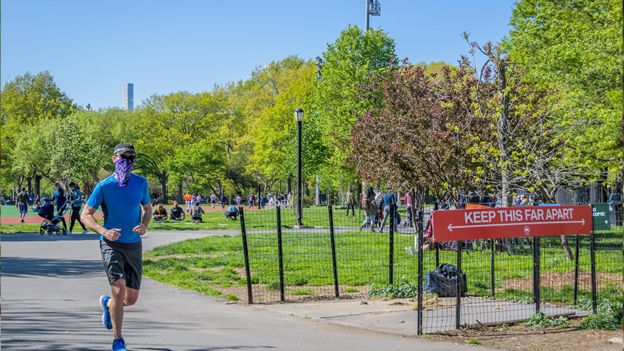
    Runners in a parkImage copyrightGETTY IMAGES

    In many countries in Europe like Germany, it is perfectly fine to go for a stroll with a beer or bring wine to a picnic. But in the US, carrying open alcohol in public is largely forbidden, except in a handful of municipalities.

    A notable exception in the US is New Orleans, Louisiana, a city that proudly boasts its relaxed open container laws, giving it the feel of a European town.

    “We are considered fairly puritanical when compared to other countries in regard to liquor laws,” Ms Schuster says.

    When the 21st Amendment repealed national prohibition in 1933, states were given the ultimate power to decide who could manufacture, sell and drink alcohol. That means that most states exercise tight control over who can sell alcohol, when, and where.

    But as the realities of the coronavirus pandemic transform many aspects of American social life, many states are relaxing their rules.

    Within days of enacting shelter-in-place ordinances and closing non-essential businesses, many states rescinded laws that previously restricted restaurants from selling alcohol to-go.

    Others loosened rules around online liquor sales, or made it easier for customers to buy directly from breweries and wineries.

    In most jurisdictions, the sale of alcohol was deemed “essential”, with the exception of the US state of Pennsylvania, which closed all state-run liquor stores.

    “It’s about creating revenue and helping these poor businesses,” said Ms Schuster.

    In addition to helping bars and restaurants stay afloat, states benefit from keeping their citizens buying booze. Taxes on alcohol serve as a large source of revenue for many states.

    And as the lockdown drags on, and coronavirus stress continues, the data shows that alcohol sales show no signs of dropping.

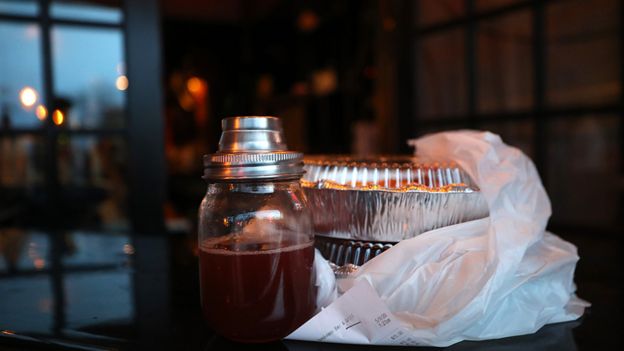
    Takeaway and a martini shakerImage copyrightGETTY IMAGES

    The week that New York announced the shelter-in-place, Nielsen reported alcohol sales had gone up significantly since the same time the previous year.

    And last week, they reported that the US saw the largest growth of alcohol sales since the pandemic shutdowns started in March.

    It’s a trend that is common in times of disaster, says Dr George Koob, the Director of the National Abuse of Alcohol Abuse and Alcoholism (NIAAA).

    “We know historically that during 9/11 and Hurricane Katrina there was an upswing in alcohol consumption,” he told the BBC.

    With more people drinking and to-go alcohol laws being loosened to protect businesses, many local governments have issued warnings that allowing to-go alcohol sales at restaurants and bars does not change open container laws.

    Alexandria, Virginia’s government website states:

    “Although the Virginia Alcoholic Beverage Control Authority has temporarily allowed licensed restaurants and bars to sell beer, wine and mixed drinks for carryout and delivery, the Alexandria City Code still prohibits carrying open containers of alcohol in public.”

    But in certain areas, there’s some indication that police aren’t focusing on people drinking in public.

    Just over an hour north, Baltimore, Maryland has said it will dismiss pending criminal charges for people arrested for many non-violent crimes, including breaking open container laws.

    The Baltimore City State’s Attorney Marilyn Mosby said that this in an effort to curb the number of people in jails that are proving to be a potential “breeding ground” of the virus.

    Dr Koob says it’s still too soon to tell how the new to-go cup policies will change alcohol behaviour, but the NIAAA is in the process of tracking it.

    However, he pointed out that with alcohol sales increasing and more people drinking, the loss of inhibition could lead to more people drinking outside.

    “Alcohol’s effect on the body is disinhibition. Some of these individuals who are drinking a little more because of the isolation and the stress are disinhibited so they might think it’s okay to go outside for a walk and take their beverage with them.”

    Whether or not alcohol to-go laws will remain the norm in the US after coronavirus passes remains to be seen, but Ms Schuster thinks it will be hard “to put the genie back in the bottle”.

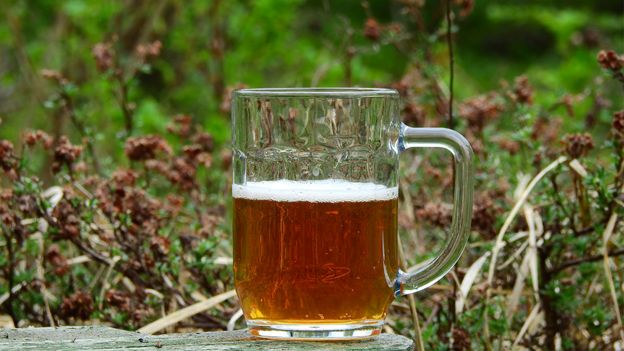
    Beer in the grassImage copyrightGETTY IMAGES

    She may be right.

    On 28 April, Texas Governor Greg Abbott tweeted that the state would be extending the temporary rule that allowed restaurants to serve alcohol to-go to continue past 1 May, when it was initially set to expire.

    And he implied that this rule may be here to stay.

    “From what I hear from Texans, we may just let this keep on going forever,” Governor Abbott tweeted.

    Short presentational grey line

    Thank you for your comments.

    I ordered a burrito at my local cafe and got a beer to go. Sipped it on my 1/2 mile bike ride home. Andrew Finchamp, Chino, California

    Writing from Williamsport, PA (yes: Little League Country): to-go cocktails and drive-up six-packs are common. Two recent daytime keg parties observed in our sleepy quiet neighborhood township of Loyalsock. Both featured an open garage with visible taps, a yard full of partying Pennsylvanians, and large pick-up trucks parked along the street. We go for walks quite often and see stuff. I must admit I usually carry a cold beer along, and some peanuts for the squirrels. These are difficult times, my friends, and a nice buzz doesn’t hurt. Jeff Vetock, Williamsport, Pennsylvania

    In my neighborhood, have seen more and more people going on walks with bottles of beers and glasses of wine. You could expect to see it maybe once when the weather is nice – but even now with poor weather you see it more and more. Even at the local fishing pier, where having an open beverage before would often result in glares or warnings from officials, is now a sea of open containers while people aren’t working and trying to enjoy the outdoors. Rob Eckert, Detroit, Michigan

    Yes, I have definitely seen an increase in outdoor drinking in the metro Vancouver regional parks. The local police do not seem to be bothered by this in the slightest. Outdoor open drinks are NOT legal here in B.C., but people really do seem to be shunning the laws and carrying on with it. Colin Nellis, Surrey, British Columbia, Canada

    For the first time ever I have been able to buy liquor, beer in this case online from a local micro brewery. Also we have been given the okay to have an alcoholic drink with our neighbours in our front gardens. A first, but coming from Europe, about time. Not all is bad with the pandemic. Catie Oates, North Saanich, British Columbia, Canada

    In New York state, bars and restaurants will even deliver cocktails to your home right now. And every time we get takeout from one of our great local restaurants, we make sure to grab a few pints for the road, something unthinkable eight weeks ago. No one cares suddenly and there’s no true harm in it. I suspect the new economy in America will be far more tolerant of such things. Robert Holahan, Binghamton, New York

    In Fort Lauderdale the bars have opened the pavement outside their premises to clientele. This has led to a street party atmosphere and in some cases the social distancing has been non-existent. Overall the customers are enjoying the freedom of drinking outside. Mi Gael Dutton, Fort Lauderdale, Florida

    While this is a Florida beach resort city, and it was already legal to walk the streets with an open container, I would say that it is even more relaxed, and restaurants which are still selling only take-away food are also selling take-away package liquors as well. So you can get your coconut shrimp basket with a rum runner in a to-go cup. This is legal ON FOOT, but it runs afoul of the states open container laws in a vehicle. Nobody is paying any attention to that at this time. Bob Gassert, Madeira Beach, Florida

    Source: bbc
  • Coronavirus: How exposed is your job?

    Millions of workers are doing their day jobs from makeshift set-ups in their living rooms and kitchens, while those in England who can’t work from home are now encouraged to go back in if they can do so safely.

    But how exposed to coronavirus might you be in your job? And how does that compare to others?

    Data from the UK’s Office for National Statistics, based on a US survey, puts into context the risk of exposure to disease, as well as the amount of close human contact workers had before social distancing and other safety measures were introduced.

    While most jobs require people to work relatively closely to others – somewhere in the range between arm’s length and a shared office environment – there are very few that typically involve exposure to disease more than once a year.

    It’s important to note that the data on both exposure to disease at work and how close people are to others is based on interviews that took place with US workers before the pandemic broke out and social distancing recommendations were introduced.

    Some jobs may find it easier to adjust than others and there may be slightly different working practices and conditions in the US for certain occupations. The results can be expected to be broadly the same in most developed countries.

    Almost all the jobs that have a high exposure to both disease and other people are healthcare professions, while those who scored low on both measures include artists, lawyers and those in more typical office jobs like marketing, HR and financial advisers.

    Cleaners, prison officers and undertakers are among those who have relatively high exposure to disease without so much close interaction with other people.

    But the people who might be most at risk to a new infectious disease like Covid-19, are those who have lots of close contact with people, but aren’t used to being exposed to disease.

    Bar staff, hairdressers and actors fall into this category, as well as taxi drivers and bricklayers.

    Other figures released by the ONS this week showed that deaths in the healthcare sector in the UK are no higher on average than those in the wider community, although social care workers were dying at higher rates. Given that these healthcare occupations are so exposed to both disease and other people, why have there not been more deaths?

    This could be because workers in these jobs are more likely to be using personal protective equipment (PPE) like masks and gloves, says Ben Humberstone, deputy director for health analysis at the ONS. They also follow regular hygiene measures like washing hands.

    One of the jobs which had many more coronavirus deaths than the average was taxi drivers. That’s a job which scores highly in terms of closeness to other people, particularly among those jobs which are still actually possible to do at the moment. Bar staff, hairdressers and fitness instructors all score higher, but with bars, gyms and hair salons shut, most of these people will be isolating.

    As taxi drivers are less exposed to disease in normal times, there may not be an existing culture of regular hand-washing and wearing PPE. Some firms are trialling partition screens and distributing gloves and masks to protect their drivers and customers.

    Methodology

    The data in the look-up comes from this release by the ONS.

    The figures on proximity to others and exposure to disease come from a survey carried out by the Occupational Information Network (O*NET) in which they asked respondents in the US to place themselves on a 1-5 scale for the following two questions.

    1. How physically close to other people are you when you perform your current job?

    2. How often does your current job require you to be exposed to diseases or infection?

    For exposure to disease, a score of one means they are never exposed, while a score of five means they are exposed daily. It’s referring to any disease, not coronavirus specifically.

    For the physical closeness question, one means the respondent works more than 100ft away from the nearest other person, while five means they need to touch or be near to touching other people at work. The survey was carried out before social distancing measures were introduced and workers in certain jobs will of course find it easier to adjust than others.

    The responses for people in the same jobs were averaged together and extrapolated to form a score of 100. We’ve looked at these scores out of of 100 and given each job a ranking.

    If any two jobs had the same score we’ve given them a tied ranking.

    Source:

  • Coronavirus: Global push for inquiry into Covid-19 response

    Global health leaders are pushing for an independent review of the response to the Covid-19 pandemic at the UN’s World Health Assembly.

    Monday’s virtual meeting brings together envoys from 194 member states of the World Health Organization (WHO).

    The WHO is facing questions on how it dealt with the coronavirus pandemic.

    Chinese President Xi Jinping, who has defended his country’s actions during the outbreak, spoke during Monday’s opening ceremony.

    He said China had acted “with openness and transparency” and insisted that any investigation should happen after the pandemic was brought under control.

    In other opening remarks, WHO Director-General Tedros Adhanom Ghebreyesus welcomed a proposed resolution calling for a review of the WHO’s handling of the pandemic and said it would initiate it “at the earliest opportunity”.

    South Korean President Moon Jae-in said the WHO must be given more legal powers to ensure that countries report outbreaks and share data.

    “A novel infectious disease could emerge at any time and we must be able to respond more quickly and effectively,” he said.

    The two-day assembly – an annual meeting that reviews the work of the UN’s health agency – comes amid recriminations between the US and China over the virus.

    The US has already stopped its funding for the agency and is promoting its own vaccine programme.

    More than 4.5 million people have been infected and more than 300,000 have died since the virus emerged in China in December.

    What is the assembly discussing?

    The European Union, alongside countries including the UK, Australia and New Zealand, is pushing for an inquiry into how the pandemic has been handled and what lessons can be learned.

    EU spokeswoman Virginie Battu-Henriksson said several key questions needed to be answered as part of any review.

    “How did this pandemic spread? What is the epidemiology behind it? All this is absolutely crucial for us going forward to avoid another pandemic of this kind,” she said.

    However, she added that now was not the time for “any sort of blame game”.

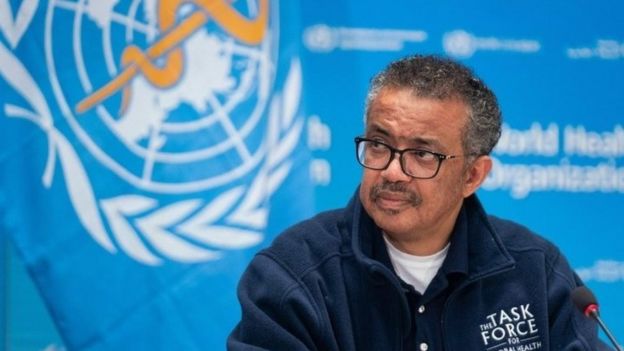
    WHO director-general Tedros Adhanom GhebreyesusImage copyrightAFP
    Image captionWHO director-general Tedros Adhanom Ghebreyesus has faced criticism for the agency’s handling of the pandemic

    A draft resolution calling for a review, to be put to a vote on Tuesday, requires a two-thirds majority to pass and already has support from 116 of the 194 member states, according to Reuters.

    Last month, an EU report accused China of spreading disinformation about the crisis.

    The bloc’s External Action Service said Russia, and to a lesser extent China, had promoted “conspiracy narratives”.

    Grey line

    War of words looms between US and China

    Analysis by Tulip Mazumdar, BBC global health correspondent

    The annual World Health Assembly is an important, but usually quite dry, event. Not this year.

    The Covid-19 pandemic is taking centre stage and the event is likely to host a strong war of words between China and the US about how this health emergency has unfolded – with the WHO stuck in the middle of a bigger geopolitical fight between the superpowers.

    The EU-led call for an investigation into the international response – and to find the animal source of Covid-19 – has been deliberately worded without mentioning China, where the virus first emerged.

    Also expect calls for an independent WHO team to be allowed into China to investigate the origins of the virus. So far international teams have only been allowed in alongside Chinese authorities. The US and others including Australia will no doubt call for this, China is highly unlikely to agree.

    Grey line

    What has the WHO said?

    WHO spokeswoman Dr Margaret Harris said that the World Health Assembly was “always the time for a lot of scrutiny [of the WHO].”

    But, she added, the organisation would remain “laser-focused” on working to lead the overall response, and on the science and solutions for this pandemic.

    The WHO is supposed to represent the interests of all member states equally but has found itself at the centre of a political battle between China and the US.

    US President Donald Trump, who faces re-election this year and has been criticised for his handling of the pandemic, has blamed China for trying to cover up the outbreak and has accused the WHO of failing to hold Beijing to account.

    The row culminated last month with the US – the WHO’s largest single donor – pulling funding to the agency.

    The assembly is also expected to hear calls to give the WHO more powers to allow inspectors to go into countries at the start of outbreaks, and carry out independent investigations.

    The WHO did send a team of scientists into China in January and February, but it was a joint mission alongside Chinese officials.

    What has China’s response been?

    China has already rejected calls for an independent international investigation into Covid-19.

    Last month, senior Chinese diplomat Chen Wen told the BBC that such demands were politically motivated and that an investigation would only divert attention and resources away from fighting the virus.

    The outbreak first emerged in the Chinese city of Wuhan late last year and was widely reported to have originated in a food market.

    Since then, however, some senior US politicians have suggested that the source was a research facility in Wuhan that had been carrying out research on bat coronaviruses. China has dismissed the idea.

    US Secretary of State Mike Pompeo said earlier this month that there was “a significant amount of evidence” that the virus came from a laboratory in Wuhan. However, in a TV interview with Breitbart on Saturday he appeared to step back, saying “we know it began in Wuhan, but we don’t know from where or from whom”.

    The draft resolution mentions identifying “the zoonotic source of the virus and the route of introduction to the human population, including the possible role of intermediate hosts”.

    Source: bbc

  • Coronavirus: European countries further relax restrictions

    Italy and Spain are among a number of European countries further easing their coronavirus lockdown restrictions on Monday.

    Most businesses in Italy, including bars and hairdressers, are reopening after more than two months of nationwide lockdown measures.

    Spain meanwhile has slightly eased restrictions on some of its least affected islands.

    The measures follow consistent drops in the number of daily recorded deaths.

    On Sunday, Italy recorded the fewest daily deaths since it entered lockdown in March.

    It said 145 people had died with the virus in the previous 24 hours. This marked a significant drop from its highest daily death toll, which was more than 900 on 27 March.

    In Spain, the daily death toll fell below 100 for the first time since it imposed its lockdown restrictions.

    But officials are warning that complacency over the virus could lead to a second wave of infections.

    What’s happening on Monday?

    Restaurants, bars, cafes, hairdressers and shops have been allowed to reopen in Italy, providing social distancing is enforced.

    Almost 32,000 people in Italy have died in the pandemic, and the economy is expected to shrink by nearly 10% this year.

    Catholic churches are resuming Mass, but there is strict social distancing and worshippers must wear face masks. Other faiths are also being allowed to hold religious services.

    But health officials have warned of the continued dangers of large social gatherings.

    Pope Francis held a private Mass at St Peter’s Basilica in the Vatican, which has been disinfected ahead of its reopening to tourists.

    The Mass honoured the late Pope John Paul II, 100 years after his birth in Poland.

    There was sorrow but relief too at morning mass in Milan’s Santa Maria del Rosario: the first time that people could return to churches in 10 weeks.

    They came for comfort and to pray for Italy’s recovery. And they abided by strict measures: pews were disinfected before the service; worshippers sat apart; and the priest wore gloves to place the communion wafer in people’s hands, not their mouths.

    “It was strange to feel the body of Christ on these gloves,” said Fr Marco Borghi, “but it’s so important for people to be able to get closer to God again at this time”.

    From restaurants and bars to museums and libraries, to hair salons and beauty parlours, Italy is reopening and emerging from the world’s longest national lockdown.

    There’s a sense of optimism in the streets but also, still, astonishment at what has happened, particularly here in Italy’s richest, most advanced region: over 15,000 people killed in Lombardy, almost half of all the Italian deaths.

    And the economic pain is intense. One in three businesses here say they won’t be reopening today.

    Presentational grey line

    In Spain, some areas are also seeing restrictions ease.

    The country has a four-phase system for reopening, which authorities are applying at different speeds in different regions.

    Most of Spain moved into phase one last week. Up to 10 people are allowed to meet together, provided they wear masks and socially distance, while bars and restaurants can open outdoor seating at half capacity. Cinemas, museums and theatres are also opening at reduced capacity.

    Some Spanish islands that have not been badly affected by the outbreak moved into phase two on Monday – allowing shopping malls to reopen and gatherings of up to 15 people.

    Barcelona, Madrid and parts of the north-west however remain in phase 0. Most restrictions will remain in place, but some small shops will be allowed to reopen on Monday and funerals can be held for groups of up to 10 inside and 15 outside. This has been dubbed “phase 0.5” – an intermediate step in these regions.

    The country is now “very close” to stopping the transmission of the virus, the head of the emergency health centre, Fernando Simon, said on Sunday.

    But he warned that the risk of a second wave of cases was “still very big”.

    Elsewhere in Europe:

    • Belgium is to begin reopening primary and secondary schools under strict conditions on Monday, with museums and zoos also opening their doors – albeit only to those who book online, to limit numbers
    • The famous Acropolis reopened in Greece, and secondary school pupils are returning to class
    • Restaurants, cafes and pastry shops restart business at reduced capacity in Portugal
    • Poland’s beauty salons and hairdressers reopen, as well as restaurants and cafes
  • Coronavirus: Hospitals in Brazil’s São Paulo ‘near collapse’

    The mayor of Brazil’s largest city, São Paulo, has said its health system could collapse as demand grows for emergency beds to deal with coronavirus cases.

    Bruno Covas said the city’s public hospitals had reached 90% and could run out of space in about two weeks.

    São Paulo is one of the country’s worst-hit regions, with almost 3,000 deaths so far.

    On Saturday, Brazil overtook Spain and Italy to become the nation with the fourth-largest number of infections.

    The health ministry reported 7,938 new cases in the past 24 hours, taking the total above 241,000. Only the US, Russia and the UK have higher numbers.

    The death toll in the Latin American nation over 24 hours was 485, meaning that the total number of deaths is 16,118 – the world’s fifth-highest figure.

    Health experts in Brazil have warned that the real number of confirmed infections in the country may be far higher than the official records, due to a lack of testing.

    Brazil’s far-right president Jair Bolsonaro has been strongly criticised both at home and abroad for his handling of the country’s escalating coronavirus crisis.

    He defied global health advice on social distancing on Sunday when he posed for photographs with supporters and children in the capital, Brasília.

    What did São Paulo’s mayor say?

    Mr Covas said he was now in crisis talks with the state governor over introducing a strict lockdown to try to slow the contagion before hospitals were overwhelmed.

    The governor of São Paulo state controls the police, and his support will be essential if a lockdown is to succeed.

    São Paulo has the population of about 12 million, and official figures show that the majority of residents have been flouting social distancing rules.

    Source: bbc.com

  • Coronavirus: European countries set to further ease lockdowns

    Italy and Spain are among a number of European countries that are set to further ease their coronavirus lockdown restrictions from Monday.

    Most businesses in Italy, including bars and hairdressers, will be free to reopen after more than two months of nationwide lockdown measures.

    Spain is set to relax its restrictions outside of Madrid and Barcelona, with groups of up to 10 people free to meet.

    The measures follow consistent drops in the number of daily recorded deaths.

    On Sunday, Italy recorded the fewest daily deaths since it entered lockdown in March.

    It said 145 people had died with the virus in the previous 24 hours. This marked a significant drop from its highest daily death toll, which was more than 900 on 27 March.

    In Spain, the daily death toll fell below 100 for the first time since it imposed its lockdown restrictions.

    But officials are warning that complacency over the virus could lead to a second wave of infections.

    What’s happening on Monday?

    Restaurants, bars, cafes, hairdressers and shops will be allowed to reopen in Italy providing social distancing is enforced.

    Catholic churches are preparing for the resumption of Mass, but there will be strict social distancing and worshippers must wear face masks. Other faiths will also be allowed to hold religious services.

    But health officials have warned of the continued dangers of large social gatherings.

    In Spain, a majority of people will have emerged from lockdown by the end of the week.

    Outdoor seating in bars and restaurants will be allowed from Monday, as well as family reunions and meetings between friends providing no more than 10 people gather.

    In Madrid and Barcelona, along with parts of the north-west, the majority of restrictions will remain in place, but some small shops will be allowed to reopen.

    The country is now “very close” to stopping the transmission of the virus, the head of the emergency health centre, Fernando Simon, said on Sunday.

    But he warned that the risk of a second wave of cases was “still very big”.

    Elsewhere in Europe, Belgium is to begin reopening primary and secondary schools under strict conditions on Monday.

    Portugal, Greece, Denmark and Ireland are among a number of countries which are also set to relax their lockdown measures.

    Source: bbc.com

  • Japan’s economy slips into recession amid coronavirus woes

    Japan has fallen into recession as the financial toll of the coronavirus continues to escalate.

    The world’s third-biggest economy shrank 3.4% in the first three months of 2020 compared to a year ago, its biggest slump since 2015.

    The coronavirus is wreaking havoc on the global economy with an estimated cost of up to $8.8tn (£7.1tn).

    Last week, Germany slipped into recession as more major economies face the impact of sustained lockdowns.

    Japan didn’t go into full national lockdown but issued a state of emergency in April severely affecting supply chains and businesses in the trade-reliant nation.

    The 3.4% fall in growth domestic product (GDP) for the first three months of 2020, follows a 6.4% decline during the last quarter of 2019, pushing Japan into a technical recession.

    Stimulus package announced
    Consumers have been hit by the dual impact of the coronavirus and a sales tax hike to 10% from 8% in October.

    While Japan has lifted the state of emergency in 39 out of its 47 prefectures, the economic outlook for this current quarter is equally gloomy.

    Analysts polled by Reuters expect the country’s economy to shrink 22% during April to June, which would be its biggest decline on record.

    The Japanese government has already announced a record $1 trillion stimulus package, and the Bank of Japan expanded its stimulus measures for the second straight month in April.

    Prime minister Shinzo Abe has pledged a second budget later this month to fund fresh spending measures to cushion the economic blow of the pandemic.

    Other economies see gloom

    Last week, the Asian Development Bank (ADB) warned the global economy could face a hit of between $5.8tn and $8.8tn due to the coronavirus pandemic.

    The US economy, the world’s largest, suffered its sharpest decline in the first quarter of 2020 since the Great Depression, falling 4.8%.

    China, the world’s second-largest economy, saw economic growth shrink 6.8% in the first three months of the year, its first quarterly contraction since records began.

    Both of those economies haven’t yet been confirmed as having fallen into a technical recession, which is defined as two consecutive quarters of negative growth, but most economists expect them to in the coming months.

    Source: bbc.com

  • Ghana Health Service releases full details of dead coronavirus patients; check the ages and regions

    Details of the 28 people who have so far died of Coronavirus in Ghana has been released by the Ghana Health Service on their official website.
    Due to reasons best known to them, the name of the deceased people was not published, however, they made available their gender, region, age, and the underlying health condition that they were battling with before their death.

    The majority of the people who have lost their lives in the battle, according to the list, died from Hypertension and Diabetes Mellitus.

    Three persons on the list, however, died without any underlying health condition.

    The three are a 9-year old, 32-year-old and 20-year-old who are 2nd, 12th and 23rd on the list.

    It is however not clear if the list is in order of time of deaths.

    17 of the victims, representing 61% of the number are male with the remaining 11 (39%) being female.

    12 persons on the list representing 43% of the total deaths were above 60 years of age, persons who were from ages 30 to 60 years were 12 in number, representing another 43%.

    The remaining 4 victims which make up 14% of the total number were below age 30 at the time of their death.

    See the full list below:

    Source: smartandstuck.com

  • Coronavirus: Brazil overtakes Spain and Italy as new cases grow

    Brazil has overtaken Spain and Italy to become the country with the fourth largest number of confirmed coronavirus infections in the world.

    Officials on Saturday reported 14,919 new cases in the past 24 hours, taking the total to 233,142. Only the US, Russia and the UK have higher numbers.

    The daily death toll in the Latin American nation rose by 816 to 15,633 – the world’s fifth highest.

    Experts warn that the real figure may be far higher due to a lack of testing.

    Brazilian President Jair Bolsonaro has been strongly criticised both at home and abroad for his handling of the country’s escalating coronavirus crisis.

    The far-right president continues to oppose lockdown measures. He has downplayed the virus as “a little flu” and has said the spread of Covid-19 is inevitable.

    Last week, Brazilian Health Minister Nelson Teich resigned after less than a month in the job. Mr Teich stepped down after he had publicly criticised a decree by Mr Bolsonaro allowing gyms and beauty parlours to reopen.

    Mr Teich’s predecessor was sacked after disagreeing with Mr Bolsonaro.

    Source: bbc.com

  • Coronavirus: Trump says US reopening, ‘vaccine or no vaccine’

    President Donald Trump says the US will reopen, “vaccine or no vaccine”, as he announced an objective to deliver a coronavirus jab by year end.

    He likened the vaccine project, dubbed “Operation Warp Speed”, to the World War Two effort to produce the world’s first nuclear weapons.

    But Mr Trump made clear that even without a vaccine, Americans must begin to return to their lives as normal.

    Many experts doubt that a coronavirus jab can be developed within a year.

    What is Operation Warp Speed? Speaking at a White House Rose Garden news conference on Friday, Mr Trump said the project would begin with studies on 14 promising vaccine candidates for accelerated research and approval.

    “That means big and it means fast,” he said of Operation Warp Speed. “A massive scientific, industrial and logistical endeavour unlike anything our country has seen since the Manhattan Project.”

    Mr Trump named an Army general and a former healthcare executive to lead the operation, a partnership between the government and private sector to find and distribute a vaccine.

    Moncef Slaoui, who previously led the vaccines division at pharmaceutical giant GlaxoSmithKline, will lead the mission, while Gen Gustave Perna, who oversees distribution for the US Army, is to serve as chief operating officer.

    Speaking after Mr Trump, Mr Slaoui said he was “confident” that a “few hundred million doses of vaccine” will be delivered by the end of 2020.

    He acknowledged in an earlier interview with the New York Times that the timeline was ambitious, but said he “would not have committed unless I thought it was achievable”.

    Many experts say a vaccine is the only thing that will give Americans confidence in fully reopening the economy in the absence of widespread testing.

    What else did President Trump say?

    “I don’t want people to think this is all dependent on a vaccine,” he said. “Vaccine or no vaccine, we’re back. And we’re starting the process.”

    “In many cases they don’t have vaccines and a virus or a flu comes and you fight through it,” he added. “Other things have never had a vaccine and they go away.”

    “I think the schools should be back in the fall,” Mr Trump continued.

    Earlier this week Dr Anthony Fauci, who serves on the coronavirus taskforce and appeared wearing a mask at the Rose Garden conference, testified to the Senate that it would be a “bridge too far” for schools to reopen in the autumn.

    As Mr Trump spoke on Friday, lorry drivers who have parked around the White House for several weeks blared their horns in protest against low wages, neither for nor against the president.

    “Those are friendly truckers. They’re on our side,” Mr Trump said. “It’s almost a celebration in a way.”

    At one point, the president – who wore no mask – instructed a reporter to remove hers so she could be better heard over the noise of honking as she addressed him.

    Is end of 2020 a realistic timeframe? Dr Fauci and other experts have strongly suggested that a jab will take at least a year to develop.

    When the Ebola outbreak struck between 2014-16, it was not until December 2019 that the US Food and Drug Administration approved its first vaccine.

    Some health experts have remained sceptical about the rapid timeline for development and distribution proposed by the White House.

    “I don’t understand how that happens,” said Dr Peter Hotez, co-director of the Medicine Coronavirus Vaccine Team at Baylor College, on CNN after Mr Trump’s announcement.

    “I don’t see a path by which any vaccine is licensed for emergency use or otherwise till the third quarter of 2021,” he added.

    Dr Rick Bright, an ousted US vaccines director who has accused the White House of exerting political pressure around coronavirus treatments, testified to Congress on Thursday that such jabs often take up to a decade to develop.

    What other US coronavirus efforts are there? ‘Warp Speed’ is the latest of several Covid response projects Washington has undertaken.

    In March, the White House launched a testing initiative, enlisting major pharmacy retailers like CVS, Walgreens and Rite Aid to set up drive-through testing sites throughout the country. Such partnerships have stalled, however, and the US has faced continued criticism for its lags in testing.

    In recent weeks, the White House announced further efforts and has helped ramp up testing to nearly 10 million as of 15 May, according to the Our World in Data database.

    Besides the new White House jab initiative, the Food and Drug Administration is also evaluating vaccine candidates for possible human trials.

    On Friday night, the Democratic-controlled US House of Representatives passed by a vote of 208-199 a bill to spend more than $3tn (£2.5tn) on coronavirus relief, including stimulus funds to local governments and direct payments to Americans.

    But the package, which even some Democrats objected to, is rated as having no chance of passage in the Republican-controlled Senate.

    Source: bbc.com

  • Coronavirus: Italy takes ‘calculated risk’ in easing restrictions – PM

    Italy is taking a “calculated risk” as it moves to further ease its coronavirus lockdown measures, PM Giuseppe Conte has admitted.

    He said “the contagion curve” could rise again, but the country could not afford to wait for a vaccine.

    Mr Conte announced that travel to and from Italy, and between the country’s regions would be allowed from 3 June.

    Gyms, swimming pools and sports centres will reopen on 25 May, and cinemas and theatres on 15 June.

    Travellers from EU countries will be able to enter Italy without going into a two-week quarantine.

    The announced measures are a major step in the country’s efforts to restart its economy after more than two months of lockdown.

    Italian officials say 31,763 people have now died with the virus in the country, the third highest figure behind the US and UK.

    But Italy’s infection rate has fallen sharply in recent days.

    It was the first country in Europe to impose nationwide restrictions when coronavirus cases began to surface in northern regions in February.

    But it began to relax those measures earlier this month, when it allowed factories and parks to reopen on 4 May.

    What did PM Conte say?
    “We’re facing a calculated risk in the knowledge that the contagion curve may rise again,” Mr Conte said in a televised address late on Saturday.

    “We have to accept it otherwise we will never be able to start up again.”

    The prime minister said Italy’s businesses could not afford to wait until a vaccine was found, because “we would end up with a strongly damaged economic and social structure”.

    Some Italian regions had called for a swifter easing of restrictions, but the prime minister said they would be relaxed gradually to avoid a second wave of cases.

    Shops and restaurants are also due to reopen from 18 May providing social distancing is enforced.

    Catholic churches are preparing for the resumption of Mass on the same day, but there will be strict social distancing and worshippers must wear face masks. Other faiths will also be allowed to hold religious services.

    Mr Conte’s announcement came shortly after the country, which was once the global epicentre of the pandemic, reported a further decline in its daily death toll.

    It reported more than 900 deaths on 27 March, but the authorities said there were 153 in the past 24 hours.

    Earlier this week, the government approved a €55bn (£48bn; $59bn) stimulus package designed to offset the economic impact of the pandemic on businesses and families.

    Source: bbc.com

  • Support Member States in coronavirus fight IHRDA Programmes Director to AU

    African Union (AU) to take steps to offer direct financial support to its member States as the continent battles the spread of the novel COVID-19.

    Mr Foley, made the call when he delivered via Zoom, the second lecture of the 14-week long “Law and Ethics Web Series”, on the theme, “Regional Governance in Africa in the Wake of Covid-19 and Prospects for the Future”.

    The online seminar is organized jointly by the African Centre on Law and Ethics (ACLE) and the African Centre of International Criminal Justice (ACICJ), both based at the Ghana Institute of Management and Public Administration (GIMPA) Faculty of Law.

    He said “so far we have seen every wonderful intervention on paper in the continental strategy, but we need to back it up with money.

    If the AU reforms are talking about sustainability in financing and funding, then it is important that we save every little penny that we are making from not moving around into that fund (the solidarity fund). I think the example of ECOWAS of direct provision of services and support to countries should be emulated by the African Union and other Regional Economic Communities”

    The Law Lecturer and Human Rights Advocate in his presentation called on other Regional Economic Communities (RECs) on the continent to follow the example of the Economic Community of West African States (ECOWAS)in the provision of support for their member states in the fight to stop the spread of the Covid-19 pandemic in Africa.

    “We haven’t heard much from the other Regional Economic Communities such as SADC (Southern African Development Community), COMESA (Common Market for Eastern and Southern Africa), and of course the Arab Maghreb Union (AMU) in North Africa. We would want to see that they emulate the example of ECOWAS” Mr. Foley posited.

    The on-going online Law and Ethics Web Series began on Wednesday the 6th of May this year.

    Various speakers have been lined up for the exercise by the organizers. The series is being coordinated by Dr. Kwaku Agyeman-Budu, a Lecturer and Head of Law Center at the GIMPA Faculty of Law.

  • No nurse wants to attend to patients on the floor Dr. Dekpeh

    No nurse would want to attend to a patient on the floor because they would have to bend or squat before attending to them, Dr. Nabil Dekpeh, the Medical Superintendent for the Wa Municipal Hospital has said.

    He said hospital facilities were compelled to accommodate patients on mattresses on the floor to manage congestion at the facilities.

    Dr. Dekpeh said this in an interview with the Ghana News Agency (GNA) in Wa on Thursday on the congestion of the maternity ward at the hospital, which had compelled the facility to accommodate some of the patients on the floor.

    “There are two options, either we tell them (the pregnant women) to go back or we give them mattresses to lie on the floor, so we decided to let them lie on the floor. It is done at every hospital when there is congestion”, he explained.

    Pregnant women at the Maternity Ward of the Hospital are compelled to lie on the floor due to the congestion of the facility causing a public outcry.

    However, the medical superintendent noted that they did not just allow any patient to lie on the floor, but those who went through self-delivery, while those who were critically ill and pregnant women who went through surgery were made to lie on the bed.

    He added that most of those patients who were made to lie on the floor stayed at the facility for less than 24 hours, mostly ten-twelve hours, and were discharged.

    Dr. Dekpeh also explained that the congestion was intermittent, saying “there are times that you will see empty beds there (the maternity ward) for about three days or even a week”.

    He indicated that the facility still served as a referral centre for some health centres in the municipality even though the new Regional Hospital was operational.

    He observed that the new Regional Hospital had come to reduce the burden on the facility as some of the patients were referred to that facility.

    Dr. Dekpeh also blamed the congestion at the facility on the inadequate personnel at some of the District Hospitals, which forced those hospitals to refer special cases to the Wa Municipal Hospital.

    Source: GNA

  • Coronavirus patient from Obuasi found at Derma

    A man from Obuasi in the Ashanti Region whose result of the COVID-19 test proved positive has been traced and found at Derma, a farming community in the Tano South Municipality of the Ahafo Region.

    The man in question was among several people whose samples were taken through contact tracing at Obuasi in early April but left for Derma on a family visit.

    Mr. Collins Offinam Takyi, the Tano South Municipal Chief Executive (MCE) confirmed in an interview with the Ghana News Agency (GNA) in Sunyani.

    He said some of the residents might panic because the man had stayed in the area for about three weeks but they did not know that his samples had been taken for testing.

    Mr. Takyi assured contact tracing of the patient had started by the Tano South Municipal Health Directorate and samples of about 50 people, now under quarantine had already been taken for testing.

    He added the Health Directorate was waiting for the results, whilst more contact tracing was being done for further testing.

    Mr. Takyi stated the patient was currently at the Techimantia Polyclinic COVID-19 Centre for treatment but in a stable condition.

    He explained that pragmatic measures were being taken by the Health Directorate and the Assembly to contain the spread of the virus in the Municipality and the region at large.

    Mr. Takyi urged the people to remain calm and religiously abide by the restrictions of no social gathering, follow hygienic protocols of regular handwashing with soap under running water whilst wearing nose mask and ensuring social and physical distancing.

    Source: GNA

  • Coronavirus: Western region records 23 new cases

    The Western Regional Health Directorate has announced that its case count of Coronavirus has increased from 61 to 87 as of Friday, May 15, 2020.

    Western Region had its first positive case of Coronavirus disease (COVID-19) on Easter Monday from a Chinese national who works with the Coastal Quarry Company at Anto in the Shama District.

    In a Daily Situation Report released on Friday, May 15, 2020, by the Western Regional Health Director Dr. Jacob Mahama and copied to Daniel Kaku, he stated that the Region has recorded 23 new positive cases of Coronavirus pushing its case count to 87 positive cases.

    He said Sekondi-Takoradi Metropolis case counts have soared from 19 to 34.

    According to him, Tarkwa-Nsuaem Municipality has also recorded 8 new positive cases of Coronavirus.

    So far, Western Region has recorded 754 suspected cases with 436 being tested negative.

    As of Friday, May 15, Jomoro Municipality, Amenfi West Municipality, Amenfi Central District, Amenfi East District and Wassa East District have not recorded any positive case of the deadly Coronavirus.

    “Assessment of Takoradi Airport by national IHR and Port Health Focal person and Regional team for the commencement of domestic flight”, Dr. Jacob Mahama assured.

    He is, therefore advising residents in the region to stay home and report any suspected case to them on 0208149141 for prompt action.

    “Do not hide any relative or friends returning from any affected areas to prevent the spread of the disease”, he reiterated.

    He is also calling on them to practice regular handwashing with soap under running water and also practicing social and physical distancing protocols.

    Breakdown of positive cases of Coronavirus in the Western Region as of Friday, May 15, 2020 are as follows

    1. Sekondi-Takoradi = 34

    2. Tarkwa-Nsuaem = 27

    3. Nzema East Municipality = 6

    4. Ahanta West = 6

    5. Effia Kwesimintim = 5

    6. Prestea Huni-Valley = 4

    7. Ellembelle District = 2

    8. Shama District = 2

    9. Mpohor District = 1

    10. Amenfi West = 0

    11. Wassa East = 0

    12. Jomoro = 0

    13. Amenfi Central = 0

    14. Amenfi East = 0

    Total = 87

    Note the following facts

    Number of suspected cases = 754

    Contact listed = 1,934

    Contacts followed = 1,859

    Negative cases = 436

    Positive cases = 87

    Pending cases = 231

    One person has been recovered and discharged

    One person has been killed by virus in Tarkwa-Nsuaem.

    Source: Daniel Kaku, Contributor

  • Health experts in Obuasi to ensure coronavirus containment

    Government has sent a team of health experts led by Dr Patrick Kuma-Aboagye, the Director-General of the Ghana Health Service to Obuasi in the Ashanti Region to step-up COVID-19 containment efforts.

    The team comprised of epidemiologists and surveillance officials, Mr Kojo Oppong Nkrumah, the Minister of Information said.

    He said the move became necessary as Ashanti was the second region to have recorded the highest number of cases apart from Greater Accra.

    Dr Kuma-Aboagye during the last update on May 12, 2020, indicated that in the Ashanti Region, Obuasi remained the hottest spot recording about 272 cases.

    Other hotspot areas in the region included Kumasi, Oforikrom, and Nkawie.

    He mentioned Old Tafo, Asokwa, Kumasi Municipal, and Kumasi Metropolis as areas recording high numbers of COVID-19 cases with Suame recording the highest figures.

    Source: GNA

  • Volta Region records first coronavirus death

    The Volta Region Friday recorded its first COVID-19 death at the local Treatment Centre in Ho.

    The deceased, a 60-year-old woman who returned from Accra two weeks ago, visited the Ho Teaching Hospital with difficulty in breathing, fever for three days and reduced level of consciousness.

    She was noticed to have been progressively getting weak prior to her presentation at the Teaching Hospital and passed on after five days on admission at the Regional COVID -19 Centre on May 14, 2020 at 1815 hours.

    Dr. Archibald Yao Letsa, Volta Regional Minister, in a statement copied to the Ghana News Agency (GNA), said the deceased was a known diabetic who had suffered a Cerebro-Vascular Accident (CVA) a few years ago.

    The sexagenarian, the statement said, also had a pacemaker in situ for an unspecified cardiac condition.

    It said she had been previously reviewed at the National Cardio-Thoracic Centre where she was told the pacemaker was no longer effective.

    “On examination, she was febrile (40.0 °C), not pale and anicteric with a Glasgow Coma Score of 11/15. She had a respiratory rate of 28cpm with Bronchial Breath Sounds and coarse crepitations bilaterally.

    Source: GNA

  • Government deserves a pat on the back for better handling of coronavirus situation – Dr. Okoe Boye

    Deputy Minister of Health, Dr. Bernard Okoe Boye, has commended the Government of Ghana for doing a good job in controlling the COVID-19 situation.

    Dr. Okoe Boye asserted that despite the increasing cases of the pandemic disease, the country’s infection and mortality rates remain one of the lowest in Africa and the world at large.

    According to Dr. Okoe Boye, but for the interventions of President Nana Addo Dankwa Akufo-Addo, the country might have seen a higher case count than what it has currently recorded.

    Speaking to host Kwami Sefa Kayi on Peace FM’s ‘Kokrokoo’ programme, he held that the government deserves a pat on the back for putting measures in place to safeguard the lives of Ghanaians and also ensuring there are no widespread infections of the virus.

    “If you want to judge a country by the number of cases to say the management of the situation has failed, then the whole world has failed. So, you don’t make the mistake of looking at absolute numbers and judge a country to be a failure because it has recorded 5,000. What you must look at is what would have happened if the measures were not put in place?”

    “. . Of the 4,832 active cases, if 2,000 of them become negative in three weeks, do you know what it means? It means this figure once upon a time was only a statistical record. In three weeks, two thousand people from this number who were once upon time positive today might become negative. Now, what it means is that the figure we’re having today is transient,” he stated.

    He also expressed his disagreement with people who think the President shouldn’t have lifted the lockdown because of the increment in the case count.

    Highlighting the main reasons for a lockdown in a pandemic as the novel Coronavirus, he said; “it was to buy time and have enough knowledge about the virus but at a particular threshold, you start going back to life knowing that the risk is still around, but you reduce the risk with steps and guidelines”.

    Source: Peace FM

  • Sixty-eight per cent of coronavirus cases are through contact tracing – Minister

    Sixty-eight per cent of Ghana’s COVID-19 cases are recorded through contact tracing, Mr Kojo Oppong Nkrumah, the Information Minister, revealed in Accra.

    He said of the 5,530 cases count recorded; 3,787 (representing 68 per cent) were through enhanced contact tracing surveillance, while 1,628 (32 per cent) were through general surveillance (those who reported to health facilities).

    Mr Oppong Nkrumah made the revelation during the meet the press series organised by the Ministry of Information, to give an update on the COVID-19 pandemic in the country.

    The Minister said countries in Europe and the Americas, were reporting the general surveillance numbers; “that is people who had fallen sick and have come to the hospitals”.

    He reiterated that those countries were not doing enhanced tracing and testing like what Ghana was doing.

    “That is why for example if you take today’s numbers 5,530; if we were doing what everybody was doing, we will only be reporting 1,628, because that is a general surveillance numbers, that is those who have contacted the system to be tested,” he said.

    He said Ghana had about 3,787 people through enhanced contact tracing; that is people who had been exposed to the virus, and the surveillance team had gone to search for them.

    “We have been deliberately spiking our curve, it is a different strategy, because we want to find it early and deal with it. In so doing the majority of the 3,787 from what they tell us are not sick, they don’t have symptoms, but they have been exposed to the virus,” Mr Oppong Nkrumah stated.

    “So, if you are going to work a quick mathematics out of that 3,787 out of 5,530 at the back of the envelope, that is about 68 per cent. So Ghana’s numbers 5,530 about 68 per cent of them are people that we went out to search for in the enhanced contact tracing,” he said.

    He said trying to compare Ghana’s method of tracing the disease with other countries was like comparing oranges to apples.

    Adding that Ghana’s formula for tracing the COVID-19 virus was very different. “If you didn’t do enhanced contact tracing surveillance, they would have been in the community spreading (the disease).

    “So, that by the time today, you are reporting 1,628, which is what you would have been, if we were doing general surveillance. You have about 5,000 or extra of about 4,000 in the community that you don’t know of, spreading it.”

    He explained that by the time they would have found 4,000 (infected persons), 16,000 would also be out there spreading the disease.

    “That is the wisdom in Ghana’s change in strategy to go for the enhanced contact and tracing. That we go out early, find these persons and give them the kind of support,” he said.

    Source: GNA

  • Mexico at ‘peak moment’ of coronavirus crisis after biggest daily rise in cases

    Mexico has reached “the peak moment” of its coronavirus outbreak, officials said, as the country recorded its largest one-day rise in cases so far.

    More than 2,409 new cases of the virus were confirmed on Thursday – the first time this figure has exceeded 2,000.

    The total number of confirmed cases in the country is now more than 40,000.

    The grim milestone comes amid preparations to ease lockdown measures and reopen the economy, particularly factories near the border with the US.

    Assistant Health Secretary Hugo López-Gatell – an epidemiologist and Mexico’s coronavirus tsar – described this as “the most difficult moment of the first wave of the epidemic”.

    He said that the country “could not relax measures” in place to stem the spread of the virus, and instead needs to embrace a “new normal” to avoid another wave of infections.

    On Monday, some key industries – including mining, construction and automobile assembly – are scheduled to partially reopen.

    Mr López-Gatell stressed that the re-opening of these industries will be largely preparatory, with a broader restart of businesses not scheduled until 1 June.

    Government data released on Thursday also showed more than half of hospitals in the capital, Mexico City, were at capacity with coronavirus patients.

    At the end of April, hospitals in the city admitted they were having to turn patients away because of a lack of equipment.

    Earlier this month, Mexico received a shipment of more than 200 ventilators purchased from a US firm.

    This followed an informal agreement between the neighbouring nations’ leaders in mid-April.

    Source: bbc.com

  • Coronavirus: WTO head steps down a year early as downturn looms

    The head of the World Trade Organization has said he will step down a year earlier than planned, at a crucial moment for the global economy.

    Roberto Azevedo’s surprise departure comes as the WTO faces the impact of the coronavirus pandemic and criticism from US President Donald Trump.

    Global trade has slumped and the world is braced for the worst downturn since the Great Depression.

    Meanwhile, Mr Trump has accused the body of treating America unfairly.

    Mr Azevedo said his early departure as the WTO’s director-general was a “personal decision” that was in the best interests of the organisation.

    “The WTO may not be perfect, but it is indispensable all the same. It is what keeps us from a world where the law of the jungle prevails, at least as far as trade is concerned.”

    The Trump administration has repeatedly accused the global trade watchdog of having strayed from its purpose to liberalise and protect markets, and that conditions around China’s entry into the organisation in 2001 have led to millions of American job losses.

    Asked about Mr Azevedo’s exit, Mr Trump, who had previously said the US would leave the organisation if it didn’t change, said he was “OK with it”.

    “We’ve been treated very badly… They treat China as a developing nation. Therefore China gets a lot of the benefits that the US doesn’t get,” he added.

    Mr Azevedo’s departure comes at an especially difficult time for the WTO, with global trade expected to slump to historic lows as measures to slow the spread of Covid-19 shut down economic activity around the world.

    At the same time the Geneva-based body last year saw one of its main functions, arbitrating trade disputes, hobbled by the US.

    Washington’s dispute with the WTO has seen it block the appointment of judges to the organisation’s top court, called the Appellate Body, since December 2019. It means it has too few officials to rule on major trade disputes between countries.

    Along with the US, other WTO members, including Japan and the European Union, have pushed for the WTO to make far-reaching reforms.

    They argue that global trading rules need to reflect new realities, notably the rise of China as a powerful economy, and address problems such as state subsidies and forced technology transfers.

    Source: bbc.com

  • Jubilation as 200 suspected coronavirus patients are discharged

    There was wild jubilation in the form of singing and dancing when over 200 suspected Covid-I9 patients at Pentecost Isolation Centre at Gomoa Fetteh in the Central Region were asked to go home yesterday.

    This means that these people have gone through all the three stages of testing at the centre and all their tests have proven negative.

    Information gathered indicates that the centre is made up of blocks A, B and C. The first two blocks, A and B, house confirmed Covid-19 patients while the Last block, C, houses suspected patients whose first test proved negative but have to await second and third tests.

    “As it is now, all the patients at Block C have been discharged by health professionals at the centre for them to reunite with their families because they have no Covid-19,” a source told the DAILY HERITAGE.

    While some were singing and dancing for being discharged, others in block A and B, numbering over 500, were sighted in a sorrowful mood because some of them were yet to complete their treatment and possible recovery from the disease.

    The people who were released were seen around midday parking their few belongings and lining them on the floor waiting for their names to be called so they could leave.

    At exactly 2:00pm the first batch left the centre for their various homes on a Ghana Health Service bus escorted by the police and health professionals while the second batch left 20 minutes later in similar manner.

    “One unique thing that took place was that the discharged patients were given a certificate each to be shown or given to their various workplaces indicating they have no Covid- 19: a Holy Bible with Church of Pentecost inscription and a nose mask.” the source stated.

    Source: kasapa FM

  • Coronavirus: Cleaners get more health allowance than us Nigerian lab scientists

    The Delta State chapter of the Association of Medical Laboratory Scientists of Nigeria, AMLSN, Thursday said its members receive an average of N30, 000 as health allowances in the fight against the COVID-19 pandemic, adding that its personnel are paid far lesser than cleaners in the health sector in the state, who are paid N70, 000.

    The scientists while threatening to withdraw their services from the Delta State COVID-19 team if the anomaly is not rectified, said they are giving the state government two weeks to look into their grievances or else, there will be no health personnel to collect samples from suspected COVID-19 patients in the state.

    Though the State Commissioner for Information, Dr. Mordi Ononye declined commenting on the matter when contacted, his counterpart in the ministry of information, Charles Aniagwu, debunked the claims by the scientists saying, “That cannot be true because our allowance is bigger than any other state in the country.” AMLSN Public Relations Officer in the state, Hilary Ugwoke while lamenting what he described as the discrepancies in the health allowances compared to other health professionals in the state, wonder the modalities used in the payments for doctors, nurses and pharmacists who he said receive far more than medical laboratory scientists in the state.

    He said: “Of all health workers in the state apart from drivers, medical laboratory scientists in Delta State are the least paid. Some are paid as much as N30, 000 for the six months based on the sample collected and we are saying that it is not a function of sample collected because hazard is hazard as we are all prone to being infected by a singular person.”

    “At the Delta State University Teaching Hospital, DELSUTH, Oghara for example, Doctors were paid an average of N250, 000; Nurses got N90, 000, Pharmacists got N180, 000 while cleaners where paid N70, 000 compared to medical laboratory scientists whom were paid N30, 000.

    “We will like to know the methods used in the variation of payments for all health professionals that will warrant us receiving N30, 000. If this anomaly is not rectified within the shortest possible time, we will be forced to withdraw our services from the COVID-19 programme in the state and we are giving them a timeframe between now and next month to do so.

    “Of all health professionals, we are the only personnel that interact with suspected COVID-19 patients with their mouths and nose open while coughing and breathing on us in most cases, unlike doctors and nurses who attend to them while wearing protective equipment thereby putting us more at risk.

    “It should also be on record that if our services are withdrawn, as the only professionals backed by law to collect samples from suspected COVID-19 patients for test, nobody will be available and allowed to collect samples from such patients for test.”

    Source: vanguardngr.com

  • 98-year-old woman recovers from coronavirus in Nigeria

    A 98-year-old woman has recovered from coronavirus in Lagos State, The Punch reports.

    Governor Babajide Sanwo-Olu, who made this known via his Twitter handle, said the woman was part of the 26 patients who were discharged in the state on Wednesday.

    According to the governor, she is the oldest COVID-19 patient to recover in the state.

    He tweeted, “Today, we discharged a 98-year-old woman, our oldest COVID-19 patient in Lagos. She joined 25 others; 13 males and 12 females, discharged from our isolation centres after testing negative for COVID-19, bringing the total of our successfully managed and discharged patients to 528.

    “The patients, six from the Mainland Infectious Disease Hospital, Yaba, 11 from Onikan and nine from LUTH Isolation Centres were discharged having fully recovered and tested negative to COVID-19 in two consecutive readings.”

    The Punch reports that Lagos has recorded 1,990 confirmed cases of COVID-19.

    Source: punchng.com

  • Coronavirus: Lockdown won’t work Health Minister

    A general or partial lockdown does not seem to be in the books of government as part of measures to fight the Covid-19 pandemic, Health Minister Kwaku Agyemang Manu has suggested.

    According to him, the recent partial lockdown of Greater Accra and Greater Kumasi has taught government a lot of things per the severe impact it had on the nation.

    He further advised that all that people have to do now is to learn to live with the disease by following the laid down protocols.

    Answering a question as to whether Obuasi will be on lockdown due to the high number of coronnavirus cases it has recorded, at the just ended Ministry of Information press briefing, Mr Manu sad he does not believe a lockdown would work any longer.

    He said “generally, a lockdown is not something that we believe is going to work any longer. Now we have realized the lockdown taught us a lot of things and the impact is quite severe. So what we have to do now is to learn to live with the disease.”

    He however indicated that the Director General of the Ghana Health Service was in Obuasi with a group of epidemiologists and until they come back with their report “we must be very careful as to whether we are talking about a lockdown in Obuasi,” he said.

    Source: Starr FM

  • German doctor warns footballers of ‘irreversible’ damage from coronavirus

    Despite rigid hygiene guidelines for the restart of the Bundesliga this weekend, a leading German sports doctor has warned footballers are still at risk of suffering “irreversible” and potentially career-ending lung damage from the coronavirus.

    With Europe’s other top leagues at least a month away from resuming, the German Football League (DFL) has drawn up strict rules for when games restart this Saturday.

    Matches will be played behind closed doors, with only a limited number of media and officials allowed to attend.

    The key games see second-placed Borussia Dortmund at home to Schalke in Saturday’s derby and leaders Bayern Munich, who are four points clear, visiting Union Berlin on Sunday.

    Players have been told to limit contact, even on the pitch, and must avoid pre-match handshakes and hugs to celebrate goals.

    The DFL says while no plan could ever be “100 percent safe”, the guidelines aim to create a playing environment with a low, “medically-justifiable risk”.

    However, professor Wilhelm Bloch, from the German Sports University in Cologne, warns that contracting the coronavirus has the potential to end a player’s career.

    “There is a risk that top athletes may lose their level of performance and never regain it,” Bloch told AFP in a phone interview.

    “Generally, the physical makeup, immune system and cardiovascular system of elite athletes means that the risk to them is low.

    “However, we do not know at this time whether even minor infections, or even mild symptoms, do not cause damage, such as minor scarring of the lungs after an inflammation.

    “This damage may be irreversible, or may last a very long time before the body repairs it.

    “We’ve already had players infected in Europe and we’ll soon know if they recover their full potential.”

    – Increased injury risk –

    Bloch said it is near impossible to estimate what the risk is to footballers in Germany, which currently has 172,239 recorded cases of the virus and over 7,700 deaths.

    “Players are not in total quarantine, they are with their families, even if they have been instructed to limit contact,” he said.

    “And there are also risks during matches.

    “They will all be tested, but not all the coronavirus tests work perfectly. There is a relatively large margin of error.”

    The sports doctor says another concern is injuries to players, given their lack of match fitness since the league stopped in mid-March.

    “Obviously, the players are not optimally prepared,” Bloch said, with clubs only resuming full team training last week.

    “Depending on the degree of preparation, the risk of injury increases.

    “We can expect that the players will be more prone to injuries.

    “We will see muscle injuries, but also injuries to the musculoskeletal system and tendons.

    “You can’t compare it with the start of the season.

    “At the beginning of the season they normally have a very intensive training period, then a short break so that the body can regenerate, and then they attack the season.

    “Now, that hasn’t been possible for all the teams.”

    Bloch also wonders how players can be expected to throw themselves into tackles after weeks of being told to observe social distancing.

    “I’m not a psychologist, it’s difficult to assess, but I think it’s going to be a difficult transition and it won’t necessarily be good for their performance,” said Bloch.

    “It’s also going to be one of those factors that you have to consider and one of the risk factors for injury.”

    Source: france24.com