Tag: Council for Scientific and Industrial Research

  • KOPIA, CSIR launch rice seed project in Ghana

    KOPIA, CSIR launch rice seed project in Ghana

    A five-year Water Energy Food Programme (WEFP) programme to solve the country’s rice seed deficit has been launched by the Korea Partnership for Innovation of Agriculture (KOPIA) and Council for Scientific and Industrial Research (CSIR).

    Under the project, 100 hectares of farmlands would be mechanised and supported with irrigation to produce 1200 tons of quality rice seeds annually which would be distributed to 12,000 farmers across the country for free.

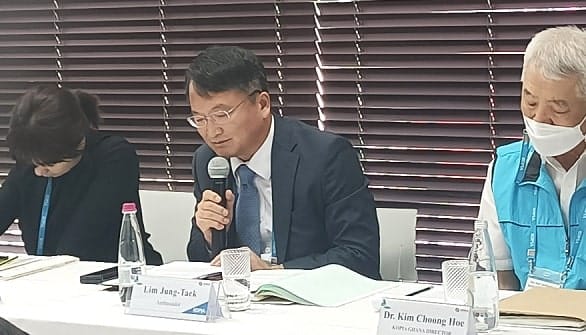
    At the launch of the project yesterday, the Ambassador of the Republic of Korea to Ghana, Lim Jung -Taek indicated that in preparation for the smooth take off of the project, a rice seed warehouse had been inaugurated at Dawhenya to help operations.

    “We expect that the new warehouse with a storage capacity of 78,000 bags of rice seeds would make a big difference by storing the good quality rice seeds for farmers,” he said.

    The event brought together representatives from the Ministry of Environment, Science, Technology and Innovation (MESTI) and rice production enthusiasts from Kenya ,Senegal ,The Gambia, Guinea, Cameroun and Uganda.

    Varieties

    Mr Jung–Taek indicated that six high-yield rice varieties and been developed for the project and it would be complemented with effective agricultural mechanisation to yield the results.

    “We have developed six high-yield rice varieties for the project and as you are all aware, high-yield rice varieties and agricultural mechanisation are crucial steps in boosting rice production and achieving greater self-sufficiency in Ghana,” the Ambassador noted.

    The Minister of Food and Agriculture ,Bryan Acheampong, who was a special guest at the event, expressed his excitement about the project and gave a firm assurance of Ghana’s support for the project.  

    The Greater Accra Regional Minister, Henry Quartey, said given the importance of the seed industry, it was important to prioritise seed certification globally to ensure that farmers accessed only high quality, genetically pure seeds ,free from diseases and adaptable to the local environment.

    “The uninterrupted distribution of quality seed is crucial to ensure that farmers have access to them through all seasons,” he said, further emphasising that the seed industry played an important role in food security, poverty reduction and economic development. 

    Challenges

    Mr Quartey expressed concern about challenges  the rice value chain faced due to lack of quality seed certification and distribution in Africa.

    “This could be attributed to lack of investment in research and development, owing to the fact that many African countries have limited resources to invest in Agriculture research, making us rely on external sources for new seed varieties “, he stated .

    The minister thus called for investment in the local research institutions by both government and the private sector, to develop new seed varieties that are adaptable to local conditions. 

  • Plague: Ancient teeth reveal where Black Death began, researchers say

    Researchers believe they have discovered the origins of the Black Death, more than 600 years after it killed tens of millions in Europe, Asia and north Africa.

    The mid-14th Century health catastrophe is one of the most significant disease episodes in human history.

    But despite years of research, scientists had been unable to pinpoint where the bubonic plague began.

    Now analysis suggests it was in Kyrgyzstan, central Asia, in the 1330s.

    A research team from the University of Stirling in Scotland and Germany’s Max Planck Institute and University of Tubingen analyzed ancient DNA samples from the teeth of skeletons in cemeteries near Lake Issyk Kul, in Kyrgyzstan.

    They chose the area after noting a significant spike in burials there in 1338 and 1339.

    Dr Maria Spyrou, a researcher at the University of Tubingen, said the team sequenced DNA from seven skeletons.

    They analyzed the teeth because, according to Dr Spyrou, they contain many blood vessels and give researchers “high chances of detecting blood-borne pathogens that may have caused the deaths of the individuals”.


    The research team were able to find the plague bacterium, Yersinia pestis, in three of them.

    Dr Philip Slavin, a historian at the University of Stirling, said of the discovery: “Our study puts to rest one of the biggest and most fascinating questions in history and determines when and where the single most notorious and infamous killer of humans began.”

    The research does have some limitations – including the small sample size.

    Dr Michael Knapp from the University of Otago in New Zealand, who was not involved in the work, praised it as “really valuable”, but noted: “Data from far more individuals, times and regions… would really help clarify what the data presented here really means.”

    The researchers’ work was published in the journal Nature, titled “The source of the Black Death in fourteenth-century central Eurasia”.

    line

    What is bubonic plague?

    Plague is a potentially lethal infectious disease that is caused by bacteria called Yersinia pestis that live in some animals – mainly rodents – and their fleas.

    Bubonic plague is the most common form of the disease that people can get. The name comes from the symptoms it causes – painful, swollen lymph nodes or ‘buboes’ in the groin or armpit.

    From 2010 to 2015, there were 3,248 cases reported worldwide, including 584 deaths.

    Historically, it has also been called the Black Death, in reference to the gangrenous blackening and death of body parts, such as the fingers and toes, that can happen with the illness.

    line
  • All encroachers on CSIR lands will be dealt with Henry Quartey

    The Greater Accra Regional Minister, Henry Quartey has bemoaned the rate at which individual developers are taking over lands belonging to the Animal Research Institute of the Council for Scientific and Industrial Research.

    He assured that government will not relent in its effort to demolish buildings on such lands.

    The institute has over the period complained about the increasing level of encroachment of about 1000 acres of their lands and the attacks on staff by land guards.

    While its efforts to evict these encroachers have proven futile, the institute has made several calls to government for assistance.

    The institute says workers are living in fear due to the activities of land guards on its lands.

    In an interview after inspecting the boundaries of the institute, Mr. Quartey vowed to ensure that the situation is dealt with in no time.

    “I have received complaints by some government officials that government lands are being encroached. An example is what we see at CSIR. It is sad that people have the effrontery to take over government property.”

    “REGSEC will meet soon and I will take a decision in no time. I will ensure that the situation is dealt with in no time.”

    Source: Citinewsroom