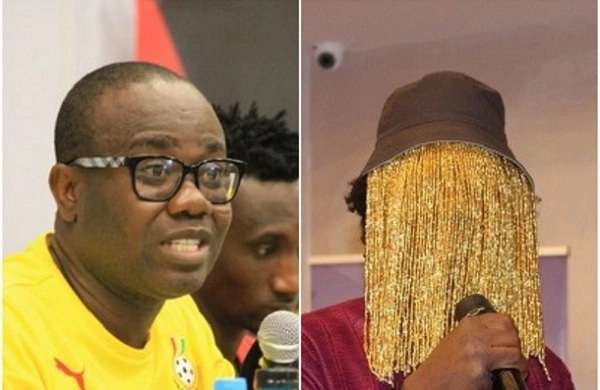
The Court of Appeal has ruled that investigative journalist Anas Aremeyaw Anasmust testify in public without his trademark mask in the ongoing trial of Kwesi Nyantakyi.
The decision, made on Thursday, January 30, 2025, was reached unanimously by a panel of three judges—Justices Anthony Oppong, Ackaah Boafo, and Aboagye Tandoh. They stated that Anas could not give evidence while hiding his face.
Justice Ackaah Boafo, who delivered the ruling, explained that an accused person’s right to a fair trial is more important than the state’s arguments for witness protection.
The court stressed that Nyantakyi has the right to see and challenge the person testifying against him.
The Court of Appeal also criticized the High Court for reconsidering the state’s request to allow Anas to testify in disguise. It ruled that the High Court should have followed an earlier Supreme Court decision on the same issue instead of revisiting the matter.
“The doctrine of stare decisis binds lower courts to the decisions of higher courts, and as such, the High Court erred in revisiting an issue already settled by the Supreme Court,” the ruling stated.
This ruling means that Anas, who is famous for his undercover investigations, must appear in court without his signature hood when testifying against former Ghana Football Association (GFA) President Kwesi Nyantakyi.
Nyantakyi is on trial over allegations of corruption that were revealed in Anas’ 2018 Number 12 documentary, which exposed misconduct in Ghanaian football.
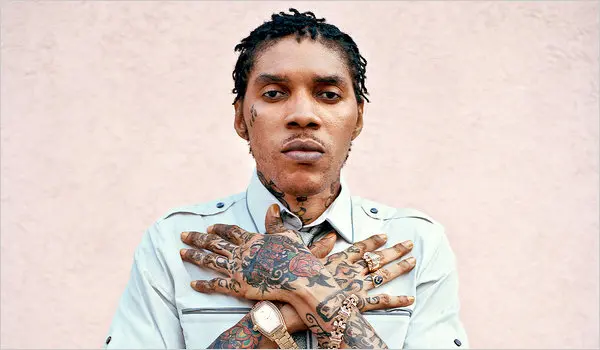
Dancehall legend Vybz Kartel has revealed plans for a highly anticipated music concert set for December 2024, marking a significant moment in his career.
This event will be his first major performance since his release after 13 years in prison.
Speaking on a podcast shared by Marigyata on Instagram, Kartel acknowledged the overwhelming support from his fans and confirmed that preparations for the concert are already in progress, with more details to be announced soon.
Kartel, whose real name is Adidja Palmer, was released from the Tower Street Adult Correctional Centre in downtown Kingston on July 31, 2024.
His freedom followed a ruling by the Court of Appeal, which decided against retrying him and his co-defendants in the 2011 murder case of Clive “Lizard” Williams.
Initially convicted in 2014 alongside Shawn ‘Shawn Storm’ Campbell, Kahira Jones, and Andre St John, their appeal to the local Court of Appeal in 2020 was unsuccessful.
However, the UK-based Privy Council overturned their convictions on March 14, 2024, citing juror misconduct.
The case was then referred back to the Jamaica Court of Appeal to determine if a retrial was necessary.
Watch below video:
Vybz Kartel set to host his first concert this December
On July 30, 2024, the Court of Appeal acquitted and discharged Dr. Cassiel Ato Forson, the Minority Leader in Parliament and former Deputy Minister of Finance, in the trial over the purchase of ambulances for the country.
Following the court’s decision, former President John Dramani Mahama expressed his satisfaction with the ruling on Twitter.
He called the acquittal “good news” and a triumph for the rule of law.
Mahama reiterated his view that the case was an instance of political persecution.
He stressed the need for an independent judiciary and pledged to appoint a fair-minded Minister for Justice to implement necessary reforms.
“Good news from the Court of Appeal, acquitting and discharging former deputy finance minister Cassiel Ato Forson in the ambulance case. This is a victory for the rule of law and confirms my long-held view that the whole case was political persecution.
“This appeal was made some time ago when they filed a no-case petition before the court and the High Court rejected it so they went to appeal.
“So, it came as quite a pleasant surprise. But it shows that we still have justice in this country, we can work to make the judiciary what we want it to be. I pledge to appoint a fair-minded Minister for Justice who will work with the legal fraternity and the Judicial Council to carry out reforms to ensure we have a truly independent judiciary we can all be proud of,” he said in his Twitter post on July 30, 2024.
The three-member Court of Appeal panel, with a 2-1 majority, decided to acquit Dr. Ato Forson. The panel determined that the trial court’s instruction for Dr. Ato Forson to begin his defense was mistaken, thus overturning the previous ruling.
Good news from the Court of Appeal, acquitting and discharging former deputy finance minister Cassiel Ato Forson in the ambulance case. This is a victory for the rule of law and confirms my long-held view that the whole case was political persecution.
The Minority in Parliament rejoiced over the Court of Appeal’s decision to acquit their leader, Dr. Cassiel Ato Forson, in the progressive ambulance case, in the aftermath of a 2-1 verdict.
This ruling, which came after an appeal concerning the no-case submission by Dr. Forson’s legal team, brings to a close a nearly two-year-long legal battle.
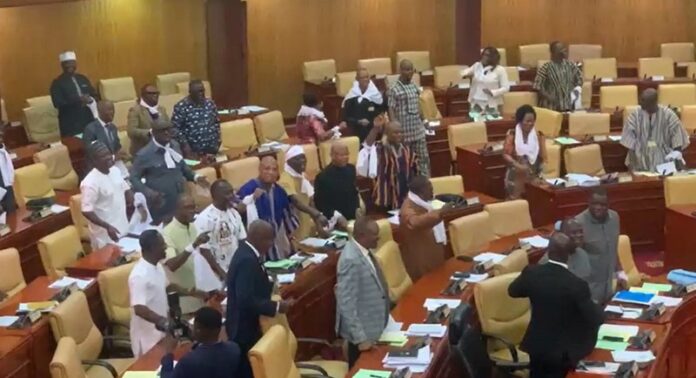
According to Parliamentary Affairs correspondent Ohene Ampomsah, the Minority cheered as Dr. Forson made his entrance into the Chamber.
Former Minority Leader Haruna Iddrisu commended the judiciary for their work and advised the Attorney General against pursuing further appeals.
Majority Leader Alexander Afenyo Markin also celebrated the outcome, underscoring the importance of judicial neutrality and urging against political influence to ensure effective justice.
Prominent High Court Justice Alexander Osei Tutu has been promoted to the Court of Appeals.
He was among 16 justices whose nominations were presented to Parliament by President Nana Addo Dankwa Akufo-Addo, in accordance with the authority vested by the 1992 Constitution of Ghana.
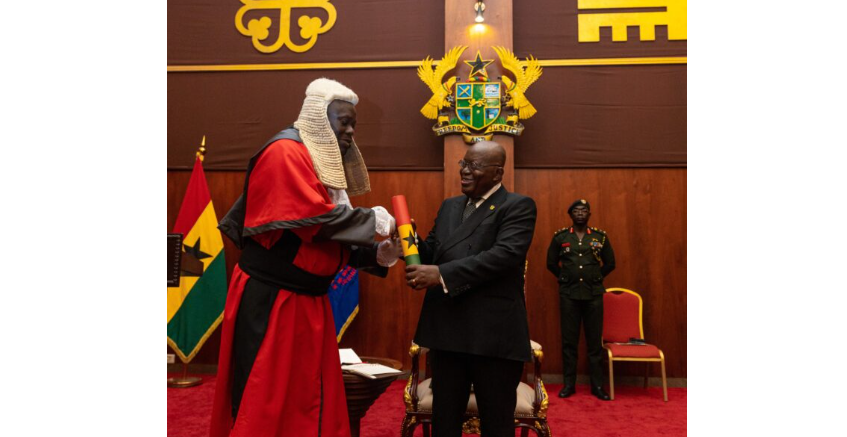
Justice Osei Tutu was officially sworn in during a vibrant ceremony at Jubilee House in Accra.
The newly appointed justices, including 12 men and four women, took their oaths of office, secrecy, and allegiance after receiving the Judicial Council’s recommendations.
About Alexander Osei Tutu
He earned his LLB from the University of Ghana in 2000 and was admitted to the bar in 2002.
After spending eight years in private practice, he was appointed as a circuit court judge in 2010.
He was elevated to the position of High Court Judge in 2013.
Justice Alexander Osei Tutu has an LLM in International Human Rights from Fordham University and a Diploma in Transnational Criminal Law from the International Law Enforcement Academy in Roswell, USA.
The Court of Appeal has dismissed an appeal filed by the legal representative of Minority Leader, Dr Cassiel Ato Forson, against an Accra High Court’s decision to dismiss an application for mistrial in the ambulance trial filed by the first accused or appleant.
On Thursday, June 6, 2024, Justice Afia Serwah Asare-Botwe, presiding over the ambulance trial, ruled that the application filed by former Deputy Finance Minister Dr. Cassiel Ato Forson was not tenable.
Dr. Ato Forson and co-accused Richard Jakpa had alleged professional and prosecutorial misconduct on the part of Attorney-General Godfred Dame.
Their application referenced a tape in which Dame and Jakpa were purportedly discussing matters before the courts.
However, the judge found no statutory basis to declare a mistrial or to investigate the Attorney-General’s conduct.
Dr Forson’s legal counsel sought to appeal the court’s decision and the grounds for this appeal as set out in the notice of appeal were as follows;
a. The Learned High Court judge erred in holding that the Particulars of offences of Counts 1 and 5 contain sufficient information on the specific acts engaged in by the 1st Accused/Appellant that manifest “without due cause and authorization” as contained in Counts 1 and 5 of the charge sheet;
b. The Learned High Court Judge failed or neglected to give adequate consideration to the case of the 1st Accused/ Appellant;
c. The Learned High Court judge erred in law by refusing or neglecting to apply the rationes decidendi of the decision of Supreme Court in The Republic v Ernest Thompson & 4 Ors (Criminal Appeal No. (J3/05/2020).
Counsel for the Appellant chose to argue all three grounds together. In doing so, Counsel for the Appellant contends that when the duty of a prosecution in stating the particulars of offence are considered vis-a-vis the requirements of Article 19 (2) (d) of the 1992 Constitution and Section 112 (4) of Act 30, the Respondent has failed to sufficiently particularize the alleged offence.
The Appellant contended that the use of the term “without due cause and authorization” in the charge sheet without stating exactly what conduct constitutes acting “without due cause and authorization” amounts to a breach of the Appellant’s rights under Article 19 (2) (d) of the 1992 Constitution.
In arguing their position, learned counsel for the Appellant made reference to the case of The Republic v. Ernest Thompson & 4 Ors (Criminal Appeal no. J3/05/2020).
The argument was made here that the standard for the formulation of criminal charges is set in that case. Counsel for the Appellant continues and says that for a charge to have been properly formulated, it must sufficiently indicate to the Accused the nature of the acts the commission of which led to the events which the law has prohibited with penal consequences.
The Appellant argued further that for criminal charges to be consistent with Article 19(2) of the 1992 Constitution, they must contain basic facts in precise language that speak to the mens rea and actus reus.
The Appellant contended that charges 1 & 5 of the charge sheet do not sufficiently do so and that the expression “without due cause and authorization” is vague forcing the Appellant to guess what that means and as such those charges should be struck out as defective.
On their part, the Respondent contended that the Appeal must be dismissed since in the view of the Respondent, the charges were properly drafted and adequate particulars had been provided on the charge sheet.
The Respondent, the Attorney-General’s Office, referenced the case of Ernest Thompson (supra) and argued that its obligations when putting together the charge sheet were to “sufficiently indicate to an accused person the nature of the acts the commission of which has led to the event which the law prohibited.”
The Respondent further contended that when drafting the particulars in the charge sheet, it had to do so with the elements of the offence in consideration.
The Respondent broke down the elements of the two charges brought against the Appellant, and concluded that it had sufficiently met its obligations in drafting the charge sheet.
Consequently, having examined the charges under scrutiny, the Court found that they contain sufficient particulars as required under Article 19 (2) (d) of the 1992 Constitution and Section 112 (4) of Act 30 and held that this Appeal is therefore without merit and is dismissed accordingly.
President Akufo-Addo is facing renewed accusations from some members of the public, who allege that he is trying to stack the courts of Ghana with members of his party, the New Patriotic Party (NPP).
These accusations stem from his reported nomination of justices for the Court of Appeal.
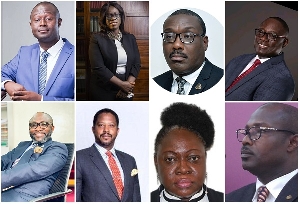
According to dailyguidenetwork.com, a list of 20 individuals, including 12 High Court judges and 8 prominent legal practitioners, has been shortlisted for appointment as justices of the Court of Appeal of Ghana.
Similar criticism was directed at the president, especially from members of the opposition National Democratic Congress (NDC), including former President John Dramani Mahama, during his previous judicial appointments.
It is important to note that appointments to the Court of Appeal are made by the president in consultation with the Judicial Appointments Advisory Board (JAAB), headed by the Chief Justice of Ghana.
According to Section 3 of Article 136 of the 1992 Constitution of Ghana, a person must have high moral character, proven integrity, and not less than twelve years’ standing as a lawyer to be qualified for appointment as a Justice of the Court of Appeal.
The following is a brief profile of the lawyers reportedly nominated for appointment as justices of the Court of Appeal.
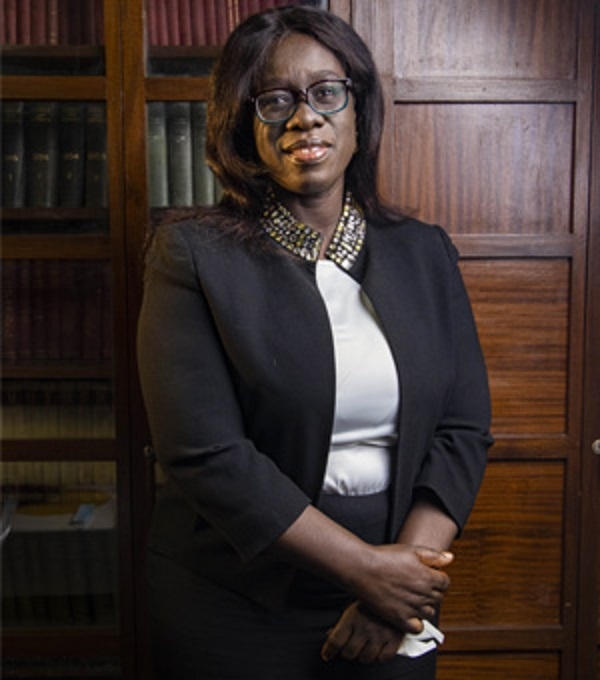
Mariam Agyeman Gyasi Jawhary
Lawyer Mariam Agyeman Gyasi Jawhary is the Managing Partner of the Totoe Legal Service and has been a lawyer in good standing for over 30 years.
Gyasi Jawhary’s profile on the website of her firm indicates that her areas of expertise include conveyancing, land litigation, family law, corporate and commercial, as well as labour law.
She is said to have previously worked as a part-time lecturer at the Ghana School of Law, teaching Law of Evidence, Labour Law and Conveyancing and Drafting. She also worked as an Administrator /Mediator for the Kumasi Legal Aid Centre for FIDA-GHANA on a volunteer basis for 6 years, between 1997 and 2003, while still engaged in active legal practice.
She has also held several positions at the Ghana Bar Association, including National Assistant Secretary of the association for 6 years (2012 to 2018), member of the National Bar Council, member of the Executive Committee of the Ashanti Branch of the association, and the representative association on the Ashanti Regional Lands Commission for 8 years (2009 to 2018).
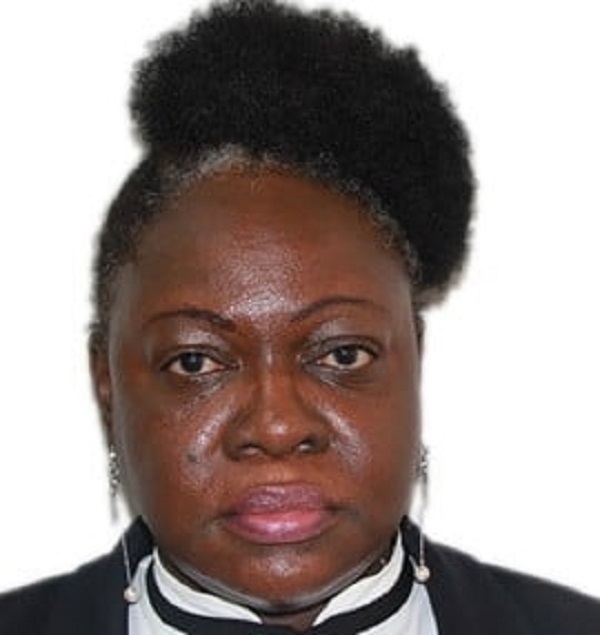
Yaa Onyameye Gyakobo
Yaa Onyameye Gyakobo was admitted to the Ghana Bar Association in 1994, marking nearly 30 years of legal practice.
She currently serves as a Senior Associate at Ansah-Obiri Legal Consult. Her previous roles include Legal Officer at the Divestiture Implementation Committee, Associate at Wuowoti Chambers, Vidal Buckle & Co, and Associate at Ayawaso Chambers, Amarteifio & Co.
In addition to her legal practice, Onyameye Gyakobo is actively involved in the Ghana Bar Association, where she currently holds the position of Assistant Secretary. Over the years, she has served in various capacities within the association, including as National Assistant Public Relations Officer, Financial and Social Security Head of the Greater Accra Regional Bar, and member of the GBA Electoral Committee.
Charles William Zwennes
Charles William Zwennes serves as the Head of Chambers at Gaisie Zwennes Hughes & Co, a position he has held since 1996, according to his LinkedIn profile.
He is a Barrister-at-Law of England & Wales and a Barrister & Solicitor of the Superior Courts of Ghana. Zwennes is also a member of the Chartered Institute of Arbitration in London.
His academic qualifications include a professional certificate in Petroleum and Energy Law from the University of Dundee, an LL.M in Company Law and International Finance Law from UCL, and an LL.B in law from the University of Kent.
Yaw Oppong
Yaw Oppong serves as the Director of Legal Education at the Ghana School of Law (GSL) and is a solicitor of the Supreme Court of Ghana. Additionally, he is the Managing Partner of Ampofo, Oppong and Associates.
He has extensive experience in legal education and has lectured at various universities in Ghana, including Central University. Currently, he holds the position of senior lecturer at the Ghana School of Law.
Yaw Oppong earned his first degree in law from the University of Ghana and qualified as a Barrister-at-Law from the Ghana School of Law, Makola – Accra, Ghana. He also holds a Master’s Degree in Oil and Gas Law (LLM) from the Faculty of Law, University of Ghana, Legon. Moreover, he is a member of the Chartered Institute of Arbitrators, London.
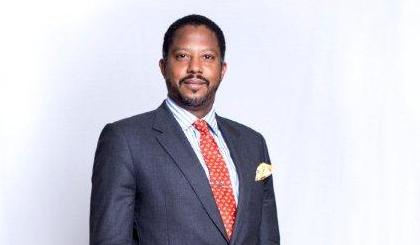
Nathan Parker Yarney
Nathan Parker Yarney was admitted to the Ghana Bar Association in October 1999, marking over 25 years of legal practice.
He currently practices law and mediation at Kobaka Chambers, a firm he established in October 2006. Prior to founding his practice, Nathan worked at Paintsil, Paintsil & Co, and Ama Harding Chambers.
His educational background includes a Postgraduate Diploma in Banking Law from Queen Mary and Westfield College (now Queen Mary University of London), an LL.M (ADR) from the University of Ghana, and an LLB (Hons) degree from the Ghana School of Law, Accra.
David Acheampong Boafo
David Boafo is a Senior Partner at S.K. Boafo and Company, where he has been since 1995. He was called to the Bar of England and Wales in 1994 and enrolled on the Roll of Lawyers in 1995, amassing 25 years of legal experience.
His areas of specialization include commercial practice, civil litigation, land matters, and administration of estates.
David Boafo currently serves as the National Secretary of the Ghana Bar Association and previously held the position of President of the Ashanti Region Branch of the association.
From 2013 to 2016, he was a member of the General Legal Counsel, representing the Ghana Bar Association. Additionally, he served as the Head of the Legal Department of Asante Kotoko Sporting Club.
Francis Koffie
Francis Koffie is a Managing Partner at Koffie & Partners (Law Conclave) Lawyers and a lecturer at the Ghana School of Law. He is also the President of the Ashanti Regional branch of the Ghana Bar Association (GBA).
Having earned his law degree from the Ghana School of Law, Francis Koffie has been actively involved in legal practice and education. He also served on the five-member committee established by the government to investigate the fire that engulfed the Kejetia Market in Kumasi, Ashanti Region, in March 2023.
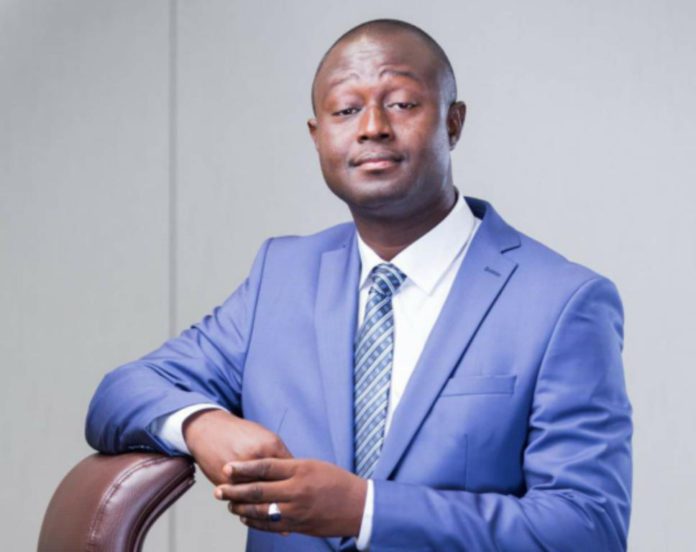
Dr. Poku Adusei is the Head of Legal at the National Communications Authority. With over 21 years of legal experience, he was called to the Ghana Bar Association in 2003.
Previously, Dr. Adusei served as the Deputy Director-General of the Ghana Standards Authority from September 2017 to March 2019. He has also been a lecturer at the University of Ghana School of Law, teaching subjects such as Intellectual Property Law, Private International Law, Company Law, and Land Law.
Dr. Adusei holds a Ph.D. in Law from McGill University in Canada. He also possesses a Bachelor of Laws (LL.B.) Degree and a Qualified Certificate in Law.
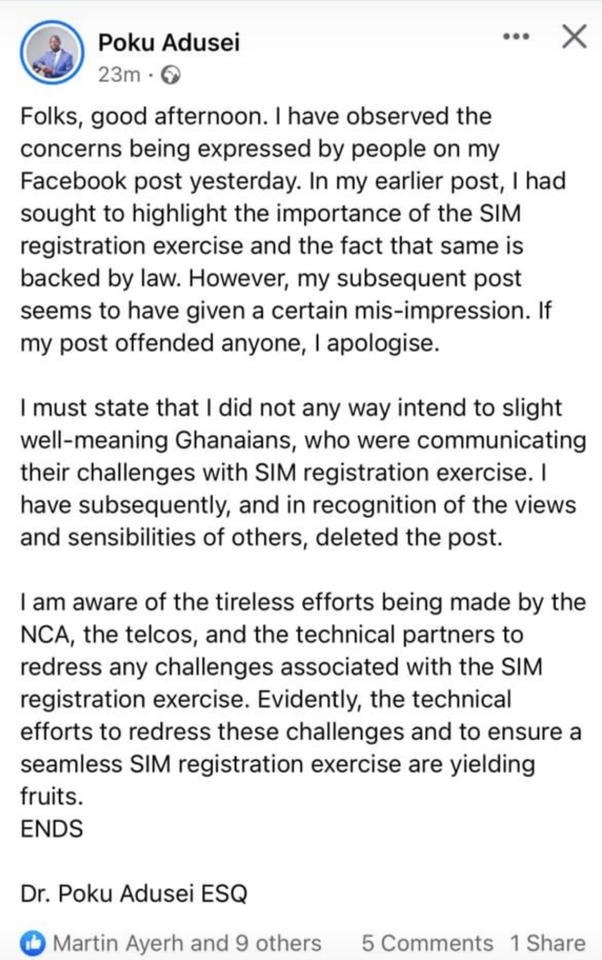
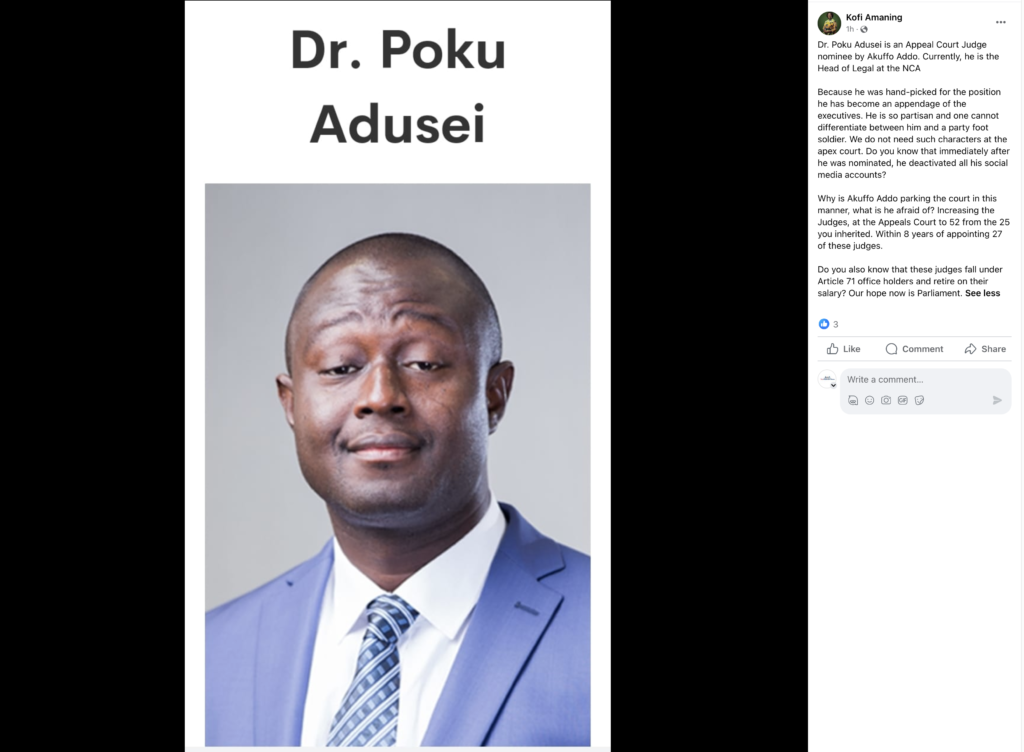
Lawyer and scholar, Dr Poku Adusei, recognized for his strong support of the ruling New Patriotic Party (NPP) and his position as the legal head of the National Communications Authority (NCA), has made a surprising move by reportedly deactivating his Facebook account shortly after President Akufo-Addo nominated him as a judge for the Court of Appeal.
Dr Poku Adusei is amongst 7 other lawyers who have been appointed by the president, for the Court of Appeal. If approved by parliament, these 8 lawyers will go down in history as the largest group in history as the most significant number of judges ever appointed to the Court at one time, elevating the total number of Court of Appeal judges to 53.
Dr Poku Adusei, highly regarded for his academic accomplishments including a Ph.D. in law from McGill University in Canada, has previously held esteemed positions such as Deputy Director-General of the Ghana Standards Authority and lecturer at the University of Ghana School of Law.
Despite his impressive background, Dr Adusei has faced criticism for his vocal support of the government and contentious remarks on various national matters.
His combative social media presence, marked by disparaging comments towards dissenting voices, has sparked considerable debate.
Observers attempting to reach out to him on social media platforms discovered that his profile had been deactivated, suggesting a deliberate attempt to distance himself from past controversies.
In a separate development last year, former President John Dramani Mahama accused President Nana Addo Dankwa Akufo-Addo of stacking Ghana’s judiciary with judges sympathetic to the NPP.
Mr. Mahama alleged that Akufo-Addo had intentionally appointed his allies to the bench to exert influence even after leaving office.
At the closing ceremony of the 3rd Annual Lawyers Conference of the National Democratic Congress (NDC), Mahama expressed concerns about the growing number of NPP-affiliated judges in the judiciary, suggesting a calculated effort to evade accountability in the future.
Parliament has granted its endorsement for the advancement of three eminent Justices from the Court of Appeal to the prestigious roles of Supreme Court judges.
The endorsed nominees, namely Justice Henry Anthony Cofie, Justice Yaw Asare Darko, and Justice Richard Agyei Frimpong, were nominated by the President following the mandatory retirement of three Justices earlier this year.
The Appointments Committee of Parliament meticulously conducted a thorough vetting process, assessing the nominees’ qualifications and suitability for the roles of Supreme Court Justices.
The nominations and subsequent approval signify a critical step in maintaining a functional and complete Supreme Court bench, ensuring the continuation of effective judicial proceedings. The new appointees will contribute their wealth of experience and legal acumen to the highest court in Ghana.
The announcement of the parliamentary approval was made by the Second Deputy Speaker of Parliament, Andrew Asiamah Amoako, during a session on Friday.
He declared, “This house has approved the Excellency the president’s nominations of Justice Henry Anthony Kwofie, Justice Yaw Darko Asare, and Justice Richard Agyei Frimpong for appointment as justices to the Supreme Court of Ghana.”
Today, Tuesday, July 4, 2023, the High Court in Accra will resume the daily hearing of the member of parliament (MP) elect for Assin North, James Gyakye Quayson‘s case.
The trial was adjourned on June 29 due to incomplete application documents received by the court.
Quayson has appealed the daily trial order in the Court of Appeal, claiming violations of his right to a fair trial.
His election as MP was nullified by the Supreme Court for holding dual citizenship.
Quayson now faces charges of perjury and deceiving a public officer.
Despite the ongoing trial, he is expected to be present in parliament for his swearing-in.
Following his dismissal from the Circuit Court in the aftermath of Anas Aremeyaw Anas‘ undercover investigation into the judiciary, a Circuit Court judge has received a favorable judgment overturning his dismissal from the Court of Appeal.
Judge Benjamin Yaw Osei, who was filmed by undercover investigtors at Juabeng, his station at the time, was part of 20 lower court judges dismissed after a Judicial Service process.
Anas’ charge against him was that he had freed an accused person after receiving bribes from them.
His lawyers, however, argued before the three-member Court of Appeal panel that contrary to the allegations made in the video, the accused person had actually been convicted and imprisoned.
The panel presided over by Justice Senyo Dzamefe on Thursday, June 22, thus, reversed an earlier high court judgment against the appellant.
The judgment means he may be reinstated as a judge.
According to reports, President Akufo-Addo intends to nominate Justice Gertrude Araba Esabaa Torkornoo, a member of the Supreme Court, for confirmation by Parliament as the next Chief Justice.
According to the sources, the Council of State has already given the green light for Justice Torkornoo’s appointment and the President would soon forward her name to Parliament for approval, in accordance with Article 144(1) of the 1992 Constitution.
When approved by Parliament, Justice Torkornoo will replace Justice Kwasi Anin Yeboah, who retires as Chief Justice on May 24, 2023 when he reaches the mandatory retirement age of 70 for justices of theCourt of Appealand the Supreme Court.
When she gets the nod from Parliament, the 60-year-old Justice Torkornoo will become the third female Chief Justice in the history of Ghana, following the footsteps of Justices Georgina Theodora Wood and Sophia Akuffo.
Justice Torkornoo will be President Akufo-Addo’s third appointment to the office of Chief Justice since he assumed office in January 2017.
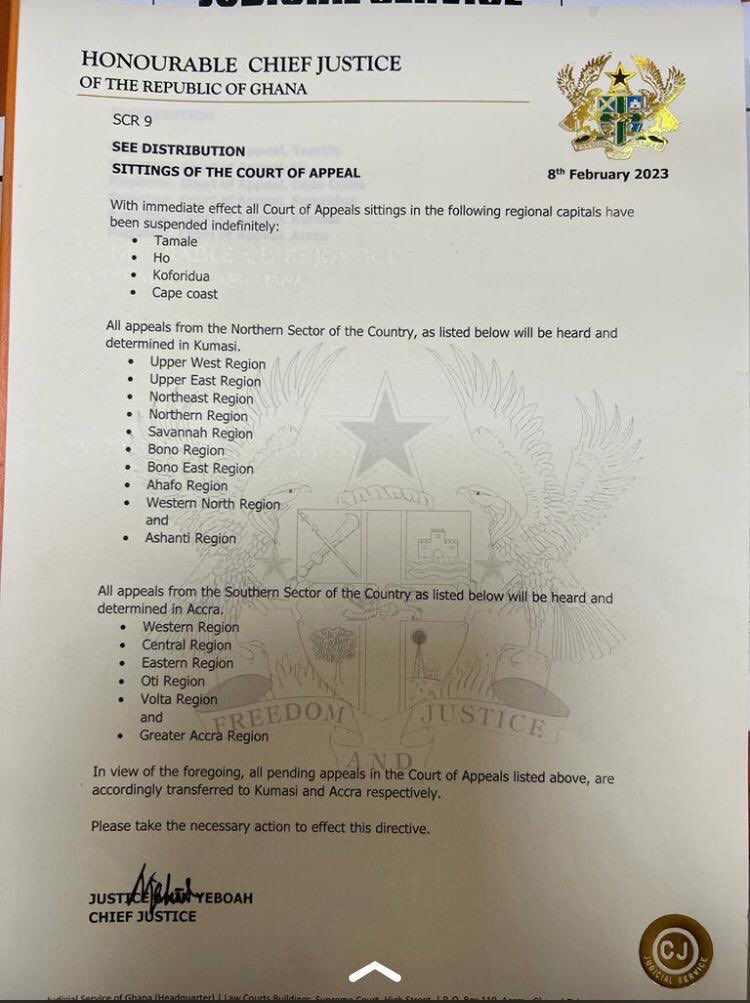
Court of Appeal sittings in four regional capitals have been suspended by the Judicial Service.
The affected cities are; Tamale, Cape Coast, Ho, and Koforidua.
The decision was communicated in a press release issued on Wednesday, February 8, signed by the Chief Justice, Justin Anin Yeboah.
The release added that all appeals from the Northern Sector of the country, including the Upper East, Upper West, North East, Northern, Savannah, Bono East, Ahafo, Western North and Ashanti regions would be heard in Kumasi. However, all appeals in the Southern sector, including the Western, Central, Eastern, Oti, Volta, and Greater Accra Region will be heard in Accra.
“In view of this, all pending appeals in the Court of Appeal listed above are accordingly transferred to Kumasi and Accra respectively,” the statement concluded.
The appointment of 15 more justices to the Court of Appeal has been accepted by President Akufo-Addo.
The President received the recommendation from the Judicial Council.
In the Jubilee House‘s Banquet Hall on Wednesday, December 21, in the late afternoon, they will be sworn into office.
They are Justice Ackah Boafo, Justice Asare-Botwe, Justice Alex Owusu-Ofori, Justice Emmanuel Ankamah, Justice Jerome Noble-Nkrumah, Justice Mrs. Gifty Agyei Addo, Justice Samuel Obeng-Diawuo and Justice Mrs. Hafisata Amaleboba.
The rest are Justice Jennifer Abena Dadzie, Justice Charles Ekow Baiden, Justice Stephen Oppong, Mr Patrick Kwamina Baiden, Mr Christopher Archer, Prof. Mrs. Olivia Anku-Trede and Dr. Ernest Owusu-Depaah.
Lawyers of Gregory Afoko and Asabke Alangde, the two persons standing trial for the death of New Patriotic Party’s (NPP) Upper East Regional Chairman, Adams Mahama, have filed a notice of appeal to challenge the order of the High Court to open their defence.
The application is seeking the intervention of the Court of Appeal, the second highest court of the land, to overturn the decision by the High Court that a prima facie case has been established against them.
Afoko and Alangde are being accused of the acid incident which allegedly killed the NPP Regional Chairman on May 20, 2015. They have pleaded not guilty to two charges of conspiracy and murder.
On June 14 this year, State Prosecutors closed their case after parading 16 witnesses, but lawyers of the accused persons filed a submission of no case to answer on the grounds that, the testimonies of the prosecution witnesses have not established a prima facie evidence against them.
Ruling on the submission of no case on Friday, October 7, the court presided over by Her Ladyship Justice Efua Merley Wood, said the elements of prima facie evidence have been established by the prosecution.
The court also ruled that, for the testimonies of the prosecution witnesses to be believed, it would be fair to hear from the accused persons.
Justice Merley Wood, a Justice of the Court of Appeal sitting with additional responsibility as a High Court Judge, ruled that the court is satisfied that the prosecution has made sufficient evidence that requires the accused persons to open their defence.
EIB Network’s Legal Affairs Correspondent, Murtala Inusah, reports that, due to the pendency of that appeal, the directive for Afoko to open his defence on November 2 has been deferred to November 16, by which time the appeal would have been determined.
President Akufo-Addo will today commission a residential complex for Appeals Court Judges at Nhyiaeso in the Ashanti Region as part of his four-day tour of the Ashanti Region.
The residential complex has about twenty (20) bungalows for Court of Appeal Judges in Kumasi.
The sod for the construction was cut in April last year by President Akufo-Addo with support from the Asantehene, Otumfuo Osei Tutu II, and the Chief Justice, Justice Kwasi Anin Yeboah.
Ahead of the commissioning later today, Ghanaweb shares images of the ultra-modern judge complex.
The three judges in the Nigerian appeal court agreed unanimously to dismiss the allegations.
The Court of Appeal in Nigeria has dismissed the government’s terrorist charges against separatist leader Nnamdi Kanu, in a unanimous judgment by all three judges hearing the case.
On Thursday, the lead judge dismissed a seven-count charge of terrorism against Kanu and discharged him, saying a lower court had no jurisdiction to try the case and that Kanu was abducted and extraordinarily extradited to Nigeria.
“In view of the fact that the trial court lacks jurisdiction to hear this case because the process of extradition of the appellant from Kenya to Nigeria was unlawful since the due process was not followed, this appeal succeeds,” the lead judge, Justice Oludotun Adefope Okojie, said.
“Consequently, the appellant is therefore discharged,” she said.
In April, Nigeria’s High Court ruled that Kanu should stand trial.
He leads the Indigenous People of Biafra (IPOB), which campaigns for the secession of southeastern Nigeria where the majority are of Igbo ethnicity.
Nigerian authorities have labelled IPOB a ‘terrorist’ organisation.
A spokesperson for Nigeria’s attorney general said the government was considering its legal options following Thursday’s ruling but said the charges Kanu faced before he disappeared while on bail in April 2017 “remain valid issues for judicial determination”.
Kanu denied the charges of terrorism and knowingly broadcasting falsehoods, which are linked to social media posts he issued between 2018 and last year.
His lawyers argued that he could not receive a fair trial because he was forcefully extradited from Kenya to Nigeria. Kenya has declined to say if it played a role in Kanu’s return.
An attempt by Igbo separatists to secede as the Republic of Biafra in 1967 — the year that Kanu was born — triggered a three-year civil war that killed more than one million people.
Since Kanu’s trials began in Abuja, IPOB has ordered residents of the southeast to “sit at home”, a form of civil disobedience to show solidarity with Kanu.
The IPOB campaign has crippled small businesses and routinely disrupted other economic activity in the five states of the region.
The Court of Appeal has unanimously acquitted and discharged Dr. Nana Owusu Ensaw, the third accused person who was being held with four others in connection with the four million dollar Pegasus machine purchased by the National Communication Authority (NCA).
Nana Ensaw a former NCA board member went to the Court of Appeal (CA) to challenge the ruling of the High Court, which directed him and four others to open their defence in the four million dollar Pegasus machine trial.
He was to open his defence in respect of two charges out of the six namely conspiracy to steal and stealing.
The three member panel of the Court of Appeal presided over by Mr Justice Victor Ofoe noted that from the face of the records before them, the High Court did not establish a prima facie case against Nana Ensaw and the High Court misapplied the law, when it ruled that he should open his defence.
“The criminal appeal succeeds and the order of the High Court directed to you to open your defence in respect of the Count three and 14 is here by dismissed,†it ruled.
Meanwhile, the High Court presided over by Mr Justice Eric Kyei Baffour has fixed May 12 this year to deliver its judgement in respect of the substantive trial.
The other accused persons in the substantive trial are: Eugene Baffour Bonnie, former Board Chairman of NCA, William Tetteh Tevie, former Director General of NCA, Alhaji Mimina Osman, a former Deputy National Security Coordinator and George Derick Oppong, a businessman and Director of Infraloc Development Limited.
The accused persons have variously been charged with stealing, using public office for public gain, willfully causing financial loss to the state in respect of the purchase of the cybersecurity equipment worth four million dollars in the year 2016.
They have denied the charges and are currently on bail.