Dr. Patrick Kuma-Aboagye, Director General of the GHS speaking in an interview on Peace FM’s morning show ‘Kokrokoo’ said the number of cases is dropping because of people’s adherence to the COVID protocols.
“Let’s pray that this goes on…I know very well that because of the Omicron surge, people started raising their self-protection and so if this continues we know it will come down further” he stated.
Data on the GHS COVID-19 update page indicates that as of 10th January 2022 the active cases stood at 9,020 from a previous of 10,889.
Ghana has identified seven more cases of the Omicron variant of COVID-19, according to a top health official bringing the total number of recorded cases of the new variant to 41.
Director-General of the Ghana Health Service (GHS) Dr. Patrick Kuma-Aboagye who disclosed this development said the new cases were detected during community testing after the first 34 cases were recorded at the Kotoka International Airport.
“We saw the first of about 34 cases that were recorded at the airport. At the time, we had sequenced about 66 community samples and they were all negative†but after the second batch of about 44 tests was conducted, seven more cases were detected,†Dr. Kuma-Aboagye was quoted by JoyNews as saying.
He was quick to add that the Delta variant remains dominant in the country.
On December 2, 2021, the Noguchi Memorial Institute for Medical Research (NMIMR) announced the detection of 34 cases of the Omicron variant of COVID-19 in the country.
In a tweet to announce the new cases, the NMIMR said the imported cases were detected in 120 samples collected between November 21 and 25.
“The Omicron variant was detected in 28% (34 out of 120) of returning traveler samples (collected from 21-25 November) sequenced.
“These are the first imported cases of the variant into Ghana, and we are closely monitoring its potential spread in the local population. We encourage the general public to continue adhering to the COVID-19 prevention protocols,†the NMIMR stated in a tweet.
Following the detection of the new variant, the country has made some modifications to its protocols regarding foreign travel through the Kotoka International Airport.
GHS directed that all persons 18 years and above arriving in Ghana from December 12 must provide proof of full vaccination.
Meanwhile, “all unvaccinated Ghanaians and residents who are currently outside the country and intend to return within 14 days from the midnight of December 12, 2021 [which has now been extended to December 14] are exempted.â€
This group, however, will be vaccinated on arrival at the airport.
According to the press release signed by GHS boss, Dr. Patrick Kuma-Aboagye, out of the 34 cases detected at the airport, 75% of them were unvaccinated.
The Noguchi Memorial Institute for Medical Research (NMIMR) says it has detected 34 cases of the Omicron variant of COVID-19 in the country.
The Institute in a series of tweets said the imported cases were detected in 120 samples collected between November 21 and 25.
“The Omicron variant was detected in 28% (34 out of 120) of returning traveler samples (collected from 21-25 November) sequenced. These are the first imported cases of the variant into Ghana, and we are closely monitoring its potential spread in the local population.
“We encourage the general public to continue adhering to the COVID-19 prevention protocols,†the NMIMR said in a tweet.
The Ghana Health Service on Wednesday, December 1, 2021, announced Ghana has recorded two cases of the new variant which were detected at the Airport.
The Noguchi Memorial Institute for Medical Research (NMIMR) says it has detected 34 cases of the Omicron variant of COVID-19 in the country.
The Institute in a series of tweets said the imported cases were detected in 120 samples collected between November 21 and 25.
“The Omicron variant was detected in 28% (34 out of 120) of returning traveler samples (collected from 21-25 November) sequenced. These are the first imported cases of the variant into Ghana, and we are closely monitoring its potential spread in the local population.
“We encourage the general public to continue adhering to the COVID-19 prevention protocols,†the NMIMR said in a tweet.
The Ghana Health Service on Wednesday, December 1, 2021, announced Ghana has recorded two cases of the new variant which were detected at the Airport.
The Director-General of the Ghana Health Service, Dr Patrick Kuma-Aboagye, revealed that the virus was detected in persons travelling from Nigeria and South Africa into the country.
The World Health Organization (WHO) has warned that the Omicron coronavirus variant poses a high risk of infection surges around the globe.
The variant could lead to severe consequences in some regions, the WHO said on Monday.
The head of the organisation, Dr Tedros Adhanom Ghebreyesus, renewed a call for a global push to get vaccines to poorer nations.
Covid-19 is “not done with us” yet he warned.
The variant was detected in South Africa earlier this month with initial evidence suggesting it has a higher re-infection risk. South Africa has been praised for its prompt reporting of the variant.
“Omicron has an unprecedented number of spike mutations, some of which are concerning for their potential impact on the trajectory of the pandemic,” the WHO said.
Speaking on Monday, Dr Tedros said scientists around the world are working to discover if the new variant is associated with higher transmission, risk of reinfection and how it reacts to vaccines.
“Omicron’s very emergence is another reminder that although many of us think we are done with Covid-19, it is not done with us,” he said.
He added that no deaths have been linked to the new variant yet.
Cases have already been reported in a number of countries including Canada, the UK, Portugal, Belgium and the Netherlands.
The new variant has prompted the UK, EU and US to issue a travel ban on Southern African countries – a decision criticised by South Africa’s President Cyril Ramaphosa.
Travel into Australia for international students and “skilled workers” holding visas was meant to re-start on Wednesday but has now been delayed until 15 December.
Israel has also banned foreigners from entering the country.
The US has also followed suit with Joe Biden telling Americans to “go get your booster”. He also urged people to wear masks indoors.
But Mr Biden also said he did not anticipate any further US travel restrictions or lockdowns at this time.
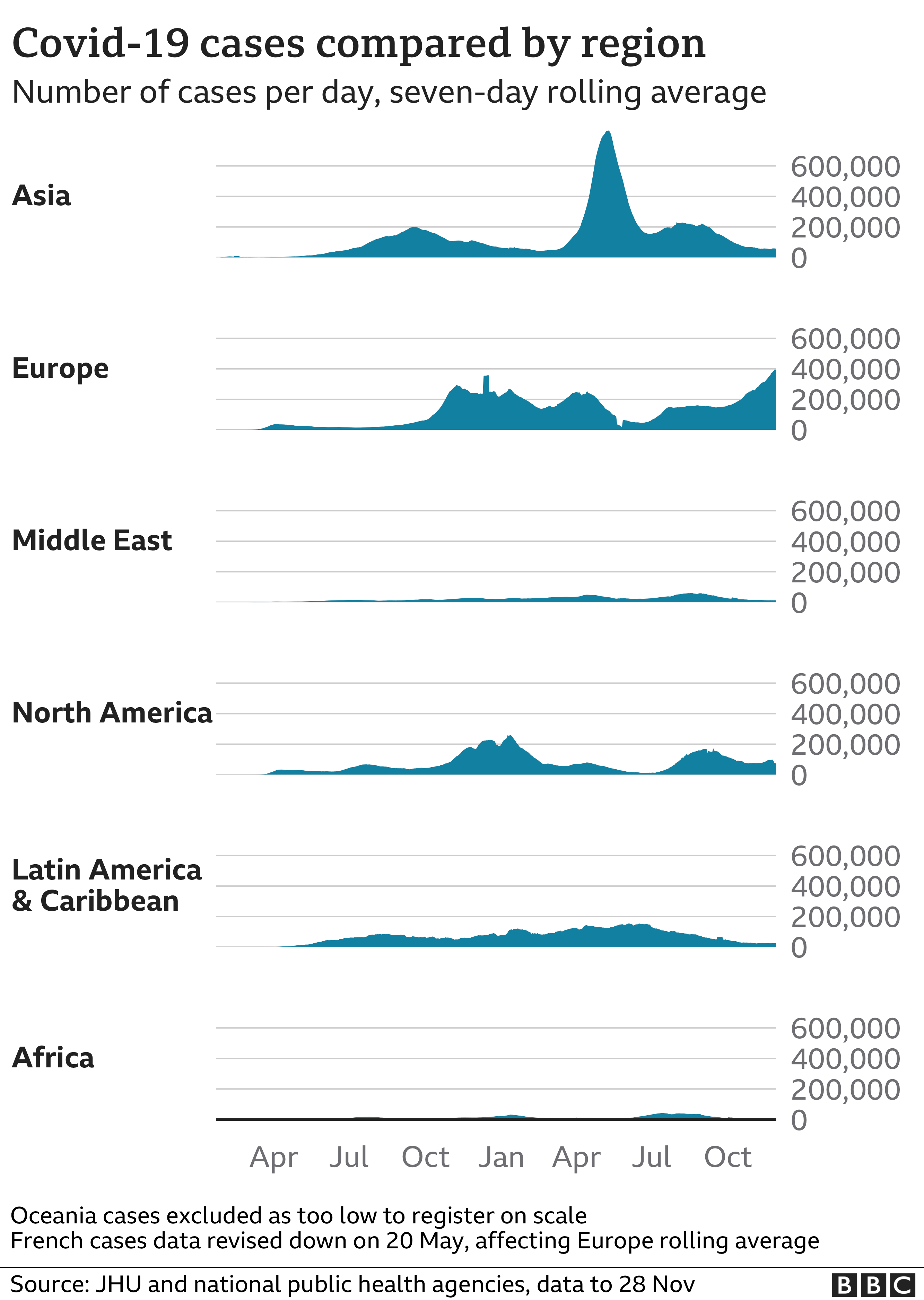
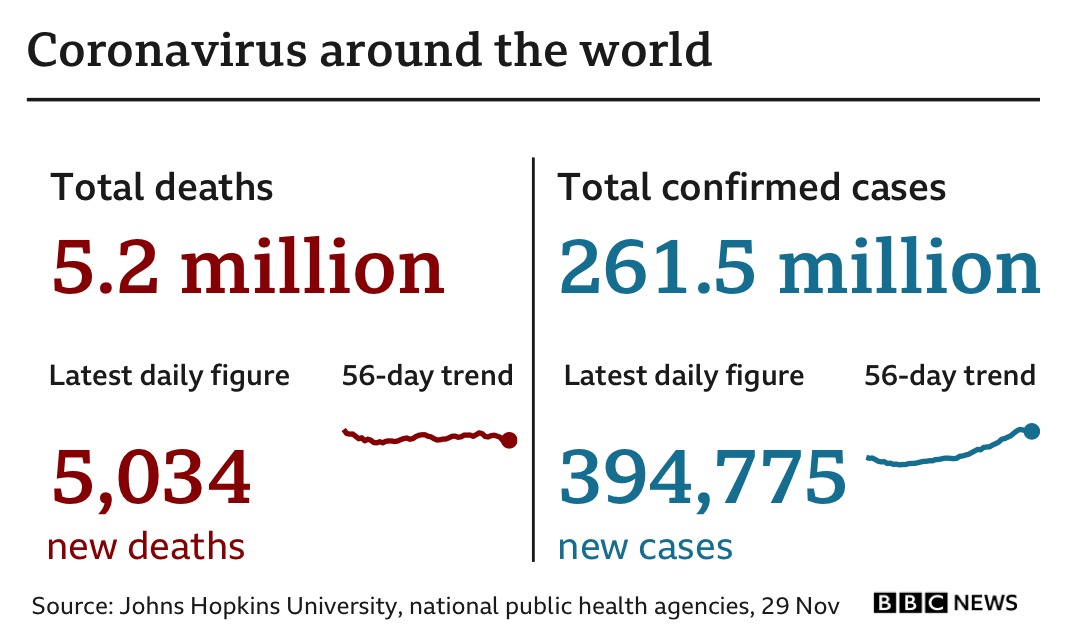
There have been more than 261 million cases and five million deaths around the globe since the pandemic started in 2020, according to data from Johns Hopkins University.
South Africa reported 2,800 new infections on Sunday, a rise from the daily average of 500 in the previous week.
Government adviser and epidemiologist Salim Abdool Karim said he expected the number of cases to reach more than 10,000 a day by the end of the week, and for hospitals to come under pressure in the next two to three weeks.
Dr Phaahla said he wanted to “reiterate that there is absolutely no need to panic” because this “is no new territory for us”.
“We are now more than 20 months’ experienced in terms of Covid-19, various variants and waves,” he added at a media briefing.
On Monday, Japan became the latest country to reinstate tough border restrictions, banning all foreigners from entering from 30 November.
The UK, EU and US are among those who earlier imposed travel bans on South Africa and other regional states.
UN Secretary General António Guterres said he was “deeply concerned” about the isolation of southern Africa, adding that “the people of Africa cannot be blamed for the immorally low level of vaccinations available in Africa”.
The bans and restrictions have left the plans of a huge number of travellers up in the air.
South African Annalee Veysey, who is getting treatment for cancer in South Africa, was expecting to be reunited with her family in the UK early in December.
She has been separated from them for the last 15 months because of earlier travel restrictions and her treatment.
“It’s almost two years of my life I’ve missed out with my family. Especially if you’ve had a journey with cancer, you find what your family means to you,” she told the BBC, adding that she felt “desperate”.
South Africa’s main airport in Johannesburg was getting quieter over the weekend as restrictions were taking effect
Hannah Day is stuck in Pretoria. She flew to South Africa last week after she got news that her son, who lives there, was in hospital after being bitten by a snake.
He is now recovering but Ms Day needs to return to the UK for work. “I can self-isolate, but I cannot afford to pay for the quarantine,” she told the BBC.
The WHO has warned against countries hastily imposing travel curbs, saying they should look to a “risk-based and scientific approach”.
The world body’s Africa director Matshidiso Moeti said on Sunday: “With the Omicron variant now detected in several regions of the world, putting in place travel bans that target Africa attacks global solidarity.”
However, Rwanda and Angola are among African states that have announced a restriction on flights to and from South Africa.
South Africa’s foreign ministry spokesman Clayson Monyela described their decision as “quite regrettable, very unfortunate, and I will even say sad”.
In a speech on Sunday, South Africa’s President Cyril Ramaphosa said the bans would not be effective in preventing the spread of the variant.
“The only thing the prohibition on travel will do is to further damage the economies of the affected countries and undermine their ability to respond to, and recover from, the pandemic,” he said.
Current regulations in South Africa make it mandatory to wear face coverings in public, and restrict indoor gatherings to 750 people and outdoor gatherings to 2,000.
Mr Ramaphosa said South Africa would not impose new restrictions, but would “undertake broad consultations on making vaccination mandatory for specific activities and locations”.
There are no vaccine shortages in South Africa itself, and Mr Ramaphosa urged more people to get jabbed, saying that remained the best way to fight the virus.
Health experts said that Gauteng, which includes Johannesburg, had entered a fourth wave, and most hospital admissions were of unvaccinated people.
Omicron has now been detected in a number of countries around the world, including the UK, Germany, Australia and Israel.
In other developments:
China said it would offer 1bn doses of vaccines to African countries on top of the 200m it had already supplied
US Covid adviser Anthony Fauci says the government is on “high alert” and that spread is inevitable
A Czech woman who came back from Namibia recently was confirmed to have the Omicron variant
Portugal has detected 13 cases of the variant among players and staff of Lisbon-based Belenenses SAD football club
Australia has paused its plans to reopen its borders in light of the Omicron variant