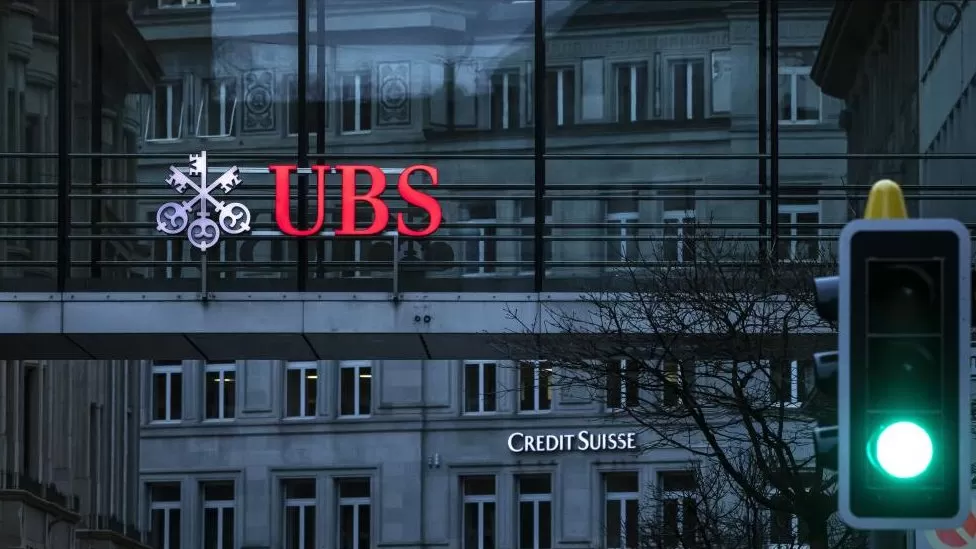
The abrupt acquisition of Credit Suisse by its competitor UBS, the nation’s second-largest bank, is the subject of an inquiry by Swiss authorities.
When concerns about Credit Suisse’s financial situation arose last month, the acquisition was hastily completed.
The Federal Prosecutor of Switzerland announced on Sunday that they would look into any potential “criminal offenses” that may have been committed.
Credit Suisse chose not to respond. We’ve reached out to UBS for comment.
The deal for UBS to buy Credit Suisse was backed by the Swiss government, and was put together rapidly after a weekend of emergency talks between the two banks and the country’s financial regulators.
At the time, the Swiss National Bank said the deal was the best way to restore the confidence of financial markets and to manage risks to the economy.
The takeover came as markets were being rattled by fears over the health of the global financial system following the failures of two smaller US banks.
The deal, when it was announced, valued Credit Suisse at $3.15bn (£2.6bn), whereas on the Friday before the settlement was reached it had been valued at about $8bn.
However, the deal has angered taxpayers and shareholders of both banks, who were deprived of a vote on the takeover. Some have also argued it has damaged Switzerland’s global reputation as a financial centre.
In statement issued on Sunday, Switzerland’s Federal Prosecutor said there were “numerous aspects of events around Credit Suisse” that need to be investigated to identify any possible “criminal offences”.
“The Office of the Attorney General wants to proactively fulfil its mandate and responsibility to contribute to a clean Swiss financial centre and has set up a monitoring system so that it can take action immediately on any issues that fall within its area of responsibility,” it added.
It added it had made contact with “national and cantonal authorities”, and that “investigative orders were also issued”.
Separately, Swiss newspaper Tages-Anzeiger reported on Sunday that the newly combined UBS-Credit Suisse bank was set to cut its workforce by 20-30%.
The combined bank will have more than 120,000 staff worldwide. The report said about 11,000 jobs could be cut in Switzerland.
The UK’s financial system is “secure and sound,” according to the Bank of England, after regulators approved a rescue plan for Credit Suisse in an effort to calm markets around the world.
In a deal supported by the Swiss government, the bank was acquired by rival UBS on Sunday.
It happens amid worries about the global financial system following the failure of two smaller US banks in recent weeks.
Shares in lenders around the world have fallen sharply and central banks have had to step in to provide reassurances.
However, experts are not forecasting a repeat of the 2008 financial crisis when the failure of a number of big banks sparked a global recession.
The Swiss National Bank said the rescue deal for Credit Suisse was the best way to restore the confidence of financial markets and to manage risks to the economy.
Credit Suisse said it was not expecting “any disruption to client services”.
“We are fully focused on ensuring a smooth transition and seamless experience for our valued clients and customers,” the bank told the BBC.
Credit Suisse shareholders were deprived of a vote on the deal and will receive one share in UBS for every 22.48 shares they own, valuing the bank at $3.15bn (£2.6bn).
At the close of business on Friday Credit Suisse was valued at around $8bn.
But the deal has achieved what regulators set out to do – secure a result before the financial markets opened on Monday.
Mark Yallop, the former UK chief executive of UBS, said the his former employer’s purchase of Credit Suisse “should” do the job of reassuring investors.
“This is a takeover of a challenged institution with particular idiosyncratic problems that relate to it specifically [and are] not reflective of broader issues in the banking markets,” he told the BBC’s Today programme.
“I think this transaction will definitely stabilise [the bank] and should bring a good degree of confidence back to the banking market more generally.”
However, stock markets across Asia stumbled despite the deal. Japan’s Nikkei 225 was down by 1.4% while the Hang Seng Index in Hong Kong fell by more than 3%.
“The human psychological aspect of markets contagion risk and bank runs suggest we could be in for an extended period of uncertainty before the storm clouds eventually lift,” Stephen Innes from SPI Asset Management said in a note.
In a bid to keep cash available through the global financial system, six central banks, including the Bank of England, announced they would boost the flow of US dollars through the global financial system.
The Bank of England, along with the Bank of Japan, Bank of Canada, the European Central Bank, US Federal Reserve and Swiss National Bank, said the move served as an “important backstop to ease strains in global funding markets” and take the pressure off banks.
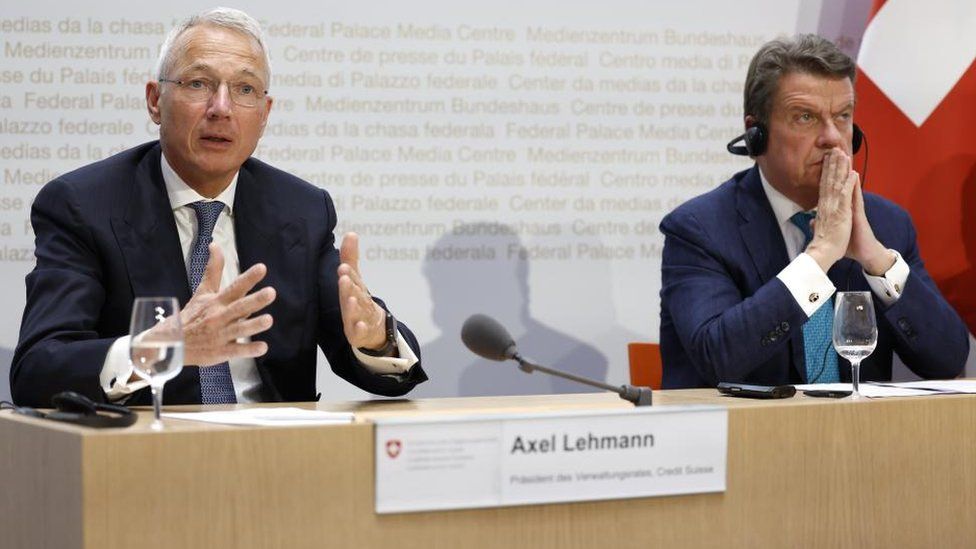
Image caption,The chairmen of both banks spoke at a news conference in Bern on Sunday
In a statement following UBS’s takeover of Credit Suisse, Switzerland’s central bank said the deal protected the Swiss economy “in this exceptional situation”.
The 167-year-old bank is loss-making and has faced a string of problems in recent years, including money laundering charges.
It was given an emergency $54bn lifeline from the Swiss National Bank on Wednesday in a bid to reassure markets, but Credit Suisse shares tumbled 24%, meaning a rescue deal was needed.
Speaking in the Swiss capital Bern after Sunday night’s announcement, UBS chairman Colm Kelleher said the takeover had been “attractive” for UBS shareholders, but described it as “an emergency rescue”.
Mr Kelleher said UBS would be winding down the investment banking part of Credit Suisse.
The UBS chairman said it was “too early” to say what would happen about jobs. The Swiss bank has around 74,000 staff, around 5,000 of them in the UK.
“We need to do this in a rational way thoughtfully, when we’ve sat down and analysed what we need to do,” he said.
Other global financial institutions praised the deal.
The Bank of England said it welcomed the “comprehensive set of actions” set out by the Swiss authorities.
“We have been engaging closely with international counterparts throughout the preparations for today’s announcements and will continue to support their implementation.”
It added the UK banking system was “well capitalised and funded, and remains safe and sound”.
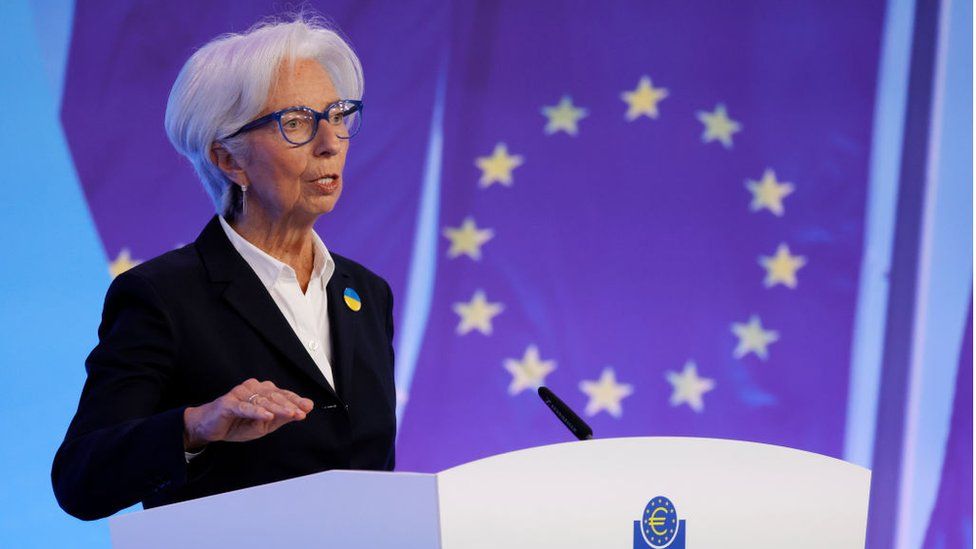
Christine Lagarde, president of the European Central Bank, said she welcomed the “swift action” of the Swiss authorities.
“The euro area banking sector is resilient, with strong capital and liquidity positions,” Ms Lagarde added.
US Treasury Secretary Janet Yellen and Federal Reserve chairman Jerome Powell both said the US banking system remained “resilient”.
Credit Suisse has become the latest and most important casualty of a crisis of confidence that has already seen the failure of two mid-sized US banks and an emergency industry whip-round for another. But this is different. Switzerland’s second biggest lender was considered one of the top 30 most important banks in the world – which is why this takeover was rushed through by the Swiss authorities.
Although the reasons for each failure differ slightly, the main factor has been a sharp rise in global interest rates which has hit the value of even safe investments that banks keep some of their money in. That has spooked investors and seen the share prices of all banks fall with those considered weakest hit hardest.
The financial authorities in the EU, US and UK are saying they support this deal, stressing that banks are strong and people’s savings and deposits are safe.
The acid test as to whether this Swiss rescue has calmed nerves in the financial world will be when financial markets open on Monday – which is why it was so important to get this done on Sunday night.
In order to strengthen its finances, Credit Suisse has announced that it will borrow up to 50 billion Swiss francs (£44.5 billion) from the nation’s central bank.
The struggling banking behemoth declared that it is taking “decisive action” to improve and streamline its operations.+
Following the announcement that it had discovered “weakness” in its financial reporting, shares of Credit Suisse dropped 24% on Wednesday.
Fears of a wider banking crisis sparked steep falls on stock markets, with Asian shares dropping.
However, markets in Europe are expected to open higher on Thursday.
The BBC understands that the Bank of England has been in touch with Credit Suisse and the Swiss authorities to monitor the situation.
Swiss National Bank, the country’s central bank, insisted Credit Suisse had the money it needed, but stressed it was ready to step in and help further if required.
Problems in the banking sector surfaced in the US last week with the shock collapse of Silicon Valley Bank, the country’s 16th-largest lender, followed two days later by the failure of New York’s Signature Bank.
The US central bank had been forced to step in to prevent a run on bank deposits as panic spread.
Sir John Gieve, former deputy governor at the Bank of England, told the BBC that central banks were sending a “message” that such problems would be contained locally.
He added that in Credit Suisse’s case, this was likely to be enough to stop the crisis spreading.
“What we’ve seen overnight is the Swiss central bank saying no, we will not let this get into a disorderly collapse,” he told the BBC’s Today programme.
“I don’t know what the future for Credit Suisse holds but so far they are still standing and it looks like the Swiss central bank will ensure it’s standing long enough to rearrange its affairs for the future.”
Japan’s Nikkei 225 index was down by 1.1% in late midday trading, with markets in Hong Kong and Sydney down by over 1.5%. The Shanghai Composite lost 0.5%.
‘Material weaknesses’
Credit Suisse, founded in 1856, has faced a string of scandals in recent years, including money laundering charges, spying allegations and high profile departures.
It lost money in 2021 and again in 2022 and has warned it does not expect to be profitable until next year.
The bank’s disclosure on Tuesday of “material weakness” in its financial reporting renewed investor concerns.
Daniel Davies, managing director at Frontline Analysts, and a former bank analyst at Credit Suisse, said that the bank’s “millionaire and billionaire client base just seems to have reached the end of their tolerance and they’ve been taking money out over the last six months at what began to look like an increasing rate”.
He added that the Bank of England will have been asking its Swiss counterpart whether it still had faith in Credit Suisse.
“Because the nature of these crises is that when you have a real massive deposit run it is like a tsunami – nothing humans can make can stop it. The only thing you can do is stop it before it turns into a proper deposit run and the only people that can do that are the central banks.”
These were intensified when the Saudi National Bank, Credit Suisse’s largest shareholder, said it would not buy more shares in the Swiss bank on regulatory grounds.
On Wednesday shares in the lender plunged as other banks rushed to pull out their funds from the bank and prime ministers in Spain and France spoke out in an attempt to ease fears.
The collapse of Silicon Valley Bank has also fuelled concerns about the value of bonds held by banks, as rising interest rates made those bonds less valuable.
Central banks around the world – including the US Federal Reserve and the Bank of England – have sharply increased interest rates as they try to curb the rate of price rises, or inflation.
Banks tend to hold large portfolios of bonds and as a result are sitting on significant potential losses.
The falls in the value of bonds held by banks is not necessarily a problem unless they are forced to sell them.
Silicon Valley Bank – which specialised in lending to technology companies – was shut down on Friday by US regulators in what was the largest failure of a US bank since 2008.