Tag: Crown Prince Mohammed bin Salman

  • China, Saudi presidents pledge “new era” in Chinese-Arab relations

    Saudi Crown Prince Mohammed bin Salman welcomed Chinese President Xi Jinping with a glamorous reception in Riyadh on Thursday, as the two countries make preparations for a series of summits that will mark an “epoch-making milestone” in Chinese-Arab relations.

    Saudi state television broadcast a grand ceremony in which bin Salman, the kingdom’s de facto ruler known as MBS, received the Chinese leader at Al-Yamamah Palace. The premises were adorned with Chinese and Saudi Arabian flags, and members of the Saudi Royal Guard lined up with swords and played music.

    In contrast to US President Joe Biden’s visit to Saudi Arabia earlier this year, the two leaders smiled warmly and posed for photos.

    Shortly afterwards, China and Saudi Arabia signed a comprehensive strategic partnership agreement that includes a number of deals and memoranda of understanding, including on hydrogen energy, on coordination between the kingdom’s Vision 2030 and China’s Belt and Road Initiative, and with regards to direct investment, reported the official Saudi Press Agency (SPA), without providing details.

    Xi landed in the capital Riyadh on Wednesday, where he was received by Saudi Prince Faisal bin Bandar bin Abdulaziz, Governor of Riyadh Region, and Prince Faisal bin Farhan bin Abdullah, Minister of Foreign Affairs. Saudi military jets accompanied the Chinese president’s aircraft, a purple carpet was rolled out upon his arrival and canons were fired.

    US President Joe Biden’s welcome is widely perceived to have been less glamorous. The American president was received in July by the governor of Mecca and the Saudi ambassador to the US in the Red Sea port city of Jeddah. Biden met MBS in Jeddah, where they exchanged a fist-bump that made global headlines and defined what ultimately became a frigid visit.
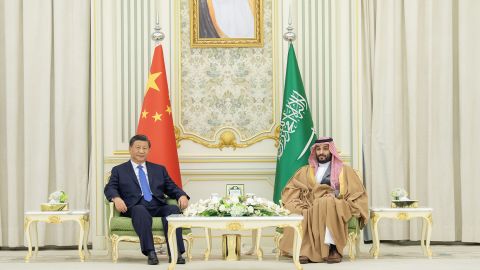
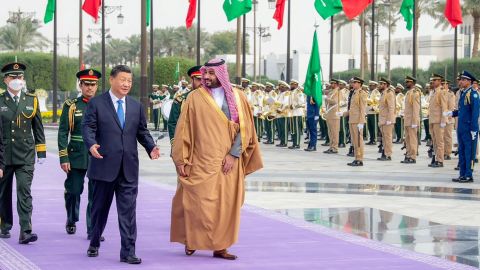
    The official welcoming ceremony for the Chinese president at the Palace of Yamamah in Riyadh on Thursday.
    The official welcoming ceremony for the Chinese president at the Palace of Yamamah in Riyadh on Thursday. Royal Court of Saudi Arabia/Anadolu Agency/Getty Images
    Bin Salman welcomes the Chinese leader to Riyadh.
    Bin Salman welcomes the Chinese leader to Riyadh. Saudi Press Agency/Reuters

    Saudi and Chinese state media have this week been keen to promote the close ties shared by their governments. Saudi state TV replayed clips of past meetings between Chinese and Saudi officials, narrating the two countries’ warm relationship, which they say spans more than eight decades.

    In a signed article published Thursday in the Saudi newspaper Al Riyadh, Xi said that his visit to the kingdom this week “will usher in a new era in China’s relations with the Arab world, with Arab states of the Gulf and with Saudi Arabia.”

    “The Arab world is an important member of the developing world and a key force for upholding international fairness and justice,” Xi wrote, adding that “the Arab people value independence, oppose external interference, stand up to power politics and high-handedness, and always seek to make progress.”
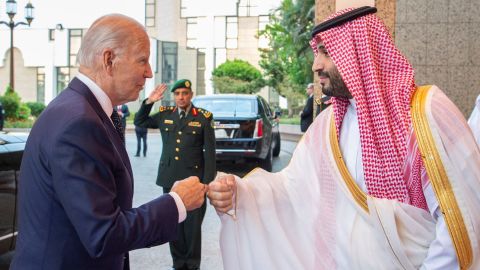
    Saudi Crown Prince Mohammed bin Salman fist bumps US President Joe Biden upon his arrival at Al Salman Palace, in Jeddah in July.
    Saudi Crown Prince Mohammed bin Salman fist bumps US President Joe Biden upon his arrival at Al Salman Palace, in Jeddah in July. Bandar Algaloud/Courtesy of Saudi Royal Court/Handout/Reuters

    In the article titled “Carrying Forward Our Millenia-old Friendship and Jointly Creating a Better Future,” Xi said that China and Arab states will “continue to hold high the banner of non-interference in internal affairs, firmly support each other in safeguarding sovereignty and territorial integrity, and jointly uphold international fairness and justice,” in a nod to US diplomacy, whose ties with the Saudis have crumbled over OPEC’s decision to slash crude oil supply.

    Saudi Arabia’s energy minister also stressed that Saudi-Chinese relations are “witnessing a qualitative leap” and that the kingdom “will remain China’s credible and reliable partner” with regards to oil, SPA reported.

    The Chinese foreign ministry said Wednesday that the China-Arab States Summit “will be an epoch-making milestone in the history of China-Arab relations,” and that “President Xi’s state visit to Saudi Arabia will elevate the China-Saudi Arabia comprehensive strategic partnership to a new height.”

    On Wednesday, Saudi and Chinese companies signed 34 investment deals covering several sectors, reported SPA, including in the fields of green energy, information technology, cloud services, transportation, logistics, medical industries, housing and construction.

    No monetary value was announced for the deals, but SPA previously reported that the two countries are expected to sign deals worth more than $29 billion during this week’s visit.

    Xi’s visit to Saudi Arabia comes amid frayed ties between the two countries and Washington, which harbors a number of grievances towards the two states over oil production, human rights and other issues.

    While China and Saudi Arabia’s friendship has blossomed over the decades, they seem to have become closer as both find themselves in precarious positions in regard to the US.

    The White House said it was “not a surprise” that Xi is traveling around the world and to the Middle East. “We’re mindful of the influence that China is trying to grow around the world,” said John Kirby, the strategic communications coordinator at the US National Security Council.

  • Algeria’s presidency: Saudi crown prince ‘not attending Arab summit on doctors’ advice’

    Algeria’s presidency says, Prince Mohammed will not attend the upcoming Arab League meeting since his physicians have recommended he should not travel.

    Saudi Crown Prince Mohammed bin Salman will not attend an upcoming Arab conference in Algeria due to physicians’ advice to avoid travel according to the Algerian presidency.

    Saudi Arabia offered no immediate acknowledgment of the comments on Saturday by Algeria about the condition of Prince Mohammed, who has quickly risen to power under his 86-year-old father King Salman.

    Statements carried in Arabic and French on the Algeria Press Service late on Saturday referred to a statement from the office of President Abdelmadjid Tebboune about a telephone call between him and Prince Mohammed.

    In the call, Prince Mohammed “apologised for not being able to participate in the Arab Summit to be held on November 1 in Algiers, in accordance with the recommendations of doctors who advise him not to travel”, the statement read.

    “For his part, Mr President said he understood the situation and regretted the impediment of the Crown Prince, His Highness the Emir Mohammed Bin Salman, expressing his wishes for his health and well-being.”

    A statement on the state-run Saudi Press Agency acknowledged a call between Tebboune and the prince but offered no word on the doctors’ advice. It just said the call focused on “the aspects of bilateral relations between the two fraternal countries” and possible joint cooperation.

    The Arab League Summit in Algeria represents the first time the regional body has met since the COVID-19 pandemic took hold across the world.

    The Arab League, founded in 1945, represents 22 nations across the Middle East and North Africa, though Syria has been suspended amid its long-running war. While unified in the call for the Palestinians to have an independent state, the body has otherwise been largely fractious and unable to enforce its mandates.

    Prince Mohammed came to power in 2015 as deputy crown prince, then became crown prince some two years later after King Salman removed Prince Mohammed bin Nayef, a once-powerful figure as head of Saudi Arabia’s counterterrorism efforts and a close ally of the United States.

    His rise to power has seen the kingdom undergo rapid changes, like allowing women to drive and opening movie theatres while loosening the grip of ultraconservatives. He also launched a purported corruption crackdown that targeted the richest men in the kingdom and led an internationally criticised Arab coalition that staged a military campaign in Yemen.

    US intelligence services linked Prince Mohammed to the 2018 killing and dismemberment of Washington Post columnist Jamal Khashoggi, a critic of the prince’s policies. The kingdom has denied the prince was involved, though its prosecution of the government squad behind Khashoggi’s slaying has been held behind closed doors.

    Recently, the prince has come under intense US criticism over Saudi Arabia’s leading OPEC and allied nations to agree to an oil production cut of 2 million barrels per day.


  • Saudi Crown Prince Mohammed bin Salman named prime minister

    Saudi Arabia’s powerful Crown Prince Mohammed bin Salman has been appointed prime minister – a post that is traditionally held by the king.

    The 37-year-old son of King Salman bin Abdulaziz, 86, is already seen the de facto ruler of the oil-rich Gulf state.

    A royal decree announcing his promotion from deputy PM and defence minister cited an exception to the Basic Law.

    An official told Reuters news agency the move was in line with the king’s previous delegation of duties to him.

    “The crown prince… already supervises the main executive bodies of the state on a daily basis, and his new role as prime minister is within that context,” the official said.

    Ali Shihabi, a Saudi analyst close to the royal court, tweeted that Mohammed bin Salman’s promotion “formalises his actual role and eliminated previous protocol issues of seniority with other heads of government”, adding: “He ranks now as a head of government de jure, not just de facto.”

    The king, who has been admitted to hospital twice this year, will continue to chair the cabinet meetings he attends.

    The decree named another of his sons, Prince Khalid bin Salman, as the new defence minister. A third, Prince Abdulaziz bin Salman, remains in the key role of energy minister in the world’s biggest oil exporter.

    Few people outside Saudi Arabia had heard of Mohammed bin Salman before his father became king in 2015.

    He has won plaudits for some of the social and economic reforms he has overseen in the conservative Gulf kingdom, including lifting the ban on women driving and seeking to diversify the economy away from oil.

    But he has also been heavily criticised for pursuing a war in Yemen that has caused a humanitarian catastrophe and for cracking down on dissent, with hefty prison sentences handed down even for critical social media posts.

    The prince’s international reputation suffered significant damage after the Saudi journalist Jamal Khashoggi, a prominent critic of his policies, was killed by Saudi agents at the Saudi consulate in Istanbul in 2018. US intelligence agencies concluded that he had approved an operation to capture or kill Khashoggi, but he denied any involvement.

    A surge in global oil prices triggered by Russia’s invasion of Ukraine has seen the prince re-embraced by Western leaders in recent months, with US President Joe Biden visiting him in Jeddah in July despite having once vowed to make Saudi Arabia “the pariah that they are” over Khashoggi’s murder.

    Source: BBC