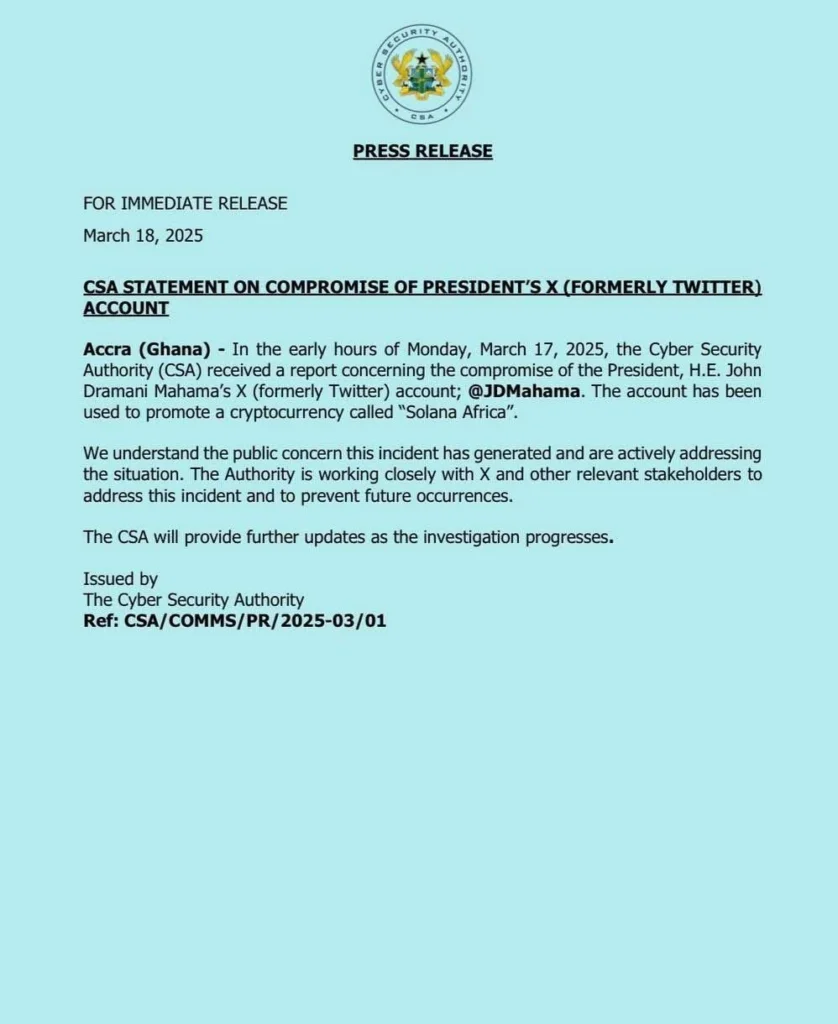
In the early hours of Monday, March 17, the Cyber Security Authority (CSA) received a report concerning the compromise of the President, H.E. John Dramani Mahama’s X (formerly Twitter) account; @JDMahama.
The account was used to promote a cryptocurrency called “Solana Africa.” This incident generated public concern.
Meanwhile, the authority says it is working closely with X and other relevant stakeholders to address this incident and prevent future occurrences. CSA will provide further updates as the investigation progresses.
Director of the Securities and Exchange Commission (SEC), Rev. Daniel Ogbarmey Tetteh, has stated that the agency is continuing its careful strategy for overseeing crypto assets.
In an interview on Joy News’ PM Express Business Edition, he noted that although the SEC has issued public warnings about the lack of regulation for cryptocurrencies in Ghana, it remains receptive to exploring and establishing a suitable regulatory framework.
“We issued a caution statement to the market that crypto assets are not regulated by the SEC, and if you dabble in it, you are basically on your own,” Rev. Tetteh stated, reaffirming the commission’s stance from 2019.
“But I can tell you that even back in the day, we had an open mind. You can’t regulate what you do not understand.”
Rev. Tetteh explained that the SEC has been actively working to build its capacity to understand the evolving crypto space, with the goal of crafting an effective regulatory framework.
“We set up an innovation team and have been engaging with various stakeholders, including virtual asset service providers (VASPs), to shore up our understanding,” he said on Thursday.
Highlighting the global nature of the challenge, he added, “We belong to IOSCO, the International Organisation of Securities Commissions, which has been providing guidance on the crypto space. It’s an evolving area, and jurisdictions are at different levels of understanding and regulation.”
While some have criticized the perceived slow pace of the SEC in taking a position, Rev. Tetteh defended the commission’s approach, saying, “Getting it right is better than getting it fast. We are on course, and we want to ensure that we have a framework that covers all angles.”
Rev. Tetteh explained that the SEC has been actively working to build its capacity to understand the evolving crypto space, with the goal of crafting an effective regulatory framework.
“We set up an innovation team and have been engaging with various stakeholders, including virtual asset service providers (VASPs), to shore up our understanding,” he said on Thursday.
Highlighting the global nature of the challenge, he added, “We belong to IOSCO, the International Organisation of Securities Commissions, which has been providing guidance on the crypto space. It’s an evolving area, and jurisdictions are at different levels of understanding and regulation.”
While some have criticized the perceived slow pace of the SEC in taking a position, Rev. Tetteh defended the commission’s approach, saying, “Getting it right is better than getting it fast. We are on course, and we want to ensure that we have a framework that covers all angles.”
The largest cryptocurrency exchange platform globally, Binance, published findings from a Binance & Pulse Survey revealing that Ghana leads in cryptocurrency and blockchain adoption across Africa.
The survey underscores Ghana’s enthusiastic embrace of these technologies, with respondents showing a strong grasp of their benefits, applications, and potential. Ghana’s impressive ranking as ninth out of 27 countries [1] in crypto adoption highlights its robust potential for further growth in the sector.
This trend is significant amid a period of solid market expansion. Statista [2] projects revenues to reach $1.5 billion in 2024, growing at a compound annual rate of 8.62%, with expectations to total $71.7 billion by 2028.
According to Mordor Intelligence [3], the rapid and continuous adoption of digital assets is propelling market advancement, enhancing transaction security and efficiency, and fostering broader adoption and integration across organizations and individuals.
“Our pulse survey really underscores how Ghana is embracing blockchain technology and how open they are to engaging on the topic,” says Yande Nomvete, Operations Manager for Binance in Africa. “The quiz achieved more than 20,000 impressions with a reach of more than 20,000 users over a three-day period, which is exceptional.”
The quiz aimed to explore fundamental beliefs and perceptions held by users in the region. It covered topics ranging from the importance of financial literacy in cryptocurrency to how digital currencies can enhance financial adoption in Africa. Over 50% of respondents emphasized that financial literacy in cryptocurrency involves understanding market trends, avoiding scams, and making informed investment decisions. This underscores their awareness of the careful consideration needed to navigate cryptocurrency investments effectively.
Over 70% of participants hold the view that cryptocurrency has the potential to enhance financial inclusion in Africa through fostering fintech innovation and driving economic growth. Concurrently, a significant majority (more than 70%) acknowledge the importance of vigilance and adherence to security protocols when engaging with cryptocurrencies.
“It was impressive how many respondents chose the correct security answers to questions around best security practices and approaches,” says Nomvete. “For example, when asked what was not a recommended security practice for cryptocurrency users, more than 70% said sharing private keys with friends. Users in the region also immediately identified the importance of anti-money laundering (AML) best practices in mitigating fraud, and the value of doing extensive research into reputable cryptocurrency exchanges before handing over their funds (60%).”
Ghana demonstrates a robust grasp of cryptocurrencies and the significance of establishing a portfolio with a trusted service provider known for its dependable reputation. Binance is committed to advancing the adoption of reliable and accessible cryptocurrencies globally. Recognizing the economic benefits of crypto and its role in fostering growth is crucial, and partnering with a platform that emphasizes security is vital for cultivating a prosperous portfolio. Binance adheres to rigorous protocols, employs cutting-edge technical safeguards, offers advanced data privacy features, and integrates security deeply within its organizational framework.
“Our understanding of the market wedded to the impressive cryptocurrency savvy of Ghanaian users equals long-term success for investors in this country,” concludes Nomvete.
Vice President of IMANI Africa, Bright Simons, has expressed worry over what he describes as a forceful exit of Binance, one of the world’s largest cryptocurrency exchanges, from Nigeria.
In a recent announcement, Binance has revealed its decision to halt all Nigerian Naira (NGN) services.
The move comes as part of the platform’s ongoing efforts to streamline its operations and adapt to evolving market dynamics.
Reacting to the news, Bright Simons noted that the exit stemmed from the Nigerian government blaming the country currency depreciation on the activities of Binance.
He asserts that Binance’s exit will have a huge impact on the many Nigerian youth who have embraced the cryptocurrency.
Govt of Nigeria forces out world’s largest crypto broker, after blaming it for massive depreciation of the national currency. Many young Nigerians have enthusiastically embraced crypto as a financial safe haven.
Govt of Nigeria forces out world's largest crypto broker, after blaming it for massive depreciation of the national currency. Many young Nigerians have enthusiastically embraced crypto as a financial safe haven. pic.twitter.com/HSZrIBQI9i
Here’s a breakdown of the key details and implications for users:
Timeline and Actions:
Deposits and Withdrawals: Binance ceased supporting NGN deposits after 2024-03-05 14:00 (UTC). Withdrawals of NGN will no longer be supported after 2024-03-08 06:00 (UTC).
Conversion of Remaining Balances: From 2024-03-08 08:00 (UTC), any remaining NGN balances in users’ Binance accounts will be automatically converted to USDT (Tether) at a ratio of 1 USDT = 1,515.13 NGN. This conversion rate is based on the average closing price of the USDT/NGN trading pair on Binance Spot over the last seven days.
Spot Trading: All existing NGN spot trading pairs, such as BTC/NGN and USDT/NGN, will be delisted at 2024-03-07 03:00 (UTC). Users with open spot orders related to these pairs will see them automatically closed.
Binance Convert: NGN and all corresponding pairs will be delisted from Binance Convert at 2024-03-07 02:00 (UTC).
Binance P2P: Binance P2P had already delisted all NGN trading pairs at 2024-02-28 15:00 (UTC).
Binance Auto-Invest and Binance Pay: NGN will also be removed from Binance Auto-Invest and Binance Pay at 2024-03-06 03:00 (UTC).
User Recommendations:
Users are encouraged to take the following actions before the specified deadlines:
Withdraw NGN balances or convert them into crypto assets before the discontinuation of NGN services.
Ensure they have not selected “Hide Small Balances” in all of their wallets to view their assets after trading ceases.
Consider removing any existing auto-invest plans involving NGN to prevent disruptions in recurring cycles.
Adjust payment methods if using Binance Pay, as NGN will no longer be supported.
The pastor Eli Regalado and his wife Kaitlyn are accused of tricking people and making more than $3 million by selling cryptocurrency that is not worth much.
The Regalados are accused of making at least $1. 3 million from their plan between June 2022 and April 2023, according to prosecutors.
Mr Regalado said that his idea came from God, as said in court documents.
The pastor claimed that God told him that people who invest in INDXcoin, a cryptocurrency created by the Regalados, would become rich.
The Regalados, who are in charge of the Kingdom Wealth Exchange, gave INDXcoin to Christians in the Denver area.
The couple didn’t know about cryptocurrency. An auditor found INDXcoin to be unsafe, unsecure, and full of technical problems.
“Even though there was a report about it, the Regalados kept telling people that INDXcoin was a safe and profitable investment,” the report said.
The INDXcoin was not easy to turn into cash and was almost worth nothing. The couple spent the money on their extravagant way of living.
Officials said they found a Range Rover, fancy purses, jewelry, rented boats and snowmobile trips.
Colorado’s top financial regulator, Tung Chan, has accused someone of breaking the law by lying or cheating to investors.
She said her department found out about the problem because many people who invested in INDXcoin complained about losing money.
Mr Relagado talked about the accusations in a video he posted on Friday.
Colorado is saying it’s worthless because people who bought cryptocurrency can’t take their money out.
We started a market where people can trade things. The trade system broke down. Things got worse, and since then, we’ve only been hoping for a miracle from the Lord.
The pastor admitted that it was true that Mr. Relagado and his wife received $1. 3 million
“He said that out of the $1. 3 million, half of it went to the IRS and $200,000 went towards renovating our home, as the Lord had told us to do. ”
Lots of people wrote nice things in the comments on the video, like “sending prayers” and “keep going, be strong”.
The BBC has asked the Regalados for their thoughts or opinions.
In the complaint, Colorado prosecutors want to get temporary help, money for investors, and control of the Relagados’ property.
They have to go to Denver District Court next week.
Government has warned all financial institutions in the country to abstain from conducting cryptocurrency transactions.
Minister of State at the Finance Ministry, Dr. Mohammed Amin Adam, made the declaration while responding to inquiries on the floor of Parliament.
“The government will continue to allow associated technologies, such as blockchain and distributed innovations in a sun box, as we explore the development of a framework.
Until such a framework is in place, the government will like to reiterate its directive conveyed in several notices, including one issued on March 9, 2022, that all institutions licensed by the Bank of Ghana are prohibited from facilitating cryptocurrency transactions through their platforms or agents outlets,” the Minister of State at the Finance Ministry cautioned.
In April 2022, the Central Bank issued cautionary directives to banks and financial entities regarding cryptocurrency trading and unregulated investment schemes.
The objective was to ensure the regulation and purification of the digital space concerning cryptocurrencies.
Authorities have seized cryptocurrency exchange Bitzlato, and arrested its co-founder, accusing the firm of fuelling a “high-tech axis of crypto crime”.
The US Department of Justice charged Anatoly Legkodymov, a Russian national living in China, with running a business that catered to what he once described as “crooks”.
They said Bitzlato processed more than $700m (£567m) in illicit funds, breaking rules designed to thwart money laundering.
Mr Legkodymov was arrested in Miami.
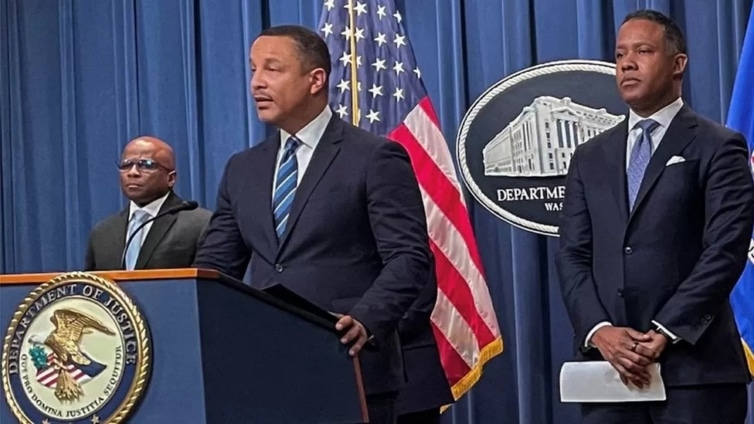
“Institutions that trade in cryptocurrency are not above the law and their owners are not beyond our reach,” US Attorney Breon Peace said at a press conference on Wednesday, announcing the arrest.
“As alleged, Bitzlato sold itself to criminals as a no-questions-asked cryptocurrency exchange and reaped hundreds of millions of dollars’ worth of deposits as a result. The defendant is now paying the price for the malign role that his company played in the cryptocurrency ecosystem.”
Since 2018, the Hong Kong-registered exchange had processed about $4.5bn worth of cryptocurrency transactions, according to the complaint.
The firm required minimal identification from its users, allowing it to become a “haven for criminal proceeds and funds intended for use in criminal activity”, prosecutors said.
They alleged that the firm was aware of the issues, citing an internal document that described Bitzlato as handling “dirty money” without standard customer-vetting procedures.
Authorities said the firm was closely connected to Hydra Market, a darknet marketplace for drugs, money laundering and stolen financial information that international authorities shut down last year.
Bitzlato claimed it did not accept US customers but prosecutors said it in fact did “substantial” business with Americans.
US authorities worked with law enforcement in France and other countries on the operation.
A disgraced cryptocurrency executive, Sam Bankman-Fried, claims he intends to launch a new company in order to generate enough revenue to compensate FTX collapse victims.
The 30-year-old faces several federal investigations into his former company’s handling of funds.
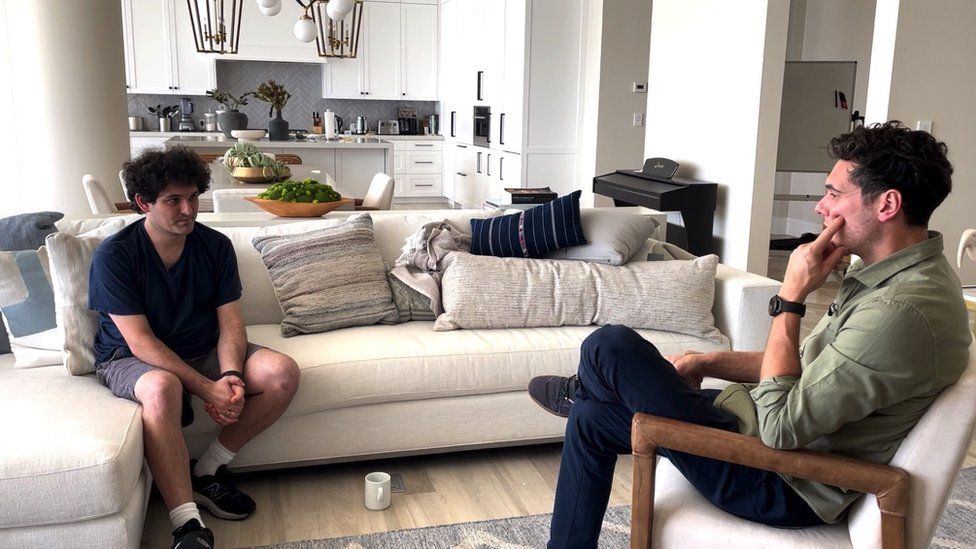
Speaking in a luxury complex in the Bahamas, the former billionaire denies fraud but says he was “not nearly as competent as I thought I was”.
He admits worrying about possible arrest while “ruminating at night”.
The FTX crypto exchange allowed customers to trade normal money for cryptocurrencies like Bitcoin.
It was the second largest in the world, trading about $10bn of crypto coins every day.
But last month it was revealed that FTX and Mr Bankman-Fried’s separate company – Alameda Research – were financially unstable.
In just eight days everything came crashing down and bankruptcy was filed.
It is estimated that more than a million FTX users are locked out of their crypto wallets and cannot access their funds.
Mr Bankman-Fried invited the BBC to the residential complex in the Bahamas where he still lives and said he hopes to find a way to pay back FTX users.
“I’m going to be thinking about how we can help the world and if users haven’t gotten much back, I’m going to be thinking about what I can do for them. And I think at the very least I have a duty to FTX users to do right by them as best as I can,” he told me.
Asked if he planned to start a new business venture to earn the money to pay investors back, he said: “I would give anything to be able to do that. And I’m going to try if I can.”
Bankruptcy lawyers have described the FTX scandal as “one of the most abrupt and difficult collapses in the history of corporate America”.
They accuse Mr Bankman-Fried of running the company as “his own personal fiefdom”.
The US Senate Banking Committee wants the former CEO to testify at next week’s hearings into the collapsed exchange, and he said on Friday that he would attend.
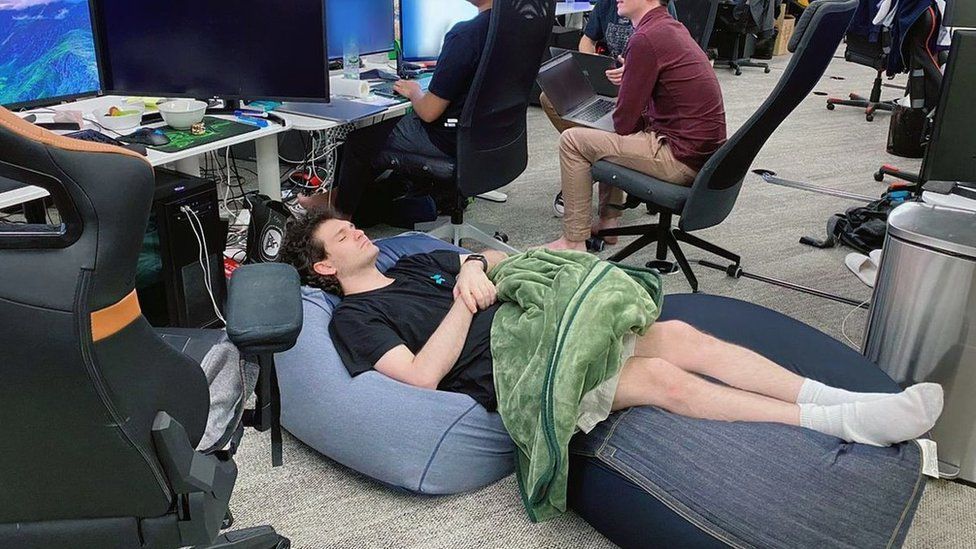
Image source, TwitterImage caption, “Mostly I sleep on a beanbag,” Mr Bankman-Fried once told his Twitter followers
At the top of a long list of alleged failings, there are allegations that Mr Bankman-Fried’s Alameda Research hedge fund was using FTX customers’ money to make risky financial bets.
A former senior FTX employee who worked with Mr Bankman-Fried has told the BBC he thinks the former CEO must have been aware that Alameda Research was using FTX customer funds.
He accused Mr Bankman-Fried of lying when he said in recent interviews that he did not know about the flows of cash and cryptocurrencies between the companies.
“No that’s not true,” Mr Bankman-Fried said, while going on to acknowledge that as CEO he was ultimately responsible for any mishandling of funds. “That’s on me, one way or another,” he said.
Asked whether he was fraudulent or incompetent, he replied: “I didn’t knowingly commit fraud, I don’t think I committed fraud, I didn’t want any of this to happen. I was certainly not nearly as competent as I thought I was.”
Image caption, Mr Bankman-Fried is meeting reporters at a luxury apartment owned by FTX
The American has conducted nine lengthy self-critical interviews in the last six days.
His team say they’ve had to relocate to an unknown location in the luxury resort where he lives, because of “security concerns”.
Reporters have taken pictures of him in his apartment with telescopic lenses from the sea, and at least two YouTubers have managed to sneak into the complex to film videos.
Mr Bankman-Fried, who comes from a wealthy family, claims to be concerned about his own personal finances with no access to his bank accounts and “less than $100K left”.
When asked if he is preparing for the possibility of arrest and prison, he said: “There’s some time at night ruminating, yes, but when I get up during the day, I try and focus, be as productive as I can and ignore things that are out of my control.”
Sam Bankman-Fried, the former CEO of the defunct cryptocurrencyexchange FTX, has denied any wrongdoing.
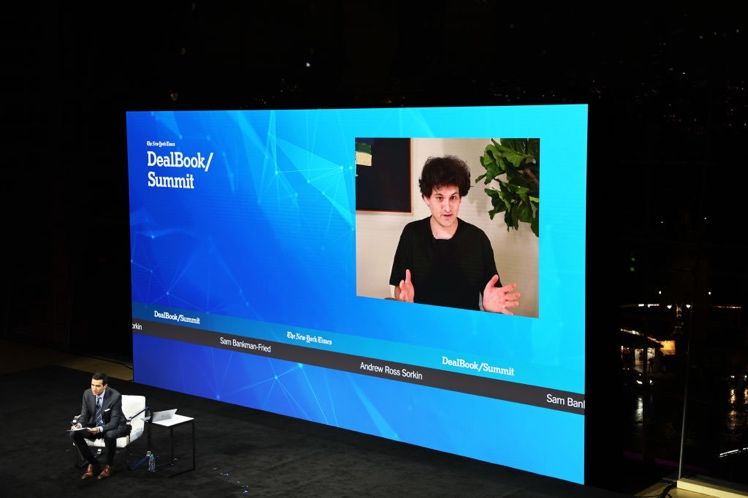
In his first public appearance since the collapse, the man nicknamed the “King of Crypto” told The New York Times that he had a “bad month” and had almost no money left.
FTX, which was once valued at $32 billion (£26.5 billion), collapsed last month.
Many investors have been unable to withdraw funds from the now-defunct global exchange.
Mr Bankman-Fried, 30, also stated that his lawyers advised him not to speak publicly, but he disregarded their advice.
He denied having moved any personal money out of FTX himself – saying he now has “close to nothing.”
Speaking from The Bahamas, he said he had one credit card left which had around $100,000 of debt on it.
In the interview he said he had not deliberately misled investors, adding: “I didn’t ever try to commit fraud.”
However, asked several times about details of money movements between FTX and other entities, including the trading firm he owned, Alameda Research, he at times seemed sketchy in detail.
He also said the company had indulged in “greenwashing” where firms engage in environmental projects for publicity.
Mr Bankman-Fried was once viewed as a young version of legendary US investor Warren Buffet, and as recently as late October had a net worth estimated at more than $15bn.
However, he says, he underestimated the sheer amount of cash needed to cover FTX customers’ withdrawals – leading to a run on the exchange.
FTX declared bankruptcy soon after. Mr Bankman-Fried stepped down as CEO on 11 November.
According to a court filing earlier this month, FTX currently owes its 50 largest creditors almost $3.1bn.
Mr Bankman-Fried had become well known in Washington DC as a political donor, supposedly supporting pandemic prevention and improved crypto regulation.
But in his talk with Times reporter Andrew Ross Sorkin, Mr Bankman-Fried confessed much of his Washington DC work had been PR “masquerading as do-gooderism.”
IMAGE SOURCE,GETTY IMAGES Image caption, Sam Bankman-Fried was speaking from the Bahamas
Mr Bankman-Fried said for now he was not concerned about potential criminal or civil liability.
“There’s a time and a place for me to thinkabout myself and my own future,” he said after starting and stopping several times. “I don’t think this is it.”
When asked if he had been truthful in his responses, Mr Bankman-Fried said he was as truthful as he knowledgeably could be. “I don’t know of times when I lied,” he said.
Though he did not provide evidence to support it, SBF said he believed FTX US was solvent and could in fact pay back American investors.
Police in Estonia have apprehended men suspected of running a $575 million (£485 million) cryptocurrency scam that affected hundreds of thousands of people.
Estonian police worked with the FBI to investigate the case, and US authorities want to extradite the Estonians Sergei Potapenko and Ivan Turogin.
The two 37-year-olds allegedly convinced people to invest in HashFlare, a cryptocurrency mining service, and Polybius, a bogus virtual bank.
A federal indictment has been issued in the United States.
A statement from the US Department of Justice (DoJ) says the pair are accused of wire fraud and conspiracy to commit money laundering – crimes punishable by up to 20 years in prison.
The defendants have appeared in court in the Estonian capital Tallinn and are being held pending extradition to the US, the statement says.
There was no immediate comment from their representatives.
Giving details of the alleged scheme, the DoJ says the two defrauded victims byoffering them the chance to buy into HashFlare’s cryptocurrency mining operations.
Crypto mining uses computers to generate virtual coins for profit – a process that consumes significant amounts of computing power.
Customers around the world are said to have purchased more than half a billion dollars’ worth of HashFlare contracts from 2015 to 2019. But the operation allegedly overstated its capabilities.
The DoJ alleges that victims were also promised dividends if they invested in Polybius, a virtual bank Mr Potapenko and Mr Turogin said they had set up.
The defendants are said to have raised $25m this way – but no bank was ever formed.
They used shell companies to launder criminal proceeds, buying at least 75 properties and luxury cars, DoJ says.
Oskar Gross of Estonia’s police cybercrime bureau described the joint investigation – which involved 100 personnel including 15 from the American side – as “long and vast”.
It was “one of the largest fraud cases we’ve ever had in Estonia”, he said on Monday, quoted by Estonia’s ERR news agency.
The country’s authorities also warned that technology had “broadened the risk of fraud”.
The case comes at a time of heightened nervousness in the cryptocurrency market, following the collapse of the world’s second-largest crypto exchange, FTX.
The firm filed for bankruptcy in the US last week,and owes its 50 largest creditors almost $3.1bn (£2.6bn), according to a court filing.
It took fewer than eight days for Sam Bankman-Friedto go from being nicknamed the “King Of Crypto” to his company filing for bankruptcy and him stepping down as CEO, potentially facing federal investigations into how he handled the company’s finances.
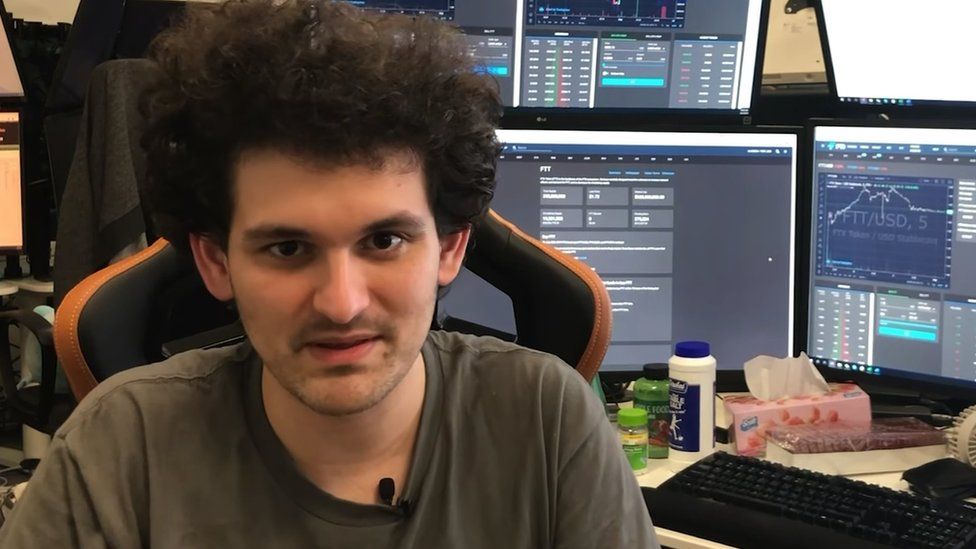
Over the last few years, the internet has been flooded with long interviews with him, speaking over video chat from his office desk in the Bahamas.
In some of them, there’s a distracting clicking noise.
As his interviewees listen intently to his incredible story of how he became a multibillionaire in five years, the sound is persistent and clearly coming from the American entrepreneur’s mouse.
“Click, click, click,” it goes, in rapid, on-off bursts.
Meanwhile, Mr Bankman-Fried’s eyes dart around the screen.
It’s not clear from the videos what he’s doing on his computer but his tweets can give us a pretty good clue.
Mr Bankman-Fried – the former boss of embattled cryptocurrency exchange FTX – is an avid gamer. And in a series of tweets to his nearly one million followers, he explained why. Playing the team fantasy battle game was his way to get his mind to switch off from running two companies trading billions of dollars a day.
“Some people drink too much; some gamble. I play League,” he said.
IMAGE SOURCE,FTX Image caption, Sam Bankman-Fried also enjoyed playing a video game called Storybook Brawl so much he brought its maker in March 2022
Since the 30-year-old’s cryptocurrency empire collapsed this week in dramatic fashion another anecdote about his gaming has resurfaced online.
According to a blog post from venture capital giant Sequoia Capital, Mr Bankman-Fried played an intense League of Legends battle during a high-level video call with their investment team.
It didn’t seem to put them off at all though. The group proceeded to invest $210m in Mr Bankman-Fried’s company FTX.
This week Sequoia Capital deleted that gushing blog post and announced they are now writing off their FTX investment as a loss.
They’re not the only investors who have lost eyewatering amounts of money since Mr Bankman-Fried’s $32bn empire collapsed.
FTX had an estimated 1.2 million registered users who were using the exchange to buy cryptocurrency tokens like Bitcoin and thousands of others.
From large traders to everyday crypto fans, many are left wondering if they will ever get back their savings trapped in FTX’s digital wallets.
It’s a dizzying downfall and the rise of Mr Bankman-Fried is also its own dramatic story of risks, rewards, and beanbags.
But the young bright undergraduate says it was lessons learned in the student dorms that led him on his path to getting rich.
In a BBC radio interview last month he recalled being swept up in the “effective altruism” movement. Effective altruism is a community of people “trying to figure out what practical things you can do with your life to have as much positive impact as you can on the world,” he said.
So, as Bankman-Fried recalls, he decided to get into banking to make as much money as he could to give it back to good causes.
He learned to trade stocks during a short stint at the trading firm Jane Street in New York before he got bored and decided to experiment with Bitcoin.
He noticed the variations in the value of Bitcoin across different cryptocurrency exchanges and started arbitraging – buying Bitcoin from places selling it cheap and selling it to other places where it was trading for more.
After a month of making modest profits, he got together with some college friends and started a trading business called Alameda Research.
Mr Bankman-Fried says it wasn’t easy and took months of perfecting techniques about how to move money in and out of banks and across borders. But after around three months he and his small team hit the jackpot.
“We were super dogged,” he said to the Jax Jones and Martin Warner Show podcast a year ago. “We just kept going. If someone throws another roadblock we would be creative and if our system couldn’t handle that we would just build a new system to get us through that hoop.”
By January 2018 his team was making $1m every day.
A business reporter at CNBC asked him recently how that felt.
Intellectually and according to his methodology, he said “it made perfect” sense. “But viscerally, it surprised me every day,” he said.
Sam Bankman-Fried became an official billionaire in 2021 thanks to his secondary and more high-profile business – FTX. The crypto exchange grew to be the second largest in the world and a titan of the industry, seeing $10-$15bn traded a day.
In early 2022 FTX was valued at $32bn and a household name with an NBA stadium named after the company and endorsements from celebrity backers like the NFL’s Tom Brady.
All the while, Mr Bankman-Fried seemingly delighted in giving his Twitter followers an insight into his lifestyle. He mainly sleeps on a bean bag next to his desk in the office, he said, with a picture of him lying next to his staff at their trading terminals.
IMAGE SOURCE,TWITTER Image caption, “Mostly I sleep on a beanbag,” Mr Bankman-Fried told his Twitter followers
In another, he posted in the early hours of the morning. “Couldn’t sleep. Back to the office,” he wrote.
Mr Bankman-Fried’s dream of giving away vast amounts of money to charity was also well underway. In the BBC radio interview last month, he claimed he had given away “a few hundred million as of now”.
And his generosity didn’t just extend to charities. In the last six months the “King of Crypto” was given another nickname – “Crypto’s White Knight”.
With the price of cryptocurrencies falling in 2022, the so-called “Crypto Winter” is in full swing. While other companies in the industry faltered, Mr Bankman-Fried was handing out bailout cash in the hundreds of millions.
Asked why he was trying to prop up failing crypto firms, he told CNBC: “It’s not going to be good long term if we have real pain and real blow points. And it’s not fair to customers.”
He also claimed, in the same interview, to have $2bn in reserve that he could use to help to fail crypto companies.
But last week he was going around the same industry himself trying to raise money to save his own company and customers.
Questions about the real financial stability of FTX began swirling after an article on the CoinDesk website suggested that much of Mr Bankman-Fried’s trading giant Alameda Research rests on a foundation largely made up of a coin that a sister company of FTX invented, not an independent asset.
Further accusations that Alameda Research used FTX’s customer deposits as loans for trading were made in the Wall Street Journal.
The beginning of the end came though when FTX’s main competitor – Binance – publicly sold off all its crypto tokens linked to FTX a few days later.
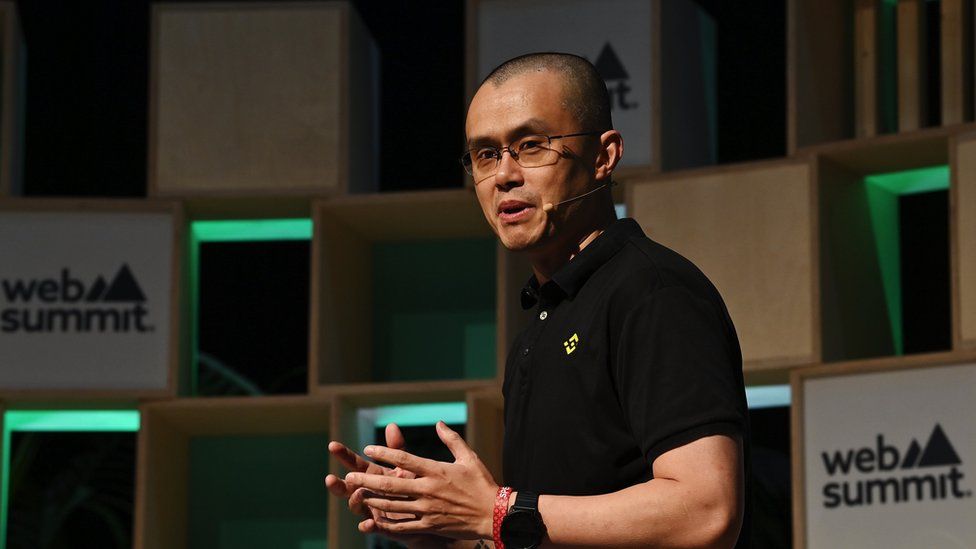
Binance CEO Changpeng Zhao told his 7.5 million followers his company would be selling off the holdings “in light of recent revelations”.
It sparked a run on FTX with panicked customers withdrawing billions of dollars from the cryptocurrency exchange.
IMAGE SOURCE, GETTY IMAGES Image caption, Binance CEO Changpeng Zhao shared terse exchanges on Twitter with his rival Mr Bankman-Fried
Withdrawals were halted and Mr Bankman-Fried tried to get a bailout, with Binance at one stage publicly considering a buyout before walking away.
Binance said reports of “mishandled customer funds and alleged US agency investigations” had swayed its decision.
A day later FTX was declared bankrupt.
Mr Bankman-Fried apologized in a series of tweets saying “I’m really sorry, again, that we ended up here.”
“Hopefully things can find a way to recover. Hopefully, this can bring some amount of transparency, trust, and governance to them.”
So was, and is the crypto world. The price of Bitcoin has fallen to a two-year low and many are wondering – if FTX can go down along with its talismanic leader, what could fall next?
A hacker who stole two unreleased songs from Ed Sheeranand sold them on the dark web has been jailed for 18 months.
Adrian Kwiatkowski traded the music by Sheeran and 12 songs by rapper Lil Uzi Vert in exchange for cryptocurrency.
The 23-year-old, from Ipswich, managed to get hold of them after hacking the performers’ digital accounts, the Crown Prosecution Service said.
Kwiatkowski admitted 19 charges, including copyright infringement and possessing criminal property.
He had made £131,000 from the music, City of London Police said.
Ipswich Crown Court heard that when the defendant’s Apple Mac laptop was searched, 565 audio files, including the songs by Sheeranand Vert, were uncovered.
Spirdark alias
An investigation was initially launched by US authorities in 2019.
It came after the management of several musicians reported to the New York District Attorney that someone known online as Spirdark had hacked a number of accounts and was selling the content.
The investigation linked the email address used to set up Spirdark’s cryptocurrency account to Kwiatkowski. His home address in the UK was also linked to an IP address used to hack one of the devices.
The case was then referred to the City of London Police and Kwiatkowski was arrested in September 2019.
According to police, seven devices, including a hard drive that contained 1,263 unreleased songs by 89 artists, were seized.
A document saved on the hard drive summarised the method he had used to obtain them along with a stash of Bitcoin which was seized.
Chief crown prosecutor Joanne Jakymec said Kwiatkowski had “complete disregard” for the musicians’ creativity, hard work and lost earnings.
“He selfishly stole their music to make money for himself by selling it on the dark web,” she said.
“We will be pursuing ill-gotten gains from these proceeds of crime.”
In August, Kwiatkowski pleaded guilty at Ipswich Magistrates Court to three charges of unauthorised access to computer material, 14 charges of selling copyrighted material, one charge of converting criminal property and two charges of possession of criminal property.
He also admitted to receiving bitcoin cryptocurrency for the songs.
Detective Constable Daryl Fryatt said Kwiatkowski was highly skilled but it was unfortunate he used his talents unlawfully.
“Not only did he cause several artists and their production companies significant financial harm, he deprived them of the ability to release their own work,” he added.
Manhattan District Attorney Alvin Bragg Jr said the case showed “cybercrime knows no borders”.
“This individual executed a complex scheme to steal unreleased music in order to line his own pockets,” he said.
Meet Ruth Iselema. She is the founder of Bitmama, a cryptocurrency trading platform with a presence in three African markets: Nigeria, Ghana, and Kenya.Iselema was inspired to start Bitmama after she got scammed for $1200 (in 2016) trying to sell bitcoin despite doing due diligence.At the time, there was no crypto-trading firm in Africa except those that operated on WhatsApp and Telegram communities.“I started learning about blockchain and cryptocurrencies earlier in 2015, through a friend and a couple of Telegram and WhatsApp groups I joined. Just as it is now, I turned out to be only one out of maybe two women in the space,” she told techpoint Africa.
Meet Ruth Iselema. She is the founder of Bitmama, a cryptocurrency trading platform with a presence in three African markets: Nigeria, Ghana, and Kenya.
Iselema was inspired to start Bitmama after she got scammed for $1200 (in 2016) trying to sell bitcoin despite doing due diligence. At the time, there was no crypto-trading firm in Africa except those that operated on WhatsApp and Telegram communities.
“I started learning about blockchain and cryptocurrencies earlier in 2015, through a friend and a couple of Telegram and WhatsApp groups I joined. Just as it is now, I turned out to be only one out of maybe two women in the space,” she told techpoint Africa.
Related stories
“Because most of the conversations happened online and nobody saw each other’s faces, people assumed I was an elderly woman. So they started calling me ‘Bitmama’ — a combination of bitcoin and mama — and the name stuck.”
Her first attempt to build a crypto exchange platform did not work out as she envisaged due to different views on how things should work by the team she assembled.
She decided to go solo and to do so, she left her comfort zone and migrated to Lagos to pursue her dreams. Migrating to Lagos was also influenced by the fact that most of the blockchain technologies she was interacting with were based there.
While in Lagos, she met Damilola Thompson, then of EchoVC, who introduced her to Tech in Heels, a women-focused pitch competition in which she participated but did not win.
Iselema persevered and applied to be among the inaugural cohort of Greenhouse Labs, a 3-month accelerator focused on early-stage female-led startups. She was subsequently accepted into Greenhouse Lab which solidified her decision to relocate to Lagos to focus solely on Bitmama.
Being among a handful of women to operate a blockchain in Africa has not been easy, Iselema said.
“Sometimes, people see a success story and assume everything happened overnight. There were times that I would cry, and there were times I would have sleepless nights. On some days, I would wake up staring at the ceiling, wondering how I was supposed to pay salaries that week,” she noted.
Iselema may be famed for her journey into the crypto world but she is also a trained pharmacist. She said that entrepreneurship has always been her first love.
“I remember I used to tell my dad how I saw myself sitting at the head of a company board and he would always respond, ‘yes, you can do it.’ He even started calling me ‘Your Excellency’ because of this,” she recalled.
Meet Ruth Iselema. She is the founder of Bitmama, a cryptocurrency trading platform with a presence in three African markets: Nigeria, Ghana, and Kenya.
Iselema was inspired to start Bitmama after she got scammed for $1200 (in 2016) trying to sell bitcoin despite doing due diligence. At the time, there was no crypto-trading firm in Africa except those that operated on WhatsApp and Telegram communities.
“I started learning about blockchain and cryptocurrencies earlier in 2015, through a friend and a couple of Telegram and WhatsApp groups I joined. Just as it is now, I turned out to be only one out of maybe two women in the space,” she told techpoint Africa.
Related stories
“Because most of the conversations happened online and nobody saw each other’s faces, people assumed I was an elderly woman. So they started calling me ‘Bitmama’ — a combination of bitcoin and mama — and the name stuck.”
Her first attempt to build a crypto exchange platform did not work out as she envisaged due to different views on how things should work by the team she assembled.
She decided to go solo and to do so, she left her comfort zone and migrated to Lagos to pursue her dreams. Migrating to Lagos was also influenced by the fact that most of the blockchain technologies she was interacting with were based there.
While in Lagos, she met Damilola Thompson, then of EchoVC, who introduced her to Tech in Heels, a women-focused pitch competition in which she participated but did not win.
Iselema persevered and applied to be among the inaugural cohort of Greenhouse Labs, a 3-month accelerator focused on early-stage female-led startups. She was subsequently accepted into Greenhouse Lab which solidified her decision to relocate to Lagos to focus solely on Bitmama.
Being among a handful of women to operate a blockchain in Africa has not been easy, Iselema said.
“Sometimes, people see a success story and assume everything happened overnight. There were times that I would cry, and there were times I would have sleepless nights. On some days, I would wake up staring at the ceiling, wondering how I was supposed to pay salaries that week,” she noted.
Iselema may be famed for her journey into the crypto world but she is also a trained pharmacist. She said that entrepreneurship has always been her first love.
“I remember I used to tell my dad how I saw myself sitting at the head of a company board and he would always respond, ‘yes, you can do it.’ He even started calling me ‘Your Excellency’ because of this,” she recalled.
Self-described “Crypto King” Aiden Pleterski had $2 million in assets seized, including luxury cars, as investors try to recoup millions given to him and his company, according to a CBC Toronto investigation.
Among the assets seized from the 23-year-old Whitby, Ontario, native include two McLarens, two BMWs, and Lamborghini. Investors also asked about a Patek Philippe watch that he claims he never owned. Pleterski maintains “he has never owned a watch with a value greater than $600,000.”
According to CBC Toronto, creditors are trying to figure out where “$35 million provided to Pleterski and his company AP Private Equity Limited for cryptocurrency and foreign exchange investments” has gone.
Pleterski called himself the “Crypto King” in paid promotional articles, and lived in supposed luxury, with expensive cars, watches, gold, private jets, and a lakefront mansion in Burlington, Ontario, he rented for $45,000 a month. He also once posted on Instagram about tipping $500 on a $41.25 bill at a Keg in Ajax.
There’s currently a $13 million bankruptcy proceeding against Pleterski, and he’s being investigated by a fraud recovery firm where 140 investors responded. In a lawsuit involving an investor who says they’re owed $4.5 million, they were effectively able to freeze Pleterski’s assets and bank accounts worldwide.
Pleterski’s lawyer Michael Simaan told CBC Toronto the claims from investors are “wildly exaggerated” and his client never solicited money from investors. He also said that no one ever considered whether Aidan, “as a very young man, was qualified to handle these types of investments.”
Pleterski said he lost the money in bad investments, but according to the bankruptcy trustee’s report, no evidence has been presented to support the claim.
A plan by the government of the Central African Republic to allow foreigners to acquire citizenship and land using a new cryptocurrency has been ruled as “unconstitutional” by the country’s top court.
Last month the government launched Sango Coin amid a sharp fall in Bitcoin prices and doubts over the project’s viability in a country with poor internet connection and destabilised by conflict.
Sales of the initial $21m (£17m) on offer have been slow, with just over 5% of the target bought in the hours after its launch on 21 July.
According to the Sango website.
, foreign investors could obtain citizenship for $60,000 worth of crypto – with the equivalent Sango Coins held as collateral for five years – and “e-residency” for $6,000, held for three years.
Investors would also be able to by a 250 sq m plot of land for $10,000, with the Sango Coins locked away for a decade.
The constitutional court ruled that nationality did not have a market value and that residency required a physical stay in the country.
A government spokesman had no response on Monday and the impact of the ruling on ambitious crypto project is not clear, Reuters news agency reports.