Tag: Cyber Security Authority (CSA)

  • Cybercriminals creating fake business profiles using Google Map, Search – CSA warns public

    Cybercriminals creating fake business profiles using Google Map, Search – CSA warns public

    The Cyber Security Authority (CSA) has discovered a growing trend in scams involving the impersonation of well-known brands and service providers.

    These include Pizza Hut, Pizzaman/Chickenman, Hisense, Bel Aqua, Papaye, Burger King, etc.

    Using Google Map and Google Search, the Authority noted that cybercriminals create fake business profiles or manipulate search results to trick the public into engaging with fraudulent phone numbers, websites, or addresses.

    Modus Operandi

    These cybercriminals create or alter Google Maps business listings of popular companies, banks, hotels, airlines, courier services, and government agencies. The fraudulent listings include fake phone numbers, emails, and websites.

    The CSA noted that when users search for a company’s contact details or service information, they are presented with the fraudulent listing usually at the top of Google results, leading them to contact the cybercriminals instead of the legitimate business.

    “The cybercriminals pose as customer service agents of the brands they represent and trick victims into sharing one-time passwords (OTP) or PIN’s, which are used to withdraw funds from their mobile money wallets or make payments for goods and services they never receive,” a statement issued by the CSA added.

    As such, the CSA has recommended members of the general public to always cross-check contact details, including phone numbers, from the official websites of institutions instead of relying solely on Google Search or Maps.

    Also, “treat top search results with caution; fraudulent listings may appear above legitimate ones, particularly paid “Ad” results. Scammers pay to have their fraudulent links appear at the very top.”

    Furthermore, the CSA entreated citizens to stop sharing sensitive information, including PINs and OTPs online.

    “If you encounter fake business listings or contacts on Google Maps, report them directly through Google’s reporting tools and notify the CSA,” the statement added.

    To institutions, the CSA advised a regular search for their brand online, including Google and Google Maps to identify fraudulent listings or fake websites.

    “Proactively share verified contact details on official websites, social media, and other trusted platforms. Monitor reviews and comments online, especially on social media handles for mentions of fraud, as this is often a sign of impersonation,” the statement added.

    Institutions are encouraged to acquire official toll-free numbers that can be centrally managed and mapped to their various branches, ensuring consistency and trust.

    Alternatively, organisations may acquire dedicated number ranges and actively publicize them to the public as their official contact lines.

    The CSA has a 24-hour Cybersecurity/Cybercrime Incident Reporting Point of Contact (POC) for reporting cybercrimes and for seeking guidance and assistance on online activities; Call or Text – 292, WhatsApp – 0501603111, Email – report@csa.gov.gh.

    Digital lending cyberbullying incidents between Jan. and May 2025

    The Cyber Security Authority (CSA) has recorded an exponential surge in cyberbullying incidents associated with digital lending mobile applications this year.

    Between January and May, the Authority received 377 reports, marking a sharp increase compared to the 228 cases reported throughout the entire year of 2024.

    The apps that have been identified include Miniloan, Mix Loan, Devtage loan, Ozzy money-cash, Plus Cash Arrow, Fundscredit, Getloan, Kcash, Bestloan, Gcash, Daraloan, Loan Base, Tap Loan, Gh Loans, Sune credit, Urgent Money, Sparkloan, Skyloan, Loancloudgh, Pea Money, Cash Arrow.

    The rest are HastyCredit, Lever credit, Molo credit, Sunloan pro, Nina loan, Upper loan, Wohia loan, Morloan pro, MumuMoney, Credit bag, Lever credit, Get loan, Ozzy credit, Molocredit, Soarcredit, E+money, Taploan, Dream Fund, Swftcredit, RocketLoan Turbo, DEVTAGE Financial, Vinvedo Wealth, Credit well, Newgry, Easy Buy, Sika Sika, WePay.

    According to Bank of Ghana (BoG) Notices BG/GOV/SEC/2022/10 and BG/GOV/SEC/2023/07, these apps violate the provisions of the Banks and Specialised Deposit-Taking Institutions Act, 2016 (Act 930).

    In addition, the owners of the apps have not met the compliance obligations of the Data Protection Commission (DPC), and thus their access and use of the data and PII of users violate the Data Protection Act, 2012 (Act 843).

    The CSA has therefore advised the public against subscribing to these mobile applications as they are not sanctioned by the Bank of Ghana (BoG) and the Data Protection Commission.

    “Individuals who patronise these services do so at their own risk,” the authority warned.
  • CSA records 377 digital lending cyberbullying incidents between Jan. and May 2025

    CSA records 377 digital lending cyberbullying incidents between Jan. and May 2025

    The Cyber Security Authority (CSA) has recorded an exponential surge in cyberbullying incidents associated with digital lending mobile applications this year.

    Between January and May, the Authority received 377 reports, marking a sharp increase compared to the 228 cases reported throughout the entire year 2024.

    The apps that have been identified include Miniloan, Mix Loan, Devtage loan, Ozzy money-cash, Plus Cash Arrow, Fundscredit, Getloan, Kcash, Bestloan, Gcash, Daraloan, Loan Base, Tap Loan, Gh Loans, Sune credit, Urgent Money, Sparkloan, Skyloan, Loancloudgh, Pea Money, Cash Arrow.

    The rest are HastyCredit, Lever credit, Molo credit, Sunloan pro, Nina loan, Upper loan, Wohia loan, Morloan pro, MumuMoney, Credit bag, Lever credit, Get loan, Ozzy credit, Molocredit, Soarcredit, E+money, Taploan, Dream Fund, Swftcredit, RocketLoan Turbo, DEVTAGE Financial, Vinvedo Wealth, Credit well, Newgry, Easy Buy, Sika Sika, WePay.

    According to Bank of Ghana (BoG) Notices BG/GOV/SEC/2022/10 and BG/GOV/SEC/2023/07, these apps violate the provisions of the Banks and Specialised Deposit-Taking Institutions Act, 2016 (Act 930).

    In addition, the owners of the apps have not met the compliance obligations of the Data Protection Commission (DPC), and thus their access and use of the data and PII of users violate the Data Protection Act, 2012 (Act 843).

    The CSA has therefore advised the public against subscribing to these mobile applications as they are not sanctioned by the Bank of Ghana (BoG) and the Data Protection Commission.

    “Individuals who patronise these services do so at their own risk,” the authority warned.

    The modus operandi used by the fraudsters, according to the CSA, begins with an automatic credit of an amount less than GHC200 into the user’s mobile money wallet even without an actual loan request upon the installation of the app.

    A week later, the fraudsters demand loan repayment with high interest rates from the victim or an associate. They then threaten to circulate actual or fabricated nude photos of the victim on social media, as well as label the victim as a thief or a wanted criminal.

    “Even after victims repay, some fraudsters continue to demand additional payments,” the Authority noted.

    This is possible as the victims would have granted these apps access to their data (contacts, photos) and personally identifiable information (PII) such as Ghana card ID, during the installation.

    The public has been urged to report cybercrimes and seek guidance as well as assistance on the CSA’s 24-hour online activities. Call or text -292, WhatsApp 0501603111, or email report@csa.gov.gh.

    The CSA has recorded financial losses of GH¢499,044 between January and April 2025, as against GH¢103,663 recorded in the same period last year in cases of online blackmail and sextortion in Ghana.

    A total of 155 cases were recorded between January and April 2024.

    However, during the same period in 2025, the number of cases surged, and the financial losses ballooned to GH¢499,044.

    The CSA revealed that its data points to increasingly sophisticated methods being employed by cybercriminals and highlights the growing economic impact of such incidents.

    It further revealed that the actors use social media to lure their victims.

    To combat this growing menace, the CSA advised the public to keep their social media accounts private and avoid storing sensitive content on their devices.

    The Authority discouraged payment of ransom as it encourages repeated demands and does not guarantee deletion of the content.

    “Preserve all evidence, take screenshots, record usernames, URLs, messages, and payment demands,” the Authority instructed.

  • 9 Chinese, Malaysian arrested for suspected cybercrime activities in Weija

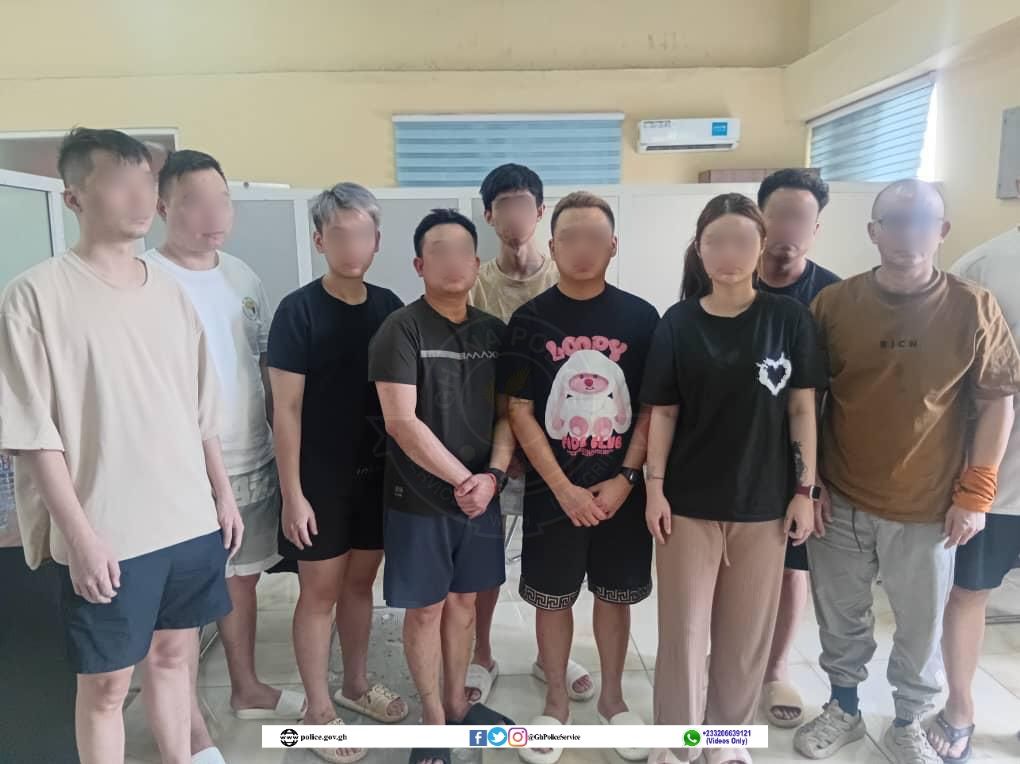
    9 Chinese, Malaysian arrested for suspected cybercrime activities in Weija

    The Cybercrime Unit of the Ghana Police Service, in a joint intelligence-led operation with the Ghana Revenue Authority (GRA), has arrested 10 individuals for cybercrime-related activities at Weija in the Greater Accra Region.

    The suspects, comprising Chinese and Malaysian, are currently in police custody assisting investigations.

    Exhibits retrieved during the operation include over 800 assorted mobile phones, some computers, and several charging devices. All the exhibits have been retained for forensic analysis to aid ongoing investigations.

    Meanwhile, the Cyber Security Authority (CSA) has urged the general public to remain vigilant and take necessary precautions to protect themselves online due to a surge in cases of online blackmail and sextortion in Ghana.

    The CSA recorded financial losses of GH¢499,044 between January and April 2025, as against GH¢103,663 recorded in the same period last year.

    A total of 155 cases were recorded between January and April 2024.

    However, during the same period in 2025, the number of cases surged, and the financial losses ballooned to GH¢499,044.

    The CSA revealed that its data points to increasingly sophisticated methods being employed by cybercriminals and highlights the growing economic impact of such incidents.

    It further revealed that the actors use social media to lure their victims.

    “After gaining the victim’s trust, they initiate explicit video calls or solicit private photos. These sessions are secretly recorded or saved without the victim’s consent.

    “They then threaten to release the compromising materials unless a ransom is paid, usually via mobile money. In some cases, even after payment is made, the threats continue or escalate”, it stated.

    To combat this growing menace, the CSA advised the public to keep their social media accounts private and avoid storing sensitive content on their devices.

    “Avoid sharing intimate content with strangers online, even if they seem trustworthy. Keep social media accounts private, and limit who can view your content.

    “Avoid capturing or storing nude images or videos of yourself on any device. Immediately cease all communication with the threat actors should you fall victim. Do not pay any ransom, it encourages repeated demands and does not guarantee deletion of the content. Preserve all evidence, take screenshots, record usernames, URLs, messages, and payment demand”, it added.

  • Cyber Security Authority warns public of Valentine’s Day online scams

    Cyber Security Authority warns public of Valentine’s Day online scams

    As Valentine’s Day approaches, the Cyber Security Authority (CSA) issues a warning to the public, emphasizing the need for caution in online activities during the romantic festivities.

    The Authority revealed that malicious cyber actors exploit the occasion to defraud unsuspecting victims through various schemes.

    In a press statement shared with the Ghana News Agency, the CSA disclosed that, in 2023, a staggering GHC 3,558,940.00 was lost to online shopping and romance scams.

    “After the unsuspecting victims engage and pay, usually to a mobile money wallet for products, the scammers block them from making further contact, and the expected delivery does not materialize,” the statement added.

    The perpetrators employ tactics such as creating fake websites, online shops, and social media profiles, enticing victims with heavily discounted packages.

    “While search engines provide convenient access to information, they can also display manipulated or misleading results, check on the official websites or with reliable sources to validate the contact details of shops rather than relying solely on search engine results,” it stressed.

    According to the statement, victims are lured into making payments for non-existent or substandard items.

    Malicious actors further manipulate Google Maps and search engine results to divert legitimate inquiries to scammer contact numbers.

    Once payment is made, victims are often blocked, and the promised deliveries never materialize.

    The CSA advises the public to exercise caution when encountering seemingly “too good to be true” deals on Valentine’s Day gifts, urging the use of reputable online marketplaces.

    Additionally, individuals are encouraged to check reviews and customer feedback before making online purchases.

    “Insist on payment only after delivery and inspection, be wary of unsolicited messages or emails claiming to be from a romantic partner, especially those that make requests for money or other sensitive information.

    “Do not share personal information such as your Ghana card number, credit card information, or bank account details with anyone, ensure that mobile money payments are made to wallets in the name of the online shop you are dealing with,” it said.

    Highlighting the risk of unsolicited emails or messages, the statement underscores the creation of fake online profiles by scammers to deceive victims into sending money or sharing personal information.

    The public is urged to be wary of such messages, especially those requesting money or sensitive data.

    To enhance online safety, the CSA recommends insisting on payment only after delivery and inspection, verifying the legitimacy of businesses, and avoiding sharing personal information.

    The statement concludes by informing the public of the CSA’s 24-hour Cybersecurity Incident Reporting Point of Contact for reporting cybercrimes and seeking guidance on online activities.

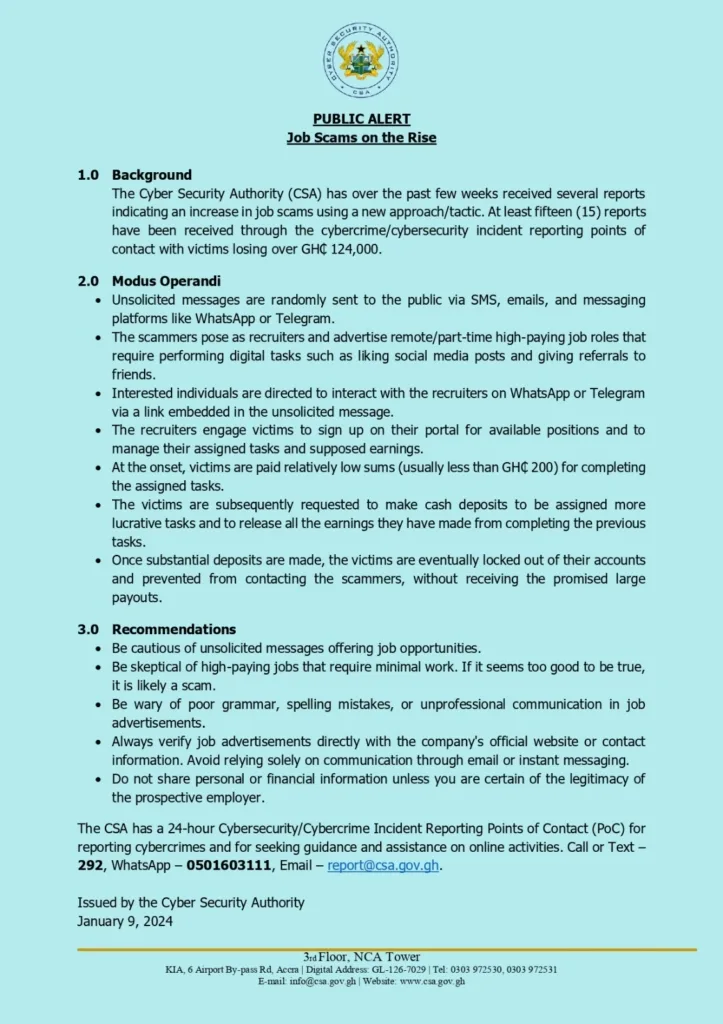
  • Job scams on the rise, be vigilant – CSA tells Ghanaians

    Job scams on the rise, be vigilant – CSA tells Ghanaians

    The Cyber Security Authority (CSA) is issuing a warning about a significant surge in job scams across Ghana, urging citizens to exercise caution.

    The CSA has already recorded at least 15 reports through its cybercrime reporting channels, detailing victims who have collectively lost over GH₵124,000 to these scams.

    The scammers employ tactics centered on masquerading as recruiters, reaching out with unsolicited messages that present enticing job opportunities.

    These fraudulent offers often promise high salaries with minimal work requirements, a characteristic that should raise suspicions for individuals familiar with legitimate job markets.

    In a statement, the CSA emphasized, “If it seems too good to be true, it’s likely a scam,” advising the public to stay vigilant and exercise skepticism when encountering such job propositions.

  • CSA orders professionals to register for license and accreditation by September 30

    CSA orders professionals to register for license and accreditation by September 30

    All cyber security service providers and experts within the nation are required to complete the process of registering for licences and accreditation from the Cyber Security Authority (CSA) by September 30 of this year.

    According to Dr. Albert Antwi-Boasiako, the Director-General of CSA, failure to adhere to this requirement will lead to the imposition of administrative penalties and potential legal action.

    Furthermore, he emphasised that these service providers and professionals will not be eligible to engage in service delivery to state entities and institutions.

    Dr. Antwi-Boasiako made these statements during a joint press conference held in Accra alongside the Public Procurement Authority (PPA).

    The purpose of the conference was to announce the implementation of the mandate for security service providers and experts to be licenced and accredited before offering their services to state institutions.

    Dr. Antwi-Boasiako highlighted that the Cyber Security Authority is mandated by Sections 49, 57, and 58 of the Cyber Security Act (Act 1038) to oversee the licencing of Cybersecurity Service Providers (CSPs) and the accreditation of Cybersecurity Establishments (CES) and Cybersecurity Professionals (CPs).

    The process of licencing and accreditation has been established to ensure that CSPs, CES, and CPs nationwide conduct their cyber security-related activities in alignment with internationally accepted best practises.

    This approach aims to offer enhanced assurance of cyber security and safety to consumers, while also addressing national security concerns.

    As of now, Dr. Antwi-Boasiako disclosed that 448 cyber security service professionals, 25 establishments, and 92 service providers have successfully completed the registration for licencing and accreditation since the initiative began on March 1 of this year.

    The Director-General emphasised that the CSA is collaborating closely with the PPA, a significant state agency, to enforce the guidelines for licencing CSPs and accrediting CES and CPs, particularly in the context of state institutions procuring cybersecurity services.

    “The focused areas of collaboration in­clude ensuring that Covered Entities, in procuring cybersecurity services in accordance with the Guidelines developed pursuant to Act 1038, engage Cybersecurity Service Providers who are licenced by the CSA; and ensuring that state institutions engage Cybersecurity Establishments and cybersecurity Professionals who are accredited by the CSA in performing cybersecurity-related functions.

    Through this collaboration, the PPA will ensure that as part of vetting procurement applications to the PPA Board, cybersecurity issues are considered, and Cybersecurity Service Providers who submit applications to the PPA Board are accredited by the CSA before being considered for any form of engagement,” Dr Antwi-Boasiako added.

    The enforcement of the regulation, he said, would make Ghana the first country in Africa, and one of the few in the world, such as Singapore, to introduce a licencing regime for Cybersecurity Service Providers and accreditation for Cybersecurity Establishments and Professionals.

    Also, he stated that, it would complement Ghana’s efforts in improving its ITU Global Cybersecurity Index ranking from 3rd to 1st in Africa and among the top 25 in the world.

    He said, since the commencement of the regulatory exercise, the CSA has engaged agencies, institutions, and associations that offer cybersecurity-related services and called on the public to support the authority in enhancing cyber safety.

    Chief Executive Officer of PPA, Frank Mante, said the Authority would ensure that, as part of qualification requirements, state institutions engage only firms and professionals that are licenced and accredited by the CSA for all contracts relating to cyber security.

    The Authority, he noted, would ensure compliance with standards and incorporate CSA licencing and accreditation into the qualification and pre-qualification criteria for the selection of Cybersecurity Service Providers, Cybersecurity Establishments, and cybersecurity professionals.

    He stated that the PPA was committed to its responsibility of working with the CSA to address cybersecurity matters as well as fighting cybercrime and maintaining the public’s safety online.

    “This partnership will ensure that best practises are observed, especially by ensuring that only CSA-licenced experts provide cybersecurity services in the public sector,” Mr Mante added.

  • Be careful of online scams – Cyber Security Authority warns ahead of Easter

    Be careful of online scams – Cyber Security Authority warns ahead of Easter

    As Easter approaches, the Cyber Security Authority (CSA) has issued a public alert warning the public to be cautious of online scams that may be perpetrated during this period.

    Malicious actors are known to take advantage of the season to trick unsuspecting victims into sharing their personal information or parting with their hard-earned money.

    According to the CSA, the three most common Easter season scams to avoid are online shopping scams, mobile payment services fraud, and courier service scams. 

    1. In the online shopping scam, cybercriminals create fake online shops or impersonate existing businesses on social media pages, offering heavily discounted goods. Victims are enticed to send money for these deals but never receive the items.

    2. In the mobile payment services fraud, malicious actors trick unsuspecting victims into sharing their mobile money wallet PIN. The scammers then proceed to make unauthorized payments or transfers from the victim’s wallet. 

    3. Meanwhile, in the courier service scam, cybercriminals impersonate workers of a legitimate courier service and lure unsuspecting victims to believe they have a package that needs to be delivered for a certain fee. No delivery is made after the victims make the payment.

    To avoid falling victim to these scams, the CSA recommends being cautious of unsolicited emails or messages offering exciting or “too good to be true” deals connected to the Easter celebration. They also advise against sharing personal information such as credit/debit card information or bank account details with anyone, especially if the person is not known well.

    The CSA advises using only reputable online marketplaces or retailers when purchasing items or gifts. They also urge the public to look for reviews and customer feedback and always insist on payment after delivery. Finally, they warn against paying any delivery fees for goods that were not ordered.

    The CSA has a 24-hour Cybersecurity/Cybercrime Incident Reporting Points of Contact (POC) for reporting cybercrimes and for seeking guidance and assistance on online activities. The public can call or text-292, WhatsApp-050 160 3111 or email – report@csa.gov.ah to report any cybercrimes or seek guidance and assistance on online activities.

    As Easter approaches, it is important to stay vigilant and take the necessary precautions to avoid falling victim to these scams.

  • Val’s day: Cyber Security Authority issues alert on cyber scammers

    Val’s day: Cyber Security Authority issues alert on cyber scammers

    Ahead of the Valentine’s day celebration, the Cyber Security Authority (CSA) has cautioned the general public to be mindful of the activities of cyber scammers who take advantage of the day to defraud people.

    The Authority in a statement issued on February 9, 2023 and sighted by the Independent Ghana, said while people genuinely express their affection for others by sending gifts or items with messages or love, malicious cyber actors also take advantage of the day to defraud people.

    Thus, the Authority by the alert is reminding the public to exercise caution and due diligence in their online activities.

    How the scammers operate?

    In first instance termed as “Romance Scams,” the Authority explained that malicious actors create fake online profiles to deceive victims into believing they are engaging in a trusting relationship.

    ” They use the relationship to persuade the victims to send money, provide personal and financial information, or purchase items for them.”

    In another instance termed as “Sopping Fraud,” malicious actors create fake websites or online shops or impersonate existing businesses on social media pages, offering heavily discounted packages and items.

    “Victims are enticed to send money for these deals but never receive the promised packages/items.”

    The Authority also mentioned “Phishing Scams” whereby malicious actors send unsolicited emails or messages claiming to be from a romantic partner, or from a company offering Valentine’s Day deals.

    “These messages contain links or attachments that when clicked, install malicious software (malware), or steal personal information.”

    Also, in what has been classified as “Lottery and Prize Scams,” malicious actors contact victims and claim that they have won a prize or lottery for a Valentine’s Day gift but need to pay a fee or provide personal information to claim the prize.

    Last but not the least, the Authority mentioned “Charity Scam” whereby malicious actors may contact victims and claim to be a charity organization.

    “They may ask for donations for Valentine’s Day gifts for needy children and other related causes.”

    The Authority thus warned the public to be “wary of unsolicited messages or emails claiming to be from a romantic partner.”

    It also cautioned against “too good to be true” deals on Valentine’s Day packages or gifts.

    “Do not share personal information such as your Ghana card number, credit card information, or bank account details with anyone, especially if you do not know them well,” the Authority added.

    Also, it advised citizens to use a reputable online marketplace or retailer when purchasing Valentine’s Day gifts. Look for reviews and customer feedback before making online purchase.

    Individuals who encounter any of the aforementioned instances can reach out to the Authority and report the incident.

    “The CSA has a 24-hour Cybersecurity/Cybercrime Incident Reporting Point of Contact (PoC) for reporting cybercrimes and for seeking guidance and assistance on online activities. Call or Text – 292, WhatsApp – 050 160 3111, Email – mailto:report@csa.gov.gh.”

    Source: The Independent Ghana

  • Be careful, online fraudsters targeting customers of banks – Cyber Security Authority warns

    The Cyber Security Authority (CSA) has warned Ghanaians, especially customers of various financial institutions to desist from giving out their personal information to others.

    According to the Authority, some unscrupulous persons act as agents of various banks to scam customers of their hard earn monies.

    In a press release sighted by GhanaWeb, it noted that these online fraudsters ask customers for their Ghana card details, ATM PINs, among other security details with the excuse of helping them link their Ghana cards to their accounts.

    The Cyber Security Authority said once the requested information is provided, these fraudsters undertake several online transactions causing financial loss to victims.

    The Authority advised customers to never share their personal identifiable information including pin codes, debit/credit card verification values and OTPs with anyone.

    “Customers of these banks first receive an SMS supposedly from their bank informing them that they will be receiving a call from an agent who will be assisting them to link their Ghana cards with their accounts and credit/debit (ATM) cards,” part of the release read.

    “The supposed agents of the banks then reach out to customers, requesting for personal identifiable information including Ghana card details, primary account numbers of debit/credit cards, card verification value numbers, expiry date of the cards, One Time Password, among others, as part of the linking process,” it added.

    Source: Complex.com

  • Deadline for licensing of Cyber Security professionals, service providers won’t change – Authority

    The Cyber Security Authority (CSA) says the January 1, 2023 deadline for the licensing of Cyber Security professionals, service providers, and establishments holds.

    The Authority has consequently developed a draft framework to guide the implementation of the licensing regime.

    The CSA, as part of the preparations, organised a public consultation meeting on the Framework in Accra on Wednesday, October 5, 2022, to solicit inputs from industry players.

    Dr Albert Antwi-Boasiako, Acting Director General, of CSA, said the licensing and accreditation Framework would ensure that cyber security professionals, establishments, and service providers attained a higher level of professional standards in accordance with the Cyber Security Act, 2020 (Act 1038).

    He said technical qualifications alone were not enough to measure professionalism, adding that the licensing regime would help to “improve the image” of the profession and protect the country’s digital ecosystem.

    “There’s a direction from the Board that effective 1st January 2023, to do cyber security service in the country, you have to be licensed and the mechanisms will be outlined by the end of the year.” Dr Antwi-Boasiako said.

    He added, “There are both administrative and criminal sanctions in the Cyber Security Act for those who perform cyber security services without legal authorisation and that will be applied.”

    Section 49 of the Cyber Security Act, 2020 states: “A person shall not provide a cyber security service unless that person obtains a license issued by the Authority in accordance with Act 1038.”

    Section 57 of Act 1038 also mandates the CSA to establish a mechanism to accredit Cyber Security professionals and practitioners.

    Madam Jennifer Mensah, Functional Lead, Legal and Compliance, CSA, said given the sensitive nature of the domain of cyber security, the Framework would ensure that cyber security professionals and practitioners were fit and proper persons to render such services.

    She said the GSA was considering having a tier system of categorisation of licenses and appealed to stakeholders to make input on the kind of parameters and requirements to be used.

    Madam Mensah said under the Act, a person providing cyber security services without a license could face a penalty equivalent to the cost of damage caused and the value of financial gain made.

    She said a licensed service provider using a license for a purpose other than the purpose for which it was granted could be fined 50,000 penalty units, equivalent to GHS 600,000.

    Cyber security threats have been an issue of concern following a surge in reported cases of online fraud, ransomware attacks and other cybercrimes.

    Last year, cyber fraud topped cybercrime cases recorded by the Cybercrime Unit of the Criminal Investigations Department of the Ghana Police Service – accounting for 45 per cent of all cybercrime cases.

    The Ghana Armed Forces (GAF), at the launch of its 2022 Cyber Security Awareness month last week, disclosed that it recorded 28 cases of cyber fraud within the last three months.

    The cases, the GAF said, were connected to recruitment and enlistment drives on fake social media platforms and Mobile Money accounts.

    Source: GNA