Tag: Death sentence

  • Asabke files appeal to overturn death sentence for Adams Mahama’s murder

    Asabke files appeal to overturn death sentence for Adams Mahama’s murder

    Asabke Alangde, a convicted felon who was given the death penalty by a seven-person jury panel, has filed a notice of appeal asking the Court of Appeal to overturn the jury’s decision.

    Asabke, a former Station Master of Bolgatanga-Kumasi Lorry Station was unanimously found guilty after the jury returned a guilty verdict for him on conspiracy.

    But returned a 4:3 verdict not guilty for him and Gregory Afoko for the charge of murder while the court had ordered for Afoko’s retrial who also had a 4:3 verdict on conspiracy in his favour.

    The two were accused for the acid incident which led to the death of New Patriotic Party’s Upper East Regional Chairman in May 20, 1015.

    Six days after his conviction, documents sighted by Starrfm.com.gh indicated that the lawyers for Asabke have filed a notice of appeal to the appeal court for his conviction and the entire ruling to be set aside.

    “Please take notice that the 2nd Accused / Appellant herein being dissatisfied with the ruling/conviction by Her Ladyship Wood JA (sitting as an additional High Court Judge) delivered on the 27 of April 2023 at the High Court, [General Jurisdiction 11], Accra, hereby Appeals to the Court of Appeal on the grounds set out in paragraph 2 below and will at the hearing of the Appeal seek the relief set out in paragraph 3 below,” the notice of Appeal filed on Wednesday, May 3, stated.

    Grounds of Appeal

    Per the groups of Appeal, the notice of appeal states that, “the trial judge failed to adequately direct the jury on the offence of conspiracy in the summing up leading to misdirection and conviction of the 2nd Accused/ Appellant.

    “The unanimous verdict reached by the jury on conspiracy and a 4-3 majority verdict for murder for the 2nd Accused/Appellant; and 4-3 majority verdict on both counts of Conspiracy and murder in favour of the 1s Accused person, on the same set of facts and charges cannot be grounded in law and thus void.

    “The conviction of the 2nd Accused/Appellant is erroneous and same is not supported by the evidence adduced at the trial.

    He is seeking for a relief that, “the entire ruling / conviction of the High Court dated 27 April, 2023 be set aside.”

    EIB Network’s Legal Affairs Correspondent, Murtala Inusah, gathered that, his legal team are also contemplating filing Certiorari at the Supreme Court to Quash the conviction of ASABKE on grounds of errors on the record.

    *Jury verdict*

    The seven member panel on Thursday , April 27, unanimously found him guilty for the offense of conspiracy for murder but returned a 4:3 verdict for him for murder

    For Gregory Afoko, the jury which comprised of four ladies and three men also returned a 4:3 not guilty verdict in his favour on both counts of conspiracy and murder.

    Justice Afua Merley Wood, a Justice of the Court of Appeal said per the law, said, a 4:3 means it is a “Hung jury” and Afoko must be Retried before another jury.

    Before passing her sentencing, the judge said. “Asabke Alangde, the men and women you have chosen to try you have found you guilty of conspiracy,” the court informed him.

    Asabke in his last words to the court said, “I have not done anything. I’m pleading with the court.”

    Justice Wood while passing her sentence said, “you are sentenced to death by hanging. May God have mercy on your soul.”

  • The death sentence of Rawlings that never saw light

    The death sentence of Rawlings that never saw light

    The young Air Force officer, Flt. Lt. Jerry John Rawlings, was detained by the military following a botched coup d’état attempt in 1979.

    He was later publicly court-martialed and given the death penalty.

    It was meant to be his punishment for attempting to overthrow Ghana’s Head of State, General Frederick William “Fred” Kwasi Akuffo, but a stronger force, coming from the civilians, overrode the General Court Martial’s authority.

    The Supreme Military Council overthrew a democratically elected government in October 1972, in what has been called a bloody usurpation, and the young Jerry John Rawlings was given the death penalty.

    However, according to Robert Beckley 1, a retired Ghanaian soldier who served during the time of Flt. Lt. Jerry John Rawlings,  in the 1970s, it took the words of the late president to save himself from being executed.

    According to the military veteran, Rawlings who was then being kept under scrutiny in maximum security, was also during the period, sent to and from court over the case.

    During one of such court trials, Rawlings addressed the court and explained his reasons for the attempted coup.

    Robert said that Rawlings gave his reasons for the attempted coup as something that was occasioned by the lack of supporting working tools for the soldiers.

    “He said that he attempted to do this coup because when he turned up at the office, he found that half the vehicles in his regiment; never mind the others, had broken down and there were no spare parts… the planes were not safe to fly because they haven’t got the right things and (all kinds of legitimate excuses) this was all going out and he found that some of the boots the soldiers were wearing, some of the soles were worn,” he said.

    Continuing to recount his memory of things, Robert Beckley 1 explained that at the time, there was a lot of fear in the barracks and among the soldiers because of how highly they admired Rawlings.

    He added that it was in those moments that Rawlings was broken out of jail, culminating into his successful attempt at the coup a second time, and on a later date.

    “And everybody was confused because he was locked up and people had given up on hope … everyone thought he was going to die; there was no way out because he was in maximum security – they take him to court and they bring him back and before we know it, in the early hours of June 4th, a mighty explosion – that was when they blew off the maximum security gates to get him out,” he told YouTuber, Aaron Ayiih.

    The death sentence that was handed him eventually became a point for civilian sympathy, leading to a military rule by the man who would later give Ghana it’s most-stable, democratic era.

  • Rising seas: ‘Death sentence’ for some countries – UN

    Rising seas: ‘Death sentence’ for some countries – UN

    The UN secretary general has issued a dire warning that rising sea levels could cause entire nations and low-lying communities to disappear.

    In light of recent data showing that sea levels have risen quickly since 1900, United Nations Secretary-General Antonio Guterres has issued a warning about the threat that rising sea levels pose to hundreds of millions of people who live in low-lying coastal areas and small island states.

    In a forceful speech to the first UN Security Council discussion on the effects of rising sea levels on international peace and security, Guterres stated that not only were large cities like Bangkok, Buenos Aires, Jakarta, Lagos, London, Los Angeles, Mumbai, Maputo, New York, and Shanghai threatened, but so were nations like Bangladesh, China, India, and the Netherlands.

    “The danger is especially acute for nearly 900 million people who live in coastal zones at low elevations — that’s one out of 10 people on Earth,” he told the council on Tuesday.

    Climate change is heating the planet and melting glaciers and ice sheets, which, according to NASA, has resulted in Antarctica shedding some 150 billion metric tonnes of ice each year on average, Guterres said. Greenland’s ice cap is shrinking even faster and losing 270 billion metric tonnes per year.

    “The global ocean has warmed faster over the past century than at any time in the past 11,000 years,” the UN chief said.

    “Our world is hurtling past the 1.5-degree warming limit that a liveable future requires and, with present policies, is careening towards 2.8 degrees – a death sentence for vulnerable countries,” he said.

    Developing countries, in particular, must have the resources to adapt to a rapidly changing world and that means ensuring the $100bn climate finance commitment to developing countries is delivered, Guterres said.

    The UN chief offered examples of the effects of a warming planet and rising sea levels on communities and countries stretching from the Pacific to the Himalayan river basins.

    Ice melting in the Himalayas has already worsened flooding in Pakistan, he said. But as the Himalayan glaciers recede in the coming decades, the mighty Indus, Ganges and Brahmaputra rivers will shrink. Hundreds of millions of people living in the river basins of the Himalayas will suffer the effects of both rising sea levels and the intrusion of saltwater, Guterres said.

    “We see similar threats in the Mekong Delta and beyond. The consequences of all of this are unthinkable. Low-lying communities and entire countries could disappear forever,” he said.

    “We would witness a mass exodus of entire populations on a biblical scale.”

    With rising sea levels creating new arenas for conflict as competition for freshwater sources and land intensifies, the secretary general said the climate crisis needs to be addressed at its root cause: reducing emissions to limit warming. Understanding the link between insecurity and a changed climate also requires developing early-warning systems for natural disasters, and legal and human rights provisions are also needed, particularly to address the displacement of people and loss of territories.

    “People’s human rights do not disappear because their homes do,” Guterres said.

    The meeting of the Security Council heard speakers from some 75 countries all voicing concern about the effect of rising seas, the Associated Press reported.

    Speaking on behalf of the Alliance of Small Island States, Samoa’s UN ambassador, Fatumanava-o-Upolu III Pa’olelei Luteru, said alliance members were among the lowest to emit the greenhouse gases that had caused global warming and climate change.

    “Yet, we face some of the most severe consequences of rising sea levels,” Lutero said, according to AP.

    “To expect small island states to shoulder the burden of sea level rise, without assistance from the international community will be the pinnacle of inequities,” he said.

    Ambassador Amatlain Kabua of the Marshall Islands said many of the tools needed to address climate change and rising seas were already known.

    “What is needed most is the political will to start the job, supported by a UN special representative,” to spur global action, she said.

  • Iran executes a dual British-Iranian national, Alireza Akbari

    Iran executes a dual British-Iranian national, Alireza Akbari

    Alireza Akbari, a dual citizen of the United Kingdom and Iran, was executed after receiving an Iranian death sentence.


    On Wednesday, Mr. Akbari’s family was requested to pay him a “final visit” at the prison, and according to his wife, he had been transferred to solitary confinement.

    The former Iranian deputy defence minister was detained in 2019 and found guilty of spying for the UK despite his denials.

    The execution, according to UK Prime Minister Rishi Sunak, was “a callous and cowardly act, carried out by a barbaric regime.”

    Iran’s rulers had “no respect for the human rights of their own people” Mr Sunak said, adding that his thoughts were “with Alireza’s friends and family”.

    UK Foreign Secretary James Cleverly said the execution would “not stand unchallenged”.

    The Iranian judiciary’s official news outlet Mizan reported on Saturday that Alireza Akbari had been hanged, without specifying the date when the execution took place.

    The news came after Iran posted a video of Mr Akbari earlier this week showing what appeared to be forced confessions, and after the country’s intelligence ministry had described the British-Iranian as “one of the most important agents of the British intelligence service in Iran”.

    However BBC Persian broadcast an audio message on Wednesday from Mr Akbari in which he said he had been tortured and forced to confess on camera to crimes he did not commit.

    The United States had also joined calls for Iran not to execute Mr Akbari. US diplomat Vedant Patel said “his execution would be unconscionable” and condemned the charges against him as “politically motivated”.

    The UK Foreign Office has ben supporting Mr Akbari’s family and had repeatedly raised his case with Iranian authorities. It had requested urgent consular access, but Iran’s government does not recognise dual nationality for Iranians.

    ‘Tortured for 3,500 hours’

    In Mr Akbari’s audio message he said that he was living abroad a few years ago when he was invited to visit Iran at the request of a top Iranian diplomat who was involved in nuclear talks with world powers.

    Once there, he adds, he was accused of obtaining top secret intelligence from the secretary of Iran’s Supreme National Security Council, Ali Shamkhani, “in exchange for a bottle of perfume and a shirt”.

    Mr Akbari alleged that he was “interrogated and tortured” by intelligence agents “for more than 3,500 hours”.

    “By using physiological and psychological methods, they broke my will, drove me to madness and forced me to do whatever they wanted,” he said. “By the force of gun and death threats they made me confess to false and corrupt claims.”

    He also accused Iran of seeking “to take revenge on the UK by executing me”.

    Hours after the audio message was broadcast, the Mizan news agency confirmed for the first time that Mr Akbari had been found guilty of espionage, and that the Supreme Court had rejected his appeal.

    Ties between the UK and Iran have deteriorated in recent months since the UK imposed sanctions on Iran’s morality police and other top security figures, in response to the country’s violent crackdown on anti-government protesters.

    Iran has arrested dozens of Iranians with dual nationality or foreign permanent residency in recent years, mostly on spying and national security charges.

    British-Iranian citizens Nazanin Zaghari-Ratcliffe and Anoosheh Ashoori were released and allowed to leave Iran last year after the UK settled a longstanding debt owed to Iran.

    However, at least two other British-Iranians remain in detention, including Morad Tahbaz, who also holds US citizenship.

    Source: BBC.com
  • Iranian-British national executed for spying on Iran

    Iranian-British national executed for spying on Iran

    An Iranian-British national was executed by Iran’s Supreme Court after being accused of spying for the British government.

    According to Iran’s judicial news agency, Mizan Online, Alireza Akbari received the death penalty for “corruption on earth and for endangering the country’s internal and external security by passing on intelligence.”

    Iran’s intelligence ministry referred to the former defence ministry official as “one of the most significant infiltrators of the country’s sensitive and strategic centres.”

    According to Mizan, who cited a statement from the intelligence ministry, Akbari was made a “key spy” for MI6 by virtue of “the importance of his position” in the UK.

    On February 2, 2019, the official government newspaper Iran published an interview with Akbari, whom it identified as a “former deputy defence minister in the reformist government” of Mohammad Khatami, who served as Iranian president from 1997 to 2005.

    ‘Barbaric regime’

    The UK’s foreign minister, James Cleverly, called the planned execution “politically motivated” and demanded Akbari’s immediate release.

    “This is a politically motivated act by a barbaric regime that has total disregard for human life,” Cleverly wrote on Twitter.

    “We are supporting the family of Mr Akbari and have repeatedly raised his case with the Iranian authorities,” a British foreign office spokesperson said in a statement. “Our priority is securing his immediate release and we have reiterated our request for urgent consular access.”

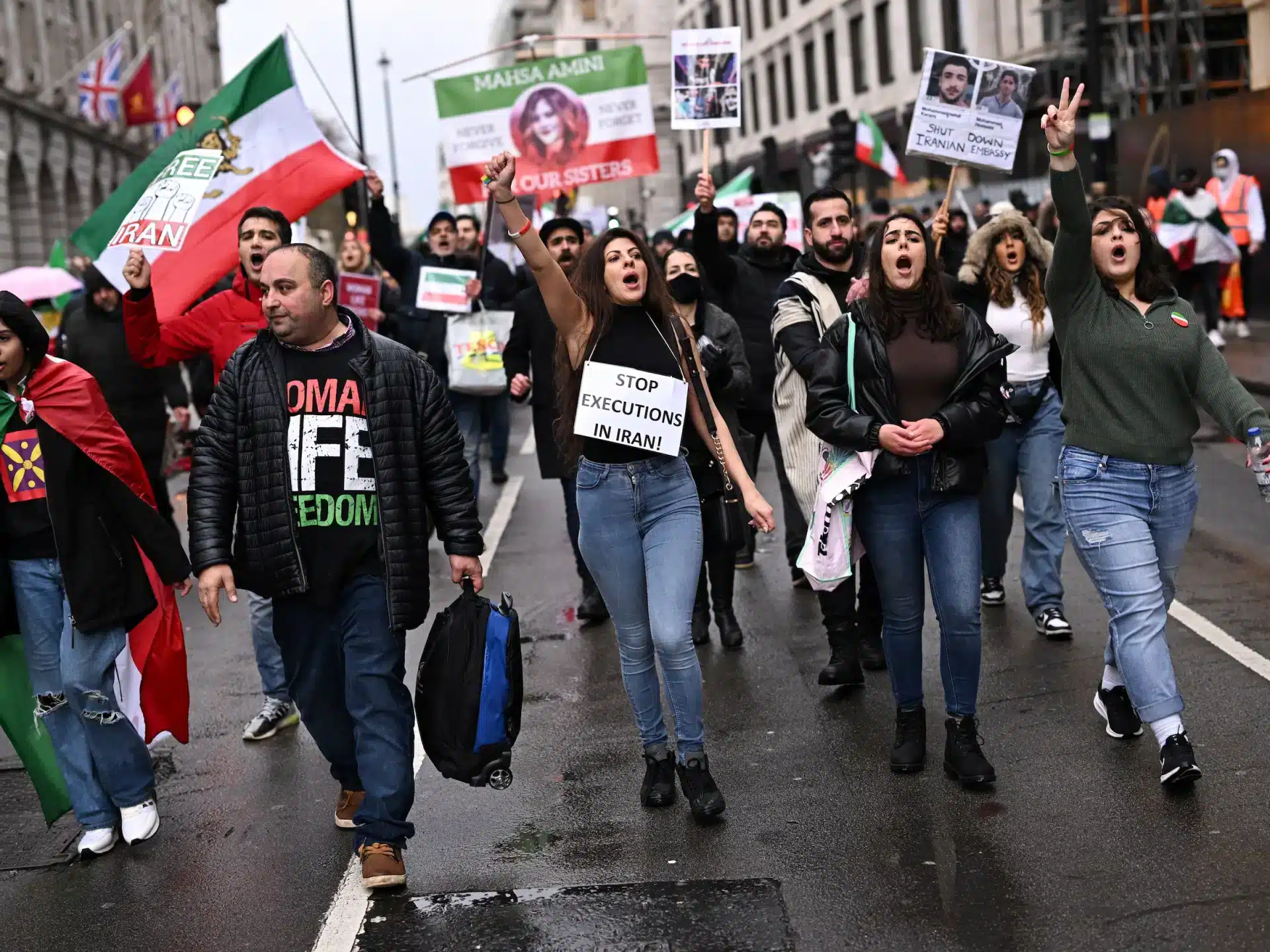
    Iran has been rocked by protests triggered by the September 16 death of Mahsa Amini, a 22-year-old Iranian Kurd, after she was arrested for violating Iran’s dress code for women.

    Eighteen people so far have reportedly been sentenced to death in connection with the protests. Of them, four were executed, setting off an international outcry, following expedited trials that the UN Human Rights Office (OHCHR) said did not meet the minimum guarantees of a fair trial.

    ‘State-sanctioned killing’

    Iran is “weaponising” the death penalty, attempting to crush dissent by frightening the public with the execution of protesters, the UN said on Tuesday.

    “Criminal proceedings and the death penalty are being weaponised by the Iranian government to punish individuals participating in protests, and to strike fear into the population so as to stamp out dissent, in violation of international human rights law,” OHCHR said.

    “The weaponisation of criminal procedures to punish people for exercising their basic rights – such as those participating in or organising demonstrations – amounts to state-sanctioned killing,” Volker Turk, the UN High Commissioner for Human Rights, said in a statement.

    OHCHR spokeswoman Ravina Shamdasani said the UN was against the imposition of the death penalty in all circumstances.

    “However, in these instances, what we have seen is a lack of due process; charges that are completely spurious and don’t make sense,” she told a news briefing.

    “These are charges of corruption on Earth and waging war against God, which are very vaguely worded.”

    She said there were also serious allegations of torture, mistreatment and humiliating treatment before the executions.

    “In such circumstances, these executions amount to an arbitrary deprivation of life,” Shamdasani said.

    Source: Aljazeera.com
  • 39-year-old man to die by hanging for killing lover

    An Abeokuta High Court on Wednesday sentenced a 39-year-old man, Musiliu Owolabi, to death by hanging for killing his lover, Afusat Idowu.

    Owolabi, an automobile mechanic was convicted on one count of murder.

    The Chief Judge of Ogun State, Justice Mosunmola Dipeolu, while delivering her judgment, submitted that the prosecution had proved its case beyond reasonable doubts that Owolabi was guilty of the offence charged, hence, convicted him.

    Dipeolu, said the offence committed contravened the provisions of section 319 of the Criminal Code, Laws of Ogun 2006.

    She held that the evidence presented by the prosecution was tenable and therefore, sentenced Owolabi to death by hanging.

    Earlier, the state prosecution counsel, Mr James Mafe, Director of legal Drafting, Planning Research and Statistics, said the convict committed the offence on Feb.1, 2018, at Camp area in Abeokuta.

    Mafe said the convict took his lover to a hotel for pleasure after a while she complained of stomachache and later started foaming from her mouth.

    Mafe added, “The convict took her to his vehicle, on his way he noticed she was dead, and secretly took the deceased to an uncompleted building, dug a shallow grave and buried her without disclosing to anybody.

    “The convict was arrested when the younger brother of the deceased went to the police station to complain that his sister who told him she was going for a naming ceremony at Bode Olude area never returned.

    “Upon police investigation, with the help of tracking the deceased phone, it was discovered that the convict was the last person that spoke with the deceased.

    “On his arrest, he made a confessional statement to the police and took them to where he buried his lover .”

    The convict had earlier been arraigned on Nov. 12, 2019, and had pleaded not guilty to the charges.

    Source: punchng.com

  • Nigerian prince sentenced to death

    A Nigerian Prince, Adewale Oyekan of Lagos, was on Monday sentenced to death for the murder of a businesswoman.

    Prince Adewale is the son of the late traditional ruler of Lagos Adeyinka Oyekan and had been employed by the deceased as a restaurant manager.

    Read:Nusrat Jahan Rafi: Death penalty for 16 who set student on fire

    He had been charged alongside Lateef Balogun, a former domestic servant, for the murder of their boss Sikirat Ekun.

    Ms Ekun was strangled to death and her body dumped in a well at her Lagos home on 17 October 2012.

    Read:Death sentence for Moroccan trio who killed European tourists

    Justice Raliatu Adebiyi of Lagos’ Ikeja high court in her Monday judgment said that the prosecution had proved the charges of conspiracy to commit murder and murder beyond a reasonable doubt.

    Nigeria’s Herald newspaper tweeted a photo of Prince Adewale and his co-accused.

    Source: bbc.com