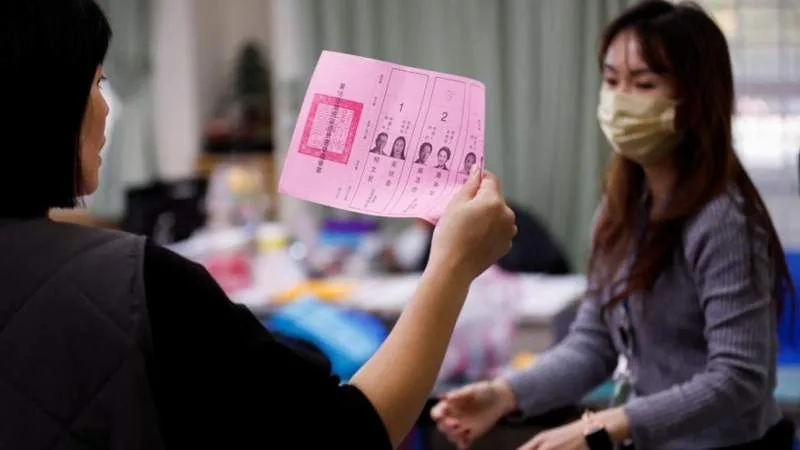
Voting in Taiwan’s presidential election has finished and now they are counting the votes. The election will decide how Taiwan will be connected to China in the future.
Taiwan is an island that runs its own government and is democratic, but China says it belongs to them and other countries don’t see it as a separate country.
Early numbers show a close competition between the current Democratic Progressive Party (DPP) and the main opposition Kuomintang (KMT) for the upcoming election.
China doesn’t like DPP candidate William Lai and tells people not to vote for him. KMT is saying they will have better relations with China and make peace in the Taiwan Strait.
The Taiwan People’s Party is also running in the election, but recent polls show a close competition between the DPP and KMT. Today, there are 113 seats in the government that people are trying to win.
Taiwanese voters care more about the economy than China.
Taiwan’s vice president and potential presidential candidate declared on Sunday while travelling through the United States that his country will never capitulate in the face of escalating Chinese threats, contradicting Beijing’s criticism of his visit.
William Lai, a front-runner in the Taiwanese presidential election in January, stopped in New York on his way to Paraguay, where he will be present for the country’s new president’s inauguration on Tuesday.
Only 13 nations, including this one from South America, have formal diplomatic ties with Taiwan, a self-governing democracy that China’s ruling Communist Party claims as its own despite never having had any kind of control over it.
Lai framed Taiwan’s long-term survival as something the world community should be concerned about in an address to supporters at a luncheon banquet in New York.
“When Taiwan is safe, the world is safe, and when there is peace on the Taiwan Strait, there will be world peace,” Lai reportedly remarked, according to Taiwan’s presidential office.
“No matter how great the threat of authoritarianism is to Taiwan, we absolutely will not be scared nor cower, and we will uphold the values of democracy and freedom.”
Lai made his remarks after the Chinese foreign ministry denounced his visit and referred to him as a “trouble maker through and through.”
China, it was stated, vehemently opposes any official contact between the US and Taiwan as well as any “‘Taiwan independence’ separatists to the US.”
Lai’s transits, which include a stop in San Francisco on his way back on Wednesday, have been described as usual by both Taiwan and the US.
A senior administration source told CNN on July 16 that such transits were “fairly common” and that they were “unofficial, in keeping with our US One China policy.”
In January 2022, Lai last travelled via the US.
Lai, 63, is a member of the Democratic Progressive Party (DPP), which is in power, and is noted for being more overtly pro-independence. This group is known as the “deep green” camp.
Former physician turned politician with a Harvard education has described himself in the past as a “pragmatic worker for Taiwanese independence.”
Beijing, which has not renounced the use of force to capture the self-governing island, has grown particularly hostile to him as a result.
But after obtaining the DPP nomination, Lai has changed his stance on China.
Beijing has increased economic, diplomatic, and military pressure on Taiwan under the direction of Xi Jinping, particularly in the wake of President Tsai Ing-wen’s 2016 victory and subsequent election to a second term in office in 2020.
Tsai is ineligible to run for a third term under Taiwan’s constitution.
In January, Taiwan will hold elections that might have a significant impact on world relations at a time when Xi’s potential to fulfil his promise to “reunite” the island with China is being closely watched.
The Kuomintang, a political group that was originally the Chinese Communist Party’s fiercest foe but has subsequently changed to support far closer ties with Beijing, is the DPP’s historical rival.
Since the US and the government of Taiwan do not have formal diplomatic relations, travel by Taiwanese officials to the US is referred to as “transits” rather than “visits” because the stopovers are part of an unofficial trip en route to another location.
Despite Beijing’s warnings and threats, Taiwan’s President Tsai visited California in March and spoke with US House Speaker Kevin McCarthy. China began three days of live-fire military drills surrounding Taiwan after Tsai’s tour.
Ma, a prominent figure in Taiwan’s opposition Kuomintang (KMT) party, will visit mainland China between March 27 and April 7, according to a statement released by his foundation on Sunday.
According to the foundation, he will pay respects to his ancestors in the southwest Hunan Province and head a group of Taiwanese students who will meet with counterparts from mainland China in several locations.
While the trip is ostensibly a private one it is filled with historic symbolism and comes at a time of deepening tensions over the future of Taiwan.
China’s ruling Communist Party has never controlled Taiwan but claims the self-ruled island democracy as its own and has repeatedly refused to rule out taking it by force.
At the end of the Chinese Civil War, Mao Zedong’s Communist Party took control of mainland China while the Kuomintang under Chiang Kai-shek fled to Taiwan– with both sides claiming to be the legitimate representative of China in the following decades, until Taiwan’s transition into a democracy in the 1990s.
But more recent decades saw increasingly ties warm between Beijing and the KMT, a rapprochement that reached its peak during Ma’s administration.
Ma served as Taiwan’s president between 2008 and 2016 during which he drew stronger economic ties between China and the democratically ruled island but kept Beijing’s push for reunification at bay.
His perceived closeness to Beijing, particularly on the economic front, sparked protests and a major voter backlash.
The KMT have lost the last two elections to the Democratic Progressive Party (DPP), which is much more skeptical toward Beijing and rejects the tacit understanding that both sides acknowledge they belong to “one China,” but with different interpretations of what that entails.
China’s leader Xi Jinping has ramped up economic, diplomatic and military pressure on Taiwan ever since the DPP took power in 2016.
Ma’s historic trip is taking place against that febrile geopolitical backdrop and comes as Taiwan and the United States ramp up efforts to counter China’s growing military capabilities.
His trip will also come at a politically sensitive time. Taiwan’s President Tsai Ing-wen will soon make a stopover in the US en route to diplomatic allies in Latin America, an official with Taiwan’s Overseas Community Affairs Council told lawmakers earlier this month. US House Speaker Kevin McCarthy also said he plans to meet with her when she is in the US.
Taiwan is scheduled to hold its next presidential election in January next year. Tsai is not eligible for re-election.
Fears of a Chinese invasion have loomed over Taiwan for more than seven decades but they have been supercharged by both Xi’s increased assertiveness andRussia’s invasion of Ukraine.
The KMT has long rejected being characterized as a “pro-Beijing” party. But its leadership, including Ma, have often pushed the need to improve ties.
The KMT’s deputy chairman Andrew Hsia visited Beijing last month to meet with senior Communist Party leader Wang Huning.
In contrast, Beijing has severed official communication with Taiwan’s Tsai-led government.
In 2015, Ma and Xi held a historic face-to-face meeting in Singapore – the first meeting between leaders of the Kuomintang and Chinese Communist Party since the end of the Chinese Civil War, although not on either side of the strait.
Ma’s foundation said a meeting between Xi and Ma is not currently being planned for the trip.
Taiwan’s presidential office said in a statement Sunday that Ma will be required to report details of his itinerary to the government before and after his visit to China.