Government says it spent over GH¢76 million towards the disinfection, fumigation and cleaning-up of markets, lorry parks and public toilet facilities across the country.
The first phase of the disinfection and clean-up exercises formed part of the government’s response towards preventing the spread of the Coronavirus disease in the country.
Hajia Alima Mahama, the Minister of Local Government and Rural Development, announced this in Accra when she took her turn of the Meet-the-Press series.
She said the Ministry set up disinfection teams at the local level, disinfected and fumigated more than 2,000 market centres and 2,000 public toilet facilities.
The amount went into purchasing of disinfectants, spraying machines, personal protective gears for sprayers, and other useful items secured for the exercise.
The Minister said the contract for the second phase of disinfection had been signed and would soon begin.
Giving accounts of financial inflows to the MMDAs for development, the Minister explained that GHc4.5 billion was transferred to the 260 Assemblies for infrastructural development including; education, healthcare, water and sanitation facilities and expressed satisfaction over the utilisation and work done so far with the funds by the MMDAs.
She noted the Ministry was mandated to promote good governance, equitable and balanced development across the country and was delivering its mandate through the formulation of policies on rural and urban development and designing systems to monitor the implementation of those projects.
Hajia Mahama assured of government’s unalloyed commitment to implement socio-economic interventions across the country to ameliorate the suffering of the masses, especially the poor and vulnerable.
The Minister indicated that in the second term of the Akufo-Addo led government, it was poised to engage all stakeholders towards building a consensus and amending the entrenched provisions in the 1992 Constitution for the election of Metropolitan, Municipal and District Chief Executives on a partisan basis.
That, she said, would enhance transparency and accountability at the local governance set up.
US President Donald Trump has been lambasted by the medical community after suggesting research into whether coronavirus might be treated by injecting disinfectant into the body.
He also appeared to propose irradiating patients’ bodies with UV light, an idea dismissed by a doctor at the briefing.
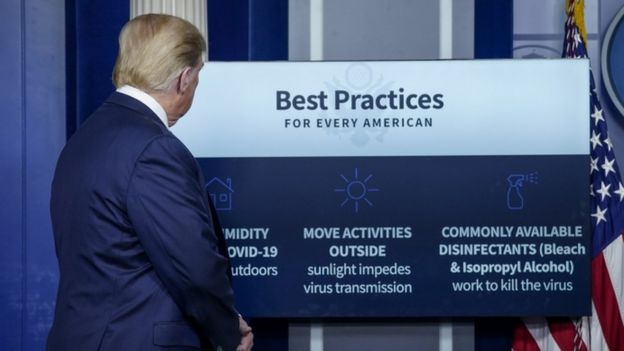
Another of his officials had moments earlier said sunlight and disinfectant were known to kill the infection.
Disinfectants are hazardous substances and can be poisonous if ingested.
Even external exposure can be dangerous to the skin, eyes and respiratory system.
What did President Trump say?
During Thursday’s White House coronavirus task force briefing, an official presented the results of US government research that indicated coronavirus appeared to weaken more quickly when exposed to sunlight and heat.
The study also showed bleach could kill the virus in saliva or respiratory fluids within five minutes and isopropyl alcohol could kill it even more quickly.
William Bryan, acting head of the US Department of Homeland Security’s Science and Technology Directorate, outlined the findings at the news conference.
While noting the research should be treated with caution, Mr Trump suggested further research in that area.
“So, supposing we hit the body with a tremendous – whether it’s ultraviolet or just very powerful light,” the president said, turning to Dr Deborah Birx, the White House coronavirus response co-ordinator, “and I think you said that hasn’t been checked but you’re going to test it.
“And then I said, supposing you brought the light inside of the body, which you can do either through the skin or in some other way. And I think you said you’re going to test that too. Sounds interesting,” the president continued.
“And then I see the disinfectant where it knocks it out in a minute. One minute. And is there a way we can do something like that, by injection inside or almost a cleaning?
“So it’d be interesting to check that.”
Pointing to his head, Mr Trump went on: “I’m not a doctor. But I’m, like, a person that has a good you-know-what.”
He turned again to Dr Birx and asked if she had ever heard of using “the heat and the light” to treat coronavirus.
“Not as a treatment,” Dr Birx said. “I mean, certainly, fever is a good thing. When you have a fever, it helps your body respond. But I’ve not seen heat or light.”
“I think it’s a great thing to look at,” Mr Trump said.
Disinfectants don’t work inside the body
Analysis by Rachel Schraer, BBC health reporter
Using a disinfectant can kill viruses on surfaces. It’s a very good idea to keep clean the things you touch, using products with anti-microbial properties – for example, substances with a high alcohol content.
There is also some evidence that, in general, viruses on surfaces die more quickly when directly exposed to sunlight. But we don’t know how much or how long they have to be exposed for UV light to have an effect, so you’re far safer just washing your hands and surfaces and trying not to touch your face.
Crucially, this is only about infected objects and surfaces – not about what happens once the virus is inside your body.
One of the main ways of catching the virus is by breathing in droplets expelled by an infected person, mainly by sneezing and coughing. The virus very quickly begins to multiply and spread, eventually reaching the lungs.
Not only does consuming or injecting disinfectant risk poisoning and death, it’s not even likely to be effective.
Equally, by the time the virus has taken hold inside your body, no amount of UV light on your skin is going to make a difference.
And since UV radiation damages the skin, using it to kill the virus could be a case of – to borrow a well-worn phrase – the cure being worse than the disease.
What’s the reaction been to Trump’s comments?
Doctors warned the president’s idea could have fatal results.
Pulmonologist Dr Vin Gupta told NBC News: “This notion of injecting or ingesting any type of cleansing product into the body is irresponsible and it’s dangerous.
“It’s a common method that people utilise when they want to kill themselves.”
Kashif Mahmood, a doctor in Charleston, West Virginia, tweeted: “As a physician, I can’t recommend injecting disinfectant into the lungs or using UV radiation inside the body to treat Covid-19.
“Don’t take medical advice from Trump.”
John Balmes, a pulmonologist at Zuckerberg San Francisco General Hospital, warned that even breathing fumes from bleach could cause severe health problems.
He told Bloomberg News: “Inhaling chlorine bleach would be absolutely the worst thing for the lungs. The airway and lungs are not made to be exposed to even an aerosol of disinfectant.
“Not even a low dilution of bleach or isopropyl alcohol is safe. It’s a totally ridiculous concept.”
Mr Trump has previously hyped a malaria medication, hydroxycloroquine, as a possible treatment for coronavirus, though he has stopped touting that drug recently.
This week a study of coronavirus patients in a US government-run hospital for military veterans found more deaths among those treated with hydroxychloroquine than those treated with standard care.
Reacting to the president’s remarks on Thursday evening, Joe Biden, his likely Democratic challenger in November’s White House election, tweeted: “UV light? Injecting disinfectant? Here’s an idea, Mr President: more tests. Now. And protective equipment for actual medical professionals.”
“The disinfectant, where it knocks it out in a minute, and is there a way we can do something like that by injection inside, or almost a cleaning. It gets in the lungs” — Trump seems to suggests that injecting disinfectant inside people could be a treatment for the coronavirus pic.twitter.com/amis9Rphsm
Only this week, the US Centers for Disease Control and Prevention warned Americans to be careful with cleaning products as sales of household disinfectants soar amid the pandemic.
“Calls to poison centres increased sharply at the beginning of March 2020 for exposures to both cleaners and disinfectants,” found the agency’s weekly morbidity and mortality report.
The US Food and Drug Administration has warned against ingesting disinfectants, citing the sale of bogus miracle cures that contain bleach and purport to treat everything from autism to Aids and hepatitis.
The agency’s website says: “The FDA has received reports of consumers who have suffered from severe vomiting, severe diarrhoea, life-threatening low blood pressure caused by dehydration, and acute liver failure after drinking these products.”
Last week a federal judge secured a temporary injunction against one organisation, known as the Genesis II Church of Health and Healing, for marketing a product equivalent to industrial bleach as a remedy for coronavirus.
A leading disinfectant producer has issued a strong warning not to use its products on the human body after Donald Trump suggested they could potentially be used to treat coronavirus.
Reckitt Benckiser, which owns Lysol and Dettol, said “under no circumstance” should its products be injected or ingested.
President Trump faces a backlash over his comments at a briefing on Thursday.
Disinfectants are hazardous substances and can be poisonous if ingested.
Even external exposure can be dangerous to the skin, eyes and respiratory system.
Mr Trump’s comments have been heavily criticised by doctors and have generated a huge online response. They have provoked hundreds of thousands of comments and caused well-known cleaning brands to trend on social media.
Reckitt Benckiser, which also owns the brands Vanish and Cillit Bang, said its products should not be administered “through injection, ingestion or any other route”.
“Our disinfectant and hygiene products should only be used as intended and in line with usage guidelines. Please read the label and safety information,” the company said in a statement.
What did President Trump say?
During Thursday’s White House coronavirus task force briefing, an official presented the results of US government research that indicated coronavirus appeared to weaken faster when exposed to sunlight and heat.
The study also showed bleach could kill the virus in saliva or respiratory fluids within five minutes, and isopropyl alcohol could kill it even more quickly.
Mr Trump then hypothesised about the possibility of using a “tremendous ultraviolet” or “just very powerful light” on or even inside the body as a potential treatment.
Trump’s claims fact-checked
The fake health advice you should ignore
Will coronavirus go away in the summer?
“And then I see the disinfectant where it knocks it out in a minute. One minute,” he said. “And is there a way we can do something like that, by injection inside or almost a cleaning?
“Because you see it gets in the lungs and does a tremendous number on them, so it’d be interesting to check that,” he said.
In a statement, the White House press secretary said the president had “repeatedly” told Americans to consult doctors about coronavirus treatment.
“Leave it to the media to irresponsibly take President Trump out of context and run with negative headlines,” Kayleigh McEnany said.
His comments have dominated social media platforms like Twitter and Reddit since Thursday night.
Many compared his idea to a dangerous viral trend in 2018 where people ate Tide laundry detergent pods.
Lysol, which is one of the America’s best known cleaning brands, has been named in tweets at least 125,000 times since the White House news conference.
Owners Reckitt Benckiser said they issued their statement on Friday “due to recent speculation and social media activity”.
What’s the medical reaction been?
Doctors warned that the president’s suggestion could have fatal results.
“This notion of injecting or ingesting any type of cleansing product into the body is irresponsible and it’s dangerous,” Dr Vin Gupta, a pulmonologist and global health policy expert, told NBC news. “It’s a common method that people utilise when they want to kill themselves.”
“Inhaling chlorine bleach would be absolutely the worst thing for the lungs,” pulmonologist John Balmes told Bloomberg News. “The airway and lungs are not made to be exposed to even an aerosol of disinfectant.
“Not even a low dilution of bleach or isopropyl alcohol is safe. It’s a totally ridiculous concept.”
This is not the first time that Mr Trump’s medical advice has generated controversy and criticism.
He has previously hyped a malaria medication, hydroxychloroquin, despite a lack of clinical evidence it helps treat Covid-19 and some concerns it can even be detrimental.
Poisoning and death risks
Analysis by Rachel Schraer, BBC health reporter
Using a disinfectant can kill viruses on surfaces. It’s a very good idea to keep clean the things you touch, using products with anti-microbial properties – for example, substances with a high alcohol content.
There is also some evidence that, in general, viruses on surfaces die more quickly when directly exposed to sunlight. But we don’t know how much or how long they have to be exposed for UV light to have an effect, so you’re far safer just washing your hands and surfaces and trying not to touch your face.
Crucially, this is only about infected objects and surfaces – not about what happens once the virus is inside your body.
One of the main ways of catching the virus is by breathing in droplets expelled by an infected person, mainly by sneezing and coughing. The virus very quickly begins to multiply and spread, eventually reaching the lungs.
Not only does consuming or injecting disinfectant risk poisoning and death, it’s not even likely to be effective.
Equally, by the time the virus has taken hold inside your body, no amount of UV light on your skin is going to make a difference.
And since UV radiation damages the skin, using it to kill the virus could be a case of – to borrow a well-worn phrase – the cure being worse than the disease.
Earlier this week, the US Centers for Disease Control and Prevention warned Americans to be careful with cleaning products as sales of household disinfectants soar amid the pandemic.
“Calls to poison centres increased sharply at the beginning of March 2020 for exposures to both cleaners and disinfectants,” the agency’s weekly morbidity and mortality report found.
The US Food and Drug Administration has also warned against ingesting disinfectants, citing the sale of bogus miracle cures that contain bleach and purport to treat everything from autism to Aids and hepatitis.
Last week, a federal judge secured a temporary injunction against one organisation, known as the Genesis II Church of Health and Healing, for marketing one of these products as a potential coronavirus cure.