Tag: dollar

  • Jan–May: Cedi depreciates 10.11% against dollar on demand pressures

    Jan–May: Cedi depreciates 10.11% against dollar on demand pressures

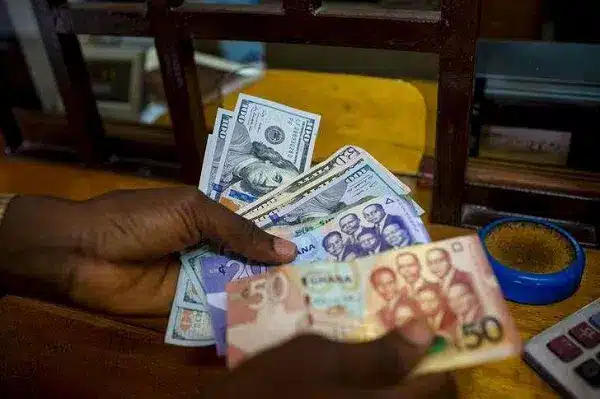
    A recent report by Joy News suggests that the Ghana cedi has weakened by 10.11% against the US dollar since January.

    It attributes the depreciation to market pressures, i.e., the rising demand for dollars in transactions in the interbank market, the market where banks trade currencies with each other) in Ghana.

    It closed at interbank mid-rates of GH¢11.63 to a dollar, GH¢15.62 against the pound and GH¢13.49 to the euro over two weeks. This reflected losses of 3.01%, 1.65%, and 1.56%, respectively.

    Similar trends were observed in the retail market, where the currency weakened by 3.07% against the American greenback, 1.56% against the pound and 1.49% against the euro, closing at mid-rates of GH¢12.20 against the dollar, GH¢16.05 to the pound and GH¢14.10 to the euro, respectively.

    “We note that the cedi’s depreciation exceeded our upper-band forecast of GH¢11.40 against the US dollar, as the central bank remained cautious about forex intermediation despite assurances from the International Monetary Fund of a likely US$385 million disbursement,” Database Research noted.

    Per the report, the authorities appear to be conserving foreign exchange reserves while they wait for a more reliable flow of foreign currency into the country, especially as demand for dollars remains high. 

    “Looking ahead, we expect the cedi to trade largely on bearish expectations within a range of GH¢11.35 – 11.86/US dollar over the next two weeks [in the interbank market], with the path shaped by the balance between FX demand and the magnitude of supply into the market,” it further stated.

    Meanwhile, the cedi began this week going for GH¢12.20 to the American greenback in the retail market. Its year-to-date loss now stands at 0.20%.

    Cedi’s value earlier this year

    The cedi recorded a 4% depreciation against major trading currencies, according to the Bank of Ghana’s January 2026 Summary of Economic and Financial Data.

    The local currency traded at GH¢10.88 to the US dollar on the interbank market, compared with GH¢10.45 at the end of December 2025. It also traded at GH¢14.77 to the pound and GH¢12.80 to the euro, representing losses of 4.9% and 4.1%, respectively.

    Despite the early-year depreciation, data from the International Monetary Fund (IMF), analysed across more than 20 major African economies, showed that the cedi emerged as the continent’s best-performing currency in 2025.

    According to the report, the cedi strengthened by more than 40% against the US dollar in 2025, making it the top-performing currency among over 20 African currencies reviewed.

    Ghana’s foreign exchange reserves also increased significantly during the period. The Bank of Ghana reported that reserves rose by 33.63%, or $3.02 billion, between December 2024 and October 2025, reaching approximately $12 billion by October 2025.

    Speaking at the launch of the 60th anniversary of the Ghana cedi in Accra on October 28, 2025, Governor of the Bank of Ghana, Dr Johnson Pandit Asiama, attributed the improvement to coordinated fiscal and monetary policy measures implemented by the government.

    He said the country had achieved a decisive economic turnaround, reflected in stronger foreign exchange reserves, improved investor confidence and increased resilience of the local currency against external shocks.

    “Under the leadership of His Excellency John Dramani Mahama and Her Excellency the Vice President, and through coordinated, difficult but necessary policy actions, Ghana had turned a decisive corner, and the evidence was compelling. Our gross international reserves were around $12 billion,” he said.

    Measures to strengthen the cedi

    As part of a revamped reserve-building drive, large-scale gold miners ‌have been instructed by the government to sell 30% of their gold output to the central bank from the earlier 20%, this is according to a Reuters report.

    According to the report, the directive is yet to be accepted by miners, as key commercial terms remain unresolved. Last year, miners operating under valid mining license were offered a special temporary bonus scheme from the Ghana Gold Board (GoldBod) in efforts to support the industry as well as combating gold smuggling.

    The licensed miners will enjoy an additional GH¢832 per pound of gold sold through the Ghana Gold Board. This information was contained in a statement issued by the GoldBod on Wednesday, August 27.

    “This novelty is in response to legitimate complaints from licensed miners about the significant reduction in the local price of gold in the last few months due to the continuous appreciation of the Ghana cedi.

    “The special bonus will ensure that licensed miners who have contributed immensely to the country’s increased gold output and foreign exchange earnings do not indirectly suffer as a result of the significant appreciation of the Ghana cedi that they have helped the country achieve,” the statement read.

    According to GoldBod, the recent development has been made possible as a result of the continuous appreciation of the Ghana cedi.

  • President Mahama is really working – Kwaku Manu reacts to cedi appreciation

    President Mahama is really working – Kwaku Manu reacts to cedi appreciation

    Renowned Kumawood actor Kwaku Manu has expressed excitement over the recent appreciation of the cedi, currently trading at GHS10.40 to a dollar.

    According to the actor, this will affect several travelers, including himself; however, the strengthening of the Ghana cedi is ultimately good news for Ghanaian traders.

    He praised President John Mahama for his hard work in less than a year since he came into power.

    “One thing I want to say is that if we put politics aside, President John Mahama is really working since he came back to power. He is really working hard. Whenever I travel abroad, I normally return to Ghana to change some dollars I get over here. Since I came here, I have always checked the dollar”.

    “I know it will affect me when I come back home, but I am happy. I am happy because if you are in Ghana and if you want to buy a ticket to China, the USA, or other countries, you will struggle. Since the dollar has come down, it will help many travelers, especially the traders,” he said in a video he shared on Instagram.

    Ghana’s local currency, the cedi, continues its upward momentum on the interbank market, registering notable gains against major trading currencies, particularly the US dollar.

    As of Friday, May 26, the average interbank rates used by commercial banks for transactions at the close of business showed the US dollar buying at GH₵10.39 and selling at GH₵10.40.

    The British pound is buying at GH₵14.09 and selling at GH₵14.11. The euro is currently being bought at GH₵11.82 and sold at GH₵11.83.

    https://twitter.com/thebankofghana/status/1927244717944705118/photo/1

    Meanwhile, Kwaku Manu has appealed to President John Mahama to pass a law that prohibits citizens from hurling insults at prominent persons such as the president, Asantehene, and others in the country.

    He asserts that such individuals at least deserve a one-year jail term to serve as a deterrent to others who exhibit such bad manners online.

    Kwaku Manu is a renowned Ghanaian actor, comedian, musician, and television presenter widely recognized for his contributions to the Kumawood film industry.

    He used to be a supporter of the National Democratic Congress (NDC) during the year 2016, however, in subsequent years, the actor has adopted a more neutral stance.

    While celebrities were publicly endorsing political parties, Kwaku Manu made his stance clear, indicating that “I will not endorse a political party, but I don’t have any problem with a celebrity doing so because they need to survive. Most of them don’t have side jobs and with the coronavirus affecting everything this is the right time for celebs to make money from the politicians especially as we approach elections.”

    Watch video below

  • Don’t hoard dollars; cedi is gaining strength – GUTA

    Don’t hoard dollars; cedi is gaining strength – GUTA

    Individuals and businesses have been cautioned against holding on to foreign exchange without immediate need, as the Ghanaian cedi continues to show signs of recovery.

    Charles Kusi Appiah, Head of the Business and Economic Bureau at the Ghana Union of Traders’ Associations (GUTA), advised that unnecessary forex holdings should be liquidated.

    Speaking on Joy News’ PM Express Business Edition on Thursday, May 8, Mr. Kusi Appiah highlighted the current market trajectory that indicates sustained appreciation of the cedi against major international currencies.

    “If you don’t have anything to do with that forex, liquidate it,” he warned, emphasizing that retaining foreign currency in the current climate could result in significant losses.

    He recounted an encounter with a concerned individual seeking guidance. “Someone called me today asking, ‘What am I supposed to do? I’m holding forex. Are we going to see a downtrend of forex?’ Of course, yes,” he responded.

    He argued that continuing to hold on to dollars or other foreign currencies when there is no pressing need for them defies economic logic. “The trajectory shows that the cedi is day in and day out, gaining strength. So it doesn’t make economic sense for you to hold on to something you are losing every day.”

    Mr. Kusi Appiah acknowledged that in the past, many traders relied on foreign exchange as a safety net amid volatility in the local currency. “People put their trust in forex when the cedi, the local currency, is not doing well and the forex becomes the store of value,” he said.

    “Everybody wants to reference their investments. And when you are in an environment where predictability becomes a challenge, you always want to see what you can do to protect your gains.”

    However, with reduced demand for foreign currency in international trade and a stable local currency environment, he believes those old assumptions no longer apply. “Now, forex demand has reduced when it comes to international trade, and the cedi is appreciating. Why do you then hold on to forex when you are losing value?”

    Mr. Kusi Appiah credited government initiatives such as the Gold for Oil programme—referred to as GoldBod—for easing pressure on forex demand. “With the introduction of the GoldBod, where most international transactions use gold, the demand for forex has reduced. Therefore, there’s no need for one to hold forex for any transaction.”

    He noted that many GUTA members have already started adjusting their financial strategies in line with these shifts. “Yes, the opposite has occurred. Now, the confidence is that the local currency is strong enough to be the store of value, so I don’t need to hold forex. That is what accounts for the things that we see now.”

    He attributed the recent stability of the cedi partly to this decline in speculative demand. “When the dynamics have changed and you can see that there’s no need to hold on to it, the forex demand reduces. And that is accounting for the downward trend of forex in our market.”

    To further protect their earnings, Mr. Kusi Appiah encouraged traders to consider alternative forms of investment. “There are other investment options—probably the gold coin—that you can invest in so that you don’t lose totally.”

    Concluding his remarks, he issued a reminder about the risks of speculation. “When forex outperforms cedis, our working capital gets depleted. But if the cedi is now stable and strong, then it’s time to rethink. Liquidate what you don’t need.”

  • Cedi depreciated by 5.3% against the dollar as of March 14 – Finance Minister

    Cedi depreciated by 5.3% against the dollar as of March 14 – Finance Minister

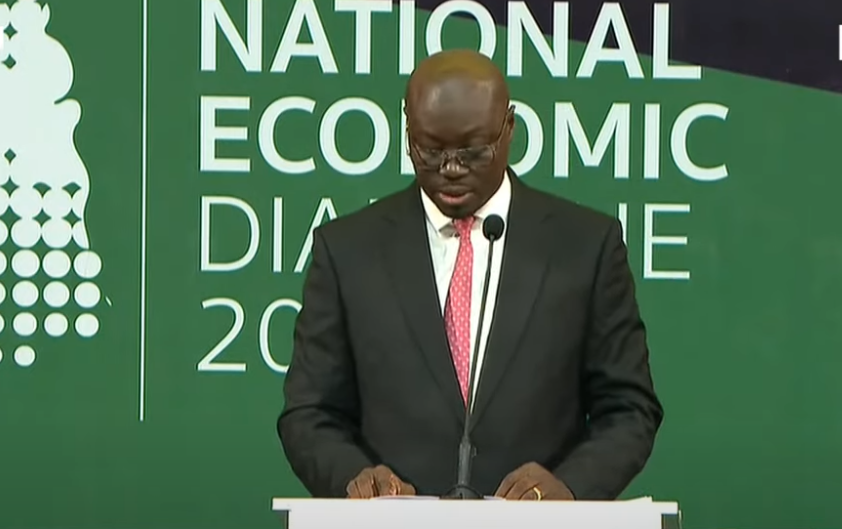
    Finance Minister Dr. Cassiel Ato Forson has disclosed that the Ghanaian cedi has depreciated by 5.3% against the US dollar as of March 14, 2025.

    He made this known while addressing Parliament on Tuesday, assuring lawmakers that the government is taking decisive steps to stabilize the local currency.

    Dr. Ato Forson acknowledged the persistent depreciation of the cedi but pointed out that its performance had slightly improved compared to the same period in 2024, when it had depreciated by 5.7%.

    “Mr. Speaker, as of 14th March 2025, the cedi had depreciated by 5.3% against the US dollar, compared to 5.7% over the same period in 2024,. This shows a reduction in the depreciation by 0.4%” he stated.

    The minister attributed the depreciation to tight foreign exchange liquidity, high demand for forex from the energy sector, and increased commercial transactions. Despite these pressures, he noted that the cedi had shown signs of stability since February 19, 2025, largely due to interventions by the Bank of Ghana (BoG).

    “Mr. Speaker, the cedi has, however, witnessed stability since 19th February, on the back of central bank forex interventions,” he emphasized.

    To further strengthen the currency and curb depreciation, Dr. Ato Forson outlined government strategies, including increasing foreign exchange reserves, enhancing domestic production through import substitution, and effectively managing external debt obligations.

    He assured Parliament that these initiatives would complement the Bank of Ghana’s monetary policies, helping to stabilize the economy, reduce exchange rate volatility, and boost investor confidence.

    Meanwhile, the Bank of Ghana’s latest data shows that in January 2025, the cedi depreciated by 2.4% against the US dollar, a sharper decline compared to the 1.3% recorded in January 2024. By the end of January, the local currency was trading at GH¢15.06 per US dollar on the interbank market.

    The cedi also weakened by 3.0% against the euro, trading at GH¢15.69, and depreciated 0.8% against the British pound, reaching GH¢18.55.

    The Finance Minister has set a target to reduce the cedi’s annual depreciation rate to 8%, as part of broader efforts to restore economic stability.

  • BoG records 2.4% cedi depreciation to dollar in January

    BoG records 2.4% cedi depreciation to dollar in January

    The Ghana cedi depreciated by 2.4% against the US dollar in January 2025, marking a sharper decline compared to the 1.3% recorded during the same period last year, the Bank of Ghana has revealed.

    By the end of January, the local currency was trading at GH¢15.06 to the US dollar on the interbank market. Similarly, the cedi weakened by 3.0% against the euro, selling at GH¢15.69, and depreciated by 0.8% against the British pound, which traded at GH¢18.55.

    In the retail forex market, the cedi’s performance was even more concerning. As of January 17, 2025, the local currency had depreciated by 2.94% to the dollar, bringing its year-to-date loss to 3.87%.

    This decline was driven by heightened demand from the manufacturing and energy sectors, coupled with the Bank of Ghana’s auction of its first US$20 million to Bulk Oil Distribution Companies (BDCs).

    The cedi’s depreciation to the dollar in January was its steepest decline since the start of the year, with the currency trading at a mid-rate of GH¢16.15 per dollar during the third week of the month.

    Market analysts attribute the cedi’s challenges to sustained pressure from key sectors and the demand for foreign exchange. The Bank of Ghana’s interventions, such as the forex auction, aim to stabilize the currency, but rising demand for dollars continues to exert downward pressure.

  • Dollar sells at GHS16.20 at forex

    Dollar sells at GHS16.20 at forex

    Ghana’s cedi has slightly strengthened against key foreign currencies like the US dollar in some forex bureaus.

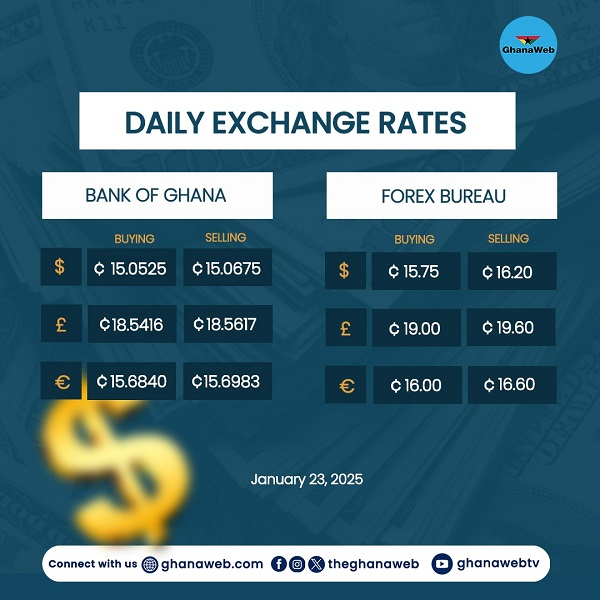
    According to the Bank of Ghana, the official rates show the cedi being bought at GH¢15.05 and sold at GH¢15.06 per dollar.

    The British pound is being bought at GH¢18.54 and sold at GH¢18.56, while the euro is trading at GH¢15.68 for buying and GH¢15.69 for selling.

    However, checks by the media on January 23, 2025 reveal different rates at some forex bureaus.

    The cedi is exchanging at GH¢16.20 per dollar, the pound at GH¢19.60, and the euro at GH¢16.60 in the retail market.

    To help stabilize the cedi, the Bank of Ghana sold over $200 million in the final quarter of 2024. This intervention is part of measures to reduce the pressure on the local currency.

  • Ghanaians are looking up to you to reduce inflation, stabilise the cedi – Mahama to Ato Forson

    Ghanaians are looking up to you to reduce inflation, stabilise the cedi – Mahama to Ato Forson

    President John Dramani Mahama has charged Dr. Cassiel Ato Forson, the newly sworn-in Minister for Finance, with the critical task of addressing Ghana’s economic challenges, including reducing inflation, stabilizing the cedi, and ensuring sustainable debt management.

    Speaking at a swearing-in ceremony held at the Jubilee House, where six ministerial nominees were officially inaugurated, President Mahama emphasized the weight of expectations placed on Dr. Forson to steer the economy towards recovery.

    “The people of Ghana are looking up to you, Dr. Forson, to reduce inflation and make life more affordable. They are looking to you to lower the cost of living, stabilize our currency, and make our debt level sustainable. You must also rein in the deficit so we can achieve macroeconomic stability,” the President urged.

    Ghana’s inflation stands a little over 20 percent and a dollar is worth over GHC14.

    The ceremony also marked the induction of five other ministers tasked with addressing challenges in key sectors. John Jinapor, now Minister for Energy and Green Transition, was tasked with ensuring consistent power supply and managing the energy sector’s debts.

    “Ghanaians are looking for stable and efficient power supply. They are also looking at you to manage the energy sector debt,” Mahama told Jinapor.

    Eric Opoku, the new Minister for Food and Agriculture, was challenged to tackle food security and make food affordable for Ghanaians. “Ghanaians are looking for food security and cheap, affordable food to fill their stomachs,” the President stated.

    In the Roads and Highways Ministry, Governs Kwame Agbodza was reminded of the public’s dissatisfaction with the state of Ghana’s roads. “You have the duty not only to maintain existing roads but to provide new roads for smooth transportation,” Mahama said, describing the portfolio as one of the most challenging.

    For Haruna Iddrisu, who now heads the Education Ministry, the directive was to improve educational quality and prepare Ghanaian youth for the job market. “You must work to ensure quality education and equip our young people with the skills they need to go into the world of work,” Mahama noted.

    Dr. Dominic Ayine, the new Attorney General, was tasked with reforming Ghana’s justice system to promote fairness and transparency. “The Attorney General will be required to reform our justice system to make it fair and transparent to all Ghanaians,” the President added.

    The swearing-in ceremony marked the beginning of what Mahama described as a crucial effort to address the pressing concerns of the nation. The six ministers, he said, bear a significant responsibility to deliver on the administration’s vision for progress and stability.

  • Cedi sells at GHS16.25 to a dollar

    Cedi sells at GHS16.25 to a dollar

    Ghana’s cedi has seen slight improvements against major foreign currencies, including the US dollar, at several forex bureaus.

    According to the Central Bank’s latest update, the cedi is currently valued at GH¢14.94 for buying and GH¢14.95 for selling.

    At the same time, the British Pound is being exchanged at GH¢18.22 for buying and GH¢18.24 for selling, while the Euro is trading at GH¢15.39 for buying and GH¢15.40 for selling.

    A recent check by GhanaWeb Business at 8:00 AM on January 20, 2025, revealed that at some leading forex bureaus, the cedi is being traded at GH¢16.25 to the dollar, GH¢19.70 to the pound, and GH¢16.80 to the Euro.

    In a bid to stabilize the cedi’s value, the Bank of Ghana sold over 200 million dollars in the last quarter of 2024.

  • Dollar selling at GHS17; when are you resigning? – Mahama quizzes Akufo-Addo

    Dollar selling at GHS17; when are you resigning? – Mahama quizzes Akufo-Addo

    Former President John Mahama has challenged President Akufo-Addo to consider resigning over the Ghana cedi’s sharp depreciation.

    Speaking at a rally in Lugni, Wulensi constituency, in the Northern region, Mahama reminded the public that Akufo-Addo, as a candidate, once suggested that the late President John Evans Atta Mills should resign when the cedi was trading at GH2 to the dollar.

    Now, with the cedi nearing GH¢17 to the dollar, Mahama questioned whether Akufo-Addo would follow his own advice and step down under the current economic circumstances.

    “He’s on video, and he said that Kufour’s time, Gh¢1 [equals] one dollar, Mahama and Mills time, two cedis, one dollar, and that if he were Mills and Mahama, he would resign. I’m asking him, today one dollar, 17 cedis, would he resign?” he quizzed.

    The NDC flagbearer asked the president to “tell the people of Ghana when he’s going to resign.”.

    Mr Mahama appealed to the Independent Parliamentary Candidate for the area, Stanley, who broke away from the party, to put his ambitions aside and rejoin the NDC.

    He said that breaking away was only going to affect his political career because the NDC was going to win massively in the Parliamentary and presidential elections.

    Speaking at Bimbilla in the Nanumba North Municipality, former President Mahama opined that members of the international community have been asking questions about Ghana’s ‘deteriorating’ democracy.

    “Anywhere I go, the question people outside in the world ask me is, ‘Ghana, what happened to you?’” he claimed.

    Mr Mahama said Ghana was not only a model of democracy but also a model of economic management but was quick to note that the country’s democracy and economy were in shambles.

    He said, “Everybody looked up to Ghana as the model of democracy; today, we’re a quack model of democracy. Our judiciary is not independent; all our state institutions have been destroyed. People looked up to Ghana as a country that was a model of economic management; today our economy is in shambles.”

    Mr Mahama was later at Ngani in the Yendi constituency on Tuesday evening,, where he addressed a mammoth rally.

  • Cedi likely to stay under pressure this week, with the dollar trading at GHS 16.55

    Cedi likely to stay under pressure this week, with the dollar trading at GHS 16.55

    Ghana cedi is anticipated to face sustained pressure this week due to high foreign exchange demand, despite the country’s progress with the IMF’s Economic Credit Facility program.

    Last week, the cedi continued its decline against key currencies, driven by increased foreign and domestic demand. To help balance demand, the Bank of Ghana accepted US$89.3 million in bids during its 7-day foreign exchange auction.

    However, this measure proved insufficient, with the cedi depreciating by 1.06% over the week, closing at GH¢16.55 per US dollar.

    The currency also fell 0.23% against the pound and 0.28% against the euro within the same period.

    As of Monday, the cedi had slid to GH¢16.65 against the dollar, marking a slight week-on-week decline. Since the start of the year, the cedi has depreciated by over 26% against the dollar, ranking it among the three weakest-performing currencies in Sub-Saharan Africa.

    To further support demand, the Bank of Ghana plans to auction an additional US$20 million for Bulk Oil Distribution Companies (BDCs) this week.

    Although this intervention may ease some demand pressures, analysts anticipate the cedi will continue to experience strain as foreign exchange demand remains elevated.

  • Ghana’s cedi trades at GHS16.50 to dollar

    Ghana’s cedi trades at GHS16.50 to dollar

    Ghana’s currency continues to face challenges, with the cedi persistently losing value against key foreign currencies like the US dollar.

    After experiencing some stability in July, coupled with easing inflationary pressures, the cedi has resumed its downward trend.

    As of October 14, 2024, at 10:00 AM, checks by GhanaWeb Business indicate that the cedi is trading at GH¢16.50 to the dollar, while the pound is priced at GH¢21.38 in various forex bureaus across the country.

    The Euro, meanwhile, is trading at GH¢17.93 on the retail market.

    Recent reports by Bloomberg reveal that the cedi has weakened by 0.1% to trade at GH¢15.67 per dollar, a development expected to exacerbate the economic struggles faced by Ghanaians, particularly in light of businesses’ pricing practices.

    Over the past month, the cedi has depreciated by nearly 1% against the dollar and has lost nearly 24% of its value in 2024 alone, according to Bloomberg.

    Additionally, Ghana’s dollar bonds set to mature in 2032 rose slightly by 0.2 cent to 52.36 cents on the dollar in London trading on September 11, 2024.

  • Cedi depreciated by 21.5% against the dollar as of August 25 – Amin Adam

    Cedi depreciated by 21.5% against the dollar as of August 25 – Amin Adam

    The Ghanaian cedi has depreciated by 21.5% against the US dollar as of August 25, 2024, according to the Minister for Finance, Dr. Mohammed Amin Adam. This development comes despite efforts to stabilize the currency through various economic measures.

    During a press engagement on Thursday, August 29, 2024, Dr. Amin Adam provided an update on the cedi’s performance and other key economic indicators. He highlighted that although the cedi has experienced depreciation, there have been improvements compared to previous years.

    For instance, the depreciation rate moderated to 27.8% in December 2023, down from 54% in November 2022. Additionally, the cedi’s depreciation rate in the first quarter of 2024 was 7.7%, significantly lower than the 22.1% recorded in the same period of 2023.

    “The cedi cumulatively depreciated by 18.6% against the US dollar at the end of June 2024, compared to 22% in the same period in 2023,” Dr. Amin Adam explained.

    He further noted that the month-on-month depreciation rate showed signs of improvement, decreasing from 6.1% in May 2024 to 3.1% in June 2024, and further to 2.1% in July 2024.

    “If this trend continues, I can assure you that our cedi will continue to hold against the major currencies,” he added.

    The Finance Minister attributed the cedi’s relative stability to several factors, including the Bank of Ghana’s monetary policies, strong fiscal consolidation, the Gold for Oil programme, and the Bank of Ghana’s gold for reserves initiative.

    Other contributing measures include the centralised platform for foreign exchange bureaus, implementation of the dynamic cash reserve ratio to absorb excess liquidity, revised regulations on advanced payments of imports, and positive market sentiments following the disbursement of the third tranche of the IMF extended credit facility.

    In addition to the cedi’s performance, Dr. Amin Adam also discussed the country’s inflation trends, particularly in relation to imported goods. Imported inflation, which refers to the increase in prices of goods and services brought into the country due to factors such as exchange rates and global market conditions, declined by 1.9 percentage points to 15.6% in July 2024, down from 17.5% in June 2024.

    This reduction in imported inflation contributed to the overall decline in Ghana’s inflation rate, which dropped to 20.9% in July from 22.8% in June 2024.

    The Finance Minister noted that the decline in food and non-food prices played a significant role in the overall inflation decrease. Food inflation fell by 2.5 percentage points to 21.5% in July, while non-food inflation declined by 1.1 percentage points to 20.5% during the same period.

  • Cedi depreciation continues; a dollar goes for GHC16

    Cedi depreciation continues; a dollar goes for GHC16

    The Ghana Cedi has continued its downward trajectory, with the value of the Cedi now exceeding GH¢16 against the US Dollar in the retail currency market.

    In banks and currency bureaus across Accra, the dollar is currently being sold for between GH¢15.95 and GH¢16.20.

    This depreciation follows recent adjustments in the foreign exchange market, as the Bank of Ghana’s dollar auction limits were relaxed by the International Monetary Fund (IMF).

    The IMF’s decision came as part of a broader US$3 billion economic recovery program aimed at bolstering Ghana’s reserves and stabilizing the economy.

    According to the Bank of Ghana’s July 2024 Summary of Financial and Economic Data, the Cedi’s value against the US dollar on the interbank foreign exchange market fell by approximately 19.6% as of July 2024. While this rate of depreciation shows some improvement from earlier periods, it still highlights ongoing volatility in Ghana’s currency market.

    The relaxation of the Bank of Ghana’s auction limits is intended to provide more flexibility in managing the country’s foreign exchange reserves. However, the impact on the Cedi’s stability remains a significant concern for both individuals and businesses engaged in international trade or holding foreign assets.

  • Cedi now sells at GHS16 per dollar at forex

    Cedi now sells at GHS16 per dollar at forex

    Ghana’s currency continues to weaken against major international currencies.

    The cedi is approaching the GH¢16 level, currently trading at GH¢15.99 at various forex bureaus nationwide.

    As of Friday, August 23, 2024, the media reported that the cedi was exchanging at GH¢15.98 per US dollar.

    On Monday, August 26, 2024, the British Pound exceeded GH¢21, with the rate standing at GH¢21.07.

    For example, the local currency is trading at GH¢17.86 per Euro at leading forex bureaus.

    Recently, the international news portal Bloomberg listed the Ghanaian cedi as the fourth-worst performing currency out of 150 major currencies tracked worldwide.

    Although the cedi has depreciated by nearly 23% against the US dollar, it has shown some degree of relative stability, according to a Bloomberg survey.

    The cedi’s decline is largely attributed to heightened demand for the US dollar to purchase petroleum products, pharmaceuticals, and other imports.

  • Cedi falls to GHS15.97 per dollar amidst continued depreciation

    Cedi falls to GHS15.97 per dollar amidst continued depreciation

    Ghana’s local currency, the cedi, has recently seen a sharper depreciation against major trading currencies, particularly the US dollar.

    As of Tuesday, August 20, 2024, at 11:00 AM, checks by GhanaWeb Business revealed that the cedi is trading at GH¢15.97 to $1 at several key forex bureaus in Accra.

    This decline is also noticeable against other currencies like the British Pound and the Euro. The cedi is currently valued at GH¢20.74 to £1 and GH¢17.68 to €1 at major forex bureaus nationwide.

    Bloomberg recently ranked the Ghanaian cedi as the fourth-worst performing currency out of 150 top currencies monitored globally.

    Although the cedi has lost nearly 23% of its value against the US dollar, it has shown some relative stability this month [August], according to a Bloomberg survey.

    The cedi’s performance has been largely linked to the increased demand for US dollars to import petroleum products, pharmaceuticals, and other goods.

  • Dollar trading at GHS15.92 at forex as of Aug 16

    The value of Ghana’s local currency, the cedi, continues to fall against major trading currencies, notably the US dollar.

    As of 10:00 AM on Friday, August 16, 2024, the cedi is being exchanged at GH¢15.92 to $1 at prominent forex bureaus in Accra.

    This depreciation is also observed with other major currencies, such as the British Pound and the Euro. Currently, the cedi is valued at GH¢20.50 to £1 and GH¢17.52 to €1 at leading forex bureaus nationwide.

    According to Bloomberg, the Ghanaian cedi is ranked as the fourth-worst performing currency out of 150 tracked globally.

    Despite a nearly 23% drop in value against the US dollar, the cedi has shown some signs of stability this month, as reported by Bloomberg.

    This decline in the cedi’s value is attributed to the increased demand for US dollars needed for purchasing petroleum products, pharmaceuticals, and other imports.

  • Ghana Cedi continues depreciation spree as $1 hits GHC16

    Ghana Cedi continues depreciation spree as $1 hits GHC16

    The Ghana cedi experienced significant depreciation last week due to increased corporate demand pressures, after maintaining stability the previous week,

    The local currency fell by 1.48% week-on-week against the US dollar, trading at a bid-offer rate of GH¢15.75/16.00 on the retail market. The cedi also depreciated by 2.80% and 2.18% against the British pound and the euro, respectively.

    In June 2024, Ghana’s refined oil imports surged to US$428.3 million from US$422.6 million in May, driven by heightened demand from oil importers.

    The Central Bank intervened by selling US$40 million to oil importers through the Bulk Oil Distributors Foreign Exchange (FX) auction. Despite this, the persistent demand from oil importers contributed to a 4.46% month-on-month depreciation of the cedi against the US dollar in June 2024.

    Analysts view the higher oil import bill and the resulting increase in FX demand as a downside risk to net foreign reserves, anticipating further pressure on the cedi in the near term. Consequently, they expect the local currency to continue weakening this week as corporate demand pressures escalate.

    Currently, the cedi is trading at GH¢15.88 to the US dollar on the retail market.

    According to the Bank of Ghana, the cedi has depreciated by approximately 19.6% against the US dollar on the interbank forex market as of July 2024, compared to a 21% loss on the retail market.

    The Central Bank’s July 2024 Summary of Financial and Economic Data indicates that the cedi lost 7.7% against the dollar in March 2024, 10.5% in April 2024, 15.9% in June 2024, and 18.6% in July 2024.

  • BoG data shows cedi lost 19.5% value against dollar as of July

    BoG data shows cedi lost 19.5% value against dollar as of July

    As of July 2024, the Ghana cedi has experienced a 19.6% depreciation against the US dollar on the interbank forex market, according to the latest report from the Bank of Ghana (BoG).

    This decline is slightly less severe compared to the approximately 21% drop observed on the retail market.

    The Central Bank’s July 2024 Summary of Financial and Economic Data reveals a pattern of depreciation throughout the year. The cedi weakened by 7.7% in March 2024, followed by a 10.5% drop in April. The losses continued with a 15.9% depreciation in June and an 18.6% decline in July.

    On the retail market, the cedi is currently trading at an average of GH¢15.60 per US dollar, while the Bank of Ghana’s rate is GH¢14.78 per dollar.

    In addition to its decline against the dollar, the cedi has depreciated by 20.8% against the British pound, with the current rate at GH¢19.10. It has also lost 18.4% in value against the euro, trading at GH¢16.09.

    Despite these challenges, the cedi showed signs of stability against the dollar last week, buoyed by increased corporate demand and market speculation about a potential rate cut by the US Federal Reserve.

    This led to a 0.29% weekly gain, with the cedi closing at a mid-rate of GH¢15.64 per dollar on the retail market. This marks the second consecutive week of gains for the cedi against the US dollar.

  • A dollar sells at GHC15.95 as cedi continues to stabilise

    A dollar sells at GHC15.95 as cedi continues to stabilise

    The Ghana cedi is anticipated to maintain stability against the US dollar this week, bolstered by enhanced foreign exchange (FX) liquidity and a slowdown in demand.

    This development follows the recent inflow of $360 million from the International Monetary Fund (IMF), which has significantly improved FX liquidity and tempered corporate demand.

    Last week, the cedi demonstrated resilience against the US dollar, supported by favorable market sentiments as foreign exchange demand eased.

    This was largely attributed to the IMF board’s approval and subsequent release of the third tranche of $360 million following the second review of Ghana’s 36-month Extended Credit Facility.

    Additionally, the Bank of Ghana has actively participated in the market, selling approximately $19 million on the spot market to further bolster foreign exchange liquidity. These measures have contributed to the stabilization of the local currency.

    Over the past week, the cedi recorded a modest decline of 0.30% against the pound and 0.25% against the euro, following the successful UK election results, which had an impact on global currency movements.

    The cedi has faced significant challenges in recent months, grappling with persistent corporate demand, leading to its depreciation. As a result, the local currency concluded the first half of 2024 with a 22.45% loss against the dollar on the retail market.

    Currently, the exchange rate stands at GH¢15.95 to one US dollar at forex bureaus. Since the beginning of the year, the cedi has depreciated by 22.58% against the dollar.

  • Cedi depreciation: Will you give businessmen additional money to buy dollar? – Issac Adongo quizzes Finance Minister

    Cedi depreciation: Will you give businessmen additional money to buy dollar? – Issac Adongo quizzes Finance Minister

    Ranking Member on the Finance Committee of Parliament, Isaac Adongo, has responded emphatically to criticisms from Finance Minister Dr. Amin Adam regarding his recent comments on the dollar exchange rate.

    Adongo clarified that his advice to businesses regarding purchasing dollars was aimed at providing truthful information to Ghanaians.

    Dr. Amin Adam had previously criticized Adongo during a joint press conference with officials from the Bank of Ghana and the IMF.

    The Finance Minister expressed concerns over speculative actions affecting the stability of the cedi and cautioned against actions that could exacerbate currency challenges.

    In a counter-statement, Adongo disputed the characterization of his advice as speculative, asserting that his remarks were grounded in factual observations.

    He defended his stance during an interview with Citi FM, reiterating that he does not engage in speculation but rather offers honest and accurate information.

    “What did I say that is not true?” Adongo questioned, pointing out the fluctuation in the dollar exchange rate following recent economic measures. He emphasized that his advice aimed to guide businesses in making informed decisions amid economic uncertainties.

    “So, if you needed dollars to do your business, by all means, you should go ahead and buy them. How is that unpatriotic?” Adongo challenged, highlighting the practical considerations for businesses in managing their financial operations.

    Adongo further pressed the Finance Minister with a rhetorical question: “Will you give businessmen additional money to buy dollar when the rate increases?”

    He underscored the practical impact of exchange rate fluctuations on business operations and questioned the adequacy of governmental measures in supporting businesses amidst economic challenges.

  • What did I say that is not true? Where is the dollar – Adongo asks Finance Minister

    What did I say that is not true? Where is the dollar – Adongo asks Finance Minister

    Ranking Member on the Finance Committee of Parliament, Isaac Adongo, has responded emphatically to criticisms from Finance Minister Dr. Amin Adam regarding his recent comments on the dollar exchange rate.

    Adongo clarified that his advice to businesses regarding purchasing dollars was aimed at providing truthful information to Ghanaians.

    Dr. Amin Adam had previously criticized Adongo during a joint press conference with officials from the Bank of Ghana and the IMF.

    The Finance Minister expressed concerns over speculative actions affecting the stability of the cedi and cautioned against actions that could exacerbate currency challenges.

    In a counter-statement, Adongo disputed the characterization of his advice as speculative, asserting that his remarks were grounded in factual observations.

    He defended his stance during an interview with Citi FM, reiterating that he does not engage in speculation but rather offers honest and accurate information.

    “What did I say that is not true?” Adongo questioned, pointing out the fluctuation in the dollar exchange rate following recent economic measures. He emphasized that his advice aimed to guide businesses in making informed decisions amid economic uncertainties.

    “So, if you needed dollars to do your business, by all means, you should go ahead and buy them. How is that unpatriotic?” Adongo challenged, highlighting the practical considerations for businesses in managing their financial operations.

    Adongo further pressed the Finance Minister with a rhetorical question: “Will you give businessmen additional money to buy dollar when the rate increases?”

    He underscored the practical impact of exchange rate fluctuations on business operations and questioned the adequacy of governmental measures in supporting businesses amidst economic challenges.

  • Fuel prices to increase by 2.17% from July 1 – COPEC

    Fuel prices to increase by 2.17% from July 1 – COPEC

    Chamber for Petroleum Consumers (COPEC) has projected an increase in fuel prices for the first pricing window of July 2024, citing factors such as a recent drop in the Dollar to Cedi exchange rate from an average of $1¢14.4788 to $1¢15.2779 (-1.89%).

    The organization forecasts that petrol’s retail price will rise by approximately 2.17%, from the current mean pump price of GH¢14.17 per litre to GH¢15.20 per litre.

    Similarly, diesel is expected to climb to GH¢15.21 per litre, while LPG prices are anticipated to range between GH¢13.24 and GH¢14.64 per kg.

    COPEC highlighted the importance of government actions to reduce taxes on LPG or introduce subsidies to enhance its accessibility and promote nationwide usage, thereby aiding environmental preservation by reducing reliance on firewood.

    Additionally, COPEC urged the government to prioritize efforts to revive the Tema Oil Refinery (TOR) to reduce or eliminate the need for importing finished petroleum products, which often results in fuel contamination issues.

  • Record low for Ghana’s cedi due to surge in dollar demand for imports

    Record low for Ghana’s cedi due to surge in dollar demand for imports

    Ghana’s cedi fell to a record low as businesses increased their demand for dollars to import fuel, pharmaceuticals, and other fast-moving consumer goods.

    The currency of the world’s second-largest cocoa producer depreciated by 0.2% to 14.9335 per dollar by the end of trading in Accra, the lowest level since at least 1994 when Bloomberg began recording the data.

    Since the start of the year, the cedi has declined by 20% against the US dollar, ranking it as the fourth-worst performer among approximately 150 currencies tracked by Bloomberg globally, following the Egyptian Pound, Nigerian Naira, and the Lebanese Pound.

    Ghana’s gross international reserves increased to $6.6 billion in April, the highest in over 19 months, according to Bloomberg data.

    The central bank has been actively managing these reserves to ensure market stability, including direct interventions to meet the foreign exchange needs of specific companies, thus easing the pressure on commercial banks.

  • Cedi to reach GHS15.91 per dollar by end of 2024 – IC Securities

    Cedi to reach GHS15.91 per dollar by end of 2024 – IC Securities

    Research firm IC Securities has forecasted that the Ghanaian Cedi will depreciate to GH¢15.91 against the US dollar by year-end.

    IC Securities attributed the revision from their initial projection of GH¢13.2 to the current macroeconomic conditions.

    The firm observed that the Bank of Ghana’s modification of the Cash Reserve Requirement (CRR) had minimal effect on decreasing local currency liquidity, as banks shifted their maturing securities into CRR holdings.

    IC Securities also mentioned that the settlement of contractor arrears led to an increased supply of Cedis in the forex market, exacerbating the pressure on the currency.

    The firm remarked, “Following the unexpected cut in the policy rate by the Bank of Ghana in January 2024, we indicated our deferred inclination to raise our forecast for the US dollar-Ghana cedi FX (foreign exchange) rate as we foresaw strong selling pressure on the local currency. Our decision to delay the revision of our forecast until mid-year was based on expected program-related inflows and the final tranche of the cocoa syndicated loan for the 2023/24 season.”

    “While these inflows could trigger a short-term retracement, we anticipate continued hedging by domestic investors as we approach the December elections, which will likely offset any inflow-induced appreciation. Consequently, we have raised our forecast for the end-2024 US$/GHS rate to GH¢15.91/US$1,” the research firm explained.

    Presently, the local currency, the Cedi, is trading at GH¢15.60 to the dollar at various forex bureaus.

    IC Securities indicated that around $2.3 billion is anticipated to flow into the country in the latter part of 2024.

  • Cedi will stabilize, don’t rush in buying dollars – Afenyo-Markin to business community

    Cedi will stabilize, don’t rush in buying dollars – Afenyo-Markin to business community

    The Majority Leader in Parliament, Alexander Kwamina Afenyo-Markin, has advised the Ghanaian business community against hastily converting their cedis to US dollars.

    Addressing the media in Parliament, Afenyo-Markin labeled negative remarks about Ghana’s economy as “unreasonable.”

    “If a politician who does not understand business comes out just for politics, the market will respond. It is a result of, I wouldn’t say reckless, but unreasonable comments that seem to be affecting the business environment,” Afenyo-Markin said.

    He recounted how the dollar rose to GH¢15.5 in 2022, but through the efforts of the then Minister of Finance, it fell to as low as GH¢8.00.

    He urged the Ghanaian business community to ignore the pessimism being spread and expressed confidence that the Cedi’s situation will improve.

    “I would have to urge businessmen not to change their cedis into dollars because the rate will be coming down. When it happened in 2022, a lot of people lost money because they were responding to the pessimism of the NDC at that time, believing that the Ghanaian economy was collapsing and there was no future for the economy, and rushed to change their dollars at the rate of 14 and 15 Ghana cedis.

    “When the dollar rate dropped to 8 Ghana cedis, here we were; they had lost huge sums of money. So, I would encourage Ghanaian businessmen individually not to rush to respond to the pessimism. They should be optimistic,” the MP advised.

    He further added that investing in Treasury bills is a better option than buying US dollars, as the government is working diligently to lower the cedi-to-dollar rate.

  • How Bank of Ghana spent GHS8.3bn control interest rate but failed

    How Bank of Ghana spent GHS8.3bn control interest rate but failed

    The Bank of Ghana (BoG) is still struggling to convince Ghanaians o the costs associated with its open market operations, which significantly contributed to the Bank’s loss position in the audited 2023 financial statements.

    According to the Central Bank’s annual report and financial statements, the cost of open market operations was GH¢8.3 billion, leading to an overall loss of GH¢10.5 billion for the 2023 financial year.

    Open Market Operations (OMO) is a central bank’s tool for influencing the money supply and managing interest rates in an economy.

    Despite this huge expenses, leading rates in Ghana still is outrageously high running between 35% to 50%, one of the highest on the Africa continent.

    Director of Communications at the BoG, Mr. Bernard Otabil, explained that the loss does not reflect a loss of policy effectiveness.

    “First, central banks pursue national welfare and not profits”, Otabil said, adding: “From December 2022 to December 2023, headline inflation decreased from 54.1 percent to 23.2 percent and that has come with a huge cost. However, the long-term benefits of low and stable inflation always outweigh the costs incurred in the short term to bring it down”.

    “Compared to the GH¢1.7 billion cost of open market operations in 2022, the almost fivefold increase in mopping up liquidity from the economy to reduce inflation is significant”, Mr Otabil explained.

    He continued, “Central banks can make losses, get into negative accounting equity and function completely successfully. Therefore, central banks are not expected to compromise policy objectives to report handsome profit.”

    Mr Otabil noted that compared to the GH¢1.7 billion cost of open market operations in 2022, the nearly fivefold increase in efforts to reduce inflation by mopping up liquidity from the economy is substantial.

    “Our strong actions to control inflation reinforce our credibility and commitment to our mission. Showing that we can effectively manage inflation, boosts confidence both domestically and internationally. This trust is vital for attracting foreign investment and maintaining favourable trade conditions,” the BoG Director of Communications noted.

  • A dollar goes for GHS15.00 at forex, GHS19.70 for £1 at major forex bureaus

    A dollar goes for GHS15.00 at forex, GHS19.70 for £1 at major forex bureaus

    Today’s Interbank forex rates from the Bank of Ghana, dated May 27, 2024, indicate that the Ghana Cedi is currently trading against the dollar at a buying price of 13.9480 and a selling price of 13.9620.

    At a forex bureau in Accra, the dollar is being purchased at a rate of 14.80 and sold at 15.00.

    Against the Pound Sterling, the Cedi’s current rates stand at a buying price of 17.7712 and a selling price of 17.7904.

    At a forex bureau in Accra, the pound sterling is being bought at 19.00 and sold at 19.70.

    The Euro’s trading figures show a buying price of 15.1360 and a selling price of 15.1498.

    At a forex bureau in Accra, the Euro is purchased at 16.20 and sold at 16.80.

    The South African Rand’s current rates indicate a buying price of 0.7571 and a selling price of 0.7578.

    At a forex bureau in Accra, the South African Rand is bought at 0.40 and sold at 1.20.

    Regarding the Nigerian Naira, it’s trading at a buying price of 105.7191 and a selling price of 105.7915.

    At a forex bureau in Accra, the Nigerian Naira is bought at 9.00 Naira per 1 Cedi and sold at 13.00 Naira per 1 Cedi.

    For the CFA, the current rates show a buying price of 43.2981 and a selling price of 43.3375.

    At a forex bureau in Accra, the CFA is bought at 23.00 CFA per 1 Cedi and sold at 25.50 CFA per 1 Cedi.

    Note that these rates may differ at a forex bureau near you. Our forex bureau rates are provided by Afriswap Bureau De Change in Osu, Accra.

    Our forex bureau rates are provided by Afriswap Bureau De Change in Osu, Accra.

  • Cedi has experienced a 14.2% depreciation in 2024 – Amin Adam

    Cedi has experienced a 14.2% depreciation in 2024 – Amin Adam

    Finance Minister, Dr. Mohammed Amin Adam has indicated that the depreciation of the Cedi has been considerably stabilized from November 2022 to December 2023 and is showing signs of modest appreciation against the Dollar in 2024.

    During his monthly economic briefing, the minister highlighted that the exchange rate has seen significant stabilization, with the depreciation of the Cedi against the US Dollar reducing by half from 54.2% at the end of November 2022 to 27.8% at the end of December 2023.

    He also mentioned that the Cedi is expected to strengthen in the medium term following the completion of the domestic debt exchange program.

    “But for recent pressures we are seeing on exchange rate movements, the exchange rate has been largely stabilised with the depreciation of the cedi against the US Dollar halving from 54.2% at the end of Nov 2022 to 27.8% at the end of Dec 2023.

    “The Cedi’s stability has continued into 2024, with a cumulative depreciation of 14.2% as of 20th May 2024, compared to 20.7% recorded in the same period in 2023. We expect the cedi’s stability to improve into the medium-term as we complete debt restructuring, make more progress on fiscal consolidation, and improve our reserves over the medium-term.”

    He further addressed the current pressures in the Cedi which he attributed to the “strengthening of the US Dollar against major trading currencies”

    “The recent pressures we are observing on the cedi is largely on the back of the strengthening of the US Dollar against major trading currencies, seasonal forex demand including elevated demand from corporate institutions, payment to contractors and to IPPs, high Cedi liquidity and speculation.”

    The Finance Minister outlined several measures, including enhancing revenue mobilization and securing World Bank loans, among others, that the government is undertaking to strengthen the Cedi against major trading currencies.

    The depreciation of the Cedi has prompted calls from various trade groups, including GUTA and Organized Labour, for urgent measures to address the decline.

  • Dollar’s strength, seasonal demand for forex, payment of contractors: Gov’t’s reasons for cedi depreciation

    Dollar’s strength, seasonal demand for forex, payment of contractors: Gov’t’s reasons for cedi depreciation

    The government has revealed why the value of the Ghana cedi has been weakening in recent times.

    Engaging the press today, Minister for Finance, Dr. Mohammed Amin Adam, provided three reasons behind this unsatisfactory development that poses a threat to businesses in the country.

    He noted that the strengthening of the dollar on the international market, seasonal demand for forex and the recent payment of contractors worth over GHC40 billion has caused the value of the cedi to fall.

    The Ghanaian cedi has depreciated by 14.2% as of May 2024, according to Finance Minister Dr. Mohammed Awal Amin.

    Despite this depreciation, Dr. Amin emphasized that the currency remains strong during an engagement with the media on the current state of the media on Friday.

    Dr. Amin highlighted that the cedi’s depreciation against the US dollar has decreased from 54% in November 2022 to 27.8% by the end of December 2023.

    He noted that the cedi’s stability has persisted into 2024, with the cumulative depreciation reaching 14.2% as of May 20, 2024, compared to 20.7% recorded in the same period in 2023.

    There have been numerous concerns from stakeholders in the financial sector over the weakening of the local currency.

    The Chamber of Petroleum Consumers (COPEC) has alerted the public to anticipate higher fuel prices at the pumps in the coming weeks due to the depreciation of the cedi.
    This warning follows increases in fuel prices by some oil marketing companies, despite earlier projections that prices would decline from mid-May. The companies have attributed the price hikes to uncertainties in the exchange rate market.

    As of May 22, at a Forex bureau located in Accra, the dollar was purchased at a rate of GH15.00 and sold at GH15.30.

  • Video of Cheddar paying barber who flew from Ghana to US to trim his hair pops up

    Video of Cheddar paying barber who flew from Ghana to US to trim his hair pops up

    As Ghana readies itself for the December polls, netizens continue to bring up controversial videos of the presidential aspirants.

    An old video of the leader of The New Force, Nana Kwame Bediako, also known as Cheddar has popped up.

    This video shows the presidential aspirant paying a Ghanaian barber who flew from Ghana to trim his hair in the United States.

    In the footage, he hands over a number of 100 greenback notes to the barber he is impressed with.

    A pleased Cheddar could not stop admiring his good looks via the mirror he held.

  • Cedi depreciated by 14.2% as of May 2024

    Cedi depreciated by 14.2% as of May 2024

    The Ghanaian cedi has depreciated by 14.2% as of May 2024, according to Finance Minister Dr. Mohammed Amin Adam.

    Despite this depreciation, Dr. Amin emphasized that the currency remains strong during an engagement with the media on the current state of the media on Friday.

    Dr. Amin highlighted that the cedi’s depreciation against the US dollar has decreased from 54% in November 2022 to 27.8% by the end of December 2023.

    He noted that the cedi’s stability has persisted into 2024, with the cumulative depreciation reaching 14.2% as of May 20, 2024, compared to 20.7% recorded in the same period in 2023.

    The minister attributed this stability to various government initiatives, including the Oil for Gold programme, the Bank of Ghana’s Gold for Reserve programme, and the Cocoa syndicated funds.

    He expressed confidence that the cedi will continue to show resilience against external pressures.

    There have been numerous concerns from stakeholders in the financial sector over the weakening of the local currency.

    The Chamber of Petroleum Consumers (COPEC) has alerted the public to anticipate higher fuel prices at the pumps in the coming weeks due to the depreciation of the cedi.

    This warning follows increases in fuel prices by some oil marketing companies, despite earlier projections that prices would decline from mid-May. The companies have attributed the price hikes to uncertainties in the exchange rate market.

    As of May 22, at a Forex bureau located in Accra, the dollar was purchased at a rate of GH15.00 and sold at GH15.30.

  • Ghana cedi going for GHS15.30 to a $1

    Ghana cedi going for GHS15.30 to a $1

    Today, May 22, 2024, the Interbank forex rates provided by the Bank of Ghana reveal that the Ghana Cedi is currently valued against the dollar at a buying rate of GH13.8687 and a selling rate of GH13.8825.

    At a forex bureau located in Accra, the dollar is being purchased at a rate of GH15.00 and sold at GH15.30.

    Against the Pound Sterling, the Cedi stands at a buying rate of GH17.6437 and a selling rate of GH17.6628.

    In another forex bureau in Accra, the pound sterling is bought at GH18.50 and sold at GH19.20.

    For the Euro, the current rates show a buying price of GH15.0608 and a selling price of GH15.0745.

    At a different forex bureau in Accra, the Euro is acquired at GH15.85 and sold at GH16.45.

    As for the South African Rand, it is trading at a buying rate of GH0.7679 and a selling rate of GH0.7687.

    In yet another forex bureau in Accra, the South African Rand is bought at GH0.40 and sold at GH1.20.

    The Nigerian Naira is valued at a buying rate of GH105.0239 and a selling rate of GH108.5791.

    At a forex bureau in Accra, the Nigerian Naira is exchanged at 9.00 Naira per 1 Cedi for buying and 13.00 Naira per 1 Cedi for selling.

    Lastly, the CFA Franc is priced at a buying rate of 43.5143 and a selling rate of 43.5539.

    In a different forex bureau in Accra, the CFA Franc is acquired at 23.00 CFA per 1 Cedi for buying and sold at 25.50 CFA per 1 Cedi.

    Note that these rates may differ at a forex bureau near you. Our forex bureau rates are provided by Afriswap Bureau De Change in Osu, Accra.

    Our forex bureau rates are provided by Afriswap Bureau De Change in Osu, Accra.

  • A dollar would have hit GHS25 if NDC were in power – NPP

    A dollar would have hit GHS25 if NDC were in power – NPP

    The Communication Director for Dr. Mahamudu Bawumia, Dennis Miracles Aboagye, has claimed that Ghanaians would be purchasing a dollar at GH₵25 if the National Democratic Congress (NDC) were in power.

    This assertion follows the consistent rise of the cedi-to-dollar exchange rate, which is currently above GH₵14 per US dollar. Several financial analysts have projected that the cedi will reach between GH₵16 and GH₵18 to the dollar.

    Banking Consultant Dr. Richmond Atuahene, speaking on GHOne TV, mentioned that while Bloomberg and others predict the cedi will hit GH₵16 by the end of the year, he believes it will go even higher, suggesting Ghanaians should prepare to trade at GH₵18 to the dollar.

    However, in an interview on Starr Chat with Bola Ray, Aboagye defended the governing New Patriotic Party (NPP)’s handling of the cedi-to-dollar exchange rate, considering the various challenges they have faced.

    “I am very sure that if in August 2014 the dollar was going that fast, if the same managers were here, we would be buying the dollar at GH₵25. Can you tell me what happened in 2014 for the cedi to move from 1.2 to 3.9 cedis to the dollar?

    “When you are running an organization, you run it with conditions, and the conditions will determine where you are moving your organization. In Ghana today, given the challenges we face in the global economy, if these managers were in charge between 2020 and now, we would be buying dollars at GH₵25 or GH₵30. Because in 2014, we had no reason to have the dollar where it was,” Mr. Aboagye stated.

    He continued: “I can tell you what COVID-19 has done to us; I can tell you what the Ukraine-Russia war has done to us. I can tell you what the challenges in Asia have done to us. Can you tell me what was happening in 2014? Mention just one thing.”

  • Govt will take measures to prevent cedi from exceeding GHS18 to a dollar – Financial Analyst

    Currency Analyst, Collins Appiah, asserts that the government will not passively watch as the Ghanaian cedi reaches GH¢18 against the US dollar.

    Various financial experts have forecasted that the Ghanaian cedi could range from GH¢16 to GH¢18 against the dollar.

    Banking Consultant Dr. Richmond Atuahene, in an interview on GHOne TV, disagreed with Bloomberg’s prediction of the cedi reaching GH¢16 to the dollar, suggesting it could be even higher.

    He suggested that Ghanaians should brace themselves for the cedi hitting GH¢18 against the US dollar.

    However, during an appearance on Morning Starr with Francis Abban, Mr Appiah expressed skepticism, stating, “I am not sure the government will allow that to happen, they will not allow because as an analyst, trust me, we are in an election year. The government will want to do whatever they can to maintain some level of stability to able to go into the elections.

    “Yes, when it get to this year, you also get to a lot of frustrations. But if you give yourself within six months. They will still try and do something to seem okay for us to get to the elections,” Mr. Appiah stated.

  • Dollar could be sold at GHC20 by end of 2024 – Kofi Amoabeng

    Dollar could be sold at GHC20 by end of 2024 – Kofi Amoabeng

    The founder of the defunct UT Bank and UT Holdings, Capt. Rtd. Prince Kofi Amoabeng, has forecasted that the local currency, the cedi, could further depreciate, potentially reaching GHȼ20 to a dollar by the end of the year.

    He attributed this to the historical trend of the dollar strengthening during election years.

    In an interview on Joy News’ AM Show on Thursday, May 16, he expressed his concerns, stating, “My fear is that if the cedi to the dollar is now GHȼ15 and we are just about getting to an election; the records are there that every time there’s an election, there is a huge devaluation of the cedi.”

    “So I wouldn’t be surprised if the cedi by the end of the year is hovering around GHȼ 18 or 20.”

    He highlighted the country’s over-reliance on imports and the decline in exports as major contributing factors to the challenges facing the cedi.
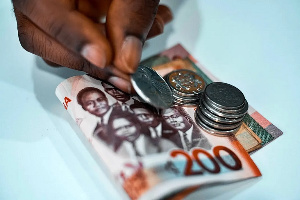
    According to him, Ghana does not export adequate resources, and even cocoa exports, which used to be significant, are now decreasing.

    He argued that countries with robust export economies experience strong growth, while those heavily reliant on imports face economic challenges.

    Mr. Amoabeng emphasised the need for better infrastructure, strategic planning, and holistic approaches to address these issues. He also pointed out that agricultural workers are leaving the sector due to insufficient support.

     “So, unless we look into ourselves and take pragmatic action to reduce…initially it should be harsh, but certain things shouldn’t even be imported at all.

    “So why is it that we’ve been forced to import things that we cannot pay for, I don’t get it.”

    Mr. Amoabeng suggested focusing on local rice production instead of importing foreign rice to reduce the country’s import cover.

    Analysts foresee a continued weakening trajectory of the local currency as the foreign exchange demand-supply disparity remains substantial.

    However, they anticipate improved liquidity conditions towards the end of the second quarter of 2024 after the International Monetary Fund (IMF) board approves the second review of Ghana’s program. This approval is expected to lead to a tranche disbursement of US$360 million under the IMF program.

  • Address fall of cedi against the dollar – GUTA tells gov’t

    Address fall of cedi against the dollar – GUTA tells gov’t

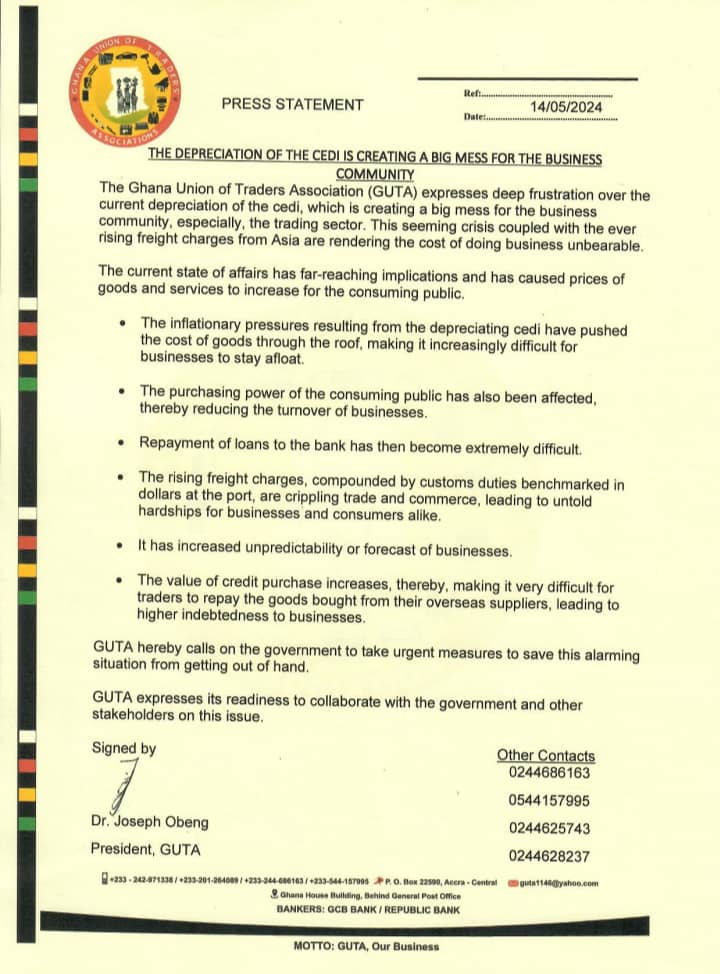
    The Ghana Union of Traders Association (GUTA) has urged the government to take urgent steps to boost the value of the cedi against major trading currencies, particularly the dollar.

    In a statement dated May 14, GUTA expressed its willingness to collaborate with the government and other stakeholders to address this issue.

    The association emphasized the detrimental impact of the cedi’s depreciation on the business community, especially the trading sector, describing the current situation as a crisis.

    GUTA highlighted that the depreciating cedi, along with rising freight charges from Asia, is significantly increasing the cost of doing business. This situation has led to inflationary pressures, resulting in soaring prices of goods and making it increasingly difficult for businesses to remain profitable.

    Moreover, the weakening cedi has reduced consumers’ purchasing power, leading to a decline in business turnover. The association noted that repaying bank loans has become exceedingly challenging under these economic conditions.

    GUTA also raised concerns about the escalating freight charges and customs duties at the port, which are denominated in dollars. These factors, according to the union, are crippling trade and commerce, causing severe hardships for businesses and consumers.

    Additionally, GUTA pointed out that the current economic conditions have heightened the uncertainty of businesses and the value of credit purchases. This has made it tough for traders to settle debts owed to overseas suppliers, resulting in increased business indebtedness.

  • Dr Mohammed Amin ‘boasts’ of slow rate of cedi depreciation this year

    Dr Mohammed Amin ‘boasts’ of slow rate of cedi depreciation this year

    Finance Minister-designate, Dr. Mohammed Amin Adam, has observed a slower rate of depreciation for the Cedi this year compared to the previous year.

    Despite recent pressures on the local currency, Dr. Adam highlighted that the Cedi’s depreciation year-to-date stands at 12%, significantly lower than the 27% depreciation recorded in the same period last year.

    Speaking at the opening ceremony of the 2024 3i Summit in Accra on Monday, May 13, Dr. Adam reassured Ghanaians of the government’s commitment to curbing the depreciation of the Cedi.

    He emphasized that measures are being implemented to address the challenges facing the currency. Dr. Amin urged Ghanaians to maintain confidence in the government’s efforts, assuring them that steps are being taken to stabilize the currency for the benefit of all citizens.
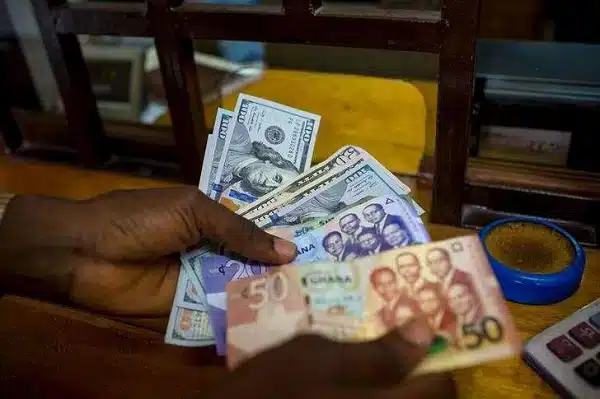
    “For this reason, Ghana’s economic rebound has been quite swift with economic growth ending the year 2023 at 2.9% against a target of 1.5%, inflation heading towards the year-end target of 15%, and interest rates declining. Despite recent pressures on our currency, the cedi’s depreciation year-to-date of 12% is far lower than its depreciation of 27% in the same period last year,” he said.

    Dr. Adam highlighted that the government is implementing fiscal measures to address economic challenges. One such measure involves accelerating the disbursement of nearly $1 billion by development partners between now and December this year. These funds are intended to provide crucial support to the economy during this period of uncertainty.

    “As we convene at the 3i Africa Summit in Ghana, it is incumbent on us to acknowledge the remarkable strides that Ghana has made in nurturing a vibrant fintech ecosystem. Ghana’s fintech sector boasts of a diverse array of startups, accelerators and regulatory initiatives, solidifying our position as a front-runner in fintech innovation across the continent.”

    “I commend the Bank of Ghana for being proactive in establishing a regulatory framework conducive to fintech innovation, exemplified by initiatives such as the Payment Systems and Services Act, Act 987 and establishing a Fintech and Innovation Office. These efforts affirm our commitment to fostering innovation while safeguarding consumer interests and preserving financial stability.”

    “I want to take this opportunity also to acknowledge the many incubators across Ghana, including the Ghana Tech Lab and MEST Africa, that provide invaluable support to fintech entrepreneurs through mentorship, financial backing, and networking opportunities.”

    As of Monday, May 13, one US dollar averages GH¢14.5 according to reports. Analysts foresee a continued weakening trajectory of the local currency, given the substantial disparity between foreign exchange demand and supply.

    However, they anticipate improved liquidity conditions towards the end of the second quarter of 2024 after the International Monetary Fund (IMF) board approves the second review of Ghana’s program. This approval will lead to a tranche disbursement of US$360 million under the IMF program.

  • “Let’s abandon the cedi and adopt the dollar if we cannot maintain the cedi” – IEA’s Dr Kwakye proposes

    “Let’s abandon the cedi and adopt the dollar if we cannot maintain the cedi” – IEA’s Dr Kwakye proposes

    Director of Research at the Institute of Economic Affairs (IEA), Dr. John Kwabena Kwakye, has proposed the adoption of the dollar as Ghana’s currency as a means to stabilize the economy.

    “Stabilising the economy is not rocket science. If we feel we cannot maintain the Cedi, let us abandon it and adopt the dollar. Let us dollarise the economy,” he  said.

    During a discussion on an Accra-based television station last Saturday, Dr. Kwakye, who made the suggestion, emphasized that the dollarization of the economy should only serve as a temporary measure until it stabilizes. Following this, Ghana could then proceed to establish its own currency.

    “Dollarisation” is when a country begins to recognise the U.S. dollar as a medium of exchange or legal tender alongside or in place of its domestic currency.

    “Dollarisation normally occurs when the local currency has become unstable and begun to lose its usefulness as a medium of exchange for market transactions. 

    Advantages for countries adopting dollarization include reduced administrative costs, a solid foundation for a more stable financial sector, and decreased interest rates.

    Disadvantages encompass the loss of monetary independence, seigniorage, a significant national symbol, and heightened susceptibility to foreign influence.

    Dr. Kwakye additionally recommended the conversion of the Central Bank into a Currency Board as an alternative for economic stabilization.

    “Unfortunately, we are being driven by the IMF programme, so, there’s very little we can do. We are bound by their policy and breaching it will attract sanctions. 

    “If we were following and implementing the right policies, we would not have even been here in the first place,” he said. 

    He expressed dismay at the recent departure of several foreign companies from the nation, warning of dire consequences for the already struggling economy.

    Glovo, a versatile online delivery platform, announced in late April its decision to cease operations in Ghana effective May 10, 2024.

    Additionally, early May reports indicated that Société Générale (SG) Ghana, a French bank, was considering exiting the country’s banking sector.

    However, during the bank’s 44th Annual General Meeting in Accra, Managing Director Hakim Ouzzani refuted these claims, labeling them as “rumors” not originating from the bank itself.

    Dr. Kwakye remarked that these withdrawals indicated a loss of Ghana’s relative competitiveness, a challenge that would require considerable time to rectify.

    “The high operational costs will lead to these companies incurring losses. So, it is rational that they will want to relocate. If we can stabilise the economy under IMF, we may be able to attract more investors,” he said. 

    Mr Yaw Sampah, a Private Legal Practitioner and Finance Analyst, however, disagreed with Dr Kwakye’s suggestion to dollarise the economy. 

    He said the Government should develop policies that would “make the dollar useless in Ghana.” 

    The Finance Analyst said the speculative effect of why people sought dollar reserves should be “killed completely.” 

    “Why does a politician who owns a house in East Legon quote the amount in dollars? Why does a hotel need to price its services in dollars? Why does everyone have to price goods and services in dollars? he quizzed 

    “Government should make the dollar completely useless in Ghana except when backed strictly by international trade and transactions,” he said.

    In a currency board system, the domestic currency is tied to a foreign reserve currency, maintaining a rigidly fixed exchange rate.

    This system refrains from influencing monetary policy, functioning instead on the principles of supply and demand. It oversees currency issuance and offers fixed-rate conversions to the designated anchor currency.

    Dr. Kwakye voiced dissatisfaction with the government’s inclination to leverage the nation’s assets as loan collateral rather than exploring diverse alternative measures.

  • Adopting dollar as Ghana’s currency won’t stabilise the economy – ASEPA

    Adopting dollar as Ghana’s currency won’t stabilise the economy – ASEPA

    The Alliance for Social Equity and Public Accountability (ASEPA) has rejected proposals put forward by the Director of Research at the Institute of Economic Affairs (IEA), Dr. John Kwabena Kwakye, advocating for the adoption of the US Dollar as Ghana’s currency to stabilize the nation’s economy.

    The Executive Director of ASEPA, Mensah Thompson, countered that Ghana’s primary challenges in achieving economic stability stem from prolonged fiscal irresponsibility and excessive borrowing, rather than the switch to the US Dollar.

    During an interview with David Kwaku Saforo-Sakyi on Citi TV’s Breakfast Daily, Mr. Thompson asserted that Ghana’s ongoing economic difficulties should be attributed to the fiscal mismanagement of former Finance Minister Ken Ofori-Atta, the actions of the Bank of Ghana’s governor, and President Akufo-Addo.

    “We are here not because our currency is not held in dollars, we are here because of the recklessness of Ken Ofori-Atta, the governor of the Central Bank and President Nana Addo Dankwa Akufo-Addo. The root cause of our problem is recklessness, borrowing and people who just don’t understand simple economic management who implemented faze economic restructuring that has thrown the economy into a cyclic spiral now going back into a debt hole and the solution is not dollarisation.

    “I have always asked myself, why did the government, after all the recklessness of Ken Ofori-Atta, still decide that if they were going under a debt restructuring programme, Ken Ofori-Atta was the person they were going to allow to oversee that debt restructuring, I was surprised when he decided to restructure our domestic debt.”

    Furthermore, Mr Thompson criticized the decision to restructure Ghana’s domestic debt, describing it as detrimental to the stability of the Cedi.

  • Dollar now sold at 14.80 at forex

    Dollar now sold at 14.80 at forex


    Today, on May 13, 2024, the Bank of Ghana’s Interbank forex rates indicate that the Ghana Cedi is trading against the US dollar at a buying price of 13.6754 and a selling price of 13.6890.

    At a forex bureau in Accra, the dollar is being bought at 14.50 and sold at 14.80.

    Against the Pound Sterling, the Cedi is trading at a buying price of 17.1079 and a selling price of 17.1277.

    At a forex bureau in Accra, the pound sterling is being bought at a rate of 17.80 and sold at a rate of 18.30.

    The Euro is trading at a buying price of 14.7266 and a selling price of 14.7411.

    At a forex bureau in Accra, the Euro is being bought at a rate of 15.40 and sold at 15.90.

    The South African Rand is trading at a buying price of 0.7415 and a selling price of 0.7422.

    At a forex bureau in Accra, the South African Rand is being bought at a rate of 0.40 and sold at a rate of 1.20.

    The Nigerian Naira is trading at a buying price of 103.0653 and a selling price of 106.7065.

    At a forex bureau in Accra, the Nigerian Naira is being bought at a rate of 9.00 Naira for every 1 Cedi and sold at a rate of 13.00.

    For the CFA, it is trading at a buying price of 44.4985 and a selling price of 44.5423.

    At a forex bureau in Accra, the CFA is being bought at 21.50 CFA for every 1 Cedi and sold at a rate of 23.50 CFA for every 1 Cedi.

    Note that these rates may differ at a forex bureau near you. Our forex bureau rates are provided by Afriswap Bureau De Change in Osu, Accra.

    Our forex bureau rates are provided by Afriswap Bureau De Change in Osu, Accra.

  • Dollar expected to hit GHS16 by end of 2024 – Bloomberg

    Dollar expected to hit GHS16 by end of 2024 – Bloomberg


    A renowned financial and media corporation, Bloomberg, has forecasted further depreciation of the Ghana cedi by the conclusion of 2024.

    As per Bloomberg’s projection, the cedi is anticipated to hit GH¢15.98 against the dollar.

    Reports from the Ghana Association of Forex Bureaux reveal that the cedi has experienced a depreciation of more than 14% since the start of the year.

    Presently, the dollar is trading at GH¢14.75 in the retail market.

    In terms of its performance on the global stage, Bloomberg noted that the cedi is undergoing its lengthiest period of weakness against the dollar and other major currencies.

    The local currency has not shown significant gains against the dollar in the past 22 trading sessions.

    “This represents the longest streak as per Bloomberg’s compiled data dating back to 1994.”

    Bloomberg elucidated its cedi projection methodology, stating that its “forward pricing is computed based on the spot rate and the interest rate differentials between the two currencies for the forward’s tenor.”

    Bloomberg attributes the dwindling dollar supply to “a decline in cocoa revenue, with exports plummeting by almost a third to $508 million in the first two months of the year due to adverse weather, diseases, and fertilizer shortages.”

    “It is the longest streak according to data compiled by Bloomberg going back to 1994.”

    The cedi’s depreciation has been linked to a deficit in dollar supply to meet the escalating demand.

    “forward pricing is calculated based on the spot rate and the interest rate differentials between the two currencies for the tenor of the forward.”

    Bloomberg blames the decline in dollar supply on “a slump in cocoa earnings, with exports dropping by nearly a third to $508 million in the first two months of the year due to adverse weather, disease, and fertilizer shortages.”

  • Worsening of cedi to dollar is due to foreign sports content in Ghana – FA Cup Chairman

    Worsening of cedi to dollar is due to foreign sports content in Ghana – FA Cup Chairman

    The owner of Division One League side Skyy FC and Chairman of the MTN FA Cup Committee, Wilson Arthur, has attributed the depreciation of the cedi against the dollar to the prevalence of foreign sports content in sports journalism.

    He highlighted the dominance of European football in over 75% of local media sports coverage as a contributing factor to this economic challenge.

    Speaking on Oyerepa FM, Arthur emphasized the importance of promoting local sports to mitigate these economic concerns.

    “The foreign sports content on our local media spaces is over 75% and that is the major reason why the cedi is performing poorly against the dollar and the media is largely part of this problem,” Arthur said.

    Despite the prevailing economic concerns and the low patronage of local sports, Arthur is eagerly anticipating the upcoming FA Cup semi-final matches.

    The fixtures will feature holders Dreams FC against Bofoakwa Tano, and Legon Cities against Nsoatreman FC, with both games set to take place at the WAFA Park in Sogakope.

  • Cedi currently selling at GHS14.70 to $1

    Cedi currently selling at GHS14.70 to $1

    Today’s Interbank forex rates, as reported by the Bank of Ghana on May 9, 2024, indicate that the Ghana Cedi is valued against the dollar at a buying price of 13.5447 and a selling price of 13.5583.

    Meanwhile, at a Forex bureau in Accra, the dollar is being purchased at a rate of 14.40 and sold at 14.70.

    Against the Pound Sterling, the Cedi is valued at a buying price of 16.9187 and a selling price of 16.9370.

    In Accra’s Forex Bureau, the pound sterling is bought at 17.80 and sold at 18.30.

    The Euro is quoted at a buying price of 14.5537 and a selling price of 14.5682.

    At Accra’s Forex Bureau, the Euro is bought at 15.10 and sold at 15.60.

    Regarding the South African Rand, it’s being traded at a buying price of 0.7291 and a selling price of 0.7297.

    In Accra’s forex bureau, the South African Rand is bought at 0.40 and sold at 1.10.

    For the Nigerian Naira, the buying price stands at 103.0122 and the selling price at 103.4742.

    In Accra’s forex bureau, the Nigerian Naira is bought at a rate of 9.00 Naira for every 1 Cedi and sold at 14.00.

    As for the CFA, it’s valued at a buying price of 45.0266 and a selling price of 45.0715.

    In Accra’s forex bureau, the CFA is bought at 21.50 CFA for every 1 Cedi and sold at a rate of 23.50 CFA for every 1 Cedi.

    Note that these rates may differ at a forex bureau near you. Our forex bureau rates are provided by Afriswap Bureau De Change in Osu, Accra.

    Our forex bureau rates are provided by Afriswap Bureau De Change in Osu, Accra.

  • Ghana Cedi reaches GHS14.45 against US dollar

    Ghana Cedi reaches GHS14.45 against US dollar


    Today, May 7, 2024, the Bank of Ghana’s interbank forex rates reveal that the Ghana Cedi is trading against the US dollar at a buying rate of 13.4094 and a selling rate of 13.4228.

    In Accra’s Forex bureau, the dollar is bought at 14.15 and sold at 14.45.

    Against the Pound Sterling, the Cedi’s buying rate stands at 16.9270 with a selling rate of 16.9453.

    At an Accra Forex Bureau, the pound sterling is purchased at 17.45 and sold at 17.95.

    The Euro’s buying rate is 14.5122 and the selling rate is 14.5266.

    In Accra, the Euro is bought at 14.80 and sold at 15.30.

    The South African Rand’s buying rate is 0.7293 and the selling rate is 0.7300.

    In Accra’s forex bureau, the South African Rand is bought at 0.40 and sold at 1.10.

    The Nigerian Naira’s buying rate is 103.1513 and the selling rate is 105.2298.

    At Accra’s forex bureau, the Nigerian Naira is bought at 9.00 Naira per 1 Cedi and sold at 14.00.

    Regarding the CFA, the buying rate is 45.1556 and the selling rate is 45.2004.

    At an Accra forex bureau, the CFA is bought at 21.00 for every 1 Cedi and sold at 23.00 for every 1 Cedi.

    Note that these rates may differ at a forex bureau near you. Our forex bureau rates are provided by Afriswap Bureau De Change in Osu, Accra.

    Our forex bureau rates are provided by Afriswap Bureau De Change in Osu, Accra.

  • A dollar goes for GHS14.40 at forex, BoG interbank rates at GHS13.42

    A dollar goes for GHS14.40 at forex, BoG interbank rates at GHS13.42


    Today, May 6, 2024, the Bank of Ghana’s Interbank forex rates reveal that the Ghana Cedi is valued at a buying rate of 13.4094 and a selling rate of 13.4228 against the US Dollar.

    In Accra’s Forex bureau, the US Dollar is being purchased at 14.10 and sold at 14.40.

    Against the Pound Sterling, the Cedi is valued at a buying rate of 16.8301 and a selling rate of 16.8483.

    At a Forex Bureau in Accra, the Pound Sterling is bought at 17.45 and sold at 17.95.

    The Euro is priced at a buying rate of 14.4452 and a selling rate of 14.4596.

    In Accra’s Forex Bureau, the Euro is purchased at 14.80 and sold at 15.30.

    The South African Rand is valued at a buying rate of 0.7252 and a selling rate of 0.7257.

    At a Forex bureau in Accra, the South African Rand is bought at 0.40 and sold at 1.10.

    The Nigerian Naira is valued at a buying rate of 103.8089 and a selling rate of 104.1070.

    In Accra’s Forex bureau, the Nigerian Naira is bought at 9.00 Naira for every 1 Cedi and sold at 14.00.

    As for the CFA, it is priced at a buying rate of 45.3648 and a selling rate of 45.4100.

    At a Forex bureau in Accra, the CFA is bought at 21.00 CFA for every 1 Cedi and sold at 23.00 CFA for every 1 Cedi.

    Our forex bureau rates are provided by Afriswap Bureau De Change in Osu, Accra.

    Note that these rates may differ at a forex bureau near you. Our forex bureau rates are provided by Afriswap Bureau De Change in Osu, Accra.

  • A dollar goes for GHS14.25 at forex, BoG interbank rate at GHS13.25

    A dollar goes for GHS14.25 at forex, BoG interbank rate at GHS13.25


    The Interbank forex rates from the Bank of Ghana today, April 30, 2024, reveal that the Ghana Cedi is transacting against the dollar at a purchasing price of 13.2376 and a vending price of 13.2508.

    At a Forex bureau in Accra, the dollar is acquired at a rate of 13.95 and vended at 14.30.

    Versus the Pound Sterling, the Cedi is transacting at a purchasing price of 16.6118 and a vending price of 16.6298.

    At a Forex Bureau in Accra, the pound sterling is acquired at a rate of 17.10 and vended at a rate of 17.60.

    The Euro is transacting at a purchasing price of 14.1872 and a vending price of 14.2001.

    At a Forex Bureau in Accra, the Euro is acquired at a rate of 14.60 and vended at 15.10.

    The South African Rand is transacting at a purchasing price of 0.7099 and a vending price of 0.7102.

    At a forex bureau in Accra, the South African Rand is acquired at a rate of 0.40 and vended at a rate of 1.10.

    The Nigerian Naira is transacting at a purchasing price of 102.5188 and a vending price of 102.8314.

    At a forex bureau in Accra, Nigerian Naira is acquired at a rate of 9.00 Naira for every 1 Cedi and vended at a rate of 14.00.

    For the CFA, it is transacting at a purchasing price of 46.1938 and a vending price of 46.2358.

    At a forex bureau in Accra, CFA is acquired at 21.00 CFA for every 1 Cedi and vended at a rate of 23.00 CFA for every 1 Cedi.

    Note that these rates may differ at a forex bureau near you. Our forex bureau rates are provided by Afriswap Bureau De Change in Osu, Accra.

  • A dollar goes for GHS14.25 at forex, BoG interbank rate at GHS13.20

    A dollar goes for GHS14.25 at forex, BoG interbank rate at GHS13.20


    Today’s Interbank forex rates released by the Bank of Ghana on April 29, 2024, indicate that the Ghana Cedi is being traded against the US dollar at a buying price of 13.1928 and a selling price of 13.2060.

    In Accra’s Forex bureaus, the dollar’s purchasing rate stands at 13.90 and the selling rate at 14.25.

    Against the Pound Sterling, the Cedi is valued at a buying price of 16.4461 and a selling price of 16.4639.

    At Accra’s Forex bureaus, the pound sterling is bought at 17.00 and sold at 17.50.

    The Euro is priced at a buying rate of 14.0999 and a selling rate of 14.1139.

    In Accra’s Forex bureaus, the Euro is acquired at 14.50 and sold at 15.00.

    The South African Rand’s purchasing price is 0.7011, while the selling price is 0.7012.

    At Accra’s forex bureaus, the South African Rand is purchased at 0.40 and sold at 1.10.

    The Nigerian Naira’s buying price is 98.6977, and the selling price is 99.2219.

    At Accra’s forex bureaus, the Nigerian Naira is bought at 9.00 Naira per 1 Cedi and sold at 14.00.

    For the CFA, the buying rate is 46.4760, and the selling rate is 46.5221.

    At Accra’s forex bureaus, the CFA is purchased at 21.00 CFA per 1 Cedi and sold at 23.00 CFA per 1 Cedi.

    Our forex bureau rates are provided by Afriswap Bureau De Change in Osu, Accra.

    Note that these rates may differ at a forex bureau near you. Our forex bureau rates are provided by Afriswap Bureau De Change in Osu, Accra.

  • A dollar goes for GHS14.10 at forex, BoG interbank rate at GHS13.18

    A dollar goes for GHS14.10 at forex, BoG interbank rate at GHS13.18


    Today, April 26, 2024, the Interbank forex rates from the Bank of Ghana reveal that the Ghana Cedi is valued against the dollar at a buying rate of 13.1683 and a selling rate of 13.1815.

    In Accra’s Forex bureau, the dollar commands a buying rate of 13.80 and a selling rate of 14.10.

    Against the Pound Sterling, the Cedi holds a buying rate of 16.4512 and a selling rate of 16.4690 according to the Interbank forex rates.

    At a Forex Bureau in Accra, the pound sterling fetches a buying rate of 16.80 and a selling rate of 17.30.

    The Euro stands at a buying rate of 14.1163 and a selling rate of 14.1292, based on the Interbank forex rates.

    Meanwhile, at a Forex Bureau in Accra, the Euro is quoted with a buying rate of 14.40 and a selling rate of 14.90.

    The South African Rand shows a buying rate of 0.6919 and a selling rate of 0.6922 according to the Interbank forex rates.

    Conversely, at a forex bureau in Accra, the South African Rand sees a buying rate of 0.40 and a selling rate of 1.10.

    The Nigerian Naira is traded at a buying rate of 96.5852 and a selling rate of 97.0345 according to the Interbank forex rates.

    In Accra’s forex bureaus, the Nigerian Naira is purchased at a rate of 9.00 Naira for every 1 Cedi and sold at a rate of 14.00.

    As for the CFA Franc, it is quoted with a buying rate of 46.4256 and a selling rate of 46.4681 based on the Interbank forex rates.

    At forex bureaus in Accra, the CFA Franc is transacted at a buying rate of 20.50 CFA for every 1 Cedi and sold at a rate of 22.50 CFA for every 1 Cedi.

    Note that these rates may differ at a forex bureau near you. Our forex bureau rates are provided by Afriswap Bureau De Change in Osu, Accra.

    Our forex bureau rates are provided by Afriswap Bureau De Change in Osu, Accra.

  • Dollar now sells at GHS14.05 at forex

    Dollar now sells at GHS14.05 at forex


    Today, April 25, 2024, the Interbank forex rates released by the Bank of Ghana reveal the trading dynamics of various currencies against the Ghana Cedi. The dollar is valued at a buying rate of 13.1355 and a selling rate of 13.1487.

    Meanwhile, in Accra’s Forex bureaus, the dollar is bought at 13.70 and sold at 14.05. Against the Pound Sterling, the Cedi’s exchange rate stands at 16.3275 for buying and 16.3451 for selling.

    In the same vein, the Euro is bought at 14.0343 and sold at 14.0482. The South African Rand’s rates are 0.6830 for buying and 0.6834 for selling.

    Interestingly, at Accra’s forex bureaus, the rates vary slightly. For instance, the Euro is bought at 14.35 and sold at 14.85. Similarly, the South African Rand is bought at 0.40 and sold at 1.10.

    Furthermore, the Nigerian Naira is bought at 97.3155 and sold at 98.0772 according to the Interbank rates, while in Accra, it’s bought at 9.00 Naira per 1 Cedi and sold at 14.00.

    Lastly, the CFA Franc is bought at 46.6933 and sold at 46.7396 in the Interbank market. However, in Accra’s forex bureaus, it’s exchanged at 20.50 CFA Francs per 1 Cedi for buying and 22.50 CFA Francs per 1 Cedi for selling.

  • A dollar hits GHC14 at forex in April – Reports

    A dollar hits GHC14 at forex in April – Reports

    The Ghanaian cedi has once again hit a new low, reaching GH¢14 against the US dollar.

    This marks a year-to-date depreciation of approximately 12.08%, highlighting the significant strain on the local currency. Forex bureaus are reportedly selling the dollar for an average of GH¢14, indicating ongoing pressures on the cedi.

    Analysts had earlier forecasted further depreciation of the cedi against the dollar this week. Despite this, Fitch Solutions predicts that the cedi will rebound to GH¢12.25 by the end of the year.

    The London-based firm attributes this potential recovery to expected improvements in the coming months. However, Fitch Solutions emphasizes that the government’s efforts in restructuring commercial debt are crucial for the currency’s stability.