Tag: Dominican Republic

  • Dominican Republic to pilot 4-day work week

    Dominican Republic to pilot 4-day work week

    In a groundbreaking move, the Dominican Republic is set to become the first Caribbean nation to experiment with a four-day work week starting in February.

    This six-month pilot program, following similar trials in the United Kingdom and elsewhere, will be voluntary for companies and won’t entail a pay cut for participating employees.

    The initiative responds to growing demands for a shorter work week, fueled by discussions during the COVID-19 era highlighting that extended, in-person work hours may not necessarily equate to higher productivity.

    What is the Dominican Republic’s four-day work week trial?

    Starting in February, businesses in the Dominican Republic have the option to partake in a six-month trial of a four-day work week.

    During this experimental phase, the standard workweek will reduce from 44 to 36 hours, spanning Monday through Thursday, while employees maintain their regular salaries.

    Participating companies include the government’s national health insurance agency, power company EGE Haina, Claro (a Latin American telecommunications firm), and IMCA (a heavy equipment business).

    A local university is entrusted with analyzing the trial’s outcomes, examining potential health changes in workers and assessing the impact on their work-life balance.

    How does a four-day work week actually … work?

    In a four-day work week, the workload typically remains the same. But companies, managers and their teams are forced to prioritise even more than they otherwise have to, cutting out, perhaps, some meetings.

    But there’s something else too that a four-day week model must emphasise, according to the Dominican Republic’s Labour Minister Luis Miguel de Camps.

    US politics, Canada’s multiculturalism, South America’s geopolitical rise—we bring you the stories that matter.

    “It prioritises people, improving health and wellbeing, and promoting a sustainable and environmentally friendly productivity,” said de Camps.

    Where has a four-day work week been trialled — and what happened?

    n response to the evolving landscape of work brought on by the COVID-19 pandemic, numerous countries worldwide have either experimented with or implemented legislation for a four-day work week. The United Kingdom conducted its most extensive trial of a four-day work week in 2023, involving 61 companies, of which 56 extended the trial, and 18 made the shift permanent. Approximately 2,900 employees participated in the pilot, leading to reduced stress levels, improved work-life balance, and better sleep for 40 percent of respondents.

    The UK trial revealed additional benefits:

    Decreased Sick Leave: Employees took less sick leave as they had more time for physical and mental recuperation from work-related stress.

    Enhanced Gender Parity: Men contributed more to household and family responsibilities during three-day weekends.

    In Japan, where overwork-related deaths claimed nearly 3,000 lives in 2022, major companies like Microsoft have also tested and reported positive outcomes with the four-day work week.

    Are there other success stories?

    Iceland trialled a shorter work week between 2015 and 2019. Approximately 2,500 public sector employees participated in it.

    The results: Workers were less stressed, and productivity did not suffer.

    The trial, that Iceland’s labour unions renegotiated contracts for more than 85 percent of the country’s workforce to reduce work hours.

    But are all four-day work weeks the same?

    In February 2022, Belgium became the first European country to legislate a shorter work week. Employees can choose to work four days a week instead of five, without losing their salary.

    But there’s a catch: They must still work 40 hours. In other words, those who choose the four-day work week must work 10 hours a day.

    In 2021, the United Arab Emirates government announced that all public sector organisations would operate for four and a half days per week. However, employees in the country still spend some of the highest hours at work, at an average of 52.6 hours per week per employed person.

    How about going longer rather than shorter?

    In India, recent calls for a 70-hour week have sparked heated debate.

    In 2023, Narayana Murthy, the iconic co-founder of Indian multinational technology company Infosys, made the recommendation saying it could boost productivity and the country’s economy.

    India’s economy is already the fastest-growing among G20 nations. And Indians already work an average of 47.7 hours a week, which is higher than the 36.4 average in the United States or 36.6 in Japan, according to the International Labour Organisation.

    In China, some firms practice a “996” work culture, in which employees work from 9am to 9pm, six days a week. The average work week, however, is 46.1 hours.

    Still, Murthy suggested that the younger generation is not hardworking enough.

    “India’s work productivity is one of the lowest in the world. Our youngsters must say: This is my country, I want to work 70 hours a week,” he said during a podcast. India’s labour unions have hit back at Murthy’s comments.

  • 11 people, including newborn babies killed in a bomb blast in Dominican

    11 people, including newborn babies killed in a bomb blast in Dominican

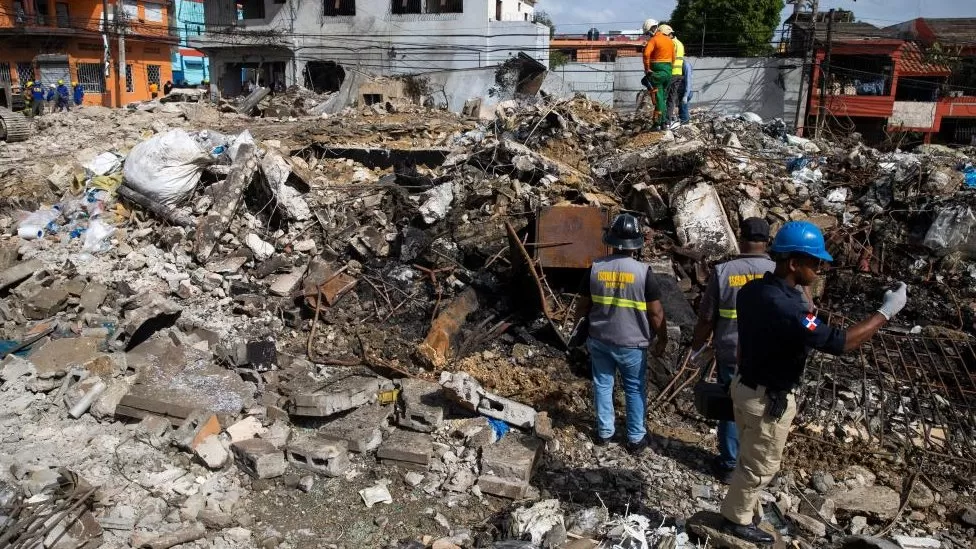
    In an explosion that occurred on Monday in the Dominican Republic‘s small town of San Cristóbal, at least 11 people died.

    Ten adults and a four-month-old baby’s remains have been recognised, according to officials, but they cautioned that “there are more corpses” likely to be discovered.

    What started the explosion in the town’s commercial district is still unknown.

    For many hours after the explosion, smoke from the flames it started could be seen drifting over the town.

    After the explosion, smoke covered the region near the blast.

    There are still ten persons missing. President Luis Abinader visited the explosion scene on Tuesday and declared, “We are doing everything humanly necessary to locate them.

    Many of the injured, who number in the dozens, are still hospitalised.

    Outside of the town’s primary hospital, family members of the injured and the missing awaited word.

    In four of the nine burning buildings, hundreds of firefighters are still working to douse the flames.

    Hours after the explosion, fires are still burning, and firemen are still working there.

    On Monday afternoon, the village, which is located on the southern suburbs of the capital Santo Domingo, was completely destroyed by the explosion.

    Its precise origin has not yet been identified. Among the structures that were destroyed were a plastics factory, a veterinary clinic, and a hardware store.

  • Child hanging from government truck angers the Dominican Republicans

    Child hanging from government truck angers the Dominican Republicans

    In the Dominican Republic, shocking video showing a tiny toddler hanging from an imprisoned woman’s arms through a truck’s barred door has sparked uproar.

    The event, which happened on Saturday in the municipality of Santo Domingo, was captured on social media cameras, showing the toddler dangling from the back of a moving immigration control truck that local authorities used to transfer detainees.

    A woman inside the car, whose arms extend beyond the door’s bars, is the only one who appears to be stopping the child from falling.

    An immigration agent sitting on the back platform of the truck, next to the child, seems to be speaking as he extends a hand and rests it on the child’s shoulder.

    In a statement, the country’s migration director Venancio Alcántara described the incident as “a disturbing and heartbreaking incident.”

    The migration agency said Monday that the agent seen sitting in the back of the truck has been fired, noting that he had only been in his job for 20 days.

    The woman, a Haitian national, was released after the agents became aware of the situation, it also said.

  • A look at Merengue, Dominican Republic’s national dance with its unique origins

    The Dominican Republic is home to several cultural dances of African ancestry. It is unusual to visit a social gathering or walk the streets of the island community without witnessing a display of gestures characteristic of the traditions of the people.

    The cocktail of the rich cultural dances in the Dominican Republic is not the focus of this article, but,  the origins of Merengue, the national dance of the Dominican region. There are conflicting histories of how Merengue originated to become a much-loved dance by the people of the island city. One fact that cannot however be challenged is Merengue is part of the national identity of the Dominican Republic, according to flodance.

    Oral history has it that the genesis of the Merengue can be traced to the enslaved who lived in the region in 1700. Historians claim that the basics of the dance were an adaptation of African and French minuet.
    It was developed through the ingenuity of the enslaved who were enthralled by the ballroom dances of their owners during festive periods. An attempt to mirror the ballroom dance and regular practice of its movement gave birth to the Merengue.

    Related stories

    Parts where their owners were rigid and boring in their dance moves, they made fun and flexible. They fast-tracked the rhythms to make the dance exciting and danceable. Traditionally, Merengue focuses on groups rather than placing emphasis on individual participation in the dancing. It is choreographed with dancers forming a round-like arc with their arms locked and dancing facing each other.

    Another school of thought on the origins of the traditional dance holds that Merengue came about following a war veteran who had been maimed in one leg after a battle. In recognition of his heroic exploits while he was returning home, the townsfolk danced dragging one leg reminiscent of the reality that had befallen him as a result of the war.

    Another origin of Merengue that has come up strongly in the Dominican Republic is that the dance came about as a result of slaves trying to get familiar with the chains on their legs on slave plantations and ended up developing a rhythm while dancing. They used the cane sticks for the drumbeats as they cut them on the sugar plantations, but, that camaraderie developed into the dance that evolved to be known as Merengue.

    It is easy to follow the dance moves of Merengue because of its popularity among the people. According to UNESCO, Merengue is woven into the identity of the Dominican Republic’s social fiber. From the streets to schools and social gatherings, people incorporate the traditional dance into these events.
    On November 26, 2005, the Merengue became recognized as the national dance of the Dominican community. In communities such as Santo Domingo and Puerto Plata, the traditional dance has festivals where it is displayed as part of efforts to nationalize it.

    Source: Face2faceAfrica

  • Dominican Republic minister shot dead in office

    The Dominican Republic’s minister of environment and natural resources has been shot and killed in his office by a close personal friend, officials say.

    Orlando Jorge Mera, 55, was holding a meeting at the time of the attack. At least six shots were heard.

    A presidential spokesman identified the assailant as Miguel Cruz, describing him as a childhood friend of the minister.

    He is now in custody. The motive for the shooting remains unclear.

    In a statement, Mr Jorge Mera’s family said he had been shot multiple times by a man he was friends with since childhood.

    “Our family forgives the person who did this. One of Orlando’s greatest legacies was to not hold grudges,” they added.

    Orlando Jorge MeraImage source, The Presidency of the Dominican Republic

    Mr Jorge Mera had served in incumbent President Luis Abinader’s administration since it swept to power in July 2020.

    In a tweet, President Abinader expressed his sincere condolences to Mr Jorge Mera’s family and said that he deeply regretted the death of his good friend.

    Bartolomé Pujals, director of the government’s cabinet for innovation, described his death as a tragedy and called for peace on social media.

    Mr Jorge Mera was the son of former President Salvador Jorge-Blanco and a founding member of the governing Modern Revolutionary Party (PRM).

    Mr Jorge Mera leaves behind a wife – the Dominican ambassador to Brazil – and two sons, one of whom is also a PRM lawmaker.

    Source: BBC

  • Six held for death of U.S. teacher in Dominican Republic

    Authorities in the Dominican Republic say they have arrested six people in connection with the homicide of a U.S. teacher on the Caribbean island nation.

    National Police said Patricia Anton, 63, was strangled in her apartment about a week ago, after her assailants had bound her feet and hands. Her cell phone, laptop computer, television and other items were missing.

    Police said Sunday they have arrested Michael Marinez Rosario, Heuri Flores Hernandez, Junior Alexis Suarez, Juan Jose Andujar Mella, Oroniel Canario Montero and Alexis Maquey, and they’re seeking a seventh suspect.

    Read:Police officer charged with murder over taser death of footballer

    Police declined to give details about Anton’s death, or say how she was connected to the suspects. Authorities said two of the men were Haiti nationals and four had previous arrests records.

    Anton, a native of Italy, grew up in Traverse City, Mich., and had lived in the Dominican Republic since 2013. She taught at the 3 Mariposas Montessori School in Puerto Plata. She and her husband had three adult-age children.

    “We are really grateful and impressed by how much effort the police in the island has put to find out what happened,” said Cousin Adrianne Machina. “I would love people to know what an amazing mother, teacher and friend Patty was to everyone. She had a huge laugh and was very inclusive.”

    Read:5 arrested for beating up hospital staff after death of loved one

    Several U.S. tourists have died in the Dominican Republic over the past year, causing some concern over the safety of Americans on the island.
    Toxicology tests, however, on three Americans who died there in May — Miranda Schaup-Werner, Cynthia Day and Nathaniel Holmes — showed they all died of natural causes, the U.S. State Department said last month.

    Source: Ghananewsagency.org