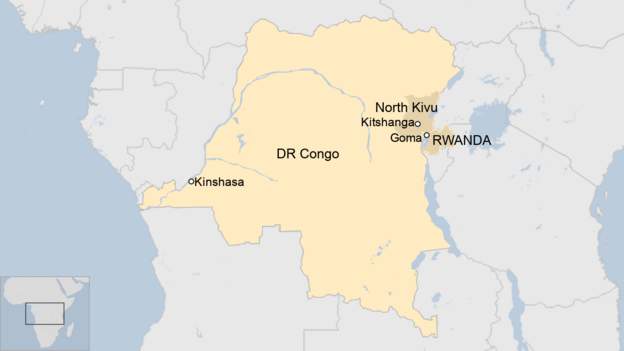
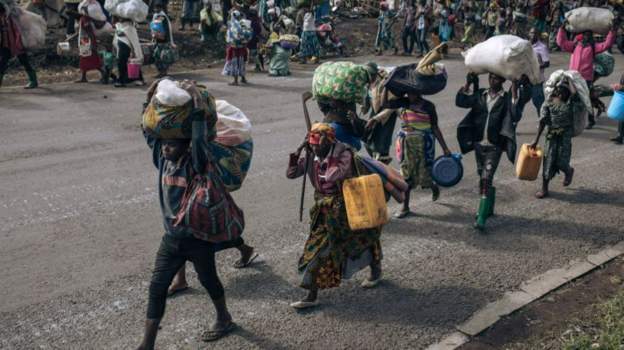
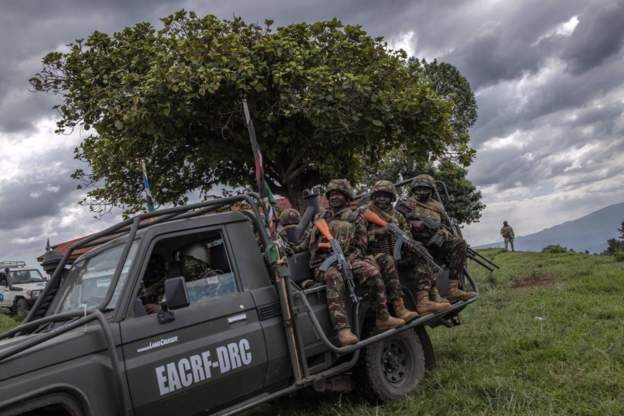
Rebels operating in the eastern part of the country have recently captured large swathes of territory in the volatile province, sparking public anger against the UN and the East African Regional Force.
Recent fighting has killed hundreds of people and displaced thousands more.
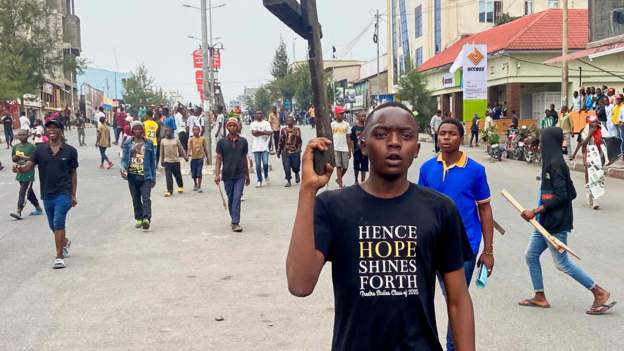
On the eastern Democratic Republic of the Congo city of Goma, hundreds of citizens have been protesting in the streets for two days.
Following violent battles between protesters and Congolese security personnel on Monday, at least two individuals died.
The UN and the East African Regional Force are accused by the demonstrators of neglecting to back Congolese military operations against the M23 rebel group.
Recently, fighting has been more intense in the area as the gang has taken control of important cities in eastern DR Congo.
Security personnel used tear gas on Monday to scatter crowds that were throwing petrol bombs and stones at the UN building in Goma.
According to reports, during the fighting, a church in one of the neighborhoods was destroyed.
In the previous days, the rebels have seized major portions of the volatile province and have threatened to march on Goma, the region’s commercial center.
Numerous people have been slain and thousands more have been displaced by the current warfare.
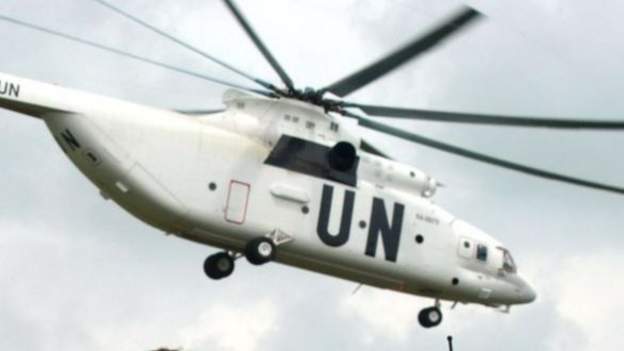
In a Sunday helicopter strike in the eastern Democratic Republic of the Congo, a South African peacekeeper for the UN was killed and another was hurt.
The aircraft came under fire while en route to Goma, the capital of North Kivu province, according to the UN mission in the nation, Monusco. Fortunately, the helicopter managed to land.
In the incident, it was reported that a second peacekeeper was hurt.
“Monusco strongly condemns this cowardly attack against an aircraft bearing the United Nations emblem,” it said in a statement.
The military in the Democratic Republic of Congo says it has expelled Rwandan soldiers attached to the command of the East African Community Regional Force based in the eastern town of Goma.
The Rwandan soldiers were expelled from the force “for security reasons” and “have already left Congolese soil”, the military said.
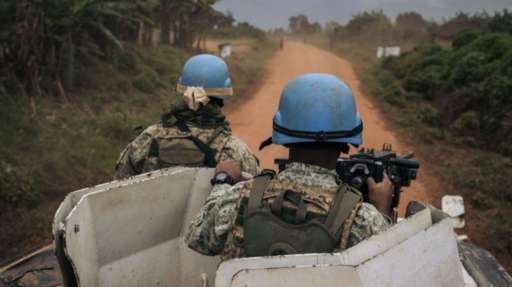
The regional force consists of soldiers from several East African countries who have joined the Congolese army, with the support of UN peacekeepers, in fighting rebel groups in eastern DR Congo.
The Congolese army claimed that Rwanda had in response recalled all its officers from DR Congo, but the authorities in Kigali have denied the claim.
“It is not Rwanda that has recalled the officers. It is DRC that has expelled them,” Rwanda’s army spokesperson Brig Gen Ronald Rwivanga told the BBC on Tuesday.
DR Congo had denied the involvement of Rwandan troops in the regional force that was deployed last year to the mineral-rich North Kivu province.
But it allowed a few Rwandan officers to be part of the force’s command as well as a security verification team.
Tensions between Kigali and Kinshasa worsened last week after Rwanda shot at a Congolese fighter jet near Goma airport.
Kinshasa accuses Kigali of supporting the M23 rebels, which the latter has consistently denied.
Marie Louise Wambale had to flee with almost nothing about ten years ago due to fighting between the M23 rebels and the DRC army in the country’s eastern region, and it took her years to rebuild her life.
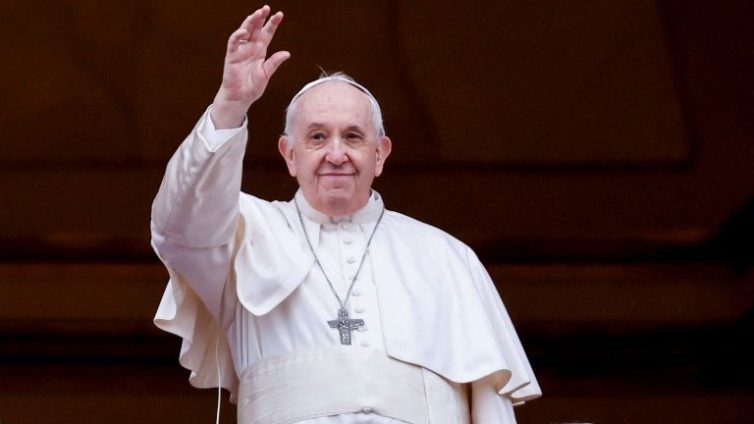
She hoped, along with the majority of Catholics in the eastern DRC, that Pope Francis would bring a message of hope at a time when the rebels are posing their greatest threat to this region since 2012.
“Many people were disappointed because they wanted to welcome him to our home, for him to come here and live our suffering, to feel it with his own eyes,” she said. “We wanted him to live it because there are many people who have fled the war. There are pregnant mothers who gave birth in the camps in very bad conditions – many women and children are suffering.”
Now Wambale has been tasked with taking this message to the capital, Kinshasa, where she will be among the Congolese faithful chosen to meet Pope Francis.
His long-awaited visit to DRC and South Sudan this week comes after he postponed an earlier trip late last year that had originally included a stop in the volatile east for health reasons. Insecurity, though, has soared in the months since so the pope is limiting his visit to Kinshasa.
“It is clear to anybody that there is a danger. But the danger, I would say, even more than for the pope is for the people,” the Vatican’s ambassador to DRC, Archbishop Ettore Balestrero told The Associated Press news agency.
The security requirements to protect people at a papal mass would be hard under ordinary circumstances, but even more delicate in an already dangerous area like the east, he said.
An estimated two million Congolese are expected at the mass at Kinshasa airport on February 1, which he said would make it the largest crowd event in DRC’s recent history.
Fighting in the eastern DRC, which involves more than 120 armed groups, has simmered for years but spiked in late 2021 with the resurgence of the M23, which had been largely dormant for nearly a decade. The rebels have captured swaths of land and are accused by the United Nations and rights groups of committing atrocities against civilians.
The violence, which has displaced approximately half a million people, has triggered a diplomatic spat with neighbouring Rwanda. Kinshasa has accused Kigali of backing the M23, an allegation also made by UN experts and the European Union.
Rwanda denies backing the group, which continues to resist a concerted pushback from the Congolese military and a regional peacekeeping force.
The region is also increasingly grappling with violence linked to ISIL (ISIS) and al-Qaeda affiliates. Earlier this month, ISIL claimed responsibility for a bomb explosion at a church, which killed at least 14 people and injured dozens while they were praying.
In DRC, the Catholic church mediated rising tensions in 2016 after the government postponed elections, creating an agreement which led to the 2018 vote, said Katharina R Vogeli, founder of CapImpact, a peace-building organisation working in the Great Lakes region.
Religious advisers say people in countries with enormously entrenched problems need to be lifted out of a generational sense of dread and anxiety.
“It’s the message of eternal hope that transcends, which is what people need,” said Ferdinand von Habsburg-Lothringen, a peace-building expert and former adviser to the South Sudan Council of Churches.
“The church has enormous power,” he said. “Though they may not necessarily have political power, they have moral authority.”
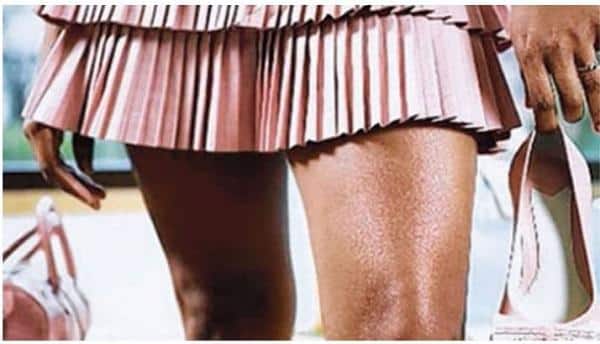
Militiamen in the eastern Democratic Republic of Congo have flogged women and girls for wearing short skirts or trousers.
The was announced by the government on Saturday and have vowed to punish the offenders.
Prime Minister Jean-Michel Sama Lukonde “condemned the degrading and inhuman abuses by the militiamen” from the armed Malaika group, according to a readout of a cabinet meeting published on Saturday.
Lukonde said the militia, who are imposing Islamic sharia punishments in the area under their control, had “recently flogged girls and women dressed in short skirts and trousers”.
A government delegation would be dispatched to the area — Salambila, in the eastern province of Maniema — and report back so the perpetrators could be punished, Lukonde said.
The Malaika militia, which claims to represent the interests of the local people, wants the government to hand over a bigger share of the revenue from the Salamabila gold mines.
It is one of several armed groups that operate freely in the volatile, mineral-rich east of the vast Central African country.
Rebels in the eastern Democratic Republic of Congo claim to have taken the key town of Kitshanga after three days of intense clashes with government forces.
The UN-sponsored local radio Okapi was among the first to report the fall of Kitshanga to the rebels.
Images of hundreds of people fleeing the town have also been shared on social media.
“Yes we now have Kitshanga and its neighbourhoods,” Willy Ngoma, a spokesman of the M23 rebels, told the BBC on Friday.
The BBC has approached the military for a response.
Local civil society groups and the UN forces in the country have condemned M23 military offensives which have forced more than 400,000 people to flee their homes.
Congolese Senator Francine Muyumba has called on parliament to hold an extra-ordinary session because “the country is doing very badly”, she said on Twitter.
A summit held in November in neighbouring Angola had asked the M23 rebels to cease hostilities and withdraw from areas it had captured.
But the rebels said they find themselves “obliged to intervene to stop another genocide” against ethnic Tutsis living in DR Congo, according to a statement on Thursday evening.
Kitshanga town lies in a strategic route between the region’s economic hubs of Goma and Butembo.
For some years, the town was the stronghold and the headquarters of the infamous rebel leader Laurent Nkunda and his CNDP rebel group, which later became M23.
Fresh fighting has erupted in eastern Democratic Republic of Congo, despite an agreement between the government and rebel groups to end hostilities.
The fighting between the army and M23 rebels on Tuesday is said to have caused many people to flee their homes, according to local reports.
“There is mass displacement towards the town of Mweso,” a local journalist told the BBC on Tuesday morning.
The military has not commented on the latest fighting, but a spokesman for the rebels accused government forces of attacking their positions as they prepared to further withdraw as outlined in an agreement reached in Angola’s capital, Luanda.
Last week in Davos President Félix Tshisekedi said the rebel group was not withdrawing but “moving around and redeploying to other areas”.
The rebels have accused President Tshisekedi of being more keen on “destroying the M23” instead of peacefully resolving the conflict.
The UN says more than 400,000 people have fled their homes in the conflict since last year.
Market traders in the capital of the Democratic Republic of Congo have expressed dismay at being forced to dismantle their stalls ahead of a visit by Pope Francis.
Officials in Kinshasa say they’re making the streets clean and tidy in time for the Pope’s arrival at the end of the month.
Some traders complained that the police – using crowbars and bulldozers – had been heavy-handed. They also said many people had lost all their goods.
The affected streets include Lumumba Boulevard, the main thoroughfare from the airport, on which a gala welcome will be staged for Pope Francis.
But hawkers are angry that they’re also being forced out of the side streets around the city centre.
Two-time TotalEnergies CHAN winners, DR Congo were held to a goalless draw by neighbours Uganda in a highly contested match at the 19 May 1956 Stadium in Annaba on Saturday in front of thousands of Algerian fans that came out to watch the action.
The result was a true reflection of the two sides who had a couple of chances in front of goal but were wasteful on several occasions and unlucky on others.
Adam Bossu Nzali had the game’s first real chance at goal with a well-taken freekick on target, but it went straight into Ugandan goalkeeper Nafian Alionzi’s hands in the 10th minute.
On the other end of the pitch, Cranes playmaker Moses Waiswa had the same opportunity to give Uganda the lead but he sent his attempt into the stands much to the frustration of his colleagues on the bench.
Nzali, who was red-hot with attacking zeal down the left side, made a fast-paced run into the box but sent his shot into the side of the net as the Ugandans hi-fived each other for avoiding the goal that could have given the Congolese the lead.
The midfield had a busy outing on the night with both sets of players trying to control the tempo of the game which also turned out to be physical but it was the Congolese who had the most ball possession – 53%.
In the second half, Uganda came close to finding the back of the net but Gift Fred’s header hit the post and was cleared by the Congolese defence.
Congolese substitute Jean-Marc Makusu almost scored within five minutes of coming on but his attempt went into the side of the net and minutes later forced Alionzi to pick up the ball from his powerful shot.
Both coaches Otis Ngoma and Milutin “Micho” Sredojevic made necessary changes but their efforts did not alter the result of the game.
DR Congo and Uganda sit at Group B ahead of the Côte d’Ivoire and Senegal fixture at the same venue.
The Democratic Republic of Congo’s army has denied the presence of fighters from Russia’s mercenary Wagner Group in the country, in response to claims by a rebel group.
The army has been struggling to contain the M23 rebel group that has in recent months captured swathes of territory in the eastern part of the country.
Reports have suggested the presence of Russian mercenaries in North Kivu province on government’s invitation to help deal with the rebel group.
“It is true, Wagner Group is here. We have evidence that we will show in due time,” M23 spokesperson Willy Ngoma told the BBC on Wednesday.
He added that they had fought a joint team of the Congolese army and the mercenaries last week in Tongo and Nyamilima fronts in Rutshuru area.
But the army spokesperson Major General Sylvain Ekenge has denied the claims.
“The Wagner group is not operating in DR Congo,” he told the BBC.
Russian mercenaries have a presence in DR Congo’s northern neighbour, Central African Republic, where in 2021 they played a role in fighting rebels.
Last year in October, Congolese President Félix Tshisekedi told a meeting in London that he would not bring in Russian mercenaries to deal with the rebel activity in his country.
“I know it’s fashionable now . . .[but] no, we don’t need to use mercenaries,” he was quoted as saying by the Financial Times.
The unrest in eastern DR Congo has displaced hundreds of thousands from their homes.
The biggest floodsin years have reportedly killed more than 120 people in the Democratic Republic of the Congo’s capital, Kinshasa, according to the authorities.
Most of the dead were in hillside areas which suffered landslides in torrential rain.
One journalist reported seeing the bodies of nine members of the same family whose home had collapsed.
A three-day period of national mourning is beginning on Wednesday.
Correspondents say there has been a big increase in the number of people moving to Kinshasa in recent years and the city suffers from inadequate drainage and poor urban planning.
Heavy rainfall on Monday night led to floods in the Democratic Republic of Congocapital, Kinshasa, that destroyed many homes and cut off one of the main roads to the the city.
The damage left a third of the city with no water and electricity, according to authorities. Most of the dead were in hillside areas which suffered landslides
Kinshasa has about 15 million inhabitants and is one of the most densely populated capitals in Africa.
Prime Minister Sama Lukonde visited the affected neighbourhoods on Tuesday together with the city’s Governor Gentiny Ngobila.
The governor said the provincial government will pay all the funeral expenses for the deceased.
The Democratic Republic of Congo’s government has “strongly” condemned what it called the “illegal presence” of journalists who support Rwanda in Congolese territory.
DR Congo’s information ministry stated that “propagandist media” were being escorted to various locations in eastern DR Congo by M23 rebel soldiers and Rwandan forces.
“This act should draw the attention of both the national and international community to Rwanda’s new campaign of lies and misrepresentation of the facts, promoting false testimony of local people and twisting the truth about the massacre in Kishishe,” it said in a statement.
— Ministère de la Communication et Médias/RDC (@Com_mediasRDC) December 12, 2022
ReportReport this social embed, make a complaint
Rwanda has always denied involvement in the violence in DR Congo.
Last week the US urged Rwanda to end its support for the M23 rebel group – but Rwanda said the responsibility ought to be placed on DR Congo.
It came amid a UN investigation that found that at least 131 civilians in DR Congo died in a November attack by the M23 rebel group.
The UN report last week said the massacre took place in two villages – Kishishe and Bambo – in the Rutsuhuru district of the eastern North Kivu province.
DR Congo says its government is determined to pursue legal means againstthose responsible for international crimes including the mass killings in Kishishe.
Survivors of the Kishishe massacre recounts how they escaped to Kitshanga, a camp for internally displaced people that has housed many displaced people for more than 20 years, after leaving the bloody east of the Democratic Republic of Congo.
“We were told that many people died in Kishishe,” says one woman who followed the river’s path to escape the massacre with some of her children.
They saw horrors in their village of Kishishe fled and walked in fear and cold for dozens of kilometres to escape the M23 rebels who are backed by Rwanda, according to the UN.
An AFP team met Samuel, Tuyisenge, Eric, Florence and others on Friday in a camp for displaced people in the locality of Kitshanga, in the Masisi territory, where they arrived in recent days.
Depending on the route they took, they travelled 40 or 60 kilometres through the hills to arrive at this camp called Mungote, after fleeing the November 29 killings.
According to a preliminary U.N. investigation, at least 131 civilians were executed that day by the M23 (“March 23 Movement”), a predominantly Tutsi rebellion that has seized large swaths of Rutshuru territory, neighbouring Masisi, north of the North Kivu provincial capital, Goma, in recent months.
The rebels are also accused of rape, abduction and looting, committed against the civilian population in retaliation for an attack by mainly Hutu armed groups.
“The M23 rebels started shooting everywhere,” said Samuel, a young man who said he saw six dead – three members of his family, including his older brother James, and three other residents of Kishishe.
“I decided to run away and it took me a week to get to Kitshanga on foot,” he says.
Tuyisenge is a 30-year-old mother. “I was in church and I was able to escape. Some resisted and were killed. I saw nine dead,” she says, with tears in her eyes.
“I have seven children, but I came here with three. The other four have disappeared and my husband, I have no news”, she adds, surrounded by other women who also want to tell the terror they have experienced.
They have nothing, just the clothes they were wearing when they ran away.
A little further on, in the middle of the displaced persons’ huts, Florence, 45 years old, explains that she walked for several days to get here. She has no news of her husband or two of her children. “In the camp, the one who takes pity on me gives me sweet potatoes,” she says sadly.
Eric is haunted by the image of his older brother’s two children who “came out of the house shouting ‘there’s shooting’”. “They were shot right at the door and died on the spot”, their names were Jacques and Musayi.
According to the Congolese government, UN experts and the American and Belgian diplomatic corps, Rwanda supports the M23. Kigali disputes this, accusing Kinshasa of supporting Hutu rebels, some of whom were involved in the 1994 genocide of Rwandan Tutsis.
The former colonial power Belgium tweeted a statement about the massacre.
It called on Rwanda “to cease all assistance to the M23 and to continue to use all the means at its disposal to persuade it to re-engage in a process of disarmament, demobilization and community reintegration.”
🇨🇩 België veroordeelt ten stelligste de moord op een groot aantal burgers in #Kishishe en #Bambo, in de provincie Noord-Kivu in de Democratische Republiek Congo.
Lees onze verklaring over de situatie in het oosten van de Democratische Republiek Congo.
There have been war-displaced people in Kitshanga for years, some having arrived at the time of a previous M23 offensive. The movement occupied Goma for about 10 days in late 2012, before being defeated the following year by the Congolese army supported by UN peacekeepers.
The M23 took up arms again late last year, blaming the Kinshasa government for not respecting commitments to demobilize its fighters.
According to its officials, the Mungote camp was already home to more than “40,000 households” and about 4,000 more arrived just recently.
“Up to four families are sleeping in a hut, men, women and children. People are dying,” says Vumilia Peruse, vice president of the camp. “They arrive with nothing… The authorities must intervene as soon as possible to avoid a catastrophe,” she said.
“We thought that this war was between soldiers and that we would be spared,” comments Toby Kahunga, president of the civil society of the Bashali chiefdom (grouping of villages). “But they are killing people,” he said, demanding that Rwandan President Paul Kagame “withdraw his men.”
Sanctions have been imposed by the European Union on a number of participants in the war in the eastern Democratic Republic of the Congo.
They include Willy Ngoma, a spokesperson for the M23 rebel faction. Mr. Ngoma has remained silent.
The M23 is held accountable for spreading unrest and insecurity in the country’s east and committing human rights violations, including sexual assault.
More than 130 villagers were allegedly killed by the group last week, according to the UN. The M23 refuted the assertion, attributing all but eight fatalities to “stray gunfire.”
A senior member of the Congolese army is one of individuals whose assets have been frozen and who is also prohibited from traveling.
According to reports, between June and December of last year, the forces under his leadership committed assaults on civilians, including rapes.
A Ugandan man accused of being a top ADF militia leader involved in arming rebels, recruiting them, and collaborating with the militant Islamic State group is also named on the list.
Numerous armed factions are active in eastern DR Congo, many of which are vying for control of the area’s mineral wealth.
The EU has also sanctioned a Belgian-born businessman, Alain Goetz. He’s accused of exploiting the instability to illicitly trade in natural resources.
But the Reuters news agency reports that Mr Goetz has pulled out of the company that was allegedly involved in the trade and has never dealt with gold from DR Congo.
A UN investigation has found that at least 131 civilians in the Democratic Republic of Congo died in a November attack by the M23 rebel group.
The UN report said the massacre took place in two villages – Kishishe and Bambo – in the Rutsuhuru district of the eastern North Kivu province.
Investigators said the attack appeared to be a reprisal for a current government offensive on the rebels.
M23 denied the massacre, blaming “stray bullets” for just eight deaths.
But the UN’s Monusco peacekeeping mission in the country said 102 men, 17 women and 12 children were “arbitrarily executed” by the rebel group “as part of reprisals against the civilian population”.
At least 22 women and five girls were also raped, the report said
“This violence was carried out as part of a campaign of murders, rapes, kidnappings and looting against two villages in the Rutshuru territory as reprisals for the clashes between the M23” and other armed groups, including the FDLR, the statement said, adding that the true number of those killed could be even higher.
It also said that M23 fighters then buried the bodies of the victims in “what may be an attempt to destroy evidence”.
The government had initially said that over 300 civilians were killed in the attack, which took place between 29-30 November. But its spokesman Patrick Muyaya accepted on Monday that it was difficult to arrive at a firm figure as the region was under M23 occupation.
Congolese authorities have described the killings as war crimes and called for deeper investigation, while protests have been organised in the capital, Kinshasa and Goma, the main city in North Kivu.
Investigators said they couldn’t access the villages where the massacre occurred, but they interviewed 52 victims and direct witnesses who fled the attack in the town of Rwindi about 20km (12 miles) away.
Witnesses told the UN’s team that members of the rebel group broke down doors, shot civilians, looted property and burned villagers out of their homes.
“MONUSCO condemns in the strongest terms the unspeakable violence against civilians and calls for unrestricted access to the scene and the victims for emergency humanitarian assistance,” the investigators said.
An M23 spokesperson rejected the UN’s findings and insisted that it had “asked that there be investigations together with us in Kishishe but the UN never came”.
“The UN is under pressure from the government to come up with a figure, even if it is false,” spokesperson Lawrence Kanyuka said.
The M23 group was formed a decade ago. It says it is defending the interests of ethnic Tutsis living in DR Congo against Hutu militias and has been involved in a long-running conflict against the central government.
After lying dormant for several years, it took up arms again last year and has been leading an offensive in eastern DRC against the Congolese army.
The massacres in Kishishe and Bambo followed clashes with the FDLR militia, which includes some of the ethnic Hutu leaders of the 1994 genocide in Rwanda who fled across the border into what is now DR Congo.
The M23 has meanwhile accused pro-government forces of “genocide and targeted killings” against the Tutsi community. It said its positions in Bwiza were attacked on Tuesday, despite the current ceasefire agreement.
The M23 has said it is ready to withdraw from some of the territory it controls. It made the announcement on Tuesday following peace talks in the Kenyan capital, Nairobi, even though it did not attend the talks.
DRC President Felix Tshisekedi has accused neighbouring Rwanda of seeking to destabilase the country by providing weapons to the rebels, an allegation recently endorsed by UN experts. However, this has been denied by the Rwandan government.
More than 100 different armed groups operate in the mineral-rich eastern DR Congo, which has been ravaged by conflict for about three decades.
Several countries have sent troops to DR Congo this year as part of an East African Community (EAC) taskforce to try and disarm the groups and bring peace to the area.
UN investigation has revealed that ,at least 131 civilians were killed in a November attack by the M23 rebel group in the Democratic Republic of the Congo.
According to the UN report, the massacre occurred in two villages, Kishishe and Bambo, in the Rutsuhuru district of the eastern North Kivu province.
According to investigators, the attack appeared to be retaliation for the government’s current offensive against the insurgents.
M23 denied the massacre, blaming only eight deaths on “stray bullets.”
But the UN’s Monusco peacekeeping mission in the country said 102 men, 17 women and 12 children were “arbitrarily executed” by the rebel group “as part of reprisals against the civilian population”.
At least 22 women and five girls were also raped, the report said
“This violence was carried out as part of a campaign of murders, rapes, kidnappings and looting against two villages in the Rutshuru territory as reprisals for the clashes between the M23” and other armed groups, including the FDLR, the statement said, adding that the true number of killed could be even higher.
It also said that M23 fighters then buried the bodies of the victims in “what may be an attempt to destroy evidence”.
The government had initially said that over 300 civilians were killed in the attack, which took place between 29-30 November. But its spokesman Patrick Muyaya accepted on Monday that it was difficult to arrive at a firm figure as the region was under M23 occupation.
Congolese authorities have described the killings as war crimes and called for deeper investigation, while protests have been organised in the capital, Kinshasa and Goma, the main city in North Kivu.
Investigators said they couldn’t access the villages where the massacre occurred, but they interviewed 52 victims and direct witnesses who fled the attack in the town of Rwindi about 20km (12 miles) away.
“MONUSCO condemns in the strongest terms the unspeakable violence against civilians and calls for unrestricted access to the scene and the victims for emergency humanitarian assistance,” the investigators said.
An M23 spokesperson rejected the UN’s findings and insisted that it had “asked that there be investigations together with us in Kishishe but the UN never came”.
“The UN is under pressure from the government to come up with a figure, even if it is false,” spokesperson Lawrence Kanyuka said.
The M23 group was formed a decade ago. It says it is defending the interests of ethnic Tutsis living in DR Congo against Hutu militias and has been involved in a long-running conflict against the central government.
After lying dormant for several years, it took up arms again last year and has been leading an offensive in eastern DRC against the Congolese army.
The massacres in Kishishe and Bambo followed clashes with the FDLR militia, which includes some of the ethnic Hutu leaders of the 1994 genocide in Rwanda who fled across the border into what is now DR Congo.
The M23 has meanwhile accused pro-government forces of “genocide and targeted killings” against the Tutsi community. It said its positions in Bwiza were attacked on Tuesday, despite the current ceasefire agreement.
The M23 has said it is ready to withdraw from the some of the territory it controls. It made the announcement on Tuesday following peace talks in the Kenyan capital, Nairobi, even though it did not attend the talks.
DRC President Felix Tshisekedi has accused neighbouring Rwanda of seeking to destabilase the country by providing weapons to the rebels, an allegation recently endorsed by UN experts. However, this has been denied by the Rwandan government.
More than 100 different armed groups operate in the mineral-rich eastern DR Congo, which has been ravaged by conflict for about three decades.
Several countries have sent troops to DR Congo this year as part of an East African Community (EAC) taskforce to try and disarm the groups and bring peace to the area.
In the Democratic Republic of the Congo, the M23 rebel group has condemned “genocide and targeted killings” against the Tutsi community by government forces and their allies in the east.
It asserted that the government’s coalition forces “attacked our positions in Bwiza and its surroundings on Tuesday, in total violation of the current ceasefire.”
The M23 claimed that government-allied forces had killed innocent civilians, destroyed their homes, looted and slaughtered their cattle, and that the ongoing attacks had displaced and injured many civilians.
“These targeted killings of Tutsi, and those who have rejected the genocide ideology by the said DR Congo government’s coalition, while the international and national community remained tight-lipped, take us back to the time prior to the genocide of 1994 perpetrated against the Tutsi in Rwanda,” it said in a statement.
The group has said that it will not “stand by and watch” as civilian populations get killed, adding that it’s “ready to intervene and stop these horrific massacres”.
The army has not spoken about the allegations but had last week accused the M23 of killing dozens of civilians in the eastern town of Kishishe, which they denied.
The statement by the M23 comes after the group agreed to withdraw from occupied territory following sustained pressure from the government and international community following resolutions agreed on by heads of states during a recent meeting in the Angolan capital, Luanda.
Over 50 Congolese armed groups that attended peace talks which concluded this week in Nairobi also announced that they had agreed to lay down their weapons.
The Rwandan president has accused his Democratic Republic of Congo counterpart of “trying to find a way to have the next elections postponed” by implicating Rwanda in the country’s crisis.
President Paul Kagame accused the Congolese leader Félix Tshisekedi of creating “grounds for an emergency so that [next year’s] elections don’t take place”.
Kinshasa hasn’t immediately responded to President Kagame’s remarks, who without presenting facts said Congolese president didn’t win “the first elections”.
In a lengthy rare speech on Thursday in parliament, Mr Kagame said it was a “shame” many parties and countries “claim to want to resolve the problem” that has remained for decades.
He cautioned powerful countries, mentioning the US, UK, France, and the UN, of accusing or believing that Rwanda was to blame on the instabilities in eastern Congo. He accused UN forces of failing to eradicate the Rwandan rebel group – FDLR – and others operating in DR Congo.
He also denied claims that Rwanda was stealing minerals from DR Congo.
“One thing we are not, we are not thieves,” he said.
“They are accusing us of stealing Congo’s minerals how about the destination?” he questioned.
Mr Kagame said the M23 rebels were not Rwandans but Congolese, blaming their insurgency on the Kinshasa government for not respecting previous agreements with the group.
He said Rwanda could help to address the problem of M23 and other rebel groups “because we are interested in a stable neighbourhood”.
The M23 rebels in eastern Democratic Republic of Congo have said that a ceasefire supposed to take hold on Friday evening “does not concern” the group.
They called on the DR Congo government for direct dialogue.
The rebels’ spokesman, Lawrence Kanyuka, said that as they had no representatives at Wednesday’s mini-summit in the Angolan capital Luanda, they were not included in the accord.
The signatories – from Rwanda, the DR Congo, Angola and Burundi – said that under the cessation of hostilities, if the rebels did not withdraw from the area an East African regional force would attack their positions.
Kinshasa has refused to engage with the M23, calling them terrorists.
DR Congo accuses Rwanda of backing the rebels, who have been advancing on the regional capital, Goma.
African leaders have declared a cessation of hostilities to start on Friday in eastern Democratic Republic of Congo where M23 rebels have been making substantial gains in recent months.
The statement was signed at the end of a mini-summit in Angola’s capital, Luanda, attended by the Rwandan foreign minister and the presidents of the DR Congo, Angola and Burundi.
The signatories agreed an East African regional forcewould attack M23 positions if the rebels did not withdraw immediately from occupied areas.
There has been no word so far from the M23.
The US has welcomed the roadmap
outlined in the Luanda summit and urged Rwanda to end its support to the M23.
DR Congo accuses Rwanda of backing the rebels, who have been advancing on the regional capital, Goma. Rwanda denies involvement.
The Luanda summit saw leaders from DR Congo and Rwanda meeting for the first time following a diplomatic fallout sparked by the raging conflict in the mineral-rich region.
As fighting intensifies in eastern Democratic Republic of Congo, hundreds of cargo trucks are stuck on the Ugandan side of the Ishasha border crossing.
Sostine Buregyeya, a local leader and businessman in Ishasha, told the BBC that some of the trucks had been stuck at the border for three weeks due to security concerns in the Democratic Republic of the Congo.
Ugandan exports to the DR Congo are worth more than $300 million (£252 million), and Ishasha is one of the main crossing points between the two countries.
“We used to go to the [DR Congo] twice a month, but now there is no business,” Geoffrey Opiyo, a Ugandan fish exporter told the BBC.
Mr Opiyo said that he was forced to sell some of his dried fish cargo locally at throw away prices and is still stuck with some 40 tonnes in a store at the border.
He brought the cargo to the border in late October after sourcing it from Uganda’s Lake Kyoga in the east, .
“Some of the trucks which had already crossed have returned to Uganda,” Mr Opiyo added.
Fighting between the Congolese government and the M23 rebels has intensified in recent weeks, with the rebels capturing more territory.
The M23 are said to be advancing on several fronts and have been sighted about 35km (22 miles) from Ishasha border.
The rebels have also been advancing towards the strategic city of Goma.
The fighting has displaced thousands of people in the region.
Efforts to bring peace to eastern DR Congo are beingchampioned by East African Community leaders, as well as Angolan President João Lourenço, who is hosting a summit in the capital, Luanda, on Wednesday.
The Democratic Republic of Congo has denied claims that a French military plane that landed on Friday at the Kisangani airport was loaded with weapons.
Government spokesperson Patrick Muyaya said the plane landed “in distress” and that it was “searched”.
He said the plane had departed from Reunion Island and was headed to the Chadian capital, Ndjamena, through Bujumbura in Burundi but had requested to land at the nearest airport as “one of its engines could catch fire”.
Photos of the plane at Kisangani airport were widely shared on social media, with many claiming it was delivering arms and ammunitions to a rebel group operating in eastern DR Congo.
Mr Muyaya said the plane had nine staff on board and there was “nothing to worry about”. It is waiting for an “intervention from Paris” to be able to continue its journey, he added.
Recent clashes between the army and M23 rebels have resulted in a rise of misinformation on social media .
Kinshasa accuses neighbouring Rwanda of supporting the M23 group, but Kigali has continuously denied the claim.
Presidents Felix Tshisekedi and Paul Kagame are on Wednesday expected to hold talks in Angolan capital, Luanda, to find a solution to thecrisis.
Angolan President João Lourenço has invited the leaders of Democratic Republic of Congo and Rwandafor talks on Wednesday to discuss rebel activity in eastern DR Congo.
The talks in Luanda will also be attended by Burundian President Evariste Ndayishimiye and former Kenyan president Uhuru Kenyatta, the state-owned new agency, Angop, says.
Kinshasa accuses Kigali of supporting the M23 rebels that now control a significant area of North Kivu province in eastern Congo. Kigali has continuously denied the allegations.
Two previous meetings this year betweenCongolese Congolese President Félix Tshisekedi and his Rwandan counterpart Paul Kagame had no remarkable results as tensions continue to grow.
President Ndayishimiye, the current chair of the East African Community, has told France24 that “agreeing to sit together is a big step”.
“So far we haven’t made a decision on a regional level, or my-self” about Kinshasa allegations against Kigali, Mr Ndayishimiye told the French broadcaster, adding that they will have an “opportunity to analyse” them in Luanda.
Regional leaders have been calling for peace talks between the Congolese government and armed groups operating in eastern Congo.
Kinshasa has said it will not negotiate with M23 rebels unless they lay down arms and withdraw from areas they have captured.
An M23 spokesperson has told the BBC the group “will not withdraw an inch” from their positions.
The Democratic Republic of the Congo’s capital is hosting talks aimed at resolving a diplomatic row with Rwanda and putting an end to a violent conflict in the country’s east.
Former Kenyan leader Uhuru Kenyatta and Angola’s President Joo Lourenço are mediating between representatives of the two governments.
This follows a meeting with Rwandan President Paul Kagame on Friday.
He has denied backing the M23 rebel group that recently re-launched an offensive that has left tens of thousands of people displaced.
The mediators will also speak to victims of the conflict.
DR Congo’s government is due to meet representatives of various armed groupslater this month in the Kenyan capital Nairobi.
Volunteers in eastern Democratic Republic of Congo sing and dance trying to bring not just food but some happiness, to the thousands of children displaced by the violence and living in precarious conditions in the improvised camps for displaced persons in Nyiragongo region.
Members of the collective Goma Actif, which draws together artists, musicians, businessmen and other Goma residents to help those in need, prepare porridge to distribute among the families fleeing from the fight between the Army and the M23 rebel group.
“We come every morning to give porridge and bread to between 2-thousand and 5-thousand children depending on the day,” said Patrick Mundeke, a volunteer member of the Goma Actif collective, after cooking a meal at Kayembe where one of the camps is located.
The humanitarian consequences of the resumption of clashes between the Congolese Army (FARDC) and the M23 in Rutshuru Territory have concerned the UN, who in a statement on Thursday said that 188,000 people had been displaced since the fighting resumed on October 20.
The new displacements, the UN said, bring the number of displaced people to at least 237,000 since March when the first clashes broke out. About 60 percent of the displaced are children (less than 18 years old). More than 76,000 children have had their schooling interrupted.
“In less than a week, we have already- UNICEF with its partners- have already identified more than 190 children who were separated from their families but more than half of them have been reunited,” said Dounia Dekhili, UNICEF chief of Emergencies for DRC’s eastern region.
Most of the displaced fleeing from the conflict in the last weeks, left their homes suddenly, with families running in different directions with nothing other than the clothes they were wearing.
“We heard bullets, after that everyone fled in their own direction, we had no opportunity to return to our homes and we came here without anything,” explained Stephanie Merida, who arrived in Kayembe where she built a precarious tent with some plastics, to have a place to sleep.
About 54 percent of the displaced are living with host families, while thousands more are occupying schools, hospitals, churches and other makeshift sites.
“It’s really a race against time because we find ourselves overnight with needs that triple, that multiply by five,” Dekhili said.
She said the precarious camp conditions were a health risk – with the possibility of a cholera outbreak- as well as the risk of exposing the displaced to another kind of violence, “the conditions of proximity (living too close one to the other) also concern us, about the risk of exposure of children and women to gender-based violence.”
Approximately 2,000 children are benefiting from a psychosocial program and awareness sessions are being organized to mitigate risks of gender-based violence, sexual abuse and exploitation, while care for victims is being set up, the UN said.
Some of the families have been fleeing to different places during the last eight months, since the conflict started, being displaced several times from one town to the other.
The situation in North Kivu is in addition to an already very complex and deteriorating humanitarian situation suffered by several regions, mainly in the East.
Ituri and North Kivu provinces are home to 64 percent of the country’s 5.7 million IDPs.
“You see many NGOs here but these children are in famine, these children do not have food and when they bring donations, they are incompatible with the customs and eating habits of our displaced people,” said Mundeke, adding that people were aware and helping the displaced families but that sometimes the aid did not arrive on the ground.
“While humanitarian assistance is paramount to saving lives,” according to a statement by Bruno Lemarquis, the UN Humanitarian Coordinator in the DRC, “it is not the only solution to humanitarian problems, which will come from restoring security and peace.”
The Rwandan government said a Democratic Republic of Congo (DRC) army fighter jet violated its airspace on Monday, just 48 hours after a deal to defuse rising tensions between the two countries.
The Congolese government has been facing an offensive by the armed group M23 (“March 23 Movement”) in eastern DRC in recent weeks, which has reignited historic tensions with neighbouring Rwanda, which it accuses of supporting the former Tutsi rebellion.
Kigali has always disputed these claims and in return claims that the DRC is collaborating with Rwandan Hutu rebels.
The DRC expelled the Rwandan ambassador in Kinshasa on 29 October and recalled its chargé d’affaires in Kigali.
In a statement on Monday, the Rwandan government said a “Sukhoi-25 fighter jet from the Democratic Republic of Congo violated Rwandan airspace at 11:20 am (local, 8:30 am GMT) this morning and landed briefly at Rubavu airport in Western province”.
“No military action was taken by Rwanda in response, and the plane returned to the DRC. The Rwandan authorities protested against this provocation to the DRC government, which acknowledged the incident,” the text added.
On Saturday, the foreign ministers of the two countries meeting in Angola announced their commitment to “maintain dialogue” and to define “a timetable to accelerate the implementation of the roadmap” signed in July and providing for a cessation of hostilities.
Relations between Rwanda and the DRC are as conflictual as they are historic, mired for nearly 30 years in the aftermath of the 1994 genocide.
The resurgence of the M23 in the east of the DRC since the end of 2021 has rekindled tension between the two neighbours.
While Kigali denies any support to the M23, a report by independent experts mandated by the UN Security Council had detailed in August the involvement of Rwanda, “unilaterally or jointly with the M23 fighters” in eastern Congo.
Washington reiterated last week its “concerns about Rwanda’s support for M23”.
Kenya announced on Wednesday the deployment of troops as part of a joint force of the East African Community (Burundi, Kenya, Rwanda, Tanzania, South Sudan, Uganda and DRC) agreed in April to help restore stability in the DRC.
According to the UN, fighting between the Congolese army and the M23 has displaced some 50,000 people since 20 October.
The Congolese government has instructed its new ambassador to Kigali “to hold on the presentation of letters of credence to Rwandan officials until further notice”.
The presentation of such letters marks the formal start of diplomatic duties.
It has also recalled its chargé d’affaires ad interim at the Congolese embassy in Kigali “for consultation”, according to a statement by the Congolese foreign ministry.
The announcement was made on Monday, just as the expelled Rwandan ambassador to Kinshasa, Vincent Karega, left the Congolese territory. Rwanda said it noted “with regret” his expulsion.
DR Congo accuses its neighbour of aggression under the proxy of M23 rebels.
Rwandahas consistently denied the accusation and instead accuses DR Congo military of collusion with Rwandan Democratic Forces for the Liberation of Rwanda (FDLR) rebels based in the east of the country with the intention to attack Rwanda.
DR Congo has in turn denied that accusation, with President Félix Tshisekedi telling a UN general assembly meeting in September the FDLR had been “decapitated” as a result of previous joint military operations against the FDLR by DR Congo and Rwanda.
He said the accusation was “an unsubstantiated alibi” for Rwanda to “justify repeated aggressions against DRC”.
The UN Secretary General, António Guterres, on Sunday called on “the M23 and other armed groups to immediately cease hostilities and to disarm unconditionally”.
At the weekend, M23 captured the towns of Rutshuru and Kiwanja – some 70km (43 miles) away from Goma, the provincial capital of North Kivu.
Since June it has also been holding the town of Bunagana at the border with Uganda.
Kinshasa orders Ambassador Vincent Karega to leave the country within 48 hours after accusing Kigali of supporting M23 rebels.
The Democratic Republic of the Congo’s government has ordered Rwandan Ambassador Vincent Karega to leave the country within 48 hours after accusing Kigali of supporting M23 rebels, who have seized two towns in the DRC’s east, raising tensions between the two countries.
Saturday’s announcement by government spokesman Patrick Muyaya came after a meeting of the defence council, presided over by President Felix Tshisekedi, in the wake of rebels seizing control of Kiwanja and Rutshuru in the province of North Kivu.
DR Congo has repeatedly accused Rwanda of backing the rebels, an allegation Rwanda has repeatedly denied. The decision to expel Karega is expected to further ratchet up tensions between the two countries whose relations have been fraught for decades.
Muyaya said that in recent days “a massive arrival of elements of the Rwandan element to support the M23 terrorists” against DR Congo’s troops had been observed.
“This criminal and terrorist adventure” had forced thousands of people to flee their homes, he added.
Rebel advance
The latest advance by rebel fighters prompted the UN peacekeeping mission, known as MONUSCO, to increase its “troop alert level” and boost support for the army.
Fierce fighting erupted on Saturday morning between the Congolese army and M23 rebels in Kiwanja, which is 70km (43 miles) from the North Kivu capital, Goma.
John Banyene, a local civil society leader, later told The Associated Press that the rebels now controlled both Kiwanja and Rutshuru Centre. AFP, quoting unnamed officials, said the rebels had seized control of the towns.
“As we speak, we confirm that the M23 rebels and their allies control the town of Kiwanja, but the armed forces of the Democratic Republic of Congo are not giving up,” Banyene told journalists in Goma.
The M23 was formed in 2012, claiming to defend the interests of Congolese Tutsis, a group sharing the ethnicity of Rwanda’s President Paul Kagame, against Hutu armed groups, seizing Goma, the largest city in DR Congo’s east, the same year. After a peace deal in 2013, many M23 fighters were integrated into the national military.
The group resumed fighting in late 2021 after lying dormant for years, accusing the government of having failed to honour an agreement over the demobilisation of its fighters.
It has since captured swathes of territory in North Kivu, including the key town of Bunagana on the Ugandan border in June.
Since May, M23 has waged its most sustained offensive in years, killing dozens and forcing at least 40,000 people to flee in only a week’s time. Nearly 200,000 people had already been displaced over the past year even before the latest surge in violence.
The M23’s resurgence has inflamed regional tensions and spurred deadly protests against the UN peacekeeping mission in DRC, which civilians accuse of failing to protect them.
Rwanda denies the charges and counters that DR Congo works with the Forces for the Liberation of Rwanda (FDLR), a notorious Hutu rebel movement involved in the 1994 genocide of Tutsis, which Kinshasa also denies.
In August, a report by UN experts said they had “solid evidence” that members of Rwanda’s armed forces were conductingoperations in eastern DR Congo in support of the M23 rebel group.
Rwanda, though, has repeatedly denied the allegations and has accused Congolese forces of injuring several civilians in cross-border shelling.
An announcement by the presidency‘s office promoting a deceased general has caused some hilarity and confusion in the Democratic Republic of Congo.
People have been tweeting clips of the announcements, with many wondering how the error was made.
President Tshisekedi has appointed Major General Floribert Kisembo Bahemuka (WHO DIED in 2011) head of military operations in the Province of Equateur. pic.twitter.com/NXZIn146nF
General Floribert Kisembo Bahemuka was killed in 2011 during an operation, but his name was on a list of military leaders being retired or promoted by President Felix Tshisekedi on Monday.
The deceased was appointed to lead military operations in the northern Equateur province which borders neighbouring Republic of Congo. It is relatively peaceful and has not experienced major security threats compared to those in the eastern region.
The DR Congo army confirmed the veracity of the list when contacted by the BBC.
The presidency told us that a “data operator” was to blame for the error.
Environmental groups in the Democratic Republic of Congo are warning that gold mining in the north-east of the country is threatening the habitat of the forest giraffe, or okapi.
The stripy-legged herbivore – the only living relative of the more familiar giraffe – is already considered an endangered species.
Organisations including the Congolese Alert Network for the Environment and Human Rights say that mining operations in the Okapi Wildlife Reserve, a UNESCO World Heritage Site are expanding, despite an official ban on their activities.
The national park is also home to endangered forest elephants and chimpanzees.
They are calling on the Congolese government to protect the unique forest ecosystem and the communities that depend on them.
They also accuse miners of hunting threatened species for food and of trading okapi skins and elephant ivory.
Uganda’s President Yoweri Museveni says he plans to invite French President Emmanuel Macron for talks on how to resolve the conflict in neighbouring Democratic Republic of Congo.
“I’m going to write to [Mr] Macron and invite him here to discuss African and world issues, including Europe,” President Museveni told the outgoing French ambassador during a meeting on Monday evening.
He added: ““I would like really to sit down with Mr Macron and we talk strategically. Europe has nothing to lose if they work well with Africa.”
I met the outgoing ambassador of France to Uganda H.E Jules-Armand Aniambossou, who briefed me on various issues the French government is involved in, including efforts to bring lasting peace to Eastern DRC. pic.twitter.com/N2eR67upml
DR Congo is battling rebel activity in large swathes of its eastern region. One of the main armed groups there, the M23, has recently made gains against the army to occupy a strategic border town and areas around it in North Kivu province.
President Macron last month met the leaders of Rwanda and DR Congo on the sidelines of the UN General Assembly in New York.
They discussed how to put an end to the activities of armed groups in DR Congo.
When the withdrawal of Ukraine’s aviation unit was announced in March, diplomats warned it could leave the UN mission seriously short of helicopters.
These are vital in the fight against the various rebel groups based in the thick forests of eastern DR Congo.
The eight Ukrainian helicopters made up about a third of the UN fleet.
Since the Russian invasion in February, Ukraine had already pulled out its troops from the other UN peacekeeping mission where they had been deployed.
Jacques Ndjoli, who serves on DR Congo’s parliamentary defence committee, told the BBC the withdrawal was relatively serious, however he pointed out that bringing peace to the country was primarily the responsibility of the Congolese army.
As the Ukrainians left DR Congo, the Brazilian commander of the UN force, Gen Marcos da Costa, said “their 10 years of immense contribution” was greatly appreciated.
The UN mission in DR Congo, Monusco, is already under pressure in the country.
It is widely criticised for failing to do enough to restore peace in the east, where numerous armed groups have operated for three decades, killing, raping and looting the region’s rich minerals resources such as gold and diamonds.
In July, 36 people, including four UN peacekeepers, died when protesters ransacked UN buildings in cities in eastern DR Congo.
After 22 years in the country, the mission is supposed to be winding down but no date has been set for its operations to end.
It is one of the largest and most expensive of the UN’s 12 peacekeeping missions.
Works have begun on a footbridge that collapsed during inauguration in the Democratic Republic of Congo, a charity group in the country, DJCEP, has revealed.
The footbridge collapsed when officials cut a red ribbon during the inauguration ceremony.
The incident caused outrage on social media as users questioned the quality of its construction.
It is believed the footbridge was built by people who lacked the necessary skills and miscalculated the amount of cement needed in the concrete to make it strong enough.
The charity called DJCEP that backed the project now says a new footbridge will be built at the same site that will meet safety standards.
It tweeted pictures of workers demolishing the old structure:
According to laboratory findings, a woman in the city of Beni passed away as a result of the virus, the National Institute for Biomedical Research (INRB) reported today.
A statement by the INRB, seen by Reuters, disclosed that the new Ebola case is genetically linked to the 2018-2020 outbreak in North Kivu and Ituri provinces. That outbreak had killed more than 2000 people. Last year, an Ebola outbreak killed seven people.
The latest confirmed case came days after a woman admitted to a hospital in the city of Beni died. The city of Beni is said to be geographically different from the known epicentres of the virus. So, authorities are trying to establish a correlation.
“Our initial findings indicate that this case likely represents a new flare-up of the 2018-2020 Nord Kivu/Ituri outbreak, initiated by transmission of Ebola virus from a persistently infected survivor or a survivor who experienced a relapse,” the statement by the INRB explained.
As epidemiologists work to establish the connection, all 131 persons who were in contact with the latest Ebola victim have all been identified. Among them are 60 front-line healthcare workers, 59 of whom are vaccinated against the deadly virus.
The DRC has been dealing with intermittent Ebola outbreaks over the years. Specifically, a total of 14 outbreaks have been recorded between 1976 and date. The country’s tropical rain forests are said the be the major source of the virus.
Also, Ebola survivors can remain vectors for a while as the virus can linger in survivors’ bodily fluids central nervous systems and even in the eyes.
The UN says 20 people have been killed and dozens more abducted in multiple attacks in eastern Democratic Republic of Congo.
The dead include children and at least four patients who were burnt alive at a church clinic in North Kivu province.
The attack is blamed on fighters from the Islamic State-affiliated group Allied Democratic Forces (ADF).
It is known as the deadliest armed group operating in the country and has been designated as a terrorist outfit by the US.
Witnesses say intense fighting is still ongoing in the volatile North Kivu province where the Congolese army and UN peacekeepers are engaging fighters from the group.
The rebel attacks began last Thursday when the armed group attacked a local clinic in Lume town – where they killed several people including the four patients who were burnt alive in the health facility.
The UN mission in DR Congo says hundreds of houses in nearby villages have also been razed down.
Dozens of people including at least 30 children are reported missing and are believed to have been abducted by the group.
Peacekeepers have also exchanged fire with the fighters in Ituri province.
Mineral-rich DR Congo has witnessed a recent resurgence in conflict involving several armed groups including the M23 movement and the ADF.
The East African Community leaders last month agreed to send a regional force to help the Congolese government counter the violence in the east.
The United Nations says its peacekeepers in the east of the Democratic Republic of Congo have come under rocket fire from rebels.
There are no reports of any casualties as a result of the attack in Kibindi district in North Kivu province, which has been blamed on fighters of the M23 group.
Earlier this week, the Congolese army regained control of villages in the area after heavy fighting.
The upsurge in clashes since April has prompted 175,000 people to flee their homes.
The fighting has also raised tensions between DR Congo and Rwanda, which denies supporting the rebels.
On Wednesday, a top UN official told the Security Council that M23 fighters were operating like a conventional army with the military capacity to overrun UN troops.
“May the land of our ancestors be sweet and mild to you,” said the president.
Lumumba was the country’s first prime minister and one of the leaders of the struggle for independence. He was also seen as one of the most prominent voices in Africa’s anti-colonial movement.
Thursday marks 62 years since the former colonial power Belgium relinquished control of the vast country.
But it viewed Lumumba as a barrier to its efforts to maintain influence as well as hold on to important economic interests.
In a famous speech on independence day in 1960, in front of Belgian dignitaries including King Baudouin, Lumumba, aged 34, castigated Belgium saying that the Congolese had been held in “humiliating slavery”.
Belgians were stunned as a black African had never dared speak like this in front of Europeans.
Lumumba was toppled as prime minister just over two months later. Then in January 1961, with the tacit backing of Belgium, he was shot by a firing squad, along with two allies.
Other Western powers were also suspicious of him, fearing that he was sympathetic to the USSR during the Cold War and some, including the US, plotted to assassinate him.
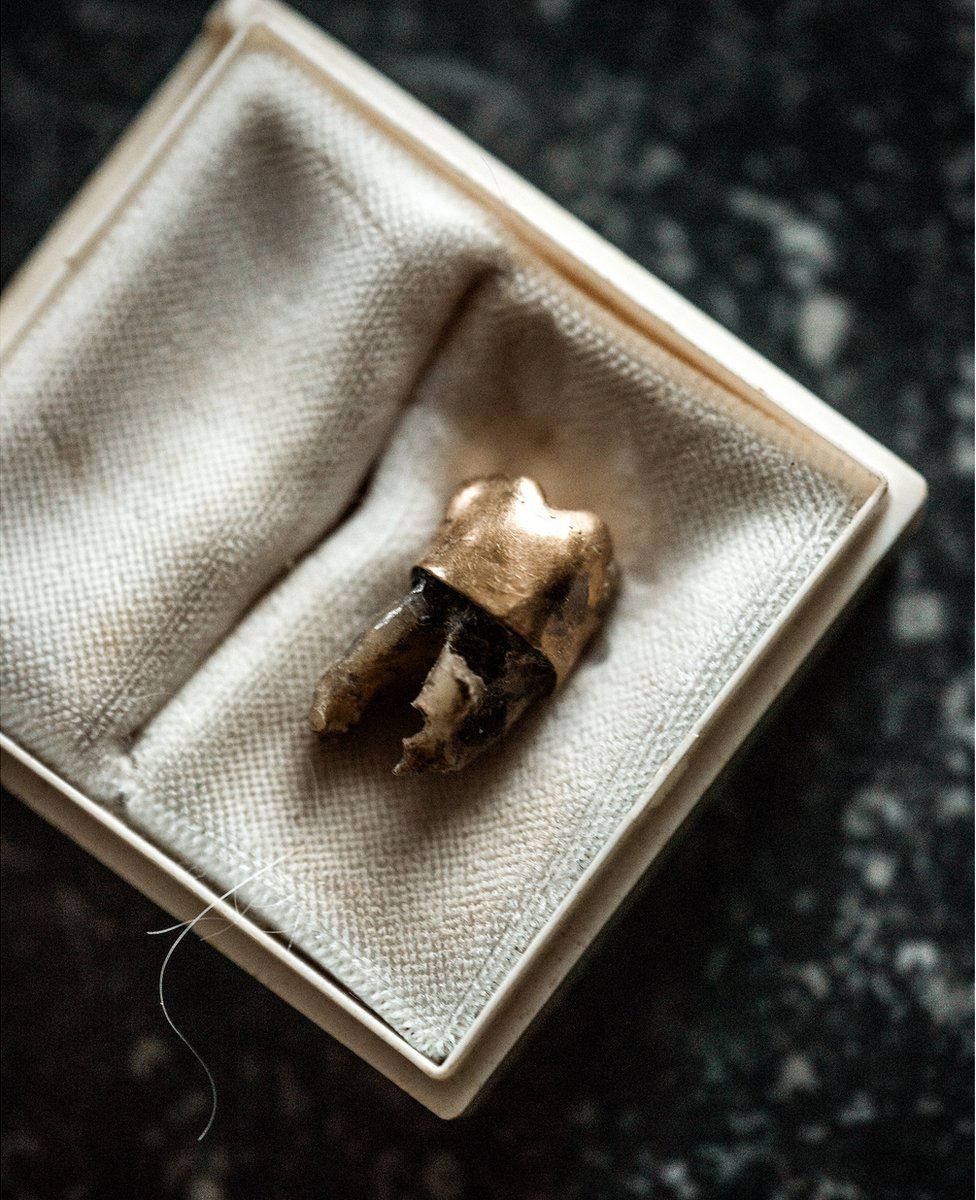
A Belgian policeman, Gerard Soete, was given the job of getting rid of the evidence. It was during that process that he pocketed the tooth and took it back with him to Belgium.
It was decades later that he revealed that he still had the tooth and only two years ago that a Belgian court ruled that it should be returned to the family.
The Covid pandemic delayed the process but last week it was handed over in Brussels.
Scenes of people carrying machetes while hunting for Tutsis in the capital, Kinshasa, and other major towns circulated on social media over the weekend.
Audio and video clips were also shared that identified the whereabouts of Tutsis.
The attackscome amid rising tensions between DR Congo and neighbouring Rwanda.
DR Congo accuses Rwanda of backing Congolese rebels and has halted all trade and co-operation agreements.
Rwanda has denied supporting the M23 rebel group – a Tutsi-led group.
Last week, an anti-Rwanda demonstration resulted in the looting of Rwandan-owned shops in the eastern town of Goma.
Angolan President João Lourenço says the Democratic Republic of Congo has agreed to release two Rwandan soldiers it detained last week, amid rising border tensions.
Mr Lourenço – who’s acting as a mediator – made the announcement after separate talks with his Congolese and Rwandan counterparts.
A military court in the Democratic Republic of Congo has sentenced to death a high-ranking police officer for his role in the murder of top human rights activists Floribert Chebeya and his driver.
Christian Ngoy Kenga Kenga was pronounced guilty of murder, desertion and the misappropriation of weapons and ammunition, the court said on Wednesday.
Jacques Migabo, another police officer, was sentenced to 12 years, while Paul Mwilambwe who had been a key witness in the trial was acquitted, UN-sponsored Radio Okapi says.
In 2011, four policeman were sentenced to death for the murder – but it was thought that there were other more high-ranking officials behind the killing.
DR Congo has not carried out the death penalty for many years.
Chebeya led the Congolese charity The Voice of the Voiceless, and was a critic of the government. He had received regular threats to his life during his career of more than 20 years.
His body was found tied up in the back of his car on a roadside in the capital, Kinshasa, in June 2010. The discovery came on the day that he had gone to police general headquarters to meet the then head of national police, Gen John Numbi.
His driver Fidèle Bazana went missing on the same day and later the authorities pronounced him dead.
Authorities in the Democratic Republic of Congo are warning the public not to drop their guard against Covid-19, as the country enters a period that has, in the past, seen higher infection rates.
Public Health, Hygiene, and Prevention Minister Jean-Jacques Mbungani on Monday said the country has seen the lowest infection rates in the last three weeks, but warned there is a threat of a fifth wave if Covid-19 protocol were ignored now.
He said that “the analysis of data from the first two years clearly indicates that the [prevalence] of the Coronavirus in our country is in the middle and end of the year.
“This indicates the likelihood of a fifth wave between April and July this year, said Patrick Muyaya, government spokesman, quoting the Minister for Health in a statement the Minister gave to the Council of Ministers earlier on Monday.
Dr. Jean-Jacques Mbungani himself called on the people “to remain vigilant, to wear masks, to keep washing their hands and to be vaccinated in order to fight effectively Covid19.Â
“This is the first time that the Covid-19 pandemic has declined simultaneously. This is thanks to responsible and appropriate management. Our government has done everything to contain this fourth wave. The big drop has been observed for the last 3 weeks.â€Â Â
But with less than having achieved just about 1 percent of the vaccination rate at Covid-19, the DRC, a country of about 90 million people, still faces a threat of a new wave.
Dr. Jean-Jacques Muyembe, the head of technical secretariat for the response to Covid and Director General of the National Institute of Biomedical Research, called for the urgency “to improve on the trend of low vaccination rate in order not to become an endemic country.â€
“The world will be divided into two parts because the disease will become endemic and therefore there will be continents where the disease prevalence is low…
“Because these countries have a very high vaccination rate and countries with high endemicity such as African countries including the Democratic Republic of Congo because the vaccination coverage is very low,” explained Dr. Jean Jacques Muyembe on Monday.
As of 10 February, less than 90,000 people have been fully vaccinated against the Coronavirus in DRC.
China has cancelled a part of the debt owed by DR Congo to help the sub-Saharan giant fight the coronavirus epidemic, the Congolese presidency said on Thursday.
Foreign Minister Wang Yi made the gesture to put 180 million yuan ($28 million) back into government coffers during a visit to the country this week.
Wang also offered a further $15 million to support wider development efforts.
China is a major investor in the Democratic Republic of Congo, and researchers from Johns Hopkins University in the US have estimated that Chinese entities have extended more than $2.4 billion in loans over the past two decades.
“The cancellation of the debt should enable the DRC to fight effectively against the Covid-19 pandemic,” the Congolese presidency said in a press release.
Since the first coronavirus cases were detected on March 10, DR Congo has officially registered 18,738 cases and 610 deaths.
Legislators in the Democratic Republic of Congo on Thursday voted to remove the National Assembly speaker, as the political rift between President Felix Tshisekedi and supporters of his predecessor Joseph Kabila deepens.
After parliament became a scene of brawls between MPS this week, they voted in favour of a petition to force out the National Assembly’s pro-Kabila speaker, Jeanine Mabunda.
The petition was launched by Tshisekedi loyalists after the president announced on Sunday that he would seek to forge another coalition within the FCC, which controls 300 of 500 seats in parliament, or would otherwise dissolve the assembly.
The coalition, formed in 2018 after Tshisekedi’s election, has prevented the president from passing much-needed reforms.
A total of 484 MPs out of 500 were present at a tense session late Thursday debating whether to oust the assembly’s speaker Mabunda, with 281 voting in favor and 200 against.
‘Dictatorial regime’
The speaker asked the assembly to reject the petition against her due to “purely technical and non-political” reasons.
But the FCC accuses Tshisekedi of breaching the constitution.
The party says Tshisekedi is plotting to establish a “dictatorial regime, in the service of personal power”.
Kabila, who is still only 49 after ruling for 18 years, retains huge clout through political allies and appointees in the military.
On Thursday Tshisekedi met with around 50 high-ranking army officials, who “reaffirmed their determination to only carry out his orders”, the presidency said on Twitter.
Tshisekedi also met with military leaders last week, the head of the elite Republican Guard ordering his troops “not to plot” against the president.
On Monday, pro-Tshisekedi MPs trashed furniture on the National Assembly’s podium, and on Tuesday, legislators on both sides brawled in the building’s lobby, prompting the police to intervene.
Tshisekedi has been verbally supported by other countries, including the United States, France, and Belgium.
Medical charity Medecins Sans Frontieres (MSF) has pulled out from a restive territory in eastern Democratic Republic of Congo.
In a statement released on Tuesday, MSF said it had decided to end projects in Kimbi and Baraka in Fizi territory, due to several violent incidents against the organisation this year.
MSF staff withdrew from that part of South-Kivu Province in July.
“The predictability of further incidents and potential further serious harm to our staff has reached a threshold that we are no longer able to accept,†MSF operational manager, Ellen van der Velden, said in a statement.
“The ever-increasing activity from criminal and armed groups across eastern-DR Congo, has led to ongoing violence and attacks against civilians at a shocking scale, including targeted killings and horrific acts of violence, including sexual violence,” the statement added.
Nearly 70 armed groups signed a ceasefire agreement on 17 September in the city of Murhesa to end hostilities, but decades-long efforts to pacify the region have failed to yield results.
A former militia leader in the Democratic Republic of Congo was sentenced Monday to life in prison for war crimes and mass rape, a decision hailed by the United Nations as a blow against the “impunity” of armed groups in the country.
Ntabo Ntaberi Sheka was convicted of “murder, rape, sexual slavery and enlisting children under 15 years old”, a military court ruled at the end of a trial that lasted two years.
The UN representative in DR Congo, Leila Zerrougui, said the ruling showed that “impunity is not inevitable”.
Sheka founded the Nduma Defence of Congo (NDC) militia, active in DR Congo’s restive North Kivu province, where he claimed to be fighting the Rwandan Hutu rebels of the FDLR.
A warrant was issued for his arrest in January 2011 after a series of attacks in which the NDC and two other groups allegedly raped nearly 400 people in 13 villages between July 30 and August 2, 2010.
What accountability looks like: a military court in #DRC found warlord Sheka guilty of war crimes by murder, rape and sexual slavery, pillaging and child recruitment. His trial started 2 years ago in #Goma. He will spend the rest of his life in prison. Our @hrw reaction 👇🏼 pic.twitter.com/6Vyv2KhHWO
The NDC was also accused of having recruited at least 154 children into its ranks.
His soldiers were blamed for razing almost 1,000 homes and businesses and leading about 100 people off into forced labour.
Due to the rape accusations and other acts that could constitute crimes against humanity, Sheka had been subject to UN sanctions including the freezing of his assets and a worldwide travel ban.
Despite the warrant for his arrest, the former minerals trader unsuccessfully stood in the country’s 2011 general election as a candidate for parliament.
After evading arrest for years, Sheka turned himself in to UN peacekeepers in July 2017 and was prosecuted along with three co-defendants.
One of his co-accused was also sentenced to life in prison on Monday, another to 15 years in prison and the last was acquitted, according to the verdict of the North Kivu Operational Military Court.
“We are satisfied with this verdict, it is a strong signal to other warlords,” Kahindo Fatuma, a spokesman representing the victims, told AFP. “The victims will be a little bit relieved.”
Sheka’s conviction “is an important step in the fight against impunity and a testament to all those who took personal risks in the pursuit of justice,” said Thomas Fessy, senior Congo researcher at Human Rights Watch.
‘Incredibly complex’
“The authorities have proven today that they are capable of handling an incredibly complex case, both legally and from a security point of view,” Daniele Perissi, head of the Great Lakes Program of the NGO TRIAL International, said in a statement.
Dozens of armed groups are active in eastern DR Congo, a lawless region rich in mineral resources. They have wrought havoc there in the decades since the official end of a 1998-2003 war, which claimed millions of lives.
The NDC still exists under the name NDC-Renovated, or NDC/R.
Last July, a faction of the NDC/R overthrew its leader, Guidon Shimiray Mwissa, accusing him of “serious violations”.
The new leaders of the movement also affirmed their willingness to “surrender their weapons”.
Over eight months, around 1,300 people were killed in the provinces of Ituri, North Kivu and South Kivu, according to a UN estimate in June.
The ADF, among the most notorious of the armed groups plaguing the eastern provinces, is accused of killing more than 800 civilians in the Beni region since October 2019.